



Abstract
African nations are trying to diversify their economies in order to induce industrialization that will help them eradicate poverty and create employment for their young workforce. One of the continent’s key challenges continues to be the shortage of physical infrastructure. Therefore, finding ways to overcome this problem has become of large importance. China has identified this and has thus enhanced its involvement in Africa primarily via its swap formula. The formula enables the financing and development of infrastructure that African nations critically need by depending on their resource wealth. However, the mounting involvement of the formula has continued to stimulate questions on its impact regarding creating backward and forward linkages. As such, one of the significant aims of this article is to identify linkages that emerge from the Chinese swap formula that involve long-term concessionary loans from China’s Exim Bank to finance major infrastructure projects in Africa. It examines whether the swap formula is creating backward and forward linkages in Africa, and what the infrastructure leads to concerning creating novel opportunities for the continent, by theoretically answering this question: “Can China’s swap formula create backward and forward linkages?” Furthermore, the article theoretically identifies the benefits and linkages of the formula via a case study – that of Abuja-Kaduna railway. Arguably, the article discovers that the formula has multiple benefits and linkages for Africa. It is also seen by the Chinese government as a way of fulfilling its strategic goals in Africa.
Introduction
One of the critical ingredients in meeting the sustainable development challenges as well as the African Union (AU) Agenda 2063 vision is infrastructure – and no nation has answered Africa’s call quite like China. China is taking the lead in developing some of Africa’s most ambitious infrastructure; as such, Chinese financing of infrastructure in Africa has emerged as a key component unique to Africa-China cooperation. China’s focus on infrastructure can be understood in terms of the economic complementarities that exist between the two parties. On the one hand, African nations remain perennially deficient in basic telecommunication, power, and transportation networks, and there is a dearth of capital to transform the advantage of its natural resources into wealth and escape the poverty trap. Meanwhile, China has developed one of the world’s largest and most competitive construction industries, with specific expertise in the civil works critical for infrastructure development. On the other hand, as a result of globalization, China’s fast-growing manufacturing economy is generating key demands for oil and mineral inputs that are speedily surpassing the nation’s domestic resources. The continent of Africa is already a key natural resources exporter and its identified as the “world’s treasure trove of resources” (Wan, 2013), and infrastructure facilitates the extraction and transport of natural resources to markets overseas such as China. Infrastructure can also enhance the newly established African Continental Free Trade Area (AfCFTA) if it is built to link manufacturing centers or sources of raw materials in one nation to markets in another.
The vast majority of these infrastructure arrangements are funded by the Export–Import Bank of China (Exim), which is devoted primarily to providing export sellers’ and buyers’ credits to support the trade in Chinese goods. This deal structure is sometimes referred to as the swap formula, in which reimbursement of the loan for infrastructure is made with future revenue from the sale of natural resources. As such, the coming of the Chinese onto the continent resources market with large infrastructure projects in exchange for access to resources has paved the way for a timely Sino-Africa swap formula pact. China hails this swap formula as “mutually beneficial” to both parties (Cassel et al., 2010). Through the formula, African nations are able to invest in projects where traditional partners such as the IMF, World Bank, and Western energy firms have declined to invest out of environmental and other concerns.
This form of Sino-Africa swap formula transaction that involves infrastructure development can help to propel foreign direct investment (FDI), and in turn help to develop backward and forward linkages which will allow African local firms to be better integrated into global supply chains. As part of the formula’s strategies, Multinational Companies (MNCs) will foster collaborations and alliances with local firms in order to reduce costs, gain better efficiency, reduce risks, and/or acquire local knowledge and skills. Such backward and forward linkages via the swap formula of developing the nation’s infrastructure to induce FDI offer enormous potential for job creation and export promotion, as well as for the migration of skills and technologies (UNCTAD, 2001, 2010, 2013). Such linkages could spur manufacturing development and the diversification of industry, therefore offering enormous development potential.
No wonder some scholars such as Mthembu-Salter (2009), Todaro and Smith (2009), Umejei (2013), and Adekola (2013) portray the swap formula and Chinese engagement in more positive terms. They affirm that the infrastructure that is acquired via the swap formula can generate one of the highest multiplier effects with other sectors of the economy, as well as raising the productivity of other factors of production, thereby creating extensive backward and forward linkages. For instance, the installation of a new irrigation system can improve the quality of farmland, therefore raising productivity per hectare and shifting the production possibility curve outward. The higher productivity, in turn, attracts more resources (private investment) into production, which further contributes to higher levels of outputs, the profitability of production, and income and employment in these sectors. This indicates that a combination of these two repercussions may occur when investment by one sector leads to investment by other sectors in a parallel way, and in other ways that the backward and forward linkages work side by side which may ensure the overall growth and development of a nation.
Alves’ (2010) study shows that the swap formula is relatively unique through its backward and forward linkages which facilitate growth, and is one of the most distinctive characteristics of China’s engagement with Africa in the first decade of the 21st century. Cain (2017) claims that since the end of the civil war in 2002, the government of Angola has used Chinese credit facilities backed by a petroleum-based guarantee to build urban projects. This is a testament that the swap formula delivers resource-rich nations tangible results, such as hospitals, railways, roads, and bridges, that benefit the general population. Improvements in roads, power generation, and electricity coverage are considered to lower the cost of doing business and to raise productivity. On top of that, regarding the Angola urban projects, during the building of these urban projects, the Chinese construction firm created employment and provided employees with on-the-job training. This could be seen as backward and forward linkages because in order to build and improve urban projects, a construction firm needs workers and a transfer of skills; therefore, people become an essential factor for the development of the project.
With this breakneck development, the International Monetary Fund (IMF) recently declared Africa the world’s second-fastest growing region (IMF, 2013), and many are predicting that it is well on its way to becoming a US$5 trillion economy (Silk Road Briefing, 2019). As such, many African governments see the swap formula as an important opportunity to support the continent’s development, and, therefore, welcomed China’s new role as a trade partner and a source of infrastructure finance. China, on the other hand, sees the formula as a way to build a partnership based on principles of equality and mutual gain that appears less exploitative and more relevant to local needs than the North’s approach to the continent of Africa. 1
Irrespective of the breakneck benefits, the swap formula has come under criticism (Asante and Debrah, 2017) and is blamed for entrenching the traditional division of labor where Africa is basically a raw material provider. Also, Kelley (2012) has accused China of using the formula to plunder African nations’ natural resources, and stated that China’s investment in African infrastructure could exacerbate the misgovernance aspect of the resource curse. Meiden et al. (2009) declare that the swap strategy was developed at the time China emphasized self-reliance, with China encouraging energy firms to expand their domestic production. Meyersson et al. (2008) highlighted how exporting to Beijing does benefit economic growth, but with regard to human rights their findings “display that exporting natural resources to China has an adverse effect.” Based on these divergent views, the most significant thing for African nations as well as the outside world is to know if these sorts of projects have created backward and forward linkages and awakened African economies. As such, the central question for this article is: “Can China’s swap formula create backward and forward linkages?” By employing backward and forward linkages theory, theoretically verified through a case study on its implementation and impact in Angola as well as drawing on multiple data sources including interviews, archives, and second-hand materials, this article argues that the Chinese swap formula has multiple benefits as well as linkages for the continent, and plays an important role in awakening African economies.
Linkage development as a window of opportunity for the Sino-Africa swap formula
Since this article is mainly theoretical, it is framed by the concept of backward and forward linkages theory. Information on an industry’s linkages with the rest of the economy helps to better understand the structure of an economy and how it changes over time, which in turn is important in formulating industrial policies (Chenery and Watanabe, 1958; Hirschman, 1958). Early pioneers, as well as some recent studies in the field of key-linkage analysis, such as Chenery and Watanabe (1958), Hirschman (1958), Beyers (1976), Hewings (1982), Hewings et al. (1989), Sonis et al. (1995, 2000), and Cai and Leung (2004), have used linkages indices to identify key sectors of the economy. Key sectors are typically defined as industries which have both strong forward and backward linkages with other industries in the economy. Linkages analysis also permits policymakers to ascertain whether or not policies designed to strengthen linkages between, say, tourism and agriculture have succeeded.
More recently backward and forward linkages analysis has been employed to survey the linkage effects of specific sectors within national economies such as construction, manufacturing, and the marine sector (Alcántara and Padilla, 2003; Morrissey and O’Donoghue, 2013; Song et al., 2006; Stilwell et al., 2000). Backward linkages emerge when the growth of one business or industry leads to the growth of other businesses that supply it. Forward linkages emerge when the growth of one business leads to the growth of companies that use its inputs and outputs. Essentially, these concepts attempt to describe the economic relationships between the customer and the firm (Guo, 2013). It has been said that normally projects produce both these linkages, and that the more linkages a project creates the better it is, and therefore the majority of investments should be boosted into that certain project than anywhere else.
When attempting to comprehend a long, ongoing process such as linkage development as a window of opportunity via the Sino-Africa swap formula that involves long-term concessionary loans from China’s Exim Bank to finance key infrastructure projects, this theory can be a good way to reveal in real terms what the infrastructure projects result in. Moreover, speaking in more modern terms of development that circles very much around development assistance, in order for these investments to add to an industrial transformation, it needs to substitute backward and forward linkages (Brautigam, 2009). One of the significant aims of this article is therefore to identify linkages that emerge from Chinese aid via the swap formula that involve long-term concessionary loans from China’s Exim Bank to fund major infrastructure projects in Africa, to examine whether the swap formula is creating backward and forward linkages in Africa, and what the infrastructure leads to concerning creating novel opportunities for the continent.
In terms of what the swap formula produces, Africa needs to provide employment opportunities for its young populace; enhance the competitiveness of its firms; facilitate the flow of goods and services, people, and information within and across the continent; and offer the best opportunity for African nations to lift themselves out of the traps of isolation, poverty, and marginalization. Only an enormous investment in infrastructure can make it easier to produce, do business, connect to regional markets, and create the window of opportunity required to maximize profits, minimize costs, create multiplier effects, and open opportunities that enable the activities of other sectors like tourism, agriculture, and extractive and industrial sectors to function. This will thus contribute to the galvanizing of the continent’s economy and position it on a pathway to economic transformation. At the same time, infrastructure investment via the swap formula is a significant driver for progress across Africa and creates a critical enabler for productivity, and helps facilitate dynamic processes of technological innovation, skills development, knowledge intensification, and capital accumulation. Linkage development in infrastructure investment via the swap formula can open important opportunities in this regard.
By promoting backward and forward linkages, African nations can maximize direct and indirect employment opportunities. Also, steady surges in linkage advancement through the swap formula can create multiplier effects, so, for instance, support for final goods producers can increase the range of parts produced, broadening the industrial base and attracting the entry of further final goods producers. Also, it can provide vital opportunities for the continent’s labor-intensive and small-scale firms, using semi-skilled and casual workforces to assist small and medium-sized enterprises to overcome frequent transaction costs and electricity and water outage that bar companies from entering markets and raising entrepreneurship, eventually affecting household income growth, consumption, and vulnerability to macroeconomic shocks.
Thus, advancing backward and forward linkages through the swap formula that involves long-term concessionary loans from the Chinese Exim Bank to fund infrastructure projects has the potential to make a substantive contribution to the processes of industrialization which have higher potential to foster inclusive growth and create employment for the millions of young African people in Africa. Furthermore, by integrating forward linkages with good infrastructure in place, African nations can anticipate accruing higher export revenues and foreign earnings (Morris and Fessehaie, 2014). Also, linkages from infrastructure through the Chinese swap formula can help boost industrial development, and this industrial development can open opportunities for positive externalities that are hard to quantify.
Through the swap formula, resource-rich African nations are able to have infrastructure that can propel diversification of technological competences as well as skill bases by advancing backward linkage supply firms to the commodity sectors and resource-processing industries. Furthermore, because the natural resource sector usually needs the development of a good infrastructure in place to extract and transport bulk commodities, the potential for linkages is enhanced. This development tends to happen more frequently with a high volume of mineral resources, which generally needs road and rail transportation. As these are advanced, it becomes easier to develop supplier and resource-processing activities, which in turn raise the economies of scope for further infrastructure development.
The above evidence reveals that there has been a steady surge in linkage development through the swap formula and that there are significant opportunities for deepening this process. So, if the process is deepened, linkage development can also create the opportunity to maximize positive externalities derived from clusters. Speaking of clusters, efficiency benefits from firms situated in clusters comprise gaining access to a pool of labor, and to specialized network suppliers. This is specifically vital for the continent of Africa. By promoting specialized supply networks, buyers accrue advantages in terms of lowering transaction costs, reducing stocks, shortening delivery times, and snowballing flexibility to adjust to novel products. Hence, infrastructure plays a critical role in all these processes reaching the market and in providing the necessary inputs for production.
The swap formula shows that when supplier and resource-processing industries have good infrastructure, such as harbors, electricity, good roads, airports, and railways, and are positioned close to the extraction site, there are agglomeration Kristian and Robert-Nicoud (2015) effects as well as a massive bonus not only for the governments of the various African nations that apply the formula but also for the receiving end of the loans for the infrastructure projects, as well as for the general public. Concerning the agglomeration effects, the processes are supported by public infrastructure, especially in the transport sector. In terms of using the swap formula to enable the funding and advancement of infrastructure that resource-rich African nations critically need, the continent needs to learn several lessons from China. The latter has used the formula to make significant advancements in its infrastructure development, and has reaped diverse rewards from the formula’s positive effect on employment, diversification, technological innovation, skills development, knowledge intensification, capital accumulation, and inclusive growth.
When Africa’s needs meet China’s drives
The Chinese swap formula is largely the product of a timely convergence of interests between African nations and China in the 21st century. On one hand, there arose a rapidly developing China loaded with cash, with a flourishing construction firm and in dire need of resources to power its fast-growing economy, and on the other hand, there was the African continent, generously endowed with natural resources and largely unexploited, but lacking the infrastructure and capital to transform this resource advantage into wealth and escape the poverty cycle. Therefore, the Sino-Africa swap formula came into being as a default strategy, inspired by China’s drive for resources as well as its own domestic experience and competitive advantages, and Africa’s infrastructure needs and receptiveness to this type of formula (Alves, 2013).
The growth of China’s swap formula came at a time when Chinese leadership noticed that traditional donor nations and institutions such as the World Bank and other International Financial Institutions had retreated from financing large infrastructure projects in Africa, in part due to greater concerns over environmental and social risks (Chen, 2018). Seeing this opportunity, coupled with China’s drive for resources, led to the convergence interest between Africa and China. Since then, not only has China promoted the swap formula by leading the establishment of novel multilateral development banks, but it is also promoting a “low-cost” pattern of global development partnership with Chinese firms, lowering prices for existing projects and services by as much as 40 percent (Jayaram et al., 2017). China’s funding also has the advantage of being substantial and readily available, compared to traditional development finance that sometimes takes years to materialize, making its funding processing advantage more appealing for African leaders than multilateral or Western funding sources. As such, China seemingly used its comparative advantage to create the swap formula to promote unconditional funding for African nations’ development projects and simultaneously enabled the exchange of natural resources for infrastructure. Therefore, the Chinese would offer economic assistance like loans and simultaneously gained long-term access to the continent’s natural resources (Brautigam, 2009).
It is worth noting that China’s heavy push for gaining long-term access to natural resources started when its internal demand for major commodities, such as strategic mineral and petroleum, had largely surpassed domestic production and China slowly had to source these commodities from resource-rich nations. Chinese leaders believe that ensuring a stable supply of key strategic minerals and petroleum to sustain its economic advancement is an essential national interest for the nation. This is an endeavor exclusively pursued by the Chinese state-owned enterprises (SOEs), which China’s construction companies are part of, and partially driven by China’s “go global” policy that encourages investment from diverse Chinese companies such as construction companies in overseas markets. Despite being a leading producer of an extensive range of mineral resources (aluminum, cement, coal, copper, gold, iron, steel, lead, manganese, rare earths, silver, tine, tungsten, zinc), and being among the top producers of several others, Beijing’s mounting demand for several strategic minerals and petroleum largely surpassed local supply. Therefore, it has become a net importer of chromium, cobalt, copper, iron, ore, manganese, nickel, petroleum, platinum group metal, and potash (Tse, 2012).
Some commentators contend that China has turned to Africa because it has a significant amount of minerals. These include coltan, which is needed for electronics, as well as half of the world-known supply of carbonatites, a rock formation that is the primary source of rare earths (Carrillo et al., 2017; Herskovitz, 2011; Schoeman, 2008; Wade, 2019). They affirm that China is also after the continent’s resources to meet the demands of its ever-increasing industrial sector(s), like Western nations are. Other studies claim that the overpopulated nation needs more resources to satisfy the needs of a growing middle class and its economic development (Berthélemy, 2011; Marysee and Greenen, 2009).
Resource-rich African nations welcome China’s drive for resources in exchange for a well-developed infrastructure network. This is mostly because of the inherent complementarities stemming from Africa’s enormous insufficient stock of productive infrastructure and scarcity of capital, combined with a large pool of underdeveloped resource assets. Notably, Africa ranks at the bottom of numerous infrastructure indicators. As such, if it must industrialize to eliminate poverty and generate employment for the 12 million young individuals who join its workforce annually, then infrastructure investment is imperative. One of the key factors retarding industrialization and access to markets, especially in the interior, has been poor physical infrastructure, covering transportation service, power, and communication. This is needed for firms to thrive in industries with robust comparative advantage, and via backward and forward linkages it facilitates economic growth. Meanwhile, social infrastructure, which comprises water supply, sanitation, sewage disposal, education, and health, which are primary services, has a direct impact on the quality of life.
Garcia-Herrero and Xu (2019) concluded that China’s project in Africa and the bulk of its lending (in the case of project finance) are directed towards its strategic goals, e.g. securing access to resources and using its excess capacity to focus on energy, construction, and transportation (see Figure 1). Gallagher et al. (2016) noticed that most of China’s lending in Africa has been concentrated in a few nations, including resource-rich ones such as Angola, Democratic Republic of Congo (DRC), Sudan, Nigeria, Zambia, Kenya, and Ethiopia (see Figure 2). With the above claims, it seems China’s foreign trade structure illustrates well this resources-oriented trait. To support this view, Badkar (2012) affirms that China is projected to account for 25 percent of global energy consumption by 2035. Hanauer and Morris (2014) assert that to guarantee future supply, China is heavily investing in the upstream and downstream oil sectors in nations such as Nigeria, Sudan, and Angola. As a result, natural resources such as oil are important to help it continue its fast pace of growth as well as its political power (Shinn, 2012: 2).

China’s project finance in Africa by sector, 2013 to 2017.
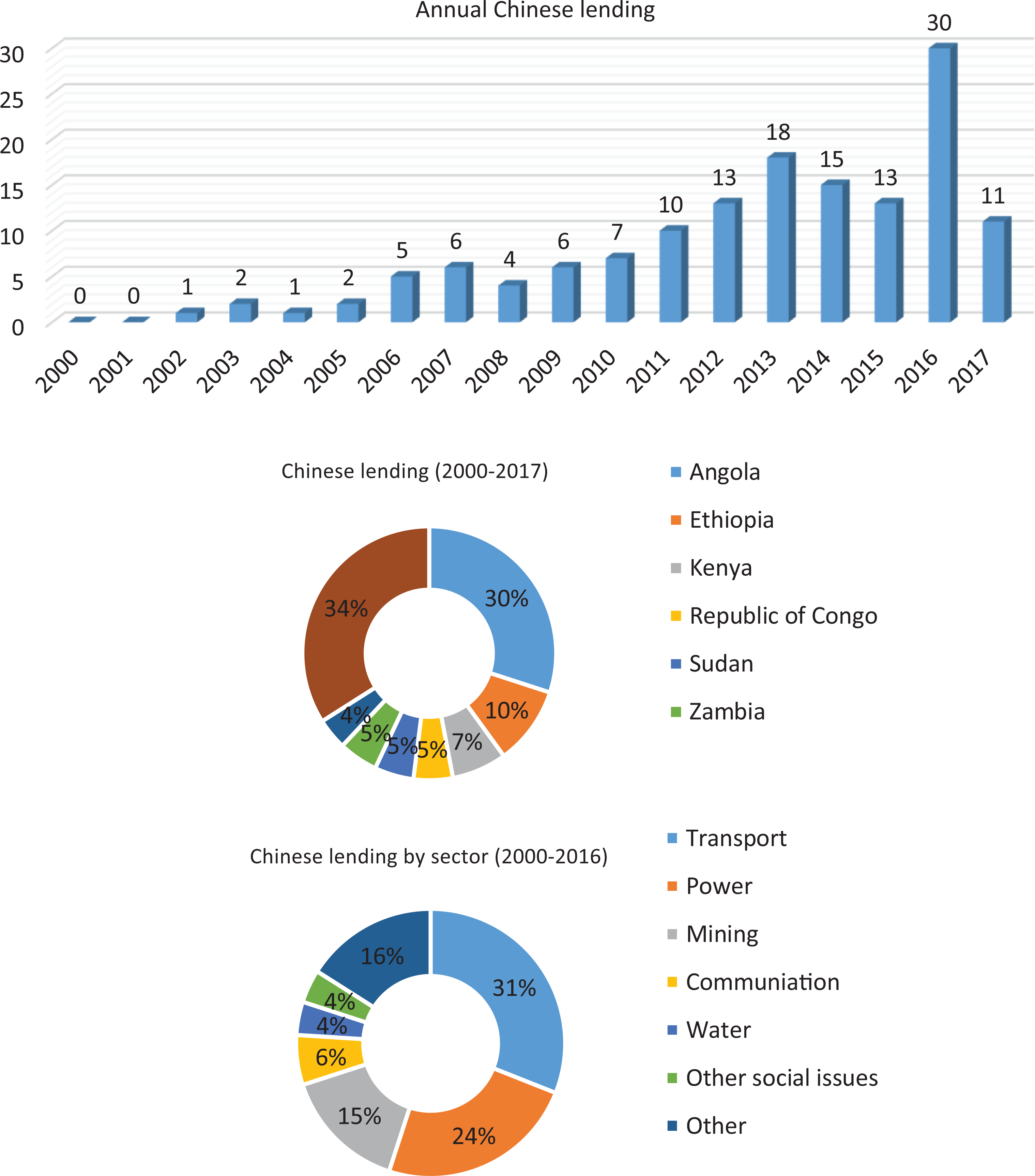
Chinese lending to Africa.
In as much as mineral resources are essential to continue the high-level growth rate of China, as for African resource-rich nations, improving connectivity is also essential. This is because Africa accounts for 16.72 percent of the world’s population, but generates 3 percent of the global gross domestic product (GDP) and only 2 percent of the world trade (WEF, 2020), as a result of poor infrastructure. Also, the African Development Bank estimates that “the road access in Africa is only 34 percent, compared with 50 percent in other parts of the developing world, while transport costs are 100 percent” (PWC (2015)). At the same time, “only 39 percent of the African population has access to electricity, compared to 70-90 percent in other parts of the developing world”; Africa power connectivity is 39 MW per million inhabitants, the lowest among developing regions; and “more than 30 African nations experience recurrent outage and load shedding, with opportunity costs amounting to as much as 2 percent of the total annual value of the economy PWC (2015). No wonder over the past decades that Africa has been lagging behind other developing regions, particularly in road, rail, and telephone density, information and communications technology (ICT), power generation capacity, and service coverage, as one of the most important obstacles to their economic diversification (UNCTAD, 2016). Despite this, six of the world’s 10 fastest rising economies are presently situated in Africa. This gives even more reason for rapid infrastructure transformation.
African nations have currently identified these infrastructure problems as one factor hindering optimal utilization of their natural resources and delaying the emergence of the modern manufacturing sector. For instance, Escribano et al. (2010) estimated that infrastructure deficiency may have been costing Africa as much as 2 percentage points of per capita GDP growth per year, as well as reducing firm productivity by 40 percent. More so, a Deloitte study has shown that poor road, rail, and harbor infrastructure adds 30–40 percent to the costs of goods traded between African nations (Deloitte, 2013). The expense of moving Africa’s imports to customers inland is on average of 50 percent higher than shipping costs in other low-income regions (Africa Renewal, 2009). In most African nations, infrastructure limitations, notably in power and logistics, inhibit productivity at least as much as other institutional challenges, such as weak governance, onerous regulation, and the lack of access to finance.
Bearing that in mind, African leaders are struggling with sourcing finance for the development of infrastructure projects, with new estimates by the African Development Bank suggesting that the continent’s infrastructure needs amount to US$130–170 billion a year, with a funding gap in the range of US$68–108 billion (AfDB, 2018). Those figures are far higher than previous estimates of US$93 billion in annual needs and 12-monthly funding gaps of US$31 billion published by Agence Francaise de Developpement and the World Bank (quoted in Foster and Briceño-Garmendia, 2010). Numerous African nations, especially in the sub-Saharan African region, not only lack the cash flow for this enormous undertaking, but they also suffer from poor credit ratings in the global financial markets. A significant number of these nations, nonetheless, are endowed with considerable amounts of mineral resources and ranked first in world quality for reserves of bauxite, chromite, cobalt, industrial diamond, manganese, phosphate rock, platinum-group metals, soda ash, vermiculite, and zirconium.
To complete the picture, massive gas reservoirs have been discovered off the eastern coast of Africa, as well as large coal deposits in Mozambique and massive uranium reserves in Namibia and Niger. For many years, the continent’s mineral wealth remained locked underground for a variety of reasons, such as low commodity prices, lack of investment, geographical obstacles, political instability, and poor infrastructure. The gradual stabilization of African nations over the years and the concomitant upsurge in demand for mineral commodities motivated by emerging economies, and particularly China, have prompted a renewed interest in Africa that has led to the Sino-Africa swap formula. As such, it has been noticed that part of the continent’s mineral assets has been directly or indirectly secured by the extension of Chinese Exim Bank concessional loans for infrastructure.
In addition to securing Africa’s natural resources, the swap formula also creates business opportunities for Chinese service contractors, such as construction firms, making Africa a traditional overseas market for Chinese contractors and the biggest player in the African infrastructure sector. Since the launch of the “going out” national strategy in the 21st century, and with the support and control of the government and subordinate agencies, business associations, and banks, and innovative financial approaches such as the swap formula, Chinese contractors’ presence in the emerging market continues to grow. As such, Sun (2014) affirms that Africa is China’s second-largest supplier of service contracts, and “when we offer Africa a loan of RMB 1 billion, we will get service contracts worth USD 1 billion (RMB 6 billion) from Africa” (Sun, 2014). As a result of China’s financial capability, it has financed over 3000, largely critical, infrastructure projects and extended more than US$86 billion in commercial loans to African governments and state-owned entities between 2000 and 2014, an average of approximately US$6 billion a year (Schneidman and Wiegert, 2018). With the Chinese government financial capability, Chinese firms are building the vast majority of roads, ports, airports and other transportation infrastructure across the continent. It is no wonder that in 2018, Chinese firms accounted for 62 percent of the market share on the continent (Chimbelu, 2020).
In exchange for most Chinese loans to Africa, China requires that infrastructure construction and other contracts favor Chinese service providers: 70 percent of them go to “approved,” mostly state-owned, Chinese firms, and the rest are open to local firms, many of which are also joint ventures with Chinese groups (Sun, 2014). Chinese construction firms are winning most of the contracts because Chinese contractors offer lower prices, undercutting their Western competitors by 20 percent or more. This is possible because Chinese construction firms benefit from subsidies from Beijing and preferential treatment in several African nations, where they are often exempt from some visa regulations and taxes. Chinese construction companies get this preferential treatment because African governments typically concur with this kind of innovative financial approach of the long-term concessionary loan from Chinese policy banks to fund major infrastructure projects, since other sources of financing are lacking or are too slow to meet the immediate key infrastructure needs of Africa. In this sense, the Sino-Africa swap formula not only benefits African nations but also creates business opportunities for Chinese firms and employment opportunities for Chinese laborers.
In addition to the above drives of China, beginning in the late 1950s, Africa became central to China’s ideologically driven campaign promoting revolution, anti-colonialism, and Third World solidarity (for more on this period, see Muekalia, 2004). This included moral and material support for liberation movements. Relations were further consolidated when Premier Zhou Enlai visited 10 African nations in 1963-1964 and articulated the “Eight Principles for Economic Aid and Technological Assistance” that would underpin China-Africa relations going forward. 2
As for Japan, since 1993, the nation has been providing aid to African nations through the Tokyo International Conference on African Development (TICAD) initiative; the initiative has been a welcome development on the continent. The most important anticipation of the initiative is to enhance Africa’s democratic reforms with a view to attaining economic transformation of Africa, through further integration of African nations into the global economy, particularly for augmented trade between both parties (Adem, 2010). The TICAD initiative is meant to be a win-win option for both Africa and Japan, and as such it was designed with the guiding philosophies of local ownership, self-help, and partnership to alleviate poverty; and enhancing education, industrial development, and local production to snowball Africa-Japan trade cooperation. It is worth noting that in spite of the uniqueness of Japan’s innovative approach to worldwide aid to African nations, Japan’s post-Washington alternative may not be sustainable. This is because of what Sato (2010) refers to as Japan’s reactive tendencies. A reactive state is a situation whereby a nation has clear-cut policies, but its eventual decisions are conditional on Gaiatsu (that is to say, influences from and by other powerful nations).
With that said, both the Chinese and Japanese aid principles were designed to compete simultaneously with the “imperialists” (the United States) and the “revisionists” (the Soviet Union) for Africa’s approval and support. As for China, these efforts grew during the Cultural Revolution under the influence of a radical revolutionary ideology, driving China to provide large amounts of development aid to Africa in spite of its own domestic economic difficulties ( China Talk, 2011). One popular instance was the Tanzania-Zambia Railway built between 1970 and 1975, for which China offered a zero-interest loan of RMB 980 million. By the mid-1980s, China’s assistance had opened the door to diplomatic recognition with 44 African nations ( China Talk, 2011). This pragmatism is an example of the Chinese swap formula which was used in the early 1970s as China’s foreign policy.
The same foreign policy is what Xi Jinping is using to win Africa from Western nations today; and it is also one of the main factors for China’s popularity on the continent. With that said, Africa has represented a key diplomatic, strategic, and political platform upon which China can operationalize its core principles of equality, non-interference, and “South-South solidarity” among African nations. The Chinese government believes that strengthening Sino-African relations raises its own international influence and helps its cause of building a more “just international order” that advances peace, prosperity, and equality globally ( China Daily, 2012). China’s “success in Africa,” write journalists Serge Michel and Michel Beuret (2009: 4) in their book China Safari, “has reinforced its status as a global superpower.” Maintaining and snowballing China’s influence in the United Nations (UN) also drives the nation’s engagement with Africa. African nations account for more than one-quarter of the UN member states and occupy three non-permanent member seats from the Africa Group regional block in the UN Security Council. Therefore, Africa represents a vital voting bloc for Chinese-led initiatives or against Western-led initiatives with which China disagrees. Africa has played a major role in the diplomatic jostling between the People’s Republic of China (PRC) and the Republic of China in the UN. African countries constituted 26 of the 76 total votes supporting the PRC taking over the China seat from Taiwan in 1971 (Fransman, 2013), which led Mao Zedong to claim that “it is our African brothers who have carried us into the United Nations” (Li, 2012).
Regardless, China’s efforts to engage with Africa have elicited copious commentary from the West, most of it negative. These criticisms have assailed China’s range of initiatives to invest, trade, arm, train, extract, sell, experiment, or provide loans for infrastructure projects. In the dominant discourse, China’s drives and objectives in Africa are essentially exploitative and violate human rights. Taylor (2006: p.8) voiced criticisms of China’s principles of engagement, saying they “effectively legitimize human rights abuses and undemocratic practices under the guise of state sovereignty and non-interference.” China frequently counters such criticisms with the notion that African problems “should be solved by Africans themselves,” (Hanauer and Morris, 2014: p.23) free from outside intervention and imposition of values, judgment, and ideology. On this point, Chinese scholars distinguish “intervention” from “involvement” or “diplomacy.” The key difference, according to one Chinese scholar, is that the latter involves “consent from either Africans themselves or international institutions such as the United Nations or African Union.” 3
From the Chinese perspective, non-intervention is intertwined with China’s role in promoting human rights and economic development on the continent. China perceives Western-led criticisms of Chinese human rights abuses in Africa as misguided and part of a larger effort to demonize Chinese policies abroad ( China People’s Daily, 2010). When asked about China’s investment in nations with records of human rights abuses, former Chinese Foreign Minister Li Zhaoxing famously retorted, “Do you know what the meaning of human rights is? The basic meaning of human rights is survival and development” (Callimachi, 2007). Such comments reinforce the notion that China sees human rights in economic development terms rather than in terms of individual liberties or political participation. Thus, applied to the context of economic development, China sees its role in Africa more as the provider of development opportunities for Africa and Africans, focusing on the means of development as opposed to the ends. To push nations for the management of their internal affairs by cutting off trade or imposing sanctions, Chinese officials argue, is counterproductive. 4
Webster (2012) makes a counterintuitive claim that, despite irrefutable cases of abuse, China’s engagement with Africa has actually improved the human rights conditions of millions of Africans, and African leaders welcome Chinese engagement on the continent. In line with Webster’s claim, Eisenman (2008) affirms that African nations welcome Chinese engagement, and as such, African nations vote in the UN function to shield China from criticism of its human rights policies. Motions by Western nations to censure China over its human rights record at the UN Commission on Human Rights Council have failed on several occasions because of support from African nations (Eisenman, 2008).
Bearing that in mind, this polarization shows the two sides of the same coin. On the positive side, China’s swap formula via its infrastructure financing fills a void left by Western nations, achieves its various aims, and at the same time promotes the development of African nations. Most Chinese projects require a large investment and long pay-back terms that traditional donors are unwilling to offer. On the other hand, nonetheless, these short-term gains should not form a cover-up for the potential long-term negative consequences related to neglecting issues of governance, fairness, and sustainability. For instance, when the loans are connected to the profitability of Chinese construction firms, it becomes questionable whether China would prioritize African nations’ interest or its personal interest.
This practice is problematic in that most of the resource-rich African nations with which China works also suffer from serious political problems, such as authoritarianism, poor governance, and corruption. When President Xi Jinping’s government pursues economic gains and links aid projects with resource extraction, it uses the swap formula to promote business relations. This directly contributes to the negative perception that China is funding infrastructure projects to prop up its corrupt governments in exchange for natural resources.
The intention of China’s Belt and Road Initiative (BRI) to Africa is benign but not altruistic. China does not seek to use its “going out” national strategy to influence the domestic politics of African nations or dictate policies. Rather, it truly hopes to support African nations to attain better development while circumventing meddling with the internal affairs of African nations through a conditional loan. But on the other hand, China is not supporting Africa in exchange for nothing. When the Chinese government emphasizes that China also offers assistance to nations that are not resource-rich to defuse worldwide criticisms, it often forgets to mention that China may have eyes on other things which these nations can deliver, such as their support of its “One China” policy, its agenda at multilateral forums, or it as a responsible stakeholder. In this sense, infrastructure loans have become a tool in China’s financial statecraft against Taiwan: loans offered after Nigerian President Muhammadu Buhari’s 2016 trip to China, for instance, led to the closure of Taiwan’s trade office in Abuja and a reaffirmation by Nigeria’s federal government of the “One China” policy ( Vanguard News, 2017b).
With that said, key in supporting the continent to realize its economic potential is the careful construction of a sustainable infrastructure that can help to turn the situation around. Africa’s growth and development are intrinsically connected to infrastructure development, but it is the push-pull relationship with commodities through the Chinese swap formula that has become the driving force for China and for infrastructure development in Africa. Therefore, the bottom line is that Africa needs China, and China needs Africa. As such, the Sino-Africa swap formula could be defined by Gramsci’s statement: “the old is dying yet the new is yet to be born” (Campbell, 2007: p. 89). This implies that Chinese relations with African nations combine elements of the old (extraction of raw materials based on the structure of African economies) with elements of the new (China’s financing role in terms of concessional loans to undertake productive projects, thereby creating both economic and social benefits). As a result, China’s role in Africa can be clearly seen and mainly depicted as a paramount instance of convergence of interest and mutual economic partnership where these credit lines have enabled African nations to build critical infrastructure neglected by traditional partners for many years.
How the swap formula is structured
One key dilemma for African nations who want to build large-scale infrastructure for developmental purposes is financial constraints. Large-scale development projects have been launched in several African nations as an essential part of their long-term development plans to help the continent attain the vision set out by the African Union’s Agenda 2063. However, with low savings and foreign reserves, securing investments for these projects is difficult for most African nations. And the 2014 negative price shock dramatically reduced African nations’ revenue in the subsequent few years. The low price of crude oil between 2014 and 2016 also severely affected the economy of resource-rich African nations such as Nigeria and Angola. The question is: where do we get the money to finance these large-scale infrastructure projects? China’s interest in Africa’s resource market provides an answer to this question.
In the 1970s and 1980s, China used resource-backed loans to foster its own development, such as leveraging its natural resources (oil and coal) to attract a US$10 billion loan from Japan. Through this arrangement, Japanese firms (transport corridors, coal mines, power grids) built new infrastructure for China (Brautigam, 2009). Based on China’s own experience, it is argued that China’s swap formula deals are a fast and promising way for Africa to bridge its infrastructural gap. The swap formula, which is a system of using commodities as security for a commercial line of credit, enables a nation with a weak credit rating to finance a specific investment now, and pay for it later with future earnings. Securing the investment with a resource flow as collateral for the loan reduces the risk and permits the interest rate to be lower and the loan to be cheaper (Brautigam, 2011).
In 2013, Chinese Premier Li Keqiang assured African leaders at the African Union meeting that Beijing will establish new “innovative” and “pragmatic” ties with the continent. The Chinese swap formula is certainly a novel frontier of innovation and pragmatism. Africa’s resources could be directly converted into development projects, and so it would not be locked into dependence on the production of raw material alone. On top of that, it highlights a period in which African nations have an extra option for funding their development projects. The fact is that Africa needs to extend its infrastructure, and China is fulfilling this demand.
That said, it is worth noting that Chinese development finance assumes diverse forms, i.e. concessional loans, interest-free loans, and grants. What makes this Chinese loan concessional is that on average it represents a relatively small share of the development finance made by Chinese policy banks in Africa, with an interest rate of 3–6 percent, plus a 5–7 years’ grace period, and the reimbursement period is up to 15–20 years (Information Office of the State Council, 2011). This represents a grant element of nearly 36 percent, which qualifies as concessional according to official definitions. While some Chinese loans can be considered concessional or preferential, those backed by commodities are typically made at rates similar to those in the worldwide capital markets (Brautigam and Gallagher, 2014). Generally, this kind of loan is entrenched in two legal tools: a loan pact signed by the Chinese Exim Bank and the borrower, and a framework of partnership pact signed by the two governments declaring the overall terms (volume, purpose, interest rate, and maturity) (Alves, 2013).
As for the interest-free loans, these are mainly offered to developing nations with relatively good economic conditions ( China Daily, 2011). While interest-free loans and grants are sourced from China’s states finances, concessional loans are offered by China Exim Bank on the market; and since the loan interest is lower than the benchmark interest of China, the difference is made up by the State as financial subsidies. At present, the two main banks in operation are the China Development Bank (CDB) and the China Exim Bank. Through the swap formula, these two banks are willing to fund Africa’s infrastructure and development projects with fewer conditionalities than the IMF, thereby offering African nations an alternative financing source from traditional donors, to increase their bargaining power.
One of the more intriguing pacts between Africa and China is that for 11 million tons of copper and 620,000 tons of cobalt over a 23-year period, China would construct 1800 railways, 2000 miles of road, hundreds of schools and hospitals, and two universities in the DRC, in a deal negotiated by the Joseph Kabila regime (French, 2014). Arguably, the swap formula acts as an effective constraint to mitigate the threat of corrupt practices on the part of kleptocratic officials and corrupt government officials. Therefore, with this formula, the infrastructural development, elusive under the previous Mobutu and Kabila regimes, would now stand a chance of completion. China’s Exim Bank would finance the enormous projects to which dozens of Chinese construction firms have been assigned. Such a pact would necessitate sophisticated accounting and evaluation procedures related to the evacuation of the ore, and efficient systems of measurement and accountability, to keep track of the enormous exchange of resources. One anticipates that transparent modalities are being worked out to accomplish this goal. Through the swap formula, the disbursement of loans to host nations is quicker and the real delivery of infrastructure is more economical and faster.
Therefore, through the swap formula and support from the various Chinese policy banks, the Chinese government has become more confident of its role in Africa. China has played a key role, not only by continuing to increase its bilateral overseas finance via its policy banks like the China Exim Bank and CDB, but by setting up brand new multilateral institutions such as the New Development Bank (NDB) and the Asian Infrastructure Investment Bank (AIIB), as well as 13 smaller regional funds which can help promote the swap formula system. These Chinese policy banks are playing a significant role within the context of the swap formula system and the size and influence of these banks have augmented speedily in recent years. As such, Chinese loans to Africa continue to increase. For instance, the volume of Chinese loans to Kenya is six times larger than that of France, the nation’s second-largest creditor (Wenjie and Nord, 2018).
Nowadays, China is already the continent’s largest creditor, accounting for 14 percent of Sub-Saharan Africa’s total debt shock (Wenjie and Nord, 2018). In this context, some analysts see China replacing the United States as a worldwide financial leader (Gallagher, 2017). Collectively, China Exim and CDB hold over US$2 trillion in assets, which is more than twice the assets of the main Western-backed multilateral development banks combined (Brautigam et al., 2017). It is worth mentioning that US$684 billion of these assets are invested abroad. Their capital base is also mounting more speedily, putting China on track to become the largest lender to African nations.
China’s concessional loans are a tool to pursue economic objectives abroad. 5 However, they are very distinguishing and “pragmatic” in nature, mostly employed to assist recipient nations to undertake productive projects creating both economic and social benefits and ultimately justified by the nation’s developing economy position. 6 Therefore, so as to pursue its economic goals abroad and simultaneously create mutual benefits through its swap formula, China established the International Development Cooperation Agency (CIDCA) (Merics, 2018). The agency was created to strengthen the strategic planning and overall coordination of China’s development finance within the context of the swap formula. The CIDCA is designed to cut through the overlap and discord of the current system. It institutionalizes a “mutually beneficial win-win” concept of “development coordination” that is strongly connected with Xi Jinping’s ubiquitous BRI. In this sense, it performs a coordinating role similar to that of the United States Agency for International Development (USAID). China’s understanding of development finance is fundamentally different from that of OECD nations. It is designed to profit both China and the host nations. China ensures that while offering development finance, the recipient nations benefit by applying the core principles of mutuality in friendship and cooperation, non-conditionality, mutual benefits, common prosperity, as well as mutual learning and development (MOFA, 2006).
Bearing that in mind, the Chinese loan is structured mostly as an export credit facility, and these credit lines come tied to the procurement of services, goods, and frequently the use of Chinese contractors on the projects and labor from China (a minimum of 50 percent), leaving usually just a small margin for local content in the recipient nation (Alves, 2013; Aubrey, 2017). However, this is not of China’s making; the truth is that African nations lack the regulatory and internal policy framework needed to engage the Chinese when it comes to negotiating that involves local content. This is not surprising because when you ask any African leaders if they negotiate with China regarding infrastructure deals, they will tell you “we do not negotiate with the Chinese.” This is because there is a widespread belief that African nations need to accept whatever terms the Chinese offer them, for fear that the money might go somewhere else. Therefore, there is a need for African nations to apply careful policy coordination that relies on the following conditions: involve everybody; empower negotiators; keep the general public onside; and upsurge knowledge between various partakers.
Due to the lack of a carefully coordinated agreement between the Chinese and African leaders, only Chinese firms are used during the building of infrastructure, and another Chinese firm is used for extracting the resources (see Figure 3). Bearing that in mind, under the swap formula pact, the capital never leaves China. It is administered on a project basis via the borrower’s account with China Exim Bank in China, and payment is made directly to Chinese contractors against completion of the construction project (Alves, 2013). Even though not all China Exim Bank loans allocated to African nations are supported by resources, the ones allocated to resource-rich African nations frequently are, and these loans are frequently enormous; they make up a substantial share of China’s portfolio in Africa (Brautigam and Hwang, 2016).

Framework of the swap formula pact.
In most cases, China is using this formula due to the fact that its concessional loans need a sufficient financial guarantee, which is most problematic among African nations because of their low creditworthiness. As such, these African nations allowed the Chinese to package natural resources exploitation and infrastructure development. It is no wonder that most of the Chinese infrastructure finance is concentrated in resource-rich nations like Sudan, Nigeria, Angola, and (as a legacy of the pre-independence period) South Sudan (Foster et al., 2008). However, as a Chinese official declared, “Chinese loans closely fit a nation’s ability to repay” Brautigam (2009: p. 167). If reimbursement in economic capital is not possible, China accepts natural resources at market prices as a viable repayment solution (Carmody, 2011). Here are just a few examples of how China has collateralized against a specific quantity of natural resource. In 2007, Kabila’s government signed a huge pact valued at a total of US$9 billion with China Railway Engineering Corporation (CREC). The US$9 billion swap formula pact, which holds the potential to unlock the DRC’s huge mineral wealth, improved the material lives of DRC people, with new roads, rails, hospitals, and universities (Landry, 2018). In Tanzania, cashew nuts are used to pay for spare parts. Sierra Leone secures its loan by exporting coffee and cocoa. Zimbabwe exports tobacco for rural electrification. Nigeria and Angola service their loans by shipping specific quantities of oil. The Ethiopian government was able to pay back its Exim Bank loans in sesame seed exports. In Ghana, the Chinese secure their loans through cocoa (Ehizuelen, 2019), with the recent development of China’s Sinohydro Corporation Limited delivering US$2 billion worth of infrastructure projects across the nation, which the Ghanaian government will repay with proceeds from the sale of refined bauxite (Knott, 2019).
Similarly, in other resource-rich African nations, China has solved the problem of repayment by locking in proceeds from the sale of commodities such as oil or minerals from the borrowing African nations to secure the loan. Mostly, this locked revenue comes from the sale of a certain commodity to Chinese SOEs. It is worth noting that apart from the above ways of reimbursement, a resource-centered parastatal organization of the borrowing nation is used as the guarantor of the loan. Though a number of deals refer to a given volume of oil or minerals to service the loan, it is agreed that this figure will actually fluctuate based on market price oscillation, which might imply adjustments to the term of the loan (Alves, 2013). Unlike the IMF’s “static” credit systems, the Chinse government’s “dynamic sustainability” approaches to loan financing exercise provide a diverse range of options to support reimbursement (Brautigam, 2009). On the other hand, loans from China provide a structure without requirements for grueling and insecure cultural shifts. Rather, they allow for feasible reimbursement strategies with a long reimbursement period to utilize profits from the initial investments. These conditions recognize the context of recipients and prioritize repayment rather than creating external debt.
However, the issue of China’s loans and soaring debt incurred by African governments has turn out to be a key public policy concern (UNCTAD, 2016). As reported by Foresight in 2018, “public debt in the median sub-Saharan Africa nation rose from 34 percent of GDP in 2013 to an estimated 53 percent in 2017, and debt service as a share of revenue has doubled” (Chen and Nord, 2018). Debt servicing accounts for more than 60 percent of government revenues in oil-producing nations like Nigeria, Angola, and Gabon (Chen and Nord, 2018). As such, the IMF has been worried about continuous soaring debt on the continent and is reluctant to grant loans to nations with unstainable debt profiles. China offers an alternative for nations to obtain loans in a much easier and quicker way than the World Bank and IMF. Yet some studies suggest that Chinese loans have substantially impaired efforts to ease Africa’s debt burden, with consequences for poverty reduction and sustainable development. Some have argued that China’s mounting loans have not had an adverse effect on the reduction of African over-indebtedness under the heavily indebted poor countries (HIPC) initiative, although a risk of excessive debt still exists in some nations (Reisen and Ndoye, 2008). Others argue that Chinese loans could encourage dependency (Dahir and Kazeem, 2018), entrap nations in debt, threaten to unravel hard-won benefits attained through the HIPC initiative and Multilateral Debt Relief Initiative (MDRI), and push debt limits to unsustainable levels (Beattie and Callan, 2006; Bloomberg, 2018; Kurlantzick, 2006; Traub, 2006).
The above claims have been contested, with some maintaining that debt relief promised by China will help to offset debt burdens (Jian-Ye, 2007; Pehnelt, 2007). CARI data reveal that as of 2014, for most government borrowers, debt levels were still moderate, even though there were exceptions like Angola and Ethiopia. CARI data further reveal that China has only offered around US$114.4 billion in loans to Africa between 2000 and 2016, which is 1.8 percent of Africa’s total external debt. Meanwhile, the IMF and the World Bank own about 36 percent of Africa’s debt (CARI, 2018). Yet, others contend that the implementation of the BRI and China’s other commercial loans may increase Africa’s debt burden (Hurley et al., 2018). It is argued that Chinese loans will put several African nations into jeopardy and undermine their efforts to alleviate poverty. The drastic slowdown in the growth of commodity exports from Africa is reducing the feasibility of large infrastructure projects, while the rising debt levels are likely to curb Chinese appetite for future project financing.
No wonder that recently China has deviated from its tradition of doubling or tripling its financial pledges, by making its commitment remain the same as in 2015, at US$60 billion. Judging from its volume and composition, China’s commitment remains robust, but it seems to be more cautious and calculating than its past pledges. The concessionality of the Chinese funding is being moderated, while China has grown visibly more focused on the commercial and viability aspects. From the traditional model of “swap formula,” China appears to be morphing towards the next stage: equity investment by a more diverse group of investors backed by state development finance.
Still, on some concerns, the Chinese swap formula deals are often less transparent than other infrastructure contracts. They have an omnibus character, whereby multiple financial and commercial agreements are weaved together. Their sheer size makes them more difficult to interpret, and less transparent, than their counterparts. As argued by Paul Collier, some shortcomings of the swap formula deals are due to the monopoly on the supply side of these deals. As he states: If there were several package deal providers – for instance, if bilateral donors teamed up with their national resource firms and construction firms – then the value of the swap formula deals could be determined through competition even if internally they remained opaque. (Halland et al., 2014: 71)
Although the debt sustainability, human rights, environmental, and transparency issues are some of the major challenges in the future development of the swap formula, some African leaders do not see them as a serious challenge. For instance, Sahr Jonny, Ambassador for Sierra Leone in Beijing, once said: The Chinese just come and do it. They do not hold a meeting about environmental impact assessments, human rights, bad governance and good governance. I am not saying it is right, just that Chinese investment is succeeding because they do not set high benchmarks. (Cited in Dadvar, 2016: p.7)
That said, the swap formula policies consider nearly every nation on an equal footing, as the same policies are presented to governments irrespective of development levels in the nation, corruption issues, human rights violations, or financial rating, but take context into account in securing feasible loans supporting resources for repayment (Brautigam, 2009). As most of China’s development work involves infrastructure, it focuses on completing projects in a cost-effective and timely manner (Brautigam, 2009). China permits the recipient to decide their projects, irrespective of apparent need or any possible negative effects they may have on the nation’s society. For instance, while in the middle of conflict, Sierra Leone received a loan to build a soccer stadium (Brautigam, 2009). Not long before, China had already completed construction of another stadium in the nation. As a Chinese ambassador to Sierra Leone said: From our perspective, it is not necessary to build another stadium…No African nation has two [Chinese-built] stadiums. The infrastructure in this nation is not good. The nation needs other things. But they insisted. Therefore, finally, we respected their choice. (Brautigam 2009: 138)
Identification of benefits and linkages
The core argument of this article will unfold from this point. A case study of the Abuja-Kaduna Railway line will be utilized to theoretically identify the benefits and linkages of the Sino-Africa swap formula. For the three decades after the first Chinese-built cross-border rail line from Tanzania to Zambia, China’s rail projects have been crossing the continent of Africa, supported by a loan secured from the China Exim Bank, and built by Chinese SOEs. Particularly, Ethiopia and Kenya have seen significant construction under the umbrella of the BRI. Nigeria, West Africa’s largest economy, is no exception. Much of Nigeria’s extant railway infrastructure is inherited from the British colonial era. This comprises of a narrow-gauge network with three primary north-south trunk lines that end at the coastal cities of Port Harcourt, Lagos, and Warri. These rail lines traditionally served primarily extractive purposes: linking the ports cities to inland agricultural and mineral resources, which were then exported to colonial metropoles. After Nigerian independence, the inflating costs of bureaucracy and corruption, coupled with the declining relevance of agricultural exports in the post-oil boom, meant that the network slowly fell into disrepair. Since then, poor transportation infrastructure has been a major economic hinderance to the development of the nation’s economic activities such as industries and exports, enhanced efficiency, and augmented competitiveness of Nigerian goods in the international markets.
Notably, a good transportation infrastructure brings symbolic benefits and highlights a nation’s independence and self-determination. This is particularly true for rail projects, which often replace colonial-era lines that were used to move resources out of Africa, before falling into disrepair. Since the railway lines fell into disrepair, the Nigerian government has sought the participation of a number of foreign actors in this effort, including the African Development Bank with German-Nigerian firm Julius Berger for the central trunk line, and, controversially, a new concession with General Electric for the existing narrow-gauge network. The largest projects in this sector have been dominated by Chinese firms.
For the Chinese, railway investment serves both strategic and commercial goals. The previous decade saw a close relationship between infrastructure finance and Chinese resource diplomacy. During this period, the swap formula has served well in the engagement with oil producers, such as Angola, but in the context of Nigeria’s short political cycle it proved unsuccessful and the railway contracts were subsequently suspended under the former Nigerian president Musa Yar’Adua (Mthembu-Salter, 2009). Essentially, what led to the failure of the swap formula in Nigeria may have been the failure of the former Nigerian president Olusegun Obasanjo to properly manage the scheme (Vines et al., 2009). Also, no follow-up mechanisms were implemented to enforce the pacts (Vines et al., 2009). Angola, on the other hand, was able to manage its relationship with China despite challenges that arose along the way. 7 Furthermore, the Asian National Oil Companies (ANOCs) that concluded the swap formula pacts under Obasanjo’s administration did not understand the political context of that time. The Nigeria National Petroleum Corporation (NNPC) in Nigeria is dysfunctional and has been used by successive Nigerian leaders for personal benefit. Moreover, the regular changes between military and civilian governments in Nigeria may have led to the uncertainty and confusion concerning the nation’s policies.
On the other hand, it was easier for China to relate with Angola because it has a stable and long-established government along with a functional oil firm, Songola. Angola has had the same ruling party since its independence and the same head of state for three decades; therefore, it has better policy consistency (Vines et al., 2009). Above all, there is a big difference between the investment scenes in Nigeria and Angola. In Nigeria, there was instability from militant action against oil installations in the Niger Delta (Nigeria’s oil producing region), which disrupted production. However, recently, infrastructure loans via the swap formula, coupled with China’s financial statecraft of the “One China” policy ( Vanguard News, 2017b), have nowadays been an instrument in Sino-Nigeria cooperation. According to CARI data, Nigeria is one of the top five recipients of Chinese loans in the world (see Table 1 for Chinese loan commitments to Nigeria from 2002 to 2017). As such, under the current Buhari administration and the direction of the Minister for Transport Chibuike Amaechi, coupled with the Chinese loans, the Nigerian government has pushed plans for an ambitious railway network connecting the 36 state capitals and offering lucrative opportunities for international contractors ( Vanguard News, 2017a).
Chinese loan commitments to Nigeria from 2002 to 2017.

Source: SAIS-CARI (2020).
This push created enormous opportunities for major Chinese railway SOEs, including the China Civil Engineering Construction Company (CCECC). CCECC, a subsidiary of the China Railway Construction Company, is involved in multiple infrastructure projects across Nigeria, all financed with concessional loans from Exim Bank. It is worth noting that in the railway sector, Chinese finance supported the replacement of Nigeria’s old, colonial-era narrow-gauge track with the 187 km Abuja-Kaduna standard-gauge railway track from Idu, near Abuja, to Kaduna in the north-western region of Nigeria. The railway was inaugurated on July 26, 2016, and was partly financed by Chinese credit lines for an estimated cost of US$874 million. China’s Exim Bank provided US$500 million as a concessional loan for the railway project, then the remainder was provided by Nigeria’s federal government. The Abuja-Kaduna train service, which offered services to over 1.5 million passengers, closed a numerous decades’ old chapter of reliance on colonial infrastructure. The scale and cost of the railway project, and the commitment displayed by the Chinese in delivering the project on time despite the refusal of other foreign actors to finance the project, are often pointed to by the Chinese as a symbol of their friendship with and commitment to Nigeria. The construction of the railway served as a blueprint for future large-scale Chinese projects in Nigeria. Regardless, the most significant is to know if the railway has created benefits as well as backward and forward linkages. Based on this instance, a number of these can be examined.
In the area of economic and social importance, the Abuja-Kaduna railway project has created a major transportation channel from the capital city Abuja to the important industrial city of Kaduna, which has improved the investment environment, promoted business trade, tourism, travel, and cargo transport between the two major cities, and helped reduce greenhouse gases linked with automobile transport, in accordance with African Union’s Agenda 2063 and UN Sustainable Development Goals (SDGs). On top of that, the railway has been able to reduce the distance for communication as well as enable firms to take advantage of new business opportunities.
Furthermore, the railway is leading to economic development in other parts of the nation as well as other sectors such as the hydroelectric power plant, making it a good example of backward linkage. Likewise, it can be a forward linkage since the power plant generates electric power for the train to run. Backward and forward linkages may be established from the power plant at the same time. For instance, when you put up a power plant in a community, you are not only generating employment directly through construction and operations at the power plant but also creating an industrial base around the plant for those who would want to tap from the power. These industries would get more entrepreneurs and employ more workers. These workers would purchase more goods from the market, creating a virtuous cycle as well as backward and forward linkages. Therefore, a well-developed infrastructure network such as a railway line is a prerequisite not only for resource-rich African nations attaining economic expansion fueled by its resources but also creating forward and backward linkages.
At the heart of any historical debate about the socioeconomic effects of the railway line is the issue of their potential contribution to growth through the so-called backward linkage – increased demand for labor, coal, steel, or financial services – and forward linkage in the form of the economic effects because of lower transportation costs for agriculture and industry. Considering this, Kopp and his co-authors’ study revealed that railway lines have a significant advantage to foster sustainable transportation (Kopp et al., 2013). On top of that, the rail sector accounts for 3.5 percent of total transport emission, while it contributes to over 8 percent of the total movement of passengers and goods and services globally; rail carries 6.3 percent of the global passenger transport demand and 9 percent of total freight demand (Atsushi et al., 2017; IEA and UIC, 2015). To survive economically, the Nigerian government must import raw materials, mining equipment, and food. Likewise, it must export commodities such as oil, which accounts for 90 percent of the nation’s export earnings. Therefore, it is a good idea for it to build railway lines. As such, the Abuja-Kaduna railway line, connecting Nigeria’s underdeveloped but resource-rich inland regions with wealthier coastal consumer markets and port cities, would have obvious benefits. Lessening inland transport costs – an enormous problem for agriculture and manufacturing industries – would improve the competitiveness of Nigerian firms against foreign imports and potentially promote the export and trade of Nigerian products.
Notably, growth in the agricultural sector, in particular, is very much dependent on the railway line. Data show that at the start of the 21st century, agriculture (including hunting, forestry, and fishing) contributed an estimated 32 percent of the GDP and employed 35.2 percent of the labor force. The principal cash crops are cocoa, rubber, and oil palm. Staple foods sold mainly on the domestic market include rice, maize, taro, yams, cassava, sorghum, and millet. Therefore, in terms of logistics, the agricultural sector depends on an efficient and extensive railway network to carry inputs and outputs through the supply chain to serve the Nigerian population currently estimated at 200 million people. It has been persistently argued by agricultural economists in Nigeria that improving the efficiency of grain transportation via railway transport narrows the gap between farm-gate prices and urban retail prices. As prices may vary substantially from one region to another, when farmers market their grains they search for the best price balanced by the cost of delivery. Hitherto, transport costs have become a significant proportion of the total costs of grains in urban markets.
The railway can have diverse social impacts on the region since it provides the most efficient mode of transporting bulk items; and at the same time, it helps shorten the distance for communication, enhance the marketing of grains and food products such as rice, beans, and vegetables to neighboring cities or regions, thereby making it possible for different regions or cities to be connected, as well as enabling entrepreneurs to take advantage of novel business opportunities and create forward linkage. Therefore, constructing the Abuja-Kaduna railway was imperative for the agricultural sector, and simultaneously the railway could help attract investment and migration to previously underdeveloped regions.
Also, the railway line has positive spillover effects for complementary industries in upstream manufacturing supply chains, such as steel and construction materials, and generates demand for retail and services, all of which promote employment. A central trunk corridor would open up agricultural and mining industries in the middle-belt, Plateau states and other neighboring villages, and benefit northern cattle and leather industries, which are currently disadvantaged against cheap imports given the costs of transport (Coste, 2014). Backward linkages include farmers purchasing leather production materials and carrying inputs and outputs of grains through the supply chain to serve the Nigerian population. Forward linkages include processing of cattle skins and transportation of those processed products, as well as the most efficient mode of transporting bulk items that improve the functioning of local markets. This has externalities for other neighboring cities and villages, as infrastructure is also available for other neighboring cities and villages such as Rigasa community which continues to see various economic activities springing up daily, providing employment and a source of livelihood for its teeming youth population.
For example, in my interview with Shuaibu Ibrahim, a father of five children who now operates a provision store at the railway station and one of the around 100 youths whose source of livelihood is directly tied to the Rigasa station, he said: In less than a year I have been able to build a house; when I worked for an oil company for years I could not acquire even a plot of land. The train station has not only changed the lives of those of us doing business here but has also brought development to the entire Rigasa community.
8
Before the train service was introduced, I used to work for CCECC as a truck driver. When I started here, I did not have my own tricycle. I have now acquired two tricycles and a car. I acquired my first tricycle on a hire-purchase basis; most of us who started like that now fully own the vehicles, having completed the payment.
9
At a societal level, low-cost transport also promotes easier mobility and migration between regions, where existing road and networks are poorly maintained, congested, and often unsafe. The impact of this social mobility can also contribute to social integration between regions and linguistic and ethnic regions. Before their decline, their extractive goal aside, the colonial railways helped link rural communities to coastal centers and encouraged rural-urban migration, and allowed safe and affordable transport for migrants seeking employment and economic opportunities. Furthermore, the railway is seamlessly linked to the international airport, satellite city, industrial zone, and downtown through the Abuja Rail Mass Transit Project, which can effectively alleviate the traffic pressure on existing municipal roads. The concept fosters inter-connectivity and efficiency, making the city of Abuja a hub and gateway linking to other parts of Nigeria and other parts of Africa. These benefits are already visible in the completed Abuja-Kaduna railway line, where demand from commuters has been strong, not only for its efficiency but also for its additional security benefits relative to travel by road.
In terms of skills transfers and employment opportunities, it is worth noting that, in spite of the speedy expansion of the Chinese swap formula in Africa in the past decade, Chinese construction firms operating in Africa have often been accused of not doing enough to encourage local skills development and technology transfer or to create jobs in Africa. The critique is frequently aimed at the manufacturing and construction sectors. Critics charge Chinese firms with leaving Africa further behind the global technology and skills frontier. They add that under credit lines, the construction projects generate a limited number of jobs for locals, as Chinese firms prefer to bring a large number of Chinese workers to Africa (Alves, 2013; Gong, 2007; Shelton and Kabemba, 2012; Schiller, 2005; Slabbert, 2012).
Contrary to these claims, the Chinese infrastructure project via the swap formula not only boosts local employment but also generates spillover effects, such as skills development, management experience, and technology transfer, which also help to lessen the high unemployment rate in Africa. For instance, the Abuja-Kaduna railway project has already generated employment as well as skills transfer – contrary to popular beliefs of Chinese firms importing their own labor; and CCECC’s localization strategy mandates a 10-to-one ratio of local to Chinese workers. The firm estimates that the construction of the Abuja-Kaduna line itself created over 6000 local jobs, and currently approximately 500 Nigerians are employed in operating the line (Chen, 2018). More than 4000 local workers were trained to lay track, use bridge-erection equipment, and understand railway operations, and a new training center was opened for future projects (Chen, 2018). Be that as it may, the lack of local engineering capacity necessitates continued Chinese management and maintenance. The firm has been proactive in running training initiatives and technology transfer centers for local engineers, including courses on railway maintenance, signals, and communications systems; staff at the Department of Transport also traveled to China for training on railway network management. Nonetheless, technology and skills transfer necessitate a long-term systematic investment in local capacity building, which entails the prolonged participation of Chinese firms.
These contributions as well as benefits from building the Abuja-Kaduna railway regarding employment opportunities and skills transfer reveals that the forward linkage for increasing labor is skills these workers have learnt which they may take to other firms in the future. There are also studies reporting that skills obtained by local workers through linkage collaboration have been used to move into new industries. For instance, Lorentzen (2008) provides an instance of a South African firm’s worker who transposed skills regarding X-ray technology obtained in the diamond industry to develop a new business in the medical industry. The AfDB (2013) reports that as many of the skills acquired by Africans working in engineering firms engaged in linkage collaborations with other firms are generic, they have been used to generate new businesses in other industries. Perkins and Robinsons (2011) report that providers of infrastructure services have developed skills that can be used in other infrastructure projects. This is particularly the case for high volume mineral resources (e.g. coal or iron), whereas the potential is less for low-volume extraction (e.g. gold and diamonds), which tend to promote enclave-type effects. Alternatively, the Abuja-Kaduna railway project could be viewed as a backward linkage because in order to build and in some cases improve the railway project, it will need workers, and therefore people become an essential factor for the construction of the railway project. Creating employment opportunities and transferring skills to the people are not only an investment for the railway project; they are also beneficial for the future of the Nigerian economy.
Also, in relation to labor, training centers and engineering workshops have emerged as a way of equipping and increasing the knowledge of new employees in this industry, but also as a way of training people and giving them access to the skills required to work with the construction firm. Again, this infrastructure investment via the swap formula can be referred to as backward linkage, as investing in infrastructure projects such as railways has directly led to a growth in training centers – directly investing in human capital.
Infrastructure linkages via the swap formula can help create a local industry because they promote the shared use of infrastructure for development. Infrastructure development can create multiplier effects and open up opportunities in other sectors, e.g. agriculture, tourism, extractive mining, and gold. Among these multiplier effects are job creation at local linkage partners. For instance, the AfDB (2013) assesses that job creation at local linkage partners in extractives oscillates between one and three jobs. Lundstøl et al. (2013) estimate that multiplier effects in mining range from a factor of one to a factor of six. A study of mining in Zambia (McMahon and Tracy, 2012) suggests that each direct job in mining firms generated 0.7 additional jobs at first-tier mining suppliers. In addition, five times as many jobs were created outside the mining sector through ‘induced’ effects. A study from the Ghana gold sector (Kapstein and Kim, 2011) found that 2.8 jobs were created. This study moreover suggests that for each direct mining job created, 28 indirect and induced jobs, formal as well as informal, were created.
This shows that linkages via the swap formula that promote multiplier effects in other sectors may be in the process of becoming more extensive, and that these linkages may lead to significant indirect employment opportunities, skills upgrading, and other spillovers on the local economy. No wonder Bourne said that “a dollar spent on infrastructure investment is said to boost private-sector activity enough that gross domestic product (GDP) surges above and beyond the original government investment itself” (Bourne, 2017). Furthermore, it is said that infrastructure has a socioeconomic rate of return of about 20 percent and one dollar of infrastructure investment can raise GDP by 20 cents in the long run (MGI, 2016).
Conclusion
This article examines whether the Chinese swap formula that involves long-term concessionary loans from China’s Exim Bank to finance major infrastructure projects in Africa is beneficial and also creating backward and forward linkages. The article also examines what the infrastructure leads to concerning creating new business opportunities for the continent by theoretically answering this question: “Can China’s swap formula create backward and forward linkages?” In answering this question, the article stressed how infrastructure through the swap formula offers new development opportunities for Africa in terms of generating jobs, creating business opportunities in other sectors, backward and forward linkages, and spillovers. The introduction of the backward and forward linkage theory offers a better understanding of the infrastructure relationship and its benefits to the other industries in an economy. No wonder the theory has gained prominence on the development agenda.
In an overall viewpoint, and with the help of new and previous research, this article has identified some common benefits and also backward and forward linkages that have been created with the emergence of the Chinese swap formula that was e.g. used to build the Abuja-Kaduna railway. The article analyses the benefits and linkages of the Abuja-Kaduna railway, and has shown that the railway project has been able to reduce the distance for communication from the capital city Abuja to the important industrial city of Kaduna and environs. This has improved the investment environment, promoted business, trade, tourism, travel, and cargo transport between the two major cities, and also enabled companies to take advantage of new business opportunities.
The railway project reveals that China’s financing of infrastructure projects through the swap formula has contributed much to addressing crucial impediments to industrial development. It also shows that there have been other significant outcomes for the infrastructure sector, with benefits as well as backward and forward linkages being created in other sectors such as agriculture, tourism, extractive, mining, and gold. Also, in the process of becoming more extensive, it leads to significant indirect employment opportunities, skills upgrading amongst workers, spillovers to other businesses and companies.
The article clarifies that through the swap formula the relationship between Africa and China has moved from the traditional ways of getting African nations back on track to resources loans for infrastructure development. It is also diverting Sino-Africa relations partly from the traditional model as it has formed a clear South-South cooperation model where a developing nation is investing in the future of other developing nations.
However, some sceptics have concerns about the swap formula, by drawing upon different instances such as human rights, environmental issues, debt sustainability, skills transfers, employment opportunities, transparency, and local content of infrastructure deals. It is worth noting that in the long run, these concerns offset the immediate benefits of the formula as well as threaten to perpetuate the dire inequality indicators in the recipient economies if not properly addressed. With that said, most of the concerns diagnosed in this article, are eventually a reflection of the institutional constraints discovered in numerous African economies. These are weak institutional capacity to negotiate deals with China on an equal footing; poor governance and accountability structures; and feeble regulatory frameworks or weak capacity to implement them. Until African leaders solve these institutional problems and also cooperate with Chinese leaders to effectively address the abovementioned concerns, the Sino-Africa swap formula will continue to be under question as a tested model of South-South cooperation.
In conclusion, to tie these final remarks together it is important to go back to the central question of this article: “Can China’s swap formula create backward and forward linkages?” As this article has attempted to demonstrate, and as the final analysis reveals by drawing upon the Abuja-Kaduna case study, at present the Sino-Africa swap formula is beneficial and has also created backward and forward linkages which Africa and China are benefiting from.
Footnotes
Declaration of conflicting interests
The author(s) declared no potential conflicts of interest with respect to the research, authorship, and/or publication of this article.
Funding
The author(s) received no financial support for the research, authorship, and/or publication of this article.
