



Abstract
China's growing involvement in Central Asia economically, culturally, politically and even militarily has been a contentious topic for people from the region. While some view China's involvement as offering Central Asian countries an opportunity for advancement, others view it in more negative ways, with China having tremendous influence in the affairs of their country. In this article, we present our findings from a survey that we conducted at the American University of Central Asia in Bishkek, Kyrgyzstan. Our questions elicited responses that focus on perceptions of trade with China and China's actions regarding COVID-19, which are both polarizing issues in Kyrgyzstan and Central Asia overall.
Introduction
In this article, we present our findings from a survey that we conducted at the American University of Central Asia (AUCA). For the survey, we asked questions that addressed how university students view trade with China and COVID-19-related topics. Given that Kyrgyzstan has significant external debt to China and there are numerous issues associated with that, it is important to examine how students at an elite university in the country view China overall. Moreover, to our knowledge, there have not been any other surveys conducted with university students in Kyrgyzstan that focus on either views towards trade with China or China's handling of COVID-19. Since this survey was done with students at AUCA, we recognize that our findings are not nationally representative; instead, our findings offer a view as to how the future elite in Kyrgyzstan perceives these topics.
We conducted this survey at AUCA during the spring semester of 2021. Due to the coronavirus pandemic, we had to conduct the survey remotely. To gain a sample representative of the different disciplines taught at AUCA, we contacted the heads of each department via email, who then invited us to join their online classes via Zoom.
AUCA is located in Kyrgyzstan's capital of Bishkek and is considered one of the top universities in the region. As such, it offers an opportunity to explore how future elites view China. The university has its origins in the Kyrgyz-American School (KAS) established at Kyrgyz State National University in Bishkek in 1993, following Kyrgyzstan's independence from the Soviet Union. Due to the rapid growth of KAS in its first few years, in 1997 by a decree of the President of Kyrgyzstan it became an independent institution known as the American University in Kyrgyzstan (AUK). Both the US government and George Soros’ Open Society Institute have provided funding to AUK. In 2002, the international Board of Trustees changed the university's name to American University of Central Asia, which they felt better reflected the university's vision as a ‘university based on the American liberal arts tradition of free and critical inquiry’ (American University of Central Asia, n.d.). Today there are around 1200 undergraduates at AUCA. The quality and prestige of AUCA education attracts students from across the region – especially Tajikistan and Afghanistan – and this diversity of students is reflected in our survey results.
Since we asked various demographic and attitudinal questions in our survey questionnaire, we are able to disaggregate our sample regarding views towards China. As such, we found statistically significant results for four different topics based on demographic or attitudinal variables – (1) trade with China; (2) concern regarding debt to China; (3) China's assistance to other countries in handling coronavirus; and (4) the handing of coronavirus inside of China.
The rest of the article proceeds as follows. First, we frame our survey in the larger context of what has been occurring in Kyrgyzstan and Central Asia in terms of Chinese involvement. That section draws on both press sources and how scholars have been writing about such Chinese involvement. After that, we present our research design and theoretical framework. In the next sections, we share our findings and finish with a conclusion.
Central Asian context
Following the collapse of the Soviet Union, China has become increasingly active in the five post-Soviet states of Central Asia (Kazakhstan, Kyrgyzstan, Uzbekistan, Tajikistan and Turkmenistan). In 2013, at Nazarbayev University in Kazakhstan, Chinese President Xi Jinping announced the creation of a multi-trillion US dollar initiative which would reinvigorate economic and cultural connections across the region of the ancient Silk Roads. The so-called new Silk Road Economic Belt was linked to the 21st-century Maritime Silk Road, announced in October of the same year by Xi in Jakarta, and jointly the two became known as One Belt, One Road. The name was later changed in English to the Belt and Road Initiative (BRI), as Chinese authorities viewed the term BRI as better reflecting the inclusivity and openness of the initiative. In Russian-speaking countries, however, including Kyrgyzstan, it continues to be referred to as odin poyas, odin put’ (One Belt, One Road).
Given that there is no single body within China which coordinates BRI, nor is there an official list of projects within the initiative, the mandate of BRI remains vague. In practice, many of the projects now promoted under the BRI banner were already in existence prior to the announcement of BRI. In Kyrgyzstan, both before and after BRI, China has played a significant role in financing infrastructure projects through concessional loans. Among other areas, these loans have been concentrated on road infrastructure (such as the Bishkek-Naryn-Torugart road and the alternative North-South road) and energy development (such as the Datka-Kemin electricity transmission line and Datka substation, which aim to increase Kyrgyzstan's independence from Central Asia's joint energy system of the Soviet era) (see Mogilevskii, 2019). Kyrgyzstan has struggled to repay the loans from these projects, and although Bishkek was beginning to meet its commitments in the first half of 2020, the impact of the COVID-19 pandemic on the global economy has played a central role in Kyrgyzstan once again coming under financial duress (van der Kley, 2020). According to official statistics, the state debt of Kyrgyzstan has reached 68.08% of GDP (Kudryavtseva, 2021). By February 2021, this debt was the equivalent of US$746.80 per citizen, with China's Export-Import Bank owning 41.8% of Kyrgyzstan's US$4 billion of external debt (Kudryavtseva, 2021).
China is also the largest source of foreign direct investment (FDI) in Kyrgyzstan. Geological exploration and mining (especially gold) is one of the main sectors for Chinese FDI (Mogilevskii, 2019). In recent years, numerous protests have taken place in Kyrgyzstan against these Chinese mining companies (see, for instance, RFE/RL 2011, 2013, 2019). Some of the main concerns raised at these demonstrations involve how local jobs are being occupied by Chinese workers, as opposed to locals, and ecological degradation by corrupt Chinese companies.
China understands that the support of local citizens is important to the success of its ventures in Central Asia and across the world. Enhancing ‘people-to-people bonds’ is therefore one of the main priorities of BRI (NDRC et al., 2015). In its soft power efforts, China places significant emphasis on the next generation in Kyrgyzstan, with large amounts of money being spent in the education sphere. Today there are four Confucius Institutes in Kyrgyzstan (Chinese government-sponsored learning centres), which promote Mandarin language and Chinese culture. Since 2019, these Confucius Institutes have sent their language teachers to schools in even the most remote regions of the country, and according to one source close to the Chinese embassy in Bishkek, ‘there is a plan to station one Chinese language teacher in every primary school in Kyrgyzstan’ (Yau, 2021). Every year, hundreds of Kyrgyz also travel to China for university studies, some on Chinese government-sponsored scholarships.
Despite the emphasis that China places on people-to-people bonds, relatively little research has been conducted into how citizens of the Central Asian countries view China and whether China's soft power efforts have been successful. The few studies that do exist often rely on secondary sources and desk-based research. Peyrouse (2016), for example, posits that a complicated relationship with China has evolved among the Central Asian populace, with elements of both Sinophilia and Sinophobia present, but does not include any primary analysis.
Several extant studies rely on discourse analysis of state-sponsored and private newspapers to understand perceptions of China in Central Asia (for instance, Burkhanov and Chen [2016] and Owen [2018]). However, as our survey finds, ‘traditional’ newspapers (whether in print or on websites) appear to have lost favour, especially among the younger generations. 1 Instead, many now rely on social media platforms such as Instagram, Telegram and YouTube as their primary news sources. For such reasons, studies based solely on discourse analysis of newspapers are not necessarily reflective of attitudes among ordinary citizens.
Chen and Jiménez-Tovar (2017) and Chen and Günther (2020) are among the few examples of survey work on Central Asian perceptions of China. Like us, their surveys are limited to the views of students due to their relative ease of access for academics. We acknowledge that such studies miss out on the more nuanced perceptions of other social groups. However, we argue that the students in a prestigious university like AUCA are likely to be among the ‘future elites’ of the region and therefore their views are disproportionally important to understand. Our survey is also significant in that it is one of the first to explore the impacts of COVID-19 on regional perceptions.
The first case of coronavirus was identified in Wuhan, China in December 2019, and by 18 March 2020 several cases were confirmed in Kyrgyzstan, carried by travellers returning from a pilgrimage to Mecca. At the beginning of the pandemic, the Chinese government was quick to deflect negative attention from itself as the epicentre of the virus by donating much-needed medical supplies such as masks and ventilators to countries around the world, including Kyrgyzstan. The ‘Health Silk Road’ – a strand of BRI first introduced in 2017 – suddenly came into prominence. In more recent months, the focus of the Health Silk Road has switched from ‘mask diplomacy’ to ‘vaccine diplomacy’. On 29 March 2021, Kyrgyzstan was able to begin its vaccination campaign thanks to Sinopharm doses donated by China.
Research design
As mentioned in the introduction, we conducted our survey at AUCA in the spring semester of 2021. Instead of sending out an email survey, which we felt would receive a low response rate and suffer from self-selection bias, we attempted to join live classes and ask all students present to participate in our project. To do this, and to receive a sample reflective of the different disciplines offered at AUCA, we contacted the head of every department at the university, explaining our survey and intention. These department heads usually then invited us to their own classes and/or introduced us to other professors within their departments. As our survey results reflect, we received more interest from social science, humanities and business-related disciplines, compared to STEM (Science, Technology, Engineering and Mathematics) departments – perhaps because the former branches could more easily relate to the purpose and importance of our research. Sometimes the arrangement was mutually beneficial. In one case, for instance, a lecturer running a research methods class agreed to the survey if we would return after the completion of the project and give a presentation to the students about our research problem, research questions, objectives and methodology, as well as the pitfalls and limitations of our research.
In light of the COVID-19 pandemic, all classes at AUCA at this time were being held virtually, and the survey was therefore conducted via Zoom rather than in person. We were generally asked to join a class at the beginning or end to minimize disruption. The professor would briefly introduce the particular member of our researcher team who was joining, before allowing him or her to explain the purpose of the survey. Given the possible sensitivity of the subject and to avoid participants self-censoring, as researchers like Billé (2015: 12) have found in direct interviews on perceptions of China, when explaining our survey to our potential participants we framed the survey in broad terms as a study of ‘social perceptions’ of Central Asian youth. This indirect approach is also reflected in some of our questions. For instance, rather than asking about consumption of Chinese cultural products or about the importance of Chinese language (and therefore possibly biasing the students towards a particular answer), we asked broader proxy questions such as ‘Do you watch any television shows or movies from countries other than your own? If so, select all that apply’ and ‘What do you consider the most important foreign language for students in Kyrgyzstan to learn?’. It is only in the final few questions that the focus on China is apparent.
The actual survey was a Google Form, available in both English and Russian versions. We asked that the students complete the survey in whichever language they felt more comfortable in. We explicitly stated that participation was voluntary and that in order to ensure anonymity students should not include any identifying information, such as their name or student identification number. The average time it took students to complete the survey was around three to four minutes, though some students spent more time. In case there were any questions, we remained on Zoom until it appeared that the majority of the students had completed the survey (which we monitored via the creator's side of the Google Form document). Generally, students did not have any questions, though in one class there was an outburst from a student over the question on COVID-19's origins. The student said that everyone knew that the pandemic originated in China and accused us of being paid by the Chinese government to conduct the survey.
For background, we decided to include the question ‘Where did COVID-19 originate?’, to explore which specific theories on COVID's origins had taken hold among students in Kyrgyzstan. By leaving the question in an open response format, we allowed participants to write as little or as much as they wanted. Although we expected most students to connect COVID-19 to China, we were particularly interested to see whether the respondents would attribute the pandemic to natural zoonotic origins, an accidental leak from a Wuhan virology lab (where Gain-of-Function research was allegedly taking place) or more sinister intentions by the Chinese government. We were also interested to see whether any of the alternative theories promoted by the Chinese government itself at various times, such as COVID-19 originating from a US military base, had taken hold. 2 The student's outburst, as mentioned above, highlights the sensitive nature of the topic and the attitudes of mistrust and suspicion with which China is often treated in Kyrgyzstan.
In total, 120 people participated in our survey. In terms of the demographic breakdown of our participants, 56% are from Kyrgyzstan; 20% from Afghanistan; 16% from Tajikistan; 3% from Uzbekistan; 2% from Kazakhstan; and the rest from other countries. Sixty-one percent are female and 39% are male. The vast majority are from urban areas, with 79% stating they are from an urban area and 21 stating they are from a rural area. Regarding participants’ major, 33% are majoring in Political Science; 31% in Business; 3% in Law; 3% in Journalism; and the rest in another discipline. Fifty-six percent are in either their first or second year of university; and 44% are in their third or fourth year.
Theoretical framework: The salience of identity
In recent decades, the topic of identity has received increased attention in international politics, as numerous scholars (Allan et al., 2018; Ashizawa, 2008; Hopf, 2012, 2016; Larson, 2015; Wolf, 2019) have argued that the ways in which people view both themselves and others is of consequential importance regarding cooperation or conflict in international politics. Social identity theory (SIT) posits that there is a stark distinction between ‘us’ and ‘them,’ the ‘in’ group and the ‘out’ group, the Self and Other. Regarding Central Asian politics, SIT is a useful lens in examining such issues for our survey. The concept of social identity theory ‘explores how social groups strive to achieve a positively distinctive identity’ (Larson and Shevchenko, 2010: 66). According to Hopf (2012: 8), social identity is ‘how you understand yourself in relationship to others’. Based on our statistical analysis, our survey findings reveal this pattern of the ‘in’ group versus the ‘out’ group or the Self versus the Other.
In exploring these issues of identity, our study also draws on the field of critical geopolitics and, more specifically, popular geopolitics. Borrowing from Ó Tuathail (1999: 110), popular geopolitics can be described as the ‘social construction and perpetuation of certain collective national and transnational understandings of places and peoples beyond one's own borders’. These socially constructed understandings are influenced by an interwoven web of cultural products ranging from cinema, magazines, comics and cartoons to social media and other Internet-based technologies, which people engage with every day, both consciously and subconsciously. Together these different cultural mediums create powerful geopolitical discourses which reflect, shape and subvert the prevailing political anxieties of their time. Critical geopolitics theorist Simon Dalby (1991: 274) writes that ‘the essential moment of geopolitical discourse is the division of space into “our” place and “their” place; its political function being to incorporate and regulate “us” or “the same” by distinguishing “us” from “them”, “the same” from “the other”’. In recognizing the importance of popular culture / mass media and examining their influence on perceptions of China in Kyrgyzstan, we included several questions to explore which cultural products were influential in shaping students’ worldviews (such as the question on watching TV shows or movies from countries other than one's own). We also included an open response question asking students to specify where they received their news from – responses varied from generic answers like ‘the internet’ and ‘my family’ to specific newspapers like Al Jazeera and 24.kg.
Survey findings and discussion
Summary statistics
In presenting a summary of our findings, we focus on four main topics: (1) trade with China; (2) concern regarding debt to China; (3) China's assistance to other countries in handling coronavirus; and (4) the handling of coronavirus inside of China (see Table 2).
Descriptive statistics from our survey.
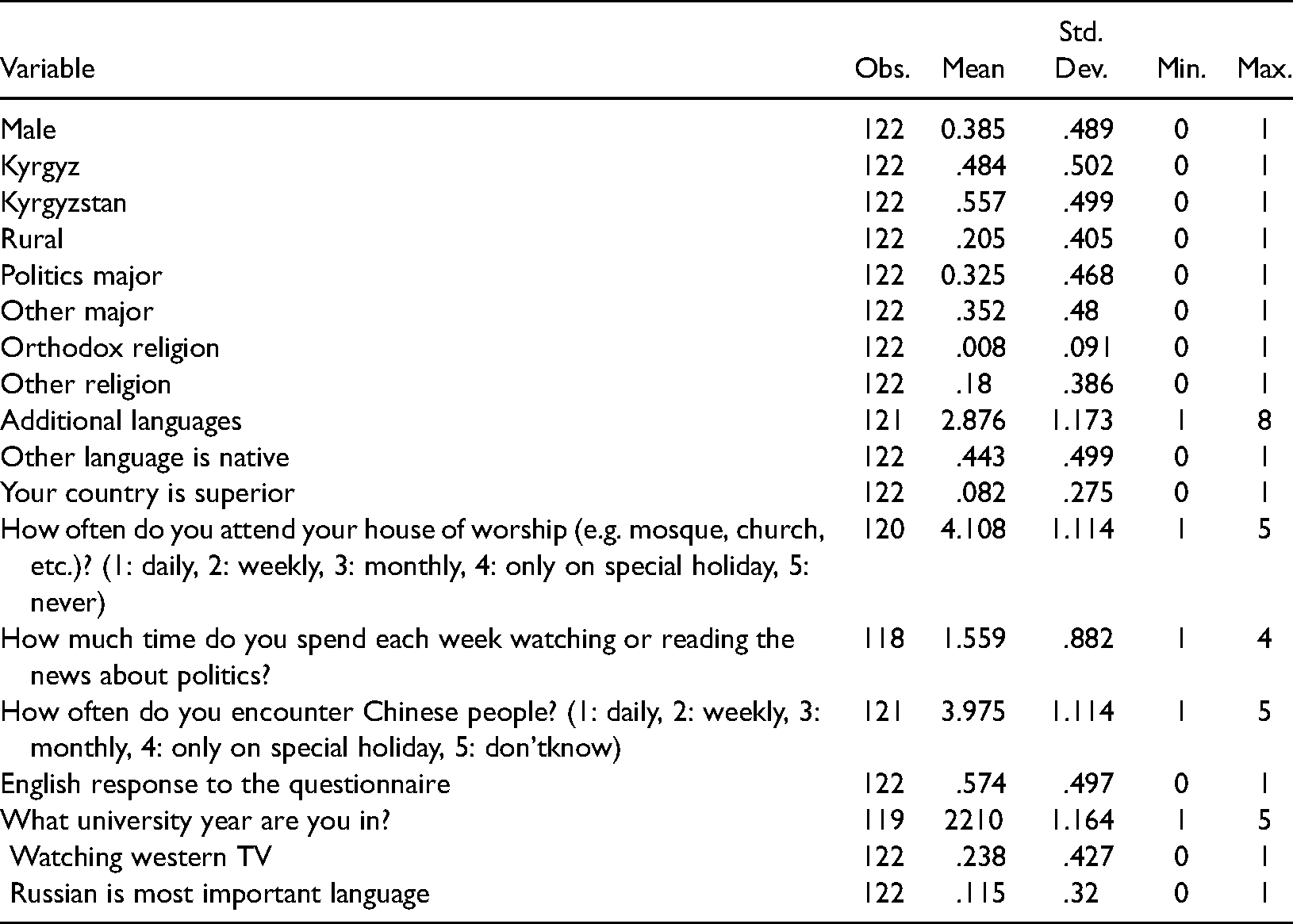
Summary statistics.
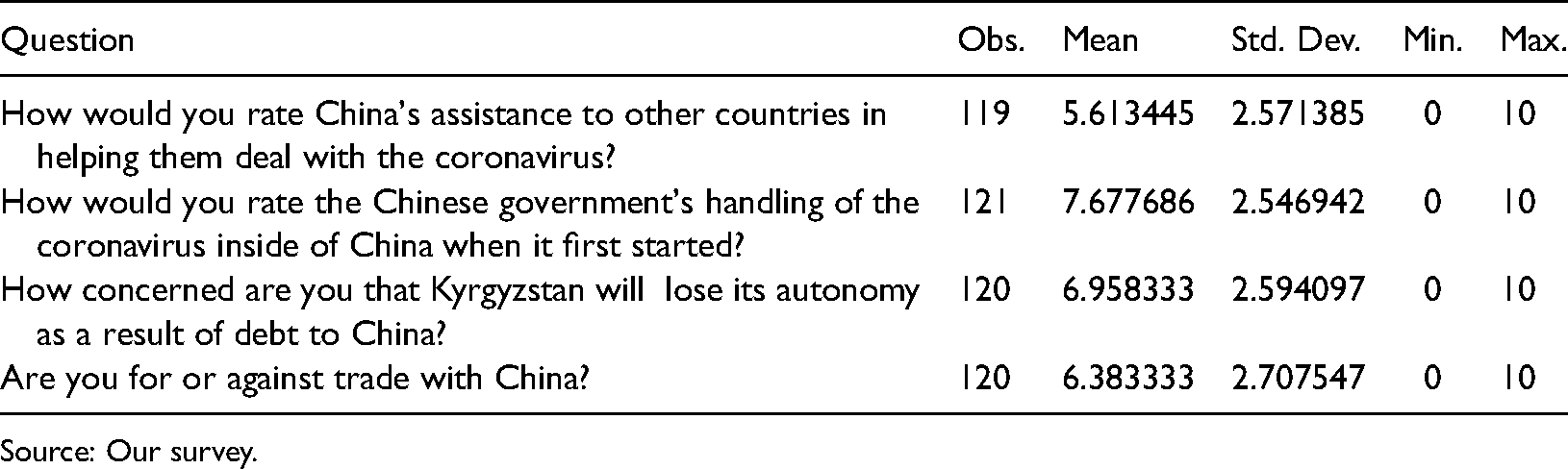
Source: Our survey.
Our participants provided a favourable evaluation of China's handling of coronavirus inside of China, with a mean of 7.67 out of 10. 3 However, the favourable view dropped regarding China's assistance to other countries in handling coronavirus, with a mean of 5.61 out of 10. 4 Continuing in a direction of concern regarding China, many stated that they are concerned that Kyrgyzstan will lose its autonomy to China as a result of debt to China, with a mean of 6.95. 5 Drawing on our theoretical framework, SIT is useful here in accounting for this pattern. Our participants’ responses reflect how they view themselves versus the Other. In short, while participants are willing to provide China with a favourable view in terms of China’s actions in dealing with coronavirus inside of China, when it comes to other highly salient issues such as loss of autonomy to China as a result of the country's debt, then China is perceived as the Other.
In terms of support for trade with China, our participants are more in favour than opposed, with a mean of 6.38. 6 In terms of the level of support for trade with China, we found that Kyrgyz nationals are statistically significantly in favour of trade with China compared with non-Kyrgyz nationals. Given that Kyrgyz nationals are also more concerned about debt to China, this is an interesting finding. Based on the findings from these two different questions, our sample of Kyrgyz nationals wants to engage in trade with China, but they are also concerned about debt to China. In terms of China's assistance to other countries in handling coronavirus, Kyrgyz nationals demonstrated a more positive view than non-Kyrgyz nationals.
Regression findings
We found statistically significant findings for four different topics – (1) trade with China; (2) concern regarding debt to China; (3) China's assistance to other countries in handling coronavirus; and (4) the handling of coronavirus inside of China.
Trade with China
Males are more negative than females in terms of how they view trade with China (see Table 2). The more languages a person speaks, the more positive they are regarding trade with China as a good thing. Those who view their country as superior embrace a negative view of trade with China. This finding is to be expected given the relationship between nationalism and relative gains (see Mearsheimer, 1994/1995). Among those who view their country as superior, more males than females view Kyrgyzstan as superior to another country, with 5.74% of males and 2.46% of females viewing Kyrgyzstan as superior. The numerous news articles highlighting concerns about Chinese men becoming involved with local women may offer insight into one reason behind the more negative perceptions of China among Central Asian males. In addition to using SIT as a lens to view this issue of identity regarding men and women, we can also use gender. Drawing from other studies that use gender as a theoretical framework (e.g. Enloe, 1990) and from SIT, such men feel threatened by the Other, that is, men from another country who are involved with local women. We also found that the more time a person spends at university, the more positive they are on trade with China. Given that we found that the more languages one speaks and the more time one spends at university, the stronger one’s support for trade with China, we can conclude that those who are more educated are more in favour of trade with China.
Handling of coronavirus inside of China
While males are more negative regarding trade with China, they view China's handling of coronavirus inside of China more favourably than females (see Table 3). Given that our male population tends to view their country as more superior to other countries than our female population, we speculate here that a person’s political views may explain why they are supportive or critical of China’s handling of coronavirus inside of China. Since we did not ask a question that would address attitudinal variables on views of democracy, we cannot say this with certainty. What this does demonstrate is that our male participants are willing to provide China with a positive evaluation in certain areas.
OLS regressions.
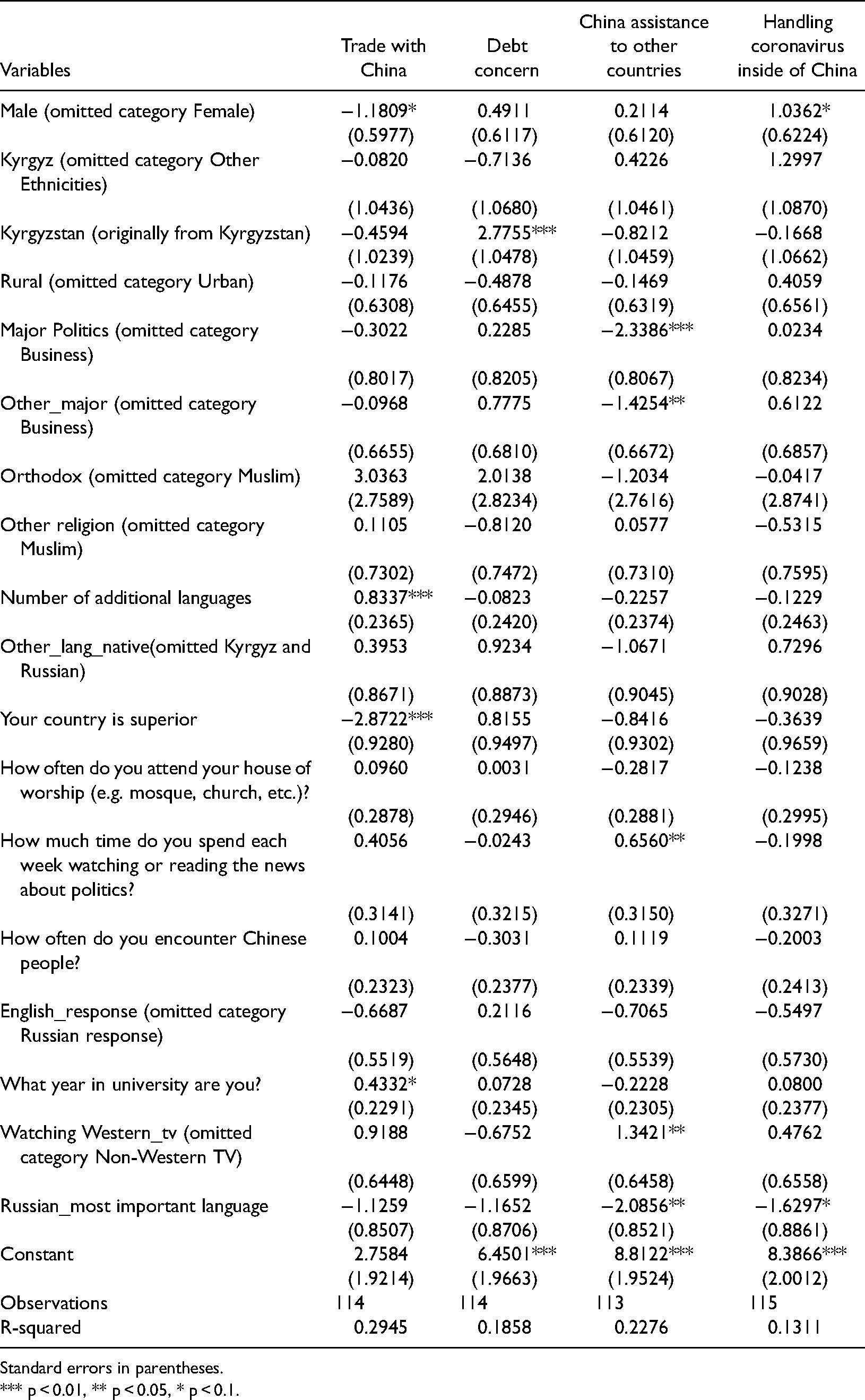
Standard errors in parentheses.
*** p < 0.01, ** p < 0.05, * p < 0.1.
For those who think that Russian is the most important foreign language to learn in Kyrgyzstan, such people also view Chinese assistance to other countries in dealing with COVID-19 in a more negative way compared to all other languages. 7 One explanation we offer for this correlation is that students who consider Russian as the most important foreign language to learn believe that Russia still is – and will continue to be – Kyrgyzstan’s most important political and cultural ally. Indeed, despite China’s growing inroads in Kyrgyzstan, Russia remains a major player in the country. In 2015, Kyrgyzstan strengthened its relationship with Russia further by joining the Eurasian Economic Union (EAEU) and as such enjoys free movement of goods, services, capital and labour with Russia and other EAEU member states. According to official statistics from Kyrgyzstan’s State Migration Service, around 700,000 Kyrgyz migrants work in Russia (from a population of 6.5 million), and as of 2019, Russian remittances made up 32.9% of Kyrgyzstan’s GDP (IOM, n.d.; Bhutia, 2019). Kyrgyzstan also remains dependent on Russia for technical and political military cooperation, with Russian military bases active across the territory of Kyrgyzstan. Our language finding suggests that many still view Russia – rather than China – as Kyrgyzstan's closest ally, impacting how they perceive China in negative terms.
Debt to China
In terms of concern regarding debt to China, Kyrgyzstani nationals are more worried than people from other countries (see Table 3). However, it is important to point out how we phrased our survey question (‘How concerned are you that Kyrgyzstan will lose its autonomy as a result of debt to China?’). 8 In hindsight, we could have phrased the question as ‘How concerned are you that your country will lose its autonomy as a result of debt to China?’. Nonetheless, debt issues for Kyrgyzstan to China have received much attention in the news and in social media, and this is reflected in our survey findings.
China's assistance to other countries in handling coronavirus
We found that a person’s major is salient in terms of how they view China's assistance to other countries in dealing with coronavirus (see Table 3). 9 The findings were statistically significant that those who major in Political Science are more critical of China's assistance to other countries in handling coronavirus. We speculate that those who major in Political Science are more cognizant of this issue and pay more attention to current events regarding China's actions internationally, and this accounts for why they view China’s assistance to other countries in a more negative way than those who major in Business. Also, compared with Business majors, those who are majoring in a different subject, but not Political Science, also embrace a statistically significantly negative view regarding China's assistance to other countries in handling coronavirus, though not as statistically significant as Political Science majors. Given the statistically significant findings for both Political Science and non-Business majors, we posit that those majoring in Business are more favourable to China overall. Given that China is the main trading partner of Kyrgyzstan and business majors are focused on cost–benefit analysis as opposed to issues of social justice, economic gains are more salient to them than issues of social justice. We attribute this to the divergence in responses between Business majors and Political Science majors on the issue of perceptions towards China. If we had not disaggregated our sample, we would not have found this.
Those who spend more time watching or reading the news view China's assistance to other countries more favourably than those who spend less time doing so. Those who watch Western TV programmes 10 look more favourably at China's assistance to other countries compared with those who watch non-Western shows or mixed. For those who think that Russian is the most important foreign language to learn in Kyrgyzstan, China's assistance to other countries is viewed in a more negative way compared with those who think that other languages are most important.
Conclusion
In this article, we have presented our findings from a survey that we conducted at AUCA in the spring of 2021. The survey questionnaire asked respondents how they view trade with China and China's actions regarding COVID-19. Both of those topics have been very contentious in Kyrgyzstan and in Central Asia overall. There has been a lack of surveys conducted in Kyrgyzstan with university students, especially at an elite university like AUCA, that focus on either of the two topics that we did. In addition, future surveys should continue to disaggregate the sample based on both demographic and attitudinal variables.
As we mentioned, we found statistically significant results for four different topics based on demographic or attitudinal variables – (1) trade with China; (2) concern regarding debt to China; (3) China's assistance to other countries in handling coronavirus; and (4) the handing of coronavirus inside of China. Our findings reveal the importance of identity. In numerous cases, we found how certain groups, for example males or females, responded in ways that indicate the salience of their identity. Given how issues involving gender in Central Asia and in Kyrgyzstan have been framed regarding Chinese investment – that is, that with Chinese infrastructure projects, Chinese men are coming to Central Asia and becoming romantically involved with local women – we suspect that this is important in accounting for the divergent responses based on whether one is a woman or a man.
Given that the trend of Chinese investments in Central Asia overall and in Kyrgyzstan specifically appears likely to continue, future surveys should focus on issues of identity in examining perceptions towards China. China's relationship with Kyrgyzstan is ever evolving, especially as the aftermath of the October 2020 revolution and Sadyr Japarov's power consolidation plays out. As such, it would be interesting for us to carry out repeated surveys at AUCA to see how the student population's views towards China adapt over time. In addition, administering future iterations of the survey at other institutions around Kyrgyzstan could produce valuable comparative insights. For instance, how do perceptions of China at the Bishkek-based American University of Central Asia compare with perceptions at other institutions in the city like Kyrgyz National University? Or at those funded by other foreign governments like Kyrgyz-Russian Slavic University or Kyrgyz-Turkish Manas University? Or at institutions in regional administrative centres like Naryn or Jalal-abad?
To enrich the understanding of perceptions of China in Central Asia, we also suggest that semi-structured interviews of students could be held in conjunction with future surveys. While surveys are useful for sampling a larger, more representative population, interviews can capture complex, discursive information behind participants’ thoughts and behaviours in a way that surveys alone cannot.
Footnotes
Acknowledgements
We would like to thank two anonymous reviewers for their helpful feedback in strengthening the article. Christopher B. Primiano and Dana Rice contributed equally to this article.
Declaration of conflicting interests
The author(s) declared no potential conflicts of interest with respect to the research, authorship, and/or publication of this article.
Funding
The author(s) disclosed receipt of the following financial support for the research, authorship, and/or publication of this article: Alma Kudebayeva received funding from the CERGE-EI Foundation.
