



Abstract
‘Spillover democratisation’ is an ongoing process. It envisages that democratic values, institutions and practices continue to spread and evolve through various pathways – horizontal, geographical and vertical. Yet, possibilities also remain that anti-democracy forces may thwart the process. In Middle East and North Africa (MENA), social and economic rights were not accompanied by civil and political rights. The Arab Spring was a response to this gap: it raised the optimism of achieving democratisation in the MENA region, through geographical and horizontal pathways. However, the promise remains largely elusive at present; rather, we witness the cementing of existing anti-democratic forces. Yet, citizens’ innate support for democracy, sporadic pro-democracy activism and rising consumerism sustain the democratising potentials of the Arab Spring.
Keywords
Introduction
Spillover democratisation is rooted in the concept of democratisation, which again starts from the notion of democracy. Democratisation involves the continuous spread, expansion and evolution of democratic ideas, values, institutions and practices, over time and space. As an ongoing, endless process, democratisation conceives several pathways – various dimensions of democratic citizenship spread from one sphere to another and evolve over a period of time. In the West, for example, it has spread from workplace to family. However, if this process is thwarted or disturbed, anti-democratisation forces may return to dominate in newer configurations. Modern democracy has developed and flourished in the West, but in a human organisation, if concentration of power is monopolised in the hands of certain individuals or groups, it becomes difficult to sustain for long because using power also requires support and cooperation from greater society.
The transition to and consolidation of democracy requires several conditions: people having a clear idea about their national political community; securing of some attributes of democracy like rights and freedom from tottering authoritarian regimes; creation of pro-democracy institutions; and finally, alteration of power being regularised so that democracy becomes ‘ingrained into political culture’ (Sørensen, 1993: 40–46). Historically, there have been three waves of democratisation: the expansion of voting rights in the West (1828–1926); the post-war period and decolonisation (1943–1962); and the end of dictatorships since the 1970s (Huntington, 1991).
In the history of democracy, the period of 2010–2011 will be remembered for the events in the Middle East and North Africa (MENA), or the Arab world. The Arab Spring, also known as the Jasmine Revolution, caught attention across the world when it spread from one country to another quickly, despite massive state repression; thus implying that even powerful dictatorships can be confronted. It started in a small way, but profoundly shaped the contemporary world history: On 17 December 2010, Mohamed Bouazizi, an unknown street vendor in the small Tunisian city of Sidi Bouzid, triggered a succession of events that have fundamentally altered the political trajectory of not only his home country of Tunisia, but also created powerful reverberations across the Middle East and North Africa (MENA) region. Frustrated with repeated mistreatment at the hands of local officials, Bouazizi set himself aflame. Tapping into all manner of grievances held by Tunisia’s citizens, this incident sparked protests across the country so intense that they quickly brought about the destabilization of the regime and soon drove the long-standing autocrat, Zine al-Abidine Ben Ali, from power. As Ben Ali fled into exile, the Tunisian uprising triggered protests in countries across the MENA region (including Egypt, Libya, Syria, Yemen, and Bahrain) now known as the ‘Arab Spring.’ Within months, Hosni Mubarak’s regime had also collapsed. (Hess, 2013: 254–255)
Democracy requires that the power of decision-makers be shared with other groups in society, where government ‘is selected in a free, open, and fair election’ (Huntington, 1991: 9). ‘Democratizing society democratizes the state’: the political and civic capacities of citizens are augmented by public debates, representations and enlarged avenues of participation. Inequalities of one sort, when converted into others – say from money to political power – significantly threaten democracy (Warren, 2002: 692-697). This presupposes ‘thick democracy’: political equality; pluralism; social inclusion; rule of law; extensive individual and group freedom; institutional checks and balances; and civilian control over the state repressive apparatus (Diamond, 2008: 22). With these attributes, democracy deepens – acquires roots in society. In social settings where perfect conditions of civility exist, such as absence of corruption, deceit, oppression, exploitation and various sorts of inequalities, democracy may not be necessary. However, in this world full of human limitations, such illusion is too obvious. Hence, democracy is necessary to ensure fair distribution of power, thus offering space to people at the receiving ends of asymmetric power relations. Upon continuous bargaining over entitlements and rights, people might evolve agreeable codes of conduct for mutual interaction. In this sense, democracy is a gateway to civilised social relations.
Democratic values and procedures gain substance and sustenance when they spread around various spheres of social existence. Horizontally, democratic attributes spread from one sector to another; for example, in Britain they have spread through the gradual expansion of rights – civil, political and social (Marshall, 1977). In post-colonial India, civil and political rights (CPR) were initially prioritised, but since the 1990s, social and economic rights (SER) have also become prominent (Jayal, 2013). New rights may lead to further democratisation: the right to information in India has worked as a ‘gateway’ for many other rights and entitlements to flourish, hence it is known as a ‘seed right’ (Ghosh, 2018: 639–641). Geographically, democratic ideas or practices may spread from one place to another quickly, so that the origin can be located. Vertically, democracy ‘spills’ when one sort of right and freedom clearly leads to another, such as freedom of speech to freedom of the press, thus having the effect of deepening democracy. Democratisation thus seems to have natural spillover effects.
The idea of ‘spillover democratisation’ is illustrated in Figure 1: democracy’s spread and evolution may take several pathways – horizontal, geographical and vertical. Any minimal attribute of democracy – idea or practice – that survives and is internalised by people may lead to demands for its expansion. Spillover democratisation is a double-edged pathway: values and factors supporting or opposing democracy are present; particular elements of democracy may lead to further democratisation if the society makes prudent efforts. On the contrary, factors opposing democracy also prevail – depending upon various socio-economic circumstances and historical legacies. Consequently, anti-democratisation forces come to dominate.

The process of spillover democratisation.
Precisely this has occurred in much of the MENA region: subsequent events and the accompanying complexities have led to overall failure of the much-cherished ‘fourth-generation’ democratisation. Apart from Tunisia, democracy activists failed to negotiate for substantial democratic entitlements or to build durable institutions for consolidating democracy in other MENA countries that have experienced changes. Hence, the desired end result – smooth alteration of power arising from regular electoral competition – could not be achieved. While having a broad socio-historical survey in MENA, the first part of this article explains the context of the Arab Spring – the way anti-democratic forces have dominated over the promises of democracy. Overall, SER in MENA was not complimented by CPR; hence it disturbed the natural course of democratisation to spread and evolve and ultimately democratisation died. Against this rather discouraging background, however, the second part of the article will argue that possibilities for democratisation are innately and psychologically embedded in MENA – broadly subsumed as quests, and emotional support – as well as outlining a few sporadic attempts towards democratisation. Though not well-articulated, these attempts somehow encapsulate the impulses for democracy – continued by growing consumerism, particularly internet and social media – and have opened up new arenas for participation and created a public sphere of dialogues. With examples from MENA politics, we argue that both opportunities and threats to democracy are always present – the essence of spillover democratisation.
MENA, the Arab Spring and the failed promises of democratisation
The Arab Spring is a benchmark phenomenon with which to discuss contemporary politics in MENA; it also offers an interesting example of the process of spillover democratisation. Apparently, it started with geographical pathways: ideas spread from one region to another. In the West, too, concepts/ideas have travelled geographically, but never in such a short time over such a vast region. Confronting police or governmental high-handedness is in fact an everyday-everywhere reality, all too common across the developing world; when it triggers such a large-scale and epoch-making event, it indicates the anger and frustration that has been simmering for quite some time. An overview of MENA society, polity and economy will enable us to understand the context of the Arab Spring where, by end of the decade, the promise of democratisation that was unplugged earlier remained largely elusive.
MENA at the time of the Arab Spring
In the post-colonial era, MENA remained conflict-prone and fragmented due to somewhat artificial territorial division, and more susceptible to the appeals of nationalism than to any realistic quest for democracy (Dahi and Munif, 2012; Hinnebusch, 2006). During this period, two tendencies emerged: liberal, modern-looking Arabs on one hand; and pan-Islamic Arabs aspiring for a ‘Caliphate’ on the other. People were caught between the lure of modern living vis-a-vis perceived attacks on their identity. The struggle between religious groups and secular-but-dictatorial regimes led to much bloodshed. From a distance, Western powers intervened to keep the trouble alive for their national interests (Sarquis, 2012). An overview of MENA society and economy enables us to perceive the context of the Arab Spring.
First, the construction of national identity has been a thorny issue in the Arab world, having affected the process of democratisation. For example, tensions between two major groups – Jordanians and immigrant Palestinians – had run deep in the social fabric of Jordan since its formation in 1921. Rulers adopted divide-and-rule policies, which frustrated the quests to define, establish and maintain a comprehensive national identity for their citizens and to achieve a larger pan-Arab identity (Bani Salameh and El-Edwan, 2016). Despite the visible dominance of Arab and Islamic identities, ethnic diversities exist in MENA countries. In spite of Islam’s ideology of togetherness, the heterogeneous populations of Egypt, Iraq, Syria and Sudan have histories of civil war (Kedouri, 1992). Alongside Muslims, religious groups like Pagans and Christians exist in MENA; and other varieties of Islam, such as Sufism, can be found in the bordering areas. In addition to Arabs, there are other ethnic groups like Kurds (Haynes, 2006). In the Ottoman period, religious and linguistic minorities were organised in a ‘millet’ system: Jews and Christians were considered as ‘protected communities’ and allowed some autonomy, but ‘different communities within the umma (the Muslim community)’ were not recognised. Unlike the majority populations, religious minorities supported autocracy (Belge and Karakoç, 2015: 283). The status quo probably offered them some degree of security.
In terms of race, Afro-descendants in MENA arrived mostly as slaves, in addition to ‘migration and long-time settlement’ as workers, soldiers and servants. Despite a significant presence and much variation in ethnic origins among Afro-descendants in MENA, they faced various forms of exclusion: limited recognition; cultural denigration and stigmatisation, such as being referred to as ‘slaves’; popular prejudice, racism, xenophobia; distance from the centres of power and opportunities; and severe unemployment (Ashmawy et al., n.d.). Overall, the term ‘minority’ remains somewhat under-discussed and a problematic issue in MENA politics, due to a virtual legacy of patron–client relationships with authoritarian rulers. Diversity sometimes lead to social conflicts, generally over the distribution of power, resources and identity. Democratisation, on the other hand, needs a unified effort: for survival and progress, a society cannot afford to remain fragmented; it must evolve ways to minimise conflict and maximise cooperation for building a robust social solidarity.
Secondly, the economic context: in most of the MENA countries, oil has been the major source of revenue. The post-colonial MENA regimes promoted SER, in the form of the public sector and health and education provisions, but the rural and informal sector was virtually excluded from these benefits (Karshenas et al., 2014: 727–728). These ‘populist authoritarian’ or ‘rentier monarchy’ types of rule were invariably marked by nationalist appeals; bureaucratic, personalised and/or clannish governments; and repression and surveillance, in lieu of some SER (Hinnebusch, 2006: 380–383). Such arrangement worked well when regimes were capable of dispersing welfare provisions, but depletion of resources, growing populations, rising expectations and warfare ended ‘this short-lived equilibrium’ (Zubaida, 2002: 232). In Algeria, unemployed youths in the previous regime became easy recruits for religious militancy – simultaneous economic and political liberalisation did not work; on the other hand, economic without political liberalisation eventually led to severe chaos in Syria (Dahi and Munif, 2012; Hinnebusch, 2006; Testas, 2002).
Regimes solely dependent on mineral or natural resources such as oil revenue display several undesirable characteristics. The easy flow of money makes the state too powerful and virtually unaccountable: it treats people as clients, instead of citizens; undermines civil society; co-opts opposition; and the well-equipped repressive apparatus suppresses aspirations for democracy. The capital-intensive oil economy does not create much employment; elites are either too organised or too divided; and crony capitalism flourishes in the place of an independent bourgeoisie. MENA countries with overall gender inequity and sharp differences in per-capita income have experienced the rise of average income without a corresponding growth in productivity. Consequently, corruption, wasteful expenditure, a lower taxation base and repression backfired against the regime when oil prices plummeted (Diamond, 2008; Rahman, 2013; Salehi-Isfahani, 2013). In Tunisia, economic crises led towards crystallisation of anti-state sentiments; and the Egyptian government’s interference with civil society’s efforts to lessen economic hardship intensified such feelings.
Thirdly, despite generally high prosperity in the region, some serious gaps are visible. Even during the tumultuous period of 2010–2011, most countries in MENA performed impressively on the Human Development Index (HDI), as published by the United Nations Development Programme (UNDP). Table 1 shows that the Arab states are among the best HDI performers in the developing world; and Table 2 reveals that on the eve of Arab Spring, three countries had scored ‘Very High’ on the HDI; seven ‘High’ HDI; three ‘Medium’ HDI; and only two (Yemen and Sudan) were under-performing countries, with a ‘Low’ HDI. Although reports on Iraq, Lebanon, Palestine and Oman are not complete, their performances, available at the bottom of Table 2, are not too unsatisfactory (UNDP, 2010). The quality of education is, however, questionable: schools only require a ‘narrow set of skills’, neglecting productivity and creativity-generating subjects, such as literature, arts, sports or music. MENA countries also fare poorly in international tests on mathematics and science; a top HDI performer, Qatar, fares the worst (Salehi-Isfahani, 2013: 354). Historically, Arabian civilisation has contributed richly to the fields of mathematics and literature. Intellectual excellence requires a creative and independent ambience supported by an appropriate political context, such as democracy and CPR. Whereas the recognition of SER helped achieve a respectable HDI, without corresponding CPR it meant little. As people had no voice on their socio-political realities, their relations of trust with regimes were shattered.
World HDI at the time of the Arab Spring.
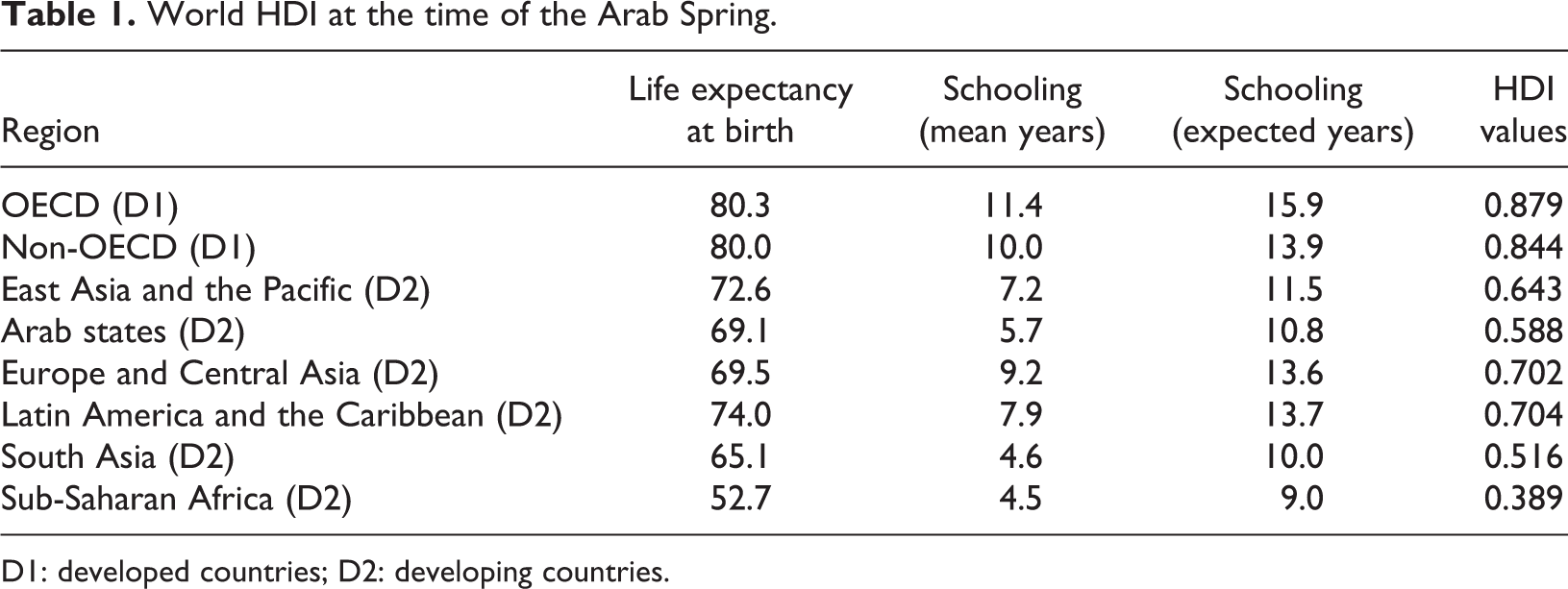
D1: developed countries; D2: developing countries.
Country-wise Human Development Index (HDI)a in the MENA region at the time of the Arab Spring.
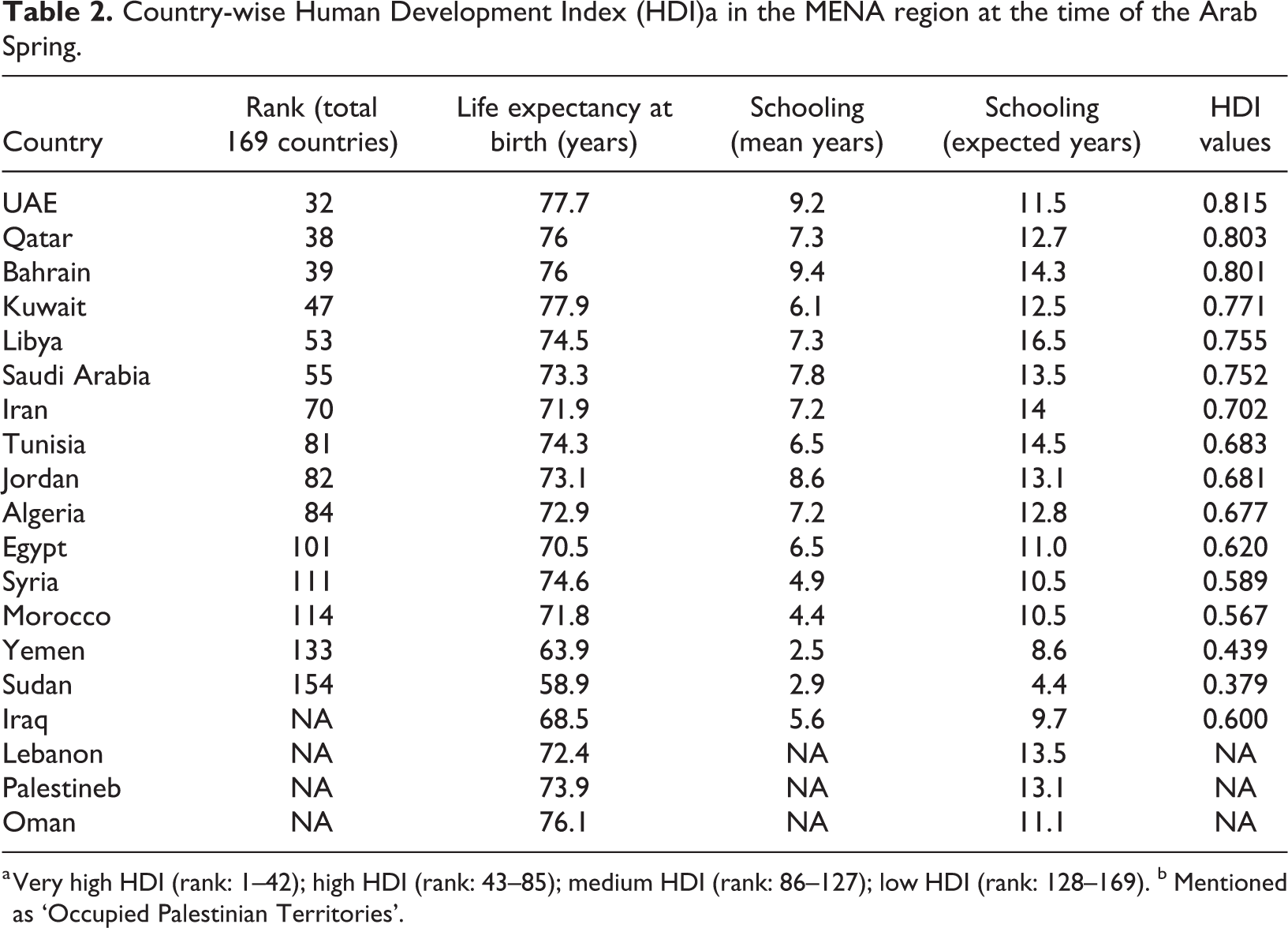
a Very high HDI (rank: 1–42); high HDI (rank: 43–85); medium HDI (rank: 86–127); low HDI (rank: 128–169). b Mentioned as ‘Occupied Palestinian Territories’.
Under these circumstances, massive corruption and severe state repression worsened matters. Corruption defies the basic norms of civility: the resulting asymmetric power relations generate humiliation, because the powerless, through no fault of their own, have to submit before the powerful. Where money circulates well, people have opportunities to improve their income and fortune; and the consequent mobility of lifestyle may ameliorate such bitterness. These options did not apply to MENA.
Alongside this, elaborate security and surveillance mechanisms were installed, with lavish financial incentives for the personnel. MENA states used much violence, both directly and through agents, often rendering the moderates and democrats as passive or irrelevant. The Arab Spring occurred during the most violent phase of state–society relations (Rahman, 2013; Stacher, 2015; Tadros, 2012). Ideally, security forces ought to be concerned with the country’s security, not the regular administration. In closed regimes, rulers know about society through intelligence and their own confidants; their loyalty and efficiency depend upon contingent factors like incentives and governance. However, the best way to convince others is to know their viewpoints. This can be achieved through the accommodating and compromising gesture of CPR, thus allowing MENA rulers with greater leverage to elicit loyalty from society. A massive repressive apparatus indicates a disproportionate allocation of social resources towards law and order, requiring a larger slice of public investment in security, often at the expense of pressing socio-economic issues. Democracy under these circumstances could have presented a cost-effective measure for the ruling elites: as the needle of popular discontent is often pointed towards the government-in-power, they might have greatly evaporated via protests expressed through legitimate channels. They appear here as proverbial ‘safety valves’, allowing popular frustrations to find a suitable outlet.
MENA since the Arab Spring
The Arab Spring demanded ‘bread, liberty and social justice’ – articulating quests for equality against ‘corruption, despotism, and the hegemony of a state that abused their basic rights’ (Mansour-Ille, 2014: 221). Alongside political and economic reforms, it has driven home the message necessitating human rights, social diversity, justice and equality; strengthening democracy and teaching the ‘culture of tolerance’ in the Arab world (Zu’abi, 2018: 964–966).
After the Arab Spring, only Tunisia appears to have made some progress towards democracy. In fact, Tunisia is the first country in the region to have drafted a modern constitution in 1861, and it has taken measures towards modern education and gender equity; secular and religious forces chalked plans for democratic governance long before the Arab Spring. Despite faltering at times, the significant presence of western-oriented elites appears to be capable of keeping the religious hardliners in check (Cross and Sorens, 2016; Grewal, 2020; Koehler, 2017; Landolt and Kubicek, 2014; Sadiki, 2002; Sanborn and Thyne, 2014; Somer, 2017; Stepan and Linz, 2013).
Both in Tunisia and Egypt, autocrats were ousted by ‘a cross-class and cross-ideological revolutionary convergence’, where armed forces had little option but to support a movement with solid mass support (Del Panta, 2020: 639–640). Unfortunately, pro-democracy activists were not successful in their missions in Egypt, as hardliners soon took over the changed regime; and the counter-revolution of 2013 resulted in further consolidation of authoritarianism under new rulers (Brown, 2013; Challand, 2017; Miller et al., 2012; Webb, 2015). In fact, ‘Egypt since 2013 has descended into highly militarized rule accompanied by unprecedented human-rights abuses’ (Dunne, 2020: 183). Almost all sections of elites – intellectuals, religious leaders, the media and trade unions – have supported the counter-revolutionary military coup in Egypt (Bani Salameh et al., 2020). We thus find two different aspects of spillover democratisation: historical antecedents and conscious human efforts enabled democratisation in Tunisia; whereas in-built social dynamics jeopardised democratic progress in Egypt.
Syria had also undergone an extremely repressive regime under Bashar al-Asad; democrats had initiated the changes, but were soon taken over by extremists. This was followed by a deadly civil war (Heydemann, 2013; Saouli, 2015). Subsequently, with the weakening of rebels since 2017, the previously initiated truce process resulted in the consolidation of Bashar al-Asad’s rule, but people who were suspected of being disloyal had to face severe repression and deprivations (Abboud, 2020). In Libya, the political leadership, hamstrung by an extremely faction-ridden population, had eventually failed to draft a meaningful constitution (Cross and Sorens, 2016). Algeria still had memories of the brutal civil war of the 1990s. Its divided opposition and a dense network of pro-government Civil Society Organisations (CSOs) enabled the ruling Islamic Salvation Front (FIS) to permeate through society; and it therefore escaped the waves of the Arab Spring (Del Panta, 2017; Lorch and Bunk, 2017).
The monarchies in Morocco and Jordan quickly responded to the changing circumstances with incremental pro-democracy reforms, though they had started such moves beforehand (Belge and Karakoç, 2015; Guessous, 2012; Yom, 2017). Other viewpoints, however, contradict such a benign notion of Jordan: the elaborate constitutional provisions of human rights, particularly on political participation and various freedoms, are hardly observed in reality (Bani Salameh and Darawsheh, 2018). The influx of refugees fleeing the battlegrounds of the Syrian civil war has worsened matters (Bani Salameh and Hayajneh, 2019). Several factors have thwarted pro-democratic reforms: the incomplete process of state formation and national identity; the weak political will and democratic culture; the strong state dominance vis-a-vis weak civil society; the gloomy economic scenario; and the recurring turbulences in the MENA region. The long list of agenda for the revival of democracy in Jordan (Bani Salameh, 2017: 67–72) indicates an uphill task ahead. Saudi Arabia, considered as one of the most conservative and repressive regimes, has been undergoing incremental changes over the last decade and cautiously balancing between repression and democratisation (Kapiszewski, 2006). Overall, in MENA, despite slow and incremental developments, we find the rays of both geo-ideational and horizontal spread of democratisation.
Yet, given the sharpening of ethno-religious identities in the MENA region after the Arab Spring, we need to focus on the issue of minorities. After the 2011 revolution, xenophobic attacks against Afro-Arabians took place in Libya and Morocco, but in Tunisia black minorities started organising themselves for rights and recognition. Even in Morocco, they started protesting against harassment (Ashmawy et al., n.d.). There is no record of the systemic, large-scale persecution of minorities in MENA, but with the emergence of the global terrorist organisation Islamic State of Iraq and Syria (ISIS), minority cultures are now significantly threatened in Syria.
The experiences after the Arab Spring suggest that the process of democracy may either spread or be reversed. It is therefore necessary that while consolidating democracy, particularly during the institution-building phase, extreme care is taken to ensure that, as a factor, ethno-religious identity is not overwhelmingly prioritised, particularly at the expense of well-being issues: social justice, poverty, unemployment and overall human development. Such care should start at the ideational level, by enlightening people with the values and promises of democracy. There are multiple identities in the modern world: some people may be strongly attached to religion or ethnicity; but for many others, engagements with work, family, cultural pursuits, hobbies or particular interests might be equally appealing. Ethnic identities generally tend to imprison one into a particular worldview, thus seriously affecting overall well-being. Human development issues that cut across ethnic identities in general have the potential to address well-being requirements. Democracy requires political integration to enable people from diverse backgrounds and orientations to discover some mutually agreed issues for conceptualising common good. People should therefore have meaningful opportunities to enjoy their preferred identities. Diffusion of the country’s unity into minority and majority, or multiple ethnic groupings, thwarts the process; hence integration can be achieved by recognition of diversities.
Many societies experiencing regime change after long years of rule by well-entrenched groups of elites face problems arising from inexperience in governance. The consolidation process is often affected: the opposition may be divided – sometimes with sharply contradicting worldviews and interests, some democratic, others reactionary. At this point, the role of visionary leadership in consolidating democracy becomes a crucial factor – they establish the vision of common good by emphasising a shared socio-political destiny. For instance, despite having inherited an extremely diverse, fragmented, populous and poor society at the time of independence, India was fortunate to have leaders like Gandhi, ably assisted by Nehru, Ambedkar, Azad and Patel, to hold the nation together, create institutions, represent various sections of society, command trust and respect from people, foresee the future of the country and thus consolidate democracy. In South Africa, the post-apartheid Mandela regime instituted the ‘Truth and Reconciliation Commission’ to create meeting spaces for various social groups with deep-rooted memories of bitterness. Democracy facilitates an inclusive political context, but also requires committed leadership capable of institution-building and weaving the common bonds of citizenship among people from diverse backgrounds.
Any society aspiring to achieve success must have some common agenda – democracy is not only about differing, but also requires points of understanding, agreement and cooperation, which occur from mutual trust, provided various opinions are well-ventilated. If crisis deepens in democracies that represent various social forces satisfactorily, a de facto understanding (consensus) emerges among elites. In India, for instance, a pro-market liberalisation programme was initiated in 1991 amid severe economic crises; despite sharp ethnic divisions then, it was virtually supported by all parties across the ideological spectrum. The more democratic ideas and institutions mature, the better are the chances for such ‘consensus’ to emerge. A new democracy may also achieve such outcomes if rulers accommodate various social groups in power-sharing arrangements.
In religion, divine blessings promise the fulfilment of human life, whereas the most demanding version of politics treats the individual as the creator of their own destiny. It follows that ‘the sole alternative to the democratic legitimating of power is the theocratic one’ (Offe and Preuss, 1991: 147). Yet, no government, howsoever autocratic, may deny the normative superiority of democracy – a fairly universal norm for good governance, and also a natural human impulse, whether individual or collective – people like to enjoy freedom and have voice over their own destiny. By granting democratic rights, whether CPR or SER, rulers do not bribe citizens; rather, they recognise them as equal co-partners in shaping the destiny of the socio-political community. Persistent denial of such impulses may lead to serious consequences: it happened in Egypt, when the post-2011 elections failed to achieve the minimum trust and stability necessary for democracy. As a consequence, the country still has to negotiate with chaos, violence and uncertainty.
The lack of democracy in the MENA region thus led to mass uprisings: despite SER, the denial of CPR left matters incomplete. It compounded problems further when economic crises along with a repressive and unaccountable government added fuel to pent-up discontent. A correlation of circumstances, culminating in the Arab Spring, desired CPR, in addition of the already existing but fledgling SER, as a vision for future. Throughout, we find that in MENA countries, the geo-ideational and horizontal spread of democratisation as reflected in the early phases of the Arab Spring was not complemented by a suitable vertical spread: the call for democracy has spread from one country to another in quick succession; in some cases, democratisation occurred in varying degrees. For example, Tunisia achieved satisfactory progress, and countries like Morocco made some cosmetic pro-democracy reforms, but overall the promise of the fourth wave of democratisation generated in the early days of the Arab Spring has failed to develop roots in society. However, the possibility for democracy, in terms of both emotional and material factors, remains dormant, but not absent.
MENA: Promises for democracy
The quest for achieving democracy in MENA has to take place in this context, where at least two indicators are visible. First, though not always explicit, people have support for democracy. This is the emotional factor for democratisation: at times they have concretised into democracy activism. Secondly, material factors such as exposure to information technology, particularly social media, have positively impacted on articulating the emotionally embedded quests for democracy: broadly, it may be subsumed as consumerism.
Support for democracy
Several indicators over the decades, though sporadic, indicate that people in MENA favour democracy. First, between 1964 and 1993, rulers in seven MENA countries introduced periodic elections to enhance their credibility and legitimacy. Though opposition had little chance to win in those elections held under an authoritarian shadow, about 50% to 72% of voters exercised their franchise. Despite patronages by rulers, voters evaluated governments’ economic performances; and abstaining from elections implied a form of protest (De Miguel et al., 2015).
Secondly, despite an overall authoritarian context, citizens and expatriates from other Arab countries in Qatar do positively respond to surveys, including on political issues (Gengler et al., 2021). Various surveys conducted between 2000 and 2006, in countries such as Egypt, Morocco, Iraq, Algeria, Jordan and Palestine, find that 84–90% of respondents voted in favour of democracy. Many respondents in Jordan and Palestine disagreed that Islam is incompatible with democracy. About half the respondents favoured secular authority; another half accepted the influence of religion in government (Diamond, 2008: 277).
Yet, it is not a tale of pure optimism: despite viewing it favourably, Arab citizens expressed doubts on the possibilities of applying democracy at home, particularly for its uncertain consequences, such as political instability and economic hardships (Benstead, 2015). In recent times, support for democracy has remained the same in several MENA countries, but has declined in countries which have experienced more open political systems after the Arab Spring, such as Tunisia, Egypt and Yemen. Disillusionment occurred because democracy failed to resolve the pressing socio-economic problems; and security emerged as a major issue (Cammett et al., 2020; Kilavuz and Sumaktoyo, 2020). However, we may note that democratisation does not have any smooth and linear progress; rather, it involves continuous interrogation with uncertainties, where optimism and disappointment are part of the process.
Thirdly, the spillover effects become apparent when quests for democracy, as mentioned above, are sometimes manifested in activism, despite its sporadic and relatively small-scale character. Popular uprisings continue in the region, particularly in Sudan, Algeria, Iraq and Lebanon, against corruption, severe economic hardship, poor delivery of government services, general mal-governance and power structures with undemocratic characteristics. As young people are participating in massive ways, with demands for democracy as a solution, more turbulence is expected in the days to come (Dunne, 2020). In several MENA countries, donor-funded NGOs started active citizenship training programmes, but shied away from questioning the real structures of power and have put the onus on citizens to cultivate civic virtues. As a result, despite massive participation, there was hardly any particular outlet through which to express dissent (Geha and Horst, 2019). However, disillusionment with democracy is part of political existence: prudent governance may ameliorate such feelings. Rather, citizens taking an interest in training programmes and articulating the inadequacies mark a definite progress: the exchange of ideas does reflect desires for achieving concrete and realistic benefits. Such endeavours, which take place in collective settings, are likely to generate mass consciousness – the stepping stone for future actions.
In essence, the Arab Spring has challenged the existing culture of the status quo marked by a passive, docile citizenry vis-a-vis the authoritarian power in several MENA countries. Despite severe state repression and political instability, they have witnessed the diversification and growth of civil society activism; and a broadening of the political space through the growth of new political parties. Memories of collective mobilisation and engagement with daily politics have facilitated learning experiences for activists in various MENA countries; and the success of Tunisia has set an inspiring example (Dinçer and Hecan, 2020). In continuation with these trends, consumerism, particularly accession to information technology and social media, has catalysed such innate yet sporadic support.
Consumerism
Consumerism is the impulse for continuously increasing consumption, in a variety of directions. Despite uneven reach, education and economic prosperity in MENA have generated consumerism, as reflected in the access to the internet: it has opened up new horizons of well-being to citizens, facilitated social networking and played a crucial role in expressing the quests for democratisation: A middle class…renders a more even distribution of resources throughout society, which in turn enables a larger portion of the citizenry to participate in politics. Economic development also expands the availability of formal education…linked to human empowerment, literacy, and the increased consumption of scientific information. (Rahman, 2013: 559)
The internet facilitates informal networking – in 2006, democracy activists from the Shiite community in Bahrain used ‘Google Earth to document the country’s extreme inequality in land and wealth’ – where elites controlled huge tracts of land and poor Shiites had to live in ‘small dense areas’: a revelation disturbing ‘for even an avowedly reformist monarchy’ (Diamond, 2008: 273). The internet was introduced in the Arab world in the 1990s, was slow to spread till 2004, but then albeit unevenly, started spreading rapidly, along with Social Networking Sites (SNSs), particularly in Egypt. Even today, about 10–12% of people have internet access: mainly the educated middle class, who prefer digital media over the monotonous state-controlled media and who communicate with friends and relatives abroad. Such expanded worldviews became the raw materials for the revolution’s spread. In Tunisia, another incident occurred before Bouazizi but was not filmed, and hence remained dormant. Satellite television and the internet arrived almost simultaneously, and changed the content of Arab news significantly. SNSs such as Facebook, Twitter and YouTube were massively used during the Arab Spring (Tudoroiu, 2014). Social media enabled people to participate in public forums. As a result, the common people felt a sense of empowerment, believing in their abilities to express their voice on common issues. Through various social media platforms, it was easier to mobilise large numbers of people collectively, to simultaneously connect with activists globally and to ‘broadcast the protests worldwide’ (Smidi and Shahin, 2017: 204). Although limited in scope, feminist movements that existed in the Arab world gathered momentum with the Arab Spring: both conservative and revolutionary viewpoints were exchanged on SNSs discussing the issues of women’s freedom and rights (Al-Rawi, 2014).
In the MENA context, thus, consumerism may potentially strengthen CPR, by facilitating fair opportunities to express views. They provide space for ordinary people who are virtually excluded from the mainstream media and frustrated with the domination of political and economic elites. Democratising ideas are embedded in daily practices and realities, and may expand through the application of normative concepts such as justice, rights and freedom. Internet facilitates the ideas’ wider and quicker circulation and spreads them around the world. Social media, to an extent, supplements the corporate media; it publishes seemingly ‘unimportant’, informal items, and creates a virtual public place.
Although nominally, it opened the door for women’s participation in public life; such base minimal rights are also important – with social recognition of such claims, their scope and reach might expand gradually. Consumerism conjures an image of an attractive lifestyle, which in turn requires the availability of money through enhanced incomes from both men and women. Consequently, women gain greater opportunities to participate at public forums and voice their concerns. This way, consumerism reflects democracy’s horizontal expanse; and geographical pathways as well, when ideas spread from one place to another.
Social media, however, can also be used by governments to harass and heckle the opposition and dissenting voices. A recent study reports that social media has been used to harass and bully political opponents in 70 countries, including seven MENA countries (Bradshaw and Howard, 2019). It is quite possible that rumour and half-truths may spread through social media (with some sophistication, this may occur through the mainstream media as well). In addition, we know the progressive roles of social media in catalysing the occurrence of the Arab Spring, but not much about the roles it plays in present times, when promises towards democratisation remain largely unfulfilled. Consumerism in MENA, particularly facilitated by information technology and social media in present times, thus offers an interesting but confusing picture of spillover democratisation. It expresses the evolution of democratic ideas and values, but remains incomplete in the absence of appropriate mechanisms and overall hostile circumstances in much of the MENA region.
In the West, adjustments to power-relations vis-a-vis conflict are recorded in documents like the Magna Carta in pre-modern England. Democratisation proceeds slowly: the French Revolution did not result in the immediate democratisation of Western Europe, but certainly started the process. We are fairly acquainted with the Western notions of democracy, but know very little about oriental societies, such as Arabic, Indian and Chinese contributions to democratic thought, although they are much older civilisations. The dearth of hard documentary evidence prevents us from claiming that democracy existed in the eastern civilisations. Yet, power relations are integral components of human civilisation: power struggle and oppression can be found in any society. Therefore, it seems logical that when tyranny reaches a crescendo, resulting protests lead to adjustment and compromise in existing power relations. The Hobbesian order of absolutism-ending-perpetual-conflict is a temporary phase: it cannot sustain for long in any society. We need to study Arabian contributions to ideas on justice, authority and political obligation – the way authorities have been able to command loyalty from their subject-population since ancient times. Socialisation and education matter, and the repressive state apparatus is also efficient, but religion alone cannot command loyalty if it has no incentive to offer. The task is therefore two-fold: refer to the existing literature; and evolve appropriate and credible methodologies to understand the eastern versions of democracy and political obligation, so that they meet the standards of rationality convincingly.
Time is an important factor in history – for spillover democratisation, it represents the moment when a society registers its readiness to experiment with uncertainty and change. In future, the year 2011 may be cited as a turning point for democratisation: the Arab Spring marks a momentous event in contemporary world history. Despite several pitfalls and the generally dismal picture in MENA, Tunisia is making slow but steady progress towards democratisation; in varying degrees, other regimes are also revising their power-sharing arrangements.
Conclusion
The spillover effect of democratisation is a process: it does not claim to have reached a safe destination until democracy becomes a self-sustaining force; it is mostly a long, yet-to-be-covered and unknown pathway. Democratisation is an ongoing, multidimensional process, but two aspects define the threshold: SER and CPR. Once they have been achieved, or promises to achieve them are alive, democracy is secure. The process, however, is not smooth, but is rather incremental: it might occur in one sector and take time to spread into other ones; the spillover effects may not always be instantly visible, but rather it has to encounter a multitude of anti-democratic forces, values, ideas and manoeuvres continuously. Deepening democracy, on the other hand, generally demands cumulative action: many issues seek instant, simultaneous and penetrating attention. The process thus gets highly complicated.
In the light of the Arab Spring, we find that democratisation has attempted to evolve and spread through geographical and horizontal routes in MENA countries. However, the success was too limited; apart from Tunisia, many parts of the region now fear unprecedented instability. MENA countries initially favoured SER; had CPR, in the forms of democracy and political inclusion, been established in times of prosperity, crises of such magnitude might have been averted. Destabilisation occurred when the financial crisis was compounded. Yet, some incremental attributes, such as people’s innate quest for democracy and sporadic actions, access to the means of consumerism, the internet and social media, often disseminate various dimensions of the prevailing crisis and thus hold optimism for future democratisation.
Democracy has tendencies to spread, but such movement must be monitored with prudent efforts and necessary actions by visionary leadership, to channel them along desired pathways. Otherwise, dangers remain of them being distorted or impeded and becoming counter-productive, as happened in MENA. Democratic demands shed light on dark corners of power asymmetry, and thus create spaces for democratisation. They might be envisaged as proverbial starting points: there are many instances, particularly in the developing world, where certain attributes of democracy, such as rights or empowerment, have assumed concrete shapes under new, unforeseen socio-political circumstances, stirring passions for change among people who may be conservative, but certainly neither inhuman nor dehumanised.
Footnotes
Acknowledgements
An earlier draft of the article was presented at the Annual International Studies Convention at Jawaharlal Nehru University, India in 2013. In addition to the participants, I am also grateful to Jeffrey Haynes and the anonymous AJCP reviewer for their very useful feedback. The usual disclaimer applies.
Declaration of conflicting interests
The author(s) declared no potential conflicts of interest with respect to the research, authorship, and/or publication of this article.
Funding
The author(s) received no financial support for the research, authorship, and/or publication of this article.
