



Abstract
Immune-enhanced natural medicines have gradually formed unique functions and usages through long-term medical practice, which contained rich immunological ideas and contents. The immune-enhancing natural medicine has a wide range of pharmacological effects in anti-inflammatory, anti-tumor, anti-viral, and immunity enhancement. In recent years, great progress has been made in the study of immune-enhanced natural drugs. In this article, the main active ingredients of some natural drugs with immune-enhancing function are reviewed, which can enhance immunity by regulating the level of some cytokines and affecting the function of non-specific immunity and specific immunity. The experimental research provides the basis and prospects for the research and development of immune-enhanced natural drugs in the future, providing new ideas for immunotherapy.
Introduction
The body’s immune system is closely related to human health. According to medical research, more than 90% of the human body’s diseases are related to immune system disorders. The structure of the human immune system is numerous and complex. It is operated by multiple organs and multiple links of the human body. It protects the body against disease and invasion and has the functions of immune surveillance, defense, and regulation. With the continuous research on the pharmacological effects of natural drugs, many single-flavor natural drugs and their active ingredients such as polysaccharides, organic acids, flavonoids, and saponins have been found to promote the immune function of the body. Natural drugs have a desirable effect on immune regulation. They act at different levels and multiple links of the immune system and can act simultaneously on multiple targets to correct the low immune status of the body. At the same time, natural drugs can enhance the patient’s resistance, improve the body’s immune function, and improve the quality of life. Moreover, natural medicines have less side effects as immunopotentiators.
Effects on cytokines
Cytokine is a kind of small-molecule protein with broad biological activity synthesized and secreted by immune cells and some non-immune cells. They regulate cell growth, differentiation, and effects by binding to corresponding receptors and regulate immune response. Cytokines are divided into interleukin, interferon, tumor necrosis factor (TNF) superfamily, and so on.
American ginseng (Panax quinquefolius L.)
American ginseng (Panax quinquefolius L.) is a plant of the family Araliaceae, which is native to Canada’s Greater Quebec, the United States’ Wisconsin, and China’s Beijing Huairou, and other places. Modern medical research shows that American ginseng has many functions such as regulating immunity, anti-tumor, and lowering blood sugar level. In recent years, with the deepening of research on American ginseng, it has been found that American ginseng extract and American ginseng polysaccharide have significant effects in promoting cytokines.
Holly et al.’s 1 results indicate that American ginseng extract can achieve immunomodulatory effects by upregulating the expression of inflammatory factors IFN-γ (interferon-γ), IL-23A (interleukin-23A), IL-6 (interleukin-6) and downregulating the expression of TGF-β (transforming growth factor-β), IL-13 (interleukin-13) and CD14 (lipopolysaccharide). Wang et al.’s 2 study showed that American ginseng polysaccharide PPQA2 (polysaccharide of P. quinquefolius L. A2), PPQA4 (polysaccharide of P. quinquefolius L. A4), and PPQA5 (polysaccharide of P. quinquefolius L. A5) all have immunomodulative effects by stimulating macrophage secretion of NO (nitric oxide), TNF-α (tumor necrosis factor-α), and IL-6, and all of these effects are concentration-dependent, with the most significant activity at a concentration of 250 μg/mL.
Yam (Dioscorea opposita Thunb.)
Yam (Dioscorea opposita Thunb.) is the dry rhizome of Dioscorea zingiberensis, found in Henan, China. It is a natural medicine and used for both medicine and food. It has the functions of anti-aging, anti-tumor, and regulation of the human immune system. Therefore, yam is often used as a health care product for enhancing immunity and has a remarkable effect in promoting cytokine secretion and humoral immunity.
Hao and Zhao 3 found that the Yam extract at a dose level of 50 μg/mL increased the secretion of IL-2 (interleukin-2) and IFN-γ but decreased the secretion of IL-4 (interleukin-4) in splenocytes, and the same dose level of yam extract enhanced the secretion of IL-6, IL-1β (interleukin-1β), and TNF-α.
Radix Paeoniae Alba (Cynanchum otophyllum)
Radix Paeoniae Alba (Cynanchum otophyllum) is a genus of Amaranthus, which is distributed in Anhui, Sichuan, and other places in China. The most effective active ingredient of Radix Paeoniae Alba has anti-pain and anti-inflammatory effects, which not only promotes the secretion of cytokines, but also can prevent diseases such as pulmonary fibrosis by Western medicine.
Total glucosides of Radix Paeoniae combined with pirfenidone have a certain improvement effect on bleomycin-induced pulmonary fibrosis in mice, which may be related to the regulation of Th17 (T-helper 17 cells)/Treg (regulatory T cell)–associated cytokines and upstream specific key transcription factors, by inhibiting Th17/expression of Treg-associated cytokines IL-17 (interleukin-17), TGF-β1, IL-6, increased IL-10 (interleukin-10) expression, inhibiting the expression of upstream transcription factor RORγt (retineic-acid-receptor-related orphan nuclear receptor gamma) messenger RNA (mRNA), increasing Foxp3 (Forkhead box p3) mRNA expression, preventing pulmonary fibrosis, and slowing pulmonary fibrosis, which has a certain effect. 4
Lycium barbarum (Lycium barbarum L.)
Lycium barbarum (Lycium barbarum L.) is a mature fruit of the Solanaceae family. It is found in Inner Mongolia, Gansu, Ningxia, and other places in China. It has a variety of health effects and is a natural medicine and used for both medicine and food. L. barbarum polysaccharide is one of the most effective active ingredients. It has good immune function and has many functions such as anti-aging, anti-radiation damage, anti-oxidation, and anti-tumor.
Yunlong Sun et al.’s 5 study have found that L. barbarum polysaccharide can downregulate the expression of Bcl-2 (B-cell lymphoma/leukemia 2) and Caspase-8 (cysteinyl aspartate specific proteinase-8), upregulate the expression of Bax protein, and weakly promote the secretion of TNF-α, and have a strong stimulating effect on the secretion of IL-1β and GM-CSF (granulocyte-macrophage colony-stimulating factor). It indicated that L. barbarum polysaccharide has anti-tumor effect, which may be achieved by inhibiting tumor cell growth, promoting secretion of serum cytokines, upregulating pro-apoptotic proteins, and downregulating apoptosis-inhibiting proteins.
Ophiopogon japonicus (Ophiopogon japonicus (Linn. f.) Ker-Gawl.)
Ophiopogon japonicus (Ophiopogon japonicus (Linn. f.) Ker-Gawl.) is a perennial evergreen plant of the family Liliaceae, native to China, and distributed in Japan, Vietnam, and India. The main chemical components contained in O. japonicus are saponins, polysaccharides, and so on. Among them, saponin compounds are the most important active ingredients, and they have immunomodulatory, anti-inflammatory, and anti-tumor effects.
Li Ma found through in vitro experiments that the main sapogenin in O. japonicus is ruscogenin; it can significantly inhibit the adhesion between HL-60 cells (myeloid cell line) and ECV304 cells (human umbilical vein endothelial) induced by cytokine TNF-α, thereby exerting anti-inflammatory activity. 6
Polygonatum (Polygonatum sibiricum)
Polygonatum sibiricum is a plant of the genus Polygonatum. It is found in Heilongjiang, Jilin, Liaoning, and other places in China and is also distributed in North Korea and Mongolia. The study found that Polygonatum has anti-viral, anti-pathogenic microorganisms, anti-fatigue, and other effects; especially, the active ingredient of Polygonatum polysaccharide (PSP) is a main active ingredient in inhibiting LLC (lung cancer cell).
Long’s study showed that in vitro experiments PSP significantly inhibited the growth of LLC (Lewis lung cancer) cells and promoted the secretion of NO and cytokines by RAW264.7 cells (mouse mononuclear macrophage leukemia cells), IL-1β, IL-6, IL-12p70 (interleukin-12p70), and TNF-α, and this promotion can be inhibited by the retarder TAK-242 (resatorvid) or ST2825 (a specific inhibitor of MyD88 dimerization). 7
Ginseng (Panax ginseng C. A. Mey.)
Ginseng (Panax ginseng C. A. Mey.) is the dry root of the ginseng of the Araliaceae plant, which is found in northeastern China, North Korea, South Korea, Japan, and eastern Russia. It is a natural medicine with high medicinal value. Ginseng can enhance human immunity and resist a variety of diseases and viruses. The polysaccharides and saponins in Ginseng have remarkable effects in regulating cytokines and affecting DCs (dendritic cells).
Ginseng polysaccharide can increase the weight of immune organs in mice and increase the secretion of plasma IL-2, IL-6, plasma IFN-γ, and TNF-α. 8
Cuscuta chinensis (Cuscuta chinensis Lam.)
Cuscuta chinensis (Cuscuta chinensis Lam.) is a plant of the genus Cucurbita, an annual parasitic herb distributed in China and Iran, Afghanistan, Japan, and other places. C. chinensis has a variety of chemical components, which have a good promoting effect on the immune system, reproductive system, and so on, especially the total flavonoids of C. chinensis as the main active ingredient and has significant effects in the reproductive system.
Ma et al. 9 reported that total flavonoids from C. chinensis could upregulate the expression of IL-4, IL-10, and PR (progesterone receptor) in the decidua of rats with abortion, downregulate the expression of TNF-α and IFN-γ, and increase the level of serum P. At the same time, it can be shown that the total flavonoids of C. chinensis may play a role in maintaining early pregnancy by regulating the endocrine–immune network balance of the maternal–fetal interface.
Effects on specific immunity
Specific immunity is the ability of the body to obtain infection resistance after infection or artificial vaccination. The specific immunity mainly includes T and B lymphocytes, by identifying antigens, activating proliferation and producing effector cells, and clearing the identified antigenic substances. Specific immunity is divided into two types: cellular immunity and humoral immunity.
Effects on cellular immunity
Angelica (Angelica sinensis (Oliv.) Diels)
Angelica (Angelica sinensis (Oliv.) Diels) is an umbrella-shaped genus belonging to plants native to Western Asia and is cultivated in Europe and North America. The root of Angelica can be used as medicine; it is one of the most commonly used natural medicines, with blood and blood circulation effects. Angelica and its main chemical components have pharmacological effects on the body’s hematopoietic system, circulatory system, immune system, and other systems. Angelica volatile oil has good pharmacological activity in terms of asthma and analgesia.
Angelica volatile oil has a therapeutic effect on asthmatic rats, which can correct T-cell immune dysfunction and reduce IL-4 expression in asthmatic rats. 10
Morinda officinalis L. (Morinda officinalis How.)
Morinda officinalis L. (Morinda officinalis How.) is a Rubiaceae plant; it is mainly found in tropical and subtropical regions of Guangdong, Guangxi, China. Pharmacological studies have shown that M. officinalis has the functions of regulating immune function, anti-aging, anti-fatigue and anti-tumor. Among them, M. officinalis polysaccharide shows good pharmacological activity in immune regulation.
Liu and Hao 11 found that M. officinalis L. can increase CD4+ (cluster of differentiation 4) levels of T cells in rats with obstructive jaundice, decrease CD8+ (cluster of differentiation 8) levels, and increase CD4+/CD8+ values. This result indicates that M. officinalis polysaccharide shows an improved effect on the immune balance function of T cells in obstructive jaundice rats.
Astragalus membranaceus (Astragalus membranaceus (Fisch.) Bunge.)
Astragalus membranaceus (Astragalus membranaceus (Fisch.) Bunge.) is a butterfly-shaped flower family plant, which is found in Inner Mongolia, Shanxi, Gansu, Heilongjiang, and other places. It is one of the traditional natural medicines. A. membranaceus has the functions of enhancing immune function, protecting liver, anti-aging, antihypertensive, and anti-bacterial. A. membranaceus contains polysaccharides, saponins, flavonoids, and other active ingredients. Astragalus polysaccharide (APS) is one of the main active ingredients of A. membranaceus, and it has a significant effect on the regulation of the immune system. APS can act on multiple links of the immune system, promote the secretion of cytokines, mediate cellular immunity, and promote DC maturation.
In vitro experiments showed that APS can induce CD11c (complement receptor)(high)CD45Rb(low) DCs in spleen DCs, and then enhance the immune function of T lymphocytes through Th2 (T-helper 2 cell) to Th1 (T-helper 1 cell) transformation. APS can inhibit the activity of CD4+and CD25+ (IL-2 receptor) Tregs in burned mice with Pseudomonas aeruginosa infection. To some extent, APS mediates T-lymphocyte immune function by binding to TLR4 (toll-like receptor 4) on Tregs; 12 Yang et al. 13 found that APS can promote the secretion of cytokines such as IL-2, IL-12 (interleukin-12), TNF-α and reduce the level of IL-10.
Rehmannia glutinosa (Rehmannia glutinosa (Gaert.) Libosch. Ex Fisch. Et Mey.)
Rehmannia glutinosa (Rehmannia glutinosa (Gaert.) Libosch. Ex Fisch. Et Mey.) is a plant of the genus Rehmannia. It is cultivated throughout China and abroad. Its roots are used as a medicine. R. glutinosa has the functions of white blood cells (WBCs), anti-tumor, and immune regulation. R. glutinosa contains a variety of active ingredients, such as polysaccharides, amino acids, which show good pharmacological activity against body-specific immunity.
Li 14 found that R. glutinosa has a significant effect on improving immune function of the body. It promotes the expression of Th1 (T-helper 1 cell) and Th2 (T-helper 2 cell) cytokines in T lymphocytes through polysaccharide active substances. The A and D sites are the basic links for the effective control of T-cell factor expression and the reduction of proliferation and proliferation efficiency.
Acanthopanax senticosus (Acanthopanax senticosus (Rupr. Maxim.) Harms)
Acanthopanax senticosus (Acanthopanax senticosus (Rupr. Maxim.) Harms) is a genus of the family Araliaceae, which is distributed in Heilongjiang, Jilin, Liaoning, and other places in China, and is also distributed in Japan, North Korea, and Russia. A. senticosus contains a variety of active ingredients. It has immunomodulatory and anti-tumor effects and has the value of developing into new health care products and medicines. Syringin is a typical phenolic glycoside compound isolated from the stem of A. senticosus.
Song et al. 15 studied that syringin from A. senticosus (15, 30 mg/kg) can enhance the proliferation of spleen lymphocytes in immunocompromised mice, increase the proliferation rate of T lymphocytes, and significantly reduce the low immunity. The degree of swelling of the mouse ear increased the number of CD4+ and CD8+ cells. Syringin can increase the ratio of CD4+/CD8+ and adjusted the ratio of Th (helper T cell)/Ts (cytotoxic T cell).
Ligustrum lucidum (Fructus Ligustri Lucidiv)
Ligustrum lucidum (Fructus Ligustri Lucidiv) is the fruit of the family Oleaceae, which is mainly found in Zhejiang, Jiangsu, Hunan, and other places in China. L. lucidum is a commonly used natural medicine for tonic, with high medical and health value, and its decoction can enhance the body’s immune function.
Han et al. 16 reported that the immunosuppressed mice were used as the research object, and the regulatory effect and mechanism of L. lucidum on T lymphocytes in mice with immune function injury were studied using L. lucidum decoction and normal saline as positive and negative controls. The results showed that L. lucidum decoction can increase the number of CD 4+ T cells and IL-2 in mice with immune injury, indicating that the immune function of the injured animals can be improved and the body can improve cellular immune function.
Effects on humoral immunity
Codonopsis (Codonopsis pilosula (Franch.) Nannf.)
Codonopsis (Codonopsis pilosula (Franch.) Nannf.) is a member of the Campanulaceae, which is found in the mountain forests and shrubs of the north of China and in North Korea and Mongolia. Codonopsis is a traditional tonic medicine commonly used in China. Codonopsis has the functions of enhancing immunity, expanding blood vessels, reducing blood pressure, improving microcirculation, and enhancing hematopoietic function. The main components of Codonopsis are polysaccharides, glycosides, sterols, and so on. Modern pharmacological studies have shown that Codonopsis polysaccharide (CPP) is one of the active ingredients in Codonopsis. A large number of studies have shown that CPP can activate lymphocytes, increase immune organs, and promote antibody production.
CPP significantly enhanced the proliferation of splenocytes induced by Con-A (Sword bean), LPS (lipopolysaccharide) or OVA (ovalbumin) in OVA-immunized mice, especially at the dose of 1 mg (P < 0.05 or P < 0.01), compared with the OVA control group. CPP significantly enhanced OVA-specific IgG (serum immunoglobulin G), IgG1 (serum immunoglobulin G1), and IgG2b (serum immunoglobulin G2b) antibody levels in serum (P < 0.05 or P < 0.01). 17
Eucommia (Eucommia ulmoides)
Eucommia (Eucommia ulmoides) is a genus of E. ulmoides, distributed in Shaanxi, Gansu, Henan, and other regions of China. Eucommia has a significant pharmacological effect in regulating humoral immunity and is called “plant gold.” E. ulmoides has different degrees of regulation on the immune system, endocrine system, and urinary system.
The data of Feng in vivo showed that Eucommia polysaccharide (EUPS) can significantly enhance FMDV (foot-and-mouth disease virus)–specific IgG, IgG1, IgG2a (serum immunoglobulin G2a), IgG2b antibody titer, and T-cell proliferation. This shows that EUPS is a strong immunopotentiator. 18
Poria cocos (Poria cocos (Schw.) Wolf)
Poria cocos (Poria cocos (Schw.) Wolf) is a dry sclerotium of Polyporaceae fungi, distributed in Hebei, Henan, Shandong, Anhui, and other places in China. It has various pharmacological effects such as immune regulation, anti-tumor, anti-oxidation, anti-inflammatory, and anti-virus. P. cocos polysaccharides have the function of enhancing immune function, including the activation of the body’s immune surveillance system.
Peng et al.’s 19 study of the immune system in mice with cyclic phosphamide was reported after taking the sputum polysaccharide, the serum IgG and IgM (serum immunoglobulin M) levels of the immunosuppressed mice were elevated, and the rate of increase is significantly higher than the normal group. This suggests that P. cocos polysaccharides are more suitable for immunocompromised populations. It has been observed in vitro that P. cocos polysaccharide can also stimulate spleen cells to produce IgG and IgM in vitro. It has a stronger effect on spleen cells of immunosuppressed mice than normal mice, and it is speculated that its mechanism of action is mediated by TLR4.
Ophiopogon (Ophiopogon japonicus (Linn. F.) Ker-Gawl.)
Ophiopogon polysaccharide can significantly increase the number of WBC and LC (Langerhans cell) in peripheral blood of exercise-trained rats; increase CD4+ percentage, CD4+/CD8+; increase serum SigA (secretory IgA), IgM, IgG, and SOD (superoxide dismutase) levels; decrease serum MDA (malondialdehyde) levels; increase spleen index and thymus index; and improve liver glycogen and muscle glycogen content. 20
Rhodiola (Rhodiola rosea L.)
Rhodiola (Rhodiola rosea L.) is a genus of Rhodiola, which is distributed in Heilongjiang, Jilin, Tibet, and northwestern Yunnan. It is also distributed in northern Europe to the Soviet Union, Mongolia, North Korea, and Japan. Rhodiola has anti-fatigue, anti-aging, immune regulation, free radical scavenging, and other pharmacological effects. Salidroside is one of the main active ingredients in Rhodiola and has a good promoting effect on immune function.
Salidroside has adjuvant-like immunological activity; it promotes spleen cell proliferation in mice and produces more IL-2 and IL-4, IFN-γ, IgG, IgG1, and IgG2b antibody levels to enhance humoral immunity (Figure 1). 21
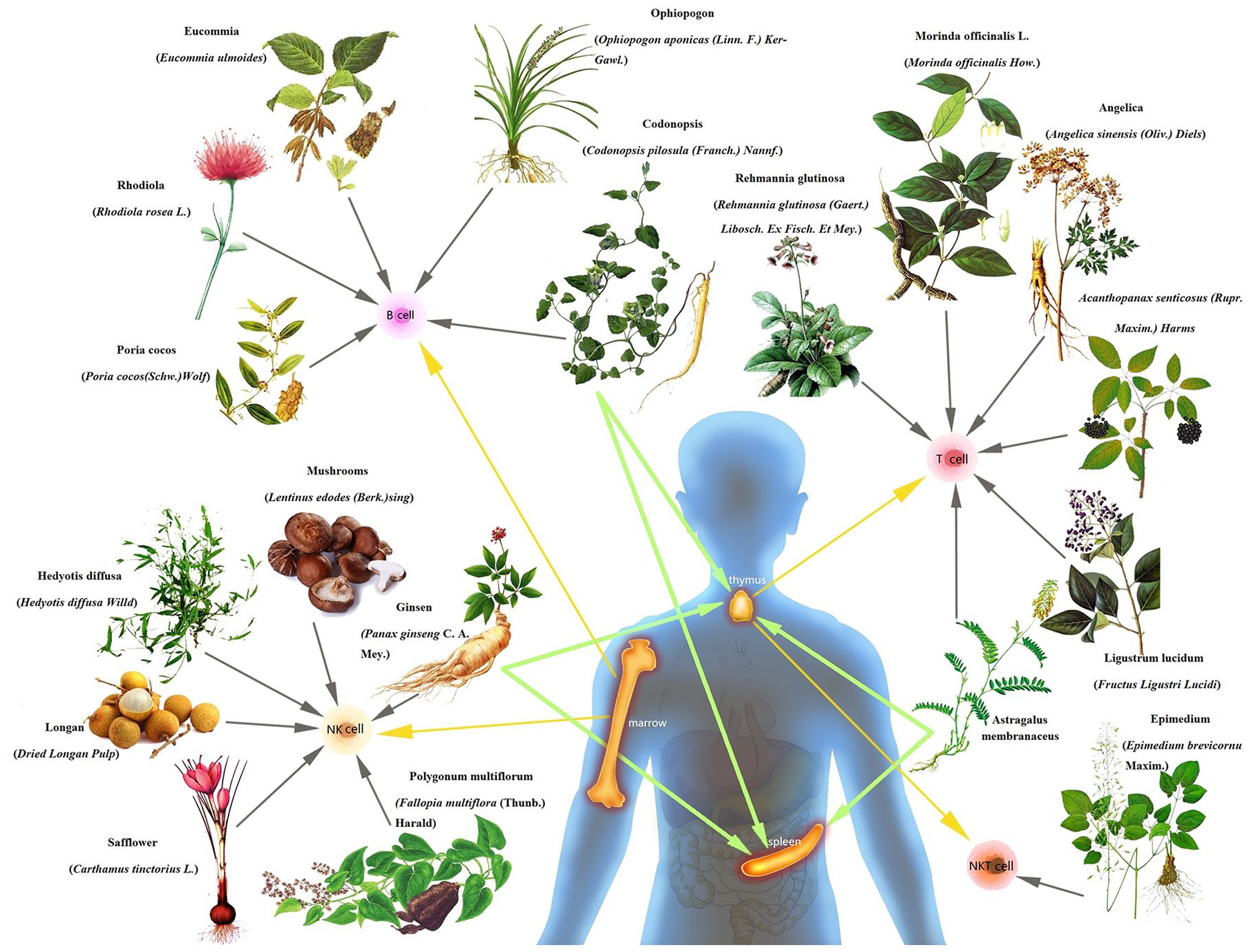
Natural drugs acting on immune organs and some immune cells.
Effects on non-specific immunity
Non-specific immunity refers to a series of natural defense mechanisms that organisms gradually form during long-term germline development and evolution, which is the basis of all immune protection capabilities. It can respond quickly to foreign pathogens and also plays an important role in specific immune responses.
Effects on macrophages
Macrophage is a kind of WBC located in the tissue. In the form of fixed cells or free cells, it performs bacteriophagy on cell fragments and pathogens and activates lymphocytes or other immune cells to respond to pathogens, playing an important role in the immune system.
Cistanche (Cistanche deserticola Ma)
Cistanche (Cistanche deserticola Ma) is a genus of Cistanche, which is mainly found in Xinjiang, Inner Mongolia, and Alxa League. It is also distributed in Gansu and Ningxia in China. It has various pharmacological activities such as immunomodulation and anti-oxidation. The low molecular sugar of C. deserticola has good pharmacological activity against macrophages in the immune system.
Zhang et al.’s 22 research suggests that the low molecular sugar of C. deserticola can activate macrophages, and its underlying mechanism is achieved through the NF-κB signaling pathway. Mannitol may be one of the key active monomer components.
Polygonatum odoratum (Polygonatum odoratum (Mill.) Druce)
Polygonatum odoratum (Polygonatum odoratum (Mill.) Druce) is a plant of the family Liliaceae, which is found in Heilongjiang, Jilin, Liaoning, and other places in China. The rhizome of P. odoratum contains various active substances such as polysaccharides, flavonoids, and alkaloids. P. odoratum extract A is an alcoholic water extract, which has been found to have the characteristics of inhibiting cellular immune function and inflammatory response.
P. odoratum extract A can effectively inhibit the release of pro-inflammatory cytokines IL-6 and TNF-a (tumor necrosis factor-a) from LPS-activated mouse peritoneal macrophages in a dose-dependent manner and inhibit LPS-activated mice by downregulating iNOS (inducible nitric oxide synthase) expression. Peritoneal macrophages secrete NO. 23
Astragalus chinensis (Astragalus chinensis Linn. f.)
Astragalus chinensis (Astragalus chinensis Linn. f.) is a dry mature seed of the leguminous plant A. chinensis, distributed in northeast China, North China, Henan, and other places. Modern pharmacological studies have shown that A. chinensis mainly contains flavonoids, triterpenoids, organic acids, and trace elements. The total flavonoids of A. chinensis can regulate the function of macrophages and play an anti-tumor role.
Cui and other experiments 24 showed that the high, middle, and low doses of flavonoids (FAC) significantly increased the thymus index and spleen index of tumor-bearing mice, which was statistically significant compared with the normal control group (P < 0.05). The middle-dose group can significantly increase the phagocytic function and lymphocyte transformation ability of macrophages, and the difference was statistically significant compared with the normal control group (P < 0.01).
Radix Pseudostellariae (Pseudostellaria heterophylla (Miq.) Pax)
Radix Pseudostellariae (Pseudostellaria heterophylla (Miq.) Pax) is a plant of the genus Pseudostellaria. It is distributed in Liaoning, Inner Mongolia, Hebei, and other places. It is distributed in Japan and North Korea. It has the effects of replenishing qi and strengthening the spleen and enhancing immunity. The polysaccharide of Radix Pseudostellariae has a good immunological effect.
Cai et al.’s 25 research found that polysaccharides from Radix Pseudostellariae can increase the phagocytic rate and phagocytic index of mouse macrophages and can increase CD3, CD4, CD4/CD8 to a certain extent and decrease CD8, indicating that the crude extract of Pseudostellaria chinensis polysaccharides on mice non-specific immune function has a promoting effect.
Cynomorium (Cynomorium songaricum Rupr.)
Cynomorium (Cynomorium songaricum Rupr.) is a perennial fleshy parasitic herb, which is distributed in many provinces and regions of China. It is also distributed in Central Asia, Iran, and Mongolia. Cynomorium has a variety of pharmacological activities such as anti-stress, scavenging free radicals, and immune regulation. In recent years, with the continuous research on Cynomorium, it has been found that Cynomorium polysaccharide has good pharmacological activity against non-specific immunity.
Re et al.’s 26 study found that different concentrations (25–400 μg/mL) of Cynomorium polysaccharide can promote the proliferation of macrophage RAW264.7 (P < 0.05 or P < 0.01). The proliferative activity of Cynomorium polysaccharides at 24 and 48 h was significantly higher than that at 6 and 12 h (P < 0.05). The concentration of 25–400 μg/mL could significantly promote the phagocytic activity of cells (P < 0.05).
Curculigo orchioides (Curculigo orchioides Gaertn.)
Curculigo orchioides (Curculigo orchioides Gaertn.) is a plant of the genus Curculigo, which is found in Zhejiang, Jiangxi, Fujian, and other places in China and is distributed in Southeast Asia and Japan. It has the pharmacological effects such as enhancing immunity and delaying the aging of the reproductive system. Clinically, it is used for infertility, impotence, menopausal syndrome, and other diseases. Modern pharmacological studies have found that C. orchioides polysaccharide may be a potential immune adjuvant.
Cai et al. 27 found that different concentrations of C. orchioides polysaccharide could upregulate the expression of CD80, CD86, and MHC-II (major histocompatibility complex-II) on the surface of peritoneal macrophages (P < 0.05, P < 0.01) in vivo experiments. It indicates that the polysaccharides of C. orchioides can promote the antigen presentation of mouse macrophages in vitro and in vivo and enhance the immune effect of influenza vaccine. It may become a flu vaccine adjuvant with potential application value.
Rehmannia (Rehmannia glutinosa (Gaert.) Libosch. Ex Fisch. Et Mey.)
Isolation of 2,5-dihydroxyacetophenone (DHAP) from Rehmannia glutinosa significantly inhibited NO production by inhibiting iNOS expression and it downregulated mRNA expression in LPS-stimulated macrophage. RAW264.7 cells significantly decreased levels of pro-inflammatory cytokines TNF-α and IL-6. Moreover, DHAP can effectively inhibit the phosphorylation of ERK1/2 (extracellular regulated protein kinases) and nuclear translocation of NF-κBp65 in LPS-stimulated cells, indicating that DHAP blocks ERK1/2 and NF-κB signaling pathway inhibits the production of inflammatory mediators in activated macrophages (Figure 2). 28

Mechanism of some natural drugs acting on macrophages.
Effects on DCs
DCs are the most powerful professional antigen-presenting cells in the body, which can efficiently ingest, process, and present antigens. Immature DCs have strong migration ability, and mature DCs can effectively activate primary T cells, which are central to initiation, regulation, and maintenance of immune responses.
Ginseng (Panax ginseng C. A. Mey.)
Ginsenoside Rh2 increased the expression of MHC-II on the surface of DCs (P < 0.05). It reduces the negative regulatory molecules on the surface of DC—the expression of programmed death molecule 1 ligand (PD-L1) (P < 0.05). 29
Glycyrrhizinic (Glycyrrhiza uralensis Fisch.)
Glycyrrhizinic (Glycyrrhiza uralensis Fisch.) is a leguminous licorice plant, mainly distributed in Xinjiang, Inner Mongolia, Ningxia, Gansu, and other places in China. Glycyrrhizinic is a commonly used natural medicine for tonic. The medicinal parts are roots and rhizomes. Glycyrrhizinic has many effects such as anti-virus, analgesic, anti-tumor, and immunity. Glycyrrhizinic Acid (GA) is a triterpenoid saponin isolated from licorice and has a good ability to regulate the immune system.
Bordbar et al.’s 30 study showed that 18α-GA (18α-glycyrrhizinic acid) and 18β-GA (18β-glycyrrhizinic acid) upregulate the expression of surface molecules CD40, CD86, and MHC-II in DCs, indicating that GA promoted the maturation of DCs. Glycyrrhizinic polysaccharides upregulate the expression of surface molecules CD80, CD86, and MHC-II in DCs; it promotes the production of IL-12 and enhances the expression of IFN-γ and proliferation of allogeneic T cells. 31
Atractylodes (Atractylodes macrocephala Koidz.)
Atractylodes (Atractylodes macrocephala Koidz.) is a genus of the family Asteraceae, which is mainly distributed in mountainous wetlands such as Sichuan, Yunnan, and Guizhou in China. A. macrocephala is used as a medicine and has many medicinal functions. Atractylodes contains a variety of active ingredients such as Atractylodes polysaccharide and atractylenolide, with anti-tumor activity, improves the body’s immunity and other effects.
Atractylodes polysaccharide can promote the expression of DC surface molecules HLA-DR (human leukocyte antigen DR), CD86, CD83, and CD80 in a dose-dependent manner and also reduce the phagocytosis of DC to promote DC secretion of IL-12 and TNF-α. 32
Aconite (Aconitum carmichaeli Debx.)
Aconite (Aconitum carmichaeli Debx.) is a plant of the genus Aconitum; it is mainly found in Sichuan, Hubei, Hunan, and other places in China. Aconite has strong heart, anti-inflammatory, and analgesic effects, among which aconite polysaccharide has the immune activity of regulating DCs.
Appropriate concentration of aconite polysaccharide can make DC highly express surface molecules such as CD80, CD83, and CD86. 33
Achyranthes bidentata (Cyathula officinalis Kuan)
Achyranthes bidentata (Cyathula officinalis Kuan) is the dry root of the Achyranthes of the family Polygonaceae, which is mainly found in Sichuan, Guizhou, Yunnan, Hebei, and other places in China. Modern pharmacological studies have shown that A. bidentata polysaccharides isolated from A. bidentata have various pharmacological activities such as anti-tumor and immune function.
Feng et al.’s 34 study found that A. bidentata polysaccharide enhanced DC to present antigen to CD8+ T lymphocytes, activated CTL (cytotoxic T lymphocyte) immune response, and antigen information was also presented to CD4+ T lymphocytes to initiate humoral immunity and kill tumor cells.
Cordyceps sinensis (Ophiocordyceps sinensis)
Cordyceps sinensis (Ophiocordyceps sinensis) is a kind of medicinal fungus. It has become a research hotspot due to its unique medicinal value. In recent years, the active ingredients of C. sinensis have been extensively studied and found to have immunological regulation, anti-tumor, anti-oxidation, and other pharmacological activities.
Experiments have shown that the extracellular polysaccharides of C. sinensis can significantly increase the levels of DC surface molecules CD1a (leu6), CD83, and HLA-DR and costimulatory molecules CD80, CD86, and CD40 (P < 0.05, 0.01). Cordyceps polysaccharide can increase the mRNA level of IL-12p40 (interleukin-12p40) and decrease the expression of VEGF (vascular endothelial growth factor) mRNA (P < 0.05, 0.01). The expression of NF-κBp65 in DC nuclear protein showed an increasing trend with the increase in the concentration of Cordyceps polysaccharide. Finally, it was proved that Cordyceps polysaccharide may enhance the immune function of the body by changing the differentiation, development, and maturation of DC. These changes may be associated with NF-κB and STAT3 (signal transducer and activator of transcription 3) signaling pathways (Figure 3). 35

Mechanism of some natural drugs acting on dendritic cells (DCs).
Effects on natural killer cells
Natural killer (NK) cells are important immune cells of the body, not only related to anti-tumor, anti-viral infection, and immune regulation, but also participate in hypersensitivity and autoimmune diseases in some cases; can identify target cells and kill medium.
Ginseng (Panax ginseng C. A. Mey.)
He et al. 36 found that ginseng oligopeptide (GOP) enhances innate and adaptive immunity in mice by improving NK cell activity.
Polygonum multiflorum (Fallopia multiflora (Thunb.) Harald)
Polygonum multiflorum (Fallopia multiflora (Thunb.) Harald) is a perennial entwined vine of the Polygonaceae family. It is found in southwestern Shaanxi, southern Gansu, and other regions and is also distributed in Japan. P. multiflorum has many anti-aging effects, affecting the immune system, reducing blood lipids and other pharmacological activities.
Sun et al. 37 reported that P. multiflorum Thunb. anthraquinone glycoside (AGPMT) can significantly enhance the ability of mouse NK cells to kill target cells, enhance the secretion of TNF activity by mouse spleen cells, and enhance the body’s defense ability.
Epimedium (Epimedium brevicornu Maxim.)
Epimedium (Epimedium brevicornu Maxim.) is a plant of the genus Ranunculus Berberis, which is cultivated in Shaanxi, Gansu, Shanxi, and Henan. Modern pharmacological studies have found that Epimedium has pharmacological effects on the immune system, reproductive system, and cardiovascular system. Icariin is a flavonoid compound with biological activities such as immunomodulation and anti-tumor.
Wu et al. 38 studies on immunosuppressed mice found that the percentage of CD3+ T cells and NKT (natural killer T) cells in the spleen and thymus lymphocytes of mice was significantly increased after administration of icariin to immunosuppressed mice.
Longan (Dried Longan Pulp)
Longan (Dried Longan Pulp) is a sarcoid plant with the same origin of food and medicine. Longan meat has anti-aging, anti-tumor, endocrine regulation, immune regulation, and other effects, among which longan polysaccharide is one of its main active ingredients.
LGP50 (longan polysaccharide 50) and LGP50S-1 (longan polysaccharide 50S-1) can improve the killing activity of NK cells and macrophages in mice, produce NO and carbon clearance ability, and strengthen non-specific immune function in mice, by activating the NF-κB and MAPK (mitogen-activated protein kinase) signal pathway to promote mice spleen lymphocyte proliferation and secretion of IL-2 and delayed-type hypersensitivity intensity increased specificity immune function in mice; at the same time, LGP50 has anti-aging effect. 39
Safflower (Carthamus tinctorius L.)
Safflower (Carthamus tinctorius L.) is a genus of the family Asteraceae, which is native to Central Asia, Japan, and North Korea. It is mainly produced in Henan, Hunan, Sichuan, Xinjiang, and Tibet. It is a traditional Chinese medicine for promoting blood circulation and removing phlegm. Modern pharmacological studies have shown that safflower has many pharmacological effects such as anti-inflammatory, anti-platelet–activating factor, and blood lipid lowering. The study found that the active ingredient safflower polysaccharide (SPS) in safflower has immunomodulatory effects.
Shi et al. 40 studied the anti-tumor activity of SPS in vitro and in vivo and its effect on the killing activity of CTL and NK cells in tumor-bearing mice. It was found that SPS can significantly improve the killing activity of spleen CTL cells and NK cells in tumor-bearing mice (P < 0.05).
Hedyotis diffusa (Hedyotis diffusa Willd)
Hedyotis diffusa (Hedyotis diffusa Willd) is a member of the genus of the family Rubiaceae, which is distributed in China, Fujian, Guangdong, Hong Kong, Guangxi, Asia, tropical, Nepal, and other places. It has anti-tumor, anti-bacterial, and immune-modulating effects. The polysaccharide of H. diffusa has the pharmacological action of regulating immune cells.
In the experiment of studying the effect of H. diffusa polysaccharide on immunosuppressive mice, Qi et al. 41 observed that compared with the model group, the activity of NK cells in the middle- and high-dose groups of H. diffusa polysaccharide was significantly increased (P < 0.01).
Mushrooms (Lentinus edodes (Berk.) Sing)
Mushrooms (Lentinus edodes (Berk.) Sing) is an edible fungus. With the continuous research of modern medicine and nutrition, the medicinal value of shiitake mushrooms is constantly being discovered. The ergosterol in the mushroom is effective for preventing and treating rickets, and the lentinan can enhance the cellular immunity and inhibit the growth of cancer cells.
Lin et al. 42 found that lentinan can restore the spleen NK cell activity of tumor-bearing mice to near-normal levels (Table 1).
Classification of natural agents acting on cytokines, specific immunity, and non-specific immunity.

Summary
Tonic kind of natural drug regulation is roughly divided into two aspects: the mechanism of the immune system through direct effects on various organs of the immune system, immune cells and immune molecules play a role of immune enhancement and adjustment or through the influence of nerve-endocrine-immune system network, directly or indirectly, to adjust the immune function.
Natural drugs have a wide variety of active ingredients and diverse biological activities. They participate in different aspects of the immune system. For example, APS can regulate cellular immunity, and it can also act on other parts of the immune system. Studies have found that APS can increase the weight of immune organs such as spleen and thymus, increase the number of macrophages, promote the chemotaxis of neutrophils to the inflammatory zone, enhance NK cell activity, promote DC maturation, increase cytokine secretion, and regulate red blood cell immunity. Ginsenoside can also promote cytokine secretion; ginsenosideRh2 can regulate DCs; ginsenosideRg1 can protect spleen; ginseng oligopeptide can increase NK cell activity; another study found that wild ginseng can significantly promote RAW 264.7 macrophages proliferation, which also fully demonstrates that the active ingredients in natural medicines act on different aspects of the immune system to exert immunomodulatory effects.
Some natural drugs can increase the proliferation of spleen lymphocytes, peritoneal macrophages, phagocytic ability, and secretion of related cytokines (such as C. pilosula). Some natural drugs can regulate the expression of related cytokines, increase the growth index of thymus and spleen, and achieve immunomodulatory effects by stimulating macrophage secretion of NO, TNF-α, and IL-6 (e.g. American ginseng polysaccharide). Natural drugs can increase the secretion of related cytokines, promote the growth of immune organs, and significantly reduce the content of MDA, increase the activity of T-SOD (total superoxide dismutase) in the supernatant of mouse macrophages, improve the body’s ability to produce NO and IL-1β, and enhance the body’s immunity; it can increase the ratio of CD3+, CD4+, and CD4+/CD8+; increase the value-adding ability of T lymphocytes; increase the serum IgG content of mice; and participate in humoral immunity (such as yam extract polysaccharide).
The above indicates that the single active ingredient in the supplemental natural medicine or the separated effective active substances can act on different immune organs, immune cells, or different parts of the immune system and exert multi-target and multi-level immunomodulatory effects, thereby correcting the immune down state. Clinical studies have shown that tonic natural drugs have low drug resistance, and many natural drugs such as medlar, yam, and shiitake mushrooms are all homologous of food and medicines, which have little side effects on the body and have great development prospects. The transition from therapeutic to prophylactic in today’s medicine and the development and utilization of natural active substances will make the development of supplemental natural drugs enter a new stage. The pharmacodynamic mechanism of tonic natural drugs is the result of multi-component, multi-target interactions. Natural drugs have rich nutritional value and special health care effects, and most of them have no obvious toxic and side effects. Many of them have broad development prospects. However, the research on the immune regulation mechanism of tonic natural drugs is still in its infancy, and many components and pharmacological effects are still unclear, and it needs to be continuously explored.
Footnotes
Declaration of conflicting interests
The author(s) declared no potential conflicts of interest with respect to the research, authorship, and/or publication of this article.
Funding
The author(s) disclosed receipt of the following financial support for the research, authorship, and/or publication of this article: This research is funded by the following projects: National Natural Science Foundation of China (no. 81760748 and no. 81550047); the Major Science Foundation of Affiliated Hospital of Inner Mongolia Medical University (NYFY ZD 010); Natural Science Foundation of Inner Mongolia Autonomous Region (no. 2018LH08032 and no. 2017MS0831); Inner Mongolia Autonomous Region “Prairie excellence” Project.
Informed consent
We declare that this manuscript entitled “Advances in research on the effects of natural drugs with immune-promoting effects on immune function” is original, has not been published before, and is not currently being considered for publication elsewhere. We confirm that the manuscript has been read and approved by all named authors and that there are no other persons who satisfied the criteria for authorship but are not listed. We further confirm that the order of authors listed in the manuscript has been approved by all of us. We understand that the Corresponding Author is the sole contact for the Editorial process. He is responsible for communicating with the other authors about progress, submissions of revisions, and final approval of proofs.
