



Abstract
Adopting a mixed-methods research design, this study explored the psychological experiences of marginalized young people participating in inclusive music projects, with attention to inter- and intra-personal outcomes and underlying mechanisms. We worked with four different music projects, aimed at young people from lower socio-economic backgrounds or those with special educational needs and/or disabilities. With a total sample of 134 young people, parents, and creative practitioners, we used quantitative analyses of retrospective surveys to assess staff members’ perceptions of changes evident in individual young people (n1(total) = 99, n1(female) = 39, n1(male) = 59, n1(non-binary) = 1, mean age = 15.59). We performed thematic analysis on eleven semi-structured focus group discussions conducted with the young people (n2 = 26), their parents (n3 = 14), and staff members (n3 = 21), and 82 session reports completed by the staff members after each session. Growth over time in both intra-personal and inter-personal dimensions of functioning was observed, with qualitative data illuminating possible environmental and psychological mechanisms via two overarching themes of “Self-Development” and “Social Acknowledgement”. These results are collated in the model of youth empowerment, and its relevance to marginalized groups of young people is highlighted through promotion of active agency and empowerment. The model is interpreted in the light of several psychological theories of well-being, particularly self-determination theory and access-awareness-agency model, and implications for future work are discussed.
Keywords
A variety of inter-disciplinary research studies have demonstrated the link between engagement in musical activities and positive psychological well-being. The value of music has been recognized in clinical contexts, in terms of outcomes such as increasing the life quality of chronic disease patients (e.g. Bradt et al., 2016), and the effectiveness of mental health treatments in the form of music therapy (e.g. Aalbers et al., 2017). Furthermore, this connection has been highlighted in casual and amateur music-making settings, such as community choirs for adults (Williams et al., 2018) or music settings for children and young people (Barrett & Smigiel, 2007). In fact, the role of music in nurturing adolescents’ well-being has been suggested to be of special importance, as this period of the lifespan can be associated with great emotional disturbances (Halle, 2003) and there are trends suggesting historical increases in adolescent mental health difficulties in the last two decades (Bor et al., 2014; Patalay & Gage, 2019). For these reasons, engagement with music presents a unique approach to facilitating youth well-being. This has been suggested by multiple psychological outcomes of engagement with music identified in past research, in relation to the self, representing internal or intra-personal outcomes, as well as beyond the self, with others, representing inter-personal outcomes (Hallam, 2015). However, the understanding of psychological mechanisms underlying commonly observed outcomes and how those connect with existing psychological theories remains understudied (e.g. Dingle et al., 2019). The present work addresses this gap with attention to inclusivity-based musical activities for vulnerable groups of young people.
Intra- and Inter-Personal Outcomes of Youth Engagement with Music
Impact on the psychological well-being as a result of youth engagement with music has been recognized in past research, generally reported qualitatively, and rarely demonstrated using quantitative measures. Some qualitative reports acknowledge the direct impact of engagement with music on one's well-being (e.g. Barrett and Smigiel, 2007), but this has been mainly acknowledged via mediating positive psychological constructs (e.g. Papinczak et al., 2015). Among the most commonly recognized mediating developments are increased general confidence and self-efficacy (e.g. Tung, 2018), as well as the ability to express and explore one's identity and affective experiences through music-making (e.g. Adderley et al., 2003; Papinczak et al., 2015).
In addition to intra-personal outcomes, music engagement appears to affect a wide range of social, inter-personal aspects as well. In fact, enrichment of social skills was recognized by young people as an extremely valuable benefit of group music-making (Kokotsaki & Hallam, 2007). Moreover, progress in a wide range of specific inter-personal skills has been recorded, including improvements in communication skills (e.g. Galarce et al., 2012) and team-work (e.g. Slevin and Slevin, 2013), as well as reductions in behavioral difficulties and bullying behavior in the participating young people (e.g. Epelde-Larrañaga et al., 2020). Additionally, young people report improved quality of relationships with other young participants and adults, as well as feelings of belonging and community (e.g. Kokotsaki & Hallam, 2007; Mo, 2018). This was specifically mentioned in relation to the inclusion of minority groups, when Adderley and colleagues (2003) interviewed members of various school ensembles, who emphasized the importance of music in connecting the ethnically diverse members of the orchestra.
Taken together, multiple evaluations of music projects for young people have identified a great range of intra- and inter-personal outcomes associated with positive well-being. What is more, there appears to be a trend suggesting that such developments have been most profoundly experienced by those identified as being the most marginalized, at risk, or otherwise in need of support. For example, “troublesome” participants of an integrated arts project were observed to show the greatest advances in their attitude towards others (McKeon, 1982), with similar conclusions emerging from Catterall et al.,’s (2012) secondary analysis of longitudinal data sets, suggesting arts engagement has a great potential in narrowing the gap between socio-economic backgrounds, especially in terms of academic achievements. Besides individual differences, opportunities for sharing one's work with others, such as performing, and praise associated with these activities, appear to play a role in enhancing young people's experiences and changes (Jermyn, 2004; Tung, 2018). These outcome differences on individual and project level highlight the importance of studying the mechanisms of change as a step towards a general and holistic understanding of youth music-making experience, rather than relying on individual population groups and projects.
Psychological Mechanisms of Youth Engagement with Music
The mechanisms that drive these intra- and inter-personal outcomes, and the way they fit into existing psychological theories of well-being, remain poorly understood. One helpful theoretical framework for understanding the role of musical experiences in relation to other contexts in young people's lives is self-determination theory (SDT; Deci and Ryan, 2000), especially as it can be integrated with other pertinent psychological theories. Self-determination theory suggests that environmental contexts play a vital role in nurturing one's psychological well-being and driving personal growth, with Deci and Ryan (2000) proposing that these can be summarized by the extent to which they satisfy three basic psychological needs for autonomy, relatedness, and competence. As outlined below, all three basic needs have the potential to be fulfilled by creative contexts, and this is also supported by studies using quantitative measures of need satisfaction in creative contexts and demonstrating their link to well-being (Milyavskaya & Koestner, 2011; Russell et al., 2021; Stewart & Lonsdale, 2016).
Autonomy, Self-Awareness, and Affective Expression
Perhaps the most prominent of the three basic needs in SDT is autonomy, relating to the need for agency in one's decisions and actions, as indicated by the theory's core focus on self-determination. Its relevance to music-making and well-being can be understood particularly in relation to social-emotional learning, as suggested by Saarikallio's (2019) proposed access-awareness-agency (AAA) model of music-based social-emotional competence. This model highlights music as a non-verbal and expressive tool for accessing and embodying one's internal experiences and emotions, facilitating self-reflective emotional comprehension and self-awareness. This not only facilitates greater emotion understanding (e.g. Frijda and Sundararajan, 2007) and self-exploration (DeNora, 1999), but also provides new means of nurturing the sense of agency over affective experiences. Moreover, the sense of autonomy was also reported to be supported through ownership of one's musical creations and choices, encouraging autonomous engagement and independence (Laiho, 2004). The AAA model highlights the role of music in encouraging agentic intra-personal development, which can be further extended via emotional communication skills and promotion of empathy (Saarikallio, 2019; Saarikallio et al., 2014).
Relatedness, Social Capital, and Social Identity
Another focal point within SDT is the experience of connection to others and a sense of belonginess, and these qualities are clearly seen in the social aspects of music. Psychologists have argued that music has a fundamental role in the creation of social bonds and offers unique tools that facilitate group formation (e.g. Savage et al., 2020). This hypothesis is particularly supported by research on inter-personal synchrony, as there appears to be an innate relationship between synchronous movement in a musical context and pro-social behaviors towards those involved, seen as early as of 14 months of age (Cirelli et al., 2014). Still observed in children and adults (e.g. Hove and Risen, 2009), physical synchrony is also relevant on a group level, nurturing the sense of cohesion and belongingness of group members engaged with joint music-making as well as singing (e.g. Good & Russo, 2016; Kirschner & Tomasello, 2010).
The concept of social capital (Bourdieu, 1986; Coleman, 1988; Putnam, 1995) introduces an additional framework by which the need for relatedness is supported within the music groups and workshops. In a community choir setting, social capital was manifested in shared values and norms as well as in the sense of trust and fellowship among its members (Langston & Barrett, 2008). Furthermore, singing ability in children was associated with higher reports of feeling socially included (Welch et al., 2014) and introducing music in schools was reported to result in enhanced classroom cohesion (Spychiger et al., 1993) and positive perceptions of the quality of school life (Eerola & Eerola, 2014). Thus, music appears to have an important role in promoting social capital on a personal as well as group level. In particular, according to the social capital theory, there are two levels on which social capital is formed, through social bonding on the basis of the similarities between participants, as well as through social bridging between different backgrounds and cultures (Gittell & Vidal, 1998; Putnam et al., 2004). Social bonding through music is of special importance for those excluded in other contexts, as it introduces new socializing and learning experiences, potentially breaking the cycle of rejection and social competence (Banerjee et al., 2011). Additionally, promoting social bridging is crucial when working with marginalized groups of young people. Promotion of inter-group contact through the inclusive nature of music is, according to the intergroup contact theory (Allport, 1954), an especially effective way of reducing prejudice and has a potential for a wider impact beyond music sessions (Pettigrew et al., 2011).
A systematic review by McPherson et al. (2014) concluded that the sense of social capital has a strong relation to well-being of the young people, in terms of improving mental well-being as well as reducing behavioral difficulties. Furthermore, the social identity approach to health (Haslam et al., 2018) particularly emphasizes the role of group membership in relation to the marginalized individuals’ well-being. This theoretical concept suggests that when positive social identity is internalized into the self-concept of its members, it encourages social support, adjustment, and well-being, the relevance to music-making of which has been recognized by Kyprianides and Easterbrook's (2020) work with music programmes in prisons. Finally, according to self-determination theory, satisfaction of all basic psychological needs further encourages internalization of group values and norms (Deci & Ryan, 1990) and appears to be a predictor of prosocial behaviors (Gagné, 2003), demonstrating how community bonds strengthen over time. Integration of such cultural elements into the “self” appears to nourish social capital, positive social identity, and individuals’ sense of belonging, which could have further added value for participants’ well-being (Stewart & Lonsdale, 2016).
Competence and Marginalized Young People
Being given an opportunity and the means of autonomous creativity in the context of trust and acceptance by others can be transformational and empowering, especially for young people who are disadvantaged by negative labels and stigmas. This transformation can occur through creating environments in which they challenge their own as well as wider perceptions of their competencies. Cooper coined the term re-signification or positive signification, describing “development of new and positive identities as a consequence of relationships and experiences which undermine the pupil's original negative view of self, by revealing evidence of desirable, positive qualities” (Cooper, 1993, p. 139). This process of transformation has been observed in the context of creative arts and music, through development of new roles as creators and musicians, independent from external labels young people have been experiencing due to their special educational needs (e.g. Thompson and Tawell, 2017), low socio-economic status (e.g. Mantie, 2008), or refugee status (e.g. Marsh, 2012).
Furthermore, the role of staff members has been highlighted in providing opportunities for achievements and praise, as well as introducing appropriate levels of challenge and encouragement through it (Cooper, 1993). In fact, Hampshire and Matthijsse (2010) illustrate the importance of music leaders’ capability of working with vulnerable young people, as failing to understand their needs and accommodate their music tastes significantly impacted participation and engagement. Lastly, the significance of sharing one's work was also emphasized, as it provides the means of communicating the competence of stigmatized groups to a wider audience, especially in relation to disabilities (Hall, 2013).
The Present Study
Music-making has been associated with multiple positive intra- and inter-personal qualities and skills that are related to well-being in young people, and self-determination theory (Deci & Ryan, 2000) provides a potential framework for conceptualizing the underlying psychological mechanisms. However, this picture is a result of collation of individual studies; the aims, evaluation materials, participants, and informant sources of which differ markedly. The aim of the present work is to integrate these issues by exploring young people's lived experiences of engagement with music, in terms of both, the perceived outcomes and the underlying mechanisms, and to address these in relation to the multi-faceted framework of self-determination theory (Deci & Ryan, 2000) outlined above. We worked with young people participating in four inclusive music-making projects, especially targeting young people from lower socio-economic backgrounds or those with special educational needs or disabilities.
Many evaluations of creative projects have been criticized for having limited methodological approaches, relying only on qualitative methods (Bungay & Vella-Burrows, 2013), and research focusing on marginalized groups of young people, especially those with special educational needs, has a poor track record of the subjects’ direct participation (Fayette & Bond, 2018). In order to address those gaps, this study adopts a mixed-methods design and addresses multiple informants, including young participants themselves. Staff members provided session notes and completed retrospective surveys about individual young people's developments, explicitly comparing various aspects of each participant's intra- and inter-personal functioning when they first began coming to the music group and later, after an average of ten sessions. Moreover, exploratory semi-structured focus groups and interviews were conducted with staff members, parents, as well as the young people, addressing the gaps in our understanding of young people's own perspectives, especially of those with special educational needs. Topic guides specifically focused on exploring observed developments as a result of music-making over time, and the environmental characteristics of musical experiences driving those, in order to identify potential mechanisms of change.
Methods
Participants
The participants were 21 staff members, 14 parents, and 99 young people involved with four inclusive music projects (N = 134). Based on the nature of the projects, we categorized them into “music spaces” (two projects), characterized as weekly drop-in sessions offering a selection of small-group music activities, ranging from performing alongside music known to the participant, creating new music, and music production tutoring, and “inclusive ensembles” (two projects), weekly ensemble sessions incorporating western classical musical instruments, contemporary pop/rock instruments, music production equipment, assistive music technologies, and a range of West African and Latin American percussion. A typical “music spaces” drop-in session begins with the young people sharing their goals and interests, based on which tutors organize a range of relevant activities, and typically finishes with participants sharing their progress with each other. A typical session at the “inclusive ensembles” begins with music-making as an ensemble, followed by work in smaller groups with individual tutors based on the participants’ needs and goals, and finishes with another group-music making activity. Generally, ‘music spaces’ mostly target young people from lower socio-economic backgrounds as the drop-in centers are located in low socio-economic areas, while “inclusive ensembles” are aimed at young people with special educational needs and / or disabilities, achieved by the projects’ close engagement with local special schools. 1 However, this does not represent a strict demographic division, as the inclusive ethos of those music projects meant that young people of any ability or background were welcome to attend and accommodated to participate in the sessions.
During the course of data-collection, 110 sessions took place, with 21 session reports returned from Inclusive Ensemble 1, 16 from Inclusive Ensemble 2, 25 from Music Space 1 (excluding 9 missing), and 20 from Music Space 2 (excluding 19 missing). As indicated in Table 1, there were a total of 99 young people involved across the projects. All were the subjects of retrospective surveys, which were completed by the staff members, and 26 of those young people also participated in focus groups. Additionally, 21 staff members participated in four separate project-specific focus groups, while 14 parents of the young people involved took part in two separate groups and one phone interview.
Participant counts across the projects and methods used, with gender breakdown for all samples and age mean with standard deviation for the young people.

Note: N = count, SD = standard deviation, F = female, M = male, NB = non-binary; Quan = count of participants involved with quantitative data (retrospective survey); Qual = count of participants involved with qualitative data (focus groups and interviews).
Measures
Quantitative Measure—Retrospective Surveys
A retrospective survey was designed to record changes in individual young people with regard to intra- and inter-personal areas of development. The survey also included items regarding musical development, but the results indicating musical progress were only utilized for reporting to funders and was deemed to be beyond the scope of this paper. The survey items were retrospective in nature, as the projects had already been running at the start of the data collection. They were completed by staff members, on a five-point Likert scale, indicating how true statements were for individual young people “at their first session”, and how true they were “now”, at the time of the completion of the survey, which was on average ten sessions later. The survey consisted of 13 items which were grouped into three factors in accordance to pre-identified areas of interest, using confirmatory factor analysis. 2 These were, Musical (α = 0.78, e.g. “Young person has a good understanding of musical skills / methods / techniques”), Social (α = 0.91, e.g. “Young person listens to others”), and Personal (α = 0.76, e.g. “Young person is confident”). One item was excluded from factor analysis and used as a variable indicating pupil engagement with the sessions (“Young person is actively engaging with the session activities”).
Qualitative Measures—Session Notes, Interview, and Focus Groups
Staff members completed a report template after each session, qualitatively describing activities as well as significant developments observed. Moreover, three semi-structured topic guides were designed for interviews and/or focus groups with the young people, staff members, and parents, respectively. The purpose of those discussions was to explore the psychological areas of development and the underlying mechanisms of music-making from multiple perspectives. All focus groups covered similar topics, summarized in Table 2, and lasted between 30 and 120 min.
Summary of topics covered in focus groups and interviews by sample group and example questions used.

Procedure
Session reports were completed after each session, starting from the beginning of the research project, January 2019. A final round of session report collection for the analysis was in March 2020, after which the staff members continued with report completion for another research project exploring virtual group music-making in times of the COVID-19 pandemic (Levstek et al., 2021). The retrospective survey work, focus groups, and interviews took place over the course of 8 months (June 2019 to January 2020). This process was aligned with the timings of different project activities, as they all differed in nature and schedule.
Retrospective surveys were distributed between the staff members working with the young people in the various projects. Staff were free to decide which young people to report on and asked to complete the surveys in their own time within 14 days of receiving them. Young people were given an opportunity to opt-out from being the subjects of these surveys, but no opt-out forms were requested or returned. Focus groups were conducted before, during, or after the session slots, at the regular venues. The exception were two staff focus groups conducted outside the session time and space due to staff availability, and one phone interview with a parent, due to parent's availability. Written consent or verbal assent was required prior to participation in focus groups and interviews, depending on the participants’ age and ability.
Analysis Plan
As this research project adopted a mixed-methods design, a range of statistical and qualitative analysis approaches were used.
Quantitative Analysis
Survey data were analyzed using RStudio software (R Core Team, 2021). The retrospective survey items were aggregated based on a confirmatory factor analysis, resulting in two outcome categories, “intra-personal” and “inter-personal”. 3 We performed a mixed analysis of variance (ANOVA, type III; Satterthwaite's method) with the retrospective survey score as a dependent variable. The within-subject predictor variables were time-point (“first session” vs. “now”) and outcome area (“intra-personal” vs. “inter-personal”), 4 and the between-subject predictor variable was activity type (“inclusive ensemble” vs. “music space”). Interactions of the within-subject predictor variables with the activity type variable were also investigated. This analysis was performed as a multi-level model with the maximum likelihood estimation method, using the “lmer” function from the “lme4” package, with time and outcome variables’ intercepts and slopes set to randomly vary by participant (Bates et al., 2015). The effect size partial omega squared was computed utilizing the “effectsize” package (Ben-Shachar & Lüdecke, 2020). The analysis was repeated with the “BayesFactor” package (Morey & Rouder, 2018), returning Bayes factor values for the predictor variables.
Since the effect of time was significant and large, we performed two regression analyses predicting the change of survey score between the two time-points (“at their first session” vs. “now”). Change scores were calculated at the individual level by subtracting baseline (“at their first session”) ratings from the ratings allocated for the time of survey completion (“now”). Utilizing the “lm” function of the “stats” package (R Core Team, 2021), we conducted two separate regression analyses predicting score change for the two outcome area scores (“intra-personal” and “inter-personal”). The predictor variables included in the regression analyses were age, gender, engagement score, 5 the number of sessions attended to the date of completion of the survey, and the baseline score for the opposite outcome area to the one predicted. 6
Qualitative Analysis
Qualitative data from focus groups, an interview, and session report notes were analyzed using thematic analysis approach. This approach was chosen to investigate emerging trends in the psychological constructs that the participants were reflecting on when talking about their experiences of the music-making groups. The transcribed texts were coded using NVivo 12 software, following the step-by-step guide suggested by Braun and Clarke (2006), within a critical realist epistemological framework (Fletcher, 2017). Considering the aim of our analysis was exploratory, we adopted an inductive, semantic approach to the analysis. We coded for all psychological and environmental constructs emerging from the data, without relying on any assumptions about the theoretical outcomes and psychological theories outlined in the introduction, or unpacking the implied meaning of the words used by the participants. However, we separated coding for themes into two super-ordinate categories, “Areas of Development” and “Mechanisms”, to which the codes were allocated. In line with the critical realist approach, themes and sub-themes were then reviewed and re-described in relation to relevant theoretical concepts, known as the process of “abduction” (Danermark et al., 2019). Following this, the results were presented to, consulted with, and approved by the initial participants as well as the key stakeholders.
Results
To explore the intra- and inter-personal domains of growth that young people experience as a result of inclusive music-making, and the mechanisms underlying them, we analyzed 82 session reports, ten focus groups, one interview, and 99 responses to retrospective surveys. The results informed the abductive construction of a model, comprising of the two main sections, representing areas of development and underlying psychological and environmental mechanisms (see Table 3 for the emerging themes and sub-themes, and Figure 2 for our conceptual model). The results are presented in relation to the model structure, uniting qualitative 7 and quantitative evidence for the areas of development young people experienced, followed by the identified psychological and environmental mechanisms that potentially drive those changes.
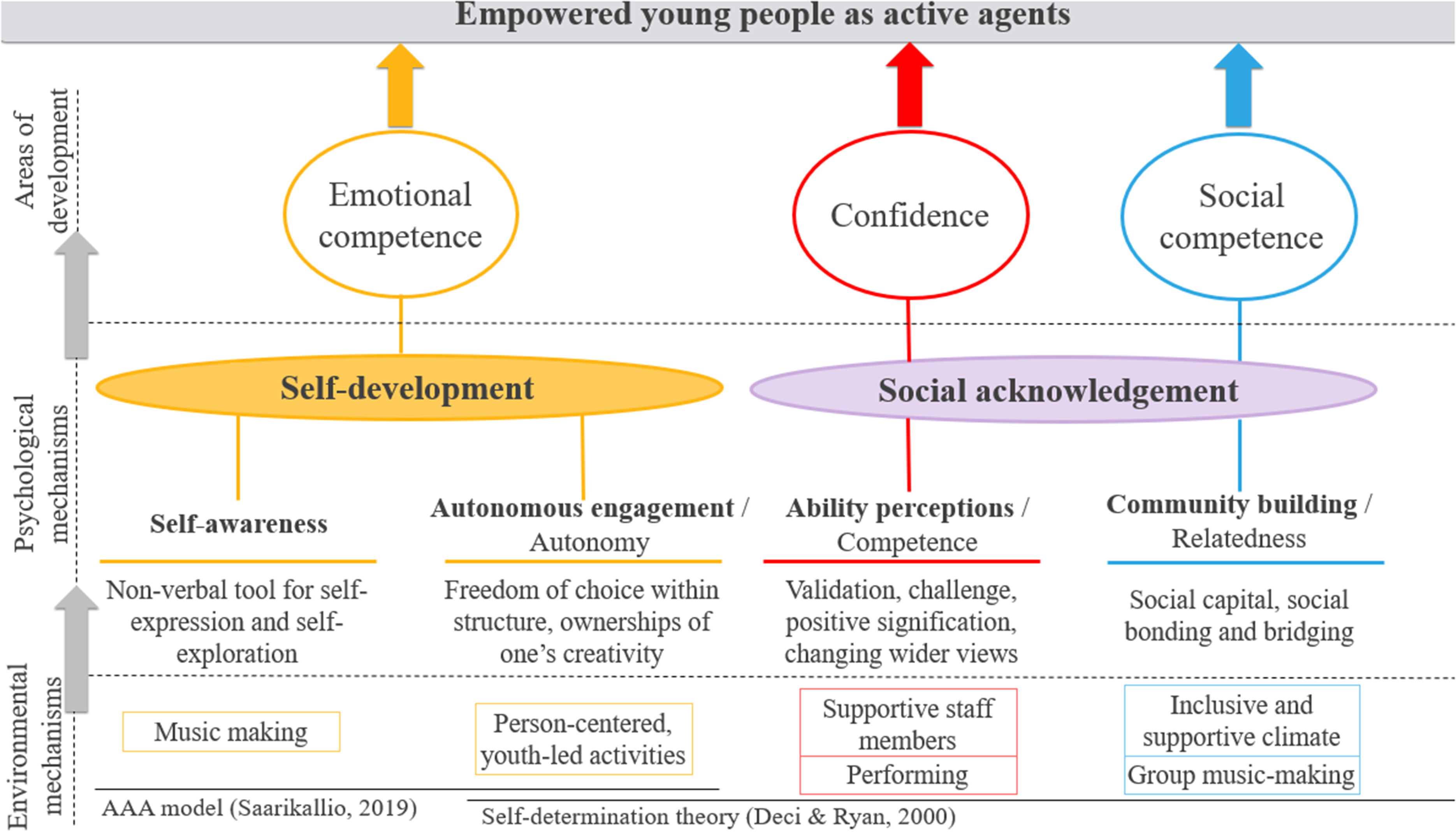
Our model of empowerment of the marginalized young participants through inclusive music projects, with the identified areas of development, the underlying environmental and psychological mechanisms, and their relevance to the existing psychological theories of well-being.
Qualitative themes and sub-themes with the number of references of occurrence.

Areas of Development
Mixed analysis of variance of the retrospective survey results indicated a significant and large (Field, 2013) main fixed effect of time (“first session” vs. “now”; b = 0.70, SE = 0.11, t(109.87) = 6.29, p < .001, Ω2 = 0.52, BF = 3.57*1057). The main fixed effects of the outcome variable (“intra-personal” vs. “inter-personal”) and the activity type variable (“inclusive ensemble” vs. “music space”) and their interactions with the time variable were not significant, with the effect sizes ranging from very small to small (Field, 2013). Figure 1 demonstrates that staff members allocated higher ratings for what the young people were like at the time of completion of the survey, M = 3.76, SD = 0.87, in comparison to what the young people were like at their first session, M = 2.95, SD = 1.01, on average ten sessions later.

Raincloud plot demonstrating changes in survey response means by time-point and outcome area of interest.
In line with these results, qualitative analysis recognized development in both areas captured by the retrospective survey, with two major themes emerging from the data: intra-personal development and inter-personal development. 8 Additionally, our analyses revealed that these developments are transferable to contexts outside the music sessions, and further expanded our understanding of personal outcomes by identifying two sub-themes (see Table 3).
Intra-Personal Development: “Several tutors noted how happy he looked.”SR
Staff members’ notes from session reports describe displays of positive psychological well-being by the young people on multiple occasions. The understanding of this area of development was expanded by identifying two main routes by which positive well-being is manifested, described by the sub-themes “Confidence” and “Emotional Competence”. “During the session, Young Person 1 played congas and several tutors noted how happy he looked, moving his body in time to the rhythm and playing with a big smile on his face.” SR
Confidence. “It Definitely Helps with Being Confident.” YP
Growing in confidence was the most commonly mentioned area of growth, coded for in every single focus group or interview. The growth in confidence over time was nicely demonstrated by two consecutive session report entries, illustrating the journey of an individual young person.
In fact, staff noted how confidence growth is reflected in young people becoming more socially comfortable as well as taking ownership of their role in the sessions by expressing their musical desires and actively engaging with their learning. Lastly, this growth also appears to be reflected outside the music sessions, especially manifested in greater independence.
Emotional Competence: “To Find Something That Could Actually Calm Me Down.” YP
Some participants opened up about their mental well-being and how engaging with music impacts it. When speaking about what the young people like about the sessions, a young person described how they “had a lot of anxiety as well due to [their] autism and wanted to find something that could actually calm [them] down.” YP This topic was touched upon on many occasions, especially when talking about young people with attention deficit hyperactivity disorder or those experiencing anxieties, describing how over time, “people feel more relaxed, behaviour becomes less extreme…” SM Significance of having a space where young people feel calm was highlighted by a parent describing how music has contributed to their child's journey through extreme anxiety and obsessive–compulsive disorder, indicating this too translates into the world beyond music sessions.
“Kind of knowing where he was, because he does have extreme anxiety, OCD, and those kinds of things. You know, my son a year ago and my son now are two completely different people. And yes, there are other, you know, I don’t contribute it all to the music group, don’t get me wrong, because he is accessing [counselling services] and other things as well. But it has had a huge impact and I don’t think the work [counselling services] were doing on their own would have been as successful had he not had exposure to this… Without a doubt, the music has transformed him.” PGC
Inter-Personal Development: “I Think I’ve got Less Socially Awkward.”YP
Another major theme relates to staff members’ observation that young participants became socially open and comfortable over time, with adults as well as their peers. A staff member describes how “some of these kids were really, like, [keeping] to themselves, they didn’t want anything to do with anybody else. And they’ve kind of, they find it easier now.” SM This feeling of being comfortable in social settings appears to sustain itself outside the sessions, with parents describing how young people recognize and speak to participants in external social contexts, which some “find difficult to do.” PGC Further, this drives young people to practice their social skills, in particular communication and team-work skills.
Um, I think, probably, better at speaking to people now, because I still find it difficult and stuff, but, um, yeah, like, um, like, [inaudible] I still find it nervous and difficult to but I do it more, definitely. […]
Yeah, I think I’ve got less socially awkward.” YP
Psychological and Environmental Mechanisms
In order to expand our understanding of the factors driving the developments observed, we conducted two regression analyses predicting change in intra-personal and inter-personal survey scores over time (from the first session to the time of completion of the survey, on average ten sessions later). As illustrated in Table 4, pupil engagement 9 was a significant predictor of inter-personal development, and a marginally significant predictor of intra-personal development. Interestingly, this pattern was not observed for the number of sessions young person attended to the day of survey completion. Further, the results suggest that those young people whose inter-personal scores were lower at their first session also showed greater improvements in the intra-personal outcome area over time and vice-versa, those whose intra-personal baseline scores were lower also showed greater improvements in the inter-personal outcome area. 10 The age or gender of young participants were not significant predictors of any change over time.
Regression results for the change of scores by the area of development.

Note: B represents unstandardized regression weights and SE B its standard error, beta (β) indicates the standardized weights and Adj.R2 adjusted R-squared; categorical predictor Gender, was coded 1 = female, 2 = male 11 ; First score S represents the baseline score (“at their first session”) of the inter-personal survey items, First score P represents the baseline score (“at their first session”) of the intra-personal survey items. * represents p < .05, ** p < .01, and *** p < .001.
Further, qualitative data highlighted several potential psychological mechanisms underlying the developments described in the outcomes section, summarized earlier in Table 3.
Self-Development
Young people appear to undergo a great level of self-exploration enabled through the non-restrictive, non-verbal, and creative nature of music, as well as personal growth due to the autonomy and acknowledgement staff members can offer through youth-led nature of the sessions. All of this allows young people to relax, feel like they can be themselves, and explore as well as express their emotions, which can be further emphasized through sharing and performing their work.
Self-Awareness Through Music: “I Think Music's Most of How I Express Myself and How I'm Feeling.” YP
Music provides a unique medium for affect expression, aiding young people's understanding of themselves. Young people reported feeling they can express their emotions non-verbally through music-making, especially important for non-verbal young people, as well as through song-writing. A young person reflected on how “you could create a happy piece and a sad piece and […] the audience would know the difference, if [one] played it to them […] I think music's most of how I express myself and how I’m feeling.” YP Additionally, staff members highlight how having the confidence to express oneself “gives yourself an identity and […] establishes who you are in a more positive and affirmative way.” SM
When exploring why such contexts allow this high level of self-expression and exploration, many reflected on the freeness and non-restrictive nature of music itself. This appears to be connected to young people feeling comfortable around others, describing that “[at the sessions], you can be yourself.” YP Staff members also acknowledge music has a meditative effect’, describing how “you can probably lose yourself in it, …, like you’re super relaxed, but you sort of hit the zone.” SM
Autonomous Engagement: “You Can Do Things However You Want To Do It and Then Not Be at Risk of Failing.” YP
Young people describe feeling like, “everyone can make a difference,”
YP
which, due to the non-restrictive nature of music and person-centered ethos of the sessions, contributes to young people feeling free and recognized. Staff members highlighted how playing music nurtures the feeling of being “sort of owner of what [one is] doing, but also how it works with other people […] You make your own part. So, you have your own voice, metaphorical voice.” SM This was described to have an especially important role for young people with disabilities, who experience limited autonomy over daily tasks or their movement (demonstrated by the quote below). However, as important as providing freedom seems to be, staff members describe how crucial it is to provide this within an organized framework, especially in terms of the session structure, location, regularity, and staff members present.
“And I think there is something also around the choice and ownership, where for the young people, generally people with disabilities, a lot of the choice, that we all take for granted is taken out of life. So, while we can offer choice through the music, it's… it really matters, like, it's big. […] So, there is a thing about choice and opportunity that in so many aspects of someone's life with a disability, potentially more so with physical disability and there is a lot of dependency. And actually, when someone can improvise in a genre that they love, it's you know, it's really important.” SM
Social Acknowledgment
The inclusive, accepting, and supportive climate of these sessions was highlighted across all focus groups and interviews, suggesting a meaningful mechanism underlying the various psychological constructs discussed above, as well as facilitating unique social opportunities and social bonding.
Changing Ability Perceptions: “They Can See That They'Re Just as Talented, Sometimes Even More So.” PGC
Staff members seem to have a unique adult role in young people's lives. This was described to lie within the autonomy and acceptance they provide, their professional but caring attitude, treating young people as young professionals, and having a good understanding of “how to work with them (young people), because there is no authoritarian structure.” SM Indeed, staff members appear to play a crucial role in young people's learning, by recognizing and validating their progress as well as challenging and supporting them (as demonstrated by the quote below). This seems to have a strong impact on the way the young people engage with the sessions and “just sort of listen to them [staff members] like they wouldn’t to anybody else.” PGC Besides, for some young people, staff members aren’t certain whether they “have trusted adults at home, [or] have trusted adults at a school?” SM
“And I think, you know, we all seem to be quite good at intuiting at what is needed. So, where we need to be, support people in being more focused in what discipline and where we celebrate. Even if something is unintentional. […] Because I think on some level that is extremely validating.” SM
Moreover, staff members highlight the importance of young people being “genuinely viewed as young musicians…”, regardless of their needs, which is especially “…important for their confidence.” SM Additionally, sharing work with others was highlighted as an important stage of confidence building, specifically emphasized in focus groups with parents of those with SEN/D, describing performances as “a really good lesson for those in the audience as well. Because they see that [their] children don’t need to be written off, […], they can see that they’re just as talented, sometimes even more so.” PGC
Community Building Through Music: “Everyone Can Connect with the Music.” YP
The topic of “thriving community”, “strong group ethos”, or “huge family” emerged in every single conversation, especially when asked about unique elements these sessions offer to the young people. This social structure seems to especially benefit those young people who struggle with or tend to avoid social interactions, as the musical element appears to facilitate social interactions among diverse groups of the young people, via the shared love for music as well as music-making itself. “Everyone can connect with the music and when everyone's in that room, there's so many different backgrounds of people, and they all love music in a very different way but when we all come together and play something we just all love and enjoy, we just love the feel of the music and it's just a really special moment.” YP
The climate of the sessions was identified as a crucial contributor towards the bonding of the groups. Participants described the climate as relaxed and open, making them feel accepted, where “no one is really going to judge you on what you write and produce.” YP This appears to originate from staff members’ relationships among themselves, who emphasized how important it is “to feel secure with each other and to feel like there is support and there is communication and help available, [which] definitely, definitely helps create that feeling in the whole group.” SM This is further nurtured and shaped by the young people themselves, who “are super supportive of each other as well […] there is a kind of, sort of vibe between everyone, which is quite nice, sort of … accepting … unifying,” SM with “more able ones, [been] given sort of mentor role for some less able ones.” SM
Lastly, a staff member highlights how “music is one of the best things for people to connect […] but there is so much lack of it in everyday lives, especially in the culture that we live in and the culture that this lot [young people] live in” SM which makes such opportunities even more valuable. “They were singing loud and laughing engaging with Staff Member 1 who was also singing the lyrics to the song. It really brought the group together. Staff member 2 said it was interesting to see the young people move between the rooms as a group, instead of being split between the rooms. It was the first time we have seen the young people taking major interest in what the others are doing and sticking together as a group.” SR
Discussion
Triangulation of quantitative and qualitative results from retrospective surveys, group, and individual discussions, as well as staff members’ session notes creates a clear picture of positive change on intra- as well as inter-personal dimensions of the young people taking part in inclusive music projects. Additionally, a wide range of psychological and environmental mechanisms have been identified, providing the basis for the formulation of a model of underlying mechanisms of change. The model consists of two overarching themes, “Self-development” and “Social acknowledgement”, summarizing key psychological and environmental mechanisms underlying intra- and inter-personal developments observed. Our proposed model illustrates the research results in the context of the relevant theories of psychological well-being, representing a potential multi-faceted framework for conceptualizing marginalized young people's experiences of group music-making.
Intra- and Inter-Personal Areas of Development
Young people appeared to grow in confidence and emotional competence, the latter being manifested in peacefulness and calmness, especially in relation to young people high in behavioral and psychological difficulties. Moreover, greater social competence was also recognized, especially evident in communication and team-working skills. These results are in line with the outcomes identified by past evaluations of music projects for young people (e.g. Adderley et al., 2003; Galarce et al., 2012; Slevin & Slevin, 2013; Tung, 2018). Further, qualitative results introduce a new inter-personal level of development, describing young people becoming more socially comfortable around others, especially evident in those high in social anxiety. This perhaps describes the first stage of relationship building identified in previous research (e.g. Kokotsaki and Hallam, 2007), especially important to recognize when working with less socially experienced young people.
There appears to be a trend suggesting developments are greater for those most in need. This is not only evident from qualitative descriptions of intra- and inter-personal developments outlined above, such as progress especially visible in those high in emotional, behavioral, or social difficulties, but also in relation to special needs and disabilities. Staff members highlight the significance of music in offering unique tools of communication for non-verbal young people and a new level of autonomy rarely experienced by physically disabled individuals. Moreover, regression analyses of change suggest that those who scored lower on either psychological construct for their first session also experienced greater progress in the other. Although it is important to consider that such results can be partially explained by a limited scale or the retrospective nature of the questionnaire, when considered in combination with the qualitative results, one can assume partial support for the suggested trend. Such tendencies have not been widely recognized before, with a few exceptions (e.g. Catterall et al., 2012; McKeon, 1982); however this could be due to a great prevalence of WEIRD (western, educated, industrialized, rich, democratic) and mainstream samples in music research (Dingle et al., 2019; Rad et al., 2018).
Self-Development and Social Acknowledgement
The sub-theme “Self-awareness through music” of the theme “Self-development” highlights music-making as a medium for communicating one's emotional experiences in a non-verbal and metaphorical way. This phenomenon matches the concept Saarikallio (2019) labels as “access”, one of three components of her access-awareness-agency model of social-emotional growth through music. The results expand our understanding of the environmental components facilitating this process, identifying importance of supportive and accepting contexts. Moreover, the role of musical expression in identity exploration has also been illuminated by staff members, which was outlined as part of the second construct of the AAA model (Saarikallio, 2019)—“awareness”. This aspect of music-making has also been discussed by DeNora (1999), referring to music as a “magic mirror” or “technology of the self”, describing it as an important tool of self-constitution and re-constitution over time. As suggested by the AAA model (Saarikallio, 2019), self-expression and self-exploration through music-making are possibly one of the mechanisms of observed developments in emotional competence.
Moreover, provision of autonomy has also been highlighted in the “Self-development” theme's sub-theme “Autonomous engagement”. The role of autonomy represents the third component of the AAA model (Saarikallio, 2019) and one of the three basic psychological needs of self-determination theory (SDT; Deci and Ryan, 2000). Supporting the AAA model (Saarikallio, 2019), our results suggest that music was a significant contributor to young people's perceptions of ownership over their creative work, inducing feelings of self-agency and self-control. Moreover, our results highlighted the significance of the “person-centred” or “youth-led” nature of the sessions, enabling creative freedom within a structured and organized framework. Freedom of choice and structure were the two essential environmental components of autonomy support identified in the context of SDT (Deci & Ryan, 2000; Reeve, 2006; Skinner & Belmont, 1993), illustrating the cross-over and relevance of both psychological theories to the developments observed.
The applicability of SDT (Deci & Ryan, 2000) to young people's psychological experiences of inclusive music projects is further described within the theme of “Social acknowledgement”. Support for the basic psychological need competence, commonly manifested in autonomous engagement (Deci & Ryan, 2000), was demonstrated within the sub-theme “Changing ability perceptions”. Participants emphasized the importance of being surrounded by supportive and reliable adults. Indeed, non-parental adult support has been associated with positive general self-concept and self-esteem in many contexts (Demaray et al., 2009; Sterrett et al., 2011) and supportive tutors were recognized as essential for youth engagement, especially when working with marginalized groups of young people (Hampshire & Matthijsse, 2010; Hanrahan & Banerjee, 2017; Wilkin et al., 2005). Staff members reflected on the delicate balance of providing validation and challenge when working with young participants. Their role in nurturing young people's perceptions of competence is further emphasized in their views of young participants as “young musicians” regardless of their needs or backgrounds. According to Cooper (1993), challenging young people's negative perceptions of their roles within societies can lead to changes in their self-concept, referred to as the process of positive signification, and can be achieved through high-quality relationships and opportunities for new, positive experiences. Lastly, the act of performing was highlighted as an important stage of confidence building by our participants, which appears to be further acknowledging and communicating young people's competencies and newly developed roles to wider audiences.
Satisfaction of the last of the three basic psychological needs of SDT (Deci & Ryan, 2000), relatedness, is represented within the communal nature of the relationships described in the sub-theme “Community building through music”. Participants emphasized the role of the general climate of the sessions in driving this sense of connectedness among the members, enabled by group music-making, and further nurtured and constructed by the staff members and young participants. Project climates were described as inclusive, supportive, and non-judgemental, suggesting these music groups are high in social capital (e.g. Langston and Barrett, 2008). Indeed, participants described the shared love of music as a fundamental bonding factor as well as a central point of contact among diverse groups of young people. This demonstrates the role of music in driving social bonding and bridging, two key routes of social capital support (Putnam et al., 2004). Additionally, the notion of strengthening group cohesion through joint music-making was also mentioned, which is in line with the hypotheses emphasizing the role of music in social bonding (e.g. Savage et al., 2020). As there is a strong link between social relations and social understanding (Banerjee et al., 2011), one may infer that facilitating social interactions through music-making could have a positive impact on the observed inter-personal development.
Empowered Young People as Active Agents
Figure 2 shows a conceptual model of how these themes fit together and collectively give rise to empowerment of the young people as active agents. Inclusive music projects appear to provide young people with the tools for changing their personal as well as social experiences. This, accompanied by the developments in understanding and perceptions of individuals and their communities as a whole, highlights the transformational potential of such spaces, especially for disempowered members of society (Karlsen, 2011; Westerlund, 2002). Karlsen (2011) suggests that musical empowerment takes place on individual as well as collective dimension, reviewed below in the context of our sample and the model.
On the individual level, music was described as providing an opportunity and the means for its participants to negotiate and develop their own identities and experience themselves as active agents (Karlsen & Westerlund, 2010). This sense of agency is further emphasized through emotional awareness and mood regulation enabled through music-making, providing young people with dominance over their affective experiences (Laiho, 2004; Saarikallio, 2019; Saarikallio & Erkkilä, 2007). In our model, this is demonstrated within the route of “Self-development” and is especially relevant to working with adolescents, as emotional disturbances and drive towards formation of independent identities are a great part of this period of the lifespan (Halle, 2003; Laiho, 2004). Moreover, its relevance to young participants’ experiences of marginalization is further demonstrated within the provision of alternative status of empowered, active creators within the society, summarized within the “Autonomy” and “Competence” routes in our model.
As highlighted by our participants, music represents a metaphorical space where young people have their own voice and can develop their own identities through musical actions and preferences, independent from their personal and environmental constraints (Laiho, 2004; Larson, 1995). This is specifically highlighted by our participants in relation to young people with physical disabilities, for whom autonomy in everyday life is extremely rare. Moreover, acknowledgement, encouragement, and support provided by the staff members create “safe” and “invisible” spaces, highlighted as important for nurturing the sense of “normality” away from external labels and stigma marginalized young people experience on daily basis (Hall, 2005, 2013; Herbert, 2009). This supports the development of new, positive identities and growth in one's perceptions of their own competence and confidence (Cooper, 1993), manifested in active engagement as suggested by our results and by SDT (Deci & Ryan, 2000). In our regression analyses of change, young participants’ engagement was a significant predictor of development on intra- as well as inter-personal level, while the number of sessions young person attended was not. This emphasizes the active role young people play in determining the impact of their own experiences within the music sessions, representing them as active agents and empowered individuals.
The collective dimension of empowerment through music is demonstrated within the communities and facilitation of social interactions created around it (Karlsen, 2012). This, in our model, is conceptualized within the route of “Social acknowledgement”, which could be crucial for marginalized groups of young people as they are generally more likely to be excluded from mainstream peer groups and miss out on the social learning opportunities (Banerjee et al., 2011; Juvonen et al., 2019). These results are highly suggestive of a positive social identity adopted by young participants, which has been identified as particularly important in well-being support for those who are marginalized (Haslam et al., 2018; Kyprianides & Easterbrook, 2020). Indeed, positive community settings where inter-personal relationships are encouraged and facilitated, such as the music contexts we have been working with, have been associated with youth empowerment (e.g. Cargo et al., 2003; Jennings et al., 2006; Maton, 2008). Past research observed that positive classroom climate was associated with greater attendance and engagement, as well as reduction in participants’ behavioral difficulties (Brand et al., 2008; Gregory et al., 2011; Wang & Holcombe, 2010). Furthermore, young people's own contribution to the empowering capacity of the environment has been highlighted by Kirk et al. (2017) student empowerment model. Indeed, our participants’ descriptions of more able or experienced young people supporting new and less able ones demonstrate how empowered young people become active agents in re-creating not only their own but also others’ experiences.
Limitations and Future Directions
Our model was developed specifically in relation to the sample of young people with special educational needs and / or disabilities and young people from lower socio-economic backgrounds. Therefore, this model should not be generalized to other age or background groups, although future research could focus on investigating the generalizability of the model as well as unpacking the differences between the two current samples. Moreover, despite strong statistical support for positive change over time, the questionnaire was retrospective in nature and completed by the staff members. We recognize this method is problematic as music tutors most likely perceive young people's improvements as an occupational goal and may have been more likely to attribute positive development in light of youth overall enjoyment of participation. Although such informant biases in survey responses are mitigated by the triangulation with the qualitative data from multiple informants, we suggest the use of longitudinal design with multiple informants in future research in order to address this limitation and substantiate our claims further.
Lastly, despite the use of mixed-methods design, an important consideration is that there may be bias arising from the fact that the participation in the music sessions was voluntary and there was no control group. Future work may focus on the outcomes and mechanisms of compulsory music engagement, for example within the school setting, as well as comparing music to other creative and non-creative extra-curricular activities. However, as mentioned earlier, our results make it highly likely that initial, voluntary engagement with the music-making activities may in fact be a crucial foundation for successful outcomes, and this needs to be explicitly addressed in future research. Our model could be used as a framework for this research, identifying key similarities and differences in psychological as well as environmental constructs.
Conclusions
The model developed in this paper illustrates the route of empowerment that young people experience as a result of engagement with inclusive music sessions, representing the study results in light of relevant theories of psychological well-being. Based on the access-awareness-agency model (Saarikallio, 2019) and self-determination theory (Deci & Ryan, 2000), four main psychological mechanisms were identified and represented within two themes of “Self-development” and “Social acknowledgement”, alongside several environmental contexts supporting them. All of these underlie the developments in social-emotional competence and confidence and play a crucial role in promoting agency and empowerment on the individual as well as a collective level. The model organizes and connects various already-existing mechanisms and theories in relation to young people's experiences of empowerment through participation in inclusive music projects. We believe this helps us move forward in understanding the psychological mechanisms underlying intra- and inter-personal developments observed and serves as a conceptual framework for future theoretical and empirical work. The results observed in this study demonstrate the importance and value of music engagement, especially as the means of empowering marginalized groups of young people and addressing the inequalities in today's society.
Supplemental Material
sj-docx-1-mns-10.1177_20592043211059752 - Supplemental material for A Model of Psychological Mechanisms of Inclusive Music-Making: Empowerment of Marginalized Young People
Supplemental material, sj-docx-1-mns-10.1177_20592043211059752 for A Model of Psychological Mechanisms of Inclusive Music-Making: Empowerment of Marginalized Young People by Maruša Levstek and Robin Banerjee in Music & Science
Footnotes
Acknowledgments
The authors would like to thank SoundCity Drop-in Sessions, U Studios 2 Drop-in Sessions, and Orchestra 360 from Brighton & Hove Music & Arts part of Brighton Dome & Brighton Festival, and UP! Orchestra from Surrey Arts for kindly welcoming the researchers into their safe spaces and sharing their experiences of inclusive music-making. Their insights have been incredibly valuable. Assistance with data collection and focus group transcription provided by Ms Rubie Mai Barnby and Ms Katherine L. Pocock, undergraduate students at the time of this project, is also acknowledged with gratitude and appreciation.
Data Availability
The raw quantitative data supporting the conclusions of this article will be made available by the corresponding author upon request, without undue reservation. Qualitative data may contain personal, sensitive, or identifiable information, meaning qualitative data sharing would be the subject to further agreement from participants.
Action Editors
Emily Payne and Karen Burland, University of Leeds, School of Music.
Peer Review
Arabella Kyprianides, University College London, Department of Security and Crime Science. Adam Ockelford, University of Roehampton, Applied Music Research Centre.
Author Contributions
ML reviewed the literature, formulated the study design, gained ethical approval, recruited participants, analysed the data, and drafted the manuscript. RB supervised all of this work, and both authors reviewed, edited, and finalised the manuscript.
Declaration of Conflicting Interests
The author(s) declared the following potential conflicts of interest with respect to the research, authorship, and/or publication of this article: The music projects involved with this research are funded and implemented by the organisation providing part of the research funding received. The authors declare that the research was conducted in the absence of any commercial or financial relationships that could be construed as a potential conflict of interest.
Funding
The author(s) disclosed receipt of the following financial support for the research, authorship, and/or publication of this article: This work was supported by the School of Psychology, University of Sussex; and the collective Future Creators, providing funding from a combination of a Youth Music grant [grant number 6376_C2S2] and support from the Brighton & Hove Music Trust. The publication of this paper was enabled by the University of Sussex Library Postgraduate Research Open Access fund.

Supplemental Material
Supplemental material for this article is available online.
Notes
References
Supplementary Material
Please find the following supplemental material available below.
For Open Access articles published under a Creative Commons License, all supplemental material carries the same license as the article it is associated with.
For non-Open Access articles published, all supplemental material carries a non-exclusive license, and permission requests for re-use of supplemental material or any part of supplemental material shall be sent directly to the copyright owner as specified in the copyright notice associated with the article.
