




Abstract
This article discusses how the Chinese government engages in online political debates and whether it adjusts its policies to respond to public concerns raised in such debates. This research explores government actions and discourses by using debates between Chinese net-users and the government around the building of an oil refinery in Kunming as a case study. It finds that the government used traditional party newspapers and social media as platforms to express its opinions and to interact with net-users regarding the oil refinery. The reports published in party media and government social media posts acknowledged the government’s awareness of the public’s concerns, demonstrated their reaction to the concerns and reinforced the government’s agenda. However, although the government engaged with the debate, it did not change its decisions about the oil refinery to respond to the public concerns raised online.
Introduction
The actions of the Chinese government in relation to the use of the Internet by its citizens are important issues in the study of the digital media in China. Studies have drawn on the perspective of the government’s regulations and controls of the Internet and have questioned how the government determines whether and how the Internet can be used by the Chinese public, which topics can be debated and what language can be used. Studies have also looked at the ways in which the government engages with, is influenced by and interacts with online public debates, questioning whether and how online debates have generated impacts and pressures on the government, and whether or not the use of the Internet in China can enhance public–government communication. Studies from these perspectives are enabling scholars to draw critical insights about Internet use in China in the digital era.
The Chinese government’s actions in relation to the Internet have attracted a great deal of attention, not only because those actions shape the development of the digital media in China, but also because the Chinese government’s actions are complex and unique, and thus offer important examples for the wider understanding of governmental behaviours in relation to digital media. In China, the government’s actions can be contradictory; while it promotes the digital media as a tool for economic growth, it fears losing control over online information flow and online political debates (King, Pan, & Roberts, 2013; S. Li, 2010; Tai, 2014; Wu, 1996). The promotion of the Internet has led to more than half of the Chinese population becoming net-users (China Network and Information Centre [CNNIC], 2017), and has allowed a booming Internet culture that is diverse, dynamic, contentious and political to develop (Yang, 2009). However, this political and contentious online culture contains serious criticism directed towards the Chinese Communist Party (CCP), and even accommodates debates with strong democratic appeal that might demand the overthrow of the CCP regime (S. Li, 2010). These are the aspects the Chinese government fears, and thus, it constantly updates control and regulation of the Internet. Tai (2014, p. 185) describes censoring and controlling of the Internet as the ‘hallmark’ action of authoritarian regimes such as China. It is seen as a ‘hallmark’ action because although the Chinese government has in recent years offered a certain level of freedom of speech for the media, including the Internet, still its fundamental attitude is to regulate and control to establish and maintain a favourable characterisation of the single-party regime in the media sphere. As a result, political control becomes the primary and major method: it frequently occurs in China, and is well explored in academic studies. But the presence of political control should not be taken as implying that the government has effectively controlled and censored all alternative voices. Rather, it should be seen as a form of struggle between the Chinese public’s constant demands for more and freer spaces for public political expression and the government’s strong determination to maintain its control (Rosen, 2010). As a result of this struggle, the Chinese government is constantly updating its regulations and controls, while the public is continually finding ways around to express alternative opinions (Endeshaw, 2004). Thus, by studying regulations and controls, scholars are not only investigating how the Chinese government tries to shape and restrict the use of media, but are also more widely studying the constant struggle between the government and the public in China.
Political control, although important, is not the only action taken by the Chinese government in relation to online activities. In recent years, the Chinese government has started to understand the importance of online communication, and thus instead of implementing total control, it has begun to develop new ways to react to and manage it. These new ways include a number of aspects: a more relaxed attitude towards some challenging voices to ‘reduce social confrontation’ (Jiang, 2008, pp. 11-12), the establishing of the government’s own online discourses to influence public opinions, engagement with existing debates to show its awareness of certain social and political problems, and communication with net-users to solve these issues for the purpose of ‘facilitat[ing] compliance with state policies’ (Jiang, 2008, pp. 11-12). In other words, the Chinese government is trying to enter into the online space and become part of the online-communication sphere as a new way to establish and maintain a favourable voice for the regime. Compared to political control such actions are less analysed in current academic debates. But this lack of attention does not mean they are insignificant; they are important and indispensable aspects of an overall understanding of the wider issues. To study whether and how the Chinese government engages in online debate is to study a form of public–government interaction in China. This approach can assist academics in understanding the extent to which the public’s use of digital media can affect government decisions and actions, and can illuminate the Chinese government’s changing attitudes towards the digital media and the new strategies it has adopted. Such investigation and analysis can thus contribute to an updated understanding of the Internet in China. A few academic studies have, so far, discussed this perspective (e.g. Huang & Yip, 2012; Jia, 2012), but because government engagement and response happen only occasionally and are hard to predict, opportunities for empirical discussion are limited. The existing studies are meaningful examples, but are few in number and limited in extent, so further empirical data are needed to enrich current debates.
This research is conducted to contribute to and enrich the current academic debates around the Chinese government’s engagement in online debates. The article presents an analysis of the Chinese government’s actions in relation to an online debate in 2013 around the building of an oil refinery in the Anning area of Kunming in Yunnan province and its sub-products including paraxylene (PX). The proposal to build this refinery was originally submitted to the government in 2004, and was agreed by the government and gradually developed over the subsequent 9 years. Heated online debates about the development took place mainly between April and June 2013, when Kunming residents found out about the potential environmental damage linked to the refinery. To understand critically the government’s actions in this case, this article analyses the content and discourses in the reports and posts about the refinery published in three party newspapers and in the mayor of Kunming’s Sina Microblog account. It finds that the Chinese government paid attention to the online public debates around the oil refinery, understood its impacts and was willing to become involved in communication with the public. In this communication, the government demonstrated awareness of the public’s environmental concerns over the Kunming refinery and understood that these concerns were primarily expressed through online debates. However, rather than truly respecting public opinion, considering public needs, or at least finding a reasonable solution from which both the government and the public could benefit the government primarily reinforced its own interests and opinions in its communications, and purely attempted to persuade the public to follow the government agenda. In the end, the public’s concerns over this refinery remain unsolved, as the government has not changed its decision, carried on with the building of the refinery and has, moreover, prevented the public from accessing further information about the refinery.
This research is important for the current understanding of digital media in China, although it only presents one example of government–public interaction, rather than offering a wider review of the subject. As suggested, although the Chinese government’s engagement with online debates is expanding, it is still rare. Under such circumstances, every individual case is valuable and acts as a contribution to the development of a bigger picture of the issues. The Kunming refinery case presented in this article can contribute to our understanding of the Chinese government’s actions in three ways. First, the case informs us that, at the point that public anger reaches a peak level, the traditional actions of deleting online posts and forbidding online accounts from posting information does not effectively reduce public anger, and may even trigger it. The government can venture beyond pure political control and become involved in communication with the public, and even in actual online debates. But this article does not want to suggest that the government will always engage with heated online debates when public anger is hard to control, and the Chinese government’s actions in such situations are still hard to predict. There are no rules to be followed and so subjective decisions are made by the government at the time of an event. The Kunming case demonstrates one possibility, but not a definite outcome.
Second, the Kunming case offers a way to critically analyse the Chinese government’s actions in relation to online debates, and suggests that such engagement actions should not necessarily be equated with being responses to the issues raised in such debates: engagement demonstrates a level of involvement and interaction between two sides, while a response suggests a meeting of the public’s needs and a solving of their concerns. By distinguishing between these two processes, it is possible to assess the impact of the online debates, by investigating to what extent the Chinese government’s attitudes and decisions have been influenced by online debates. The Kunming case in particular shows that the Chinese government’s engagement with a debate does not necessary lead to a response, and the action of engaging in online communication was instead used by the government to reinforce its own interests, rather than to truly understand the public’s needs or to discuss a reasonable solution.
Third, the Kunming case also demonstrates that the action of engaging in online debates does not mean that the Chinese government’s general attitude towards online debates has changed, as it is still the government’s core interests which are reinforced through its communications. In this particular case, such reinforcement is demonstrated by the ways that the national government’s interests are constructed as being unchallengeable while local government’s interests are presented as something that can be discussed. This is similar to the agenda that the Chinese government adopts when it controls, regulates and censors online debates: the legitimacy of the CCP regime cannot be questioned, while the struggles and conflicts between local government and the public may be discussed, with the intention of reducing public anger and facilitating compliance towards the central government.
The Chinese government’s actions in relation to online political debates
Political control and censorship
The most studied and debated government actions relating to the Internet in China are political control and censorship, and they define the scale of online political debates in China chiefly in terms of what can and cannot be said. The frequency and importance of such actions reflect the Chinese government’s definitions of the political status of the media. As Chan (2003, p. 159) states, the media is ‘regarded as an important part of the ideological apparatus’ for the Chinese government to use to promote party interests, stabilise its regime and control opinions in the public domain (see also Hassid, 2008; Wang & Ang, 2010). To establish and maintain such a political status for the media, political control and censorship are crucial government actions, used to ensure the media serves the party’s interests rather than being used against it. Through regulating, controlling and censoring, the Chinese government defines certain information as sensitive and harmful, and prevents its appearance in the public domain, thus discouraging and forbidding the public from engaging in debates containing such information.
For the Internet in particular, the Chinese government has established a regulatory framework that controls both the physical structure of the network and public access to it. It regulates and controls online service providers, including Internet business companies and website administrators, to ensure that they always follow the government agenda, and it regulates and censors online information to be favourable towards the government (Clayton, Murdoch, & Watson, 2007; Goldsmith & Wu, 2008; Harwit & Clark, 2001; O’Rourke, Harris, & Ogilvy, 2007). Service providers and website administrators are also regulated to be self-responsible for the information that is published and transferred via their networks. If a particular IP address or website is found to contain sensitive and harmful information, then the service provider that facilitates the IP or administers the website will need to take actions to assist the state monitoring body and censors. This responsibility has economic implications for the service provider, as if they fail to self-regulate and self-censor, their licences could be revoked, websites could be shut down or they could be subject to fines (S. Li, 2010). Individual users are also required to comply with national and website-level regulations regarding information and behaviours with which they are prohibited from engaging. If they publish opinions that are regarded by the monitoring bodies as sensitive, their opinions are removed, their access to particular websites can be blocked and their accounts on those websites can be closed down. Through the establishment of this regulatory framework, the views and information people can express and their online access are regulated and restricted.
Relaxed approach and limited engagement
Political control and censorship set the context for online political debates in China. However, this does not mean that the government will censor every bit of information, leaving no space for political communication through the Internet. Rather, McCormick and Liu (2003, p. 146) suggest that there is room for ‘uncertainty’: the government can be very strict in keeping information out of the public domain, but sometimes can relax its control and allow political debates around certain issues to exist in the public domain. It can even communicate with users rather than censoring every debate, although this approach is limited in extent. Zhang (2011, p. 104) argues that the Chinese government’s control and censorship is more relaxed if the information appearing in the media relates to ‘natural disasters and accidents’ that are intimately related to ordinary individuals’ lives, even if discussing those issues may involve ‘bargaining’ and ‘negotiation and accommodation with the state’. But topics such as human rights, religions, protests, violent eruptions of frustration and ethnic problems … social issues and conflicts that are perceived to threaten the CCP’s legitimacy or the political system do not gain from such relaxed policies. (Zhang, 2011, p. 115)
Tai (2014, p. 186) suggests that the government encourages ‘exposés of the misbehaviour of local officials’, but ‘tends to ban news that directly threatens the legitimacy of the regime’ (Tai, 2014, p. 190). These findings demonstrate that, although the overall approach the Chinese government takes towards political debates is controlling and censoring, it applies different strategies to particular issues. Issues that do not shake the fundamentals of the CCP regime, and those which help the national government to target local corruption, can remain in the public domain, to be ‘managed’ and ‘guided’ (Tai, 2014, p. 190). By allowing such criticisms to be aired, the government makes the public feel that some public opinions can be expressed, although only to an extent that is manageable by the national government. Although local government and certain behaviours of the national government are criticised, the legitimacy and the rightfulness of the CCP regime as a whole is still not questioned.
A few studies show that Chinese government takes this more relaxed approach a step further by occasionally engaging in debates to communicate with net-users and even to solve such users’ concerns. The types of debates that the government may engage in are very limited: it may occasionally engage around local events that attract huge public attention and are linked to daily lives, including sudden accidents, but not with those that challenge the legitimacy of the CCP. Huang and Yip (2012), for example, studied anti-PX protests in Xiamen, showing that, because of countless public opinions expressed online disagreeing with the Xiamen government’s decision to set up a PX factory, the Xiamen local government was pressured to ‘announce a suspension of the project’ (Huang & Yip, 2012, p. 210). This suggests the possibility that the government can react to online political debates of this kind, and even change its decisions to respect public opinion. A more systematic study of the government’s engagements is presented by Jia (2012). By using the 2011 7.23 train accident as an example, Jia analysed related official and public discourses. He shows that, as online public debates around the accident grew, the government kept a close eye on the public opinions expressed, and engaged with the public to discuss the accident through traditional media, publishing official documents and staging meetings and conferences (Jia, 2012, p. 2). He also suggests that official discourses were mostly constructed to report on, and provide updates about, the situation, to ensure the government’s ability to carry out rescue procedures, to explain its accountability and to praise social cooperation in the aftermath of the accident (Jia, 2012, p. 6). The limitation of Jia’s study is that, although it provides a quantitative picture to categorise the government’s discourses and to demonstrate the interactions between it and net-users, it lacks critical reflection about these discourses. It demonstrates what the government did but does not discuss what the government’s actions meant in terms of the online political debates around the issue.
It should also be noted that although a more relaxed approach has been observed, the decisions made by the government about whether and how to control and censor certain information are still arrived at subjectively. The decision-making process is opaque, arbitrary and unpredictable. In other words, although in the Xiamen event and the 7.23 accident, government engagement and even responses were observed, it cannot be concluded that the government will always react in similar ways. The government has not established and does not follow a publicly accessible and clearly defined legal framework that demonstrates what information will be controlled and censored and what will be engaged with or responded to. Decisions are made purely according to the government’s needs and interests at the time, and the public is not given the power to request explanations or to fight against government decisions. Thus, although a more relaxed approach can be observed, this does not necessarily indicate an actual loosening of control.
However, it is still necessary to examine this relaxed approach and limited government engagement as it has manifested in particular circumstances, not only because this helps to widen our understanding of the Chinese government’s behaviours towards online debates, but also because new questions are posed that need to be answered. Following a review of the literature, this article identifies three key questions and aims to answer them through empirical analysis. The first question is whether it is possible for us to find another event in which the Chinese government has engaged with online debate, or are the Xiamen PX and 7.23 events just rare exceptions to the more characteristic hard-line approach? The second question is that in Xiamen PX case it was possible to observe the government’s engagement into online debates, and such engagements have led to solution of the concern, namely the plan to build the factory was suspended; then should we regard the Xiamen PX case as a one-off occurrence, or as a repeatable result that may be consistently observed in similar events? The final question addresses whose interests are actually reinforced in the process of engagement: the public or the government? Can we regard government engagement as something positive, or is the underlying situation just ‘business as usual’?
Selection of the case study
To answer these questions, the Kunming oil refinery debate has been selected as a case study. A case-study approach has been chosen because it is a specific way to examine government behaviours and enables this paper to critically analyse the government’s actions. The Kunming case was a public debate around the building of an oil refinery, and the central contentions and concerns expressed between the public and the government related to the environmental impact of the refinery. The national government decided to build the oil refinery as a part of its national resource strategy, to address the country’s resource shortage and transportation problems (Chen, 2010). The local government welcomed the refinery as a source of local economic growth through heavy industry. However, Kunming locals considered it to be environmentally damaging, as discharges from the oil-refining and sub-production processes could pollute the local atmosphere and waterways. They thus disagreed with the government’s decision and asked for it to be scrapped. The primary platform for the public to express their concerns was Sina Microblog (the equivalent of Twitter in China). Following the online debate, both national and local government reacted to public concerns by using both party media and Sina Microblog, albeit to a limited extent.
The Kunming case is selected because previous studies show that government engagement is more likely to occur in debates around those local events which attract huge public attention and are intimately linked with citizens’ daily lives. Both the Xiamen case and the 7.23 accident fit this category, and the Kunming case is of a similar kind, but with unique aspects. Its significance lies in the nature of the issues and the fact that it not only generated huge public participation but also gained government recognition. The Kunming case is one among a stream of oppositions to PX production in China, although PX production is only one part of the Kunming refinery’s operations. This opposition to PX production began with the 2007 Xiamen protest (Huang & Yip, 2012), and many similar protests and debates occurred apart from the Xiamen and Kunming cases. The dispute over this particular issue displayed a visible level of sustainability, which took it beyond specific local cases to become a nationwide issue. Xiamen can be regarded as the starting point, with the Kunming case being a landmark in terms of isolated anti-PX protests developing over time into a potential movement and sustained debate around a particular issue. Such sustainability in environment-related political communication was regarded by Stalley and Yang in their 2006 study as non-existent in China (Stalley & Yang, 2006) at that time. However, the Kunming case, alongside other emerging anti-PX debates and protests across China, has proved that sustainability does exist. The Kunming event is a landmark in this development, not only because it was huge at the time, but also because the Chinese government admitted its importance. China Environment Report (2017), the national official newspaper owned by China’s Ministry of Environmental Protection, named the Kunming case as 1 of the 10 landmark events of 2013. It is the only anti-PX event in this ranking of key events in China’s environment protection, and no other PX-related event has gained similar recognition.
The case is also unique because it is the first case in China that involves a city mayor’s engagement via an official microblog account. The city’s mayor of Kunming was the first in China to open an official microblog account and its first use was to engage with individuals regarding the oil refinery. This engagement by the mayor is also significant because it took place on Sina Microblog, where the online debate around the issue first emerged and developed. In contrast with the government’s engagement in previous cases, which mainly used traditional media, the use of social media in this case is worthy of analysis.
Methodology
To answer the research questions through the Kunming case, this research studied two party media formats: first, posts in the Kunming mayor’s microblog from May 2013 (when the account was opened), to December 2013, 1 and second, reports from three key party newspapers: Kunming Daily and Yunnan Daily (two local party newspapers) and The People’s Daily (the central party newspaper), for the period from January 2004 to December 2013. The reason for analysing the government’s attitudes and actions through party media is that they are the mouthpieces of the CCP and reports from them reflect the needs and interests of the government. 2 These differing representatives of party media are selected because the use of a microblog was unique to the Kunming case, while the party newspapers are the major media outlets used to communicate the government’s views. The People’s Daily, Yunnan Daily and Kunming Daily, as three central party newspapers at the national, provincial and city levels, are studied to provide comprehensive coverage. The period between 2004 and 2013 was chosen because the proposal for the building of the Kunming refinery first came up in 2004, and then gradually developed over the following decade, gaining public attention in 2013. It is necessary to study reports over this period to understand whether there have been changes in the government’s attitudes over time, especially in the periods before and after the online public debates. This can help researcher s to understand whether or not heated online debate impacts on government behaviour.
The method applied in this research is a combination of content analysis and discourse analysis. This combination is chosen to enable investigation of the three research questions: whether Chinese government would engage with online debates in Kunming’s case; if so, does engagement has led to the resolution of public concerns of the environmental damage; and whose interests are actually reinforced in the process of engagement – the public or the government? To answer these questions, it is necessary to understand the government’s actions (and/or its changing approach to such actions) from both quantitative and qualitative perspectives. Quantitative data, such as numbers of reports and posts and the various themes covered, enables this research to analyse whether and to what extent the government paid attention to the Kunming events (measured through the amount of reporting), and the major focus and concerns of its attention (e.g. the economic benefits of the oil refinery or environmental protection). Through these data, this article can demonstrate to what extent the government paid attention to the oil refinery issue between 2004 and 2013 and whether more attention in terms of a visible increase of numbers of reports was given to the issues following the online debates which took place between April and June 2013. If such an increase is identified, this suggests that online debates did have an impact on the government’s behaviours, and pushed the government to face the public’s concerns, and become involved in communications.
In contrast, identification of the themes of reports can provide further evidence for the research questions by demonstrating whether or not there was a change in the focus of the reports. To clarify, it can be suggested that the government regarded the refinery as economically beneficial and a part of its resource strategy, while the public believed that the refinery would be environmentally unfriendly and perceived the government’s decision to build the refinery as an ignoring of public needs. Given such assumptions, if the theme of a report is the economy and resources, this indicates that it reinforces the government’s definition of the refinery, while if a report addresses the environment and public opinion, then the public’s view of the refinery is reinforced. Thus, by identifying the themes of reports, it is possible to identify whether the party media’s focus regarding the refinery changed after the online debates appeared. If so, this could be further proof of the impact of the online debates on the government. To provide the quantitative data required, this research applied content analysis to identify and categorise the themes of reports. Four codes were applied to the various naming of the refinery in reports: China National Petroleum Corporation (CNPC), Yunnan oil-refining factory/plan, CNPC 10-million-tonne oil-refining factory/plan, China-Burma Oil/Gas pipeline, and these were then searched for in the titles of reports in the party media. Then, associations with the codes were identified, to discover whether they were associated with environmental protection, resource strategies, economic issues, public/public opinion or Internet/net-users. These categories are established according to the characteristics of the online debates around the refinery issue, as mentioned above. These associations allow the article to categorise the reports into different themes.
Quantitative data answer the first research question, investigating whether online debates can impact the government’s behaviours and lead it to become involved, but it cannot provide a critical and detailed reflection of whether the public’s concerns have been engaged with and solved after the involvement, nor can it demonstrate whose interests are reinforced in the communication. To answer these questions, this research applies critical discourse analysis (CDA) to measure the qualitative date. CDA is used because it is a method that is primarily concerned with power relations in communications: who gains power in the construction of the discourse and through what means? As Gee (2014, pp. 7-8) argues, languages are structured by different groups with different interests and needs, and people are seeking to ‘gain’ or ‘give’ ‘social goods’ in or through their use of discourses; when certain groups are gaining in discourses, other groups could be ‘losing’ or ‘being denied’. In the Kunming case, there is a power struggle between the government and the public, as they have different needs and interests. In this struggle, the government is the powerful actor, and it defines the needs and interests around the refinery without enquiring into public opinions; the public is the less powerful actor, but it has the power to challenge the government by using the Internet. The process of communication can be seen as one of (re)defining whose interests and needs should be put first: whether it is the government’s strategic needs for economic growth and resources or the public’s challenge which acquires the greater power. In this process, if one side gains, the other side may lose, but alternatively a win–win solution can be discussed in the communication. But regardless of the results of such processes, when the party newspapers were used by the government to communicate, the discourses used demonstrate the processes of the power struggle taking place. By critically analysing the construction of words, phrases and sentences in the party media, this research asked what words are used by the party media to describe the refinery and online public debates; whose needs (the public’s or the government’s) are constructed through the discourses and in what ways; and who has the power to define what should be done about the refinery, about the public concerns over the refinery, and about the future of the refinery.
The Chinese government’s actions in the Kunming oil refinery case
The Kunming case illustrates the Chinese government’s actions in relation to online political debates. These range from censorship, to limited tolerance of oppositional voices, to engagement, but they do not go as far as actual responses. Censorship and limited tolerance are the first reactions to be observed. The heated online debates about the refinery took place between April and June 2013, and the large numbers of posts, comments and retweets generated on various Sina Microblog accounts questioned and argued against the government’s decision, suggesting that its decision to launch the refinery harmed local people’s interests. Many of the posts, however, were immediately or eventually removed from the platform. Interestingly, not all posts were removed. For example, a microblog posting of an article entitled ‘Why Does Kunming Move in Reverse?’, which reported the potential environmental damage related to the refinery, remained uncensored, and was commented on and retweeted a total 13,493 times. Public concerns are repeatedly expressed through these comments and retweets, showing the public’s disagreements with the government’s decision. The procedures and reasons for censoring most of the posts but being relaxed about some of them remains unclear for this case, since the government and the Sina Microblog regulatory body did not offer any explanations.
Methods, themes and discourses in the government’s engagements
The Chinese government also engaged in these debates to a limited extent. After concerns were raised, both the local and national governments joined the debates, mainly using the party newspapers as platforms, but also involving other channels. Table 1 lists the different methods used by both local and national governments between April and June 2013, the period when online public debates were most heated.
Responses from local and national public authorities to concerns about the Kunming oil refinery.

Table 1 demonstrates that in the period of heated online political communications about the refinery, the government took multiple actions to communicate with the public about the oil refinery in Kunming. Party newspapers were the most-used channels, and in the period between May and June 2013, reports relating to the refinery appeared in party newspapers almost on a daily basis. In addition to reporting through party media, the local government organised a range of other activities to engage with the public, including press conferences, discussion panels, public exhibitions, talks and field visits. These events were then reported by the two local party newspapers.
Table 1 shows that party newspapers were the primary channels through which government attitudes and actions were reported. This reflects the function of the party newspapers as the most important outlets through which the government demonstrated its opinions around the refinery in reaction to the online debates. Figures 1 and 2 provide information supporting further analysis of the content of reports from these newspapers.

Themes in reports about the Kunming oil refinery in the Kunming Daily, Yunnan Daily and The People’s Daily from May to June 2013.
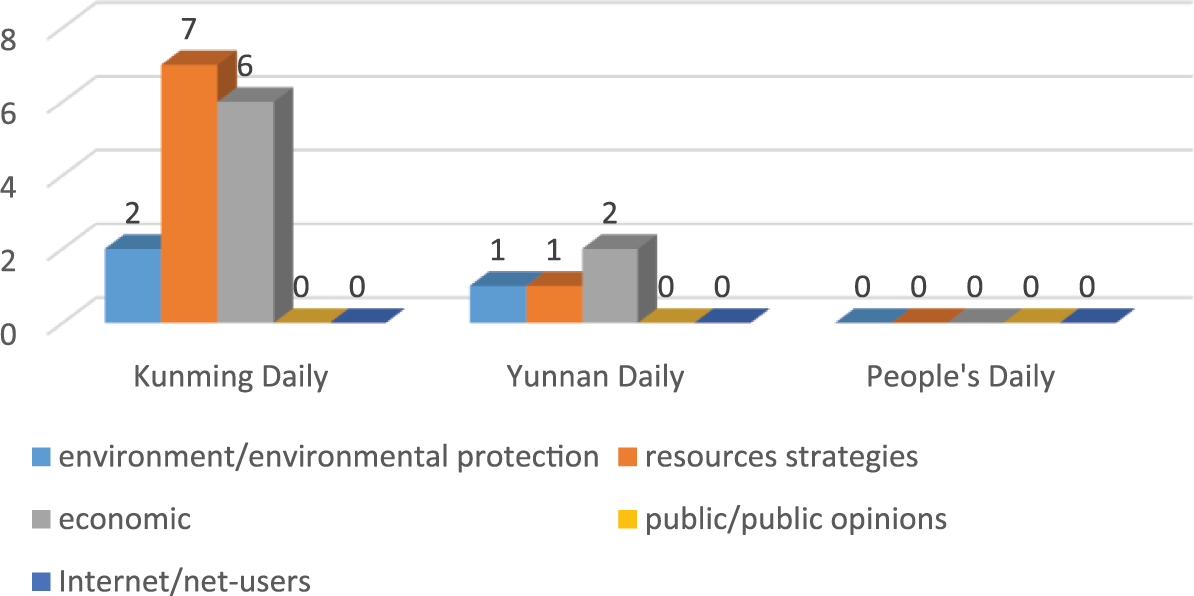
Themes in reports about the Kunming oil refinery in The Kunming Daily, Yunnan Daily and The People’s Daily between January 2004 and April 2013 and from July to December 2013.
Figures 1 and 2 show that, in reporting on the Kunming refinery in May to June 2013, there were 70 reports in the three newspapers, while between 2004 and April 2013 and between July and December 2013, there were only 19. This reveals a considerable increase in government attention given to the refinery in the immediate aftermath of the heated online debate, followed by a sizable decrease 2 months later. When it comes to the themes of the reports in May and June 2013, the term ‘public/public opinions’ appeared most frequently (29 times), followed by the term ‘environment/environmental protection’ (27 times). However, in the time before and after this period, the themes ‘resource strategy’ and ‘economy’ were mentioned most often (eight times each), while the environmental aspect was only mentioned three times and public opinion and Internet/net-users were not mentioned at all.
It can be seen that before environmental concerns about the refinery were raised in online political communications in April 2013, the coverage of the refinery was very limited in both extent and topic. The government only gave limited attention to issues relating to the refinery, and the economy and its resource strategies were the major focuses in the coverage that did appear, reflecting the government’s original objectives for the refinery. However, in 2013, when the government’s economics-driven objectives were questioned by net-users and environmental concerns about the refinery were clearly demonstrated through online debates, the coverage of the refinery increased dramatically in the party newspapers, and the focus of the party media changed, as they started to establish public opinion and the environment as the main themes of their reports. This is powerful evidence that online debates did influence the government, with the huge online debate pushing the government to pay considerably more attention to the public concerns around the Kunming oil refinery, to increase coverage of the issues in the party media and to focus reporting more on the public’s concerns about the refinery, namely the environment.
The Kunming mayor’s Sina Microblog is also evidence of engagement. It not only demonstrates government willingness to communicate about the public’s concerns as raised through online debates, but it also shows that local officials were attempting to engage with the public by using Sina, the primary platform used by Chinese net-users. Understanding this to be a key arena for communication, Kunming’s mayor opened a microblog account on 17 May 2013, becoming the first mayor in China to have an official microblog account. The purpose of his microblog was not only to communicate about the oil refinery, but also, as his first post suggests, ‘to listen to your opinions about Kunming’s development,’ and ‘to carefully study the advice and suggestions made by the crowd’. Public concern about the oil refinery was clearly the main factor behind his decision. The third post on his account started a discussion about the oil refinery and, in total, 11 of the mayor’s posts specifically focused on the refinery. Furthermore, a report published in the Kunming Daily on 18 May 2013 suggested that the oil refinery was the biggest concern in the microblog (Y. Li, 2013, p. A1). By using the microblog, the mayor shows his awareness of the importance of this online platform for communicating about the refinery and enters into the arena to engage in online discussions. By using this online platform, in which the mayor has the power to express his opinions through microblogging but other users can also react to his posts through comments and retweets, other net-users have the opportunity to talk directly to government officials. The opinions of both the officials and the Internet users are equally visible in the same arena, enabling a more equal and inclusive interaction between the users and the government to be observed through the Internet. Indeed, the mayor’s 11 posts about the Kunming refinery generated a total of 14,752 retweets and 20,855 comments.
Evidence of the government’s engagement in online debates can also be found in the contents of the reports, such as the following:
(Title) Kunming City Held a Press Conference with regards to the CNPC Yunnan Oil-Refining Plan Yesterday/The Oil-Refining Plan Insists on the Implementation of ‘One Vote Veto’ on Environmental Protection: The Whole Plan Does Not Have PX Device, Will Not Produce PX Products, Whether or Not Have Sub-Productions Will Follow Democratic Decision Procedures. (First sentence) A few citizens and net-users have questioned whether the plan would impact on the environmental standards in Kunming. (Ma, 2013, p. 1)
This is an example text from Kunming Daily, published on 11 May 2013. This text is used as an example here because it was the first piece in any of the party newspapers to report on the oil refinery after the start of the heated online debates, and thus, it exemplifies the government’s fundamental attitudes at the time.
The discourses used in the title and first sentence are the focus here of CDA. It can be identified when constructing discourses that the key terms ‘environmental protection’ and ‘democratic decision procedures’ appear, indicating that when this party newspaper initially approached the issue of the oil-refinery during the time when the online debates were taking place, public concerns and environmental protection, rather than the economy and resource strategy, were referenced. This suggests a gain for the public, in that the public’s needs and interests were reinforced while the government’s interests were invisible in the report. Furthermore, the title of the report uses the phrase ‘one vote veto’ on environmental protection’, meaning that if there were environmental problems, production would not be allowed to commence, thus reassuring the public that their concerns had been taken into consideration. The title also suggests that ‘democratic decision procedures’ would determine the sub-production of the refinery, helping to construct more power for the public, as if the power to make the decision is no longer held by the government, but by the public. The first sentence of the report then explains the reason for the government’s changing attitude, in other words, why the party newspaper was willing to construct more power for the public. It reports that the reason for this stance was that locals and net-users were questioning the environmental impact of the refinery. In other words, the power that pushed the government to construct the discourse in such a way was the online debates. Without the online debates the government would not have become involve in communication of this type, nor would it have allowed the public to gain more power in the discourses.
The various methods used to communicate and, particularly, the use of the microblog, changes in numbers of reports, the overall themes addressed, and the discourse of the reports indicate that the Chinese government can engage in online debates, even after it has tried to censor and subsequently become somewhat more relaxed about certain information, but could not reduce public anger and concerns. Engagement indeed has become a choice for the government, and the Xiamen PX and 7.23 events are not exceptions to this approach. This also means that online debates in China can generate impacts on the government in ways that force it to recognise the existence of public needs which differ from its own, and may lead the government to begin negotiating with the public.
However, these actions cannot be equated with the government being willing to follow public opinion and give up the refinery. Although the government carried out multiple actions in relation to the public online debate, the function of those actions was to explain the government’s decisions and to defend and reinforce its own interests and needs to persuade individuals to accept the refinery. The government did not invite individuals into a fully open conversation to seek the most reasonable solutions regarding the refinery; nor did it change its decision over the refinery in response to public concerns, although it had promised this in a newspaper article. Therefore, while the government’s actions can be regarded as an attempt to engage in political debates, it cannot be regarded as having fully responded to the public concerns raised online.
Limitations of the government’s actions
There are three indications of the limitations of the governments’ actions. The first is that the government’s core interests are maintained as unchallengeable in the various communications, and this can be particularly observed through the different association created between local and national government. It was the national government’s decision to launch the refinery, while the local government was only involved in making decisions about the refinery’s sub-production. In the online debate, members of the public were concerned about the potential environmental damage of the whole refinery, while the sub-production, and PX in particular, intensified their worries. If the government was truly engaging in the communications around the issue, understanding the concerns of the public and allowing the public to make gains, then the decision to establish the refinery should have been re-considered. However, in the government’s discourses, the decision made by the local government to add sub-productions was regarded as the negotiable area, whereas the national government’s decision to establish the oil refinery itself was regarded as unchallengeable, and as delivering only benefits. By separating these decisions in the communications, the legitimacy of the national government’s decision was protected, and, in consequence, the concerns raised over the environmental impact of the refinery were not fully addressed. The government, as a whole, still satisfied its own needs.
In the text already mentioned, this division is clear:
Kunming City Held a Press Conference with regards to the CNPC Yunnan Oil-Refining Plan Yesterday/The Oil-Refining Plan Insists on the Implementation of ‘One Vote Veto’ on Environmental Protection: The Whole Plan Does Not Have PX Device, Will Not Produce PX Products, Whether or Not It Has Sub-Productions Will Follow Democratic Decision Procedures.
In this text, PX/sub-productions appeared three times, while the oil refinery itself only once (excluding the name of the refinery). The oil refinery reference related only to the ‘“one vote veto” on environmental protection’, but not to the democratic decision. This means although the government promised some sort of environmental protection measurement to be placed, still it did not allow the public to have the power to determine the establishment of the oil refinery. Also, when using the term ‘one vote veto’, the text does not demonstrate who the voter is; in fact, the voter is the government itself. This is because there is no public voting system in China, and without changing the political system, the public does not have the power to vote on any issues. This sentence therefore actually means that the government could decide to close the refinery if it damages the environment, but regardless of how it decides, the power to make the decision is still held by the government alone. The public cannot have their say about any aspects in relations to the refinery, which makes the national government’s decision to be unchallengeable. In contrast, the PX/sub-production was constructed with totally different discourses. It was denied (‘does not have’, ‘will not produce’) twice, and then, in allowing the public to determine whether to have PX production at the plant, the power to decide has been clearly constructed for the public, through the term ‘democratic decision’.
Another example of this division between the refinery as a whole and its sub-production is the first report about the refinery after the online debates on 11 May 2013 published in Yunnan Daily:
(Title) Oil-Refining Project Will Benefit National Strategies and People’s Living Standards, Sub-Production Items Will Respect Public Opinions.
The discourses in this text are constructed around two key terms: ‘oil-refining’ and ‘sub-production’, and the words in the constructions are very different. The oil-refining project is described as benefitting ‘national strategies and people’s living standards,’ which is how the government defined this refinery in the first place. Through this definition, the government maintains its interests and needs. Also, when arranging the words, the term ‘national strategies’ is placed before ‘people’s living standards,’ giving a prior position to the former, as if people’s living standards, although important, are not as important as national strategies. This also stresses the requirements of the Chinese government from this refinery. In contrast, decisions about sub-production are described as ‘respect[ing] public opinions’, which constructs power for the public: the power to determine. By constructing the discourse differently around the two aspects of the refinery, the government tried to suggest that it had listened to the concerns expressed in the online debates and forced the local government to compromise. But the oil refinery would still go ahead, as the national government’s decision is legitimate and unquestionable despite the online debates. It may appear on the surface that the government had respected public opinion and allowed the public to gain in terms of its interests, but in fact, by going ahead with the oil refinery, the government’s interests are protected while environmental concerns are not met.
The second indication of limited government actions is its choice to communicate about the refinery predominantly through one-direction/single channels, rather than by engaging in debate in an equal and inclusive arena. By using traditional party newspapers, public exhibitions and talks, information flowed from the authorities towards individuals, and no space was left for individuals to challenge them directly in an interactive platform. For the press conferences, the two discussion panels and the field trip to Qinzhou oil refinery, the government also took a dominant role. What questions could be asked, what answers could be reported, where and how to report them, and even which factories could be visited, were issues entirely determined by the government to fit with its interests. Questions and trips were designed to enable the government to justify its decisions rather than to equally and inclusively present both the government’s opinions and individuals’ concerns. By using these types of channels, the government was able to communicate its own view of the refinery, to reinforce its pre-existing interests and to promote its interests further, rather than opening up a conversation in which diverse opinions could be equally and inclusively exchanged. The microblog was the only open, equal and inclusive arena used by governmental representatives, but it was a minor one in this process. Thus, although the government communicated to the public about the reasons behind its decisions and promised that certain actions would be taken to reduce environmental damage, the content of the communications was not produced through an equal and inclusive debate between the two sides. The pre-existing interests of the government were reinforced at the expense of public concerns.
The third limitation is that the government terminated communications about the refinery without the public’s concerns being resolved. Communications about the refinery from the government ceased after June 2013, and there was a general lack of follow-up information about the construction of the refinery or the promised actions. It can be seen that although the concerns and contentions regarding the oil refinery had not been resolved, the government was no longer willing to engage. This argument is based upon the observation of a dramatic decrease in the number of reports in the party newspapers and a decrease in posts in the Kunming mayor’s blog after June 2013, as illustrated in Figure 3.

Number of articles about the Kunming oil refinery from January to December 2013, in Yunnan Daily, Kunming Daily and the Kunming mayor’s microblog.
Figure 3 shows that in May 2013 the refinery was a central topic, as the number of reports referring to it reached a peak. However, after June 2013, there was a dramatic drop in the number of reports. In the Kunming Daily and Yunnan Daily, there were only 11 reports in total between July and December 2013, while 58 had been published in May and June. Kunming’s mayor did not post any further microblogs about the proposed refinery after June. In fact, May and June 2013 was the only period during which information was provided in his microblog and when there was engagement about the refinery. In other words, while the party media offered a great amount of information regarding the refinery in that 2-month period, after this period, information became minimal and almost ceased. Yet this drop was not because the problem had been solved; public concerns over the refinery were not fully addressed and the construction of the refinery itself had not yet been completed.
Moreover, as previously analysed, the party media reported that the government would invite a democratic process to determine whether to go ahead with the sub-production (Hu, Sun, & Li, 2013; Ma, 2013). If the government had kept its promises, there would have been further information about the construction process, and about a public consultation process of some kind that could take decisions regarding further developments at the refinery, especially about sub-production; however, none of these materialised. The dramatic drop in reports meant that very few further information was published about the construction of the refinery or about the sub-production; neither was there any sign of the promised democratic process. Thus, individuals had very little knowledge of what had been built, whether the refinery would produce PX, and even where they could access further information about the refinery. It was not until August 2015 that the public were informed by a non-party newspaper that the refinery had been fined by China’s Ministry of Environmental Protection because it had not put in place the environmental protection measures it had promised (South Urban Post, 2015). However, the fine imposed was negligible and the refinery continued to operate without any measures being put in place. After 2 years, during which little information about the refinery was imparted and with no public monitoring in place, the refinery had still not installed the promised measures to reduce pollution, and the government had failed to supervise construction to ensure that those measures were in place; the ‘one vote veto’ had been an empty promise, which did not solve environmental concerns about the refinery. In this sense, the government’s engagement was limited because, although it engaged in communication, this engagement did not lead to changes; the government’s interests were maintained and the public’s concerns were still neglected.
Discussion and conclusions
This research expands the current understanding of the Chinese government’s actions in relation to online political communication, showing that these were varied in nature and not limited to one type. But despite the variety of actions, the purposes of the government’s behaviours were still to maintain the political status of the digital media as a part of its ‘ideological apparatus’ (Chan, 2003, p. 159). This research has systematically examined the government’s engagement with online political communication around the oil refinery at Kunming, identifying that censorship was conducted to prevent online voices opposing the government’s decision from growing, this being the traditional practice of the government. However, the government also engaged in online debates, recognised public concerns expressed online, as it did in Xiamen and the 7.23 accident. This proves that engagement has become a possibility for the Chinese government, and should not be ignored in further studies. However, when critically examining the methods, contents and discourse used by the government in the political communication, it has been found that engagement by the government does not always lead to responses, and rather than aiming to facilitate equal and inclusive communications to understand public concerns and respond to them, the government uses such communications to reinforce and highlight its interests and needs and to keep its political agenda in the forefront of the public view. And even when, as in this case, the government promised actions, its promises were empty and the actions put forward were not delivered. This is different from the Xiamen case, and the reason for this is that the Xiamen case only involved local government decisions, while in Kunming, both local and national government decisions and interests were involved, and the national government’s decision dominated. These differences reflect the fundamental attitudes of Chinese government: the legitimacy of the national government cannot be questioned, while local government decisions can, as long as there is no impact on the national government, and if resulting discussion can reduce social instability and help to facilitate compliance with the government as a whole.
This research also indicates that governmental behaviour in China is complicated, and rather than trying to draw generalised conclusions, specific and particular case-by-case examinations are more accurate and useful. Only through such examinations will it be possible to develop a more critically accurate understanding of the Chinese government’s actions in relation to online debates.
