




Abstract
Contemporary China owns over 750 million Internet users, and a short-video-sharing app named Kwai has over 600 million users. From 2016 to 2017, when Kwai emerged as the largest short-video-sharing app and the fourth largest social media app in China, its major competitor Dou Yin was just released, and no other similar app could post a serious threat to Kwai. However, the emergence of Kwai to the mainstream public was tightly intertwined with a media discourse that established Kwai as a representation of rural China and low culture. Words like “vulgar,” “low,” “absurd,” and so forth were constantly used to describe Kwai and its users, and Kwai embodied a representativeness of rural and low culture that carries a taken-for-granted characteristic. This article unpacks Kwai’s controversial emergence and examines the power relations and cultural dynamics that were at play when Kwai was established by the mainstream media discourse a rural and culturally low. It interrogates the media discourse that constructs a regime of representation of Kwai, as well as how it contributes to the establishment of a regime of truth about Kwai, rural China, and rural Chinese. I unearth the seemingly natural condition of this representativeness and argue that Kwai’s controversial emergence from 2016 to 2017 signifies China’s rural–urban dichotomy, as well as a dominance of urban culture. I also indicate that we see a flow of this cultural dynamic from the physical world to the cyberspace, where the urban culture exercises the power to define and marginalize the rural.
Introduction: problematiques, theories, and methodologies
In March 2017, China’s tech giant Tencent Holdings announced a strategic investment of 350 million US dollar into Kwai (or Kuai Shou), which is a short-video-sharing app that envisions to “show the life of ordinary people” (Technote, 2017). However, Kwai is not just an ordinary app that shows the life of ordinary people; in fact, Kwai and its user are anything but ordinary. As People’s Daily reported a few weeks after the Tencent investment, Kwai has been treated as representing “low” and “negative” reputation for years. “An article circulated online in 2016 describes Kwai as a place full of ‘self-torture,’ ‘vulgar performance,’ and ‘people with absurd behavior,’” this report cites an earlier popular article that blasted the public discussion of Kwai, “though that article was controversial, but that Kwai is different from other short-video-sharing apps is a manifest truth,” the report concludes (Ma, 2017). If we further trace back to the article cited by this report, it is titled “Cruel Stories of the Bottom: Rural China in a Video App” (China Digital Times, 2016); this article was written by an independent writer who names himself “Doctor X” and was published through his individual WeChat Official Account. 1 In this article, Doctor X remarked that though “you might have never heard of this app,” Kwai had over 10 million Daily Active Users (DAUs) and was the fourth largest mobile app in China. This is a shocking fact, as he argues, because while Kwai has a large number of users, non-rural people—as the article implies—would most likely have never heard of this app. In addition, it also presents Kwai as explicitly rural, full of “vulgar, self-torture, crudely made” content such as people eating worms and a snake alive, pornographic content, and “all kinds of extremely absurd behavior.” Finally, it repetitively describes Kwai as rural: “when you open this mysterious software, you must be confused about why this vulgar and crude app is China’s number one app,” the article writes, “because its users are China’s large number of rural population” (China Digital Times, 2016). After accumulated close to 2 million views, the article was reported by anonymous readers and was deleted by authorities within 24 hours of its publication. This article is arguably the first phenomenal online article that generated a million-level viewership and specifically addressed Kwai; the viral circulation and the deletion of this article no doubt for the first time put Kwai under the spotlight and contributed to an extensive public discussion. The very fact that it was cited by People’s Daily, China’s top party-throat press, demonstrates the mainstream attention drawn to this article.
Just like People’s Daily writes, Kwai has been deemed as representing a low culture as well as rural China for years (Ma, 2017). However, this essay intends to take a close look at this phenomenon and unearths the historical moment of its emergence, as well as the conditions that favored the construction of such public discourse. Just like Levine (1988) once said, “media are…constructed complexes of habits, beliefs, and procedures embedded in elaborate cultural codes of communication” (p. 8). If we focus on the period from 2016 to 2017, when Kwai’s user base grew exponentially and started to receive mainstream media attention such as the examples mentioned above, Kwai’s unique identity necessitates the discussion that addresses a few critical questions: why does Kwai become a representation of rural culture? What does this “rural culture” look like? In what ways this reputation of rural was constructed? And by whom? The period from 2016 to 2017 is a particularly good window to take a glimpse of the construction of Kwai’s identity: this is when Kwai dominated the video-sharing market in China and just started to generate extensive mainstream attention and public discussion; it is also when Kwai’s later major competitor TikTok (or Dou Yin) was still in its infancy. Therefore, this article aims to focus on this unique period of time, and discusses the media discourse that establishes Kwai as simultaneously rural and culturally low. As far as I am concerned, one of the most critical aspects of this discursive context is the particular kind of truth produced by the media discourse—the truth of Kwai, its content, and the nature of its users. Particularly, I am concerned about the truth that defines Kwai as rural and culturally low, the truth of what does it mean to be rural in this historical period of contemporary China, as well as the implied connection between the rural and culturally low. In this sense, Kwai functions as an instrument that embodies these productions of truth, and the mainstream representation of Kwai forms a regime of representation that articulates the socially produced truth.
In order to address these concerns and the aforementioned research questions, I draw upon Michel Foucault’s concept of the regime of truth and Stuart Hall’s discussion of the regime of representation. Foucault (1977/1995) argues that a regime of truth emerges when “a corpus of knowledge, techniques, ‘scientific’ discourses is formed and becomes entangled with the practice of the power” (p. 23). In other words, truths are constructed by particular bodies of knowledge through the practice of power, or knowledge/power, to use a Foucauldian term. The public belief of Kwai’s representativeness of rural and low culture made visible a particular kind of truth about China’s cultural hierarchy—one that marginalizes rural as low culture and implies a dominance of urban culture, as I will discuss later. Media discourse constructs particular “statements” that enable not “objective, capital-T Truths . . . [but] the process by which small-t truths are produced and circulated socially” (Vavrus, 2019, p. 7), because “truth,” as Foucault (1977) argues, is “a system of ordered procedures for the production, regulation, distribution, circulation and functioning of statements”; it is linked “by a circular relation to systems of power which produce it and sustain it, and to effects of power which it induces and which redirect it” (p. 14). Therefore, Kwai’s identity is a particular knowledge produced and circulated by a historically contingent regime of truth that involves particular institutions of power such as media institutions. During the period of 2016 to 2017 when Kwai’s growth and public discussions about it made visible a cultural articulation of rural and low culture, media representations constitute what Stuart Hall calls a “regime of representation,” through which a “whole repertoire of imagery and visual effects through which ‘difference’ is represented” (Hall, 1997, p. 328). In other words, the influential media representations about Kwai consist of its regime of representation, which contributes to the operation of a regime of truth that ultimately defines Kwai’s representativeness of rural and low culture. There are two layers of operations, I will argue, one is the particular way in which mainstream and influential media discourse such as People’s Daily and Doctor X’s article represent or presume Kwai’s ruralness and vulgarness; the other is the particular types of content that selectively reported and thus made typical of Kwai by the media discourse.
In this article, I first contextualize Kwai in the period of 2016 to 2017; then I discuss a few cases of mainstream and influential media representations of Kwai. I also discuss examples of selective typical types of content circulated in media discourse that favors Kwai’s vulgarness and ruralness; finally, I examine the social and cultural implications of such a media discourse. In general, Kwai came under the spotlight of mainstream media discourse and public discussion from 2016 to 2017 for multiple reasons: a lack of like-type competitor, a large number of users that dominate the short-video-sharing market, and, most importantly, Kwai’s representativeness of rural and low culture. I argue that the media discourse of the time constitutes a regime of representation of Kwai that defined its ruralness and lowness, which contributed to a discursive formation of knowledge or truth of Kwai and rural China; this double-layer operation of regime of representation and regime of truth implies a cultural dominance of urban culture that marginalizes the rural in the cyberspace of contemporary China by exercising the power of selecting, representing, and defining rural China.
It is important to point out that the rural–urban controversy is not something new, the historical account of which is also beyond the scope of this article. However, this article offers a close look at a particular historical moment when a particular app triggers China’s rural–urban issue. Doctor X points out the drastic gap between Kwai’s number of user and its invisibility to China’s mainstream media discourse. To borrow this idea, I would argue that Kwai’s invisibility made visible and embodied China’s rural–urban cultural hierarchy that has been existing for decades.
Text selection and methodology
Methodologically, I adopt a rhetorical criticism and a discourse analysis method; this means that I choose texts that were inordinately influential or represents particular kinds of significance both in setting the boundaries of Kwai’s definition and in constituting the cultural meanings of Kwai and its users. In particular, these are texts that played critical role and served to establish and define Kwai’s representativeness of rural China and low brow culture in a rural–urban hierarchy. Rhetorical criticism aims to unearth rhetorics that serve a particular function, and this style of discourse analysis focuses on delineating the construction of influential discourse that demonstrates particular power relations and cultural dynamics; therefore, this study does not seek to do an exhaustive read of every document produced on the subject of Kwai but seeks to do an in-depth reading of those texts that demonstrate and embody particular political and cultural significance.
Along the line of rhetorical criticism, I utilize a reality construction criticism in particular to examine how particular media texts articulate Kwai’s representativeness of rural and low culture, thus constructing particular types of reality. Reality construction is a method that has been widely studied and utilized in rhetorical criticism (Chesebro, 1984; Combs & Mansfield, 1976; Graber, 1976); it especially looks at “rhetoric as the means by which we create and sustain the social reality necessary to form relatively enduring governments and social institutions” (German, 1985, p. 94); language and speech are thus pivotal in forming the discourses that produce particular knowledge/power. Through examining the dominant rhetoric, it is possible to unearth the processes of reality construction that carry out values, moralities, truths, and so forth. By a close reading of influential texts such as the report on People’s Daily, Doctor X’s article, and so forth, I showcase a biased depiction of Kwai’s ruralness as well as rural China in general.
I also utilize a Foucauldian discourse analysis method that understands “discourse as collections of signs and symbols that together operate as a source for social knowledge” (Vavrus, 2019, p. 24). Such an understanding enables the studies of discursive formations that can be defined as the presence of a “regularity (an order, correlations, positions and functionings, transformations)” when we can “describe, between a number of statements . . . a system of dispersion . . . between objects, types of statement, concepts, or thematic choices” (Foucault, 1972/2010, p. 38). Therefore, the discourse analysis method examines the constitution of a particular knowledge, how it is disseminated and passed on, “what function it has for the constitution of subjects and the shaping of society,” and the consequences and impacts of this process (Jager, 2001).
Based on the above methodologies, my criteria of selecting the critical texts are obvious. For example, I look at an article published on People’s Daily that specifically discusses Kwai’s phenomenon, because (1) People’s Daily is one of China’s most prestigious party-press, and it to a certain extent represents an official attitude, especially when the report is reposted and circulated among other major party-press, and (2) this is the first time Kwai is positioned at the center of an article published by top party-press. Before this article, People’s Daily had three reports that mentioned Kwai (Dong & Qian, 2017; “Two Hosts,” 2017; Xu, 2016), but all of them mentioned Kwai only as one of the major short-video-sharing apps or indirectly. For example, one report was about arresting two people who swindled donations by fake charity, and Kwai was mentioned because they were live-streaming their fake donations via Kwai. These reports are insignificant in setting the boundaries of Kwai’s meaning construction, but the article that I analyze in the following section is significant, because this is when People’s Daily for the first time explicitly talks about Kwai’s representativeness of rural China. In addition, this article was immediately reposted and circulated among other major press such as Xinhua (“People’s Daily,” 2017), enlarging its influence.
I selected Doctor X’s article based on the same methodologies. Doctor X is a popular independent writer who publishes blog-style articles via his Individual Official Account on WeChat; however, other articles written by him, ranging from historical novels to mysterious tales, from urban literature to self-reflecting blogging, are insignificant to this study. This is a self-media that writes about various topics that interest Doctor X himself, and it has never been a political column that might carry some political significance, for example. The article on Kwai is just another time that Doctor X decided to write about something that looks interesting, and he has never written anything related to this topic before. Therefore, Doctor X’s blog or his other articles are insignificant in my analysis. I choose this particular article written by him because (1) this is the article that triggered the public discussion of Kwai’s ruralness, in other words, this is the starting point of the massive online discussion of Kwai that I analyze in this article, and (2) the over-two-million views made this the first time that Kwai is exposed to the mainstream media discourse with massive discussions.
These two examples illustrate how I select particular texts to analyze and the methodologies that guild my selection. The methodologies are consistent in other selections as well. For example, I discuss the interview of Kwai’s CEO because that was the first time a top executive of Kwai accepts an interview with mainstream media, and the interview was also partially to respond to the controversy triggered by Doctor X’s article. In a word, I trace media texts that are influential and significant in constructing Kwai’s representativeness, because media discourse of Kwai is discursively constructed by signs and symbols and, in my case, significant representations of Kwai that functions to exercise power in a particular way that empowers some and degenerates others. Therefore, it is helpful to examine what kind of representations of Kwai was actually circulated among the media discourse. Patterns of reporting and repetitions of particular signs would shed light on the power dynamics behind the regime of representation—if a particular kind of content is favored by a media system, a particular power is being exercised to favor something over others. The focus on non-academic materials such as media reports, interviews, blog articles, and popular posts on Weibo and Zhihu, for example, as well as a focus on 2016 to 2017 allow me to chart the actual representative public discussion of the time, hence understanding the condition of possibilities that enabled what comes after.
Contextualizing Kwai in 2016 to 2017
When we look at the period from 2016 to 2017, Kwai came to the public attention with three critical conditions, as I mentioned previously: a large number of users, a lack of like-type competitor, and controversial representativeness of rural and low culture. However, a pivotal ground that underlies these conditions is Kwai’s invisibility to the mainstream media discourse, which collapsed with Kwai’s sudden extensive public attention, thus enabled the highlight moment of Kwai from 2016 to 2017.
Kwai was founded in 2011 and was first named “GIF Kuai Shou.” GIF Kuai Shou was an entirely different app, because it started as a tool app that helps users to make GIF pictures. Until the summer of 2013, when Kwai’s CEO Su Hua joined the GIF Kuai Shou with his team, Kwai was officially born as a short-video-sharing that focuses on social media function instead of merely being a tool app. When “GIF Kuai Shou” was entirely redesigned into the new app Kwai, the user number dropped to only around 10,000 in 2014, and only started to grow after early 2014; by June 2014, Kwai had over 1 million DAU, and by January 2015, Kwai’s DAU surpassed 10 million (“Kuai Shou,” 2017). By mid-2016, when Doctor X wrote his article, Kwai was the fourth largest social media app (China Digital Times, 2017). However, with such fast growth, Kwai has never been under the spotlight of the media. As one of the first major media coverages of Kwai writes, “before June 9th [of 2016], there was no legend about Kwai in this world”; “even Kwai is the absolute number one in short-video-sharing social media market,” the report writes, “we can’t even use ‘very limited’ to describe their media coverage, but no coverage at all” (Wu, 2016, p. 76). Indeed, Kwai has been relatively invisible to the mainstream public before 9 June 2016, which is when Doctor X published his article. Su Hua, Kwai’s CEO, was interviewed by two industrial media on 15 June 2016—a week after Doctor X’s article went viral. This interview, according to the reporter, was “Kwai’s first [media] exposure in five years” (Wu, 2016, p. 77). At the time of the interview, if people search Kwai’s two co-founders on the search engine, there was only “fragmented information” available for the CEO Su Hua and “even less information” about another co-founder Chen Yixiao. “Where exactly does Kwai come from? Who are Su Hua and Chen Yixiao? How did they start their business? There is no additional information. To many people, [Kwai] is a suddenly appeared unicorn” (Wu, 2016, p. 76). Indeed, it is not an exaggeration to say that no major media reported on anything related to Kwai or its co-founders before this very first interview. To a certain extent, Kwai had been invisible to the mainstream netizens and major media.
With such invisibility, however, Kwai was contradictory and undoubtedly one of the most popular apps in the period of 2016 to 2017. While Kwai had 67 million DAU (China.com, 2017), the second largest short-video-sharing app Miao Pai had a DAU ranging from 4.1 million (Jiguang, 2017) to 7.5 million (Sohu, 2017) among different sources. This demonstrates Kwai’s absolute dominance in the short-video-sharing market. In addition, though with a focus of video-sharing, Kwai is also a social media app. In early 2017, Kwai achieved 400 million registered user, making it China’s fourth largest social media app in China—following WeChat, QQ, and Weibo (“Kuai Shou,” 2017). Even though Kwai’s user number was lower than Weibo, for example, its weekly penetration exceeded Weibo as of June 2017 (36Kr, 2017). By September 2017, Kwai had over 600 million registered users (China.com, 2017), which makes Kwai’s user number almost 80% of China’s total Internet users (ChinaNews, 2017, reports that China has 751 million Internet users by the end of June 2017).
With such a huge user base, Kwai faced very limited competition within the short-video-sharing market. In addition to the far lead in the market and the absolute dominant market share as I discussed above, in the period of 2016 to 2017, Kwai’s later major competitor TikTok was still in its infancy. According to its own report, TikTok was brought online in September 2016, and achieved 30 million DAU in March 2018 and 150 million DAU in June 2018 (TikTok, 2018). During the entire 2017, TikTok and other video-sharing apps had almost no threat to Kwai’s market dominance. Figure 1 demonstrates a comparison of Monthly Active User (MAU) among top video-sharing apps published by the big-data analysis company QuestMobile (2018), 2 which shows a far lead of Kwai in MAU among other apps, including TikTok in the entire 2017.
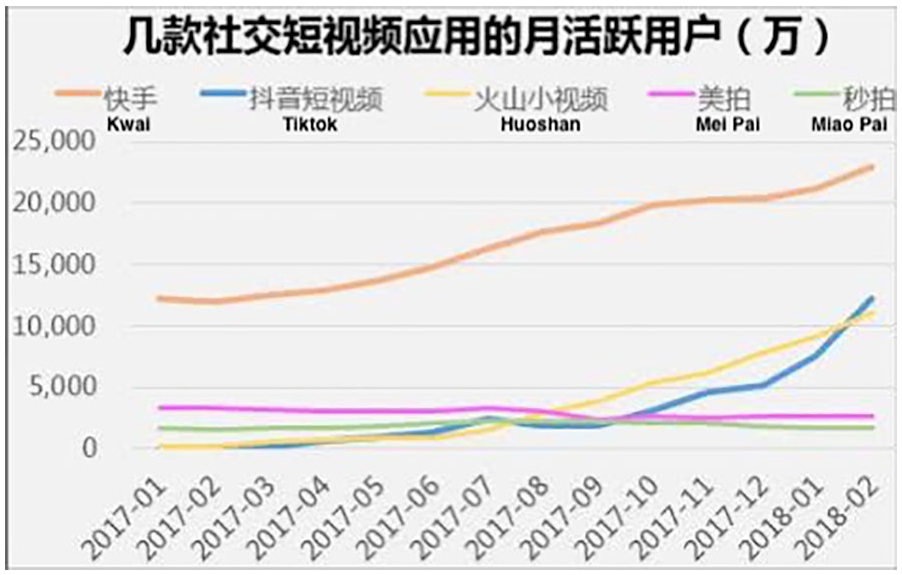
A comparison of MAU among video-sharing apps.
With this overview of Kwai’s development, the statistics and the comparison of Kwai with other similar products, the following scenario is quite clear: Kwai steadily grew from 2013 and became the largest short-video-sharing app and the fourth largest social media app in China in 2016; however, for some reason, it remained invisible to the mainstream media discourse. Doctor X’s article published on 9 June 2016 initiated Kwai’s first major public discussion and brought Kwai under the scrutiny of the mainstream public and media. Kwai’s market dominance in 2016 and 2017 left very limited space for competitors, and TikTok—which has been proven to be Kwai’s major competitor—was only released in September 2016 and remained relatively insignificant for the major part of 2017 compared to Kwai’s market share. Kwai’s invisibility until June 2016 and its large user number post a seemingly bizarre contradiction: how could an app that has such a huge number of users remain invisible to the mainstream media? The popularity in user number and invisibility among media discourse seem an absurd impossibility. This, as I will discuss in the following section, can only be understood with Kwai’s representativeness of the rural and low culture. Just like Doctor X’s article demonstrated, it is the colliding of the absurdity of the allegedly rural nature of Kwai and the fact of its popularity triggered mainstream media’s curiosity and the public’s extensive discussion.
Defining Kwai’s ruralness
Kwai’s representativeness of the rural and low culture is the catalyst of its controversy, which can be seen as an illustration of a broader cultural hierarchy of urban over rural that is embedded in the history of the People’s Republic of China. Before I discuss this deeper cultural implication, it is necessary to examine the way in which Kwai’s representativeness of rural and low culture is defined. In order to do so, I first look at a few critical and representative texts that articulated Kwai’s representativeness, then I look at particular media representations circulated among the media discourse and unpack how they reflect certain power dynamic of cultural dominance.
Before I get into the rhetorical analysis, it is important to point out that Kwai does have a relatively large number of users who locate in lower-tier cities and rural areas. China classifies cities into a tier system based on the degree of development: Beijing, Shanghai, Guangzhou, and Shenzhen are considered first-tier cities; other developed cities and provincial capitals such as Nanjing, Wuhan, Changsha, and so forth are considered second-tier cities; less developed and smaller cities are ranked third tier or lower. Data from China Daily show that among short-video-sharing apps, over 60% of users come from third-tier cities or rural areas; in regard to Kwai, only less than 20% of its users come from first-tier cities (Ma, 2017). According to statistics from QuestMobile (2018), only 9.5% of Kwai’s user comes from first-tier cities, while the percentage of users who locate in second, third, and fourth or lower tier cities were 29.3%, 20.9%, and 40.3%, respectively. Interestingly, according to the World Bank (2019), China’s rural population consisted of 45.17% of its total population in 2017, which correlates with the proportion of Kwai’s user in fourth-tier or lower tier cities. This illustrates the popular description of Kwai’s growth as “encircling the cities from the rural areas” (“Kuai Shou,” 2017).
However, if pure statistics reflect the constitution of Kwai’s user demographics, it tells nothing about the content. In fact, according to a report published by China Internet Network Information Center (CNNIC, 2018) by December 2017, Internet users in rural areas were about 209 million and consisted of 27% of the total number of netizens; this is also a significant amount of people. Given these numbers, rural representation in cyberspace should not be insignificant, if not fair. Nevertheless, influential media texts present Kwai’s ruralness in a way that does not do justice to what should actually be accounted as a rural culture. Here I look at Doctor X’s article and People’s Daily’s report in particular.
Doctor X’s article 3 is important because it is arguably the article that brought Kwai under the spotlight of mainstream media discourse. Not coincidently, the first interview of Kwai’s CEO Su Hua, the report on People’s Daily, as well as many other influential publications all refer to this article in particular as a starting point of Kwai coming into the realm of mainstream media discourse (see “Kuai Shou,” 2017; Wu, 2016, for example). In the first paragraph of the article, Doctor X establishes a taken-for-granted connection between Kwai and rural China. “If Chairman Mao lived in today’s China, he didn’t need to go to the countryside” in order to write his report on situations in rural China, he only needs to use “Kwai, [he] would be able to understand the spirit of rural China.” By establishing this connection, he is able to present all that come afterward in the context of rural China as if Kwai’s ruralness is natural and taken-for-granted. He then posts the question of Kwai’s invisibility among mainstream media and its massive amount of user; by calling this phenomenon a “shocking” fact, he asks why this “vulgar and crude app is China’s number one video app,” and he definitively offers his answer to the question: “because its users are China’s massive amount of rural population.” Doctor X’s articulation made a rhetorical transformation here: by asking the question assuming the vulgarness and crudeness of Kwai, and by the absolute tone of connecting Kwai and rural China, he naturalized Kwai’s ruralness by assuming the vulgarness and ruralness as a given, and jump to the explanation of in what way Kwai is vulgar and rural. In other words, Kwai’s vulgarness and ruralness are presented as something natural and taken-for-granted, unquestionable, and whose authenticity is unnecessary to challenge. In Barthes’ language, the vulgarness and ruralness of Kwai are not diminished but put to a distance; it becomes the form that signifies the mythical meaning, which, in Kwai’s case, is how or in what way Kwai is vulgar.
The article jumped to examples of Kwai’s vulgarness and ruralness immediately. It offered a screenshot from Kwai with a note saying, “Kwai’s basic interface overview”; four posts are presented here: one man eating something unrecognizable with odd looking, two half-naked men with only pants on lying on the ground with a subtitle saying “icing the head,” a women holding two strings of barbecue that looks like cuttlefish, and a man smoking a cigarette with dirt on his face. He continued to write that when you open Kwai, you see one after another video full of people touring themselves, vulgar and pornographic performance, and all sort of people with absurd behavior. He then offered a few examples to illustrate his conclusion, which include a mid-age woman eating light bomb, worms, and glasses; a man who put firecrackers in his pant; a young boy who eats a snake alive; and another man who eats a died pig. He then switched toward issues with children and offered a screenshot of an overweight boy smoking, a 15-year-old girl who is pregnant, and another young boy with tattoos covering his entire upper body. With a few more similar examples, Doctor X started to talk about rural China as the “forgotten land” that nobody pays attention to; with empathetic voice to rural children and peasants, he offered a cynical accuse to the society we live in that does not treat well those who come from the bottom, echoing the title of the article: “Cruel Stories of the Bottom: Rural China in a Video App.”
It is true that the examples Doctor X gave all come from Kwai, and it is also true that Kwai has a large number of rural users. However, it would be very difficult to argue that these examples actually represent rural China, as he implied in his article. With a close reading of this article, it is not hard to realize that Doctor X is not offering arguments with proper reasoning, but novelty and emotion—the novelty of the atypical content, and the emotional empathy to the children and the people from the bottom. Most importantly, the article provides a naturalization of Kwai’s ruralness and rural China’s absurdity. As I discussed above, the rhetorical structure of the article takes Kwai’s ruralness and vulgarness as a given condition, then leads the reader’s attention to why Kwai is so rural or why rural China is so absurd, instead of questioning whether Kwai is rural or whether rural China is absurd. With intense examples of content that are absurd to a certain extent, Doctor X selectively depicted Kwai representing rural and the vulgarness of rural China. He posted the question assuming the absurdity of Kwai, and he offered an answer that definitively attributes the popularity and invisibility of Kwai to its ruralness; what he really does is actually attributing vulgarness to rural China and rendering Kwai as the representative of this vulgarness.
Articles that challenge the authenticity of Doctor X’s depiction of rural China and question his logic did appear after the viral dissemination of Doctor X’s article (e.g. see Ah Miao, 2016; China Youth Daily, 2016), but the over-two-million viewerships and the controversy triggered by Doctor X’s article are hard to ignore or surpass. Just like how every other article that talks about Kwai unavoidably cites Doctor X’s article, the influence of this article has departed from the article itself and became virtually the footnote of Kwai’s emergence into the mainstream media discourse. Even though the first interview with Su Hua aimed to reveal the entrepreneurship of Kwai’s team and the People’s Daily primarily encourages more social responsibility and support for rural population’s entertainment need, for example, they both cited Doctor X’s article as the starting point of this phenomenon.
If Doctor X’s article represents how influential writers and opinion leaders could portray Kwai’s ruralness and rural China’s vulgarness using strong rhetoric that does not appeal to authenticity and logic, but novelty and emotion, then mainstream media coverage on this issue reveals other aspects of cultural bias. The article published by People’s Daily also demonstrates the naturalization and taken-for-granted status of Kwai’s rural and vulgar representativeness that I discussed above. In People’s Daily’s article, “Face Up to the Rigid Demand of Entertainment from the Grass-root,” 4 the writer started off by referring to Tencent’s investment into Kwai as I mentioned at the beginning of this article, but it immediately calls Kwai a “complicated contradictory object,” because it, on one hand, owns huge number of users and, on the other hand, “has been suffering from the reputation of being [culturally] low for years.” Then it refers to Doctor X’s article and quotes phrases such as “self-torture,” “vulgar performance,” and “absurd behavior.” The article further concludes that these are “facts that are obvious to all.”
“Open the app Kwai,” the article writes, “what comes to eyes is the straightforward or even slightly crude interface.” The contents on this app are “far away from the ‘petty-bourgeois’ or ‘elegant’ style, and full of a strong style of the third-tier city and rural county.” With a supposedly neutral tone, the article further writes about China’s development of urbanization and the increasing purchasing capacity of rural population; taking the development of film industry in rural counties as an example, the article points to the entertainment need of the rural populations. In a positive voice, the article endorsed Kwai’s user stickiness with rural population and advocates that “on the vast land of China, cultural and entertainment markets still have rooms to raise, and there are still a lot to be accomplished.”
By taking a close look at People’s Daily’s report, there are a few things notable: first, though with a positive voice that advocates more entertainment and cultural product to fulfill the rural population’s need, the article also takes for granted the vulgarness described by Doctor X’s article, and it explicitly notes that these are obvious facts to all. Just like how myth functions, here, the attention is drawn to the potential solution of a problem, and the existence or the authenticity of this problem is taken for granted or not to be doubted. There is no need to interrogate whether the problem actually exists, or whether the way in which the problem is depicted in Doctor X’s article is true. Just like Doctor X directs readers to why Kwai is popular, why rural China is vulgar, and the emotional empathy to the children and people from the bottom, the article on People’s Daily directs readers to the entertainment demand of rural population (which is an important issue for public discussion) but simultaneously naturalized Kwai’s representativeness of rural China and rural China’s vulgarness.
Reinforcing the regime of representation
While influential writers and mainstream media reports repeatedly refer to Kwai’s representativeness of rural China and low culture as a given context of Kwai’s phenomenon, the circulation of the stereotypical contents further reinforces the regime of representation that ultimately defines Kwai’s representativeness. In the process of reinforcing this regime of representation, more media coverage was drawn to Kwai and the phenomenon of Kwai in general, and a particular type of public culture is constituted. Jameson (1979) argues that mass culture “entertain relations of repression with the fundamental social anxieties and concerns, hopes and blind spots, ideological antinomies and fantasies of disaster,” and it is “a transformational work on social and political anxieties and fantasies which must have some effective presence in the mass cultural text in order subsequently to be ‘managed’ or repressed” (p. 141). It is then critical to ask: what kind of public culture is being produced in the circulation of Kwai’s regime of representation? And what does this culture do? More specifically to Jameson’s framework, what social anxieties or fantasies does Kwai’s regime of presentation manage or confirm? As Susan Douglas puts it, whenever something becomes a hit, it is important to examine the social anxieties and aspirations revealed and managed by such phenomenon (Douglas, 2013).
Instead of asking what kind of content exists on Kwai, it is better to examine what kind of content gets reported and circulated among mainstream media after the discursive construction of Kwai’s representativeness as discussed above. By looking at a few examples of popular cases reported by mainstream media, as well as how different form of texts depicts Kwai, its user, and those who newly joined Kwai who is not rural, it could be indicated that these circulations articulate social anxieties of the forgotten rural, and they also exemplify urban culture’s anxiety of creating a rural China that is different.
For example, a considerable amount of media report on relatively atypical contents on Kwai that demonstrate a need for attention. Kuaishou Fengjie (快手凤姐) is a mid-age woman who posted short videos of her eating all sorts of unusual things—light bulbs, worms, cigarettes, and so on. Eating unusual or even non-edible objects soon attracted millions of viewers and followers. However, after the local police investigating Fengjie under the suspicion of forced torture, the truth was that this was an intentional self-promotion by Fengjie and her son in order to gain viewership and followers (China Youth Network, 2016). Another Kwai user named Tian Wai Fei Xian (天外飞仙) is a mid-age man who performs hammering various things such as cars, refrigerators, television, laundry machines, and so on. In one video, he puts a rock on his son’s chest and hammers the rock, which resulted in his son splitting blood and getting hospitalized. When asked by the reporter if he regrets such behavior, the man did not deny but explained that the injury was not bad; then the reporter asked him what is his future plan, he said that he wants to post more videos and let more people know him. Another Kwai user, Yo Zhou Di Yi Shuai (宇宙第一帅), is a young woman who is the mother of a 7-year-old son. She gained her fame on Kwai by videotaping eating fish alive, eating cactus, and letting her husband light up firecrackers in bed with her. She admits to the reporter that the purpose of posting those videos is to gain followers and obtain people’s attention (Huang & Ye, 2016). These three examples were all reported by mainstream media, and the second layer of meaning here is that they also represent what is being reported. The novelty in these examples exemplifies the atypical content on Kwai, which hardly represents Kwai’s nature, but is what is being exposed to the public by Doctor X, by other writers like him and by mainstream media. This lack of attention anxiety is also manifest in the article by People’s Daily as I discussed above, which acknowledges this neglecting of rural China and advocates for attention. However, it is critical to point out that it is the atypical content that has been circulating among the media, which reinforces the stereotype of Kwai’s ruralness and cultural lowness.
In addition, Kwai also reveals a need for urban or mainstream media discourse to create a different rural so that they could maintain urban. In other words, a fantasy of an imagined rural is needed in order to maintain the urban-ness of the urban. For example, the title of Doctor X’s article, “Cruel Stories of the Bottom—Rural China in a Video App,” indicates a direct link between the subject and rural China. Not all Kwai users come from the rural area, and there is a considerable amount of users live in the first-, second-, and third-tier cities; however, this article presumed Kwai’s user as only rural, which rhetorically directs the subject from a mixture of rural and urban to a purely rural context. The article by People’s Daily also reinforces this need of making the rural different from the urban. It explicitly distinguishes rural culture from an urban culture for the “white collars, middle class, and intellectuals” (Ma, 2017), ignoring the fact that white collars, middle class, and intellectuals also live in rural China, and there are a huge number of rural immigrants who work in urban areas. The reality is that urban and rural population live in a mixture in today’s China, though with different proportion in different areas, but the media discourse and public discussion of Kwai reinforce the rural–urban dichotomy as if rural people only live in rural areas and vice versa. A question on Zhihu (a Chinese version of Quora, which brands itself as a platform for the elite) asks that “why Kwai is so annoying?” and attracted 1209 answers and more than 4.5 million views. One answer that received over 4000 agrees concludes that “if one day everyone uses Kwai, it means Kwai got really popular, and it also means that China is doomed” (Jiu, 2017). With the media discourse constructing Kwai’s representativeness of rural China and rural China’s vulgarness and culturally lowness, it no longer matters whether Kwai has all of its users rural or not, because the regime of representation constructed Kwai’s rural representativeness among the mainstream media discourse, and this discourse assigns Kwai to a particular position that is delegitimized, culturally low, and vulgar, so that the urban can be the privileged urban.
In other words, the above discussion of Kwai’s regime of representation reveals a dominant cultural order (Hall, 1980/2001) established by urban culture, in which the mainstream media discourse constructs rural culture as different from the urban, and the urban culture as that which exercises the power of defining the rural and assigning the rural to a particular position within the hierarchical cultural order. This cultural dominance of urban culture is not something new to today’s China; instead, it is deeply entrenched in China’s political and public cultural since the early PRC (People’s Republic of China) period due to the household registration system or hukou and a series of related political and cultural operations since the reform era. However, what Kwai’s phenomenon in 2016 to 2017 demonstrates is a flow of this cultural dynamic from the physical world to the cyberspace, where—unlike the utopian imagination of Internet as a place of anonymity, equality, and openness—the cultural hierarchy exists in its very real form.
Cultural dynamics and implications
Meaning is never fixed, as noted by Hall (1997), because the interactions—negotiations and interpretations of meaning—of representations within a particular media context construct the meaning (p. 328). Kwai’s representativeness of rural and low culture is articulated by the regime of representation that circulates among influential writers, mainstream media, social media platforms, and so forth. This representativeness, as well as the interactions among various media contexts, as I noted above, defines Kwai’s difference or otherness—different from the mainstream urban culture, and an other that is anything but urban. The fundamental cultural dynamic in Kwai’s phenomenon reveals mainstream media discourse as institutions of power that favors and marginalizes a culturally low rural China which is defined by the dominant urban culture. However, it is critical to first situate this cultural dynamic within China’s rural–urban dichotomy, especially since the reform era, which is the historical, economic, and political backdrop of the construction of Kwai’s representativeness. This context is pivotal because it is not just “something out there, within which practices occur or which influences the development of practices. Rather, identities, practices, and effects generally constitute the very context with which they are practices, identities or effects” (Slack, 1996, as cited in Kraidy, 2005, p. 156).
First, the first-tier cities in contemporary China historically have been established as the economic and political centers. Beijing, as the capital of the nation, serves as the political and economic core of northern China; Shanghai centers the Yangtze River Delta region, which is a special economic zone that champions China’s economy; Guangzhou and Shenzhen—adjacent to Hong Kong and Macao special districts in southern China—were established as key cities in the Pearl River Delta region. These three regions were set up as test grounds of market reform since the 1980s, and, as a result, these cities enjoyed a tremendous amount of financial and political support. For example, with unprecedented support from the central government, Shenzhen grew from a small fishing village with a population of 30,000 to 12 million by 2005; its gross domestic product (GDP) grew from 1.96 million CNY in 1979 to 500 billion CNY in 2005 (Tam, 2017). Under the backdrop of economic reform, similar state support can be found in other major cities such as Shanghai and Beijing, as lots of studies have documented in detail (e.g. see Segal, 2003). Most of China’s major Internet companies located in these cities as well. For example, Tencent was founded in Shenzhen, Kwai was founded in Beijing, and so did Sina (the owner of Weibo) and Sohu (one of the first and largest web portals in China). In addition to the concentrated urbanization in the reform era, China’s household registration system explicitly distinguishes individuals as urban or rural residents. Starting in 1958, the system limited rural resident’s migration to urban area for decades; though with gradual reform, the system still exists today and is the most critical factor that contributes to the establishment of the rural–urban dichotomy. Scholars such as Kam Wing Chan (2019; Chan & Buckingham, 2008; Chan & Zhang, 1999) have provided in-depth accounts of this system. This system tremendously influenced China’s political and public culture, which for years construct rural people as having low quality, being backward, and in general as secondary citizens (Greenhalgh, 2010). The economic reform that concentrates on major urban areas and the household system constituted a cultural dynamic in China that deems the rural at a lower position compared to the urban. It is precisely within this context where we should situate the phenomenon of Kwai.
When a dominant cultural order is established on cyberspace, there exists a hierarchy that exemplifies this historical cultural construction of the rural and the urban, because “culture depends on giving things meaning by assigning them to different positions within a classificatory system. The marking of ‘difference’ is thus the basis of that symbolic order which we call culture” (Hall, 1997, pp. 329-330). Therefore, by re-appropriating and articulating a regime of representation of Kwai, mainstream media discourse successfully defined Kwai as different from what should be considered as mainstream—which, according to People’s Daily, is “bourgeois and elegant” lifestyle of white collars, middle class, and intellectuals (Ma, 2017), or, in a more discursive form, popular culture represented by major media press and social media platforms. The media discourse classifies Kwai as rural and culturally low, simultaneously reinforcing the historical and cultural inertia of an assumed connection between rural China and cultural lowness. The symbolic construction of Kwai’s representativeness thus unearths the power of urban culture that “impose[s] its classifications of the social, cultural and political world, and . . . constitute[s] a dominant cultural order” (Hall, 1980, p. 172).
The difference or otherness of the rural culture is the anchor point of this cultural dynamic, because only through which the dominant culture could establish a sense of alienation or distance that assigns the rural to a position that is culturally lower that the urban culture. Therefore, it is not surprising to see the selective and biased depiction of only extreme contents on Kwai, as well as the empathetic voices such as that from articles by Doctor X and People’s Daily. In other words, within this dominant cultural order, the rural needs to be seen through the eyes of the urban. For example, in order to take into account a “real” Kwai after Kwai was penalized by the government for having illegal content of teenage pregnancy, Q Daily, an emerging new media company that has been praised as “China’s most profitable commercial magazine” (H. F. Zhang, 2016), interviewed a woman who claims that she used to spend at least 30 minutes on Kwai everyday watching videos of indigenous craftsmen, indie studio works, and dogs. The idea is that people watch regular content on Kwai as well. However, the woman lives in Shanghai and used to work in the finance industry and now lives as a professional playwriter. She explains that she did not watch Kwai for a sense of novelty, but only for a different perspective of life (Han & Jiang, 2018). Similar depictions appear elsewhere as well, carefully crafting languages to demonstrate an appreciation of the indigenous and rural images, while reifying a sense of distance from the rural. These examples demonstrate an affective or a sympathetic articulation of the mainstream media discourse, where the rural is imagined, talked about, and seen through the eyes of urban culture.
The difference is also defined by occupations. Historically, the household registration system used to classify individuals based not only on their status of rural or urban residence but also on their occupation. In today’s China, though the occupation-based household registration system has faded away through the reform, the middle class in major cities and the socially constructed middle-class occupations such as information technology (IT), finance, and so forth reinforce a bourgeois discourse that favors the dominant cultural order. For example, in my interview with a Tencent employee who works at Tencent’s headquarters in Shenzhen, we discussed the reality of large-scale presence of rural immigrants in cities. He admits that as a Tencent employee who lives in Shenzhen’s high-tech district, he seldom has any chance to even see rural immigrant because most of whom live aggregately in another district. He also very seldom sees any media content about the rural population or rural immigrants, and he explains that “it is obvious that the Internet and high tech professionals, as well as the capital power behind them, dominate the social discourse in contemporary China” (Liu, personal communication, November 18, 2017).
The rural–urban dichotomy is implicitly expressed in my interview. For example, during the interview, the interviewee expressed that Shenzhen is a city based on the concept of efficiency, technology, knowledge, and professionalism, which is what attracts him and people like him. These concepts, not surprisingly, are historically related to urbanization, economic reform, and globalization. Therefore, even though he lives in a city that is also the home of millions of rural immigrants, he would never see those immigrants in his everyday life. “those people would probably go home after working here for several years, not because they can’t afford the living expense or anything like that, but they do not fit in Shenzhen’s city culture,” he concluded (Liu, personal communication, November 18, 2017).
Consequently, the meaning-making of the representation of difference is determined by the dominant meaning or preferred reading of the dominant cultural order. Because difference is hierarchically organized into dominant or preferred reading (Hall, 1980, p. 172), the meaning of Kwai’s differences is articulated by the mainstream media discourse that roots in urban culture. In other words, urban culture’s preferred reading becomes the dominant meaning of the cultural order, and it exercises the power through the mainstream media discourse to define Kwai, or the rural China represented by Kwai, as different. Because events that breach “the ‘common-sense-constructs’ or ‘taken-for-granted’ knowledge of social structures must be assigned to their discursive domains before they can be said to ‘make sense’” (Hall, 1980, p. 172), urban culture needs to posit Kwai to the opposite of urban. As a result, Kwai is labeled by urban culture as atypical as opposed to typical, low as opposed to high, and, eventually, rural as opposed to urban. And since the audience is oftentimes been attached to the media when the media is labeled to high or low (Newman & Levine, 2012, p. 36), Kwai’s users—the majorities who live in lower cities or rural areas—are also deemed to be rural, low, and atypical.
Kwai’s representativeness of rural and low culture exemplifies a regime of truth that is rooted in China’s historical, political, and economic contexts. This regime includes the brief history of rural–urban dichotomy I discussed above, the mainstream media system and major commercial corporations that derive from this history, as well as the media discourse that for decades serves to consolidate a public culture that favors the urban and marginalizes the rural. In the physical world, rural individuals have been suffering from occupational segregation that only allows them to take the low-end and low-skilled jobs that urban people would not want (Z. Zhang & Wu, 2017), and they also live marginalized lives in urban areas because they are constantly discriminated due to both political and cultural reasons (Fu, Wong, Li, & Song, 2006). Kwai’s phenomenon in 2016 to 2017 allows us to catch a glimpse of the transplantation of this cultural hierarchy from the physical world to the cyberspace. The representativeness of rural and low culture demonstrates how the dominant cultural order “mark, assign and classify” (Hall, 1997, p. 338) Kwai’s representation and cultural position, which reflects a regime of truth that produces the truth of Kwai and rural China. This truth does not necessarily need to be authentic, like the media discourse of Kwai showcased; it only needs to allow the mainstream or urban culture to exercise “symbolic . . . power to represent someone or something in a certain way . . . through representational practices” (Hall, 1997, p. 338). This study of the construction of Kwai’s representativeness in 2016 and 2017 sheds light on this process of power operation and truth production, and, to refer back to the beginning of this essay, the invisibility of Kwai and its process of becoming visible in a particular way made visible of a cyberspace cultural dynamic that marginalizes the rural and favors the urban.
Footnotes
Funding
The author(s) received no financial support for the research, authorship, and/or publication of this article.