



Abstract
This article situates Bruce Lee’s films and star persona in the context of wider patterns in global genre cinema of the 1960s and 1970s. I argue for a connection between the Western reception of Lee’s films and those of the mid-century Italian sword and sandal films, beginning with the Colosseum fight between Bruce Lee and Chuck Norris that concludes Way of the Dragon (1972). From the dojo fights of Fist of Fury (1972), through the tournament structure in Enter the Dragon (1973), to his statistically led re-animation in the EA Sports UFC 3 (2018) videogame, Bruce Lee can be usefully considered as a gladiator. Bruce Lee, as fighter, performer and star persona, contributes to the enduring gladiatorial archetype that is an embedded feature in the Western visual imaginary. Furthermore, I argue that the gladiator archetype itself shifted because of Lee’s onscreen roles and the discourse that surrounds his star persona. In order to map these shifts and patterns of confluence, I chart three main points of impact that Lee has had on the gladiatorial archetype using his Western-facing roles on film and television, namely the television series Longstreet (1971–1972) and Enter the Dragon (1973). First, I consider the inclusion of martial arts and, second, the opening up of the field of representation to different models of masculinity, including a leaner body type and a non-White – in this case, ethnically Chinese – gladiator. The third point is the emphasis on a popular, or vernacular, stoicism. Ultimately, I elucidate the relationship between the gladiator, Bruce Lee, and philosophy, arguing that Lee embodies a vernacular stoicism that has become one of the defining features of the post-millennial gladiator and notions of heroic masculinity in popular culture more widely.
The Colosseum
In The Way of the Dragon (1972), Bruce Lee fought Chuck Norris in the Roman Colosseum. The stands were empty of the bloodthirsty crowds of antiquity, although by all accounts the cinema crowds were plentiful. The amphitheatre itself is pictured not in the digitally augmented wholeness of Ridley Scott’s turn of the millennium blockbuster Gladiator (2000) but as the ‘noble wreck in ruinous perfection’ immortalised in Lord Byron’s romantic poetry. ‘Once more’, reads a publicity card for the film, ‘the Colosseum echoes the sound of a fight to the death!’ This sequence is compellingly gladiatorial – in its location, in its celebrity combatants with their distinct systems of fighting (Chinese boxing vs Japanese-American Karate) and in its celebration of classically informed ideals of masculine warrior physicality. Furthermore, as a modestly budgeted genre film partially filmed in Italy, it recalls the cycle of so-called ‘gladiator movies’ that experienced a golden age in the late 1950s and early 1960s. Western audiences watching Lee and Norris in the Colosseum could not have failed to connect other spectacular genre fights staged by the near-exhausted Italian genre.
I argue that the gladiatorial evocations of this fight sequence are not exceptional within Lee’s oeuvre, nor in the paratextual legacies of his celebrity. From the dojo fights of Fist of Fury (1972), through the tournament structure in Enter the Dragon (1973), to his statistically led re-animation in the EA Sports UFC 3 (2018) videogame, Bruce Lee can be usefully considered as a gladiator. To offer an initial broad definition, the gladiator is a professional fighter who combines showmanship, professionalism, and violent skill. Paradoxically, the gladiator has come to signal both the corrupt decadences of an empire’s spectacle-based culture and the ideals of its stoic masculine virtue. In his Western reception, Bruce Lee belongs to an established pattern of gladiatorial visual imagery (and narrative scenarios) linking the suffering body of the celebrity fighter with virtue, nostalgia, and iconic philosophical principles.
Methodology
Because of this gladiatorial connection, quite differently from many other approaches to Bruce Lee, this article analyses the Western reception of Lee’s films. It focuses more on those roles that were visible in the West, notably Enter the Dragon and Lee’s earlier television appearances in Longstreet (1971–1972). These two texts are centralised because they were designed with Western audiences in mind and thus aim to present a version of Bruce Lee’s persona that the filmmakers and showrunners considered most suited to Western media culture in the 1970s. In addition to these textual representations, this article is focused on the Western reception and invention of Lee’s star persona, particularly since his death. This attention to Lee’s position in the Western imaginary is chosen because the gladiator as an archetype is rooted in Western culture and this Western gladiatorial dimension has remained underdeveloped in all treatments of Bruce Lee, whether they have been Western or Eastern in focus.
Bruce Lee, as fighter, performer and star persona, contributes to the enduring gladiatorial archetype that is an embedded feature in the Western visual imaginary. Furthermore, I argue that the gladiator archetype itself actually shifted because of Lee’s onscreen roles and the discourse that surrounds his star persona. In order to map these shifts and patterns of confluence, this article will first offer a critical definition of the gladiatorial, particularly in cinema. It will establish the fluid relationship between the gladiator and genre before focusing on Bruce Lee as a gladiator. I chart three main points of impact that Bruce Lee has had on the gladiatorial archetype. First, the inclusion of martial arts and, second, the opening up of the field of representation to different models of masculinity, including a leaner body type and a non-White – in this case, ethnically Chinese – gladiator. The third point is an investigation of the emphasis on a popular, or vernacular, stoicism. Ultimately, I elucidate the relationship between the gladiator, Bruce Lee, and philosophy, arguing that Lee embodies a vernacular stoicism that has become one of the defining features of the post-millennial gladiator and notions of heroic masculinity in Western popular culture more widely.
Towards a critical definition of the gladiatorial
The gladiator is a ubiquitous and infinitely adaptable archetype in Western culture. 1 He is notable for his striking physicality, for his martial skill and for being simultaneously celebrated and marginalised. From his first appearance in Roman funeral games in 264 BC, the gladiator has always had a ritual or spiritual significance. His violence has always been more than spectacle. Nevertheless, during their imperial heyday, the gladiatorial games (or munera) represented the apex of Roman spectacular entertainment. The several hundred ruined amphitheatres discovered around the Mediterranean are lasting visible evidence of Roman imperial expansion and the driving importance of celebrity fighters to their politics and culture. 2 Gladiators did not disappear when they were banned by Western Emperor Honorius in AD 404. It is through his vivid fictionalised afterlife that the gladiator is upgraded from celebrity to archetype via pathways of neo-classicism (such as Jean-Léon Gérôme’s painting in Figure 1), romantic poetry (such as Byron’s (1812–1818, 1816–1817) Manfred and Childe Harold’s Pilgrimage) and genre fiction (such as Howard Fast’s (1951) Spartacus and Edward Bulwer-Lytton’s (1834) The Last Days of Pompeii). It is in the cinema, however, the gladiator finds his most resonant post-Roman expression through a compelling combination of aesthetics and narration.
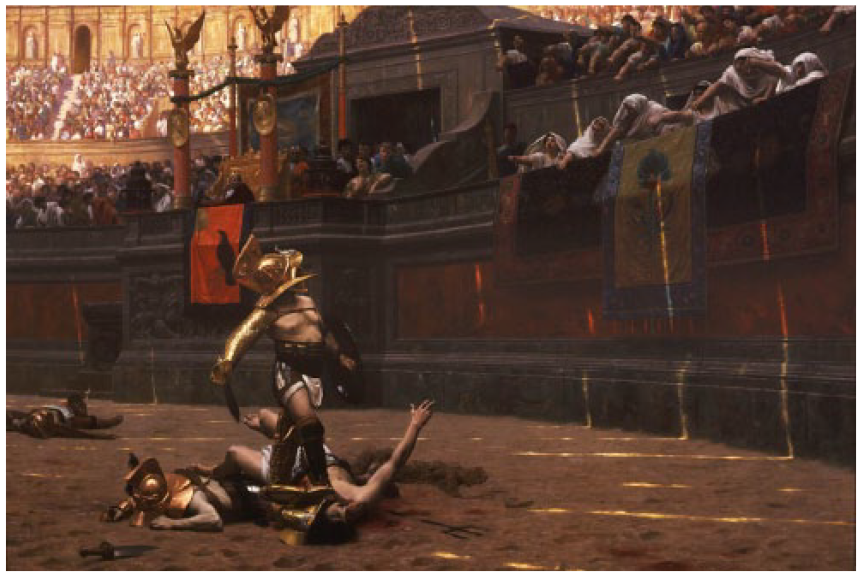
Jean-Léon Gérôme’s meticulously researched neo-classical painting provided inspiration for the film Gladiator.
As I argue in a forthcoming monograph, in which I trace gladiatorial imagery in visual culture, the gladiator archetype is perfectly suited to the medium of film, where he has found a successful home in notable cycles such as the Italian peplum, which featured gladiators played by American (or Americanised) bodybuilders. The genre is more commonly known by the label ‘sword and sandal’ film or, more significantly, ‘gladiator movie’. The gladiator has most recently found renewed popularity in the reboot of the genre begun by the 2000 release of Ridley Scott’s Gladiator, where the character is haunted by post-millennial sadness and nostalgia.
Mapping gladiator characters across approximately 400 feature films, television programmes and, to a limited extent, videogames, I define the fictional gladiator as a man (occasionally a woman) forced to fight (by circumstances or enslavement) for the entertainment of a capricious crowd. This archetypal character is not limited to his Roman origins or to his associations with the sword and sandal genre. Indeed, from the Colosseum to the Thunderdome and the most recent instalment of the Thor franchise, the gladiatorial scenario plays out in resonant and strikingly conventional ways. Examples of cinematic gladiators include men who fought in the amphitheatres of the ancient world, such as Maximus (Russell Crowe) in Gladiator, Roccia (Dan Vadis) in Triumph of the Ten Gladiators (1964), the eponymous hero (played by Arnold Schwarzenegger) in Conan the Barbarian (1982), Milo (Kit Harrington) in Pompeii (Anderson, 2014) and the many Spartacii (Kirk Douglas, John Heston, Kirk Douglas, Goran Visnjic, Andy Whitfield, and Liam McIntyre). I argue that the archetype also includes Tyler Durden (Brad Pitt) from Fight Club (1999), mind-controlled videogame avatar John Tillman (Gerard Butler) in Gamer (2009), Katniss Everdeen (Jennifer Lawrence) from The Hunger Games (2012) and the performer, fighter, and celebrity Bruce Lee.
Bruce Lee as gladiator
It is at the crossroads of the gladiator genre and archetype that I position Bruce Lee. He is the centre around which a complex feedback loop crystallises between redemptive violence, philosophy, nostalgia, and transnational genre cinema. Lee fits all the features of the gladiator as I have outlined them above. Fighting is never his characters’ first choice, as they are required to do so for a larger and worthy purpose. The audiences that witness his performances in the cinema are frequently doubled diegetically, as in the bouts in Enter the Dragon, the dojo fight in Fist of Fury or when Lee/Cheng takes on a large group of thugs singlehandedly in The Big Boss (1971). Like the gladiators before him, he is physically striking – iconic even. The much-reproduced image of a shirtless Lee from Enter the Dragon with three scratches on his chest has become a metonym of Lee’s celebrity and, arguably, of kung fu cinema in general. This iconic physicality parallels the role of the strongman in the peplum genre and there are visible similarities in the way those gladiatorial bodies are positioned in publicity posters and lobby cards advertising the films in which they appear (e.g. Figure 2).
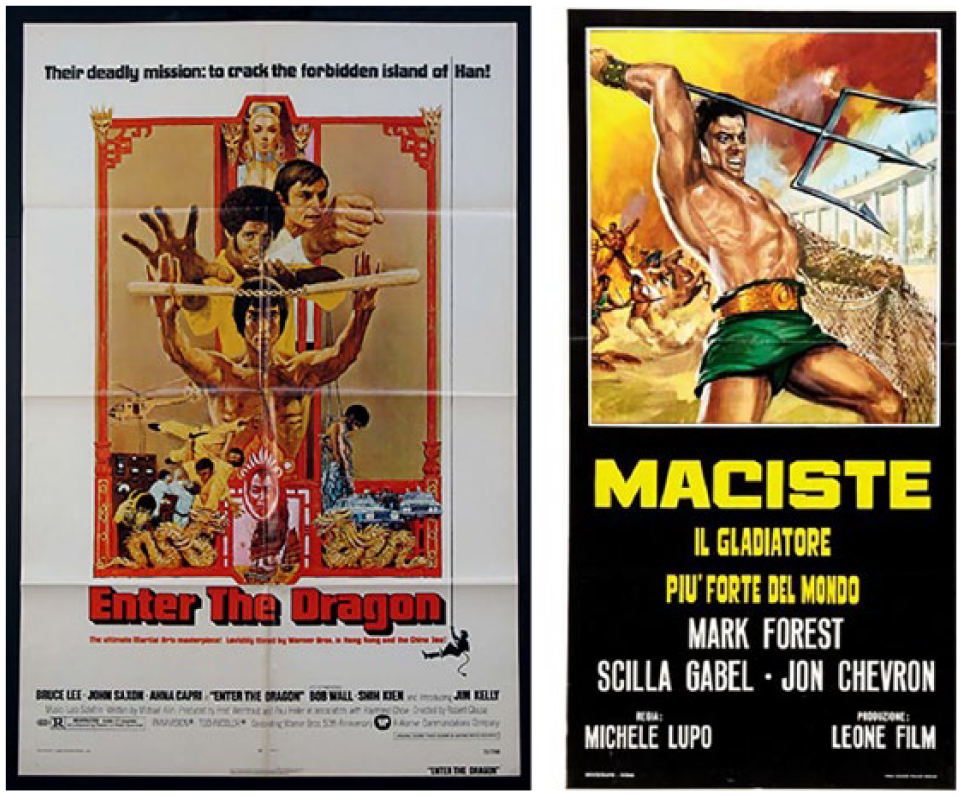
The publicity posters above are built around the centrality of the gladiator characters, posing here shirtless with their iconic weaponry.
If we take gladiatorial masculinity as a barometer for measuring shifts in cultural mythologies (and I do), then the wildfire of Lee’s celebrity – and its ongoing paratextual and digitally augmented legacies – represents a measurable shift in Western fantasies of ideal manhood. Such established Western masculine ideals have been built on classicist or nostalgic reinterpretations of key Roman concepts such as stoicism and virtus (a public-facing characteristic very loosely translated as masculine martial valour and virtue). 3 I would suggest that Lee’s appearance in Enter the Dragon is a key stepping stone for bringing the gladiator archetype out of the Colosseum and into the present day. To return to my opening imagery, Lee is able to step back into the Colosseum as a ruin and retrofit its function as an enduring monument to past articulations of the warrior. Here the ruined Colosseum belongs not to the Roman gladiator but the gladiator archetype as a larger, globalised icon.
Gladiator as teacher
The gladiator has always been a martial artist. The Roman gladiator was trained in a school (ludus) in a particular style or armature (e.g. the net and trident of the retiarius) through a highly hierarchical and disciplined system. The contemporary sport martial artist is sometimes seen as a kind of continuation of the professional gladiator. This connection is particularly resonant in the discourse surrounding the rise of Mixed Martial Arts where it is, paradoxically, used both as a marketing tool for the Ultimate Fighting Championship and as an insult to condemn the brutality of the sport. 4 However, the moment when the Western gladiator learned Asian martial arts is attributable to the popularity and legacies of Bruce Lee’s stardom, beginning in the West with The Green Hornet (1966–1967) and solidified with Enter the Dragon. The spectre of these lessons is visible in the stylised gladiatorial violence of 2014’s Pompeii and the Starz series Spartacus (2010–2013). Although Enter the Dragon remains absolutely crucial here, I would like to privilege one of Lee’s television roles as primary to the process by which the gladiator learned kung fu or, to be more precise, Jeet Kune Do. In the short-lived crime show Longstreet, an Adidas-clad, Reebok-wearing Bruce Lee plays antiques dealer Li Tsung. Li is an advocate and practitioner of Jeet Kune Do who becomes the martial arts/self-defence instructor to the titular character, tragically blinded insurance investigator Mike Longstreet (James Franciscus). In typically orientalist fashion, Li becomes both teacher and sidekick to the White male hero, embedded in the idealised multicultural ‘work-family’ group that gathers around Mike.
Li appears early in the first episode of the series (following the original 90-minute Pilot), entitled ‘The Way of the Intercepting Fist’. His character and his Jeet Kune Do are clearly informed by Lee’s star persona. Many of Lee’s most quoted aphorisms are articulated by this character, including his advice: If you try to remember you will lose. Empty your mind. Be formless; shapeless; like water. Now you put water into a cup, it becomes the cup. Put it into the teapot, it becomes the teapot. Now water can flow and creep or drip or crash. Be water, my friend.
It is important to acknowledge and analyse Li as an embodiment of Lee’s Jeet Kune Do and his star persona; I would argue that none of his other screen characters embody Lee as directly as Li Tsung. However, I would like to reconsider Lee’s role on Longstreet in the wider context of crime television. Longstreet is a crime television programme that was broadcast on ABC, the network that also screened Batman (1966–1968), the aforementioned The Green Hornet, and even earlier, the similarly New Orleans-set procedural Bourbon Street Beat (1959–1960). The crime genre has an established tradition of drawing on exciting urban locales and subcultures to flavour and differentiate its generic content. Lee’s Jeet Kune Do should be read in the context of such American ‘flavouring’ tactics. Although Longstreet has a somewhat special status as a stage for Bruce Lee, it needs to be stressed that it was first and foremost a crime series whose unique selling points were its disabled investigator and the many exotic background details of New Orleans, of which antiques dealer Li’s pragmatic martial arts was merely one recurring fixture. Li’s Jeet Kune Do is distilled into a concentrated and digestible form, conventional to the genre and medium. In order to do so, the show uses orientalist shorthand to frame Lee/Li as mysterious teacher–sidekick and places the spectator in Mike’s position as student. The programme further fuses Li with the urban background of an exoticised New Orleans invigorated by the youthful subcultures of the late 1960s.
I would argue that Longstreet’s importance to the industry and celebrity of Bruce Lee, as to the archetype of gladiatorial masculinity, is to reinforce and naturalise the notion of the gladiator-warrior as teacher. Meaghan Morris (2001) and Paul Bowman (2010, 2013) emphasise Lee’s importance as an iconic teacher, particularly to Western audiences. Robert A. Rushing makes the same point regarding the strongman characters of mid-Century Italian peplum films, arguing that, ‘from its beginning . . . the mid-century peplum presented the strongman as a teacher and a role model’ (Rushing, 2016, p. 70). Rushing’s take is much more psychoanalytically focused, looking to the strongman and gladiator as a teacher for young men (in the diegetic and cinema audiences) and focusing on lessons about manhood and heterosexuality. He adds the caveat that ‘heterosexuality must be gotten to, and it will require a Herculean labor to get there’ (Rushing, 2016, p. 70). The screen image and persona of Bruce Lee, like the strongman, is an object of deep libidinal investment for his audience. Like the Western gladiator characters before him, he gathers a crowd of devoted young followers about him keen to learn from his strength and mastery. To this potent pedagogical cocktail, Lee fused the traditions of martial arts pedagogy with its own long-standing conventions. Despite the fact that Lee vocally insisted that his take on martial arts was a radical departure from traditional martial arts teaching forms, in Longstreet, as elsewhere, he is able to signal both this radical rupture with tradition and unspecified traditions of Asian spiritual martial arts teaching styles. Lee/Li teaches Mike martial arts framed by generic conventions (both televisual and martial), in ways that emphasise ritual repetition, pan-Asian mysticism, and personal betterment.
The moment when the gladiatorial archetype incorporated conventions of Asian martial arts into his fighting arsenal further represents a moment that opened up the field of representation for a different kind of embodied martial masculinity. First and foremost, Lee subverts the persistent whiteness of the gladiator character – a quality noted and influentially analysed by Richard Dyer (1997). As Dyer establishes, by the turn of the 20th century, ‘the Caucasian whiteness of the classical world was taken for granted, down to the pleasures taken in the literal (hue) whiteness that its statues now have’ (Dyer, 1997, p. 148). Like Lee’s character in Longstreet, non-White (generally Afro-Caribbean) actors played roles as sidekicks to gladiators in sword and sandal films, for example, Woody Strode’s memorable performance as Draba in Spartacus (1960). In films, and via the celebrity industry that persisted after his death, Bruce Lee was not a sidekick but a central protagonist whose warrior identity and gladiatorial qualities had a profound impact on global audiences fresh from seeing the monochromatic classicism of peplum genre cinema. 5
The body of the gladiator
The body of Lee as gladiator moves away from the bulk of stars such as Dan Vadis, Mark Forest, or Kirk Douglas to a toned and leaner body type defined by a tense kinetic energy. This would inform, and arguably pave the way, for the physiques of later action stars such as Brad Pitt, Kit Harrington, and Jason Statham, all of whom play gladiator characters. Lee’s celebrity hinges on his abilities as a martial artist, bringing a hard edge of authenticity to the gladiator’s battles that had before this been implied through the impressive physical size and lifting strength of the bodybuilder. Gordon Mitchell (as Marcus) in Gladiator of Rome/Il gladiator di Roma (1962), for example, signals his worthiness to fight by lifting boulders at a slave mine. Where Mark Forest or Dan Vadis’ bodies are defined by posing in a manner recalling classic statuary (Dyer, 1997; Wyke, 1997), Lee’s onscreen physicality is rooted in rapid movement as much as static posing. Where the strongman visibly strains or lifts, Lee’s gladiators explode into quick action. A notable example of this association of Lee’s onscreen body with movement occurs in a much-circulated screen test in which the 24-year-old Lee explains and demonstrates kung fu. After posing for the camera, Lee demonstrates some movements against a volunteer, who visibly flinches at Lee’s speed (‘These are just natural reactions’, explains the man). The crew can be heard laughing with admiration and surprise at Lee’s quickness and his volunteer’s reactions. This association is further mythologised in the celebrated ‘one-inch punch’ associated with Lee (and, like the screen test, widely circulated online) and in the rumours that Lee’s punching speed was so fast on the set of Enter the Dragon that they had to slow the cameras to capture his movement.
In addition to this sense of weaponised speed, the narration and fight choreography of many of Lee’s film appearances also provide moments of sculptural intensity that recall the classicism of ancient world statuary in a manner similar to the posing of the gladiator bodybuilder. This is exemplified in the Colosseum sequence in The Way of the Dragon, which sets up relatively static long shots showcasing the combatants’ bodies as they slowly and with intention take off their shirts. This is intercut with moments of fast blows and more mobile camerawork, including zooms. Nor is this pattern limited to fight sequences, as The Way of the Dragon also features other moments in which Lee/Tang Lung poses, for example, while warming up shirtless on a balcony.
David Bordwell has influentially identified the ‘pause/burst/pause’ pattern used to such powerful effect in Hong Kong cinema, even using a sequence from The Way of the Dragon in particular to illustrate his point (Bordwell, 2000, pp. 221–224). Such a pattern reveals the importance of combining stillness with movement to produce a compelling rhythmic structure to action. I would suggest that while Western cinema, as Bordwell argues, does not take the best advantage of this kind of rhythmic narration, the arena fights of Italian genre cinema and their big budget Hollywood epic counterparts (e.g. Demetrius and the Gladiators (1954) and Spartacus) rely on a similarly powerful combination of posed moments (and interchanges of gazes) with explosions of violent action. In its Western cinematic setting, Bordwell’s paradigm can be amended to describe gladiatorial combat not as pause/burst/pause but as pose/burst/pose. Because the performing fighter must always keep his audience in mind, even in the heat of combat, posing is an absolute necessity.
The pattern of interchangeability between gladiatorial posing and martial kinetic action, brought together in Lee’s onscreen life, continues in the post-millennial sword and sandal film, which Rushing observes is marked by the use of high-speed cameras that make possible a technique of rhythmic ramping, an effect that permits movement between speeds in the same shot. The most notable example of this technique is in Zach Snyder’s 300 (2006), which makes heavy use of this practice to dramatise and aestheticise the struggle of the hyper-masculine Spartans. The effect, according to Rushing, is that Time is slowed, allowing the viewer to gaze in rapt admiration at the beautifully muscled body poised to strike, and then smoothly ramps up to nearly normal speed so the viewer can admire the kineticism of the movement as it uncoils. (Rushing, 2016, p. 56)
Starz’s Spartacus, in obvious homage to 300’s aesthetic, makes liberal use of rhythmic ramping and moments of extreme slow motion in its presentation of gladiators. There is a genealogical relationship here between the digital ramping of Spartacus and the zooms used to punctuate Lee’s 1972 Colosseum fight. Both represent moments when speed and focus change dramatically within the shot and permit posing and speed to exist almost simultaneously. For Bordwell, the Hong Kong pause/burst/pause pattern links stillness and speed in formal mastery that adds emotional impact (‘motion emotion’) to the fight sequence, while, for Rushing, this combination (realised through high-speed ramping and made famous in 300) is proof of the way sword and sandal films imagine time as fundamentally entwined with the doomed nature of the gladiator character.
‘We who are about to die’
Enter the Dragon was released on Western screens shortly after Bruce Lee’s death in July 1973, and its reception is framed by a hyper-awareness that what was supposed to be the Hollywood breakout of a physically expressive star was an uncanny freeze frame of the cinematic moment just before his premature death. 6 This is compounded by the posthumous cobbling and recobbling together of his unfinished film, The Game of Death (released in 1978 as Game of Death) and the many faux sequels and ‘Bruceploitation’ efforts such as Goodbye Bruce Lee: His Last Game of Death (1976) and Enter the Game of Death (1981). Like James Dean or Marilyn Monroe, Lee belongs to a pantheon of Hollywood stars whose youthful qualities (of rebelliousness or sexuality, for example) are frozen and heightened by their early deaths. Leon Hunt and Paul Bowman insist that Lee’s Western stardom is built on the ‘paradox of an impossibly athletic and charismatic star who seemed to have burned out on first contact. In this context, Lee’s death was always part of his “aura”’ (Hunt, 2003, p. 97, cited in Bowman, 2010, p. 18). Furthermore, the tragic circumstances surrounding the death of Lee’s son Brandon layer a deeper sense of tragedy to Lee’s stardom.
Inevitably, dying young is a fundamental feature of the cinematic gladiator; they are the morituri, or ‘those about to die’. The cinematically ubiquitous if not historically accurate gladiatorial salute nos morituri te salutamus/‘we who are about the die salute you!’ – underpins the mythological appeal and melodramatic impact of the gladiator. As a boxer touches gloves or a martial artist bows before their fight, so the mythic gladiator salutes his opponent, his emperor and his audience before fighting. Such gestures are significant as they call attention to the ritual and narrative importance of the gladiator’s violent performance, whether that happens in the amphitheatre or the dojo. In his comprehensive study of the sword and sandal film, Rushing argues that the ‘about to die’ of the gladiator is a key factor in the way the peplum genre imagines cinematic time as slowed down or stopped; as he contends, ‘the time of the peplum is the time of the morituri, literally Barthes’ “going to die” of still photography, a future without a future’ (Rushing, 2016, p. 57). I argue that this also describes the impact that Bruce Lee’s death has had on the Western reception/understanding of Enter the Dragon and Game of Death, as well as, retrospectively, all of Lee’s roles, filmed appearances (e.g. the screen test) and photographs (e.g. the one-inch punch). These are recirculated, remediated, and recreated across digital culture; Lee’s ever-evolving star image carries with it the sense that he, like the gladiator, is always ‘about to die’, frozen in his last skilful movement as in the last shot of Fist of Fury. Gladiators are always about to die, even at the height of their martial skill, physical fitness, and youthful beauty.
The rapid changes in time and speed coupled with the ‘about to die’ of the gladiator character further frames the nostalgic register of the gladiator as a man who is always out of time (in both senses of the phrase). This ‘about to die’ aura fuels the afterburn of Lee’s celebrity and cements an elegiac structure of feeling that now belongs to the gladiator archetype, particularly since the turn of the millennium with Gladiator. The gladiator has always been a man out of step with time. This plays out in the ongoing negotiations around Lee’s celebrity discourse, which has become entangled with the archetypal features of the mournfully sincere gladiator as well as the philosophical wisdom of the cinematic kung fu fighter.
Philosophers and gladiators
The last and perhaps most significant way that Bruce Lee affected a change to the gladiatorial archetype and connected the gladiators of the past with those of the cinematic present and future is through his association with philosophy. In a now widely circulated interview (resonantly entitled ‘The Lost Interview’), Canadian author and historian Pierre Berton connects Lee’s superstar martial artist persona with philosophy and, significantly here, with the Greco-Roman world: We don’t, in our world [by which he means the West], and haven’t since the days of the Greeks who did, combine philosophy and art with sport. But quite clearly the oriental attitude is that the three are facets of the same things.
Here, Berton connects the Western classical past with a (generic/orientalist) East Asian present, suggesting that Lee’s articulation of violence belongs, in some way, to Western classicist ideals. It is this triangulation between Western classicism, Eastern mysticism and Bruce Lee that I want to examine through a popular, perhaps even populist, articulation of the philosophy of stoicism. 7
Gladiators, well known as fighting performers like Lee, likewise have an established relationship to philosophy and philosophers. Ancient Roman thinkers showed significant interest in the figure of the gladiator, notably stoic celebrities such as orator and lawyer Cicero, statesman and stoic philosopher Seneca, and gladiator physician and stoic critic Galen. Historically, stoic writers have provided some important literary insights on Roman gladiators. 8 Like the Christian writers who would follow them (such as St. Augustine and Tertullian), they used gladiators as resonant examples for their teachings on ethics and morality – as cautionary tales and, sometimes, as virtuous ideals. Unlike later Christian thinkers, the Roman stoics sometimes employed the gladiator as an illustrative example of ideal masculine virtus, acting in harmony with the nature of the universe and as examples to emulate. Seneca likens the gladiator to a stoic wise man. Cicero points to the gladiator’s discipline and ability to withstand pain. It is particularly as a pedagogical tool that the gladiator is of the most concern to Roman stoic philosophy, in a manner that parallels the teaching aspects of Bruce Lee’s public image. To be somewhat whimsical, it is tempting to make at least a superficial connection between the Roman stoic statesman Cato the Younger and the martial artist/chauffeur Kato played memorably by Bruce Lee in The Green Hornet series.
Where the gladiators of Rome and their cinematic realisations were generally used as illustrative examples for philosophy, Lee changed the gladiatorial archetype in the wake of the post-war sword and sandal film, adding a philosophic intellectualism that was not a part of this type of masculinity before – from the silent character of Ursus in Quo Vadis (LeRoy, 1951) to Steve Reeves’ grinning heroics. The gladiator went from being the body on which the philosopher might meditate, to the body that fights and philosophises or philosophises through fighting. However, the type of stoicism associated with Bruce Lee and with gladiatorial characters such as Maximus in Gladiator would be almost unrecognisable to Seneca or Cicero.
Vernacular stoicism
The philosophical gladiators emerging in the wake of Bruce Lee’s popularity exhibit a kind of popular stoicism which draws from neo-classicist nostalgic iterations of Greek and Roman stoicism. This is part of a larger pattern of vernacular stoicism circulating in popular culture with renewed vigour in the 21st Century. It is manifest in the popularity of philosophically flavoured self-help books such as The Daily Stoic (Holiday & Hanselman, 2016), How to be a Stoic (Pigliucci, 2017) and social media sites such as The Art of Manliness. Nancy Sherman argues that stoicism is a fundamental part of military identity, and she defines the vernacular sense of stoicism as associated with ‘control, discipline, endurance’ (Sherman, 2007, p. 2). This expression of stoicism is tied to a masculinity that is unemotional, aloof and taciturn. However, I would argue for the centrality of the martial undercurrents of vernacular stoicism and a powerful subtext of (just barely) contained violence.
Bruce Lee is consistently associated with philosophy, as the Berton interview illustrates, and he is also often described using the label and attributes of the vernacular stoicism I have just described. For example, Kyle Barrowman’s analysis of an early comedic sequence in The Way of the Dragon describes Bruce Lee’s performance as marked by a ‘Keatonesque stoicism’ (Barrowman, 2012). Another example is a blog entry on The Daily Stoic connecting martial arts with stoicism, and using Lee as an example of stoic patience (it cites his aphorism ‘I fear not the man who has practised 10,000 kicks once, but I fear the man who has practised one kick 10,000 times’). To push this association further, I would suggest that Lee’s (1975) Tao of Jeet Kune Do has taken on a talismanic status similar to Marcus Aurelius’ Mediations as a popularised and recirculated ‘how-to’ of warrior-philosophy. Certainly, many of the concepts outlined have stoic resonance. To wit, The great mistake is to anticipate the outcome of the engagement; you ought not to be thinking of whether it ends in victory or in defeat. Let nature take its course, and your tools will strike at the right moment. (Lee, 1975, p. 12)
In this vein, but with reference to the digitally reanimated Lee featured in a Whisky commercial, a New York Times review of The Bruce Lee Legacy Collection (Kehr, 2013) ends its summary by associating Lee’s digital re-animation with stoicism: ‘Looming out of the shadowy background, CGI Lee expounds his stoic philosophy (“Walk on”) on behalf of Johnnie Walker Blue Label whiskey. “Dragons never die”, says Digital Bruce – or is it that their managers won’t let them?’ Here, the author aptly makes the connection between vernacular stoicism and the commercialisation of Bruce Lee’s star image. In this way, the stoicism of Lee’s digital re-animation is another lucrative element in the ‘Bruceploitation’ industry, which has been discussed at length by Brian Hu (2008). Hu argues that the wave of Bruce Lee imitators (or ‘conjectural Bruce Lees’) that appeared following the star’s death added to the star persona of ‘Bruce Lee’: ‘After his death the Bruce Lee star persona functioned by becoming flexible and sticky, providing Bruce with new narrative scenarios’ (Hu, 2008, p. 126). This process continues and Lee’s association with, and embodiment of, a gladiatorial stoicism is part of a new narrative that has been layered on his existing persona, at least since the Pierre Berton interview and with more intensity in his posthumous re-animations.
Social media sentiment visualisation
It is via social media, on sites such as The Daily Stoic and more generally on Twitter and Instagram, that there is evidence of a particular bias towards reading Lee as a stoic warrior ideal. Here, I have borrowed from the toolkit of the digital humanities and used the hashtag ‘#brucelee’ as a fruitful cross section for analysing Lee’s digital legacy, as well as illustrating how he is now associated with a stoic martial masculinity.
In 2019, between 9 and 13 August, there were 307 posts on Twitter using the #brucelee hashtag. Sentiment visualisation software (Figure 3) demonstrates that Bruce Lee inspires Tweets on an emotional register that is largely pleasant, falling under the labels like ‘calm’ and ‘serene’ but within the active field. 9 This fits nicely with popular notions of the stoic as simultaneously emotionally controlled but physically active. In popular conceptualisations, the stoic is a man of action rather than of emotions or words. Thus, the ‘emotional content’ of Lee’s persona has, in its digital afterlife, moved away from the comic irreverence of the opening of The Way of the Dragon, the undigested rage of Fist of Fury, or even the emotional expressiveness of Lee’s interview with Berton. The vernacular stoicism of the persona ‘Bruce Lee’ exhibits an active serenity embodied by his Western-facing characters, such as Lee in Enter the Dragon, and explicitly taught through his teacher characters, such as Li in Longstreet. This stoic element has become more important since Lee’s death.

Sentiment visualisation from 9 August to 13 August 2019 for #brucelee.
Just as Lee’s digital re-animation represents an aspect of an established phenomenon of Bruceploitation, his association with stoicism is a singular example of a wider pattern of analysis that connects Lee with philosophy. This entanglement between man, martial artist, star performer, and a generalised sense of Eastern philosophy continues to be a source of a good deal of discussion and debate. Paul Bowman suggests that most analyses in popular accounts ‘either collapse into odes of straightforward hagiography or celebrations of a rather saccharine self-help ideology’ (Bowman, 2010, p. 169). Such considerations are built on assigning Lee the status of authorial genius or visionary iconoclast. This tendency notably continues in, and is compounded by, many of the popular publications on stoicism.
While Lee famously opposed what he read as the rigidity of classicism, particularly in the teaching of martial arts (cf. Lee, 1971, 1975), in his stoic associations he has become a model for a kind of classicism that is a hybrid expression of Eastern and Western pasts, philosophies and fighting systems. Rather than the bricolage of postmodernism that implies composites, pastiche or hybridisation, the post-digital stardom of Lee belongs to a gladiatorial network. Furthermore, Lee’s stardom has shifted this network to imagine a gladiator-as-philosopher via layered pathways of associations, the most salient of which is a stoicism that is vernacular in its use and hybridised in its references from Eastern and Western sources.
Conclusion
To conclude, I would like to journey back to the Colosseum to reinforce the assertion that Bruce Lee should be considered in the context of wider patterns of gladiatorial masculinity. His fight with Chuck Norris is the apex of his creative expression as a filmmaker and martial performer, as nowhere else did he have as much control over the cinematic product as with The Way of the Dragon. It is significant that Lee chose the Colosseum as the stage for this fight because it explicitly connects Lee as a fighting performer to the Roman gladiators who fought in that amphitheatre. Bordwell (2000) describes this memorable moment as when Lee ‘turns the West’s emblem of combat, the Coliseum, into an arena for Eastern gladiators’ (p. 51). This off-hand summary has profound resonance. This moment, and the Western fame that was to follow Lee’s death and the release of Enter the Dragon, solidified Lee’s persona as gladiator-performer-philosopher.
Lee’s star image continues to feed into and out of the fluid archetype of the gladiator. Despite the resolute whiteness of the character, Lee’s enduring but evolving star discourse has opened up the archetype to different types of physical expression and embodiment. Like other gladiators, Lee’s screen characters belong to the ranks of the morituri, those about to die, frozen in youthful physicality at the active moment just before death. As a philosopher-gladiator, Lee has come to embody a hybrid vernacular stoicism that can nostalgically recall the traditions of the past while retrofitting them in ways that are easily digestible and feel both mysteriously ancient and urgently modern.
Footnotes
Funding
The authors disclosed receipt of the following financial support for the research, authorship, and/or publication of this article: The author is grateful for the support of Oxford Brookes University, which awarded her a Research Excellence Fellowship that contributed to the completion of this article.
