




Abstract
By proposing a dual-perspective model of attitude formation related to Chinese products, the survey of 592 adults investigated how Americans’ evaluation and purchase intention of Chinese products can be influenced by China’s image driven by a synergy of US politics and mass media. Younger people and minorities had better evaluation of and more intention to purchase Chinese products. A better country image of China contributed to more positive products beliefs and stronger purchase intention. Republicans engaged in partisan-motivated reasoning in their purchase intention, while Democrats converged with nonpartisan audiences. More social media use resulted in stronger purchase intention, while partisan media failed to make an impact on product beliefs and purchase intention. The findings suggested that although Americans’ judgment and purchase intention of Chinese products is affected by individual’s preexisting perception of China, only Republicans are prone to partisan-motivated reasoning of Chinese products. Social media use could lead to more acceptance of Chinese products, but conservative and liberal media seem to make little impact on this matter.
Introduction
As a developing country, China was known for its poverty, corruption, and many other social and economic problems in the last century. Since its reform and opening-up in the late 1970s, China successfully transitioned from planned economy to free market economy (Howell, 1993). According to the World Bank (2019), this economic reform not only lifted more than 500 million people out of extreme poverty, but also helped China maintain an average growth rate of 10% annually and eventually led to its status as the world’s second largest economy. Today’s China is recognized as the “world’s factory” as Chinese products are pouring into the global market and can be found in various categories. The United States is no exception to the “made in China” phenomenon. On one hand, Chinese products benefit ordinary Americans’ lives with their miscellaneous choices and affordable prices; on the other hand, Chinese products were not best known for superior quality and innovative design. Due to negative news (i.e. food safety, product recall, cheap knock-offs, and others), consumers from Hong Kong, United States, and United Kingdom have expressed concern about the quality of Chinese products and displayed reluctance to purchase them (Kabadayi & Lerman, 2011; Rapoza, 2012).
It is impossible to investigate Americans’ attitudes toward Chinese products without probing the role of US media and politics because China’s profile is constantly affected by US media agenda along with the ever-changing White House’s foreign policies with China. In particular, US media tend to frame China’s rise as a threat and challenge to America’s superpower status (e.g. Liss, 2003; Roy, 1996). One of the popular beliefs is that China is taking a toll on the US economy by using cheap labor to steal manufacturing jobs away (Elliott, 2007). Since 2008, the US–China relationship has greatly improved as the Obama administration welcomed the rise of China and considered the bilateral relationship with China the most important (Li, 2016). The scenario, nevertheless, shifted dramatically after Donald Trump took office. The Trump administration accused China of “raping” the US economy and started an ongoing trade war with China (e.g. Diamond, 2016; “A Quick Guide to the US-China Trade War,” 2020). In such an increasingly complicated political atmosphere, it is necessary to reevaluate how China’s country image can affect Americans’ attitudes toward Chinese products.
Literature review
Country image
The conceptualization of country image can be traced back to research in Country-of-Origin (COO) effects 40 years ago. Nagashima (1970), one of the first scholars to study this term, defined country image as “the picture, the reputation, the stereotype that businessmen and consumers attach to products of a specific country” (p. 68). Since Nagashima (1970) gave a product-specific definition of country image by adopting the dimensions of price and value, service and engineering, advertising and reputation, design and style, and consumer’ profile, many succeeding scholars (e.g. Agarwal & Sikri, 1996; Han, 1989; Roth & Romeo, 1992) also embraced this traditional perspective of country image focusing on consumers’ impression of products from a particular country.
Meanwhile, other scholars (e.g. Han, 1989; Jaffe & Nebenzahl, 1984; Knight & Calantone, 2000) were not satisfied with this narrow definition and chose to incorporate other relevant elements into the strictly product-specific construct of country image. For example, Johansson and Nebenzahl’s (1986) country image included two dimensions of economy and status; Jaffe and Nebenzahl (1984) included technology, marketing, and price as its dimensions. Some scholars adopted a different approach by differentiating the product-related elements from the remaining country image construct and examined the dynamics between the two. Hence, the term product-country image was invented (Papadopoulos & Heslop, 1993; Pappu et al., 2007).
A third group of scholars treated the concept as a generic construct that incorporates a variety of factors beyond the country’s product attributes. For example, Desborde (1990) considered country image to be the general perceptions or mental snapshot of a country in an individual’s mind. Martin and Eroglu (1993) defined country image as a comprehensive cognitive construct, that is, “the total of all descriptive, inferential, and informational belief about a particular country” (p. 193). Parameswaran and Yaprak (1987) also developed a three-dimension construct of country image, which includes general country attribute (GCA), general product attribute (GPA), and specific products attribute (SPA). Others (e.g. Lee et al., 2016; Magnusson et al., 2014) treated country image as a holistic construct activated by nodes in an associative network of memory.
Last but not least, Papadopoulos et al. (1988) and Laroche et al. (2005) advocated a three-factor construct, consisting of the cognitive, affective, and conative components. The cognitive component (i.e. country beliefs) stands for the country’s level of industrial and technological advancement; the affective component (i.e. people affect) denotes the consumers’ emotional responses toward people of that country; the conative component (i.e. desired interaction) refers to consumers’ willingness to interact with a foreign country. Based on the three-factor construct, other scholars (e.g. Buhmann, 2016; Buhmann & Ingenhoff, 2015) also proposed a four-dimensional (4D) model of country image comprising specific beliefs and general feelings in the functional, normative, aesthetic, and emotional dimensions.
Since the 1970s, many international marketing scholars have investigated country image’s role in forming individuals’ perception of imported products. As Gaedeke (1973) found out, consumers’ evaluation and attitude concerning a certain brand or product can dramatically change, either in a positive or in a negative way, once the country-of-origin label is revealed. Giraldi and Ikeda (2009) argued that consumers’ evaluation of products from other countries can be influenced by their deeply rooted stereotype associated with these countries. Studies in international marketing (Chandrasen & Paliwoda, 2009; Ganideh, 2012) also showed a correlation between a nation’s economic status and the superiority of its products because consumers generally are in favor of products made from highly industrialized countries. However, with the complexity of globalized economy and more sophisticated division of labor, a product may be associated with multiple countries in terms of its manufacture, brand, design, assembly, and head office, which further complicates the issue of country-of-origin effects.
A potential factor that discourages customers from buying foreign products could be country animosity or consumer nationalism. Country animosity is a hostile attitude toward a specific foreign country (Jung et al., 2002; Klein et al., 1998). Suh and Kwon (2002) argued that country-based animosity could give rise to a sense of guilty and the tendency to avoid purchasing foreign products. For example, Japan, as a product’s country of origin, could affect Chinese people’s purchase decision due to Chinese consumers’ negative attitudes related to Japan’s invasion to China (Klein et al., 1998). In a similar way, scholars (i.e. Han, 1988; Wall & Heslop, 1986) defined consumer nationalism as the intention to make sacrifice in order to buy domestic goods. Consumer ethnocentrism is believed to represent beliefs held by consumers with regard to appropriateness and morality of purchasing foreign products compared to domestic ones (Shimp & Sharma, 1987).
Forty years ago when Information and Communications Technologies (ICT) were not as advanced and pervasive as today, people’s access to information of foreign countries was limited. As a result, their knowledge about them was scant and outdated. Nowadays citizens do not solely rely on foreign products to form their attitudes toward other countries as they are constantly exposed to a plethora of mass media including print news, radio, TV, and the emerging digital and social media. Multiple studies (e.g. Iyengar & Simon, 1993; Krosnick & Brannon, 1993; Pan & Kosicki, 1997) suggested that media have the ability to influence the audience’s perception of important public issues. Country image could be among the public issues as Zeng et al. (2011) argued that global media converge plays a crucial role in constructing and changing national images of different countries. With the wide reach of various international broadcasting networks (such as Unites States’ CNN, United Kingdom’s BBC, China’s CGTN, and Qatar’s Al Jazeera), people across the world are becoming increasingly knowledgeable about foreign countries and their cultures (Paswan & Sharma, 2004). Since scholars (e.g. Chung & Woo, 2011; Stock, 2009) suggested that media may have the capacity to shape people’s perception of a foreign country, it is crucial to probe country image in the context of mass media.
Partisans, partisan media, and China
Partisans are an inescapable phenomenon in today’s political communication as studies (e.g. Asher, 1980; Goren, 2005; Hoffmann and Miller, 1997) showed that Americans share an increased correlation of views regarding a series of political issues including government intervention in the economy as well as issues related to racial relation, minority and women’s rights, social welfare, and religion. Consequently, a typical US political belief system classifies its citizens into two easily identifiable partisan groups, that is, the conservative and the liberal. Although individuals may hold their own idiosyncratic personal belief systems, most partisans fall under the dichotomous belief spectrum of conservatism and liberalism.
For the most part of the 20th century, the US news media tended to present political debate in the format of the Op-Ed section of newspapers, in which conflicting political views were usually covered evenly (Bennett, 1996; Dalton et al., 1998). This is because the US Federal Communication Commission (FCC) stipulated the Fairness Doctrine in 1949, requiring news media to report controversial public matters in a fair and balanced way. After the FCC’s repeal of the Fairness Doctrine in 1987, partisan media surfaced and thrived in the US mainstream media landscape (Prior, 2007). Following the prevalence of partisans and the popularity of partisan media, the United States is becoming increasingly polarized because news media are more likely to function as an echo chamber for their target audience than stay neutral (Levendusky, 2013). For instance, Fox News is a right-wing news channel with a large portion of audience being conservatives and Republicans; MSNBC, on the other hand, enjoys great popularity among liberals and Democratic viewers.
For a long time, China was not a key issue that could cause heated debate between Republicans and Democrats. With its booming economy in recent years, China is becoming a recurring theme in the US politics. During the presidential campaigns, China bashing has been a commonly used bipartisan campaign strategy for many candidates, including Ronald Reagan, Bill Clinton, George W. Bush, and Barack Obama (Dorning, 2015), not to mention Donald Trump and Bernie Sanders. Although politicians and mass media may feature a more negative rhetoric concerning China, partisan audiences’ attitudes toward China fluctuated over the past few years. In a 2005 Gallup poll (Newport & Himelfarb, 2013), Republicans and Democrats scored closely with 45% of Republican and 50% of Democrats holding a favorable view of China. But a clear partisan discrepancy was witnessed in a 2013 Gallup poll with only 32% of Republicans having positive opinions about China, while the percentage of Democrats (52%) liking China remained stable. Nevertheless, Pew Research Center (Silver et al., 2019) demonstrated that China’s image dropped sharply in 2019, with 60% of Americans holding unfavorable opinions of China. The survey also showed although China’s disapproval ratings have risen across both parties, more Republicans (70%) think unfavorably of China than Democrats (59%), suggesting a slightly reduced partisan discrepancy concerning China. In this case, it is still early to conclude whether China is a strictly partisan controversy that could cause divergent views between two parties.
Partisan-motivated reasoning
Previous research (e.g. DellaVigna & Kaplan, 2007; Nir & Druckman, 2008; Stroud, 2007) suggested that mass media could have an influence over the audience’s political position although more substantial evidence is needed to verify these effects. With the increasing popularity of partisan media, individual’s political standing and party affliction may play a crucial role in their judgment of news content related to political issues. Although some scholars argued that the political ideology of being liberal or conservative is no longer applicable in political communication (e.g. Durrheim, 1997; Ray, 1988), others (e.g. Jost, 2006) disagreed by suggesting relationships between political ideology and various psychological and political factors. A study by Miller et al. (2009) suggested that liberals and conservatives engage in two distinct information-processing modes: liberals engaged more in a systematic manner and tend to focus on the content of a persuasive message, while conservatives exhibited more heuristic processing of cues surrounding the message.
It has been found out that strong political beliefs could lead to conformation bias and selective exposure to news among audiences (e.g. Iyengar et al., 2008; Lavine et al., 2002; Rickert, 1998). Not only would audience prefer media outlets that are agreeable to their own personal tastes and opinions, but they also have a tendency for motivated reasoning when processing news content. Motivated reasoning occurs when people’s information processing and attitude formation is driven by directional goals (Kunda, 1990). In comparison of accuracy goals of reaching objectively true conclusions, directional goals motivate individuals to reach a particular predesignated conclusion, often in consistency with partisan predisposition or preexisting ideology (Baekgaard et al., 2019; Taber & Lodge, 2006).
Based on the literature in information processing, political communication scholars (Gaines et al., 2007; Goren, 2002; Petersen et al., 2013) put forward the theory of partisan-motivated reasoning, that is, a tendency for people to use political cues to form their judgment directionally. This theory argued that partisan audiences are likely to seek information that reinforces their preferred party’s standings and to ignore or discharge information that contradicts their party identifications. Several studies (e.g. Bolsen et al., 2014; Druckman et al., 2013) indicated that partisans’ evaluation of a policy is influenced by the political party sponsoring the policy as a source cue. Ramirez and Erickson’s (2014) experiment also suggested that partisanship can bias people’s evaluation of the current economy. As Bolsen and Druckman (2018) argued, when a public message such as climate change was politicized, partisanship might undermine the effect of a scientific consensus statement and lead to polarization. In addition, partisan-motivated reasoning in information processing could occur in the evaluation of issues including political figures (Goren, 2002; Mullinix, 2015), governments (Lyons & Jaeger, 2014), events (Gaines et al., 2007), violent actors (Noor et al., 2019), and scientific messages (Roh et al., 2015). Nevertheless, Bullock (2011) argued that the effect of partisanship may have been exaggerated due to the insufficiency of policy information provided in many studies.
Research Question and Hypotheses
A hypothesized dual-perspective model of attitude formation (see Figure 1) was proposed to predict Americans’ evaluation and purchase intention of Chinese products. This model integrated the two main perspectives that may potentially affect individuals’ processing of Chinese products. The first perspective covers various internal individual factors, comprising people’s demographics, their preexisting perception of China, as well as political standings (e.g. the degree of liberalism and conservativism, and party affiliation). The second perspective incorporates the external factors of media usage, that is, mass media’s role in shaping individuals’ opinions about the “made in China” issue.
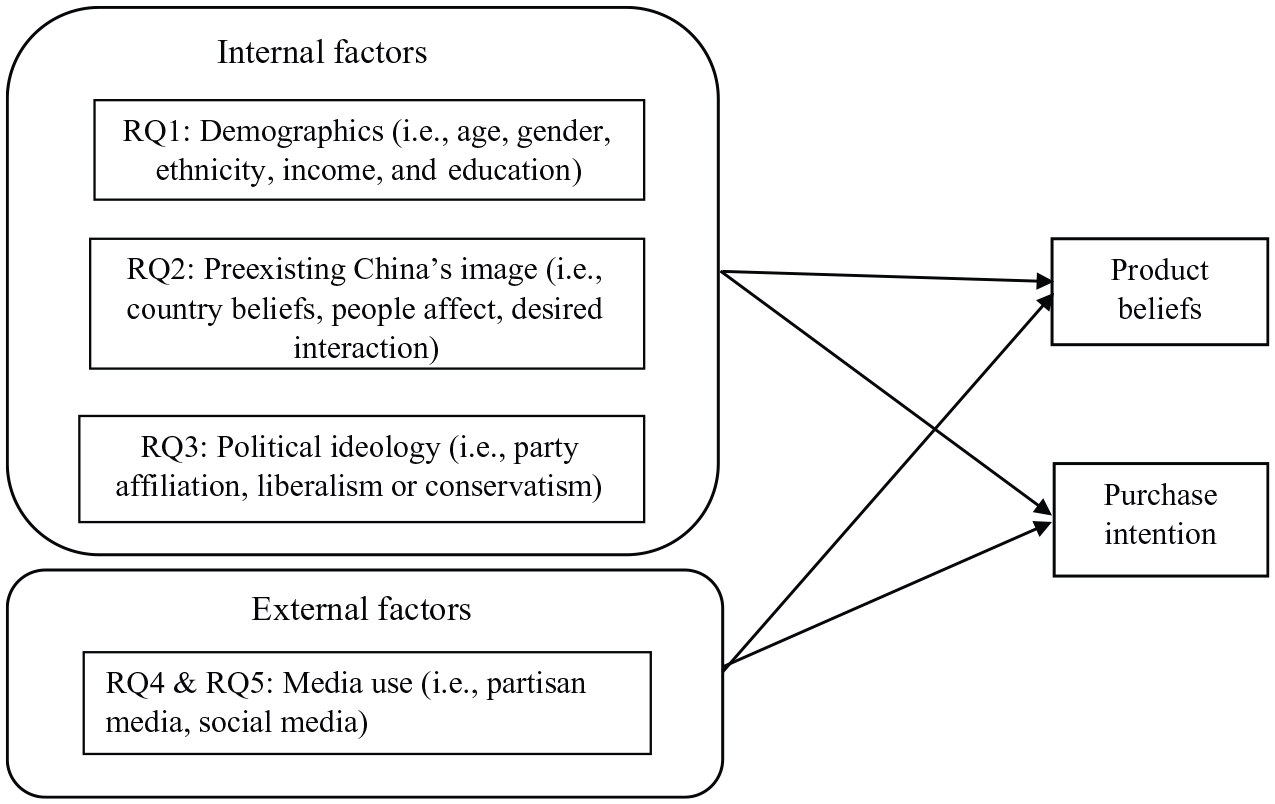
A dual-perspective model of attitudes formation of Chinese products.
Based on the above model, a few research questions and hypotheses are proposed:
RQ1. Do demographics make a difference in product beliefs and purchase intention in regard to Chinese products?
Age may be a predictor as a Pew Research Center study (Wike, 2017) showed that Americans below 30 years old tended to have a more positive view of China and that people aged 50 and older tended to emphasize various problems in China, especially human rights policies, than 18- to 29-year-olds. Ethnicity may also potentially affect consumption patterns (Jafari & Visconti, 2015; Zeugner-Roth et al., 2015). In particular, ethnic consumers are likely to have different attitudes toward foreign products, especially if they are imported from countries of their own origin (Little & Singh, 2014; Podoshen, 2009). Furthermore, a Gallup poll (Newport, 2009) revealed that the Republican Party is dominated by White Americans, with 89% being non-Hispanic Whites, while Democrats have a more racially diverse composition with 36% being Hispanic, Black, or other races. Since young people and minorities tend to be liberal and Democrats, the following hypotheses are proposed:
H1a. Younger Americans have more favorable evaluation of Chinese products and are more willing to purchase Chinese products than older ones.
H1b. Minorities have more favorable evaluation of Chinese products and are more willing to purchase Chinese products than White Americans.
People’s gender, education, and income may also predict product beliefs and purchase intention. No hypotheses were proposed here due to lack of literature.
A three-dimensional construct of country image comprising the cognitive, affective, and conative components (Laroche et al., 2005; Papadopoulos et al., 1988, 1990) was used in this study. Accordingly, country image breaks down into three subcomponents, that is, country beliefs, people affect, and desired interaction. Based on previous findings of country image’s influence on imported products (e.g. Chandrasen & Paliwoda, 2009; Ganideh, 2012; Samiee et al., 2016), it is hypothesized that all three components may affect people’s attitude and behavior related to Chinese products:
RQ2. Does preexisting perception of China’s image affect people’s product beliefs and purchase intention in regard to Chinese products?
H2a. A higher degree in China’s country beliefs, people affect, and desired interaction leads to a better evaluation of Chinese products.
H2b. A higher degree in China’s country beliefs, people affect, and desired interaction leads to a stronger intention to purchase Chinese products.
Previous literature (e.g. Aldrich et al., 2015) indicated that Democrats and liberals tend to have more positive evaluation of China than Republicans and conservatives. In addition, a Pew Research Center report (“US Public, Experts Differ on China Policies,” 2012) suggested that Republicans are more likely to view China’s rise on the world stage as a major threat than Democrats. If this trend applies, their political ideology could also influence the perception of Chinese products and willingness to buy them:
RQ3. Does political ideology affect people’s product beliefs and purchase intention in regard to Chinese products?
H3a. Democrats tend to have more positive evaluation of and stronger intention to purchase Chinese products than average Americans.
H3b. Republicans tend to have more negative evaluation of and less intention to purchase Chinese products than average Americans.
H3c. The more liberal a person is, the higher he or she will score in Chinese product beliefs and purchase intention; the more conservative a person is, the lower he or she will score in Chinese product beliefs and purchase intention.
Liberal media and politicians, compared to conservatives, tend to be more open when dealing with issues related to foreign countries and immigrants. This contrast can be witnessed in the shifting China-related foreign policies between the Obama and Trump administrations. If Democrats and Republicans have different views about China and its role in American economy and politics, it is reasonable to assume that the rhetoric concerning China would differ across partisan media. Therefore, we expect exposure to liberal or conservative media may result in divergent attitudes and behaviors related to Chinese products:
RQ4. Does partisan media use affect people’s product beliefs and purchase intention in regard to Chinese products?
H4a. More liberal media use leads to better evaluation of and stronger intention to purchase Chinese products.
H4b. More conservative media use leads to worse evaluation of and less intention to purchase Chinese products.
Besides traditional partisan media, a new form of media, that is, social media, has become increasingly crucial in political communication, especially after Obama’s heavy adoption of social media in his 2008 presidential campaign. Nevertheless, unlike traditional media (i.e. TV, radio, and print news) and less interactive digital media (i.e. news websites), social media are a public sphere that embraces the philosophy of free marketplace of ideas. Thus, the platform itself does not adopt a particular partisan bias. It would be interesting to investigate whether social media use is related in any way to people’s judgment of Chinese products. Because of lack of literature in this matter, no hypothesis was proposed:
RQ5. Does social media use make a difference in people’s product beliefs and purchase intention in regard to Chinese products?
Method
An online survey webpage was constructed by using HTML, CSS, and SQL languages. The survey, which can be completed within 15–20 minutes, collected data about participant’s demographics, political ideology, media use, perceived China’s image, as well as their evaluation and purchase intention of Chinese products. The data were collected within 30 days between February and March 2016 as a pretest of a larger experiment project.
Sample
Participants were recruited in a medium city of northwest Ohio in the two ways. First, printed brochures containing survey invitations were posted on the billboards of the city’s public facilities including libraries, parks, shopping malls, and schools. Second, survey links were shared on several online local community groups on Facebook. A lottery for several Amazon gift cards was offered as an incentive for participation. A total of 592 participants were verified to be American adults with ages ranging from 18 to 72 years. The median age of the participants is 32 years. In addition, 63% of the participants were White and 37% were ethnic minorities; 59% of the participants were female and 41% were male. According the US Census data (e.g. Howden & Meyer, 2011; Schaeffer, 2019), the median age for all US population is 37.2 years, with 51% female and 49% male; 60% of Americans are White compared to 40% of minorities. Our data are close to the national population in terms of the ratios in gender and ethnicity. The sample’s ages are younger than the national data, but not by far. This is predictable since citizens aged 60 and older are less likely to participate in an online survey. Among the 592 participants, 210 people identified themselves as a Democrat and 118 identified themselves as a Republican. In addition, 227 people claim to be independent and 37 people belong to other parties.
Measures
Demographics
Information of participants’ age, gender, ethnicity, education, and income levels was collected. Participants’ actual age was used for data analysis. Ethnicity was coded as 0 for White/Caucasian and 1 for ethnic minority. Gender was coded 0 for female and as 1 for male. Education and income levels were both recorded as ordinal variables with a bigger number indicating a higher educational level and higher income.
China’s country image
A five-item scale of “country beliefs” (Cronbach’s α = .755) was developed to measure people’s perception of China as a country in general, including science and technology, educational system, companies and brands, and economy; a four-item scale of “people affect” (Cronbach’s α = .832) was developed to measure Americans’ emotional responses to Chinese people and culture; a four-item scale of “desired interaction” (Cronbach’s α = .715) was developed to measure Americans’ desired interaction with China and Chinese people. Participants were asked rate each item with a 10-point Likert-type scale ranging from 1 (“strongly disagree”) to 10 (“strongly agree”) and an average score was calculated for each of three scales. A higher score indicates a more positive evaluation.
Party affiliation
Participants’ self-reported party memberships were recorded. Two dummy variables, that is, Democrat (1 = yes, 0 = no) and Republican (1 = yes, 0 = no), were used for data analysis.
Liberal-conservative scale
Participants were asked to rate their standing in the political spectrum with a 10-point Likert-type scale ranging from 1 (extremely liberal) to 10 (extremely conservative).
Partisan media use
Participants were asked to rate how much they use different conservative media including conservative TV/radio (e.g. FoxNews), newspaper/magazine (e.g. The Wall Street Journal), and news website/blog (e.g. FoxNews.com or Drudge Report) with a five-level scale from “never” to “always,” based on which an average score was calculated for conservative media use. Similarly, an average score was calculated for liberal media use including TV/radio (e.g. MSNBC), newspaper/magazine (e.g. The New York Times), and news website/blog (e.g. Huffington.com). The list of liberal and conservative media examples was chosen based on a Pew Research Center study of partisan media (“Ideological Placement of Each Source’s Audience,” 2016).
Social media use
Participants were asked to rate how much they use social media (e.g. Facebook, Twitter, and Instagram) with a five-level scale from “never” to “always.” An average score was calculated.
Product beliefs
A four-item scale of “product beliefs” (Cronbach’s α = .896) was measured by using the average scores of participants’ impression of Chinese products in terms of quality, price, design/workmanship, and durability/reliability. Participants were asked to rate the four aspects about Chinese products with a 10-point Likert-type scale ranging from 1 (“extremely negative”) to 10 (“extremely positive”).
Purchase intention
A four-item scale of “purchase intention” (Cronbach’s α = .828) was adapted from the construct of “product evaluation” by Laroche et al. (2005). Participants were asked to rate their willingness to purchase Chinese products in different conditions and an average score was calculated.
Results
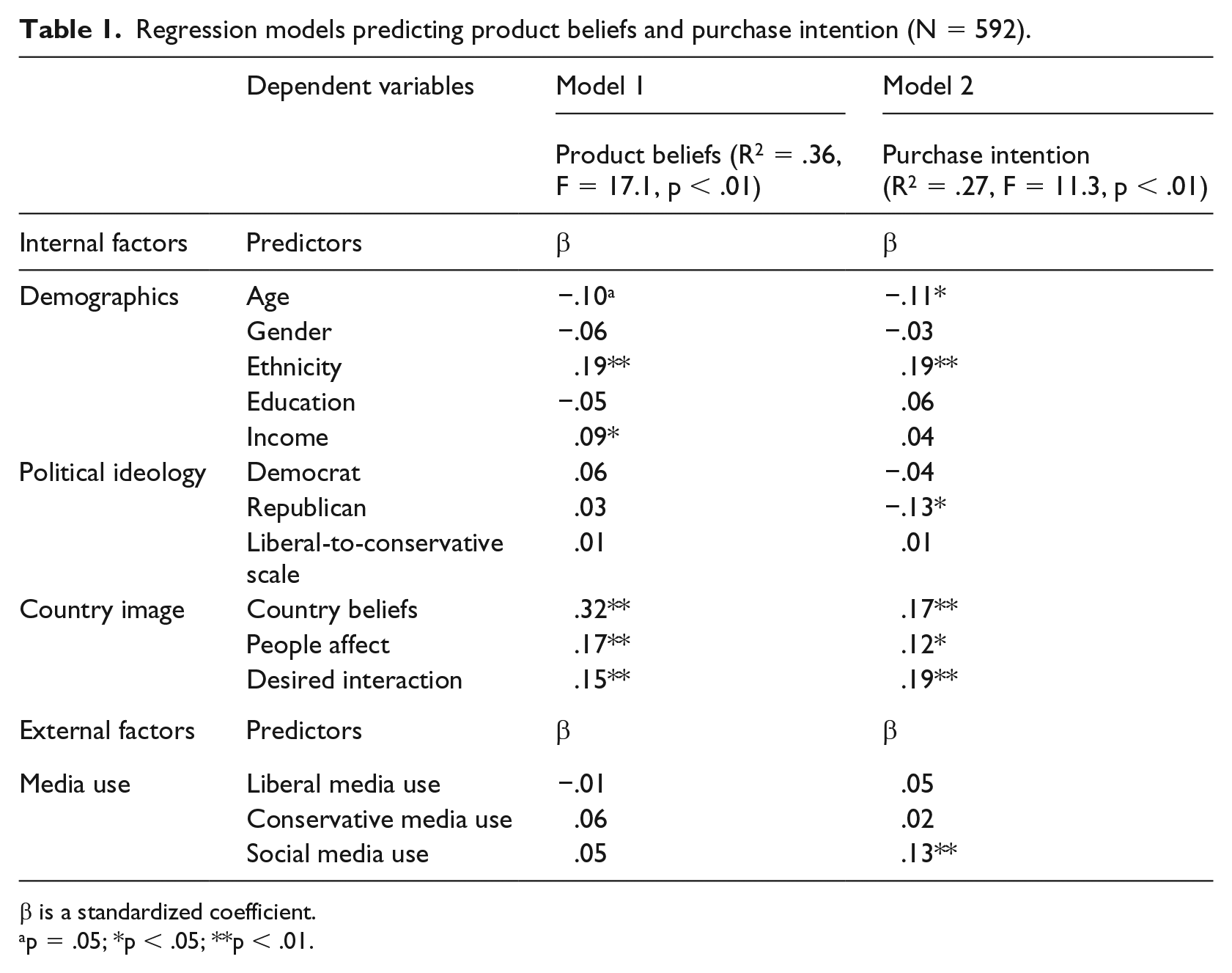
Two models of multiple regression analysis (see Table 1) were employed to study the above RQs.
Regression models predicting product beliefs and purchase intention (N = 592).
β is a standardized coefficient.
p = .05; *p < .05; **p < .01.
Age marginally predicted product beliefs (β = −.10, p = .05) and significantly predicted purchase intention (β = −.11, p < .05). Thus, H1a was mostly supported, indicating that younger Americans tend to have more favorable evaluation of Chinese products and stronger intention to purchase them than older Americans. Ethnicity significantly predicted both product beliefs (β = .19, p < .01) and purchase intention (β = .19, p < .01). Thus, H1b was supported, indicating that minorities tend to have more favorable evaluation of Chinese products and stronger purchase intention than White Americans. Therefore, as for RQ1, age and ethnicity are significant predictors for people’s product beliefs and purchase intention in regard to Chinese products. Other demographics did not show any difference except for income, indicating a tendency that people with higher income tend to have more favorable evaluation of Chinese products.
People who scored higher in China’s country beliefs (β = .32, p < .01), people affect (β = .17, p < .01), and desired interaction (β = .15, p < .01) tend to have better beliefs of Chinese products. Similarly, people who scored higher in China’s country beliefs (β = .17, p < .01), people affect (β = .12, p .05), and desired interaction (β = .19, p < .01) tend to have stronger intention to buy Chinese products. Thus, H2a and H2b were supported. As for RQ2, a higher score in country beliefs, people affect, and desired interaction leads to more favorable evaluation of Chinese products and stronger intention to purchase them.
Democrats are not significantly different from nonpartisan Americans in their products beliefs (β = .06, p > .05) and purchase intention (β = −.04, p > .05). Thus, H3a was rejected, indicating that Democrats do not view Chinese products differently and nor is their willingness to purchase them different from nonpartisan Americans. Republicans are not significantly different in products beliefs (β = .03, p > .05) either but have much lower purchase intention (β = −.13, p < .01). Thus, H3b was partially supported, indicating that Republicans do not view Chinese products differently from nonpartisan Americans but are less willing to purchase them. The liberalism-conservativism scale did not predict products beliefs (β = .01, p > .05) or purchase intention (β = .01, p > .05). Thus, H3c was rejected, indicating that liberals do not view Chinese products differently from conservatives and neither does their purchase intention differ. As for RQ3, the liberalism-conservativism scale is not a significant predictor for product beliefs and purchase intention; party affiliation only makes a difference in predicting Republicans’ purchase intention.
Liberal media use failed to predict products beliefs (β = −.01, p > .05) and purchase intention (β = .05, p > .05). In a similar way, conservative media use failed to predict products beliefs (β = .06, p > .05) and purchase intention (β = .02, p > .05). Thus, H4a and H4b were not supported, indicating that exposure to liberal or conservative media makes no difference in people’s evaluation of and willingness to purchase Chinese products. As for RQ4, partisan media use failed to predict either purchase intention or product beliefs related to China.
Table 1 showed that more social media use did not affect products beliefs (β = .05, p > .05) but led to more willingness to purchase Chinese products (β = .13, p < .01). Therefore, as for RQ5, more social media use leads to stronger purchase intention of Chinese products.
Discussion and conclusion
Major contributions
The findings gave some insight into average Americans’ attitudes toward the “made in China” issue in an increasingly politicalized media environment.
First, Americans’ general perception of China as a nation did influence their evaluation and purchase intention of Chinese products. The data showed that a better assessment of China’s country beliefs led to a more positive view of Chinese goods and more willingness to purchase them. In addition, more positive opinions of Chinese people and stronger desire to interact with them also led to a better evaluation of Chinese products and stronger purchase intention. As Diamantopoulos et al. (2011) argued, country image could affect purchase intention of foreign products indirectly as a mediator and people’s assessment of a brand could also enclose consumer’s perception of country image. Our study further corroborated this statement by demonstrating a positive association between country image and likeliness to buy foreign products. Furthermore, besides affecting Americans’ purchase intention, the analysis indicated that China’s image could also influence people’s assessment of Chinese products in terms of quality, design, reliability, and others. This findings may challenge the claim by Klein et al. (1998) that consumers likely avoid products from a foreign country due to military, political, or economic conflicts between two countries, but not because of their concern of the quality of goods.
Second, partisan media did not make a difference in people’s evaluation and purchase intention concerning Chinese products. There are two possible reasons for the non-effect of media partisanship. One possibility could mean that the influence of partisan media source cue over people’s opinions about “made in China” products is limited. Likewise, Clayton et al. (2019) also suggested that partisan media source may not overwhelm people’s judgment of false information in news. An alternative explanation could be that liberal and conservative media do not differ dramatically from nonpartisan mainstream media in their coverage of China and Chinese products. The China-bashing rhetoric is not exclusive to conservative media and politicians as democratic presidential candidates Elizabeth Warren and Bernie Sanders also talked about confronting China in issues of trade and human rights (Ehrlich, 2019; Rapoza, 2019). The bipartisan anti-China rhetoric may have intensified as China’s image plummeted again in 2019 when the US Senate and House unanimously passed the Hong Kong Human Rights and Democracy Act (Cochrane et al., 2019), showing a unified sympathy across parties for Hong Kong protesters.
Third, more use of social media led to stronger intention to buy Chinese products, suggesting that social media have more power in influencing people’s judgment of foreign countries than traditional media. Because few studies specifically explored the relationship between a foreign country’s image and audience’s social media use, it is hard to draw a conclusion to this discovery. A few speculations are suggested here. First, unlike TV, newspaper, and radio, social media are a media platform that adopts no political standing, enjoys no national border, and welcomes all different cultures and ideologies. By using more social media, Americans have a chance to broaden their knowledge about foreign nations and keep themselves updated with latest news happening across the world. A great portion of news circulating on social media originates from less mainstream media including nonpartisan news, citizen news, and news from foreign agencies. The diverse choices of news sources could have encouraged heavy social media users to look beyond the prevailing prejudice and bias of profiling and criticizing China across the current US mainstream media. Second, social media users are likely to develop more online friendships and interactions with people outside America, which may contribute to their broadened vision and diversified understanding about foreign countries as well as their people and culture. Intergroup contact theory (Allport, 1954; Pettigrew & Tropp, 2006) argued that intergroup contact typically reduces intergroup prejudice in the terms of race and ethnicity. According to Saleem et al. (2016), intergroup contact not only refers to direct face-to-face contact but also includes indirect media-based contact. Previous studies showed that mediated contact can reduce outgroup prejudice against migrant workers (Ju et al., 2016), gay men (Sink & Mastro, 2018), and immigrants (Wojcieszak & Azrout, 2016). In addition, a survey by Shim et al. (2012) revealed that young Korean adults’ consumption of US dramas can improve their attitudes toward American citizens. Consequently, we could hypothesize that social media may play a crucial role in improving Americans’ attitudes toward China and easing their consumer nationalism by exposing US audiences to more diverse and less biased alternative media and by establishing substantial mediated contact with Chinese people in the cyberspace. However, these are only educated speculations, which still need more empirical studies to corroborate.
Limitations
A few limitations in this study should be acknowledged. First, the survey used a self-reported 10-point liberalism-to-conservative scale to measure participants’ partisanship, which may be subjective and inaccurate. However, because random errors in responses usually can compensate for each other, it should not pose a threat to the validity of the study. Second, the study is intended to explore the general pattern concerning the public’s attitudes toward Chinese products. Discretion must be used when generalizing the findings to a specific product category or brand from China. Third, the results may not reflect the current political climate as the data were collected in 2016. Nevertheless, the findings still shed light on the mechanism of partisan-motivated reasoning and can contribute to a better understanding of dual-process models in the context of country image.
Theoretical implications
While acknowledging the occurrence of partisan-motivated reasoning in processing China’s country image, the study argues that the working mechanism of partisan-motivated reasoning may vary across different sub-groups within partisan audiences. Previously, Nicholson et al. (2016) revealed that female partisans tended to rate people who share similar candidate preference as more attractive but male partisans did not show such effect. A growing discrepancy was also found in attitudes toward global warming between Democrats and Republicans along with media’s increased coverage of this issue in 2006 (Zhao et al., 2016). In a similar way, the current study showed that, despite Republicans’ increased reluctance to purchase Chinese products, Democrats did not differ from nonpartisan Americans in their purchase intention. A poll (“US Public, Experts Differ on China Policies,” 2012) showed that 60% of Republicans view China as a major threat and 65% think United States should take tougher stance against China (compared to 48% and 35% of Democrats), suggesting country animosity and consumer nationalism might be the major reason behind Republican’s reluctance to buy Chinese goods. Since Republicans and Democrats do not significantly differ in their evaluation of Chinese products’ quality, reliability, and design, it can be implied that Republicans’ unwillingness to buy Chinese products is not due to their lack of confidence in “Made in China,” but driven by their preexisting political ideology. The findings echo with previous research, signaling Republicans’ propensity to appeal to directional goals and Democrats’ tendency to converge with politically neutral audience in their attitude-formation process (e.g. Hart & Nisbet, 2012; Meirick, 2013).
Consumers’ political ideology can make a difference in their judgment of Chinese products, but the impact tends to be aligned with their party membership (i.e. being either a Democrat or Republican) as the liberalism-conservativism scale failed to predict either product beliefs or purchase intention. This is an important contribution to the understanding of partisan-motivated reasoning as many studies did not differentiate party membership from the liberalism-to-conservativism spectrum with the two concepts often being treated interchangeably. Our findings suggested that the spectrum of liberalism and conservativism might not be as simplistically dichotomous as assumed. As far as China is concerned, this scale is not an outstanding cognitive cue that is salient enough to trigger directional processing. Instead, party affiliation is a more prevailing factor for US consumers to activate partisan-motivated reasoning.
Nevertheless, the absence of a significant partisan media effect on the scales of product beliefs and purchase intention is unexpected. This may suggest that the influences of mass media are, to some extent, overvalued. The finding also projected general Americans as hardheaded independent thinkers or, in a slightly negative tone, to be highly opinionated when dealing with political issues. Media’s non-effect has been demonstrated by CNN’s constant criticism of then-candidate Donald Trump during the 2016 presidential campaign, which nevertheless failed to stop Trump’s momentum to become the command-in-chief. The missing effect from partisan media further supported Yang and Yun’s (2020) argument that country image is “a long-term holistic representation of accumulative knowledge, attitudes and personal feeling” about a country and a relatively stable construct that is resistant to short-term media propaganda. This dual-perspective model of attitude formation demonstrated that US consumers’ process of judgment formation and decision making in regard to “made in China” is mainly shaped by their demographic background, political affiliation, and preexisting long-term memory of China’s image. Heavy social media users may think more positively about Chinese products by consuming more diverse coverage, while partisan media’s influence on this issue is likely to be negligible.
Footnotes
Funding
The author(s) received no financial support for the research, authorship, and/or publication of this article.
