



Abstract
This research explores the variations between Chinese party and non-party newspapers in the framing of trans-edited international news. Existing studies on the framing of Chinese domestic news show that the variations depend on the sensitivity of news, which invokes government control. However, it is not clear how strictly the government would control international news and whether party and non-party news organizations would show similarities or variations in the framing of it. To address these issues, we conducted a comparative quantitative content analysis of 806 pieces of trans-edited international news from one party newspaper and one non-party newspaper. The findings show that the party and non-party newspapers show similarity on the use of three frames but small variations on the other four. This implies a strong control of the Chinese government on the reporting of international news. By comparison, the government control has stronger effects on the party newspaper than on its non-party counterpart.
Introduction
A number of studies have identified substantial influence of political authorities on news production. Some of these studies emphasize the influences of political authorities as sources, for example, Cook (2006), Lang and Lang (1983), Rodelo and Muñiz (2019), Salwen (1988), and Schudson (2002); others suggest a more direct control with the use of administrative and political power (Harcup, 2009; Shoemaker & Reese, 1996).
In recent years, there have been an increasing number of studies on how political powers influence the frame use of news media (see, for example, Bolsen, 2010; Dimitrova & Kostadinova, 2013; Ferree et al., 2002; Hänggli, 2012; Snow et al., 2007). Good examples include those situated in the Chinese context, among which Luther and Zhou (2005) investigated the news framing of SARS in China and the United States, and Kuang and Wei (2018) looked into the framing of politically sensitive issues which are detrimental to the legitimacy of different levels of government in China.
However, most research, as cited in the work of Rodelo and Muñiz (2019), focuses on the framing of domestic issues within the country of the news organizations being studied, for example, biotechnology (Nisbet & Lewenstein, 2002), election campaigns (Hänggli & Kriesi, 2012; Lengauer & Höller, 2013), energy conservation (Bolsen, 2010), impunity in public affairs (Y. Zhou & Moy, 2007), and language policy (Kee et al., 2012). Few studies looked into how news organizations in a country frame international news.
Besides, although existing studies have confirmed the association between news media type and frame use (Luther & Zhou, 2005; McMenamin et al., 2013; Strömbäck & van Aelst, 2010), the result is mostly based on the analysis of domestic instead of international news reports. It is, therefore, not clear whether the findings from the framing of domestic issues are replicable to that of the international counterparts. In the case of China, both Luther and Zhou (2005) and Kuang and Wei (2018) found that in the reporting of politically sensitive domestic issues, different newspapers in China, that is, party and non-party papers, show similarity on frame use as the framing of these issues is heavily controlled by the propaganda authorities. However, when it comes to international news reporting, we are not sure how tight the control is. It is, therefore, unclear whether the same pattern appears in frame selection in the reporting of international news by party and non-party newspapers.
The present study sets out to answer two major questions, that is, what frames are most frequently used in international news reporting and whether party and non-party news organization use similar frames in the reporting. To that end, we selected 806 pieces of international news, from one party newspaper (the Xinhua Daily (XHD)) and one non-party newspaper (the Southern Metropolis Daily (SMD)) and did a quantitative content analysis. These pieces are in fact trans-edited news meaning that they were originally from international news organizations but have been simultaneously translated and edited by local journalists (Cheesman et al., 2011).
Political control on news production
The impact of political institution on news production is significant. News media are even attested as a political institution in some extant studies (Cook, 2006; Schudson, 2002). Scholars in the United States clearly pointed news organizations as “semi-independent” (Bennett & Livingston, 2003), indicating the strong influence of political power on them. They considered news content a product of politics involving daily interaction between reporters and the sources in political institutions (Cook, 2006; Schudson, 2002). The shaping power of the sources on news media production is evident in many earlier studies (e.g. Lang & Lang, 1983; Salwen, 1988). Besides their influences as sources, political authorities could also exert direct control on the news organizations through licensing, laws and regulations, and censorship (Harcup, 2009).
In authoritarian states, the influences of political power on news production are more direct than in democracies. This is because journalists in these non-democracies, like most of their democratic counterparts, would report news issues by involving debates from political elites much more often than the other sources like the grassroots, which is known as indexing (Bennett, 1990, 2003). Besides, news organizations in authoritarian countries receive direct control from the government. As a result, the news media in such countries are considered as more authoritative and conservative (Ostini & Fung, 2002). Take China as an example, with a sophisticated news censorship program, the Chinese propaganda authorities can control the reporting of every piece of news, though they do not usually do so due to some political considerations (Kuang, 2018). For example, as part of its effort to monitor and manage local governments, the central government would encourage news organization at higher levels to report on wrongdoings of the local cadres so that legitimate ruling of the state led by the Chinese Communist Party (hereafter “Party-state”) is not ruined (Kuang, 2018; Liebman, 2011; Lorentzen, 2014).
Studies on media control in China hold that the Party-state’s principle of censorship practices is to maintain legitimate ruling (see, for example, Brady, 2008). This means that the propaganda authorities put under control the news reporting of issues which are considered as sensitive and harmful to state legitimacy. The Party-state and its propaganda apparatus do this by sending directives to news organizations at different levels (including central, provincial, and municipal levels) to confine their reporting on such issues (E. Zhang & Fleming, 2005). In some sensitive periods, the government would summon news media editors and managers, both traditional and online media, routinely for meetings in which news reporting guidance and disciplines are reaffirmed (X. Wu, 2010).
In non-sensitive periods, the propaganda departments will send through notice in either form of reporting guidance or ban on a case-by-case basis to suppress the rapid dissemination of such newly emerging issues (Kuang, 2017). And for the long-standing taboo issues, for example, Tibet, Xinjiang, and Taiwan issues, guidance on the reporting is deemed repeated in the routine trainings and meetings of the news organizations by editors-in-chief who are usually appointed by the propaganda department (Jia, 2002).
It is also believed that the way of controlling international news reporting is similar to that of controlling taboo issue reporting. This is because many news stories from abroad would demonstrate different ideological and political standpoints and values from the Chinese government. As N. X. Liu (2017) stated, some news frames fit in well with certain ideologies better than the others, indicating that news organizations from different countries with different ideologies would use distinct frames to report the same issue. So as part of the ideological work, the Chinese propaganda authorities would very likely exert as tight control on the reporting of trans-edited news as on the nationally sensitive issues.
According to existing studies on governmental control in China, the propaganda authorities would request all news organizations in China not to do original reporting on sensitive yet unavoidable issues, such as the Tibet and Taiwan issues, but follow the agenda of the state news agencies like the Xinhua News Agency (Kuang & Wei, 2018; J. Li et al., 2017). This agency is the mouthpiece of the Central Committee of the Chinese Communist Party which always report news issues according to the guidelines of the Party-state (Feng et al., 2012; Ma, 2005; M. Wu, 2006). Consequently, many news organizations, especially the party ones which are more self-censored than their non-party counterparts, trans-print the complete articles from Xinhua (Kuang & Wei, 2018). Only non-party organs would re-edit or excerpt part of the Xinhua reports.
We assume that the Chinese propaganda authorities would use the same method to regulate the reporting of international news. This is supported by the fact that many newspapers in China use the Xinhua News Agency as the major source of international news or follow its agenda (J. Li et al., 2017), despite they have the capability to translate and edit news from foreign sources.
However, even though political authorities are inherently influential as they are the major sources of news (Cook, 2005; Gans, 1980; Gitlin, 1980; Sigal, 1973), we are not clear about which news agendas and frames they would more likely to promote in the reporting of international news. It is also unclear whether different types of news organizations in China would use similar news frames or not in the reporting of international news, despite the fact that they are all directed to use the news reports from state news agencies. This is because non-party newspapers, which are more responsive to the market/audience than its more compliant and self-censored party counterpart (Zhao, 2000), may negotiate the reporting boundaries (Kuang, 2017) for international news and want to adopt just a part instead of the entire piece of the agencies’ reports.
Existing studies on the news reporting of domestic issues in China have provided ample implications for the case of international news framing. Most of these studies (e.g. Pan & Chan, 2003; Stockmann, 2011, 2013; G. G. Wu, 2000) believed that economic reforms and media and commercialization in China have brought news media more reporting autonomy. This is because the commercialization of news media requires journalists to embrace the notions of news value and audience appeal (S. Liu, 2011), promoting a sense of journalistic professionalism that becomes a competing paradigm to party-journalism in China (Pan & Chan, 2003). This brought forth the emergence and development of non-party news organizations, which are more market-oriented as they mainly aim for market support for more profits to subsidize the party news outlets that continue to serve as the mouthpiece of the Party-state until today (Qian & Bandursk, 2011; Zhao, 2000). The bread-winner role of the non-party news organizations has gained them an increasing bargaining power for expanded news reporting boundaries on various issues (Akhavan-Majid, 2004; Huang, 2007). However, some studies have indicated that the lifted autonomy and expanded boundary are only confined to the less sensitive issues which are not threatening state legitimacy (Kuang & Wei, 2018; Stockmann, 2013). After all, media commercialization was a state-led initiative and the Party-state still has complete powers in controlling the reporting of news organizations (Hadland & Zhang, 2012; Huang, 2001; L. Li, 2013; Winfield & Peng, 2005), which explains the limited space that both party and non-party news outlet have on the highly sensitive issues (Kuang & Wei, 2018). This implies that the autonomy of Chinese news organizations on the reporting and framing of international issues could vary across the party and non-party news organizations, if the news issues are not highly sensitive. As the existing findings are mainly drawn from the investigation of news organizations’ coverage of domestic/local issues, the present study, targeting the international news issues, could further our understanding of news control over both the party and non-party news organizations in China.
News framing
The concept of framing has been developed by a few generations of researchers following the first introduction of it by Goffman (1974). Entman (1993, p. 52) defined that framing is a process of selecting some aspects of a perceived reality and making them more salient in the text of communication. News framing, therefore, is a process in which news organizations conceptualize an issue in a particular way by emphasizing some aspects of the news issue (Chong & Druckman, 2007). The products of this process, that is, news frames, are expected to influence thinking of the public and shape their perceptions and opinions about the news issue (De Vreese, 2005; Knight, 1999).
Frames as the framing products appearing in the news article can be coded as issue-specific frames or generic frames as De Vreese (2005) proposed. The former type of frames are identified and given a name related to specific events or topics, while the later are named after the thematic limitations they transcend and thus can be applied to analysis of different topics. As the texts we are analyzing in this study involves various social and political topics related to overseas subjects and entities, generic frames are used to analyze the framing of trans-edited news by party and non-party newspapers. Due to the same reason, we adopt all the five generic frames used in previous studies in the West, including conflict frame, responsibility frame, human interest frame, economic consequence frame, and morality frame, and two others mainly used in studies in China including leadership frame and factual information.
By name, a conflict frame focuses on the “conflict between individuals, groups, or institutions as a means of capturing audience interests” (Semetko & Valkenburg, 2000, p. 95). A responsibility frame presents an issue or problem “in such a way as to attribute responsibility for its cause or solution to either the government or to an individual or group” (Semetko & Valkenburg, 2000, p. 96). A human interest frame “brings an individual’s story or an emotional angle to the presentation of an event, issue, or problem” (Valkenburg et al., 1999, p. 551; X. Zhou, 2008). An economic consequences frame emphasizes the actual or potential economic impact or consequences of an event, issue, action or problem on individuals, societies, or nations (Luther & Zhou, 2005; Neuman et al., 1992; Valkenburg et al., 1999). A morality frame interprets an issue, event or problem in terms of “moral prescriptions,” such as presenting moral messages, or offering “specific social prescriptions about how to behave” (X. Zhou, 2008). A leadership frame, which was found to have significant appearance in the Chinese news stories, concerns the activities, actions, or speeches of a leader of a nation, an institution, a government agency, or a group, or highlights the discussion and assessment of the leadership (Luther & Zhou, 2005; X. Zhou, 2008). Last but not least, factual information presents news in a factual manner and in a “straightforward fashion” without “indication of implications” (X. Zhou, 2008; Zillmann et al., 2004). Strictly speaking, factuality does not emphasize one or more aspects of an issue and therefore is not taken as a “frame” (Kuang & Wei, 2018). However, we consider it important as some sensitive international news stories, especially those involving tensions between China and another country, may be presented in a factual manner so that no speculations of the audience were stimulated.
Framing of international news in China
Although Chinese authorities consider the control over international news reporting as important as that over nationally sensitive news, the frames they prefer to see in the international news might not be the same with what they want in domestic news. This is because the two types of news concern different entities, that is, the international news mainly reports issues about foreign governments, organizations, and persons while domestic news focuses on the Chinese counterparts. In the reporting of domestic issues, the Chinese authorities are believed to be in favor of frames like leadership and the use of factual information, which are less threatening to state legitimacy than others like the responsibility and conflict frames (Kuang & Wei, 2018). However, in the case of the reporting of international news, the Chinese authorities may want to keep more conflict and responsibility frames in the original news articles as exposing conflicts in foreign countries and attributing responsibility for a problem’s cause or solution to the foreign government or to a foreign group or person would not bring harm to the Party-state.
The speculations above indicate that the framing of trans-edited international news in China is unlikely to replicate that of the domestic issues. It is, therefore, important to explore what frames are more likely to be used by the Chinese news organizations in the reporting of trans-edited international news. Existing studies have already found that the use of information sources in these news stories associates with the application of some certain frames (Han et al., 2017).
Thus, in consideration of the tight control of the Chinese authorities over the news media on the reporting of trans-edited news by ordering them to trans-print the international news from the Xinhua News Agency, we assume that the news organizations will use more conflict and responsibility frames. However, it still remains unknown as to how frequently the other frames, including economic consequence, human interest, morality, leadership, and factual information are used. Our first research question is thus formulated as follows:
RQ1. What frames are more likely to be used by the Chinese news organizations in the reporting of international news?
Framing of international news by party and non-party news organizations
Existing studies (e.g. McMenamin et al., 2013; Strömbäck & van Aelst, 2010) show that the reporting and framing of the same news issues varies across news organizations of different types in the less controlled societies. Particularly in the case of China, newspapers of different political affiliations, that is, party and non-party also show differences in their news content (Huang, 2001; Wei, 1999). Party newspapers are the mouthpiece of the Communist Party of China (CPC) to establish rapport between the Party and the Public (Shirk, 2011). Thus, the news reports of the party organs give weight to the information in line with national policies and Party-state guidance (Shirk, 2011; Shao, 2002). On the other hand, the non-party newspapers, which emerged as a new and different type of outlet following the economic reform and media commercialization in China (Gang & Bandurski, 2011), highlight materials considered sensational and appealing to the masses in their news articles (Shao, 2002; Zhao, 2000). To summarize, party and non-party newspapers in China are distinctive on both political status and content (Kuang & Wei, 2018). According to Shao (2002), the party outlets have higher political status as they are the authoritative channel for the Party-state to disseminate its voices, while non-party newspapers are not “official” but the party organs’ sub-outlets targeting the market. The content of the party news organizations would thus involve more government policies and party guidance, while that of their non-party counterparts more on materials appealing to the public (Kuang & Wei, 2018; Shao, 2002). As a result, despite non-party newspapers are also subject to government control, they are less self-censored and less compliant with propaganda notices (Kuang, 2014, p. 68) and may choose some frames that are not favored by the Party-state or the government.
The impact of political affiliation of news organizations on news framing depends on the sensitivity of news. Kuang and Wei (2018) and Luther and Zhou (2005) found that in the reporting of nationally sensitive issues, the two types of newspapers use similar frames. However, in the reporting of locally sensitive issues, party and non-party newspapers show significant variations in frame selection. This is because the reporting of locally sensitive issues is only controlled by the local government in the locality where the news issue happened, but not by other local governments or government of higher levels, leading to more freedom of the news media from other localities and high levels, for example, national newspapers. Given the freedom, the less self-censored non-party news organizations would select more frames that are not favored by the government than their party counterparts.
Assuming that the propaganda authorities in China exert as tight control on the framing of international news as on that of nationally sensitive issues, we would expect that party and non-party newspapers use similar frames. Nonetheless, J. Li et al. (2017) have found that the framing of Chinese news organizations on the disease of SARS, which originated domestically, is very different from the framing of them on another disease with foreign origins, that is, Ebola. To eliminate this confusion, we raised the second research question as follows:
RQ2. Do Party and non-party newspapers show similarity in frame selection in international news reporting?
A series of sub-research questions under RQ2 on the use of the particular frames between the party and non-party newspapers are as follows: Do party newspapers use the conflict (RQ2a), responsibility (RQ2b), economic consequence (RQ2c), human interest (RQ2d), morality (RQ2e), leadership frames (RQ2f), and the factual information (RQ2g) as frequent as non-party newspapers do?
Methods
To analyze the impact of political affiliation of news organizations on their frame selection in international news reporting, we have collected and analyzed international news stories published in the XHD and the SMD.
XHD is a party newspaper based in Nanjing, Jiangsu Province. Founded in 1938, it was the first newspaper published nation-wide by the CPC. It is now a provincial level party newspaper under the direct supervision of the Provincial Committee of CPC in Jiangsu. SMD, on the other hand, is a non-party newspaper in Guangzhou, Guangdong Province. Commenced by the Nanfang Daily Group (NDG) in 1997, it is one of the flagship commercialized newspapers in China and is subject to supervision of both NDG and the Propaganda Department of Guangdong Provincial Committee of CPC. There are three reasons for the selection of the two newspapers. First, they are typical party and non-party newspapers, respectively. Second, selecting newspapers from two different provinces instead of the same one could improve the representativeness of the samples. Alternatively, we could select any other two newspapers from other provinces. However, since the authors are more familiar with the newspapers in the two provinces and another project of us has involved interviews with international news editors from both newspapers on their trans-editing process, it is more convenient for us to select the two newspapers for observation and analysis.
We collected all of the trans-edited international news stories published in the two newspapers between October and December 2014. We chose this period of time because the years of 2013–2014 signified the transition of international news reporting of non-party newspapers like SMD from flourishing to shrinking as indicated by Lai (2015), which was considered as part of the Party-state’s increasing influences on the news media after President Xi Jinping assumed office in late 2012 (Brady, 2017; X. Zhang & Boukes, 2019). There are altogether 377 news stories from XHD and 429 from SMD collected and analyzed. The total number of stories is 806.
In terms of topic areas, the majority of international news in both newspapers is political news (60% in XHD vs 60% in SMD). Social news comes the second with 24% in XHD and 22% in SMD. News on health issues accounts for 8% in XHD and 6% in SMD, while stories on sciences account for 8% in XHD and 7% in SMD, respectively.
After training, two coders coded the entire sample of news articles using the guidelines detailed in the codebook. After all the six frames and factual information were identified in the news articles used for the coder training, the two coders began to code the frames appearing in the news articles. It was found more than one frame could be identified in one story and when this is the case, each frame was given a binary code of either 1 (yes) or 0 (no).
The guidelines for the coding of frames were developed by making references to existing studies on news framing in China, for example, Luther and Zhou (2005), X. Zhou (2008), Kuang and Wei (2018). Following the frame coding instructions of this study, a conflict frame is coded as present in the situations below: (a) the news addresses disagreement between different entities including governments, political parties, organizations, or individuals or (b) the news story highlights the debates or reproaches one side over another. A responsibility frame is identified when the news story (a) directs the responsibility for the occurrence of an issue/problem to an entity, for example, government, organization, or individual or (b) indicates that the entity is responsible for a solution to the issue/problem. A human interest frame is coded when (a) a vivid personal story or an example of a news issue is presented or (b) personal living experiences of an actor being affected by the issue are highlighted. A leadership frame appears when a news story (a) focuses on what a government official or political leader says or does or (b) highlights evaluations or assessments of the political leadership. As for factual information, we look at if (a) the whole story presents facts of an issue only or (b) the process of the issue is introduced in a straightforward way without giving any implications. We also set the coding guidelines for the economic consequence and morality frames as follows: An economic consequence frame is found when a news item highlights the actual or potential economic impact of an issue on a social entity. A morality frame is detected when a news story (a) interprets an issue from a moral perspective or (b) offers specific social prescriptions on how to behave.
When the coding process was completed, we conducted an inter-coder reliability test. The results were highly positive with the Scott’s Pi for the dependent variables being calculated as: 0.958 for conflict frame, 0.943 for economic consequence frame, 0.941 for responsibility frame, 0.932 for factual information, 0.858 for human interest frame, 0.855 for leadership frame, and 0.703 for morality frame.
We also ran a series of chi-square tests in SPSS to assess the relationship between political affiliation and frame use. In our reports of the chi-square results, we include both the statistical significance level, that is, the p value and an effect size measure, that is, Cramer’s V.
Findings
To answer the first research question (RQ1) about the frames that are more likely to be used by the Chinese news organizations in the reporting of international news, we have calculated the frequency of each frame which appears in all the 806 pieces of international news.
As we can see from Table 1 below, the more frequently used frames/information among the seven are factual (56%), conflict (21%), and responsibility (15%). In comparison, the less likely adopted frames include leadership (5%), human interest (4%), economic consequence (2%), and morality (1%).
Frame/information use by party and non-party newspapers.
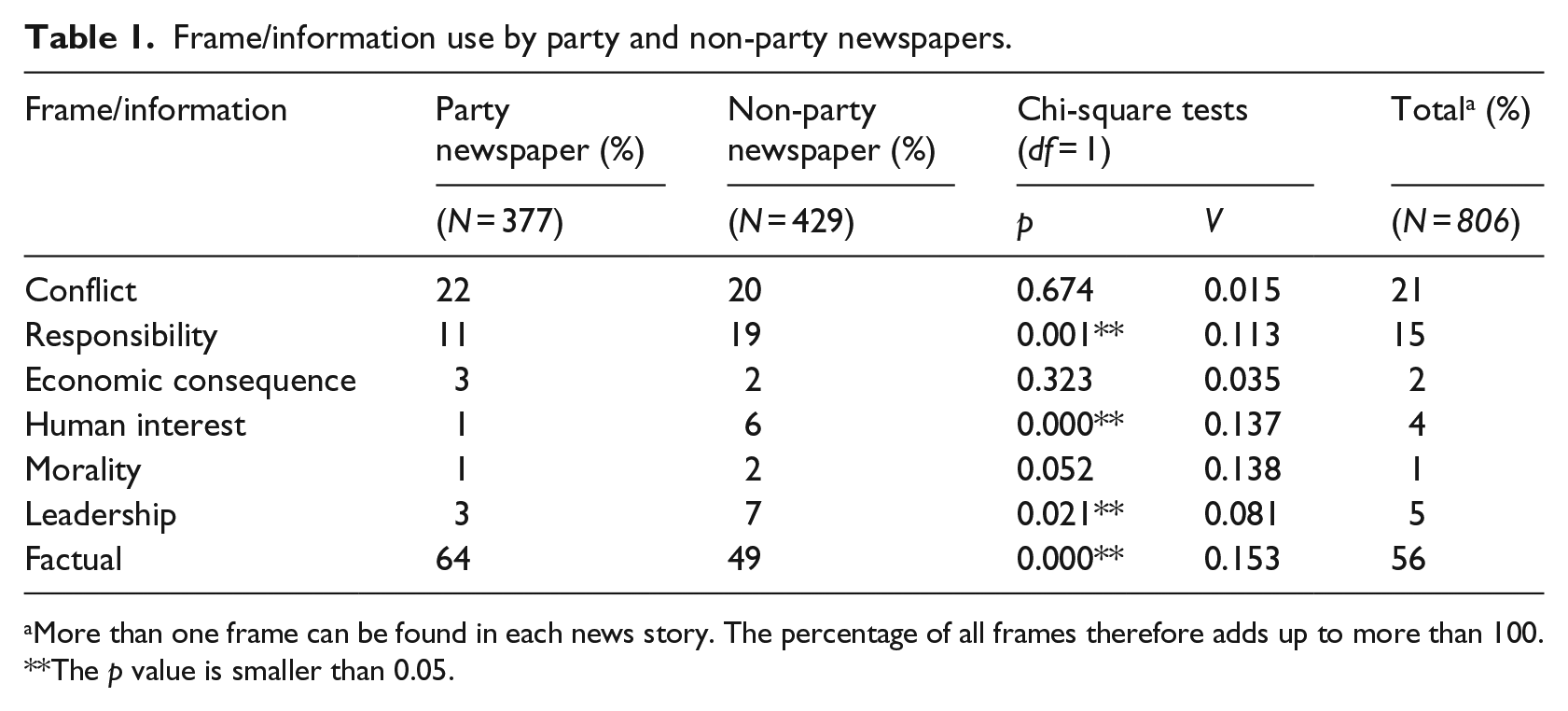
More than one frame can be found in each news story. The percentage of all frames therefore adds up to more than 100.
The p value is smaller than 0.05.
To examine whether newspapers varying in terms of political affiliation (party and non-party) will show similarity in frame use in international news reporting (RQ2), a series of chi-square analyses were performed to answer the seven sub-research questions (RQ2a–2g) under RQ2.
According to Table 1 above, party and non-party newspapers have very similar patterns in the use of the conflict, economic consequence, and morality frames. Regarding the use of conflict frame in the reporting of international news, the party newspaper has a frequency of 22%, while its non-party counterpart has 20%. The difference between them is not statistically significant (p = 0.674); moreover, the tiny V (0.015) suggests that the difference is almost negligible. Similarly, regarding the economic consequence and morality frames, the large p and small V values indicate that the party newspaper use these two frames as frequently as the non-party newspaper. Thus, we can answer RQ2a, RQ2c, and RQ2e by confirming that party newspapers use the conflict, economic consequence, morality, and leadership frames as frequently as non-party newspapers.
As for the responsibility, human interest, leadership frames, and the factual information, significant differences are detected. As Table 1 shows, the party newspaper uses less responsibility frame (11% vs 19%), human interest frame (1% vs 6%), and leadership frame (3% vs 7%), but more factual information (64% vs 49%) than the non-party newspaper. The small p values (0.001 for responsibility frame, 0.021 for leadership frame, and 0.000 for both human interest frame and factual information) indicate that the differences are statistically significant. Furthermore, the small-to-medium V values (0.113 for responsibility, 0.137 for human interest, 0.081 for leadership, and 0.153 for factual information) suggest that the associations between political affiliation and the use of these four frames fall between the weak and the medium levels of association. Therefore, we can answer RQ2b, RQ2d, RQ2f, and RQ2g by concluding that party newspapers do not use the responsibility, human interest, leadership frames, and the factual information as frequently as non-party newspapers.
Conclusion and discussion
It is widely acknowledged that political institutions have substantial influences on news organizations. In authoritarian states, with a sophisticated censorship program, the governments can exert effective control over the production of news (Kuang, 2018; Liebman, 2011; Lorentzen, 2014). As many international news stories demonstrate contradicting ideologies and values, the Chinese government is assumed to impose tight control over the reporting of international news as it does on that of nationally sensitive issues. As a result, we would expect that the Chinese news organizations would select more conflict and responsibility frames as they are considered as harmless to the Chinese governments. Nevertheless, it is quite uncertain about the use of other frames in the reporting of international news in China due to the rare studies in the field. Thus, it was important to do a comprehensive investigation on the use of all the seven frames/information including the conflict, responsibility, economic consequence, human interest, morality, leadership, and factual in international news reporting in China.
Our findings on RQ1 show that conflict and responsibility frames are indeed among the three most frequently used frames in the reporting of international news in China. Surprisingly, factual information is also frequently used and, in fact, it was the most heavily used among the seven frames. A possible explanation for this is that, as state official media of the CPC and the major source of news organizations for international news in China, the Xinhua News Agency would only present facts on important international/bilateral issues that involve China without giving any implications that trigger speculations from the citizens. In contrast with the frequent use of factual information, conflict, and responsibility frames, the use of leadership, human interest, economic consequence, and morality frames in international news reporting is rare in China.
The data of our research indeed show that most of the international news reports originated from the Xinhua News Agency. This observation of the international news reports published in late 2014 is in contrast with that in earlier years before Xi’s regime when newspapers like SMD could use quite a few news reports produced by itself (Lai, 2015). This partly reflects that the control and influences of the Party-state over the news media increased after Xi took office as Brady (2017) found.
As existing studies on the framing of domestic news in China, for example, Luther and Zhou (2005) and Kuang and Wei (2018) suggested that political affiliations, that is, being party or non-party, have an impact on news selection, this study thus shed light on the same problem in the case of international news reporting. The results about RQ2 show that the party newspaper used as many conflict, economic consequence, and morality frames as the non-party newspaper did. While this is similar to the framing of nationally sensitive news in China, in which the use of all frames shows no significant differences across the party and non-party newspapers (see Kuang & Wei, 2018), we do see small variations in the use of four other frames/information, including the responsibility, human interest, leadership, and factual. Such differences between the party and non-party newspapers, however, are not as big as what Kuang and Wei (2018) found in the case of locally sensitive news issues, in which the less self-censored provincial non-party newspapers would frame differently from their party counterparts. This might be because the provincial non-party newspapers are not restricted by the control from the lower levels of government, for example, the municipal or district/county levels.
Just as X. Zhang and Boukes (2019) and J. Li et al. (2017) found, political authorities in China still have strong influences on the reporting of international news. Neither party nor non-party news organizations have much autonomy on the reporting of international news. The impact of the political institutions on the process of trans-editing news is indeed substantial. But the small differences between the party and non-party newspapers on the use of some frames in the reporting of international news also suggest that non-party newspapers would make every efforts to incorporate different frames into their news reports, despite the control of the government requiring them to use news originates from the Xinhua News Agency. Such differences do not only suggest different reactions of party and non-party newspapers to political control (Kuang, 2014), but also indicate distinctive market/audience demands or journalistic routines of them (Shoemaker & Reese, 1996).
It is thus easier to understand why the party newspaper used more factual information than the non-party one: The former was expected to adopt more of the story versions from the Xinhua News Agency, which, as we discussed earlier, usually presented the facts of important international issues involving China. Only by doing so, it would not instigate speculations from the citizens. This could also explain why the party newspaper used less responsibility, human interest, and leadership frames than its non-party counterpart, which would try not to follow the Xinhua News Agency way of reporting, but incorporate a more variety of frames to meet the market/audience demands for more interesting stories (Zhao, 2000).
While this study has filled the research gap by offering insights into how news organizations in China frame trans-edited international news, its limitations are that there are only one party and one non-party newspapers being sampled. However, considering the fact that both of them are typical news outlets of their type and that most newspapers at the time mostly use news originates from the Xinhua News Agency for their international news pages, we consider the findings from the two cases would be similar with those from many other Chinese news organizations. Future research could examine the framing of international news in more party and non-party newspapers across China to see if the findings from this study could be generalized to a bigger population. As this research only investigates the framing of trans-edited news in the transition period of Chinese news organizations witnessing tightened-up media control by Xi’s government, future research can also do a comparison study on the framing of international news before and after Xi’s government to see the influences of the presidency.
Footnotes
Funding
The author(s) disclosed receipt of the following financial support for the research, authorship, and/or publication of this article: This work was supported by China’s Jiangsu Bureau of Education Philosophy and Social Sciences Program under Grant 2015SJD616 and XJTLU Research Development Funding under Grant RDF-19-01-25.
