



Abstract
The worldwide popularity of South Korean popular music has generated global consumer demand for variations of its grueling training regimen offered by talent recruitment agencies and dance studios. Using the case study of the South Korean popular music boot camps offered by the Australia-based agency, The Academy, this article seeks to frame these performative engagements along more cosmopolitan notions of choreographic co-creative labor. In contrast to the highly competitive South Korean popular music machinery, participation in these boot camps can be characterized as affective prosumer “free labor” from trainees from diverse backgrounds, abilities, and motivations. Through programs that enable trainees to “re-present,” “re-organize,” and “re-interpret” K-pop dance performances, studios like The Academy leverage on K-pop’s popularity and its training pedagogies so as to open new fields of creative labor. Accompanying such openings are the strengthening transnational connectivities in the activities of The Academy in intensifying existing multicultural networks in Australia. The studio is also part of a more cosmopolitan platform in orienting traditionally Eurocentric mainstream Australia culturally toward the Asia-Pacific region. By further democratizing the dance abilities of K-pop choreographies, initiatives like The Academy serve in enlarging creative labor in transnational rhythmic communities.
Keywords
Introduction: learning (Korean) manners before K-pop dances
Tucked in the middle of Singapore’s busy tourist belt Orchard Road, the youth-oriented SCAPE building has been the informal home to young freestyle dancers. Between 20 and 21 June 2019, a Korean pop music (hereinafter, K-pop) dance workshop conducted by Australia-based dance training company, The Academy, was attended by 50 participants. Established in 2016 by Angela Lee, a Singapore-born permanent resident of Australia, The Academy seeks to bring the K-pop training experience or “boot camp” to the rest of the Asia-Pacific. On the second day of this audition workshop, two of The Academy’s assistant dance trainers grouped participants according to their age and the kinaesthetic abilities that they had demonstrated on the previous day. During the process, the otherwise casual mood of the dance studio stiffened suddenly when Angela Lee, the main organizer of the event and the founder of The Academy, entered the room. All participants promptly assembled themselves into a rectangular formation as they greeted Lee resoundingly in Korean.
As she walked solemnly within the formation, Lee sternly voiced her displeasure at the lackluster performances and manners of some participants from the previous day. For Lee, the K-pop workshop goes beyond dance choreographies, as it also emphasizes the basic cultural etiquette, manners, and protocols commonly characterizing the highly structured and hierarchal K-pop training regime. After a warm-up session with the assistant trainers, Kim Jin Hwan—a professional dance trainer associated with JYP Entertainment and HOW Entertainment—commenced his class. The participants responded to his arrival by collectively bowing and greeting him in Korean.
This training boot camp phenomenon attests to the popularity of K-pop music and dances. With their rigorously trained youthful performers and hybridized assemblages of diverse genres in meticulously synchronized dance patterns, K-pop dance choreographies have inspired global followings. In order to better understand these performative engagements with Korean popular entertainment, this article seeks to locate the transnational collaborative activities of The Academy within the creative and affective labor inspired by K-pop dance choreographies. It will do so by focusing on The Academy’s efforts in providing the platforms and expertise for K-pop training outside the major Seoul-based K-pop recording labels. To that end, its creative authenticity and agency in structuring participatory fan practices of K-pop-inspired cover dances within the infamously regimented K-pop industry (Wong, 2018; Yim, 2019) will be further explored. On its part, The Academy’s workshops with professional K-pop choreographers, boot camp sessions in Australia and South Korea, mock auditions, video productions of trainee practices, and public performances parallel that of the actual K-pop industry. Thus, agencies like The Academy can be said to be engaged in bringing together the otherwise sporadic creative labor and affective investments of K-pop aspirants from diverse backgrounds, whether for a day or for a career.
This article will delve into the cultural currencies of transnational networks, as reflected in The Academy’s training program, by framing them as choreographic co-creative labor activities. This study follows Banks and Deuze (2009) by recognizing participatory agencies’ prosumer co-creative labor as activities that transcend the straitjacketed binaries of labor-capital tensions. Rather than a zero-sum game between industry and creative professionals on one hand and prosumers on the other hand: We also need to be attentive to the capacities and competencies of the participants, both professional and non-professional, commercial and non-commercial, to negotiate and navigate the possibilities of these emerging co-creative relationships for mutual benefit. (Banks & Deuze, 2009, p. 426)
In this respect, The Academy’s boot camps leverage on the popularity of the K-pop industry by appropriating and customizing its training regime for performers for the larger Australian public. As professional creatives, The Academy facilitates the democratization of K-pop choreographies’ danceability by transforming a wider viewing audience into potential active performers. Emerging from the creative labor of these active performers are organizers like Lee of The Academy, and dance instructors and cover-dancers who have turned their activities into commercial ventures and careers.
Through the case study of The Academy’s boot camps, the authors will explore the creative authenticity and autonomy of these seemingly imitative dance covers that are plugged into the tentacles of the K-pop industry. As will be elaborated further in this article, the creative labor of these dance boot camps is manifested in three areas: “re-presentations” through the cosmopolitanizing of K-pop’s ethnocentric cast, “re-organization” through the establishment of customized training boot camps, and “re-interpretation” of K-pop dance choreographies. Collectively, the creative labor in studios like The Academy is part of the burgeoning economy of appropriated K-pop dance performances that fosters the growth of transnational rhythmic communities in the Asia-Pacific.
K-pop dromospheric choreographic cover-dances and creative reproducibility
K-pop’s global projection in the past two decades has been attributed to its successful leveraging and incorporation of contemporary popular music styles (Doré & Pugsley, 2019; Guest, 2012; S. Y. Kim, 2016b) as competitively executed performances by rigorously trained youthful “idol” groups. Its international breakthrough came from the confluence of techno-kinaesthetic trends. Aside from a choreographic architecture that transforms subtle emotions and everyday actions into memorable gestures (Doo, 2018), structural and technological factors have also brought the dance component of K-pop into the forefront of public imagination. The introduction of highly synchronized group dance choreographies beginning with all-girl idol groups like Girls’ Generation and Wonder Girls shifted the performative emphasis from bands to dancers (Ahn, 2011).
Through hypervelocity dromospheric Music Video narratives (Tan, 2015), these productions are further rendered ubiquitous by the industry’s leveraging of social media (J. O. Kim, 2016a). As an upshot, the release of official K-pop music videos and dance choreographies is often accompanied by a plethora of online uploads of recordings of dance covers performed by fans in intimate domestic residences as well as public areas (Liew, 2013). As emphasis has been placed on the performative aspects, namely the execution of existing K-pop songs’ choreographies, dance has become critical for aspirants and contestants (Angela, 2016; Yoon, 2018).
Despite its novelty and intense popularity on both the physical space and cyberspace, K-pop fandom and activities have yet to be actively angulated within the shifting scholarly positions on the agency and value of prosumer-oriented co-creative labor. In some respects, K-pop fits into the sensationalized images of fanatical consumers fuelling an industry of exploited performers of manufactured performances (Connelly, 2017; Kwan, 2017, pp. 42–43; Oh, 2015; G. S. Park, 2013; Williams & Ho, 2016; Wozny, 2010). On one hand, the reproducibility of these manufactured performances underlines the absence of historical authenticity or “aura” (Benjamin, 1969; Reynoso, 2019). On the other hand, K-pop fandom has been critically acknowledged as relatively autonomous communities, mobilizational networks and creative cultures (Lee, 2015; Liew, 2013; Sun, 2011).
K-pop fandom is thus a double-edged sword that fosters the exploitative Marxian surplus value (Böhm & Land, 2012; Gill & Pratt, 2008; McMahon, 2015) within the captured subjectivities of the social factory (Lepecki, 2016, pp. 2–4) on the one side, and more adaptive practices cultivated from the emotional investments in co-creative labor on the other hand. Even as most prosumer activities appear to be cheering on K-pop’s corporate machinery, the “self-organised practices” (Sholette, 2011) of creative labor negotiates itself within the Foucauldian notions of the social-bios and its routines of contemporary capitalism (Foucault, 1994, as cited in Hardt & Negri, 2000, p. 27). These unofficial performers and cover-dancers collectively provide new cultural and artistic currencies to Jenkins’ (2014) notions of fan adaptive practices and behaviors in co-creative labor.
While most scholarly research on fan adaptive practices provide greater legitimacy to fan labor, this article seeks to position the K-pop dance training and dance cover productions as more active co-creative labor, or more specifically, choreographic co-creative labor. Three interrelated attributes, namely “re-presentation,” “re-organization,” and “re-interpretation” will be highlighted through the case study of The Academy. Here, “Re” indicates the creative customization and systematization of original K-pop choreographic and media texts into pedagogical training resources for prospective amateur dance cover performers. Diversification of the Asian-Australian presence within the K-pop circuit is the central aim of The Academy. To achieve this goal, The Academy offers intensive but significantly shortened sample versions of K-pop training regimes in their boot camps and masterclasses with K-pop dance choreographers. Through this structure, The Academy provides participants from diverse backgrounds with an opportunity to experience the expressive (dance) against the measured (an intense training regimen; Taylor, 2014, p. 189).
Similar to other more sporadic dance covers, the re-interpretative dimensions of The Academy’s trainee showcase are not reflections of mimicry, but instances of the creative practices of versioning, circulation, and learning within the canonical-corporate notions of authorship (Booth & Shope, 2013; Negus et al., 2017; Robinson, 2015). The choreographic co-creative labor, as experienced by The Academy’s participants, acknowledges the aesthetic choreographies and imageries K-pop in two ways. First, K-pop dance choreographies are made more universally accessible through the enabling process of danceability (Herman & Chatfield, 2010; Oliver & Risner, 2017). Second, studios like The Academy are able to broaden the Inter-Asian conviviality (Whang, 2015) of K-pop in conjunction with Australian cosmopolitanism by engaging with participants from diverse backgrounds.
A note on the approach
The Academy, which is in its fourth year as of 2020, is a relatively new dance boot camp training company. To better analyze the impact of its activities on choreographic co-creative labor, this article will focus on The Academy’s operational structures through the publicly accessible materials on its website and social media. Statistics on trainee enrolment and other insights on the experiences of the trainees are provided by its director, Angela Lee, who is both a cultural contributor and second author of this article. She is neither involved in the scholarly analysis herein nor did she intervene in the critical framing of The Academy in this article. Rather than the conventional footnoted “acknowledgement,” her inclusion underscores the intention of this project to provide more concrete recognition to active industry and community partners of academic research. She qualifies as a “cultural advisor and contributor” according to Griffith University’s (2014) authorship matrix guidelines, because her knowledgebase and contribution to this project warrants her claims to authorship.
Lee also occupies the problematically dynamic multiple subject position (Monaco, 2010, p. 129). As the founding director of The Academy, she heads a quasi-commercial studio and performs a disciplinarian role over its trainees. Lee and the First Author also frame their autoethnographies by self-reflexively positioning their own partialities and motivations (Monaco, 2010). Sharing the common interest of advancing K-pop in the Asia-Pacific region, both Lee and the First Author have leveraged their multicultural Chinese-Singaporean identities herein out of the belief that these very identities have facilitated transnational cultural flows. By researching and platforming the evidence of cosmopolitanism and multiculturalism within the Australian context of K-pop boot camps, Lee and the First Author have used their motivation to advance the scholarly analysis of K-pop in the wider Asia-Pacific. Formal oral interviews with Lee’s trainees have been avoided in this research in acknowledgment of her directorial position over them within the hierarchy of The Academy. Opinions on the profiles of the trainees have been based on Lee’s anecdotal feedback. Instead of interviews with the trainees, this project focuses on publicly available recordings and texts. All examples of individual trainees have been taken from the organization’s online public domains; no confidential records of trainees were used in this article.
As firsthand accounts of their training could not be secured from the trainees, this article would not be able to focus on the more intimate insights in the area of fan stories (Keith, 2019b) where the trainees’ backgrounds, motivations, perceptions of the cultural politics of K-pop, and Asian-Australian identities can be explored. Instead, this article will discuss the role played by smaller studios like The Academy in mobilizing and channeling otherwise individual trainees into re-staging K-pop cultures as forms of “re-presentation,” “re-organization,” and “re-interpretations.”
Re-presentations
The inroads made by BTS and Blackpink in the US Billboard charts show that K-pop has found ways to challenge the Eurocentric dominance of the cultural sphere (J. O. Kim, 2018). As a hybridized genre melding together American-style pop music with Korean music and culture, K-pop stands out for its distinctive ethno-gender aesthetics. The most noticeable of which are the soft masculinity of “androgynous male idols” (Ainsle, 2017; Laurie, 2016), the highly manicured hypersexualized framing of its female idols (T. Kim, 2003; J. Park, 2011; Sun & Hirata, 2012), and the near-monoethnic Korean or “East Asian looking” line-up of members in K-pop groups. Despite countless officially televised auditions and training programs featuring multiethnic participants, “people of color” are seldom included in the final lists of trainees debuting in new K-pop groups.
There is, however, a growing K-pop-inspired cultural economy of dance studios and amateur cover-dancers with more organic cosmopolitan representations running parallel to the official mainstream labels of the K-pop industry. By expanding the framework of cultural representations (Hall, 1973), these grassroots activities are actively decoding the dominant readings encoded by the K-pop industry. Ethnicity, body shape, and gender apparently matter less to the countless groups performing dance covers and dance tutorials of K-pop choreographies (Liew, 2013). The Academy is a more organized model of these groups.
As a talent training dance studio, The Academy (2019a) described itself as: An Australia-based agency designed as a platform for Australia’s talents to explore their potential through experiential training boot camps, reality-TV style workshops, and selected programs. Playing a dual role in bringing Australia’s talents to Asia, and Asia’s events into Australia, The Academy connects talents with opportunities, and lifestyle with communities.
Established in 2016, the 9-member team of assistant trainers, videographers, photographer, and administrators under the directorship of Angela Lee, work together to conduct K-pop boot camp sessions for their young trainees.
Transnational projections of Asian-based popular music have often been ethnically driven through the efforts of diasporic communities attempting to sustain cultural-linguistic connections with their “homelands.” With its visibly cosmopolitan fandom worldwide, contemporary K-pop has transcended the confines of the otherwise traditional ethnoscapes of the past decade to become a global-Asian popular music genre. In this respect, the Australian continent, as part of the “Western” cultural hemisphere, is home to an assemblage of Asian diasporic migratory circuits and their accompanying transnational flows (Lam & Raphael, 2019; Thomas, 2000, p. 285). K-pop was probably well known among the minority Australian-Asian communities before gaining mainstream attention through the globally popular Gangnam Style in 2012 (Epstein, 2016).
After the worldwide success of Gangnam Style, K-pop raised the profile and visibility of Asian popular music in Australia. Of the estimated 25 million people in Australia, 3.5 million are classified as “Asian-Australians”; of these, 116,000 are ethnic Koreans (Australia Bureau of Statistics, 2016). Despite the small number of ethnic Koreans in the country, Australian cities are now commonly listed as part of the global concert tours for idol groups and festivals, such as the KCON Hallyu festival in Sydney in 2017. This demonstrates that the market for K-pop in Australia has broadened beyond the Korean diaspora (Baudinette, 2019; Keith, 2019a; Voloder, 2019). Further enhancing the appeal of the genre is the fact that some prominent K-pop idols, such as Rosé and Jennie of Blackpink, Bang Chan and Felix of Stray Kids, Christian Barom Yu of C-Clown, Kim Namjun (RM) of BTS and Nichkhun of 2PM, have Australian-New Zealand connections either as residents or students (Blinky DownUnder, 2018). K-pop’s celebrity connections with Australia and New Zealand underscore the socio-cultural impact of close to 700,000 Asian students from the region, whose dynamic diasporic mobility have plugged Australian society into the transnational flow of Asian popular culture (Scott-Maxwell, 2020, p. 32).
To Baudinette (2020), K-pop’s growing popularity in Australia also entails the cultivation of “Asia literacy as a form of intercultural competence.” This concept of “Asia literacy” harkens back to Kuan-Hsin Chen’s (2010) “Asia as method” because it allows fans—Australian K-pop fans in this case—to “provincialize Western norms and disrupt the supposed naturalness of Eurocentric understandings of the world common within Australia” (Baudinette, 2020, p. 329). As a consequence, K-pop fandom has evolved as complex interconnected and dynamic subjectivities (Keith, 2019b) to become situated within a more multifaceted musical cosmopolitanism (Epstein, 2016) that connects Australia with the possibility of the Asian future over “old Australia” (Scott-Maxwell, 2020). Hence, this study of the K-pop boot camps run by the Australia-based The Academy negotiates with East Asian choreographic cultural aesthetics to become part of the broader scholarly dialogue on the development of Asia literacy and musical cosmopolitanism.
The boot camp program has had a steady stream of trainees since it began in 2016. According to data provided by The Academy, enrolment increased from 33 students in its first year to 39 students in 2017 and 50 students in 2018. When it was announced that the December 2019 boot camp would take place at the Global K Center in South Korea, the number of participants surged to 102. There have been very few men in each cohort, with only 1 in 2016, none in 2017 and 4 in 2018.
This is unsurprising given that the majority of The Academy’s trainees since 2016 were women in their early 20s. While most of the boot camps’ registered participants hail from Asian backgrounds, The Academy has seen more involvement from mainstream Australians in its subsequent intakes. The number of trainees from Caucasian backgrounds rose from 8 in 2016 to 12 in 2017, 16 in 2018, and a high of 27 in 2019 for the boot camp in South Korea. From the feedback that Lee received, the 2019 intake of trainees were acquainted with K-pop through information from friends, social media platforms like YouTube, and mainstream Special Broadcasting Service (SBS) PopAsia programs. The gradual increase in the number of Caucasian participants reflects the growing cosmopolitanism of the otherwise Asian-oriented genre of K-pop in Australia.
Apart from individual participants from Hong Kong and Japan, there were also 10 trainees from Singapore. Their enrolment was probably due to Lee’s efforts in promoting the boot camp in Singapore. The growth of The Academy’s student cohorts is complemented by the list of sponsoring and partnering agencies from K-pop entertainment groups like Stone Music, Source Music, Belift Lab, Lionheart Entertainment, and Global K Center, as well as commercial firms like Asiana Airlines and instant food company Paldo. The inclusion of Singapore-based partners, such as the events venue SCAPE and the casting agency Yaplat Casting, is also indicative of The Academy’s plans to extend its operations in the republic. Overall, the multicultural profile of the trainees reflects the organic way in which K-pop-inspired activities have created transnational rhythmic communities that connect the Australian continent more closely with trends in the “new Asia.” Through boot camps where locally born and bred Asian-Australians train alongside Asian residents and Caucasian Australians, organizations like The Academy are able to converge the minority, diaspora, and mainstream in these disparate communities and cultivate the Asian literacies in them.
Re-organizations
Establishing and operationalizing the organizational framework to channel resources and mobilize participants can be the most critical yet understated aspects of choreographic co-creative labor. From the conceptualizing and packaging of the training program to the logistical and administrative efforts in marketing, to the networking and recruitment of staff and participants, the structure of its K-pop boot camp distinguishes The Academy’s organizational profile as a formal training center for K-pop dances. By offering more professionalized training packages like boot camps, studios like The Academy leverage on the popularity of K-pop as enabling platforms that further universalize the genre’s danceability.
The K-pop boot camp program has multiple functions; one of which is to allow young talents who wish to pursue a career in K-pop to receive a reality check on their ambitions. This would enable the aspirants to experience the training process for themselves, thereby allowing them to determine if this was truly the career path that they wanted to pursue. The K-pop industry is built on the artistes being “pure perfection” (Wong, 2018). A career in the industry is a labor-intensive undertaking with a high turnover rate, as most idols start as trainees in entertainment agencies with no guarantee that they will debut even after years of training (B. Kim et al., 2018, p. 961). Even though the aspiring K-pop idols and K-pop enthusiasts do read up and watch videos on the tough nature of this rigorous training, they are still drawn in by the experience. Thus, the chief draw of the boot camp program for participants is the opportunity to personally experience the K-pop training process for themselves for 10–14 days.
Lee states that these boot camps enable participants to realize that it is a tough road to becoming a K-pop artiste, as they need to have talent to progress, grit to cope with the rigorous pace of learning, determination to hold their own against competition from other countries, and a keen sense of teamwork. While the boot camp is a competition where the talents fight to become the “center” or the main focus, it is also about working together as a team. In addition to learning about spatial skills in dancing and understanding the physical limits of their bodies, boot camp trainees will also experience living with dorm mates, working with group members, helping weaker members, keeping up with stronger members, developing mental grit, being independent, and gaining confidence.
There are, of course, more potentially promising talents among the mostly “recreational” participants of the boot camps. The Academy will select these promising candidates and facilitate their bridging across to the K-pop industry. As Lee mentioned in a media interview a year after the establishment of the agency: We picked K-pop because there is a demand for it on two fronts—from agencies searching for new talent, and young talent searching for a breakthrough in the entertainment industry besides Hollywood. . . . With the boot camp, it also provides talent scouts a better opportunity to observe the boot camp trainees over a few days so that they can have a better understanding of the trainee’s talent, personality and culture, [and] fit for Korea. (Khouri, 2017)
According to Lee, there are currently some participants who have been shortlisted and are undergoing further training, but details are unavailable due to issues of commercial confidentiality. The Academy’s training process also opens up new career options. Two members of The Academy, Anne the trainee manager and Fresha the operating manager were from the pioneering batch of trainees. They utilize both their professional backgrounds as dancers and their management skills to organize the boot camps and motivate the trainees.
The Academy’s boot camps still mirror the competitive selection process of the K-pop industry, even though they have been translated into operational training programs for prospective trainees in Australia. As seen in Figure 1, the Mobile Audition stage consists of aspirants sending in solo video recordings of their dancing. The trainers and participating agencies would then select the best applicants to join the boot camp. During the selection process, The Academy would also upload the solo audition video recordings of participants publicly to YouTube for collective voting so that the most popular performers can be chosen. These videos profiles are also potentially used to select the more outstanding candidates whose video and photo portfolios can be sent to the main K-pop agencies for exclusive auditions (Frost, 2017).
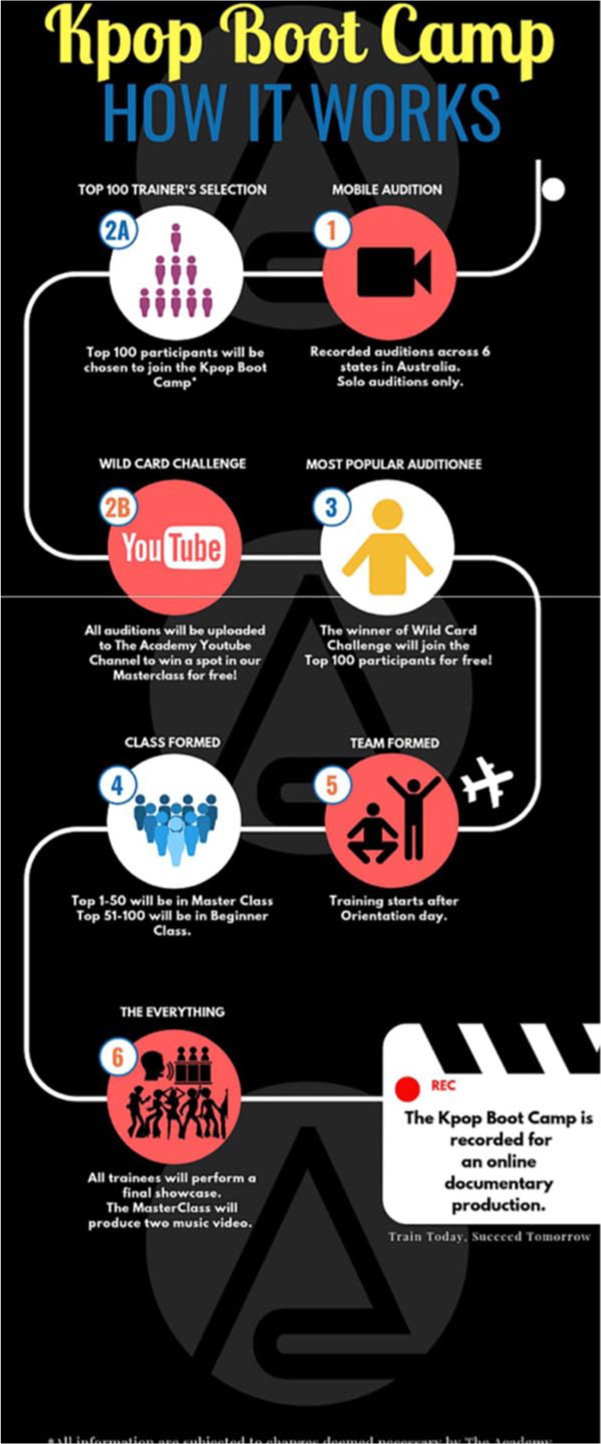
How the K-pop boot camp works.
The various packages of the boot camps offer vocal and dance training, video productions and recordings, cosmetic makeovers, basic Korean language lessons, mock auditions in venues in Australia, and more recently in 2019, training sessions and mock auditions at South Korea’s Global K Center (The Academy, 2019c). Established in 2014, the Global K Center, also known as the Hallyu Training Center, offers more holistic K-pop training pedagogies for local and international students (Global & Center, 2014).
Crucially, The Academy provides choreographic directions to its trainees in the Australian K-pop community. In addition to The Academy’s regular Korean trainers (Koh Woo Rim, Kim Jin Hwan and Park Seung Min) and assistant trainers who graduated from the organization’s first boot camp (The Academy, 2019c), the organization also brings in guest choreographers with reputable engagements in the K-pop industry. In 2019, The Academy hosted guest choreographers Kasper Kim (aka Kim Tae Woo) and Choi Young Jun. Kim is a choreographer for the K-pop group EXO, and his dance repertoire includes the choreographies for popular K-pop songs like Call Me Baby and Ko Ko Bop; Choi, however, won the 2017 MAMA Best Choreographer Award for several K-pop dances like TWICE’s Knock Knock, Monsta X’s Jealousy and Dramarama as well as Produce 48’s Rumor (SBS PopAsia HQ, 2019).
The next section will use examples from The Academy’s official video uploads of individual and group dance cover performances to discuss some of the creative re-arrangements arising from the boot camp training sessions. These dance performances collectively serve to diversify the otherwise East Asian-centric genre of K-pop along more cosmopolitan, multicultural Asian-Australian representations.
Re-interpretations
In terms of geo-spatial Inter-Asia “re-presentations,” The Academy seeks to plug Australia more intimately into the new regional pop culture circuits of K-pop. This section will discuss The Academy’s boot camps to show how the more embodied socio-cultural constructions and performativities in K-pop choreographies are projected and “re-interpreted.” Indeed, scholarly interest has been drawn to the ways in which K-pop dance performances negotiate and “re-interpret” the gendered contours of masculinity and femininity. The globalization of K-pop has brought about transnational reimaginations of Asian gender portrayals (Howard, 2015; Manietta, 2015; Oh, 2017). These reimaginations of the portrayals of Asian gender are often reconfigured by cover-dancers as parodies and citations that democratizes the danceability of the genre further (Conley, 2019; Kang, 2014). According to Liew (2013, p. 179), Highly networked to the digital social media with personally managed multi-referenced Facebook, YouTube and Twitter accounts [. . .] are the generation of cover performers that Hallyu 2.0 has engendered. Decentering and transcending the geo-social and cultural boundaries of the highly manufactured and rigidly regimented industry, these K-pop fan performers have used the text as a kinesthetic tool to re-articulate and re-affirm their own presence in what Martin (2006) calls the “passionate public.”
As will be discussed below, The Academy’s boot camps and choreographic mentorship imbue participants with the danceabilities to re-interpret existing K-pop choreographies more broadly and creatively.
With a systematized platform in mobilizing trainees into adaptive choreographic possibilities, The Academy is able to direct its resources into more concrete re-interpretive practices of K-pop dance covers. Some of the broadcasted group performances will be discussed in this section as illustrations of The Academy’s organized efforts in training previously unrelated individual participants as cover-dancers who are able to follow and improvise upon the original K-pop choreographies. Each group’s dance cover falls under two choreographic directions—the aesthetic replication of the original and their re-interpretation of it. The challenge in the former lies in matching both the choreographic formations as well as the social composition of the original cast as closely as possible. The latter, in contrast, poses the challenge of creating choreographic mixtures between the original performances and external samples, and the re-arrangements of the cast.
Aside from the groups formed and dance covers performed during these boot camps, The Academy also develops other groups dedicated to specific geographical locations and puts on thematic dance covers for its public showcases. Although The Academy is based in Melbourne, it is keen to magnify its presence throughout Australia. To that end, The Academy has these dance performance groups in the following states: Harmony in New South Wales, MELT in Victoria, TBC in Queensland, Undefined in Western Australia, Ignite in South Australia, and Maniac in Tasmania. In 2020, The Academy also created the group Re-mix for trainees in Singapore. As fluid entities, these state-based groups are run by boot camp trainees who also perform at local public events.
One of the most recent additions, Rumor, is a thematically structured K-pop dance cover group created in December 2018 in honor of the visiting K-pop choreographer Choi Young Jun for the purpose of participating in the 2019 K-pop World Festival. Unlike its spontaneously formed counterparts like MELT that have more Caucasians than Asian-Australians (The Academy, 2019b), the five members of Rumor were systematically selected along ethno-gender lines to match the original song and dance choreography of girl group IZ*ONE. In addition, Rumor was trained by Choi, the choreographer of IZ*ONE’s original dances.
The strength of The Academy in “re-interpretations” stems from its mobilizing ability to adapt K-pop dance choreographies for larger groups of dancers selected from the pool of trainees within the period of the boot camp.
Figure 2 shows the still of a dance cover medley of 6-member K-pop boy group iKON’s Killing Me and American pop singer Ariana Grande’s Problem that she recorded with Iggy Azalea. This cover dance performance was directed by K-pop choreographer Park Seung Min, who had been brought in by The Academy. As one of The Academy’s most elaborate filming efforts, the dance video utilized multiple venues and lighting features. This performance by Team Park (named after their choreographer and trainer) also features 22 talents from diverse ethnic and gender backgrounds so as to reflect the creative amalgamation of the two original dances.
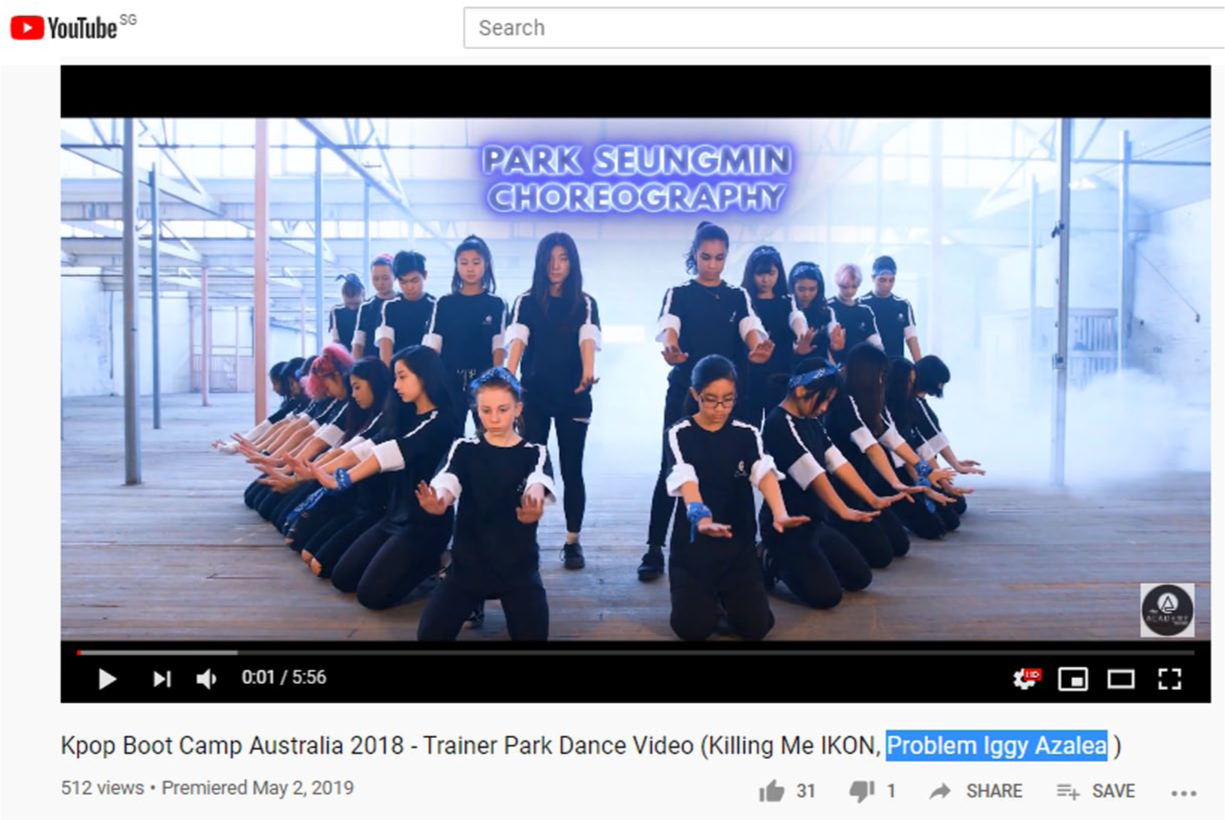
K-pop boot camp in Australia, 2018.
Other notable dance cover performances curated by The Academy include the predominately female trainees performing the dance choreographies of the all-male K-pop group BTS’s Blood Sweat and Tears (featuring only one male trainee among the 19 dancers) and Not Today (featuring 14 female trainees). As seen in Figures 3 and 4, the dancers in these two performances showcase bold steps and leaps as well as wide hand gestures and swings that are often executed by male idol groups in official K-pop dance choreographies.

K-pop boot camp in Australia, 2017—Performance of Blood, Sweat and Tears.
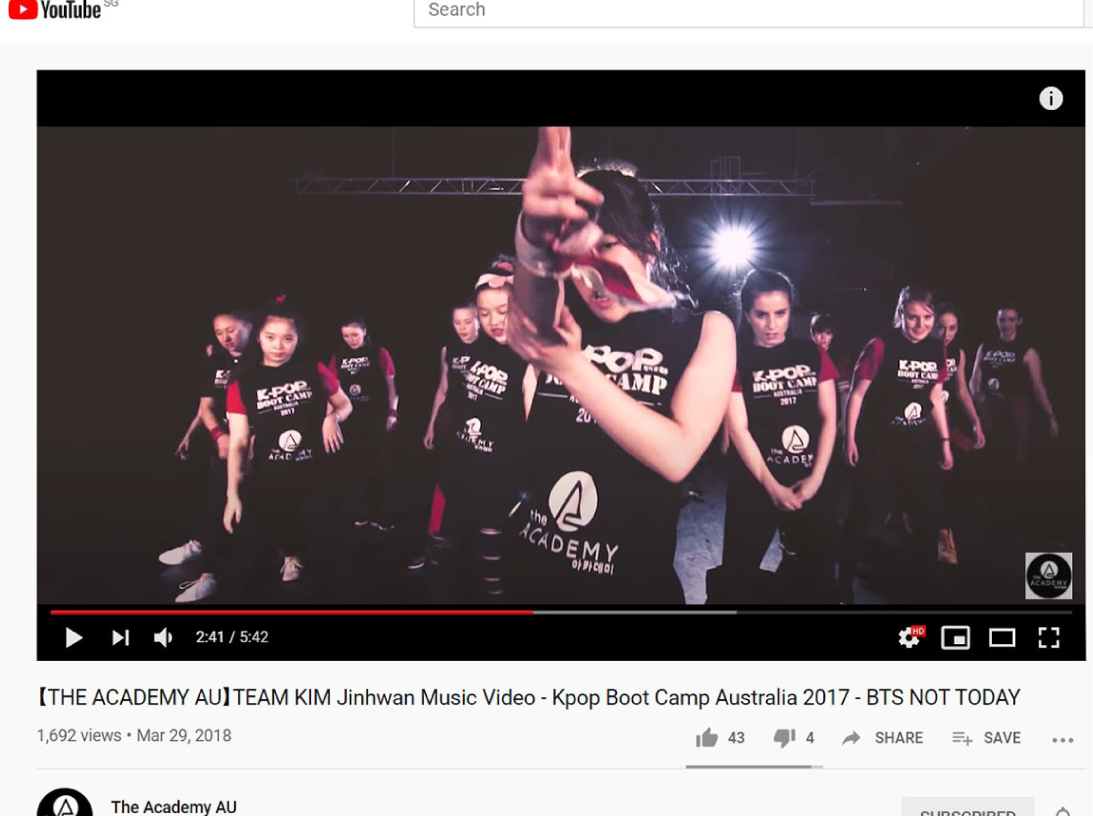
K-pop boot camp in Australia, 2017—Performance of Not Today.
In sum, The Academy has enlarged the otherwise scattered segments of Australia’s K-pop community by honing in on the Australian K-pop enthusiasts’ gravitation toward the dance components, and customizing the publicly accessible individual digital media portfolios of its trainees accordingly. The structured training platforms of the boot camps have further eased K-pop’s danceability into wider recognition. In so doing, they provide their participants with the imaginative choreographic possibilities as cover-dancers.
Conclusion: choreographic co-creative leverages
From relative obscurity to global sensation, the South Korean popular music industry has attracted an international following encompassing enthusiastic fans and K-pop idol aspirants. By framing the case study of the Australia-based The Academy’s K-pop dance boot camps as choreographic co-creative labor, the authors have demonstrated how participants are able to experience a slice of the industry’s grueling training regimen. Between the professional mainstream K-pop industry and the burgeoning do-it-yourself social media parodies and dance cover performances, organizations like The Academy that leverage on K-pop’s global popularity offer more structured and guided approaches to active prosumers who wish to take on the challenges of K-pop training.
As discussed in this article, the work of the facilitators and trainers in The Academy can be framed as choreographic co-creative labor that serves to autonomously expand K-pop’s aesthetic imaginations and cultural reach to a broader audience. By holding a boot camp event in South Korea and a workshop on Singapore in 2019, The Academy has expanded its creative labor input in two critical areas—democratization and transnationalization. Despite K-pop’s increasing global audience, the often rigidly gendered and racialized images of slim and fair-skinned youthful performers have often defined the genre’s image. Like the more scattered individual prosumer initiatives, dance cover performance trainees from diverse social and cultural backgrounds are able to come together and take center stage in mirroring, and even adapting the dances of K-pop celebrities.
Aside from the plethora of online dance cover performances from individual hobbyists, an industry of professional fitness and dance initiatives like that of The Academy have leveraged on K-pop’s global popularity. This form of leveraging enables this autonomous industry to stand out from the otherwise problematic inequalities between the prosumer and capital in perspectives on co-creative labor. These efforts by The Academy necessitate the reframing of creative labor away from original individual authorship toward more fluid transnational rhythmic communities.
Footnotes
Funding
The author(s) received no financial support for the research, authorship, and/or publication of this article.
