




Abstract
Objective
Impacts to the head are the primary cause of concussive injuries in sport and can occur in a multitude of different environments. Each event is composed of combinations of impact characteristics (striking velocity, impact mass, and surface compliance) that present unique loading conditions on the head and brain. The purpose of this study was to compare falls, collisions, and punches from accident reconstructions of sports-related head impacts using linear, rotational accelerations and maximal principal strain of brain tissue from finite element simulation.
Methods
This study compared four types of head impact events through reconstruction. Seventy-two head impacts were taken from medical reports of accidental falls and game video of ice hockey, American football, and mixed-martial arts. These were reconstructed using physical impact systems to represent helmeted and unhelmeted falls, player-to-player collisions, and punches to the head. Head accelerations were collected using a Hybrid III headform and were input into a finite element brain model used to approximate strain in the cerebrum associated with the external loading conditions.
Results
Significant differences (p < 0.01) were found for peak linear and rotational accelerations magnitudes (30–300 g and 3.2–7.8 krad/s2) and pulse durations between all impact event types characterized by unique impact parameters. The only exception was found where punch impacts and helmeted falls had similar rotational durations. Regression analysis demonstrated that increases to strain from unhelmeted falls were significantly influenced by both linear and rotational accelerations, meanwhile helmeted falls, punches, and collisions were influenced by rotational accelerations alone.
Conclusion
This report illustrates that the four distinct impact events created unique peak head kinematics and brain tissue strain values. These distinct patterns of head acceleration characteristics suggest that it is important to keep in mind that head injury can occur from a range of low to high acceleration magnitudes and that impact parameters (surface compliance, striking velocity, and impact mass) play an important role on the duration-dependent tolerance to impact loading.
Introduction
Concussions in impact sports involve head contact that can occur in numerous different ways. In 2015, the leading causes of concussion were identified as falls (42%), transport collisions (40%), and being struck by or against an object (18%). 1 The study further revealed that, of the “struck by or against an object”, 71% of these concussions occurred in sport or recreation. In professional ice hockey, the three primary impact events leading to concussive injury are collisions between players, falls to the ice, and fighting.2,3 Similarly, falls to the ground and body to head collisions were the most common events causing concussion in American Football (National Football League [NLA]).4,5 In sports, such as football and ice hockey, falls typically occur with the player’s helmeted head contacting the ground or ice, respectively. In sports, such as soccer or basketball, falls occur where the unprotected head (unhelmeted) hits the ground or floor. The main difference between these two fall impact scenarios is one uses a helmet, an energy mitigating layer, and one does not, however in both cases, concussions are a common result under injury-causing conditions. In contrast, collisions typically involve a padded shoulder or elbow impact to the helmeted head where both the striking object and struck object have protective layers and are free to move post-impact.3,6–10 Ice hockey is also unique in that fighting at the junior and professional levels is common where fighting increases the likelihood of concussive injuries. 2 Combative sports, such as boxing and mixed-martial arts (MMAs), with the goal of delivering “knockout” blows to their opponent, are also high-risk sports for concussive injury. 11 In summary, falls to immovable surfaces, collisions with various body parts, and punches aimed at the head are among the most common impact delivery mechanisms to the head in sport. Based on the impact mechanics of each head impact event, it is reasonable to assume that different combinations of impact mass, striking velocity, surface compliance, and impact location are necessary to create concussion within each injury-causing event. The different combinations of input parameters associated with injury will result in unique head loading conditions, reflected as differences in head accelerations and resulting brain tissue strains.12,13
Numerous studies over the years have reported a high correlation between head motion and brain tissue injury. At damaging levels of linear acceleration, skull fractures, brain contusions, as well as concussions were observed in animal models of head injury. 14 The proposed mechanisms of concussion from linear acceleration is thought to happen from a dynamic pressure wave that traverses the head and brain causing localized stresses to affect various brain regions and tissue functions.11,14–17 Rotational acceleration damage to the head and brain is thought to cause shear deformation on the underlying brain tissue as the brain lags the motion of the skull.15,18,19 Rotational head motion creating injurious levels of strain deformation on the brain tissue has been proposed to be the primary cause of concussive injury.15,17,20 Recent studies have since demonstrated relationships between peak rotational acceleration and concussive injury brain tissue strain levels.11,19,21,22 Kinematic parameters, such as peak linear acceleration and peak rotational acceleration, have since become important injury predictors to consider in the biomechanical assessment of concussion risk. 23 The duration of the head impact pulse coupled with the acceleration magnitude has also been shown to have an effect on head injury outcomes and is the basis of the Wayne State Tolerance Curve, which demonstrates the relationship between linear head acceleration and pulse duration with onset of concussion. 16 This linear acceleration magnitude and duration-dependent relationship has been similarly demonstrated for rotational acceleration.16,24,25 The dominating effects of linear or rotational accelerations on brain injury have been demonstrated in high energy head loading scenarios including car accidents, falls from significant heights, and motorcycle accidents. These injuries often result in observable damage and severe injuries. At comparatively lower levels of loading, characteristic of sport impact, the role of an individual type of acceleration, and the dominating mechanisms at play to cause concussion is not clear. The purpose of this study was to describe the impact characteristics of four different sport head impact events (collisions, unhelmeted falls, helmeted falls, and punches) using physical accident reconstruction methods to best represent the impact mechanics of each. These events were compared using peak linear and rotational acceleration, linear and rotational pulse durations, and brain tissue strain. A second objective of this study was to infer on the dominating roles of linear and rotational acceleration on peak strains for these different events through linear regression analysis.
Methods
Physical parameters defining the accident reconstruction were approximated from video footage of elite sport and from medical reports obtained from hospital. In general, video footage of American football, ice hockey, and MMAs was used to populate cases for collisions, helmeted falls, and punch events. Publically available team databases and individual athlete injury reports were examined to identify players whom missed playing time due to “head injury” or “upper body injury”. These players were flagged as potential reconstruction cases, along with information regarding the sport, team name, and date of the game. Further, game or athlete video of the injury event was obtained and viewed for evidence of loss of consciousness, presence of postural imbalance immediately after impact, or if the player was removed from the game following impact. 26 When these outcomes were observed, a “significant head impact event” was identified to have occurred and the video was evaluated for suitability of accident reconstruction. For unhelmeted falls, medical reports were obtained from hospital from fall-related concussions as diagnosed by a physician. In total, 72 cases were obtained in this manner and used for reconstruction. Table 1 summarizes the impact characteristics of each impact event.
Impact characteristics for the four different head impact events resulting in concussive injury (n = 72).

Collisions events
Twenty-six significant collision head impact events used in this study were taken from ice hockey and American football. These collisions were defined as impacts resulting from two players colliding, where the shoulder of the “hitter” connected with the head of the “struck” player. The inclusion criterion for this category required that the injury occurred from a single impact to the head or helmet of the injured player. A pneumatic linear impactor (Figure 1), using pressurized air to accelerate a 13.1-kg ram at the appropriate velocities, was used to deliver impacts to a Hybrid III headform equipped with the appropriate model of ice hockey or American football helmet (as determined from video analysis). The end of the ram was capped with a shoulder pad impactor validated for human shoulder to head impact reconstructions to represent the compliance of the shoulder during collisions. 27

Physical reconstruction set-ups for the four different head impact conditions (unhelmeted falls, helmeted falls, collisions, and punch).
Helmeted and unhelmeted fall events
The fall impact events were defined as an event where the subject fell from a determined height to the ground. The injury must have occurred during a single and clear impact of the head on the ground during an event. For falls taken from sport video, a frame-by-frame analysis was used to observe an acceleration of the head to the ground, impact, and then a rebound of the head in the opposite direction. This characteristic was used as supportive evidence of a head impact for this category. Similarly, other impact variables, such as impact location and surface, were determined from frame-by-frame video analysis of the sport reconstructions and through careful consideration of the ensuing injury descriptions from medical reports. For example, if the medical report noted superficial bruising or scratches at a location on the head remote from the primary impact location causing the injury, then multiple impacts were assumed to be sustained by the subject and the case was excluded from reconstruction. A total of 14 sports injury reconstructions from video footage of American football and ice hockey events with a significant head impact event were used. All events involving a helmeted player making contact with the ground or ice surface were placed into the “helmeted fall” category. Twelve falls were placed in the “unhelmeted fall” category and were taken from medical reports obtained from Ottawa General Hospital in Ottawa, Canada, and the Centre de Sante et de Services Sociaux in Gatineau (Hull site), Canada. These reports included a description of the event, a list of symptoms, and a medical diagnosis. A monorail drop tower (Figure 1) was used to simulate all fall events. In these reconstructions, a Hybrid III headform and neckform were guided in a fall to impact a similar surface for which was described in the injury report or video (ice, cement, and field turf). For sport reconstructions, the appropriate or similar helmet type and model were fitted on the headform during impact tests.
Punch events
The punch impact events were collected from filmed MMA matches. Twenty injury reconstruction cases were used in this study. The inclusion criterion for the punch impact event resulting in a significant head impact event was described as follows: the event video allowed for good visibility of the hand impacting the head in order to calculate impact velocity and location. The final impact was from a punch before the struck fighter lost consciousness, fell down, and/or showed signs of imbalance. 26 Reconstruction of the punch impact events was simulated using a high-speed anvil launcher to deliver an impact mass to a stationary Hybrid III headform fixed to a rigid plate mounted with unbiased neckform (Figure 1). Inbound impact velocity was monitored using a High Speed Imaging PCI-512 Fastcam running at 2 kHz and Photron Motion Tools computer software of the launched anvil. The anvil was manually digitized using a frame-by-frame analysis to confirm velocity prior to impact with the headform. The mass of the anvil could be modulated to approximate the mass of the punch impact. Three impact masses were used during this test set-up based on the weight categories of fighters. Anthropometric data of the fighters were calculated using the literature and the approximate effective masses of the punch were determined (Table 2). 28
Mass of anvil used for impact reconstruction based on subject mass.
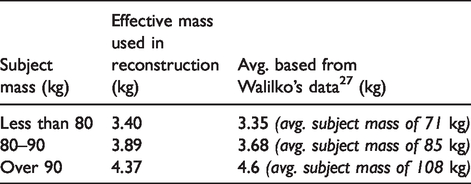
Well-trained boxers and fighters are skilled at increasing their effective mass of the arm and fist to deliver forceful blows, therefore the values presented here are likely an underestimation of the actual effective mass of a punch. These masses reported here likely represent the lower end of possible impact masses for punch impacts. The end of the anvil was constructed with varying density and layers of foam to simulate compliance to match that of a hand and MMA style glove. In order to ensure that the compliance of the impacting anvil matched that of a punch, three-dimensional dynamic response data were collected from punching trials, performed by volunteers, to a Hybrid III headform while wearing MMA style punching gloves. Further, test trials were completed using the anvil while changing foam layers and densities to obtain acceptable compliance for the punch loading condition by matching the dynamic response curve shape and impact durations (Figure 2).

Resultant linear (a) and rotational (b) dynamic response curves from human punch and anvil to a Hybrid III headform for compliance matching.
Head impact reconstruction
For the collision and punch head impact events, reconstruction parameters (velocity and location of impact) were determined from Kinovea video analysis software (Version 0.8.20, Joan Charmant & Contributors, France) of each event (football, hockey, and MMA). To obtain these variables, a calibration grid using known distances (field/ice surface markings) was applied to the playing area in order to calculate player displacement (Figure 3).

Video analysis using Kinovea software (a) to capture impact velocity and impact location (b) for sporting events.
The displacement from five frames prior to the impact over time (0.2 s for five frames) was calculated to approximate the impact velocity of the collision.27,29,30 The impact location was obtained by enlarging the image and using a reference system to describe the height and region of the head for all impact events to establish a consistent method for identifying location.27,29,30 For fall events, impact velocity and impact location were determined using video of the event from sport and through full-body computer simulation using MADYMO software to estimate the fall mechanics likely to have occurred from the medical report descriptions.5,10,27,29–33 The characteristics for each of the 72 significant head impact cases are described per impact event in Table 1. This table provides a summary of the impact velocities, impact masses, and compliance for each of the different impact events. The location and direction of the impact vector for all head impact events are shown in Figure 4.

Impact vector and locations for all the head impact conditions used in this study: unhelmeted falls (red), helmeted falls (green), collisions (yellow), and punch (orange).
A 50th-percentile adult male Hybrid III headform and unbiased neckform was used for all injury reconstructions. The unbiased neckform was used to eliminate any directional bias from off-centered impacts. However, the unbiased neckform has been shown to perform similarly to the standard Hybrid III neckform during dynamic impact tests measuring peak head acceleration.34,35 The headform was instrumented with nine mounted single-axis (Endevco7264C-2KTZ-2-300) accelerometers (Endevco, San Juan Capistrano, CA) in a 3-2-2-2 accelerometer array to capture time histories of linear and rotational accelerations in three dimensions. 36 All the accelerometer signal data were sampled at 20 kHz and filtered with a fourth order 1650 Hz low pass Butterworth filter according to the SAE J211 convention. 37
Data processing
Head kinematics taken from the impact tests were applied to a node at the center of mass of the finite element model in a manner similar to Doorly and Gilchrist. 31 The resulting X, Y, and Z linear and rotational acceleration loading curves from the Hybrid III were applied to the University College Dublin (UCD) Brain Trauma Model developed by Horgan and Gilchrist 38 to calculate maximal principal strain (MPS). Simulations using the model had been compared with cadaveric pressure and brain motion data39,40 and had been employed in reconstructions of traumatic brain injuries. 31
A one-way MANOVA followed by Scheffe’s post hoc tests were used to determine the main effect of impact event on the dependent variables: peak linear acceleration and duration, peak rotational acceleration and duration, and MPS (p < 0.01). In preparation of the data for the MANOVA, linear acceleration was log transformed to satisfy the normality assumption of the MANOVA and replaced the raw linear acceleration scores during statistical analysis. Mahalanobis distances were calculated for each case, resulting in the removal of two outliers (one unhelmeted fall and one collision case). Linear regression analyses were conducted with peak linear and rotational accelerations as predictor variables of peak strain to describe the influence of head acceleration type on intracranial deformations measures to infer on the mechanisms at play from head impact loading.
Results
Plots of peak linear and rotational acceleration and corresponding pulse durations are plotted in Figure 5. The one-way MANOVA for impact event was found to be statistically significant for each dependent variable using Pillai’s Trace. Each head impact event produced significantly different (p < 0.01) peak linear accelerations and durations, where unhelmeted falls had the highest peak and shortest durations, followed by punches, helmeted falls, and then collisions. Peak rotational accelerations followed the same patterns in response; however, the rotational duration between punches and helmeted falls was statistically similar (Table 3). Figure 6 illustrates peak MPS results for all impact events. On average, collisions produced the lowest MPS values, followed by helmeted falls, punches, and unhelmeted falls (p < 0.01). Examples of strain fields for the four different head impact events are depicted in Figure 7. Visual strain field differences at peak strain between the four head impact condition can be qualitatively observed. Linear regression results demonstrate that MPS was significantly influenced by both linear and rotational accelerations for unhelmeted falls, meanwhile helmeted falls, punches, and collisions were influenced by rotational acceleration alone (Table 4). These results are discussed further in the next section.

Peak linear and peak rotational acceleration versus pulse duration plots from the four different impact conditions (red, unhelmeted falls; purple, helmeted falls; green, punch; and blue, collisions).
Mean linear and rotational durations in seconds and standard deviations in parentheses for each mechanism.

aDenotes no significant differences between those two conditions. All other conditions were significantly different (p < 0.001).

Maximal principle strain for all impacts across the four different head impact event; table provides mean MPS values for each type of head impact event.
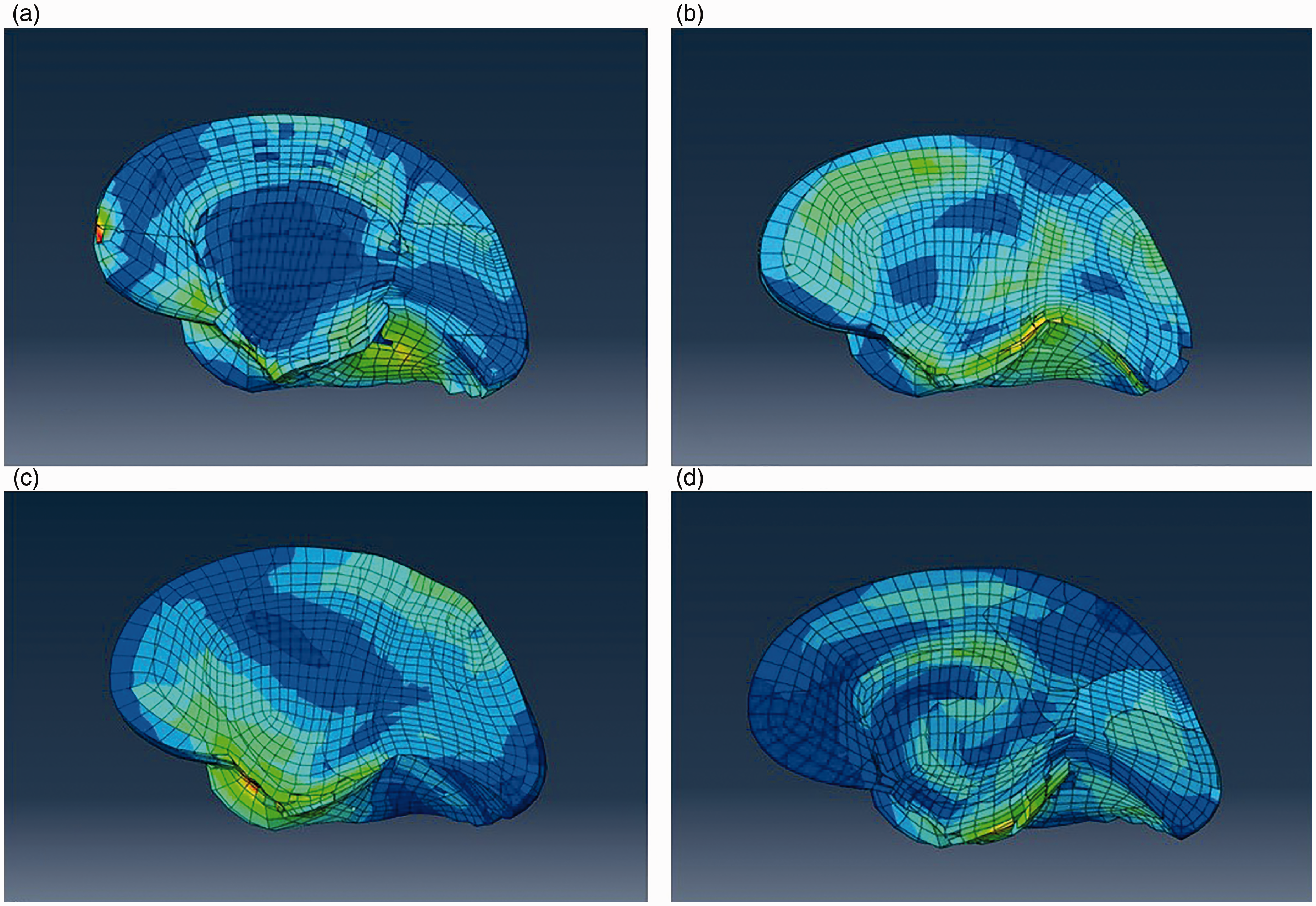
Brain model cross-section at peak strain for the four different head impact events: (a) unhelmeted, (b) helmeted, (c) collision, and (d) punch.
Linear regression results with linear and rotational accelerations as predictors of peak maximum principal strain for each impact event type.

Discussion
This study compared four distinct types of impact events through reconstruction of cases from significant impacts occurring in ice hockey, American football, MMAs, and hospital fall data sets. Each of these events resulted in unique combinations of impact event parameters (impact mass, impact location, surface compliance, and striking velocity) that contributed to different levels of acceleration peak and duration responses, as well as strain values. The results presented in this study show that the injury-causing event produces unique linear and rotational acceleration magnitudes and durations in sport-related head impacts.
Previous investigations evaluating the relative effect of impact parameters on head and brain dynamics demonstrated compliance to contribute to the greatest increases in peak linear and rotational acceleration, meanwhile impact velocity created the greatest increases in peak strain.1,5,23,41–43 Therefore, it is no surprise that impactor compliance differences between the four impact events in this study contributed to significant differences reported in mean peak linear and rotational accelerations and pulse durations (Figure 5). Linear and rotational acceleration pulses were averaged and plotted, along with ±standard deviations for each of the four types of head impact events, to illustrate the unique acceleration curve shapes for each event (Figure 8). Unhelmeted falls had the highest peak linear and rotational accelerations and shortest durations, and collisions with the lowest accelerations combined with the longest durations. Helmeted falls and punches produced intermediate linear and rotational accelerations characteristics between the two extremes.

Average linear and angular loading curves (with SD) for the four different head impact events.
The results from the four impact events were compared to proposed injury risk reported in the literature. The resulting peak dynamic response values for falls (unhelmeted and helmeted) and punch events were higher than proposed thresholds taken from helmeted impacts in American football, 73.6–103.4 g and 5.0–7.9 krad/s2.16,26,44 All impact events, except the collision events (less than 25% risk), resulted in peak dynamic response values presenting with a 50% and 80% risk for concussive injury. 35 Contrarily, the collision events produced lower peak linear and rotational accelerations than the proposed concussive injury ranges. The collision data from this study support previous collision impact event data where concussive injuries occurred from peak linear and rotational accelerations in the lower ranges 20–30 g and 2.5–3.0 krad/s2, respectively, for longer pulse durations.5,27,43,45 These distinct patterns of head acceleration characteristics suggest that it is important to keep in mind that concussions can occur from a range of low to high acceleration magnitudes (30–300 g and 3.2–7.8 krad/s2)5,43,45 and that impact parameters (surface compliance, striking velocity, and impact mass) play an important role on the duration-dependent tolerance to impact loading. 46 Therefore, high values of linear and rotational accelerations are not necessary to cause a risk of concussion, and that consideration of the characteristics of the injury event is important factors influencing injury risk. Based on the wide range of responses observed in this study, it is hypothesized that the levels of linear and rotational accelerations and strain necessary for concussive injury risk for helmet-to-helmet impacts in American football are not equivalent to those from head-to-shoulder impacts in ice hockey. While all the injury events in this dataset were assumed to be concussive injuries, the only metric that consistently indicated risk of concussion across all conditions was MPS values of strain (0.20–0.26) in the brain.11,21 It may seem that brain tissue strain results provide a more robust indicator of injury risk for sports-related concussions than head acceleration measures, however, the sensitivity of each predictor variable cannot be established without comparison with non-injury cases in order to establish robust injury thresholds that are specific to the event.
The type of event (falls versus collisions) and the specific combinations of mass, velocity, impact direction, and compliance determine how much impact energy can potentially be transmitted to the head (acceleration) and brain (strain). The two fall impact (helmeted and unhelmeted) reconstructions involve head forms impacting large masses (i.e., ground) with an almost complete transfer of kinetic energy of the impact to the head and brain. The collision (13.1 kg) and punch (3.4–4.4 kg) impact reconstructions involve smaller effective masses than both fall impacts and the subsequent motion of the head after impact allows it to move out of the way of the striking anvil. These reconstructions also differ from the fall impacts in that the headform is stationary prior to an impact from a moving anvil representing a shoulder or fist. 47 The fall to ground impacts, for the most part, are also described as more centric in nature, where the force vector passes through the headforms’ center of gravity. This results in a more complete impact energy transfer through the head and brain following an impact. This is a bias in the case selection for these injury cases, as more serious falls from centrically oriented falls, resulted in outcomes necessitating a visit to the emergency room. Interestingly, increases to strain values were more strongly influenced by both linear and rotational accelerations for unhelmeted falls (low compliance events), and rotational acceleration was the only predictor for strain under helmeted falls, punch, and collisions. The tendency for helmeted falls, collisions, and punch reconstructions having comparatively greater effects of rotational acceleration on strain could be due to the compliant layers involved (helmets, helmets and shoulder pads, boxing gloves) that are able to reduce levels of linear accelerations meanwhile leaving rotational acceleration levels unaffected. In addition, these impacts tend to have more non-centric or oblique impacts, due to different impact angles for both the head and the impacting surface. Non-centric impacts created a rotationally dominant impact condition resulting in increased rotational accelerations, which are a main cause of strain-based concussive injuries.5,19,21 The punch impacts are consistent with this since impacts tend to occur on the side chin (45% of punch impacts occurred in this region) creating rotation of the head in the transverse plane. The direction at the off-centered location results in a high rotational acceleration, since the linear force is applied away from the center of gravity of the head, which causes the head to rotate about the neck. This is confirmed in part by the results shown in Figure 5, where lower linear accelerations and high rotation accelerations were found for punch impact events. While the lower linear accelerations were also found for the collision impact event, off-centered impacts might only account for a portion of that lower result. It is more likely that impactor compliance played a larger role for this type of event. Therefore, in sport, significant head impact events are likely characterized by both linear and rotational accelerations, however certain type of impact events, i.e., punches, collisions, and helmeted falls, is rotational acceleration dominant.
Limitations
A Hybrid III headform was used in the reconstruction of the injury events. While the purpose of this study was not to define injury thresholds for concussive injuries, the surrogate headform and neckform have limitations associated with biofidelity that are well documented.40,48,49 Headform and neckforms tend to be more rigid than more cadaveric headforms and thus is a limitation to this study. Furthermore, the headform and jaw were assumed coupled together for all impact conditions. This may create a more rigid impact than reality for any impact in the jaw region of the head. An unbiased neckform was used, rather than a standard Hybrid III neckform, in order to reduce any directional bias from off-centered impacts. Previous studies using this neckform have shown to produce similar kinematics to the standard Hybrid III neckform. 34 The data presented in this study are specific to shoulder collisions, punches, and falls from professional ice hockey, professional football, professional MMA, and hospital concussive injury cases. Any of the concussive injuries used in this study were diagnosed at the discretion of medical and team doctors. Injury reconstruction data were gathered from team or hospital injury reports and thus were completed to the best of their knowledge. The injury events were reconstructed from video of the event or estimated from detailed hospital injury reports. Velocity errors with video reconstruction have been reported between 10% and 15%.5,30 We attempted to account for this error by creating a corridor of impact velocity ±10% of the targeted velocity in the reconstructions.
The UCD brain trauma model is another limitation in this study and is a rudimentary approximation of the human brain, and while it has previously been employed in accident reconstructions, further validation is necessary to ensure that the model can robustly simulate the brain under varying levels of loading and consistently produce brain injury outcomes. In the current study, the FE model was employed to provide a relative comparison of each injury event as represented by an MPS value from the complex three-dimensional linear and rotational kinematics from dynamic head impact. Extrapolation of the MPS values to human biomechanical thresholds of injury was not the purpose of this exercise as a more sophisticated FE model and larger injury reconstruction data sets are required to draw conclusions about injury risk.
Conclusion
Sport involving physical contact encompass many environments in which different events can lead to head impact and concussive injuries. This study compared four types of significant head impact events through reconstruction and reports a wide range of acceleration magnitudes associated with injury (30–300 g and 3.2–7.8 krad/s2). In addition, regression analysis reveals that strain values from unhelmeted falls (low compliance events) were strongly influenced by both linear and rotational acceleration, meanwhile helmeted falls, punches, and collisions were most influenced by rotational acceleration alone. Based on the wide range of responses observed in this study, it is hypothesized that the levels of linear and rotational accelerations and strain necessary for concussive injury risk are not equal for the different types of head impact events in sport. For example, the levels of head accelerations necessary for concussion from helmet-to-helmet impacts in American football are not equivalent to those from head-to-shoulder impacts in ice hockey. Impact parameters such as compliance, velocity, mass, and location play an important role on the acceleration magnitude and duration-dependent tolerance to impact loading and support the need for further refinements in accident reconstruction techniques in order to appropriately model the specific injury event and infer about biomechanical response associated with injury.
Disclaimer
The views expressed in this article are of the listed authors and do not necessarily represent the official position of the institutions.
Supplemental Material
sj-jpg-1-ccn-10.1177_2059700220936957 - Supplemental material for Accident reconstructions of falls, collisions, and punches in sports
Supplemental material, sj-jpg-1-ccn-10.1177_2059700220936957 for Accident reconstructions of falls, collisions, and punches in sports by Marshall Kendall, Anna Oeur, Susan E Brien, Michael Cusimano, Shawn Marshall, Michael D Gilchrist and Thomas B Hoshizaki in Journal of Concussion
Supplemental Material
sj-pdf-2-ccn-10.1177_2059700220936957 - Supplemental material for Accident reconstructions of falls, collisions, and punches in sports
Supplemental material, sj-pdf-2-ccn-10.1177_2059700220936957 for Accident reconstructions of falls, collisions, and punches in sports by Marshall Kendall, Anna Oeur, Susan E Brien, Michael Cusimano, Shawn Marshall, Michael D Gilchrist and Thomas B Hoshizaki in Journal of Concussion
Supplemental Material
sj-pdf-3-ccn-10.1177_2059700220936957 - Supplemental material for Accident reconstructions of falls, collisions, and punches in sports
Supplemental material, sj-pdf-3-ccn-10.1177_2059700220936957 for Accident reconstructions of falls, collisions, and punches in sports by Marshall Kendall, Anna Oeur, Susan E Brien, Michael Cusimano, Shawn Marshall, Michael D Gilchrist and Thomas B Hoshizaki in Journal of Concussion
Footnotes
Declaration of conflicting interests
The author(s) declared no potential conflicts of interest with respect to the research, authorship, and/or publication of this article.
Funding
The author(s) received no financial support for the research, authorship, and/or publication of this article.

References
Supplementary Material
Please find the following supplemental material available below.
For Open Access articles published under a Creative Commons License, all supplemental material carries the same license as the article it is associated with.
For non-Open Access articles published, all supplemental material carries a non-exclusive license, and permission requests for re-use of supplemental material or any part of supplemental material shall be sent directly to the copyright owner as specified in the copyright notice associated with the article.

