




Abstract
Life after prison can pose challenges for the formerly incarcerated, their families, and wider communities. This research studies Austria where probation services are either mandated by the court or sought voluntarily after prison. Through semi-structured interviews with formerly incarcerated individuals, reintegration experiences from their perspectives are examined. The narratives emphasized social factors that either assuage or complicate life after prison. The main factors addressed were stable housing, the maintaining and (re)building of relationships, and employment. Overall, a lack of stable housing appeared to complicate life after prison the most and also negatively affected relationships and employment. For some, life after prison was further exacerbated by immigration status and a perceived stigma related to the nature of one’s convictions. This study shows the importance of working towards a better understanding of the social context individuals are released into after prison to better meet their individual needs and to counteract recidivism.
Introduction
Life after prison can be very challenging for the formerly incarcerated individuals, their families, and wider communities. The term reintegration is commonly used to describe the long-term adjustment of the formerly incarcerated to community life, which is both a process and a goal (Visher and Travis, 2003, 2011). The adjustment process is considered to be gradual, and its goal is usually defined a “crime-free” or “law-abiding” life (Bahr, 2015; Visher, 2015; Taxman, 2004; Zurhold et al., 2011). Extant reintegration research can be divided into two major groups. While desistance research has stressed the importance of individual characteristics such as maturity and the development of a “crime-free” identity (Maruna, 2001; Maruna et al., 2004), other studies have examined the social context an individual is released to as factors negatively influencing reoffending. Overall, complimenting research on social factors with the desistance literature has found to be important for a more thorough understanding of reintegration. While people might want to change their lifestyles after prison, specific social factors surrounding them, such as relationships, employment, and housing often contribute to bolstering “the necessary resilience” (Armstrong and Durnescu, 2016: 4).
Regardless of the focus, reintegration research usually aims at understanding which factors over the course of one’s reintegration journey hamper reoffending and hence heighten public safety, the predetermined goal in that convoluted process. As most research on reintegration tends to be conducted with individuals who are under some form of community supervision model that emphasizes continued control and restriction of liberties, the narrow focus of recidivism as an indicator of reintegration seems obvious. However, this lens also prevents us from understanding the complexities of life after prison. As individuals will reenter the communities from which they came, the narrow focus on recidivism as reintegration failure ignores that life after prison should also be about reconnecting the formerly incarcerated with the many social institutions that they had left behind.
In the country of Austria, reintegration is a topic that has gained little scholarly attention. This is surprising, as Austria applies a specific model of probation for those released from prison that lends itself nicely to the study of the reintegration process. First, the formerly incarcerated are not under the auspices of peace officers but rather receive “community assistance” through the private organization Neustart. This organization focuses more on providing services rather than control and supervision. Second, not every person released from prison is mandated to serve a community supervision term. Still, anybody who is in need of services can receive voluntary probation assistance through Neustart.
It is this Probation Assistance Model of Austria that I find provides a fruitful ground for a study of the reintegration process that does not set the absence of recidivism as the end goal in an individual’s post-prison journey. As the Probation Assistance Model does not emphasize supervision and control but cares about the reintegration needs as defined by the clients first, it invites for a study of the social factors facilitating or impeding that process as defined by those actually experiencing it. In order to capture these complex challenges that come with life after prison, I conducted semi-structured interviews with formerly incarcerated individuals who could speak directly to their reintegration experiences. In alignment with the Probation Assistance Model, I examine the factors they believed had proven beneficial or challenging on their personal journeys after prison. I hope that this research will contribute to a more thorough understanding of individual reintegration experiences not only in Austria but elsewhere. It might also help to better understand how successful reintegration not only checks the box of public safety but is a large contributing factor to the overall well-being of a community.
Lifer after prison in Austria
In Austria, probation can be served either as an alternative to incarceration or after a prison term (Austrian Penal Code, 2019: § 50). For those released conditionally from prison, a court must give directives or order probation, if it finds that such is necessary to prevent future crime (§ 50 (1)). This clause reflects the centrality of specific preventative considerations in Austrian criminal law, as the court must take into consideration whether the incarcerated will refrain from committing more crime upon release (Bruckmueller and Hofinger, 2012). The court must order probation after prison if the person was released conditionally before two thirds of the sentence were served (2.1.), if the governing offense was committed before the age of 21 (2.2.) or involved a crime against the “sexual integrity and autonomy of another person” (2.3.), or if the person was released from a long prison sentence of over five years or from a life sentence (3.4. and 3.5.). Finally, probation must be ordered for individuals released conditionally from Involuntary Forensic Placement (IFP), a special form of detention for “mentally disturbed” individuals, who are housed in special treatment institutions or separate wards in the country’s major prisons for an indefinite time period (Austrian Federal Ministry of Justice, 2016: 29). Conditional release will depend on a psychiatric evaluation and the possibility of post-release placement in an outpatient or hospital aftercare (Austrian Federal Ministry of Justice, 2016). Generally, the period of community supervision if ordered by a court lasts from one to three years, but it can be extended if the person served a longer prison sentence or was released from IFP (Bruckmueller and Hofinger, 2012).
The Austrian government has mandated the private organization Neustart (translated into Restart or New Start) to provide probation assistance to released individuals. In 2016, 57% of conditionally released prisoners were ordered probation services through Neustart (Neustart, 2016). If the court did not mandate a probation term after release (Bewährungshilfe [BWH]), the formerly incarcerated can still seek probation assistance with Neustart on a voluntary basis (Haftentlassenenhilfe [HEH]). Regardless of whether a client comes to Neustart because of BWH or HEH, their risk of recidivism is generally considered high. In fact, many HEH clients have served long prison sentences and were not ordered BWH, as they were not conditionally released from prison but rather had to serve their full terms behind bars (Hofinger and Peschak, 2018).
Regardless of whether probation is mandated or sought voluntarily, Neustart considers its mission not to be “one of surveillance; rather it is one of support—for apartment and job searches, the contact with offices and public authorities and, most importantly, for personal reintegration into society” (Neustart Official Website, 2020). In an effort to support its mission, Neustart’s probation “assistants” (the term used instead of “officers”) must have a social work rather than a law enforcement background. Furthermore, approximately 30% of Neustart’s clients are assisted by community volunteers rather than working professionals (Neustart, 2016). This reliance on volunteers is used to reduce stereotypes about criminality within society and to demonstrate that reintegration is a communal project (Neustart Official Website, 2020). Regardless of whether the assistants are professionals or volunteers, they consider themselves “personal tutors” who must work according to “the personal needs of their clients” (Neustart Official Website, 2020).
For clients on BWH, the probation assistant must also check that they are following the court’s directives they might have received upon their conditional release from prison. In regular intervals, the probation assistants must report to the court on the client’s progress and they could even suggest adding further directives if they find them to be necessary (Neustart Official Website, 2020). Furthermore, a revocation of conditional release is possible if the client “recklessly disregards directives despite formal warnings,” “persistently fails” to keep contact with their probation assistant or commits another crime. In one study on life after prison in Austria, Bruckmueller and Forstner (2012) examined the most common reasons for probation revocations. For those who received directives from the court and were mandated probation after release, Bruckmueller and Forstner’s study (2012) revealed that, in practice, new crimes committed during the mandated probation term were the main reason for such revocations. Meanwhile, the other factors triggering revocations were almost non-existent in the Austrian context, exemplifying the social work over the law enforcement orientation of probation services in Austria.
Upon review of the vast array of reintegration literature outside of Austria, it can be concluded that many studies have been conducted in jurisdictions with stringent post-prison community supervision, where the contact with a probation “officer” is often perceived as a “pain of life after prison” (Armstrong and Durnescu, 2016: 3). In such environments, the formerly incarcerated have to abide by various conditions that can substantially limit personal freedoms. When individuals are still under some form of correctional supervision after prison and when the community corrections officer also wears a law enforcement hat, it is not surprising that the main study interest quickly becomes recidivism or the lack thereof (Bahr et al., 2010; Bowman and Travis, 2012; Durnescu, 2011; Ohja et al., 2018). Much research on life after prison in the United States as well as other English-speaking countries therefore uses recidivism as a marker to assess reintegration success or failure.
With the focus on recidivism, however, much of the day-to-day work that probation agencies do beyond supervision is ignored. In their seminal work on probation practice in England, Bottoms and McWilliams (1979) highlight that as social work agencies, and this is what Neustart must be referred to, probation assistants must be there to “help” their clients above all. In what they call the “help model,” the probation assistant must be there to “facilitate a response to the expressed needs” of clients (Bottoms and McWilliams, 1979: 174). In other words, the client should not feel subordinate in the relationship but instead be the one who makes choices about their reintegration while receiving support from their assistant along the way. Through a survey with probationers and their assistants in England, Willis (1983) was able to find support for the “help model,” concluding that probation assistants were primarily there for their clients to help them with whatever they needed. Probation assistants provide “an individualized approach to need rather than an individualized approach to crime” (Willis, 1983: 345). Neustart’s official presentation (Neustart Offical Website, 2020) reflects the basic tenets of the “help model” or “Probation Assistance Model,” the term used to exemplify their social work orientation.
More recent research by Lynch (2006), Cobbina (2012), and Western (2018) in the US context has shown that the expansion of the concept of successful or unsuccessful reintegration beyond testing for recidivism can be beneficial for other reasons. First of all, recidivism must actually be detected. In fact, “recidivism can . . . be the product of an isolated and foolish act when most of a released inmate’s behavior is positive and constructive” (Lynch, 2006: 406). At the same time, not every individual released from prison will actually be supervised within the community, and those coming to Neustart under HEH are an example of that. The use of recidivism rates as an indicator of successful reintegration might therefore reveal more about how the formerly incarcerated have been managed by probation agencies rather than whether they have regained community membership through a successful reconnection with societal institutions within their communities.
Furthermore, a lack of reoffending should be part of a successful reintegration experience but should not be limited to it (Cobbina, 2010). For instance, family support has been found to be negatively correlated with recidivism, but family support can do much more. It can also have quite positive effects on the former prisoner’s family members, especially if the family members (children included) rely on their emotional support and income (Cobbina, 2010). As another example, stable housing has been found to hamper reoffending, but it can also be seen as a means for finding employment and for reconnecting positively with loved ones and can thus contribute more generally to the overall welfare of a community (Cobbina, 2010).
In short, I find that a study of reintegration in Austria, which embraces the Probation Assistance Model that prioritizes help over supervision, creates a context that will allow for a reconfiguration of reintegration success. While staying out of prison must be a major goal of the formerly incarcerated, it is not the only goal and it is certainly not what might be narrowly defined as reintegration success. It is therefore that I decided to allow the formerly incarcerated themselves to define which specific social factors assuaged or complicated their lives after prison.
Methodology
In an effort to gain insight into the complexity of the reintegration experience of the formerly incarcerated in Austria, I decided to conduct semi-structured interviews with individuals receiving probation assistance at one of Neustart’s probation offices in Austria. Upon Institutional Review Board (IRB) approval at my local university, Neustart agreed to provide office space in one of its urban probation offices, where the interviews could be conducted in a confidential space. Any individual who had previously done prison time and who was mandated probation services by the court or sought them voluntarily could participate in the study. To recruit potential interviewees, I distributed flyers that explained the purpose of the study, 1 time commitment, the time frame of when the interviews would be conducted, and informed consent, in the office’s main lobby and waiting area. Additionally, individual probation assistants took flyers to their offices where they shared the study participation opportunity with eligible clients coming in. Right after the flyers were distributed, I was provided an empty office so I could conduct the interviews in a confidential space. Anybody who wanted to be interviewed and could spare some time could come to this office voluntarily. Once potential interviewees entered the office space I was provided, they were given the opportunity to ask more detailed questions about the purpose of the study and the use of study results. They were guaranteed that they would not have to provide a detailed account of their criminal history, and that any personal identifiable information shared would be treated confidentially. They were also informed that they could withdraw from the study at any time. After the person had given their verbal consent to be interviewed, the interview commenced. Upon completion of the interview, participants were compensated with 15 euros each for their time commitment.
In June 2018, a total of 13 individuals agreed to be interviewed for this study. Table 1 below provides a basic overview of these interviewees. They ranged in age from 25–52 years, with a median age of 39 years. While 12 interviewees identified as male, one identified as female. The types of criminal convictions ranged from various categories of drug offenses, to burglary, attempted robbery, robbery, aggravated assault, and aggravated sexual assault. Two of the 13 interviewees had served time under involuntary forensic placement (IFP). This means that they served their prison sentences in specialized correctional institutions, and release was only possible after a psychiatric evaluation that determined that they were not considered a danger to society anymore. In other words, the prison sentences that these two individuals had served were indefinite, and the uncertainty of when their release would happen added some additional stress to their confinement and post-confinement experiences. Finally, the interviewees also differed in that nine out of 13 (69%) were coming to Neustart under a mandatory probation order, while the other four (31%) sought probation assistance voluntarily at the time of the interview. However, three of these four had initially been mandated probation assistance after release from prison and they explicitly stated that they wanted to continue coming to Neustart due to the good experiences they had with mandatory probation assistance. Another three of the individuals who had been mandated probation assistance this time had sought voluntary probation assistance following a previous prison sentence, suggesting that six interviewees had experience with both mandatory and voluntary probation assistance at Neustart. Furthermore, there was also a lot of variation in terms of the length of prison sentences served. While the shortest sentence one of the individuals had served was one month, the longest prison sentence recorded was seven and a half years.
Overview of interviewee sample.
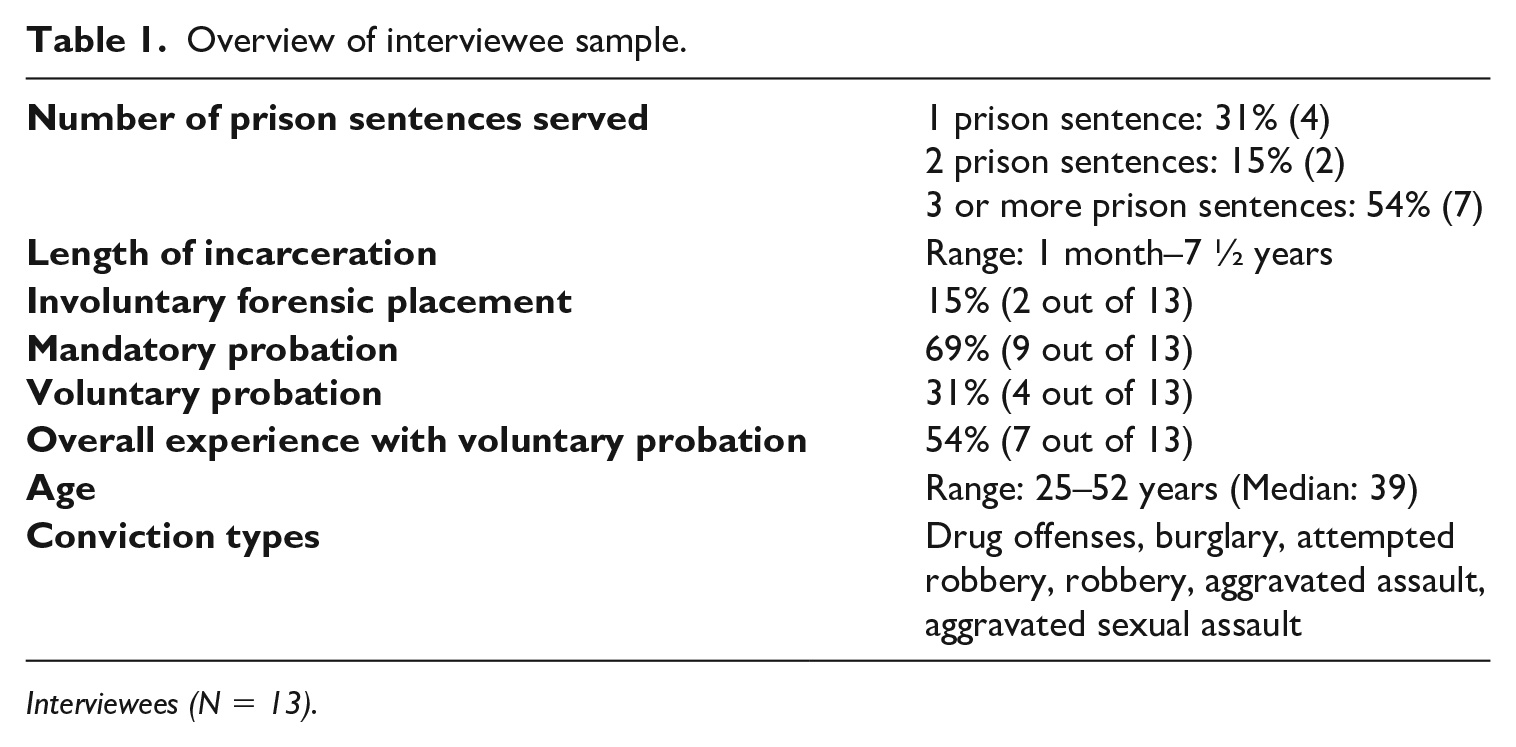
Interviewees (N = 13).
While 13 interviewees is a small sample size, it is important to note that the majority of the interviewees were part of a vulnerable population group for research, as they were mandated probation service and must therefore be considered being under some form of correctional supervision. Prisoners and/or former prisoners are in general a hard-to-reach population group, as research must take extra precautions to ensure voluntariness and confidentiality (James, 2013). To ensure that participation in my study was entirely voluntary, I let the clients approach me instead of me approaching them. This was a time-consuming strategy but allowed me to only interview those who truly wanted to share their experiences with me. Another constraint was the limited time I could use for collected data for this study. Confidential office space at Neustart is limited, which is why I could only come in on days that the office was not occupied by any working professional or volunteer.
It is also noteworthy in that context that nine out of 13 interviewees (69%) had not only served one prison sentence, but instead had been to prison twice (2) or three or more times in their lifetimes (7). 2 This unexpected feature of the sample added to the richness of the experience that was reported. Upon the analysis of the various narratives, it became clear that those who had served more than one prison sentence naturally compared their various reintegration experiences with one another, regardless of whether they were shorter or longer sentences. The fact that the majority of the interviewees had served more than one prison sentence added another layer to this study, as it allowed for not only a horizontal comparison of the reintegration experience between various formerly incarcerated individuals but also for a vertical comparison of several reintegration experiences of the same individual.
After the brief collection of these basic descriptive statistics, I asked the 13 interviewees to describe their life after prison as they had experienced it. I also asked each interviewee questions about certain aspects of reintegration experiences commonly discussed in the extant literature, such as housing, employment, social relationships, probation, and substance abuse (see discussion of extant research above). Interviews lasted somewhere between 40–60 minutes, and I recorded each one of them on a thumb drive recorder. Once all interviews were completed, I transcribed them, translated them from German into English, and assigned each interviewee a pseudonym to guarantee their anonymity. Finally, I reviewed the interviewees and categorized them by looking for common themes and uncommon narratives.
Reintegration narratives
As the analysis of the various reintegration stories unveiled, life after prison for these 13 individuals in Austria revolved around a multitude of complex and overlapping issues. By grouping the numerous reintegration stories horizontally and vertically, several common themes emerged. The main aspects of reintegration that were discussed by the interviewees were housing, relationships, and employment.
Housing
First, the majority of the interviewees (7 out of 13) found that finding stable housing was the biggest challenge for them after prison. Four of them had even struggled with homelessness for some time after their release(s). Two of them were able to find a communal living space after their release, but they both found that the temporary living arrangement made their lives after prison more difficult. Both pointed to the lack of privacy in these communal living spaces and found that the consistent exposure to other individuals with a criminal lifestyle and drug addiction made life after prison more challenging for them. One of them, Franz, even admitted that he felt unsafe in his current living quarters and that life in the communal living space “was worse than life in prison.”
Several interviewees addressed the issue of housing multiple times throughout their interview. Apart from seeing housing as a challenge by itself, several of them found that it was due to the lack of stable and adequate housing that they struggled with other issues after release, such as building, rebuilding, or maintaining relationships with loved ones, finding employment or being equipped to dealing with their drug or alcohol addictions. In other words, these interviewees believed that if they had stable and adequate housing, they might have faced fewer challenges, which explains why housing was their top priority after prison. For example, Franz indicated that, “I still plan on getting back to work, once I have my own apartment.” While struggling with substance abuse, Hannes found that “it is really hard to stay away from drugs, especially when you do not have a place to live.” Emil, who also dealt with substance abuse and had served several prison sentences, had never worried much about housing after prison, but circumstances changed quickly after his last release as a result of a death in the family: The biggest challenge for me after prison was to find stability, but it is hard to do when you do not have a place to live. My grandparents have always supported me, but they passed away while I was in prison this time. And now all of a sudden, I am all by myself. Not having a place to live makes it so much harder for me to stay away from drugs.
Finally, Leo noted that “because of the living situation, nothing else in my life has been moving forward.” This quote exemplifies the priority that many of the interviewees give to housing and how inadequate housing can make it more difficult for the formerly incarcerated to find stable employment and to deal with substance abuse.
Interestingly, those who had experienced two or more prison sentences and were able to compare their various reintegration experiences with one another, stressed that life after prison was more difficult, whenever their housing situation was not clear. In fact, two of the seven individuals who had served at least three prison sentences of various lengths pointed out that reintegration was easier for them after their longer sentences and much more difficult after their shorter sentences and that this experience had a lot to do with housing. Hannes, for instance, had been to prison more than three times but purchased an apartment a while back and wanted to keep it. As a result, he rented out his apartment to a “drug user friend” who promised to take care of the apartment and dog, while Hannes was in prison. While in prison, the apartment was not taken care of: I told him to pay for the utilities, but he did not do that, and then he ordered movies for several hundred euros, and now I am still paying all these bills because the apartment was trashed . . . this has been the worst reintegration experience of them all for me . . . before I did not have to worry about my living situation at least.
The majority of those who identified housing as their main reintegration challenge also noted that they have sought help from Neustart with this issue in particular. Franz, for example, was first mandated probation assistance by the court, as he was released from prison conditionally. After that mandated period was over, he asked to extend his probation assistance voluntarily: “I still come here because of their assisted living program.” Sandra also needed help with housing: After I was released from prison, I found a communal living space through Neustart. Unfortunately, I soon started using drugs again and could not pay the rent, so I had to move out. Neustart still stuck with me, as they stored my belongings, and many of them are still stored. My probation assistant also helped me find a new place to live, because I had to live on the streets for a while.
While seven of the interviewees described the issue of finding stable housing as their biggest challenge after release, only two stated that housing did not constitute a challenge for them, either because they owned a home that they could keep during their incarceration (1) or because they had family support throughout (1). Meanwhile, another four interviewees addressed the issue of housing in a different way. These interviewees stated explicitly that they considered themselves “lucky” to not have had to worry about housing after release. They were able to maintain relationships with family members and loved ones while incarcerated and once released, they moved back in with a parent, grandparent, or another family member. All four of them, however, did not take their living arrangement after prison for granted and found that if it was not for the support of their family or other loved ones, they would have really struggled with life after prison. For example, Tim said that he was “very lucky that I have been able to stay with my ex, because otherwise I would be homeless.” Similarly, Manuel confessed that: I am very grateful for my wife, as I can live with her. Because of her, I have not had to worry about housing after prison. She has supported me financially over the years. However, I am really ashamed, as I have been free for about three weeks, but I continue to have to ask her for money, so I can buy cigarettes.
Willi who had served more than five years in prison reflected on his situation and surroundings by stating that: I was not the average prisoner, as I had a large social network, a good attorney, and a place to live. But the average prisoner loses their place to live while imprisoned, and once they are released, they have nothing and nobody. With no place to live, they lose everything.
By summing up the narratives, housing clearly emerged as the most frequently cited reintegration challenge. Those who did not identify housing as a major reintegration challenge for themselves were still aware of the enormous difficulties many formerly incarcerated faced upon release from prison in finding stable housing. They were also aware of how the lack of stable housing tends to complicate life after prison.
Relationships
Even though housing was considered the main reintegration challenge for many, 10 of the 13 respondents found that dealing with relationships with family members and/or loved ones posed another major challenge for them after release. Many dealt with loneliness, a state that had defined their daily lives after prison. Four of the 13 interviewees lamented that the relationship with their intimate partner had ended during their last incarceration period. Three interviewees believed that their loneliness was a result of their addiction to heroin, as they found that “junkies cannot have friends.” One of them, Robert, was very clear on the impact broken relationships had on his life after prison: I lost a lot of friends because of my second prison sentence. I even lost my girlfriend during my incarceration. We had dated for six years. I am pretty certain that the break-up made me even more depressed and explains why I have struggled with life since I have been released from prison.
To overcome the feeling of loneliness, interviewees had developed either one of two major coping strategies. The first group had spent a considerable amount of time and energy on trying to rebuild relationships with loved ones. Three interviewees mentioned that they did not pursue any relationships with family and loved ones while they were incarcerated and wanted to focus on reconnecting with alienated family and friends after release. Kurt, who had been to prison multiple times for short stretches noted that: Family puts everything into perspective. Every single time I got released from prison, I thought about what it would mean to lose my family and I became so fearful of that possibility. I did not want to disappoint my family and partner anymore, as they had always supported me, even during all the times I messed up. This time, I am working really hard to not disappoint them anymore.
Some struggled with that endeavor in particular, as the crime and prison sentences had led to disappointment by family and friends. Sandra noted that she had lost a child to a foster family while incarcerated and had since her release focused on regaining custody of that child: “To be able to care for my child is what will keep me sober and out of trouble,” she noted. This statement echoes others made by two more interviewees, Emil and Arno, who felt that the responsibility that comes with being a caregiver for a child is what had defined their life after prison. Emil admitted that because of . . . being a role model for my son, I had to quit working in the brothel. With that, I have become less exposed to criminal behavior than ever before in my adult life. I only removed myself from these temptations because of my son.
Others were working on finding new and meaningful relationships after their release. Hannes, who had been without family support for several years found that: As a junkie, I am very lonely. Junkies are lonely. Junkies do not have friends . . . not really . . . I do not know a single junkie who has friends. Well, they might call them “friends,” but . . . friendship has a different meaning to me. I am working really hard now to make friends who are not drug addicts.
Others, however, stated explicitly that the fostering of relationships has only been of secondary concern for them, typically ranked right after housing. Willi, for instance, believed that “personal relationships are not the biggest problem. Because once you have found a place to live and work, you will automatically build up social networks anyway.”
In sum, the narratives revealed that healthy relationships were of major concern and the majority of interviewees therefore appeared to invest much time and energy into building and maintaining these bonds. They found relationships with family and/or loved ones to be crucial for staying focused and successful after prison. Not a single one of the 13 interviewees found relationships not to be an important component in the rebuilding of their lives after prison. In contrast to housing, however, none of the interviewees mentioned explicitly that they sought help with relationships from Neustart.
Employment
Apart from housing and social relationships, employment was a third aspect of reintegration, which was addressed by many interviewees. Yet, employment was not the most pressing issue of reintegration and seemed secondary to housing and relationships for most of my interviewees. Nonetheless, six out of the 13 interviewees noted at least once during the interview that they considered employment a major challenge after prison. They stated explicitly that they had spent a substantial amount of energy on finding employment after prison, but that they had so far not been successful for reasons discussed below. The other seven interviewees did not mention employment to be challenging. For some, this was because they already had a job and were satisfied with the arrangement (4). For three of this group, this was because they learned a new trade in prison and could apply their new skills after release. The fourth person, Emil, mentioned that “my criminal record was not something that concerned any employers . . . luckily. One employer said that I just have to report to work at 8a.m., and that would be all he cared about.” For the other three interviewees who did not believe employment was a major challenge, it was because they were more concerned about housing and social relationships at the time of the interview (see quotes above).
For those who found employment to be challenging, they relied on Neustart for assistance. Tim, for example, mentioned that he came to Neustart voluntarily, primarily due to help he needed with finding employment after his recent prison sentence. Kurt was mandated probation assistance this time, and he met with his probation assistant two to three times a week. “The probation assistant helps me with work,” he stated. In comparison to housing assistance, however, employment help was sought less frequently by my interviewee sample.
Substance abuse
Apart from housing, relationships, and employment, substance abuse was identified as another major challenge by some. Of the 13 interviewees, eight addressed substance abuse at least once during the interview. While six of them struggled with drug abuse, for two of them the concern was alcohol. Most of them found that it was their history of abuse that led them to engage in criminal behavior in the first place and that has since been hard for them to deal with. Hannes showed the prevalence of substance abuse in his reintegration journey by stating that “everything in your life is about drugs. You forget everything else, as you need money to get more drugs, and you know it, so you think about it all the time.”
However, several of the interviewees who dealt with substance abuse made it clear that their struggles with addiction were exacerbated by them not having access to stable housing, as exemplified by this other quote from Hannes: It is really hard to stay away from drugs, when you get back out. Especially when you do not have a place to live, and then there is the “release euphoria” you experience about being free. And one thing quickly leads to the other.
Leo, who was dealing with alcohol abuse, found that “Because of my homelessness, I get panic attacks in the morning that cause me to drink two beers so I get calmer and can run errands,” and I have lived a week here and a week there. Right now, I live with somebody who I met in therapy. It is a really bad environment for me, because there is a lot of alcohol available in that home.
Sandra, who was dealing with drug abuse made a similar comment by saying that: Before my release, I was convinced that I would not relapse and that I would never use drugs again. That is because when I was in prison, I felt really good, as I was working and staying busy and I just did not have time to think about drugs. I studied a lot and I could memorize things so easily. I really enjoyed the learning, and I thought I could continue with that lifestyle after my release. But living on the streets was not easy, and it was not possible to stay away from the drugs, because they were everywhere.
While substance abuse challenged the majority of interviewees, five of the 13 respondents did not classify this issue as a challenge. While four of them noted that substance abuse had never been of concern to them, Robert mentioned that drug abuse led him to prison in the first place, but he indicated that abuse was not defining his day-to-day life and, more specifically, his life after prison at this point. Most interestingly, none of those who reported substance abuse were among those who found housing to be their biggest reintegration challenge. In fact, among these five are the two interviewees who were not concerned about finding a place to live after prison (simply because they owned a home that they could keep while incarcerated) and three who considered themselves lucky to have had family who were supporting them with housing after release. This indicates again that a lack of stable housing exacerbates other types of reintegration challenges, and in this case, it is substance abuse.
Several of those dealing with substance abuse sought help from Neustart to better deal with their addiction. For some, that help entailed substance abuse counseling or therapy, while for others the help was more geared towards finding adequate housing where the exposure to others with drug or alcohol use issues could be minimized.
Immigration status
Another factor that was a major challenge for a select few interviewees was their immigration status. The two interviewees who did not have Austrian citizenship noted that their immigration status complicated their lives after prison. Xaver worried substantially about his immigration status and future upon release while in prison: I was really concerned about my immigration status, as I am not an Austrian citizen and only here on a permanent visa. The country I was born in is not my home country anymore, as I have lived in Austria longer than I ever lived there. In prison, you have time to think about so many things, so the fact that I might have to leave Austria after prison weighed heavily on me. I have since tried to be very diligent with my probation term, so I won’t have to worry about my immigration status that much anymore.
Manuel was less concerned about the prospects of having to leave Austria than about how his immigration status impeded his employment options after prison: In my past, I always felt good, just like a human, when I can get up in the morning and get ready for work . . . I do not even have time to think about getting in trouble, as I do not have that much free time anymore when I work. I feel really good when I work, but unfortunately there is no work available for me right now because of my immigration status.
These quotes confirm that an uncertain immigration status can complicate reintegration substantially. While Xaver was worried about the uncertainty of his future due to his sentence, Manuel found that the barriers he faced to find employment had less to do with his criminal record and incarceration than with his immigration status.
Stigma related to the nature of the crime committed
While concerns about immigration status were unique to these two stories, the narratives of the two interviewees released from IFP also shared some commonalities. Even though both had spent several years in IFP and therefore did not know the exact date that they would be released from confinement, both considered themselves lucky to not have to worry about housing after release. While one of them attributed their luck to a “large social network,” the other was able to find an apartment quickly after release with the help of their probation assistant. While housing was therefore not a challenge for them at the time of the interview, both indicated that the stigma related to the nature of the crime(s) that involved violence and/or sex had complicated other aspects of their reintegration journey. For both, finding employment after release was described as difficult, as they were required to disclose information about their criminal history and the nature of their governing offenses. Willi claimed that: If I were not to disclose my criminal record, they know you have something to hide. The criminal record conversation with potential employers was really something that frustrated me. I really wanted to work . . . but I almost did not get the job because of my crime and time in IFP.
Similarly, Alexi stated that: In my resume, I have a lot of professional experience listed over the seven years in prison, but it is all scattered. Any potential employer will look at that and wonder . . . so I have to tell them the truth about my crime. They usually acknowledge that I worked well, but as soon as they learn about my crime, they become distant. They worry about the women in their workplace and they worry about me doing something bad again.
For Alexi, finding employment was not the only difficulty mentioned after release from IFP. For him, also family relationships were disrupted due to the stigma related to the nature of the criminal convictions. As one example pulled from the transcriptions, Alexi conceded that: [M]y brother is not in my life anymore. He was really disappointed with me, and he said that if I had at least “just” robbed a bank, but attacking a woman is just the worst of the worst, he said.
These narratives show that Alexi and Willi found that their reintegration experience was not necessarily complicated by them having a criminal record per se but by the nature of their criminal records. In addition, IFP and the indefinite time they were confined in such an institution seemed to further stigmatize them and added to the struggles they both felt after their release from prison.
Discussion
Individuals are released from prison back into the communities from which they came. Rather than following a clear timeline, the reintegration stories in Austria were messy, as they varied from individual to individual, sentence to sentence served, and were not contingent on the time they had served in prison or the time that had elapsed since their release. Reintegration in Austria as elsewhere (Maruna et al., 2004, on England and Wales; Shinkfield and Graffam, 2009, on Australia; Doherty et al., 2014, on Canada) unfolded as a life filled with a multitude of concurrent and complex challenges.
The narratives of the formerly incarcerated in Austria also revealed that post-prison challenges do not present themselves in an obvious sequence of events with the successful completion of their probation term as their ultimate goal and happy endpoint. After all, four of the 13 participants came to the probation office on a voluntary basis at the time of the interview, indicating that they had faced challenges on their reintegration journey that they needed assistance with. Some of those with mandated probation also had previous experience with voluntary probation assistance. Overall, none of the interviewees considered the “control” element of a mandatory probation term a major post-prison challenge. Instead, the narratives suggested that probation was considered a helpful tool during the difficult time post-prison. As Willi summarized this point for all interviewees, probation is about getting “help with whatever” you need post-prison. These findings reflect the basic tenets of the “help model” (Bottoms and McWilliams, 1979; Willis, 1983) or Probation Assistance Model, as practiced in Austria.
With the emphasis on help and assistance, the difficulty of finding stable and adequate housing after release emerged as a major theme in the narratives, as also discussed by Graffam et al. (2004), Baldry et al. (2006), and Western (2018). Of the 13 interviewees, housing is what most needed help with after prison. Most of those who did not need help with housing stated explicitly that they felt lucky about that circumstance, further corroborating the importance of housing assistance. Moreover, the issue of housing clouded other common reintegration challenges, such as the fostering and building of healthy relationships and the finding and maintaining of employment. These findings are similar to Baldry and Maplestone’s (2003) study on reintegration in Australia, for which they concluded that a lack of stable housing impedes the social reintegration of individuals after incarceration.
The prevalence of a concern for housing over relationships and employment was not only noticeable in the horizontal analysis of the narratives. Instead, it also surfaced in the vertical analysis (the comparison of the various reintegration experiences of the same individual who had been to prison more than once). This is consistent with the research findings of Zurhold’s et al. (2011) study on former female prisoners in select European countries, as they found that the frequency and length of imprisonment do not impact one’s reintegration experience.
Conclusion
Upon review of the narratives of the formerly incarcerated in Austria, we can see that these individuals face many barriers upon release that can complicate reintegration and might exacerbate their ability to reestablish themselves in their wider communities. While access to stable and adequate housing prevailed as the most pressing issue after release, a place to live was also the prerequisite for being able to deal with other very common reintegration challenges, such as rebuilding broken or building new relationships with family and loved ones and finding and maintaining employment. In other words, the interviewees found housing to be a springboard for the fostering of relationships and the securing of employment. Adequate and stable housing was further considered a basis for more diligently being able to deal with other types of reintegration challenges, such as substance abuse, uncertain immigration status, and “crime stigma,” all of which can further exacerbate life after prison and community cohesion. Clearly, the challenges associated with finding and maintaining housing, relationships, and employment affect not only the formerly incarcerated but also their families and loved ones as well as the wider communities that they are released into. Probation services and their wider communities must remain considerate of the importance of housing when facilitating the reintegration of the formerly incarcerated. Future research in Austria and elsewhere should deepen the discussion on housing and what types of housing alleviate or impede reintegration success. For example, interviewees alluded to specific challenges that come with communal living spaces or transitional housing, and future research could aim at distinguishing more between these various types of housing and learn from people who not only occupy these spaces but also run them.
In this light, it is clear that reintegration, as suggested by Visher and Travis (2003), must be understood as both a process and a goal. The process itself is complicated, as life after prison does not follow a clear timeline but can be considered a compilation of messy stories that overlap and vary not only from individual to individual but also from various reintegration journeys experienced by the same individual. Meanwhile, the ultimate goal of reintegration should not be limited to “staying out of trouble.” If we truly want to take the perspective of the formerly incarcerated and if we want to support them when reintegrating them back into our communities, successful reintegration must include checkboxes for factors that go beyond heightened public safety.
Footnotes
Funding
The author received no financial support for the research, authorship, and/or publication of this article.
