



Abstract
The Risk-Need-Responsivity model of correctional intervention has become the cornerstone of correctional practice in the United States. With a primary focus on building human capital through interventions aimed at developing knowledge and skills needed for prosocial behavior, the model enjoys widespread empirical support. This approach, however, has been criticized by desistance-focused scholars for its failure to recognize social capital and the importance of social networks for facilitating behavior change. The current article examines the concept of individual-level social capital and describes how its development can be integrated into the Risk-Need-Responsivity model of correctional interventions as an important responsivity factor. Recommendations include assessing for social capital and strategies for enhancing both bonding and bridging social capital.
Introduction
Rehabilitative attempts to reduce recidivism have generally focused on reducing risk and addressing criminogenic needs. The most effective correctional treatment programs are largely designed to change criminal thinking and build human capital by teaching social, coping, and self-regulation skills (Latessa et al., 2014). The most effective programs reduce recidivism about 30% on average; however, many programs fall far short (Andrews and Bonta, 2010). There are many reasons as to why programs fail; we contend that one source of failure is the lack of attention paid to barriers, or responsivity factors, that may impede someone’s success (Bourgon and Bonta, 2014). That is, reductions in recidivism may be thwarted by the failure of programs to consider responsivity factors that must be addressed for behavior change to both occur and be sustained (see Andrews and Bonta, 2010).
One potential responsivity factor is individual-level social capital. Social capital can be defined as “the capacity of a person to call upon personal ties and social networks in order to advance some personal interest” (Clear, 2007: 80). In other words, social capital provides people with connections and access to resources such as housing, employment, and improved general well-being (Wolff and Draine, 2004). The relationship between social capital and desistance has been written about extensively in the United Kingdom, but there have been few attempts to place social capital within the rehabilitative framework commonly used in the United States (Farrall, 2004; Flavin, 2004; Salisbury and Van Voorhis, 2009; Walker et al., 2014). The current article positions social capital within the context of the Risk-Need-Responsivity (RNR) model of rehabilitation. Specifically, we conceptualize individual-level social capital as a responsivity factor and provide guidance for assessing and addressing the lack of prosocial social capital among correctional clients. To do this, we draw on two competing models of correctional intervention: the Risk, Need, and Responsivity model and the Good Lives Model.
RNR model of intervention
The major premise of the Risk, Need, Responsivity (RNR) model of rehabilitation is that sound interventions can facilitate behavior change if they adhere to the principles of risk, need, and responsivity (Andrews and Bonta, 2010). Specifically, programs are expected to be more effective when they target higher risk clients, seek to change criminogenic needs, use a behavioral approach, and are responsive to individual differences. There is ample evidence to suggest that these principles hold true across a range of program and offender types (Andrews and Dowden, 2006; Andrews et al., 1990; Hanson et al., 2009; Lipsey et al., 2007).
The risk principle indicates programs are more effective when the level of service is matched to the likelihood of recidivism (Andrews and Bonta, 2010). In practice, this means programs should assess the risk level of individuals and prioritize services for those that are higher risk; lower risk individuals should generally be diverted from programs and receive minimal services. Research demonstrates that programs targeting moderate and high-risk individuals for treatment are associated with reductions in recidivism, whereas programs that target low risk individuals are likely to have either a null or negative effect (Latessa et al., 2010; Lovins et al., 2007, 2009; Lowenkamp and Latessa, 2004).
The need principle states that programs should focus on criminogenic needs as targets of change. Specifically, programs should provide groups and activities aimed at reducing the very risk factors, or criminogenic needs, that drive an individual’s propensity to reoffend. Examples of criminogenic needs include pro-criminal thinking, delinquent and criminal networks, and personality characteristics (e.g. impulsivity) that support criminal behavior. Additional needs include family communication and relationships, employment and educational deficits, substance abuse, and a lack of prosocial leisure activities. By targeting these types of dynamic factors with structured interventions, programs can reduce the likelihood of recidivism. Meta-analyses have consistently revealed greater effect sizes for those programs that emphasize criminogenic over non-criminogenic needs (Andrews and Bonta, 2010; Dowden and Andrews, 1999a, 1999b, 2000).
According to the responsivity principle within the RNR model of intervention, treatment and staff should be matched to individual client characteristics in a manner that enhances the chances of program success (Andrews and Bonta, 2010). This principle encompasses two key components. The first is general responsivity which suggests that correctional staff should use models of treatment that are most effective with criminal justice populations. General responsivity has been widely studied with the research suggesting that behavioral and cognitive-behavioral interventions lead to significant reductions in recidivism (Lipsey et al., 2007; Pearson et al., 2002; Smith et al., 2009; Wilson et al., 2005).
The second component, specific responsivity, focuses on individual characteristics and circumstances that affect success in treatment. It is ultimately about creating an environment which engenders learning (Bourgon and Bonta, 2014). Most studies of specific responsivity reveal that it is important to match treatment approaches to the age, gender, and race of clients while others suggest that internal barriers to success, such as mental health, motivation, and personality, are important responsivity considerations (see Latessa et al., 2014). There is also evidence to suggest that external factors (e.g. living in high crime areas) and organizational barriers (e.g. a lack of treatment resources) are also important to consider (Kapoor et al., 2018; Taxman, 2014).
The research around RNR is both voluminous and supportive. Meta-analyses have found that program adherence to all three principles can reduce recidivism between 17% and 55%, depending on setting and population (Andrews and Bonta, 2010). RNR has been adopted across the United States and internationally, with many state legislatures requiring that agencies adopt at least elements of the model. However, it is not without its critics. Ward and Brown (2004), for example, criticized RNR for its emphasis on client deficits, risk reduction, and recidivism and introduced the Good Lives Model that focuses more on building strengths and promoting desistance.
Good Lives Model
In contrast to RNR, the Good Lives Model (GLM; Ward and Brown, 2004) is viewed as a strengths-based approach to behavioral change and oriented toward desistance, rather than recidivism. It is believed to facilitate desistance through building social bonds and social capital (Maruna and LeBel, 2012) and posits that individuals engage in maladaptive or criminal behaviors as a way to fulfill primary human goods (Ward and Brown, 2004). These goods are essentially basic needs, which must be met to live a good life, and include life, knowledge, excellence in work, play and agency, inner peace, friendship, and community among others (Ward and Fortune, 2013). GLM assumes people seek to fulfill these goods, to some extent, through secondary goods or means, such as employment or church groups.
According to GLM, crime and maladaptive behaviors occur when primary goods cannot be met through conventional means (Ward et al., 2007). Crime may also occur when individuals lack either internal or external capacities to achieve primary goods (Ward and Fortune, 2013). Internal capacities include factors like motivation and knowledge, whereas external capacities include social capital, social support, and opportunities. Within this context, correctional treatment programs should be designed to identify the types of criminal or maladaptive behaviors used to meet primary goods and identify strategies for meeting these goods through alternative measures.
Despite popular support for GLM, there is relatively limited empirical evidence to attest to its efficacy. In a systematic review of the literature, Netto et al. (2014) failed to find any rigorous evaluations of GLM. Their review of four non-experimental studies concluded it has promise for increasing treatment engagement and motivation and, subsequently, decreasing treatment attrition. Comparisons of GLM and traditional relapse prevention (RP) programs for sex offenders have found that, although participants viewed GLM more favorably, there were no differences in treatment attrition or treatment effects (Barnett et al., 2014; Harkins et al., 2012).
Even with the limited empirical evidence, it has been argued that GLM makes important contributions to rehabilitative efforts by taking a strengths-based approach that helps to engage and motivate correctional clients with a focus on building social networks important for facilitating desistance (Willis and Ward, 2013; Ziv, 2016). It is clear that parallels between GLM and RNR exist. Both emphasize crime free lives and utilize skill-building and behavioral approaches to facilitate change. And both recognize the role of internal and external factors such as motivation, personal abilities, and social capital as being important for bringing about change.
Like Ziv (2016), we contend RNR should serve as the primary framework for designing and implementing correctional treatment programs as RNR-aligned programs enjoy the greatest effects. However, while he proposed a revised RNR framework that incorporates human goods and well-being throughout the model, we focus specifically on the role of social capital for improving engagement and, ultimately, outcomes. Relatively few programs engage family members, systematically connect participants to local agencies, or provide aftercare, despite the strong evidence in support of these services. Although many programs may build human capital by engaging in cognitive restructuring, skill-building, and relapse prevention planning, far too few seek to build up social capital in meaningful and important ways (Farrall, 2004; Farrall and Calverley, 2006; Maruna and LeBel, 2012). Drawing on Farrall and others, we argue for an integrated model of intervention that focuses on building both human and social capital.
A place for social capital in the EBP/what works agenda
Social capital has emerged as an important concept within the academic literature and has been a particularly popular topic in discussions of sociology, economics, and political science (Kawachi et al., 2007). It also has been linked to outcomes regarding community well-being, physical and mental health, and crime (Archuleta and Miller, 2011; Claridge, 2004). Although the ideas surrounding social capital (e.g. the importance of social networks and social bonds) are embedded in many criminological theories, it is only recently that individual-level social capital has been examined as a discreet construct that can be enhanced through appropriate intervention (Farrall, 2004; Hunter, 2016; Webber et al., 2019). In this section of the article, we define the construct of social capital and discuss its place in the RNR model of correctional intervention.
Social capital defined
As noted earlier, we draw on Clear’s definition which emphasizes the role of personal ties and social networks for advancing personal interests. There are four key dimensions of social capital including social networks, social support, reciprocal relationships, and productive action (Cook, 2016; Johnson, 2016). Social networks refer to the ties we have with other people and groups, which vary in size and strength (Cook, 2016). Larger social networks provide more access to social capital, as do more durable and reliable ties. It is through these social networks that we find access to various forms of social support, which can be instrumental (the provision of tangible goods or services) or emotional (the provision of care and concern) (Lin, 2001). More diverse social networks provide greater access to social support. The difference between social support and social capital lies in the emphasis placed on reciprocation (Coleman, 1988). Halpern (2005) asserts that “individuals who draw heavily on their social networks without putting much back in find themselves increasingly isolated and alone” (p. 30). In other words, a failure to reciprocate can lead to the erosion of social capital (Salehi et al., 2019). Finally, social capital leads to productive action. That is, it “makes possible the achievement of certain ends that in its absence would not be possible” (Coleman, 1988: S98).
Social capital exists at both community and individual levels. Community-level social capital exists when broad social networks work together for a common purpose that benefits the larger community. For example, through its membership, an active parent-teacher association has a variety of resources and talents it can draw upon to support school goals. Individuals have social capital when, through social networks, they are able to access and provide resources that can be used to reach personal goals. The informal economy that often emerges in lower class neighborhoods (Campbell et al., 1993; Fitchen, 1991; Jensen et al., 1995) provides a good example of individual-level social capital, which involves the unregulated reciprocal exchange of services and favors that are embedded in the social relationships (Tickamyer and Wood, 1998). For example, someone might offer childcare or transportation for cash, other things of value, or the promise of returning the favor (Jensen et al., 1995).
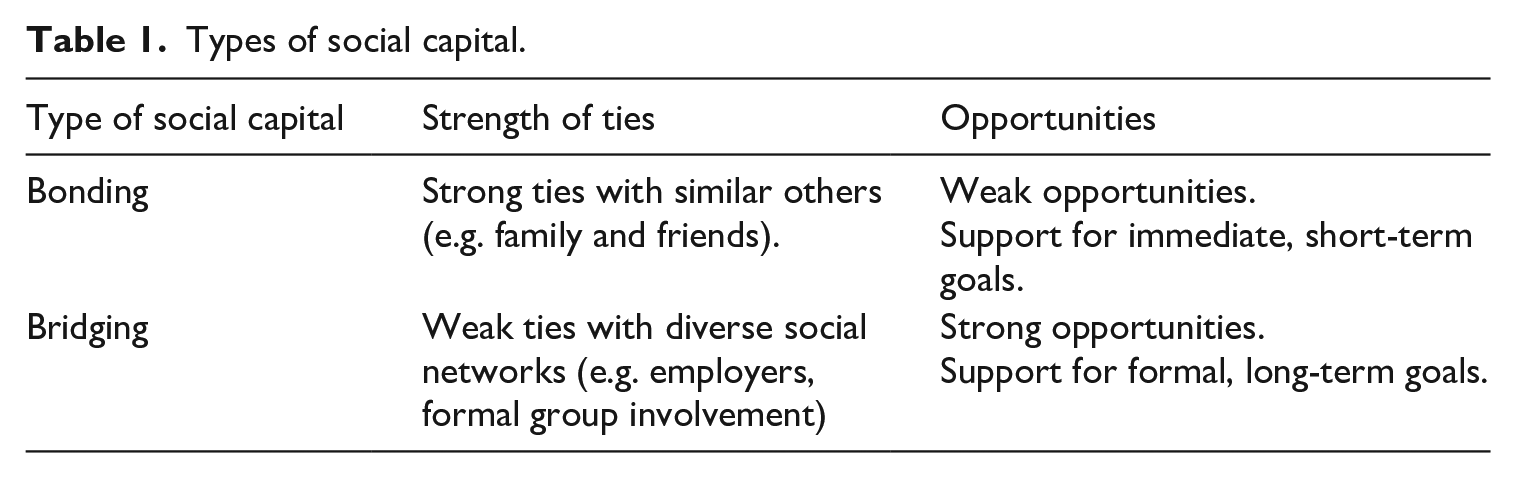
There are two key types of social capital as illustrated in Table 1. “Bonding” social capital refers to ties among family and friends (Putnam, 2000). These are strong ties that are a likely resource for emotional support or for day-to-day help with childcare, a dead car battery, and so on. Though meaningful, close family and friends typically have similar resources, and are unlikely to provide much opportunity for advancing our social status (e.g. finding a new job or appropriate housing in a different neighborhood) (Putnam, 2000; Salehi et al., 2019). As a result, Putnam contends this bonding social capital sustains social stratification and that other sources of social capital are needed to help us achieve more formal, long-term goals. “Bridging” social capital refers to more dynamic and diverse networks. These are generally weaker ties that provide stronger opportunities (Eriksson, 2011; Putnam, 2000). That is, it is typically these more distant ties developed through formal group involvement, or by accessing services, that are critical to helping people bridge the gap between existing resources and future goals. Bridging social capital is not evenly distributed among persons and groups (Bourdieu, 1986; Lin, 2000) and is likely to be in limited supply for persons under correctional supervision.
Types of social capital.
Community-level research reveals that higher levels of bonding and bridging social capital contribute to a range of positive outcomes from better functioning schools to safer neighborhoods (Chilenski and Summers, 2016; Putnam, 2000). Social capital also offers clear benefits for at the individual level (see Table 2); it contributes to a better quality of life overall and to improvements in specific life domains, including academic success and employability (Bourdieu, 1985; Chilenski and Summers, 2016; Jarrett et al., 2005; Portes, 1998). Boeck et al. (2008) highlighted the role of social capital in assisting young people through various life transitions. Their research suggested that “widespread network relationships contribute to processes of self-assurance, personal development, and in turn, resilience and desistance” (p. 16). Given the benefits of social capital, and the challenges posed by its absence, we recommend that correctional programs recognize individual-level social capital as an important responsivity consideration to be routinely addressed through the case planning process.
Benefits of social capital (Chilenski and Summers, 2016).

Social capital as a responsivity factor
In this article, we conceptualize individual-level social capital as a specific responsivity factor rather than a criminogenic need. Through qualitative research, we know that social capital is important to the desistance process (Farrall, 2004; Maruna and LeBel, 2012; Sampson and Laub, 1993). But what specific function does it serve? Is it a direct predictor of criminal conduct (i.e. a criminogenic need), or does it reduce criminal conduct by increasing the likelihood of successfully achieving intermediate supervision and treatment goals (e.g. employment, sobriety) that are more strongly correlated with desistance? We argue it is the latter based on empirical studies suggesting that the relationship between social capital and criminal behavior weakens when controlling for other risk and protective factors (Piquero et al., 2014; Salmi and Kivivourich, 2006). Moreover, there is some evidence to suggest that social capital has an indirect impact on desistance by facilitating job attainment (Berg and Huebner, 2011; Sampson and Laub, 1993; Visher et al., 2008), compliance with supervision and treatment (Mitchell, 1989; Nelson et al., 1999; Rex, 1999), and improved risk-management (Boeck et al., 2008).
Early writings on the responsivity principle focused on internal, or client, characteristics that impacted their response to treatment (e.g. verbal intelligence, anxiety, motivation) (Andrews, and Bonta, 1990). More recent work emphasizes the impact that external factors (e.g. treatment characteristics; family, community, and cultural factors) have on treatment success (Bourgon and Bonta, 2014). In concert with Farrell and colleagues, we view social capital as one of these external factors that requires consideration in correctional programming. A low level of social capital can limit the extent to which someone can benefit from treatment programs or other types of services. For example, someone can successfully complete an employment readiness program and still have trouble finding employment due to a lack of bridging social capital. That is, they may not have access to networks that can more fully connect them to the job market.
Despite their importance, no clear practice or research agenda has emerged for assessing or addressing these external responsivity factors. This is especially true as it relates to social capital. We believe that there are several reasons for the limited focus on external factors as an important treatment consideration. First, and foremost, it stems from cultural beliefs in the United States about personal responsibility. Correctional treatment and services are predominately focused on improved decision-making and acceptance of responsibility; few are designed to improve the social context in which people under correctional supervision live. One study, for example, found that few intervention goals in client case plans focused on the enhancement of social factors (Bosker et al., 2013). Second, the focus on evidence-based practices leads administrators/policy-makers to turn a blind eye to programming that has not been shown to be effective through carefully controlled evaluations. To our knowledge, there are no empirical tests demonstrating that programs aimed at building social capital at the individual level lead to reductions in recidivism. Third, and perhaps most importantly, the policy implications are overwhelming. There is no pre-defined program for building social capital. Moreover, the advocacy role it requires is amorphous and worrisome for already overworked correctional personnel.
Despite these challenges, we contend that social capital is an important specific responsivity factor that, if ignored, will limit the extent to which programs can facilitate reintegration and positive change among correctional clients. Staying true to the RNR model of intervention, a lack of positive social capital would be viewed as a barrier to treatment and positive behavioral change. By creating or strengthening social capital, it is argued, we can enhance clients’ responsiveness to interventions and services that are designed to address criminogenic needs.
Practical matters
Andrews et al. (2011), in a critique of the desistance paradigm and GLM, asserted that the desistance agenda takes a passive approach to helping individuals lead prosocial lives, waiting for important social conditions to naturally occur in clients’ lives. In contrast, the RNR model has provided a formula for translating research into practice. Fitting social capital into this formula requires implementing mechanisms for assessing one’s level of social capital and finding ways to programmatically create social capital.
Assessing social capital
It is important to assess the level of social capital available to correctional clients (Wolff and Draine, 2004). Marginalized populations (e.g. youth, persons with severe mental illnesses, persons under correctional supervision) are often deficient in both bonding and bridging social capital (Boeck et al., 2008; Hunter, 2016; Webber and Fendt-Newlin, 2017; Wolff and Draine, 2004). Their troubles take a toll on families and friendships and limit their connections with broader social networks (Salehi et al., 2019). Identifying the sources of social capital deficiencies can help correctional workers identify targets for improvement (Archuleta and Miller, 2011).
In concert with the RNR model, we recommend that actuarial, or standardized, tools be used to assess social capital. The most popular risk assessment tools (e.g. COMPAS, ORAS) do not include adequate measures of social capital, or the type of social relationships that deliver information and resources needed to accomplish personal or common goals and provide limited utility in case planning for building social capital. There are several research instruments designed to measure social capital but none, to our knowledge, that are used as the basis for correctional case planning.
One popular measurement of social capital, the Resource Generator (RG; Van Der Gaag and Snijders, 2005), could potentially be used for assessment and case planning purposes. This tool includes a checklist of specific resources commonly needed for daily living (e.g. transportation) or for social and occupational advancement (e.g. someone in the position to hire). Respondents are asked to indicate the percentage of people in their social network with each of the listed resources and whether these people are acquaintances, friends, or family members. Respondents are also asked if they possess the resource themselves. Four domains of social capital are measured (Van Der Gaag and Snijders, 2005: 23–24). The first domain measures access to resources of high-status persons that could be important for social mobility and job success. The second domain measures political party membership, knowledge of governmental regulations, and financial matters. The third domain measures access to persons with certain skills (e.g. speaking languages, working with a personal computer) and car ownership. The final domain measures access to instrumental and expressive support. In sum, the tool provides an inventory of resources to which a person may have access through their social connections. Although the tool is vulnerable to socially desirable responses (Van Der Gaag and Snijders, 2005), it has been found to be a valid and reliable (H = .37; p = .89) measure of personally owned social capital (Van Der Gaag and Webber, 2008) and both user friendly and easily interpreted (Van Der Gaag, 2005). Moreover, the items included in the Resource Generator may be modified to meet the needs of a specific population making it particularly useful for correctional agencies.
Another measurement of individual social capital that may be useful for corrections agencies is the Personal Social Capital Scale (PSCS; Chen et al., 2009). An English version of the instrument, the PSCS-E includes 10 composite scales comprising 42 separate items that are rated with Likert-type scales (Archuleta and Miller, 2011). The first five scales measure bonding social capital, or close personal ties, and ask respondents to rate the size of their network, the extent to which they have routine contact with network members, and network members’ trustworthiness and willingness to provide assistance. The next five scales measure bridging social capital. Respondents are asked about the number of social, cultural, and governmental organizations that they can access in their community, the extent to which the organizations represent their rights and interests, and their willingness to provide assistance. The PSCS-E was found to be reliable (a = .85) and user friendly, and to possess content, face, and construct validity (Archuleta and Miller, 2011). Shorter PSCS tools (PSCS-16 and PSCS-8) have been developed for use in large-scale research (Wang et al., 2014). They, too, were found to be reliable measures of personally owned social capital (a = .90 and a = .83, respectively).
Although neither of these tools are perfectly designed for the assessment of social capital among correctional populations, we believe that both can be used for assessment and case planning purposes. The best approach may include the use of the PSCS-16 along with the RG. The PSCS-16 has been validated with migrant and non-migrant populations and across educational levels (Wang et al., 2014). Although the RG has been tested across populations (Foster and Maas, 2016), we are not aware of validation studies of either instrument with correctional populations or with individuals living in disadvantaged communities in the United States. It will be important to test and validate the use of these instruments with correctional populations prior to full-scale implementation.
Programming
Can we programmatically create social capital, or must it develop through more organic processes? This is, ultimately, an empirical question that requires further study. Bourdieu (1986) and Putnam (2000) suggest that social capital emerges from day-to-day social interactions between individuals and groups and is a fluid commodity that changes as people move through various stages of life and reformulate their identities (Smylie, 2015). To simulate these organic processes, corrections staff should expose their clients to new opportunities for developing social capital. According to Webber et al. (2016), it is especially important for staff to connect clients with social networks that can help them address their criminogenic needs and to coach them on how to relate to these networks. In addition, staff should be selective about identifying networks of prosocial adults that would relate to correctional clients in a respectful way (Jarrett et al., 2005) and that will provide opportunities for reciprocation (Salehi et al., 2019). Doing so will provide a foundation for facilitating the development of bonding and bridging social capital.
Developing bonding social capital
Bonding social capital (i.e. ties among family and friends) can be developed by strengthening existing social ties. Potential strategies for building this type of capital include improving staff–client relationships, engaging family, and encouraging participation in self-help groups. Correctional staff can be important sources of social capital for their clients (Macklin, 2013). They can provide both instrumental and emotional support and information about, and access to, jobs, education, and prosocial networks. Through meaningful interactions, staff can provide clients with opportunities to practice new communication skills learned from correctional interventions. Finally, staff can be a source of hope and expectancy for the client by providing ongoing encouragement and clear expectations.
Being a source of social capital for clients, however, requires a more egalitarian relationship (Webber et al., 2016) than is typical in a correctional setting. It requires the development of a therapeutic, or working, alliance that is characterized by collaboration (Horvath and Symonds, 1991) and creates a positive environment that promotes engagement and learning (Bourgon and Bonta, 2014). But it comes with challenges, even for the most dedicated correctional staff. Building trust needed for the alliance and learning environment, requires time and patience, both of which may be in short supply among overburdened officers.
Additional sources of bonding social capital include both the family of origin and the family of formation (Coleman, 1988; Farrall, 2004; Macklin, 2013). Family members can assist in reintegration by providing financial, moral, and emotional support (Farrall, 2004; Mills and Codd, 2008). Many studies suggest that strong family ties contribute to an array of positive outcomes including lower rates of prison misconduct in the institution and decreased substance abuse, higher rates of employment, and reduced recidivism upon return to the community (Bales and Mears, 2008; Berg and Huebner, 2011; Hochstetler et al., 2010). Through his qualitative study of probationers in the United Kingdom, Maruna (2001) found that the family provided a context in which an offender was defined as something other than criminal (e.g. father, brother, son) which helps him or her shed the criminal identity and engage in more prosocial endeavors. Given the prominence of the family’s role in desistance, we suggest several strategies for facilitating the development, or activation, of social capital within the family.
The first strategy is to work with clients to build and reinforce negotiation and problem-solving skills needed to navigate troubled family relationships. Through this process, officers should help clients identify ways to contribute to their families in order to develop reciprocal relationships that foster social capital and reinforce clients’ perceptions of themselves as contributing members of society (Farrall, 2004; Maruna and Toch, 2005). The second strategy involves providing support for prison visitation. Over 40% of prisoners lose contact with their families during imprisonment (Duwe and Clark, 2011; NACRO as cited in Mills and Codd, 2008) which strains family relationships, weakens social bonds, and contributes to increased rates of misconduct and recidivism (Bales and Mears, 2008; Berg and Huebner, 2011; Cochran, 2012; Duwe and Clark, 2011). Prison visitation with family and friends provides a means of maintaining social networks and increases optimism about returning to the community (Cochran, 2012). The third strategy involves engaging the family in case planning and direct intervention. This can be accomplished through officer meetings with the family to discuss the stress of reintegration, what to expect, case planning, and legal requirements of supervision (Bobbit and Nelson, 2004) or through traditional family counseling.
When it comes to family intervention, there are several caveats worth mentioning. First and foremost, it may not be wise to strengthen social ties with antisocial family members. Second, it is likely that the clients’ behavior has taken its toll on already weak family relationships (Macklin, 2013). As such, family members may be unwilling to participate in any type of family intervention. Third, family intervention requires staff to understand the family system and have strong facilitation skills (Bobbit and Nelson, 2004). Despite these challenges, engaging families in the supervision process appears to be a worthy investment as it helps to activate the type of bonding social capital associated with overall well-being.
Finally, self-help groups should not be overlooked as potential sources of social capital. Desistance scholars encourage a strength-based approach to offender reintegration that provides “opportunities for those formerly incarcerated to make amends, demonstrate their value and potential, and make positive contributions to their communities” (Maruna and LeBel, 2003: 97). The Right Turn initiative for veterans involved in recovery in the North of England (Albertson et al., 2017) and the Circles of Support and Accountability for sex offenders (Elliott and Zajac, 2015) are two examples of this strengths-based approach. At the core of these programs is regular association with peers through group meetings that are based on the mutual aid group model which provides clients with a sense of belonging and the opportunity to both give and receive social support (Albertson and Hall, 2020; LeBel, 2007; Maruna, 2001).
Developing bridging social capital
As stated earlier, bridging social capital is needed to help people bridge the gap between existing resources and future goals. Bridging social capital involves helping individuals gain access to local organizations that might otherwise be inaccessible. Several avenues for building social capital are described below. Although none of the proposed strategies are new to community supervision, they are proposed in a new light, for a new purpose—increasing social capital as a responsivity factor that, if addressed, will facilitate the achievement of important treatment goals. Specifically, we contend that employment, community service, mentoring, and community engagement initiatives can all serve as important mechanisms for developing bridging social capital.
Employment is a critical source of social capital (Farrall, 2004; Sampson and Laub, 1993). However, it takes some level of social capital to get a job in the first place, particularly for people struggling with the stigma of a criminal conviction and limited work skills. Employment is frequently gained by accessing families’ social capital (Berg and Huebner, 2011; Farrall, 2004). But clients with weak family ties, or family members also lacking social capital, will need bridging social capital that facilitates access to new opportunities. They need correctional staff to facilitate employment by referring them to employment readiness programs and connecting them to local employment opportunities that are “felon friendly.” In other words, they need to be able to tap into the social capital of correctional staff and benefit from the relationships staff have built within the community. Once employed, offenders can access new sources of social capital through exposure to non-offenders, work-based clubs, and people with their own stock of social capital (Farrall, 2004).
Well-designed community service may be a good option for building social capital among clients who are un- or under-employed. Using community service as a source of social capital, however, will require a significant shift in how we, in the United States, think about community service. In concert with other countries, we assert that community service should be assigned as a restorative intervention aimed at building social capital, developing work skills, and providing clients with a meaningful role in the community. Well-designed community service can encourage desistance by giving offenders the sense of giving back to the community and helping them find purpose in their lives (Maruna, 2001). Doing this will require officers to identify reputable agencies that can provide opportunities for meaningful engagement.
Mentoring involves interaction between two individuals, over time, whereby a mentee is in a position to imitate or benefit from a mentor with greater experience, knowledge, or power (Tolan et al., 2008). Though popular, there is little evidence of the intervention’s efficacy in terms of recidivism reduction (Singh et al., 2019; Wincup, 2019) and it is often found to be a “promising not proven intervention” (Jolliffe and Farrington, 2008: 9). There are, however, other benefits to mentoring. In sum, a mentor can aid in the development of bridging social capital by providing the mentee with relational support, practical assistance, and access to more diverse social networks (Brown and Ross, 2010; McNeill et al., 2012; Singh et al., 2019; Wincup, 2019). The effectiveness of mentoring programs can be enhanced by ensuring a good match between the mentor and mentee based on common interests and mentor skills (Geither, 2012).
Finally, community engagement initiatives refer to strategic efforts to build social capital by connecting clients to more diverse social networks. This strategy for building social capital may be the most challenging to implement but is likely to contribute to a host of positive outcomes. There is some evidence that community engagement interventions for youth (Jarrett et al., 2005) and for persons with mental health or learning disabilities (Newlin et al., 2015; Webber and Fendt-Newlin, 2017) can increase access to social capital. For example, a youth program designed to promote intergenerational relationships was found to generate social capital for youth in the form of information, assistance, exposure to adult worlds, support, and encouragement (Jarrett et al., 2005). A review of 14 interventions aimed at enhancing community engagement among persons with mental health problems found that social skills development and asset-based approaches that connect clients to others led to significant improvements in a variety of social outcomes including increased social capital as measured by size of social networks and social engagement (Newlin et al., 2015).
A good example of comprehensive community engagement is the United Kingdom’s Right Turn Veteran-Specific Service Project. This addiction recovery service provided a continuum of interventions designed to build social capital (Albertson and Hall, 2020). Interventions included weekly group meetings based on the mutual aid group model, group based-discussions designed to raise awareness of available community-based services, and involvement in social events, group tasks, and activities designed to foster positive networks and civic engagement (e.g. walking groups, garden projects). In addition, participants were provided opportunities to engage in acts of reciprocity and generative activities (e.g. volunteering) and to participate in non-veteran community events (e.g. charitable events) to expand social networks and make valuable contributions to the community. Finally, participants took part in normal civic, governance, decision-influencing activities (e.g. conferences, seminars, political functions) to give them a sense of restoration as a citizen in terms of rights and obligations.
The project was successful for two reasons (Albertson and Hall, 2020). First, participation in the aforementioned activities was voluntary. Second, the various project activities were determined by group members. An evaluation of the project revealed a range of positive outcomes including an enhanced sense of belonging, improved physical and psychological health, success in addiction recovery, no further involvement in the criminal justice system, higher rates of involvement in voluntary work or paid employment, improved family relationships, and wider community engagement (Albertson et al., 2017).
Conclusion
Traditionally, corrections work in the United States has focused on addressing client deficits, or criminogenic needs, with little attention given to establishing social networks needed for desistance (Bosker et al., 2013; Farrall, 2004; Rex, 1999). In this article, we have argued that correctional staff should work with clients to strengthen individual-level social capital to enhance their amenability to, and success in, correctional interventions. Building social capital is a complex process that unfolds over time. It involves strengthening existing ties, exposure to new individuals or social groups, engagement in activities of mutual interest, and the development of reciprocal relationships characterized by trust.
At first glance, building social capital may seem like a daunting task for already overburdened correctional staff. We contend, however, that much of what is currently done within the RNR model (e.g. building a therapeutic alliance with clients, skill building with clients, referring to community service programs) supports this new direction. What is needed more than anything, is for correctional staff to reimagine their work and become more intentional about strengthening clients’ social capital, specifically as it relates to increasing clients’ access to social, cultural, and governmental agencies that can aid in the improvement of life outcomes.
There is sufficient evidence to suggest that this approach facilitates community reintegration and aids in the development of new life narratives that are supportive of desistance. To gain any traction within the US model of intervention (i.e. RNR), however, correctional agencies must be able to demonstrate that social capital increases the ability of individuals to successfully meet supervision and treatment goals. Future research should examine the validity and utility of social capital assessment tools and the impact of social capital on criminogenic needs and, ultimately, recidivism. In the long run, building social capital may be just what is needed to produce better outcomes for the already robust RNR model of intervention.
Footnotes
Authors’ Note
Koetzle and Matthews contributed equally to this work.
Funding
The author(s) received no financial support for the research, authorship, and/or publication of this article.
