



Abstract
Based on an empirical quantitative study, the paper examines the sentencing trends and individualisation of probation conditions in domestic violence cases. The study sample included 577 Lithuanian court verdicts for moderate bodily injury in a domestic setting between 2015 and 2019. The study results suggest that the length of the probation period imposed by the courts may depend on the offender’s conviction history but is not related to the offender’s socio-demographic characteristics and the mitigating or aggravating circumstances. Such characteristics as employment and marital status, mitigating and aggravating circumstances may relate to the type of sentence decisions. The study revealed a discrepancy between the main characteristics of the offender and the nature of probation conditions imposed by courts. Based on study results, the authors of this paper presume that Lithuanian sentencing practice lacks evidence-based individualisation of probation conditions.
Introduction
Domestic violence (DV) is widely recognised as a serious problem with harmful consequences, especially for women and children. According to Bond and Jeffries (2014), ‘although there is a growing questioning of the appropriateness of criminal justice responses to domestic violence and greater advocacy for prevention and restorative approaches, the involvement of legal regulation continues to be a key platform in Western governments domestic violence strategies’. Therefore, it is important to ‘better understand how the criminal justice system is treating offenders (and victims) of domestic violence in practice’ (Bond and Jeffries, 2014). Similarly, these statements can be applied in the Lithuanian context, where the focus on criminal sanctions handling the problem of domestic violence prevails (see Michailovič et al., 2019; Jakštienė, 2019).
This article analyses one of the forms of criminal justice intervention – Lithuanian courts sentences individualising probation conditions. The need to study the sentencing is driven by theoretical insights and research into the specifics of legal decision-making in criminal cases.
Courts make decisions that determine people’s destinies, especially when deciding on a custodial sentence. Therefore, it is particularly important for judges to take an objective, consistent and individualised decisions, both in terms of human rights and the coherence of individualisation and punishment. However, the decision-making in the sentencing process is a complex and challenging task (Mair, 2016; Belton, 2018). To make a fair sentence, judges must consider many circumstances and factors relating to the offence, the offender’s personality and reoffending risks.
The ‘uncertainty avoidance’ theoretical perspective proposed by Albonetti (1987) suggests that sentencers operate from limited knowledge of both the alternatives available and the consequences of particular decisions (Albonetti and Hepburn, 1996). The lack of knowledge results in a situation of uncertainty. In order to avoid such uncertainty, legal decision-makers rely on patterned responses based on past experiences, stereotypes and prejudices that can result in decisions based on extra-legal factors such as race, gender or others (see Albonetti, 1987, 1991; Albonetti and Hepburn, 1996). Following the ideas of ‘uncertainty avoidance’, Steffensmeier and colleagues (1993, 1998) proposed a ‘focal concerns’ theory suggesting that judges’ decisions in sentencing reflect their beliefs about three essential factors: blameworthiness, community protection (e.g. offender dangerousness/rehabilitative potential) and practical constraints. When evaluating their focal concerns, sentencers use both legal factors and stereotype-driven assumptions based on extra-legal factors (Belton, 2018). The research literature on the psychological aspects of judicial decision-making emphasises that judges usually follow an ‘instinctive synthesis’ method when making decisions in the sentencing process (Bagaric, 2015). However, instinctive decision-making may lead to sentencing inconsistency, bias and discrimination against specific individuals or social groups (Bacik, 1999; Dhami, 2003; Goodman-Delahunty and Sporer, 2010; Bagaric, 2015; Dhami and others, 2013).
Numerous research supports these theoretical insights revealing that courts take decisions based on extra-legal factors such as race, age, gender and socioeconomic status of offenders (e.g. Light, 2014; Doerner and Demuth, 2014; Feldmeyer and Ulmer, 2011; Albonetti, 2002; Spohn and Holleran, 2000; Steffensmeier et al., 1998, 1993). However, the individualisation of DV sentencing was not often addressed in studies. For example, the Bond and Jeffries (2014) comparison study of sentencing trends in DV versus non-DV cases has shown that judges are less likely to impose custodial sentences for DV. Moreover, of those imprisoned, DV offenders received significantly shorter sentence terms. Olson and Stalans (2001) compared the probation sentences of those charged for DV and other violent offenders. The average sentence for DV offenders was shorter than the average sentence for other violent probationers: 15.4 months compared to 22.4 months, respectively. However, DV offenders received more conditions on probation than other violent offenders. DV offenders were more likely to be ordered to pay criminal fines, participate in a treatment program or be placed on a specialised probation caseload. Furthermore, they were less likely to be ordered to perform community service. Thus, compared to other violent offences, DV offences are treated more leniently in court. On the other hand, DV offenders were imposed more probation conditions compared to other violent offenders.
Some studies sought to determine the most frequent types of sentences imposed in cases of DV. Their results suggest that courts often impose probation with the condition of participating in an offender treatment program (Gilchrist and Blissett, 2002; Pinchevsky, 2016). George’s (2012) study has shown that proscriptions, fines, jail and probation were the most common conditions imposed on DV offenders. This study has also demonstrated that courts impose various kinds of treatment (e.g. alcohol and drug treatment; anger management) on a relatively small group of offenders.
Several studies aim to reveal the effects of intoxication on sentencing outcomes. They show that judges can assess intoxication as both an aggravating and a mitigating circumstance (Lightowlers and others, 2020; Dingwall, 2013; Padfield, 2011; Rumgay, 1998). Lightowlers and colleagues (2020) revealed that specific sentencing outcomes usually depend on the social context and the circumstances of alcohol consumption in a violent offence situation. Such circumstances include a type of psychoactive substance, degree of intoxication, place of alcohol consumption (public or private environment), victim-offender relationship and others.
Domestic violence and individualisation of probation in Lithuania
The full criminalisation of domestic violence in Lithuania is rather recent. The negligible physical domestic violence in most cases was considered a private matter until 2012, 1 when Protection against Domestic Violence Act (2011) (PDVA) came into force. After this legal reform, police and prosecutors have been obliged to charge the offender without the victim directly making an allegation.
The enactment of PDVA resulted in a substantial rise in the official DV rate in the state. In 2012, police received more than 18.000 reports of DV, while in 2013, the number of reports exceeded 21.000, and in 2014, police received more than 29.000 reports of DV per year (Čaplikienė and Velička, 2017). According to the Department of Statistics (2020a), from 2015 to 2020, the number of reports of DV in Lithuania varied from 38.510 to 58.553. These legal developments shed light on a serious yet previously overlooked issue.
In some cases of DV, a custodial sentence is the sole option of punishment available in the Criminal Code (2000). However, if the offender has no previous criminal record, the court can impose a probation sentence. The growing number of DV offenders significantly changed the probation services client structure. DV offenders make up approximately one-third of all offenders sentenced to probation in Lithuania. 2
In Lithuanian legislation, probation is defined as a conditional alternative to an imposed custodial sentence, including a probationer’s supervision. Probation includes the suspension of a sentence and conditional release from prison (Probation Law, 2012). The suspension of the custodial sentence is applied during the sentencing process. Therefore, in this article, we focus on the individualisation aspects of this form of probation.
The individualisation of probation conditions is embedded in both Probation Law (2012) and the Criminal Code. The former refers to the individualisation of the supervision process, while the latter provides the general sentencing guidelines and specifies the list of available probation conditions.
According to the Probation Law, individualisation is the core principle for successful offender rehabilitation. The law covers criminal risk assessment procedures, supervision planning and offender rehabilitation. In addition, it emphasises the use of standardised criminal risk assessment tools to determine the level of criminal risk and the offender’s criminogenic needs. The principal efforts towards providing the opportunity to evaluate the risk were made in 2012 when various risk assessment tools were adapted for the national correctional system (Čėsnienė et al., 2015).
While Probation Law emphasises the importance of an individualised approach during the supervision, some specific articles of the Criminal Code provide the guidelines for individualising sentences imposed in court. General sentencing guidelines are provided in Article 54 of the Criminal Code. According to them, the type and the length of the sentence for each specific offence should correspond to the one set in the specific article of The Code. Every specific article prescribes a minimum and maximum (at times only maximum) sentence for a particular offence. The minimum and maximum sentence mean is set as a starting point for further sentence determination.
Article 54 also specifies the list of additional factors to be regarded before determining the final sentence. A judge should consider the type and the severity of the crime committed, the offender’s personality, the presence of mitigating and aggravating circumstances, the extent of the damage caused, etc. It is noteworthy to mention the court’s discretion to impose a more lenient type of sentence if the one set in the Criminal Code is considered too severe. Article 55 of the Criminal Code establishes the general rule that in cases where the offender is tried for the first time for a minor or less serious intentional crime, 3 the court imposes non-custodial sentences. This rule does not apply to the suspension of a custodial sentence. 4 This form of probation is usually used as an alternative to imprisonment, especially in cases where the person is not being tried for the first time and/or is being tried for several offences. 5
In terms of probation, the courts are to determine not merely the length of the probationary period but also the specific conditions the probationer will have to follow. The length of the probationary term varies from 12 to 36 months. Articles 75 and 67 of the Criminal Code provide decision-makers with the list of possible probation conditions – restrictions, obligations applicable to the probationers. A person sentenced to probation may be obliged to restrain from substance abuse, attend a correctional program, comply with a no-contact order, pay restitution, etc. 6
However, in Lithuania, sentencing usually precedes criminal risk assessment. Although the Criminal Procedure Code (2002) allows judges to initiate a pre-sentencing evaluation procedure requesting social inquiry reports, such attempts have been rather uncommon in the local court practice (Michailovič and Girdauskas, 2016). 7 The research literature regarding pre-sentence assessment suggests that in other countries, pre-sentence reports serve an important role in individualising the sentence (Norman and Wadman, 2000; Tata et al., 2008; Tata, 2010; Wandall, 2010). In Lithuania, however, probation conditions are usually individualised based on case information rather than evidence-based tools.
As in Lithuania, it is the court that decides on the measures applicable to DV offenders. The court practice in DV cases is the topic of particular interest. However, neither the official sources nor the scientific studies provide comprehensive information about the sentencing trends or individualisation of probation conditions in such cases. Despite the high prevalence of DV in the state, it is still unclear which measures are among the most frequently prescribed and whether they correspond to the individual characteristics of the offenders.
The Department of Statistics (2020b) provides information about one number of DV offenders who were imposed with a condition to attend a correctional program. In 2020, 38% of DV offenders sentenced to community sanctions that year were obliged to participate in a program. However, these statistics apply to all DV offenders regardless of the community sanction they received. In other words, it includes not only the probationers who are subject to suspension of a custodial sentence but also those sentenced to the restriction of freedom, 8 community service, released from criminal liability 9 or released from prison by parole. Therefore, it is difficult to estimate the prevalence of this specific condition among probationers. Furthermore, there is no definite information about the imposition of other probation conditions, such as no-contact order and treatment for substance abusers.
Thus, even though Lithuania adopted PDVA in 2012, the peculiarities of local court practice in cases of DV remain unexplored. As far as we know, no previous study in Lithuania has ever addressed the aspects of sentencing trends and individualising probation conditions in cases of DV. As reviewed above, previous research in other jurisdictions reveals only small fragments of the DV sentencing picture. Furthermore, these studies have been conducted in Anglo-Saxon states, mainly in the United States. Thus, we believe that our study will enrich the knowledge about the sentencing and individualisation of probation in a different Lithuanian context.
Method
Sample selection
A sample of 577 court verdicts was derived from the open-access official judicial practice database LITEKO. The Lithuanian National administration of courts manages the database. It contains anonymised versions of court verdicts annunciated in the state. The sample included a court verdict regarding the cases of moderate bodily injury in a domestic setting (Art. 138 of CC) in a domestic setting from 1 January 2015, through 31 December 2019.
We chose this particular offence in light of the objectives of this study. It is important to mention that moderate bodily injury in a domestic setting is a less serious offence. However, offenders can only be punished by a custodial sentence for this crime under the Criminal Code. The judge has no choice of alternative penalties. Therefore, probation (suspension of non-custodial sentence), as, in most cases, the only alternative to actual imprisonment, is often imposed in cases of moderate bodily injury in a domestic setting. Therefore, we presumed that the analysis of court practice regarding the chosen category of offence would allow us to take a closer look at the individualisation of probation conditions in cases of DV. It is also important to emphasise that the sample covers only a small part of all domestic violence crimes. Most of them are minor bodily injuries, provided for in Article 140 of the CC. It is a minor offence. Thus, in practice, it is rare for this offence to be punishable by custodial sentence and, consequently, probation as an alternative to a custodial sentence. Furthermore, those sentenced for minor bodily injury may also be imposed with other types of community sentences, such as the restriction of freedom and community service. A severe bodily injury (Art. 135) is a serious crime, and probation usually cannot be applied to this category of crimes under the CC. Limited research resources have also been an obstacle to larger-scale research.
Procedure
Based on the content of court verdicts in the Liteko database, a specific 226-item questionnaire (mostly closed-end) for data collection was developed to cover various case characteristics, including administrative case information (case number, court institution, etc.), 1. Socio-demographic characteristics of the offender (age, gender, occupational status, marital status, mental and physical health issues, etc.), 2. Legal characteristics of the offender (number of previous convictions, number of previous violent convictions, previous DV convictions, etc.), 3. The circumstances of the DV incident (additional charges, time of an incident, use of weapons, children witnesses, etc.), 4. Characteristics of the victim (age, gender, relationship with the offender, etc.), 5. Mitigating and aggravating circumstances (the presence of any mitigating or aggravating circumstances set in the Criminal Code and the presence of any substance abuse problems) and 6. Sentence characteristics (type and length of the sentence and imposition of particular probation conditions set in the Criminal Code).
After sample pieces, which met eligibility criteria, had been selected, each piece was encoded following the questionnaire.
In the framework of the research presented in this article, we analysed the data collected by the questionnaire to answer the following research questions: 1. What are the general trends of the sentencing for moderate bodily injury in a domestic setting in the period of 2015–2019 (focussing on the type of sentence, social-demographic characteristics of offenders and the length of probationary term)? 2. Is the length of the probation period imposed by the courts, associated with the socio-demographic characteristics such as gender, education, occupational or marital status (extra-legal variables)? 3. Is the length of the probation period imposed by the courts associated with the conviction history, status of the declared recidivist
10
and mitigating and aggravating circumstances (legal variables)? 4. What are the trends and the structure of probation conditions imposed by courts? 5. Do the trends and structure of the probation conditions imposed correspond to the prevailing characteristics of offenders?
We created control and independent variables to answer the first and second research questions. The length of the probationary term was utilised as a
Statistical analysis
Statistical data analysis was performed using IBM SPSS Statistics 21. The chi-squared test has been applied for intergroup comparisons. Statistical analysis also included t-test, ANOVA, and correlational analysis.
Results
General findings
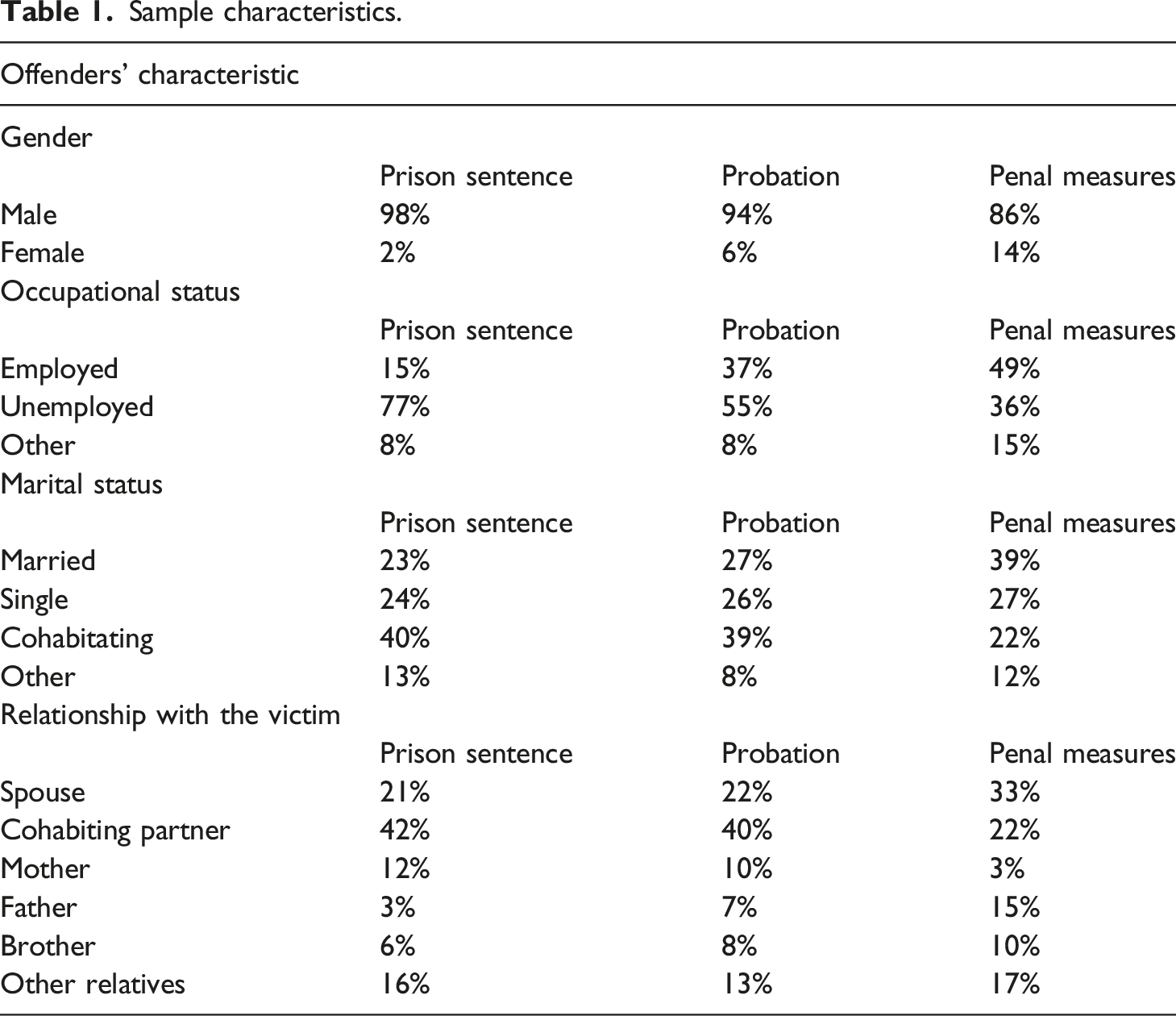
Sample characteristics.
The length of the probationary term
Descriptive statistics for a probation sentence.

The offender’s socio-demographic characteristics appeared to be insignificant in terms of the average length of the probation sentence. Neither education nor occupational or marital status had any impact on the length of the probationary term.
A comparison of average probation term depending on the offender’s criminal history.

Association between the length of the probationary term and the number of previous convictions.

rp - Pearson correlation, ** - p<0.001.
Comparison of the average probationary term depending on whether the offender was declared a recidivist.

Other types of aggravating circumstances appeared to be insignificant in terms of the average probationary term. Furthermore, in this study, the presence of mitigating circumstances did not have any impact on the average length of the probationary term.
Probation conditions for DV offenders
Further analysis has shown which types of probation conditions were imposed most often: 63% of the offenders received a travelling restriction, 43% had to stop using psychoactive substances, 42% were obliged to get employed and 42% had to attend a correctional program, while 31% had to attend a program for violent offenders. 12
The further analysis sought to disclose the most frequent combinations of probation conditions. According to the results, those included: travelling restriction along with a program for violent offenders (5%), travelling restriction as a sole condition (5%), a correctional program along with a travelling restriction and restraint from substance abuse (4%), obligation to get employed along with a travelling restriction and restraint from substance abuse (3%), a correctional program along with a travelling restriction (3%) and obligation to get employed along with a correctional program (3%).
Individualisation of probation conditions.

Although most offenders (55%), who were sentenced to probation, were unemployed, only 45% of those, who did not have a job, were obliged to get employed (Table 6).
The results suggest that 86% of offenders had a history of previous convictions. Among those, who had been previously convicted, only 41% were obliged to attend a correctional program (Table 6).
A history of previous violent convictions was less common as only 28% of the probation sample had been previously convicted for violent offences. Among those, who had a history of violent conviction, 38% were obliged to attend a specialised program for violent offenders. Only 27% of offenders had a history of previous DV convictions. Only 36% of them received a condition to attend a program for violent offenders. The imposition of a no-contact order was rather uncommon as it was imposed on merely 3% of the offenders with a previous history of DV conviction (Table 6).
Discussion
The current study sought to explore the sentencing trends and the individualisation of probation conditions in cases of DV. The results suggest that, within the sample, most offenders accused of moderate bodily injury in a domestic setting were sentenced to probation. Among those sentenced to probation, most offenders were male. Further analysis of socio-demographic data has shown that more than half of the probation sample were unemployed. In addition, in most cases, those sentenced to probation had a cohabitating partner rather than being officially married. The majority of those accused of DV have committed a violent act against their cohabitating partner or spouse.
The results suggest that the average length of probationary term for DV offenders was approximately 17 months. Previous studies have indicated that the average probation term in cases of DV was approximately 15 months, while the probationary term for the majority of DV offenders was less than 13 months (Olson and Stalans, 2001). Apparently, Lithuanian courts tend to impose slightly longer probation sentences for those accused of DV, yet the apparent disparity is not significant. However, such a comparison is not entirely reliable since differences in the length of probationary terms may be due to differences in national legislation and practice.
This study also suggests that nearly half of all offenders were sentenced to 12 months on probation. Therefore, courts were apt to impose the minimal probationary term set in the Criminal Code in most cases. Such sentencing trends might indicate a rather lenient judicial attitude towards the offenders of DV. The lenient sentencing of offenders of DV compared with other violent offenders is revealed in other studies (Bond and Jeffries, 2014; Olson and Stalans, 2001). Future studies could involve the comparison of sentencing trends in cases of DV and non-DV offences to test this assumption in the context of Lithuania.
In this study, the average length of the probationary term did not depend on gender, education, occupational or marital status. Such results might indicate that the socio-demographic characteristics might not affect the length of the sentence as the type of the sentence itself. For instance, the share of unemployed offenders in prison and probation samples varied significantly (chi-squared = 46.5, p < 0.001). It can be assumed that those who had a job were more likely to receive probation rather than a custodial sentence. Similar trends were revealed in terms of marital status: most offenders in prison and probation samples were cohabitating with their partners. At the same time, the majority of those released from criminal liability with penal measures were officially married (chi-squared = 49.3, p = 0.003). It means that a more lenient type of decision was mostly made to those who were married. Therefore, socio-demographic characteristics possibly come into play when the decision regarding the type of the sentence is made.
The results, however, suggest that, unlike socio-demographic variables, criminal history variables might have an impact on the length of the probationary term. Intergroup comparisons have shown that a history of violent or DV conviction may result in a longer probationary term imposed in court. Furthermore, being previously sentenced to probation or committing a new DV crime during the probationary period may also lead to a longer probationary term imposition.
Surprisingly, the presence of mitigating or aggravating circumstances did not have any impact in terms of the average probationary term. Such results may indicate that, just like socio-demographic characteristics, mitigating or aggravating circumstances do not affect the length of the sentence but may rather alter the decision on the type of sentence. The statistical analysis partially confirms this assumption. The results of intergroup comparison suggest that the presence of mitigating circumstances was more common in the probation sample than in the prison sample. In the probation sample, mitigating circumstances were recognised in 81% of cases, while the prison sample included 58% of such cases (chi-squared = 40.9, p < 0.001). There were no significant differences between the prison and the probation sample in terms of aggravating circumstances. However, the existence of aggravating circumstances in both samples was considerably more frequent compared to the sample of penal measures (74 and 79% in prison and probation samples compared to 54% in the sample of penal measures, chi-squared = 57.2, p < 0.001). Therefore, although the recognition of aggravating and mitigating circumstances might not be significant when it comes to the length of the probationary term, in some cases, the recognition of mitigating circumstances and the absence of aggravating circumstances might lead to the imposition of a more lenient type of sentence.
The apparent peculiarities of Lithuanian courts’ sentencing practice in cases of DV partially correspond to the ones determined during the previous studies. The results of the previous studies have distinguished an obligation to attend a program for batterers as one of the most frequent conditions in cases of DV (Olson and Stalans, 2001; Gilchrist and Blissett, 2002; Pinchevsky, 2016). Although the results of this study have also shown that it was a frequent option, it still may not be considered the standard practice in Lithuanian courts. Compared to the previous studies (e.g. Olson and Stalans, 2001), in this study, the list of the most frequent probation conditions did not include the option of a fine. Furthermore, contrary to the results of the previous studies (George, 2012), no-contact order during the probationary period was rather uncommon in cases of DV.
Surprisingly, travelling restriction was the most common probation condition imposed on DV offenders. The effectiveness of such restriction is questionable as limited mobility will most likely have no impact on violent behaviour. Even though the obligation to get employed was one of the most frequent conditions for DV offenders, only 45% of unemployed received such conditions along with a probation sentence. Such results indicate that Lithuanian courts often fail to address problems of unemployment which are considered to be one of the critical risk factors leading to domestic violence recidivism (Alonso-Borrego and Carrasco, 2017; Capaldi et al., 2012).
Even though 76% of the offenders were intoxicated during the incident, only half were obligated to restrain from using alcohol and drugs. The results of this study have also revealed the insufficient use of no-contact orders along with probation sentences which could potentially enhance the safety of the victims. Finally, only one-third of those who had previously been convicted for DV received an obligation to attend a program for violent offenders. Such results indicate that most batterers are not referred to obtain professional help concerning their violent behaviour, even if they have a history of previous DV convictions.
The study results suggest that the imposition of particular probation conditions on DV offenders still needs a more individualised approach. The tendency of insufficient individualisation can be explained in terms of the theories of ‘uncertainty avoidance’ (Albonetti, 1987) and ‘focal concerns’ (Steffensmeier et al., 1998). For example, as the research literature suggests, judges may lack knowledge and understanding of the context of domestic violence (Douglas, 2007; Gilchrist and Blissett, 2002). They, therefore, base their decisions on their personal views on the crime and its factors. It can also be assumed that judges may have insufficient information about the goals and content of programs used by probation services (Fitz-Gibbon et al., 2020; Jakštienė, 2019; Michailovič et al., 2019). The lack of knowledge and information may lead judges to be pessimistic and sceptical about programs and other interventions (see Fitz-Gibbon et al., 2020).
Furthermore, previous research has shown that applying the instinctive decision-making method can lead to consistency deficiencies (Dhami et al., 2015; Bacik, 1999) or/and influence of extra-legal factors (Dhami, 2003; Goodman-Delahunty and Sporer, 2010). Based on the results of our study, we would assume that an instinctive decision-making without any decision-objectifying instruments may also be a factor hindering individualisation of sentencing, especially in terms of addressing probation conditions to criminogenic risk factors. Referring to Mair (2016), sentencing is a difficult and complex process where probation staff can help provide a more objective appraisal of the offender. Thus, we believe that the shift from instinctive to evidence-based decision-making could be facilitated by the broader application of risk assessment tools and pre-sentence (social inquiry) reports in judicial practice.
The main obstacle to the broader application of social inquiry reports in Lithuanian courts lies within the judges’ broad discretion. The Criminal Procedure Code provides that judges may issue a social inquiry report at their discretion. Judges, for various reasons such as lack of time (aiming to complete the process as soon as possible to protect the interests of the victim (Michailovič et al., 2019), as well as possible lack of knowledge and understanding of the benefits of social inquiry reports), 13 are reluctant to use this tool. Therefore, for future research, it would be important to examine judges’ attitudes regarding the use of evidence-based individualisation tools in decision-making.
At the same time, it would be important to emphasise that risk/need assessment tools are not a panacea. Although some studies show their effectiveness (e.g. Hanson et al., 2009; Stewart et al., 2014; Usher and Stewart, 2014), the criminological literature criticises risk/needs assessment practices for their potential bias against racial/ethnic minorities, women and socio-economically marginalised persons which could result in sentencing disparities (e.g. Van Eijk, 2017; Hannah-Moffat, 2016; Chenane et al., 2015; Harcourt, 2015; Holtfreter and Cupp, 2007). Nevertheless, we believe that practical implementation issues should not be an argument for denying the benefits of risk/need assessment tools. However, the question of how to deal with the bias problem is not an easy one. For example, referring to Van Eijk (2017), inequality in decision-making is driven by a concentration on risk rather than needs assessment. According to the author, ‘the rehabilitative efforts are undermined when they are accompanied, or preceded, by sentencing based on risk assessment’. Thus, socio-economically underprivileged individuals ‘are confronted with a higher risk score and, consequently, are more likely to face a custodial sentence or to face a longer custodial sentence, compared to their more privileged counterparts’ (Van Eijk, 2017). Therefore, we believe that further research to investigate the possibilities for avoiding biased and unequal decision-making using risk/needs assessment tools is needed.
Footnotes
Funding
The author(s) received no financial support for the research, authorship, and/or publication of this article.
