



Abstract
Individuals on probation have a high prevalence of health problems when compared to the general population. For them it is often difficult to access health treatment. Thus, improvement of mental health and access to mental health services could increasingly become a role of the probation officer. In Europe, there is less data about the use of specialty mental health probation (SMHP) than in the United States (US). In a survey for the Council of Europe, Brooker and Monteira (2021) summarized the practices of probation services and prisons among European countries. The authors alluded to useful initiatives in German states. One example is Baden-Wurttemberg, where some probation officers are trained to be mental health specialists (Brooker and Monteira 2021: 16). The main difference between the SMHP model in the US and the model in Baden-Wurttemberg is that the specialist in mental health in Baden-Wurttemberg does not necessarily care exclusively for individuals with mental illnesses, but rather serves as a source of expert knowledge to colleagues and assists with case consultations. Thus, the probation officer does not focus exclusively on one topic (mental health) and can take a holistic view of each individual case.
Background
In recent years, it has become increasingly clear that the prevalence of mental illness amongst prisoners is steadily rising. In prisons, individuals are in an enclosed system. Psychiatric care is available in prison, but is not always easy to access. Moreover, prisons are not designed as therapeutic institutions and incarceration itself can damage mental health (Scott and Moffatt 2012: 4).
Some prisoners, especially forensic patients, that is, individuals with mental illness charged with, or convicted of a criminal offense, are supervised in Germany after they have been discharged in order to assure a more effective control of their conduct after their release from custody by means of mandatory treatment and monitoring. Special outpatient clinics have been established to assist discharged patients in complying with the conditions of probation and parole (Konrad and Lau: 2010: 238).
For those who are on probation and do not have a condition to attend a forensic outpatient clinic, it is difficult to get access to health treatment. Thus, facilitating access to medical psychiatric services and improving the mental health of people on probation will increasingly be part of the role of probation officers.
While not a homogenous group, people on probation have a high prevalence of health problems when compared to the general population. Some 38% of individuals on probation are recorded as having a mental health issue (Her Majesty’s Inspectorate of Probation 2021: 7). Often they experience a combination of mental illness and a substance misuse problem (dual diagnosis) which is often unrecognized and untreated (Brooker et al., 2020: 8).
A study by Brooker et al. (2020) found that a large proportion of those with a current mental illness were not receiving treatment: for example, 60% of those with a mood or anxiety disorder were not receiving any treatment, and only half of those with a current psychosis were receiving any mental health treatment. Moreover, the research suggests that mental health problems are under-identified by probation staff: only 33% of individuals identified as having a psychotic disorder by the study’s researchers were subsequently recorded in probation files as having such a disorder (Brooker and Glyn, 2012).
Scott and Mofatt (2012) also suggest that there could be an under-identification of mental illness by probation officers. This can be partly explained by the limited opportunities available to probation staff to receive any form of mental health awareness training, with many grades of probation staff receiving no formal training in this area. In their report, Brooker et al. (2020) concluded that probation staff require at least a “basic” level of mental health awareness in order to effectively perform tasks (Scott and Mofatt, 2012: 5).
Twenty years ago, the Council of State Governments (CSG) in the US encouraged specialized approaches for community supervision of individuals with mental illnesses, including reduced caseloads, mental health training for officers, and assignment to designated mental health caseloads for the duration of their supervision (Council of State Governments, 2002).
Since then specialty mental health probation (SMHP) has been implemented in nearly 140 probation agencies with different variations in the approach to implementation and the structure of the service according to the criminal justice model employed across the United States (Skeem et al., 2006). Five key elements are identified as the prototypical model: (1) probation caseloads consisting exclusively of individuals with mental illnesses; (2) reduced caseload size; (3) ongoing mental health training for specialty mental health officers; (4) use of a problem-solving orientation; and (5) collaboration with internal and external resources to link probationers with services and supports (Skeem et al., 2006).
Current research shows that having SMHP has an impact on reoffending. The study by Skeem et al. (2017) shows that SMHP reduced rearrests rates. Traditional probationers were 2.68 times more likely to be rearrested within 2 years than were those on specialty mental health probation, which translates to a 23.1% decrease in arrest rates (28.6% specialty vs 51.8% traditional). However, the results also show that an SMHP has no impact on violence and thus on public safety (Skeem et al., 2017).
Another study designed by Van Deinse et al. (2021) shows that a higher percentage of individuals on SMHP caseloads had violations due to a new crime. Peer-reviewed research literature on SHMP indicates greater mental health treatment engagement and mixed findings regarding criminal justice outcomes (Manchak et al., 2014; Wolff et al., 2014). If SHMP has an effect on the likelihood of recidivism, but less for reducing violence, the question is whether other approaches are needed to strengthen the security of society.
In Europe, there is less data about the use and impact of SMHP. In a survey, Brooker and Monteiro (2021) summarize the practices of probation services and prisons among European countries. According to the authors, there are two interesting models described within probation settings. One model employs forensic psychologists address the needs of clients with a mental health disorder. Other countries, such as England and Spain, are attempting to address the issues with continuity of mental health care in the transition from prison to probation. The authors also add that there are some useful initiatives in German states. One example is Baden-Wurttemberg, where some probation officers are trained to be a specialist on mental health and provide input to the nine probation offices (Brooker and Monteiro, 2021: 16).
This article will describe the approach used in Baden-Wurttemberg to share knowledge and understanding of this approach with those who may wish to establish similar models. We aim to show that this approach can be effective even though the probation officers do not have a reduced caseload and do not exclusively work with individuals with mental illnesses.
Methods
Our analysis is based on data from the probation service in Baden-Wurttemberg.
First, we will present probation data to highlight the need to focus on mental health. Second, we will describe the development of the specialist model used by the probation service in Baden-Wurttemberg to highlight differences between this and the prototypical model advanced by Skeem et al. (2006). Finally, we will describe the next steps that we believe are needed to develop model further.
Findings—data from the social diagnostic system in Baden-Wurttemberg
The social diagnostic system, used in Baden-Wurttemberg, is called Risk-Resources-Inventory (RRI), and was developed in 2013 by the Central Department of Social Work of the probation service of Baden-Wurttemberg (BGBW) in cooperation with the association NEUSTART Austria. It is a standardized and validated instrument for social diagnostics in the field of social work within the criminal justice system. The aim of the RRI is to identify not only the static and dynamic criminogenic factors but also the resources and needs of the individuals being assessed. The system itself is based on the risk-need-responsivity model designed by Andrews and Bonta (2015). In addition, the instrument elicits individual’s self-assessment of the different areas within the assessment. The BGBW implemented the RRI in June 2018. Since then, it has been applied to all new probation cases.
The RRI consists of four areas, which in turn are subdivided into 13 dimensions. The following domains are included: delinquency domain (cause of offense, development of crime, risk management, conditions, and directives), socioeconomic domain (housing/residence, financial situation, education/training, and employment/activity), interpersonal domain (family of origin and social environment), and the
Mental health 2020 according to the RRI.
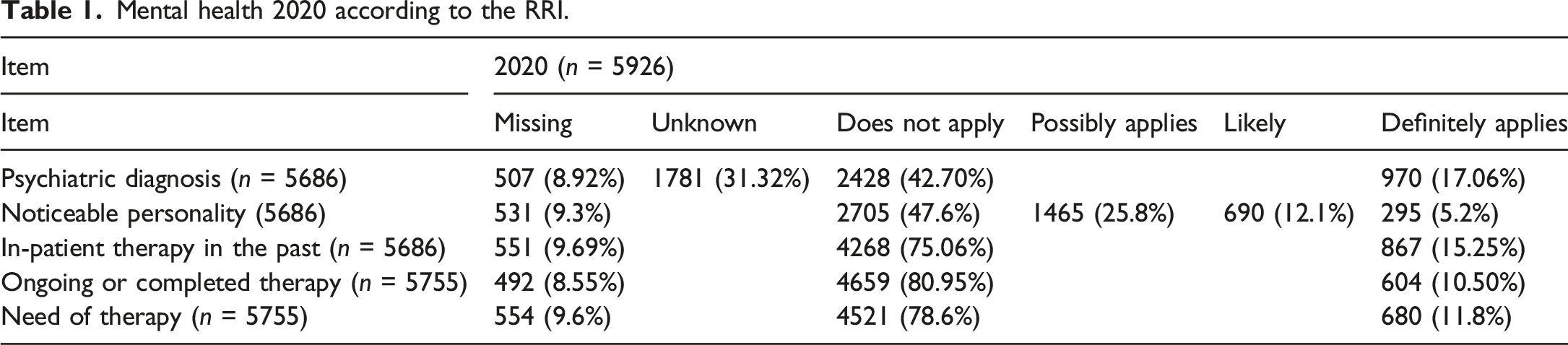
At the moment, we are unable to explain why the number of total entries (n = 5926) and the number of entries of the different items (psychiatric diagnosis (n = 5686, noticeable personality (n = 5686), stationary therapy in the past (n = 5686), ongoing or completed therapy (n = 5755) and need of therapy (n = 5755) varies. Furthermore, the Department of Social Work of the BGBW wanted to collect all receipts of probationers from the year 2019 to 2021 in order to make comparisons between the years. However, these data are unfortunately not available.
It is striking that around 10% of the items remain missing. We can only speculate on the reasons for this. (1) As a result of the Covid pandemic, starting in April 2020, no face-to-face contact could take place in the probation office. Making an assessment about the mental health could be difficult without getting a personal impression of the client. Audick (2021) finds in a survey that telephone consultation was used during the pandemic to conduct initial assessments. 46% of the probation officers stated that they had carried out initial interviews with positive experiences, 33% had initial interviews that, in retrospect, they considered unsuitable in the context of telephone counseling, and around 21% had no new cases for initial interviews. One argument was that the personal impression of a client is made more difficult because perceived feelings and reactions cannot be included in the probation officer’s assessment (Audick, 2021: 5). (2) Probation staff have 6 months to enter data about their clients into the documentation system, so the data may not have been entered yet. If the person on probation came up for probation in December, it has not yet been possible to collect relevant data. This can cause distortion effects. (3) The probation officer is unsure what to enter for the item because they have little knowledge about mental health.
Approximately 17% of the new cases have a psychiatric diagnosis. It is currently not possible to ascertain the precise nature of these diagnoses. When the data are compared to those from other countries, such as England and Wales, the percentages reporting having a psychiatric diagnosis are low. A study by Brooker and Glyn (2012) reported that 38.7% of the sample (n = 173) were positive for a DSM-IV Axis I disorder, with 17.3% being positive for current major depressive episode, 11% for a current psychotic disorder, and 27.2% for a current anxiety disorder. Overall, 47.4% of the sample screened as probable cases of personality disorder and 41.6% had experienced a major depressive episode in the past (Brooker and Glyn, 2012: 529). It should be noted that 31.32% of probation officers noted that they did not know if a psychiatric diagnosis had been made. It can be assumed that there is a knowledge gap regarding psychiatric diagnoses, possibly due to lack of information. Thus, the diagnosis of a mental illness is likely to be much higher.
A total of 15.25% of people on probation had accessed in-patient therapy or residential treatment in the past. Looking at the number of people who have a psychiatric diagnosis (17.06%), it is striking that fewer people have had inpatient treatment in the past (15.25%). Approximately 2% of the persons with a psychiatric diagnosis were not accessing inpatient or outpatient treatment.
11.8% of probation officers estimate that people on probation need some kind of therapy. Whether the need for therapy also exists among people who have already completed in-patient therapy would have to be examined on the basis of individual case studies. Similarly, it would have to be examined on a case-by-case basis whether the need for therapy exists among people who have not yet completed inpatient therapy. In particular, this would require the data of people who have a need but have not yet completed therapy, as this would allow conclusions to be drawn about the connection to treatment.
The data collected so far differ from those collected in other countries such as England. The question is whether the diagnostic system (RRI) used by the BGBW as well as the specialist model leads to a faster and safer handling and connection to treatment. It should be noted that it may also be that the RRI is not completed properly because probation officers have no or insufficient knowledge about mental health.
The concept of the specialist in Baden-Wurttemberg/Germany
The “specialist” model/concept was adopted from the association NEUSTART Austria, when the probation service was privatized in Baden-Wurttemberg in 2007. Before that there were less standards in the probation service. In some areas of Baden-Wurttemberg there were some probation officers who had a similar function to SMHP, but were more focused on sexual offenders and youth. In this period, mental health was not systematically recorded and was not aligned to any quality standards. The need for quality standards was recognized and through a European-wide tender, NEUSTART Austria was given the task of restructuring the probation service in Baden-Wurttemberg in 2007. Since 2017, the probation service in Baden-Wurttemberg has been returned to state hands. Many concepts—such as the specialist model—have been retained and are constantly being developed further.
The primary objective of the specialist model is to increase and maintain the quality of social work care through the presentation, introduction and establishment of specialized subject content within probation facilities through giving probation staff the ability to consult specialist colleagues. This should lead to the expansion of their existing knowledge and ultimately lead to a uniform level of knowledge amongst probation staff.
Second, this activity supports the professionalization of staff; expanded knowledge should lead to improved social diagnostic and risk assessment work and thus serve the overriding goal of the Probation and Court Assistance in Baden-Wurttemberg to promote the social integration of the clients and to enable them to lead a life without criminal offenses.
Third, the specialists aim to establish and maintain an internal and external network among professionals. This is to ensure professional exchange. The individual specialists within the probation facilities are also connected with each other, which should contribute to ensuring high quality work.
Baden-Wurttemberg is divided in nine institutions. Each institution has a probation officer who is specialized in the following areas: (1) Drugs/Addiction (2) (3) Violent offenders (4) Sex offenders (5) Juvenile offenders (6) Migration (7) Finances (8) Extremism
To be eligible for the position as a specialist the applicant must have previous experience in the field and be motivated to self-educate. There are two requirements for being a specialist. First, professional competence (up-to-date technical knowledge, willingness for continuous education, also in the context of self-study, affinity and interest for the subject area, and proactive working attitude). Second, a high level of personal competence in methodical and didactic skills; communication skills; advisory skills; and flexibility and creativity in carrying out and implementing the work.
Each specialism has its own job description within the probation service in Baden-Wurttemberg. The job description for mental health requires that the applicants should have the following qualifications: - Advanced basic knowledge in the area of mental illness - Knowledge of the legal framework with regard to mental illness - Basic knowledge of diagnostics/prognosis - Knowledge of treatment and intervention concepts - Experience in network work/working in partnership - Interest in further education and training - A high level of commitment and ability to work in a team - Confidence to act in front of and in groups
Specific training is not required, but to ensure continuing professional development, the specialists have to attend (external) training—such as international congresses—to expand their expertise every year. For the specialization on mental health, in the last 2 years one specialist mental health probation officer attended the conference of the German Society for Psychiatry and Psychotherapy, Psychosomatics and Neurology (DGPPN) and shared their learning from the conference with all specialist mental health probation officers across the region.
The list below describes the role and duties of a specialist probation officer. - Advising probation officers and supervisors on (difficult) cases as requested (case analysis) (e.g., discuss if the person on probation maybe has a psychiatric disorder) - Support colleagues with crisis intervention in individual cases (e.g., what can the probation officer do when there is danger to others or self-harm because of mental illness) - Tandem supervision of difficult cases on demand - Cooperation with the relevant key staff members (e.g., with psychiatrists and psychologists) - Contributions to the transfer of knowledge within the facility or departmental meetings (e.g., about topics such as personality disorders or schizophrenia) - Organization of workshops, training events, network meetings, round tables, workshops, lectures, tours, etc., for the facility (inviting speakers on a specific topic such as forensic psychiatric services) - Contributions, case discussions, professional exchange within departmental meetings - Offering a telephone or personal consultation hour for all colleagues - Passing on information through circular e-mails, distribution of information material within the facilities, maintenance of forum content, development of FAQ’s, etc. (e.g., passing information about attended conferences or meetings) - Implementation of networking with partners (such as the forensic psychiatric service) - Cooperation in quality development
For example, the probation service in Freiburg has signed a cooperation agreement with the nearest psychiatric clinic. The agreement states that a good transition is made through information sharing between (forensic) psychiatry and release. Continuous support through case management is to be given. This should reduce the likelihood of relapse and ensure continuation of and compliance with treatment post-release.
An overview of the mental health specialists’ activities can be gained through analysis of data from time sheets where the specialists detail the activities that they have undertaken during the year to the Department of Social Work. This includes information about: - Offers for the facility, including case consultations - Networking with other agencies - Supporting quality development - Continuing professional development (training) - Others (not listed)
Data from 2020 show that each specialist mental health probation officer spent more or less 20 h a year consulting on cases.
In addition, each year the specialist has an interview with his or her supervisor at the facility to review the past year and to look ahead to the coming year. A record of the interview is made and sent to the Department of Social Work of the BGBW in the first quarter of the year.
Furthermore, the Department of Social Work meets with all the specialist groups every year, including the one responsible for mental health, to explore the collaboration within and outside the probation. To date this has been done in an annual face-to-face or remote meeting. The following questions are discussed. - Suggestions for topics for future training events (own training and also suggestions for all staff) - What was the focus of activities? - How do the colleagues accept the offers? - Is there cooperation with the other specialists at the facility? - How is the partnership working with the management team of the facility? - How is the partnership working with the central social work department? - General wishes and suggestions
An example of collaboration with other specialist groups is the collaboration between mental health and drugs/addiction. For example, at the Freiburg facility, a joint presentation was given by social workers from forensic psychiatry on the forensic possibilities of placement due to an addiction (§ 64 Strafgesetzbuch (StGB), 2011 Penal Code) or a psychiatric illness (§ 63 Strafgesetzbuch (StGB), 2011 Penal Code).
Discussion/limitations
We are only beginning to collect and evaluate data from the RRI. To capture developments, including the impact of the Covid pandemic, we need data from 2019 and 2020 to compare the last 3 years.
In addition, any analysis is dependent on the information provided by the probation officers. This depends on what information is provided by the courts and other institutions and what those on probation report to their probation officers. Besides the lack of information, some information cannot be shared due to the Data Protection Regulation until a confidentiality agreement is in place.
Furthermore, the BGBW work may be undertaken to further develop the specialist model after a structured evaluation has taken place. Future research and evaluation work will involve improving our understanding of how the specialists are involved in case consultations and the exact nature of the support that they provide in a structured manner; and understanding the impact of the specialists on any interventions initiated by the probation officers following their advice on mental health. Therefore, it is important to ask all probation officers in Baden-Wurttemberg how they work with the specialists and how confident they feel in dealing with mentally ill people.
Conclusions
The specialist model could be a potential approach to improving health and legal outcomes for people on probation, but have not been subject to full research or evaluation to date. The main difference with the SMHP model is that the specialist on mental health in Baden-Wurttemberg does not necessarily work exclusively with individuals with mental illnesses in particular, but rather serves as a disseminator of knowledge to colleagues and assists with case consultations. Thus, the specialist probation officer does not focus exclusively on one topic (mental health), but can take a holistic view of each individual case.
As mentioned above, most of the time of the specialist mental health probation officer is engaged with providing advice to colleagues—an important role when working with difficult cases. In a survey of the probation service in England, 70% (n = 54) of probation officers interviewed reported that they did not have access to effective mental health learning. Some of them used the Internet to try to find information but were afraid to do or say the wrong thing. A particular weakness was in understanding and applying motivational interviewing skills (Her Majesty’s Inspectorate of Probation 2021: 86). A specialist on mental health could give more security in dealing with information and give appropriate ideas for interventions. They may also be able to assist with making referrals to partnership organizations.
In the coming years, it will be important to examine the impact of specialist mental health probation officers on the work of other probation officers. The question is what interventions by probation officers have an impact on the likelihood of recidivism and whether the interventions were provided by specialist counseling. This will be best investigated through probation services collaborating and working together with research agencies such as universities.
Footnotes
Acknowledgments
Many thanks to Charlie Brooker (University of London) for giving me the opportunity to write the article. I also thank Julia Audick and David Okorie (Bewährungs-und Gerichtshilfe Baden-Wurttemberg) for helping me to read the data.
Declaration of conflicting interests
The author(s) declared no potential conflicts of interest with respect to the research, authorship, and/or publication of this article.
Funding
The author(s) received no financial support for the research, authorship, and/or publication of this article.
