




Abstract
Like many other jurisdictions, the Danish criminal justice system has used pre-sentence reports for almost a century to be able to impose individualised sanctions. During this period, suspended sentences and a range of alternative sanctions have been developed, and the number of pre-sentence reports issued has increased dramatically accordingly. These changes are often explained in terms of shifting ideologies about the relation between crime, person and society during the 20th century. However, this article argues that the larger, paradigmatic changes within penal decision-making may be articulated quite differently in everyday institutional practices. Both current and former perceptions of ‘the criminal’ thus appear as hybrid forms in judges’, probation officers’ and other professionals’ contemporary practices feeding into sentencing. The penal history of pre-sentence reports as phenomenon thus enables us to raise awareness about contemporary, heterogeneous and anachronistic constructions of the defendant that influence their punishment.
Introduction
The purpose of this article is to analyse the relationship between broader penological developments during the 20th century, and the shifting institutional practices regarding pre-sentence reports in Denmark, from their introduction in the 1930s until the present day. 1 In Denmark, a report of this kind is usually a pre-condition for implementing alternatives to imprisonment, since it should state the defendant’s suitability for a suspended sentence of this nature. The article examines the role pre-sentence reports have played in constructing the offender as a subject for penal intervention during this period. This role should be seen in conjunction with the development of suspended sentences and their penal purposes. The national perspective intends to demonstrate how pre-sentence reports both incorporate and resist new penological ‘trends’ due to their flexible format and heterogeneous, local-institutional use. In so doing, I aim to demonstrate that heterogeneous practices surrounding pre-sentence reports are not just manifestations of local resistance, but are underpinned by systemic and institutional conditions.
At the international level, pre-sentence reports have received fluctuating research attention. The bulk of this research has investigated issues about their impact on sentencing (Bottomley, 1973; Hood, 1966), how judges evaluate them (Phoenix, 2010; Tata et al., 2008), and in what ways the reports reflect broader tendencies within contemporary sentencing (Beyens and Scheirs, 2010; Hannah-Moffat and Maurutto, 2010; Tata, 2019). While these research outputs have mostly focused on present conditions, this article adopts a historical perspective in line with Persson and Svensson (2012) and Quigley (2014). This approach, however, should not be considered as merely providing historical context, but also relevance; I argue that historical ways of perceiving and treating the defendant may persist even though the focus and perceptions of crime and punishment undergo considerable changes, leading to hybrid, contradictory and often anachronistic evaluations of the defendant’s person. Both current and former perceptions of ‘the criminal’ thus appear as hybrid forms in judges’, probation officers’ and other professionals’ practical considerations regarding contemporary sentencing. Using the concept ‘historical criminology’, as defined by Lawrence (2019), I explain present-day practices surrounding pre-sentence reports by using historical primary sources to gain a more nuanced understanding of present practices, as well as changes and continuities over time.
Both Danish and international researchers have stated that shifts between old and new penologies should be viewed as coexisting and partly overlapping penal rationales, arguing that it is impossible to give a linear picture of penal thoughts since they appear to be both indecisive and contradictory (Field and Nelken, 2010; Hannah-Moffat and Maurutto, 2010; Moore, 2007; O’Malley, 1999; Wandall, 2010). Feeley and Simon (1992), on the other hand, argue that there has been a pronounced change within the last decades from a focus on the offender as an individual to the collective that is now perceived as having to be ‘protected’ against crime (see also Garland, 2001).
The article thus forms part of an ongoing theoretical discussion about major ideological shifts in perceptions of the relationship between offender and punishment, on the one hand, and a much more diverse, local practice when handling offenders on the other. It is not the intention of this paper to simply further this discussion, but to use it as the backdrop for an analysis of the constants as well as changes in the practices of pre-sentence reports. Research on contemporary pre-sentence reports has shown that discrepancies between general penal tendencies and local practices emerge at the level of ‘street-level bureaucrat’ probation officers who seem to resist new penologies (Persson and Svensson, 2012). I agree on this point, adding that pre-sentence reports in Denmark make these variations possible through their flexible format and heterogeneous guidelines.
Danish pre-sentence reports have always focused on a range of aspects and properties of the defendant’s person and social circumstances, which are reflected in the obligatory forms that the probation service has to complete. They contain specific areas for ‘diagnosis’ suggesting both shifting and consistent perceptions of what constitute normal and by contrast risky lifestyles. This perspective, in turn, makes it necessary to delimit the scope of the article to analyse only the changes in penological perceptions that directly address the offender as a subject and consider the information about their personal and social circumstances that these changes make necessary. The article thus presents the Danish case example of pre-sentence reports that have been used since 1933, focusing on four periods that brought about major changes in both practices and purposes surrounding the reports: the general welfare ideologies of the 1930s and a specific introduction of suspended sentences; the development of individualised treatment of offenders in the 1950s; the introduction of community service in the 1980s; and finally neoliberal perceptions of risk that call for very specific interventions from the 1990s onwards. My periodisation, therefore, does not strictly follow more general criminal semantics (elaborated by e.g. Borch, 2015; Garland, 1985) since I focus on the changes that happened in relation to Danish pre-sentence reports. I am also aware that periodisation, in general, may create artificial layers of distance between contemporary and historical processes (cf. Lawrence, 2019: 7). The article concludes by discussing the implications of these changes and continuities for the present practices surrounding pre-sentence reports, particularly the problems inherent in incorporating elements based on former penological attitudes towards offenders.
Methods and analytical approach
The historical development in crime perceptions has most often been researched with reference to a Foucauldian perspective on how power relations between the state and its subjects has changed since the 18th century (Borch, 2015; Foucault, 1977; Garland, 1990; Innes, 2003). This approach will also provide a starting point for my presentation of developments in the perception of the offender and punishment in Denmark. Foucault (1977) describes how the shift from a sovereign monarchic power to a new, rational and disciplining state power also marks a shift from physical punishment to ‘modern’ disciplining sanctions. The state changes focus from the crime itself to the offender as a person, and accordingly, punishment becomes directed at the offender and their emotions and motives for the offence. One further development occurred in the 19th century in the shape of strong links forming between law and science, particularly medicine and psychiatry (Foucault, 1977). Knowledge about the offender’s inner self and their criminogenic inclinations was coupled with the need for understanding the reasons for the criminal act (Cohen, 1985). This meant that punishment became individualised as a natural effect of the new attention given to the offender’s life style, nature and thinking (Foucault, 1977). This expansion of judges’ powers and competences in evaluating the offender’s general behaviour entails that other kinds of professional knowledge became influential on penal decisions (Foucault, 1997; Weber, 2003).
These perspectives set the stage for the subsequent introduction of the pre-sentence report as a normalisation technique in Denmark and beyond, since it expresses a focused interest in the offender’s inner self and life story, and a wish to reform both. The legal concern with the offender’s future was linked to a rapidly expanding knowledge about their past, expressed through this new interest in the offenders’ ‘biography’. This is why pre-sentence reports constitute an important tool for grasping what kinds of knowledge have been valued throughout the 20th century, how knowledge is collected, and what kind of (criminal) person this knowledge contributes to creating at the intersection between crime and punishment. I use this to analyse how Danish pre-sentence reports at present incorporate knowledge from earlier periods.
Lawrence (2019) points to the fact that criminology mostly uses historical approaches in three ways: as ‘the jarring counterpoint’ where an example from the past may challenge present-day assumptions about progress – or decline within the criminal justice system. Or as an example of ‘surprising continuity’ by reinforcing stable ideas, perceptions and representations between some point in the past and the present. Finally, Lawrence advocates for a ‘long term historical survey’ approach to criminological issues, since it does not just pick and choose specific past or present events, but follows developments through centuries (see also Yeomans, 2019). My own approach in this article is similar to the long term historical survey since it follows the development of pre-sentence reports in Denmark from their introduction in the 1930s up to the present day. This approach facilitates the role of change over time, shifting focus away from strictly linear perceptions of penology and towards more complex and open perceptions of coexisting planes of historical time (Lawrence, 2019: 19). Lawrence (2019) refers to Corfield’s (2007) concept of historical time as being ‘trialectical’ in that it is composed of continuity, micro change, and turning points of radical change, all of which may continuously combine and intertwine.
My methodological approach consists in studying historical documents as empirical data in order to trace the three-dimensional history of pre-sentence reports. The analysis of texts is particularly relevant in studies of organisations such as the probation service or the courts, since documents play a pivotal role in the shaping of institutional actions and decisions, just as they are performative actions in themselves (Atkinson and Coffey, 1997). I do not intend to analyse documents, however, as an exact reflection of reality, but I see them as contributing to a specific institutional definition of reality, created under specific circumstances. By this, I mean that institutional guidelines for making pre-sentence reports, for instance, may reflect ideals and categorisations that do not translate directly into actions, but rather mediate them.
As primary sources, I have selected documents for analysis that relate specifically to changes within criminal law, presenting new alternatives to imprisonment during the 20th century in Denmark. These changes also mark amendments within probation guidelines for pre-sentence reports because they should ideally incorporate changes and collect information that may assess the offender’s suitability for such (new) sanctions. I have analysed all relevant legal frameworks, that is, the adopted laws and consultation responses regarding alternatives to imprisonment from 1930 and to the present, legal reports, debates between legal professionals, all the existing guidelines for issuing pre-sentence reports, and the format of these reports. My approach to the systematic analysis of these texts is based on a historical discourse analysis by studying the historical processes through which specific practices within the criminal justice system have emerged (Dean, 1999; Peräkylä and Ruusuvuori, 2011; Rose, 1999). Since pre-sentence reports have received scarce attention in a Danish context, I have relied on the few studies available, although each of them should be treated as a snapshot of the time in which they were produced. Blegvad and Pedersen (1966) conducted a study of these reports throughout the Nordic countries at the request of the Nordic Council for Criminology, which asked for an overview of legislation and practice in the field in the various countries. Blegvad and Pedersen therefore studied all relevant legal material and conducted a number of interviews with social workers to flesh out their practices. In line with this, Clausen (2007) conducted a study in Denmark on community service at the local Prison and Probation offices, including how defendants are assessed in practice for this service in pre-sentence reports. I also use qualitative data from my project on pre-sentence reports from 2008 to 2012 to put into perspective the historical analysis (Johansen 2015). This research was conducted as a multi-sited study in three different institutional settings within the Danish criminal justice system: the Prosecutor’s Office, the Probation Service, and the District Courts. Using participant observation and qualitative interviews, I studied the practices surrounding pre-sentence reports with a specific focus on the defendant interview, the editing process as well as the general interactions between investigators, defendants, and judges.
These insights from primary legal sources as well as from qualitative studies are applied in the next section to analyse how and why the offender’s person became so important in the 20th century Danish penal rationale, and how the individualisation of punishment is expressed in both guidelines for and discussions of pre-sentence reports as a tool for exploring into the offender’s inner dispositions. Before embarking on this analysis, however, the Danish and Nordic penal context is briefly introduced to give the reader an overview of the alleged ‘Nordic penal exceptionalism’.
Danish and Nordic penal movements
With the Danish Criminal Code of 1930, special measures were introduced so that decisions on the placement of convicted persons could be made on the basis of whether there was a need for treatment and, if so, what kind of treatment was needed. The special measures were indefinite and might continue until it was deemed that the offender had been resocialized.
The period from the 1950s and on was a time of intensive penal reform globally. While the dominant trend seemed to be the introduction of more punitive ideologies, the Nordic countries have had a reputation for a ‘Scandinavian penal exceptionalism’ grounded in the welfare state model (cf. Pratt 2008). 2 The issue of individualised treatment thus became intensified as a core-term in Scandinavian crime policies and practices in the 1950s and 1960s, particularly through a focus on psychiatric treatment as propagated by Stürup (1956, 1960).
In the 1970s, attention in Scandinavia shifted away from the idea of treatment. The background for this was primarily criticism of the indefinite sentences, which were a product of the treatment idea. The desire to treat or rehabilitate offenders led to long prison stays for often very minor crimes. The uncertainty about the time of release also entailed an extra burden for the convicted person. Furthermore, criminological effect research in a Scandinavian context could not support the assumption that it was possible to reduce crime through the special, treatment-motivated sanctions. After massive critique by Scandinavian criminologists (Balvig et al., 1969; Hekscher, 1980; Kyvsgaard, 1978) the so-called treatment-criminology was abandoned and a number of variations of penalties were cancelled.
From the treatment ideology, there was a movement in Scandinavia towards ‘neoclassicism’, characterised by the fact that the offense came into focus in contrast to the treatment ideology, which had focused on the offender and fostered a system where punishment should be adapted to the person and not the crime (Christie, 1980; Kyvsgaard, 1997; Törnudd, 1980). The proportionality between the crime and the punishment became the main element, so that the harmfulness, dangerousness or reprehensibility of the crime determined the punishment (Von Hirsch, 1982).
Institutional logics of the Danish prison and probation service
The institution and its employees
In 1933, a private institution called Danish Safeguarding Society (Dansk Værneselskab) was established with the aim of providing systematic pre-sentence reports and undertaking supervision activities for offenders with suspended sentences (Dansk Forsorgsselskab 1975:1). The Danish Society of Prisoners’ Aid (Dansk Forsorgsselskab), also a private institution, was established in 1951 and replaced by the public Prison and Probation Service in 1973 as part of the state acquisition of a range of welfare and public services within this field (Henze, 2010: 96).
The Danish Society of Prisoners’ Aid was highly dependent on volunteer labour including lawyers, police officers and social workers (Dansk Forsorgsselskab 1991:11). When the Danish State took over this institution in 1973, it kept these volunteer workers on board, meaning that the employees continued being a heterogeneous group going forward. This heterogeneity was and is still particularly evident within the group of freelance employees issuing the pre-sentence reports. Their educational and professional background has been a continuous point of discussion regarding Danish pre-sentence reports from the 1930s and until the present (see, for instance, Johansen, 2015; Blegvad and Pedersen, 1966; Hurwitz, 1952; Waaben, 1948). The freelancers have always been a heterogeneous group and they have never received any systematic training in interview techniques with defendants or report synthesis. In 1953, for instance, The Danish criminal law commission encouraged a professionalisation of this workforce (Report 1953), while the Welfare Company, for its part, argued that the existing freelance workforce was adjustable to the fluctuating requests for pre-sentence reports, and that the group’s heterogeneity ensured a more solid embeddedness in the general population and helped maintain interest for the work of the Welfare Company (Blegvad and Pedersen, 1966). These comments suggest the coupling of a pragmatic-economic approach with ideals about lay legitimation.
In a Scandinavian context, a similar heterogeneity regarding the reporters’ professional backgrounds and their freelance status has been observed in Norway (Hauge, 1965), while Finland has predominantly used permanent employees save for sparsely populated regions in the country (Justitieministeriets beslut 1964). Sweden has used either lawyers or social workers as reporters (Lithner 1965; Persson and Svensson 2012).
In 1951, many freelance reporters were protestant priests, but this demographic changed in the 1960s when retired social workers came to represent the majority of freelancers (Blegvad and Pedersen, 1966). Today, freelance reporters still have many different professions, and during my own fieldwork, I have met former police officers, lawyers, anthropologists, nurses and so on. Although they all came across as dedicated reporters, their different professional perspectives also guided their ways of obtaining information from the defendant (Johansen, 2015). For instance, one freelancer was previously employed by the police, and during the conversation with the defendant in a case of violence, they focused on the accused’s crime and behaviour. Another freelancer had a medical background and was aware of symptoms of both mental illness and alcohol dependence in defendants who were similarly accused of violence. The freelancers’ professional backgrounds therefore excert an influence on the prioritisation of questions and topics during the interview, which means that some problems in the defendant are exposed more than others. Interestingly, this professional input is not necessarily institutional, since the freelancers’ own professions are not directly linked to the Prison and Probation Service.
A basic set of rules on how to conduct pre-sentence reports was issued in 1933 and 1935, and the first set of comprehensive guidelines was issued in 1962, followed by revised guidelines in 1992, 2002 and 2011. In 1953, the Criminal Law Commission advocated for increased use of suspended sentences, which resulted in a growth in the number of pre-sentence reports issued. Similarly, the initial 1982 experiment with community service that was made permanent in 1992 (see e.g., Report, 1990), led to a rise in the number of reports, a development that was further accentuated in 1997 and 2000 when it became possible for sexual offenders and traffic offenders to be given the possibility to perform community service.
Freelance reporters are supposed to collect and synthesise personal and social information about the defendant, while the concluding assessment about suitability for receiving a suspended sentence, community service, treatment, etc. has always been the responsibility of the head of the local department. However, as documented by Blegvad and Pedersen in 1966, and by Clausen in 2007, local practices are often such that the freelancers propose a conclusion which is then accepted or modified by the staff. The recommendation should be worded in a way that does not interfere with the judges’ sentencing, for instance, in this recent example: ‘If NN is found guilty, and should the court find that the pending case can be sanctioned with a partly or fully suspended sentence on the condition of community service, she/he is considered eligible to receive such a sanction, where it is recommended that supervision by the Probation Service is added to the sanction’. (Johansen 2015)
From 1933 to the present, several important developments have taken place. The number of pre-sentence reports has risen from 1760 in 1958 (Blegvad and Pedersen, 1966) to roughly 10,000 per annum over the last 10 years (Kriminalforsorgen Statistik 2022). Probation work has been centralised moving away from the initial, private initiatives and to a publicly funded Prison and Probation Service, and the guidelines for making pre-sentence reports have been professionalised accordingly. What remains unchanged, however, is the heterogeneous freelance group of reporters as well as the fact that they still do not receive any systematic or thorough training.
Welfare and crime – The 1930s to 1950s
The development of the Danish welfare society at the beginning of the 20th century created new state responsibilities with regards to citizens’ education, health, security, etc., leading to a new ‘penal-welfare’ complex in which police and carceral institutions developed alongside social initiatives (Borch, 2015; see also related international dimensions of this in Garland, 2001; Innes, 2003). Innes shows how reform and normalisation of the offender became a priority in the West during this period, resulting in a fine-grained investigative and diagnostic knowledge apparatus intended to uncover forms of deviance and flaws in the offender. The rationality of the welfare state is predicated on promoting humanist values in resocialising criminals (Borch, 2015). This corresponds to Danish developments which constructed the deviant criminal resulting in divisions between ‘ordinary’ offenders on the one hand, and recidivists or insane people on the other (Borch, 2015). These understandings of the criminal person resulted in a quest for knowledge about the offender’s personal and social circumstances. My own studies focus on the former – the ‘ordinary’ offender – as opposed to a more Foucauldian approach focusing on deviance or insanity as a mirror for normality (Foucault, 1977; also Borch, 2015). Since Danish pre-sentence reports intend to promote suspended sentences, they were also targeted toward offenders within a spectrum of normality and petty crime. 3 This was also expressed in the 1930 Danish Criminal Code which states that offenders should receive individualised punishment according to an analysis of their dangerousness, dispositions and personality. The connection between inherited, social dispositions and crime were addressed with an attempt to reform and normalise the criminal person. The penal-welfare nexus thus relied on both professional knowledge about crime as well as welfare. As Garland (2001) states, professional opinions and verdicts from probation officers, social workers, and psychologists were regarded as being more neutral and more constructive than those of the judiciary as they sought to improve and reform the individual.
Pre-sentence reports at the time
Following the publication of the Danish Criminal Code and a monitoring administrative order from 1933, guidelines were issued for reporters in 1933 and again in 1935. The administrative order referred back to article 56 of the Danish Criminal Code which stated that ‘…in cases where it is estimated that a suspended sentence might be relevant…an investigation with the intent of bringing forth information about the defendant’s former and present situation at home, in school or at work, physical as well as mental state and other circumstances that might be relevant for the decision’.
4
The guidelines further urged reporters to exercise consideration, discretion, and to get to know the details of the defendant’s family situation by visiting them at home. The reporter should gather information according to the points mentioned in the guidelines as well as by relying upon their own observations and estimations of ‘what kinds of information might be relevant in each particular case’ (Blegvad and Pedersen, 1966). The template (Figure 1) was in use from 1933 and four decades ahead, and even though minor changes were introduced in the 1980s following a pilot scheme for community service, the core issues have remained the same, as the comparison below shows: Presentence report templates.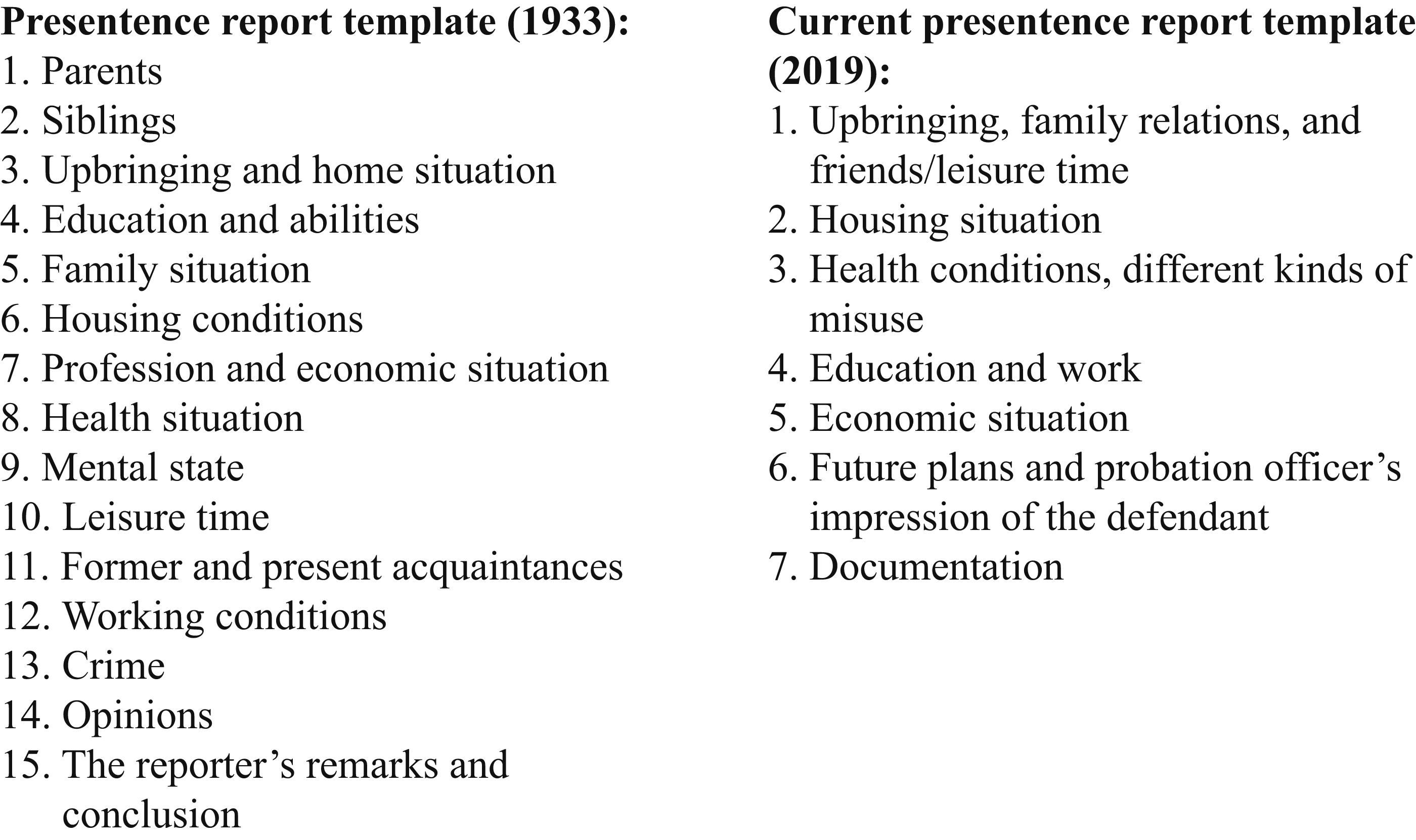
From the beginning, a very broad range of potentially ‘relevant’ knowledge has been gathered to explore the relationship between the defendant’s circumstances and the case. A closer reading of the guidelines for reporters shows a heterogeneous and comprehensive approach from as early as 1933. Ideally, a reporter should take the defendant’s home life into account by visiting their home, presupposing a connection between home conditions and criminality, in addition to looking into internal states of mind, and external factors such as economy and work. The general welfare ideology about reform and normalisation of deviance during this period was therefore just one aspect that was considered at a local level.
The offender’s inner self – The 1950s
Psychotherapy and cognitive programs were introduced as treatment options in Danish prisons during the 1950s. This has meant a gradual change in focus from inherited social and physical dispositions for committing crime and a reorientation toward prioritising the individual’s personal and mental reactions and treatment through targeted interventions (Stürup, 1956). The new focus on offenders’ inner states spurred an even stronger desire to get to know as much as possible about the offender and their background in order to be able to treat the person as fairly as possible (Borch, 2015). This development in the late 1940s and 1950s brought with it a renewed interest in pre-sentence reports, incurring a significant rise in their number as well. Several larger debates among practitioners arose, among them one established by the ‘Socio-political association’ in 1949 entitled ‘pre-sentence reports in criminal cases’ in which defence lawyers, judges and chief inspectors debated the role of information about the offender. The debate was subsequently published and is interesting because the debaters speak from very different positions and institutions within the criminal justice system, providing insights into specific professional and institutional mindsets.
The defence attorneys relate perspectives on education and pedagogy to issues of recovery, resocialisation and inclusion. Defence attorney Knud Frederiksen states that: ‘The legal consequences, i.e. the nature and degree of the criminal sanction – is decided legally on the basis of the offender’s personal and social individuality…If we are to succeed in recovering them - or as the prison order states: “to educate to continued citizenship” - it is crucial to know about the offender’s inner and external life … This is why the study of the person is particularly valuable, along with, well even rather than, the criminal judicial categorization of the offence itself […](Socialpolitisk Forening, 1949: 4-5)’.
5
This defence attorney stresses individual treatment as a prerequisite for reforming the offender, as well as education into civic participation, and a focus on the offender’s inner self and individuality. As Moore (2007) states, the idea of a ‘project of change’ has endured as a stable penal consideration, but the role of the offender’s inner life gained importance during this period.
Chief inspector H. Kudsk replied to defence attorney Knud Frederiksen by pointing out that the police work with the intention of ‘finding the most accurate individual decision’ (Socialpolitisk Forening 1949: 27), and ‘finding the most accurate basis for the verdict’ (Socialpolitisk Forening 1949: 28). He further comments that: As soon as we suspect that the person deviates from the normal in any way, we take action (Socialpolitisk Forening, 1949: 29). […] we should do anything possible to diagnose as precisely as possible in every criminal case (Socialpolitisk Forening 1949: 30).
The ‘most accurate decision’ seems to be this institutional actor’s primary concern, along with ‘individualised decisions’ and ‘precise diagnoses’. This is interesting since these concepts accurately reflect the ‘new’ penological approaches of the 1950s, in particular the ideas of individualisation, diagnosis of deviance and normalisation techniques.
The judges’ professional and institutional position differs somewhat, privileging the importance of their own discretion and ability to read offenders’ character and motives. They also stress that the principle of equality must outweigh the interest in individual offenders’ personal circumstances because of the ‘democratic attitudes in our society’ (Socialpolitisk Forening 1949: 26). Individual considerations thus seem to be at odds with society’s principles of fairness, and uniform implementation of sentences. Similar debates took place in the Danish weekly law reports between 1951 and 1952 (Harbou, 1952; Harne, 1951). The most accurate decision seems to constitute a valid, taken-for-granted and neutral purpose, but debates at the time reflect quite different approaches to offenders and penal decision-making, which may in part be attributed to different institutional interests and professional self-understandings.
The international context in which these local Danish discussions took place shows that the Danish debates were neither unique nor arbitrary. On the contrary, the idea that the offender’s individual circumstances should be taken into consideration when sentencing was spreading in Scandinavia at the time. Sweden had adopted a law on pre-sentence reports as early as 1939, and an UN commission issued a report in 1952 entitled ‘General report from the United Nation’s seminar on probation’. On this basis, The Danish Criminal law commission issued a report on suspended sentences in 1953 in which pre-sentence reports were addressed and general information about the offender was provided, as this excerpt states: Often, the first offence gives rise to more perpetual crime; we cannot know beforehand if this will be the case, but the possibilities for getting to the bottom of the causes of the crime and initiating the best treatment are greater the more data [about the offender] is available (Report 1953: 57).
The report states that the concrete amount of information is paramount for reducing recidivism. The report further emphasises that important information includes background on the offender’s upbringing, education, employment, familial relationships ‘and other issues of importance for an evaluation of their personality’ (Report 1953: 58), serving the purpose of ‘giving a better basis for the sorting and treatment of offenders…’ (ibid.). This entails a specific knowledge production about the defendant in relation to sentencing options.
In summary, the penal positions emerging in around 1950 evidence changes as well as continuities regarding the concepts and language used about defendants and the reasons for their offending.
The documents and debates from this period all emphasise the need for collecting as much personal information as possible about the offender in order to be able to give them individual treatment. This individualisation means that even more facets of the offender are brought into play, and any information learned might potentially become important for sentencing.
Rose (1998) describes how this period’s general societal focus was placed on citizen’s inner wellbeing and/or dysfunctions. Using a therapeutic discourse, actions and behaviours were interpreted as expressions of an inner deviance, and therapy seen as an avenue to help the individual person normalise (Innes, 2003). Although these general tendencies also emerge in my analysis of local practices, the complexity of local (legal) practitioners, reports, etc. is obvious. They make use of arguments about the offender’s inner and external conditions, their normality or deviance, societal values, upbringing, social dispositions, health, etc. This suggests quite a heterogeneous set of views on crime and its prevention, making it difficult to make clear-cut distinctions between different kinds of penal semantics during the 20th century, as these views are also shaped by local practices, institutions and professional interests.
Knowledge about social environments in the 1960s
The link between crime and social factors played a major role in the penal politics of the 1960s, resulting in an increased interest in other aspects of the offender’s life, for instance, external causes such as childhood, employment, economic situation, marital status and social milieu (Borch, 2015). Pre-sentence reports had in fact routinely and continuously gathered this kind of information since the 1930s, but it was only at this point in the sixties that it was elaborated into a scientific discourse about the social reasons for crime. Theories about shifting penal approaches to the offender ‘as subject’ at different time periods should therefore take into account that some kinds of knowledge may actually be available at all times, but only certain aspects of this knowledge will be activated and highlighted within a specific time period (cf. Latour, 1987).
This development in the 1960s meant that focus shifted away from the criminal individual and to the social factors causing crime. The Danish Penal Code of 1930 had placed great emphasis on resocialization, which was reflected in the introduction of special, often indefinite measures entailing that the offenders should remain under these sanctions until they were resocialized. These indefinite sanctions received increasing criticism in the 1960s and 1970s, partly because the sanctions meant that the offender in practice often received a longer sanction than they would have received under a fixed-term sentence, and partly because there was no evidence that these sentences were more effective in preventing recidivism than fixed-term sentences (Balvig, 2003). The existing perception of crime based on the notion of abnormal criminals who ought to receive (indefinite) state treatment was also rejected, and was substituted by a perception of crime as normality. Crime as deviance was thus discursively replaced by a perception of crime as being a ‘normal’ phenomenon, at least in a Danish context (Borch, 2015; Greve, 1972). Since crime was understood as being caused by social problems, crime itself was logically created by society and as such inevitably forms a part of it (ibid.). Alternatives to imprisonment were also discussed in light of this external explanation for crime.
A more nuanced penalty system which multiplied the opportunities for suspended sentences was introduced in 1961 through an amendment of the Danish Criminal Code. The interlinkage between a focus on the social reasons for crime and a significant expansion of the use of suspended sentences also meant that new demand was created for the work of freelance reporters issuing pre-sentence reports. It was explicitly stated that reporters should possess specific skills, such as those mentioned in the report on suspended sentences cited below: ‘General knowledge about societal issues as well as specific knowledge about the prison and probation service is required […] the expanded use of suspended sentences for heavily crime-ridden young offenders and the increasingly complex social factors/conditions that will inform many [pre-sentence] investigations will place considerably higher demands on reporters’ knowledge and other qualifications’. (Report 1960: 35)
This citation expresses some of the marked differences between the guidelines for reporters in the 1930s and the 1960s, when reporters were suddenly assumed to have a more difficult task within an increasingly complex penal and social system. It is therefore explicitly stated that reporters should possess knowledge about societal issues, emphasising the new penological view on the links between crime and society.
Another change consists in the scientific move away from the ‘psy-’ professions and a prioritisation of the social sciences during this period, supported by the concurrent outward switch from a perspective on the offender’s inner states to societal explanations for crime (Borch, 2015). In the same ethos, freelance reporters in the 1960s were often (retired) social workers as opposed to primarily being protestant priests or lawyers. In summation, the 1960s was an era of general development in the perspective on relationships between individual and society that influenced penal policies and perceptions in similar ways, recognising crime as ‘normal’ and its perpetrators therefore not in need of psychiatric treatment (in contrast to former diagnostic approaches to offenders).
Community service and local embeddedness: The 1970s and 1980s
In Denmark, the penal landscape of the 1970s was characterised by debates on alternatives to imprisonment, driven partly by the desire to find less costly alternatives to imprisonment, and partly with a view to increasing levels of care for the individual offender (Borch, 2015; Clausen, 2007). This development was also spurred by a more general, global critique of the rationale behind institutional, coercive penalisation, and in a Danish context, Balvig et al. (1969) contributed by showing that imprisonment did not lead to lower recidivism rates but rather had unintentional stigmatising effects. Following these debates, Denmark introduced an experimental regime for community service in 1982 that was later incorporated into the Criminal Code in 1992. Article 808 in the Civil Procedure Code (governed by the 1916 Administration of Justice Act) was revised, stating in its Subsection 2 that a thorough examination of the accused’s personal circumstances should generally be conducted. This includes, in particular, their past and present conditions at home, school, and work, as well as their physical and mental state. Such an examination is necessary when there is a possibility of imposing a conditional sentence, including with conditions such as community service, a dismissal of charges under conditions other than the acceptance of a fine and payment of compensation, or legal consequences that serve as an alternative to punishment.
Aside from the obvious economic benefits of reducing the prison population, several penal rationales were mentioned in subsequent Reports on community service (1972, 1977), and in debates surrounding the proposition to privilege this approach (e.g. Rentzmann, 1975): community service was regarded as a kind of ‘payback’ to society, while also being somewhat uncomfortable for the offender. On a slightly different, individually preventive note, community service was argued to allow the offender to stay within their usual work and familial contexts, and the local embeddedness of their sanction would have pedagogically positive effects on the offender. Since community service is, by nature, locally embedded in that it is served in local enterprises, etc. that could accommodate offenders, local communities became involved in the execution of sentencing, and this engagement marked a shift in the perception of punishment as being a state issue to a question of local responsibility (Vestergaard, 1990). These different arguments and justifications for community service in the Reports show that this kind of sanction provides possibilities for incorporating very different penal considerations (Borch, 2015).
Community service presupposed a suitability assessment that was delegated to the pre-sentence report and its individual perspective on the offender. In 1984, the Prison and Probation Service issued new guidelines for assessing this suitability, suggesting, among others, that four different ‘kinds’ of pre-sentence reports should be put to use, since defendants being assessed for community service were allegedly less socially disadvantaged than other defendants. The four suggested formats were (1) a ‘full’ investigation in which all questions should be addressed (2) a minor one in which reporters could omit certain issues (3) a community service report, and (4) a supplementary investigation. However, in the final adoption of the law on community service, only one ‘full’ pre-sentence report was recommended, and the format thus remained the same although the guidelines specified how the different subjects should be handled within the well-known format used since 1930 (childhood, family, housing, job, health, leisure time, abuse, etc.). The guidelines in 1984 specified that assessment of suitability for community service should: ‘[…] depend on an overall assessment of the defendant’s personal, familial and social circumstances, comprising present and former crime, and held up against the possibilities for finding a work location. […] Lastly, the defendant’s fitness for and attitude towards performing community service form part of the suitability assessment. The defendant’s intellectual and/or character prerequisites may speak against imposing a community sanction’.
6
The Prison and Probation Service also stated that a core purpose of community service was to exert influence on the offender socially as well as pedagogically. As a result, defendants were increasingly categorised according to their motivation and the possible pedagogical gains from community service in place of other sanctions. The criteria for this suitability must be calculated on the basis of a ‘general assessment’, as stated by the guidelines, but no further explanation of this process was provided at the time or subsequently (Clausen 2007). Freelance reporters must therefore use their own (personal) discretion in order to evaluate the defendant’s ‘character’ and ‘attitude’.
This lack of precision regarding ‘suitability’ was maintained in The Danish criminal law commission comments to the legislative proposal on community service (1991) when addressing the suitability assessment. Here, the commission stated that: ‘The conclusions of the Probation Service regarding suitability must be based on a comprehensive assessment of the defendant's personal and social circumstances. This assessment may include information about prior criminal activity, alcohol abuse, negative factors during previous supervision or imprisonment, and so forth. In some cases, the reporter may be able to determine with a high degree of certainty whether the defendant is suitable or unsuitable for community service. However, in other cases, the assessment may lead to doubt. It is difficult to establish general guidelines for when the investigation should allow doubt to prevail or when it is better to give the conclusion a more positive interpretation, despite some uncertainty’.
The rather vague description on the role of doubt regarding suitability may have contributed to the quite high number of defendants being assessed as suitable for receiving a sentence with community service right from the outset, 72% in 1987 (Rentzmann and Reimann, 1994) and 73% in 2005 (Lagoni and Kyvsgaard 2008).
Although the template of the pre-sentence report thus remained largely unchanged from 1933 onwards, the 1980s saw an increased awareness of the possibility of resocialising the offender, which was interlinked with the development of multiple (sentencing) uses of the report. Whereas pre-sentence reports were essentially used in the 1930s as a means of ‘rough sorting’ defendants into groups eligible and unsuitable for a suspended sentence, this later developed into a fine-tuned and differentiated suitability assessment of the individual offender.
Risk, habits, minds and treatment – The 1990s
Researchers have suggested that a change in motivations for punishing crime occurred in the 1990s, based on complementary, new perceptions of ‘risk’ (e.g. Feeley and Simon, 1992; Garland, 2001). While former perceptions of punishment focused on morals, diagnosis, and treatment, the ‘new’ penal approach identified different criminal risk groups and was based on a neoliberal understanding of the relationship between individual and society (Feeley and Simon, 1992).
While the concept of treatment within the Danish criminal justice system was abandoned in the 1960s, to be placed under the responsibilities of social services instead, it underwent a revival in the late 1980s (Borch, 2015) with the idea that offenders presenting a risk should receive focused treatment (Moore, 2007). Cognitive (skills) programmes were introduced, implementing the penal approach that treatment of the offender could redress a shortcoming in them, rather than criminality being seen as an almost incurable disease, as previously believed. Treatment programmes for anger management, gambling addiction (ludomania), and substance misuse were introduced in prisons and later became conditions of a suspended sentence (to be followed-up on by the probation service). Treatment was based on the offender’s mindset, which freelance reporters as well as staff at the probation service were encouraged to identify (Frandsen, 2010).
Frandsen (2010) describes Danish penal politics in the 1990s as consisting of two opposite tendencies: An increase in imprisonment bordering on ‘mass incarceration’ to ‘contain’ criminals; and a prioritisation of treatment. He characterises Cognitive Skills Programmes as a ‘refined moral educational program aimed at uniformity and control’ (Frandsen, 2010: 126). As a practical result, freelance reporters were required to monitor for many different signs of behaviours requiring treatment (Johansen, 2023). This broad range of treatment options constitutes a ‘social technology’ (cf. Jöhncke et al., 2004), making the pre-sentence report’s function as an increasingly complicated and multifaceted diagnostic technique. In the Canadian context, Moore (2007) describes how new neoliberal politics concerned with effectiveness gradually substituted the former, more holistic idea of treatment with actions much more targeted at specific, criminal elements of the offender: ‘This criminal addict can choose to change. This criminal addict is also not a whole person; rather, he is fractured by actuarial assessments that reduce him to a set of criminogenic factors, which includes his addiction. It follows that this person needs interventions not to make him a better person but only to address that in him which is defined as criminogenic’. (Moore, 2007: 42)
This fragmented treatment of the offender is inspired by neoliberal ideas of responsibility, freedom and self-management. Valverde (2003) similarly refers to this neoliberal development by pointing to the fact that offenders’ lifestyles have become a much greater focus of interest than before, a tendency she connects with a shift in interest from depth psychological perspectives on identity and deviance to more fluid habits or lifestyles: ‘Habits and lifestyles occupy an ontological space that […] is more “on the surface” than “deep down.”’ (Valverde, 2003: 226)
Valverde (2003) argues that the kind of knowledge required to gain an insight into the offender’s lifestyle is more heterogeneous and eclectic, without inscribing itself in a specific epistemology (cf. Rose, 1998). From this perspective, freelance reporters in Denmark at present are perceived to be able to diagnose and describe the defendant in precise detail because of their diverse professional backgrounds and experiences, combining institutional and more general perspectives on offenders’ lifestyles, habits, and misuse behaviours.
Reflections
Referring to my qualitative research on contemporary pre-sentence reports (Johansen, 2015, 2018, 2023), this section discusses the possibilities for explaining some of these practices in light of the historical analysis in the previous sections.
Irrespective of the defendant’s age, their childhood home life, parents’ marital status and social and economic position are always mentioned in the final report that is read out loud in the courtroom prior to sentencing using standard terminology such as ‘born and raised’, ‘born in-marriage’, ‘raised by married parents’, ‘father is a qualified craftsman’, etc. This information is framed according to normative ideas about childhoods and homes through sentences such as ‘a mother who was normally at home’, or ‘an ordered economy’ in the household (Johansen, 2018). At the same time, these phrases expose cases which fall outside the norm as reports may mention if defendants come from ‘a broken home’. The reports seldom elaborate upon the implications of what it means to come from ‘a broken home’ or to be ‘born in-marriage’, thus being premised on a presumed shared sense of what constitutes a normal family life (cf. Field and Nelken, 2010). This practice is in line with the Guidelines for reporters (2002), stating that they should probe into issues like the defendant’s mother’s (changing) boyfriends. While this focus on family life and stable marriages seems to prioritise the past and to establish a very persistent interconnection between family background and crime, other elements of contemporary reports point to recent developments in line with theories about risk society. For instance, the local freelance staff I studied had recently discovered a new treatment paradigm, including treatment for compulsive gambling, and applied it to conversations with defendants whether or not this related to their indictments. This practice is also in line with the Guidelines for reporters (2002), stating that they should probe into defendants’ plans for seeking treatment for misuse.
Many freelance reporters thus seem to focus on the defendant’s ‘criminal situation’, reflecting a contemporary focus on criminogenic needs. This perspective is complemented by a range of other considerations referring back to former foci on the offender’s background and upbringing, that is, a more holistic, biographical consideration. Instead of replacing one another, these different penal perspectives seem to coexist when reporters in my study included the defendant’s entire childhood story built upon quite old-fashioned gender and family stereotypes, on the one hand, and very specific, delimited risk behaviour on the other. This suggests that it is not possible to situate sharply demarcated shifts in penal considerations. International research on pre-sentence reports in Europe and Canada conducted in the past decades, shows that the new tendencies on risk assessment are manifest, but to varying degrees from country to country, and even in countries using ‘risk templates’ in pre-sentence reports, the correctional services include ideas about risk as well as rehabilitative ideas (Field and Nelken, 2010; Wandall, 2010). While England and Wales have introduced strongly risk-focused templates for pre-sentence reports (Field and Nelken, 2010), other countries like Denmark and Italy espouse other penal rationalities described as ‘traditional’ and ‘welfare-based’ (Field and Nelken, 2010; Wandall, 2010). Lynch (1998) also modifies the ‘new’ risk approach by suggesting that while the idea of ‘dangerous criminogenic groups’ is not new, the identification of dangerousness and its management are fluid. However, these approaches do not help us analyse the precise changes and continuities occurring in relation to the role of the offender’s person. Echoing Lawrence (2019) and Corfield (2007), I believe the heterogeneous contemporary practices surrounding pre-sentence reports may additionally be explained by applying a trialectical view of their historical development. This means that continuities, micro changes and radical turning points may coexist. Corfield (2007) states that these dimensions of persistence, momentum, and turbulence operate within a holistic time-space with both synchronic and diachronic properties. Transposed to the present empirical example, this approach may make us more aware of the changes, continuities, and not least their consequences for present-day representations of the criminal as a person. One might argue that important changes have taken place which alter the former, holistic approach to the offender as project of change and give rise to the contemporary, more fragmented risk and needs approach to criminal behaviour. The present-day offender is constituted differently following the rationale of responsibility and self-management rather than being framed by the 1950s ethos of pathological welfare subject in need of therapy. From another perspective, stable patterns have emerged that focus on family life and upbringing as being pivotal in the description of the criminal person. The fact that these shifts and apparent status quos exist side-by-side in contemporary pre-sentence reports may lead us not to simply accept them as poorly conceived or random practices, but to view them as problematic examples of a lack of historical awareness (cf. Yeomans, 2019). Contemporary Danish reports rely on a conception of family life that seems rooted in family roles from the 1950s. Mentioning a ‘broken home’, or that the defendant grew up in ‘a house with a garden’ with ‘a mother who was normally at home’ conveys specific knowledge to the courts about the defendant that may ultimately have significance for sentencing. This kind of information would probably not even be worth mentioning in other Danish contexts, given that almost half of Danish marriages end in divorce at present, and the most people work outside of the home regardless of gender or marital status. Maintaining their importance in a legal setting, therefore, accentuates values that would be outdated elsewhere but which help define the defendant’s ‘personal circumstances’. In this sense, the longitudinal or diachronic study of pre-sentence reports as a phenomenon enables us to see differences and continuities, and the synchronic perspectives to link these changes and continuities to different contemporary values and beliefs. It also helps raise awareness about the heterogeneous and anachronistic construction of the defendant in Denmark today.
Footnotes
Declaration of conflicting interests
The author(s) declared no potential conflicts of interest with respect to the research, authorship, and/or publication of this article.
Funding
The author(s) received no financial support for the research, authorship, and/or publication of this article.
Notes
Author biography
