




Abstract


Introduction:
Indocyanine green may be utilized during robotic ureteral reconstruction to assess ureteral perfusion, identify the ureter during ureterolysis, and delineate stricture margins. We demonstrate the largest series on outcomes using indocyanine green under near-infrared fluorescence during robotic ureteral reconstruction.
Materials and Methods:
We retrospectively reviewed our multi-institutional Collaborative of Reconstructive Robotic Ureteral Surgery database to identify all consecutive patients who underwent robotic ureteral reconstruction using intraureteral or intravenous indocyanine green as an adjunctive technique between 01/2012 and 12/2023. We performed a descriptive analysis of perioperative outcomes in patients who met inclusion criteria. In addition, in our video, we demonstrate four cases in which intravenous or indocyanine green was utilized.
Results:
Overall, 381 patients were included in the analysis (Table 1). Of 381 patients, 215 (56.4%) had undergone prior abdominopelvic surgery, 38 (10.0%) had undergone prior pelvic radiation, and 108 (28.3%) had undergone prior ureteral stricture intervention (either endoscopic or surgical management). The median operative time was 189 (141–257) minutes, and the estimated blood loss was 50 (30–100) milliliters. Overall, 335 (87.9%) patients had surgical success.
Perioperative Data for Indocyanine Green Usage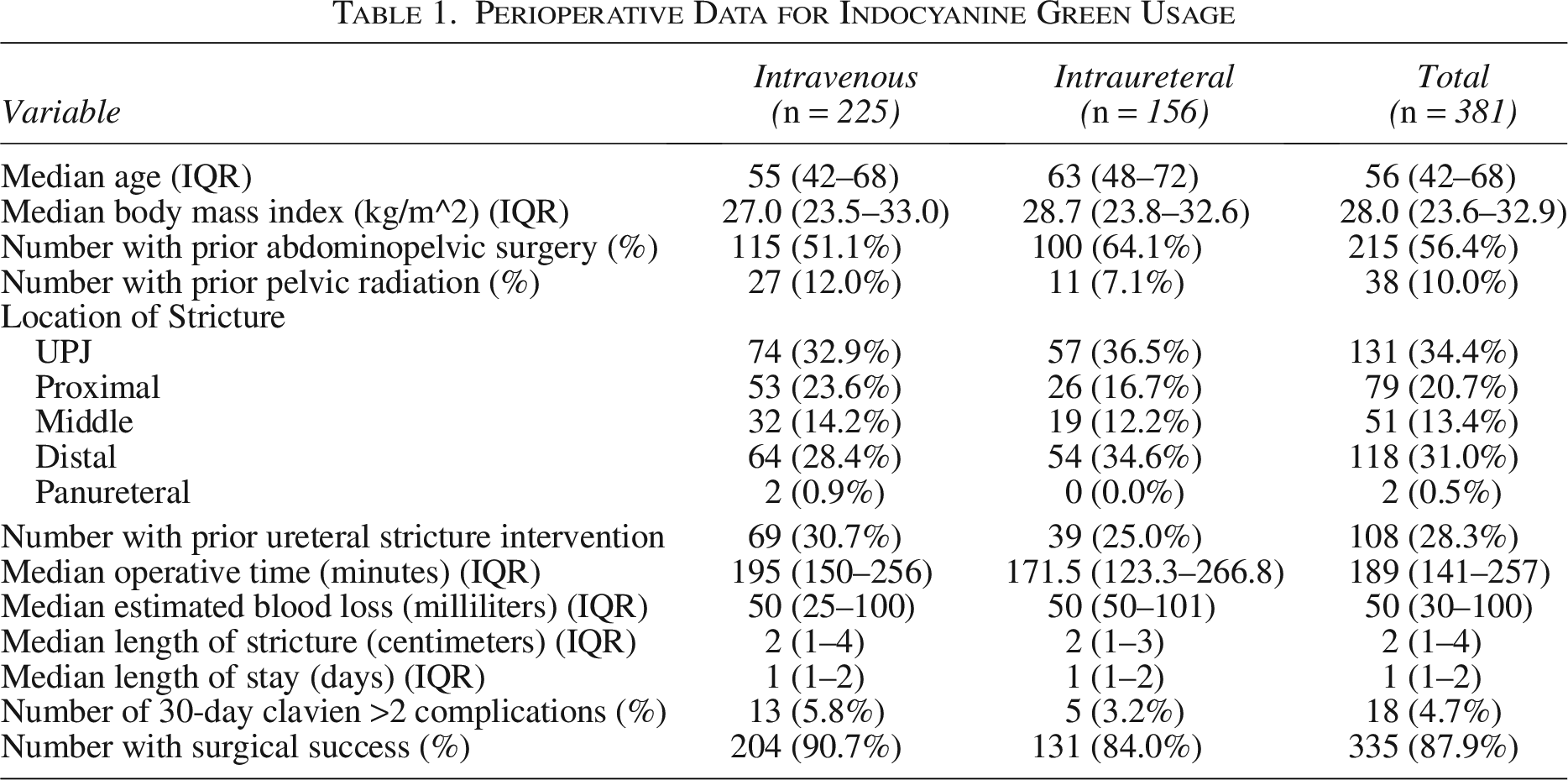
Variable
Intravenous (n = 225)
Intraureteral (n = 156)
Total (n = 381)
Median age (IQR)
55 (42–68)
63 (48–72)
56 (42–68)
Median body mass index (kg/m^2) (IQR)
27.0 (23.5–33.0)
28.7 (23.8–32.6)
28.0 (23.6–32.9)
Number with prior abdominopelvic surgery (%)
115 (51.1%)
100 (64.1%)
215 (56.4%)
Number with prior pelvic radiation (%)
27 (12.0%)
11 (7.1%)
38 (10.0%)
Location of Stricture
UPJ
74 (32.9%)
57 (36.5%)
131 (34.4%)
Proximal
53 (23.6%)
26 (16.7%)
79 (20.7%)
Middle
32 (14.2%)
19 (12.2%)
51 (13.4%)
Distal
64 (28.4%)
54 (34.6%)
118 (31.0%)
Panureteral
2 (0.9%)
0 (0.0%)
2 (0.5%)
Number with prior ureteral stricture intervention
69 (30.7%)
39 (25.0%)
108 (28.3%)
Median operative time (minutes) (IQR)
195 (150–256)
171.5 (123.3–266.8)
189 (141–257)
Median estimated blood loss (milliliters) (IQR)
50 (25–100)
50 (50–101)
50 (30–100)
Median length of stricture (centimeters) (IQR)
2 (1–4)
2 (1–3)
2 (1–4)
Median length of stay (days) (IQR)
1 (1–2)
1 (1–2)
1 (1–2)
Number of 30-day clavien >2 complications (%)
13 (5.8%)
5 (3.2%)
18 (4.7%)
Number with surgical success (%)
204 (90.7%)
131 (84.0%)
335 (87.9%)
Conclusions:
Intraureteral or intravenous indocyanine green may be utilized as an adjunctive technique to aid in robotic ureteral reconstruction. Indocyanine green may be particularly useful in patients with a history of abdominopelvic surgery, ureteral surgery, and/or pelvic radiation due to the increased risk of periureteral fibrosis and scarring, which may impact ureterolysis and ureteral perfusion.
Matthew Lee, Connor McPartland, and Julienne Jeong have no disclosures. Michael Stifelman has served on the advisory board for Intuitive Surgical and as a consultant for Vascular Technology, Incorporated. Lee Zhao has served as a consultant for Intuitive Surgical. Daniel Eun is a paid speaker, consultant, and proctor for Intuitive Surgical, on the medical advisory board for Medtronic, a shareholder of Melzi Corp and has received trainee support from Hitachi Medical.
Authors have received and archived patient consent for video recording/publication in advance of video recording of procedure.
Runtime of video: 5 mins 31 secs.