



Abstract
Phubbing has become a prominent phenomenon in today’s digital landscape, with detrimental effects on relational well-being. Beyond its negative impact on various types of relationships, scholarly interest has been paid to the influence of phubbing on impression formation. Drawing on the Stereotype Content Model, which highlights the roles of warmth and competence in social perception and evaluation, this study examined how phubbing affects these dimensions and subsequently influences social attractiveness, likability, and interaction intentions. Two experiments were conducted. Study 1 found that phubbing significantly reduced perceptions of warmth and competence, which led to lower social attractiveness, likability, and interaction intentions. Serial mediation analysis confirmed the mediating roles of warmth, competence, and social attractiveness. In Study 2, moderated mediation analyses demonstrated that contextual information significantly moderated these effects. These findings offer important theoretical and practical implications by clarifying the psychological mechanisms through which phubbing harms social evaluations and undermines relational well-being.
Introduction
Widespread mobile technologies raise concerns about the impact of online connectedness on offline relationships. Phubbing, the act of ignoring present interaction partners in favor of mobile phone activities, 1 negatively impacts conversation quality, 2 violates relational norms in romantic relationships and diminishes relationship satisfaction, 3 harms parent — child relationships by affecting child self-esteem and increasing problematic phone use,4–6 and creates feelings of social exclusion that lead to conflict and negative emotions.4,7,8 Although the negative effects of phubbing on phubbees (those who are phubbed and ignored by others) have been studied extensively, there is limited evidence regarding its impact on the phubbers (those who phub others) themselves. Although phubbees are often viewed as the primary victims of phubbing, phubbers are not immune to its negative repercussions. Pesch et al. found that phubbers are perceived as less trustworthy and are evaluated as less polite compared with individuals who refrain from using mobile phones. 9 Cameron and Webster suggested that work mentors who phub are perceived as disrespectful. 10 Building on this, our study examined the impact of phubbing on interpersonal evaluations of phubbers. Drawing from the Stereotype Content Model (SCM), 11 we investigated how phubbing affects perceptions of warmth and competence and, subsequently, evaluations regarding social attractiveness, likability, and interaction intentions toward phubbers (Study 1). As identical behaviors can be interpreted differently depending on contextual factors, we further explored the effects of contextual information (Study 2).
Study 1
According to SCM, individuals perceive others based on warmth (associated with a person’s intentions) and competence (related to a person’s ability to achieve these intentions).11,12 Individuals evaluated as high in warmth are perceived as sincere and friendly, whereas those evaluated as high in competence are seen as capable and intelligent. 13 Evidence shows the impact of warmth and competence judgments on impression formation and social evaluations, suggesting that these two dimensions shape a person’s perceptions and influence emotions felt toward the person and behavioral tendencies to either approach or avoid them.12,14
We examined how phubbing shapes perceptions of warmth and competence toward phubbers and how these perceptions subsequently affect social attractiveness, likability, and interaction intentions. In dyadic relationship contexts, focusing on one’s mobile phone and ignoring the partner may negatively influence warmth perception, as they show the phubber is disengaged, leading to decreased feelings of closeness and friendliness.15,16 While attention, active listening, and response with care and empathy by partners foster interpersonal closeness and intimacy, 17 phubbing behaviors hinder this development or at least signal the unavailability of meaningful interactions. Moreover, phubbing may negatively affect competence perceptions, which could be interpreted as lacking appropriate skills. Because phubbing is often regarded as impolite and inappropriate, 3 phubbers are likely to be perceived as less skillful and competent. Núñez et al. 18 suggested that phubbing lowers perceptions of warmth and competence in both men and women, as individuals tend to assume that phubbers maintain poor-quality relationships. Building on this, we expect phubbing to negatively impact perceptions of warmth and competence.
Furthermore, phubbing likely decreases social attractiveness, likability, and interaction intentions owing to negative perceptions of warmth and competence. Social attractiveness refers to how friendly and desirable someone appears as a group member, 19 focusing on socioemotional appeal rather than physical appearance. Prior research shows that warmth and competence are the two fundamental dimensions of person perception, and individuals high on both are generally preferred as social relationship partners. 20 Phubbers, whose behavior is often seen as unfriendly and socially inappropriate,3,18 are therefore likely to be judged low on warmth and competence, which would reduce their social attractiveness. Lower social attractiveness, in turn, diminishes likability and willingness to interact, as people are more inclined to engage with those perceived as socially attractive and capable of offering high-quality relationships.21,22 Empirical evidence supports the positive effects of social attractiveness on likability and behavioral intentions.19,20 Accordingly, this study proposes the following hypotheses (see Figure 1 for proposed model):

Proposed model.
H1. Phubbing reduces perceptions of (a) warmth, (b) competence, (c) social attractiveness, (d) likability, and (e) interaction intentions.
H2. Warmth, competence, and social attractiveness mediate the impact of phubbing on (a) likability and (b) interaction intentions.
Study 1 method
Study 1 examined how phubbing behavior affects evaluations of warmth and competence, subsequently shaping perceptions of social attractiveness, likability, and intention to interact. An online experiment was conducted using a stimulus depicting a dyadic interaction without specifying the relationship. To account for any potential effects of the phubber’s sex, we conducted a 3 (Phubber: male vs. female vs. no phubber (control); between-subjects) × 2 (Character: male vs. female; within-subjects) mixed-participants experiment. We recruited 105 participants from an online community affiliated with a major university in South Korea (Mage = 25.05, SDage = 5.22). The sample comprised 70.5 percent females. The sample size was determined based on prior studies on phubbing3,18 and the results of a post hoc sensitivity analysis using G*Power 23 indicated that the sample size was sufficient to detect a small-to-medium effect size. 24
Based on prior studies that manipulated phubbing using videos and images,2,18 the stimuli consisted of six photographs depicting a male and a female character meeting, walking into a café, ordering coffee, and engaging in a conversation. To enhance ecological validity, the sequence was designed to represent a typical social interaction situation in a café setting. Among six photographs, phubbing was manipulated in three photographs: the male and female phubbing conditions involved the male and female characters, respectively, using their phone during the interaction, and in the no-phubbing condition, neither character used the phone (See appendix for stimuli). The other elements in the photographs were kept consistent across the conditions. After providing informed consent, participants viewed a series of photographs and completed a questionnaire measuring perceived warmth, competence, social attractiveness, likability, and interaction intentions toward both the male and female characters. Perceptions of warmth and competence were measured using a semantic differential scale. 25 Social attractiveness, 26 likability, 27 and interaction intention 28 were measured using seven-point Likert scales (1 = strongly disagree, 7 = strongly agree).
Study 1 results
We conducted a series of 3 (Phubber: male vs. female vs. no-phubber (control)) × 2 (Character) repeated-measures analyses of covariance (ANCOVAs), including participants’ sex as a covariate. While the main effects of character were not significant (ps > 0.05), the main effects of phubbing were significant for all dependent variables (warmth: F(2, 101) = 59.08, p < 0.001; competence: F(2, 101) = 53.06, p < 0.001; social attractiveness: F(2, 101) = 24.70, p < 0.001; likability: F(2, 101) = 38.83, p < 0.001; and interaction intention: F(2, 101) = 24.71, p < 0.001). The interaction effects of phubbing and character were significant for all dependent variables (warmth: [F(2, 101) = 148.44, p < 0.001], competence: [F(2, 101) = 44.62, p < 0.001], social attractiveness: [F(2, 101) = 122.04, p < 0.001], likability: [F(2, 101) = 136.95, p < 0.001], and interaction intention: [F(2, 101) = 93.26, p < 0.001]). Specifically, the results of pairwise comparisons showed that in both the male- and female-phubbing conditions, the phubbing character was evaluated significantly lower in warmth, competence, social attractiveness, likability, and interaction intention than the non-phubbing character (all ps < 0.001). In contrast, in the control condition, no significant differences emerged between the evaluations of the male and female characters (all ps > 0.05; see Figure 2 for detailed comparisons). Thus, the results supported H1.

Results of pairwise comparisons (Study 1).
By using Model 80 of the SPSS PROCESS macro, 29 the serial mediation model was tested by comparing the no-phubbing condition with the male and female phubbing conditions separately. When comparing the male phubbing condition to the no-phubbing condition, phubbing was negatively associated with perceptions of the male character’s warmth and competence, which subsequently positively affected social attractiveness, influencing likability and interaction intentions. The indirect paths, including warmth and competence, were all significant. In contrast, a different pattern was observed for the female character—the impact of competence on social attractiveness was not significant, resulting in nonsignificant indirect paths through competence. Apart from that, the indirect paths through warmth were significant, consistent with the results for the male character. Thus, H2 was partially supported (Table 1).
Results of the Serial Mediation Models (Study 1)

LLCI, 5000 bootstrapped 95 percent lower-level confidence interval; M1, parallel mediator 1 (warmth); M2, parallel mediator 2 (competence); M3, serial mediator (social attractiveness); ULCI, 5000 bootstrapped 95 percent upper-level confidence interval; Y1, dependent variable 1 (likability); Y2, dependent variable 2 (interaction intention); X1, phubbing (male vs. no phubbing); X2, phubbing (female vs. no phubbing); ***p < 0.001.
Study 2
Study 2 examined the potential moderating effect of the context in which phubbers use mobile phones instead of fully attending to their interaction partners. Previous studies investigating the contextual factors that moderate individuals’ responses to phubbing found that providing an important reason for phubbing led to significantly more positive evaluations toward the phubber and higher perceived relationship quality compared with phubbing without an explanation. 30 In addition, individuals who phubbed for trivial reasons experienced stronger feelings of exclusion and partner distraction than those who phubbed for important reasons. 31 Moreover, from an agentic viewpoint, proactive phone users are perceived as less polite and attentive than reactive phone users. 3 In addition, proactive phone use decreases conversational quality. 32 These findings can be explained through intentionality in the social allergen theory, which suggests that seemingly minor but irritating behaviors, such as phubbing, elicit stronger negative responses when perceived as intentional or deliberate rather than unintentional or habitual. 33
Individuals’ perceptions of phubbers may be influenced by the contextual information provided. Although Study 1 found that phubbing negatively affected perceptions of warmth and competence, this relationship may vary if individuals are informed that the phubber uses their mobile phone for work- or social-related purposes. Work-related phubbing may be perceived as more acceptable than social-related phubbing because work-related phone use is viewed as less intentional and more unavoidable. In addition, phubbing can be considered a form of multitasking involving simultaneously managing social relationships and professional activities. 34 Therefore, work-related phubbing may be viewed as balancing personal and professional demands, which could positively influence interpersonal evaluations. Thus, the following research question was posed:
RQ1. Will the context of phubbing affect the impact of phubbing on perceptions of warmth, competence, social attractiveness, likability, and interaction intention?
Study 2 method
Study 2 examined how contextual information about phubbing behavior affects interpersonal evaluations. We conducted a 3 (Context: work-related vs. social-related vs. no-context) × 2 (Phubber: male vs. female) × 2 (Characters) mixed-participants experiment. The phubber’s gender was included as a factor to explore potential differences in evaluations of male and female phubbers because Study 1 revealed inconsistent indirect effects between male and female characters, suggesting possible gender-related variation in evaluations toward phubbers. Moreover, from the perspective of SCM, greater warmth is expected from women and greater competence from men.12,35 Such gender biases in warmth and competence perceptions warrant exploration of whether phubbing shapes evaluations toward male and female phubbers in different ways. In addition, the literature on phubbing suggests that phubbing occurs more frequently among women than among men,8,36 which might lead to different effects of phubbing on perceptions toward male versus female phubbers. In light of these considerations, we treated phubber gender as a between-subjects factor to explore whether evaluations of male and female phubbers differ. Based on the recommended sample size calculated using G*Power analysis (effect size f = 0.25, α = 0.05, power (1−β) = 0.90), 23 218 participants (Mage = 25.15, SDage = 7.09) were recruited from an online community in South Korea. The sample included 65.1 percent females.
The stimuli included the same photographs used in Study 1. In addition, scenarios describing the phubbing context were developed by modifying those used in previous studies.31,32 In the work-related phubbing condition, participants were informed that the phubber was using a mobile phone to send documents in response to a work-related request from a manager. In the social-related phubbing condition, participants were informed that the phubber was using a mobile phone to respond to a friend’s message and make plans for a weekend meet-up. Considering the evidence of the moderating impact of proactive phubbing, 3 the activeness level was controlled by describing both types of phubbing as reactive, wherein the phubbers used their mobile phones to respond to others’ messages. No contextual information was provided in the no-context condition. Once informed consent was obtained, participants viewed the stimuli, including the context and phubbing manipulations, and completed a questionnaire measuring perceived warmth, competence, social attractiveness, likability, and interaction intention toward both the male and female characters. The same items from Study 1 were used in Study 2 to measure the mediators and dependent variables.
Study 2 results
A series of 3 × 2 × 2 repeated-measures ANCOVAs were conducted on warmth, competence, social attractiveness, likability, and interaction intention, including participants’ sex as a covariate. The results showed significant main effects of context for all dependent variables (all p < 0.05). The ratings were significantly higher in the work-related phubbing context than when no contextual information was provided. The three-way interaction effects of context, phubbing, and character were significant for all dependent variables (warmth: F(2, 211) = 7.21, p < 0.001; competence: F(2, 211) = 4.53, p < 0.05; social attractiveness: F(2, 211) = 6.46, p < 0.01; likability: F(2, 211) = 3.52, p < 0.05; and interaction intention: F(2, 211) = 4.62, p < 0.05).
The results of pairwise comparisons revealed that, for the male phubbing condition, the ratings for the male character (i.e., the phubbing character) differed significantly across contexts, whereas those for the nonphubbing character did not. Specifically, work-related phubbing, compared to phubbing without contextual information, led to significantly higher ratings on all measures (all ps < 0.05), except for competence, which did not differ across contexts (all ps > 0.05). The ratings in the social-related condition were not significantly different from those in the no-context or work-related phubbing conditions (all ps > 0.05). For the female phubbing condition, the ratings of competence, social attractiveness, and interaction intention in the work-related phubbing condition were significantly higher than those in the no-context condition (all ps < 0.05), whereas the ratings in the social-related phubbing condition were not significantly different from those in the no-context or work-related phubbing conditions (all ps > 0.05). Moreover, when the female character phubbed, warmth and likability ratings were significantly higher in both the work- and social-related conditions than in the no-context condition (all ps < 0.05). Differences in warmth and likability between the work- and social-related conditions were not significant (all ps > 0.05; see Figure 3 for detailed comparisons).
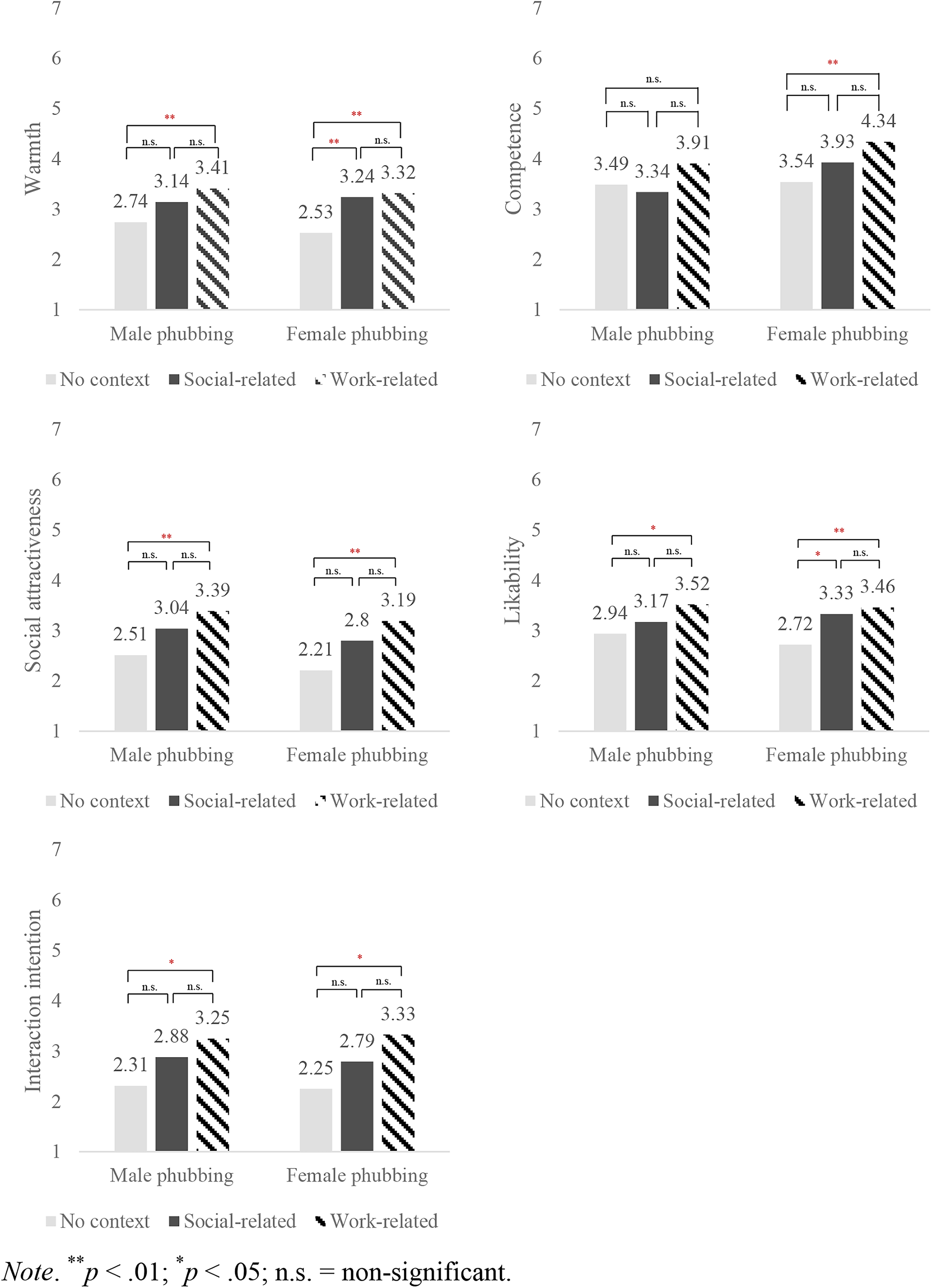
Results of pairwise comparisons (Study 2).
The moderated mediation model with serial mediators was analyzed using Model 83 of the SPSS PROCESS macro. 29 In the model, context was entered as an independent variable and phubbing as a moderator. Context was treated as a multi-categorical variable with three conditions and analyzed by comparing the no-context condition with the social- (X1) and work-related phubbing conditions (X2). For the male character, the interaction effect of context and phubbing was significant on warmth but not on competence. Particularly, when the male character phubbed, both the work- and social-related phubbing conditions, compared with the no-context condition, led to a higher warmth perception. Warmth positively affected social attractiveness, thereby enhancing likability and interaction intention. The indirect effects of the context through warmth and social attractiveness were significant for likability and interaction intentions in the male phubbing condition, not in the female phubbing condition. The indices of moderated mediation were significant for both likability and interaction intention (Table 2).
Results of the Moderated Mediation Models for the Male Phubbing Condition (Study 2)

LLCI, 5000 bootstrapped 95 percent lower-level confidence interval; M1, parallel mediator 1 (warmth); M2, parallel mediator 2 (competence); M3, serial mediator (social attractiveness); ULCI, 5000 bootstrapped 95 percent upper-level confidence interval; X1, context (social-related vs. no-context); X2, context (work-related vs. no-context); Y1, dependent variable 1 (likability); Y2, dependent variable 2 (interaction intention); *p < 0.05, ***p < 0.001.
For the female character, the interaction effect of context and phubbing was significant for both warmth and competence. Particularly, in the female phubbing condition, both work- and social-related phubbing, compared with no-context phubbing, led to higher perceptions of warmth and competence. Warmth and competence positively affected social attractiveness, enhancing likability and interaction intention. The indirect effects of context through warmth and social attractiveness were significant for likability and interaction intention, except for the path of context (×1) → competence → social attractiveness → likability. The indices of moderated mediation were significant for likability and interaction intention, both when warmth and competence were included as a mediator (Table 3).
Results of the Moderated Mediation Models for the Female Phubbing Condition (Study 2)

LLCI, 5000 bootstrapped 95 percent lower-level confidence interval; M1, parallel mediator 1 (warmth); M2, parallel mediator 2 (competence); M3, serial mediator (social attractiveness); ULCI, 5000 bootstrapped 95 percent upper-level confidence interval; X1, context (social-related vs. no-context); X2, context (work-related vs. no-context); Y1, dependent variable 1 (likability); Y2, dependent variable 2 (interaction intention); *p < 0.05, **p < 0.01, ***p < 0.001.
Discussion
Study 1 results indicated that phubbing behavior harmed participants’ perceptions of warmth and competence. This makes the phubber seem like a less attractive social partner, thereby lowering perceived likability and interaction intention. These findings align with Abeele et al., 3 who demonstrated that phubbers are perceived as less attentive and polite. By extending previous studies,3,18 the findings suggest that phubbing behaviors may harm individuals’ impression and potentially obstruct their social well-being by making them less desirable social relationship partners. More specifically, this study contributes to the literature by demonstrating the mediating roles of warmth and competence. Building on prior studies that have identified decreased perceptions of warmth and competence as consequences of phubbing, 37 the results of this study empirically demonstrated that phubbing reduces evaluations of warmth and competence, which in turn decrease social attractiveness, thereby negatively affecting liking and interaction intention. This serial mediation model is consistent with the SCM and the BIAS map, which posit that warmth and competence perceptions shape both affective and behavioral responses. 14 The models suggest that targets low in warmth and competence tend to yield negative emotions, which may lead to avoidant behaviors in social interactions, such as distancing and rejecting. 12 By demonstrating that phubbing reduces likability and interaction intention through lowered warmth and competence, this study provided a theoretical explanation of the interpersonal consequences of phubbing from the lens of SCM and extends the application of the model to inappropriate forms of mobile phone use in social interactions. Furthermore, the results provided a more nuanced understanding of the consequences of phubbing. Specifically, Studies 1 and 2 revealed the mediating role of competence as weaker than that of warmth because several indirect paths were not significant. This pattern suggests that phubbing is more strongly associated with perceptions of warmth in social interactions, which reflect intentions for meaningful relationships, whereas it is only loosely connected to competence perceptions of ability and intelligence.
The results of Study 2 further provide a nuanced understanding of how contextual information moderates the effects of phubbing on impressions. Providing work-related reasons for the phubber’s mobile phone use led to higher warmth, competence, and social attractiveness perceptions than when no contextual information was provided. The results showed that social-related phubbing was more detrimental to impression formation than work-related phubbing. This supports previous research showing that disclosing the reason for phubbing can effectively mitigate its negative consequences.31,34 Individuals consider the reasons phubbers engage with their phones, and this contextual information serves as a reference point for evaluating the phubbers’ warmth, competence, and social attractiveness, which ultimately affect likability and willingness to interact with the phubbers. This finding also aligns with the previous studies suggesting that negative responses to phubbing are moderated by the importance of the cause of phubbing.31,38 This is because the phubbing behavior in response to work-related requests may be viewed as relatively important and unavoidable, weakening the impression that the phubber intentionally ignores the interaction partner.
Interestingly, the findings captured the potential gender bias in the evaluation of phubbers. For example, the results of Study 2 showed that competence ratings were not affected by phubbing context for the male phubber. Moreover, social-related phubbing led to significantly higher warmth perceptions than no-context phubbing for the female phubber, whereas this effect was not observed for the male phubber. Although the results should be interpreted cautiously, they may indicate that gender associations persist.11,14 Given that the adverse effects of phubbing have been explained by the lens of expectancy violation theory,39,40 gender biases in warmth and competence might have affected the perceptions of misalignment (i.e., the sense that phubbing behavior violates relational norms).41,42 These findings offer valuable insights for future research on how gender dynamics interact with phubbing behavior in shaping impression formation.
Understanding that phubbing reduces perceptions of warmth and competence, it is advisable to avoid phubbing in situations where such perceptions are critical. For example, individuals should exercise caution regarding mobile phone use in professional settings, where both perceptions of warmth and competence critically influence career outcomes. Moreover, previous studies suggest strong associations among social media addiction, fear of missing out (FOMO), and phubbing behavior.43–45 Excessive mobile phone use may negatively affect how such individuals with high FOMO and social media addiction are evaluated in face-to-face interactions, ultimately damaging their social impressions.
This study has certain limitations. We examined phubbing only within interactions between opposite-sex dyads; however, responses may differ in same-sex interactions. The negative effects of phubbing are attenuated when the phubbee is of the same sex, 3 suggesting the need for future research. Another limitation relates to the use of photographs as stimuli. We did not provide an explicit textual description of phubbing, as doing so might have primed participants and biased their evaluations. However, with photo-based stimuli, the behavior could have been interpreted in alternative ways, potentially limiting manipulation validity. Future studies should employ more realistic stimuli (e.g., videos) or in-person experimental settings to strengthen validity. Moreover, this study investigated the phubbing context effects by comparing work- and social-related contexts, given their relevance to the warmth and competence dimensions. To further explore the observed effect, future research could examine diverse work- or social-related contexts in which phubbers’ behaviors can be more or less rationalized, thereby affecting their impressions toward them. Also, we framed phone use as reactive (i.e., responding to others’ messages) across both contexts to hold perceived intentionality constant. This may have made the situations appear similarly unavoidable, thereby reducing differences between work- and social-related phubbing. Future research should manipulate context (work vs. social) and intentionality (proactive vs. reactive) independently to clarify their joint effects.
In addition, the participants in this study were relatively young, overlapping with Generation Z. Given a recent meta-analysis confirming a small but negative relationship between age and phubbing, 46 future research should employ more age-diverse samples to enhance generalizability and to examine whether age further moderates the impact of phubbing on interpersonal evaluations. Also, we did not measure participants’ own mobile phone use (e.g., problematic use), which may shape perceptions of and responses to phubbing; future studies should consider such individual differences.
Footnotes
Author Disclosure Statement
The authors declared no potential conflicts of interest with respect to the research, authorship, and/or publication of this article.
Funding Information
No funding was received for this article.