




Abstract
Extending previous research on creative AI to the context of AI advertising, the present study examined whether creativity in AI advertising could evoke perceptions of uncanniness and consequently have a negative impact on ad outcomes. Based on a two (ad creativity: low vs. high) by two (creator label: human vs. AI) between-subjects experimental design, the present study showed that ad creativity in general had a positive direct impact on attitude toward the ad (Aad), attitude toward the brand (Ab), and purchase intentions. In addition, there were significant mediation effects of perceived creativity on Aad and Ab via perceived uncanniness, which was moderated by creator label. For the AI-creator-labeled condition, perceived creativity had negative indirect effects on Aad and Ab via perceived uncanniness, such that greater perceived creativity led to greater perceived uncanniness, which in turn induced less favorable Aad and Ab. However, the mediation effect was not found for the human-creator-labeled condition. Thus, the positive effect of ad creativity was smaller for the AI-creator-labeled ad.
Introduction
AI technologies have changed the advertising landscape, significantly affecting advertising creation as well as placement processes.1–3 For example, the script for Lexus’s “Driven by Intuition” ad was created by AI. 4 In addition, for Coca-Cola’s “Masterpiece” ad, AI was used to visualize the transformation of the masterpiece. 5 Given the wide use of AI for advertising creation, it is important to revisit ad creativity in the context of AI advertising.
Ad creativity in AI advertising can signal AI’s human likeness, which is generally valued in creative AI. Previous research showed that high anthropomorphism induces more positive responses to creative AI.6,7 However, the uncanny valley of mind literature presents a somewhat different perspective. 8 The literature suggests that high human likeness (i.e., when machines have mental capacities comparable to humans) can evoke negative responses. Given the contrasting predictions, the effects of human likeness need further scholarly attention.
As an attempt to examine the effects of human likeness in the context of advertising, the present study focuses on the role of ad creativity in AI advertising. Ad creativity generally leads to positive responses, such as positive ad attitudes. 9 However, considering that highly creative AI advertising could signal mental capacities of AI and human likeness, the positive effects of ad creativity could decrease for AI advertising. In light of these ideas, the present study examines whether ad creativity has negative indirect effects via raising uncanniness perceptions for AI-creator-labeled advertising, but not for human-creator-labeled advertising. The present study contributes to the literature on creative AI and the uncanny valley of the mind by examining the role of human likeness, and can provide practical insights regarding the appropriate level of ad creativity in AI advertising.
Literature Review
The core components of ad creativity are divergence (i.e., originality or unexpectedness)10,11 and relevance (i.e., meaningfulness or appropriateness).12–14 Previous research has shown that ad creativity could induce favorable cognitive and/or attitudinal responses.9,15 However, the effect of ad creativity might vary by who generated the ad (human vs. AI). Ad creativity can signal mind perceptions, which include agency perception and experience perception. Agency perceptions are perceptions about an entity’s capacities for thinking and planning, whereas experience perceptions concern perceptions regarding capacities to feel emotions. 16 Highly creative ads can activate perceptions that the ad creator has high capacities to think and feel.
High creativity is beneficial for human-creator-labeled advertising because it is expected that advertising practitioners would have creative minds. However, the positive effect of ad creativity might be smaller for AI-creator-labeled advertising due to perceived uncanniness. The uncanny valley of mind suggests that when the mental capacities of an entity reach those of a human, people feel uncanniness. 8 Thus, the perception that machines have an ability to think or feel could raise uncanniness perceptions.8,17,18 In fact, Stein and Ohler 8 found that when study participants were told that the behaviors of digital characters were autonomous (vs. scripted), participants reported greater feelings of eeriness. In addition, Yam and colleagues 18 showed that dehumanizing humanoid robots (by depriving robots of the capacity to feel) reduced uncanniness.
In addition, the relationship between high perceived creativity and uncanniness could also be explained based on the model of autonomous technology threat.
19
The model suggests that autonomous technology poses threats to the uniqueness of human beings, and that human uniqueness concerns could affect aversion to autonomous technology (e.g., high eeriness and low attractiveness). Considering that creativity has been viewed as humans’ unique ability, high perceived creativity can pose threats to human uniqueness and consequently leads to high eeriness and uncanniness. Finally, perceived uncanniness, raised by high creativity, could induce negative ad responses. Wu and Wen
20
showed that perceived eeriness was negatively related to appreciation of AI-created advertisements. Thus, in light of the aforementioned ideas, the present study suggests that ad creativity will have negative indirect effects on ad outcomes via perceived uncanniness for AI-creator-labeled advertising but not for human-creator-labeled advertising. Ad creativity will induce more favorable ad outcomes (attitude toward the ad [Aad], attitude toward the brand [Ab], and purchase intentions [PI]). There will be a moderated mediation relationship. Ad creativity will have negative indirect effects on ad outcomes (Aad, Ab, and PI) by raising perceived uncanniness, and the indirect effects will be moderated by creator label (human vs. AI). Specifically, the negative indirect effects will be found for AI-creator-labeled ad, but not for human-creator-labeled ad.
Methods
Overview
This study used a two (ad creativity: low vs. high) by two (creator label: human vs. AI) between-subjects experimental design. The experiment was conducted online, and study participants were recruited by Macromill Embrain, which maintains an online panel of more than one million individuals. 400 Korean adults completed the study, and 21 participants were excluded because they reported that they had been previously exposed to the experimental stimuli. Thus, the data from 379 participants were analyzed using SPSS 29.0 (H1) as well as the PROCESS macro 21 for SPSS for moderated mediation analyses (H2). PROCESS, which provides a regression-based path analysis, is a popular and user-friendly analysis tool for moderated mediation analyses. 22
Participants’ age ranged from 20 to 71 (M = 40.01, SD = 11.90), and 50.9 percent of the participants were female. There were no significant differences in age (F[3, 375] = 0.09, p = 0.97) and gender (χ2 = 0.42, p = 0.94) across the four experimental groups, and thus, randomization was successful.
Experimental stimuli and measures
The present study created experimental ads for a hypothetical dental floss brand (Dental Pro) to control for prior perceptions about existing brands. Dental floss was selected based on a pilot test, which examined product involvement and ad perceptions. We created two experimental ads that varied in terms of creativity (i.e., high vs. low). Adobe Firefly, a generative AI tool, was used to create visuals used in the experimental ads. The high- and low-creativity ads were carefully designed to maximize comparability and avoid confounding. Creative ideas for the high-creativity ad were obtained from an existing Colgate ad, which visualizes excellent flossing capability by showing a seedless kiwi fruit. Descriptions for high- and low-creativity ads are presented in Table 1. Prior to the main study, we conducted a pretest with 42 Korean college students and found that the high- (M = 11.8, SD = 4.00) and low-creativity ads (M = 8.5, SD = 4.42) were perceived as intended (t = 2.61, p < 0.05).
Experimental Stimuli
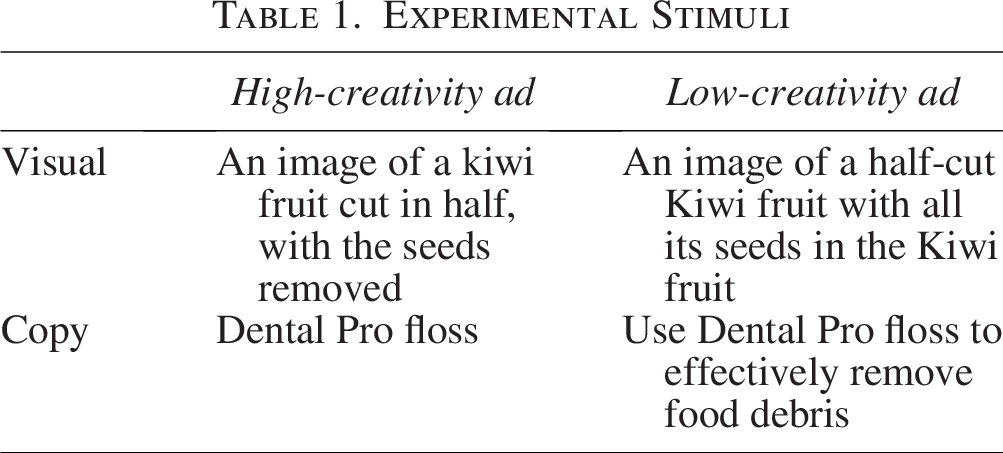
Creator label conditions were manipulated by providing information that the ad was created by human (for the human-creator-labeled condition) or AI (for the AI-creator-labeled condition) prior to participants’ exposure to the stimuli ad. Measures for ad creativity, perceived uncanniness, Aad, Ab, and PI are reported in Table 2.
Measures
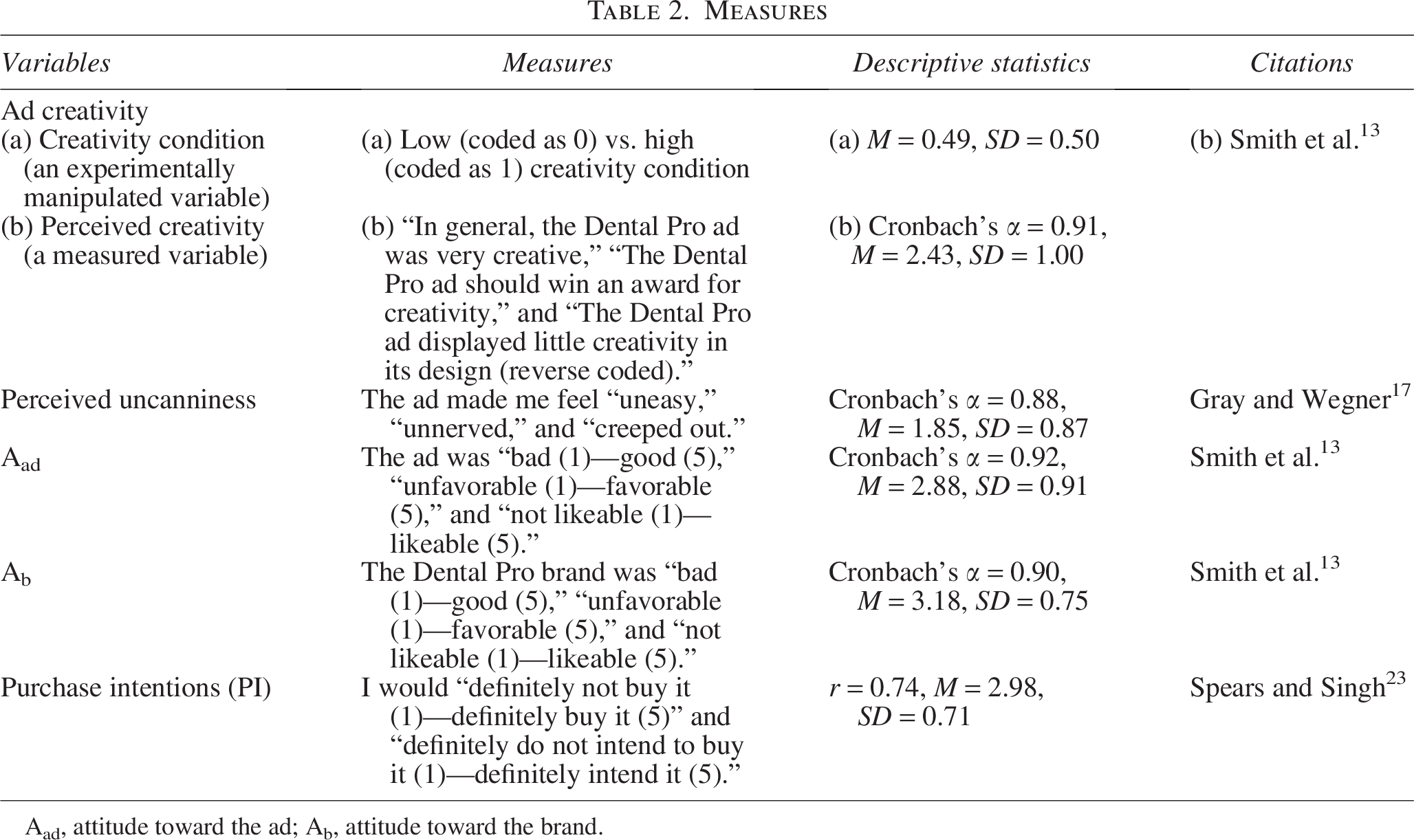
Aad, attitude toward the ad; Ab, attitude toward the brand.
Results
Manipulation check
Respondents evaluated that the high-creativity ad (M = 10.79, SD = 4.88) was more creative than the low-creativity ad (M = 7.86, SD = 4.94) on a 20-point scale 13 (t = −5.80, p < 0.001). In addition, those in the AI-creator-labeled condition (M = 3.99, SD = 0.98) were more likely to believe that the ad was created by AI (t = −13.43, p < 0.001) compared with those in the human-creator-labeled condition (M = 2.45, SD = 1.24). Thus, manipulations were successful.
Hypotheses testing
H1 predicted that ad creativity, which was operationalized as (a) creativity condition and (b) perceived creativity, would induce more favorable Aad, Ab, and PI. Regarding creativity condition, results of t tests showed that those in the high (vs. low) creativity condition reported more favorable Aad (t = 4.31, p < 0.001, Cohen’s d = 0.44, high M = 3.09, SD = 0.92; low M = 2.69, SD = 0.87), Ab (t = 3.18, p < 0.001, Cohen’s d = 0.33, high M = 3.31, SD = 0.78; low M = 3.06, SD = 0.70), and PI (t = 2.76, p < 0.01, Cohen’s d = 0.28, high M = 3.09, SD = 0.72; low M = 2.89, SD = 0.69). For perceived creativity, perceived creativity had positive correlations with Aad (r = 0.64, Cohen’s d = 1.67, p < 0.001), Ab (r = 0.55, Cohen’s d = 1.32, p < 0.001), and PI (r = 0.51, Cohen’s d = 1.19, p < 0.001). Thus, H1 was supported.
H2 hypothesized that ad creativity would have negative indirect effects on ad outcomes (Aad, Ab, and PI) by raising perceived uncanniness, and the mediation effects would be moderated by creator label. We analyzed this model using the PROCESS macro model 8 (see Figure 1). 21 When ad creativity was operationalized as creativity condition, there were no significant moderated mediations. However, when ad creativity was operationalized as perceived creativity, creator label moderated the mediation effects of perceived creativity on Aad and Ab, but not on PI (see Table 3). More specifically, the negative indirect effect of perceived creativity on Aad and Ab via perceived uncanniness was found for AI-creator-labeled ad but not for human-creator-labeled ad (see Table 4). These results suggest that the positive effect of perceived creativity is less likely for AI-creator-labeled advertising (and more likely for human-creator-labeled advertising) because highly creative AI ads increase perceived uneasiness (Figure 2) and subsequently induce negative Aad and Ab. The discrepancy between the results for creativity condition and perceived creativity indicates that it is not the creativity condition but perceived creativity that leads to perceived uncanniness and subsequent negative responses. This is because creativity perceptions regarding an ad could differ across individuals. Thus, H2 was partially supported.
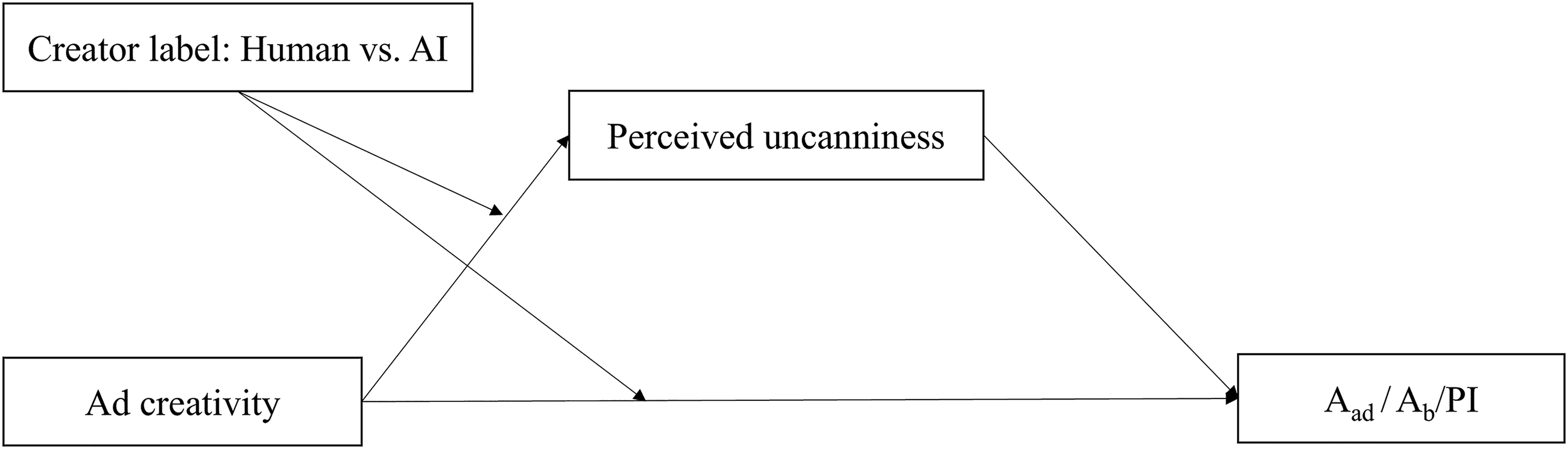
Study model.
Index of Partial Moderated Mediation

95 Percent CI in parentheses.
Indirect Effects of Ad Creativity via Perceived Uncanniness: The Moderating Role of Creator Label
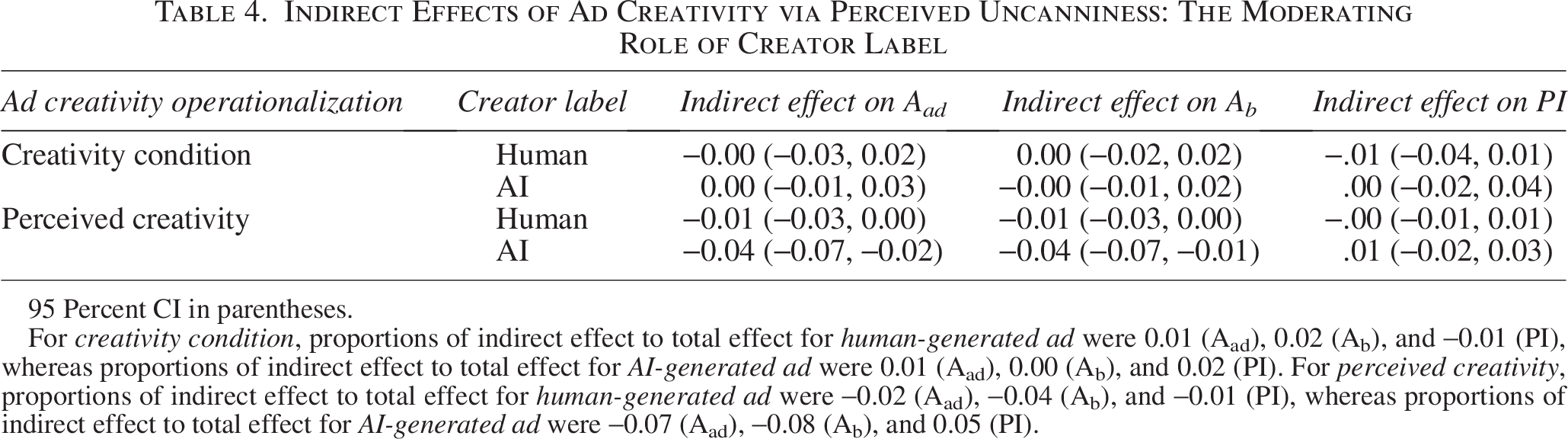
95 Percent CI in parentheses.
For creativity condition, proportions of indirect effect to total effect for human-generated ad were 0.01 (Aad), 0.02 (Ab), and −0.01 (PI), whereas proportions of indirect effect to total effect for AI-generated ad were 0.01 (Aad), 0.00 (Ab), and 0.02 (PI). For perceived creativity, proportions of indirect effect to total effect for human-generated ad were −0.02 (Aad), −0.04 (Ab), and −0.01 (PI), whereas proportions of indirect effect to total effect for AI-generated ad were −0.07 (Aad), −0.08 (Ab), and 0.05 (PI).
Discussion
This study showed that human likeness and ad creativity could have negative indirect effects by raising perceived uncanniness, which has often been overlooked in previous AI research. Although previous research on creative AI showed positive effects of human likeness,6–7 the present study showed that human likeness can have negative effects. Then, the next question would be when human likeness induces positive and negative responses. By connecting the uncanny valley of mind and the model of autonomous technology threat, it can be argued that the effects of human likeness may depend on the extent to which human likeness activates concerns related to human uniqueness and subsequent threat perceptions. Future research can further examine AI characteristics and individual differences for which human likeness is more likely to induce human uniqueness concerns and subsequent threat perceptions.
With regard to the effects of AI ad creativity, To and colleagues (Study 3) recently showed that the positive effect of ad creativity is more pronounced for AI advertising because high creativity signals high perceived effort of advertiser. 24 In contrast, the present study showed that the positive effect of ad creativity is less pronounced for AI advertising because high creativity can signal mind perceptions. These results suggest that creativity of AI advertising could affect ad responses via multiple routes. Thus, identifying the processes through which creativity of AI advertising exerts its effects would be an important research agenda for future research.
From a practical perspective, the results of this study suggest that ad practitioners need to carefully adjust the level of ad creativity when designing advertising campaigns so that the campaigns are considered as creative yet not threatening. On a related note, mind perceptions might be activated and perceived as more threatening when AI is used to aid advertising idea generation (vs. advertising production) and when experience (vs. agency) perceptions 16 are involved. Thus, the use of AI in advertising could be more acceptable when AI is used to facilitate advertising production, and the target ad does not address emotional aspects.
The present study has limitations. The scope of this investigation was limited to a single product category, a hypothetical brand, and a specific cultural context. To generalize these findings, subsequent research must replicate the study across a wider range of cultural settings, utilize diverse product categories, and incorporate brands with varying levels of familiarity. In addition, our focus was limited to the effect of the AI label applied to the same content, rather than comparing different content outputs from AI and human creators. Future research could further examine the effect of the AI labeling and the effect of AI content generation.
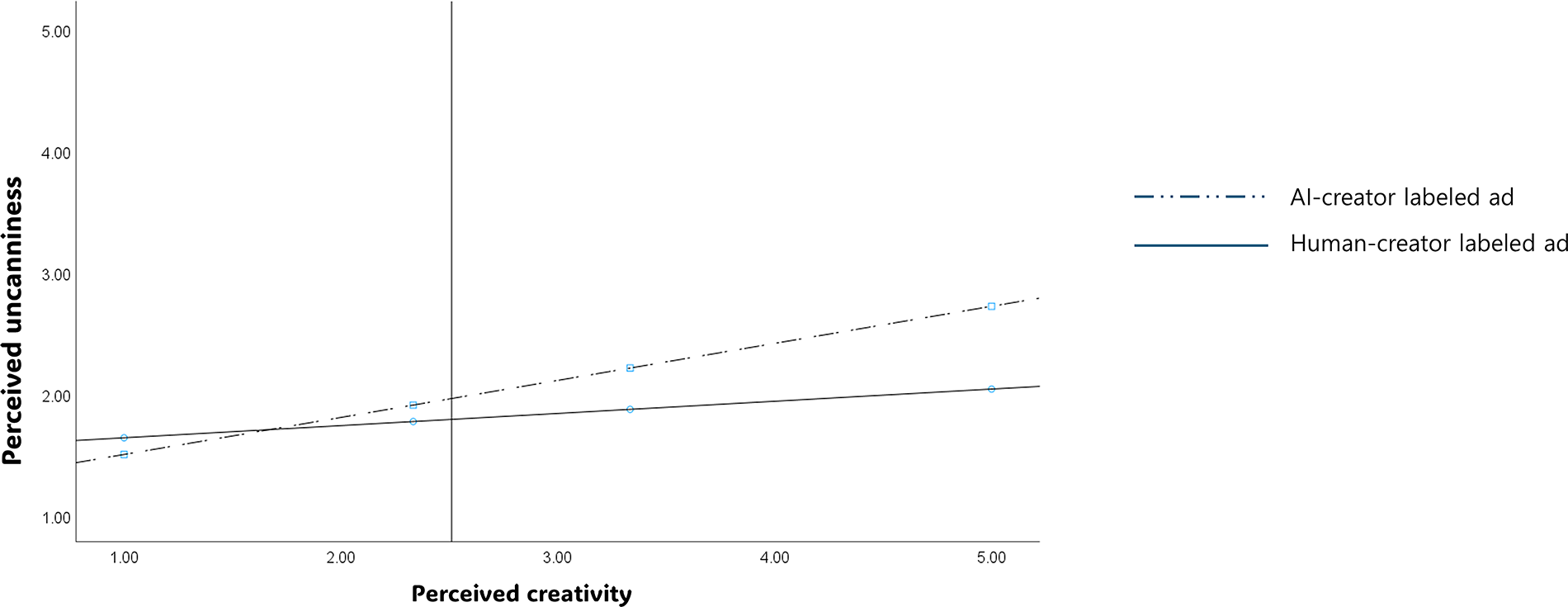
Johnson–Neyman plot for the conditional relation between perceived creativity and perceived uncanniness as a function of creator label. The vertical line represents the boundary of the region of significance (perceived creativity = 2.51).
Authors’ Contributions
Y.H.: Conceptualization, methodology, data curation, and writing. S.-H.J.: Writing, funding acquisition, and project administration.
Footnotes
Author Disclosure Statement
There are no conflicts of interest to disclose.
Funding Information
This research was funded by the College of Media and Communication at Korea University.