



Abstract
Avatar-based communication in virtual worlds offers a crucial space for online social support. Such support can be facilitated through avatar customization. However, most platforms, designed primarily for entertainment and attracting numerous users, have not fully examined the relationship between avatar customization and social support. This study provides an integrated explanation of the interplay among avatar customization, avatar identification, and online social support and proposes a practical approach for enhancing user well-being. Drawing on data from a two-wave longitudinal survey with a 9-month interval, conducted among Japanese users of three major avatar communication services (Second Life, ZEPETO, and Pigg Party), we analyzed the longitudinal relationships between these factors. A cross-lagged panel analysis revealed a positive feedback loop wherein avatar identification and perceived online social support mutually and positively reinforce each other over time. More frequent avatar customization at Wave 1 predicted higher avatar identification at Wave 2, suggesting that customization can serve as an upstream starting point for this feedback loop. Avatar identification and perceived online social support were positively associated with subsequent user satisfaction on most metrics. In addition, mediation analyses indicated significant indirect effects of avatar customization on perceived online social support and user satisfaction via avatar identification. By demonstrating how these concepts work together, our findings provide a practical strategy for service providers. By encouraging avatar customization—a measure that aligns naturally with platform operations, such as item releases and events—companies can initiate a positive feedback loop between avatar identification and online social support. This can enhance user well-being by increasing social support while potentially supporting platform success via higher user satisfaction, creating a win-win scenario.
Keywords
Introduction
Communication via avatars in virtual worlds enables rich nonverbal and emotional expressions while maintaining user anonymity. 1 The anonymity of online communication facilitates safe self-disclosure, thereby mitigating the risk of rejecting confided secrets and worries.2–4 Furthermore, the rich expressions enabled by avatars facilitate effective online social support,5–8 wherein self-disclosure is essential. Therefore, online avatar communication can compensate for the lack of social resources in real life.6,8–11
However, widely used avatar communication services are generally positioned and designed as entertainment-oriented platforms that aim to attract large users, for example, by enabling fun conversations and avatar dressing, rather than explicitly framing themselves as venues for self-disclosure and social support. As a result, directly foregrounding sensitive personal topics or therapeutic support in such services may not align with their existing world-building and brand image, and may risk being perceived as awkward or intrusive by some users. Consequently, service providers have tended to focus on operational measures such as engagement and monetization. In this study, therefore, we focus on an indirect route to enhancing online social support that can be realistically leveraged through provider-friendly operational practices in avatar communication services.
People are unconsciously influenced by their avatars via the Proteus effect.11–14 This study focused on the influence of avatars on communication to promote social support because providers of avatar communication services can naturally intervene in avatar customization; for example, by regularly releasing new avatar parts or holding dress-up events, such as Halloween.
This study provides an integrated explanation of the relationships among avatar customization, avatar identification, and online social support, building on existing empirical evidence. Based on these findings, we propose practical implications for enhancing social support for avatar communication services.
To test our model, we collected and analyzed data using a longitudinal study. 15 A longitudinal study is a research method that surveys the same subjects at different points in time to examine how earlier states predict later states. This allows us to assess temporal ordering and cross-lagged associations between variables, which is informative about potential causal processes, although definitive causal inference remains limited in observational data.
Avatar identification refers to the extent to which users experience their avatar as reflecting their own appearance, personality, and wishes, and the extent to which they feel embodied in or merged with their avatar. 16
Avatar identification increases as users customize their avatars to reflect themselves.14,16–18 Customizing one’s avatar can therefore be viewed as an upstream, user-driven behavior that strengthens the psychological bond with the avatar. Accordingly, we first hypothesize: The higher the frequency of avatar customization, the higher the avatar identification.
In virtual worlds, higher avatar identification has been linked to reduced social anxiety, 11 greater social participation, 19 a stronger sense of belonging, 14 and facilitated communication 20 and self-disclosure.14,21 Therefore, avatar identification promotes social behaviors; as a result, it can increase online social support.
Several processes may explain why avatar identification leads to greater perceived online social support. First, when users strongly identify with their avatars, the avatar becomes an “extended self” for self-expression in the virtual environment. 22 Such identification can facilitate communication and avatar-driven self-disclosure, partly because avatar-based interaction maintains anonymity while enabling rich nonverbal/emotional expression.1,5–8,14,19–21 Second, identification can increase interpersonal approach behaviors via self-representation processes (e.g., the Proteus effect), thereby increasing opportunities for supportive exchanges with online friends.12,13 Because online social support in avatar spaces is closely tied to communication and self-disclosure,5–8 these processes together suggest a pathway from identification to higher perceived support.8,10,23
Perceived online social support may strengthen avatar identification, plausibly via belongingness and social presence processes. When users experience frequent, supportive interactions with others in an avatar-based environment, they are more likely to feel connected to and embedded in the online group, thereby increasing their sense of belonging. Importantly, belongingness is not only a social outcome but also a psychological condition that can deepen the embodied bond with one’s avatar: a previous study 16 reported that a stronger sense of belonging to an online group was associated with greater embodiment, a core facet of avatar identification. Social interactions and social support in gaming contexts can enhance social presence and, in turn, increase avatar identification. 24 Consistent with these accounts, prior work has also shown that avatar identification increases as online spaces become more social. 25 Together, these findings suggest a plausible pathway from supportive social experiences to stronger avatar identification, particularly via increased belongingness and heightened social presence within the virtual community.
Therefore, this study proposes and tests the following hypotheses: High avatar identification increases online social support. Online social support increases avatar identification.
High levels of avatar identification promote engagement and longer play times in virtual worlds.17,18,25–27 Furthermore, the perception of high online social support in the virtual world suggests a positive experience within the world.
8
Therefore, we hypothesize that an increase in avatar identification and online social support will improve user satisfaction with services that provide virtual worlds as follows: High avatar identification and online social support increase user satisfaction with the service.
Overall, our model assumes that avatar customization serves as an upstream behavior that enhances avatar identification (H1), which then enters into a reciprocal relationship with perceived online social support (H2 and H3); in turn, both identification and support are expected to promote user satisfaction with the service (H4). Figure 1 illustrates the relationships among H1–H4. In this framework, “avatar customization” refers to users’ behaviors of modifying their avatars, “avatar identification” reflects a psychological state capturing how users perceive and relate to their avatars, and “perceived online social support” represents users’ subjective perception that they receive emotional and/or instrumental support from others in their online social relationships. Accordingly, we conceptualize avatar customization as an upstream behavior that contributes to the formation of avatar identification, and we hypothesize that avatar identification influences users’ social experiences, including perceived online social support. These hypotheses further imply that avatar customization may enhance perceived online social support indirectly via avatar identification and that avatar customization may be linked to higher user satisfaction through indirect pathways involving avatar identification and perceived online social support. Therefore, we also examine these indirect effects in addition to testing the direct hypotheses. To understand the shared features of avatar communication services, we surveyed users of three avatar communication services with distinct avatar appearances and worldviews: Second Life, ZEPETO, and Pigg Party.

Relationships among the four hypotheses tested in this study. H, hypothesis.
Data and Methods
Avatar communication services
We investigated user behavior across three major avatar communication services: Second Life, ZEPETO, and Pigg Party (Figure 2). All three platforms allow individuals to create personalized avatars, explore virtual spaces, and interact via chat. However, they diverge in terms of avatar appearance, worldviews, history, and culture. These services have also been the subject of numerous studies on human behavior in the metaverse.

Screenshots of avatar communication services (Image sources: Second Life: https://community.secondlife.com/blogs/entry/14709-season’s-greetings-from-linden-lab/, ZEPETO: https://x.com/zepeto_official/status/1617327573234589698, and Pigg Party 28 ).
Second Life, a pioneering metaverse service by the U.S. company Linden Research, Inc., has been in operation since 2003. Known for its realistic 3D avatars, it currently sustains ∼500,000 monthly active users.a Japanese users accounted for 1.3% of the population in 2007,b and the platform has been a frequent subject of academic inquiry.5,6,29–31
ZEPETO, launched in 2018 by South Korea’s Naver Z Corp., has a massive user base of 20 million active users per month.c Its visual style is an intermediate between realistic and cartoonish, and an estimated 5–10% of its users are Japanese.d This concept has recently attracted significant scholarly attention.32–36
Pigg Party is a social avatar community service launched in Japan by CyberAgent Inc. in 2015. It features stylized 2D avatars and has been reported to have at least 550,000 active users over a 6-month period. 28 This platform was investigated in online communities and for users’ mental health.8–10,23,37,38
Participants
This study used a two-wave longitudinal survey design. Data were collected in two phases: the first (March 5–11, 2024) and second (December 2–12, 2024) waves, resulting in an ∼9-month interval between waves. Participants aged 18 years or older were recruited through a panel of Japanese residents operated by Cross Marketing, Inc. The survey was conducted among the Japanese and targeted Japanese-speaking individuals living in Japan.
The survey procedure was as follows: In the first wave, we screened individuals based on their use of three avatar communication services: Second Life, ZEPETO, and Pigg Party. Those who confirmed the use of at least one service were advanced to the main survey. Each qualified participant was then randomly assigned to one of their utilized services and asked to report on that specific platform to ensure that each person reported only one service.
In the second wave, the original cohort of participants was recontacted and asked to complete the survey. The demographic characteristics and the numbers of first-wave and final-sample participants, categorized by assigned service, are detailed in Table 1.
The Number of Participants, Their Demographic Information, and Attrition Rates
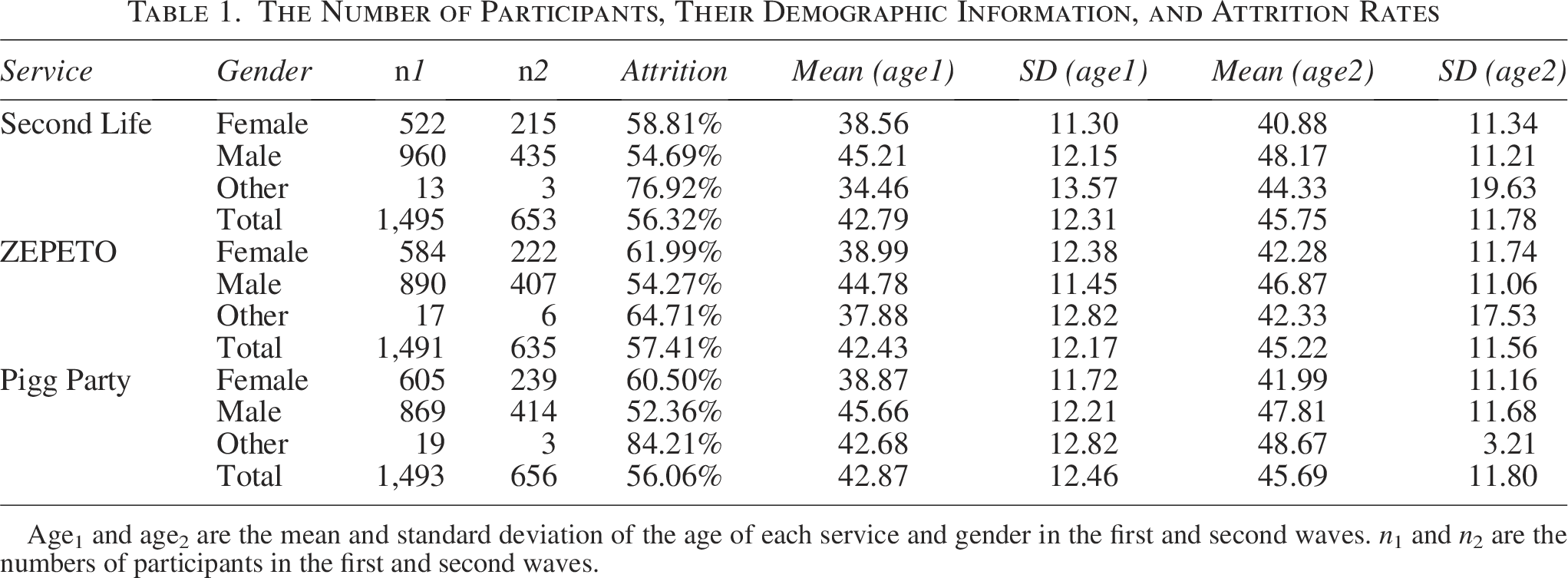
Age1 and age2 are the mean and standard deviation of the age of each service and gender in the first and second waves. n1 and n2 are the numbers of participants in the first and second waves.
In total, 4,479 participants completed Wave 1 (female: 38.20%; male: 60.71%; other: 1.09%) and 1,944 completed Wave 2 (female: 34.77%; male: 64.61%; other: 0.62%), corresponding to an overall attrition rate of 56.60%. In Wave 1, the numbers of respondents (and gender distributions) were 1,495 for Second Life (female: 34.92%; male: 64.21%; other: 0.87%), 1,491 for ZEPETO (female: 39.17%; male: 59.69%; other: 1.14%), and 1,493 for Pigg Party (female: 40.52%; male: 58.21%; other: 1.27%). In Wave 2, the corresponding numbers were 653 for Second Life (female: 32.93%; male: 66.62%; other: 0.46%), 635 for ZEPETO (female: 34.96%; male: 64.04%; other: 0.94%), and 656 for Pigg Party (female: 36.43%; male: 63.11%; other: 0.46%). Thus, attrition rates were ∼56–57% across services. To assess potential attrition bias, we compared Wave 1 baseline characteristics between participants who completed both waves and those who dropped out after Wave 1 (Table 2). Dropouts had lower Wave 1 levels of avatar identification, perceived online social support, and satisfaction metrics (Net Promoter Score [NPS]/Customer Satisfaction [CSAT]/Continuance Intention [CI]), had higher Wave 1 levels of avatar customization, were younger, and had a lower proportion of female participants. In contrast, usage frequency and in-app purchase (IAP) did not differ significantly.
Comparison of Wave 1 Baseline Characteristics Between Participants Who Completed Wave 1 Only (Wave 2 Dropout) and Those Who Completed Both Wave 1 and Wave 2 (Waves 1 and 2 Completer)
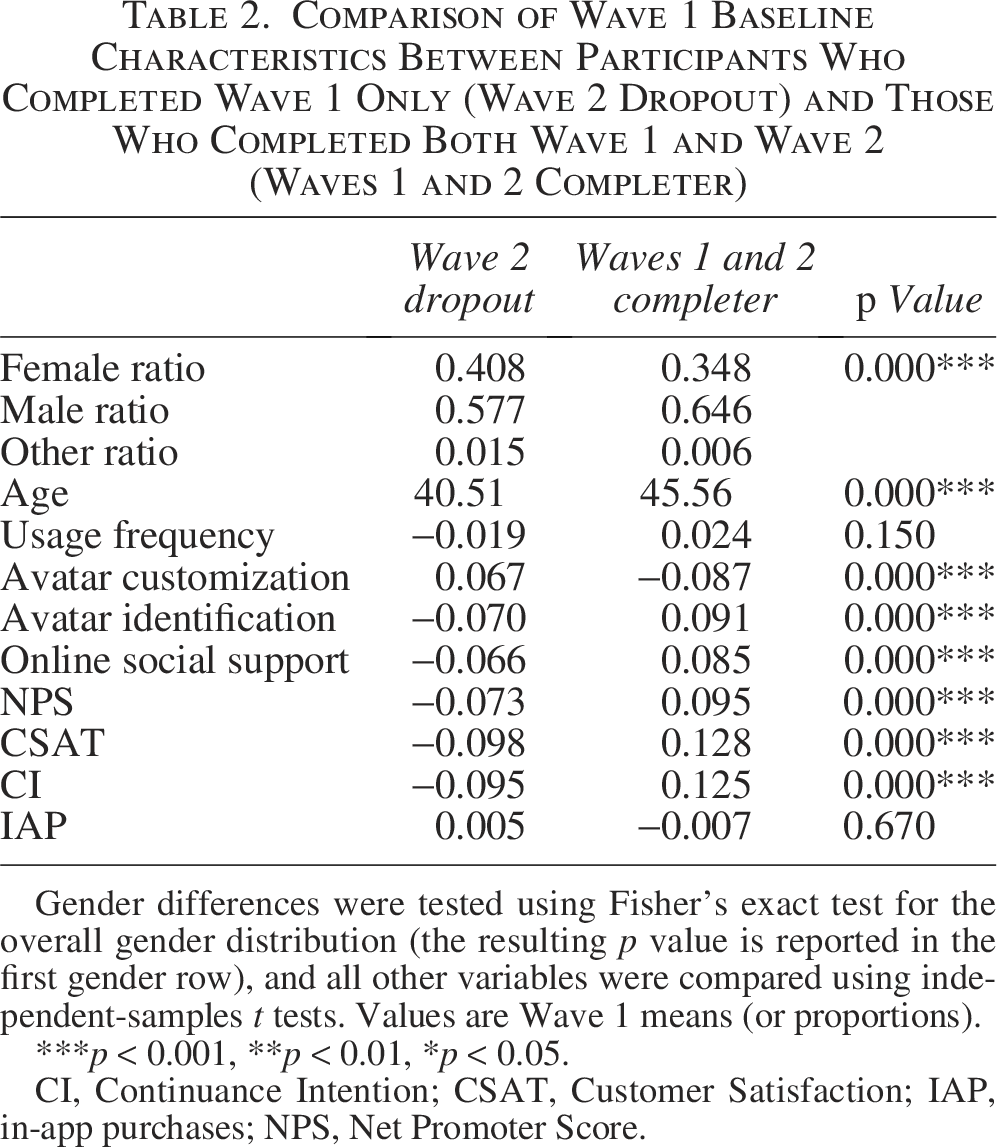
Gender differences were tested using Fisher’s exact test for the overall gender distribution (the resulting p value is reported in the first gender row), and all other variables were compared using independent-samples t tests. Values are Wave 1 means (or proportions).
***p < 0.001, **p < 0.01, *p < 0.05.
CI, Continuance Intention; CSAT, Customer Satisfaction; IAP, in-app purchases; NPS, Net Promoter Score.
All analyses in this study were conducted using the longitudinal panel sample consisting of participants who completed both waves.
Measures
Avatar identification
We measured three types of avatar identification: similarity identification, embodied identification, and wishful identification. 16 We used the Japanese version of this scale in a previous study. 11 This scale was translated from the original English items 16 into Japanese by a previous study, 11 and two Japanese psychologists and one Japanese computer scientist backtranslated the questionnaire. Typical question items for each identification were “My avatar is similar to me” (similarity), “In [the service], it is as if I became one with my avatar” (embodied), and “I would like to resemble my avatar more” (wishful), where [the service] was the specific platform that the participant was reporting on.
We conducted confirmatory factor analysis using the maximum likelihood estimation of this scale. Cronbach’s
Perceived online social support
To measure online social support, we used the perceived emotional and instrumental support from online friends using established scales “Japanese version of social support scale” developed by Fukuoka and Hashimoto.
40
Because of the high correlations between support types, as in41,42 and according to a previous study,10,23 we performed PCA for each source to avoid multicollinearity and used the first principal component (overall support strength) in the analyses. Cronbach’s
Avatar customization
The participants provided their avatar customization frequency for the specific service they reported according to six levels: almost every day, 4–5 days per week, 2–3 days per week, 1 day per week, 2–3 days per month, and 1 day per month.
User satisfaction
We measure four metrics commonly used in marketing as indicators of user satisfaction with a service: NPS, CSAT, CI, and IAP. NPS, CSAT, and CI were assessed using a unified 5-point Likert scale ranging from 1 (“Strongly disagree”) to 5 (“Strongly agree”), with participants indicating their agreement with each statement about the avatar communication service they reported. Although NPS is often operationalized as an 11-point scale in industry settings, we adopted a 5-point agreement scale to maintain consistency across the attitudinal satisfaction measures and to facilitate integration into the structural equation modeling (SEM) framework.
IAP was measured separately as a self-reported spending category rather than an attitudinal rating. Participants reported their average monthly in-app spending on the target service using an 8-point ordinal scale: 0 JPY; 1–1,000 JPY; 1,001–5,000 JPY; 5,001–10,000 JPY; 10,001–30,000 JPY; 30,001–50,000 JPY; 50,001–100,000 JPY; and >100,000 JPY. Higher scores indicate greater spending.
Control variables
The participants provided their demographic information (gender [female, male, or other], age (18 years or older), usage service (Second Life, ZEPETO, or Pigg Party), and usage frequencies (six levels, as with avatar customization). These variables were included as covariates in all longitudinal models to adjust for demographic and platform-specific differences.
Analysis framework
We tested each hypothesis based on a cross-lagged panel model 15 using longitudinal data. A schematic of the approach is shown in Figure 3. This approach explains variation in each dependent variable at Wave 2 by its own prior level at Wave 1 while also accounting for the influence of other Wave 1 variables.
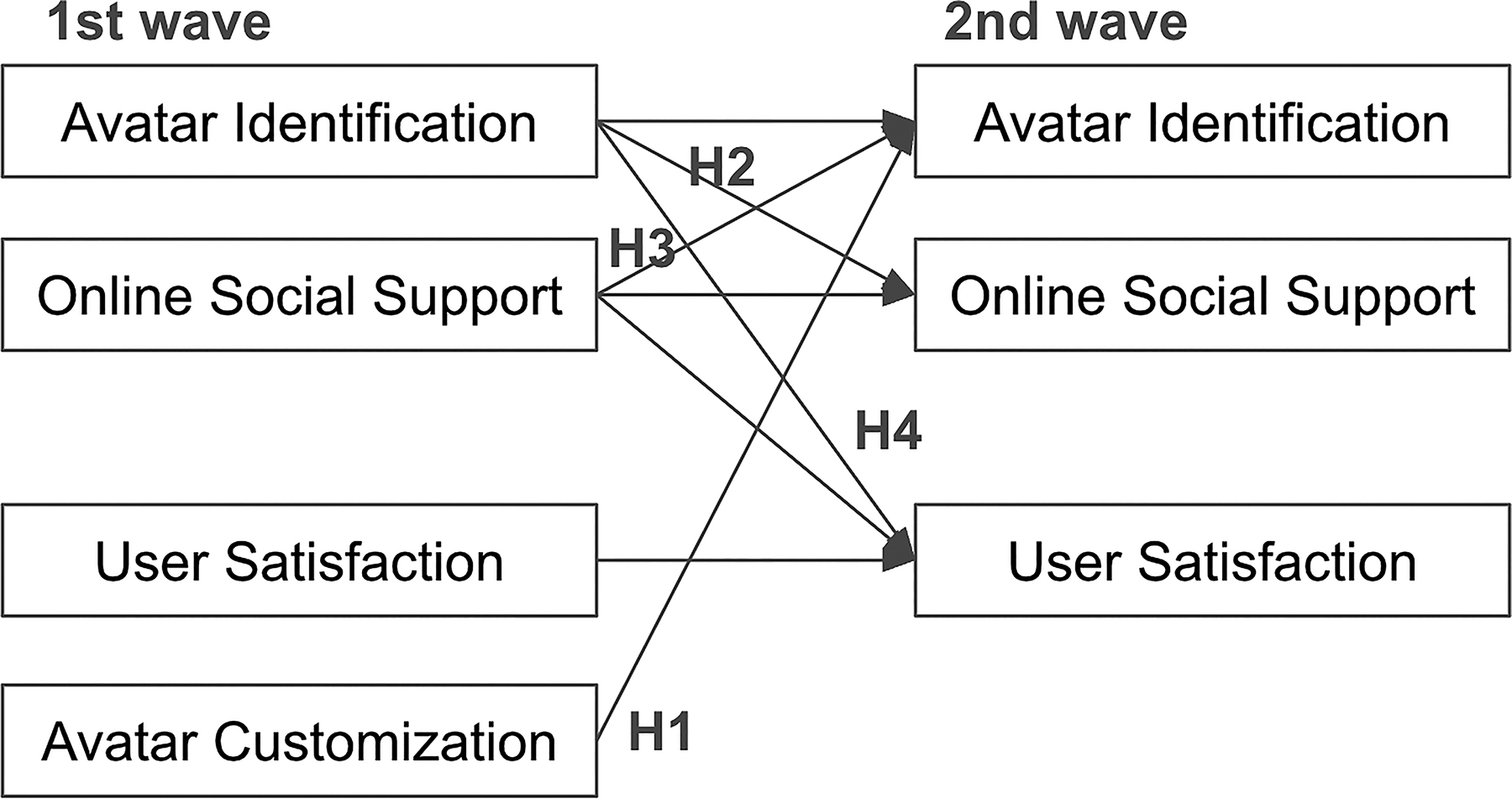
Schematic diagram of the statistical model (H1–H4).
To control for demographic and service-specific differences, we included gender (dummy-coded with female as the reference category), age, usage service (dummy-coded with Second Life as the reference category), and usage frequency as control variables in all models.
Except for categorical variables (gender and usage services), all variables were standardized to have a mean of 0 and a standard deviation of 1 before analysis.
In principle, a cross-lagged panel model can estimate all possible cross-lagged paths between Wave 1 and Wave 2 variables. However, in this study, we did not assume that avatar customization is an outcome variable (i.e., we did not model predictors of customization) nor that user satisfaction functions as an antecedent of other outcomes. Accordingly, we excluded paths that would treat avatar customization as a dependent variable or user satisfaction as an independent variable predicting other constructs.
Several alternative approaches exist for analyzing longitudinal data, such as latent growth models. 43 However, in the present study, our primary interest was in directional predictive relationships among multiple constructs, as specified by our hypotheses. The cross-lagged panel model directly corresponds to these hypotheses by estimating whether earlier levels of one construct predict later levels of another while controlling for each variable’s autoregressive path. By contrast, latent growth models focus primarily on the magnitude of change (e.g., mean and variance of change scores) and on individual differences in growth trajectories. These approaches generally require additional waves and latent-variable structures (e.g., three or more waves, common factors, and/or latent change components) and therefore more complex model specifications. Given that our data consist of two measurement occasions (∼9 months apart) and include multiple constructs (avatar customization, avatar identification, perceived online social support, and multiple user satisfaction indicators) across three distinct platforms, we considered a parsimonious cross-lagged panel model to be the most appropriate and transparent approach for testing our directional hypotheses.
In addition to the direct cross-lagged paths, we evaluated indirect (mediated) and total effects of avatar customization on perceived online social support and user satisfaction outcomes implied by our conceptual model (Figure 1). Specifically, we examined (a) the indirect effect of avatar customization on perceived online social support through avatar identification and (b) the indirect effects of avatar customization on user satisfaction through avatar identification alone and through a serial pathway involving both avatar identification and perceived online social support. The total effect of avatar customization on each outcome was computed as the sum of the relevant indirect effects along these pathways. Although longitudinal mediation is ideally evaluated with three or more waves, two-wave panel data can provide limited insights under additional assumptions (e.g., stationarity). 15 Indirect effects were estimated within the SEM framework by defining each indirect path as the product of the corresponding structural coefficients. Standard errors and confidence intervals for these indirect effects were computed in lavaan (R) using the delta method, and statistical significance was evaluated based on these confidence intervals.
Ethics approval statement
This study was approved by the ethics committee of a Japanese company.e All procedures were performed in accordance with the guidelines for studies involving human participants and ethical standards of the Institutional Research Committee. The participants provided informed consent to participate in the survey and were allowed to stop at any time. Participants were allowed to withdraw their responses after completing the survey. The informed consent form included an inquiry contact form for requests for disclosure and the withdrawal of responses. Quantitative data outputs were presented at the aggregate level, indicating that no identifying information was presented.
Results
Direct effects (H1–H4)
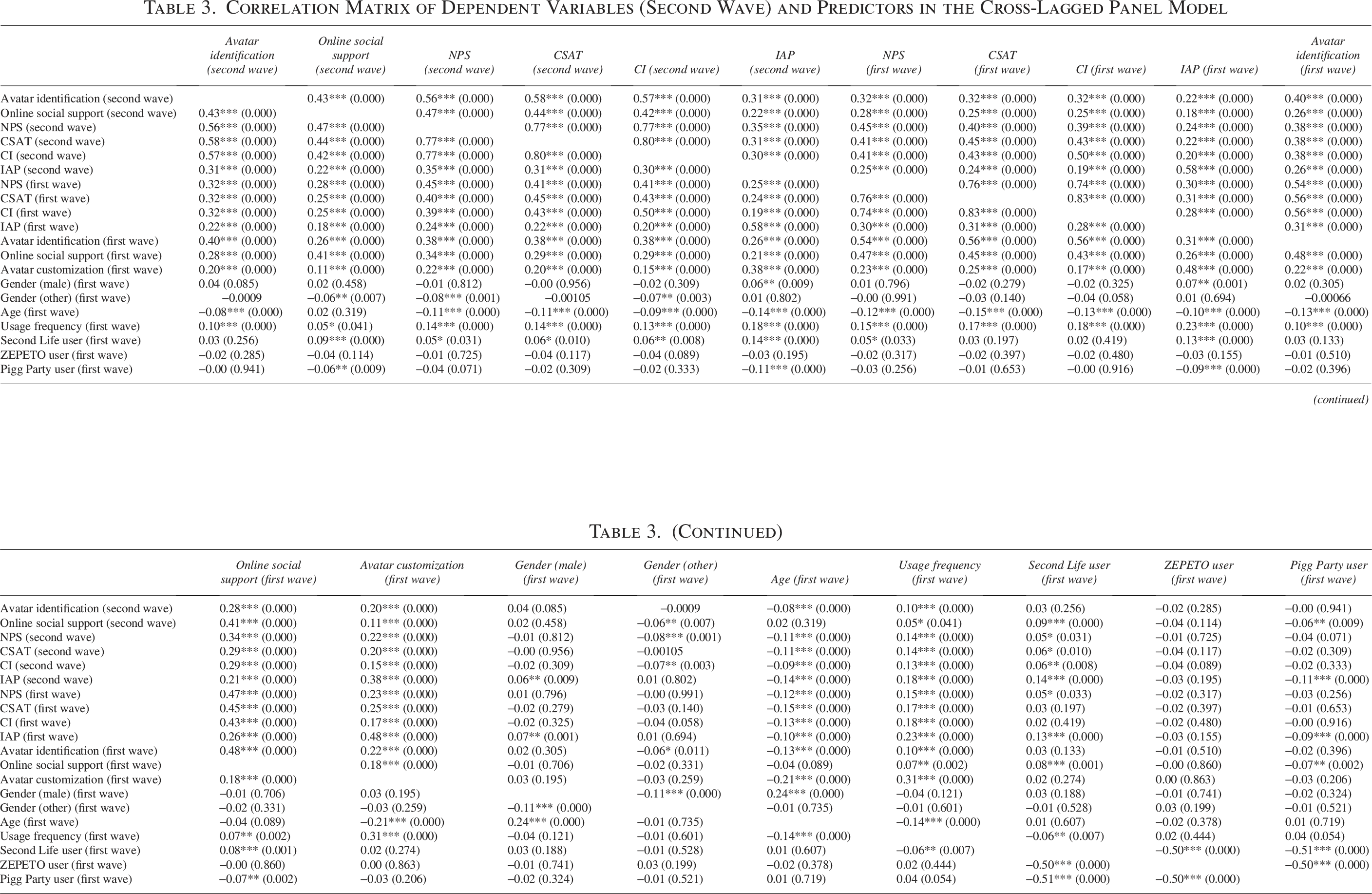
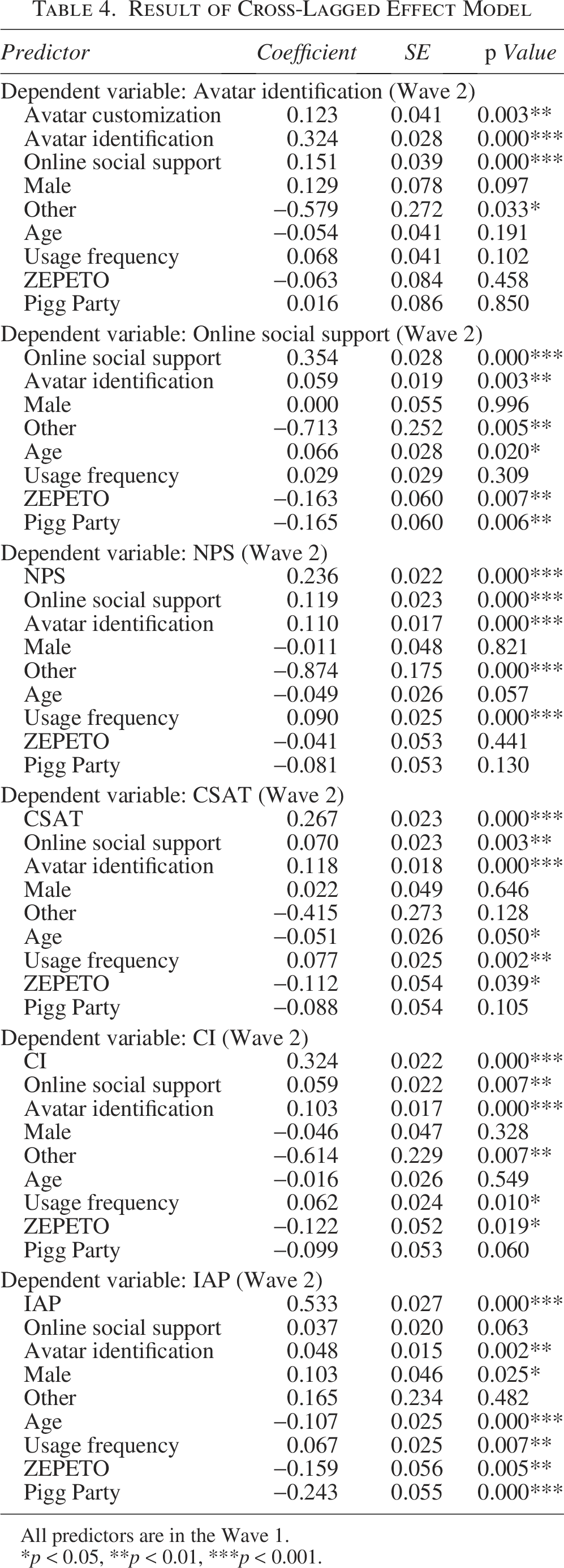
Tables 3 and 4 show the correlation matrix and results of the cross-lagged panel model, respectively. This cross-lagged panel model showed a good fit with the data (comparative fit index 44 : 0.989, root-mean-square error of approximation 45 : 0.043 [0.035, 0.051], where square brackets indicate a 90% confidence interval).
Correlation Matrix of Dependent Variables (Second Wave) and Predictors in the Cross-Lagged Panel Model
Result of Cross-Lagged Effect Model
All predictors are in the Wave 1.
*p < 0.05, **p < 0.01, ***p < 0.001.
In the first wave, avatar customization positively predicted avatar identification in the second wave. Thus, H1 was supported.
Avatar identification in the first wave positively predicted online social support in the second wave. Thus, H2 was supported. Furthermore, online social support predicted increase of avatar identification; thus, H3 was supported.
Avatar identification in the first wave positively predicted all user satisfaction metrics in the second wave. Similarly, perceived online social support positively predicted user satisfaction metrics except for IAP. Therefore, H4 was partially supported, except for the relationship between online social support and IAP.
Indirect and total effects of avatar customization on online social support and user satisfaction
We evaluated the total effect of avatar customization on online social support mediated by avatar identification, as well as user satisfaction mediated by avatar identification and online social support (Figure 1). This mediation analysis focused on the pathway from customization to outcomes. Although evaluating the mediation effects in longitudinal studies should ideally use data from three or more waves, it is possible to gain limited insights from two-wave panel data by assuming stationarity. 15
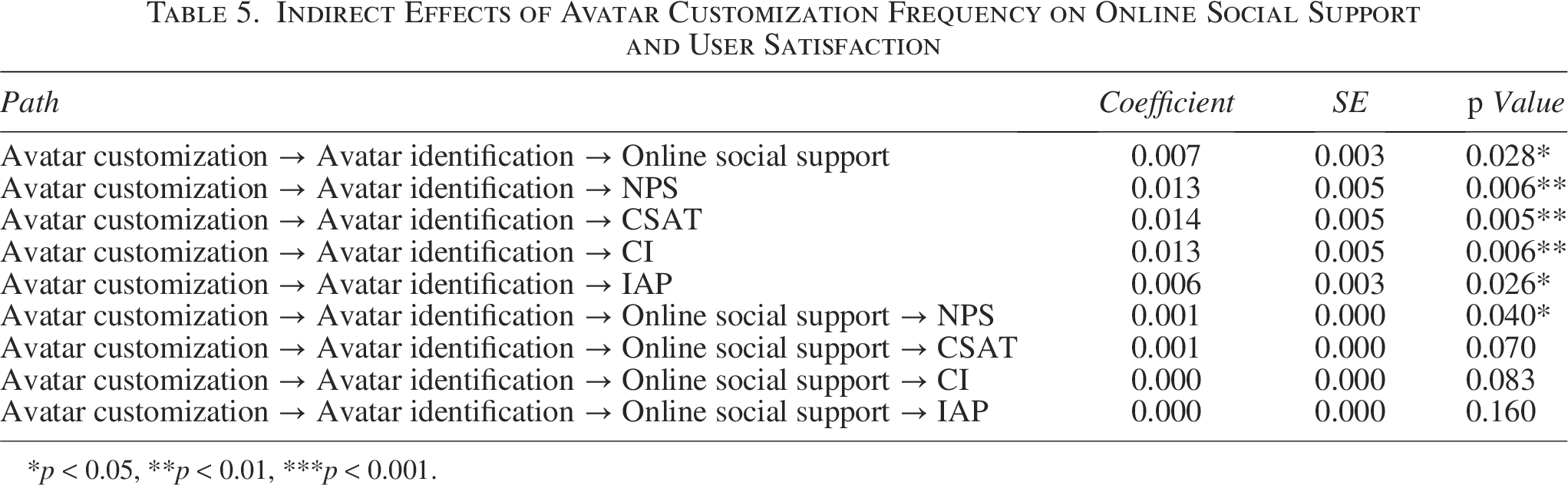
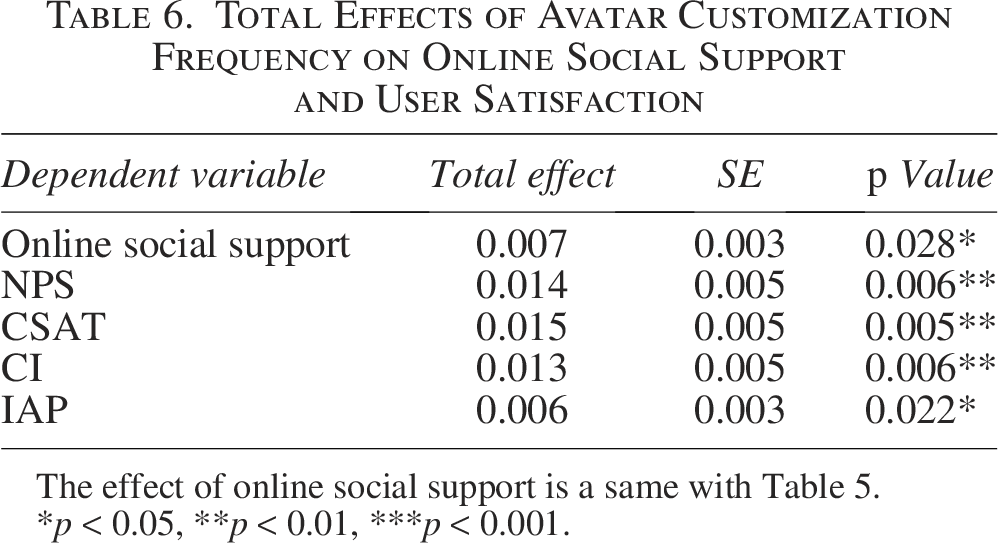
Tables 5 and 6 present the indirect and total effects of avatar customization on perceived online social support and user satisfaction. The indirect effect of avatar customization mediated by avatar identification was significantly positive for both online social support and user satisfaction. In contrast, the serial indirect effect of avatar customization on user satisfaction through both avatar identification and online social support was significantly positive only for NPS.
Indirect Effects of Avatar Customization Frequency on Online Social Support and User Satisfaction
*p < 0.05, **p < 0.01, ***p < 0.001.
Total Effects of Avatar Customization Frequency on Online Social Support and User Satisfaction
The effect of online social support is a same with Table 5.
*p < 0.05, **p < 0.01, ***p < 0.001.
As a result, avatar customization had a significant positive total effect on perceived online social support and all user satisfaction metrics. These total effects were largely attributable to the indirect pathway through avatar identification.
Discussion
To gain insights into how online social support can be enhanced in avatar communication services, this study employed a longitudinal survey to build and test an integrated model of avatar customization, avatar identification, and their outcomes.
We empirically demonstrated a mutually reinforcing relationship between avatar identification and online social support (H2 and H3 were supported), creating a positive feedback loop in which a stronger connection to one’s avatar promotes supportive interactions and those interactions, in turn, deepen the connection. This may suggest an inherent mechanism within avatar platforms for sustaining social support. This study can integrate previous findings that high identification promotes social activity11,14,19–21 and that social environments enhance identification.16,24,25
This study identified frequent avatar customization as a key starting point for this positive feedback loop (H1 supported). This finding is of great practical importance because avatar customization is a feature that service providers can easily and naturally encourage. Instead of directly and perhaps awkwardly trying to facilitate sensitive social interactions, platforms can focus on operational measures they already perform, such as releasing new avatar clothes and accessories, or hosting seasonal customization events, like Halloween costumes and parties.
Importantly, our measure of avatar customization captures a user-side behavioral indicator (i.e., how frequently users customized their avatars) rather than platform-side features or the availability of customization options. Therefore, our practical implications should be interpreted as follows: platform operations (e.g., item releases or seasonal events) are plausible levers that may increase users’ customization frequency, which our longitudinal results suggest is linked to stronger subsequent avatar identification and, indirectly, higher perceived social support and user satisfaction. However, because we did not directly measure platform-side customization supply or specific design choices, future research should examine how particular platform interventions causally affect users’ customization behavior and downstream outcomes (e.g., using platform logs, natural experiments, or field experiments).
This pattern yields tangible benefits for service providers and users. We found that both avatar identification and online social support predicted higher user satisfaction on some metrics; thus, H4 was partially supported. The total effect analysis further suggested that more frequent customization is linked to higher levels of both social support and user satisfaction, largely through avatar identification. These patterns are consistent with a potential win-win scenario in which measures that enhance user well-being may also support platform success.
Beyond these practical implications, our findings also contribute to the literature on avatar-mediated communication and virtual identity in three ways. First, it tests the reciprocal association between identification and perceived social support using a large-scale, two-wave longitudinal design across three distinct avatar communication services. Second, it identifies user-side avatar customization frequency as a practical and observable starting point for this positive feedback loop. Third, it links these psychological processes to marketing-relevant indicators of user satisfaction, thereby connecting theories of avatar identity to platform sustainability.
Limitations and future work
This study has limitations that warrant future research. First, although we established longitudinal relationships, the detailed mechanisms linking avatar customization to online support remain unexamined, and investigating these could enhance the observed positive effects.
Second, this longitudinal design strengthens causal inference by establishing temporal precedence, it cannot rule out the influence of confounding variables. Future research should employ experimental designs.
Third, baseline comparisons indicated some selective attrition (Table 2); thus, the longitudinal estimates should be interpreted with appropriate caution regarding generalizability.
Fourth, the scope was limited to communication services and difficulties; exploring a broader range (including virtual reality and artificial intelligence avatars) and more diverse challenges would clarify the generalizability of the findings.
Fifth, the findings were based on Japanese participants, which limits their cultural generalizability and requires cross-cultural validation.
Sixth, avatar customization effects depend on how the avatar is customized. 14 Exploring this could contribute to the development of more effective interventions for avatar identification and online social support.
Seventh, avatar customization was measured as users’ customization frequency (a behavioral indicator) rather than platform-side customization opportunities or design features (e.g., the amount, diversity, or salience of customization options). Future work should directly model platform interventions and examine their causal impacts on users’ customization behavior and downstream social outcomes.
Last, there are potential risks that may undermine the sustainability of the proposed positive cycle. Prior work has suggested that reflecting a wishful self in avatars may be associated with addiction-related risks in avatar-based services. 18 Building on this, platforms should monitor and mitigate potential user fatigue and problematic or excessive engagement. In particular, providers should be cautious about design choices that may intensify over-idealization (e.g., releasing highly extravagant or overly realistic avatar parts) and should consider implementing safeguards that balance engagement with user well-being.
Conclusions
This study conducted a longitudinal survey to gain insights into the enhancement of perceived online social support. We evaluated how avatar customization and avatar identification affect perceived online social support. The results indicate the following:
More frequent avatar customization predicted higher avatar identification (H1) and, through this mediation, was indirectly associated with higher perceived online social support and user satisfaction with services. Higher avatar identification predicted higher perceived online social support at the subsequent wave (H2). Higher perceived online social support predicted higher avatar identification at the subsequent wave (H3). Avatar identification and perceived online social support were positively associated with later user satisfaction, although the association between perceived online social support and IAP was not statistically significant (H4; partially supported).
In summary, our findings suggest that encouraging avatar customization may be a practical strategy for supporting perceived online social support by fostering avatar identification. This approach may benefit both users (via increased perceived support) and service providers (via higher user satisfaction on most metrics) while acknowledging the limits of causal inference in observational data.
Authors’ Contributions
M.T.: Writing—original draft, Project administration, Methodology, Investigation, Formal analysis, Data curation, Conceptualization. K.Y.: Writing—review & editing. T.K.: Writing—review & editing. N.A.: Writing—review & editing. F.T.: Writing—review & editing.
Footnotes
Author Disclosure Statement
M.T. is an employee of CyberAgent, Inc. (the provider of Pigg Party). There are no patents, products in development, or marketed products to declare. K.Y., N.A., and F.T. were funded by CyberAgent, Inc.
Funding Information
This work was supported by JST, PRESTO Grant Number JPMJPR2367, Japan.
