




Abstract
The perception of hostility in online contexts is closely associated with the occurrence of online aggression. Compared to traditional methods that rely on self-report or behavioral analysis, ERP allows for real-time, objective capture of neural responses to emotional stimuli, making it especially suited to reveal the immediate processing of hostility expectation violations. By creating distinct social contexts, we examined participants’ brain responses to violations of hostility expectations in text-based communications, both with and without emojis. The results indicated that in the absence of emojis, violations of hostility expectations triggered a significant negative deflection in the N400 waveform, reflecting a heightened neural response to perceived hostility. In contrast, when emojis were present, this negative neural response was substantially reduced, suggesting that emojis play a key role in mitigating hostile attributions and fostering positive social interactions. These findings not only highlight the important function of emojis in online communication from a neuroscience perspective, demonstrating their ability to effectively reduce hostility attribution and potential conflicts in digital interactions, but also provide new empirical evidence for understanding the emotional regulation mechanisms of nonverbal cues in digital environments and improving the quality of online interactions.
Introduction
Several studies have demonstrated that hostile attributions are strongly associated with aggressive behavior.1,2 Deficits in social information processing may lead aggressive individuals to interpret and perceive others more negatively and hence react aggressively. 3 Hostile Attribution Bias contributes to reactive aggression, where individuals interpret others’ actions as hostile. This bias is more pronounced online, affecting social information processing and aggressive behavior.4–6
Online hostility is associated with information asymmetry, missing context, and emotional expression limits. The lack of non-verbal cues in computer-mediated communication can result in misinterpretation and conflict escalation, which emojis help mitigate by adding emotional context to text, reducing miscommunication.7,8
Emojis also facilitate the contextual processing of information, further reducing hostile attributions. Yang et al.’s research shows that emoji can attenuate N400 effect by simplifying semantic integration. By reducing semantic ambiguity and cognitive load through congruent emotional cues, emojis facilitate more efficient semantic integration, which in turn mitigates overreactions to aggression and reduces hostile interpretations when emotions are consistent. Emojis also affect information interpretation by adjusting attention, especially with emotional mismatches. This suggests that, when faced with contradictory information, recipients need to exert more cognitive effort to avoid superficial interpretations of aggressive content, thereby reducing immediate hostile reactions.
However, the role of emojis is not always positive. Weissman and Tanner found that certain ironic emojis can distort the emotional interpretation of messages, increasing the likelihood of hostile attributions. 9 Furthermore, when emojis do not emotionally match with the accompanying text, recipients may perceive the message as contradictory or insincere, which further escalates conflicts.
To empirically test these mechanisms, the Hostile Expectancy Violation Paradigm is an ERP task developed by Gagnon et al. to measure an individual’s hostile attribution bias and is employed. 10 This paradigm leverages the N400—a well-established neural marker of semantic or expectancy violation. Research shows that incongruent stimuli (e.g., semantically mismatched prime-target pairs as in Kutas & Federmeier or emotionally inconsistent contexts as in Leuthold et al.) elicit a stronger N400, reflecting the cognitive conflict generated when receiving social-emotional information that contradicts expectations.11,12
To explore how emojis influence online social information processing, this study uses the Hostile Expectancy Violation Paradigm and neurophysiological indicators to examine how emojis modulate cognitive processes in online hostility perception. ERP technology, with its high resolution, captures real-time neural responses to social and emotional stimuli, offering a unique advantage in studying immediate cognitive conflict in online communication. We hypothesize using emojis will alleviate the aggressive atmosphere in online interactions. The hypotheses are as follows:
Without emojis, violating hostile expectations will trigger a larger N400 than violating non-hostile expectations; with emojis, the opposite applies, meaning the use of emojis reduces hostile attribution bias. Under the condition of violating hostile expectations, the N400 will be smaller with emoji; under the condition of violating non-hostile expectations, the N400 will be larger with emoji, indicating that the use of emojis reduces hostile attribution bias.
Methods
Participants
The participants were 37 students (17 males, 20 females) from a university in Zhejiang, with a mean age of 19.54 (SD = 0.92) years. All participants were native Chinese speakers. See supplementary data for details.
Materials
This study employed the Hostile Expectancy Violation Paradigm, using semantic texts to create varied contexts that induce expectation violations. Materials were based on real-life events from social platforms such as Weibo, Zhuihu, and Rednote. These events were first classified according to whether they involved hostile or non-hostile emotions/behaviors. They were then rewritten into three-sentence scenarios consisting of (1) a context-setting sentence, (2) a sentence describing an ambiguous provocative act, and (3) a target sentence that clarified the actor’s true intention. According to whether the intention described in the target sentence was hostile or non-hostile, the scenarios were classified into hostile or non-hostile conditions. Furthermore, depending on whether the contextual cues were consistent with the target intention, each scenario was adapted into matching or mismatching conditions.
In total, 320 scenarios were constructed. Target sentences were equally divided into affirmative and negative forms across all conditions. In addition, we selected online socializing contextual materials-emoji “ ” through rigorous scoring by others.
The standards and specific details of the materials are outlined in the Figure 2.
Procedure
The test procedure was prepared with E-Prime 3.0. Each participant completed a block consisting of 1 practice block and 16 formal experimental blocks. The practice block consisted of 5 trials, and the formal block consisted of 20 trials (5 each of hostile/match, hostile/mismatch, non-hostile/match, and non-hostile/mismatch) and 1 filler. The filler was a judgement question about the content of the scene, the point of which was to ensure that the participant was carefully reading and understanding the material. If the trial was a filler, the judgement question appeared 300 ms after the last word appeared. There were breaks between each block, the duration of which was determined by the participant. Fillers were presented randomly in 16 blocks with an average correct response rate of 88 percent.
The procedure of the experiment is shown in Figure 1.
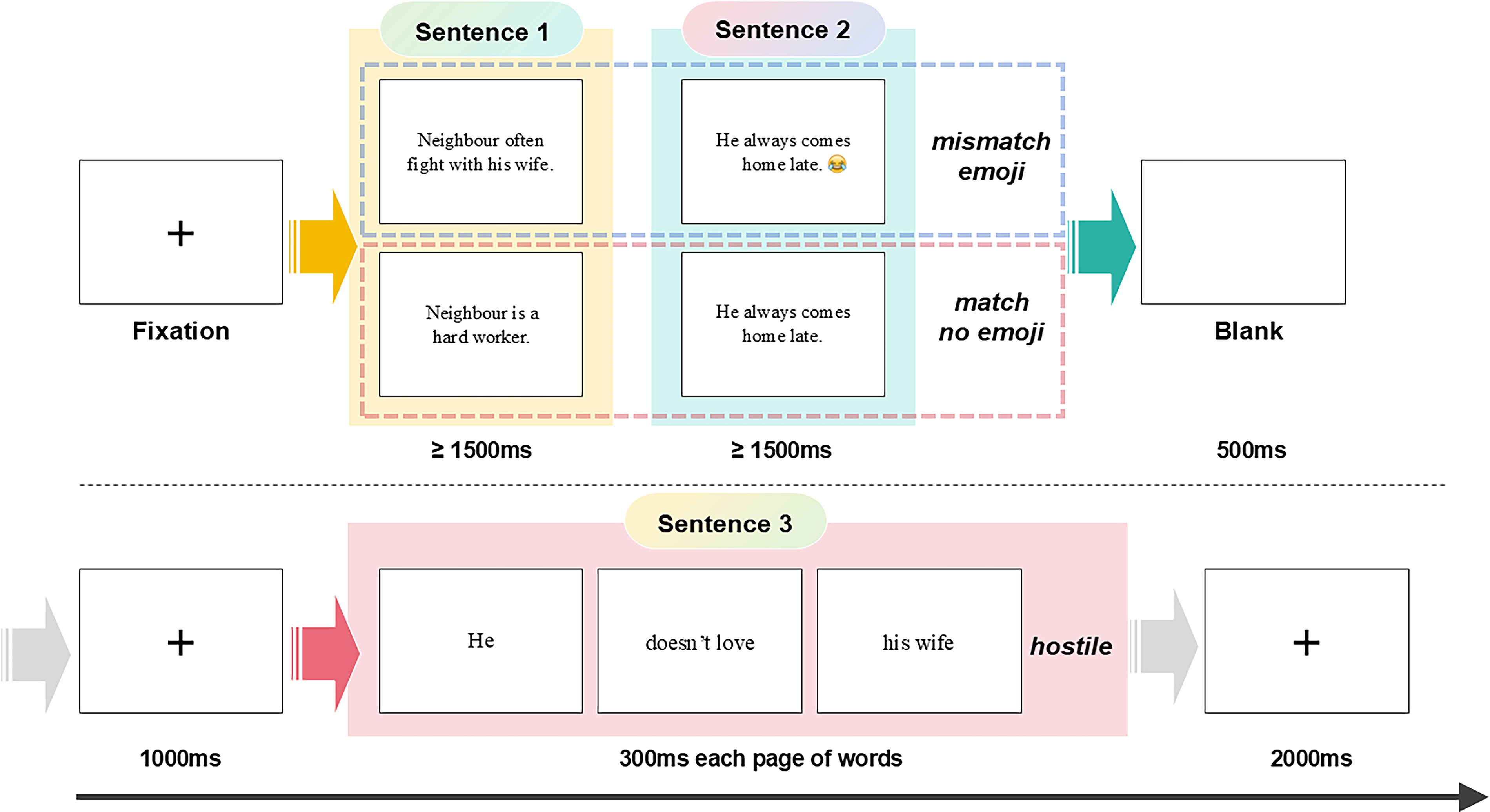
Experimental flowchart for single trial.
The experiment can be accessed via the following link: https://osf.io/gekd8
Results
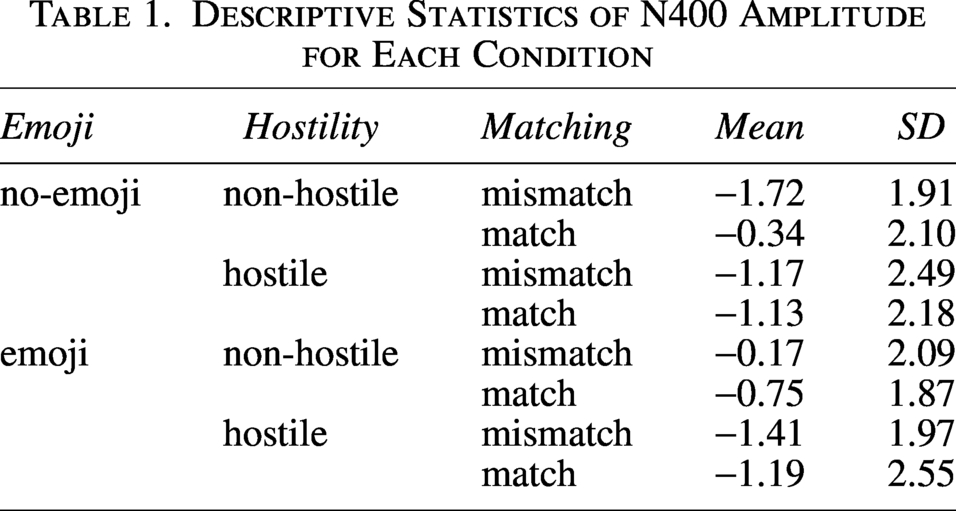
This study used a 2 (hostility: hostile/non-hostile) * 2 (matching: match/mismatch) * 2 (presence of emoji: emoji/no emoji) within-subjects design, and the dependent variable was EEG amplitude. EEG data analysis methods are detailed in Figure 2. The results are shown in Figure 3. Descriptive statistics for the N400 in each condition are shown in Table 1.
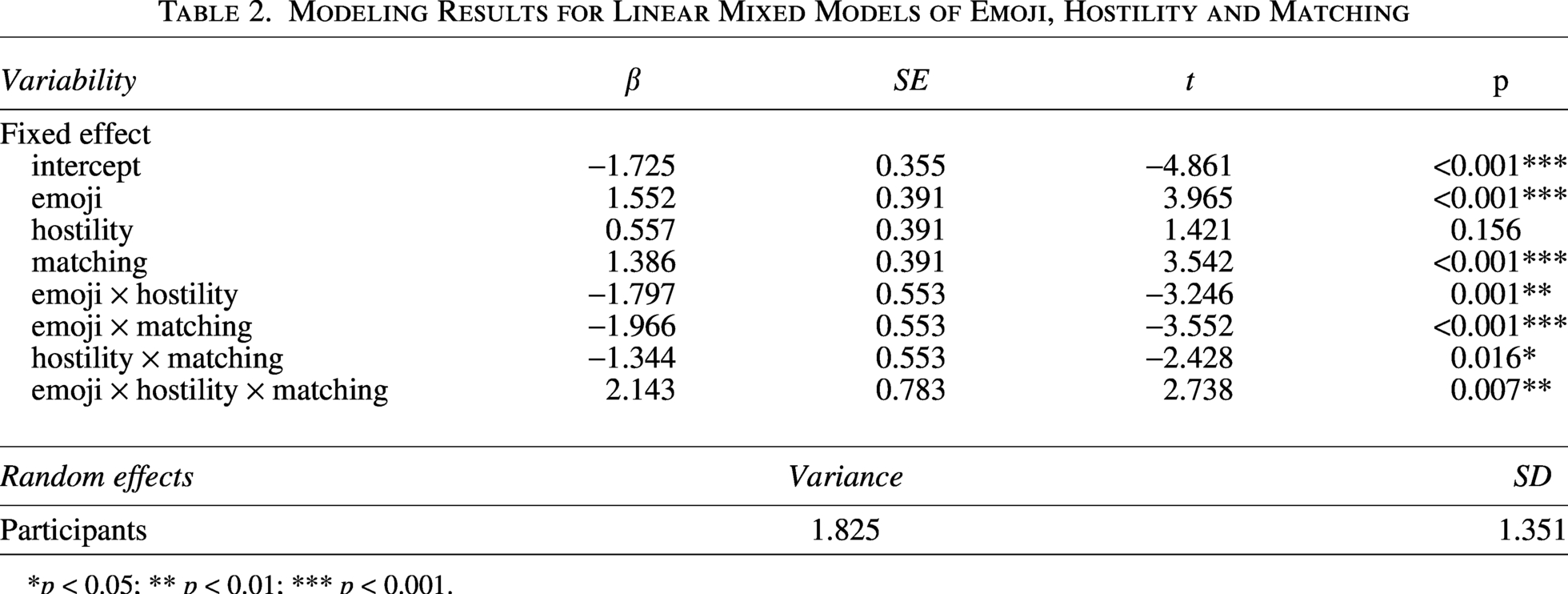
We used LMM: Amplitude ∼ Emoji × Hostility × Match +(1∣Participant)
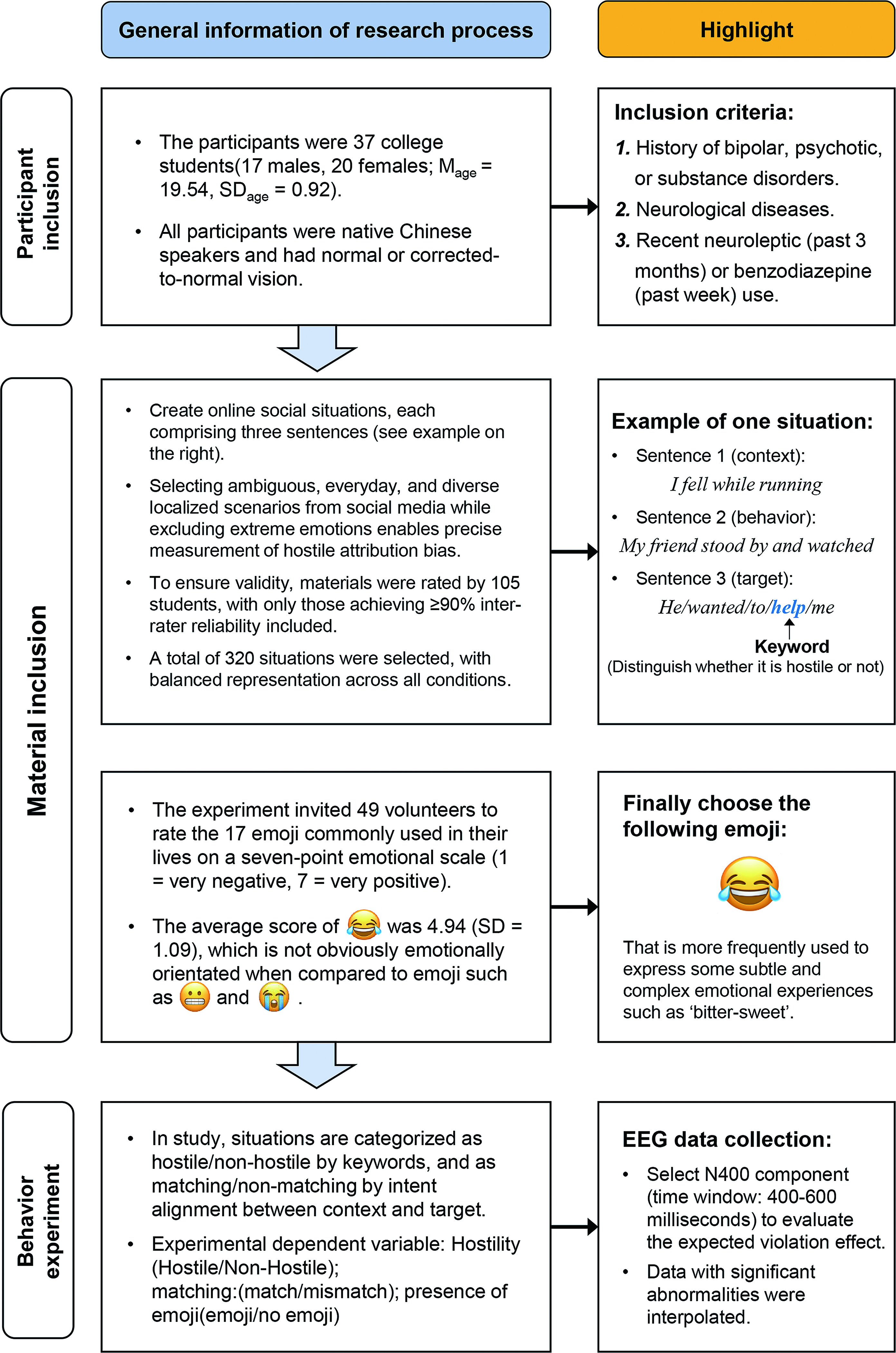
Complete process of experimental task.
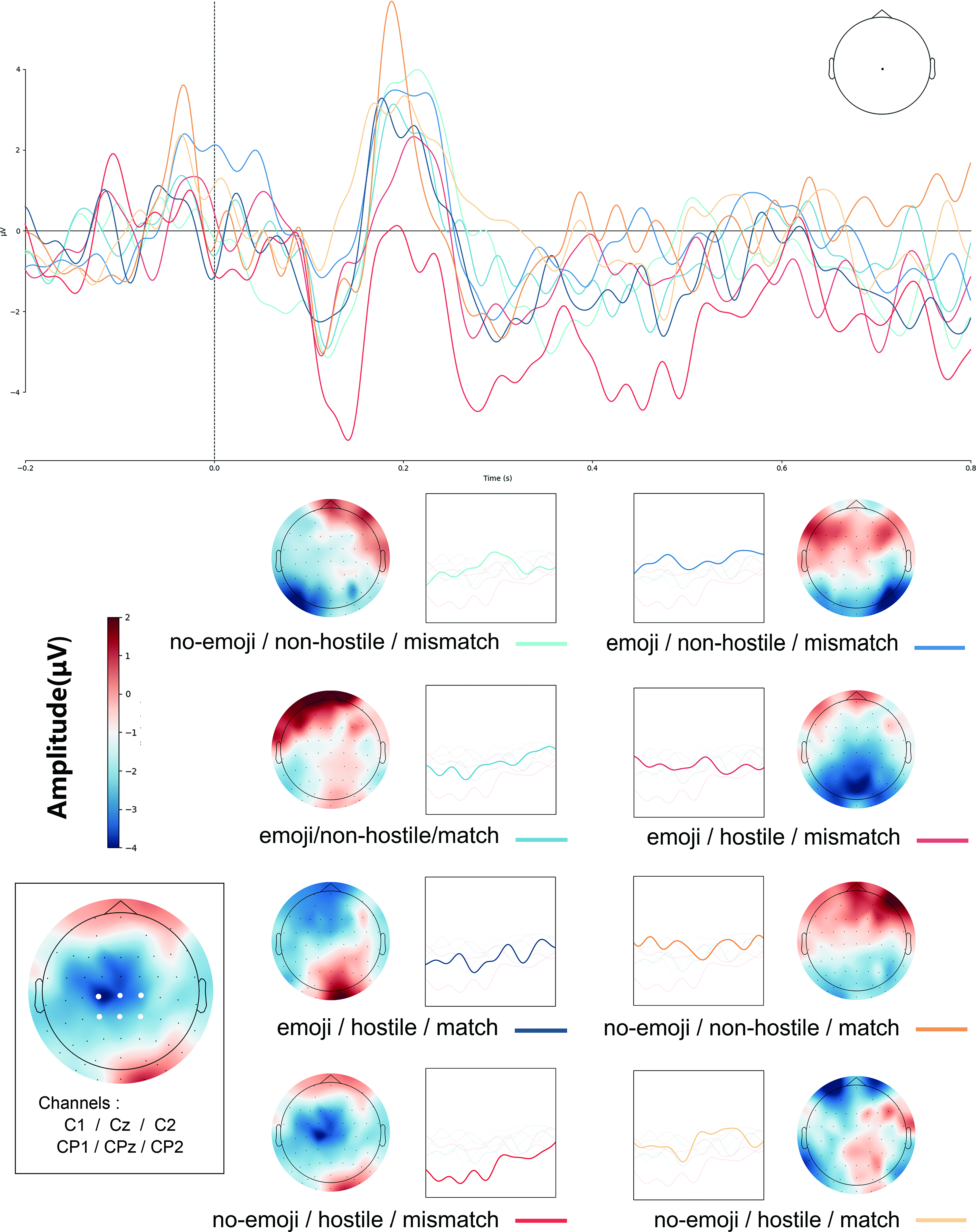
Topographic map and waveform map of EEG task results EEG data were recordedby a 64-channel EEG system (ANT Neuroscan) with a sampling frequency of 500 Hz. The scalp impedance of each electrode was kept below 5 kX, using bilateral mastoid (M1 and M2) average asthe reference. A bandpass filter was applied with a high-pass of 0.1 Hz and a lowpass of 30 Hz. Artifacts wereremoved for amplitudes exceeding-80 lV.
Descriptive Statistics of N400 Amplitude for Each Condition
The fitted parameters of the linear mixed model are shown in Table 2.
Modeling Results for Linear Mixed Models of Emoji, Hostility and Matching
*p < 0.05; ** p < 0.01; *** p < 0.001.
In the interaction analysis of the three factors of emoji, hostility and matching, the three-factor interaction was found to be significant, so further tests of simple two-factor interaction effects were conducted.
Fixed levels of hostility to test the interaction effect of matching and emoji
The interaction effect of matching and emoji on the dependent variable was statistically significant in the non-hostile condition, (F(1,108) = 13.744, p < 0.001). The interaction effect of matching and emoji was not significant in the hostile condition, (F(1,108) = 0.101, p = 0.751).
Fixed level of matching to test the interaction effect of emoji and hostility
The interaction effect of emoji and hostility on the dependent variable was statistically significant in the mismatch condition, (F(1,108) = 10.526, p = 0.002) whereas in the match condition the interaction effect of emoji and hostility was not statistically significant (F(1,108) = 0.363, p = 0.548). We, therefore, conducted a simple effects analysis. The main effect of emoji on the dependent variable was significant in the mismatch and non-hostile condition (F(1, 36) = 20.038 p < 0.001). Further Tukey post-hoc tests showed that the mean value of N400 amplitude was significantly lower in the condition with emoji than in the condition with no-emoji, with a difference of −1.55 (SE = 0.347, t(36) = −4.476, p < 0.001).
Fixed emoji levels to test the interaction effect of hostility and matching
The interaction effect of hostility and matching on the dependent variable was statistically significant when there was no emoji (F(1,108) = 6.685, p = 0.011). The interaction effect of hostility and matching was not significant when there was an emoji (F(1,108) = 1.927, p = 0.168); therefore, we conducted a simple effects analysis in the absence of an emoji. The main effect of matching on the dependent variable was significant in the non-hostile and no-emoji condition (F(1,36) = 16.555, p < 0.001). Further Tukey post-hoc tests showed that the mean N400 amplitude was significantly lower in the unmatched condition than in the matched condition, with a difference of −1.39 (SE = 0.341, t(36) = −4.069, p < 0.001).
Discussion
According to the predictive coding framework, the brain does not passively receive information but continuously generates predictions about the world based on prior beliefs, updating these beliefs through prediction errors. 13
In the domain of social cognition, hostile attribution bias may represent a specific manifestation of this mechanism: individuals holding a strong prior belief that “others are hostile” will prioritize hostility-consistent predictions when processing ambiguous social information, while encountering belief-inconsistent information (e.g., non-hostile intentions) generates substantial prediction errors that resist effective updating through new experiences, thereby maintaining or even reinforcing the original hostile interpretation pattern. 14 ,15
In this study, target words that violated hostile expectations (non-hostile mismatch condition) under conditions without emojis elicited a greater N400 between 400 and 600 ms post-stimulus, compared to the matched condition. In other words, individuals show stronger neural responses in situations where hostile intent is expected but non-hostile intent is encountered than in situations where expected and actual intent are consistent. This N400 showed an even greater amplitude than in conditions where individuals expected non-hostility but encountered actual hostility.
From a predictive coding perspective, this enhanced N400 represents a prediction error signal generated when the brain encounters input that contradicts a strong prior belief (e.g., “the other person is hostile”). This “conservative prediction strategy” prioritizing the maintenance of hostile expectations to minimize potential social threats, even in the face of disconfirming evidence—reflects a tendency to remain vigilant.
The neural cost of this strategy is reflected in the additional recruitment of prefrontal resources when expectations are violated, facilitating the suppression of the threat schema and the re-evaluation of the situational context. 16 While this defensive cognitive strategy enhances the speed of threat response, it incurs a higher neuroeconomic cost when expectations are disconfirmed. 17
This cost leads to a key question: whether the N400 originates from the violation of specific hostile expectations or from the ambiguity caused by the inconsistency between situational cues and intent. Our interaction analysis results tend to support the former interpretation: in hostile contexts, the match or mismatch of intentions did not significantly modulate the N400. This finding suggests that hostile expectations may play a more critical role in the cognitive processing. This interpretation is also consistent with previous studies that have identified the N400 as a key neural marker indexing the violation of hostile expectations.18,19
When participants’ non-hostile expectations are violated, the N400 exhibits a greater negative deflection. Therefore, if the N400 is attenuated when emojis are incorporated, we can reasonably conclude that emojis can reduce hostile attribution in online contexts.
As hypothesized, when emojis were present, violations of hostile expectations (non-hostile mismatch condition) no longer elicited a significant N400 effect, suggesting that emojis, serving as “contextual anchors,” reduce prediction errors and enhance cognitive processing efficiency by providing top-down predictive cues.
The presence of emojis increases the predictability of verbal information by offering additional contextual cues, thereby reducing semantic integration load. This “contextual anchoring” function may disrupt the automatic pattern of hostile attribution, prompting individuals to re-evaluate textual content based on more complete contextual information rather than making direct hostile assumptions
20
. Notably, even if the “” emoji is occasionally perceived as sarcastic, empirical evidence shows it functions to reduce sarcasm and increase positivity, consistent with our interpretation of N400 attenuation as reflecting mitigated semantic conflict.
21
Future research could apply computational modeling within the predictive coding framework—for instance, using Bayesian updating mechanisms as demonstrated in social cognition studies to quantitatively estimate the modulatory weight of specific emojis on prior beliefs and prediction error signals.22,23
Limitations and future research directions
First, this study used only the “” emoji; its polysemy may affect results. Future research should include diverse emojis to dissociate presence from emotional effects. Second, the sample was limited to Chinese university students with culturally specific materials, limiting generalizability. Finally, lab settings differ from real online interactions, and emotion-related components (e.g., LPP) were not analyzed. Future studies could employ naturalistic methods and multi-component measures.
Conclusion
This study found that, among Chinese university students, violation of hostility expectations elicited a stronger N400, particularly when participants anticipated hostility but encountered non-hostile scenarios. However, when emojis were included, the N400 associated with hostility expectation violations was significantly attenuated. This suggests that emojis can reduce hostile attribution in online communication. This study also has limitations, including the use of a single emoji type, a homogeneous sample, and a single analytical component.
Authors’ Contributions
X.W.: Writing—review and editing, formal analysis, visualization, and methodology. H.H.: Writing—review and editing, conceptualization, methodology, and software. J.S.: Data curation, visualization, writing—review and editing. W.L.: Writing—review and editing. Q.Z.: Project administration, supervision, validation, writing—review and editing. J.Z.: Writing—review and editing.
Ethics
This study protocol was reviewed and approved by the Ethics Committee of Wenzhou Medical University, approval number 2024-034, and participants signed an informed consent form before the experiment.
Footnotes
Acknowledgment
The authors sincerely thank all participants for their valuable time and contributions to this study.
Author Disclosure Statement
The authors declare that they have no known competing financial interests or personal relationships that could have appeared to influence the work reported in this article.
Funding Information
The authors disclosed receipt of the following financial support for the research, authorship, and/or publication of this article: This work was supported by the Technology Research and Development Program Joint Fund in Henan Province [grant number 232103810101].
Supplemental Material
References
Supplementary Material
Please find the following supplemental material available below.
For Open Access articles published under a Creative Commons License, all supplemental material carries the same license as the article it is associated with.
For non-Open Access articles published, all supplemental material carries a non-exclusive license, and permission requests for re-use of supplemental material or any part of supplemental material shall be sent directly to the copyright owner as specified in the copyright notice associated with the article.
