



Abstract
Background:
Pharmacological options for severe obesity in early childhood are limited. While lisdexamfetamine is approved for attention-deficit/hyperactivity disorder (ADHD) and binge eating disorder, its role in managing obesity in children without these conditions has not been well studied. This case series assessed the effect of lisdexamfetamine on weight in young children with severe obesity but without ADHD or binge eating disorder.
Methods:
We conducted a retrospective chart review of six children with severe obesity treated with lisdexamfetamine for weight management. Demographic, anthropometric, and metabolic data were collected. One patient had Prader–Willi syndrome (PWS); the others had no known syndromic obesity.
Results:
Median age at treatment initiation was 6.5 years (range: 4.5–14), with equal male and female distribution. Median treatment duration was 12 months (range: 12–24), and mean maximum tolerated lisdexamfetamine dose was 35 mg (range: 10–60). In patients without syndromic obesity (n = 5) including one child with hypothalamic obesity, lisdexamfetamine significantly reduced body mass index (BMI) percent of the 95th percentile at 12 months (median change –24%, range: −18 to −28, p = 0.031), equating to a 13.8% reduction in BMI. Height percentile remained unchanged (p = 0.59). The patient with PWS did not achieve lasting weight loss. Three children reported decreased appetite.
Conclusions:
Lisdexamfetamine was associated with weight loss in young children with severe obesity without genetic syndromes. Further studies are warranted to assess the long-term efficacy and safety of lisdexamfetamine in the management of pediatric obesity.
Introduction
Obesity represents a significant public health challenge, with about one in five children in the United States having obesity. The percentage of children and adolescents with severe obesity has nearly doubled over the last two and a half decades, from 3.6% in 1999–2000 to 7% in 2021–2023.1–3 Intensive health behavior and lifestyle treatment (IHBLT) is the most effective known behavioral treatment of child obesity but is often challenging to deliver and not universally available. Health behavior and lifestyle interventions have been demonstrated to have only modest benefit in children with severe obesity.4–6 The benefits are noted in the short term, but the improvements are often not sustained in the long term, and additional strategies are needed to enhance and maintain weight loss. 7 The latest clinical practice guidelines from the American Academy of Pediatrics recommend that anti-obesity pharmacotherapy may be considered as an adjunct to lifestyle and behavioral interventions for children aged 8 years and older with obesity. 4 While glucagon-like peptide-1 receptor agonists, semaglutide and liraglutide, and the combination of phentermine and topiramate (Qsymia) are approved by the United States Food and Drug Administration for children aged 12 years and up, there are currently no approved anti-obesity medications for children below 12 years of age. Setmelanotide, a melanocortin 4 receptor agonist, is the only medication approved below age 12 specifically for children with Bardet–Biedl syndrome and certain forms of monogenic obesity.8,9
Lisdexamfetamine is a long-acting stimulant medication approved for the treatment of attention-deficit/hyperactivity disorder (ADHD) in children aged 6 years and older. It is also indicated for the management of binge eating disorder (BED) in adults, attributed to its appetite-suppressing properties.4,10 Compared to immediate-release amphetamines, lisdexamfetamine has demonstrated a lower potential for misuse and a more favorable safety profile.11–16 Lisdexamfetamine has been associated with weight loss in children with ADHD.14–18 ADHD itself is a risk factor for excessive weight gain, 19 and therefore weight loss in children with ADHD may be partly related to improvement in ADHD symptoms. In this case series, we assessed the weight loss effects of lisdexamfetamine when used primarily for weight management in children with severe obesity who did not have a diagnosis of ADHD.
Methods
Participants were six pediatric patients with severe obesity, defined as body mass index (BMI) at or above 120% of the 95th percentile who were prescribed lisdexamfetamine for weight management. All patients were evaluated in the Pediatric Endocrinology Clinic at Mayo Clinic, Rochester, MN. Patients with a documented diagnosis of ADHD or binge eating disorder were excluded. Patients were not formally assessed for ADHD, as there were no concerning symptoms suggestive of ADHD at baseline.
Data were obtained through a retrospective review of electronic medical records. Collected variables included demographic characteristics (age, sex, ethnicity) and anthropometric measures such as body weight, height, BMI, BMI % of the 95th percentile, and height percentiles. These parameters were obtained at baseline (prior to initiation of lisdexamfetamine) and during treatment, up to the time of medication discontinuation or the time of data collection, whichever occurred first. Additional data included the maximum tolerated dose of lisdexamfetamine, reported side effects, and cardiometabolic parameters [e.g., fasting glucose, hemoglobin A1c (HbA1c), lipid profile, blood pressure, and alanine aminotransferase (ALT)] prior to and following initiation of the medication.
All data were collected and managed using REDCap (Research Electronic Data Capture). Research authorization was obtained from the caregivers of the patients. This study was reviewed and deemed exempt by the Mayo Clinic Institutional Review Board.
Given the small sample size and the presence of outliers/possible non-normality for certain variables, we report the median (with range) as a measure of central tendency and data distribution that is less influenced by extreme values.
Case Presentations
A retrospective chart review identified six pediatric patients initiated on lisdexamfetamine for weight management due to severe obesity. Median age at treatment initiation was 6.5 years (range: 4.5–14), with equal sex distribution (50% male and 50% female). The majority of patients were non-Hispanic or Latino (83%, n = 5), and 83% (n = 5) identified as White. The median treatment duration was 12 months (range: 12–24) and the median maximum tolerated dose was 35 mg (range: 10–60). One patient had Prader–Willi syndrome (PWS), and the other five did not have syndromic obesity.
Children without Syndromic Obesity
Baseline anthropometric measures for 5 children without syndromic obesity included a median height percentile of 93% (IQR: 87.5–98.5), BMI at 161% of the 95th percentile (IQR: 158.5–163.5), median BMI Z-score of 3.64 (IQR: 2.80–4.48), and median absolute BMI of 30.86 kg/m2 (IQR: 29.06–32.67). Three had abnormal lipid profiles; HbA1c was normal (Table 1).
Baseline Characteristics of Participants Including Demographic, Anthropometric and Metabolic Parameters
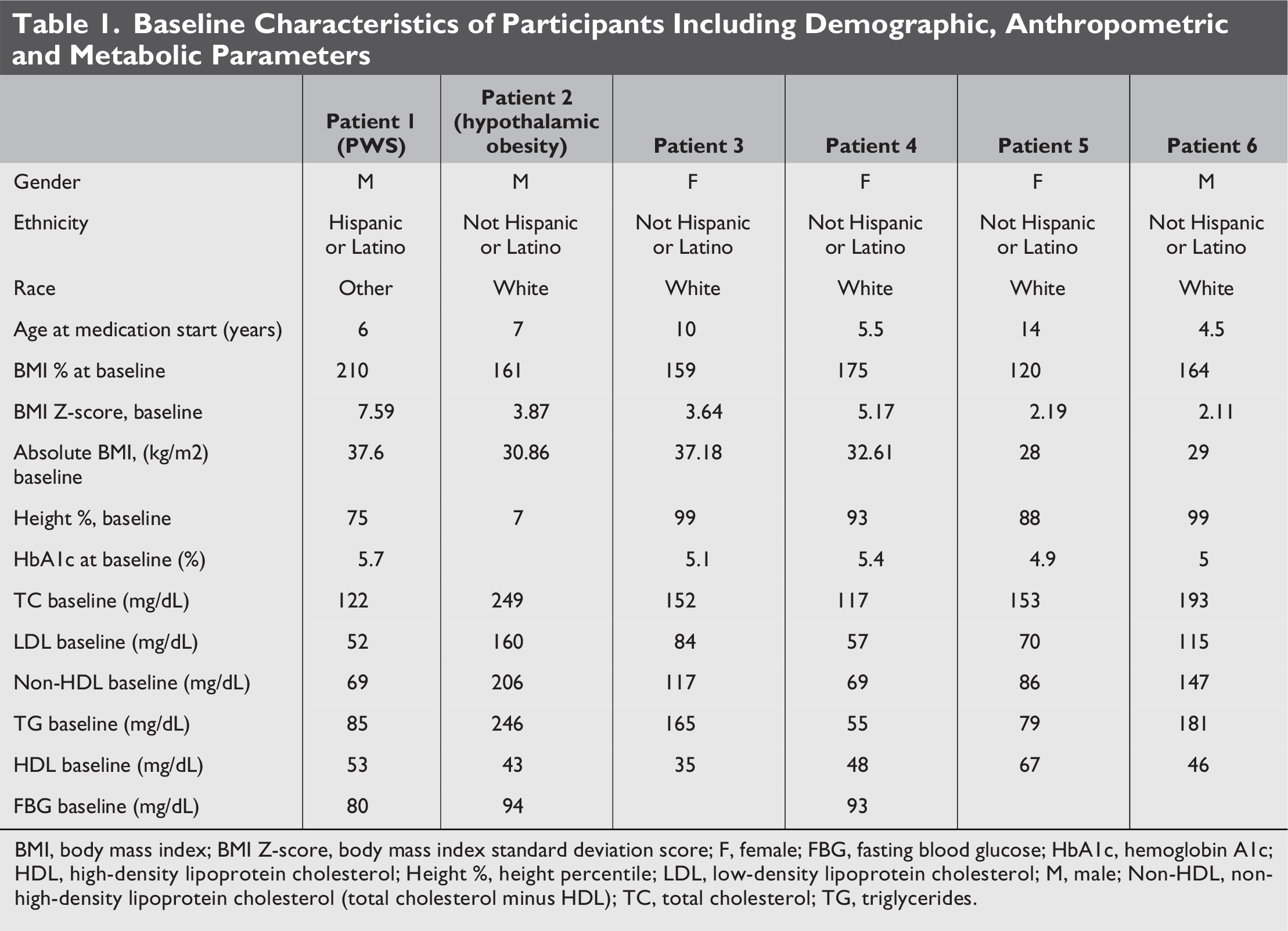
BMI, body mass index; BMI Z-score, body mass index standard deviation score; F, female; FBG, fasting blood glucose; HbA1c, hemoglobin A1c; HDL, high-density lipoprotein cholesterol; Height %, height percentile; LDL, low-density lipoprotein cholesterol; M, male; Non-HDL, non-high-density lipoprotein cholesterol (total cholesterol minus HDL); TC, total cholesterol; TG, triglycerides.
After 12 months of treatment, the median change of BMI percent of the 95th percentile was –24 [p = 0.031; 95% confidence interval (CI): –27.2 to –20 (R: −18 to −28)] with a BMI percent change of −13.8%. BMI z score decreased by −1.23 [p = 0.031, 95% CI: –1.64 to −0.35 (R: −1.68 to −0.35)] (Fig. 1, Table 2).
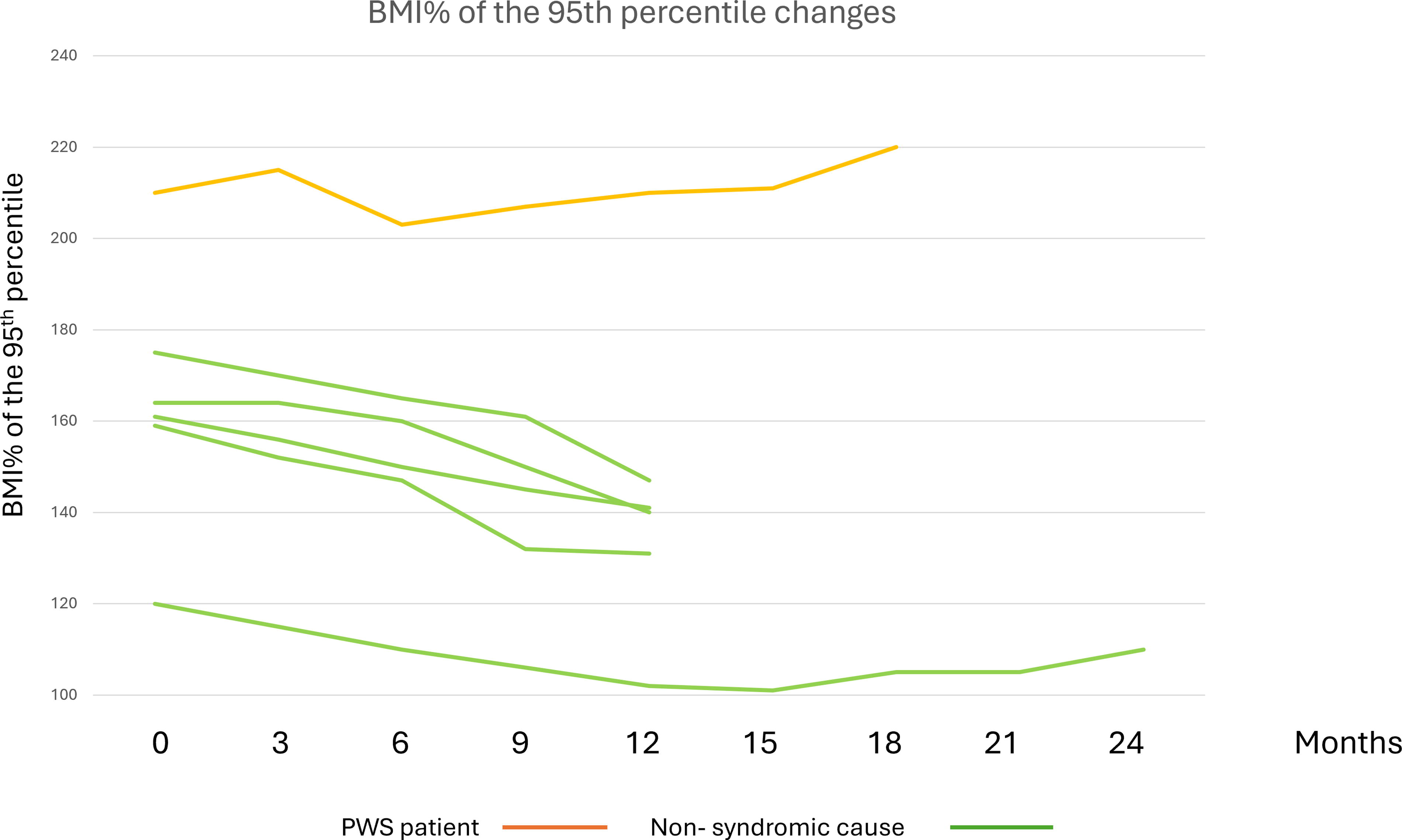
Longitudinal changes in BMI percent of the 95th percentile during treatment with lisdexamfetamine in six pediatric patients with severe obesity. Each line represents an individual patient’s BMI percent of the 95th percentile over time, measured at regular intervals following initiation of lisdexamfetamine. BMI, body mass index.
Changes in BMI Following Initiation of Lisdexamfetamine, Maximum Tolerated Doses, and Reported Adverse Effects

BBS7, Bardet–Biedl syndrome gene 7; PWS, Prader–Willi syndrome; VUS, variant of uncertain significance.
One of the five patients is a now 8-year-old child with a complex medical history, including septo-optic dysplasia and congenital hydrocephalus status post ventriculoperitoneal shunt placement. His clinical course was further complicated by central diabetes insipidus, central hypothyroidism, and hypothalamic obesity. Weight gain began around 3 years of age, accompanied by hyperphagia and increasing preoccupation with food. Despite lifestyle modifications and behavioral interventions, there was no significant improvement. At 7 years of age, lisdexamfetamine was initiated. At baseline, his BMI was 161% of the 95th percentile. After 1 year of treatment with lisdexamfetamine at a dose of 10 mg daily, his BMI decreased to 141% of the 95th percentile, with notable clinical improvement in hyperphagia and food-related obsessions.
Longitudinal cardiometabolic parameters were not available for most patients. One patient demonstrated no change in HbA1c relative to baseline. Lipid profiles were available for two children who received treatment for 12 months. One of the two children had a heterozygous pathogenic variant in the ABCG8 gene associated with elevated low-density lipoprotein (LDL) cholesterol. In these two cases, triglyceride levels decreased from 246 mg/dL and 181 mg/dL to 190 mg/dL and 70 mg/dL, respectively. No changes were observed in high-density lipoprotein (HDL) cholesterol or non-HDL cholesterol. Both children exhibited increases in LDL cholesterol, from 160 mg/dL and 115 mg/dL to 206 mg/dL and 132 mg/dL, respectively. Total cholesterol increased from 249 mg/dL to 287 mg/dL in one patient, while remaining stable in the other (193 mg/dL–191 mg/dL).
Child with Prader–Willi Syndrome
PWS was identified in one of six patients based on characteristic dysmorphic features, hypotonia, and feeding difficulties, later confirmed by genetic testing. The patient required gastrostomy tube placement at 3 weeks of age, began gaining excessive weight at 24 months of age, and had a BMI at 210% of the 95th percentile by age 6. The patient’s baseline laboratory tests included HbA1c of 5.7%, fasting blood glucose and lipid profile, and ALT of 82 U/L. Comorbidities were obstructive sleep apnea (OSA), hypertension, and metabolic dysfunction-associated steatotic liver disease.
Lisdexamfetamine was initiated at 10 mg when the patient was 6 years old and gradually increased to a maximum of 40 mg. There was no change in the patient’s BMI or metabolic parameters. The patient developed increased agitation and elevated blood pressure, which led to a dose reduction to 30 mg.
Side Effects
Three patients reported adverse effects from lisdexamfetamine. Two experienced sleep difficulties within 1 month of increasing the dose (one from 10 to 15 mg, another from 10 to 20 mg, with the latter also experiencing increased nail-biting leading to a reduction back to 10 mg). The patient with PWS developed elevated blood pressure 4 months after increasing the dose from 20 to 40 mg. Though systematic assessment of hyperphagia was limited, three of five patients with non-syndromic obesity reported reduced appetite and reduced snacking.
After 12 months of treatment, the median change in height percentile was –2% (p = 0.59; 95% CI: –17 to 40). In terms of growth velocity, a 6-year-old patient exhibited a reduction from a pretreatment annual growth velocity of 5 to 4.3 cm/year during the initial year of therapy. A 10-year-old patient experienced a decrease from 7 cm/year before treatment to 2.7 cm/year at 12 months, followed by an improvement to 7 cm/year at 17 months. Additionally, a 5.5-year-old child demonstrated a decline in growth velocity from 10 to 6 cm/year over the same observation period.
Discussion
This case series reports on six children with severe obesity treated with lisdexamfetamine for weight management, without ADHD or BED diagnoses. Lisdexamfetamine was associated with clinically significant weight reduction after 1 year of treatment in the five children without a known syndromic etiology of obesity. The patient with PWS did not have weight loss. To our knowledge, this is the first report to assess weight loss effect of lisdexamfetamine in children with severe obesity without ADHD or BED diagnoses.
Lisdexamfetamine is a long-acting stimulant approved for treatment of ADHD in children aged 6 and older. Several studies have demonstrated the weight loss effects associated with stimulant medications in children with ADHD.18,20 In a study examining the BMI trajectories of 22,714 children aged 4–19 years with ADHD, of whom 70.2% were prescribed stimulant medications, stimulant use was associated with reductions in BMI, and this effect was more notable among children under 10 years of age. 20 The lower BMI z score was associated with greater reduction in BMI z score in a study of children with ADHD aged 5–12 years over a 6-month period following the initiation of stimulant therapy. 21 In a cohort of 44 children with ADHD and overweight or obesity, 43% achieved a healthy BMI after 1 year of stimulant medication use. 22
Lisdexamfetamine, unlike other stimulant medications, has a lower potential for abuse due to its pharmacokinetic profile as a prodrug. It requires enzymatic conversion in the bloodstream to its active form, d-amphetamine, resulting in a delayed onset of action and lower peak plasma concentrations. 23 In addition to its efficacy in managing ADHD, lisdexamfetamine is approved for the treatment of binge eating disorder in adults due to its appetite-suppressing effects. This anorexigenic effect is attributed to its active metabolite, dextroamphetamine, which increases synaptic levels of dopamine and norepinephrine. These neurotransmitters are believed to influence neural pathways related to appetite regulation, satiety, and reward processing, thereby contributing to reduced appetite. 24
In our case series, patients showed a significant BMI reduction, with three reporting appetite suppression and less food-seeking behavior. Prior studies on lisdexamfetamine in children with ADHD also found appetite suppression and weight loss.14–17,25 A 2-year open-label study of 191 children (6–17 years) reported a mean BMI decrease of 0.5 kg/m2.17 Similarly, a 52-week, phase 3, double-blind randomized controlled trial with 113 children (4–5 years) reported decreased appetite in 13.7% and a mean BMI percentile reduction was −18.56 (standard deviation = 20.17). 14
Prior studies have assessed children with ADHD and severe obesity or ADHD with a normal BMI. The major strength of our case series is that it assesses the response to lisdexamfetamine for severe obesity in the absence of ADHD or BED. This contrasts with prior studies which were done on children with ADHD with either a normal or elevated BMI. A retrospective study specifically investigating the weight loss effects of lisdexamfetamine in children with ADHD and overweight/obesity, with follow-up extending up to 2 years, showed that treatment with lisdexamfetamine resulted in a significant reduction in BMI z score of −0.41 (95% CI: −0.57 to −0.25, p < 0.001) in children with severe obesity at 24 months. 18 BMI z score declined by −0.44 (95% CI: −0.56 to −0.31, p < 0.001) in children with mild to moderate obesity. Younger children aged 4–10 in the overweight and mild-to-moderate obesity groups have even greater reductions in BMI. 18 These findings align with our findings, supporting lisdexamfetamine’s potential for significant BMI reduction, especially in younger children with severe obesity.
To date, no studies have specifically evaluated the efficacy and safety of lisdexamfetamine for weight management in individuals with PWS. In our case, the patient with PWS had an initial drop in BMI but regained weight, resulting in no significant long-term change. Future research is warranted to assess the efficacy and safety of lisdexamfetamine in patients with syndromic and other genetic forms of obesity.
Our case series found that height percentile did not change after starting lisdexamfetamine, although some patients experienced a decline in height velocity, which later stabilized or improved. Previous studies have shown a modest reduction in height velocity, most notable in the first year of treatment with stabilization thereafter. 17 Notably, the greatest growth deceleration has been reported among children who are taller, have higher BMI at baseline, or have higher cumulative stimulant exposure.21,26
The safety of lisdexamfetamine in children has been extensively studied. Common side effects include decreased appetite, weight loss, and insomnia. 27 In our cohort, sleep disturbances were most frequently reported, followed by behavioral issues such as increased agitation and nail biting. A 2-year open-label trial with 191 children with ADHD found that decreased appetite (49.4%), weight loss (18.2%), insomnia (13.1%), initial insomnia (8.9%), and irritability (8.6%) with most occurring within the first few months of treatment. 17 In our cohort, adverse effects generally appeared within the initial months following the start of treatment. A separate study of children aged 6–12 years reported similar findings, with most side effects occurring within the first 4 weeks of treatment. No clinically significant alterations were noted in blood pressure or electrocardiographic parameters. 16 The observation of hypertension as an adverse effect in the patient with PWS is confounded by the presence of several preexisting risk factors for systemic hypertension, such as severe obesity, ongoing weight gain despite lisdexamfetamine therapy, OSA, and pulmonary hypertension. Both severe OSA and pulmonary hypertension independently correlate with a higher risk of systemic hypertension, and their coexistence may exert a synergistic effect due to overlapping pathophysiological mechanisms. 28 Studies on lisdexamfetamine in preschool-aged children show similar tolerability, with no serious adverse effects reported. In a 52-week open-label trial including 113 children, most participants experienced at least one side effect, but decreased appetite was the only one affecting more than 10% of participants. Additionally, mean changes in blood pressure and pulse were minimal and not clinically significant. 25
Currently, there are no data on the metabolic effects of lisdexamfetamine in children, and only limited evidence exists in adults. In a short-term, open-label study of adults with comorbid ADHD and bipolar disorder, lisdexamfetamine was associated with reductions in weight, BMI, total cholesterol, LDL cholesterol, HDL cholesterol, and leptin levels. 29 No significant changes were observed in triglycerides, blood glucose, ghrelin, adiponectin, or resistin. Diastolic blood pressure and pulse increased but remained within normal limits. 29 Limited availability of longitudinal metabolic data, combined with variability between fasting and non-fasting laboratory results, limited our ability to evaluate the impact of lisdexamfetamine on the metabolic profiles of our patients.
This report has several limitations. First, it represents a small case series with a limited sample size, and therefore the findings may not be generalizable to larger populations. Furthermore, the report reflects the experience of a single institution, which may limit external validity. Another important limitation is the lack of detailed information regarding patients’ lifestyle behaviors, which could have a significant impact on BMI and cardiometabolic outcomes. Finally, only limited longitudinal data were available regarding cardiometabolic changes.
Conclusion
This case series suggests that lisdexamfetamine may be an effective therapeutic option for weight management in young children with severe obesity and no comorbid ADHD or genetic syndromes, especially where other pharmacologic options are limited. The lack of effect in a patient with PWS highlights the need for further research on syndromic obesity. Larger and prospective studies are necessary to better evaluate the efficacy and safety of lisdexamfetamine in children with obesity.
Impact Statement
This case series provides preliminary evidence that lisdexamfetamine may be an effective weight-loss intervention in young children with severe obesity. By demonstrating significant reductions in BMI, these findings suggest a potential novel therapeutic role for lisdexamfetamine in a population with limited pharmacologic options. These results highlight the need for further investigation through larger, controlled studies to evaluate the long-term efficacy and safety of lisdexamfetamine for pediatric obesity management.
Authors’ Contributions
M.S.: Conceptualization, data collection, formal analysis, writing original draft, visualization. D.H.: Data curation, methodology, writing original draft, investigation. S.P.: Review and editing, Validation. S.K.: Supervision, project administration, writing review and editing.
Footnotes
Author Disclosure Statement
S.K. is a clinical trial investigator for Rhythm Pharmaceuticals. However, none of the authors have any conflicts pertinent to the current article. All other authors do not have any conflicts of interest pertinent to the article to disclose.
Funding Information
The authors declare that they have no financial interests related to the research presented in this article.
Data Availability Statement
Original data generated and analyzed during this study and are available upon reasonable request.
Ethical Consideration
Research authorization status was obtained prior to study enrollment, and the study was approved by the Mayo Clinic Institutional Review Board.