



Abstract
Background:
Obesity is a multifactorial condition and represents a major public health issue. In 5% of cases, obesity is monogenic, secondary to an abnormality in a gene of the leptin–melanocortin signaling pathway.
Objectives:
The aim of our retro-prospective descriptive study is to reclassify heterozygous variants of unknown significance (VUS) and to describe the clinical and biological phenotypes of the patients carrying these variants.
Methods:
Our study population included adult and pediatric patients followed in the Hospices Civils de Lyon for severe obesity, with a heterozygous probably pathogenic variant or a variant of unknown significance on a specific gene of interest identified by genetic analysis between January 2018 and December 2022. Reclassification of variants was based on family segregation and the recent literature data. The data concerning medical history, phenotypic characteristics, and biological results were extracted from medical files.
Results:
Twenty-six patients underwent family segregation analysis: 10 patients were identified as carriers of a heterozygous probably pathogenic variant or VUS with a positive segregation. All patients had early-onset obesity at a mean age of 2.8 years.
Conclusions:
Our study highlights the clinical relevance of family segregation in reclassifying VUS within the leptin–melanocortin pathway and underscores the diagnostic value of early obesity onset in identifying potential monogenic forms.
Introduction
Obesity is a multifactorial condition influenced by environmental, behavioral, socioeconomic, and biological factors. 1 In 5% of cases, obesity is monogenic, often linked to pathological variants in the leptin (LEP)–melanocortin signaling pathway genes, which regulate the balance between energy expenditure and caloric intake. 2 Adipocytes produce LEP, which activates LEP receptors (LEPR) on proopiomelanocortin (POMC) neurons in the hypothalamus. This triggers the production of POMC, which proprotein convertase subtilisin/kexin 1 (PCSK1) cleaves into hormones, including α-melanocyte stimulation hormone.1,3 The latter activates the melanocortin-4 receptor (MC4R) on other neurons, promoting satiety and energy expenditure.1,4–6 Conversely, LEP also inhibits agouti-related protein (AGRP) neurons, responsible for an orexigenic effect. 5 Homozygous or composite heterozygous variants in genes like LEP, LEPR, POMC, MC4R, and others cause hyperphagia and severe early-onset obesity, often associated with hypothalamic–pituitary axis abnormalities.1,4–7 Heterozygous variants in MC4R cause isolated, less severe obesity.7–10 Identifying these variants has enabled the development of treatments, such as Setmelanotide, for monogenic obesity. Our study aims to reclassify heterozygous variants of unknown significance (VUS) in the LEP–melanocortin pathway genes and describe the clinical and biological phenotypes of the affected patients with early-onset severe obesity.
Material and Methods
Study Design and Participants
Our study population included all adult subjects who consulted for severe obesity (defined by a BMI of >35 kg/m2) at the Specialized Obesity Centre of the Endocrinology Diabetes and Nutrition Department of the Lyon Sud Hospital and all pediatric subjects (from 0 to 17 years and 12 months) who consulted for severe obesity (defined by an BMI greater than or equal to International Obesity Task Force [IOTF] 35) at the Endocrinology and Diabetology Department of the Hôpital Femme Mère Enfant in Lyon. Genetic analysis of the LEP–melanocortin pathway genes was carried out between January 2018 and December 2022, in all subjects having childhood-onset severe obesity, associated hyperphagia, and/or a family history of overweight.
Inclusion and Exclusion Criteria
Inclusion criteria were based on the identification of either a heterozygous VUS or likely pathogenic or pathogenic variants in the LEP–melanocortin pathway genes, following the American College of Medical Genetics and Genomics (ACMG) guidelines. 11 These variants must be associated with a protein action downstream of LEP. Exclusion criteria included the identification of homozygous or composite heterozygous pathogenic (class 4) or likely pathogenic (class 5) variants in specific genes, the identification of likely benign (class 2) or benign (class 1) heterozygous variants, the presence of variants in MC4R or LEP genes, or the absence of variants in the genes of interest. For VUS (class 3), patients and their first-degree relatives were contacted for clinical genetic consultation, with family segregation analysis proposed for reclassification. Reclassification of VUS was based on family segregation and the recent literature. Only patients with a heterozygous probably pathogenic variant or a VUS with positive family segregation were included in the analysis.
Data Collection
Data concerning patient’s medical history, including personal and family history, weight trends (birth weight, age of onset of weight gain, age of onset of overweight and obesity, lifetime weight, and BMI), phenotypic characteristics, and biological results, especially dosages concerning carbohydrate metabolism, pituitary function, and LEP, were extracted from hospital medical files.
Data and Statistical Analysis
The basic features were analyzed with descriptive statistics. The median (range) was used to summarize continuous quantitative variables, and the frequencies were used to summarize qualitative variables.
Genetic Analysis
Genetic analysis was conducted at the Medical Biology Laboratory of the Hospices Civils de Lyon. Written informed consent for genetic analyses was obtained from all patients. Since 2018, variants responsible for monogenic obesity have been identified using next-generation sequencing (NGS) of a gene panel, including the following genes: ADCY3, AGRP, BDNF, CEP19, FTO, INSR, KSR2, LEP, LEPR, MAGEL2, MC3R, MC4R, MRAP2, MYT1L, NCOA1, NTRK2, PCSK1, POMC, SH2B1, SIM1, TBX3, and TUB.
Genomic DNA was extracted from peripheral venous blood samples collected in EDTA tubes, stored at +4°C, and then extracted using a Maxwell® 48 extractor. DNA libraries were prepared using the Roche’s KAPA HyperCap® v3.0 protocol. After enzymatic fragmentation, amplification, and purification, the DNA was hybridized to custom-designed KAPA Target Enrichment Probes®. After 16–20 hours of incubation, captured DNA fragments (including exons and flanking intronic sequences) were washed, eluted, amplified, and purified. Sequencing was performed on the NextSeq 500 platform (Illumina®) using paired-end massively parallel sequencing. Bioinformatics analysis was conducted using the HCL pipeline (HCL Bioinformatics Department, Dr. C. Bardel). This pipeline comprises a succession of processing modules on the Nextflow pipeline generation software (https://www.nextflow.io/docs/latest/index.html) and follows recommendations from the Broad Institute (www.broadinstitute.org/). For each sample, read pairs were trimmed using Trimmomatic. Reads were then aligned against the GRCh37 version of the human genome using BWA-MEM, producing a Binary Alignment Map (BAM) file indexed and sorted with SAMtools. The BAM files were preprocessed as follows: (1) duplicates were marked by PicardTools MarkDuplicates and (2) indel realignment and (3) nucleotide recalibration were done, respectively, using Genome Analysis Toolkit (GATK) IndelRealigner and GATK BaseRecalibrator. FastQ and BAM metrics were collected using FastQC and PicardTools. The variant call was performed using GATK HaplotypeCaller, procuring a variant call format (VCF) file per sample. Genotyping was performed using GATK GenotypeGVCFs, merging samples into one VCF. Variant normalization and annotation were handled by GATK LeftAlignAndTrimVariants and the snpEff/SnpSift toolbox. VCF metrics were collected using snpEff/SnpSift. Copy number variations (CNVs) were called using DeCovA.
Targeted regions were analyzed for single-nucleotide variants (SNVs), indels, and CNVs. The pathogenicity of variants was interpreted based on allele frequency databases (gnomAD), in silico prediction software, and literature review. Variants were classified according to the ACMG guidelines as benign, probably benign, of undetermined significance (VUS), probably pathogenic, or pathogenic. 11
Ethics
The study protocol was approved by the ethics committee of the Hospices Civils de Lyon (MR004-22-5089). In accordance with the current French regulations, parents were informed of the study. The database was registered with the French data protection agency according to the MR004 protocol (CNIL-22-5089).
Results
Variants and Family Segregation
Between January 1, 2018, and December 31, 2022, 502 patients underwent genetic analysis following an endocrinological consultation for severe obesity. The analysis of the MC4R gene revealed likely pathogenic heterozygous variants in six patients and a homozygous pathogenic variant in one patient. Only one homozygous probable pathogenic variant was found in the LEPR gene, 12 but no pathogenic homozygous variant was found in any other gene of the LEP–melanocortin pathway.
Genetic analysis identified heterozygous variants in the LEPR, PCSK1, POMC, BDNF, SM1, NTRK2, and AGRP genes in 47 patients. The identified VUS in 98% of the cases (46 patients). Only one patient had a probable pathogenic heterozygous variant in the LEPR gene at the time of the first analysis, designated LEPR c4 1 for probable pathogenic variant class 4. Two patients were not contacted at the request of the referring endocrinologists. All 45 patients were contacted by phone and mail to organize genetic counseling with their first-degree relatives. Twelve patients could not be contacted or were unable or refused to participate. (Fig. 1).
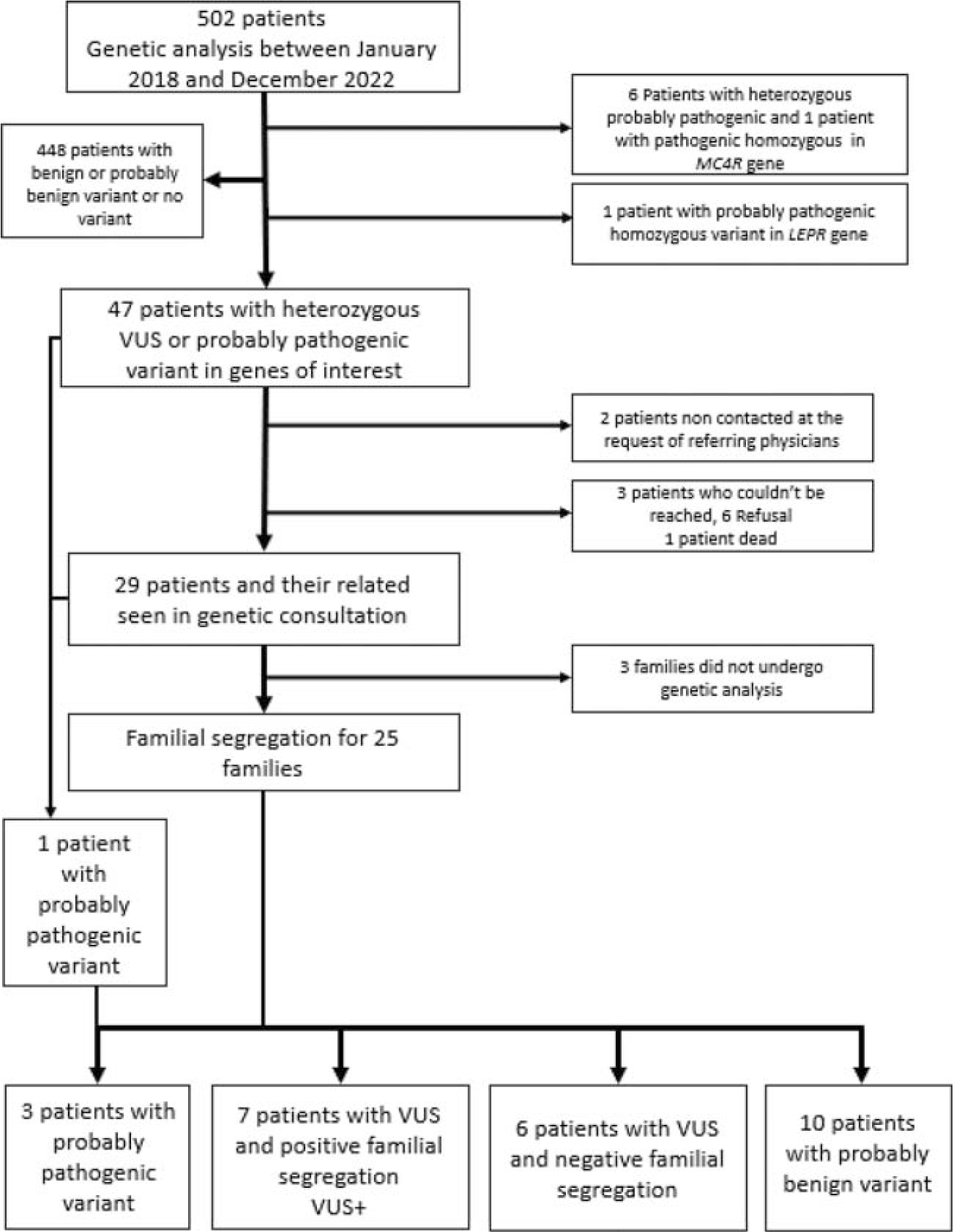
Flowchart.
Twenty-nine patients (64.4%) underwent genetic counseling for family segregation. At the end of the consultation, three families did not perform the analyses. Segregation studies were carried out in 25 families, with an index case with VUS, and resulted in the reclassification of 10 variants as probably benign (40%) and 2 variants as probably pathogenic (8%) (referred to as c4 for class 4), in line with the current literature 13 (Supplementary Data); 6 variants (24%) remained of unknown significance with a negative family segregation but no data in favor of a probably benign trait; conversely, 7 variants (28%) remained of unknown significance with a positive family segregation and no recent publication allowing reclassification, called “VUS+” in our study (Fig. 1). The studies were conducted on living parents of the patients and on adult siblings willing to participate, whether they were with or without obesity. Segregation study was also performed on the family of the patient with a probable pathogenic heterozygous variant in the LEPR gene already identified during the initial analysis for familial information (Fig. 1).
Clinical and Biological Phenotypes of Patients Carrying a Heterozygous Variant in Genes of the LEP–Melanocortin Genes Signaling Pathway
Among the 10 patients with a probable pathogenic variant or a VUS+, 8 patients were women and 9 were children at the time of the first genetic analysis. All patients had a severe obesity, with an BMI greater than or equal to IOTF 35 for the pediatric population. Birth weight was normal for 90% of the patients, with only one patient presenting with macrosomia. Weight trends in all patients showed an early rebound adiposity before the age of 6 years, with a mean age of 2.78 years (range: 1–5 years). Obesity developed on average at the age of 2.79 years (range: 1–7 years,) and morbid obesity, defined by a BMI greater than IOTF 40, developed at the mean age of 3.9 years (range: 1.5–9 years) (Table 1). Patients showed above-average weight growth from an early age (Supplementary Data), with the exception of patients with a variant in the PCSK1 gene, who gained weight after 6 years (Supplementary Data). The LEPR c4 1 patient showed stabilization of BMI after early management in pediatric endocrinology (Supplementary Data). No analysis of energy expenditure or body composition was performed in patients.
Heterozygous Variants and Phenotype of the Study’s Patients
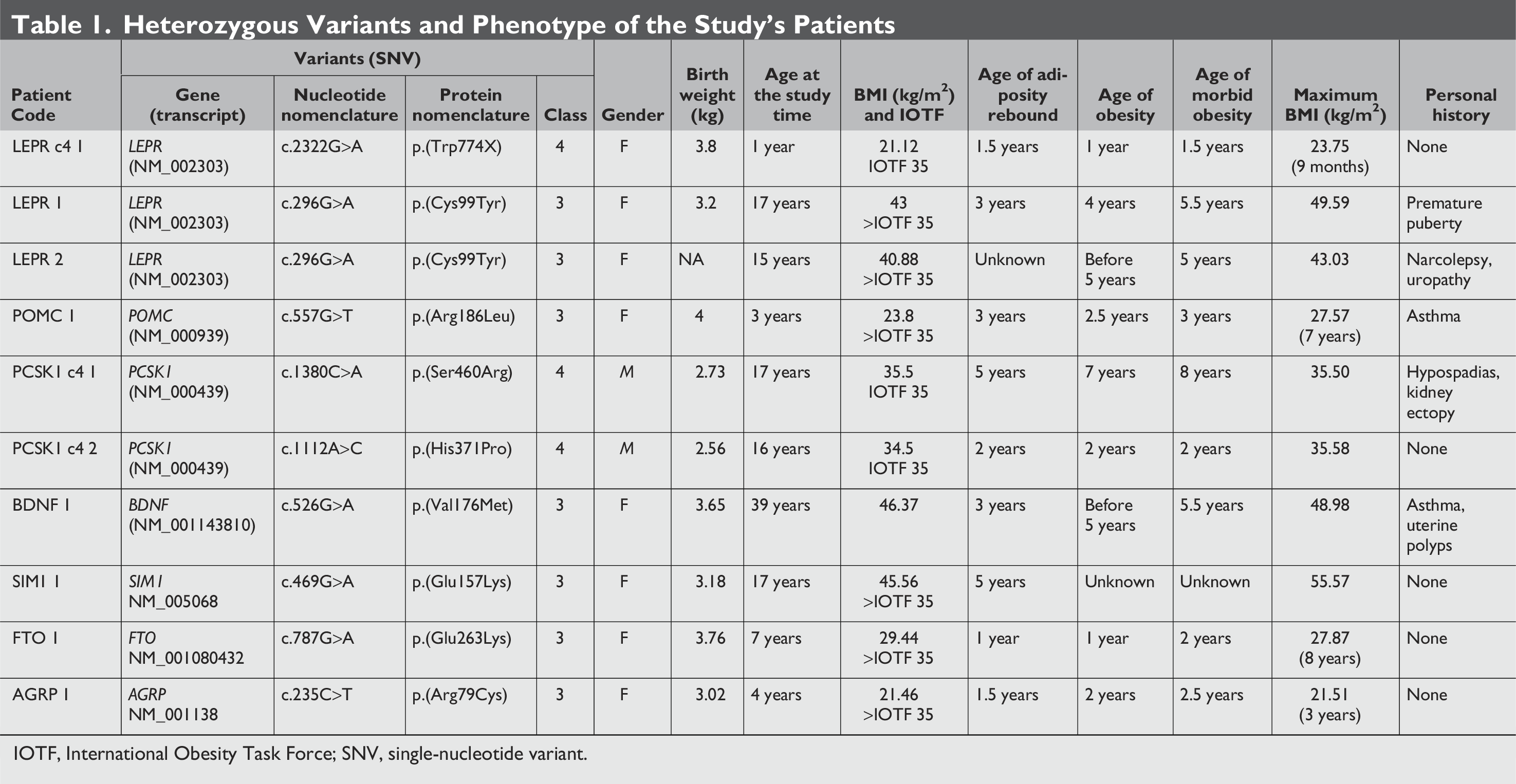
IOTF, International Obesity Task Force; SNV, single-nucleotide variant.
In all but one patient, hyperphagia was described during the dietary interview. Two patients associated their weight gain with psychological disorders, two patients with family difficulties, and one patient with central hypersomnia. Patients’ histories are reported in Table 1. None of the patients had thyroid disorders, pituitary deficiencies such as somatotropic, corticotropic, or gonadotropic deficiencies, or neurodevelopmental disorders. There was a family history of overweight and obesity in 80% of the cases.
Regarding the complications of obesity (Table 2), 80% of patients had insulin resistance with a median Homeostasis Model Assessment of Insulin Resistance (HOMA-IR) score > 2.5 (range: 2.59–12.7), but none had diabetes or carbohydrate intolerance. Lipid biology revealed low-HDL cholesterol in 30% of cases and hypertriglyceridemia in 20% of cases. Three patients had high blood pressure, one patient had sleep apnea syndrome, and only one patient had hepatic cytolysis.
With regard to other biological data (Table 2), none of the patients had hydroelectrolytic disorders, abnormal renal function, or abnormal blood cell counts. Vitamin D insufficiency was found in three patients (out of nine patients, i.e., 33.3%). LEP levels were variable, and no patient had an LEP level above the upper norm available (norms according to the patient’s BMI and the Tanner stage of puberty).
Obesity’s Complications and Biological Results of Patients with Heterozygous Probably Pathogenic or VUS+ Variants in Genes of Interest
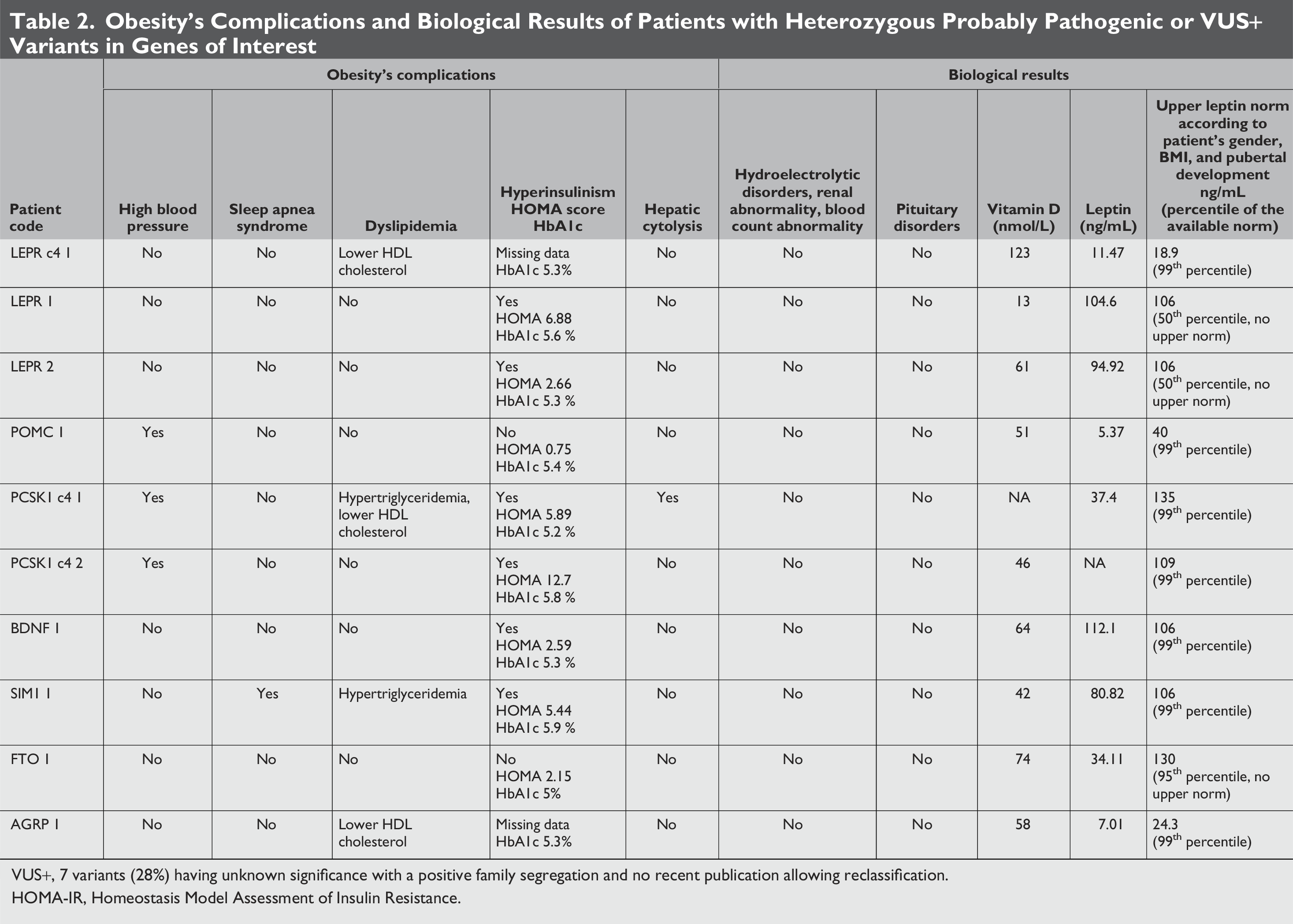
VUS+, 7 variants (28%) having unknown significance with a positive family segregation and no recent publication allowing reclassification.
HOMA-IR, Homeostasis Model Assessment of Insulin Resistance.
Discussion
Our study emphasizes the difficulty of reclassifying heterozygous of unknown significance (VUS) variants in the LEP–melanocortin pathway genes, relying on both literature data and family segregation results. 11 Variant classification is complex due to the limited published data, leading to uncertain diagnoses. In silico prediction algorithms help, but their limitations require using multiple tools. 11 Family segregation aids in classification, but it cannot confirm pathogenicity if limited to first-degree relatives. 11 The absence of segregation suggests a benign variant, although variable penetrance must be considered. 11 Functional or large-scale family studies would indeed be valuable for confirming the pathogenicity of these variants. However, such assays are rarely available and costly. 11
The identification of new variants has been made possible by advances in molecular biology. 14 NGS is faster than the previous Sanger technique, enabling the detection of small variants, as well as larger deletions, insertions, and duplications. CNVs are routinely confirmed using quantitative polymerase chain reaction. 15 Advances in genetic analysis have led to the development of exome sequencing (WES) and whole-genome sequencing (WGS), 16 initially for research and more recently for diagnostics (France Médecine Génomique 2025 plan). WGS detects SNVs, CNVs, deep intronic variants, non-coding region variants, and triplet expansions. This technique offers a high diagnostic yield, although it is variable depending on the condition, and is gaining popularity due to shorter result turnaround times and lower costs.14,16,17
In our study, patients with heterozygous probably pathogenic variants or VUS+ in the LEP–melanocortin signaling pathway genes presented with severe early-onset obesity with no significant endocrine history. As the panel was only analyzed in patients with obesity, we lack data on heterozygosity in normal-weight individuals. Except for MC4R, most monogenic obesity is autosomal recessive, although the impact of heterozygous variants in these genes remains debated. Studies on POMC variants show mixed results: some found no link to severe childhood obesity, while others showed greater obesity in family members with a heterozygous variant.18,19 Some SIM1 variants also follow autosomal dominant inheritance, like MC4R.14,20 Recent studies, including ours, suggest a predisposition to early-onset obesity with heterozygous variants in this pathway. Sket et al. found that heterozygous variants in LEPR and PCSK1 were associated with greater weight by the age of 5 years and earlier obesity before the age of 2 years in POMC heterozygotes. 21 Obesity in heterozygous carriers often favors autosomal dominant inheritance and resembles the MC4R phenotype, with early-onset obesity and fewer pituitary issues.21–23 Isolated obesity without other impairments, such as immune or behavioral disorders, has been seen in patients with heterozygous variants in LEPR, BDNF, and SIM1.7,8,21–25 These findings align with our cohort with the absence of any associated endocrine deficiencies, highlighting the isolated nature of obesity in these patients. Hyperphagia was reported in 90% of our patients, even without questionnaires. While eating disorders are common in heterozygous patients, they are less frequent than in homozygous cases. The effect of heterozygous variants on protein function has also been questioned. Folon et al. showed that PCSK1 variants causing the complete loss of function are pathogenic, while partial effects do not increase obesity risk. 26 These results highlight the importance of interpreting genetic variants to confirm pathogenicity.11,14,22,26
Body shape evolution is a key factor in patients with monogenic obesity. In our study, patients exhibited an early rebound in adiposity, with a mean age of obesity onset at 2.79 years, similar to Courbage et al.’s study, which found an average onset of 3 years. 22 Abawi et al. examined BMI trajectories and found that patients with non-syndromic genetic obesity had a birth weight similar to controls with common obesity. 27 However, body shape increased significantly during the first 2 years of life, and the onset of obesity was notably earlier in genetic obesity, with a median age of 0.6 years for children with biallelic variants. Children with heterozygous variants in the LEP–melanocortin pathway genes developed obesity before the age of 5 years, with a median age of 2.3 years. 27 These findings align with our study, where 90% of patients had normal birth weight and experienced rapid weight gain, with an average obesity onset of 2.8 years. Identifying early adiposity rebound and obesity onset before preschool age explains the higher diagnostic yield of gene panels in pediatric patients in our cohort. 2 Monogenic obesity should be considered in cases of isolated early obesity before the age of 3 years, especially with rapid BMI increase starting around age 1. Diagnosing obesity in adults is more challenging due to the lack of accurate childhood data and a higher environmental influence on the obesity after the age of 18 years.
In our study, patients showed no abnormalities in ion levels or blood cell counts, and 80% had normal serum LEP levels given their sex, body composition, and pubertal stage. LEP, a protein secreted by adipocytes, is positively correlated with body fat percentage in both children and adults. 28 However, excessive LEP can lead to LEP resistance, where it fails to activate satiety signals.28,29 Mechanisms include receptor saturation at the blood–brain barrier, overactivation of LEP-inhibiting enzymes, and hypothalamic inflammation.28,29 High-sugar, high-fat diets can trigger inflammation and oxidative stress, reducing LEP’s effectiveness. 29 In our study, no patients had elevated LEP levels beyond normal limits. These results align with the literature, where patients with homozygous pathogenic variants do not consistently show hyperleptinemia. 10 However, LEP can serve as a marker for obesity-related complications, with high levels linked to metabolic syndrome and cardiovascular disease risk, especially in children.30,31
The majority of our patients exhibited insulin resistance (HOMA-IR score > 2.5) without glucose intolerance or diabetes. With 90% of our cohort under 18, this raises questions about the link between heterozygous variants in the LEP–melanocortin pathway and carbohydrate metabolism. This is consistent with the existing research, which shows that LEP supports carbohydrate metabolism and prevents insulin overproduction. 31 Disruptions in LEP signaling reduce insulin sensitivity and increase blood glucose, contributing to obesity.32–34 LEP regulates insulin sensitivity through the central nervous system, acting on specific POMC neurons to reduce the hepatic glucose production.32,33,35 Our study found LEP levels within normal ranges for sex, Tanner stage, and BMI in 70% of cases but slightly high-normal in three out of seven patients, potentially indicating relative hyperleptinemia and insulin resistance. Monitoring insulin resistance and LEP levels over time could provide further insight.
Our study has the following limitations: first, the small size of our cohort prevents statistical analysis; second, we lacked a control group; and third, there were no biological markers to guide diagnosis. However, our study has several strengths. It focuses on the phenotypic and biological analysis of patients with heterozygous variants likely to be pathogenic or VUS with a higher probability of being pathogenic. It also highlights the challenges in diagnosing monogenic obesity. Our study emphasizes the importance of anamnesis, particularly regarding the evolution of body shape during early childhood. Additionally, it underscores the complexity of family segregation studies, which require physicians or counselors trained in genetic medicine to conduct dedicated consultations.
Conclusions
Our study highlights the complexity of reclassifying heterozygous variants on the LEP–melanocortin pathway genes based on the literature and also on the results of family segregation. Patients in our cohort presented with severe early-onset obesity, on average starting at 2.8 years of age, with no other associated impairment. The evolution of body weight during early childhood therefore appears to be a key element to consider when evaluating patients to guide the diagnosis, a history that is more difficult to recover in the adult population. Accurate identification of patients at risk of genetic obesity is also more difficult in adults, as the environmental component of obesity increases with age.
The diagnosis of genetic obesity due to a heterozygous variant allows early intervention to stabilize weight and is facilitated by advanced genetic techniques, a key development in identifying monogenic obesity over the past 30 years. Patients with very early-onset obesity, without a pathogenic or likely pathogenic variant in the LEP–melanocortin pathway, could also benefit from these evolving methods. When environmental factors alone cannot explain weight gain, especially in pediatric patients, further investigations like exome sequencing for unknown variants or genome analysis for secondary genetic events may help. The development of targeted therapies is also promising. Setmelanotide, an MC4R receptor agonist, has proven to be effective and safe in homozygous patients, and its use in heterozygous patients is being tested in a phase 3 trial (NCT05093634), highlighting the importance of identifying these variants.
Authors’ Contributions
E.D., K.P., and D.C.-C. conceptualized and designed the study, drafted the initial article, and critically reviewed and revised the article. E.D. and B.S. designed the data collection instruments, collected data, carried out the initial analyses, and critically reviewed and revised the article. M.N. and E.D. conceptualized and designed the study, coordinated and supervised data collection, and critically reviewed and revised the article for important intellectual content. All authors approved the final article as submitted and agree to be accountable for all aspects of the work.
Footnotes
Author Disclosure Statement
The authors have no conflicts of interest to declare.
Funding Information
No funding was secured for this study.
Impact Statement
Our study reveals the limitations of genetic research in patients with obesity, particularly the reclassification of variants of undetermined significance. Additionally, our study emphasizes the importance of patients’ weight history, especially during the first years of life, in diagnosing monogenic obesity.
Supplemental Material
References
Supplementary Material
Please find the following supplemental material available below.
For Open Access articles published under a Creative Commons License, all supplemental material carries the same license as the article it is associated with.
For non-Open Access articles published, all supplemental material carries a non-exclusive license, and permission requests for re-use of supplemental material or any part of supplemental material shall be sent directly to the copyright owner as specified in the copyright notice associated with the article.
