




Abstract
A great deal of research has documented racial disparities in imprisonment rates in the United States, but little work has been done to understand the process by which inmates are assigned to individual correctional facilities. This article extends research on racial disparities in imprisonment rates to consider racial disparities in inmate populations across prisons. Specifically, it examines the racial pattern of inmate placement in privately operated and publicly operated correctional facilities. Analysis of American adult correctional facilities reveals that, in 2005, White inmates were significantly underrepresented (and Hispanic inmates overrepresented) in private correctional facilities relative to public ones. Results from multilevel models show that being privately operated (as opposed to publicly operated) decreased the White share of a facility’s population by more than eight percentage points and increased the Hispanic share of a facility’s population by nearly two percentage points, net of facility- and state-level controls. These findings raise legal questions about equal protection of inmates and economic questions about the reliance of private correctional firms on Hispanic inmates.
Introduction
American reliance on imprisonment has grown tremendously since the 1980s. The rate of imprisonment per 100,000 population grew from 139 in 1980 to a peak of 506 in 2007. By 2007, more than 1.5 million people were in prison ( Sourcebook of Criminal Justice Statistics, 2012). While most inmates in the United States are held in government custody (either federal or state), a growing share of inmates is held by firms in the private sector, which entered the field of correctional management in earnest in the 1980s (Logan, 1990). As of 2011, these private correctional facilities held 8% of state- and federal-sentenced prisoners in the United States (Carson & Sabol, 2012).
The high overall imprisonment rate in the United States masks important variation across race. That Blacks are greatly overrepresented in American prisons is by now well known among scholars of law, crime, and punishment (Garland, 2001; Mauer & King, 2007; Western, 2006; Western & Wildeman, 2009). In every year between 2000 and 2010, the Black male imprisonment rate exceeded 3,000 per 100,000 in the population, more than 6 times the highest rate of non-Hispanic White males during the period (487). Hispanics are also overrepresented in American prisons, though to a lesser extent. In every year between 2000 and 2010, the Hispanic male imprisonment rate exceeded 1,100, more than twice the highest rate of non-Hispanic White males during this period (Guerino, Harrison, & Sabol, 2011).
Where do these inmates go once they are sentenced to prison? And, do racially disparate rates of imprisonment translate to racially disparate placement in individual correctional facilities? Previous work has not addressed the racial patterning of inmate placement in correctional facilities. This article does so by comparing the racial demographics of inmates in private and public correctional facilities. Mounting evidence suggests that private correctional facilities lag their public counterparts on a number of dimensions that influence inmates’ conditions of confinement. In light of the Supreme Court’s decision in Johnson v. California (2005), which mandated a strict scrutiny standard of review for racially disparate treatment in prisons, racial disparities in assignment to private facilities have the potential to provoke legal challenges. Multivariate analysis of adult correctional facility data (Bureau of Justice Statistics [BJS], 2009) reveals that, in 2005, White inmates made up a significantly smaller portion of private correctional facility populations relative to public ones. Conversely, Hispanic inmates made up a significantly larger portion of private correctional facility populations than public ones. These findings offer initial evidence of racially patterned—though not necessarily racially motivated—assignments to correctional facilities. They raise legal questions about equal protection of inmates and economic questions about the role of Hispanic inmates in the private corrections industry.
This article first reviews literature on inmate classification, race, and correctional privatization. It then presents several hypotheses that may explain variation in the racial composition of facilities’ inmate populations. After discussing the data, variables, and analytic strategy used to assess variation in inmate populations, the article presents results of descriptive and multivariate analyses. It concludes by considering the implications of these findings and raising questions that should guide future research. The article’s major contribution is to extend research on imprisonment disparities across race to consider racial disparities across prisons.
Inmate Classification and Race
As part of the move to a more actuarial penology (Feeley & Simon, 1992), corrections departments increasingly utilize systematic risk and needs assessments to place inmates in appropriate facilities (Andrews, Bonta, & Wormith, 2006; Austin & Hardyman, 2004; Clements, 1996). The move to objective inmate classification resulted from increasing levels of prison overcrowding, violent prison riots, and related lawsuits over prison conditions (Austin & Hardyman, 2004). Objective classification was (and is) viewed as a means of efficiently managing prison populations in a way that minimizes inmate violence, misconduct, and escapes and maximizes inmate opportunities for rehabilitation (Austin & Hardyman, 2004).
Racial categorization is an important part of the broader inmate classification process. During the classification and intake process, inmates must be designated as belonging to one (or more) racial categories, which are predetermined by corrections administrators. In some cases, inmates interact directly with prison staff to determine the most appropriate racial classification, although the prevalence of such face-to-face interactions is unknown (Goodman, 2008). Racial classification became more important as the inmate population became increasingly non-White and race-based prison gangs became more powerful and violent (Slate, Johnson, & Hemmens, 1999).
The threat of race-based violence long served as a justification for racial segregation in prisons, typically within double-occupancy cells or within cell blocks. The courts historically allowed this practice, deferring to prison administrators on matters of internal security (Noll, 2011; Robertson, 2006; C. R. Trulson, Marquart, Hemmens, & Carroll, 2008). This began to change in 1968, when the Supreme Court ruled in Lee v. Washington that prison administrators may only segregate prisoners by race in “particularized circumstances” when racial tensions and security concerns are present. The Court, though, was vague about what constitutes the “particularized circumstances” that could justify segregation (Slate et al., 1999; C. R. Trulson et al., 2008). A number of cases have been heard in lower federal courts since Lee. These courts have concluded that vague and speculative fears of race violence are not sufficient to continue policies of racial segregation (C. R. Trulson et al., 2008). (As an empirical matter, research has found that racial segregation does not reduce inmate-on-inmate violence and may actually increase it; C. Trulson & Marquart, 2002.) In the 2005 case of Johnson v. California, the Supreme Court ruled that prison administrators cannot use race to segregate inmates except under extraordinary conditions. Importantly, the Court also ruled that the standard for evaluating the use of racial segregation in prison must be strict scrutiny: Racial segregation must be narrowly tailored to achieve prison security and there must be no adequate alternatives (Noll, 2011; C. R. Trulson et al., 2008).
This history of litigation speaks to the practice of racial segregation within prisons. It does not, however, speak to the process by which inmates of various races are assigned to facilities. In particular, it does not address the potential for prison staff to disproportionately send inmates of a given race to private facilities rather than public facilities.
Private Correctional Facilities
For most of the 20th century, incarceration in the United States was the sole responsibility of government, whether at the federal, state, or local level. 1 In the 1980s, governments faced two significant strains on their corrections systems. The first was the previously noted rise in rates of incarceration (Blumstein & Beck, 1999; Raphael & Stoll, 2009; Western, 2006), which swelled prison populations. The second strain was an ascendant market-oriented conservatism that painted government as inept and inefficient and held up the private sector as a superior service provider. Governments at all levels increasingly sought opportunities for contracting with the private sector to provide goods and services (Chi & Jasper, 1998; Fixler, Poole, & Scarlett, 1989).
Private correctional facilities emerged and grew during this time of rising imprisonment and political conservatism. As used in this article, the term “private correctional facilities” indicates correctional facilities operated by the private sector, regardless of facility ownership. In the 1980s, contracting was typically limited to services that were not deemed to be core functions of government, including custodial service, garbage disposal, facility maintenance, and information technology (Auger, 1999; Camp & Camp, 1984). With private correctional facilities, government began contracting with the private sector for the day-to-day operation and management of correctional facilities. A typical contracting process involves a government entity specifying its needs via a request for proposals and private firms submitting competitive bids to win the incarceration duties (cf. Culp, 2009). Typically, the government offers a per diem payment to the winning firm, with the firm attempting to fulfill the requirements of the contract within the confines of the budget (Harding, 1997; Logan, 1990; Price & Morris, 2012). In many contracts, states guarantee that a facility will hold a minimum number of inmates, which buoys up payments to the firm and provides a disincentive to reduce inmate populations in private facilities (In the Public Interest, 2013).
Do private correctional facilities provide higher quality services, as many proponents have claimed? Or, do private firms cut back on necessary expenses in order to maximize profits, as critics have alleged? These questions have driven a great deal of empirical research, although much of this has been lacking in methodological rigor. (See Perrone and Pratt, 2003 for a discussion of the shortfalls of many of these studies.) The more methodologically rigorous analyses have failed to show consistent evidence that private prisons provide superior services. Recent empirical analysis has found that, relative to their public counterparts, private prisons have more inmate misconduct (Camp & Daggett, 2005; Camp & Gaes, 2002; cf. Lundahl, Kunz, Brownell, Harris, & Van Vleet, 2009), offer fewer inmate work assignments (Makarios & Maahs, 2012), generate more inmate grievances (Hulley, Liebling, & Crewe, 2011; Lundahl et al., 2009), offer less training for employees (Blakely & Bumphus, 2004; Lundahl et al., 2009), have higher staff turnover (Camp & Gaes, 2002), and have worse public safety outcomes (Camp & Gaes, 2002; Lundahl et al., 2009). Research has shown mixed evidence or equal performance in terms of inmate assaults (Camp & Daggett, 2005; Lukemeyer & McCorkle, 2006), health care for inmates (Lundahl et al., 2009; Makarios & Maahs, 2012), staff safety (Lundahl et al., 2009), and staffing levels (Makarios & Maahs, 2012). Two areas of private prison superiority are working conditions for employees (Lundahl et al., 2009) and less overcrowding (Makarios & Maahs, 2012). Other research has considered the role privatization has on rates of reoffending after release from prison. Although evidence is somewhat mixed (Lanza-Kaduce, Parker, & Thomas, 1999), the most recent and most sophisticated analyses show that inmates who spend more time in private prisons (vs. public ones) reoffend at higher rates (Duwe & Clark, 2013; Spivak & Sharp, 2008) or about equally (Bales, Bedard, Quinn, Ensley, & Holley, 2005), depending on the sample analyzed.
While the empirical record does not allow for an unequivocal indictment of private prisons (at least in terms of observable measures of service provision quality), it does expose several deficiencies that directly affect inmates (viz., inmate misconduct, vocational opportunities, staff quality). This has legal implications. Overrepresentation of one racial group in deficient private facilities could raise 14th Amendment questions about equal protection under the law, especially in light of the Supreme Court’s ruling in Johnson v. California (2005) that racially disparate practices in prisons must be reviewed under the strict scrutiny standard (Fallon, 2006; C. R. Trulson et al., 2008). Such a review would require corrections agencies to demonstrate that racially disparate assignment to facilities is narrowly tailored to address a specific security problem and that no race-based alternative exists. While merely demonstrating the existence of racially disparate assignment to private (or public) correctional facilities is not sufficient to prove a Johnson violation, the existence of disparities could serve as a justification for a strict scrutiny review in the event of a legal challenge.
Few studies have reported on the racial profile of inmates in private versus public correctional facilities. Those that do so use widely varying data sets and present inmate racial composition as a simple descriptive statistic. Austin and Coventry (2001, p. 41), Blakely and Bumphus (2004), the Sourcebook of Criminal Justice Statistics (2003a), Petrella and Begley (2013), and Petrella (2013) have reported inmate racial disparities between sectors, with Whites typically underrepresented in private facilities. Yet other research has found no significant difference in racial makeup between public and private facilities (Armstrong & MacKenzie, 2003, p. 552; Bales et al., 2005, pp. 70, 73, and 76). Overall, this extant research on racial demographics within correctional facilities has been cursory. Importantly, it has not attempted to explain inmate racial variation across correctional facilities through a rigorous multivariate analysis. The subsequent research does just that by using data on all American adult correctional facilities to examine the racial profiles of inmate populations in private and public correctional facilities while controlling for a rich set of facility- and state-level variables.
Data, Analytic Strategy, and Variables
The BJS (2009) conducts a recurring Census of State and Federal Adult Correctional Facilities, a survey of all American adult correctional facilities in the country that holds primarily state or federal prisoners. The BJS Census covers a wide variety of types of facilities, ranging from very high security confinement facilities to low security rehabilitation facilities that allow inmates to enter the community. It includes data on a variety of institutional factors related to a facility’s inmate population, staffing, programming, security, and facility operations. In 2005, the BJS Census questionnaire asked prison administrators to submit inmate population counts by race and offered the following mutually exclusive categories: “White, not of Hispanic origin;” “Black or African American, not of Hispanic origin;” “Hispanic or Latino;” “American Indian/Alaska Native;” “Asian;” “Native Hawaiian or Other Pacific Islander;” “Two or more races;” and a residual category for “Additional categories in your information system.” Importantly, the BJS Census does not gather data on immigration detention facilities, which have especially high levels of Hispanic inmates (Simanski & Sapp, 2011).
Does inmate racial composition vary between the public and private sectors? If so, what factors might explain this variation? Five hypotheses are presented here and tested in multivariate analyses subsequently. Three address substantive factors (security level, illegal immigrants, and state racial demographics) and two address shortcomings in data validity (noise in the data collection and nonresponse bias).
Security-level hypothesis—Inmates are matched to facilities with security levels appropriate to their objective risk classification (Austin & Hardyman, 2004; Berk, Ladd, Graziano, & Baek, 2003). Private correctional facilities tend to be used for lower risk offenders and they have lower security.
2
If offenders of a particular race are more likely to be sent to lower security facilities, and these lower security facilities are disproportionately private, then any race disparities across sectors may be simply due to differences in security levels.
Immigrant detention hypothesis—Immigrant detention is a big market for private corrections industry (Douglas & Sáenz, 2013; Mason, 2012). The number of detainees held by private firms for Immigration and Customs Enforcement (ICE) tripled between 2002 (4,841) and 2010 (14,814; Mason, 2012). The vast majority of immigrant detainees are Hispanic; Mexican, Guatemalan, Honduran, and Salvadoran nationals made up nearly 88% of admissions to ICE detention facilities in 2011 (Simanski & Sapp, 2011). High levels of immigrants in private facilities may account for any overrepresentation of Hispanics in these facilities. (Although the BJS Census omits facilities operated by ICE, many state, private, and especially Bureau of Prisons [BOP] facilities in the Census hold large numbers of immigrant detainees.)
State racial demographics hypothesis—Private correctional facilities are most prominent in southern and western states (Harrison & Beck, 2005), where Hispanics make up a relatively large share of the population. Given this fact, higher Hispanic inmate populations in private facilities may be a mechanical result of the racial demographics of the state. Thus, the state-level racial profile may explain race differences between private and public facilities.
Noise in the data collection hypothesis—The BJS Census survey instrument allowed respondents to flag population counts (including counts for inmate race) that were estimates rather than exact counts. For White, Black, and Hispanic inmates, the exact population responses were significantly higher than the estimated responses (in t-tests; not shown). If private facilities were more (or less) likely to provide exact inmate counts for a particular race group, they may also report artificially high (or low) counts for that group. To account for any systematic measurement error, the subsequent analysis controls for facilities that provided estimated race population counts.
Nonresponse bias hypothesis—Certain inmate race categories suffered from widespread nonresponse (or “Don’t know”). This was especially true for smaller race categories (Native/American Indian; Asian; Native Hawaiian or Pacific Islander; multiple races; and other) but also for the Hispanic category (missing in 19% of facilities). It is possible that nonresponse in one category influenced the responses in another category. For example, imagine a 100-inmate facility that has one Hispanic inmate but provides a nonresponse in the Hispanic category. The respondent may inflate a different category (say, White) in order to account for the Hispanic inmate who was not marked as Hispanic. If this nonresponse tendency is systematic within the private or public sector, it may lead to artificially inflated or deflated counts of one type of inmate in that sector. The subsequent analysis considers this possibility by accounting for those facilities that provided valid data for all race categories.
The initial analysis of inmate racial demographics in correctional facilities is a basic bivariate description of the data. It considers the unadjusted mean number and proportion of inmates of various races in each facility. Because private facilities tend to be smaller and have a lower security level, a second, multivariate analysis will assess the extent to which these and other confounding factors “explain away” any sectoral differences in inmate racial demographics. The multivariate analysis consists of a series of multilevel models that regress facility-level inmate race proportions on facility- and state-level variables drawn from the hypotheses laid out previously, as well as additional controls. In this analysis, facilities (Level 1) are nested within states (Level 2).
The Level-1 model is given by:

where yij
is the proportion of a given race (White, Black, or Hispanic) in a facility’s inmate population, β0j
is the intercept for state j, β1 is the coefficient for a privately operated facility, private
ij
indicates whether a facility is privately operated,
The Level-2 model is as follows:

where γ00 is an overall intercept,
To assess the security-level hypothesis, the model includes a categorical variable to indicate whether a facility is supermaximum security, maximum (or “close” or “high”) security, medium security, or minimum (or “low”) security (the omitted reference category). To assess the immigrant detention hypothesis, the model includes a variable for the proportion of inmates in a facility that are not U.S. citizens. To assess the state racial demographics hypothesis, the model includes three state-level variables describing the racial profile of a state: proportion of a state that is White (Hispanic or not), proportion of a state that is Black (Hispanic or not), and proportion of a state that is Hispanic (any race). To account for noise in the data collection, the model includes dummy variables for facilities that indicated that their race population count used for the dependent variable was estimated (“[White/Black/Hispanic] estimate flag”). To account for possible nonresponse bias, the model includes a dummy variable indicating whether a state provided complete (nonmissing) data for each inmate race category (full race data). Additional facility-level control variables include whether a facility houses males, females, or both; the (possibly multiple) functions that a facility serves; 4 facility construction date; whether a facility was under a court order to reduce its inmate population; the natural log of the inmate population; and level of facility overcrowding, calculated as the number of inmates in a facility divided by its rated capacity. All facility-level data come from the 2005 Census of State and Federal Adult Correctional Facilities (BJS, 2009). State-level race data come from the 2005 American Community Survey of households, conducted by the U.S. Census Bureau (n.d.). Descriptive statistics for all variables are provided in Table A1 in the Appendix.
Results
According to data from the 2005 Census (BJS, 2009), privately operated correctional facilities and publicly operated correctional facilities varied in the racial makeup of their inmate populations. Table 1 reports the means, sample sizes, and significance levels from t-tests of the number and proportion of inmates by race for public and private facilities. Considering raw population size (Panel A), public facilities had significantly more White, Black, and Hispanic inmates. The larger number of inmates is not surprising, since public correctional facilities are generally larger than private ones. There is no significant difference in the number of inmates in a residual “other” category (note the high incidence of missing values). 5 However, as a proportion of the facility population (Panel B), private facilities had significantly more Hispanics (18.7% vs. 11.4% in public facilities) and “others” (6.1% vs. 2.4% in public facilities), and they had significantly fewer Blacks (36.6% vs. 42.6% in public facilities). The multivariate analysis that follows attempts to “explain away” these sectoral differences in inmate racial demographics by controlling for the factors described previously.
Mean Number and Proportion of Inmates by Race for Public Facilities and Private Facilities, 2005.
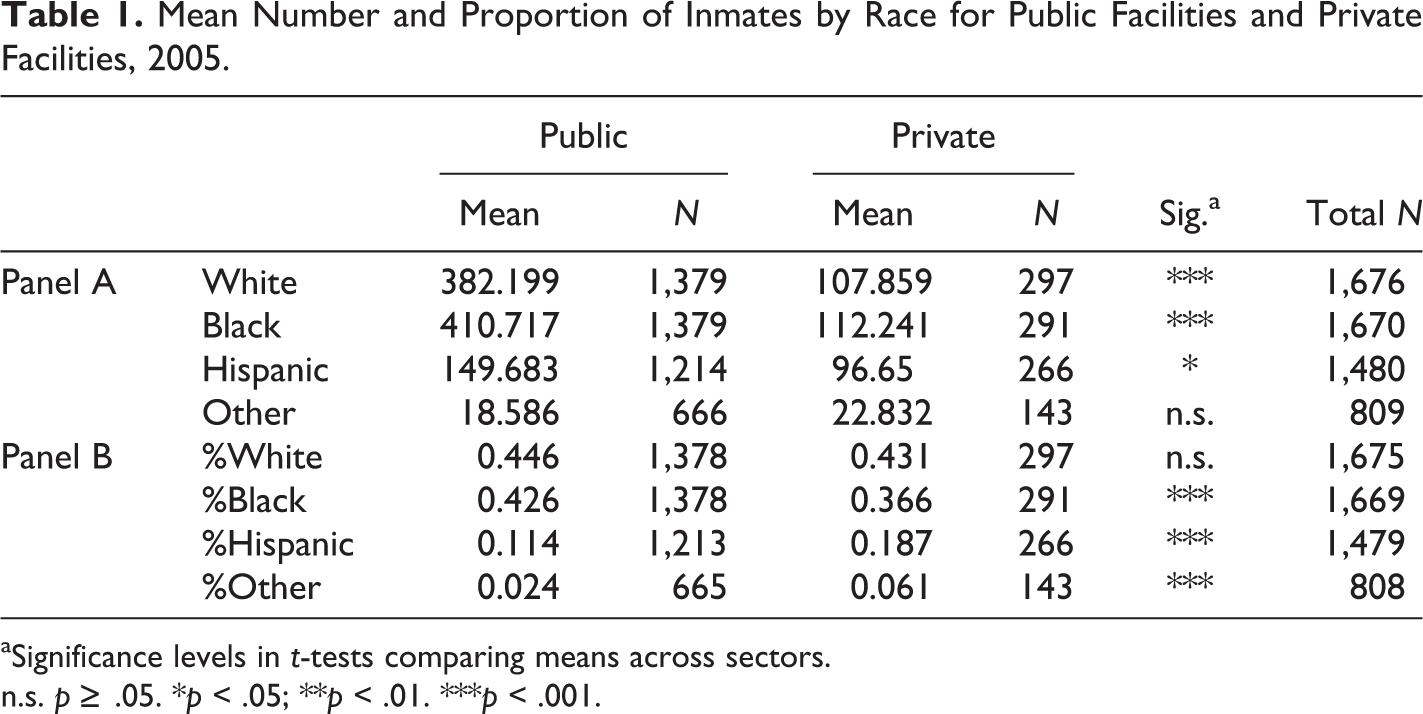
aSignificance levels in t-tests comparing means across sectors.
n.s. p ≥ .05. *p < .05; **p < .01. ***p < .001.
Table 2 presents results from three separate multilevel regressions. 6 The results of the three models suggest systematic variation in inmate racial demographics across sectors, even after accounting for the five hypotheses laid out previously. The inmate risk hypothesis received some support; the physical security level of facilities explained part of the variation in inmate racial composition across facilities. Relative to minimum security facilities, supermax and maximum security facilities had smaller shares of White inmates. Also relative to minimum security facilities, maximum security facilities had larger shares of Black inmates. 7 The immigrant detention hypothesis also received support; the share of non-U.S. citizens in a facility was significantly related to the proportions of Hispanic (positive) and Black (negative) inmates. The state racial demographics hypothesis was strongly supported by the analysis. In each model, the size of a race group in the general population was positively and significantly related to the share of that race group in a correctional facility.
Multilevel Regression of Inmate Racial Proportions in Correctional Facilities, 2005.

Note. Standard errors are adjusted for clustering by state. The following facility-level control variables are included in all models but are omitted from the table: indicator variables for male-only, female-only, or mixed gender population; indicators for various special functions (general adult population, boot camp, geriatric, alcohol/drug, mental, medical, reception, return to custody, and youth); construction year; natural log of year-end inmate population; overcrowding level; and presence of a court order to limit population. Complete results are available by request to the author.
Statistical significance levels: † p < .10. *p < .05. **p < .01. ***p < .001.
The analysis also largely rules out two forms of data problems as confounding factors. The noise in the data collection hypothesis was not supported. Facilities reporting estimated (rather than exact) counts of inmates by race did not have significantly higher or lower proportions of White, Black, or Hispanic inmates. Additionally, the nonresponse bias explanation was not supported in two of the three models. Although many facilities failed to report all race categories, this inconsistent reporting was not systematically related to facilities’ White and Black inmate populations. In the third model, the indicator for complete race reporting was significantly negatively related to Hispanic inmate proportions, although the coefficient for private facilities remained statistically significant. 8
While facilities’ security levels and (to a lesser extent) race reporting practices and states’ racial demographics account for part of the variation in inmate race composition across correctional facilities, these factors cannot explain away the differences in racial composition between the public and private sector. Private sector facilities were significantly less White and more Hispanic than their public counterparts. Specifically, the percentage of White inmates in private facilities was more than eight points lower than in public facilities, and the Hispanic percentage of inmates in private facilities was nearly 2 points higher than in public ones, net of other confounding factors at the facility and state levels. Additionally, the 2½ point difference in Black inmate proportion across sectors was marginally statistically significant. If Black inmates and Hispanic inmates are combined, their share of the inmate population in private facilities is estimated to be more than four percentage points higher than in public facilities (b = .0425, p < .01), net of facility- and state-level factors (results available upon request).
The multilevel models can be used to generate average predicted inmate race compositions of private and public correctional facilities at different security levels (see Figure 1). For each model, these predictions represent the average of all predicted inmate race proportions over all facilities, varying the private and facility security variables and taking all others as observed. (Predicted values for the supermaximum security level are not presented because no private supermaximum facilities exist in the data.) As predicted by the White model, the White share of a facility’s inmate population declines as the physical security level increases. At the minimum and medium security levels, White inmates make up roughly 48% of public facilities and 39% of private facilities. At the maximum security level, White inmates make up approximately 43% of public facilities and 35% of private ones. A facility’s share of Black inmates increases with the physical security level, but, as seen in the previous model, the difference between public and private facilities is small (b = .0266) and only marginally statistically significant (p < .10). Across security levels, the Hispanic share of a facility’s inmate population is approximately 13% in public facilities and 15% in private facilities, a two percentage point disparity. Considering the disparity as a proportional difference, the models predict that Hispanic inmate proportions are roughly 15% higher in private facilities relative to public ones
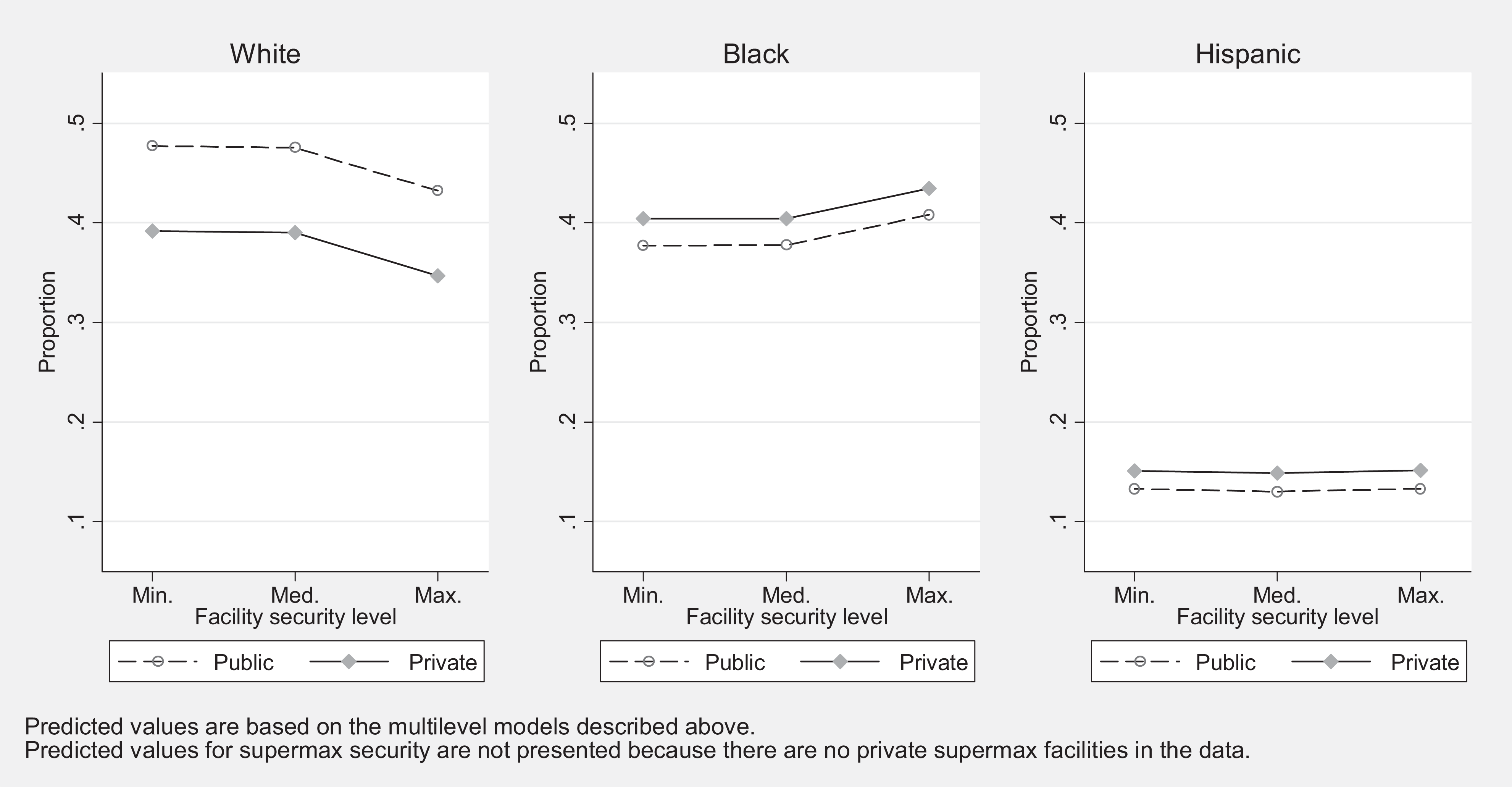
Predicted inmate racial composition of public and private correctional facilities, by physical security level, 2005.
Alternative Explanations
Other possible explanations of these private–public race disparities relate to race recording practices across sectors, out-of-state inmate transfers, federal facilities, and Hispanic inmate outliers. These alternative explanations were not directly tested in the previous analysis but are considered here.
Recording Differences Across Sectors
One explanation of these findings is that private correctional facilities are more likely than public ones to classify and record an inmate as Hispanic (and less likely to record an inmate as White). This scenario seems unlikely. A number of different private operators are represented in the data, including for-profit firms (e.g., Cornell, Corrections Corporation of America [CCA], GEO, and others) and nonprofit organizations (e.g., The Salvation Army, Dismas Charities, Volunteers of America, and others). While there may be differences in race recording practices between a private operator and a government corrections authority, it is not likely that all private operators would differ in race recording practices in a way that would systematically underrepresent White inmates (and overrepresent Hispanic inmates). Furthermore, there is likely to be just as much variation in race recording practices among public facilities, even within a single state, as there is across sectors. Goodman’s (2008) case study illustrates this possibility by describing how inmate race categories on intake paperwork varied between two publicly run reception centers in a single state (California).
Out-of-State Transfers
Another possible explanation for Hispanic overrepresentation in private correctional facilities involves the practice of sending state inmates to be held in out-of-state facilities. If states with large Hispanic populations (and large Hispanic inmate populations) shipped out large numbers of Hispanic inmates to out-of-state private facilities, then Hispanic inmate populations in receiving states would be inflated and this inflation would not be captured by the in-state racial demographic variables used in the previous models. A 2006 survey (LIS, 2006) asked state corrections administrators to describe their practices of sending inmates out of state. Results suggest that states with large Hispanic populations did not export inmates to private facilities in other states. For example, California, Texas, Arizona, and New Mexico all sent inmates out of state but only to state or federal facilities. Conversely, states that did ship inmates to out-of-state private facilities were very White (e.g., Vermont, Washington, Wyoming, North Dakota, and Alaska). This pattern casts doubt on the ability of inmate transfers to influence other states’ private correctional populations. 9
Federal Facilities
In addition to facilities operated by states and by private contractors, the main sample includes facilities operated by the federal BOP. Including these facilities in the analysis presents two potential problems: high immigrant populations and race recording practices. First, BOP facilities have a large immigrant inmate population; in the sample, approximately 20% of inmates in federal facilities were not U.S. citizens (compared to 16% for private facilities and less than 5%for state facilities). Second, these federal facilities (with one exception) did not use a distinct “Hispanic” race category. Instead, any ethnic Hispanic inmates were included in another race. This has the effect of inflating non-Hispanic inmate counts in these public facilities. Including publicly operated federal facilities in the analytic sample may therefore result in private facility coefficients that are biased downward for White and Black models and biased upward for the Hispanic model. A supplemental analysis omitted all federal facilities from the models (see Sample 4 in Table A2) and the results generally confirm those from the main model. In private facilities, White inmate population shares were 5.64 percentage points lower (p < .001), Black inmate shares were 2.69 percentage points higher (p < .05), and Hispanic inmate shares were 1.80 percentage points higher (p < .01) relative to public facilities, net of all other variables in the model.
Outliers
Some states had facilities that were outliers with respect to Hispanic proportion of inmates. Across the 1,346 correctional facilities in the sample used to estimate the previous Hispanic model, 13% of inmates were Hispanic (see Table A1). However, three states (California, New Mexico, and Texas) had at least one private facility (and no public facilities) that had between 80 and 100% Hispanic inmate populations. 10 (Texas had eight such facilities.) Is the relationship between private facility operation and Hispanic population attributable to one of these states with outlier facilities? Rerunning the model for Hispanic inmate proportion and sequentially omitting these three states change the results only slightly (see Samples 5a–c in Table A2). Omitting California’s 83 correctional facilities produces a coefficient for private facilities that is very similar to the previous main model (b = .0180; p < .01). Omitting New Mexico’s nine facilities yields the same result. Removing Texas’s 123 facilities reduces the coefficient for private facilities (b = .0157), but it remains statistically significant (p < .05). Thus, while Texas is influential in the analysis of Hispanic inmate populations, it alone cannot explain the overrepresentation of Hispanic inmates (and underrepresentation of White inmates) in private prisons.
Discussion and Conclusion
A growing body of research has documented the many ways in which criminal justice is apportioned unevenly across racial categories. Racial minorities experience greater exposure to law enforcement (Beckett, Nyrop, & Pfingst, 2006; Fagan, Davies, & Carlis, 2012), harsher sentences (Mitchell, 2005; Stolzenberg, D’Alessio, & Eitle, 2013), higher rates of imprisonment (Western, 2006), and a variety of postprison collateral consequences (Manza & Uggen, 2006; Pager, 2007; Wakefield & Wildeman, 2011). The present research points to a new manifestation of racial disparity in criminal justice: assignment to correctional facilities. The tremendous growth of imprisonment rates since the 1980s facilitated the emergence of a modern private corrections industry, in which governments contract with private firms (either for profit or not for profit) to take over management of correctional facilities (Logan, 1990; Selman & Leighton, 2010). A growing body of empirical evaluation research on the performance of private corrections increasingly casts the industry in a negative light. At best, the industry has failed to consistently provide better services at lower costs (Bales et al., 2005; Camp & Daggett, 2005; Lukemeyer & McCorkle, 2006; Duwe & Clark, 2013; Lundahl et al., 2009; Makarios & Maahs, 2012). And, in many cases, sophisticated evaluations demonstrate that privately operated correctional facilities perform worse than their public counterparts (Camp & Daggett, 2005; Camp & Gaes, 2002; Duwe & Clark, 2013; Lundahl et al., 2009; Makarios & Maahs, 2012; Spivak & Sharp, 2008).
This article is the first to use rigorous, multivariate techniques to document systemic racial differences in the inmate populations of public correctional facilities and private correctional facilities. The inmate populations in private facilities are significantly less White (by more than eight percentage points) and more Hispanic (by nearly two percentage points) than their public counterparts. Conversely, public correctional facilities have proportionately larger White and smaller Hispanic populations relative to private facilities. These differences persist even after accounting for confounding factors at the facility level and the state level, and (for the White analysis) they are robust to changes in the analytic sample (see Table A2).
Because this set of findings is new in the research literature, this article ends by raising a series of questions to guide future inquiry. The first question bears directly on the validity of the results: Are there omitted variables that would “explain away” the racial disparities seen here? The current research lacks inmate-level data. Each individual inmate is unique, and placement into a facility may in fact be the result of a particular set of personal characteristics (e.g., risk level, programming needs, previous behavioral problems, gang affiliation, etc.) unrelated to race. While individual characteristics may explain the racial pattern observed here, it is unlikely. Individual factors are used to match inmates to facilities, and as a result, there is a high correlation between individuals’ risks and needs, which are omitted from the models, and the accommodations provided at a particular facility, which are included in the models (e.g., high-risk inmates tend to be placed in facilities with higher levels of security). One factor unrelated to risk and needs assessments, which cannot be captured by the facility-level data, is inmates’ place of last residence. Corrections authorities may try to place inmates closer to their home base, all other things being equal (e.g., Arizona Department of Corrections, n.d.; Bureau of Prisons, n.d.; Michalsen, Flavin, & Krupat, 2010, p. 585; New York State Senate, 2013). If private prisons are disproportionately placed in Hispanic areas within states, then this would explain Hispanic concentration in the private sector. Likewise, if public prisons are disproportionately located in White areas within states, this would explain White concentration in public facilities. This explanation cannot be tested with the aggregate data used in this analysis, but it merits further examination.
The second question deals with legal protections of inmates. The phenomenon of race-patterned inmate assignment documented here is not a case of inmates being assigned to facilities solely on the basis of race, which would raise obvious constitutional questions (C. R. Trulson et al., 2008). Nor is this a case of racial segregation within prison cells, which has been largely undermined by court cases from Lee v. Washington (1968) to the more recent Johnson v. California (2005). Rather, what is observed here is a pattern of racially patterned assignment to correctional facilities that cannot be explained by numerous facility or state characteristics. Given increasing evidence of deficiencies in the private corrections sector, correctional administrators should consider the possibility that such racial imbalance in inmate placement across sectors may bring legal challenges on the basis of inmates’ equal protection guarantees under the 14th Amendment. This issue is particularly germane in light of Johnson v. California (2005), in which the Supreme Court decided that all inmate housing decisions based on race must be evaluated under a standard of strict scrutiny. Using this standard, a policy of racialized housing assignment would be acceptable only if it is narrowly tailored to achieve prison security goals and no adequate alternatives exist (C. R. Trulson et al., 2008). The analysis presented here does not speak directly to the merits of any such claim—that is, that racial patterns are not narrowly tailored to maintain security and that no alternatives exist. After all, any particular case of an alleged violation may very well be explained by a legitimate, race-neutral facility assignment process. However, the results of this analysis should sensitize litigation-weary corrections officials, as well as criminal justice researchers, to the issue of racial balance across facilities.
Another question deals with the role of Hispanic detention in the modern private corrections industry. Immigrant detention—which overwhelmingly affects Hispanics—has become a growth area for private corrections firms. In 2011, the two largest private corrections companies generated 20% (CCA) and 14% (GEO Group) of their revenues from contracts with ICE (Mason, 2012). The exact role that private corrections companies play in immigration law is unclear. Arizona was recently the first in a series of states that proposed or enacted tough state immigration laws to clamp down on undocumented immigrants. In 2009, Arizona state senator, Russell Pearce, drafted the bill that would become SB1070, which charged state law enforcement officers with verifying the immigration status of those suspected of being in the country illegally. The bill soon became a piece of model legislation in the American Legislative Exchange Council (ALEC), a partnership of conservative legislators and businesses, of which CCA and GEO Group are members (Hodai, 2010; Sullivan, 2010). The model legislation was soon introduced in other states (Mason, 2012; Sullivan, 2010). In addition to the model legislation offered by ALEC, private corrections firms have lobbied and made financial contributions to elected government officials, many of whom sponsor or support toughened immigration legislation (Detention Watch Network, n.d.; Douglas & Sáenz, 2013; Golash-Boza, 2009; Mason, 2012; Sullivan, 2010). Critics claim that these actions are intended to put more immigrants into private detention facilities (e.g., Carlsen, 2012; Cervantes-Gautschi, n.d.; Hodai, 2010). For its part, CCA, the largest private prison company, denies any involvement in creating or altering sentencing or detention legislation (CCA, 2013).
Whether the industry actively influences sentencing and detention policy is unclear. What is clear, however, is that Hispanic detainees and inmates play a significant role in the private corrections industry. Is there a nexus between the temporary detention of (mainly Hispanic) immigrants in private immigrant detention centers and the longer term custody of Hispanics in private correctional facilities? Are immigrants held in private immigrant detention centers being shuttled to private correctional facilities after being convicted of a crime? Are undocumented immigrants who are incarcerated in private correctional facilities being transferred to private immigrant detention facilities to await deportation? These questions deserve further investigation.
The final question is perhaps most important: What is the mechanism that could account for such a systemic pattern of racial inmate placement? There are three possibilities. First, White inmates may self-select into public facilities (and Hispanic inmates may self-select into private facilities) for some unknown reason. This account seems unlikely, as inmates cannot freely select their facilities. Second, government corrections officials responsible for inmate classification and assignment may systematically shunt Hispanic inmates to private facilities. According to a National Institute of Corrections report on prisoner classification (Austin & Hardyman, 2004, p. xii), a “general standard is that 5–15 percent of a prison population’s custody levels are based on discretionary overrides” rather than objective inmate classification scores, meaning that assignments to facilities may occur by fiat rather than objective classification in some instances. It is not immediately clear why Hispanics would systematically be diverted to the private sector (or Whites retained in the public sector), but one possibility may involve fear of racial or gang violence. (Such fears, however, have more typically influenced cell assignments, not facility assignments; Noll, 2011.) Third, private corrections firms may somehow prioritize Hispanic inmates. Theoretically, this could happen through a clause in the government contract that facilitates more Hispanic inmates being assigned to private facilities (by virtue of some objective, nonracial criteria; e.g., behavioral problems, programming needs, security, etc.) or through the private operator sending non-Hispanic White inmates back to government authorities (again, by virtue of some other criterion). 11
While this article cannot answer these critical questions, it does offer an initial foray into the racial demographics of private correctional facilities and the racially patterned placement of sentenced offenders. Systematic underrepresentation of Whites (and overrepresentation of Hispanics) in private correctional facilities can be added to the growing list of racial disparities in the American criminal justice system. This finding should serve as a catalyst for further empirical research on how race operates in the private corrections industry, an issue that deserves the attention of researchers, policy makers, and corrections administrators.
Footnotes
Appendix
Multilevel Regression of 2005 Inmate Racial Proportions in Correctional Facilities, Various Samples.
| White | Black | Hispanic | |||||||
|---|---|---|---|---|---|---|---|---|---|
| Sample | b | Sig. | N | b | Sig. | N | b | Sig. | N |
| 1: All available facilities | −.0855 | *** | 1,525 | .0266 | † | 1,521 | .0183 | ** | 1,346 |
| 2a: Maximum security facilities a | −.0918 | *** | 333 | .0009 | n.s. | 333 | −.0131 | n.s. | 306 |
| 2b: Medium security facilities a | −.0383 | * | 446 | −.0035 | n.s. | 445 | .0105 | n.s. | 394 |
| 2c: Minimum security facilities a | −.0842 | *** | 726 | .0330 | † | 723 | .0113 | n.s. | 630 |
| 3: Facilities with complete race data b | −.0631 | *** | 701 | .0336 | * | 701 | .0089 | n.s. | 701 |
| 4: No federal facilities | −.0564 | *** | 1,432 | .0269 | * | 1,428 | .0180 | ** | 1,344 |
| 5a: No California | −.0715 | *** | 1,433 | .0213 | n.s. | 1,429 | .0180 | ** | 1,263 |
| 5b: No New Mexico | −.0869 | *** | 1,516 | .0267 | † | 1,512 | .0180 | ** | 1,337 |
| 5c: No Texas | −.0842 | *** | 1,392 | .0379 | ** | 1,388 | .0157 | * | 1,223 |

Note. Multilevel models with random state intercepts. Dependent variable is proportion of inmates in a facility listed as a given race. Column “b” represents the coefficient for the private facility dummy variable. Column “N” represents the number of facilities included in the estimation sample. Unless noted otherwise, the models control for complete inmate race data; facility security level; race-specific inmate population estimate flags; categorical variable for male/female/both inmates; indicators for general adult population, medical, boot camp, geriatric, alcohol/drug, mental health, reception, return-to-custody, and youth functions; year of construction; year-end total inmate population (ln); overcrowding; presence of a court order to reduce population; and state-level White, Black, and Hispanic population shares. aFacility security level omitted. bIndicator for complete race data omitted.
Statistical significance levels (“sig.”) are calculated using state-clustered standard errors and are indicated as follows: † p < .10. *p < .05. **p < .01. ***p < .001.
Author Notes
This work was presented at the OSU School of Public Policy Research Colloquium on January 18, 2013, and the annual meeting of the American Sociological Association on August 11, 2013. I received helpful feedback on early iterations of the article from Pamela Oliver, Paul Hanselman, Scott Akins, and Matt Palm. All errors are my own.
Declaration of Conflicting Interests
The author(s) declared no potential conflicts of interest with respect to the research, authorship, and/or publication of this article.
Funding
The author acknowledges support from the Oregon State University Faculty Release Time Grant, which facilitated the research used in this article.