



Abstract
Although using personal electronic devices to record police–public encounters has surfaced as an important social phenomenon that could potentially shape public perceptions of the police and police–community relations, very little research has investigated factors affecting people’s willingness to record the police. Using survey data collected from two universities, this study assessed whether race/ethnicity and social and legal consciousness influence college students’ inclination to record public interactions with the police. Results indicated that minority students and those who believed that recording served social justice, had a deterrent effect on the police, and was legally justified were more likely to engage in such behavior. Past recording experience and negative encounters with the police also led to higher levels of willingness to record police activity. Implications for policy and future research are discussed.
Keywords
Introduction
It was over 20 years ago when George Holliday used a Sony Handycam video recorder outside of his apartment building in Los Angeles to videotape four police officers brutally beating a man (Kies, 2011). That man was Rodney King, and the now infamous 8-min long recording sparked outrage about police misconduct and race relations across the nation (D. Robinson, 2012; Turley, 2011). Since the early 1990s, the realm of technology has soared and evolved, making available an array of new gadgets and handheld devices that can easily capture video footage. Along with the newfound and increased use of technology, there has been a substantial growth in people recording the police (Kies, 2011), accompanied by a notable rise in the prosecution under state wiretapping laws of citizens who have recorded the police (Bodri, 2011; Cerame, 2012; Kies, 2011; Mishra, 2008; D. Robinson, 2012).
One of the first such cases involved Simon Glik, a Boston attorney who used his cell phone to record police officers arresting another citizen in October 2007. Glik was arrested and charged under the state wiretapping law, in addition to disturbing the peace and aiding in the escape of a prisoner. Charges against Glik were later dropped and he filed a constitutional tort suit against the arresting officers and the city alleging violation of his First and Fourth Amendment rights (Hudson, 2012). Similar cases occurred in Chicago, where Tiawanda Moore and Christopher Drew were arrested for secretly audio recording their separate encounters with the police (Terry, 2011, January 22). In 2011, Moore was acquitted of felony eavesdropping charges, and in 2012, a Cook County judge ruled in Drew’s favor, stating that the eavesdropping law was unconstitutional. In spring 2014, the Illinois Supreme Court declared the eavesdropping law on the books unconstitutional (Schmadeke, 2014).
In the United States, it is completely legal to record the police in 38 states, with the 12 remaining states (California, Connecticut, Florida, Illinois, Maryland, Massachusetts, Michigan, Montana, Nevada, New Hampshire, Pennsylvania, and Washington) requiring all-party consent under wiretapping or eavesdropping laws. Even in these 12 states, with the exception of Illinois and Massachusetts, the law has a provision for reasonable expectation of privacy (Silverman, 2012). Therefore, recording the police is still legal if they are on-duty in a public space. Even though recording the police is legal, a person might still be arrested for obstruction of justice or similar misdemeanor, although charges related to recording the police are almost always dismissed (Balko, 2014; Silverman, 2012).
The purpose of this study is to assess racial and nonracial factors that influence citizen willingness to record police–public encounters. Recording people’s interactions with the police has surfaced as a vital social phenomenon in recent years as scores of such videos have appeared on popular social networking and news websites, potentially reaching millions of viewers and impacting public perceptions of the police (Calanan & Rosenberger, 2011; Chermak, McGarrell, & Gruenewald, 2006; Walker & Archbold, 2014; Weitzer & Tuch, 2006). Scholars have referred to such public behavior as “citizen journalism,” where an ordinary person actively engages in recording, generating, and disseminating newsworthy events to confront issues of social injustice and police accountability with technology such as cell phones (Antony & Thomas, 2010; Greer & McLaughlin, 2010). Citizen journalism happened during the incidents involving Oscar Grant in Oakland, California, in 2009 and Eric Garner in New York City in 2014, who both died during their encounters with the police. Although the mainstream media tends to be scrupulously neutral in tone or promote pro-police perspectives, citizen journalists counter the status quo with visual evidence (Greer & McLaughlin, 2010).
Not surprisingly, whether the public should be permitted to record police activity has sparked considerable debates and litigations. Proponents posit that the use of cameras to record police–citizen encounters is a constitutional right that can serve as a powerful tool to curb police misconduct and enhance police accountability (Jeffries, 2011; Kies, 2011; Mishra, 2008; D. Robinson, 2012; Walker & Archbold, 2014). The recording of police can improve public respect for law enforcement and police effectiveness and has actually changed how police do their jobs (Potere, 2011; Schaefer, 2012). Indeed, police departments have become increasingly aware of the impact of citizen journalism on public perceptions of police legitimacy and authority (Greer & McLaughlin, 2010). Those who oppose using personal devices to record police–citizen encounters contend that it can obstruct police duties or unfairly influence public opinion and misrepresent police work (Jeffries, 2011; Kies, 2011). Furthermore, citizens seeking vigilante justice might even go so far as to harass police officers who have been recorded engaging in misconduct (Kies, 2011; D. Robinson, 2012).
Given the ubiquitous role of recording devices in highlighting contemporary popular culture and the crucial role of public recording in enhancing police accountability, it becomes correspondingly important to understand how citizens view the use of recording devices in capturing police actions. Most literature to date has focused narrowly on constitutional rights and privacy concerns of recordings (Alderman, 2010; Bodri, 2011; Cerame, 2012; Jeffries, 2011; Kies, 2011; Mishra, 2008; Potere, 2011; D. Robinson, 2012; Schaefer, 2012). Although this line of research improves knowledge about people’s rights in recording the police and officers’ legal and illegal responses to such action, it fails to address the motivations of those who are willing to take the recordings and why they engage in such behavior. This study attempts to fill this void in the existing literature.
The connections between people’s race/ethnicity and social and legal consciousness and their decisions to record the police are of particular interest. The racialized nature of American policing has long been recognized, with Blacks being more likely to be subject to police coercive control, such as arrests and traffic stops (Eith & Durose, 2011; Snyder, 2011) and having less favorable attitudes toward the police than their White counterparts (Brown & Benedict, 2002; Wu, Sun, & Triplett, 2009). African Americans thus may be different from White Americans in their inclination to record encounters with the police. Besides race and ethnicity, there is an expectation that people’s judgments to record police–public interactions will be linked to their social and legal consciousness, including their sense of social justice, belief in the deterrent effect, and consideration of legal justifications. Like other forms of behavior, people are more likely to engage in recording the police when they believe that their action is morally and legally justified. Morality promotes good acts by creating virtuous feelings and praise, whereas the law inhibits bad acts by threatening to use sanctions (Shevell, 2002). Studying these possible contributing factors will improve the understanding of baseline information pertaining to an emerging and critical social phenomenon.
Using survey data collected from college students at two universities, the study addresses the following three key research questions.
By exploring racial and nonracial factors that may influence public decisions to record police interactions with the citizenry, this study can generate important implications for policy makers and police administrators to design and implement policies and programs aimed at strengthening police accountability and police–community relations. Recording police can be used not only to expose misconduct but also to legitimize the policing profession, improve trust in law enforcement, and ultimately increase police effectiveness (Kies, 2011; Potere, 2011). Police legitimacy is important in problem-oriented policing and effective crime control (Bayley, 2002; Walker, 2007). This study provides a necessary first step to examine how new technology is being used to enhance oversight of the police in communities.
Factors Influencing Decisions to Record the Police
Public’s willingness to record police–citizen encounters could be influenced by a number of factors. This study focuses on four groups of predictors: race/ethnicity, sense of social justice, belief in the deterrent effect, and consideration of legal justifications.
Race and Ethnicity
Race is arguably one of the most salient features in grounding social relationships and control strategies in America (Higginbotham & Anderson, 2012). Previous research has yet to formulate a theoretical linkage between people’s racial and ethnic background and their inclination to record encounters with the police. Fortunately, theoretical frameworks have been well articulated to account for racial/ethnic disparity in public assessments of legal authorities and injustice, which can be reasonably extended to explain the relationship between race/ethnicity and willingness to record police–citizen encounters. Originating from social psychology (Berger, Zelditch, & Anderson, 1972; Deutsch & Krauss, 1965; Runciman, 1966), the sense-of-injustice model, for example, posits that public evaluations of criminal justice agencies are profoundly affected by the feeling of being treated unjustly by the gatekeepers of the system, police officers (Wu et al., 2009). African Americans tend to display less positive attitudes toward legal authorities (Brunson & Miller, 2006; Longazel, Parker, & Sun, 2011; Lundman & Kaufman, 2003; Weitzer & Tuch, 2002) because they are likely to have personal or vicarious experiences of unequal treatment by the criminal justice system in general and the police in particular, leading to a higher level of sense of injustice among Blacks (Anderson, 1999; Brunson, 2007). Indeed, the disproportionality by race in arrests, use of deadly force, and traffic stops has a negative impact on minority and poor communities and casts serious doubt about the impartiality of policing among Blacks (Barlow & Barlow, 2000; Justice Policy Institute, 2012; Walker, Spohn, & DeLone, 2007).
The central propositions of the sense-of-injustice model are parallel to the arguments of comparative conflict theory, which proposes that Blacks perceive more injustice than any other racial category, and minorities who have contacts with the criminal justice system are differentially impacted and their perceptions change from these experiences (Hagan, Shedd, & Payne, 2005). Minority citizens frame their perceptions of injustice from a historical and social perspective, which tend to be formed during their youth. This theory also proposes that Hispanics should perceive less injustice than African Americans, because not only do Hispanics have a less intensive history of discriminatory treatment within the United States, but also because Whites and their agents of social control tend to view Hispanics as less threatening than African Americans due to their lighter skin tone (Buckler & Unnever, 2008; Buckler, Unnever, & Cullen, 2008; Hagan et al., 2005).
The sense-of-injustice thesis also echoes findings from studies on procedural justice which suggest that people’s perceptions of local legal authorities, including the police, are primarily shaped by whether they perceive such agencies as fair and equitable in both the procedures for making decisions and the outcomes of the decisions (Tyler, 1990). Additionally, people’s perceptions of legitimacy are also influenced by perceived fair distribution of police services (so-called distributive fairness or justice) across individuals and/or social groups/communities. Distributive fairness, however, is argued to play a less salient role than procedural justice in shaping police legitimacy (Sunshine & Tyler, 2003; Tyler & Huo, 2002). Studies have shown that Black Americans’ perceived legitimacy of police interventions is lower than their White counterparts. In 2008, for example, a quarter (25%) of Black drivers believed that the police did not have a legitimate reason for stopping them, compared to 13.7% of White and 17.5% of Hispanic drivers (Eith & Durose, 2011). Low perceptions of police legitimacy may lead to low legal compliance and cooperation with the police, poor police–community relations, and even more deviant and criminal behavior (Anderson, 1999; LaFree, 1998; Tyler, 2003).
Past research has consistently found that racial minorities, African Americans in the case of much of the research, are more inclined to perceive injustice (Buckler et al., 2008; Hagan et al., 2005) and rate the police less favorably than Whites (Brown & Benedict, 2002; Weitzer & Tuch, 2006; Wu et al., 2009). Having a strong sense of procedural injustice and a lower perceived legitimacy of police control, minorities may seek ways to minimize the potential risk associated with their personal and fellow citizens’ contacts with the police. For many young minorities with smartphones, recording self or other people’s encounters with the police may become one of their options to fight against possible mistreatment by the police. It is therefore hypothesized that racial/ethnic minorities tend to show a higher degree of willingness than nonminorities to record police–citizen encounters.
Sense of Social Justice
It has long been argued that human behavior is guided by utilitarianism, which stresses maximizing total benefit and reducing costs or suffering associated with the course of an action (Bentham, 2001). The morally right action is the one that generates the overall good, including the good for oneself and the good for others. Applying Bentham’s utilitarian principle to the issue under consideration, people are more willing to record police–citizen encounters if the act of recording is perceived to be morally correct or culturally acceptable and can produce such benefits as social justice, fairness, and equality.
Social justice is a concept that can be broadly defined as the fair and proper administration of laws to all persons, based on principles of equality (Miller, 2003; Rawls, 2003). Drawing on ideas of utilitarianism and the social contract, Rawls (1971, p. 4) concluded that “in a just society the liberties of equal citizenship are taken as settled; the rights secured by justice are not subject to political bargaining…. truth and justice are uncompromising.” Each society has a basic structure, which includes social, economic, and political institutions, and citizens are expected to be bound by these institutions and accordingly accept formal and informal laws from them (Rawls, 2003).
In the arena of policing, the public’s sense of justice could be reinforced through police departments’ mission statements and officer code of conduct and, even more importantly, the equal application of the laws and services to all social groups (M. Robinson, 2010). Abusive police behavior and misconduct, such as racial profiling, use of excessive force, and corruption, are likely to be the primary sources of public sense of injustice in policing, since such actions are inconsistent with the “equality principle” and “equal liberties” proposed by social justice theorists (M. Robinson, 2010).
A sense of social justice in the context of recording the police could be framed within the concept of “sousveillance” (Mann, Nolan, & Wellmann, 2003). This type of inverse surveillance invokes the use of monitoring to watch powerful entities (Marwick, 2012), such as the police. Many are familiar with formal surveillance activities, which refer to organizations observing people. One significant way to challenge the idea of formal surveillance is to “resituate these technologies of control on individuals, offering panoptic technologies to help them observe those in authority” (Mann et al., 2003, p. 180). Using personal devices to record police–citizen encounters is a primary example of sousveillance, encompassing the notion that there is an unbalanced power relationship between the citizens and the police and that inverse surveillance can be undertaken by social groups who are the subject of constant monitoring by legal authorities, creating a “new visibility” of police that changes public perception (Goldsmith, 2010; Thompson, 2005).
Citizens who strongly advocate for social justice or have a great sense of social justice would presumably be more likely to engage in activities that bring awareness to acts of injustice, including instances of police misconduct. If using personal devices to record the police is viewed as a primary way to ensure social justice for those wronged, then such action is more likely to be morally justified and actually executed. The second hypothesis examined is that people who believe that recording the police is a right way to ensure social justice are more likely to record police–citizen encounters.
Belief in the Deterrent Effect
From traditional preventive patrol to mandatory arrest for domestic violence and to hot spot policing, the police have relied heavily on the promises of deterrence in preventing and fighting crime. The deterrence theory also serves as the guiding principle in controlling police misconduct, particularly corruption. As Sherman (1978, p. 146) pointed out, police agencies attempted “to increase the detection and punishment of corrupt acts in order to deter all officers in each department from engaging in corrupt acts.” In addition to internal investigation, external control mechanisms of abusive and corrupt acts include mobilizing public opinion, special investigation commissions, and civilian review (Walker & Katz, 2012), all of which are expected to exert a deterrent effect on future offending. Prior studies have shown that legal and extralegal sanctions could prevent police misconduct (Pogarsky & Piquero, 2004) and that citizens support various initiatives to prevent misconduct, particularly when a high-profile incident occurs (Weitzer, 2002).
How to make the police accountable for their actions and how to effectively exercise civilian oversight of the police have been constant concerns in democracies. A well-known Latin phrase asks, “Who will watch the watchmen” (Burger, 1964)? This question does not have a steadfast answer, but if the police are considered to be “watchmen,” then it could logically follow that citizens recording police activities are doing the “watching,” and the primary motive is to deter police misconduct. Public recording of any questionable encounter with the police and possibly making it available on the Internet yields strong incentive for the police to always act within the boundaries of the law. Indeed, recording the police and engaging in citizen journalism can bring misconduct and other negative actions to the forefront, revealing horrible injustices and, in some cases, causing police officers to alter their behavior (Johnson, 2010, October 15; Mishra, 2008; Murphy, 2013; D. Robinson, 2012; Skehill, 2009).
In one of the first studies of the effect of body cameras on policing, the Rialto, California, police found that use-of-force incidents and complaints against officers dropped nearly 60% and 90%, respectively, between 2011 and 2012 when officers started wearing body cameras in 2012, indicating that police tended to behave better when they knew that they were being recorded (Gomez, 2014, October 11). Similarly, knowing it is possible for the public to record them might encourage police to change their demeanor and presentation in their encounters with citizens. Reports have suggested that police should embrace this technology as it allows for transparency in policing (Schafer, 2007).
Allowing the public to act as a check on police power and prevent misconduct is an essential element of transparent policing in a democratic society (Mishra, 2008). When citizens realize the power or utility that they wield in recording the police, either to prevent misconduct from occurring initially or to document what they perceive as misconduct as it is happening, it is reasonable to assume that the likelihood for them to engage in recording would increase. Therefore, it is also hypothesized that people who believe that recording the police will help deter or prevent police misconduct are more willing to engage in such behavior.
Consideration of Legal Justifications
Legal justifications for recording the police vary across states. As mentioned earlier, 12 states have stricter interpretations of laws and legislations, which require the consent of all parties that are being recorded and are also based on whether or not the recording device is visible (Alderman, 2010; Kies, 2011; D. Robinson, 2012; Schaefer, 2012). In most of these states, the recording of police is a felony (Schaefer, 2012). The State of Illinois had the most restrictive law (Kies, 2011), which prompted the American Civil Liberties Union (2012) to sue the state attorney arguing that citizens should be able to record if police officers are performing public duties, in public places, are speaking at an audible volume, and the manner of recording is otherwise lawful (Kies, 2011; D. Robinson, 2012). Many of the arrests related to recording the police have happened under the accusation that the citizen was interfering with police work by recording.
The key issues addressed in the prosecuting of citizens under wiretapping laws are whether or not the laws to protect police privacy and safety should be outweighed by citizens’ rights under the First Amendment, specifically the freedom of press. Some suggest that prosecution under privacy laws are misplaced, with the government creating or bending existing laws to empower officers and find ways to explain away any problems (Bodri, 2011; Jeffries, 2011). Others state that while the police are citizens who do have at least some expectation to privacy, this expectation is diminished because of their interactions with citizens in the public sphere (Kies, 2011; Mishra, 2008; Schaefer, 2012). Therefore, the right to privacy is lesser for those in law enforcement, at least when they are on duty and in public areas. Cerame (2012) points out that the main interests of the state related to citizens recording the police are officer and witness safety, efficient investigations, accurate evidence, and personal offense to officers. As a result, concerns for police safety should take precedent over citizens recording, especially if the recording becomes physically intrusive (Mishra, 2008).
More recently, states have begun to amend and overturn such harsh legislation. For example, as previously noted, the State Supreme Court of Illinois stuck down the controversial eavesdropping law that had been the subject of harsh ridicule from the public (Schmadeke, 2014). Whether this ruling becomes commonplace in state courts remains to be seen, but there is no question that the expansive use of smartphones and other electronic devices brings about difficult questions and conflict between authorities and citizens.
This study focuses on how public perceptions of the invasion of privacy and the intrusion into police work potentially associated with recording the police may influence their willingness to conduct such action. It is speculated that people who view recording the police as acceptable under a broader context (e.g., in public places, no interference to police work, and involving police misconduct) are more inclined to participate in the activity. It is therefore hypothesized that people who tend to view recording the police as legally justified are more willing to engage in such behavior.
Method
Data Collection and Sample
Data for this study were collected during the fall of 2012 and spring 2013 from two public universities in a mid-Atlantic state. The first university is a large nationally ranked public university located in a small college town. With a history of more than 250 years, the university presently offers more than 260 degree programs across a wide array of disciplines. The school had an enrollment of 21,800 in 2012 (when the data were collected), with the majority of its students (61%) from neighboring states. Females constituted 57% of its student population. Nearly 80% of students were Whites, followed by 6% Hispanics, 5% Blacks, and 4% Asians. Established in the late 19th century, the second institution is a historical Black university. In 2013 (when the data were collected), the university offered over 90 undergraduate and graduate degree programs to a student body of approximately 4,500. Females represented 62% of the student body, which was 71% Black, 11% White, 5% Hispanic, and 1% Asian. The choice of universities was based on convenience, enabling the researchers to capture potential variations in willingness to record police across universities with distinctive size and racial composition.
Researchers from both universities developed a survey instrument consisting of 53 items. In addition to the items used in this analysis, several groups of questions were asked but not used, including privacy issues, trust in law enforcement, negative and positive consequences of recording, availability and purpose of recording devices, and 13 demographic questions. Given the broad range of initial survey questions, this particular study focused only on items directly related to the research questions. A pretest was conducted on a small number of students in a criminal justice class and minor revisions were made based on students’ comments and responses.
The researchers contacted their colleagues, who offered introductory and upper-level criminal justice courses in the departments, for their permission to administer the survey. Once the approval was obtained, the researchers worked with the instructors to obtain a mutually agreed upon date to survey their students. Both introductory and upper-level courses were targeted because the former comprised a large number of nonmajors taking courses to fulfill university breadth requirements, whereas the latter were composed of mainly criminal justice majors. This sampling strategy allowed the researchers to compare difference in willingness to record across criminal justice majors and nonmajors. A nonprobability convenience sampling approach was used because other sampling methods were inaccessible due to costs and time constraints. The survey was distributed either at the beginning or 20 min before the end of a class to minimize the interruption to the lecture. Surveys were distributed to all of the students in each class to maximize response rates. Researchers explained the purpose of the project to the students, answered any questions that students might have had, and emphasized the completely voluntary and anonymous nature of participation. Students were instructed to leave the survey blank if they chose not to participate and reminded to not put any identifying information on the survey. Students were also assured that their nonparticipation would not bring any negative consequence to their performance in these classes. It took students an average of 15 min to complete the survey.
The classroom setting generated high response rates. A total of 884 surveys were distributed to students at both universities and 848 were returned. Exclusionary criteria for the analysis included respondents under the age of 18 and surveys that were incomplete. Surveys completed by respondents who were under 18 and cases with missing values were therefore excluded from the analysis, resulting in a final sample of 644 students. Mean comparisons were conducted between respondents included and excluded in the analysis and found that the two groups did not differ significantly in gender, race, age, and socioeconomic status. A separate set of data analysis with the entire original sample was performed and no significantly different results were found compared to the final sample. In addition, even though the samples were not randomly selected from the student populations in both universities, there was a reasonable degree of congruence in terms of student gender, age, and class status between the samples and the populations of sample universities.
Measures
The dependent variable in the current analysis is the willingness to record police–citizen encounters. Respondents were asked on a scale of 1 (very unlikely) to 4 (very likely) what the odds are that they would (1) be willing to use a personal device to record police–citizen encounters even if there is no police misconduct involved, (2) use a personal device to make a recording of a police–citizen encounter if they witness police misconduct, (3) use a personal device to make a recording if they experience police misconduct personally, (4) use a personal device to make a recording if police are engaging in physical brutality, (5) use a personal device to record if police are engaging in verbally inappropriate behavior, and (6) refuse to record any police–citizen encounters. The last item was reverse coded. Factor analysis confirmed that all 6 items loaded into a single factor (eigenvalue = 3.3, explained variance = 54.3%) with factor loadings of .54, .86, .82, .79, .75, and .60, respectively. All 6 items were summed up to create a scale that measured willingness to record police. The scale has a Cronbach’s α of .81, suggesting high internal consistency. A high value indicates a greater level of willingness to record police–public contacts.
The independent variables included one variable measuring respondents’ race/ethnicity and three variables reflecting their social and legal consciousness. Race is a dummy variable coded in the direction of minority (= 1; majority = 0). In this study, minority includes any respondent who identified as Black or Hispanic, while the majority category includes any respondent who identified as White. The first consciousness variable is sense of social justice, which was an additive scale based on 4 items: (1) recordings of police–citizen encounters enhance social justice, (2) using personal devices to record police–citizen encounters is the best way to protect the public from injustice, (3) the public has a duty to record or report any incident of police misconduct that is witnessed, and (4) using personal devices to record the police is a passive way of helping (1 = strongly disagree and 4 = strongly agree). It should be noted that the word “passive” in the last item was an intentional word choice as helping passively (i.e., recording the police from afar) can be seen as less intrusive than helping directly. Factor analysis confirmed the extraction of a single factor (eigenvalue = 2.2; explained variance = 55.8%; factor loadings = .81, .75, .65, and .77). These items have good internal reliability (α = .73). A higher value on the scale suggests a stronger sense of social justice associated with recording the police.
The second consciousness variable is belief in the deterrent effect. Similar to sense of social justice, this variable was constructed by summing 3 items: (1) police who engage in misconduct would be deterred if they knew they were apt to be recorded, (2) recording police–citizen encounters will prevent police misconduct, and (3) police misconduct should be recorded because it might lead to fewer instances of misconduct (1 = strongly disagree and 4 = strongly agree). Factor analysis confirmed the construct of the scale is appropriate (a single factor extracted; eigenvalue = 1.8; variance explained = 59.4%; factor loadings = .76, .79, and .76). The item has a Cronbach’s α of .66, indicating acceptable internal consistency. A greater value on the scale suggests a stronger belief in the deterrent effect of recording the police.
The last consciousness variable, consideration in legal justifications, was also additively constructed based on 5 items: (1) it is generally legal to record the police, as long as you do not physically interfere; (2) if the devices being used are visible, privacy concerns do not apply; (3) if I was concerned my rights might be violated, I would record the police encounter for proof; (4) if the recordings are taken in a public space, there should be no expectation of privacy; and (5) recordings taken in nonpublic spaces are justified as long as it involves an interaction between the police and the public (1 = strongly disagree and 4 = strongly agree). One factor was generated from factor analysis (eigenvalue = 2.0; explained variance = 40.9%; factor loadings = .73, .62, .57, .69, and .57), and this scale has acceptable internal reliability (α = .64). A higher value indicates a greater acceptance of legal justification for recording police–citizen encounters.
Control variables consisted of three experiential variables. Respondents were asked if within the past 3 years they have experience of (1) recording police–citizen encounters, (2) having negative contact with the police, and (3) being arrested. All three were coded as dummy variables with 0 representing a negative response to any of the above items and 1 representing a positive response to the items. Three additional variables were also controlled, including gender, college major, and parents’ income. Gender and college major were dummy variables with 0 representing female and 1 representing male and criminal justice majors (0 = female and noncriminal justice major). Parents’ annual income is a categorical variable ranging from less than US$20,000 (= 1) to US$140,000 and above (= 8). It should be noted that although data were collected from two universities, the preliminary analysis indicated that students’ willingness to record the police did not differ across the two sample universities. Therefore, a variable “university” was not included in the analysis. Likewise, age of respondents was recorded but not included in analysis because the variable lacked variation and our preliminary analysis indicated that age was not a significant predictor of willingness to record. The average age of the entire sample was 19.88 years, with a median of 20 years, signifying that the vast majority of respondents were traditional students. Although the survey did not ask respondents about their law enforcement experience, the age information and the researchers’ understanding of the student body suggested that very few, if any, students are current police officers or had prior law enforcement experience. Respondents were also asked about the availability of personal devices to record interactions with the police and more than 90% of the respondents reported that they have at least one personal device with them very often or always. This item was also excluded from the analysis due to a lack of variation.
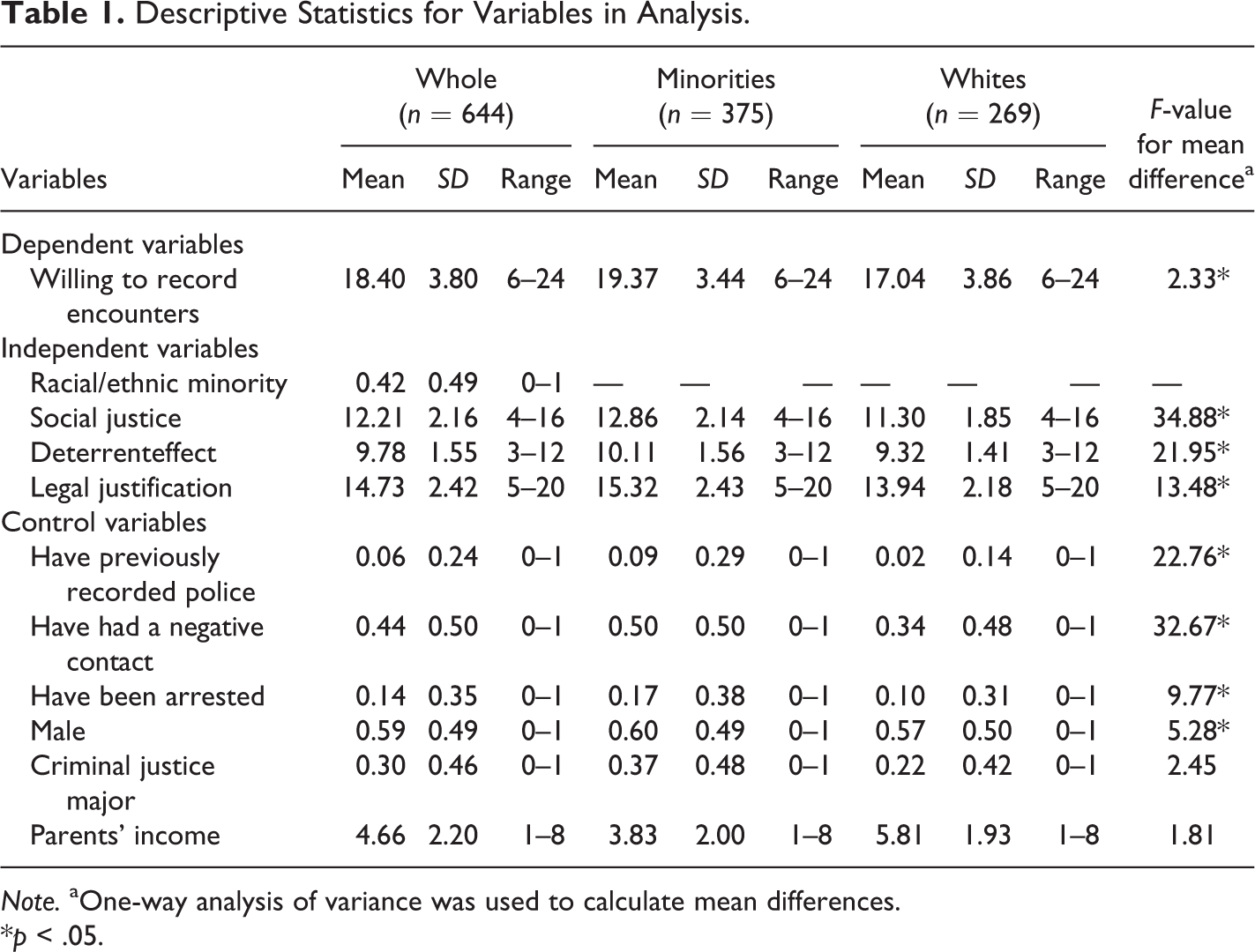
Table 1 displays the descriptive statistics for all variables used in this study by the whole sample and the separate samples for minorities and majorities. Possible multicollinearity problems were checked by examining the matrix of two-variable correlations among all independent variables. The highest correlation between two variables (sense of social justice and belief in the deterrence effect) in the whole sample was .64, which was acceptable. The small magnitude of the correlations was further confirmed by examining variance inflation factors, all of whose values were well below the generally accepted limit of 10 (Neter, Kutner, Nachtsheim, & Wasserman, 1996).
Descriptive Statistics for Variables in Analysis.
Note. aOne-way analysis of variance was used to calculate mean differences.
*p < .05.
Analysis
Both bivariate and multivariate analyses were performed. The bivariate analysis focused on the comparison of the mean scores of willingness to record the police across racial/ethnic minorities and majorities. The F-value associated with mean comparisons would signal whether the differences were significant. The multivariate analysis involved two steps. Using the whole sample of students from both universities, willingness to record the police was first regressed on race/ethnicity, sense of social justice, belief in the deterrent effect, consideration in legal justifications, and control variables. The minority and White students were then divided into separate categories and regression was performed for the variable willingness to record the police on the predictors in two models. The t-values of differences in corresponding coefficients of separate analysis were computed to assess whether minority and nonminority students’ inclination to record police–public encounters was shaped by a different set of predictors. Ordinary least squares regression was the procedure used for multivariate analysis.
Results
Mean Comparisons
Mean comparisons were first conducted to answer the research questions about whether minority and White students differ in their willingness to record police–public interactions. As shown in the second and third column in Table 1, minority and White students’ mean for the scale of willingness to record the police is 19.37 and 17.04, respectively, suggesting that minority students were more willing than their White counterparts to record police–public encounters. The F-value confirms that the mean difference is statistically significant. Table 1 also reveals racial differences across all variables except two (i.e., college major and parents’ income). Compared to White students, minority students have higher mean scores for all social and legal attitudinal variables, indicating that they are more likely to buy into the concepts of social justice, deterrence, and legal justifications associated with recording the police. A greater percentage of minority students also reported having previous recording experience, having negative contacts with the police, being arrested by the police, and being male, when compared to White students.
Multivariate Regression
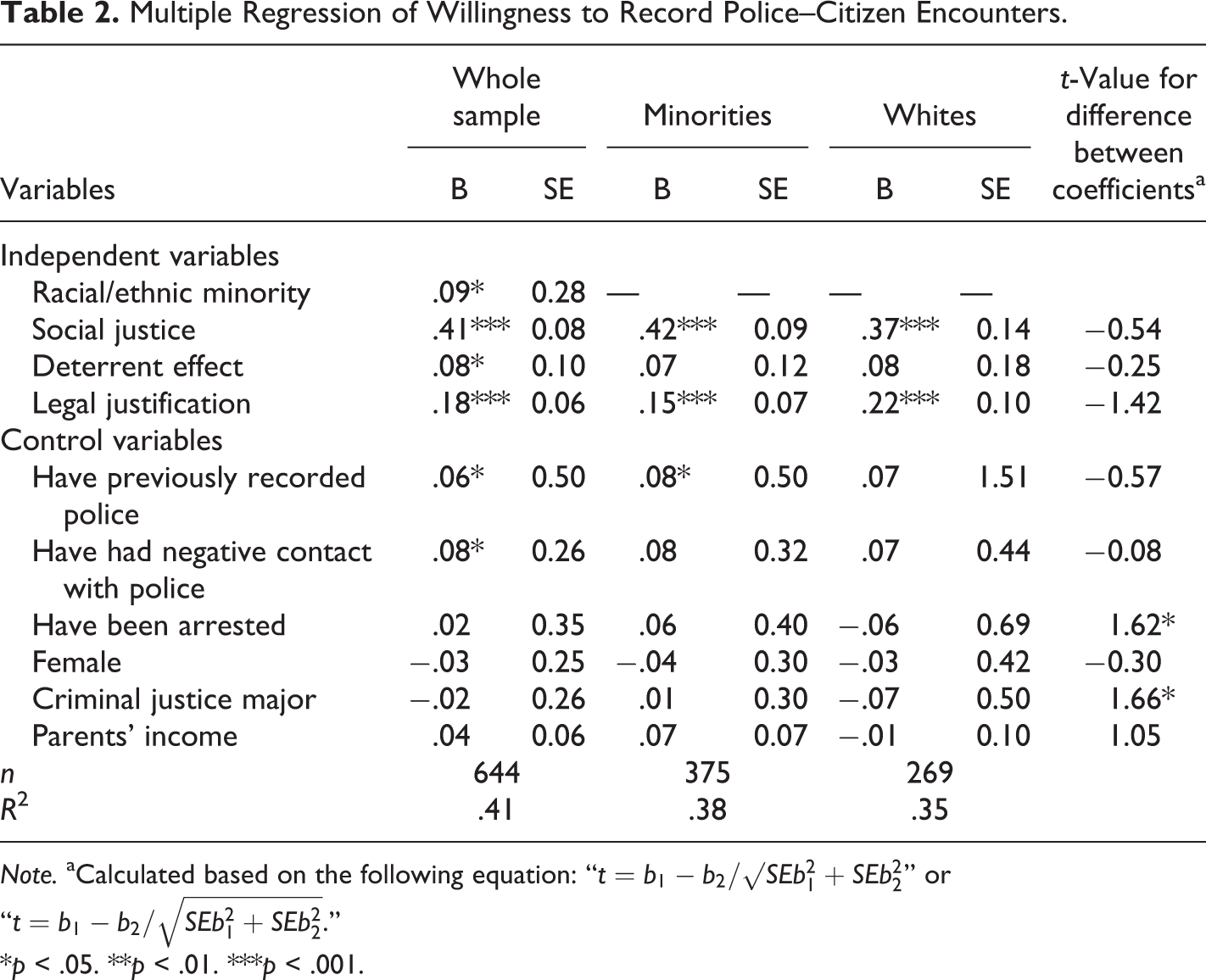
Multivariate regression was then performed on the whole sample to assess whether the racial distinction in recording the police sustains after controlling for relevant variables and whether social and legal consciousness affect college students’ willingness to record police–citizen encounters. The first panel in Table 2 displays the regression results. Consistent with the hypothesis, minority students were more willing to record police–citizen encounters than their White counterparts. All three nonracial variables were also significantly related to willingness to record the police. As expected, college students who believed that recording the police reflected social justice, had a deterrent effect, and was legally justified were more willing to engage in such behavior.
Multiple Regression of Willingness to Record Police–Citizen Encounters.
Note. aCalculated based on the following equation: “
*p < .05. **p < .01. ***p < .001.
Among control variables, two exerted a significant impact on decisions to record police–public contacts. Not surprisingly, those who had previously recorded the police within the past 3 years and who had negative contact with the police were more willing to record police–citizen encounters. Background characteristics (gender, major, and parents’ income) were ineffective in predicting willingness to record police activity. All variables together explain 41% of the variation in readiness to record officer–citizen contacts.
The next two panels in Table 2 demonstrate regression results for minorities and Whites separately. For both minority and majority students, the significant effects of social justice and legal justifications on readiness to record the police persist, but the significant impact of deterrent effects disappears. Previous recording experience only influences minority, but not White, students’ willingness to record police–citizen contacts. The significant link between negative police contacts and willingness to record found in the whole sample analysis discontinues for both minority and White samples. The t-values suggest that two comparisons between regression coefficients reach statistical significance. One is arrest experience and the other is college major, with minority students more likely to have been arrested before and have a major in criminal justice. Despite their significant distinctions, both variables did not affect willingness to record the police. The explanatory power of predicting variables is slightly better for minorities than Whites, registering an R 2 of .38 and .35, respectively.
Discussion
Using personal electronic devices, particularly smartphones, has emerged as a popular way for the public to safeguard themselves against potentially unlawful actions by police officers. It is a proactive form of political participation (Bodri, 2011; Jeffries, 2011) that allows public scrutiny of authority figures (Haggerty & Ericson, 2000; Meyrowitz, 1985). Despite its growing popularity, recording the police has yet to receive much research attention in terms of factors shaping people’s willingness to partake in such action. This study served as a preliminary analysis of the relevance of race/ethnicity and social and legal consciousness in predicting college students’ inclination to engage in recording the police. Three major findings are derived from the analysis of the survey data.
First, racial/ethnic minority students display a stronger willingness than White students to record public interactions with the police. It seems that race/ethnicity not only affects how people are treated by legal authorities (Walker et al., 2007) but also defines how people would respond to official intervention. Considering the historical and contemporary contexts of criminal justice in America where minorities, particularly African Americans, have been the primary targets of social control, their stronger willingness to exercise a relatively easy and perhaps effective way to monitor the police is not totally unexpected. Recording the police seems to carry the spirit of nonviolent or peaceful resistance, which was widely used during the Civil Rights Movement of the 1950s and 1960s.
Although this study did not directly answer the question of why minorities showed a higher degree of readiness to record police–public interactions, several clues may shed light on this issue. For instance, it was found that minority students were more likely than their White counterparts to have previously recorded the police and been arrested by the police (see Table 1), both of which tend to strengthen the willingness of minorities to document police–citizen encounters. For many minorities, recording the police may be a logical extension of their suspicion or even resentment toward the racial inequality embedded in the criminal justice system. Future research should continue to investigate the linkage between personal and vicarious experiences and inclination to record the police perhaps by gathering and analyzing in-depth interview information. In-depth interviews with people who have previously recorded the police would also be useful to understand the context in which recordings of law enforcement most often take place and how police react to these encounters.
Second, college students’ willingness to record police–citizen contacts is significantly linked to their perceptions of whether the recording is socially and legally justified. Students who believed that recording the police could strengthen social justice and who viewed it as acceptable under a broad range of situations are more likely to endorse such action. While race/ethnicity did determine the level of willingness to record the police, the separate-sample analysis also revealed that both minority and White students are similarly influenced by their senses of social justice and legal justifications, which actually are stronger predictors than race in the whole sample model.
The inclination to record police activity clearly is not a stand-alone phenomenon but highly intertwined with social and legal attitudes. Given that college campuses are places where students are likely to develop a stronger sense of justice and learn legal arguments of controversial issues, a close relationship between their social and legal consciousness and willingness to record could be anticipated. Whether such a connection can be applied to the general population remains largely unknown and should be further tested using noncollege student samples.
Finally, college students’, particularly minorities’, previous recording and contact experiences with the police affect their levels of willingness to electronically document encounters with the police. This finding echoes the results of past research showing that the type and content of police–citizen contacts matter in shaping public assessments of the police (Dean, 1980; Frank, Smith, & Novak, 2005; Reisig & Parks, 2000; Skogan, 2005). Though it was found that those who had recorded police–citizen encounters and had negative contacts with the police displayed higher degrees of readiness to record police activity, this connection is less evident in the subsample analysis for Whites, who were less likely to have recording and negative contact experiences with the police compared to their minority counterparts. This particular finding thus indicates a potential conditional effect of past experience on willingness to record the police based on race/ethnicity. Such a possibility needs to be attended and better assessed in future studies, especially in regard to whether citizens have ever encountered problems or intimidation when recording the police in the past.
Before discussing implications for policy, three limitations associated with this study should be acknowledged. First, the data did not contain enough cases for non-Black minority students, which prohibited meaningful statistical analysis of potential variation among racial/ethnic minority groups. Future research can address this concern by collecting enough samples from the Hispanic, Asian, and Native American populations to further test whether there is a “racial gradient” (Buckler & Unnever, 2008) in people’s willingness to take actions toward the police. Second, data used in the study were collected from two public universities in the same state.
Whether these findings can be generalized to other types of universities (rural and private institutions) is an open question. Future studies should continue to assess similar research questions using different student samples. Including information on the type of respondents’ hometown might also be of value, as experiences with police may be different between urban and rural areas. Finally, while college students have been widely used in criminological research (Payne & Chappell, 2008), the findings may not be generalized to the general population. More research using nonstudent samples should be conducted to further explore factors influencing people’s willingness to record police interactions with the public. Additionally, since only one of the actors (i.e., college students) was included in this study, it is important for future research to assess police officers’ perceptions of being recorded by citizens.
Several implications for policy emerge from the findings of this study. These findings suggest that minorities are more willing to partake in recording police–public encounters and such intention is closely related to their past experience with the police. If police departments would like to minimize potential conflicts or even crisis resulting from video recording, then two directions should be considered. First, police administrators have to ensure that officers adequately understand laws, rules, and policies related to citizens’ rights and accordingly render appropriate responses to record police–public contacts. Written guidelines, if not in place, should be fully developed and implemented to effectively regulate officers’ behavior in handling public recording of their activity. Police can also educate the public about their rights of recording by attending community events or meetings to communicate legality of the action with local residents.
Second, police cultural diversity training must educate officers about the sensitivity of race/ethnicity in street-level policing and its impact on people’s willingness to intervene in police work. The best way to defuse possible police–public conflicts is by applying the law impartially and treating the public respectfully, regardless of their race and ethnicity (Tyler, 1990). When encountering racial minorities, police officers have to be extremely patient in explaining the reason of involuntary contacts and treat minority citizens equally and justly. The idea of equal application and protection of the laws would not be handily instilled in the minds of many minorities, especially African Americans, but treating all people they encounter in a fair and polite manner would be a good starting point for the police.
The issue of citizens filming police has certainly come a long way since the days of George Holliday’s video recording of the Rodney King case. It is apparent that new technology, particularly cell phones with video recording capabilities, has emerged as a key mechanism in civilian oversight of policing by making it easier for communities to monitor the police and increase accountability (Walker & Archbold, 2014). Allowing citizen recordings of police can reveal how law enforcement interacts with the public, promote transparency in policing, and expose unlawful or inappropriate behavior of law enforcement (Jeffries, 2011; Walker & Archbold, 2014). This study takes a first step to assess factors influencing college students’ willingness to record the police. More research is clearly needed on various aspects of this critical social phenomenon.
Footnotes
Declaration of Conflicting Interests
The author(s) declared no potential conflicts of interest with respect to the research, authorship, and/or publication of this article.
Funding
The author(s) received no financial support for the research, authorship, and/or publication of this article.