




Abstract
Racial and ethnic disparities in criminal justice have received increasing scrutiny recently. Little attention, however, has been directed toward understanding inequality in the area of probation. The current study addresses this dearth through two analyses of 14,365 probation cases. The first involves a logistic regression analysis, which examines race/ethnicity against probation failure. Using probation success as a control outcome, the second analysis uses a multinomial regression to examine the effects of race and ethnicity across four types of probation failure—administrative failure and revocations resulting from technical violations, new felonies, and new misdemeanors. Across both models, racial/ethnic categorization were found to be significantly and positively associated with probation failure outcomes. In addition, the standardized coefficients indicate that Black and Hispanic racial/ethnic categorization presented a moderate to strong effect sizes across outcomes studied. The strongest effect sizes for these two variables were found in the multinomial model within the administrative failure outcome. Across both models, other racial categorization (Asian/Pacific Islander or Native American/Alaskan Native) was statistically significant but consistently produced some of the weakest effect sizes. Potential explanations for these findings are offered along with a discussion of study limitations, future research suggestions, and policy implications.
Introduction
The United States currently imprisons its citizens at a rate of 910 per 100,000, the largest in the world. While our fixation on incarceration has impacted many, racial and ethnic minorities are disproportionately affected. Specifically, Blacks and Hispanics constitute about 13% and 17% of U.S. population, respectively, yet they are incarcerated at roughly 6–8 times the rate of Whites (Carson, 2014). Further, “One in three young African American men will serve time in prison if current trends continue, and in some cities more than half of all young adult Black men are currently under correctional control” (Alexander, 2010, p. 9). Incarceration rates, however, are only the tip of the iceberg. The majority of persons under the supervision of the criminal justice system are controlled through parole and probation. Probation alone controls the greatest number of citizens with 57.2% of the correctional population within its purview (Glaze & Kaeble, 2014). In other words, while 1 in 110 persons in the United States are incarcerated, 1 in 62 are on probation.
Much like incarceration, racial disparities are evident within probation. Approximately 1 in 35 African Americans and 1 in 90 Hispanics are currently in the U.S. probation system. 1 Although mass incarceration certainly presents a problem for racial and ethnic equality, relatively little attention has been given to examining the relationship between race and probation, the institution that affects the most offenders processed through the system. Indeed, relatively few scholars have attempted to dissect this relationship, although the research continues to expand (Gould, Pate, & Sarver, 2011; Gray, Fields, & Maxwell, 2011; Ho, Breaux, Jannetta, & Lamb, 2014; Johnson & Jones, 1998; Morgan, 1994; Olson & Lurigio, 2000; Roundtree, Edwards, & Parker, 1984; Piquero, 2003; Steinmetz & Henderson, 2016; Tapia & Harris, 2006). As will be discussed, of the relatively few studies that have examined race effects within probation, many find reason for concern. The evidence, however, is inconsistent. In light of the differential impact of probation across racial/ethnic groups and the relative paucity of research, this study investigates the relationship between race and probation failure in a large Midwestern sample of probationers.
Before describing the results of this analysis, a brief review of the literature is provided. First, the historical and theoretical perspective on race and ethnicity underpinning this study is explained. The review then turns to explaining the general state of research in the area of race/ethnicity in probation. The review of the relevant academic literature is then followed by a discussion of the data and analytic method deployed in this study. Results of two statistical models are then provided. The first involves a logistic regression analysis on likelihood of probation failure with emphasis on racial/ethnicity variables. The second consists of a multinomial analysis that examines different kinds of probation failure—including administrative failure and revocation resulting from technical violations, new felonies, and new misdemeanors—relative to probation success. The implications of these results are then explored. This study concludes with a discussion of study limitations and future research implications.
Literature Review
Theoretical Overview
American and Western societies have been heavily scrutinized for historical and contemporary racial and ethnic inequalities. The dearth of research and theorizing on race and ethnicity reveals that these constructs are not static. Although the related social hierarchies between races and ethnicities have tended to persist, beliefs, perceptions, structures, cultures, and ideologies of race/ethnicity have morphed and reconfigured over time. The early history of race and ethnicity in America is marred by perhaps the starkest examples of racial/ethnic inequality including the genocide of the Native Americans and the chattel enslavement of Africans and persons of African descent (Zinn, 2005). During this era, ideologies of race emerged as mechanisms to legitimate the transformation of non-Western persons as others. These ideologies were thus used to justify subjugation, resources extraction, and even the conversion of non-Westerners into property. Reforms over time ended these practices in America. Even following legal changes like Emancipation, however, social hierarchies between races/ethnicities persisted, managed through legal mechanisms like Black Codes and Jim Crow Laws (Alexander, 2010).
Following the Civil Rights Movement of the 1960s and 1970s, de jure forms of racial and ethnic inequality were stymied. Racial/ethnic inequality, however, did not vanish. Instead, ideologies of race and ethnicity only became less visible and more abstract. For instance, a “commonsense” belief exists that racism and other forms of inequality require intent. Such a belief ignores enduring structural, cultural, and systemic forms of inequality as well as discrimination from unconscious biases. In criminal justice, this manifests as a belief that criminal justice agencies cannot be racist because the system—by and large—prohibits overtly racial/ethnic discrimination by policy. Such beliefs neglect to consider the grossly disproportionate outcomes based on race and ethnicity that occur throughout the U.S. criminal justice apparatus.
In this context, racism and related inequalities have tended to become more subtle, hiding in the background of popular culture, political rhetoric, public consciousness, and individual cognition (Bonilla-Silva, 2006; Russell, 1988). For instance, the punitive turn of the 1980s was further intensified and racialized through a television commercial for the George H. W. Bush presidential campaign that featured a middle-class, white couple emotionally recounting the kidnapping, torture, humiliation, and rape experienced at the hands of a black male named Willie Horton (who was often pictured with a menacing scowl). He was a convicted murderer who had been furloughed from prison in Massachusetts by Governor Michael Dukakis, the Democratic candidate. (Galliher, 1991, p. 246)
In a process eerily similar to Becker’s (1963) descriptions of marijuana prohibition and moral entrepreneurs, this advertisement did not necessarily explicitly claim all Black persons were dangerous criminals. Instead, the commercial encouraged a cognitive connection between Black men and criminality which supported “a widespread cultural, Black-male-savage common-sense theory of crime … which is a product of racism and also legitimates racism” (Galliher, 1991, p. 246). In the words of radical criminologists, race and racism is therefore an intensely ideological social product (Platt et al., 1982).
Contemporary racial and ethnic minorities are also often burdened by the legacies of historical inequalities, ones that impact their material circumstances and the ability to transfer social and economic standing intergenerationally. For example, Massey and Denton (1993) argue that many Blacks were economically hamstrung in the early to mid-1900s due to policies that excluded members of the African American working classes from home-ownership. At the same time, African American neighborhoods saw their properties systematically devalued relative to other groups on the basis of race through practices like “redlining.” Thus, one of the best mechanisms of intergenerational wealth accumulation and transmission was denied to large swaths of the African American population. Such deprivation stems from the disproportionate marginalization of African Americans to socially disorganized neighborhoods marred by crime and comparatively harsh enforcement initiatives—factors that exacerbate the erosion of social ties and collective efficacy within these communities (Rose & Clear, 1998; Sampson, Raudenbush, & Earls, 1997; Shaw & McKay, 1942; Websdale, 2001). Thus, many African Americans have been historically positioned in localities conducive to crime and disrupted by criminal justice action.
Thus, despite the legal prohibition of overt discrimination, racial and ethnic inequality endures in the social imaginary and in the lived experiences of the marginalized. These inequities persist at least in part because of ideologies that insist disparate racial/ethnic experiences, and outcomes are the result of individual character flaws or defective subcultural value systems. Bonilla-Silva (2006) thus asserts that we are in an age of “color-blind” racism, where oppression is obscured by a belief that America is a “postracial” society where anyone can succeed in equal measure. “Much as Jim Crow racism served as the glue for defending a brutal and overt system of racial oppression in the pre-Civil Rights era,” he explains, “color-blind racism serves today as the ideological armor for a covert and institutional system in the post-Civil Rights era” (Bonilla-Silva, 2006, p. 3). In criminal justice, color-blind racism allows the public and legal institutions to assert race is not a factor, and, rather, crime and related phenomena stem largely from poor decisions (Schaefer & Kraska, 2012).
The previously described circumstances and influences potentially impact disparate representation and outcomes within probation. The argument is not that any racial/ethnic differences are a result of instrumental decisions by probation officers and administrators. Rather, these inequities most likely stem from historical forces, material circumstances, and unconscious biases that augment and influence decisions, behaviors, and opportunities for both offenders and probation workers. The remainder of this review will discuss the current state of the literature concerning race/ethnicity and probation.
Race, Ethnicity, and Probation
Much attention has been given to the role of race/ethnicity in penal institutions. Race and ethnicity have been associated with negative or detrimental results across various presentencing/pretrial (Demuth, 2003; Demuth & Steffensmeier, 2004b; Free, 2001), sentencing (Demuth & Steffensmeier, 2004a; Steffensmeier, Ulmer, & Kramer, 1998; Tonry, 1995; Zatz, 2000), incarceration (Alexander, 2010; Burkhardt, 2015; Petit & Western, 2004), parole (Grattet, Lin, & Petersilia, 2011; Vito, Higgins, & Tewksbury, 2012), and capital punishment outcomes (Kleck, 1981), to name a few. Evidence thus appears sufficient to declare that race and ethnicity inequality issues are pervasive in the U.S. corrections complex. Some research, however, indicates such findings may not be ubiquitous. While confessedly a minority in race/ethnicity inequality scholarship, these studies find little to no support for inequality-related effects in correctional outcomes or, at the very least, present mixed results (e.g., Jennings, Richards, Smith, Bjerregaard, & Fogel, 2014; Morgan & Smith, 2008; Steiner & Wooldredge, 2015). Research into racial/ethnic inequality in corrections research can thus be described as largely confirmatory yet circumspect—a description that applies equally to research into racial/ethnic inequality in probation.
Despite its scope and scale, relatively little scholarly attention has been paid to U.S. probation systems and its relationship with race and ethnicity. Studies have found that Black and/or Hispanic probationers are at greater risk for probation revocation, rearrest for new crimes, and technical violations compared to other races (Gould et al., 2011; Leiber & Peck, 2013; NeMoyer et al., 2014; Sims & Jones, 1997; Steinmetz & Henderson, 2016). For example, Johnson and Jones’s (1998) analysis of drug and nondrug felony probation outcomes revealed that Black probationers were more likely to have their probation revoked than White probationers. Similarly, one analysis found that both Blacks and Hispanics were more likely to have their probation revoked or adjudicated and less likely to be discharged early compared to Whites (Steinmetz & Henderson, 2016).
Other studies have found inconsistent support for race/ethnicity effects in probation. Some research finds that not all minority populations experience negative probation outcomes equally. For instance, Ho, Breaux, Janetta, and Lamb (2014) found that revocation was more likely for Blacks compared to Hispanics, but both were more likely than Whites have their sentences revoked. In Tapia and Harris’ (2006) study, revocation likelihood was found to significantly differ between African Americans and Whites. Hispanics, however, were roughly equivalent to Whites in odds of revocation.
In addition, studies have found differential race/ethnicity effects based on probation outcome studied (Gray et al., 2001; Johnson & Jones, 1998; Leiber & Peck, 2013; Olson & Lurigio, 2000; Piquero, 2003). NeMoyer et al. (2014) studied the records of 120 juvenile probationers and found that Black juveniles were more likely to fail probation for noncompliance with sentence terms. In addition, the authors found that Hispanic juveniles were more likely to not receive a mandatory school requirement for noncompliance, a finding that “may indicate that judges are taking inappropriate extralegal factors … into account when imposing probation conditions” (NeMoyer et al., 2014, p. 587). In juvenile probation, while Leiber and Peck (2013) did find that Blacks and Hispanics generally received more severe outcomes, their results also indicated that Black juveniles received “leniency at adjudication,” and Hispanics did not receive disproportionately harsh punishment at “the stages of adjudication and judicial disposition” (Leiber & Peck, 2013, p. 71). Importantly, some studies have observed no relationship between race and probation outcomes (Morgan, 1994; Roundtree et al., 1984).
While not directly related to racial/ethnic inequality, it is worth noting that other forms of stratification have come under investigation in probation, notably gender/sex. Generally speaking, female probationers have been found to have greater chances of probation success than males (Morgan, 1993; Olson, Alderden, & Lurigio, 2003). Recent examinations, however, revealed mixed or contradictory results. For example, two studies indicate that likelihood of successful probation completion and rearrest does not differ between genders/sexes (Gould et al., 2011; Olson & Lurigio, 2000). In addition, Gould, Pate, and Sarver (2011) found that both male and female probationers were more likely to violate the probation terms if placed on the highest level of supervision.
Method
The current study examines the relationship between race/ethnicity and probation failure across two statistical models. The first involves a logistic regression to assess the predictive relationship between race/ethnicity and probation failure while controlling for demographic and administrative variables. There are different kinds of failure within the probation system, however. Each hinges on different acts committed by the probationer and different decisions made by probation officers, administrators, and judges. A multinomial analysis is therefore conducted to investigate how race and ethnicity may predict four different forms of probation failure: administrative failure and revocations resulting from technical violations, new felonies, and new misdemeanors. The data and analytic methods to test these hypotheses are described in greater detail subsequently. Based on prior research and theorizing, this analysis predicts that the racial and ethnic variables will be positively associated with likelihood of probation failure.
Sample
The sample for this study consists of state-level data from a Midwestern department of corrections for all closed probation cases between November 2004 and November 2014. In addition, cases that were closed due to death or because the case did not involve formal sentencing to community corrections were removed. 2 Once fully cleaned and aggregated, the final sample includes 15,728 unique probation cases. Missing data, however, reduces the usable sample further to 14,365 cases. 3 See Table 1 for a rundown of the sample’s characteristics.
Descriptive Statistics.
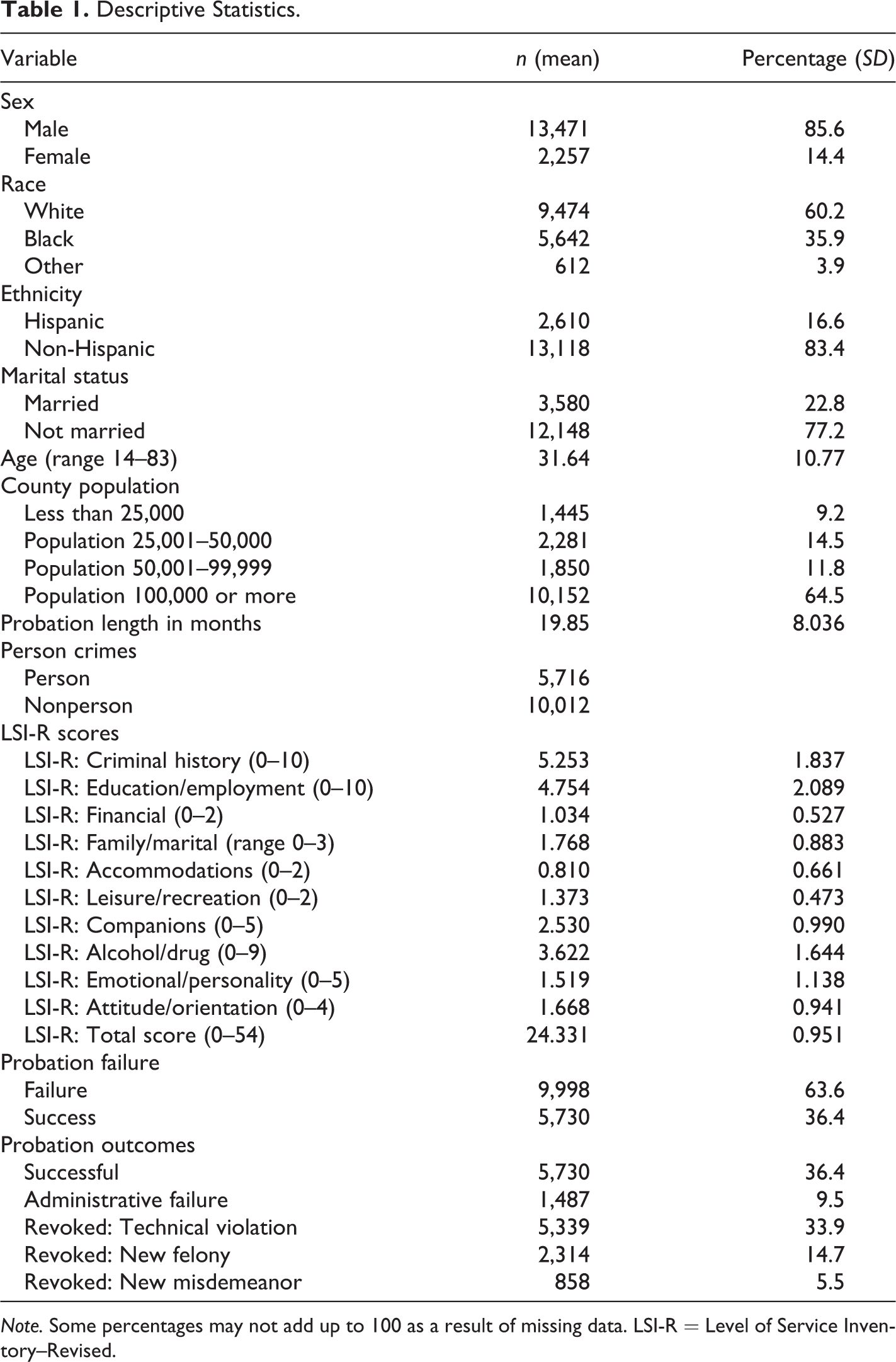
Note. Some percentages may not add up to 100 as a result of missing data. LSI-R = Level of Service Inventory–Revised.
Predictors
Outcome variables
Two outcome variables are examined in this study. The logistic regression analysis attempts to predict probation failure (1 = failure, 0 = success), or the noncompletion of a probation sentence often resulting in the triggering of the original jail/prison sentence, some other sanction, or an otherwise unsuccessful probation completion. Within this sample, 9,998 (63.6%) cases are listed as failed while 5,730 (36.4%) are successful.
Focusing on a five category nominal-level measurement of probation closure, the multinomial analysis attempts to predict likelihood of four forms of probation failure relative to success. With success as a control, the first predictor category is described here as administrative closure (n = 1,487; 9.5%). These cases are terminated and considered unsuccessful through means other than formal revocation to the department of corrections. In these cases, probation may be closed because a probationer may have erred (in some form or fashion) during their probation sentence but generally not in a manner deemed severe enough to warrant revocation. The other predictor categories include three kinds of revocation triggered by different offenses including technical violations (n = 5,339; 33.9%), new felonies (n = 2,314; 14.7%), and new misdemeanors (n = 858; 5.5%). 4 Revocation is the withdrawal of probation and the reinstatement of the underlying prison sentence with potentially new sanctions applied. While this analysis is interested in the role race/ethnicity plays in probation failure generally, the multinomial analysis permits more specific forms of probation failure to be investigated for their relationship with racial/ethnic categorization.
Demographic variables
Race was divided into two dichotomous variables, Black (1 = Black, 0 = non-Black) and other (American Indian/Alaskan Native and Asian/Pacific Islander; measured 1 = Other, 0 = non-Other). 5 White racial status serves as the control. In this sample, 35.9% of the population was Black, 3.9% were within other racial categories, and 60.2% were White. Ethnicity, as is typical in many government-driven data sources, was measured separately from race as a dichotomous variable (1 = Hispanic; 0 = Non-Hispanic). Hispanics comprise 16.6% of the sample population.
Sex is also included in the models as a binary measure (1 = male; 0 = female). 6 Within the total sample, 85.6% were male while 14.4% were female, consistent with the vast majority of criminal justice and criminological research. Ages range from 14 to 83 years (μ = 31.64 years). Marital status (1 = married; 0 = non-married), an indicator of a prominent social bond, is included as well (22.8% married). County population is thus included as an ordinal measure (1 = less than or equal to 25,000; 2 = 25,001–50,000; 3 = 50,001–99,999; 4 = greater than or equal to 100,000). This measure attempts to control for environmental differences that may arise from disparately populated areas. 7
Legal/administrative variables
Aside from the demographic variables included in this study, multiple legal and administrative factors were also considered. First, offense type was included in the analysis as person versus nonperson crimes. In instances where a person is put on probation for multiple offenses, they are counted as committing a person offense if at least one of their charges involved a crime against a person. In this sample, 5,716 (36.3%) of probationers were sentenced for person crime while 10,012 (63.7%) were not. 8 The length of time one was sentenced to probation was also controlled for. These sentences are distributed as 12-, 18-, 24-, 36-, or 60-month intervals (μ = 19.85). For analysis, the variable was recoded as an ordinal variable ranging from 1 to 5, respectively.
Finally, this study includes 10 risk assessment measures. In probation and parole, risk assessments are used to predict likelihoods of recidivism and revocation, identify “offender’s needs that are amenable to change,” and develop “plans of correctional intervention” (Morash, 2009, p. 174). The risk assessment variables used in this study are from the Level of Service Inventory–Revised (LSI-R) instrument which is based on social learning theory and cognitive psychology (Andrews & Bonta, 1995). Included are both static and dynamic or “potentially mutable” risk factors (Smith, Cullen, & Latessa, 2009, p. 185). Although generally considered to be a valid assessment instrument, research is still exploring use of the LSI-R across different populations, as some disagreement exists about its alleged universal applicability (e.g., Ferguson, Ogloff, & Thomson, 2009; Holtfreter & Cupp, 2007; Whiteacre, 2006).
The LSI-R measures risk and needs through 54 items aggregated into 10 measures or “subdomains,” which are incorporated into the current study. These measures are criminal history (0–10; μ = 5.253), education/employment (0–10; μ = 4.754), financial (0–2; μ = 1.034), family/marital (0–3; μ = 1.768), accommodation (0–2; μ = 0.810), leisure/recreation (0–2; μ = 1.373), companions (0–5; μ = 2.530), alcohol/drug problem (0–9; μ = 3.622), emotional/personal (0–5; μ = 1.519), and attitudes/orientation (0–4; μ = 1.668). Probation departments in this study conduct multiple risk assessment evaluations over the course of a probationer’s involvement in the system. For the sake of parsimony, the scores used are averages within each case.
Results
Logistic Regression Models
Race and ethnicity
The results of the logistic regression analysis are presented in Table 2. 9 Overall, the model significantly predicted probation failure with a modest goodness of fit (p < .001; RL 2 = .2480). 10 Among individual predictors, both racial measures were significant. Being Black, Exp(b) = 1.753; p < .001, was associated with 75.3% and other racial categorization, Exp(b) = 1.712; p < .001, demonstrated a 71.2% increase in the log odds of probation failure relative to White probationers. Similarly, the Hispanic ethnicity, Exp(b) = 2.010; p < .001, was significant, yielding a 201% increase in the likelihood of failure relative to non-Hispanics.
Logistic Regression Analysis of Probation Failure.
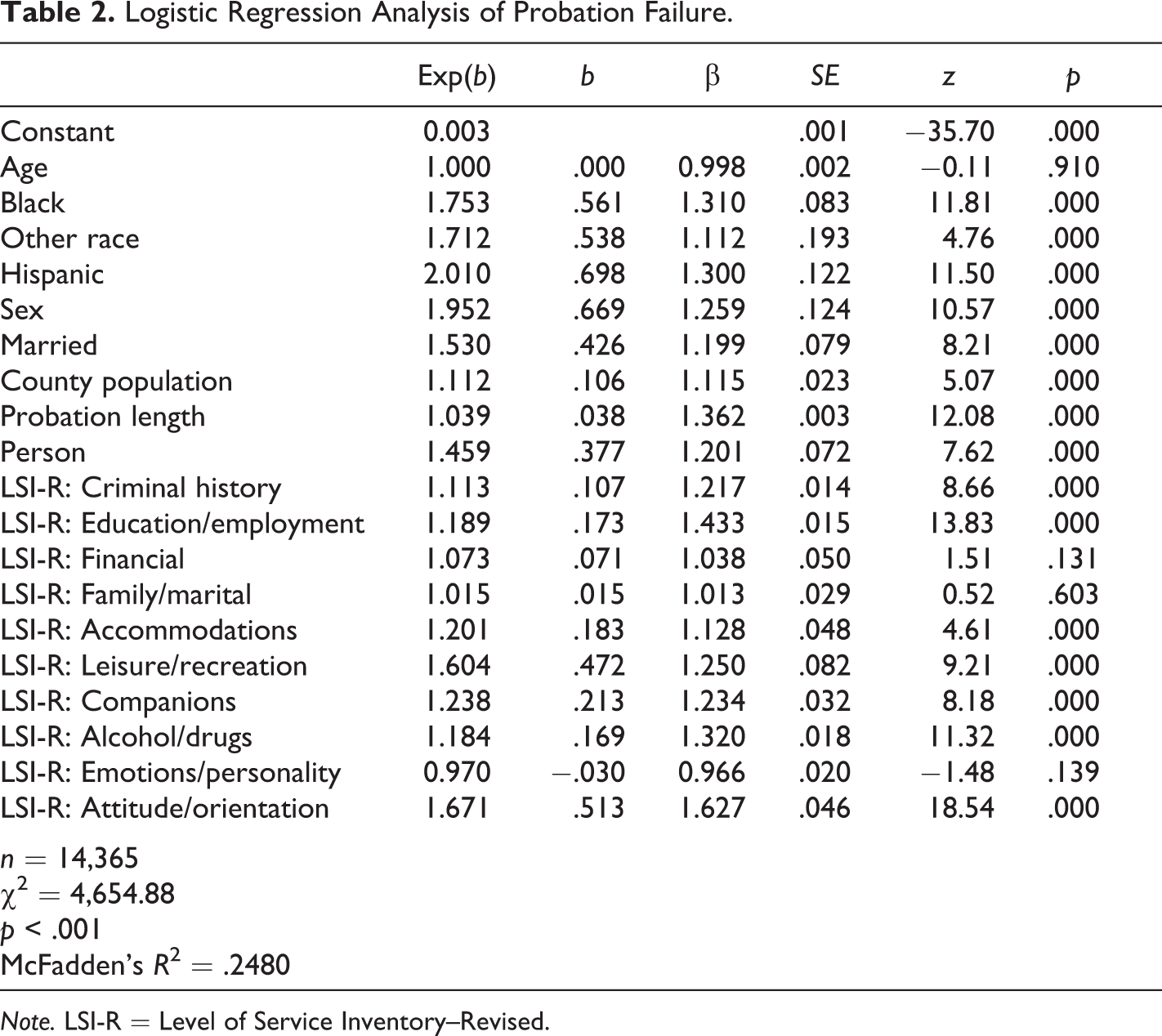
Note. LSI-R = Level of Service Inventory–Revised.
The statistical significance found within this model, however, is hardly surprising given the size of the analytic sample. As such, it may be more useful to examine the fully standardized logistic regression coefficients. Regarding relative magnitude, being Black (β = 1.310) was the fifth most powerful variable in the model behind three LSI-R predictors—attitudes/orientation (β = 1.635), education/employment (β = 1.634), alcohol/drugs (β = 1.260)—and length of probation (β = 1.362). While the Black racial status is a relatively potent predictor, other racial categorization (β = 1.112) was the weakest of the statistically significant variables. For ethnicity, being Hispanic (β = 1.300) was a relatively important predictor, falling just behind Black in predictive power.
Other results
Within the logistic regression model, sex was the seventh strongest predictor (p < .001; β = 1.259) behind being Black and Hispanic. In this fashion, being male, Exp(b) = 1.952, is associated with 95.2% increase in the log odds of failing probation relative to females. Curiously, being married, Exp(b) = 1.530; p < .001, was significantly associated with a 53% increase in the log odds of probation failure compared to unmarried, divorced, or widowed persons. County population, Exp(b) = 1.112; p < .001; length of probation sentence, Exp(b) = 1.014; p < .001;, and person offenses, Exp(b) = 1.459; p < .001, were also linked to greater odds of failure. Age at time of offense was not statistically related to probation failure in this sample.
In addition, seven of the LSI-R predictors were statistically significant (p < .001). In terms of relative magnitude, three of the four most powerful predictors in the model were LSI-R measures, including those for attitude/orientation (β = 1.627), education/ employment (β = 1.433), and alcohol/drug use (β = 1.320). Four additional LSI-R measures were significant but lagged in predictive power according to the standardized logistic regression coefficients including the leisure/recreation (β = 1.250; p < .001), companion (β = 1.234; p < .001), criminal history (β = 1.217; p < .001), and accommodations (β = 1.128; p < .001) scores. Despite the fact that the LSI-R was designed to predict likelihood of probation failure and reoffending, the financial, family/marital, and emotions/personality measures were not statistically significant.
Multinomial Regression Models
Race and ethnicity
The multinomial analysis compares the likelihood of falling into four types of probation failure relative to success (Table 3). While the model remains significant in the prediction of the outcome categories, the goodness-of-fit measures weaken compare to the logistic models (RL 2 = .1412; p < .001). Throughout the probation outcome categories, all racial and ethnic predictors were statistically significantly associated with increases in the likelihood of the probation failures examined here. Their magnitude of impact, however, differed based on the outcome variable under investigation. In addition, the Black and Hispanic racial/ethnic predictors alternated throughout the model in terms of which variable was strongest in the prediction of these outcomes.
Multinomial Regression Analyses of Probation Failure.

When examining relative magnitude of effect for the racial/ethnic variables in the analysis, both Black (β = 1.245; p < .001) and Hispanic (β = 1.273; p < .001) racial/ethnic statuses were strongest in their relationship with administrative failure. These two variables, however, remained moderate to strong predictors of the other probation failure outcomes throughout the model. In addition, Black and Hispanic status alternated as the most potent racial/ethnic predictors among the probation failure categories. Being Black had a greater impact on technical violation (β = 1.321; p < .001) and new misdemeanor revocations (β = 1.355; p < .001) compared to other racial and ethnic variables. Conversely, being Hispanic appeared to more strongly predict administrative failure (β = 1.273; p < .001) and revocations resulting from new felonies (β = 1.377; p < .001). Other racial categorization was significant throughout the model but was among the weakest predictors across the failure outcomes (administrative failure β = 1.110, p < .01; technical violation β = 1.111, p < .001; new felony β = 1.111, p < .001; and new misdemeanor β = 1.134, p > .01).
Other results
While the central objective of this article is to explore the relationship between probation outcomes and race/ethnicity, other factors included in these models merit exploration. For instance, sex was significantly linked to each of the four probation outcomes (p < .001). Being male was consistently linked with greater odds of probation failure. Sex, however, was not as powerful as Black racial and Hispanic ethnic status in the prediction of probation failure outcomes with the exception of new felony revocations (β = 1.111, p < .001). Although not testable in this data, this is likely a result of felonies being more aggressive crimes generally, a trait linked to masculinity. In addition, sex was stronger across the model than other race.
While the LSI-R measurements are designed to predict likelihood of reoffending and probation failure, there are differences in these indicators among the probation outcomes worth noting. For instance, the attitude/orientation measure—a predictor which attempts to gauge anti-criminal/prosocial attitudes, values, and beliefs—was the strongest predictor of likelihood across administrative failure (β = 1.377; p < .001) and revocations resulting from technical violations (β = 1.713; p < .001), new felonies (β = 1.622; p < .001), and misdemeanors (β = 1.800; p < .001). Some measures, however, were consistently nonstatistically significant across all four outcomes categories in the model, namely, the emotions/personality and the family/marital measures. The financial LSI-R indicator was nonsignificant in all but one of the outcomes examined, administrative failure (p < .001). This predictor, however, was the second weakest of the significant variables (β = 1.089). The remaining LSI-R measures, however, varied in their relative magnitude. Consistently, however, Black racial and Hispanic ethnic status held greater impacts on the likelihood of probation failure over at least some of the LSI-R measures—indicators designed to predict likelihood of failure and reoffending.
County population was significantly associated with increases in likelihood of probation failure across the revocation outcomes. For administrative failure, however, increases in county population were linked to lower likelihoods of nonsuccess (relative risk ratio [RRR] = 0.711; p < .001). This finding may indicate that higher population areas may favor the more formal revocation outcomes compared to the slightly less formal administrative failure approaches. Such an explanation is only tentative, although, particularly as county population was the weakest predictor of administrative failure (β = 0.765; p < .001).
When predicting revocation, however, length of probation sentence is consistently within the top four strongest predictors (technical violation β = 1.403, p < .001; new felony β = 1.564, p < .001; and new misdemeanor β = 1.489, p < .001). According to these findings, longer probation sentences are associated with increases in the odds of probation revocation. There may be two reasons for these findings. First, longer probation terms are likely linked to more opportunities to violate probation terms and reoffend over time. Second, longer probation sentences may be linked to worse offenses, which may indicate a proclivity to err while on probation. Probation length, however, holds no statistical significance in the prediction of administrative failures in this model.
Person offenses were significantly linked to increased likelihoods of failing probation across the model. This offense predictor, however, was among the weakest predictors of administrative failure (RRR = 1.225; β = 1.103; p < .01), technical violations (RRR = 1.426; β = 1.188; p < .001), and new felonies (RRR = 1.581; β = 1.248; p < .001). For revocation resulting from new misdemeanors, however, person offending was the fourth strongest variable (RRR = 2.096; β = 1.431; p < .001).
Marital status was positively associated with increases in likelihood of probation failure across all four categories, although its effects were relatively modest relative to other predictors (administrative failure RRR = 1.419, β = 1.161, p < .001; technical violation RRR = 1.446, β = 1.170, p < .001; new felony RRR = 1.782, β = 1.279, p < .001; and new misdemeanor RRR = 1.828, β = 1.293, p < .001). Finally, despite its traditional significance as a criminological predictor, age failed to achieve statistical significance across any of the probation outcomes examined, similar to the logistic regression model. 11
Discussion
Inequality has long been recognized as running rampant through the U.S. corrections system. While the causes of such inequities are multitude, there is little disagreement that the phenomena deserve intense scrutiny. Community corrections approaches—including probation—have garnered significant attention from administrators and policy makers as a solution to various problems confronting corrections including overcrowding and budgetary shortfalls. Relatively little attention, however, has been given to examining if such solutions manage to escape racial/ethnic inequality issues that afflict so many other areas of criminal justice. The results of this study, in conjunction with previous scholarship (Gould et al., 2011; Johnson & Jones, 1998; Leiber & Peck, 2013; NeMoyer et al., 2014; Steinmetz & Henderson, 2016), indicate such remedies are not immune.
Consistently, throughout this analysis, racial/ethnic status was found to significantly predict likelihood of probation failure. Despite controlling for multiple demographic and administrative variables, race/ethnicity effects remained. Black racial and Hispanic ethnic status in particular were strongly associated with the examined probation outcomes relative to other predictors. As detailed in the theoretical overview of this analysis, these results likely stem from numerous sources. For instance, organizational and administrative factors may play a role. This is not to say that such organizational actors are consciously making probation decisions out of prejudice. At the systemic level, such disparities are likely the result of more subtle and indirect forms of discrimination, such as cognitive bias or stereotyping. Such bias in perceptions have been found to impact decision making in other domains of criminal justice (e.g., Sadler, Correll, Park, & Judd, 2012). In addition, racially and ethnically disparate results in probation may also be a result of “cumulative discrimination.” While most studies examine race and ethnicity and its relationship with a singular step in the criminal justice process (the current study notwithstanding), focus on such “episodic discrimination” may not fully capture discrimination or bias that may occur at different points as an offender moves through the system (Stolzenberg, D’Alessio, & Eitle, 2013). Since probation failure occurs at the end of the criminal justice process, such disparate outcomes between racial and ethnic groups may be the result of disadvantage that has accumulated over the tenure of a case.
Broader social and structural issues may also impact likelihood of failure for racial/ethnic minority populations. In effect, indicators of racial/ethnic status in this study may serve as a proxy for broader social structural and historical forces. Such forces, in turn, may impact likelihood of successfully navigating probation (and criminal justice in general). For example, structures and institutions such as colonization and slavery have left scars on the Black population—legacies that continue to have effects on contemporary racial issues (Alexander, 2012; Websdale, 2001). More contemporarily, Blacks have been subjected to a number of economically and socially marginalizing practices, such as redlining and similar practices which excluded many Blacks from secure home-ownership (Massey & Denton, 1993). As home-ownership is inextricably intertwined with economic stability and wealth accumulation, Blacks were for generations hence further economically disadvantaged. These practices, and others, structure the very material conditions in which many Blacks are situated, bearing implications for early childhood development, structures of opportunity throughout the life course, (mis)trust in institutions of authority, and so on. In addition, criminal justice policy—primarily through the Wars on Crime and Drugs—have disproportionately targeted Black communities (Alexander, 2012). Such circumstances may contribute to criminal justice sanctions operating as a form of disintegrative shaming which may manifest as differential attitudes and behaviors before, during, and after probation (Braithwaite, 1989). In addition, these conditions may also dramatically impact the structures of opportunity available to many members of these populations (Merton, 1938).
Similarly, Hispanic populations have been heavily impacted by structures and practices that have left a lasting legacy in regard to their political, economic, social, and cultural positioning in society. For example, the North American Free Trade agreement opened up Mexico to intense capital investment which, despite early promises, did not increase job production.
12
Instead: the deregulation of agriculture; the selling of land to foreigners; the withdrawal of farm subsidies; and the opening of Mexico’s food, seed, and feed markets to competition from Canada and the United States led to the migration of many peasants who found themselves unable to compete with mechanized grain exports once Mexican agricultural protection was broken down. (Fernández-Kelly & Massey, 2007, pp. 105–106)
These potential explanations for the outcomes in the data, however, are only recommendations. This study—like many other race/ethnic inequality studies—only helps establish that disparate outcomes manifest between racial/ethnic groups. Fantastic theoretical and qualitative works exist which attempt to explain the presence of such inequality within the criminal justice system (e.g., Alexander, 2012; Barrett, 2012; Websdale, 2001). Relatively little—if any—of this research, however, has been directed toward understanding inequality in the context of community corrections, including probation. Patterns are becoming increasingly well established, but research needs to begin delving into examining the lifeworlds, processes, and social structures that impact differential probation outcomes among disproportionately marginalized populations.
Despite the prominence of race/ethnicity effects within the results, other factors in the models were often stronger predictors of probation outcomes. Two factors in particular consistently presented larger effect sizes. The first is the LSI-R measure of attitudes/orientation. Although structures of racial/ethnic inequality can impact perspectives and orientations (Unnever & Gabbidon, 2011), these are not the only influences. Indeed, many caught in the criminal justice apparatus have had their share of trials and tribulations which would impact their attitudes and orientations—some related to racial and ethnic inequality, some not. As such, general attitudes and orientations among every population—regardless of etiology—may influence likelihood of failure beyond any effects that race or ethnicity can predict. In fact, the relationship between attitudes and behavior is often so substantial that entire theories take into consideration such confluences, like social learning theory (Burgess & Akers, 1966).
The second factor which regularly presented larger effect sizes compared to race/ethnicity was the LSI-R measure of education/employment. This finding is not surprising as employment and education are likely indicators of broader material deprivations and opportunity constrictions (Websdale, 2001). While race and ethnicity may disproportionately influence these conditions, they may not necessarily override the effect that such conditions impose on correctional outcomes. Future research should consider longitudinal analyses to model such effects more specifically. Regardless of the effect sizes of these two LSI-R measures, race and ethnicity were still important indicators within these models.
Limitations
As with any study, limitations confront the research presented within these pages. First, the data used throughout this analysis were drawn from official corrections databases. As a result, the data are constructed to meet the needs of corrections administrators and line-level workers rather than social science research. The appropriation of data designed for one purpose, however, and using it for another has been a staple of criminological research for decades. In this manner, criminal justice and criminology have endured as long-lasting love–hate relationship with official data. This study is not immune to any of the well-established issues in such usage. One distinct advantage of official data, however, are large sample sizes unobtainable without significant extramural funding. In addition, the use of administrative data circumvents the political pitfalls and perils that are often packaged with the gathering of primary data through such agencies.
Related to the use of official data, the modest measure of model fit indicates that a large amount of variation in the outcome measures is left unexplained by these variables resulting in a potential omitted variable bias in the analyses. This limitation is particularly disappointing, as risk assessment instruments are specifically designed to predict probation failure and recidivism. Clearly more work is needed to refine predictive power. That said, the fit statistics given in this study are within range of many other studies of criminal justice agencies. Geography presents an additional limitation, as the data for this study represent a single Midwestern state. Different results may occur elsewhere. Other studies should seek to expand and/or replicate the findings presented here with different data in separate geographies. The state under analysis, however, does have racial and ethnic minority populations within their correctional purview. Racial/ethnic disparities in Midwestern states are thus equally open to scrutiny as more diverse localities.
The use of risk assessment measures presents another potential shortcoming within this data. In particular, some research has found evidence of racial bias within such instruments (Henderson & Miller, 2011). Some studies, for example, have found risk assessments may disproportionately present false positives for racial/ethnic minorities, particularly Blacks (e.g., Rembert, Henderson, & Pirtle, 2014; Whiteacre, 2006). While the LSI-R is generally considered a valid instrument, Whiteacre (2006) found evidence of racial bias within the LSI-R, the very instrument used in this study, although some research has found no evidence of bias (e.g., Schwalbe, Fraser, & Day, 2007; Vincent, Chapman, & Cook, 2011), enough corroboration exists to warrant concern. Furthermore, this study is limited by the administration of the assessments themselves. As previously mentioned, there is a marked variation in scoring between various probation departments. The LSI-R scores used in this study are averages of multiple assessments conducted across a probationer’s term. Some offenders, however, had assessments conducted by two or more departments, resulting in varied risk levels being assigned to the same case. As such, these variations may have impacted the results described throughout. 14
Despite these limitations, this study provides a vital step forward in the study of the probation, race, and ethnicity nexus. At the very least, these results indicate that disparities exist in probation outcomes that cannot be explained away with standard risk assessment and administrative variables. This study is therefore consistent with prior research which has similarly found evidence of racial/ethnic differences in the administration and disposition of probation (Gould et al., 2011; Gray et al., 2001; Ho et al., 2014; Johnson & Jones, 1998; Leiber & Peck, 2013; NeMoyer et al., 2014; Olson & Lurigio, 2000; Piquero, 2003; Sims & Jones, 1997; Steinmetz & Henderson, 2016; Tapia & Harris, 2006). Scholars should continue investigating the potential of unconscious/cognitive, institutional, and structural disparities in American probation systems.
Future Research and Policy Implications
With these limitations in mind, there are multiple directions future researchers could follow. For instance, researchers should prioritize developing primary data sets outside the confines of community corrections administration. While such data would require significant funding, the outcome would be a more valid and robust data set for criminal justice and criminological inquiry. In light of the problems of assessment implementation across jurisdictions, research should consider multilevel modeling to better control for departmental differences in the execution of probation. Future research would also benefit from longitudinal models that examine probation decision making over the duration of various probation cases. Longitudinal studies could also be conducted on barriers, opportunities, and other factors that may be tied to differential outcomes among racial/ethnic minorities undergoing the process of probation. These are but a few examples. Whatever direction researchers adopt, it is clear that further inquiry into racial and ethnic inequality in the area of probation is warranted.
While more research is necessary before making conclusive recommendations, these results suggest potential policy directions. First, probation officers may need to garner greater attunement to racial/ethnicity inequality and the potential role it may play in probation treatment and disposition. There is a fine line, however, between attunement and profiling. Probation officers should therefore emphasize sensitivity-based approaches to offenders and consider different racial/ethnic-centered factors when deciding how to best help an offender avoid recidivism and revocation. Care should be taken to avoid additional supervision and/or punitive measures based on these factors, however. Second, probation departments—particularly those included in this sample—should consider thorough evaluations of policies and procedures to ensure that their practices are not inadvertently contributing to differential probation outcomes. This process would require significant research. Finally, decisions made by individual probation officers could be screened periodically. If drastically disproportionate outcomes are discovered based on race/ethnicity, corrective measures could be taken internally.
Conclusion
Probation needs to be more central in the discussion of the corrections–oppression nexus. Often heralded as a progressive alternative to incarceration, probation has been one of the most integral components in the “widening of the net” which has occurred since the late 1970s and early 1980s. This net strains under the weight of all those who have been ensnared. The lives of many racial/ethnic minorities, the poor, and the young are disproportionately crushed through this bloat. Recent dialogs concerning mass incarceration and police violence are vital for progress. The implications of probation, however, should not be overlooked—by researchers, policy makers, or the public at large. Bringing racial inequality to the fore in corrections debates has been a long and difficult endeavor, largely as a result of what Bonilla-Silva (2006) terms “color-blind racism” that acts to discredit assertions of racial inequality in our alleged postracial society. Hopefully recent trends in public, media, and political attention will erode such ideological forces. Such scrutiny toward criminal justice, however, would be well served by greater attention to its largest control apparatus—probation.
Footnotes
Declaration of Conflicting Interests
The author(s) declared no potential conflicts of interest with respect to the research, authorship, and/or publication of this article.
Funding
The author(s) received no financial support for the research, authorship, and/or publication of this article.