



Abstract
An extensive body of research indicates that community levels of crime are either unaffected by levels of immigration or that immigration is associated with lower, not higher, rates of crime. According to the “immigrant revitalization” perspective, the protective effects of immigration are largely indirect, working through neighborhood-level processes, such as social networks, social capital, and collective efficacy. However, these mediating effects have received little empirical attention in the immigration–crime literature. Using data from the Project on Human Development in Chicago Neighborhoods, the current study seeks to extend research on immigration and crime by assessing the mediating effects of neighborhood friendship and kinship ties and collective efficacy in immigration–violence relationships. Similar to previous studies, we find that the total effect of immigrant concentration on homicide and perceptions of violence is null. However, examining the indirect pathways reveals that immigration works in complex ways, with both positive and negative influences on violence that ultimately manifest as a nonsignificant effect. Specifically, immigrant concentration is associated with lower levels of collective efficacy, thereby increasing violence, but it is simultaneously linked to stronger friendship and kinship networks, which in turn reduces violence. Implications of these findings are discussed.
As immigration flows to the United States swelled at the turn of the 21st century, so too have concerns that immigration could be contributing to greater crime and social problems in American communities. In response to these growing anxieties, criminologists have generated a sizable body of empirical research, which indicates that fears of immigration–crime links are largely unwarranted. Research consistently shows that immigrants are less likely to be involved in serious crime compared to the native-born (Bui, 2009; Dinovitzer, Hagan, & Levi, 2009; Hagan & Palloni, 1999). Likewise, macro-level studies indicate that immigration either has little association with crime rates or is linked to lower levels of crime, leading scholars to suggest that immigrant communities may be “some of the safest places around” (Sampson, 2008, p. 30; see also Feldmeyer, 2009; Martinez, Stowell, & Cancino, 2008; Martinez, Stowell, & Lee, 2010; Ousey & Kubrin, 2009; Wadsworth, 2010). However, what is less clear are the mechanisms, processes, and indirect effects at work in these immigration–crime relationships. What is it about immigrant communities that protects them from crime and other social problems? After all, immigrant neighborhoods face severe strains and disadvantages commonly linked to crime. They are often exposed to extreme levels of poverty and deprivation similar to those seen in some of the poorest inner-city areas (see Steffensmeier, Ulmer, Feldmeyer, & Harris, 2010; Velez, 2006). In addition, research has long documented the many daunting strains and struggles that migrants face as they adjust to the norms, languages, customs, and rules of their new environments (Alba & Nee, 1997; Martinez & Lee, 2000; Portes & Rumbaut, 2006). Yet, despite these challenges, immigrant communities tend to have remarkably low levels of crime, substance use, and physical and mental illness—a finding which has become known as the “immigrant paradox” (Burchfield & Silver, 2013; Sampson & Bean, 2006; Vaughn, Salas-Wright, DeLisi, & Maynard, 2014; Vega & Sribney, 2011).
What is it about immigrant communities that creates this paradox? How is it that immigrant neighborhoods are entrenched with structural disadvantages but insulated from social ills? Scholars have offered several related explanations for these findings, which have coalesced into the immigrant revitalization perspective. According to this perspective, immigration protects communities from social problems like crime by strengthening local institutions, reinforcing social networks, and especially by fostering social capital and collective efficacy (see reviews in Kubrin & Desmond, 2015; Martinez et al., 2010; Sampson & Bean, 2006; Velez, 2006). In sum, theory suggests that the protective effects of immigration are largely indirect, working through neighborhood networks and structures to reduce social problems.
The immigrant revitalization perspective has been widely embraced and has become a leading theoretical explanation for the immigrant paradox and for immigration–crime relationships. Yet, despite its prominence, few studies have actually tested for indirect effects of immigration on crime or explored the types of neighborhood-level mediating processes proposed by this perspective (for exceptions, see Browning, Dirlam, & Boettner, 2016; Burchfield & Silver, 2013; Feldmeyer, 2009; Stowell, 2007). Instead, prior macro-level studies on immigration and crime have overwhelmingly focused on direct effects of “percent foreign-born” (or “percent immigrant growth”) on crime rates, either alone or alongside a series of structural controls. These prior analyses have been highly informative in showing that immigration largely has null or protective effects on crime rates of cities and Metropolitan Statistical Areas (MSAs), net of other structural conditions. However, this focus on direct effects provides limited information about the specific mechanisms through which immigrant concentration may shape community patterns of crime. Furthermore, the small set of studies that have explored indirect effects of immigration on crime have often focused on more highly aggregated study units, such as cities or MSAs (e.g., Feldmeyer, 2009; Ousey & Kubrin, 2009), and have been unable to examine the types of neighborhood-level processes, such as social networks and collective efficacy, described by the immigrant revitalization perspective.
Drawing from the immigrant revitalization perspective, the current study aims to address these gaps in prior research by empirically examining the indirect effects of immigration on neighborhood levels of homicide and perceived violence. Specifically, we use the 1995 Community Survey Data from the Project on Human Development in Chicago Neighborhoods (PHDCN) combined with the 1990 U.S. Census Data to examine how neighborhood friendship/kinship ties and collective efficacy mediate immigration–crime relationships for 342 neighborhood clusters (NCs) in Chicago. In the following section, we discuss theory and prior research on immigration and crime, with a specific focus on theorized indirect effects of immigration on neighborhood crime. We then provide a detailed description of our data, measures, and analytic technique, followed by presentation of findings. We conclude by discussing the implications of our findings for research on immigration, communities, and crime and suggest key avenues for future research exploring these and other mediating mechanisms in the immigration–crime nexus.
Theory and Prior Research
During the waning years of the 20th century and the early decades of the 21st century, the United States experienced a surge in immigration, largely from Central and South America. The percentage of the U.S. population that was foreign-born increased from approximately 14 million people (6.2% of the U.S. population) in 1980 to more than 42 million (13.2% of the U.S. population) by the year 2014, amounting to a 3-fold increase in the size of foreign-born population over a 35-year period (Pew Research Center, 2016). Immigrant flows appear to have slowed considerably from their peaks in the 1990s and early 2000s, as job growth in the U.S. economy stagnated following the 2008 recession. Even at this slowed pace, immigration to the United States remains above its pre-1990 levels, with demographic estimates projecting that the foreign-born population could account for more than 20% of the U.S. population by the year 2050 (Passel & Cohn, 2008).
This sudden surge in immigration created substantial concerns among the public about the consequences of immigration for U.S. health care, social services, American culture, and jobs, with particularly poignant fears that it might increase crime across communities. Reports indicate that nearly 75% of Americans believe that contemporary immigration increases crime rates in U.S. locales (Rumbaut & Ewing, 2007). Likewise, political leaders and lawmakers have widely echoed these concerns, suggesting the need for increased immigration enforcement and legislation aimed at combating immigrant crime (e.g., 287(g); Arizona SB1070; Alabama HB56; see Rumbaut & Ewing, 2007; Treyger, Chalfin, & Loeffler, 2014).
In fact, more than a decade after the immigration peaks of the late 20th century, claims of immigration-fueled crime waves continue to occupy a central role in political dialogue and policy debates over immigration reform, with some of the most prominent stances appearing during the 2016 presidential race. Donald Trump took a commanding lead in the 2016 Republican Party primary race and later secured the presidential election, in part by making illegal immigration a central pillar of his campaign. Specifically, he claimed that undocumented immigrants “have a lot of problems…They’re bringing drugs. They’re bringing crime. They’re rapists. And some, I assume, are good people” (Rappeport, 2015). Although these controversial statements received substantial criticism, they also resonated with large portions of U.S. voters and echoed public fears about immigration and crime, enough so that it helped propel Trump to victories in both the Republican primary and the 2016 presidential election.
In contrast to these pervasive fears, research indicates that immigration may not be the engine for crime that many expected. As public and political anxiety about immigration and crime grew in tandem with surging immigration rates, criminologists recognized the urgent need for renewed attention to immigration and crime and produced a rapid outpouring of scholarship on the topic. This now sizable body of research has been fairly conclusive. At the individual level, research consistently indicates that foreign-born persons are less likely than the U.S.-born to experience incarceration (Hagan & Palloni, 1999; Olson, Laurinkkala, Huff-Corzine, & Corzine, 2009; Rumbaut & Ewing, 2007), report alcohol and drug abuse (Ojeda et al., 2008), commit violent and property offending (Bui, 2009), or exhibit antisocial behavior (Vaughn et al., 2014).
Likewise, research at the macro-level indicates that immigration is not linked to higher rates of crime or violence. More than two dozen macro-level studies published to date show that immigration typically has either neutral effects on crime or may be linked to lower levels of homicide and other serious violent offenses (e.g., Akins, Rumbaut, &; Ferraro, 2016; Feldmeyer, 2009; Feldmeyer, Harris, & Scroggins, 2015; Feldmeyer & Steffensmeier, 2009; Lee, Martinez, & Rosenfeld, 2001; Light & Ulmer, 2016; Lyons, Velez, & Santoro, 2013; MacDonald, Hipp, & Gill, 2013; Martinez et al., 2008, 2010; Martinez, Stowell, & Iwama, 2016; Ousey & Kubrin, 2009, 2014; Sampson, Morenoff, & Raudenbush, 2005; Shihadeh & Barranco, 2010; Stowell et al., 2009; Velez, 2009; Wadsworth, 2010). These macro-level findings are consistent across a variety of offenses (homicide, robbery, and index violence), time points (1990–2010), locations (California, New York, Chicago, and Miami), and study units (counties, MSAs, census places, and neighborhoods). Even more remarkably, immigrant communities appear to maintain these “paradoxically” low rates of crime in the face of substantial poverty and structural disadvantages. Thus, in contrast to public fears, it appears that immigration generally is not part of the “crime problem” for most U.S. communities and may instead be linked to lower levels of crime.
Immigrant Revitalization
To explain these findings, researchers have offered several related arguments, collectively referred to as the immigrant revitalization perspective. The immigrant revitalization position argues that immigration has multiple protective effects that strengthen communities and help insulate residents from social problems like crime. According to this perspective, new waves of immigration are thought to bolster economic growth by providing an attractive source of low-wage labor, drawing in employers, and spurring the expansion of new businesses and services to cater to growing populations. Migration flows may also revitalize protective institutions like church, work, and family, based on the strong traditions of labor force attachment, religious adherence, and traditional family structures among immigrant groups (for reviews, see Kubrin & Desmond, 2009; Martinez et al., 2010; Ousey & Kubrin, 2009; Sampson & Bean, 2006; Velez, 2006).
Yet, perhaps, the most widely recognized benefits of immigration for crime control are thought to come from the ways that immigration strengthens social ties, kinship networks, and collective efficacy in local communities. Research has long recognized the rich interpersonal networks of friendship and kinship ties commonly present in immigrant enclaves (Portes & Rumbaut, 2006; Portes & Stepick, 1993). In part, this stems from the familial connections and patterns of chain migration found in many immigrant neighborhoods. New migrants are often drawn to enclaves where friends and relatives have settled because they provide resources and social support for newcomers trying to adapt to life in the United States (Alba & Nee, 1997; Massey, 1985; Portes & Rumbaut, 2006). In addition, research suggests that as new waves of immigrants flow into these neighborhoods, it may act as a “shot of morality” (Harris & Feldmeyer, 2015, p. 229) and a fresh infusion of shared heritage that promotes social cohesion and reinforces existing social networks in the community.
According to immigrant revitalization arguments, these strong social networks provide a variety of benefits to immigrant communities. They are key to helping residents overcome the many hurdles of assimilation, such as language barriers and challenges navigating complex immigration procedures. They provide a safety net for residents who need assistance with housing, employment, child care, transportation, or financial aid (see reviews in Martinez, 2002; Ousey & Kubrin, 2009; Shihadeh & Winters, 2010; Velez, 2006). As Velez (2006) argues, social ties within the enclave may help foster more favorable relationships with economic officials, law enforcement, and local politicians (see also Lyons et al., 2013). Most importantly for the current study, these friendship and kinship networks may also be responsible for the low levels of crime found in immigrant communities.
The strong systems of social ties and resource-sharing networks in immigrant communities may offset or neutralize the crime-generating strains and structural disadvantages these neighborhoods often face (Burchfield & Silver, 2013; Feldmeyer et al., 2015; Kubrin & Desmond, 2015). Likewise, kinship ties may promote feelings of trust, interpersonal obligation, and reciprocity, which are essential for creating collective efficacy and informal social control of crime (Sampson, Raudenbush, & Earls, 1997; Sampson et al., 2005). In sum, current theorizing suggests that (1) immigration insulates communities from crime, even in highly disadvantaged contexts, and (2) this effect is largely indirect, whereby immigration reinforces networks of social ties, social control, organization, and collective efficacy, which in turn reduces neighborhood crime.
However, research has provided surprisingly little empirical evidence testing these arguments about the protective mechanisms at work in immigrant communities. As noted earlier, the vast majority of prior macro-level studies of immigration and crime rely on analyses in which percent foreign-born or similar measures of immigrant composition or growth are entered into regression models alongside a series of variables controlling for social conditions of locales (for further discussion, see Harris & Feldmeyer, 2015; Kubrin & Desmond, 2015). Although such analyses are highly informative in showing that immigration generally is not linked to higher crime, they provide less evidence about how or why this is the case.
When immigration variables are entered alongside other controls for neighborhood conditions, the findings produce a “direct effect” of immigration on crime. This direct effect describes the link between immigration and crime when other factors like collective efficacy, social ties, and structural conditions are held constant, but it does not take into account that immigration may also shape these factors and work through them to impact crime. As a result, prior empirical research focusing on direct effects has examined part of the immigration–crime story but has offered surprisingly few tests of the indirect mechanisms that are thought to underlie immigration–crime relationships.
Notably, several key studies have sought to empirically examine the processes at work in immigration–crime relationships. Much of this work has focused on more highly aggregated study units, such as MSAs, cities, and census places. Among these studies, findings indicate that the lower rates of crime in places with large immigrant concentrations may be due (in part) to lower rates of single parent families (Feldmeyer, 2009; Ousey & Kubrin, 2009), greater levels of religious adherence (Harris & Feldmeyer, 2013; Shihadeh & Winters, 2010), and population characteristics like nativity composition (Stowell, 2007). In addition, research by Lyons, Velez, and Santoro (2013) indicates that the protective effects of immigration are particularly pronounced in places with receptive political environments, which may in turn foster increased trust, social organization, and public social control (see also Velez, 2006).
However, only a few select studies have explicitly examined the way that immigration–crime relationships are mediated by social networks and collective efficacy at the neighborhood level, which is particularly surprising given that the immigrant revitalization perspective focuses on neighborhood-level mechanisms. In a first study focusing exclusively on robbery, Burchfield and Silver (2013) used data from the Los Angeles Family and Neighborhood Study (LAFANS) to examine (1) the mediating effects of social ties and collective efficacy in immigration–robbery relationships and (2) differences in the effects of collective efficacy, social ties, and structural variables on robbery across Latino versus non-Latino neighborhoods. In contrast to immigrant revitalization arguments, they found that collective efficacy was lower and robbery victimization was higher in immigrant neighborhoods. Social ties did not mediate effects of immigration or other structural variables on neighborhood robbery rates. In addition, they found that neighborhood disadvantage and collective efficacy had weaker (nonsignificant) effects on robbery victimization in Latino than in non-Latino neighborhoods.
In a second study, Kubrin and Desmond (2015) used data from the National Longitudinal Study of Adolescent Health (Add Health) to examine the ways that neighborhood-level relationships between immigrant concentration and youth violence are mediated by neighborhood levels of social capital (i.e., network closure, organizational participation, and collective supervision) and vicarious victimization. Similar to prior research, they found that immigrant concentration was linked to lower levels of youth violence. However, in contrast to revitalization arguments, they found that social capital was lower in immigrant communities. In addition, their findings offered little evidence that social capital or vicarious victimization mediated immigration–violence relationships in the sample of Add Health neighborhoods.
Finally, although they did not examine crime, Browning, Dirlam, and Boettner’s (2016) analysis of immigration effects on collective efficacy is highly relevant for studies of immigrant neighborhood networks and for the immigrant revitalization perspective. Using LAFANS and PHDCN data, Browning et al. (2016) examined connections between neighborhood levels of Latino immigration and perceptions of collective efficacy (but not crime) in Los Angeles and Chicago. Their findings suggest that this relationship is complex. Specifically, they found that immigrant concentration was linked to lower collective efficacy. However, this relationship was curvilinear and reversed course at high levels of immigration, where they found that larger shares of Latino immigrants were linked to greater collective efficacy.
Taken together, there appears to be no clear empirical consensus about the way in which collective efficacy and social networks work to indirectly shape crime and violence in immigrant neighborhoods. In contrast to theoretical predictions, the few studies that have examined these relationships found lower levels of collective efficacy in immigrant communities (except see Browning et al., 2016) and no indication that social ties and social capital explained immigration–crime relationships. Thus, as Kubrin and Desmond (2015, p. 360) note, the findings from these studies appear to “raise more questions than they answer,” and the mechanisms behind the protective effects of immigration remain somewhat of a paradox.
Data and Method
In light of the mixed findings described above and the scarcity of research examining mediating effects in immigration–crime relationships, there is a clear need for research examining the indirect effects in neighborhood-level relationships between immigration and crime. The current study aims to address these gaps in research by empirically examining the degree to which community social ties, collective efficacy, and social–structural context mediate effects of immigration on neighborhood levels of homicide and perceived violence for 342 NCs in Chicago during the 1995–2002 period.
The data used here are drawn from the PHDCN, a multilevel study of community and individual influences on children and adolescent development over time (Earls, Brooks-Gunn, Raudenbush, & Sampson, 2002). Specifically, we focus on the neighborhood-level component of the PHDCN, the Community Survey. Although this survey dates back to 1995, it provides some of the only existing data that simultaneously report community-level patterns of crime, immigration, structural conditions, as well as the social ties, kinship networks, and well-established measures of collective efficacy described by the immigrant revitalization perspective.
PHDCN researchers combined Chicago’s 847 census tracts into 343 larger but internally homogenous ecological units, called NCs, which serve as our unit of analysis (N = 342). 1 These clusters were derived through analysis of geographical boundaries (i.e., freeways and railroads), knowledge of local neighborhoods, and cluster analysis. Data were collected from each NC using a three-stage sampling design: city blocks were sampled from each NC, dwelling units were selected from sampled blocks, and finally, one adult from each selected dwelling unit was interviewed. This procedure yielded a final probability sample of 8,782 Chicago residents, for a 75% overall response rate. The sample is representative of Chicago residents and has a sufficient number of cases per NC (i.e., within-cluster samples range from 20 to 50 residents) to estimate reliable measures at the neighborhood level (see Morenoff, Sampson, & Raudenbush, 2001; Sampson et al., 1997, 2005). In addition to the Community Survey data, the PHDCN included data from the 1990 Census and local police, which we supplemented with additional data merged from the 1990 Census to capture other structural characteristics of Chicago neighborhoods not recorded in the PHDCN.
Dependent Variables
Our dependent variables are two measures of neighborhood-level violent crime available in the PHDCN data: homicide and perceived violence. Homicide is a count measure of the homicides occurring in each NC as reported by the Chicago Police Department in 1995. Perceived violence is a composite scale based on 5 items in the Community Survey. Respondents were asked how often each of the following incidents had occurred in their neighborhood during the past 6 months: a fight in which a weapon was used, a violent argument between neighbors, a gang fight, a sexual assault/rape, and a robbery/mugging. The responses provided (1 = never, 2 = rarely, 3 = sometimes, 4 = often) were combined and aggregated to the NC level by the PHDCN team, as described in Sampson, Raudenbush, and Earls (1997). 2 Notably, our use of both homicide and perceived violence measures extends prior research by examining indirect effects of immigration on both official (homicide) and perceived neighborhood violence.
Independent Variables
Our primary predictor of interest is immigrant concentration, which combines measures of (1) the percentage of the population that is foreign-born and (2) the percentage of the population that is Latino. The immigrant concentration variable is available in the PHDCN data and was created by the PHDCN researchers using weighted regression factor scores resulting from an alpha-scoring factor analysis of the 1990 Census data, as detailed in Sampson et al. (1997).
Our analysis also includes several neighborhood structural characteristics and processes, which are likely related to both immigrant concentration and violence. Concentrated disadvantage is a factor score that combines the percentage of residents below the poverty line, residents receiving public assistance, female-headed households, residents unemployed, residents younger than age 18, and African American residents. Similar to the immigration variable described above, the concentrated disadvantage measure was created by the PHDCN research team using alpha-scoring factor analysis of the 1990 Census data (see Sampson et al., 1997). 3 Residential stability is measured using a factor score in the PHDCN data that combines two 1990 Census measures—the percentage of residents living in the same house as 5 years earlier and the percentage of owner-occupied homes. In addition, given that recent migrants tend to include greater shares of young men than native-born populations, we include a measure of the percent males ages 15–24 in the neighborhood population, taken from the 1990 Census.
According to the immigrant revitalization perspective, the protective effects of immigration on crime are thought to work through networks of social ties and informal social control operating in immigrant communities. To examine these potential mediating processes, we include measures of neighborhood friendship/kinship ties and collective efficacy. Neighborhood friendship/kinship is a composite measure of the number of friends and relatives who live in the neighborhood, based on 2 survey items asking: (1) “How many of your relatives or in-laws live in your neighborhood?” and (2) “How many friends do you have in the neighborhood?” Survey responses (0 = none, 1 = 1–2, 2 = 3–5, 3 = 6–9, 4 = 10 or more) were averaged for each respondent and then aggregated to the neighborhood level (see Morenoff et al., 2001). 4
Following the methods described by Sampson et al. (1997), we measured collective efficacy by combining the scales of social cohesion and informal social control available in the PHDCN data (r = .80). Social cohesion is an aggregate-level scale based on survey responses regarding the following five statements: “This is a close-knit neighborhood,” “people around here are willing to help their neighbors,” “people in this neighborhood generally do not get along with each other,” “people in this neighborhood do not share the same values,” and “people in this neighborhood can be trusted” (1 = strongly disagree, 2 = disagree, 3 = neither agree nor disagree, 4 = agree, 5 = strongly agree). Neighborhood informal social control was based on aggregated scores from 5 survey items asking neighborhood residents the following: “If a group of neighborhood children were skipping school and hanging out on a street corner, how likely is it that your neighbors would do something about it?” “If some children were spray-painting graffiti on a local building, how likely is it that your neighbors would do something about it?” “If a child was showing disrespect to an adult, how likely is it that people in your neighborhood would scold that child?” “If there was a fight in front of your house and someone was being beaten or threatened, how likely is it that your neighbors would break it up?” and “Suppose that because of budget cuts the fire station closest to your home was going to be closed down by the city, how likely is it that neighborhood residents would organize to try to do something to keep the fire station open?” (1 = very unlikely, 2 = unlikely, 3 = neither likely nor unlikely, 4 = likely, 5 = very likely). We combined the neighborhood scores of social cohesion and informal social control as an average, where higher scores indicate higher levels of collective efficacy. 5
Our models also include several additional control variables. Total population is a count of the number of residents in each neighborhood cluster, based on the 1990 Census. In light of the possibility that values for our predictors and mediating variables may be influenced by previous levels of violence (Morenoff et al., 2001), we control for 1990 homicides using a logged-transformed measure of the average homicide rate between 1988 and 1990.
We also performed a preliminary analysis to determine whether spatial autocorrelation was present in the data. Results of the local Moran’s I-test statistic indicated that there was significant spatial autocorrelation for homicide (Moran’s I = .44, p < .001) and perceived violence (Moran’s I = .52, p < .001). Thus, we include a homicide spatial lag and a perceived violence spatial lag in our models following the two-stage approach described by Land and Deane (1992). 6 First, we regressed homicide and perceived violence on all of the independent variables described above, except the spatial lag (which was not yet created), and saved the predicted values. Next, we created a weight matrix (using ArcGIS and GeoDA) to identify all neighboring locations for a given NC, using the queen contiguity criterion. 7 We then used this matrix and the predicted values to generate the spatial lags. The resulting lags represent, for a given neighborhood, the average predicted values of homicide or perceived violence for all of its adjacent neighborhoods.
Analytic Strategy
The goal of the current study is to explore the indirect effects (as well as direct and total effects) at work in neighborhood-level relationships between immigration and violence, focusing in particular on the mediating role of friendship/kinship networks and collective efficacy. The conceptual model guiding our analysis is shown in Figure 1.

Hypothesized model on the indirect effects of immigrant concentration on violence.
We use structural equation modeling (SEM) to estimate the path model illustrated in Figure 1. Specifically, we estimate two separate SEM models: a negative binomial model of homicide that accounts for the overdispersion observed in this variable 8 and an Ordinary Least Squares (OLS) model of perceived violence. We report the unstandardized and standardized path coefficients for our structural models and illustrate the mediating effects by decomposing the total effects of immigration on violence between direct effects and indirect effects. 9 We closely monitored associations among predictors to ensure that our models did not have multicollinearity problems, a common concern in aggregate-level analyses. Inspection of the bivariate correlations among independent variables and variance inflation factors revealed no signs of multicollinearity. 10 Model fit was assessed using the χ2 test, the comparative fit index (CFI), and the root mean squared error of approximation (RMSEA). For the homicide model, the CFI was .94, the RMSEA was .10, and χ2 test was significant (χ2 = 65.30, df = 14, p < .001). For the perceived violence model, the CFI was .96, the RMSEA was .13, and the χ2 test was significant (χ2 = 43.82, df = 6, p < .001). Although the suggested cutoff value of .06 for the RMSEA falls below the reported values, this may be due to our low sample size and small degrees of freedom. Notably, CFI values approach the suggested cutoff points (.95), indicating acceptable model fit. 11
Last, we performed an extensive battery of supplemental analyses to assess the robustness of our results. We estimated models with and without the variable representing young males, and the results were consistent. We used two alternative measures of our key concept of immigrant concentration (percent foreign-born and percent immigrants in the last 5 years) and found that regardless of the measure used, the direct effect of immigration on homicide and perceived violence was negative, but the total effect was not significant. Similarly consistent were the results observed with alternative measures of disadvantage (see Note 3).
We also examined modification index statistics to explore whether other paths not specified in Figure 1 might be significant and substantively important and examined these effects in supplemental analyses. Supplemental models, including these additional direct and indirect effects on homicide and perceived violence, revealed almost no other significant effects. More importantly, the effects of immigration and the mediating variables in our models were nearly identical in more saturated models with additional path estimates.
Results
Table 1 shows the descriptive statistics for our exogenous predictors, mediating variables, and measures of homicide and perceived violence. The descriptive statistics show that homicide is a rare event in Chicago neighborhoods, with an average homicide rate of approximately 30 per 100,000 residents across the 342 NCs in the PHDCN data. However, homicide varies widely across communities with many Chicago neighborhoods experiencing no lethal killings and others with homicide rates greater than 50 per 100,000 over the 1988–1990 period. Similarly, residents’ perceptions of neighborhood violence also vary widely across neighborhoods, as illustrated by standard deviation values shown in Table 1.
Descriptive Statistics of Study Variables.
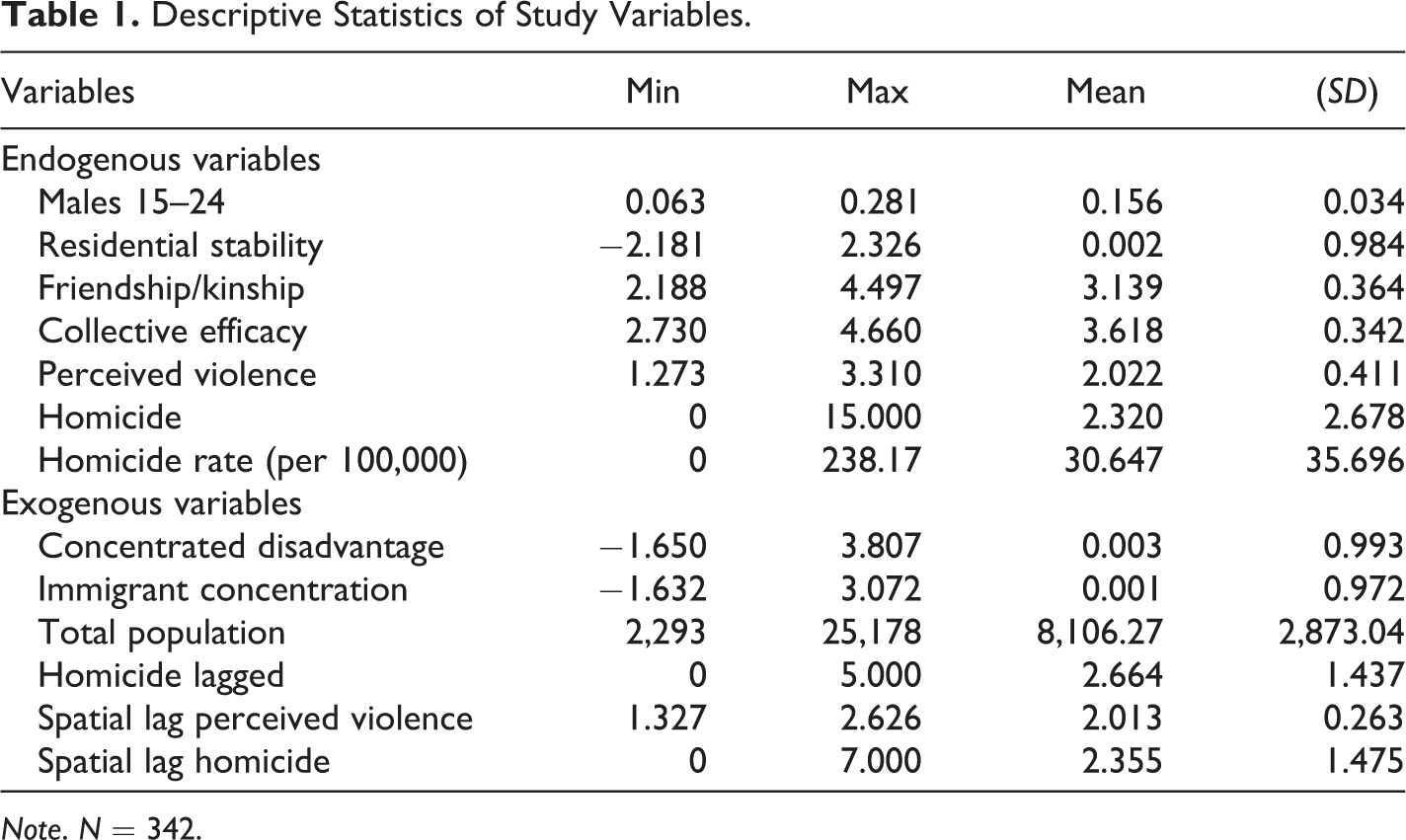
Note. N = 342.
We next turn to the bivariate correlations shown in Table 2 to observe the baseline associations between immigration, neighborhood-level contextual and social characteristics, and our measures of homicide and perceived violence. Table 2 reveals several noteworthy findings. First, we find that immigrant concentration and homicide are negatively correlated, indicating that NCs with high levels of immigrant concentration tend to have lower levels of homicide. In contrast, immigrant concentration has no significant association with perceived violence, suggesting a different relationship than for homicide. Neighborhoods with greater concentrated disadvantage and young males also both have significantly higher levels of homicide and perceived violence.
Bivariate Correlations of Study Variables.
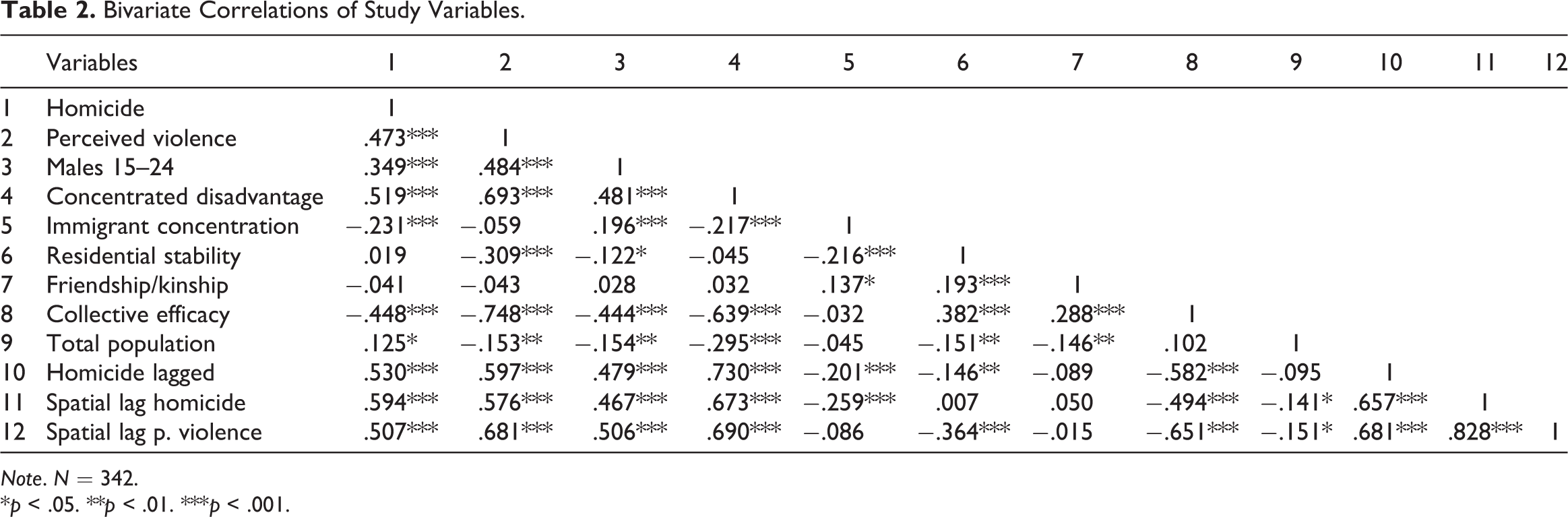
Note. N = 342.
*p < .05. **p < .01. ***p < .001.
With respect to our mediating variables, Table 2 shows that neighborhoods with greater friendship and kinship ties tend to have higher levels of collective efficacy. However, their connections with immigration and neighborhood violence are somewhat complex. We find that neighborhoods with greater immigrant concentration have higher levels of friendship and kinship ties but not greater collective efficacy. At the same time, collective efficacy, but not friendship/kinship ties, is associated with significantly lower levels of homicide and perceived violence. Taken together, the bivariate relationship in Table 2 offers some initial indications that immigrant neighborhoods have lower levels of violence and some of the protective neighborhood features described by immigrant revitalization perspectives. Yet, there appears to be some complexities in the ways that immigration and neighborhood violence are connected to neighborhood social ties and collective efficacy. Thus, we turn to the multivariate structural equation models to better identify these relationships and explore the indirect pathways through which immigration shapes neighborhood homicide and perceived violence.
Multivariate Path Models
To examine the indirect effects at work in immigration–violence relationships, we first describe the results of our homicide path model, shown in Figure 2 (standardized coefficients) and Table 3 (unstandardized coefficients). Turning first to the control variables, Figure 2 and Table 3 show that neighborhoods with larger populations have significantly higher levels of homicide, net of other factors. The spatial lag term for homicide is also positive and significant (b = .205, p < .001), suggesting the presence of “spillover” effects of homicide from neighboring communities. As expected, the time-lagged homicide variable measuring lethal violence in the prior 5-year period is closely associated with neighborhood levels of homicide in 1990.
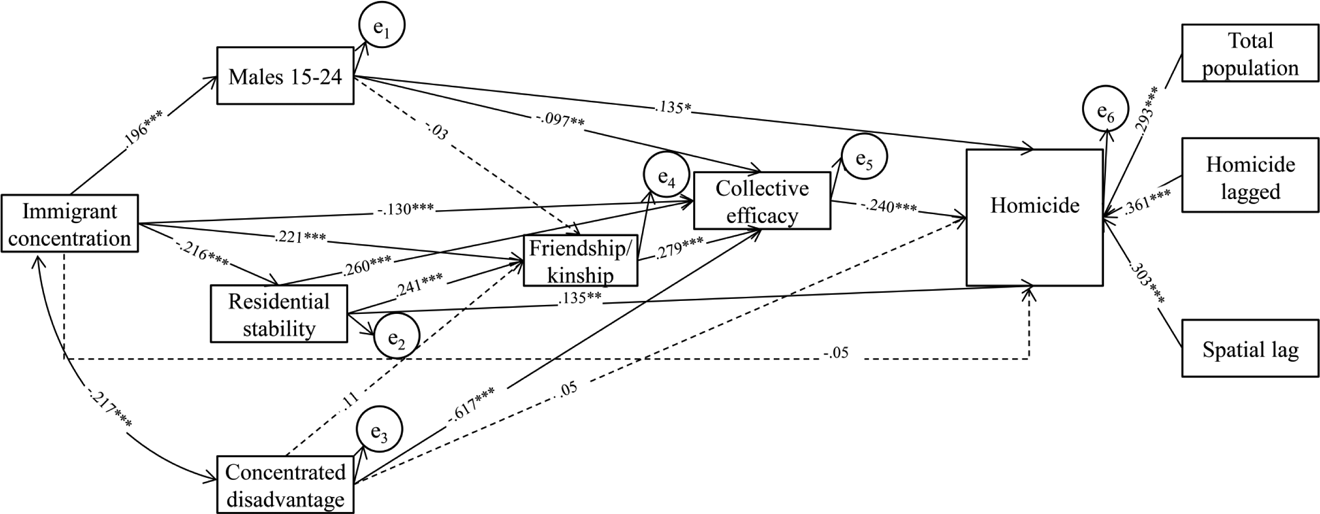
Effects of immigrant concentration on homicide (standardized coefficients).
Unstandardized Path Coefficients for the Structural Equation Models Predicting Perceived Violence and Homicide.
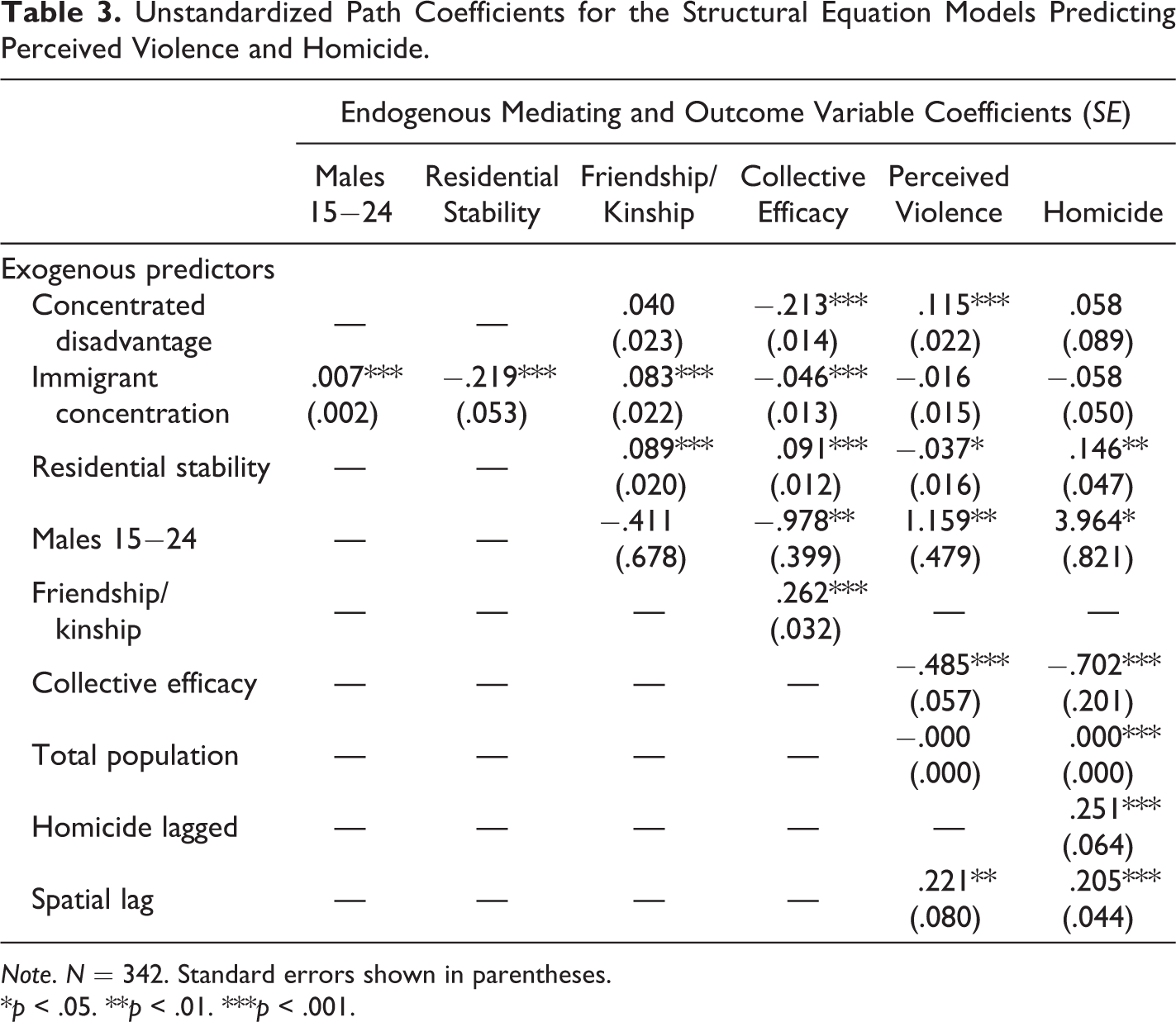
Note. N = 342. Standard errors shown in parentheses.
*p < .05. **p < .01. ***p < .001.
Figure 2 and Table 3 also reveal several noteworthy relationships between the mediating variables and neighborhood-level homicide. As seen in prior research, collective efficacy is related to lower neighborhood levels of homicide (Sampson et al., 2005). Contrary to expectations, residential stability is positively and significantly related to neighborhood homicide. Neighborhoods with larger shares of men ages 15–24 have higher levels of homicide. Although structural disadvantage is commonly linked to aggregate patterns of lethal violence, Figure 2 shows that the direct effect of concentrated disadvantage on homicide does not reach significance once all controls and mediating variables are included. Instead, it appears that any homicide-generating effect of concentrated disadvantage operates largely through reduced neighborhood levels of collective efficacy, as illustrated in our path model.
The mediating variables shown in Figure 2 are also associated with collective efficacy. Neighborhoods with larger percentages of young males have lower levels of collective efficacy, net of other factors. As suggested by social disorganization theory, residential stability is linked to higher levels of collective efficacy. In addition, neighborhoods with strong networks of friendship and kinship ties have significantly higher levels of collective efficacy than neighborhoods with sparse or weak social ties. In sum, the findings thus far parallel prior research in showing that (1) collective efficacy is one of the primary drivers of neighborhood patterns in homicide and (2) a variety of interrelated social and structural features of community context predict these neighborhood patterns of collective efficacy.
Yet, the key question of the analysis is how immigration intersects with these features of neighborhood social structure, friendship ties, collective efficacy, and ultimately violence. Figure 2 and Table 3 illustrate that, when considering the full model and all direct and indirect effects, immigration has multiple complex relationships with neighborhood-level homicide. First, our results indicate that the direct effect of immigrant concentration on homicide is not significant. Although the bivariate correlations showed a significant negative association between immigration and homicide, the multivariate results suggest that immigrant concentration may have little direct effect on neighborhood homicide after accounting for all controls and indirect effects of immigration, which we turn to next.
Figure 2 and Table 3 show that immigrant concentration has multiple indirect effects on homicide working through the mediating variables in our model. However, these effects are somewhat complex and work in offsetting ways. On one hand, immigrant concentration has some indirect effects that are associated with greater homicide. Immigrant concentration is associated with lower levels of collective efficacy net of other factors and indirect effects (b = −.046, p < .001). In addition, immigrant communities tend to have greater shares of young males (b = .007, p < .001) and less residential stability (b = −.219, p < .001), both of which result in lowered collective efficacy. As noted above, collective efficacy has a protective effect on neighborhood homicide and is linked to lower lethal violence (b = −.485, p < .001). Thus, by reducing collective efficacy, these indirect effects link immigration with higher levels of homicide.
In contrast, immigration has several other indirect effects that work in the opposite direction and contribute to increased collective efficacy. Figure 2 and Table 3 show that immigrant concentration is negatively correlated with neighborhood concentrated disadvantage. Thus, it appears that neighborhoods with larger shares of immigrants tend to have lower levels of socioeconomic disadvantage, which, as noted earlier, is linked to greater neighborhood collective efficacy. 12 Likewise, immigrant concentration is associated with lower levels of homicide through decreased residential stability, given that residential stability is positively linked with homicide. Notably, this homicide-increasing effect of residential stability conflicts with the traditional social disorganization model, which predicts lower crime and greater social control in stable neighborhoods. However, rather than creating social organization, residential stability can also be a sign of entrenched poverty, social isolation, and an inability of residents to move out of a neighborhood. In such cases, residential stability may reflect patterns of stagnation and stable deprivation in Chicago’s most disadvantaged, high-crime communities. As a result, the mobility and growth generated by immigration may actually serve to revitalize communities and disrupt cycles of isolation and entrenched deprivation, which would support immigrant revitalization arguments.
Perhaps most notably, immigrant concentration also has a positive and significant relationship with neighborhood friendship and kinship ties (b = .083, p < .001), indicating that social networks are stronger in communities with larger shares of immigrants. In turn, friendship and kinship networks have strong positive relationships with neighborhood collective efficacy (b = .262, p < .001). In fact, based on the standardized coefficients shown in Figure 2, friendship and kinship ties have the largest effect on collective efficacy in the model. To describe these effects in more substantively meaningful terms, the standardized effects from Figure 2 indicate that controlling for other factors, a one standard deviation increase in immigrant concentration is associated with a .22 standard deviation increase in neighborhood friendship/kinship ties. A one standard deviation increase in friendship/kinship ties is associated with a .28 standard deviation increase in neighborhood collective efficacy. Finally, a one standard deviation increase in collective efficacy is linked with a .24 standard deviation decrease in neighborhood homicide. 13
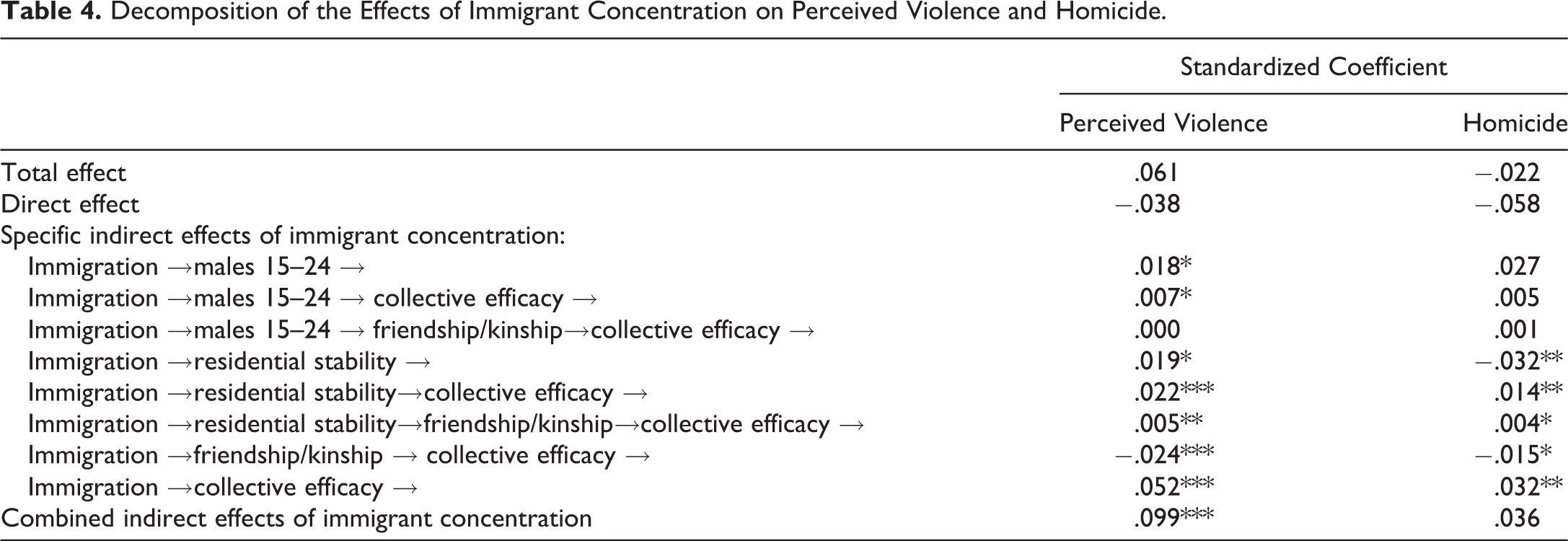
In sum, immigrant concentration has multiple indirect effects on neighborhood levels of homicide that work in opposite ways. To further illustrate the summed picture of these effects, we present Table 4, which shows (1) the direct effect, (2) the indirect effects, and (3) the total (direct plus indirect) effect of immigrant concentration on homicide. Table 4 again shows that immigration has a null direct effect but has both positive and negative indirect effects on neighborhood homicide, working through neighborhood structural characteristics, social ties, and collective efficacy. To gain a better understanding of these different indirect effects, the bottom of Table 4 provides the calculation of the “combined indirect effects” of immigration on homicide, which estimates the sum of all of the mediating pathways between immigration and homicide. Notably, we see that the combined indirect effect of immigration on homicide is not significant, indicating that the positive and negative indirect effects in the immigration–homicide model largely offset one another. Likewise, the total or “overall” effect of all direct and indirect effects in the model is also null. Thus, despite a complex web of indirect influences on violence, including increased friendship/kinship networks and reduced collective efficacy, immigration has a largely neutral overall relationship with neighborhood patterns of homicide.
Decomposition of the Effects of Immigrant Concentration on Perceived Violence and Homicide.
Perceived Violence
We now turn to the results of our perceived violence model, shown in Figure 3 (standardized coefficients) and Table 3 (unstandardized coefficients). Among the control variables, there are some differences in the effects on perceived violence compared to the homicide model. Specifically, concentrated disadvantage has a significant positive effect on perceptions of violence (b = .115, p < .001), whereas its effect on homicide was largely indirect, through collective efficacy. In addition, residential stability is associated with lower levels of perceived violence (b = −.037, p < .05), and the effect of neighborhood population is not significant.
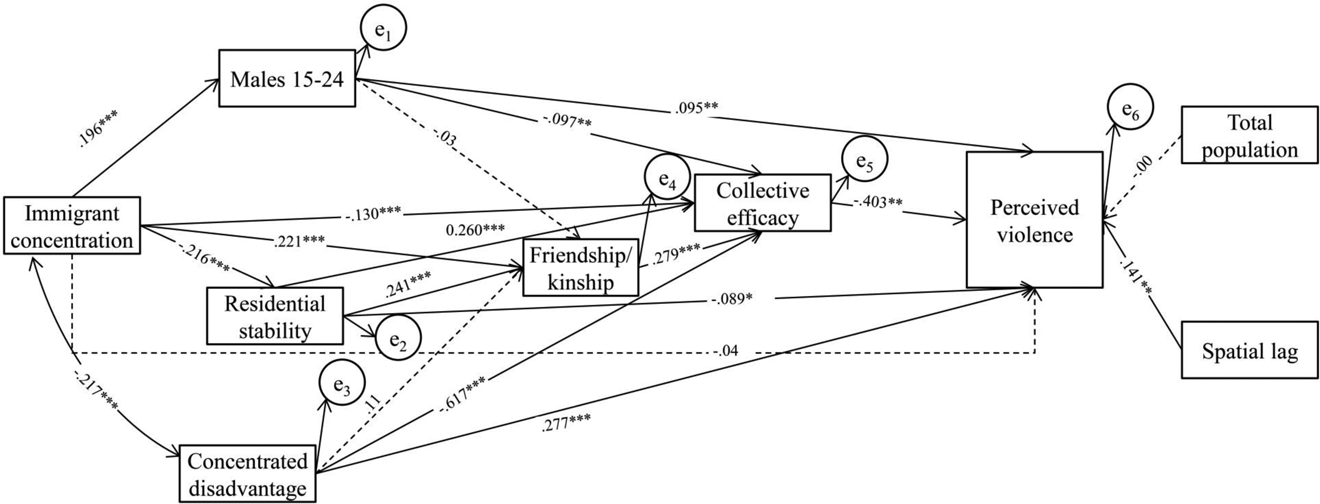
Effects of immigrant concentration on perceived violence (standardized coefficients).
However, outside of these control variables, the predictors of perceived violence are generally similar to our homicide model. The size of the young male population and the spatial lag terms are both significant, indicating that perceptions of violence are higher in neighborhoods with relatively more young males and in locations neighboring other communities with high levels of perceived violence. Immigration has no significant direct effect on perceived violence, net of other factors. As seen for homicide, collective efficacy is the strongest predictor of neighborhood perceptions of violence, with lower perceived violence in neighborhoods with high collective efficacy (b = −.485, p < .001). In addition, because the mediating variables and pathways did not change from the homicide model, the predictors of collective efficacy are identical to those observed in the homicide analysis. Thus, we again see that concentrated disadvantage, immigrant concentration, and percent young males are associated with lower collective efficacy, while residential stability and friendship/kinship ties are linked to higher collective efficacy.
Likewise, the effects of immigration on the mediating variables shown in Figure 3 are identical to those observed for homicide (Figure 2). Immigrant concentration is related to larger shares of young males, lower residential stability, and lower collective efficacy. At the same time, communities with high levels of immigrant concentration also have significantly stronger friendship/kinship networks and lower levels of concentrated disadvantage, net of other factors. Taken together, the relationship between immigrant concentration and perceived violence is similar to that observed between immigration and homicide. Net of other factors, immigrant concentration does not appear to have a significant direct effect on perceived violence (Figure 3 and Table 3). Instead, the effects of immigrant concentration on perceived violence are largely indirect, working through neighborhood levels of residential stability, friendship/kinship ties, and collective efficacy. As seen for homicide, these effects work in complex ways that are simultaneously linked to both higher and lower neighborhood levels of perceived violence.
We again refer the reader to Table 4, which summarizes the indirect effects shown in Figure 3 and provides the full set of indirect effects as well as the “total” effect (i.e., the summed direct and indirect effects) of immigrant concentration on neighborhood levels of perceived violence. Table 4 illustrates that immigrant concentration is indirectly linked to greater perceptions of violence due to the large share of young males in immigrant neighborhoods and decreased levels of residential stability and collective efficacy. Yet, these effects are countered by the strong friendship and kinship networks in neighborhoods with high immigrant concentrations, which in turn contribute to greater collective efficacy and lower perceived violence. Specifically, the standardized effects indicate that a one standard deviation increase in collective efficacy (net of other factors) is associated with a .40 standard deviation decrease in perceived violence.
When summed together, the “combined indirect effects” of immigrant concentration on perceived violence working through all the estimated pathways are positive and significant, indicating that the indirect effects do not completely offset one another as they did in the homicide model (Table 4). However, the total or “overall” effect of immigrant concentration on perceived violence, which combines all direct and indirect effects, is not significant. Thus, despite some subtle differences in indirect effects on perceived violence compared to homicide, the overall picture of immigration and neighborhood violence is similar in the two models. Regardless of whether one examines homicide or neighborhood perceptions of violence, immigrant concentration has multiple indirect effects but little or no overall effect on neighborhood levels of lethal violence or on perceptions of violence.
Discussion and Conclusion
Despite pervasive public fears of immigrant-generated crime, studies have consistently shown that immigration generally does not increase rates of serious violence and may instead revitalize and protect communities from crime and social problems. However, research has offered surprisingly few analyses of mediating mechanisms in immigration–crime relationships to identify how these revitalizing effects might work at the neighborhood-level. Furthermore, the few studies that have examined these indirect effects have focused on (1) highly aggregated spatial units (MSAs, counties, and places; Feldmeyer, 2009; Ousey & Kubrin, 2009), (2) official crime measures (rather than perceptions of local residents), or (3) have produced mixed findings on the neighborhood-level relationships between immigration, social networks, social capital, and crime (Browning et al., 2016; Burchfield & Silver, 2013; Kubrin & Desmond, 2015).
The current study sought to address these gaps in research by examining the indirect, neighborhood-level relationships between immigrant concentration and both homicide and perceived violence, with a specific focus on the mediating effects of collective efficacy and friendship/kinship ties. Our analysis reveals several key findings. After accounting for all controls and indirect effects, immigrant concentration has little direct impact on neighborhood homicide or perceived violence. Yet, examining only the direct effects masks several complex indirect associations between immigration and neighborhood violence, which work in competing ways. On one hand, immigrant concentration has some connection to higher violence through its association with decreased residential stability (for perceived violence), larger young male populations, and lower levels of collective efficacy. On other hand, immigration is linked to significantly stronger friendship and kinship ties and lower levels of disadvantage, which are related to increased collective efficacy and ultimately, lower levels of homicide and perceived violence. Taken together, our results show that these indirect effects largely offset one another and result in a null overall or total effect of immigration on violence, and that this is the case whether one examines official records of violence (neighborhood rates of homicide) or resident perceptions of violence.
The findings presented here hold important theoretical implications for the immigrant revitalization perspective and help illustrate the mechanisms through which immigration shapes neighborhood violence. Based on our findings, friendship and kinship ties, and their effect on collective efficacy, appear to be a key driver in the immigrant revitalization process. Thus, our findings support theoretical arguments, suggesting that dense networks of social ties offer protective benefits to immigrant communities that help curtail neighborhood violence.
Yet, as seen in some prior studies (Burchfield & Silver, 2013; Kubrin & Desmond, 2015), the indirect effects observed here do not fully account for the immigrant paradox and reveal some relationships that do not align with immigrant revitalization arguments. Specifically, immigrant communities appear to have lower collective efficacy, net of friendship/kinship ties. Although the effects of friendship/kinship ties largely offset this relationship, this finding raises questions about factors that could restrict collective efficacy in immigrant communities, particularly in light of prior research that also shows reduced social capital in immigrant neighborhoods (Burchfield & Silver, 2013; Kubrin & Desmond, 2015). Perhaps, legal cynicism and limited contact with police may contribute to this finding. Essentially, immigration may create strong social networks, but simultaneously have limited collective efficacy and social control due to anxieties and concerns about contacting local law enforcement. Notably, we explored this relationship by adding measures of legal cynicism from the PHDCN into our path models. However, they were highly correlated with other measures (collective efficacy) and could not be included in the final models. Regardless, exploring this possibility and the complex and somewhat surprising connections between collective efficacy and immigration is an important area for future research.
In addition, the findings here illustrate the importance of exploring indirect effects in the immigration-crime nexus. Although the standard analyses of percent foreign-born, net of controls, have been essential for establishing the relationships between immigration and crime, additional analyses that unpack the mechanisms and processes behind these relationships are needed. This is particularly important given that leading theoretical perspectives on immigrant revitalization suggest that most (if not all) of the effect of immigration on local crime rates is likely indirect, working through local institutions (family and church), economic conditions, social ties, social capital, and social control. Furthermore, from a practical stance, unveiling the different pathways that connect immigration with community rates of crime is a necessary step for designing public policies and programs aimed at improving safety and quality of life in neighborhoods. For example, our findings suggest that programs aimed at strengthening social ties in immigrant communities might be beneficial.
Although the current study offers several contributions, further research is needed to address the caveats of our analysis and more thoroughly explore the mechanisms at work in the immigrant revitalization process. The PHDCN offers one of the most well-established data sets for analyzing neighborhood-level patterns and predictors of collective efficacy and serious violence. However, it is limited to a single city (Chicago) at a single point in time. Future analyses that explore these relationships in other locations with different immigrant profiles and ethnic backgrounds would be valuable for assessing the generalizability of these findings. Likewise, data that allow longitudinal assessments of neighborhood immigrant concentration, violence, collective efficacy, and other mediators are needed to identify how these relationships vary over time and to more clearly identify the causal ordering of these processes.
Future research should examine these relationships for other types of crime beyond homicide and perceptions of violence, perhaps including property and drug offending. In addition, future analyses should explore other neighborhood-level factors that may help account for immigration–crime relationships but that were not examined here, such as immigrant business ownership, relationships with local police, and gang membership. In sum, there is clearly a need for further research that unpacks the immigrant paradox and empirically identifies the mechanisms through which immigration revitalizes communities. The current study marks an important step toward that goal, illustrating that despite some complex effects of immigration on collective efficacy, dense networks of social ties and family/kinship bonds appear to be a lynchpin in the protective buffer offered by immigrant communities.
Footnotes
Acknowledgments
This study uses data from the Project on Human Development in Chicago Neighborhoods, available from the Inter-University Consortium for Political and Social Research. The authors would like to thank Rustu Deryol for his assistance with the spatial analysis in ArcGIS.
Declaration of Conflicting Interests
The authors declared no potential conflicts of interest with respect to the research, authorship, and/or publication of this article.
Funding
The authors received no financial support for the research, authorship, and/or publication of this article.