




Abstract
Hate crimes have received substantial scholarly attention, largely focusing on victims from marginal groups. Large numbers of White Americans also report being the victim of racial hate crime, though very little research has sought to examine the etiology or meaning of anti-White hate crimes. The present work explores the neighborhood context of hate crimes against non-Hispanic Whites in a majority-White city—comparing police reports with self-reported victimizations. Police reports of anti-White hate crimes are most common in areas that have high rates of nonhate crimes and residential instability. Perceptions of bias incidents, by contrast, appear largely driven by the racial composition. Hate crimes against members of dominant groups appear fundamentally distinct from hate crimes against members of subordinate groups and require separate theoretical models of their substantive meaning and etiology. In general, White residents appear to interpret the motivations for victimizations through a racial lens—attributing anti-White motivations most often when they live near larger numbers of Black neighbors—and reporting them most frequently in disorganized and higher crime places. Implications for theory and research on hate crimes, racial threat, anti-White racism, and the effect of the racial composition on perceptions of crime are discussed.
Hate crime refers to unlawful, violent, destructive, or threatening behavior in which the perpetrator is motivated in whole or in part by prejudice toward the victim’s perceived race, ethnicity, religion, sexual orientation, gender identity, age, or impairment (Federal Bureau of Investigation [FBI], 2013; Green, McFalls, & Smith, 2001; Levin & McDevitt, 2002). Most journalistic accounts of hate crime, hate crime legislation, and academic research on hate crimes focus on crimes committed against members of historically oppressed or marginalized groups. For instance, the term “hate crimes” first came into widespread use among journalists in the 1980s to describe a series of incidents targeting Black, Jewish, and Asian Americans (e.g., Levin & McDevitt, 1993; Shively, 2005). The first official hate crime legislation at the state and eventually federal level was also passed around this time (Shively, 2005), though many point to precedents in the anti-KKK Civil Rights Act of 1871 and the protections from race-based injury or intimidation in the 1968 Civil Rights Act.
Despite this focus on victims from historically oppressed groups, large numbers of White citizens also report being the victim of racially motivated hate crimes (e.g., Gladfelter, Lantz, & Ruback, 2019; Lyons, 2007). In fact, as described below, in the majority-White city of Seattle, White residents report being the victim of hate crimes at lower rates but in greater numbers than non-White residents.
Although only a small amount of research has directly considered hate crimes against members of dominant groups, the results suggest these crimes may be etiologically distinct from those perpetrated against members of subordinate groups. Hate crimes, like nonhate crimes, cluster geographically in spaces with particular kinds of social and demographic characteristics (e.g., Green, Strolovitch, & Wong, 1998). However, anti-White and anti-minority crimes appear to cluster in different kinds of places. Two studies—Lyons’s (2007) study of neighborhoods in Chicago and Gladfelter, Lantz, and Ruback’s (2017) study of municipalities in Pennsylvania—each come to a similar but striking conclusion: Unlike anti-minority hate crimes, which tend to occur in more advantaged and organized places, anti-White hate crimes appear most likely in classically socially disorganized communities.
This research, however, relies—as does much hate crime research—on public records of hate crimes: those crimes which were reported to the police (e.g., Lyons, 2007) or to the media or hate crime advocacy groups (e.g., Gladfelter et al., 2017). As with the counting of other kinds of crimes, these public records are likely to substantially undercount hate crimes both generally and in systematic ways (Bureau of Justice Statistics, 2014; Iganski, 2001; Levin, 1999; Perry, 2001). In particular, public records may best capture those incidents which are both serious in their consequences and obviously motivated by bias—and especially the “stereotypical” White-on-Black hate crimes (Lyons, 2008b) which are most likely to be cleared and result in arrests (Lantz, Gladfelter, & Ruback, 2019; Lyons & Roberts, 2014).
The most basic issue in identifying hate crimes is the difficulty of establishing a motive with any certainty. This may be a particular problem for anti-White hate crimes. While anti-minority hate crimes appear to be specialist crimes—occurring in places where other crimes are less common—anti-White hate crimes occur in the same places as other types of crimes (e.g., Lyons, 2007). In short, people may perceive an incident as being motivated by bias but, lacking clear evidence of the bias, may not report the incident to the police as a bias crime. Importantly, these perceptions may not always be correct. In cases where the motive is not clearly communicated by the offender, victims must make guesses about the reasons for the crime. Importantly, a perceived bias victimization may still have an impact on both the victim and the community regardless of the veracity of the belief—perceptions need not match reality to influence behavior.
Based on this, the present work has two goals. First, we seek to replicate the general question from the small number of prior studies (Gladfelter et al., 2017; Lyons, 2007) on the ecological distribution of anti-White hate crimes in a new context: the majority-White city of Seattle. Second, in addition to police reports of anti-White bias incidents, we use self-report data from a large survey of residents of Seattle neighborhoods. This allows us to ask a different kind of question, examining the neighborhood distribution of what we believe may be two different phenomena: incidents that are reported to the police specifically as something motivated by hate and the theoretically larger set of crimes that are more simply believed by the victim to have been motivated by racial bias.
These questions are important for several reasons. First, anti-White hate crimes are particularly interesting because they do not clearly fit within the threat-based theoretical framework generally employed to make sense of other kinds of hate crimes—that hate crimes are perpetrated by majority or dominant group members against minority or subordinate group members whom they perceive as a threat to their privileges. This question is particularly important in light of the recent U.S. political climate, which has included both a surge in hate incidents and hate groups (Potok, 2017; Southern Poverty Law Center, 2016) as well as claims of anti-White racism (Norton & Sommers, 2011), often in response to those seeking racial justice or equality for non-White racial groups (e.g., Kew, 2016).
Second, this work heeds the call to pay more attention to overlooked sources of bias in crime and justice processes (Peterson, 2017). Typically, hate crime research focuses on the motivation of the offender. However, the reality is that it is often the victim’s perception of the crime and offender that will determine whether the crime is considered motivated by hate or not. Implicit racial biases are pervasive (e.g., Banaji & Greenwald, 2013), and impact not just criminal justice processing (e.g., Banks, Eberhardt, & Ross, 2006; Pizzi, Blair, & Judd, 2005), but also perceptions of crime more broadly (Drakulich, 2015; Drakulich & Siller, 2015; Eberhardt et al., 2004). In this light, implicit bias likely plays a role not just in the way that offenders see victims, but also in the way that victims see offenders. While much attention has been paid to bias on the part of the offender as the motivation for perpetrating a hate crime, little to no work has directly considered potential bias—implicit or explicit—in the way victims see the offender. Although we do not examine implicit bias directly, we draw on this body of work to develop expectations about the way individuals may perceive a victimization, and in particular how those perceptions may be influenced by the racial context of the neighborhood.
Theoretical Model
Prior work has drawn on some version of three different theories to set up explanations for the distribution of hate crimes across neighborhoods (e.g., Lyons, 2007). First, resource threat theories position hate crime as the end result of perceived competition for scarce economic and political resources. From this perspective, residents perceive an incoming marginalized out-group population as a threat to valued but limited economic opportunities (Brief et al., 2005; D’Alessio, Stolzenberg, & Eitle, 2002). This perceived threat leads to prejudice, discrimination, and negative stereotyping of the out-group (Brief et al., 2005; Jackson, 1993; Schofield, 2009; Stephan & Stephan, 2000).
By contrast, the defended neighborhood thesis argues that the motivation for unrest is not based on competition for economic resources but rather on cultural competition. An influx of in-migration by a racial or ethnic minority may challenge the shared cultural identity of the neighborhood (Blalock, 1967; Bobo, 1988; DeSena, 2005; Grattet, 2009; Green et al., 1998; King, Messner, & Baller, 2009; Levin & McDevitt, 2002; Suttles, 1972). Under some conditions, the response to this perceived cultural threat is to “defend” the territory from the invasion of ethnic outsiders (Buell, 1980). Such defenses might include hostile acts of intimidation aimed at the offending minority group, such as damaging property belonging to the group or physically assaulting a member of the group. Lyons (2007) argues that these defenses are more likely in neighborhoods which are economically and socially organized, as these areas have the resources available to actively repel these perceived threats. Green and colleagues (1998) found support for this when examining racial change over a 10-year period, identifying that hate crime was highest when in-migration occurred in areas where the majority of the population was White. They identified that it is not simply the proportion of a given minority in an area but rather the change in this proportion that leads to conflict. This led the authors to suggest that hate crime “stems not from economic frustration but from an exclusionary impulse on the part of Whites defending what they perceive to be their territory” (Green et al., 1998, p. 373).
Finally, scholars have drawn on a more general theory of crime: social disorganization. According to this theory, high levels of residential instability, ethnic diversity, and economic disadvantage decrease social cohesion and the willingness of residents to engage in informal social control (Sampson, Raudenbush, & Earls, 1997; Shaw & McKay, 1942). The result of this breakdown of social relationships is increased crime rates, which will include both hate and nonhate offenses (Brunton-Smith, Jackson, & Sutherland, 2014; Hirschfield & Bowers, 1997; Sampson et al., 1997; Villarreal & Silva, 2006). From this perspective, crime and hate crime would share the same ecological drivers given that they both involve a criminal element (Green et al., 1998; Lyons, 2007). Grattet (2009, p. 135) argues that “bias crime always contains conduct that is already criminalized,” meaning that hate crimes are already reflected in counts of nonhate crimes, for instance as vandalism, a threat, or an assault.
However, there are problems in applying each of these theories to our specific problem of interest: anti-White hate crimes. First, both the resource threat and defended neighborhoods perspectives are rooted in a notion of threat. Classically, racial threat theories have focused on threats posed by minority or subordinate group members as perceived by majority or dominant group members (Blalock, 1967). This is rooted in a sociological notion of prejudice as a sense of group position, in which the perceived threat emerges from a feeling of group-based proprietary claims to certain privileges or advantages combined with the feeling that a subordinate group is interested in obtaining those privileges or advantages (Blumer, 1958). In Seattle, as in the United States in general, White residents clearly occupy the dominant sociopolitical and economic racial position. Broadly, then, theories rooted in this notion of perceived subordinate group threat will be less useful for explaining hate crimes against dominant groups. Confirming this, Lyons (2007) fails to find evidence to support either of these explanations as a predictor of anti-White hate crimes. However, on a smaller scale, when a process like gentrification increases the presence of dominant group members in an area with an established nondominant group population, this may be experienced as a threat.
The third theory—social disorganization—presents its own issues. The most important implication of this perspective is that it assumes that hate crimes do not require a special explanation—that they are etiologically indistinct from other more routine kinds of crimes (e.g., Lyons, 2007). The issue, then, is that there is no theoretical reason—at least from social disorganization theory—to expect that this model would help explain hate crimes against some groups but not others. However, Lyons’s (2007) work found just this to be the case (as did Gladfelter et al., 2017). Thus, while anti-Black hate crimes may be best understood as specialist crimes—motivated primarily by the message they send to the group perceived as posing a threat—anti-White crimes may, at least in part, be rooted in the same structural causes of many nonhate crimes, suggesting they may be a fundamentally different phenomenon than hate crimes against subordinate groups (e.g., Lyons, 2007). Police reports of anti-White hate crimes, then, may be most likely in the kinds of places where police reports of nonhate crimes are also common.
These cases reported to the police, however, represent only a small portion of a larger population of incidents believed by the victim to have been motivated by racial bias or animus. This larger group of incidents—likely varying widely in the seriousness of the offense and the explicitness of the racial motivation—may require a separate explanation. The starting place for the explanation is the idea that the motivation behind a crime can be difficult to ascertain with any certainty. In fact, these issues may be more pronounced for anti-White hate crimes, as they tend to occur in contexts where larger numbers of nonhate crimes also occur, and may be less likely to be committed by hate crime specialists (Lyons, 2007). 1 As a result, White victims may be more apt to make perceptual misjudgments.
After experiencing a victimization, the victim is left with a difficult question: why? Narratives which ascribe meaning, attribute blame, and suggest future actions are important (see, for instance, sociological work on narratives and framing: Benford & Snow, 2000; Goffman, 1974; Small, Harding, & Lamont, 2010). Symbolic interactionism suggests that “human beings act towards things on the basis of the meaning that the things have for them” (Blumer, 1969 p. 2), but that the meaning of a thing is not necessarily intrinsic to that thing. In short, narratives and meaning may be important independent of the real-world events and conditions they interpret. Applied to crime, prior work has suggested victims hold differing views of the blame for and motivation behind their victimizations (e.g., Lim, Valdez, & Lilly, 2015; Perilloux, Duntley, & Buss, 2014). The question then is how people come to understand their victimization experiences, especially when the motivations or causes are ambiguous. To answer this, two insights about our cognitive processes are useful.
First, our views and judgments are often influenced by subtle cues in an automatic fashion without necessarily consciously realizing that this has happened, a phenomenon known as priming (e.g., Banaji & Greenwald, 2013; Kahneman, 2011). Race is a powerful prime (e.g., Banaji & Greenwald, 2013). This is particularly true for perceptions of crime. The racial context—and in particular the presence of larger numbers of African Americans—provokes overestimations of the presence of disorder, the threat of criminal danger, and the likelihood of victimization (e.g., Drakulich, 2012, 2013; Pickett, Chiricos, Golden, & Gertz, 2012; Quillian & Pager, 2001, 2010; Sampson, 2009). If someone has been primed by the racial context, they may be more likely to think of race as they attempt to make sense of a victimization experience and thus more likely to attribute a causal role to race. In trying to determine the reason for a victimization, White residents of Black neighborhoods may be more likely to assume race must have played a role. In short, the racial context may influence not just estimations of the likelihood of victimization but also understandings of the experience of victimization.
Second, ascertaining whether a victimization was motivated by racial hate is, at its root, a judgment about probability in the face of uncertain or imperfect information. Social psychologists suggest that in these kinds of questions, we rely on heuristics—or cognitive tricks—to develop answers (Kahneman, 2011; Tversky & Kahneman, 1974). The problem is that these heuristics often lead us to the wrong answer and do so in relatively systematic and predictable ways. For instance, if characteristics of the victimization are a good match for a stereotypical mental image of an anti-White hate crime—for example, that they tend to occur in areas with more Black residents—the victim may be more likely to identify it as such, even though in reality, nonhate crimes may be more common than hate crimes in these same places. 2 In short, perceptions that victimizations were motivated by anti-White bias may be the product of a systematic patterning of assumptions about the motives for victimizations primed by the racial context.
Prior Research
Anti-White Hate Crime
As suggested above, prior work has suggested that the distribution of police reports of anti-White hate crimes appear to be the product of social disorganization processes. Lyons (2007) finds that anti-White incidents in Chicago were reported at a higher frequency within socially disorganized neighborhoods, particularly where there had recently been a high population turnover. In contrast, neighborhoods with higher levels of informal social control were associated with fewer anti-White hate crimes, suggesting that informal social control has a mediating effect on the number of hate crimes reported within the community. Gladfelter and colleagues (2017) found that in Pennsylvania, hate crime incidents were significantly and consistently associated with residential instability. The role of advantage, on the other hand, appeared to depend on race: Anti-Black crimes were most likely in largely White and socioeconomically advantaged communities while anti-White hate crimes were most likely in socioeconomically disadvantaged neighborhoods (Gladfelter et al., 2017). Thus, in both studies, anti-White hate crimes appear better explained by a classic social disorganization model (the confluence of residential instability and socioeconomic disadvantage).
These findings have an important implication for an understanding of hate crimes: The ecological drivers of hate crimes against different races may be distinct. Lyons (2007) finds that anti-Black crimes were more likely to occur in organized, relatively affluent communities that had recently experienced a sudden influx in Black in-migration. Organized communities, rich in economic resources, were able to work together to exhibit hate crime as a “message” crime. Largely consistent with this, Gladfelter, Lantz, and Ruback (2017) report anti-Black crimes are most likely in residentially unstable but affluent and racially homogeneous communities. In short, anti-White hate crimes appear most likely in socially disorganized neighborhoods—along with other crimes more generally. Anti-Black hate crimes, by contrast, appear more likely in relatively organized communities experiencing some kind of change (residential instability generally in Gladfelter et al.’s 2017 work and an influx of Black residents specifically in Lyons’s 2007 work). Consistent with this, Lyons (2008a) finds that “the influx of black newcomers matters only in white communities whose residents express a strong sense of community attachment” (p. 378, original emphasis).
Perceived and Reported Hate Crime Incidents
Studies on the neighborhood ecology of hate crime have to date primarily relied on official data to inform their analyses (e.g., Grattet, 2009; Green et al., 1998; Lyons, 2007). 3 However, there are several problems noted with official data in relation to hate crime offenses. First, police records in many jurisdictions are inaccurate or incomplete (Iganski, 2001; Levin, 1999; Perry, 2001). In the United States, hate crime data should be reported annually to the FBIs for the Uniform Crime Reports under the Hate Crime Statistics Act 1990 (Krouse, 2010). However, in 2006, almost 5,000 police departments of approximately 17,000 departments in the nation did not provide figures (Henry, 2009). Further, 83.3% of the 12,620 agencies that did participate reported zero hate crimes in their jurisdiction. Errors have also been identified in the hate crime data collection, as often agencies that do not provide data will be reported as recording zero offenses. Police often do not understand whether to classify an offense as a hate crime or are reluctant to do so to avoid additional paperwork (Henry, 2009).
Additionally, even when police agencies do record and report hate crimes, victims often do not report the crimes to the police. Estimates suggest 60–70% of incidents are not reported—a rate which is reasonably consistent across the United States, United Kingdom, and Australia (Bureau of Justice Statistics, 2014; Home Office, 2013; Victorian Equal Opportunity and Human Rights Commission, 2011). Victims may be reluctant to report victimization to police for a number of reasons, including fear of secondary victimization, mistrust of the police, unsatisfactory previous experiences with the police, or perceiving the offense to be too trivial to report (e.g., Harlow, 2005). Additionally, victims may be less likely to report the crime to the police—or to report it as a normal nonhate crime—in cases where the evidence of the hate is less clear. In general, there appears to be variability in what people perceive to be a hate crime (e.g., Craig & Waldo, 1996). The potential detrimental effects of hate crimes are not limited to those which end up reported to the police. For this reason, we are interested not just in those hate crimes which are reported to the police but also in the full population of crimes perceived to be motivated by hate, regardless of whether they were reported to the police.
The Present Research
Anti-White hate crimes appear to be relatively prevalent. According to the FBI (2013), 21.4% of the 3,407 racially motivated hate offenses reported in the UCR in 2013 were motivated by an anti-White bias. Despite this, as Perry (2002, 2003) has noted, scholars of hate crime research have tended to neglect the dynamics of anti-White victimization.
In this research, we evaluate the neighborhood etiology of hate crime offenses using both self-reported victimization data from the Seattle Neighborhoods and Crime Survey (SNCS) and hate crimes reported to the Seattle Police Department (SPD). We are interested in exploring several basic research questions. The first is to investigate the neighborhood conditions in which anti-White crimes are most prevalent. The theoretical models outlined above suggest two possible explanations. Based on Lyons’s (2007) work, our first expectation is that anti-White bias crimes are most prevalent in classically socially disorganized communities: those with disadvantaged structural conditions, low collective efficacy, and high general crime rates. The second possibility involves the notion of racial assumptions or misperceptions. Under this explanation, White residents may be more likely to interpret victimizations as racially motivated when they live near larger numbers of Black neighbors. In other words, the racial context may influence the meaning people attribute to victimization experiences, just as prior work has found the racial composition to influence perceptions of crime more generally (e.g., Drakulich & Siller, 2015; Quillian & Pager, 2001).
The second question contrasts our two measures of hate crimes, asking whether there is a difference between a general measure of self-reported hate crimes and those reported to the police. It is often difficult to establish hate as a motive for crimes, and it may be that citizens frequently experience victimizations which they interpreted as motivated by hate, but for which not enough direct evidence of that hate exists to make it worthwhile to file a formal police report. Based on Lyons’s (2007) findings, we expect that police reports of anti-White hate crimes will be more likely in socially disorganized neighborhoods. Perceived bias victimizations may also be more common in socially disorganized neighborhoods. However, to the degree that these self-reported perceptions reflect a wider range of incidents, including more cases for which the evidence of bias is less concrete, assumptions and misperceptions may play a larger role. In particular, we expect that the racial context of the neighborhood may play a larger role in the distribution of perceptions of anti-White hate incidents.
Data, Measures, and Methods
To test these ideas, we draw on several sources of data from Seattle, WA, collected during the early 2000s. Seattle presents an interesting setting in which to examine hate crimes targeting Whites. Relative to cities in the Midwest and Northeast, Seattle is simultaneously relatively White and relatively integrated (Crutchfield, Matsueda, & Drakulich, 2006). Significantly for this topic, during this period of time, Seattle was undergoing rapid gentrification, specifically middle- and upper-class White residents moving into neighborhoods that were traditionally less White (Crutchfield et al., 2006; Fay-Ramirez, 2015).
Data
The first source of data is the SNCS, a survey of 5,812 residents of 123 Seattle census tracts conducted in 2002 and early 2003, with an American Association for Public Opinion Research cooperation rate of 97% and a response rate of 51%. 4 Four separate sampling schemes were employed in data collection. These include two simple random samples, the first drawn from the White pages and the second drawn from the universe of residential addresses without listed numbers. A third sample was designed to be comparable to an older survey of Seattle residents, while a fourth sample disproportionately targeted blocks with the largest proportions of ethnic and racial minorities (Matsueda, 2010; see Drakulich, 2013, for more details). The survey provides our key perceptual measure of anti-White hate incidents as well as our measure of neighborhood collective efficacy.
A second source of data on bias victimizations is developed from SPD reports on bias crimes. The data come from a public disclosure request for “bias crimes incidents” reports compiled by the SPD from 2000 to 2005. The request was made by Ken Molsberry, who eventually produced a 2006 report in collaboration with the Seattle LGBT Community Center (Molsberry, 2006). In addition to the report, Ken Molsberry made scans of the paper copies of the bias crime incident reports publicly available (specific addresses and other potentially identifying information were redacted by the SPD). Using this information, we developed an incident-level data set noting key characteristics of the incident as well as the census tract in which the location occurred. 5
Information on the local context was constructed from two additional sources of data: sociodemographic and economic information from the 2000 U.S. Census and information on the prevalence of general crimes (not just bias incidents) from the SPD for each census tract targeted by the survey.
Measures
Perceived Bias Victimizations
The core interest of this article is victimizations perceived by White respondents to have been motivated by race–ethnic bias. The SNCS includes a variety of victimization reporting questions. After asking respondents to report on three kinds of personal victimizations—vandalism to one’s home, verbal threats, and physical assaults—respondents were asked whether “any of the incidents just mentioned, involving vandalism, harassment, or assault, [were] motivated by dislike for people because of their race or ethnic background.” Respondents were asked to report all incidents which have occurred since childhood, but the results presented here are limited to incidents occurring in the last 2 years. 6 Although these offenses range in seriousness, they are all examples of police-reportable offenses.
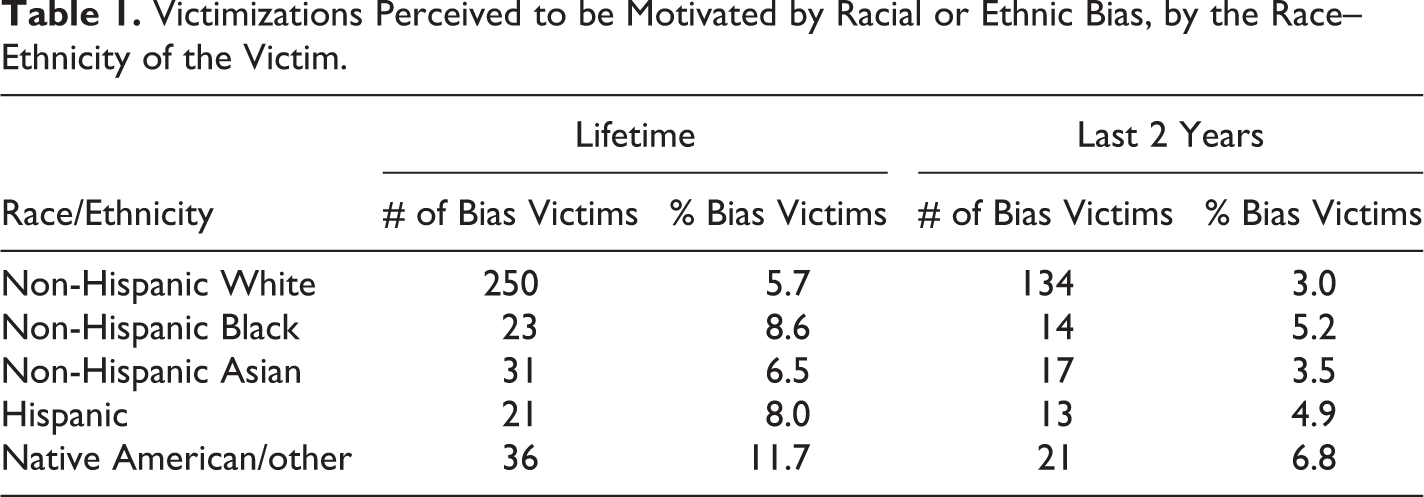
Table 1 presents basic counts and rates of perceived bias victimizations by the race and ethnicity of the respondent. Given the larger number of White respondents—representative of the majority-White population of the city of Seattle—the largest number of victimizations was unsurprisingly reported by non-Hispanic Whites. At the same time, however, non-Hispanic White respondents reported such incident at a lower rate than any other race–ethnic group. Asian Americans also reported relatively low rates, with Hispanic, African American, and “other” race–ethnicities (including native Americans) reporting much higher rates of perceived bias victimizations. In the analysis, we focus specifically on victimizations perceived to be motivated by racial bias and reported by non-Hispanic White respondents.
Victimizations Perceived to be Motivated by Racial or Ethnic Bias, by the Race–Ethnicity of the Victim.
Police Reports of Bias Incidents
We also construct a measure of bias incidents from the SPD “bias crimes incidents” reports. We restrict the measure to capture incidents reported to the police which have a “bias focus” on race (as opposed to sexual orientation or religion, for instance), and for which the victim(s) were reported to be non-Hispanic White. The resulting measure is a count of such incidents for each census tract. Consistent with our claim that the police reports reflect a selective subclass of perceived bias incidents, the rate of such victimizations is far lower than that reflected in the victimization data: Only about 1 in every 10,000 White Seattle residents were the victim of bias incidents between 2000 and 2005 according to the police reports.
Neighborhood Racial Composition, Socioeconomics, and Crime
Several measures of neighborhood context were developed from the 2000 U.S. Census. The racial composition is captured as the proportion of Asian, African American, and Hispanic. Increases in the White population are captured as the difference between the proportion non-Hispanic White in 2000 and 1990. Concentrated disadvantage is captured through four indicators: the proportion of families in poverty, the proportion on public assistance, the proportion unemployed, and the proportion single-parent households. 7 Residential stability is captured by two indicators: the percentage of residents who lived in the same home for at least 5 years and the proportion of home owners. Additionally, an indicator of the general presence of all types of violent crimes (rather than just bias incidents) is included. The measure reflects violent crimes known to the SPD—captured as the average number of crimes per year per 1,000 residents, averaged over a 3-year period from 1999 to 2001.
Collective Efficacy
To capture a neighborhood social process potentially relevant to the distribution of bias incidents, we include a neighborhood-level measure constructed from the survey data. Collective efficacy is captured by six indicators. Two of these tap into perceived trust and cohesion in the community and four ask about perceptions of neighbor’s willingness to intervene when youths are misbehaving. 8 Neighborhood-level estimates of collective efficacy were captured as empirical Bayes residual scores from multilevel models controlling for basic personal characteristics that may be associated with bias in the reporting of neighborhood social processes. 9 In short, neighborhood-level estimates of the presence of collective efficacy were constructed by treating respondents as reporters of its presence, controlling for the potentially uneven distribution of sociodemographic characteristics that may be associated with biases in this reporting, and then adjusted based on the confidence of particular neighborhoods as a function of the number of reporters within that neighborhood.
Analytic Strategies
The two bias incident outcomes are captured at the neighborhood level as counts. The classic model for count data is the Poisson, though this is frequently not the best-fitting model either because of overdispersion (recommending alternatives like the negative binomial model) or because of an excess of zeroes (recommending a zero-inflated model). However, the counts of bias crimes did not show evidence of either of these problems, 10 and as such Poisson models are presented here. In all cases, we report robust standard errors and corresponding tests of significance. For both models, the White population is included as an exposure term. The models of police reports include the logged population of White respondents per neighborhood from the census as a control, while the victimization reports include the logged number of White survey respondents. We also ran all of the models using the total population rather than just the White population as the exposure term and found substantively identical results.
Limitations and Methodological Considerations
Fortunately, race bias incidents, particularly those reported by Whites, are relatively rare. This rarity, however, does pose challenges in estimating the neighborhood prevalence of such incidents using the survey data. A combination of the low incidence and the ordering of questions in the SNCS also prevents us from separating out types of victimization that involve bias (for instance, distinguishing harassment from assault). However, our substantive interest is less in the event itself and more in the perception that the event was motivated by race–ethnic bias. The coding of the police reports is consistent with this interest. The survey also does not include any information about the offender. The low incidence of cases for non-White Seattle residents, combined with the geographic concentration of non-White Seattle residents in a small number of neighborhoods, means that neighborhood-level estimates of non-White hate crime victimizations are not reliable. 11 Thus, a direct comparison study of neighborhood variation in non-White hate crime victimization is not possible (although we recommend future work explore direct comparisons of White and non-White perceptions of bias incidents). Finally, although the low incidence is limiting, there are substantial generalizability advantages to the random sampling design relative to a more purposive design that may have netted a larger number of bias crime incidents.
Results
The results are organized in two sections. The first presents bivariate associations between the two measures of anti-White bias incidents and measures of the neighborhood context, examining whether basic similarities or differences exist in the distribution of these incidents over Seattle neighborhoods. The neighborhood characteristics examined are highly interdependent: A combination of segregation and inequality produces substantial overlap between the race–ethnic composition and the socioeconomic structural conditions, and collective efficacy and crime are often described as products of these structural factors. Given this, the second section examines these characteristics in a multivariate context, simultaneously exploring the potential roles of social disorganization and the racial composition.
Bivariate Associations
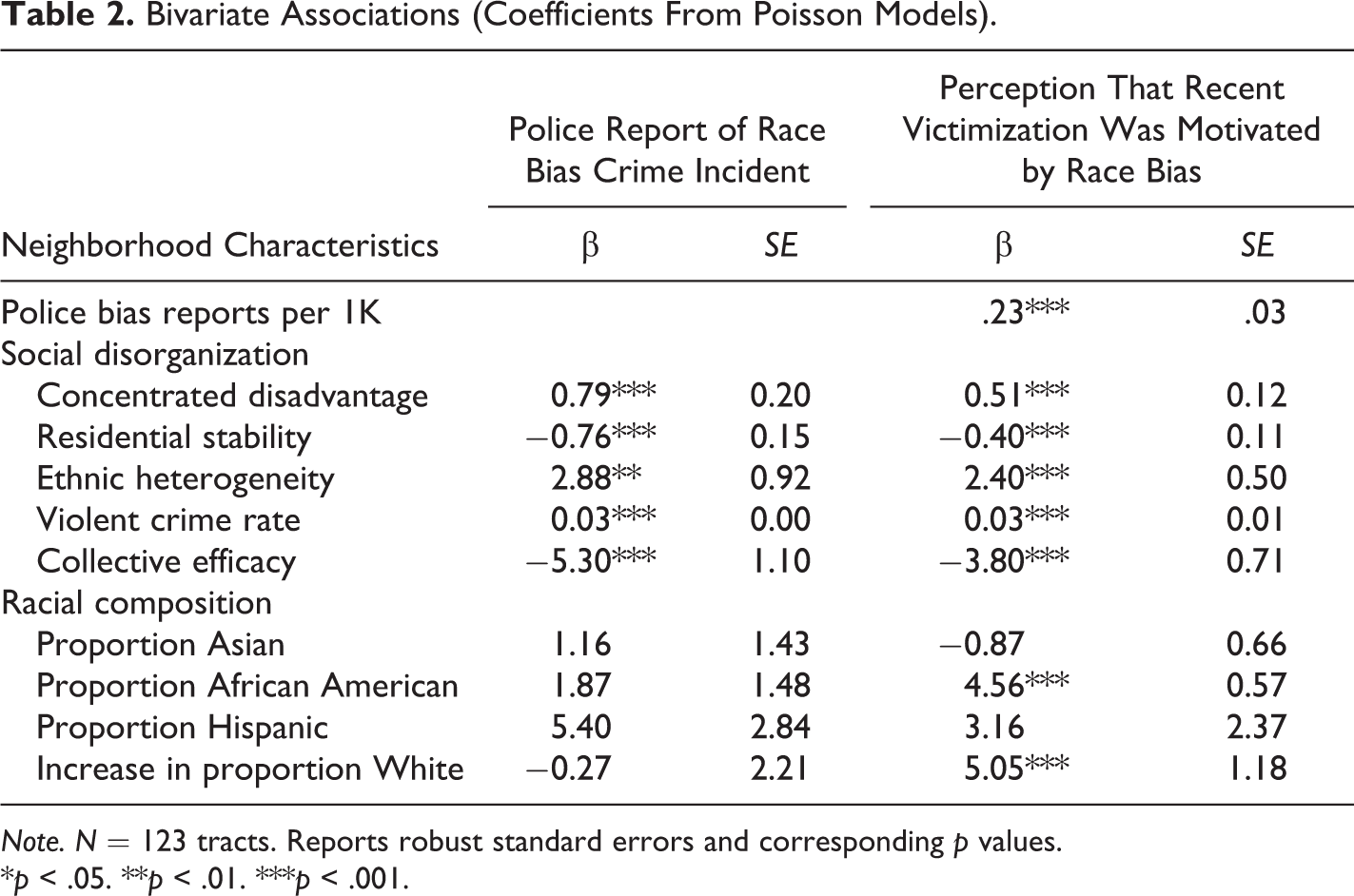
Table 2 presents bivariate associations between the two measures of anti-White bias incidents and measures of neighborhood characteristics. 12 These incidents appear to occur most often in neighborhoods characterized by classically socially disorganized structural conditions (high disadvantage, low stability, and high ethnic heterogeneity 13 ) as well as an absence of social processes often associated with lower levels of crime overall (collective efficacy). This is true regardless of which measure of bias incidents is used and is generally consistent with the finding in prior work (Lyons, 2007) that anti-White bias incidents—unlike bias incidents targeting other groups—are the product of the same kinds of processes that produce nonbias victimizations. 14 Consistent with this story, such incidents were also more common in neighborhoods with higher overall levels of violent crime.
Bivariate Associations (Coefficients From Poisson Models).
Note. N = 123 tracts. Reports robust standard errors and corresponding p values.
*p < .05. **p < .01. ***p < .001.
The major difference between the two measures appears to be related to race. The perceived bias victimizations—but not the police reports of bias incidents—are substantially more likely in neighborhoods with larger African American populations. Notably, this means that while police reports of anti-White bias incidents do not appear more likely—either in Seattle or in Chicago in Lyons’s (2007) work—in neighborhoods with larger African American populations, individual perceptions of bias incidents, many of which may have gone unreported to the police, appear to be highly more likely in such neighborhoods.
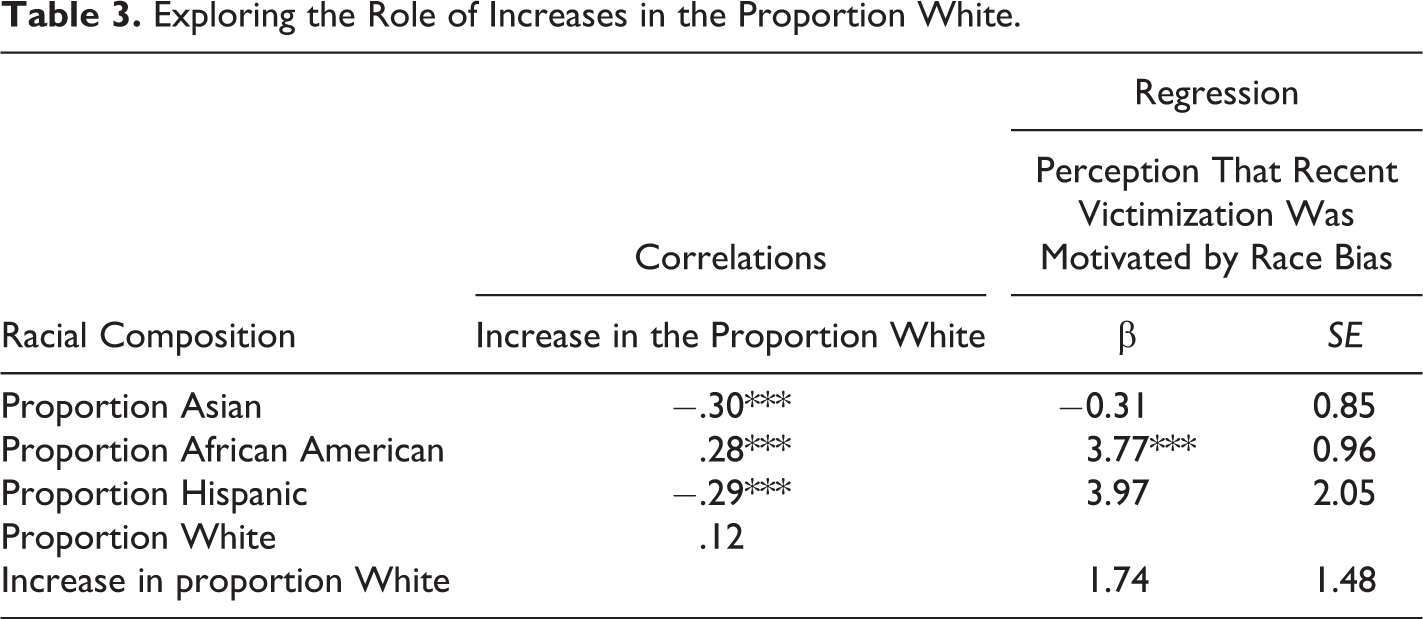
Finally, police reports of anti-White bias incidents are not more likely in neighborhoods having experienced an increase in the proportion White either in Seattle or in Lyons’s (2007, pp. 845, 846) work on Chicago. Thus, in both places, a “White threat” hypothesis appears to be a poor explanation for anti-White bias incidents—at least those reported to the police. Perceived bias victimizations, however, do appear more common in neighborhoods with growing White populations. Table 3 explores this finding further. The first column presents correlations between an increase in the White population and the racial composition of the community. The results suggest that the White population was less likely to increase in communities with larger numbers of Asian or Hispanic residents, and not any more or less likely in communities with larger existing White populations. Instead, increases in the White population were most likely in neighborhoods with larger Black populations. Given this overlap, the second column asks whether perceived anti-White bias crimes are more related to the proportion Black or increases in the White population when considered simultaneously. The proportion Black remains strongly and positively associated with perceptions of anti-White bias victimizations. By contrast, increases in the White population are no longer associated with perceived bias victimizations when the racial composition is controlled for. In short, it is the presence of Black residents and not increases in White residents that seems to be driving perceptions of bias victimizations among White respondents.
Exploring the Role of Increases in the Proportion White.
Neighborhood Models of Anti-White Incidents
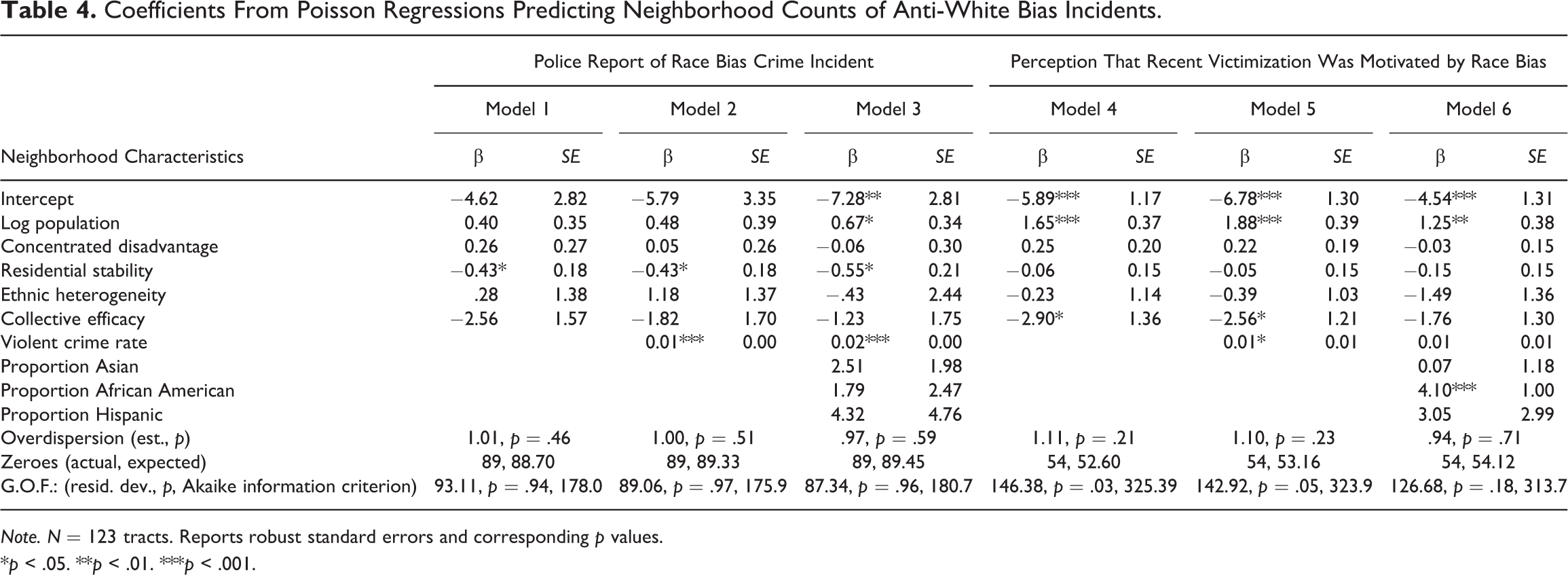
Of course, the neighborhood characteristics described in Table 2 are highly interdependent: Neighborhoods with larger number of racial and ethnic minorities tend to have worse structural conditions and higher crime rates. Thus, our second question is which of these neighborhood characteristics appears most important to the distribution of bias incidents when considered simultaneously. Table 4 presents three models for each of the two measures of anti-White bias incidents. 15 For each outcome, the first column presents the basic social disorganization model: structural characteristics and collective efficacy, the second adds violent crime, while the third adds measures of the racial composition.
Coefficients From Poisson Regressions Predicting Neighborhood Counts of Anti-White Bias Incidents.
Note. N = 123 tracts. Reports robust standard errors and corresponding p values.
*p < .05. **p < .01. ***p < .001.
Police reports of incidents were less likely to occur in neighborhoods characterized by residential stability (Model 1 of Table 4). Disadvantage, heterogeneity, and collective efficacy are not directly related to the distribution of police-reported anti-White incidents once stability is accounted for. Police reports of incidents were more likely to occur in neighborhoods with a higher overall violent crime rate (Model 2). Interestingly, violent crime exerts an independent influence and does not explain the connection between residential instability and police reports of bias incidents. Model 3 confirms the story from the bivariate results that the racial composition does not appear relevant to the distribution of anti-White bias incidents known to the police.
For self-reported perceptions that victimizations were motivated by bias, a somewhat different pattern emerges. When considering the classic social disorganization variables, perceived bias incidents appear somewhat less likely in neighborhoods with higher levels of collective efficacy (Model 4 of Table 4) and somewhat more likely in neighborhoods with high violent crimes rates (Model 5). Both of these effects, however, disappear when accounting for the role of the racial composition (Model 6). 16 Perceptions that victimizations were motivated by bias were substantially more likely in neighborhoods with a higher proportion African American. This effect is relatively strong. Most Seattle neighborhoods have relatively low numbers of African Americans. For those with essentially no African Americans, the predicted number of perceived bias incidents would be less than one (.60); similarly, for the average neighborhood which is only about 8% African American, the predicted number of perceived anti-White bias incidents would also be less than one (.84). However, in a neighborhood that is one-quarter Black, the predicted number of incidents increases to more than one and a half (1.67) and in a neighborhood which is half Black (the highest percentage in Seattle), the predicted number of incidents is nearly 5 (4.67).
Discussion
The goal of the present work was to address two questions. The first concerns the contextual factors associated with the distribution of anti-White hate incidents over neighborhoods. The second involves potential differences between those incidents reported to the police and the larger population of incidents simply perceived by the victim to have been motivated by race. The results appear to suggest that different factors explain the distribution of perceived and reported bias incidents. Anti-White hate incidents reported to the police are more common in neighborhoods in which other kinds of street crimes are also likely and may be committed by those who also commit other kinds of crimes. In short, they may not be strongly distinguished in their origins from other kinds of crime. On the other hand, White people who simply believe that they have been a victim of a hate crime were most frequently found in neighborhoods with larger numbers of Black residents.
The first finding is consistent with the pattern identified by Lyons (2007): Anti-White bias incidents appear to follow roughly the same pattern as other kinds of neighborhood crime not motivated by bias, communities characterized by low residential stability and high levels of other kinds of crime—and, notably, such incidents are not more common in places where the White population has been increasing. This is significant because it differs from the spatial patterns Lyons (2007) identifies for anti-Black bias crimes—Gladfelter et al. (2017) also report this distinction. Lyons (2007) suggests that in contrast to anti-Black hate crime offenders whose crimes serve a specialized purpose to intimidate and defend based on racial prejudice, anti-White offenders may engage in a wide range of criminal activities with a number of different motivations which may or not include motivations of prejudice.
The second finding moves us beyond prior work, which has not previously explored the distribution of perceived anti-White bias crimes across neighborhoods. The results, interestingly, suggest a distinct pattern from those which are reported to the police. Specifically, the primary neighborhood determinant for perceived anti-White hate incidents is the racial composition of the neighborhood, and in particular a higher proportion African American. In other words, the story about where White residents are most likely to perceive that incidents are motivated by hate is simple: They do so in areas with more Black neighbors. By contrast, hate incidents which are reported to the police do not appear to be any more likely in neighborhoods with larger Black population, even at the bivariate level. 17
Our interpretation is that the police reports likely reflect a subset of cases for which the evidence of the hate motivation is more overt, while the perceived incidents capture a much wider array of victimization incidents, many of which may be more ambiguous in their motivation. This greater ambiguity allows the perceptual biases to play a larger role. In these cases, then, the racial context may be acting as a prime and providing an important interpretive lens through which White residents perceive their experiences and make judgments about the motivation of others.
Conclusion
This work advances our understandings of hate crimes by exploring two understudied dimensions of this issue which reveal important differences from existing work. First, the vast majority of prior work on hate crimes has focused both theoretically and empirically on hate crimes directed at members of minority or lower status groups. Despite this, large numbers of White Americans report being the victim of bias incidents motivated by their race. In fact, in majority White cities like Seattle, these may represent the majority of racial hate incidents, even if Whites are victimized at lower rates. In addition to being understudied, anti-White hate incidents—those perpetrated against members of the dominant majority group—present an interesting counterexample to the kinds of hate incidents usually theorized and studied. In the present work, we find that in fact anti-White hate incidents appear to have a fundamentally different etiology than prior work has suggested for those perpetrated against other groups.
Second, the vast majority of prior work on the neighborhood distribution of hate crimes has been limited to those incidents reported to the police. This misses a larger and potentially distinct subset of incidents that do not end up reported to the police. This omission appears consequential, as our work finds a fundamentally different distribution of perceived versus reported hate crimes, with each more common in neighborhoods with different social and demographic characteristics.
These findings have several important implications for theory and suggestions for future research. First, confirming work by Lyons (2007) and Gladfelter et al. (2017), anti-White hate incidents appear to be fundamentally distinct in their etiology from anti-Black incidents. While Lyons (2007) found that anti-Black incidents appear consistent with a racial threat model—organized communities experiencing an increase in Black residents—anti-White incidents appear more common in the kinds of socially disorganized communities that experience larger numbers of nonhate crimes. If anti-White and anti-Black hate crimes are the product of fundamentally different theoretical processes and appear in different kinds of neighborhoods, this suggests we may need to rethink whether they are fundamentally different phenomena—just as scholars suggest there are fundamental differences between “racism” and “reverse racism.”
This finding also suggests several important new lines of research. First, if these incidents are motivated by hate or dislike of Whites as a group, what is the source of this hate? For incidents targeting non-Whites, threat-based models have been used to understand the genesis of animus toward members of minority or subordinate groups, but these make less theoretical sense for incidents targeting members of majority or dominant groups. Social disorganization—the theory which seems to best explain the distribution of anti-White incidents reported to the police—does not suggest any obvious mechanisms by which anti-White hate would be produced. If the hate is the product of different theoretical processes, this may reinforce the above suggestion that anti-White hate incidents be treated as a fundamentally different phenomenon.
Second, future work should also explore the suggestion that White residents may be subject to greater errors in judging whether incidents are motivated by anti-White hate, in part due to their greater co-occurrence with nonhate crimes. If this is the case, it suggests a need for better understanding the cognitive and perceptual processes by which people make determinations about the causes of their victimizations.
Finally, this work adds a new dimension to our understanding of how the neighborhood racial context shapes perceptions of crime. Previous work has found that residents of neighborhoods with larger numbers of Black neighbors overestimate the presence of disorder, the threat of criminal danger, and the likelihood of victimization (e.g., Drakulich, 2012, 2013; Pickett et al., 2012; Quillian & Pager, 2001, 2010; Sampson, 2009). The present work finds that the presence of Black neighbors may make White residents more likely to assume that victimizations were motivated by race. In other words, the racial context may shape not just our view of the danger posed by crime but also how we interpret the direct experience of crime.
Prior work has suggested that racialized misperceptions of danger have consequences: Residents may flee or withdraw, they may avoid participating in formal or informal social control efforts, all of which harm those communities (e.g., Drakulich & Crutchfield, 2013; Miles-Johnson, Fay-Ramirez, & Wiedlitzka, 2018). Perceptions that victimizations were motivated by anti-White hate may have similarly negative consequences, including flight, withdrawal, or the avoidance of interracial contact, ironically one of the few mechanisms that may reduce racial misunderstandings (Allport, 1954; Drakulich, 2012). Future work would do well to explore these possibilities.
This basic idea—that the racial context primes not only how we view our local space but how we interpret specific experiences within that space—also suggests a range of other investigations. How, for instance, does the racial context shape our interpretation of a neighborhood asking for a favor, a needy person asking for change, or an interaction with a law enforcement officer. In any case, this works points toward the pervasive, complicated, and multifaceted ways in which the racial context influences neighborhood life.
Footnotes
Acknowledgments
The authors would like Christopher Lyons and Rebecca Wickes for comments and guidance on an earlier draft of this paper.
Declaration of Conflicting Interests
The authors declared no potential conflicts of interest with respect to the research, authorship, and/or publication of this article.
Funding
The authors received no financial support for the research, authorship, and/or publication of this article.
