



Abstract
We advance a structural racism approach to understanding the variation in homicide across the U.S. states. We conceptualize structural racism by juxtaposing the conditions for Blacks with those for Whites across multiple domains. We also include two ideological beliefs, racial resentments and Whites perceptions that their racialized social status is threatened by minority gains. The results show that higher Black homicide rates are associated with greater exposure to structural racism and that states with more Whites who harbor racial resentments have higher rates of Black homicides. We also found that states with more Whites who feel that their status is threatened exhibit higher rates of White homicides. However, the results reveal that structural racism exhibits a non-significant association with White homicide rates. We conclude that the challenge going forward is to develop strategies that can undo the oppression of Blacks without enhancing attitudes of Whites that promote criminality.
An impressive body of research has accumulated that documents the multifaceted relationship between racism and crime including detailing the racialized pathways that Blacks traverse on their way to engaging in problematic behaviors (Unnever et al., 2015; Unnever & Gabbidon, 2011). Although the focus on how interpersonal racism influences Black offending is vital, the equally compelling question of what role racialized structural inequalities may have in generating racial disparities in rates of crime warrants further attention. Such racialized inequalities span core domains such as education, health, income, poverty, and residence to constrain the life chances of Blacks, and in so doing, subjugate Blacks—while institutionalizing “White privileges” (Bonilla-Silva, 2015).
Our objectives are to advance the literature by applying a structural racism perspective on crime to explain state-level variation in homicide. Toward this end, we first elaborate the concept of structural racism and discuss how it is grounded in a set of interconnected institutional processes. Second, we outline how the ideological component of structural racism produces belief systems that benefit Whites while diminishing the wellbeing of Blacks. Third we propose that because of historical and contemporary conditions, structural racism should vary significantly across U.S. states. Fourth, we review the research on the consequences of racialized inequalities in social structures, including the health-related studies of structural racism along with the criminological literature on the relationship between forms of racial inequality and crime. Based on this literature, we hypothesize that structural racism should predict lower homicide rates for Whites and higher rates for Blacks. We then assess our hypotheses with seemingly unrelated regression analyses of race-specific homicide rates with state-level data for the United States.
Conceptualizing Structural Racism
We conceptualize structural racism as the set of social structural processes that function to constrain the resources, life chances, and well-being of Blacks, and while doing so, enhance the resources, opportunities, and well-being of Whites. As Bonilla-Silva (2015, p. 1360) observed, racism of this sort “produces practices, behaviors, and mechanisms that are responsible for the reproduction of racial order.” Structural racism is thus “…responsible for the production and reproduction of systemic racial advantages for some (the dominant racial group) and disadvantages for others (the subordinated races)” (Bonilla-Silva, 2015, p. 1370).
Our conceptualization of structural racism mirrors that adopted by the U.N. Committee for the Elimination of Racial Discrimination (CERD; Menendian et al., 2008). CERD argues that “racial discrimination includes distinctions and exclusions that have an ‘unjustifiable disparate impact’ upon the rights of freedoms of particular racial or ethnic groups” (Menendian et al., 2008, p. 12). Structural racism is evidenced by racial disparities that occur across the range of institutional domains. The Committee thus describes this approach as an “inter-institutional perspective” (Menendian et al., 2008, p. 14). According to this approach, structural racism and the disparities in outcomes it produces arise and are sustained by the interconnections among policies and institutions, along with private decision-making. Note also that structural racism is a dynamic process whereby the totality of the disparities is greater than the association of any one inequality in outcome.
The segregated housing market illustrates how overlapping institutional arrangements produce racial disparities across multiple domains (Anderson, 1999; Jacoby et al., 2018; Kirk & Papachristos, 2011; Light & Thomas, 2019; Massey & Denton, 1993; Sampson & Wilson, 1995). Research documents that racial segregation is related to a vast array of other racial disparities including home ownership (Choi et al., 2019), wealth accumulation and income (Akbar et al., 2019; McKernan et al., 2013) mass incarceration (Sykes & Maroto, 2016), educational attainment (Rothstein, 2017), and rates of crime (Sampson & Wilson, 1995). Furthermore, the evidence indicates that residential segregation is crime-producing because it inhibits employment networks, decreases school quality, reduces public investments, corrodes local systems of social control and collective efficacy, intensifies legal cynicism, reifies racist depictions of Blacks, and encourages gang formation and subcultural adaptations that value retaliatory violence (Anderson, 1999; Jacoby et al., 2018; Kirk & Papachristos, 2011; Light & Thomas, 2019; Massey & Denton, 1993; Nazroo et al., 2020; Sampson & Wilson, 1995; Unnever & Gabbidon, 2011). However, note that our perspective argues that racial segregation is just one component of what constitutes structural racism.
Additionally, the research shows the interconnectedness among other racial disparities. For example, research indicates that the mass incarceration of Blacks exacerbates the racial disparities across housing, employment, income, educational attainment, and health (Alexander, 2020; Sykes & Maroto, 2016). Scholars have also found that the disproportionate mass incarceration of Blacks has resulted in their greater felon disenfranchisement, which played a decisive role in U.S. Senate elections and the outcome of at least one Republican presidential victory (Uggen & Manza, 2002).
Ideology and the Costs of Structural Racism
Bonilla-Silva (2019) highlights how structural racism can have deleterious effects on Blacks that go beyond its material foundation—the racialized distribution of scarce goods, services, and resources. He contends that structural racism has within it an ideological component that dynamically furthers the interests of Whites will diminishing the well-being of Blacks. Racial ideologies are not mere reflections of structure, but operate as “broad mental and moral frameworks…that social groups use to make sense of the world, to decide what is right and wrong, true or false, important or unimportant.” Included within this ideological formation, is an “hierarchy of racialized emotions” characterized by White’s emotional hegemony. “While Whites believe the system is fair (Jensen, 2005), the racially subordinate experience the unfairness of the system, leading each group to develop emotions that match their “perceptual segregation” (Robinson, 2008). Accordingly, races fashion an emotional subjectivity generally fitting of their location in the racial order” (Bonilla-Silva, 2019, p. 2).
Feagin (2013, p. xii) adds that structural racism may produce negative emotions within some Blacks as they are confronted by “racist framing, racist ideology, and stereotyped attitudes.” Scholars argue that a prevailing deleterious racist stereotype that is chronically “in the air” depicts Blacks—especially Black men—as “savage” and “dangerous”—as the “criminalblackman” (Bonilla-Silva, 2019; Feagin, 2013; Russell-Brown, 2009; Steele, 1997). Unnever and Gabbidon (2011) posit that chronic exposure to negative depictions deplete the emotional capital of Blacks, weakens their ability to bond with conventional institutions, can lead to secondary deviance as they internalize the racialized stereotypes, and causes oscillating feelings of anger, hostility, and depression (Unnever & Chouhy, 2020b).
On the other hand, Bonilla-Silva (2019) argues that structural racism infuses “dominant actors with beliefs and emotions about selves (e.g., good, beautiful)” that are affirming. The racial frames, racist ideology, and racialized stereotypes also generate among some Whites a disavowal of the durable racialized material foundation of structural racism. Therefore, Bonilla-Silva (2019) argues that many Whites deny structural racism, and, therefore believe that the system is fair and that they achieved success based entirely on their own initiative. Thus, Whites are allowed to “escape anxiety, shame, and guilt through the mechanism of disavowal” (Bonilla-Silva, 2019. p. 13; see also, Mueller, 2020).
In sum, structural racism creates material conditions that differentially influence the lives of Whites and Blacks. It denies Blacks equitable access to scarce goods, services, and resources while disproportionately exposing them to heightened levels of discriminatory behavior. Simultaneously, structural racism provides Whites with a privileged access to scarce goods, services, and resources while diminishing their likelihood of experiencing institutionalized discriminatory behavior based on their Whiteness. These material conditions are so ingrained within racialized formations with their accompanying justifying ideologies that many Blacks and Whites may not be self-aware that structural racism is benefiting or impeding them (Omi & Winant, 2018). Indeed, a structural racism perspective contends that it is possible that Blacks may not always perceive how institutional arrangements discriminate against them (Bonilla-Silva, 1997; Gee & Ford, 2011; Homan, 2019; Krieger, 2014; Lukachko et al., 2014). Additionally, the ideological component of structural racism includes beliefs systems that degrade Blacks while empowering Whiteness. Thus, structural racism produces the direct experiences for Blacks with racial discrimination, whether the experience is profound—driving while Black—or nuanced everyday acts of racial microaggression. Alternatively, as Bonilla-Silva (2019) argues, for some Whites, racial discrimination is self-affirming—even if they are personally unaware of their discriminatory behavior.
State-Level Variation in Structural Racism
Structural racism is multifaceted. Similar to “structural sexism,” its processes are manifested at multiple levels of analysis—the macro level, the meso level, and the individual level (Homan, 2019). Our analyses focus on the macro level. Scholars argue that racialized policies are “largely shaped at the state level” and that states “are laboratories of policy innovation whose experiments can exacerbate or ameliorate racial inequality” (Smith et al., 2020, p. 527; see also, Michener, 2019; Lukachko et al., 2014). Racialized state policies and legislation—the slave codes, the Black codes, Jim Crow segregation statutes—have historically defined and divided states (Blackmon, 2012; Greene & Gabbidon, 2000; Russell-Brown, 1998). Indeed, the nation divided into a civil war that was fought over “state rights” and the institutionalization of slavery (Kaczorowski, 1996). Further, CERD notes that: “Historically, ‘state’s rights’ has been the cry of many concerned with protecting or promoting local white privilege against federal government interference” (Menendian et al., 2008, p. 17).
Scholars have documented the legacy results of racialized state-level policies (e.g., slavery, the Black codes, and Jim Crow segregation). These include the disproportionate use of corporal punishment against Black students, the institutionalization of segregation academies, Black–White inequality in poverty, mortality, environmental racial injustices, school segregation, and subprime lending and foreclosures (Acharya et al., 2016; Grove et al., 2018; Hernandez, 2009; Jacoby et al., 2018; Owens & Fett, 2019; O’Connell, 2012; Porter et al., 2014; Reece & O’Connell, 2015; Simmons, 2020). In sum, evidence supports the “historical persistence” thesis that argues that Whites who live in states who institutionalized racial policies still harbor more animosity toward Blacks and policies designed to mitigate historical injustices (Acharya et al., 2016; Smith et al., 2020).
The evidence also reveals that state-driven policies have become increasingly racialized as legislatures enact policies that are informed by the ideological dimension embedded within structural racism. A core ideological component of structural racism is White racial animus (Bonilla-Silva, 2015). Analyzing the ANES, Smith, Kreitzer, and Suo (2020) revealed that states significantly vary in the degree to which their citizens hold racial resentments, that southern states had the highest levels of racial animus in the country, and there is little variability in the relative rank ordering of state’s racial resentment over time. Of note, Smith et al. (2020) found that states’ levels of racial resentment have improved and declined at different rates and in different times. Other research that employs the “racial threat” perspective shows that the size of a state’s Black population is a chief factor that predicted the degree to which a state incarcerated Blacks at unusually high levels (Beckett & Western, 2001, p. 31). 1
It is also noteworthy that civil legal resources that Blacks can employ to mitigate the consequences of structural racism are unequally distributed across states. Michener (2019) reports that states that make the paltriest investments in civil legal resources are also states with significant Black populations and long-standing histories of institutional racism (e.g., South Carolina, Alabama, Mississippi, Texas, Georgia, Tennessee, and Arkansas). Further, research shows that White state legislators were less likely to respond when Blacks requested help with registering to vote and Black legislators were more likely to respond to requests by Blacks than by Whites (Butler & Broockman, 2011). In sum, there is compelling evidence indicating that racialized state-level actions and policies vary and result from the degree to which states are structurally racist.
Prior Research on Race and Structured Inequalities
Health-related researchers have taken the lead in operationalizing the explicit concept of “structural racism” and assessing its disparate impacts on the well-being of Whites and Blacks (see Groos et al., 2018, for a systematic review of measures used to quantify structural racism). For example, Lukachko et al. (2014) examined the relationships between health outcomes and multiple measures of structural racism at the state level. Their measures included the relative proportions of Blacks to Whites who were registered to vote, who actually voted, and who were elected to the state legislature; ratio measures of Blacks to Whites who were in the civilian labor force, who were employed, who were in executive or managerial positions, and who were in professional specialties; relative proportions of Whites versus Blacks who had attained bachelor’s level degree or higher; and Black-White ratio measures of incarceration (jails and prisons), disenfranchisement, and death sentencing. They regressed self-reports of whether Blacks and Whites experienced a heart attack or myocardial infarction within the past 12 months on their measures of structural racism. Lukachko et al. (2014) reported that high levels of structural racism were generally associated with greater odds of myocardial infarction among Blacks and were generally associated with inverse or null outcomes on myocardial infarction among Whites net of other covariates including state-level disparities in poverty.
Wallace et al. (2017) constructed state-level measures of the ratio of Black to White population estimates in educational attainment, median household income, employment, imprisonment, and juvenile custody and found that increasing racial inequality in unemployment was associated with an increase in Black infant mortality and that decreasing racial inequality in education was associated with a reduction in the Black infant mortality rate. They also reported that none of the structural racism measures were significantly associated with infant mortality among Whites. Scholars have also linked measures of structural racism to fatal police shootings at the state level (Mesic et al., 2018), and earlier gestational age and lower birth weight among Black and White women (Chambers et al., 2018). In sum, the health-related literature has been highly innovative in constructing multiple ways to measure structural racism, showing that such measures predict health outcomes, and that the outcomes of structural racism often vary between Blacks and Whites.
The criminological literature presents an insightful juxtaposition. On the one hand, an extensive body of research has accumulated on the relationship between structural racial disparities and crime (Blau & Blau, 1982; Corzine & Huff-Corzine, 1992; Eitle, 2009; Krivo & Peterson, 2000; McCall & Parker, 2005; Messner & Golden, 1992; Ousey, 1999; Ousey & Augustine, 2001; Ousey & Lee, 2004; Parker, 2001; Parker & McCall, 1999; Parker et al., 2016; Steffensmeier et al., 2010; Stolzenberg et al., 2006; Velez et al., 2003; Wadsworth & Kubrin, 2004). On the other hand, most of the research does not explicitly contextualize the origin and persistence of these racial disparities within a structural racism perspective. Notably, this absence of an explicit structural racism perspective has occurred even though scholars have noted the existence of racism by highlighting the pernicious link between racial segregation and crime (Peterson & Krivo, 2010). Indeed, Peterson (2012, p. 309) concluded, after examining the segregation-crime link, that race “is a core organizing construct that operates to generate the patterns, sources, and consequences of crime.”
However, these studies have understood racism as either a macro-level process that explains government resource allocation and disinvestment in certain areas or as a micro-level factor that impacts individual-level sorting into neighborhoods. In our study, we examine how racism and state-level processes are intimately intertwined. Bonilla-Silva (1997) argues that racial dynamics are embedded in the “normal” operation of any racialized social system. Thus, racism does not only shape the formation of states and their racial composition but also influences individuals’ daily experiences within their state and thus likely defines key social processes that are related to racial disparities (Unnever, 2019). Nevertheless, none of the racial inequality studies we have reviewed suggest that the endogenous causal connection between racial inequalities and crime results from the consequences of racism within geographical spaces (Unnever & Gabbidon, 2011). Additionally, this omission negates the possibility that Blacks and Whites may differ in their encounters with interlocking forms of racial oppression because states may differ in the degree to which they are racist. Indeed, as noted, Smith et al. (2020) found that states significantly vary in the degree to which their citizens embrace racial animus. Rather, the criminological literature employs a plethora of general theories including elements of frustration/aggression theory, social disorganization theory, and anomie theory to explain why racial disparities should predict higher rates of crime without much attention directed explicitly to racism (see Messner & Stults, 2019, for a review). 2
The criminological literature has examined the relationship between crime and racial disparities in multiple ways including aggregating crime rates across racial/ethnic groups (Blau & Blau, 1982) and examining whether racial inequalities explain the racial gap in crime rates (for example, see Ulmer et al., 2012; Velez et al., 2003). However, most germane to our purposes are the studies that theorize that the consequences of racial disparities on crime should be race-specific. Our structural racism argument adopts this theoretical perspective; interconnected racialized disparities should increase the rate of crime among Blacks while decreasing the rate of crime among Whites. Although not embracing a structural racism perspective, Messner and Golden’s (1992) study was the first to argue that crime rates should be analyzed separately for Blacks and Whites. They theorized that racial inequalities should cause Blacks to have heightened states of frustration/aggression, which in turn should be related to higher rates of homicide, whereas, Whites should have lower rates of homicide because they experience relative gratification from high levels of racial inequality. The results of their regression analyses revealed that racial inequality exhibited significant positive outcomes on the total homicide rates and on both race-specific homicide rates, thereby offering no support for the hypothesis of “relative gratification” for Whites. However, they cautioned that their scaling procedure for racial inequality was not necessarily “the theoretically correct one,” and they acknowledged that the use of different measurement procedures yielded substantively different results (Messner & Golden, 1992, p. 441; original emphasis).
Subsequent studies continued to examine racially disaggregated rates of offending and arrest, with many of them highlighting measures of racial inequality as predictors. This more recent research has found that racial inequality leads to higher rates of Black offending (e.g., Corzine & Huff-Corzine, 1992; McCall & Parker, 2005; Parker, 2001; Parker & McCall, 1999; Stolzenberg et al., 2006). For example, Light and Thomas (2019) found that racial segregation substantially increased the risk of homicide victimization for Blacks while simultaneously decreasing the risk of White homicide victimization, net of the composite measure of structural disadvantage and other controls. On the other hand, other scholars have found no significant association of racial inequality (Eitle, 2009; Krivo & Peterson, 2000; Ousey & Augustine, 2001; Wadsworth & Kubrin, 2004).
We suggest that these inconsistent results may be due, at least in part, to differences in the conceptualization and operationalization of racial inequality. Many of these studies include a single indicator of racial inequality—measured as Black-White differences or ratios—and most restricted their attention to disparities in economic characteristics such as joblessness, household income, and educational attainment. The structural racism perspective that we advance suggests a much broader conceptualization of racial disparities that recognizes the systemic disadvantages for Blacks and advantages for Whites across multiple inter institutional domains including the economy, but also non-economic institutions such as systems of health care and criminal justice.
The Current Study
We build upon prior macro-level research on the race/crime nexus in a number of important respects. Consistent with the health-related literature on structural racism, our analytic and measurement strategy is guided by the “inter-institutional perspective” described above. We accordingly incorporate indicators of disparate outcomes for Blacks and Whites across multiple institutional domains—the economy, education, the criminal justice system, and health systems. We also include a measure of racial residential segregation in our analyses. Our primary hypotheses are that structural racism, by constraining the resources, life chances, and general well-being of Blacks, while enhancing those of Whites, should exhibit contradictory relationships with race-specific levels of homicide. Specifically, we predict that a measure of structural racism will be positively related to levels of homicide for Blacks, and negatively related to levels of homicide for Whites.
In addition to examining the relationships between structural racism and homicide levels, we also introduce into the analyses two aggregate indicators of ideological beliefs that are likely to accompany structural racism—White racial resentment and perceptions of White status threat. As discussed above, our approach in this respect is informed by Bonilla-Silva’s (2015) “racialized social system” perspective. Our indicator of White racial resentment captures a “color-blind” expression of racism. Those who embrace it attribute Black-White structural disparities to the unwillingness of Blacks to take advantage of existing opportunities, while resenting perceived favoritism that is presumed to be given to Blacks (Kinder & Sanders, 1996; Russell-Brown, 1998, 2018; Steele, 1997; Unnever & Gabbidon, 2011). Research offers a rationale for anticipating a relationship between exposure to contexts where such beliefs are prevalent and criminal offending by Blacks. The evidence indicates that experience with racism undermines the ability of Blacks to bond with conventional institutions and engenders negative emotions such as hostility, frustration, and anger (Carter et al., 2019; for meta reviews see Benner et al., 2018; Paradies et al., 2015; Unnever et al., 2015, 2016). We accordingly hypothesize that a measure of racial resentment among Whites should be positively related to Black homicide rates, net of the measure of structural racism and other covariates.
Bonilla-Silva’s (2015, 2019, p. 2) racialized social system perspective further suggests that in a racialized social system, Whites are likely to form a social collectivity defined by a racial interest to preserve the racial status quo “because they perceive tangible benefits.” Additionally, Bonilla-Silva (2019, p. 2) contends that “Whiteness” does not operate in isolation but rather is defined in “the process of racial contestation.” Other scholars frame the racial contestation between Whites and Blacks as a zero-sum game whereby Whites perceive Black gains as threatening their dominant position within the racial order (Malat et al., 2018; Norton & Sommers, 2011; Sidanius & Pratto, 2004; Wilkins et al., 2015). Researchers have also reported that Whites are most likely to think of themselves in terms of their racial identity—their linked fate—when they are primed to consider threats to their group status (Schildkraut, 2017). Moreover, research by Scott and Anderson (2020) suggests a linkage between contested ideological terrain and criminal offending by Whites. They found that Whites who perceived that they had encountered anti-White bias were more likely to engage in felony-level offenses.
We hypothesize that indicators of the contested racial ideologies that are likely to accompany structural racism—White racial resentments and White status threats—should exhibit contrasting relationships with race-specific homicide rates. States with greater racial resentments among Whites should have higher rates of Black homicides, and states that have a greater percentage of Whites who perceive threats to their social status should have higher rates of White homicides, net of the measure of structural racism and other covariates. In the absence of any clear theoretical rationale, we do not advance hypotheses about a relationship between our indicator of White racial resentment and homicide rates for Whites, or a relationship between our indicator of White status threat and homicide rates for Blacks. We nevertheless explore such possibilities in the regression modeling.
In sum, we add to the existing research in multiple ways. First, we present a structural racism perspective that should give coherence to a wide body of disparate research that spans multiple disciplines. Our structural racism perspective argues that racial inequalities cannot be studied divorced from the reality of what it means to live within a systemically racist society. Rather, we argue that racial disparities were originated by Whites and are perpetuated by them to further their group interests at the expense of Blacks. Most notable, our structural racism perspective differs, particularly from the criminology literature, in that we contend that structural racism supports and perpetuates the discrimination of Blacks. Thus, our structural racism model argues that racism in and of itself—whether it is structural or interpersonal or a combination of the two—is an endogenous process at work within areas that should be related to higher rates of homicide among Blacks and lower rates among Whites. In short, our structural racism perspective argues that White privilege and racism are endogenously related to crime.
Second, our structural racism perspective embraces the interinstitutional perspective. Doing so, suggests that a measure of structural racism must include the multiple ways in which structural racism manifests itself across various domains. Thus, our inclusive measure of structural racism includes indicators across health, education, and the criminal justice system. Additionally, we do not consider residential segregation and poverty as exogenous to the mechanisms of structural racism. Rather, we consider both as integral indicators of the degree to which a state is more or less structurally racist. Thus, we believe that our index of structural racism is theoretically coherent, grounded, and a more accurate presentation of how structural racism can subjugate Blacks while perpetuating White privileges.
Third, to our knowledge no criminological study of crime has theorized or empirically incorporated the ideological manifestations of structural racism. We include two White beliefs that we suggest are integral to the ideology of structural racism; the degree to which Whites harbor racial animus toward Blacks and the degree to which they perceived that their White privileges may be threatened by minority group agency. In short, we believe that the current study advances the literature as it is the first to present an inclusive structural racism perspective that argues that it is an endogenous cause of crime.
Data and Methods
We analyze state-level data from multiple sources to test our hypotheses. All variables are either measured in the year 2016 or in pooled years centered on 2016, as described below. We collected complete data for 46 states (including Washington, DC), with missingness due to the suppression of data on infant mortality for Blacks in five states because of small sample sizes (ID, MT, NH, VT, WY).
Dependent Variables
Our dependent variables are Black and White homicide offending rates per 100,000 averaged over the years 2015–2017. These data are drawn from the mentary Homicide Reports (SHR) of the Uniform Crime Reporting (UCR) Program compiled by the Federal Bureau of Investigation (FBI). Homicide data provide a unique opportunity to analyze race-specific offending across the entire country because it is the only form of crime for which race of the offender is reported. Specifically, we used SHR files provided by Fox and Fridel (2019) that account for missing data using a multi-stage approach (Fox & Swatt, 2009).
Independent Variables
Structural racism
Our measure of structural racism is informed by our inter-institutional perspective, the health-related research, and the criminology literature that focuses on the relationship between racial inequalities and crime (Groos et al., 2018; Lukachko et al., 2014; Phillips, 1997; Ulmer et al., 2012; Velez et al., 2003). There is a general consensus that indicators of structural racism should include measures of the racial disparities that exist in educational attainment, criminal justice, income, labor force participation, and in health care. We selected variables that represent each of these dimensions, and then constructed Black-White ratios to indicate racial disparities. We also assess the possibility that residential segregation and racial differentials in poverty can be usefully conceptualized and operationalized as components of the broader construct of structural racism.
The following describes how we constructed our indicators of structural racism across the different domains. We measure race-specific percentages of labor force participation for persons age 16–64. 3 These data come from the multi-year estimates of the American Community Survey (ACS), which pools the years 2014–2018. 4 We calculate the measure of racial disparity as the ratio of White and Black labor force participation by dividing the White percent by the Black percent. Similarly, we measure racial disparities in income as the ratio of the White and Black percent of households earning an income of $100,000 or greater, again using data from the ACS. We measure racial disparities in education by calculating the ratio of the Black and White high school dropout rate for the 2015–2016 school year (National Center for Education Statistics, 2017). The racial disparity in health care is measured as the ratio of the Black and White infant mortality rate (per 1,000) taken from the Linked Birth and Infant Death Data from the Centers for Disease Control for the pooled years 2014–2016. Racial disparities in the criminal justice system is measured as the ratio of the Black and White Part I index crime arrest rate using UCR data from 2016. We assess racial disparities in the level of poverty as the ratio of the Black and White percent of families living below poverty. For these ratio measures, larger values indicate greater disadvantage for Blacks compared to Whites.
We measure racial residential segregation with the Dissimilarity Index, which indicates evenness of the distribution of Black and White residents across neighborhoods, operationalized as census tracts. We used tract-level ACS data to calculate the Black-White Dissimilarity Index for each state. We first generated county-level segregation scores, and then weighted these by the Black population size of the county and averaged to the state level. This weighted average measures the degree of county-level residential segregation experienced by the average Black resident in the state. Descriptive statistics for each of the items and ratios described above are provided in Table 1, along with statistics for the additional covariates included in the analyses (described below).
Univariate Statistics.
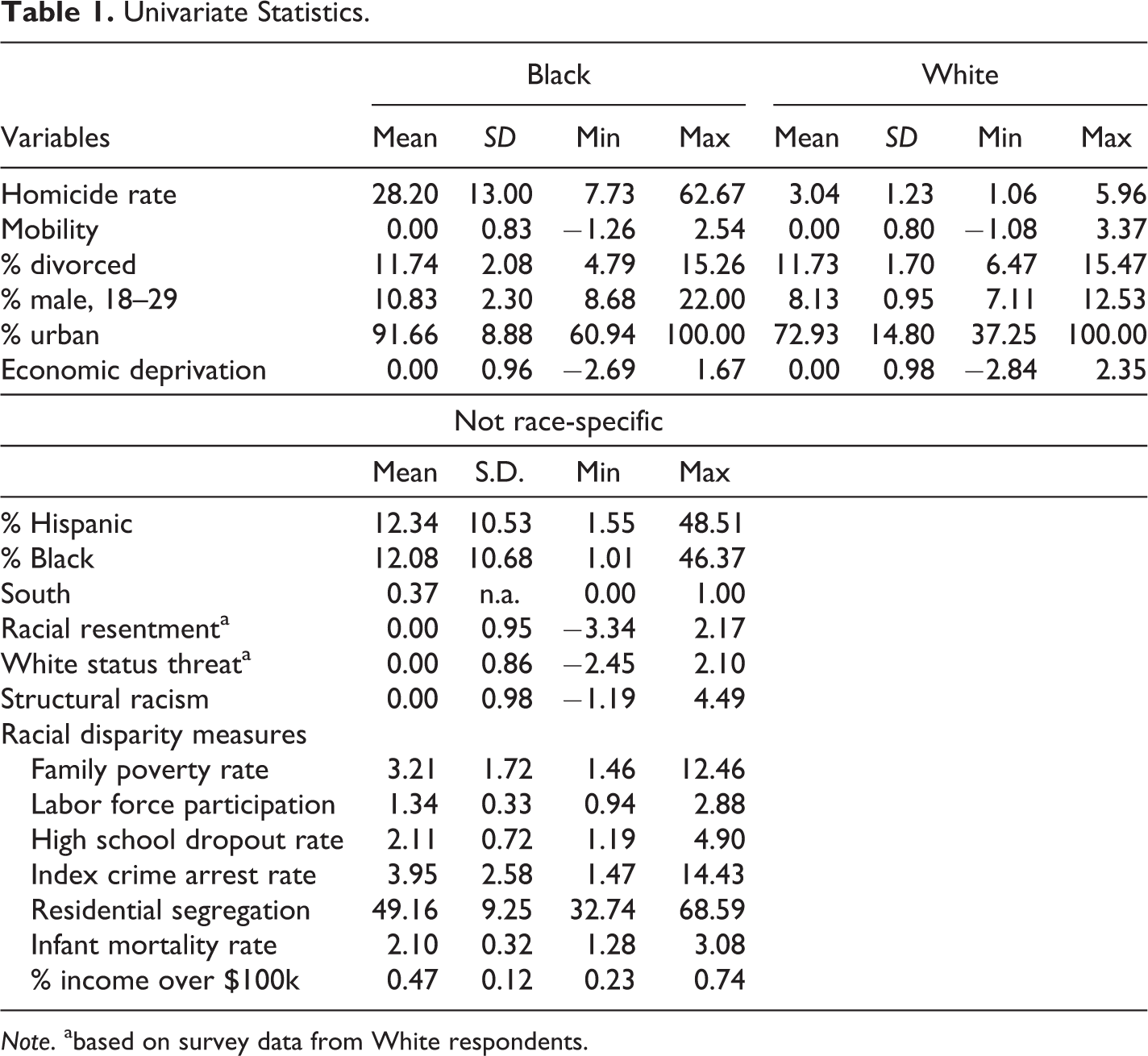
Note. abased on survey data from White respondents.
We submitted these racial disparities measures to a principal factor analysis to generate a factor score representing the latent construct of structural racism. As shown in the top panel of Table 2, the eigenvalue for this factor was 3.99, and all the factor loadings were greater than 0.5. The second highest eigenvalue in the factor analysis was 0.650, indicating that our Black–White disparity measures load best on a single factor. The factor loadings for the poverty differential (.873) and for the Dissimilarity Index (.620) support our expectation that these indicators can be treated as components of the broader construct of structural racism, along with the other racial disparities. The Cronbach alpha score for structural racism was 0.897.
Factor Loadings for Structural Racism, Racial Resentment, White Status Threat, and Economic Deprivation.

Racial resentment and White status threat
Our measures of racial resentment and White status threat are based on survey items drawn from the American National Election Studies (ANES) survey for the year 2016. Items indicating racial resentment included the following questions: (1) “How much does R agree or disagree that Blacks should work their way up without special favors, like the Irish, Italians, and Jews have?” (2) “Over the past few years, Blacks have gotten less than they deserve.” (3) “It’s really a matter of some people not trying hard enough; if Blacks would only try harder they could be just as well off as Whites.” (4) “Generations of slavery and discrimination have created conditions that make it difficult for Blacks to work their way out of the lower class.” All values were coded so that higher values reflect greater levels of racial resentment among Whites and averaged at the state level. A principal factor analysis of these items revealed a single-factor solution with an eigenvalue of 2.821, and all factor loadings were higher than 0.8 (shown in Table 2). We use the resulting factor score to indicate our measure of racial resentment (α = 0.904).
Items indicating White status threat included the following questions: (1) “How important is it that Whites work together to change laws that are unfair to Whites?” (2) “How likely is it that many Whites are unable to find a job because employers are hiring minorities instead?” (3) “How important is being White to your identity?” The five response categories for the first two items ranged from “extremely important” to “not at all important,” and the five responses for the third item ranged from “not at all” to “extremely.” All values were coded so that higher values reflect greater levels of status threat and averaged to the state level. A principal factor analysis of these items revealed a single-factor solution with an eigenvalue of 1.486. The factor loading for the survey question about White identity was slightly below the common cutoff of 0.5, but as noted, the eigenvalue was above 1. We use the resulting factor score to indicate White status threat (α = .752).
Control variables
We control for a composite measure of disadvantage that we generated from the 2014–2018 ACS. The composite measure includes four race-specific items: (1) percent of families living below poverty, (2) percent of persons age 16–64 in the labor force, (3) percent of households that are headed by a female with children, and (4) median family income. We generated race-specific principal factor scores based on these four items, which we label as Economic deprivation. As shown in Table 2, the Black and White eigenvalues were greater than 2.5, and all the factor loadings were greater than 0.5. 5
We also include race-specific factor scores indicating residential mobility (Mobility) comprised of the percent of people who lived in a different house one year prior and the percent of housing units that are renter occupied. The eigenvalues were greater than 1 for the Black and White factors and the Cronbach’s alpha scores were greater than 0.70. 6 We also include controls for race-specific measures of percent divorced (% divorced), the percent of males age 18–29 (% male, 18–29), and the percent living in urban areas (% urban). Finally, we include a dummy variable indicating whether the state was in the south (South), the percent non-Hispanic Black (% Black), and the percent Hispanic (% Hispanic). Though researchers sometimes include percent Black in the measurement of economic deprivation, we found that it did not load strongly with the Black economic deprivation items (0.163) nor with the structural racism items (0.237). Moreover, the correlations between % Black and the factor scores for structural racism, Black disadvantage, and White disadvantage are low at 0.216, 0.045, and −0.156, respectively.
Analytic Strategy
We present results from regression models that separately predict Black and White homicide offending rates per 100,000. Because these models are estimated from the same units and share some of the same predictor variables, error terms are likely to be correlated across equations. Estimates from separate ordinary least squares regression equations would be consistent in this case, but we use seemingly unrelated regression (SUR) to produce more efficient estimates (Greene, 2003). This estimation procedure uses robust standard errors to account for heteroskedasticity. Though homicide is a relatively infrequent event, which often prompts researchers to utilize count-based regression models, homicide rates in our state-level data were approximately normally distributed. The results generated from negative binomial regressions with seemingly unrelated estimation were substantively identical to our SUR regression models. We found no evidence of serious multicollinearity, with all correlations under 0.7 except between the control variables White mobility and White percent young male (0.775), a maximum VIF of 4.18, and a maximum condition number of 26.8. Diagnostics including Cook’s D, DFFITS, and DFBETA showed no evidence of problematic cases with influence.
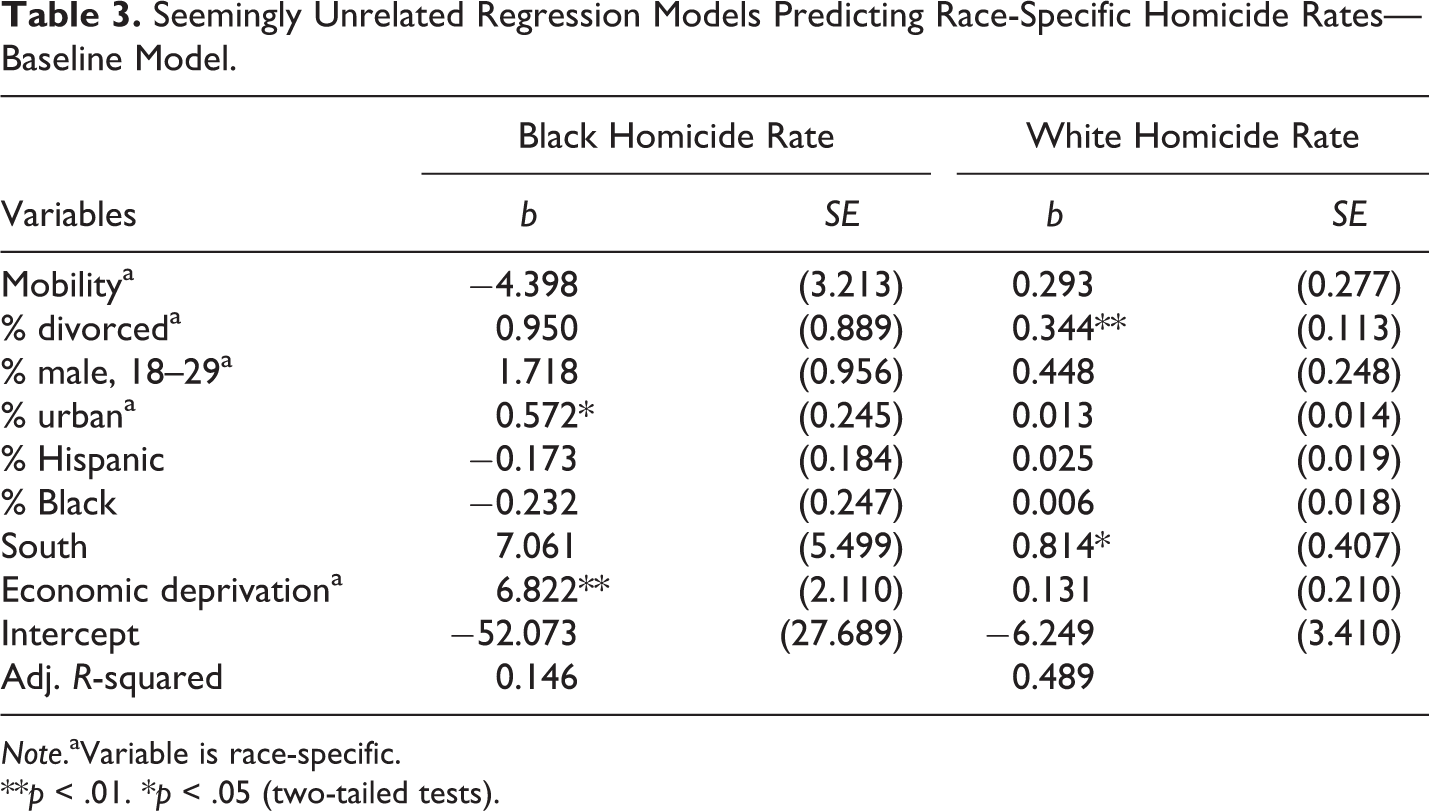
Our modeling strategy begins in Table 3 with a set of SUR models predicting Black and White homicide rates based on predictors that are commonly used in the macro-level criminological literature. We then present models in Tables 4 and 5 that build on this baseline specification by adding our measures of racial resentment, White status threat, and the separate indicators of our measure of structural racism. In our final models, displayed in Table 6, we replace the separate indicators of the Black-White disparities with the factor score representing the latent construct of structural racism. By comparing these models with the models displayed in Tables 3, 4, and 5 we assess the degree to which structural racism adds to the explanation of Black and White rates of homicide. The Appendix (see Online Appendix), presents the correlation matrix for the variables included in the regression models.
Seemingly Unrelated Regression Models Predicting Race-Specific Homicide Rates—Baseline Model.
Note.aVariable is race-specific.
**p < .01. *p < .05 (two-tailed tests).
Seemingly Unrelated Regression Models Predicting the Black Homicide Rate With Each Indicator of Structural Racism.

Note. aVariable is race-specific; bbased on survey data from White respondents.
**p < .01. *p < .05 (two-tailed tests).
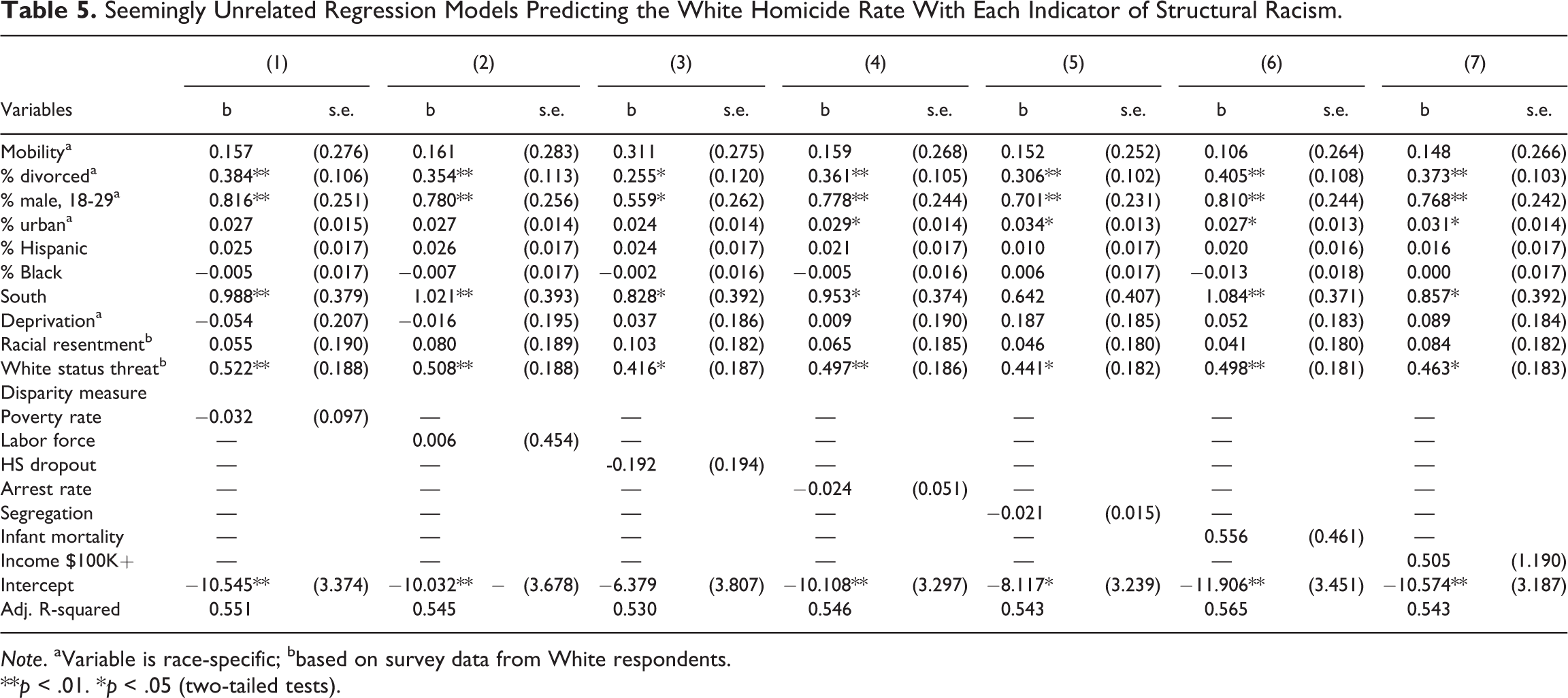
Seemingly Unrelated Regression Models Predicting the White Homicide Rate With Each Indicator of Structural Racism.
Note. aVariable is race-specific; bbased on survey data from White respondents.
**p < .01. *p < .05 (two-tailed tests).
Structural Racism and the Black and White Rate of Homicides.

Note. aVariable is race-specific. bbased on survey data from White respondents.
**p < .01. *p < .05 (two-tailed tests).
Results
Table 3 displays the results from our baseline models of race-specific homicide rates with predictors that are typically included in macro-level research on crime rates. The model predicting the Black homicide rate shows that states where Blacks are more heavily concentrated in urban areas tend to have higher Black homicide rates. The only other statistically significant association in the Black model is for economic deprivation, supporting the well-established finding in the prior research that areas with greater Black disadvantage tend to have higher Black homicide rates. The model for the White homicide rate reveals that states with higher White divorce rates and states in the South tend to have higher White homicide rates. It is notable that disadvantage is not a significant predictor of White homicide and that explained variability is substantially greater for the White homicide rate than the Black homicide rate, as evidenced by the larger adjusted R-squared.
In Tables 4 and 5 we add our measures of racial resentment, White status threat, and the racial disparity indicators of structural racism. Each SUR model includes one of the measures of the Black-White disparities. We present the results in two tables. Table 4 presents the results for the Black homicide rate, and Table 5 presents the results for the White homicide rate. Several key findings emerge. First, Table 4 indicates that the measure of racial resentment is positively associated with the Black homicide rate in all the models although the association only attains statistical significance in the model that includes Black–White disparities in labor force participation. Second, Table 4 shows that the relationship of each disparity measure on the Black homicide rate is positive, as expected, but only the disparity in labor force participation and high school dropout rate reach statistical significance. Third, Table 5 reveals that our measure of White status threat is positively and significantly related to the White homicide rate in all the models. Fourth, the findings in Table 5 reveal that the signs of the disparity measures on the White homicide rate are inconsistent, and none of these relationships is statistically significant. Taken together, the results from Tables 4 and 5 indicate that separate indicators of structural racism are limited in their ability to explain either the Black or White rate of homicide. These findings suggest that the relationships with racial disparities across multiple dimensions may be better evaluated with a measure of a single underlying construct of structural racism.
Table 6 presents the results of our SUR models that regress Black and White homicide rates on our measure of structural racism and the other covariates. Consistent with expectations, the results from the model for the Black homicide rate indicate that our measure of structural racism significantly predicts higher rates of Black homicide. The standardized coefficients show that structural racism exhibits one of the strongest outcomes on Black homicide, exceeded only slightly by the outcome of percent Black. The results also support our hypotheses pertaining to racial resentment and White status threat. The measure of racial resentment is positively related to the Black homicide rates, and the measure of White status threat is positively related to White homicide rates. However, contrary to our hypothesis, the results show that structural racism has a null outcome on White homicide rates rather than the predicted negative relationship.
Additionally, the results from Table 6 reveal that our measures of structural racism, racial resentment, and White status threat explain a considerable amount of variation in homicide rates, above and beyond that explained in the baseline models shown in Table 3. The model predicting Black homicide in Table 6 explains nearly 30% of the variance in the homicide rate, which is more than double the explained variation in our baseline model. An F-ratio test reveals that this improvement in explained variance is statistically significant (p = .025). The model predicting White homicide in Table 6 explains about 54% of the variation in the White homicide rate, which is 12% greater than the baseline model of White homicides presented in Table 3. However, this increase in adjusted R-squared falls just short of statistical significance (p = .069).
Sensitivity Tests
We believe the models presented above are the best specifications for our research questions. However, we explored several other model specifications, measurement strategies, and outcome measures to evaluate the robustness of our findings to different measurement and analytic decisions. We are sensitive to the concern that including the racial disparity in arrest rates in our measure of structural racism may introduce some statistical confounding due to reverse causation. If disparities in arrest rate are at least partially caused by variation in the Black homicide rate, we may be overestimating the relationship between structural racism and Black homicide. To assess this possibility, we re-estimated our models while omitting the arrest rate disparity from the measure of structural racism. Re-estimation of the SUR models using a factor score for structural racism that excludes the arrest rate indicator produces results that are identical to those reported above. We also explored whether the Black economic deprivation measure could be considered another component of structural racism. Recall that we include race-specific deprivation scores in our models as control variables, in addition to including the racial disparities in poverty and income in our factor score for structural racism. We believe that this estimation strategy is important as a test of whether structural racism explains a significant amount of variation in homicide rates above and beyond economic deprivation—a widely tested and theorized predictor of offending in the criminological literature.
The correlation between our Black deprivation score and our measure of structural racism is a modest 0.309 (p = .036). Adding Black deprivation to the factor analysis with our disparity-based indicators of structural racism reveals a two-factor solution where Black deprivation loads strongly on a factor by itself, and it has a loading below 0.5 on the other factor on which the disparity items load strongly. Finally, re-estimation of our models while omitting the race-specific economic deprivation score as a predictor reveals substantively similar results compared with those reported in Table 6. As expected, the outcome of structural racism is strengthened under this specification; the unstandardized coefficient increases from 6.552 to 8.391 and the standardized coefficient remains the second strongest in the model. These results indicate that Black economic deprivation is empirically distinct from our measure of structural racism, and the inclusion of the measure of the level of Black deprivation as a control variable does not alter our finding that structural racism predicts higher rates of Black homicides.
Lastly, because many prior studies have examined whether predictors of homicide vary depending on the relationship between the victim and the offender, we re-estimated our models separately for homicides where the victim and offender were strangers compared with if they knew one another (including acquaintances, friends, intimate partners, and other family). Consistent with our original findings, the results show that the structural racism measure significantly predicted both the rate of stranger and acquaintance-related Black homicides, but it is not significantly associated with either type of White homicide.
Summary and Conclusion
The current project has advanced a structural racism approach that is consistent with contemporary theoretical understandings that racism at all levels—macro, meso, and the individual level—has pervasive negative consequences on the wellbeing of Blacks while enhancing the wellbeing of Whites (Unnever & Chouhy, 2020a). Building upon the CERD report, the nascent health-related research, and the criminological literature on racial inequalities and crime, we have conceptualized and measured structural racism in explicitly relative terms, juxtaposing the conditions for Blacks with those for Whites across multiple domains including the economy, education, health care, and the criminal justice system. Additionally, our research has affirmed our expectation that residential segregation and racial disparities in poverty can be usefully regarded as integral mechanisms of structural racism manifested at the state level.
Furthermore, our approach incorporated two ideological contested beliefs that are likely to emerge in racialized social systems. Specifically, we examined whether there is an association between a state’s Black homicide rate and the percentage of Whites that harbor racial resentments—the belief that racial disparities exist because of the failure of Blacks to take advantage of existing opportunities (Kinder & Sanders, 1996). We also examined whether the White homicide rate is related to the percentage of Whites that perceive their racialized social status is threatened by minority gains. Our structural racism approach thus embraces how both the material and ideological components of structural racism may uniquely be related to Black and White rates of homicide.
The results of our seemingly unrelated regression analyses offer support for our hypotheses pertaining to Black homicides. As expected, higher Black homicide rates are associated with greater exposure to the material aspects of structural racism. This finding is consistent with the health-related research that shows that structural racism is related to a myriad of negative health conditions among Blacks, and it suggests that the uneven spatial distribution of resources across “the color line” is a racialized social force that has detrimental consequences for the wellbeing of Blacks, including increasing their rate of homicide (Du Bois, 1903). Our findings also indicate that the ideological beliefs embraced by Whites may also be related to the Black homicide rate. We found that states have higher rates of Black homicides if they have a greater percentage of Whites who harbor racial resentments.
The literature on how racism increases Black offending explicates a number of pathways through which racism may be related to a greater likelihood of some Blacks committing crime. This research shows that exposure to racist beliefs and to interpersonal racial discrimination, whether vicarious or sporadically perceived, generates adverse emotions, such as anger and hostility, that leads to negative outcomes (English et al., 2020; Unnever, 2014). The extant research also reveals that exposure to racist beliefs and actions undermines the ability of Blacks to bond with conventional institutions such as the educational and health-related institutions (Steele, 1997; Unnever et al., 2015, 2016). Our research adds to this accumulating body of literature by suggesting that structural racism and racialized belief systems create areas of racialized compounded deprivation (Perkins & Sampson, 2015). It is likely that these areas of racialized compounded deprivation exacerbate the likelihood that Black residents will traverse racialized pathways of offending.
For Whites, understanding the criminogenic consequences of structural racism is less straightforward. We observe the predicted relationship between our measure of White status threat and White homicide rates. States with more Whites who feel that their status is threatened by minority gains exhibit higher rates of White homicides. Bonilla-Silva (2015) argues that Whites have an interest in protecting their tangible benefits that flow from structural racism. We argued that this “process of racial contestation” becomes most relevant for Whites when they perceive that states are passing laws that favor minorities or when they perceive that employers are hiring minorities at their expense. Thus, we suggest that Whites are most likely to become aware of their privileged position within the racial order when their status position is threatened. Our finding of a positive relationship between White status threat and White homicide rates is consistent with the research reporting that Whites who perceived that they had encountered anti-White bias were more likely to engage in felony-level offenses (Scott & Anderson, 2020). Moreover, our results add to the literature that shows that threats to their social status, including the relative size of the minority populations, increase White racial resentment, White opposition to welfare programs, White Americans’ political ideology, support for Donald Trump’s candidacy, and fortifies the identity boundaries that separate Whites from non-Whites (Abascal, 2020; Bai & Federico, 2020; Bobo, 2011; Craig & Richeson, 2014; Fossett & Kiecolt, 1989; Major et al., 2018; Taylor, 1998; Wetts & Willer, 2018).
However, contrary to expectations, our results reveal that the individual indicators of Black–White disparities and our measure of structural racism are not significantly related to the White homicide rate. We proposed that states should have less White homicides the more its White members garnered a greater share of resources in comparison to their Black counterparts. The literature suggests a possible reason for this null relationship. Whites generally disavow any benefits that structural racism affords them (Mueller, 2020; Schildkraut, 2017). Indeed, most Whites believe that Black-White disparities are not a result of institutionalized forms of racism that have persisted since slavery, but rather the disparities exist because Blacks do not match the effort put forth by Whites (Abascal, 2020; Anderson, 2017; Mueller, 2020; Norton & Sommers, 2011). For most Whites, Black–White disparities are not problematic; they are part of an unexamined normative order based on a system of perceived earned meritocracy. Thus, Blacks and Whites profoundly experience structural racism differently, which might account for the lack of any relationship between Black-White disparities and White homicide rates.
In sum, our results reveal that structural racism and contested beliefs have notable consequences for race-specific homicide rates. The Black-White racial disparities captured in our measure of structural racism significantly increase the Black homicide rate. Additionally, states have a higher Black homicide rate if they have a greater percentage of Whites who harbor racial resentments. The results also reveal that the association between structural racism and the White homicide rate mostly occurs because Whites appear to feel threatened by actors affording minorities more opportunities that they feel are at their expense. Our results suggest that this zero-sum ideology contributes to higher rates of White crime (Norton & Sommers, 2011). Consequently, it is possible that attempts to undo the racialized structural disadvantages that confront Blacks may reduce their rate of homicide but may dialectically increase the White rate of homicide. Moreover, our findings suggest potentially dialectical processes associated with movement toward reduced structural racism for levels of Black homicide as well. The dilemma is that remedying the structural disadvantages confronting Blacks might enhance White social status threats and may increase White resentment, given that these forms of contested beliefs tend to increase as the structural conditions confronting the races become more equal.
We recognize that there are limitations to the analyses. We cannot infer causality because our data are observational. In addition, as we have mentioned, future research should examine these research questions using alternative units of analysis such as cities or metropolitan areas. We provide reasons above for why we believe the state level is valid and meaningful for this analysis, and it allowed us to draw on a much larger array of indictors of structural racism than available for smaller units. However, we acknowledge the heterogeneity that surely exists within states, and a larger sample size of smaller units would facilitate a structural equation approach or a more comprehensive factor analysis that could shed light on the complex ways in which the various indicators contribute to structural racism.
We also recommend that future studies replicate our findings using mortality data from the CDC to measure homicide. Since the SHR data that we use do not impute ethnicity, our estimates of homicide offending for Blacks and Whites include both Hispanics and non-Hispanics. To the extent that Hispanics also experience structural racism, the inclusion of Black Hispanics and White Hispanics in our Black and White homicide rates may confound differences between them. We partially account for this by controlling for state variation in the percentage of Hispanics, but our estimates for the Black-White differences in coefficients may still be conservative. We did not use CDC data because it would have required omitting an additional nine states from our analysis.
Our research was also limited because we only examined White-specific beliefs—White racial resentments and White status threat. However, it is possible that structural racism also has embedded within it Black-specific beliefs that might enhance their likelihood of offending. Other researchers have argued that racial disparities are related to Black-specific beliefs that are related to higher rates of Black offending. For example, Steffensmeier et al. (2010, p. 1161) argue that racial inequalities increase the likelihood that Blacks—especially those residing in “Black underclass neighborhoods”—embrace retaliatory violence. 7 As an alternative, we propose that future research may wish to investigate whether there is a link between structural racism and Black resentment toward conventional institutions—for example, the criminal justice system—which, in turn may increase Black offending. Indeed, researchers could examine whether there is a legacy consequence whereby areas that experienced heightened structural racism and past racial disturbances currently have more Blacks that express anger-hostility-rage toward their oppression. It is possible that these conditions will be related to higher rates of Black offending (Unnever & Gabbidon, 2011).
With these limitations in mind, we are convinced that the results of our analyses reveal the potential of a structural racism approach to understanding violent crime. This approach may challenge existing theories to consider how the material and ideological components of structural racism may be related to a racialized distribution of crime—one of the manifestations of a geography of privilege (Twine & Gardener, 2013). A structural racism perspective could also enrich the research that examines how individual perceptions of racism may be related to the likelihood that some Blacks and Whites will engage in crime (Unnever & Gabbidon, 2011). A structural racism approach suggests that individual perceptions of racism and how they relate to crime are best understood as being part of a larger racialized structural context. This larger structural context—defined by the material and ideological components of structural racism—may not only enhance the likelihood of individuals perceiving racism, but it also may be related net of the individual processes that link racism to crime. If so, actors will simultaneously need to dismantle the structural foundation of racism while implementing policies that reduce the likelihood that individuals will perceive interpersonal racism as well as harbor racist beliefs. The challenge going forward will be to develop strategies that can undo the social structural oppression of Blacks without enhancing attitudes of Whites that promote criminality for both races.
Supplemental Material
Supplemental Material, sj-pdf-1-raj-10.1177_21533687211015287 - Structural Racism and Criminal Violence: An Analysis of State-Level Variation in Homicide
Supplemental Material, sj-pdf-1-raj-10.1177_21533687211015287 for Structural Racism and Criminal Violence: An Analysis of State-Level Variation in Homicide by James Unnever, Brian Stults and Steven Messner in Race and Justice
Footnotes
Declaration of Conflicting Interests
The author(s) declared no potential conflicts of interest with respect to the research, authorship, and/or publication of this article.
Funding
The author(s) received no financial support for the research, authorship, and/or publication of this article.

Supplemental Material
Supplemental material for this article is available online.
Notes
References
Supplementary Material
Please find the following supplemental material available below.
For Open Access articles published under a Creative Commons License, all supplemental material carries the same license as the article it is associated with.
For non-Open Access articles published, all supplemental material carries a non-exclusive license, and permission requests for re-use of supplemental material or any part of supplemental material shall be sent directly to the copyright owner as specified in the copyright notice associated with the article.
