



Abstract
Purpose:
Adolescent and young adult (AYA) cancer survivors have unique psychological needs and require tailored support, as they transition from hospital settings following cancer treatment. This study aimed to evaluate the safety and clinical effectiveness of the online “Recapture Life” program to improve AYA aged survivors’ psychological adjustment in early cancer survivorship.
Methods:
The intervention was delivered in community settings, by trained psychosocial staff at partnering cancer-support organizations. The participants received seven cognitive behavioral therapy-based online sessions six weekly 90-minute group sessions and a booster session. A pre–post design was used, where participants completed patient-reported outcome measures at intake, and 6 months after intervention completion. Measures assessed psychological distress, cancer-related problems, peer support, and program benefit/burden.
Results:
Thirty 13–39-year-olds with mixed cancer diagnoses (mean time since diagnosis 2.9 years) completed both assessments. We did not find evidence that the intervention reduced psychological distress. However, 6 months after completing Recapture Life, AYAs reported fewer cancer-related problems (t(29) = 2.63, p = 0.003) and improved peer support (t(29) = 8.04, p = 0.015), with medium effect sizes. Most participants reported no program burden (72%) and found Recapture Life at least somewhat beneficial (79%). Most (73%) reported staying in contact with AYAs from their group post-intervention.
Conclusion:
Six months after completing Recapture Life, AYAs reported having more peer support and fewer cancer-related problems. This study addresses a well-documented gap in psychological services tailored to AYA survivors’ needs. Recapture Life delivered in the community addressed areas of concern for the AYAs and may teach adaptive skills for survivors adjusting to life after cancer treatment.
Introduction
For adolescents and young adults (AYAs) recovering from a cancer diagnosis, this period coincides with the peak time of onset of mental health disorders in young people. 1 The intersection of AYAs’ developmental vulnerabilities with cancer-related stressors means that their distress can be more complex to manage than other age groups.2,3 AYAs’ psychological distress can increase at the end of cancer treatment, with long-lasting effects into survivorship.4–7 AYA cancer survivors are also more likely to have impaired quality of life (QoL) compared with the general population, regardless of other demographic factors. 8 Like distress, QoL can still be affected when AYAs complete cancer treatment and remain for many years after the end of treatment.9,10
Elevated distress has been shown to be negatively associated with other clinical factors crucial to medical outcomes (e.g., treatment adherence). 11 Adequate psychosocial aftercare is therefore essential. Beyond the hospital walls, however, survivors’ psychological needs are among their most unmet when it comes to providing high-quality survivorship care.12,13 There is a recognized research gap regarding how best to deliver skills-based support for AYAs affected by cancer. 14 This stands in stark contrast to the fact that AYAs themselves consistently rate research addressing their psychological needs, as well as their need for peer connection, as key priorities for future research. This has emerged as one of AYAs’ Top 5 and Top 10 priorities across research priority-setting initiatives undertaken in partnership with AYAs in the United Kingdom, 15 Australia, 16 and Canada. 17 Peer support is also associated with positive psychosocial outcomes. 18
To meet these needs, our team developed the ‘Recapture Life’ group-based online intervention, involving evidence-based cognitive-behavioral therapy (CBT) strategies tailored to the concerns AYAs have during early cancer survivorship. 19 There is currently a lack of CBT-based interventions for AYAs in general, and especially in early survivorship. Those that have been published are pilot studies with few participants. Zhou et al. conducted a pilot study targeting insomnia through video delivery in this group, 20 while Hagstrom et al. conducted a face-to-face CBT study with psychological distress as an outcome. 21 There is therefore a strong need for more studies on CBT for AYA cancer survivors, especially with online delivery. The Recapture Life intervention was designed to promote resilience in early survivorship by teaching adaptive CBT coping skills.19,22,23 The peer-group format aimed to meet AYAs’ desires for peer connection and normalization of their experiences, and to enhance therapeutic/clinical efficiencies in terms of being able to deliver psychosocial support to more AYAs simultaneously. Data from the initial phase II feasibility randomized controlled trial (RCT) demonstrated its clinical safety in a hospital setting 24 and its ability to support positive therapeutic processes in the online setting, both from AYA and group-facilitator perspectives.25,26 We also demonstrated its acceptability and feasibility, 23 and that participants showed positive impacts on their acquisition and use of adaptive coping strategies (to better manage the challenges of life after cancer treatment) learned through the CBT skills. 22
The Recapture Life program was initially delivered by hospital-based facilitators.19,22 However, in Australia, community-based, not-for-profit organizations, external to the health care system, are increasingly providing a platform for broader education regarding psychological concerns post-treatment, as well as directly addressing survivors’ and families’ needs by providing resources and interventions. Partnering with the community sector to enhance access to online models of care may improve AYAs’ psychosocial outcomes in survivorship, as they transition away from hospital settings which also reduces the burden on the health care system. Given this, evidence is needed to support the efficacy of psychosocial interventions delivered from community settings.
Aims and hypothesis
Building on our prior RCT, this study aimed to evaluate the preliminary safety and clinical effectiveness of the Recapture Life program in reducing the psychological distress and improving cancer-related problems of AYA-aged survivors when delivered in community settings. We hypothesized that Recapture Life would produce positive psychological outcomes such as reduced distress, as well as reduced cancer-related problems and increased perceptions of peer support, among AYA cancer survivors when delivered by not-for-profit community organizations.
Materials and Methods
Intervention adaptation and facilitator training
We partnered with three community organizations in this trial: Canteen (for AYAs aged 15–25 years), 27 Cancer Council NSW (CCNSW; for older AYAs aged 25–39), 28 and Country Hope (younger AYAs, aged 13–14 years). 29
The development of Recapture Life has been previously described in detail. 19 Within this community-based implementation of Recapture Life, the intervention was delivered by trained staff within community organizations, where it was offered alongside each organization’s other existing support and counseling services. The content of the original, manualized Recapture Life intervention was reviewed together with staff within each community organization, as well as researchers and consumers, with some additional tailoring undertaken to bring the intervention’s content in line with support models within that organization as well as the needs of that organization’s core user-base. For example, given the older age range targeted by CCNSW, Recapture Life content was tailored to ensure its relevance to older AYA survivors. The format of the intervention was not changed in any organizational setting and across settings, participants received six, weekly, 90-minute online sessions, and a booster session facilitated by a trained psychosocial staff member from within the community organization. An overview of the different sessions is presented in Table 1.
Contents of the Recapture Life Program

Modules 1–6 were delivered as group sessions, whereas the booster session was delivered individually.
Each community organization nominated staff to deliver Recapture Life. Staff members were eligible to deliver Recapture Life if they (1) were a registered health care professional (including but not limited to psychologists, clinical psychologists, and nurses); (2) had prior experience in the delivery of a cognitive-behavior therapy group treatment program; and/or (3) were determined by the community organization as having sufficient experience to deliver the program due to the requirements/experience involved in their current psychosocial support role.
Alongside the Recapture Life facilitator manual, facilitators were also provided with experiential, in-person training on how to deliver the program.
Intervention delivery
Each therapeutic group consisted of a facilitator plus 3–6 AYAs with mixed cancer diagnoses and genders. Potential participants were identified by the community organizations. Sessions were delivered via online videoconferencing. Each 90-minute module included both psychological skills and cancer-related content, applying CBT techniques to the key domains of concern identified by previous studies.30,31 The skills and content focus of each Recapture Life module has been previously published. 22 To reinforce CBT skills learned during the program, the booster session occurred six weeks after the conclusion of the series of group sessions, and focused on identifying recent challenging situations, reminding the participants of the goals of the program, and reviewing strategies for dealing with ongoing problems. AYAs required internet access and a suitable computer set-up in a private location to participate. We assessed all AYAs’ technology and internet access and had a computer/tablet to loan and an access to internet data when necessary.
Inclusion and exclusion criteria
The broadest definition of AYAs was used, 32 in order to include as many eligible participants as possible. AYAs were eligible if they were: (1) aged between 13 and 39 years; (2) had completed cancer treatment with curative intent at any Australian hospital, for either childhood or AYA cancer; (3) able to provide informed consent; (4) fluent in English; (5) able to provide the name and contact details of a trusted health-professional, such as their general practitioner or hospital-based social worker; (6) able to access the internet in a private location weekly for 6 weeks to participate in the intervention.
AYAs were excluded if the initial intake interview and/or their first questionnaire indicated that they were experiencing severe depression and/or suicidal intent/plan, clinically significant distress, endorsed symptoms of psychosis or substance abuse, or had cognitive/developmental delay. All excluded individuals were provided with appropriate referral options. Due to ethics restrictions, we were not able to gather data on AYAs who declined participation. Additionally, due to partner community organizations’ ethos around providing best possible support to all young people, we chose not to use an RCT design, but rather include all eligible participants in the intervention.
Measures
AYA participants completed questionnaires at intake (T0) and 6 months after the completion of the booster session (T1), through a secure online portal (Qualtrics). Questionnaires collected participant demographic data and assessed cancer-related problems, psychological distress, peer support, and program benefit/burden. Cancer-related problems were measured with the validated AYA Oncology Psychosocial Screening Tool, which was developed as a quick distress screening instrument for AYAs with cancer, as well as identifying current cancer-related concerns. 33 The screening tool consists of the Distress Thermometer and its associated Problem Checklist. Previous sensitivity analyses have highlighted that a score of five or more on the distress thermometer is the optimal indicator of clinically-significant distress. 34 The Problem Checklist contains 80 items across 11 domains: Physical, Emotional, Survivorship, Impact of Experience, Social, Concentration, Family, Employment, Fertility, Lifestyle, and Education.
Peer support was measured with the Cancer Peer Support Scale. This scale has been demonstrated to be a valid and reliable peer-support measure for adolescents living with cancer. 18 An additional measure for psychological distress was the Kessler Psychological Distress Scale (K10), a self-report questionnaire measuring anxiety and depression symptoms. 35
Additionally, at T1 participants were asked purpose-designed questions about the benefit and burden of the program, using a Likert-scale with five options. These questions have been used internationally to demonstrate the benefits and burdens of psychosocial research. 36
Participants were also asked if they had been in contact with other group members since the completion of the intervention (Yes/No).
Statistical analysis
All calculations were made with SPSS version 29. We assessed Recapture Life’s effectiveness by examining changes in reported outcomes between baseline and 6 months post intervention. For the Cancer Peer Support Scale, we used the corrected analytic approach (without item 11). 18 Due to its non-normal distribution, K10 was analyzed categorically, using the clinical cut-off of 24. 37 Missing-value analyses were undertaken to understand the pattern of missing data. To examine whether missing data at T1 was related to scores at T0, Mann-Whitney U test of the continuous variables at T0 was conducted between those who did, and did not, complete the questionnaire, and Fisher’s exact test used for categorical variables. Outcome variables were analyzed across the two time points, with paired samples t-test for continuous variables and chi-square for the K10. Effect sizes were calculated according to Hedges’ g. Effect sizes were considered small (0.2), medium (0.5), or large (0.8). The non-validated questions were not analyzed statistically.
Ethical approval and trial registration
The study was approved by Human Research Ethics Committee at The University of New South Wales (16969) and registered in the Australian New Zealand Clinical Trials Registry (ACTRN126240013995830). Participants provided written consent.
Results
Participant demographics
Data for T0 were collected between September 2019 and February 2021, and T1 data were collected between March 2020 and August 2021. Thirty-eight participants completed the intervention, but eight of these did not complete the assessment at T1 and were therefore excluded from analyses. Missing data at T1 were neither related to participants’ scores at T0 nor their age. However, females were more likely than males to complete follow-up at T1 (p = 0.031), with 88.9% of females completing the second assessment compared with 54.5% of males. For the participants that completed the assessment at T1, the mean age at T0 was 21.8 years (SD = 8.37, range = 13–39). Most participants were female (24/30; 80.0%), and most had been treated for a solid tumor (24/30; 80.0%). Most participants were either employed part-time (11/30; 36.7%) or studying (12/30; 40.0%). Table 2 depicts participant demographics.
Participant Demographics (N = 30)

SD, standard deviation.
Outcome measures
The results are presented in Table 3. For the distress thermometer, over half of our sample fell below the clinical cut-off (5/10) at both T0 (17/30; 56.7%) and T1 (16/30; 53.3%). We did not find evidence of a significant change in average distress thermometer scores from T0 to T1. Similarly, while the proportion of AYAs with clinically-significant distress on the K10 was smaller at follow-up (T1), this was not statistically significant. For the Problem Checklist, however, there was a significant decrease in concerns: on average, AYAs reported almost five fewer cancer-related problems 6 months after completing Recapture Life (mean change −4.97, t(29) = 2.63, p = 0.003), with a medium effect size. As depicted in Figure 1, fewer AYAs reported a problem in all areas from T0 to T1, with the exception of the ‘Family domain’, where there was a slight increase in AYAs reporting problems at T1. Additionally, participants reported a significant increase in perceived peer support (mean change 3.72, t(29) = 8.04, p = 0.015), a medium effect size.
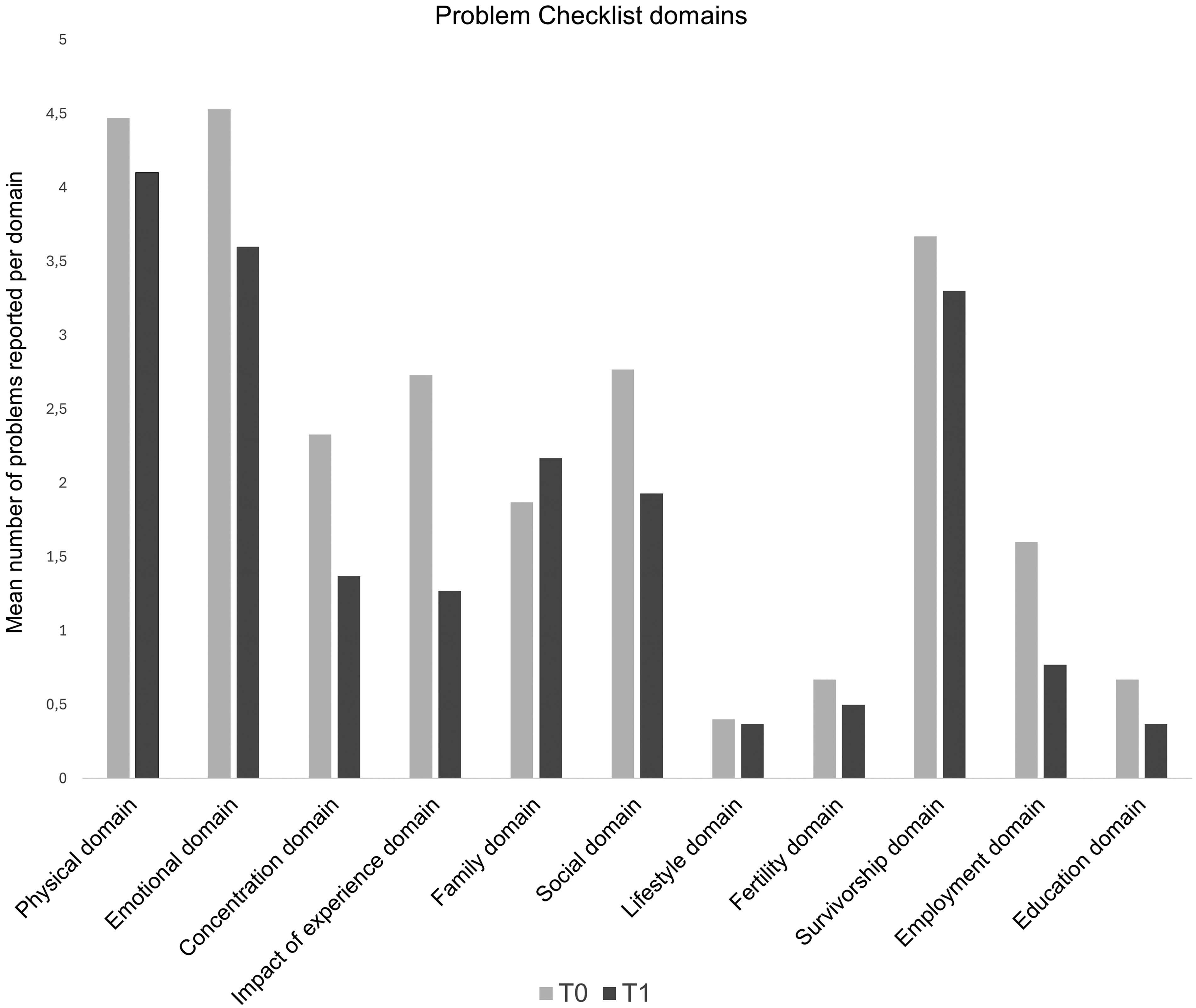
Changes in mean scores on the Problem Checklist domains between T0 and T1. The total mean score for numbers of problems reported changed from 25.70 at T0 to 19.73 at T1.
Pre- and Post-Assessments

Continuous outcomes were analyzed with paired samples t-test for the continuous variables and chi-square for binary outcomes.
Effect sizes were calculated according to Hedges’ g and considered small (0.2), medium (0.5), or large (0.8). p Values are reported as two-sided.
For the purpose-designed, non-validated questions, the majority (21/29; 72.4%) reported that the program was not burdensome at all, and no patients reported experiencing “quite a bit” or “very much” burden. Most participants (23/29; 79.3%) reported receiving at least “somewhat” of a benefit from the program (27.6% “somewhat” beneficial, 27.6% “quite a bit”, and 24.1% “very much”). Furthermore, 21/29 (72.4%) reported that they had been in contact with other group members since the competition of the group. The results from the purpose-designed questions are presented in Figure 2.

Percentages of participants (N = 29) reporting program benefit and burden and contact with other members since the completion of the group.
Discussion
This study evaluated the preliminary psychological impact and safety of Recapture Life on improving AYAs’ psychological distress and cancer-related problems when delivered in community settings. We hypothesized that Recapture Life would produce positive psychological outcomes such as reduced distress, decreased cancer-related problems as well as increased perceived peer support, in AYA cancer survivors. Participants did not report reduced psychological distress, but AYAs’ perceptions of their cancer-related problems and peer support improved significantly over time. Participants reported minimal program burden, and most found the intervention at least somewhat beneficial. Additionally, most participants kept in touch with other group members after the intervention. While utilizing different outcome measures and including different age ranges, these results are in line with what has been reported across the two previous Recapture Life outcomes studies.22,23 All in all, the program has been demonstrated to be acceptable, feasible and safe, and has showed promise in supporting AYAs to learn more effective CBT strategies, but without leading to statistically significant improvements in psychological distress.
In the current study, the lack of a statistically-significant improvement for psychological distress may be due to the exclusion criteria. Participants who scored too highly on the Distress Thermometer at intake were excluded from the study, which could have reduced any possible improvement at a group level. Our participants were also reporting distress below the level of clinical significance even at baseline, which raises potential for a floor effect on reductions in distress. Likewise, for the K10, which measures anxiety and depression symptoms, 31.0% of the participants in our study scored above the cut-off at T0 and 27.6% at T1. Another possible explanation is that the measures used (K10 and DT), while validated and sensitive to change, are too general and not cancer-specific.
It is also worth considering the impact of the global COVID-19 pandemic: while some AYAs started the program before the onset of the pandemic, all were participating during the pandemic at some time-point, as T1 assessments occurred between March 2020 and August 2021. One Canadian study on psychological distress in AYAs with cancer during COVID-19, using the K10, found 68% scored above the K10 cut-off. 38 It is therefore possible that our participants were already experiencing better QoL and less depression and anxiety than other AYAs during COVID-19. This accords with previous research on mental health in Australian AYA cancer survivors, who reported lower depression and anxiety symptoms to comparison Australian AYAs in the community. 39
Although some survivorship concerns are common across age groups, others are specific to AYAs’ developmental stage, which emphasizes the need for age-appropriate and targeted survivorship care services. 40 One of the types of support that matters most to AYAs is support groups with peers of a similar age. 41 Previous studies on the Recapture Life program have concluded that AYAs generally felt supported and accepted by the group and held positive views about the peer-support model.25,26 Our results echo this finding, and further indicate that participants experienced increased peer support and that many AYAs also then remained in contact with other group members after the completion of the intervention. Peer support has previously been demonstrated to be associated with positive outcomes for this group. 18 Taken together, this suggests that group-based models of psychosocial support are beneficial, and remain worthy of investment in community-based settings.
Finally, in addition to increased peer support, our participants also reported a significant decrease in cancer-related problems from T0 to T1, indicating that the Recapture Life intervention may provide useful psychological skills to manage these challenges in survivorship. This finding reflects positive adjustment to a range of life areas for AYAs in the early months and years post-treatment completion.
Strengths and limitations
While the participants reported statistically significant increased peer support and decreased cancer-related problems, our trial was not large enough to investigate differences between diagnostic groups. Our sample included AYAs who chose to participate, and we do not know the characteristics of AYAs who declined to participate. The main limitation of the study was the lack of a randomized control group design, which was not possible to implement in a manner in line with our partner community organizations’ ethos. Another limitation is that almost half of the male participants did not complete the follow-up assessment, despite completing the intervention. The results may therefore not be representative for male AYAs. We also did not have data on ethnicity/race, culturally and linguistically diverse status or Indigenous status, which limited our ability to understand the AYAs from these groups. Finally, the mix of diagnoses does not perfectly reflect the proportions of these in the general AYA population—for example, participants with solid tumors were somewhat overrepresented, while participants with brain tumors were underrepresented.
Future research
Despite this promising evidence, implementing manualized interventions such as Recapture Life into real-world settings remains challenging. Indeed, recent reviews have shown that despite an increase in psycho-oncology interventions, there is a lack of implementation studies, with <6% of existing interventions being implemented in practice. 42 One barrier to the implementation of complex psychosocial interventions is the gaps and variability in available psychological services for AYAs in hospital settings, particular in post-treatment cancer survivorship. 43 It will be important for future research to examine barriers and facilitators to implementing psychological interventions for AYAs—both within and outside of health care systems.
Conclusion
In line with previous research on the Recapture Life program, our participants reported that they benefitted from the intervention and that the participation burden was low. Our results indicate that Recapture Life increases peer support in the AYA group and also provides CBT skills that may help AYAs adapt to, and manage, cancer-related challenges in early survivorship.
Authors’ Contributions
E.I.: Writing—original draft, review and editing, methodology, statistical analysis, visualization, funding acquisition. C.W.: Conceptualization, funding acquisition, methodology, writing—review and editing. K.H.: Conceptualization, funding acquisition, methodology, writing—review and editing. B.C.M.: Conceptualization, methodology, writing—review and editing. H.E.: Writing—review and editing. F.M.: Methodology, funding acquisition, writing—review and editing. P.P.: Methodology, writing—review and editing, A.B.: Methodology, writing—review and editing, R.J.C.: Conceptualization, funding acquisition, writing—review and editing. U.M.S.-D.: Conceptualization, funding acquisition, methodology, statistical analysis, visualization, writing—review and editing.
Footnotes
Acknowledgments
The authors wish to thank Jessica Buster and Gadiel Dumlao for their assistance with data collection for this study, as well as Amber-Marie Firriolo and Rachel Houweling for their administrative contributions to this study.
Author Disclosure Statement
No competing financial interests exist.
Funding Information
The Recapture Life study was funded by a Cancer Council New South Wales Program Grant (PG16-02) the Estate of the Late Harry McPaul, the Maridulu Budyari Gumal SPHERE (Cancer Clinical Academic Group), as well as from philanthropic funding from the Sydney Children’s Hospital Foundation. E.I. reports a personal grant from the Swedish Childhood Cancer Fund (PD2024-0012). C.E.W. is supported by the National Health and Medical Research Council of Australia (APP2008300). K.H. is supported by the Cancer Institute Translational Program Grant (2021/TPG2112) as well as Luminesce Alliance—Innovation for Children’s Health. U.M.S.-D. reports an Early Career Fellowship from the Cancer Institute of New South Wales (ID: 2020/ECF1163) and an Early Career Fellowship from the National Health and Medical Research Council of Australia (APP1111800).
Data Availability Statement
The data that support the findings of this study are available from the corresponding author upon reasonable request.