Abstract

Introduction
Promoting awareness and education in adolescent and young adult (AYA) oncology care is indispensable. Proper awareness among AYA, their families, and health care professionals builds a wealth of knowledge on the peculiar issues and considerations in handling cancer during this critical life stage. 1 Empowered individuals are more likely to take an active role in their own treatment plan, participate in their medication routine, and practice healthy habits, thus improving their outlook. 2 Integrating education into treatment can help AYA to become more informed decision-makers and lead to treatment that is more patient-oriented and effective. Emphasizing AYA-specific training for health care professionals is also an important step toward improving awareness of developmental priorities during cancer care.
Guidelines
Some guidelines exist that explore specific recommendations for promoting awareness of AYA cancer among the public and health care professionals, as well as improving patient education for AYA with cancer. The American Society of Clinical Oncology (ASCO), the National Comprehensive Cancer Network (NCCN), and the Mattie Miracle Cancer Foundation are three key organizations that describe the impact of awareness and education efforts in AYA cancer care. In 2019, ASCO published a resource list for oncology providers, broken down into six topics: fertility and sexuality, genetic testing, clinical trials, psychosocial issues, survivorship, and patient resources. 3 Importantly, ASCO recognizes that some places caring for AYA with cancer lack access to resources about developmentally specific needs. Publishing the list of resources, which includes a section on written patient education for AYA, is an attempt to reduce these gaps in care.
The NCCN Guidelines (2023) for AYA are critical in assuring timely and appropriate care of young adults and adolescents with cancer. These guidelines recommend a more extensive, patient-centered process. 4 In addition to educating AYA about their diagnosis and treatment, the NCCN offers specific recommendations regarding patient education, including the need to provide AYA guidance on medications, the impact of cannabis use, sexual health, nutrition, physical conditioning, and psychoeducation for end-of-life preferences.
The Mattie Miracle Cancer Foundation published a set of Psychosocial Care Standards for Children with Cancer and Their Families, designed for children and adolescents up to 18 years. 5 Although this guideline focuses on the younger end of the AYA population, 3 of the 15 standards regard education and complement those shared by the NCCN. The psychosocial standards of care share an emphasis to provide psychoeducation and anticipatory guidance related to diagnosis and treatment, while also offering two new education-directed guidelines. The first is patient-focused, recommending procedural preparation and support as a standard of care in pediatric and adolescent oncology. 6 The second is clinician-focused, recommending specialized developmental training and education when working with children and adolescents with cancer. 7
Barriers to Awareness and Education in AYA Cancer Care
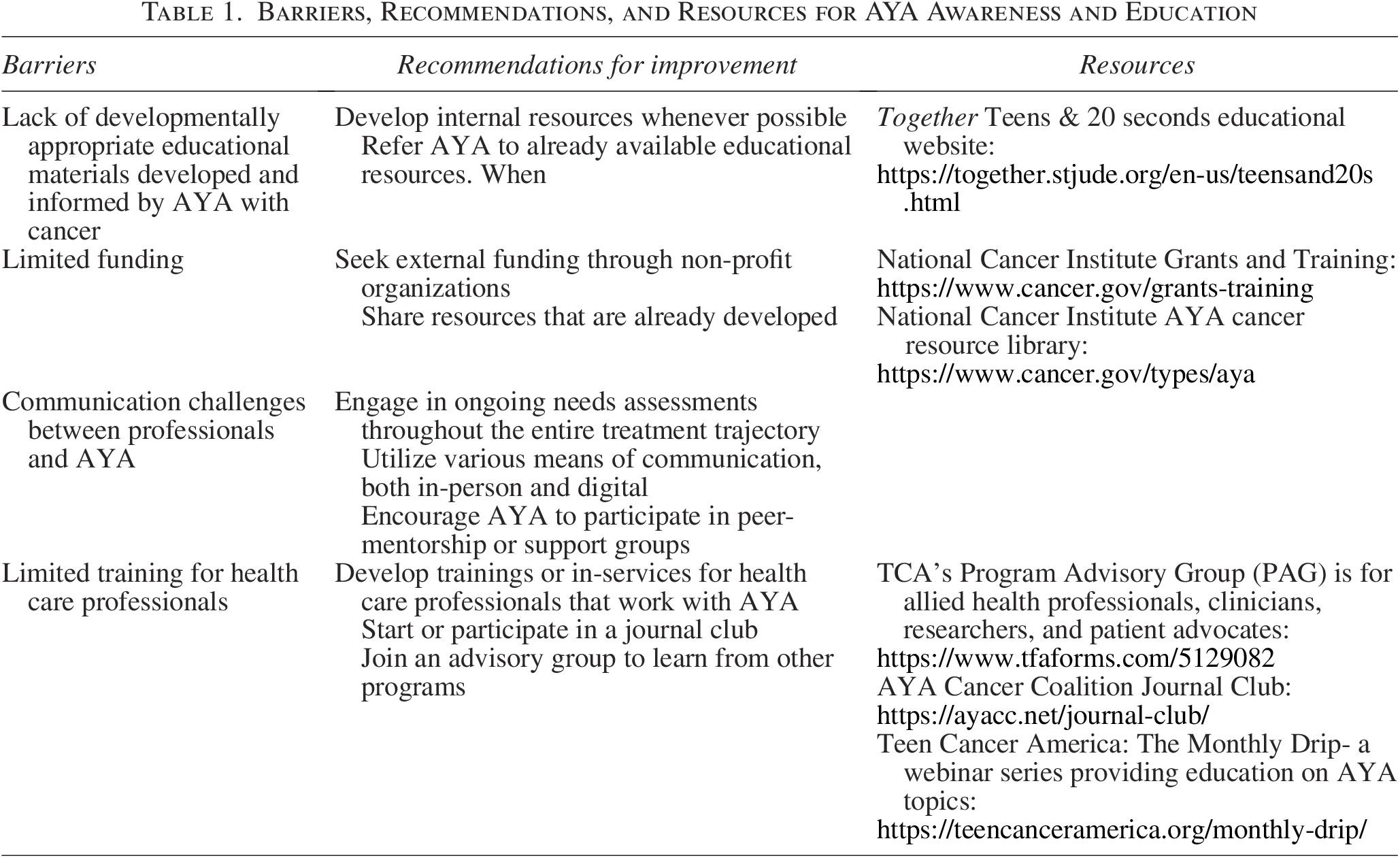
Several barriers hinder adequate awareness and education in AYA oncology. First, there is a shortage of AYA-specific educational materials, and especially ones that are informed by AYA themselves. Of the education resources that do exist, health care professionals may not have time to critically assess the quality of those materials and resist recommending them. 8 A centralized location to house such resources is also inexistant. Limited materials thus interfere with the circulation of relevant information oriented to the special needs of this age group. 9 Insufficient knowledge among AYA may be due to a lack of appropriate and understandable resources online, as well as to limited opportunities to communicate with their health care team openly. Many AYAs prefer to seek information about their cancer online 10 or simply require additional time to process information that they receive from their clinical team before they are ready to ask questions or receive education. Finally, limited funding also constitutes a major challenge to designing and implementing efficient educational programs. 2
Improving Awareness and Education in AYA Cancer Care
To combat the challenges noted above, continuous evaluation, collaboration, and broadening communication channels are important steps to take. Attention should be placed on creating awareness programs that address the issues that differ between pediatric, adolescent, young adult, and adult cancer patients. This begins with educating health care professionals through in-person or virtual training, guest lectures, and even journal clubs that review topics in AYA cancer. Continuous and targeted training can empower health care professionals and reinforce their competencies, as well as lead to better knowledge transfer, facilitating helpful and informed conversations with AYA.1,11 Once health care professionals have increased awareness of AYA cancer, they may be more readily able to engage in frequent assessment of patient needs. Stakeholder voices are also important, and advocacy programs help AYA patients and their families participate in the treatment process by sharing decision-making responsibilities. 12 Collaborating with educational institutions such as universities and community organizations is vital for promoting AYA cancer awareness. One way that institutions align in this effort is through disseminating information during AYA cancer awareness week, typically recognized in the first full week of April each year.
Developing AYA-friendly instructional tools is necessary. Continuing to assess those tools from AYA and health care professionals’ perspectives can ensure they are designed and adapted toward AYA preferences and implemented in practice.12,13 Education materials should not only be tailored to AYA needs and preferences but should also be visually appealing, relevant, and accessible via smartphone. 10 Regarding communication between AYA and their health care team, increasing utilization of digital resources, such as patient portal messaging, is also valuable. 8 Financial support should be available to form educational projects, materials, and outreach programs that educate the AYA population and raise awareness. 9 Collaboration is important to address financial problems. For instance, health care facilities, advocacy groups, and charitable organizations can fund such programs through partnerships. 13 Finally, making resources more widely available online via scholarly publishing can assist health care professionals and AYA in finding reputable sources of information even if settings with limited institutional resources and support.
Conclusion
This paper presents current guidelines on awareness and education in AYA cancer. Barriers, strategies, and recommended resources for improving awareness and education in AYA cancer care are presented in Table 1. Although resources are fragmented, there is consistency in agreeing that AYA receive better care when provided with developmentally informed guidance about their diagnosis and treatment. Recommendations are offered for increasing public and professional awareness, including developing trainings, collaborating across institutions and organizations to access already developed information, and participating in digital campaigns that spread the word about AYA cancer. Additionally, patient education goals are emphasized, covering medical and psychosocial topics, and special attention is paid to the format for delivering this information. When adhering to these strategies, health care providers, educators, and advocates will be able to improve cancer outcomes, quality of life, and decision-making in the case of AYA. 13
Barriers, Recommendations, and Resources for AYA Awareness and Education