




Abstract
With the growth of the adolescent and young adult (AYA) cancer survivor population, attention has increasingly focused on long-term outcomes such as employment. In the current study, we compared work productivity between AYA and non-cancer controls (NC) and the association with quality of life. We compared standardized measures of the impact of health on work productivity between AYA survivors (n = 71) and non-cancer controls (NC; n = 70). Work Productivity and Activity Impairment Questionnaire: General Health was used to index work productivity, and PROMIS measures of quality of life were administered. Results indicated that AYA survivors reported missing more hours of work due to health (F(1,135) = 5.76, p = 0.018) and rated their health more negatively, impacting work productivity (F(1,135) = 9.20, p = 0.003), as compared to NC. Poorer self-reported quality of life was associated with greater effects of health impacting work productivity. Finally, self-reported cognitive functioning was more strongly associated with work productivity in the AYA group, as compared to healthy controls. Our results demonstrated that AYA cancer survivors reported long-term health-related impact on work productivity. As the AYA cancer survivor population continues to grow, attention to better characterizing work-related outcomes and identifying interventions to facilitate return to employment will be a critical need.
Keywords
Background
With 5-year survival rates over 85%, there have been dramatic increases in the number of adolescent and young adult cancer survivors (AYA; 15–39 years; 1 ) and it is estimated that there are over 2 million AYA survivors in the United States. 2 The timing of the diagnosis and treatment for cancer is disruptive in terms of educational and employment opportunities.3,4 Evidence indicates that AYA survivors are less likely to be employed as compared to persons without cancer, and when they are employed, they are more likely to earn less.5–7 This pattern has implications for the growth of financial toxicity among AYA survivors. 8
Among AYA survivors, disease site and severity 9 and treatment with chemotherapy 6 were associated with a decreased likelihood of being employed. There has been a recent shift from focusing exclusively on unemployment and absenteeism to considering presenteeism, whereby an individual may be at work, but they are less productive, and this may be related to poorer health. 10 AYA survivors continue to experience alterations in physical and mental health, as well as cognitive performance, many years after diagnosis,11,12 yet these potentially modifiable factors are rarely considered when predicting return to employment, nor have they been related to work productivity. Therefore, evaluating the extent to which health limitations among AYA survivors may impact effort at work is critically important.
In the current study, we evaluated differences between AYA cancer survivors and persons with no history of cancer (NC) on employment status, hours worked, as well as whether health impacted their work hours and work productivity. We also evaluated the impact of several quality-of-life measures (QOL) on work productivity and whether these associations differed for cancer survivors or healthy controls.
Methods
Potential AYA participants were identified from the AYA survivorship program at the Moffitt Cancer Center. Eligible AYA participants: (a) were between the ages of 18–45; (b) had been diagnosed with cancer between the ages of 18–39 and had completed curative treatment; (c) had no documented psychiatric or neurological disorders that could interfere with study participation (e.g., dementia, psychosis); (d) were capable of speaking and reading standard English; and (e) had no recurrence of cancer. Potential non-cancer control participants were recruited through Research Match. Eligible NC participants (a) were between the ages of 18–45; (b) had no history of cancer, other than non-melanoma skin cancer; (c) had no documented psychiatric or neurological disorders that could interfere with study participation (e.g., dementia, psychosis); and (d) were capable of speaking and reading standard English. This study was approved at the Moffitt Cancer Center by Advarra Inc. Institutional Review Board (Pro00058328). For both groups of participants, an information sheet was presented with details regarding the study, and electronic consent was obtained. Participants were offered a monetary incentive of $25 to complete the online questionnaires.
Study measures included the Work Productivity and Activity Impairment Questionnaire: General Health v2.0 (WPAI:GH; 13 ), a validated six-item questionnaire that evaluates the extent to which health impacts hours worked and the extent to which health negatively impacted work productivity and everyday activities (0—no effect to 10—complete impairment). QOL domains included (with measures in brackets): subjective cognitive performance (PROMIS Cognitive Functioning 8a, Cognitive Abilities 4a measures; 14 ), depressed mood (PROMIS Depression Short Form 8a; 15 ), fatigue (PROMIS Fatigue 7a;16,17), sleep quality (PROMIS Sleep Disturbance 8a and PROMIS Sleep Related Impairment 8a; 18 ) and physical function (PROMIS physical function 8b).
Statistical Analysis. All cancer survivors were included in the analyses, and we did not consider specific diagnosis or treatment regimen in the statistical models. Analytically, group differences in WPAI: GH outcomes were evaluated using ANCOVAs with age as a covariate. Assumptions underlying ANCOVA were evaluated by interacting age with the AYA group and the assumptions were not violated. Pearson correlations were used to examine the impact of QOL measures on health-related limitations to work productivity. Finally, moderated regressions using the Process macro 19 were used to evaluate differences in the impact of QOL on work productivity between AYA and NC groups. The current study had 80% power to detect medium-effect sizes (Cohen’s d = 0.5) for mean differences, assuming a two-tailed alpha of 0.05. For the regression analyses, the analyses had 80% power to detect a moderation effect that accounted for at least 5% of variance. Finally, due to the exploratory nature of the study, we did not correct for multiple comparisons.
Results
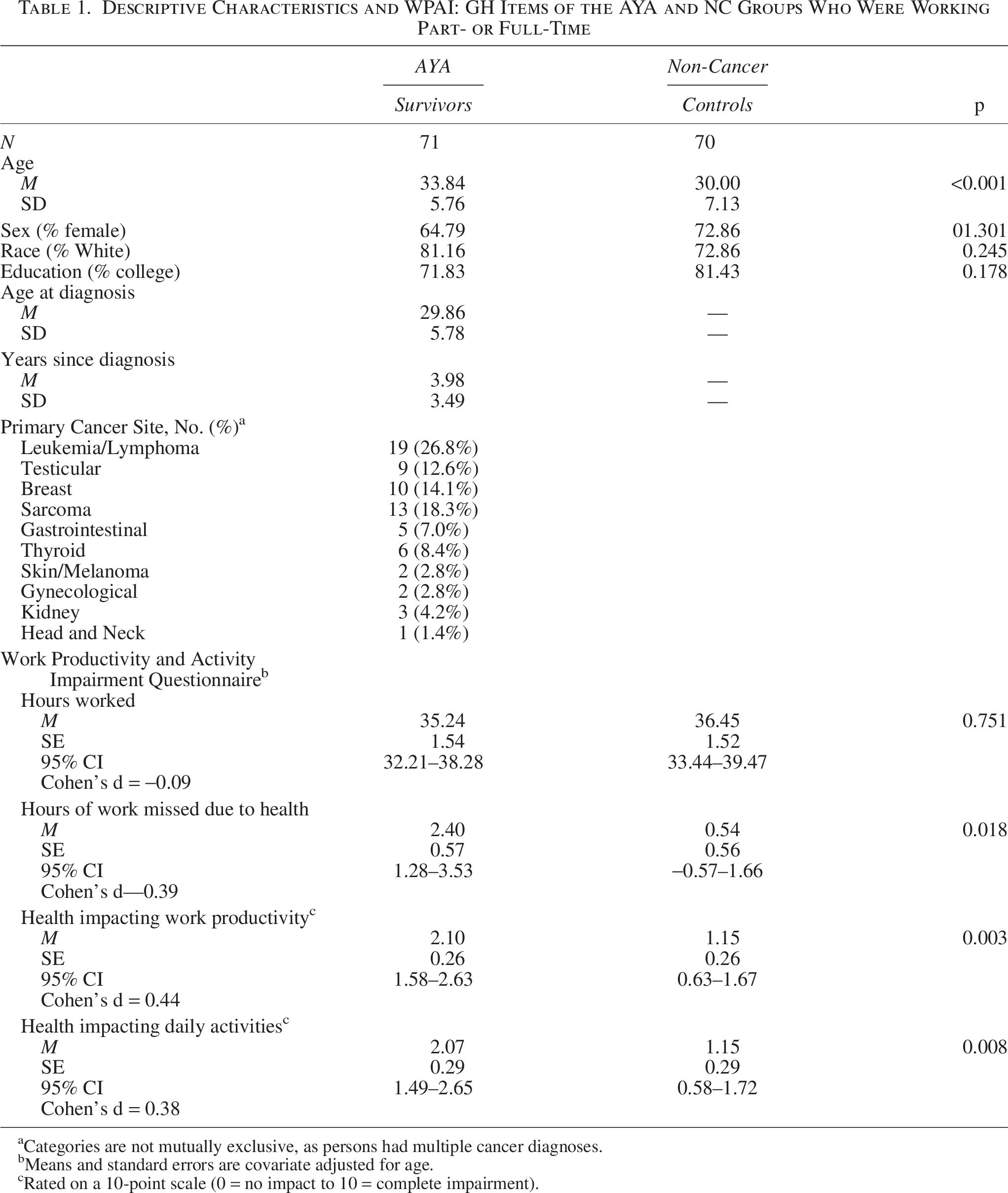
The sample consisted of 96 participants with no history of cancer (NC) and 88 cancer survivors. We restricted the analyses to persons who reported part- or full-time employment. From this group, 80.7% (n = 71) of the AYA group reported working full- or part-time, and 72.9% (n = 70) of the NC reported full- or part-time employment (X2(1) = 1.55, p = 0.214). As compared to persons not working full- or part-time, the working sample was significantly older (31.9 versus 29.5 years; F(1,180) = 4.82, p = 0.029), and there were trends toward the working sample having a smaller proportion of females (73.5% versus 86.3%; X2(1) = 3.40, p = 0.065) and a larger proportion with a college education (80.0% versus 67.4%; X2(1) = 3.21, p = 0.073). There were no differences in terms of race/ethnicity (X2(1) = 0.43, p = 0.513). Table 1 displays the demographic characteristics of the working NC and AYA groups. The AYA group was significantly older (F(1,139) = 12.35, p < 0.001), but there were no differences in terms of biological sex (X2(1) = 1.07, p = 0.301), White race (X2(1) = 1.35, p = 0.245), or college education (X2(1) = 1.81, p = 0.178). The majority of AYA survivors were diagnosed with lymphoma/leukemia and averaged almost 4 years since diagnosis.
Descriptive Characteristics and WPAI: GH Items of the AYA and NC Groups Who Were Working Part- or Full-Time
Categories are not mutually exclusive, as persons had multiple cancer diagnoses.
Means and standard errors are covariate adjusted for age.
Rated on a 10-point scale (0 = no impact to 10 = complete impairment).
As shown in Table 1, participants reported similar numbers of hours worked over the past 7 days (F(1,135) = 0.01, p = 0.751, η2 = 0.01). However, AYA survivors reported missing more hours of work due to health (F(1,135) = 5.76, p = 0.018, η2 = 0.04), and they rated their health as more negatively impacting work productivity (F(1,135) = 9.20, p = 0.003, η2 = 0.08) and regular daily activities (F(1,135) = 7.22, p = 0.008, η2 = 0.06). Finally, 35% of AYA survivors indicated that cancer had a negative or very negative impact on their plans for work. Thirty-six percent of AYA and 56.7% of controls indicated that their health had no impact on work productivity.
Among all participants, a worse health-related impact on work productivity was associated with worse anxiety (r = 0.40, 95% CI = 0.25 to 0.54, p < 0.001), cognitive functioning (r = −0.59, 95% CI = −0.69 to −0.47, p < 0.001), cognitive ability (r = −0.58, 95% CI = −0.68 to −0.45, p < 0.001), depressed mood (r = 0.41, 95% CI = 0.26 to 0.54, p < 0.001), fatigue (r = 0.65, 95% CI = 0.54 to 0.74, p < 0.001), physical function (r = −0.54, 95% CI = −0.65 to −0.41, p < 0.001), sleep disturbance (r = 0.53, 95% CI = 0.39 to 0.64, p < 0.001), and sleep impairment (r = 0.66, 95% CI = 0.55 to 0.74, p < 0.001). Moderation analyses indicated cognitive ability was more strongly associated with health impacts on work productivity for the AYA group (B = −1.32, SE = 0.19, 95% CI = −1.67 to −0.94, p < 0.001), as compared to the NC sample (B = −0.69, SE = 0.22, 95% CI = −1.12 to −0.25, p = 0.002), and the difference between the slopes was statistically significant (p = 0.032). Figure 1 illustrates this association, with group differences in health-related impact on work productivity being greatest at lower levels of self-reported cognitive functioning.
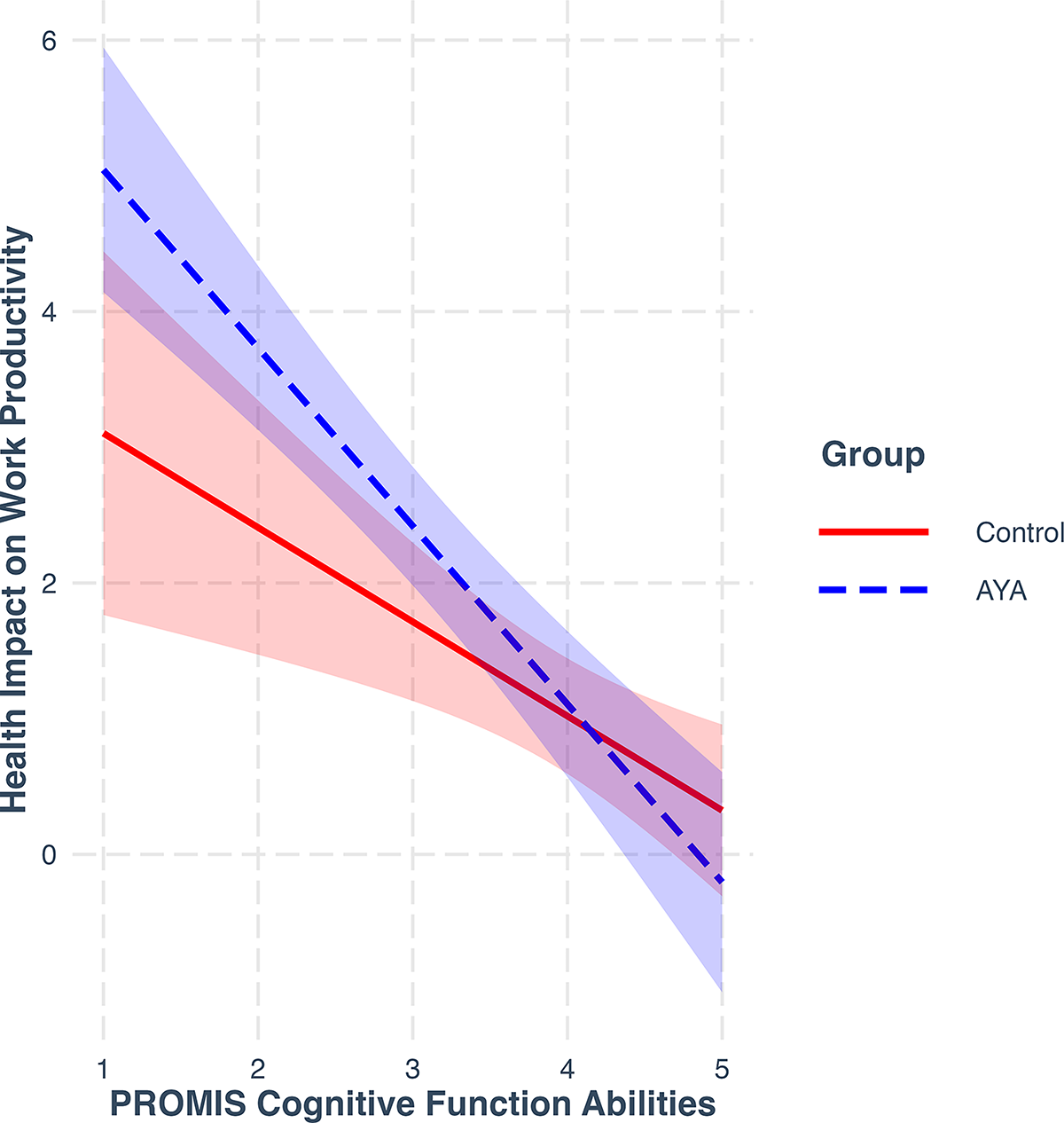
Association between PROMIS Cognitive Function Abilities and Health Impact on Work Productivity for AYA and NC, with 95% CI. Model estimates are based upon regression analyses, with age, gender and educational attainment as covariates. The associations indicate that for the AYA group, lower values on the PROMIS Cognitive Function Abilities measure was associated with worse ratings on health impact on work productivity.
Discussion
The results of our study demonstrated that AYA survivors were more likely to work fewer hours due to health problems and report that their health limited work productivity. Furthermore, lower QOL was associated with worse ratings of the extent to which health impacted work productivity. Finally, self-reported cognitive functioning was more strongly related to work productivity among the AYA survivors.
The results of the current study contribute to the literature suggesting a long-term impact of cancer and its treatment on employment among AYA cancer survivors. Importantly, our measurement of employment evaluated the extent to which health impacted work productivity, rather than simply indexing whether AYA survivors are unemployed or experience greater rates of absenteeism. In a recent commentary, Bradley and colleagues 20 advocated for the use of validated measures of work productivity, like the WPAI: GH that we used here, as well as healthy control comparison samples to better characterize the experience of work-related outcomes among cancer survivors. Thus, when considering the potential clinical implications of this work, AYA cancer survivors should be asked about whether they have had to miss work entirely, as well as whether they have experienced limitations at work because of their health and the long-term impacts of cancer and its treatment, as well as providing recommendations for AYA survivors to effectively return to the workforce. 4
We also observed that QOL outcomes were associated with self-reports of health-related impact on work productivity. Furthermore, self-reported cognitive functioning was more strongly related to work productivity among AYA survivors as compared to healthy controls. Hansen and colleagues 21 reported that among adult breast cancer survivors, worse fatigue ratings were more strongly related to work limitations for cancer survivors as compared to controls. In the current study, we observed an association with fatigue, but the influence did not vary as a function of group membership. In their study, no relationship between work limitations and self-reported cognitive functioning was observed. There is increasing attention that AYA cancer survivors may be susceptible to cancer-related cognitive impairment, 12 yet relatively little work has focused on this population. 11 Given the association between self-reported cognitive performance and work productivity identified here, future studies should evaluate the extent to which cognitive functioning may be related to occupational effectiveness.
Limitations
The strengths of the current study include the examination of employment outcomes among AYA cancer survivors, an underrepresented group in research, as well as the use of a healthy control sample and well-validated measures of employment productivity and QOL. With that said, there are several limitations that must be highlighted. First, we examined a convenience sample of AYA cancer survivors with a diverse set of diagnoses and varied treatment regimens. Although the broad scope of cancer diagnoses is a potential strength, as it represents a diversity of experiences, future studies should focus on a narrower set of cancer diagnoses that also allows for the consideration of treatment effects on work outcomes. Second, we are unable to examine changes in employment patterns, whereby individuals may reduce from full- to part-time employment or change occupations to ones that are potentially less demanding. Finally, the sample was generally healthy and well-educated and was recruited from a single center.
Implications
As the AYA cancer survivor population continues to grow, attention to better characterizing work-related outcomes and identifying interventions to facilitate return to employment will be a critical need. Further, evaluating the impact of health on work performance, not only whether a survivor returns to employment or not, will be critical.
Conclusion
The current study evaluated work productivity among AYA cancer survivors. Our results demonstrated that AYA cancer survivors reported long-term health-related impact on work productivity. QOL was associated with work productivity, and AYA cancer survivors self-reported cognitive functioning was more strongly related to work productivity among AYA cancer survivors.
Footnotes
Author Disclosure Statement
D.R.R.: Springworks, Eisai: Data Safety monitoring board. H.S.L.J.: Consultant for SBR Biosciences, grant funding from Kite Pharma. The other authors have no conflicts of interest to disclose.
Funding Information
This work was supported in part by an award to B.J.S. and H.S.L.J. from the AYA Survivorship Program at the Moffitt Cancer center and a National Institutes of Health Cancer Center Support Grant (grant number P30CA076292).
Data Availability Statement
In accordance with the NIH Data Sharing Policy, deidentified data collected as part of this study and supporting documentation will be made available to other researchers who contact the Principal Investigator directly and complete a material transfer agreement.