



Abstract
We explored the outcomes of a school counselor consultation intervention informed by the Advocating Student-within-Environment theory as delivered to nine teachers of 149 students in a Title I school. Results from hierarchical regression analyses revealed changes in teachers’ perceptions of the teacher–student relationship that predicted students’ perception of the same relationship. We also found that similar coregulated changes in two curiosity scales can be attributed to the intervention, as can a small change in teachers’ stress tolerance from the pre- to post-test data collection periods. We discuss implications for school relationships and school counseling services.
These are particularly inauspicious times for teachers and students as the COVID-19 pandemic has collided with longstanding social challenges. Consequently, school climates have changed dramatically, often compromising how teachers and students relate and interact (Hamilton & Gross, 2021; Pressley et al., 2021). Ineffectual educational relationships have far-reaching consequences on teachers’ pedagogical practices and students’ school experiences and learning outcomes (Wentzel, 2009); whereas propitious teacher–student relationships are associated with desirable academic, behavioral, and instructional outcomes (Sabol & Pianta, 2012; Sethi & Scales, 2020). Many teachers are stricken with various forms of stress that can compromise instructional performance and contribute to instructional disengagement and professional attrition (Goldhaber & Theobald, 2021; Kim et al., 2022). Left in the wake are students who have also been compromised both academically and socially (Huck & Zhang, 2021). Although school relationships can be threatened, emerging evidence supports interventions designed to improve teacher–student relationships (e.g., Duong et al., 2019; Gregory et al., 2016).
School counselors are often understood as the educational personnel best positioned to encourage social/emotional development in schools (American School Counselor Association [ASCA], 2019a). For classroom teachers, school counselors can provide consultation services that can positively influence how they interact with students (Brigman et al., 2021). Cholewa et al. (2016) found that teachers prize the collaborative relationships engendered by school counselors when consulting with teachers or working directly with students. Considering the outstanding stressors in the current educational milieu and the potential of school counselors to kindle helpful teacher–student relationships, we investigated how a theoretically informed school counselor consultation intervention affected the ways that teachers and students coregulate their classroom relationships. Coregulation—which includes interacting relational, cultural, and personal influences that shape and guide identity and action (McCaslin, 2009)—is important given its influence on constructive teacher–student relationships and its status as a foundational concept for the intervention approach considered in the current study, namely the Advocating Student-within-Environment (ASE) theory for school counseling practice (Lemberger, 2010; Lemberger & Hutchison, 2014).
Teacher–Student Relationships
Classroom climate is deeply influenced by teacher–student relationships and, therefore, affects schooling processes and learning outcomes (Walker & Graham, 2021). Teacher–student relationships are generally defined as “teachers’ and students’ aggregated and ongoing perceptions of one another, affect towards each other, and interactions over time; these perceptions are stored in memory and guide future interactions with the other party” (Brinkworth et al., 2018, p. 25). These relationships are especially important during the middle school years as youth experience profound changes in all types of relationships, particularly those that occur in school environments (Hughes & Cao, 2018). Quality teacher–student relationships are generally important for all students and educators, but the literature suggests a critical value for ethnic minorities, boys, and students from economically challenged backgrounds (Murray & Zvoch, 2011; Roorda et al., 2011).
Several personal and social qualities contribute to teacher–student relationships, including the degree to which one is relationally curious or manages stress. More than a century ago, Dewey (1916) posited that curiosity is a foundational disposition for both teachers and students when pursuing democratic education. Although the intuitive value of teacher curiosity is widely accepted (Jirout et al., 2018), the empirical literature pertaining to teacher curiosity lags. To fill this gap, Amorim Neto et al., (2022) sampled 518 U.S. teachers and found that teacher curiosity predicted their relationships with students, with relationships in Grades 6 to 8 particularly vulnerable to students’ negative behavior, time constraints, large class sizes, family issues, and truancy. Panning out to varying workplace environments, curiosity is associated with job satisfaction, work engagement, healthy work relationships, and innovation in workplace performance (Kashdan, Goodman, et al., 2020). For students, curiosity is associated with important learning and social outcomes (Engel, 2011; Jirout et al., 2018). Further, curiosity might be a mechanism that students can use to leverage more just and supportive classrooms (Clark & Seider, 2017). As such, experiencing and engendering curiosity might prove to be critical, especially given the various professional, relational, and societal threats affecting elementary and secondary classrooms.
Negative teacher–student relationships can have enduring consequences for teachers and students. For teachers, negative relationships with students can compromise physical and psychological health, resulting in experiences of harmful stress and professional dissatisfaction (Spilt et al., 2011; von der Embse et al., 2016). For students, perceptions of supportive teachers are associated with various constructive classroom behaviors and academic performance (Frenzel et al., 2018; Tao et al., 2022), whereas negative perceptions of teachers are associated with a litany of deleterious outcomes in and beyond school (Rudasill et al., 2010). Considered together, teacher–student relationships appear to be a complex tapestry that can have protracted effects on teachers and students alike, therefore, requiring interventions that are responsive to the complex nature of schooling relationships.
Poling et al. (2022) performed a review of 24 teacher–student relationship intervention studies and found that relationship-building approaches generally focused on increasing closeness, decreasing conflict, promoting social/emotional learning, and emphasizing relationship-driven classroom management. In one example study, Duong et al. (2019) tested how a professional development training entitled Establish-Maintain-Restore affected the relationships for 20 middle school teachers and their students. Using a multilevel analysis approach, the researchers found that the teachers and students in the treatment condition reported significant improvements in the relationship, increases in engaged academic time, and reduced disruptive behaviors in class. Similar results have been reported in studies that include culturally diverse student populations and differing school settings (Gehlbach et al., 2016; Gregory et al., 2016).
School counselors work directly with students and teachers; thus, they might be in a position to help support positive teacher–student relationships. Molina et al. (2022) investigated how school counseling consultation utilizing ASE theory affected 30 randomly assigned teachers in a Title I school district. Results from hierarchical linear regression analyses revealed statistically significant decreases in teacher-reported stress and conflict in the teacher–student relationship. Moreover, teachers in the treatment condition self-reported greater rates of change in how they act with awareness, a precursor for self- and co-regulated behavior (Short et al., 2016). Given that school counselors are embedded in schools and generally readied with skills to support teacher–student relationships, it is important that scholarship can demonstrate how school counselors might ameliorate educational relationships in ways that are germane to both teachers and students and that are determinants of school climate over time.
Current Intervention Approach and Empirical Study
School counselor consultation is intended to support students by directly engaging with relevant adults who will in turn utilize the consultation content in interactions with students (Brigman et al., 2021). This systemic aspect of school counseling corresponds to ASE theory in that the approach purports to amplify students’ and school stakeholders’ capacities while simultaneously pursuing more hospitable and contributory school ecologies (Lemberger-Truelove & Bowers, 2019). In this manner, ASE theory is concerned with the pursuit of social justice and student development as conjoined praxis, consistent with liberatory approaches to critical education (Freire, 1970). As illustrated in Figure 1, the specific school counseling behaviors suggested in ASE are chiefly concerned with engendering curiosity, connectedness, coregulation, compassion, and contribution in students, educators, and other education stakeholders. Advocating student-within-environment theory map.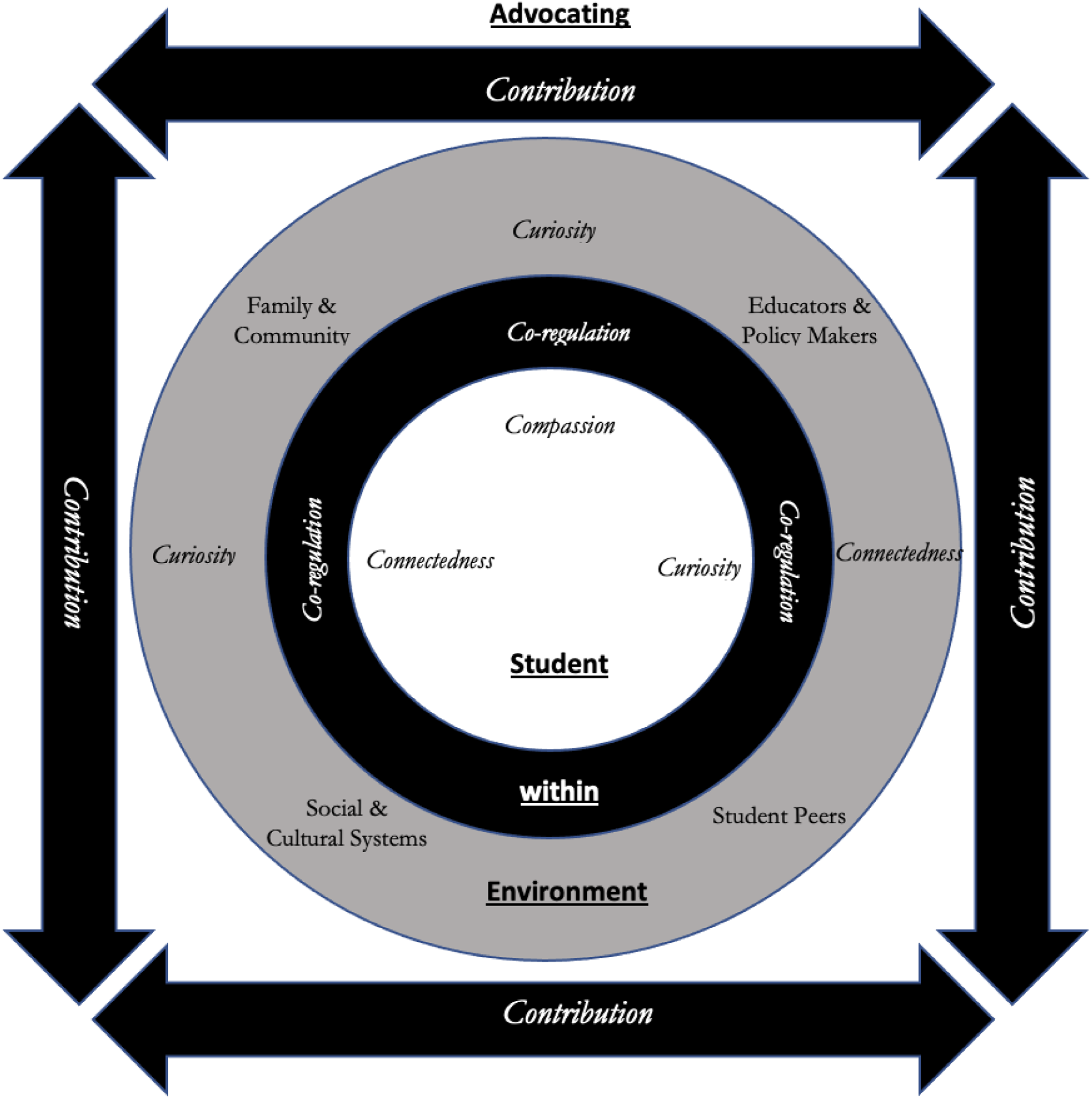
Prior ASE-related studies were generally concerned with causal comparative effects of interventions delivered directly to students or educators. Student outcomes associated with ASE interventions include development in executive functioning, connectedness, curiosity, and achievement in reading, math, and science on standardized academic tests (Bowers et al., 2020; Ceballos, et al., 2021; Lemberger et al., 2018; Lemberger-Truelove et al., 2020). Treatment outcomes include samples of ethnically and economically diverse students, ranging from pre-K to high school settings in both rural and urban schools. Among teachers exposed to ASE interventions, results have demonstrated significant changes in their perceived stress, mindfulness, and teacher–student relationships (Molina et al., 2022). ASE theory was designed to accommodate comprehensive school counseling programs (see ASCA, 2019a) that serve all students and teachers in corresponding ways across the duration of a school period. Although ASE theory and practice behaviors endorse reciprocal interventions with students and school faculty, prior ASE empirical studies have only considered how the intervention influences students or educators discretely, rather than as coregulating forces in school environments.
For the current study, we were interested in how an ASE school counseling consultation intervention might affect the coregulated relationships between teachers and students, including effects on teacher or student curiosity and teacher stress. This focus deviates from prior ASE studies in that our current intent was less on causal intervention effects extrapolated from randomized samples with treatment and control conditions; instead, for the present study, the concern was to interrogate how coregulated change between teacher and student might occur as a consequence of that teacher’s exposure to an ASE consultation intervention. This overarching focus informed the following research questions: 1. Do changes in teachers’ perception of the teacher–student relationship predict changes in students’ perception of the same relationship? 2. Do changes in teachers’ perception of their own curiosity predict changes in students’ perception of their curiosity? 3. After accounting for baseline teacher stress, did changes in teachers’ perception of teacher–student relationships predict changes in students’ perception of the same relationship?
Methods
Our research team obtained institutional review board approval from the University of Texas at Tyler prior to disseminating recruitment material nationally through ASCA’s online network. Initially, 19 school counselors responded with interest to participate in the study. After discussing the intervention and data collection responsibilities, two school counselors in a single middle school, Midwestern school, met inclusion criteria and committed to the study. In turn, the school counselors recruited teacher and student participants and facilitated electronic consent (or assent) processes.
The first two authors trained the two school counselors for the purposes of intervention fidelity. The school counselors participated in an initial 2 day training seminar utilizing the Zoom online meeting platform. The initial training included the content for each consultation session with teachers and spontaneous ASE-inspired counseling language prompts. Beyond the initial training, the school counselors participated in six weekly meetings with the investigators to discuss upcoming sessions, unique circumstances with teachers or students, and other intervention or data collection concerns.
Each manualized consultation session included the following general components: (a) 15 minute teacher check-in (e.g., teacher goals, classroom experiences, and evaluations of consultation); (b) 15 minute psychoeducational content pertaining to relationship and social/emotional skills germane to culturally diverse middle school classroom settings; (c) 10 minute meditation exercise; and (d) 5 minute “contribution talk” (i.e., social advocacy commitments by the school counselor and teacher, intended to improve school climate). Inspired by the initial and weekly training sessions, the school counselors delivered five consultation sessions to the participating teachers. Each session lasted approximately 45 minutes and occurred once a week, generally during the teachers’ planning periods during the school day.
Data Collection Procedures
Data were drawn from both the consented teachers and the middle school students in those teachers’ classrooms. We used the Qualtrics platform to disseminate the assessment surveys to students and teachers. The school counselors were emailed the anonymous Qualtrics survey links, which they then forwarded to participating teachers and students. To help ensure confidentiality during data collection, teachers created a pseudonym to use when completing Qualtrics assessments and students were given a unique code identifier to use for the surveys. Quantitative data were captured across three time periods: 1 week prior to the initial consultation session, after the third week of the intervention, and within 1 week after the final session was delivered.
Instruments
Teacher–Student Relationship Scale (TRS)
The TRS (Brinkworth et al., 2018) asks teachers and students to independently complete parallel scales where students report their perception of the student–teacher relationship and teachers report their perception of their relationship with each student, one at a time. The questionnaire comprises 14 statements, with nine statements asking about positive perceptions and five related to negative perceptions. Responses are provided along five points, from Not at all to A tremendous amount. Scores for each item are averaged to form one score for positivity and one score for negativity. The reliability for students and teachers across all assessment points ranged from α = .82 to .95.
The Five-Dimensional Curiosity Scale (5DC)
The 5DC (Kashdan, Disabato, et al., 2020) is a self-report measure consisting of 25 items that assess the multifaceted construct of curiosity. The instrument, as suggested by its name, has five constructs: joyous exploration, deprivation sensitivity, stress tolerance, social curiosity, and thrill seeking. Each subscale is assessed by five items that ask for responses to statements about how the individual feels and behaves on a 7-point, Likert-type scale. All teachers and students completed the 5DC at three time points. Scores from this scale have been validated by independent research teams in multiple countries (e.g., Birenbaum et al., 2019). In the current sample, the scores across each subscale and assessment point demonstrated strong reliability, with alpha ranging from .78 to .85.
Perceived Stress Scale (PSS)
The PSS is a 14-item measure to assess the degree to which an individual appraises life situations as stressful. All teachers in the current study completed the PSS at each of the three time points. Teachers responded to each provided statement on a 4-point scale from never to very often; responses were averaged to form a teacher score for perceived stress. Internal consistency reliability across the three time points ranged from α = .82 to .95. Previous research using the PSS demonstrated that the scores produced by the instrument have evidence for both concurrent and predictive validities (see Cohen et al., 1983).
Participants
The current study included two school counselors, nine teachers, and 149 students. One teacher did not complete the study. The school counselor participants reported 9 and 11 years of experience as school counselors and both identified as White. Teacher participants self-reported years of teaching experience as follows: five indicated 0–5 years, two indicated 5–10 years, and one each reported 10–15 years and more than 20 years. The average class size reported by teachers was 20–25 students. All teacher participants (n = 8) self-identified as White. Of participating students in those teachers’ classrooms, 4% self-identified as multiracial (n = 6), 7% as biracial (n = 11), 11% as Hispanic (n = 16), 16% as Black (n = 23), 58% White (n = 82), and 4% identified as Asian (n = 5); seven students did not report their ethnicities. All participants worked or attended a Title I school, meaning more than 40% of students are economically disadvantaged and qualify for free and reduced lunch (U.S. Department of Education, n.d.).
Analytic Approach
We used a series of hierarchical regressions (Aiken & West, 1991) to determine if changes in teachers’ perceptions of teacher–student relationships and their own curiosity predicted students’ perception of the same relationship and students’ curiosity. For each model, we first created change variables for students and teachers by subtracting their first assessment from their last assessment for each construct of interest (e.g., teacher–student relationships and curiosity constructs). Change scores then served as our dependent variables in each model and teachers’ scores were assigned to their corresponding students.
To assess if change in teachers predicted change in students, we first entered students’ and teachers’ initial responses. In a second step, we entered (a) teacher stress and (b) the teacher’s change score to determine if any significant relationship existed between an individual teacher’s change and each of their students’ change, after accounting for differences that may have existed in their initial responses. We examined change in R2 (ΔR2) to determine whether teacher change significantly predicted student change.
Results
Preliminary Analysis
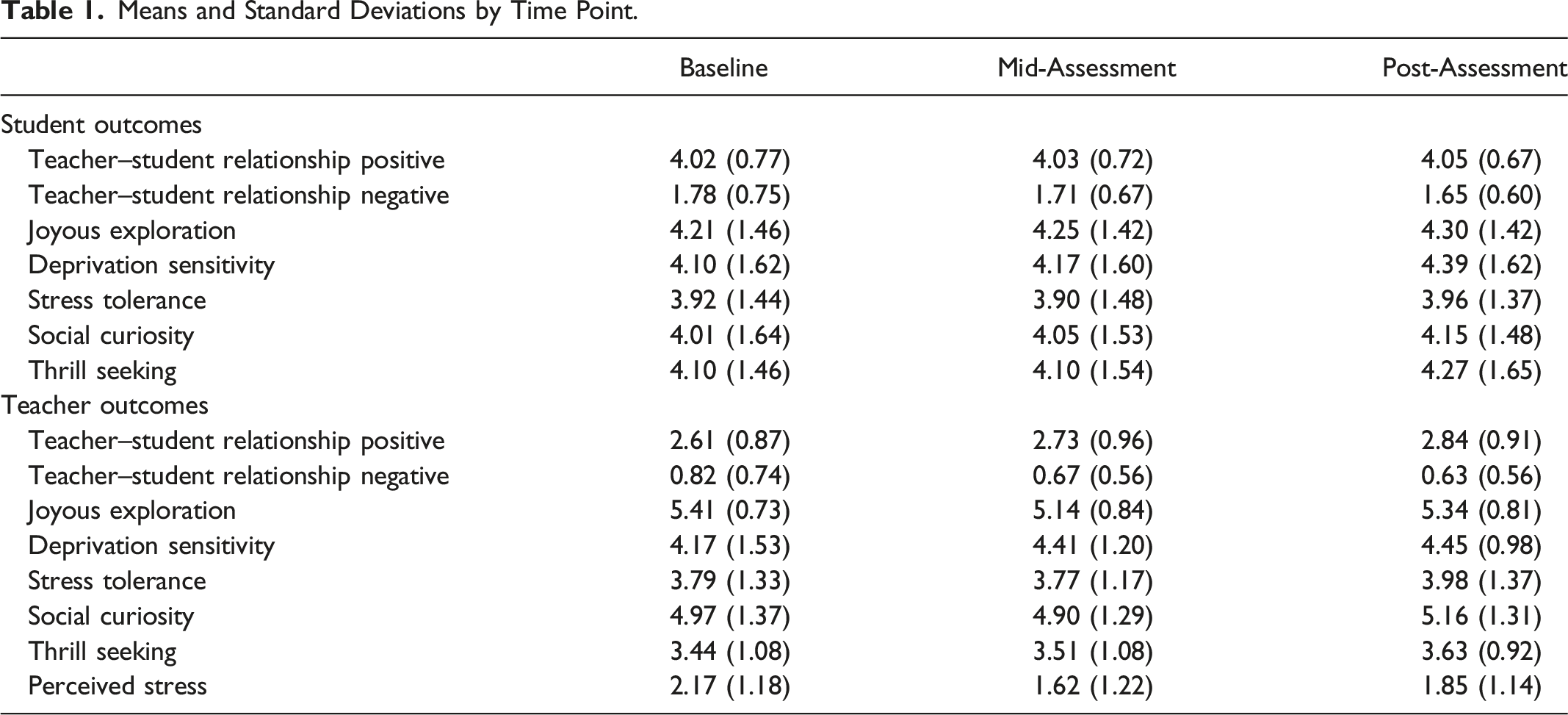
Means and Standard Deviations by Time Point.
Teacher–Student Relationships
Positive Perceptions
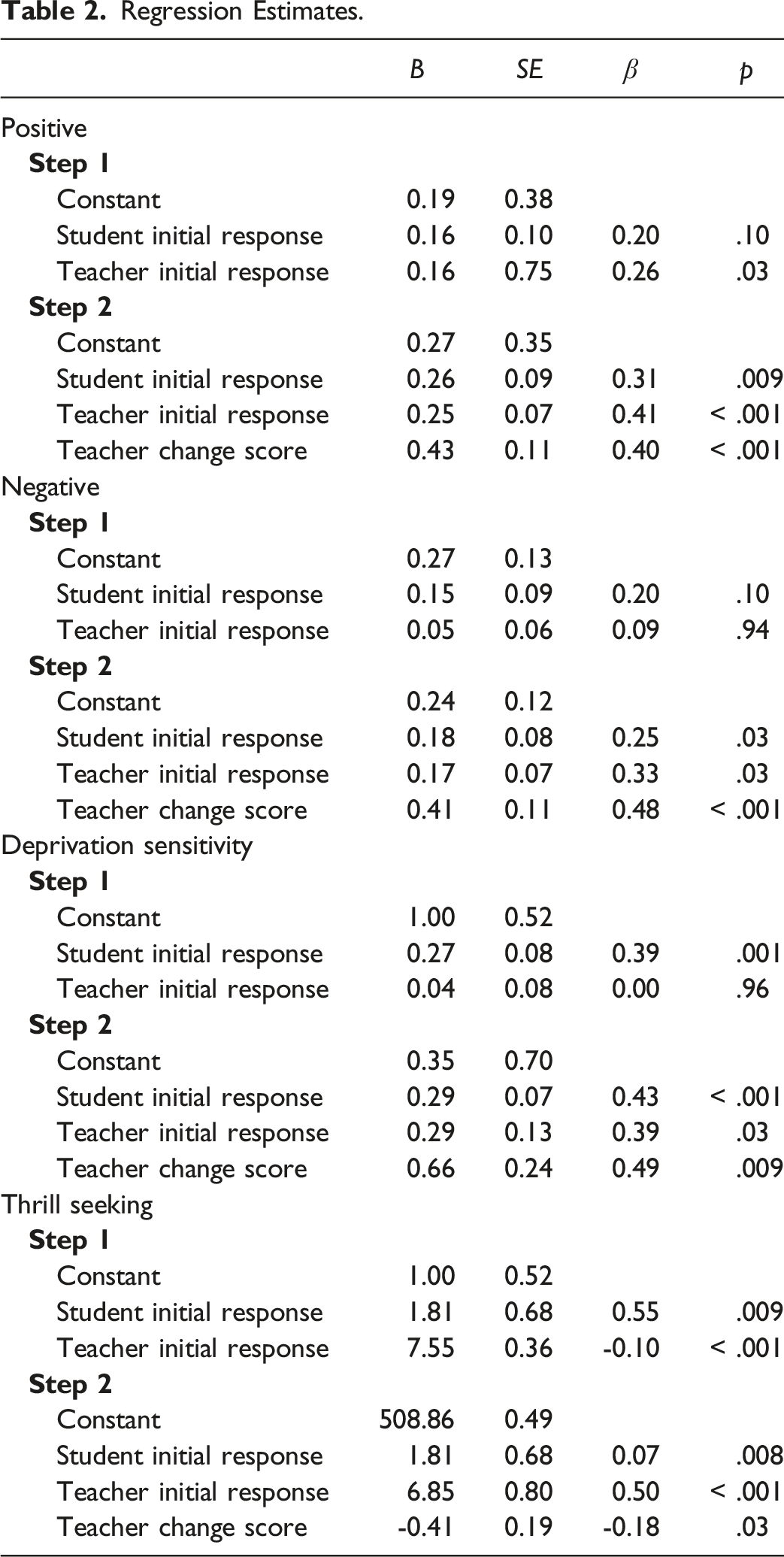
Regression Estimates.
Negative Perceptions
Negative perception followed a similar pattern in that teacher change predicted student change. Results suggest that as teachers reduced their negative perceptions, so too did students. Specifically, after reducing the influence of initial responses, change in teachers’ perception of negative teacher–student relationship statements (β = 0.41, p < .001) accounted for a statistically significant amount of unique variance (ΔR2 = .13, p < .001; overall R2 = .176). As with positive perceptions, teacher stress was not significantly related and was therefore removed from the model. Our finding indicates that as teachers felt less negative towards students, students felt a more positive relationship emerge, with approximately 17% of the variance in why students changed their negative perceptions being related to teacher change as well as students’ and teachers’ initial responses.
Teacher and Student Curiosity
The 5DC scale is a multifaceted construct of curiosity with five constructs: joyous exploration, deprivation sensitivity, stress tolerance, social curiosity, and thrill seeking. Of the five constructs, deprivation sensitivity and thrill seeking were the only two aspects that demonstrated significant relationship between teacher change and student change.
Deprivation Sensitivity
Changes in teachers’ deprivation sensitivity positively predicted student change, with both groups becoming more tolerant of stressful situations. Our findings suggest that after accounting for initial responses to deprivation sensitivity, change in the teacher’s score predicted change in students score (β = 0.66, p = .009), and accounted for a statistically significant amount of unique variance (ΔR2 = .09, p < .009; overall R2 = .247). As with results from the student–teacher scale, teacher stress was not significantly related and was therefore removed from the model. Put concisely, our finding indicates that as teachers became more tolerant of stressful situations, so did students, with approximately 25% of the variance in why students changed their deprivation sensitivity being related to teacher change as well as students’ and teachers’ initial responses.
Thrill Seeking
Changes in students’ thinking about taking academic risks (e.g., doing something new) were predicted by changes in teachers’ willingness to take on a new challenge. Results from the thrill-seeking regression model indicated that after accounting for initial responses to thrill seeking, change in the teacher’s score predicted change in students score (β = 0.50, p = .016), and accounted for a statistically significant amount of unique variance (ΔR2 = .08, p < .016; overall R2 = .253). Like all other models, teacher stress was not significantly related and was therefore removed from the model. Overall, approximately 25% of the variance in why students changed their thrill-seeking score was related to their teacher’s change as well as students’ and teachers’ initial responses.
Discussion
We examined how teachers’ participation in a 5-week, ASE-informed, school counseling consultation intervention affected coregulated experiences between teachers and students, including their teacher–student relationship and curiosity, and teachers’ stress. Results indicate that after accounting for students' and teachers' initial positive and negative relationship perceptions, changes in students' perception of their relationship with their teacher were significantly predicted by their teacher's perception of the same relationship (with positive perceptions increasing and negative perceptions decreasing). These findings potentially demonstrate that the ASE consultation intervention had some positive influence on the coregulated development of teacher–student relationships and that these positive changes were coregulated between teacher and student. Further, the analyses revealed significant relationships in two of the five scales pertaining to coregulated teacher and student curiosity, namely deprivation sensitivity and thrill seeking. Finally, teacher participants reported greater tolerance to stressful situations over the course of the three data collection periods.
Findings from the current intervention study add to a nascent literature that suggests use of school-based interventions can foster teacher–student relationships (Poling et al., 2022). The manualized ASE consultation intervention used in the current study is generally consistent with the recommended practices, including opportunities for teachers to increase closeness to students, decrease conflict, promote social/emotional learning, and emphasize relationally focused classroom experiences. The current study does add to the extant teacher–student relationship intervention literature in a number of ways, particularly the inclusion of school counseling services. Rather than reliance on resource-intensive external resources, school counselors are embedded in schools and readied with training and responsibilities necessary to deliver teacher–student relationship-building experiences across entire school environments. These results also provide germinal evidence for the importance of coregulated relationships between teachers and students (McCaslin et al., 2015). In this way, students and teachers might have more agency to determine the shared classroom culture.
Along with coregulated changes in teacher–student relationships, our results indicated that teachers’ perceptual changes in deprivation sensitivity and thrill seeking predicted similar changes in students’ perception of these two forms of curiosity. Kashdan et al., (2020) found that people who scored high in deprivation sensitivity tended to engage deeply in complex ideas, seek to reduce knowledge gaps, and are solution focused. This result is consistent with ASE theoretical intentions to cultivate capacities in students and teachers, especially in the face of socially challenging circumstances. In a similar way, Kashdan and Goodman’s group (2020) found that individuals who scored high on thrill seeking were more amenable to seeking out novel and intense experiences, which might align with the liberatory aspirations of ASE theory. Somewhat surprisingly, results yielded no significant coregulated relationships between teachers’ and students’ joyous exploration, stress tolerance, and social curiosity. These results might be a function of the modest sample size (especially at the teacher level) or the relatively brief duration of the study. Curiosity can be a generally durable and intrinsic personal characteristic (Ryan & Deci, 2000), especially in schooling relationships.
A third important finding pertained to coregulated changes in teacher stress tolerance. For teacher–student relationships and curiosity, teachers’ stress tolerance did not predict significant outcomes. Results instead indicated that a small change in teacher stress responses occurred between the first and third data collection points. The consultation intervention included a mindfulness lesson in each session, but the particular mindfulness activities were not necessarily focused on stress reduction but chiefly concerned teachers’ awareness of experience and intentional teaching behaviors. The subtle changes in stress response found in these results also indicate the pernicious nature of stress for teachers, especially given that the various factors that potentially induce stress are outside of teachers’ control or the influence of the teacher–student relationship. Nonetheless, these modest findings provide some optimism that coregulated relationships might begin to introduce some limited relief for teachers’ stress levels.
Implications for School Counseling Practice
The school counseling literature has a burgeoning focus concerned with social justice practices (Holcomb-McCoy, 2022; Stickl Haugen et al., 2022). Social justice in schools includes, at least in part, how adult educators interface with students (Dover, 2009). The preponderance of the school counseling scholarship related to social justice in schools is conceptual or reflects the social justice values of the school counselor; although these works are unequivocally laudable, the literature lacks empirical scholarship demonstrating how school counselor-led interventions affect the school environment and peoples’ lived experiences.
Results from the current study provide some initial evidence that school counselors can affect the relationships shared between teachers and students, which may in turn enhance classroom dynamics, leading to more just and advantageous outcomes for students. The participating school counselors were trained to consult with the teachers such that those teachers could interrogate their internal experiences, consider how their instructional approaches affect themselves and their students, and commit to more intentional and prosperous alternative classroom behaviors including teacher–student relationships. This approach to social justice-focused school counseling places profound trust in teachers and students as co-determining agents of social change.
The ASE approach to school counseling illustrates that social justice practice can align with counseling values such as prevention, development, and wellness (Myers, 1992). The liberatory social justice focus of ASE suggests that teachers and “students from disenfranchised communities do not accept inadequate or deleterious social conditions; instead, using social-emotional and mindfulness strategies, they accept their cognitive and affective reactions and respond with clearer intentionality” (Lemberger-Truelove et al., 2018, p. 299).
Conclusion and Future Research
Relationships in schools have profound implications on the educational experiences and outcomes for teachers and students. Findings from the current study provide some preliminary support that school counselors using theory-informed consultation can contribute to constructive teacher–student relationships while amplifying curiosity and supporting teachers who experience stress.
ASCA (2019b) requires that school counselors operate under the influence of evidence-based theories and techniques. Most human service approaches were not designed explicitly for the purposes of intervening in school environments or with students or teachers, and there is value in providing interventions that are tailor made for the specific context (Lemberger-Truelove et al., 2020). Findings from the current investigation add to the prior outcome literature in support of the ASE approach and of school counseling more generally. The preponderance of the intervention literature related to school counseling treats student or teacher outcomes as ends, whereas the current focus on coregulated experiences shared between teacher and student is more consistent with philosophical assumptions of ASE. Synthesizing ASE findings pertaining to student outcomes such as their executive functioning or feelings of connectedness (Bowers et al., 2020; Lemberger-Truelove et al., 2018), coupled with academic achievement outcomes (Lemberger-Truelove et al., 2018, 2020), with teacher outcomes such as improved relationships with students and more mindful teaching behaviors (Molina et al., 2022), adds greater dimensionality to the results of current study. Inferentially, considering the sum of these various results, school counselors who utilize ASE theory can demonstrate that students and teachers can flourish when provided sufficient support and hospitable schooling climates.
Although this work is promising, future empirical scholarship might include a greater number of matched pairs of teachers and students or use stricter experimental conditions (e.g., randomization; treatment and control conditions). The ASE approach to school counseling has accrued a modest and tentatively impressive empirical foundation, yet no study has fully actualized the delivery of complimentary services to students and educators or other school stakeholders. In this manner, the ultimate aspiration of ASE is to cultivate relationships between students and educators aimed at personal and social well-being.
Footnotes
Declaration of Conflicting Interests
The author(s) declared no potential conflicts of interest with respect to the research, authorship, and/or publication of this article.
Funding
The author(s) disclosed receipt of the following financial support for the research, authorship, and/or publication of this article: This work was supported by the Hackett Fund.
