



Abstract
The current study presents results of a quantitative analysis of K–12 school counselors’ perceptions on and preparedness for college and career readiness counseling in a large urban school district serving a diverse, low-income student population. We highlight differences between K–8 and high school counselors’ perceptions related to preparedness, their preservice and in-service training in college and career readiness, and subsequent time allotted to these activities. We also discuss implications for future in-service and preservice training.
Introduction
Career development is a lifelong process that begins in early childhood (Gottfredson, 1981; Super, 1990). Elementary school students are at a crucial stage where career beliefs, self-concepts, and aspirations are being developed (College Board, 2012; Gottfredson, 1981; Mariani et al., 2016; Pulliam & Bartek, 2018; Super, 1990). However, studies indicate that school counselors are not well prepared to deliver these services (Morgan et al., 2014; Novakovic et al., 2021) or are prevented from doing so due to high student-to-school-counselor ratios (Pham & Keenan, 2011). This is especially true in elementary schools (American School Counseling Association [ASCA], 2019a), which often have only one school counselor in the building, tasked with providing career, academic, and social/emotional interventions.
Career Theory and Early Intervention
According to Super (1990), from birth to age 14, children are in the growth stage, which is critical to the development of self-awareness, self-esteem, and self-knowledge. School curriculum offers opportunities for students to make connections between their self-concepts and future work roles (Pulliam & Bartek, 2018). Thus, scholars (Mariani et al., 2016; Pulliam & Bartek, 2018) have recommended that comprehensive, developmental college and career readiness interventions be strategically integrated into elementary school curricula. Knight (2015) recommended better preparing elementary school counselors to provide career-related content to students, such as teaching skills for collaboration and consultation, developing data-driven developmental and comprehensive career interventions, building university and elementary school partnerships, and incorporating career-related material, resources, and information specific to elementary school children and methods for delivering classroom lessons.
Elementary School Counselor Role in College and Career Readiness
Given that elementary school counselors play a pivotal role in supporting students’ early college and career development, ASCA issued a position statement on career development (2017), stating that “career education begins in kindergarten and is exemplified by students who are knowledgeable about options and are prepared to enroll and succeed in any postsecondary experience without the need for remediation” (para. 3). Several professional standards and guidelines have been created to advocate for college and career readiness throughout K–12 education and have made specific mention of early intervention. For example, the National Office of School Counselor Advocacy (NOSCA) created an eight-component framework for providing comprehensive and systemic interventions, beginning in elementary school (College Board, 2012). Specifically, of the eight components outlined, six begin in elementary school: (a) college aspirations, (b) academic planning for college and career readiness, (c) enrichment and extracurricular engagement, (d) college and career exploration and selection process, (e) college and career assessments, and (f) college affordability planning (Pulliam & Bartek, 2018).
Although college and career readiness is one of the three ASCA domains (ASCA, 2019b), practitioners in the field may have difficulty incorporating this domain in elementary school settings, particularly at a time of significant school counselor shortages (United States Department of Education, 2021). Some states have few, if any, practicing elementary school counselors. For example, in Connecticut, approximately three quarters (72%) of school districts provide no comprehensive school counseling services to K–5 students (ASCA, 2019a). Further, 26 states have no mandates for K–8 school counseling and 19 states do not mandate counselors for Grades 9–12 (ASCA, 2023). Another inhibitory factor exacerbating this challenge of meaningfully incorporating college and career readiness activities at the elementary level lies within the high student-to-school-counselor ratios in schools of all levels (United States Department of Education, 2021). A large body of research indicates that students attending schools with high student-to-school-counselor ratios had less access to college and career readiness (Gilfillan, 2018, Pham & Keenan, 2011; Novakovic, et al., 2021). High ratios are particularly troubling for students of lower economic status and first-generation students, because students attending poorer schools are less likely to meet with a school counselor regarding college (Bryan et al., 2011; Clinedinst, 2019). School counselors have consistently cited a lack of sufficient time for working with students in college and career readiness (Clinedinst, 2019). However, research has indicated that the percentage of hours spent on college-related counseling is associated with higher college-going rates, particularly for low-income students (Belasco, 2013; Bryan et al., 2011; Cholewa et al., 2018; Engberg & Gilbert, 2014; Poynton & Lapan, 2017), and with lower suspension rates (Lapan et al., 2012).
Social/Emotional Learning and College and Career Readiness
At the same time, school counselors are combating shortages and high student-to-school-counselor ratios, several states mandate social/emotional learning (SEL) standards in schools and hold school counselors responsible for their implementation. The widely accepted Collaborative for Academic, Social and Emotional Learning (CASEL) model consists of five core skills: self-awareness, self-management, social awareness, relationship skills, and responsible decision making (CASEL, 2003). These key abilities are developmental in scope and are viewed as important life competencies but have not been explicitly linked to foundational college and career readiness components or practiced as such. However, we posit that elementary school counselors, many of whom are responsible for implementing SEL components in their schools, are laying the essential building blocks for college and career readiness. For example, early elementary school students may learn about “stop, think, act” strategies for problem solving; late elementary school students may work to generate alternative solutions; and early high school students can begin incorporating ethical and societal factors in their decision making. Finally, late high school students begin to apply decision-making skills to make responsible social, health, and work choices (Denham, 2018). These developmental tasks are paramount in student development and career counseling and provide the required continuity that will further support students in making informed postsecondary decisions. Without regard for research showing that SEL impacts academic and behavioral aspects in a positive manner, some states are attempting to restrict the delivery of SEL content to students (SEL4US, n.d.).
School Counselor Preparedness in College and Career Readiness
Despite the importance of engaging in SEL-informed college and career readiness activities in K–12 education, practicing school counselors have reported a lack of preparation in providing such services to students (Novakovic et al., 2021). The majority of studies in counselor preparedness in this subject have used a broad definition of general college and career readiness counseling skills, knowledge, and practices (College Board, 2012; Pérusse et al., 2015) and school counselor self-efficacy (Parikh-Foxx et al., 2020). Although these studies contributed to an understanding of general college and career readiness issues, more recent studies began investigating individual aspects and recognizing the importance of targeting more directly specific college and career readiness components to practice. For example, Novakovic et al. (2021) explored which specific aspects of college and career readiness counseling are important to school counselors and how well-prepared they reported being to implement these aspects in schools. That study found that school counselors did not believe they were well prepared to provide many aspects of college and career readiness counseling, despite their belief that each area was important to their work with students and families (Novakovic et al., 2021). In addition to the dearth of studies investigating specific college and career readiness activities, researchers also have not investigated any potential differences between K–8 and high school counseling practitioners, especially in those settings that serve a diverse student body with high numbers of low-income students.
Study Rationale and Research Questions
To address both training on specific college and career readiness activities and differences between elementary and high school practicing school counselors serving low-income and diverse student populations, the present study investigated the following four research questions: 1. What are school counselors’ perceptions of the professional development they have previously received on specific college and career readiness counseling activities? 2. What are school counselors’ perceived confidence levels to engage in specific college and career readiness counseling activities? 3. Does a statistical difference exist between K–8 school counselors’ and high school counselors’ perceptions of professional development they have previously received on specific college and career readiness counseling activities, or in perceived confidence to engage in specific college and career readiness counseling activities? 4. Does the number of professional development trainings school counselors have previously received or the specificity of such training on particular college and career readiness counseling activities predict confidence levels engaging in such activities?
Method
Participants
Participants in this study were full-time school counselors in one of the largest urban school districts in the United States, serving a diverse student population with more than 75% of students eligible to receive free or reduced-price lunches, living in substitute care, or whose families receive public aid. University faculty partnered with the district to assist in assessing school counselor perceptions of and needs for professional development on specific college and career readiness activities, and their confidence levels engaging in such college and career readiness components. The questionnaire used in the present study was distributed electronically as an attachment to the district’s biannual school counseling survey. Participants could opt out of completing the study’s questionnaire. No incentives were provided to those completing the study’s questionnaire.
Demographics.
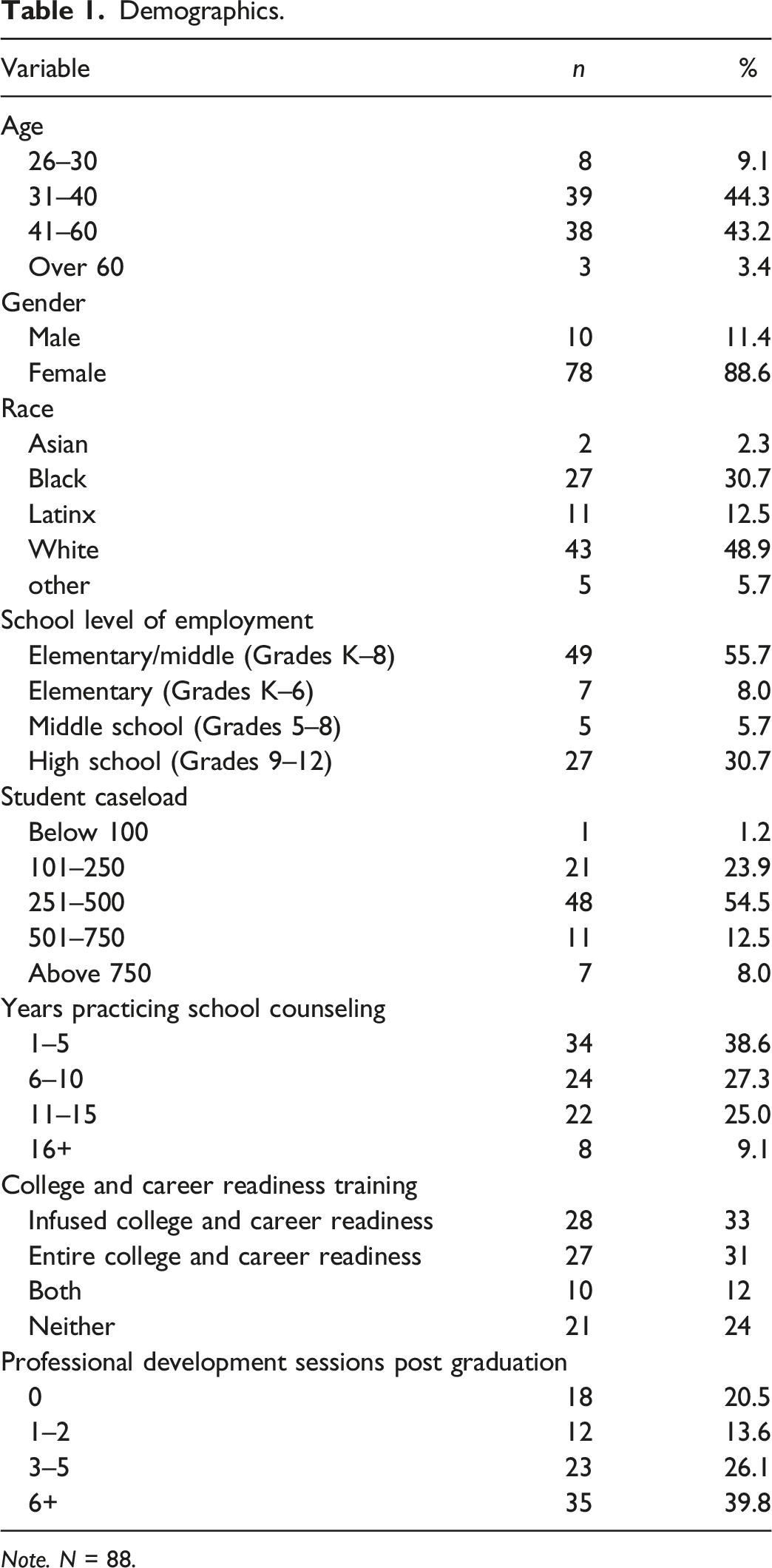
Note. N = 88.
Measures
For this study, we developed a questionnaire including items with specific activities related to NOSCA’s college and career readiness counseling framework (College Board, 2012). The finalized questionnaire was shared with three school counselor educators for their review, addressing the instrument’s content validity. Based on their feedback, we revised certain questionnaire items to enhance clarity. Further, to ensure the questionnaire’s user-friendliness, we asked two practicing school counselors to complete the revised questionnaire and provide feedback. Final edits were made to the questionnaire to enhance readability based on the practicing school counselors’ recommendations.
The questionnaire comprised six parts. The first section consisted of 10 items on demographics (e.g., age, employment status, years in the field). The second, third, and fourth sections used similar college and career readiness components to inquire (a) about the extent to which professional development sessions respondents had previously attended included those college and career readiness components; (b) perceived confidence levels to engage in the components; and (c) how much time school counselors spent on each component. Section 5 addressed barriers that school counselors have experienced when working with students and their families, while the sixth and last section sought participant input on supports that they considered helpful to better engage in college and career readiness activities.
Scales
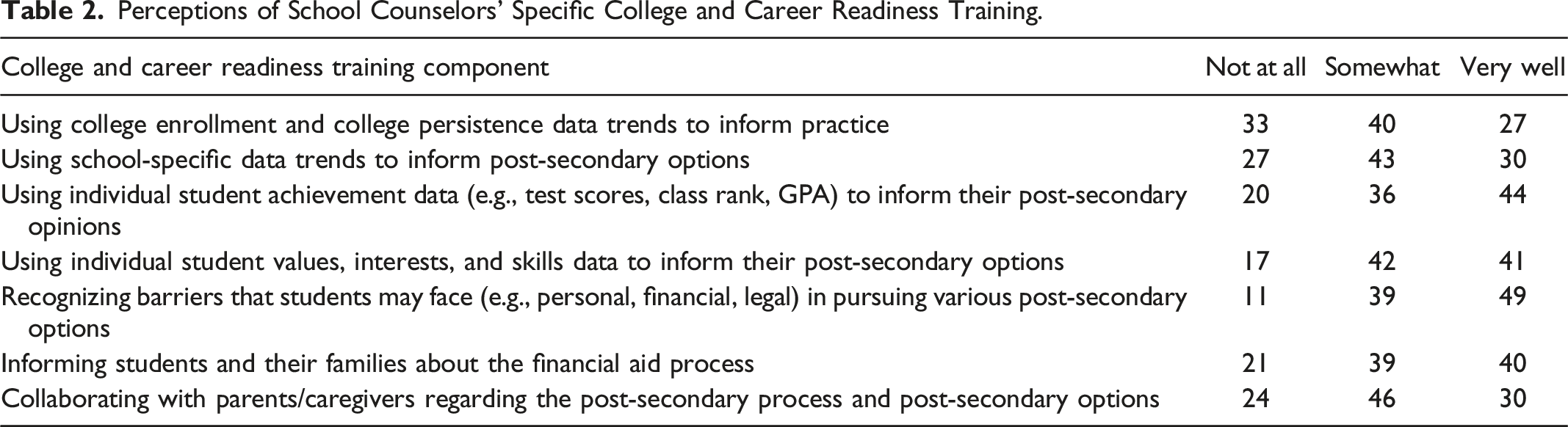
Perceptions of School Counselors’ Specific College and Career Readiness Training.
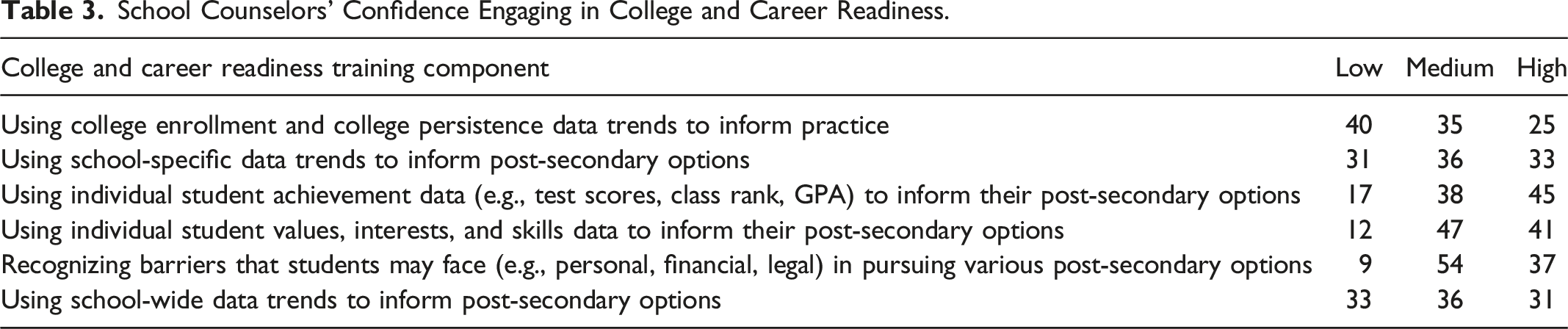
School Counselors’ Confidence Engaging in College and Career Readiness.
Procedures
We first obtained institutional review board approval from both our higher education institution and the school district. The questionnaire was administered through the online platform Qualtrics (https://www.qualtrics.com/) and distributed electronically by the district as a supplement to their biannual school counseling survey. School counselors received a link to our questionnaire and could opt out from completing it. Of the 403 school counselors accessing the survey, 88 completed it in its entirety (61 K–8 and 27 high school [HS] counselors) for a 22% completion rate; this rate is higher than that of prior studies investigating school counselors’ perceptions of their training experiences (e.g., Goodman-Scott, et al., 2022). Questionnaires that were not completed in their entirety were not utilized. The collected data we received had no identifying information.
Data Analysis
We generated descriptive statistics to address the first two research questions. We used analysis of variance (ANOVA) to address the third question, and last, we conducted a stepwise multiple regression analysis to address the fourth question.
Before proceeding with the ANOVA, we tested the homogeneity of variance, especially due to the different sizes of the K–8 and high school groups. Levene’s test of equality of variances was used for both scales, and for individual items. The null hypothesis was rejected in all tests (F confidence = .444, p = .507; F PD = .579, p = .449); therefore, equality of variance was assumed.
To investigate any strong correlations among the predictive variables before running the multiple regression models, we tested for multicollinearity. Specifically, we calculated variance inflation factors (VIF); VIFs were less than 2, well below the threshold of 10 that is used to raise concerns regarding multicollinearity (Field, 2013; O'Brien, 2007; Stevens, 1992).
Results
Descriptive Statistics
Research Question 1
What are school counselors’ perceptions of the professional development they have previously received on specific college and career readiness counseling activities? Reports on how well professional development sessions covered college and career readiness components ranged from 27% to 49%. About a third of respondents reported that the professional development sessions in which they participated covered three components very well: (a) using college enrollment and college persistence data trends to inform practice (27%), (b) school-specific data trends to inform postsecondary options (30%), and (c) collaborating with parents/caregivers regarding the postsecondary options (30%). For the component of informing students and their families about the financial aid process, 40% reported that their sessions covered it very well, while for barriers that students may face in pursuing various postsecondary options, 49% reported that the component was covered very well. When asked about using individual student data to inform postsecondary options, 44% of participants responded that their sessions covered this component very well, and 41% reported that using individual student values, interests, and skills to inform post-secondary options was covered very well (see Table 2).
Research Question 2
What are school counselors’ perceived confidence levels to engage in specific college and career readiness counseling activities? The percentage of participants indicating that they are highly confident engaging in specific college and career readiness activities ranged from 26% to 45%. Specifically, the item receiving the lowest percentage of reported confidence was “using college enrollment and college persistence data trends to inform practice,” while the item “recognizing barriers that students may face in pursuing various post-secondary options” was the highest (see Table 3 for detailed percentages).
Analysis of Variance
Estimated Coefficients of Full Regression Model, Grades K–8.
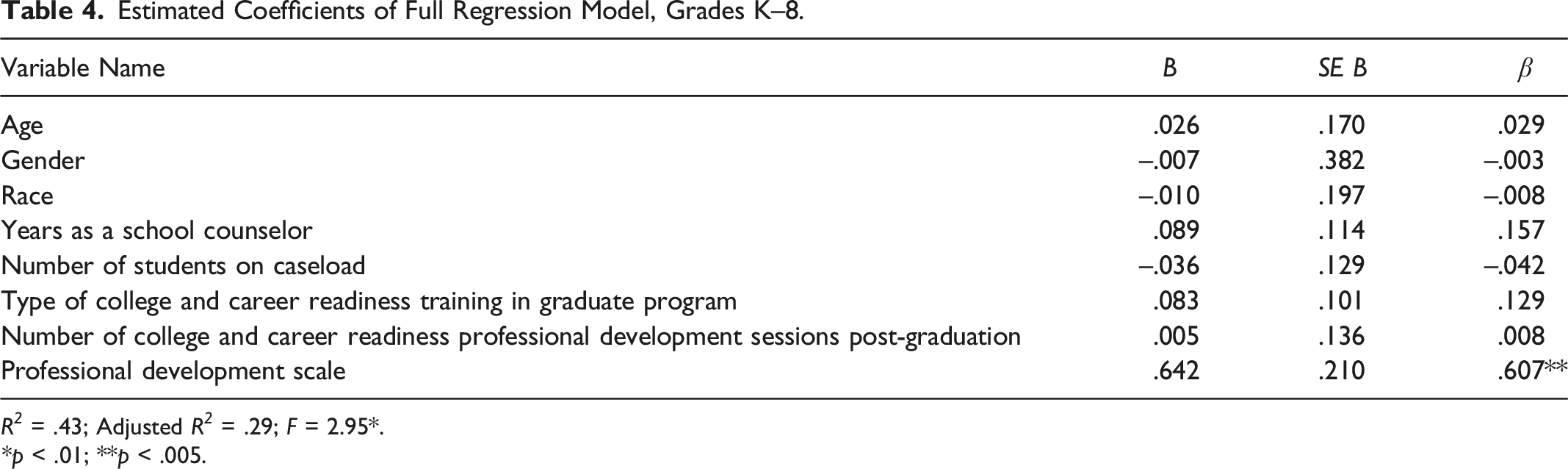
R 2 = .43; Adjusted R 2 = .29; F = 2.95*.
*p < .01; **p < .005.
Multiple Regression Analysis
Research Question 4: Does the number of professional development training school counselors have previously received or the specificity of such training on particular college and career readiness counseling activities predict confidence levels engaging in such activities? Given the differences in responses between K–8 and high school counselors on the PD and the Confidence scales, we ran the full multiple regression model separately for each group. The full model included eight independent variables and accounted for 43% and 79% of the variance in confidence, respectively, for K–8 and high school counselors. The only statistically significant variable (p = .005) in each group was the PD scale (β PDK-8 = .607; β PDHS = .501).
Estimated Coefficients of Full Regression Model, High School.
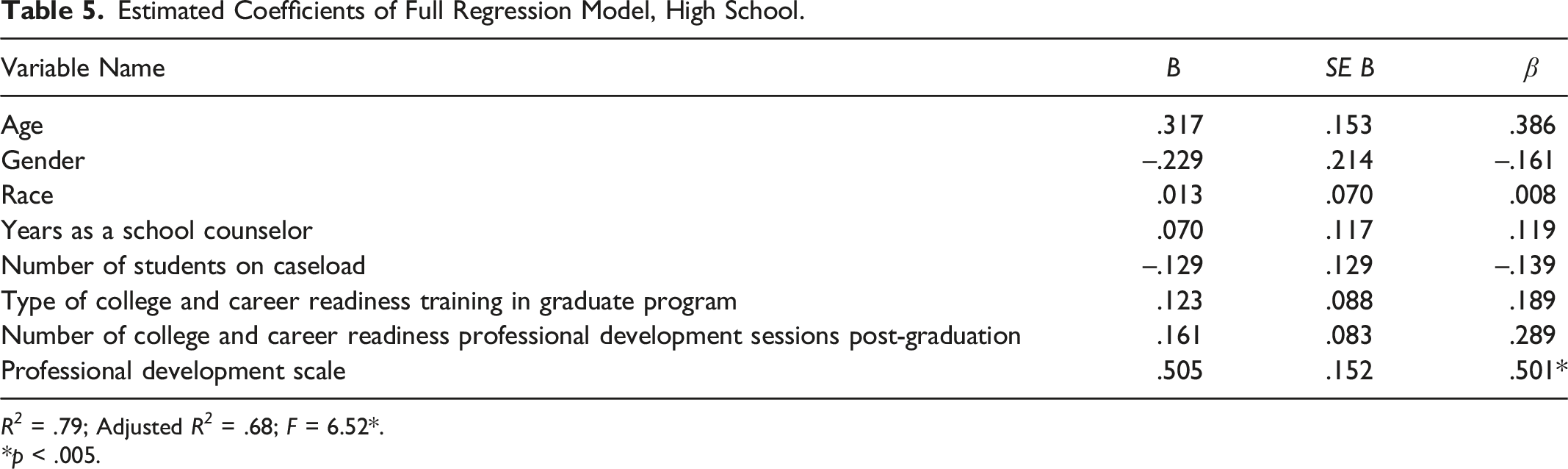
R 2 = .79; Adjusted R 2 = .68; F = 6.52*.
*p < .005.
Discussion
The current study examined school counselors’ professional development training on specific college and career readiness activities, their perceived confidence to conduct these activities, and differences in the responses of elementary and high school practicing school counselors. Overall, less than half of the school counselor respondents reported that their professional development sessions had covered any of the college and career readiness activities in the survey very well. Only a third of the school counselors surveyed indicated that their professional development had covered well the following important college and career readiness components: (a) using college enrollment and college persistence data trends to inform practice, (b) using school-specific data trends to inform postsecondary options, and (c) collaborating with parents/caregivers regarding the postsecondary process and postsecondary options. This finding is supported by Novakovic et al. (2021), who reported that only 18% of those surveyed reported being very well prepared to use data trends to inform practice. Our results also indicated that almost half of participating school counselors were highly confident in using individual student values, interests, and skills data to inform their postsecondary options. Surprisingly, only a quarter of respondents were highly confident in using college enrollment and college persistence data trends to inform practice.
More high school counselors than K–8 counselors in the study reported that their professional development sessions covered college and career readiness components very well and that they felt highly confident when engaging in those activities. However, our findings also indicated that elementary school counselors were very much interested in training sessions that specifically and succinctly address developmentally appropriate, evidence-based college and career readiness activities. Other studies have also highlighted that elementary school counselors displayed a greater openness to evidence-based practice than their high school counterparts (Mullen et al., 2019). Our results also indicated that school counselor confidence in providing college and career readiness counseling was influenced by the focus of professional development training on specific relevant activities and not simply by the number of sessions attended.
Traditionally, school counselors emphasize college and career readiness skills primarily during high school. Despite calls for strategically integrating college and career readiness interventions in K–8 settings (Mariani et al., 2016; Pulliam & Bartek, 2018), such components are not typically prominent in K–8 schools. However, we purport that a critical basis for college and career readiness skills is being built throughout formal schooling, including elementary schools, without being recognized as such. More specifically, SEL programming, which is currently integrated into several districts’ curricula across the United States, focuses on key competencies essential to school and life success. SEL competencies such as self-awareness, self-management, and responsible decision making are necessary for developing an understanding of career interests, values, and skills and making informed career decisions. Because elementary school counselors may perceive this work as belonging only to the social/emotional domain, they are not necessarily making the direct link of these needed skills as being foundational to college and career development. At the same time, high school counselors may not recognize SEL work conducted during the elementary school years as a critical foundational component of college and career readiness, and therefore may not have been capitalizing on the benefits of such prior work.
SEL competencies are also key components of multitiered systems of support (MTSS; Goodman-Scott et al., 2020), thus college and career readiness counseling can also be integrated into the MTSS model early and create continuity and integrity in the implementation of MTSS. A Tier 1 intervention might include classroom lessons on career development-related topics, a Tier 2 intervention could be social skills and communication groups, and a Tier 3 intervention may be individual career counseling sessions (Morningstar et al., 2018). In this way, the problem-solving emphasis of this model can maximize the benefit of college and career readiness for all students, not excluding those who may be encountering academic or behavioral challenges. Thus, the continuity of college and career readiness interventions can be fostered using this preexisting, school-wide structure throughout K–12 schooling.
A second important aspect of successful MTSS integration is family–school partnerships (Betters-Bubon et al., 2019). Such connections between schools and families have been shown to impact social/emotional competence significantly and positively (Smith et al., 2020) across the developmental spectrum, and increase parental support in their children pursuing college and career goals (Horrillo, et al., 2021). However, the results of the present study indicate that only a third of school counselors felt their professional development addressed family engagement in college and career readiness counseling very well. This finding is in accordance with previous studies (Novakovic et al., 2021; Patrikakou et al., 2016).
Another benefit of further enhancing collaboration among school personnel is fostering student college and career readiness through academic subject matters (Turner & Danridge, 2014). Teachers are involved in fostering SEL, especially in K–8 settings. In that context, they can be key allies to school counselors in integrating college and career readiness. For example, elementary school counselors can work with teachers to incorporate assignments such as Turner’s Career Activity, in which students draw themselves “doing their future jobs and share with peers how they will use literacy practices (e.g., reading, writing, speaking, listening) for productive work” (Turner & Danridge, 2014, p. 215). Moreover, school counselors can collaborate with teachers to incorporate culturally normed, evidence-based curricula such as Student Success Skills (Webb et al., 2018) to promote the development of critical foundational SEL and college and career readiness skills. Such joint efforts will help to create a school-wide focus on postsecondary readiness early in students’ educational trajectories.
Our findings indicated that high school counselors were more confident in providing college and career readiness counseling activities than their elementary counterparts, but elementary school counselors’ interest in the component of further training in this area was also noted. As discussed above, college and career readiness counseling should not be viewed, or implemented, in a fragmented way, solely being provided to students in their high school years. Social/emotional and career development learning in elementary grades informs career decisions made in high school. Counselor awareness and intentionality about curriculum across all grades can result in students being better prepared to make important career and educational decisions (ASCA, 2017; College Board, 2012).
Limitations
This study has several limitations that are important to consider when interpreting the results. Inherent in self-report surveys are implicit and social desirability biases and, as such, the credibility of such reports can be subject to various sources of inaccuracy (Paulhus & Vazire, 2007). For example, participants may not accurately recall the content and quality of specific professional development sessions they had previously received. More K–8 than high school counselors fully completed the questionnaire, therefore capturing fewer perspectives of the latter group. Another consideration is that the study was limited to a sample of school counselors within one school district. Although the district is one of the largest and most diverse in the United States, the results may not be generalizable to school counselors in other types of districts such as rural or suburban. Therefore, replicating the present findings in other large school districts, and in districts with different overall characteristics, would further clarify the relationship between specific college and career readiness training and confidence to engage in such activities beginning in K–8 settings. This could include longitudinal research that considers probable changes over time. Qualitative research would also provide the opportunity to further explore school counselors’ perceptions of the efficacy of their college and career readiness training. Finally, because data were collected anonymously, no follow-up questionnaires or interviews were possible with participants of the present study to further examine identified patterns.
Implications for Practice
The results of the present study suggest that more attention needs to be paid to K–8 college and career readiness counseling, both in terms of training and practice. A paradigm shift regarding K–8 college and career readiness counseling training and practice is required to build counselor confidence in integrating the fundamentals of career development into a comprehensive school counseling model, starting early in formal schooling. In this way, school counselors will not only avoid fragmentation of services but will alleviate the added stress that incurs. Indeed, research indicates that school counselors are more likely to engage in college and career development activities when they believe that college and career readiness is important (Anctil et al., 2012; Novakovic et al., 2021).
Preservice Training
Teaching school counseling trainees to understand the theoretical and practical importance of college and career readiness counseling in elementary grades and its relationship to SEL, and helping them gain the tools and skills to provide this counseling, can enable future school counselors to place more focus on this area. Knight (2015) suggested that counselor educators need to put greater emphasis on elementary-level college and career readiness counseling, including providing elementary-level career resources, teaching consultation and collaboration skills around elementary career development, teaching skills for developing and delivering elementary-level evidence-based college and career readiness curricula, and increasing university and elementary school partnerships.
The results from the present study also indicate that school counselors feel the least confident when working with data trends ranging from school-wide to school-specific; this finding is in accordance with previous studies (Novakovic et al., 2021; Young & Kaffenberger, 2018). Given the fact that the overwhelming majority of participants were trained within the past 15 years, well after the development of the ASCA National Model, we were puzzled that school counselors reported being least confident when using data to make college and career readiness-related decisions. More explicit preservice instruction on how to use data for evidence-based decisions and guided opportunities to apply such data in practicum and internship are critical to enhance school counselors’ confidence in this domain.
An explicit, evidence-based approach is also important to highlight the connection between college and career readiness and SEL, making it clearer. For example, in courses including college and career readiness content, such as introduction to school counseling and college and career development courses, a direct link to the five SEL competencies and emphasis on their importance to set the foundation for postsecondary decisions can be instrumental in fostering school counselors’ confidence in using data more purposefully. Another component of this training should be ways to collaborate with families regarding the postsecondary process, an underutilized source of college and career readiness. Incorporating specific postsecondary planning strategies for meaningful parental engagement (including high school choices and course selection) in specific school counseling coursework (e.g., practicum, internship, college, and career readiness courses) would further increase student support in postsecondary decision-making.
In-Service Training
Despite practicing school counselors’ exposure in their preservice training to specific ways to use data trends to inform postsecondary options, their reported confidence to engage in such practice is low. Given the importance of evidence-based decisions, especially during transitions, focused professional development on this critical component of college and career readiness implementation is urgently needed. For example, offering workshops that use actual site- and district-specific data trends and their application to specific student cases would be beneficial. This type of training offers concrete, practical application of data trend use.
Similar to preservice training, professional development should emphasize the link between SEL and college and career readiness and the foundational work to which students are exposed in elementary school. SEL competencies such as self-concept, self-awareness, and decision-making skills are precursors to successful postsecondary planning. These skills serve as the foundation for more specific tasks that occur later in high school, such as college selection based on personal interests and career needs. Specifically, targeted training for K–8 school counselors can build on SEL competencies and provide early career awareness and exploration based on the ASCA Mindsets & Behaviors (American School Counselor Association, 2021; e.g., students’ self-concept, interests, values, skills) and maximize the effectiveness of college and career readiness counseling starting in elementary grades. To further enhance the continuity of services offered to students, developing district-wide programming is also important to allow collaboration among elementary and high school counselors. In particular, using comprehensive developmental school counseling programs could greatly increase the amount of college and career readiness counseling and curriculum conducted in schools and build upon student learning at the elementary level.
Only 30% of study participants reported that their professional development covered very well the best ways to collaborate with families. Collaborating with families, and community partners, remains an underutilized resource. Deliberately working with families can further help students build personal and social skills for career success. School counselors also can collaborate with teachers to involve families in early career development opportunities. For example, school counselors can invite family members to discuss their career paths and engage in a Q&A with students in the classroom. In one such case, a school counselor created the “Great American Teach-In” where 44 members of the community came to classrooms to share their career experiences with students. The school counselor also routinely invited families to a breakfast at school where parents and caregivers highlighted the strengths of their students, helping to foster student resilience and school–family connectedness (Bryan & Henry, 2008). Despite popular belief that by the time children reach adolescence, parental involvement becomes less relevant, research indicates the contrary. Researchers (Patrikakou, 2004; Wang & Sheikh-Khalil, 2014) found that parent influence impacts student expectations and academic outcomes in adolescence, such as graduating from high school, entering postsecondary training, and even subsequent employment.
Implications for Research
To obtain a broader understanding of current trends in K–12 college and career readiness counseling and counselor engagement in related activities, future research could include a national survey of K–12 school counselors on their engagement in college and career readiness counseling and their experience with its continuity across elementary and high school settings. Further, research specifically investigating the impact of K–8 SEL school counseling activities on high school freshman students’ postsecondary planning readiness would provide evidence of the link between SEL interventions at the K–8 level and college and career readiness. Because we were not privy to the specific content of the professional development sessions to which participants were exposed, we cannot evaluate the nature and degree of specific training session impact. To ascertain the impact of specific training, future studies may employ a quasi-experimental design including different variations of college and career readiness sessions.
Conclusion
The results of the present study indicated that not only high school counselors but also K–8 school counselors are interested in engaging in college and career readiness counseling. This can be achieved through existing curricula, specifically on SEL, and through the systemic fostering of collaboration between elementary and high school counselors. Comprehensive K–12 school counseling programs, as elucidated by the ASCA National Model (ASCA, 2019b), can be facilitated by connecting the SEL building blocks of elementary school with college and career readiness activities in high school. If career development is to be recognized as a lifelong process, waiting until high school to engage students and their families in relevant activities is a missed opportunity to support our youth in reaching their fullest potential.
Footnotes
Declaration of Conflicting Interests
The author(s) declared no potential conflicts of interest with respect to the research, authorship, and/or publication of this article.
Funding
The author(s) received no financial support for the research, authorship, and/or publication of this article.
