



Abstract
The concept of meaning plays a central role in major conceptualizations of the stress process, yet it remains underanalyzed by sociologists. In this article, the author proposes a series of research questions that place meaning construction at the center of the stress process. The questions are motivated by a review of limitations of prior approaches to analyzing meaning: appraisals, narrative ratings, social context, and respondents’ personal meanings. These approaches use meaning to improve the prediction of stress outcomes but neglect their social origins. Two new lines of research on meaning are proposed to address this limitation: the structural and cultural origins of meaning and the process of meaning negotiation. These lines of research broaden the view of the “social” in social stress research and allow a more comprehensive understanding of the processes through which social arrangements affect personal distress.
Since its introduction 30 years ago (Pearlin et al. 1981), the stress process model has dominated sociological research on the origins of mental health and mental illness. Its dominance reflects its flexibility and embracement of complexity (Wheaton 2010). Over time, the model has broadened to incorporate a more differentiated understanding of each of its major components: the social context, stressors, resources, and outcomes. This differentiation has invited contributions from sociologists with diverse substantive interests, including communities, family, and work, who have applied the model to a wide range of life circumstances. The incorporation of life-course principles has produced increasingly sophisticated analyses of the socially structured nature of life change and of the contribution of persistent and cumulative stress to the social distribution of well-being (Elder, George, and Shanahan 1996; Pearlin et al. 2005). Each expansion of the model has opened up new questions for investigation, thereby ensuring the model’s influence for many years to come.
Even as the conceptualization of the stress process has become more differentiated, most sociological applications have retained a narrow focus on its objective characteristics. These applications emphasize a structural over a cultural conceptualization of social arrangements—in Wallace’s (1983) terms, “social structure” (patterns of interaction, interdependence, and inequality) over “culture structure” (shared meanings). These applications analyze variation in responses to stressors, especially as predicted by social and personal resources, and/or the extent to which objective stress exposures and vulnerabilities account for the social patterning of distress. Although worthy in their own right, these analyses neglect equally important questions about the social origins of meaning, specifically, how the meanings of stressful experiences are constructed over time in response to structural and cultural constraints and how they are negotiated in interpersonal interaction. These questions derive from basic symbolic interactionist principles that complement structuralist conceptualizations: (1) people act toward things on the basis of the meanings those things have for them, (2) meanings arise through interaction between people, and (3) people use meanings to communicate with themselves and others and as guides for action and interaction (Stryker and Vryan 2003). Incorporating these principles into studies of the stress process suggests questions that have not been asked or answered adequately.
To assert the importance of meaning to the stress process is neither new nor unique. All major conceptualizations of the stress process, including Pearlin’s, acknowledge that responses to stressors depend on their meanings to the person (e.g., Lazarus and Folkman 1984; Park and Folkman 1997; Pearlin 1989; Thoits 1995b). Yet despite scattered studies that analyze how the meanings of stressors modify their effects on outcomes, stress researchers (especially in sociology) have not fully incorporated the concept into their research. To most investigators, meaning is useful primarily to the extent that it improves predictive power. In contrast, the questions I pose about meaning construction take meaning itself as an object of investigation. Drawing on symbolic interactionist principles, these questions assume that meaning is a social product, shaped by broad structural and cultural constraints as well as by the structure and content of proximate interpersonal interactions. They bridge sociological and psychological approaches to stress research and have the potential to deepen our understanding of the social origins of distress.
To motivate and support the proposed questions, I first review the stress process model itself, in particular how it has been applied by sociologists. I identify potential contributions of integrating the analysis of meaning construction into these applications. I then review prior approaches to analyzing meaning and discuss how a shift in orientation toward analyzing meaning construction could yield an even richer understanding of the stress process. I close by identifying research questions that extend the traditional structural approach in potentially fruitful directions.
The Stress Process Model
Pearlin’s stress process model (Pearlin 1999; Wheaton 2010) begins by locating stressors in their broader social context: the structural positions, statuses, and roles that shape exposure and response. Stressors come in many different forms, including major life events, chronic strains, daily hassles, and traumas. The effects of stressors on outcomes depend on the extent to which stressors proliferate as well as on social and personal resources to which people have access, including social support and the self-concept. These moderating resources may themselves be affected by stressors, as when a job loss diminishes one’s access to supportive social relations, and may therefore mediate as well as moderate stressors’ effects. 1
This model has motivated two major lines of sociological research. In the first, researchers use the stress process framework to analyze the process through which people respond to challenging life circumstances. For example, Aneshensel et al. (1995) used the stress process framework to conceptualize the experiences of family members caring for a person with Alzheimer’s disease. The questions they asked centered on the stress process itself: Given the presence of a stressor (caregiving), what processes determine its outcomes? Stress proliferation, stress containment, social support, and mastery were among the experiences and resources that predicted variation in physical and mental health in their sample. Other scholars have evaluated variation in the association of summated measures of stressors with outcomes based on these same factors (see Thoits 1995b for a review). Although different in the specifics, these studies share an interest in what distinguishes people who adapt successfully to stressors from those who do not.
In the second line of research, researchers use the components of the stress process model to analyze the social origins of distress. For example, Turner, Wheaton, and Lloyd (1995) evaluated the extent to which group differences in depression were attributable to group differences in stress exposures. Similarly, Williams et al. (1997) evaluated the extent to which race differences in health were attributable to race differences in exposure to discrimination. The questions these researchers asked included the following: Do stress exposure and access to social and personal resources vary on the basis of important social statuses, such as race, socioeconomic position, and gender? Do these variations explain group differences in distress? In this line of research, the focus is less on the stress process itself and more on its components as proximate manifestations of stratification.
Both lines of research would be advanced by integrating an explicit analysis of meaning. A central tenet of psychological and sociological stress research is that the effects of stressors on outcomes depend on their meanings to the person (Lazarus and Folkman 1984; Pearlin 1989). This tenet implies that the resources and actions that modify stressors’ effects (e.g., social support and coping) do so in part by altering meanings (Thoits 1995b). It further suggests that (1) we cannot understand how the stress process operates without taking meaning into account and that (2) social arrangements may produce distress not only by influencing objective life circumstances but also by influencing how those circumstances are interpreted. Dominant approaches to analyzing meaning in the stress process do not give systematic attention to either.
Meaning in the Stress Process
The concept of meaning has multiple definitions in stress research. Some scholars define meaning with reference to specific dimensions of appraisals, for instance, novelty, pleasantness, relevance to goals or motives, conduciveness to goal accomplishment, certainty of effects, responsibility, and controllability (Ellsworth and Scherer 2003). Other scholars define meaning with reference to “core relational themes” such as other-blame, self-blame, threat or danger, and loss (Smith and Lazarus 1993). Park and Folkman (1997) presented a broader definition, “perceptions of significance” (p. 116), which encompasses global meaning, “a person’s enduring beliefs and valued goals,” and situational meaning, “the meaning that is formed in the interaction of a person’s global meaning and the circumstances of a particular person-environment transaction.” I adopt this broader definition here, consistent with Thoits’s (1995b) usage.
Stress researchers typically incorporate meaning into analyses to better predict variation in outcomes. I evaluate the relative strengths and weaknesses of traditional approaches to analyzing meaning and also suggest a more fundamental limitation in prior research: By using meaning to predict variation in outcomes, it has ignored the process of meaning construction itself.
Prior Approaches to Analyzing Meaning 2
Stress researchers have taken four main approaches to analyzing the role of meaning, two direct and two indirect. The most direct approach to analyzing meaning involves asking respondents to report stress appraisals and using those appraisals to predict coping responses and outcomes (e.g., Folkman et al. 1996). Measures of stress appraisals are based on questions about the extent to which respondents experience their lives as uncontrollable, overwhelming, and the like (as in the Perceived Stress Scale; Cohen, Kamarck, and Mermelstein 1983) or questions about the extent to which specific events or conditions are experienced as undesirable, serious, and so on (as in Sarason, Johnson, and Siegel’s [1978] Life Experiences Survey). The same set of appraisals can be solicited at multiple points in time, offering insight into how the meanings of specific events or conditions change, and appraisals can then be used to predict outcomes. Appraisal measures privilege respondents’ personal assessments, which is both a strength and a limitation. Direct reports come closest to tapping the personal significance of the experience but are also confounded operationally with outcomes. For that reason, critics charge that appraisal ratings provide a weak basis for causal inference (see the review by Monroe and Kelley 1995). 3
A second direct approach involves narrative ratings. The best-known examples are Brown and Harris’s (1978) Life Events and Difficulties Schedule (LEDS) and Dohrenwend’s Structured Events Probe and Narrative Rating Method (SEPRATE; Dohrenwend et al. 1993). In each case, detailed descriptions or narratives of life events are elicited from respondents and are then used by trained raters to assess the meanings of the events. The two rating strategies differ in several specific ways: The LEDS evaluates events within the individual’s biographical and social context whereas the SEPRATE emphasizes the immediate circumstances surrounding the event, and the LEDS focuses especially on the long-term threat posed by an event whereas the SEPRATE focuses on fatefulness and centrality (Dohrenwend 2000). For present purposes, their similarities are as important: They elicit in-depth narratives of respondents’ specific life experiences and they use those narratives as the basis for assigning standardized ratings of the meaning of the experience. In both cases, respondents’ responses are explicitly excluded from consideration in the ratings, alleviating concerns about confounding. Although a strength from the perspective of causal inference, by excluding respondents’ interpretations from the ratings, narrative rating approaches assume that we can infer the meanings of life experiences exclusively from the surrounding circumstances. As Becker (1998) noted, “the danger is that we will guess wrong, that what looks reasonable to us will not be what looked reasonable to them” (p. 14).
Indirect approaches to analyzing meaning involve an additional level of inference. The first indirect strategy uses characteristics of the social context to infer the meanings of stressors for respondents. Wheaton’s (1990) analysis of variation in response to life events on the basis of their placement in sequences of life experiences is an example. He observed that role strains sometimes dampen the effects of role-related transitions on distress and inferred that the transitions represented a relief from prior stress rather than the introduction of a new form of stress. By contextualizing stressors within sequences of objective life experiences, Wheaton avoided the confounding of meaning with outcomes. At the same time, the limited information on which inferences about meaning were made weakened them.
The second indirect approach evaluates variation in the associations of stressors with outcomes on the basis of respondents’ personal meanings as represented by identities, beliefs, and values. For example, in a series of analyses, Thoits (1991, 1995a) tested the hypothesis that stressors that are identity-relevant—that involve losses of, damages to, or threats to highly valued identities—are more psychologically harmful than comparable stressors involving less valued identities. She observed that, contrary to the hypothesis, identity-relevant stressors were not always more consequential than other stressors for mental health. Her in-depth analyses of qualitative interview data revealed that identity relevance alone was insufficient to characterize the meaning of a stressor; personal biographies and situational circumstances altered the meanings of events and their identity relevance (Thoits 1995a). To grapple with these complexities, she urged researchers to adopt measurement strategies that take contextual meanings into account more fully. (See Bierman 2010 and Simon 1995, 1996, 1997 for other examples of research involving beliefs and values.)
Analyzing meaning to improve the prediction of stress outcomes is a useful application of the concept but also a limited one. Studies using appraisals incorporate direct measures of meaning into models of the stress process but remove appraisals from the social contexts in which they are developed. Studies using narrative ratings or that consider identities, beliefs, and values assume meanings without measuring them. None of these approaches analyzes the social origins of meanings. To the extent that meanings alter the effects of stressors, their social origins are an important potential path through which social conditions affect distress.
The questions I pose concern these origins. They derive from a fundamentally different approach that views meaning construction as a central dynamic in the stress process. In this approach, meaning construction is an ongoing process by which people construe the significance of an event or condition for themselves or others. It builds on Park and Folkman’s (1997) definition of meaning as “perceptions of significance” to emphasize the dynamic and interactional process through which perceptions are constructed. This approach takes analyses in a new direction by encouraging analyses of the process of meaning construction itself. Its bold, and perhaps most controversial, assumption is that everything that is represented by the components of the stress process—the social context, stressors, resources, and outcomes—can be conceived of as part of a more general, continual process by which people construct the meanings of life conditions in interaction with others.
New Lines of Research on Meaning
Figure 1 presents a very simplified version of the stress process model that links the social contexts in which people are embedded to stress exposures and the availability of resources. These exposures and resources independently and interactively affect outcomes. Figure 2 presents an expanded version of the stress process model that disaggregates the objective (i.e., material) and subjective (i.e., symbolic) properties of the model’s major components and adds meaning negotiation as a process that links macro-social contexts, objective life stressors, and material and social resources to macro-cultural contexts, subjective life circumstances, personal meanings (beliefs, values, and self), and outcomes. Both models parallel the social structure and personality framework in sociological social psychology, which traces the effects of macro-structures and processes on personal outcomes through experiences in proximate environments (McLeod and Lively 2003).
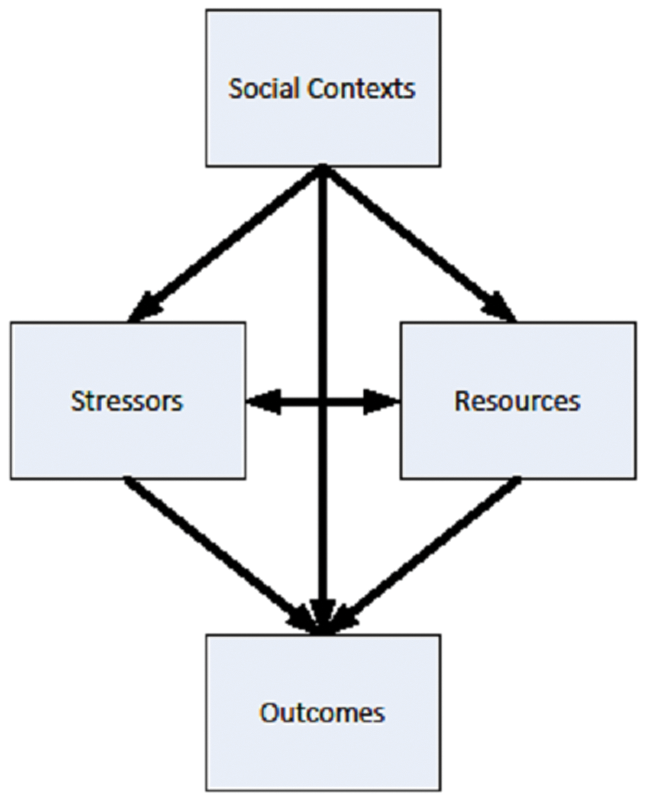
A Simplified Model of the Stress Process
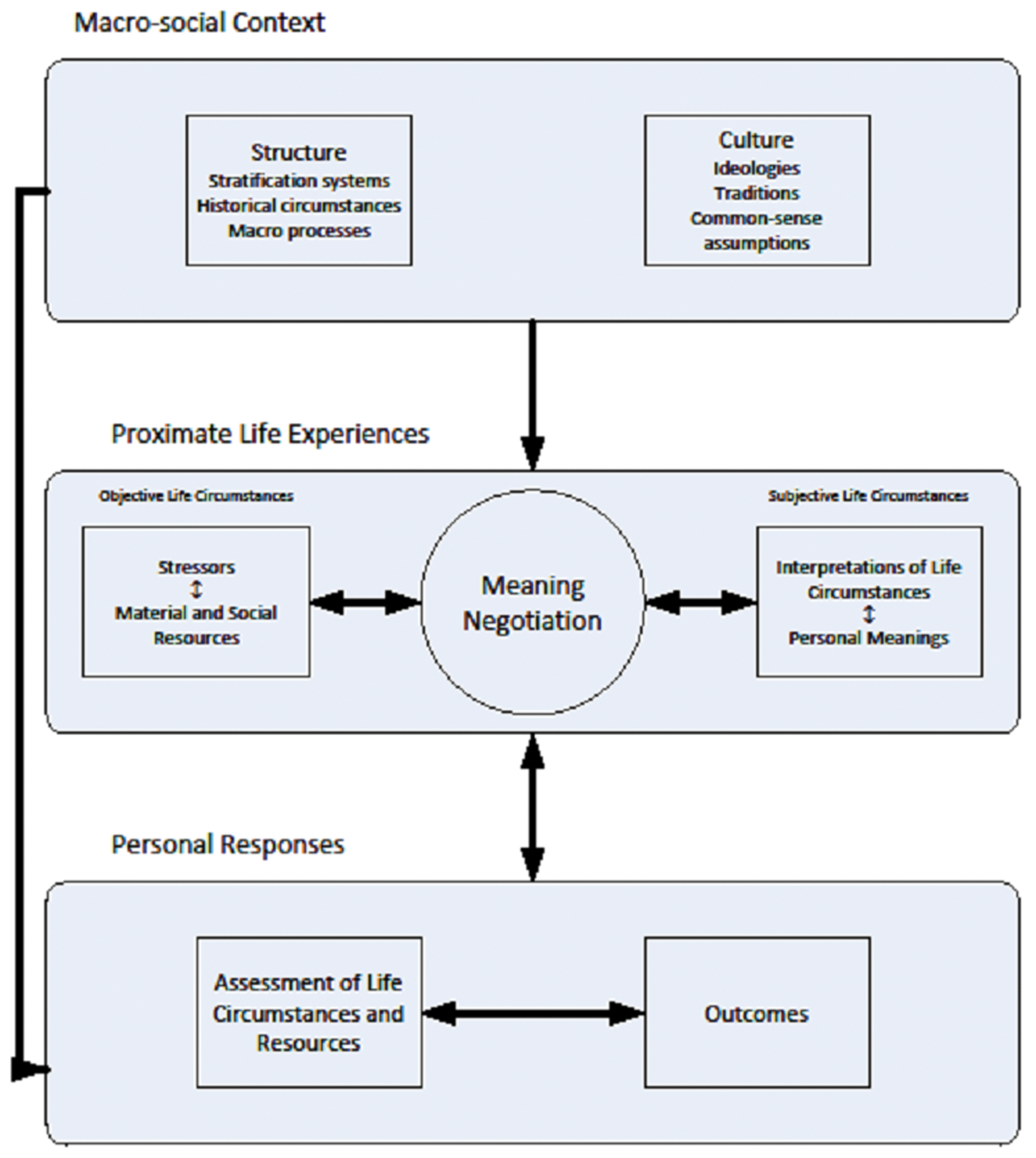
An Expanded Model of the Stress Process
In the expanded model, the macro-social context encompasses structures—stratification systems, historical circumstances, and other macro-social processes such as capitalism and deindustrialization—as well as cultures—ideologies, traditions, and commonsense assumptions (what Wallace 1983 called “social structure” and “culture structure,” respectively). The macro-social context shapes the structure and content of proximate environmental experiences. These experiences have both objective and subjective properties. With respect to objective properties, the structure and content of proximate environments influence exposure to stressors (e.g., job conditions, financial difficulties, family conflict), as well as the material and social resources to which people have access (e.g., income, social capital). With respect to subjective properties, proximate environments influence subjective interpretations of objective life circumstances (e.g., as threatening, unpleasant) as well as personal meanings, such as beliefs and values (e.g., perceived emotional support, or the belief that love, sympathy, and esteem are available from significant others [Thoits 1995b], and mastery, or the belief that one is in control of forces that significantly affect one’s life [Pearlin and Schooler 1978]).
Proximate environments are also the sites for interpersonal interactions that bring people together in specific contexts. The central circle, for meaning negotiation, represents the process that occurs when the objective life circumstances and subjective interpretations of these multiple people meet. In this process, the interpretations and personal meanings of the focal respondent confront the objective circumstances and meanings held by others to yield the respondent’s personal assessment of stressors and resources. Although assessments are held by individual persons, they are constructed meanings that derive from a process of negotiation. As in more traditional stress process models, these assessments, in turn, influence how people respond to stressors and, ultimately, the outcomes of the process.
Most sociological research emphasizes the objective social origins of distress: how structural arrangements produce variation in exposure to stressors and access to resources and, thereby, variation in outcomes. The underlying dynamic in this approach is the differential distribution of human and social resources. The elaborated model introduces a complementary dynamic—meaning construction—that emphasizes the subjective social origins of distress: how structural arrangements and cultural beliefs produce variation in subjective interpretations and personal meanings which become the basis for negotiations over the meaning of life circumstances, people’s responses to those circumstances, and outcomes.
I draw on the model to propose two sets of research questions on meaning construction that emphasize concerns sociologists are uniquely equipped to address: the structural and cultural origins of meaning and the negotiation of meaning in interpersonal interaction.
The Structural and Cultural Origins of Meaning
Social stress researchers have been centrally concerned with how structural locations influence objective life circumstances and resources for managing them, that is, stress exposure and vulnerability (e.g., Turner and Avison 2003; Turner et al. 1995). Studies of stress exposure and vulnerability typically calculate summated measures of stress exposure on the basis of standardized items and use these measures to evaluate the extent to which (1) groups differ in stress exposures, (2) stress exposures explain group differences in distress, and (3) groups differ in vulnerability to stress (i.e., group membership and stress exposure interact when predicting distress). These studies rely on the assumption that standardized items mean the same things to members of different groups. That assumption is reasonable for more objective items, such as “there was a marital separation or divorce,” but is untenable for less objective items, such as “you have a lot of conflict with your partner.” 4 Indeed, narrative rating approaches rely on a very different assumption: that the meanings of stressors are shaped by the broader context. Stress research provides strong evidence that the same objective circumstance can represent a different subjective circumstance to different people (e.g., Dohrenwend 2006). However, stress researchers have not systematically investigated whether and why meanings vary systematically on the basis of social location, cultural ideologies, or historical circumstance—broadly, “macro” factors (see Picou and Hudson 2010 for an exception). 5
Social positions, such as those indexed by race/ethnicity, social class, and gender, represent statuses in stratification hierarchies that determine the quality of our lives and the resources to which we have access: a bedrock assumption of research on differential exposure to stress. Yet social locations are also standpoints: positions from which people view the world and construct meaning (Harding 2004). Both because of their associations with objective life conditions and because of their statuses as standpoints, social positions also shape the meanings of life experiences.
Systematic differences in the interpretations of objective life circumstances can be analyzed from a narrow methodological perspective concerned with reporting errors. Prior research has established that checklists of stressors sometimes miss reports of relevant life experiences and elicit reports of things the investigator did not intend. Respondents may overreport to please the interviewer (“I thought I would seem boring if I didn’t say anything”) or underreport because they did not perceive the experience as stressful and therefore saw it as falling outside of the inferred goals of the study (Monroe 2008). If reporting errors were random, we would have imprecise but unbiased estimates of group differences in stress exposure and in the effects of stressors on outcomes. However, given that the accuracy of reports is influenced by respondents’ understandings of the task at hand, their general knowledge and beliefs about life stress, and the success of their efforts to resolve problems, it seems likely that reporting errors will vary systematically (Schwarz 2007). If reporting errors do vary systematically, we cannot interpret group differences in reports of stressors as evidence of group differences in stress exposure, and our conclusions about the social correlates of stress exposure may be flawed.
Differences in the interpretation of objective life circumstances can also be analyzed more broadly with reference to the role of social structure and culture in the stress process. Simon’s (1995, 1996, 1997) research on gender differences in distress demonstrates clearly that social positions and their associated ideologies systematically influence how life circumstances are interpreted and the significance they have for individual people. She found that employed married mothers reported higher levels of distress than employed married fathers. Their higher levels of distress were partly attributable to objective differences in life circumstances: Employed married mothers had greater responsibilities for housework and child care (Bianchi, Robinson, and Milkie 2006). However, their higher levels of distress also were attributable to a greater perception of conflict between the roles of parent and worker than experienced by employed fathers (Simon 1995, 1997). Families are supposed to be mothers’ first priorities (Blair-Loy 2001; Hays 1996), which makes work-related intrusions into family life especially distressing to women.
Although Simon did not ask her respondents directly about specific dimensions of appraisals such “harm,” “threat,” and “challenge,” their narratives invoked those appraisals. For instance, one employed mother felt guilty about the harm her employment caused her children: “[I wonder] who’s suffering. Am I spending enough time with my kids? Am I doing the right thing? Would my kids be better off with less of a lifestyle, less of a neighborhood, and more time with me?” (Simon 1996:34). Another noted threats to her identity as a good homemaker that result from gendered expectations: “If someone comes to your house and it doesn’t look tidy, they don’t say ‘gosh, your husband’s not a very good housekeeper’” (Simon 1995:186). Simon’s research established that there are gender differences in the meanings of specific role configurations that derive from broad cultural ideologies. These meanings contribute to gender differences in the assessment of objective life circumstances and, in turn, to gender differences in distress. Notably, a traditional analysis that evaluated the interaction between gender and employment when predicting distress could have told us that employment is more distressing to women than men but could not have told us why.
Ideologies influence interpretations of objective life circumstances even when they are not aligned with social positions. For example, Bierman (2010) found that negative treatment by adult children had a much stronger association with anger for respondents who held an orthodox moral cosmology. An orthodox moral cosmology involves the beliefs that God is the ultimate arbiter of what is right and wrong, that the word of God as revealed in sacred texts is inerrant, and that God is an active presence in people’s day-to-day lives (Starks and Robinson 2009). An orthodox moral cosmology supports the interpretation that children’s negative behavior is transgressive and therefore worthy of anger. In circumstances in which people who hold more modern moral cosmologies (i.e., who believe that people are the ultimate judges of right and wrong and that morality is an open, evolving quest) do not experience children’s negative treatment as stressful, people who hold orthodox moral cosmologies do.
These examples demonstrate that people’s interpretations of objective life circumstances depend on their social locations and on broad social ideologies. Although traditional approaches to studying stress exposure and vulnerability attribute group differences in distress to group differences in objective stressors and resources, respectively (e.g., Kessler 1979; McLeod and Kessler 1990; Turner et al. 1995), ideologies, beliefs, and values offer an alternative explanation (Pearlin 1991). Women view their lives as more stressful not only because their objective circumstances differ from those of men’s but also because dominant ideologies define their circumstances as more conflicted. People who hold an orthodox moral cosmology experience their children’s negative treatment as more stressful not necessarily because their children behave more negatively than other children but because children’s negative behavior conflicts with their parents’ cosmology. Research by Simon and Bierman provides clear evidence that people draw on dominant ideologies to make sense of their experiences and that ideologies place constraints on the alternative meanings people are able to construct. Studies that fail to take meaning into account miss an important pathway through which social arrangements affect personal well-being.
Following from these examples, I propose three research questions about the social origins of meaning that complement traditional studies of the social distribution of stressors and resources.
How do interpretations of objective life circumstances vary by important social locations? This question links macro-structural conditions directly to subjective interpretations. One might ask, for example, whether appraisals of objectively equivalent events (e.g., job loss) or conditions (e.g. unemployment) differ systematically by race, class, gender, and parental status or whether there are systematic differences in the narrative accounts people from different population subgroups give for the same event.
How do people draw on ideologies, traditions, and commonsense assumptions to make sense of their objective life circumstances? This question links macro-cultural factors to subjective interpretations. An example of a specific question that follows from this is, Do appraisals of objectively equivalent events (e.g., divorce) or conditions (e.g., marital strain) differ systematically across cultures or on the basis of religious ideologies? Alternatively, one might ask whether people from different religious groups or who affirm different religious ideologies present different themes in narrative accounts of the same life circumstance.
Under what conditions are people able to resist ideologies, traditions, and commonsense assumptions in favor of more salutary interpretations of their life circumstances? This question allows for the possibility that people do not always accept dominant interpretations of their life circumstances and, instead, develop alternative interpretations that allow them to construct positive meanings. Along these lines, Kroska (1997) observed that men whose wives were employed sometimes trivialized their wives’ work or represented it as their gift to their wives to maintain congruence between their gender ideologies and their role arrangements. These more salutary meaning constructions helped men maintain a positive sense of self in the face of a potentially threatening circumstance. Following from Kroska’s analysis, we might also ask, Under what conditions are people able to resist dominant ideologies? For example, given the gendered nature of power, it seems likely that men would be better able than women to develop salutary interpretations for women’s employment.
As these examples suggest, empirical analyses of the structural and cultural origins of meaning could draw on survey-based quantitative approaches but could also be extended with qualitative methodologies. Using survey methodologies, researchers could evaluate differences in standardized stress appraisals on the basis of social location, cultural origin, and other macro-structural variables. This line of research could take the additional step of estimating the extent to which differences in appraisals are attributable to differences in personal meanings: identities, beliefs, and values. A less traditional line of research would apply qualitative methods to exploring how people draw on their social locations and cultural origins to make sense of life experiences by asking them to provide narrative accounts of those experiences (Orbuch 1997) and then extracting themes from those accounts. Either line of research could consider broad sets of stressors (e.g., on the basis of checklists) or could focus on specific life conditions, such as a diagnosis of cancer or work-family conflict. Analyzing the conditions under which people accept or reject dominant interpretations for their life circumstances, and their strategies of accommodation and resistance, would add depth to our understanding of how people cope with stressors (Park and Folkman 1997).
In sum, studies of stress exposure and vulnerability demonstrate that social structural conditions influence the degree to which people experience potentially stressful life conditions and, in turn, the degree to which group differences in stress exposures and vulnerabilities explain group differences in distress. A complementary approach evaluates the extent to which cultural and structural conditions influence people’s interpretations of objective life circumstances systematically, the structural and cultural origins of those interpretations, and people’s efforts to resist dominant interpretations in favor of more salutary meanings. By so doing, studies of the social origins of meaning have great potential to enrich models of the processes through which social arrangements produce distress.
The Process of Meaning Negotiation
Personal life experiences have implications that extend beyond the people who are most directly affected. Family members, friends, colleagues, and acquaintances are affected by the events and conditions of our focal respondents and the meanings of those events and conditions are negotiated with these referent others. The involvement of other people in the stress process is typically conceptualized as social support or coping assistance. Studies of social support have revealed that the belief that one is loved and cared for is an important buffer against the negative effects of stressors on physical and mental health (see Thoits 1995b for a review). In recent years, psychologists have given sustained attention to the collective nature of coping in studies of dyadic coping. Those studies focus on strategies couples use to cope with common stressors such as a spouse’s illness (Cutrona and Gardner 2006; O’Brien and DeLongis 1997; Revenson, Kayser, and Bodenmann 2005). Studies of dyadic coping ask questions about which spouse is most likely to offer specific forms of coping assistance and how specific forms of dyadic coping affect marital and personal outcomes.
Taking these lines of research as a starting point, we can broaden our focus beyond the dyad to other social groupings and look beyond social support and coping assistance to meaning negotiation as a process that links macro-conditions to the outcomes of the stress process. Although meaning negotiation is a more abstract concept than social support or coping, it has several analytical advantages: It attunes us to the interactional basis of the stress process, it encompasses real as well as imagined interactions with referent others (McLeod and Lively 2007), it offers a way to understand how people other than close family and friends influence the stress process, and it allows for the possibility of disagreements as well as agreements in interpretation.
The negotiations of relevance to stress researchers occur across multiple levels of analysis and may involve communities, formal groups, and dyadic interactions involving professionals, family members, and friends. When collective events occur—disasters or tragedies that affect large groups of people simultaneously—entire communities negotiate interpretations for those events. Conflicts over the interpretation are sources of stress for community members. For example, following the Exxon Valdez oil spill, community members differed in the extent to which they held Exxon responsible for the disaster and in whether they were willing to accept employment opportunities associated with the cleanup; those who were willing and able to accept those opportunities were identified as “Exxon whores” and “spillionaires” by those who were not (Gill and Picou 1998). This interpretational rift led to what Gill and Picou (1998) called a “corrosive community,” “a deterioration of social relationships, resulting from fear, anger, apprehension, confusion, conflict, and stress that characterize a social milieu of uncertainty” (p. 797). In this case, the conflict over how to interpret the disaster generated secondary stressors, diminished perceptions of social support, and hampered individual coping efforts. Although conducted outside of the stress process framework, this study illustrates that analyzing negotiations over the meaning of life circumstances can offer insight into how the stress process operates beyond that offered by a traditional analyses of stress proliferation and stress buffering.
Collective interpretations become relevant to personal events as well. For example, Kaiser (2008) observed that many women who completed treatment for breast cancer experienced distress when confronted with the survivor identity. This identity dominates current discourse and is promoted by physicians and advocacy organizations. The distress that women experienced was especially pronounced when their personal experiences did not match the implications of the survivor label, for example, when they were concerned about recurrence or felt that they had not been close enough to death to interpret their recovery as survival. For these women, the interpretation that physicians presented compounded self-blame and uncertainty, and diminished perceptions of provider support, especially because providers’ authority gave them disproportionate influence over the meaning negotiation process. A traditional analysis of social support and coping might have revealed that some breast cancer survivors did not feel supported by their physicians or found it difficult to construct a salutary meaning but would not have identified conflicts over meaning as the reason.
Meaning negotiation also occurs in formal groups and has implications for coping and outcomes (Pearlin and Schooler 1978). Francis (1997) observed that members of support groups for widowers worked together to change the meanings of their losses to maintain more positive identities. Widowers who came to the group believing that they had “failed their spouse” were encouraged to reframe the event as “spouse left you.” Group leaders built on this more positive definition to encourage members to see themselves as “survivors,” an identity that was positive, strong, and active. The support that group members perceived came, in part, from this shared, reconstructed identity. Group attempts to reframe meaning are not always as successful as this, however. For example, Garrett-Peters’s (2009) study of support groups for unemployed workers revealed that workers collaboratively constructed new, salutary meanings of their unemployment. For example, support group leaders discussed the importance of treating unemployment as a full-time job (“employed full-time to find a job”; p. 555), a framing that group members then advocated among themselves. However, some group members recounted times when the positive meanings promoted by the support group did not match the emotional realities of their experiences and were therefore experienced as unsupportive. Here, too, the success or failure of negotiations over the meaning of a life circumstance influenced whether the event was experienced as stressful and perceptions of support in ways that would not be captured by analyses that simply measure objective life events and levels of support.
Friends and family members also participate in the negotiation of meaning surrounding life experiences. Milkie (2010) identified negotiations over “whose problem is it?” as central components of the stress process in families. In some families, stressors such as the health problems of an elderly relative are “given” to one member to manage, whereas in other families problems are seen as the responsibility of the full group. Other types of negotiation within families over how serious or threatening a problem is, who is to blame, and how it would best be addressed can complicate the coping efforts of individual members. For instance, women often experience social pressures to minimize their perceptions of the severity of health problems so that they can resume their caregiving responsibilities (Benyamini 2009). More generally, research on failed support attempts confirms that disjunctions in meaning may be damaging to the person. For example, people who suggest that bereaved parents should not grieve because they can have another child are offering an interpretation that is inconsistent with most parents’ perceptions of the event as serious and threatening (Lehman, Ellard, and Wortman 1986; Wortman and Lehman 1985).
In sum, our personal interpretations of life experiences are subject to sustained scrutiny and evaluation by others. Even when we are alone, we check our interpretations against the imagined interpretations of others: What would other people think about this? How would they judge its importance? Meaning negotiation is an overarching concept that transcends the sometimes artificial distinctions between coping and support on which we have come to rely and redirects our efforts to the analysis of process. Although scholars have acknowledged the network basis of meaning negotiation, empirical research has yet to embrace an interactional perspective on how appraisal, coping, and adjustment occur in relation to other people, especially over time (Berg and Upchurch 2007).
These points suggest two general questions about how other people’s responses shape the stress process.
Who participates in meaning negotiations? This question directs us to consider which other people and/or groups in the respondent’s proximate environments become involved in negotiations over the meaning of specific life circumstances. These people and groups could become involved in those negotiations through direct interaction (as when family members, friends, and professional caregivers accept or reject our interpretations of stressors) or through the respondent’s imagination (as when we imagine how other people might evaluate our interpretations or responses).
Whose interpretations are most influential and why (Hollander and Gordon 2006)? This question brings stress research into conversation with theories of the structure of interpersonal interaction and of the production and reproduction of interpersonal power (Schwalbe et al. 2000). Analyses of this question might take into account the specific interactional contexts most relevant to the stressor, how structured patterns of interaction influence who the respondent encounters most often within those contexts, the closeness of relations to specific others, and the relative power of the interactional partners. (See Lin and Peek 1999 for comparable considerations in research on social support.)
The studies already cited, most of which have a qualitative component, offer examples of how researchers could implement more systematic investigations into these questions. There have also been recent methodological developments in the study of help-seeking decisions that could be extended to meaning negotiation processes (Carpentier and Bernard 2011). These methods combine qualitative and quantitative data collection strategies to elicit detailed accounts of the help-seeking process. Panel surveys collect information about respondents’ network members, the frequency and means of contact, and relevant experiences, beliefs, and values. Retrospective narratives elicit in-depth descriptions of illness episodes that emphasize the network members whom the respondent considers to have participated in the decision-making process, the sequence of consequential interactions, and the content of those interactions. Together, these data allow for a detailed analysis of who entered and left the respondents’ networks over time, the reasons why, conflicts and convergences in interpretations during illness episodes, and the outcomes of the interactions. Although these methods are in the early stages of development, they have already shown great promise in advancing our understanding of the role of social networks in help-seeking decisions. These methods could be adapted to the study of specific stressful experiences (e.g., divorce, marital strain), as well as to sequences of stressors. They build on the strengths of the traditional survey-based approach to the stress process while complementing those strengths with an in-depth analysis of meaning construction. Although each data collection strategy could be used separately (i.e., just a panel survey or just retrospective narratives), they are especially informative when used together.
In sum, by inquiring about who becomes involved in negotiations over the meaning of potentially stressful life circumstances and whose meaning prevails, we gain access to the processes of social support and coping, as well as to more nuanced ways in which social locations shape how much control people have over their responses to stress. In essence, control over stress interpretations become an additional, or alternative, path through which social locations and beliefs shape exposure and vulnerability to stress. The study of meaning negotiation in specific interactional contexts (e.g., communities, families, workplace, social networks) also highlights the dynamics of the stress process: how stressors and responses unfold over time in complex sequences of action and interpretation. Meaning construction has been central to previous discussions of stress process dynamics. Thoits (2010) identified meaning-focused coping—“re-framing the meaning or significance of a stressful situation in an attempt to reduce its emotional impact” (p. 23)—as an important, if understudied, coping response (Pearlin and Schooler 1978). Others assert that the outcomes of the stress process influence subsequent assessments of the situation which, in turn, propel new coping attempts (Monroe and Kelley 1995). By locating changes in meaning within interpersonal interactions, studies of meaning negotiation introduce another layer of social influence into the stress process.
Closing Thoughts
Twenty years ago, Pearlin (1992) argued for the benefits of synergistic exchange between structure seekers, “who seek to reveal structure in social life and its consequence,” and meaning seekers, who “who seek to reveal the meaning of social life.” Although his argument was directed to the general audience of medical sociologists, it could easily have been directed to the interdisciplinary audience of social stress researchers. Despite the two decades that have passed since Pearlin’s statement, the question of how best to integrate analyses of structure and meaning in the stress process has not been settled. Sociologists still pay much less attention to meaning than to structure and continue to use checklist or inventory measures of stressors without reference to how their items are interpreted. Psychologists measure meaning with self-reported appraisals but do so without linking those appraisals to structural contexts. There is some meeting of the minds in narrative rating approaches, although even these do not account for the negotiated, dynamic nature of meaning construction.
Placing meaning construction at the center of our inquiries would allow us to build a more comprehensive model of the social stress process by using the best insights of its two founding disciplines, sociology and psychology. Subjective interpretations are purported to be engine of the stress process: the determinant of responses and outcomes. Yet for most social stress researchers, these interpretations go unmeasured and their origins unanalyzed. Analyses that fail to take subjective interpretations into account may yield inaccurate conclusions about the nature of the stress process. In addition, to the extent that specific meanings arise from specific types of interpersonal interactions or trigger specific coping responses, any moderating effects we attribute to social support or coping may represent moderating effects of meaning.
Meaning construction is a useful point of entry into the stress process because it links personal efforts to comprehend and cope with difficult life circumstances to the proximate environments in which people are embedded and to the macro-conditions that shape interpersonal interactions. It allows us to analyze how conflicts in meaning arise and are resolved in and among people, their networks, and larger collectives, how meanings affect and are affected by the actions people do and do not take, and how people preempt, resist, and succumb to life challenges.
More generally, conceptualizing the stress process with reference to meaning construction allows us to take a broader view of the “social” in the stress process. The social world is not confined to macro-structures and processes but can also be found in small groups and network-based interactions. These central concerns of sociological social psychology have been neglected by stress researchers relative to the structural origins of stressors and resources (McLeod and Lively 2007). Orienting ourselves toward analyses of meaning construction would invite researchers from many differential theoretical and methodological orientations into the world of stress research and would strengthen the bridges between stress research and related lines of research on disasters, illness narratives, emotions, and power, control, and bargaining in interpersonal interactions. It would allow sociologists to engage more meaningfully with stress researchers from psychology to whom we have largely ceded the measurement of meaning. Perhaps most important, research on meaning construction would allow us to develop a more comprehensive understanding of the processes through which social arrangements shape people’s lives.
Any attempt to advance studies of meaning construction faces two key challenges: measurement and causal interpretation. With respect to measurement, to predict subjective interpretations in quantitative models, we must have reliable and valid measures of those interpretations. Psychologists have developed several different measures of stress appraisals (e.g., Cohen et al. 1983; Folkman et al. 1996), but whether those measures are suitable outcomes for studies that predict variation in interpretations has not yet been considered. With respect to causal interpretation, depending on how subjective interpretations are measured, they may be confounded operationally with measures of outcomes (i.e., people who respond negatively to the event or condition may appraise the event or condition as more negative, serious, threatening, etc.). In that case, observed associations between stressors and outcomes cannot be interpreted as causal.
Although worth noting, both challenges can be surmounted. New measures can be developed if current measures prove inadequate. Longitudinal data can help address causal complexities, especially if the lags between data collection points are short. As important, if we take seriously the study of meaning construction, questions about causal priority in the associations of stressors with outcomes become secondary to questions about how macro-, meso-, and micro-factors intersect in the process through which people make sense of their life circumstances and move forward.
Footnotes
Acknowledgements
This article originated in an earlier chapter with Kathryn Lively, my very best sounding board, and gained new life as the keynote address at the International Conference on Social Stress held in Santa Fe, New Mexico, May 31 to June 2, 2008. I benefited greatly from the comments of conference participants, especially Michael Hughes, Robin Simon, Elaine Wethington, and Blair Wheaton. I returned to the manuscript while on sabbatical in the Department of Sociology at the University of Toronto. The warm welcome I received from the department supported my further work. Special thanks are due to Shirin Montazer, Melissa Milkie, and especially Marisa Young for offering comments during my stay. When I returned to Indiana University, Pam Jackson, Eliza Pavalko, Bernice Pescosolido, and Peggy Thoits offered invaluable advice on the figures. The manuscript also benefited from the insightful and encouraging comments of the Society and Mental Health editor and reviewers. None of these persons bears responsibility for the final article.