



Abstract
The deleterious effects of poverty on mental and physical health are routinely argued to operate, at least in part, via dysregulation of the hypothalamus-pituitary-adrenal (HPA) axis, although empirical examinations connecting poverty with HPA axis functioning are rare. Research on the effects of timing of poverty is a particularly neglected aspect of this relationship. This study uses 15 years of prospective data from the Study of Early Child Care and Youth Development to assess how exposure to poverty during infancy, childhood, and adolescence is related to awakening cortisol (n = 826), a marker of HPA axis functioning. Among female participants, poverty exposure in infancy and adolescence, but not childhood, was negatively associated with awakening cortisol. Poverty exposure was unrelated to cortisol among male participants. The importance of timing and gender differences are discussed along with directions for future research.
How does poverty in early life influence hypothalamus-pituitary-adrenal (HPA) axis functioning? The answer to this question has important implications for how social disparities in physical and mental health arise. Two core themes help frame this study: (1) poverty is a dynamic experience that must be viewed in terms of timing, and (2) the stress of living in poverty can have long-term influences on the HPA axis. The overarching goal of this project is to investigate how early-life poverty exposure is related to awakening cortisol, a marker of HPA axis functioning, in adolescence. This study tests if poverty exposure during infancy is more detrimental than exposure during childhood or adolescence. Moreover, this study also highlights the importance of gender in these relationships.
Early-life poverty can have harmful consequences that proliferate across the life course. For instance, childhood poverty is associated with poor mental and physical health, diminished cognitive and memory function, and diminished life chances, including socioeconomic attainment (Evans and Kim 2007; Evans and Schamberg 2009; Massey 2004). These detrimental effects, coupled with high child poverty rates, present a pressing need to understand how poverty exposure alters HPA axis functioning. The Great Recession of 2008 and its lingering aftermath have greatly exacerbated the already pernicious problem of child poverty and point toward a future when a sizable portion of the U.S. adult population will have experienced poverty in early life (Macartney 2011). Little is known about how this will affect population health, however. An understanding of the enduring effects of early-life poverty will be of vital importance for future health policy.
HPA Axis Functioning and the Sociology of Mental Health
Stress research has expanded precipitously in recent years because of its potential to elucidate the origins of health disparities (McEwen 2004; Pearlin et al. 2005; Turner and Schieman 2008). The HPA axis may play a critical role in producing these disparities. The HPA axis is a complex set of interactions among the hypothalamus, pituitary gland, and adrenal gland that controls and regulates an individual’s reaction to stress as well as other vital functions (Gunnar and Quevedo 2007). HPA axis activation occurs shortly after the body’s fight-or-flight response and results in the release of stress hormones into the bloodstream. These stress hormones are referred to as glucocorticoids, of which cortisol is perhaps the most important. The purpose of this process is to maintain increased energy and vigilance to better deal with an observed threat. It is of critical importance for survival but can have pernicious effects following repeated activation (see Sapolsky 2004 for an accessible review).
Sociological research has created a wealth of knowledge on the intersection between the social context and mental health (Aneshensel, Phelan, and Bierman 2013). Most of this work, however, neglects or downplays biological pathways linking the social context with mental health outcomes. The HPA axis may represent an especially important avenue by which the social context is associated with a range of mental health outcomes. A growing body of work has documented associations between cortisol levels and depressive symptoms, depression, chronic fatigue, irritability, and anxiety (Hellhammer and Hellhammer 2008).
There are several reasons to expect that HPA axis functioning influences mental health. The first comes from experimental evidence on the treatments for inflammatory diseases. Because glucocorticoids are often used to treat inflammatory diseases, researchers have assessed the effect of increasing glucocorticoids levels (pharmaceutically) on mental health. The basic idea behind these studies is that one group is randomly given glucocorticoid therapy while another (control) group is given a nonglucocorticoid therapy for an inflammatory disease. Those persons exposed to glucocorticoids are consistently more likely to experience signs of irritability, anxiety, and depression (McDonough, Curtis, and Saag 2008). The second reason is based on the consequences of Cushing’s syndrome. Cushing’s syndrome is a hormonal disorder that is characterized by the body producing high levels of cortisol. People with Cushing’s syndrome are disproportionately likely to experience irritability, nervousness, depression, and severe anxiety and also likely to witness a decrease in these symptoms after successful treatment (Pereira, Tiemensma, and Romijn 2010). Finally, stress affects neurotransmitters (e.g., serotonin), and neurotransmitter functioning is thought to be causally linked to mental health (McEwen 2000). For instance, the chronic release of cortisol can affect (1) how fast neurotransmitters are broken down, (2) the number of neurotransmitters, (3) the number of neurotransmitter receptors, and (4) the efficacy of the neurotransmitter receptors (McEwen 2000). Although not definitive, these lines of evidence coupled with a multitude of associational studies (e.g., Hellhammer and Hellhammer 2008) point to the importance of the HPA axis for understanding mental health.
The associations between cortisol and mental health are likely rooted very early in life in a complex interplay of social and biological factors. For example, cortisol levels can influence brain functioning in early childhood, which can lead to different aptitudes for social and emotional regulation (Ellis and Boyce 2011). Diminished social and emotional regulation may lead to increased interpersonal conflict and poor performance at school, trouble-making friends, and low self-esteem (Miech, Essex, and Goldsmith 2001; Oberle and Schonert-Reichl 2012). Low self-esteem, in turn, may lead to externalizing problem behaviors and expose children to environments that continue to elicit stress responses. Understanding HPA functioning, therefore, is fundamentally a sociological problem and is an important part of a larger agenda of understanding how social conditions get “under the skin” to influence mental health outcomes.
Sociologists are just beginning to examine the physiological stress process because of its close connections with social stressors, symbolic threats, ideas and memories from the past, and concerns for the future (Taylor 2012). For instance changes in cortisol levels during laboratory settings have been repeatedly observed in a number of sociologically relevant phenomena such as social exclusion, threat to status, and social evaluation (Dickerson and Kemeny 2004). Moreover, the HPA axis is thought to act as, among other functions, a “social self-preservation system” (Dickerson and Kemeny 2004). Indeed, HPA axis functioning and its correlates have been suggested as a potential mechanism that produces and reproduces social structures (Taylor 2012; Barchas 1976). Conceptually, there may be a dynamic interplay happening between HPA axis functioning and how one perceives, selects, interacts, or elicits responses from their environment.
Consequences of Early-Life Poverty and Its Timing for HPA Axis Functioning
The harsh environment characteristic of early-life poverty can alter brain functioning that predisposes one to mental distress and poor health over time and may help explain how social disparities in mental and physical health arise (McEwen 2004). Poverty can disrupt psychosocial functioning and development, shape parent-child relationships, and disproportionately expose children and their parents to acute, chronic, and traumatic stressors (Evans 2004).
There is a compelling body of evidence suggesting that the conditions associated with poverty can alter the HPA axis through exposure to stress, although the relationship between poverty and HPA axis functioning is still debated (e.g., Blair et al. 2011; Dowd et al. 2009; Lupien et al. 2001; Steptoe et al. 2003). Repeated activation of the HPA axis can have several direct biological and indirect social ramifications. For instance, chronic stress can decrease functioning of the hippocampus (vital for memory), decrease functioning of the prefrontal cortex (important for cognition), and increase functioning of the amygdala, which produces a heightened sense of fear and anxiety (Gunnar and Quevedo 2007). These alterations can result in decreased life chances (Gunnar and Barr 1998). Moreover, all these factors may facilitate further HPA axis activation, leading to more harmful consequences and therefore starting and maintaining a perpetual progression of HPA axis dysregulation (McEwen 2004).
Poverty in early life is associated with higher risk exposure, including physical risk, such as substandard housing, crowding, low neighborhood quality, and noise pollution, as well as social risk, such as family conflict, parental insensitivity, harsh parenting, and family and residential instability (Evans 2004). These risk factors have been found to be associated with increased HPA activation (Repetti, Taylor, and Seeman 2002). A small body of research has found that early-life poverty increases HPA activation (e.g., Evans and English 2002; Lupien et al. 2001), with all but one study using cross-sectional data. Evans and Kim (2007), using prospective data, found that cumulative childhood poverty exposure, but not current poverty, was positively related to increased overnight cortisol. An implicit assumption in prior research suggests that more exposure is worse than less. No research, however, to our knowledge has incorporated a timing-based view of early-life poverty.
Exposure to poverty in infancy may have especially enduring consequences for HPA axis functioning. This idea stems from research on the significance of infancy for an array of developmental outcomes in childhood. For example, during infancy, people begin to acquire social and cognitive skills that form the basis for all other learning. They are also especially dependent on caregivers in achieving autonomy and self-regulation during this period (Farkas and Beron 2004; Yeung, Linver, and Brooks-Gunn 2002). Indeed, the bedrock of future social and emotional well-being may originate in the attachment between the infant and their mother or caretaker (Bowlby 1988). In addition, infants do not have access to resources outside the home environment and are completely dependent on their caretakers, while older children can potentially access other resources such as a structured school environment. Child care for infants in impoverished families is also likely to be of especially poor quality before children become eligible for most Head Start and intervention programs (Allhusen et al. 2001). Finally, infants are highly likely to experience a tumultuous and chaotic living environment characterized by the father or boyfriend entering or exiting the household (Cooper et al. 2009). Chaotic home environments, in turn, can have deleterious effects on child development (Repetti et al. 2002).
The earliest periods in life are also thought to be particularly important because the brain is in a state of rapid development. From a biological perspective, infancy is often characterized as a sensitive period particularly important for launching emotional, cognitive, and physical trajectories (e.g., Zeanah 2009). Experiencing excessive amounts of stress in the first few years of life is thought to disrupt the formation of the brain and result in enduring changes to a child’s stress response (Gunnar and Quevedo 2007). For example, animal studies have shown that early exposure to stress reduces the number of glucocorticoid receptors in the hippocampus. Because glucocorticoid receptors are involved in shutting down activation of the HPA axis, low numbers of receptors mean sluggish regulation and prolonged stress reactions (Gunnar and Quevedo 2007). The first year of life is particularly important and represents a period when the environment may have its largest effect on brain development (Zeanah 2009). A study of Dutch infants provides some evidence that an infant’s HPA axis functioning can be affected by social disadvantage. In particular, Saridjan et al. (2010) found that infants in household earning less than €2,000 per month and whose mothers reported higher parenting stress had elevated daily cortisol exposure and an increased cortisol awakening response.
The available evidence suggests that infants are sensitive to the stress associated with living in poverty (Zeanah 2009; Gunnar and Quevedo 2007). For example, poverty may elicit a chronic stream of negative emotions that shape parent-infant interactions. One important study showed that parents living in or near poverty were less responsive to their six-month-old infants than those with higher socioeconomic status (Hart and Risley 1995). Relatedly, an experimental study found that six-month-old infants have the capacity to produce an anticipatory stress response on the basis of parental interactions (Haley et al. 2011). In that study, an experimental group of infants experienced two-minute bursts of still-faced encounters in which the mother was instructed to be unresponsive to the infant’s facial expressions for two minutes. The control group consisted of infants whose mothers were instructed to be naturally responsive to facial expressions for the same two-minute interval. As expected, the experimental group witnessed increased cortisol levels, while the control group did not. The next day, these same infants were brought back to the laboratory, and the experimental group continued to have higher cortisol levels than the control group, even though a stress test was not performed on either group. This study supports the idea that stressful encounters among infants may have a long-lasting effect on the HPA axis.
Adolescent Poverty Exposure and Gender
In addition to the consequences of exposure to poverty in very early childhood, there are reasons to expect that poverty exposure in adolescence also will be related to HPA axis functioning. First, adolescents may be more aware of their economic disadvantage than younger children, and this awareness may result in reductions in aspirations and effort, self-esteem, and the confidence that they can control the direction of their life (Guo 1998; Mickelson 1990). Second, adolescents become increasingly exposed to life outside the household, and poverty disproportionately exposes individuals to neighborhoods and schools characterized by various dimensions of social disorder, including violence, drugs, graffiti, vandalized property, and a ubiquitous lack of interpersonal trust and social cohesion (Ross and Mirowsky 2008).
Adolescence is a time when profound changes in brain architecture are occurring and when the external environment becomes especially salient for development (Casey, Jones, and Hare 2008). During adolescence different regions of the brain (e.g., the limbic system) develop faster than others (e.g., the prefrontal cortex). The limbic system is essential for emotional processing and behavior, among other things, and the prefrontal cortex is essential for rational thinking, delayed gratification, and impulse control. This is one reason adolescence is often considered as a time of increased emotional reactivity, impulsiveness, and risk taking (Casey et al. 2008). Poverty structures the environment in which these developments occur and may exacerbate these normative changes in ways that are detrimental to future well-being. For instance, exposure to a stressful environment may lead to drastically heightened levels of emotional reactivity.
Gender
By early adolescence, a gender gap in depressive symptoms emerges, with female adolescents fairing worse than their male counterparts, a gap that widens throughout adolescence (Hankin and Abramson 2001). Female adolescents also report a lower sense of control (Lewis, Ross, and Mirowsky 1999). Early in life, boys and girls receive different messages about gender-appropriate roles, identities, and behavior (Denny 2011), which take on additional importance in adolescence. Internalized images of femininity may lead to gendered inequalities in regard to psychosocial resources and mental health (Rosenfield, Lennon, and White 2005). For instance, gender socialization may increase a female adolescent’s propensity to engage in or exhibit emotion work, nurturing behavior, and emotional expressiveness. These behaviors and predispositions have been shown to prompt female adolescents to privilege others over themselves (Rosenfield et al. 2005). The privileging of others may result in the denying one’s own needs and desires as well as self-blame for other’s difficulties. Studies show that female adolescents report more perceived stressors, especially interpersonal ones, which provides support for this idea (Finkelstein et al. 2007; Hankin, Mermelstein, and Roesch 2007). Moreover, prominent gender socialization practices experienced throughout childhood are often thought to lead to body image dissatisfaction and ruminative coping styles among female adolescents (Hankin and Abramson 2001).
Although adolescence may be more challenging for girls generally, it may be especially challenging when living in poverty. Female adolescents living in poverty experience more internalizing symptoms and lower self-worth than male and female adolescents not living in poverty, a phenomenon referred to as “double jeopardy” (McLeod and Owens 2004; Mendelson et al. 2008). This idea of double jeopardy suggests that living in poverty during adolescence is more challenging for girls. For example, female adolescents living in poverty experience more interpersonal-related stressors (Gore, Aseltine, and Colton 1992). Those experiencing poverty are disproportionately likely to live in neighborhoods characterized by social disorder, wariness, defensiveness, and a general lack of trust (Ross, Mirowsky, and Pribesh 2001). Living in these neighborhoods may lead to increased interpersonal conflict. In addition, female adolescents living in poverty may face more challenges and more severe stressors than male adolescents (e.g., sexual violence). And poverty may weaken the protective influences that would be most beneficial for buffering the deleterious effects of poverty. For instance, parental monitoring is thought to play a uniquely protective role for female adolescents, and poor families are less likely to provide it (Browning, Leventhal, and Brooks-Gunn 2005; Pettit et al. 2001).
Finally, families living in poverty are more likely to be characterized by family conflict, and female adolescents may be disproportionally affected as they attempt to minimize this conflict more than their male counterparts (Davies and Lindsay 2004). Because female adolescents develop more ruminative coping styles and a lower sense of control, they may be less equipped to deal with stressors than their male counterparts. For instance, the impact of poverty may be worse for female adolescents because they have a lower sense of control. Whether a challenge is viewed as threatening depends on one’s perception that one can successfully deal with that challenge (Thoits 2010). Those with a higher sense of control will experience fewer challenging situations and ostensibly fewer instances in which the stress response is activated.
The Nature of the Poverty and Cortisol Relationship
Although there is strong evidence to suggest that poverty exposure is related to cortisol, there is still uncertainty as to how they are related. In particular, the relationship between long-term exposure to stress and cortisol is not well understood. The frequent finding that chronically stressed populations often have flatter diurnal cortisol curves, including lower awakening cortisol, prompted a reexamination of the taken-for-granted assumption that stress leads to higher levels of cortisol (Gunnar and Vazquez 2001). Arguments developed to explain this phenomenon suggest that for such flattened curves to arise, an individual must first be exposed to chronic stress and hence elevated cortisol. These elevated levels of cortisol are thought to lead to reduced availability of hormones, down-regulation of hormone receptors, and increased sensitivity of the HPA axis, which produces blunted HPA axis activity (Heim, Ehlert, and Hellhammer 2000). In other words, when the body experiences repeated activation of the stress system and hence elevated cortisol levels, it mounts a counter-regulatory response such that cortisol output rebounds below normal (Miller, Chen, and Zhou 2007). Although this vein of work is potentially confounded by different study designs, measurements, and selection issues, the best available evidence suggests that chronically disadvantaged populations have lower levels of awakening cortisol than others (Dowd et al. 2011; Roisman et al. 2009; DeSantis et al. 2007; Hajat et al. 2010). Consistent with this biological framework and with a growing body of empirical evidence, we treat lower levels of awakening cortisol as a marker of repeated physiological stress exposure (Gunnar and Vazquez 2001; Roisman et al. 2009). 1
Hypotheses
On the basis of these arguments, we present four hypotheses. These hypotheses are not necessarily competing, as hypothesis 1 concerns significant associations, while hypotheses 2 and 3 concern both significant associations but also relative magnitude. Hypothesis 1 is consistent with a general exposure perspective, while hypotheses 2 and 3 are consistent with the timing exposure perspective.
Hypothesis 1: Poverty experienced at each point in time will be negatively associated with awakening cortisol in adolescence.
Hypothesis 2: Poverty experienced in infancy will be negatively associated with awakening cortisol in adolescence, and this relationship will be stronger in magnitude than that of poverty experienced later in childhood.
Hypothesis 3: Poverty experienced in adolescence will be negatively associated with awakening cortisol in adolescence, and this relationship will be stronger in magnitude than that of poverty experienced earlier in childhood.
Hypothesis 4: Poverty experienced in adolescence among girls will be negatively associated with awakening cortisol in adolescence, and this relationship will be stronger in magnitude than that of poverty experienced in adolescence among boys.
Data and Methods
Data
The National Institute of Child Health and Human Development Study of Early Child Care and Youth Development (SECCYD) is a longitudinal study that followed one cohort from birth through high school. In 1991, data collection began after recruiting families in the hospital after giving birth in 10 cities: Little Rock, Arkansas; Irvine, California; Lawrence, Kansas; Boston, Massachusetts; Philadelphia, Pennsylvania; Pittsburgh, Pennsylvania; Charlottesville, Virginia; Morganton, North Carolina; Seattle, Washington; and Madison, Wisconsin. During a 24-hour sampling period, 8,986 women were approached in the hospital to determine eligibility and willingness to participate in the study. Among the 8,986 women, 3,416 met the eligibility requirements and agreed to be telephoned in two weeks. The key eligibility requirements included the following: (1) the mother had to be older than 18 years and speak English; (2) the infant had to be healthy, not part of a multiple birth, and not being adopted; and (3) the family could not be planning to move within the following year. At a follow-up telephone interview, 1,353 either declined to participate or could not be reached. A total of 1,364 families were recruited after randomly dropping 699 potential recruits. This process resulted in a 52 percent response rate. By design, more than 10 percent of the sample consisted of single mothers, mothers without high school educations, and nonwhite mothers. Among the 1,364 originally enrolled in the study, 1,009 were available in the final phase of the study during adolescence. Among those adolescents, 868 agreed to participate in the cortisol component of the study. Male adolescents and respondents with mothers with less than a high school education had especially high rates of attrition. Only those with valid cortisol measurements across all three days of collection were included in our study.
We imputed missing data for all control but not poverty variables for five data sets using the mi impute command in Stata. The data sets were then combined to produce regression estimates. After imputation, the final sample size was 826, with 408 male and 418 female adolescents. All tests reported in this text were replicated using multiple imputation for all independent variables (n = 868). This replication resulted in the same substantive conclusions presented here. Although the SECCYD is a large national study, it is not nationally representative.
Cortisol
Cortisol is one of the most important glucocorticoids and is an indicator of HPA axis functioning. Cortisol was measured using salivary assays. At a home visit at age 15 years, parents and adolescents were provided with detailed instructions and trained extensively on the proper use of Salivettes. Adolescents collected saliva upon awakening for three consecutive days. They were instructed not to eat anything and to wash their mouth out with water before saliva collection each morning. They were told to keep the cotton roll from the Salivette in their mouths for three minutes and then place the roll into the container and place everything in a freezer. After each saliva collection, the adolescents completed a diary in which they recorded the date and time of collection, awakening time, medications taken, and quality of sleep. 2
Teens returned their cortisol samples when they arrived to complete an age 15 laboratory visit. A small number of samples were retrieved by research assistants from the adolescent’s home. Once on campus, the saliva samples were stored in ultralow freezers (–80°C) and shipped to Salimetrics on dry ice for assay. The samples were assayed using a sensitive enzyme immunoassay specifically designed for use with saliva. Only individuals with valid cortisol values across all three days were included in our analyses. The test had a calibration range of 0.012 to 3.000 µg/dL. Samples were assayed in duplicate and had an intra-assay coefficient of variation of 5.34 percent. The sample values were averaged across three consecutive days.
In addition to using a continuous measure of awakening cortisol, we also used a dichotomous measure. This dichotomous measure captured whether an individual fell into the upper or lower half of their same-sex specific distribution on the basis of the averaged score. This measure was constructed using same-sex distributions because the onset of puberty influences HPA axis functioning, and girls begin puberty earlier than boys (Netherton et al. 2004). This indicator is intended to measure low levels of awakening cortisol that may be indicative of future hypocortisolism. 3 On the basis of our hypothesis that poverty exposure would be associated with lower awakening cortisol, we code this variable so that a value of 1 indicates lower levels.
Poverty
Household income was measured via the mother’s report at each period of collection. This included mother’s earnings, father’s or resident partner’s earnings, and all other sources of household income, including public assistance. Measures of household income were collected at 13 points in time over a 15-year observation window. We collapsed these income measures into four categories to serve as a proxy for average household income in a given age range. The age ranges we choose were 0 to 1, 1 to 6, 6 to 11, and 11 to 15 years. 4 An income-to-needs ratio was calculated by dividing the household income by the poverty threshold for a given family size at numerous points in time.
Although poverty is a multidimensional construct, and there is heterogeneity in what poverty means for families at equivalent incomes, this measure is useful because it allows us to tap into changing economic conditions experienced by a child and hence allows a test for timing effects. This approach has been shown to have utility in studies focused on timing effects as well as cortisol as an outcome (Blair et al. 2011; Guo 1998). The income-to-needs ratio was continually updated to take into account inflation vis-à-vis the Consumer Price Index. Within each age period, the measure of poverty is a dichotomy that distinguishes children who lived in households with an average income-to-needs ratio of less than 2 from other children. The poverty exposure variable is a count of the number of periods in which children lived in poverty on the basis of the above definition and was calculated by summing these four dummy variables to give a range of 0 to 4, where 0 indicates never having had experienced poverty and 4 indicates having lived in chronic poverty from infancy to adolescence.
Controls
Race/ethnicity (1 = white or non-Hispanic, 0=others) and child’s gender (1 = female) were measured dichotomously. Mother’s education was measured at one month after their child’s birth and included categories for less than high school, high school, some college, bachelor’s degree, and master’s degree or higher. Marital status was measured at one month, and a dummy variable was constructed to indicate if the mother was married (1 = yes, 0 = no). Depressive symptoms of the mother at one month were measured using the Center for Epidemiological Studies Depression Scale at baseline (α = .88). Also, given that poverty exposure in utero, as opposed to infancy, may also be a sensitive period, we included controls for birth weight (in grams) and whether the mother experienced gestational diabetes, high blood pressure, or any other medical complications during her pregnancy. Although not included here, ancillary analyses used a measure of time since last menstruation for female participants. Because it did not alter any of the substantive findings, it was excluded from the final analyses to maintain model symmetry between male and female participants.
Given that cortisol levels vary diurnally, controlling for sleep problems and awakening time is imperative (Adam and Kumari 2009). Sleeping problems were measured by self-reports at age 15 using an adapted version of the Children’s Sleep Habits Questionnaire, composed of nine items gauging various dimensions of sleep problems, including amount of sleep, difficulties going to sleep, waking up during the night, and so on (α = .78). Awakening time was recorded by the adolescent upon wakening on each day the cortisol sample was collected. These times were converted to minutes after midnight and then averaged over the three days.
Analytic Strategy
The analysis is based on ordinary least squares or logistic regressions, as appropriate, and consists of two parts. The first examines whether the effects of poverty exposure at specific points in time differ from zero, and the second tests whether these effects differ from each other and by gender. All models in these analyses include the aforementioned control variables and are stratified by gender. Tests for statistically significant differences by gender are reported in all multivariate analyses tables. Also, given the focus on timing issues, it is imperative to evaluate whether the basic relationships between poverty exposure at various ages and cortisol are not a statistical anomaly driven by the correlations between poverty experienced at different age ranges. Using reduced-form models with just poverty in infancy and adolescence, respectively, will help alleviate these concerns. Also, tests for multicollinearity in these models did not suggest a problem.
Model 1 tested whether poverty exposure in infancy was related to awakening cortisol net of controls but not poverty exposure at other ages. The second model tested whether poverty in adolescence was related to awakening cortisol net of controls but not other poverty exposure at other ages. The third model tested the effect of poverty at 0 to 1, 1 to 6, 6 to 11, and 15 years and for evidence concerning sensitive periods and poverty exposure more broadly. This third model is of the form
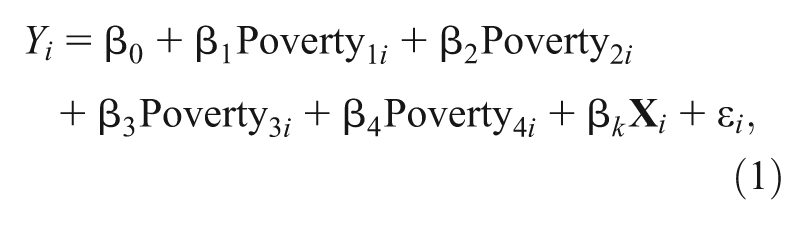
where Yi represents awakening cortisol in adolescence for individual i, and the first four terms represent the effect of poverty experienced at four time periods, ranging from infancy to adolescence, net of other time periods. The remaining coefficients represent the effects of k – 4 control variables. Evidence for poverty exposure throughout childhood (hypothesis 1) was based on whether all the coefficients were statistically different from zero and equal in magnitude. In other words, evidence for hypothesis 1 was found if β1 = β2 = β3 = β4 ≠ 0. Evidence for hypotheses 2 and 3 was found if β1 or β4 was different from zero and the absolute value of the coefficient was greater than that of the other poverty exposure variables. Because the analyses were stratified by gender, we tested whether any of the poverty coefficients differed across this third model. Evidence for hypothesis 4 was found if |β4| for the female model was greater than |β4| for the male model.
The analyses concerned with testing the equality of regression coefficients was based on the strategy of constraining the effect of poverty to be equal over time and then testing whether poverty at each point in time had a unique effect net the constrained uniform effect. The category left out of the equation was the one being examined for period-specific effects. For instance, the test for infant-specific effects is of the form
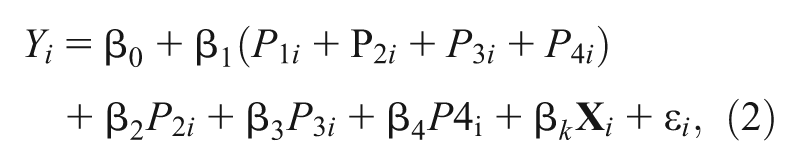
where β1 represents the uniform effect of each period of poverty exposure, and β2, β3, and β4 are period-specific effects. On the basis of our hypothesis that poverty exposure in infancy will lead to lower cortisol, we would expect the coefficients for P2i and P3i to be positive and significant.
Results
As is evident in Table 1’s descriptive summary of the data and measures, there were a sufficient number of participants in each time period who experienced poverty, with 83 participants in the smallest cell size (i.e., male adolescents who experienced poverty at 15 years of age). Experiencing poverty was also most likely to occur in infancy. Female adolescents had higher levels of cortisol than male adolescents, but otherwise the male and female samples were similar in composition.
Descriptive Statistics in the Study of Early Child Care and Youth Development
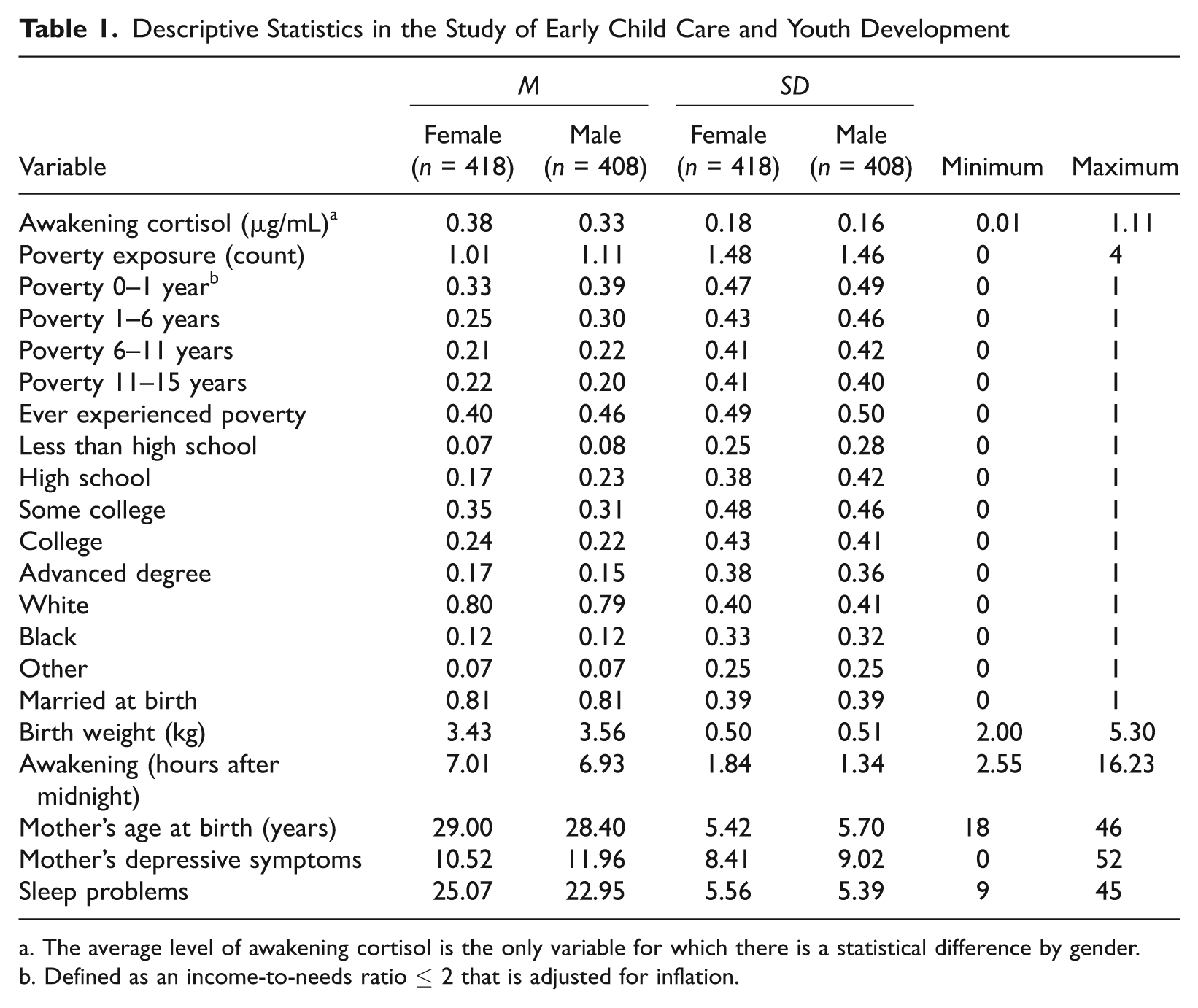
The average level of awakening cortisol is the only variable for which there is a statistical difference by gender.
Defined as an income-to-needs ratio ≤ 2 that is adjusted for inflation.
Table 2 shows the relationships between poverty and the continuous measure of awakening cortisol and reveals a number of notable findings. First, model 1 tests whether poverty experienced in the first year of life is associated with awakening cortisol and shows that female adolescents who witnessed poverty in infancy had lower levels of awakening cortisol. Second, model 2 tests whether female adolescents who were exposed to poverty in adolescence had lower levels of awakening cortisol and provides evidence for this association. Third, model 3 tests whether poverty exposures during infancy and adolescence were negatively associated with awakening cortisol net of poverty exposure from 1 to 6 and 6 to 11 years of age and each other. The results show that female adolescents who experienced poverty from 1 to 6 or 6 to 11 years old did not have lower levels of awakening cortisol than those who did not experience poverty at these ages. It appears that poverty exposure in infancy and early adolescence are more consequential.
Awakening Cortisol at 15 Years of Age and the Timing Effects of Poverty

Note: All models include controls for race, sleeping problems, average time of waking, birth weight, health complications during pregnancy, maternal age, education, marital status, and depressive symptoms at one month. Standard errors are shown in parentheses.
The coefficient is statistically different from the coefficient for poverty at 1 to 6 years in model 3 (two-tailed p ≤ .05).
The coefficient is statistically different from the coefficient for poverty at 6 to 11 years in model 3 (two-tailed p ≤ .05).
The F test using models 3 and 6 as the baseline comparison was statistically significant (p ≤ .05). Significance suggests that model 3 or model 6 is a better fit than models 1 and 2 or 4 and 5.
A t test was used to test for gender differences in the coefficient (Clogg, Petkova, and Haritou 1995).
p ≤ .05, **p ≤ .01, and ***p ≤ .001 (two-tailed).
This point is reinforced by tests for the equality of coefficients shown in Table 2. The results revealed that the magnitude of the effect of exposure during infancy was greater than the effects of exposure from 1 to 6 years old. Similarly, the effect of exposure during adolescence was greater in magnitude than the effect of exposure from 1 to 6 and 6 to 11 years old. Models 4 to 6 show the results of the analogous tests for male adolescents. These models show that male adolescents who experienced poverty did not have lower levels of awakening cortisol than others. Tests for gender differences in these effects showed that the influence of poverty exposure from 0 to 1, 1 to 6, and 6 to 11 years old did not differ between male and female adolescents. These gender tests did show that poverty exposure during adolescence was harmful for female but not male adolescents. Taken together, these results provide evidence for hypotheses 2, 3, and 4 among female adolescents. No support was found for any of the hypotheses among male adolescents, although it is notable that the effect of poverty exposure during infancy was negative and not statistically different from the coefficient for female adolescents.
Table 3 displays how the timing of poverty influenced the odds of having lower awakening cortisol, defined as being in the lower 50 percent of the distribution. Among female adolescents, there are three important points. First, experiencing poverty in infancy was associated with a 145 percent increase in the odds of having lower cortisol. Similarly, model 2 tested if poverty exposure was harmful during adolescence. Experiencing poverty in adolescence was associated with a 132 percent increase in the odds of having lower cortisol. Model 3 tested whether poverty exposure at each point in time was associated with cortisol net of exposure at other times. Model 3 suggests that poverty experienced in infancy and adolescence but not in childhood was harmful with regard to awakening cortisol. Tests for the equality of coefficients show that the magnitude of the influence of exposure during infancy was statistically larger than that between 6 and 11 and that the influence of exposure during adolescence was greater than that between 1 to 6 and 6 to 11 years of age. No evidence was found that poverty influenced cortisol among male adolescents. Tests for gender differences showed that experiencing poverty in adolescence was harmful for female but not male adolescents. Taken together, these results provide evidence for hypotheses 2 and 3 among female adolescents. Support for hypothesis 4 was found, but notably, poverty was not harmful for male adolescents. No support was found for any of the hypotheses among male adolescents.
The Timing of Poverty on Being in the Lower Half of the Awakening Cortisol Distribution

Note: All models include controls for race, sleeping problems, average time of waking, birth weight, health complications during pregnancy, maternal age, education, marital status, and depressive symptoms at one month. Standard errors are shown in parentheses. To make the results easier to interpret, we used the same t test as in Table 2.
The coefficient is statistically different from the coefficient for poverty at 1 to 6 years in model 3 (two-tailed p ≤ .05).
The coefficient is statistically different from the coefficient for poverty at 6 to 11 years in model 3 (two-tailed p ≤ .05).
Significance suggests that model 3 or model 6 is a better fit than models 1 and 2 or 4 and 5 (p ≤ .05).
We initially performed tests outlined by Allison (1999) and found no evidence for residual variation across models.
p ≤ .05 and **p ≤ .01 (two-tailed).
Figure 1 provides a graphical representation of the findings presented in model 3 of Table 2 for a white adolescent with an unmarried mother at birth who had some college and did not experience any health problems during pregnancy, a case relatively common in the data. All other variables were set to their means to produce this figure. This graph shows the predicted probability of having lower awakening cortisol by poverty exposure. Overall, this figure illustrates the importance of the timing of exposure. If we had only accounted for repeated exposure, we would have come to an incorrect conclusion that the effects of poverty become more harmful with increased exposure and missed valuable information about the importance of timing. Those who experienced chronic poverty from 0 to 15 years of age had a higher probability of having lower cortisol than those who never experienced poverty, but this relationship was due to the effects of experiencing poverty in infancy or adolescence. Those who experienced poverty only from 1 to 11 years of age did not have a statistically different probability of having low awakening cortisol compared with those who never experienced poverty.

Predicted Probability of Low Awakening Cortisol by Poverty Exposure
Discussion
A burgeoning framework for describing how social disadvantage becomes biologically embedded claims that repeated activation of the stress response leads to biological dysregulation (e.g. Repetti et al. 2002). Key to this assumption is that exposure to persistent deleterious environments can have long-lasting effects on the HPA axis. The present study revisits this assumption by following one cohort of individuals from birth to adolescence and finds evidence among female adolescents that poverty may lead to a dysregulation of the HPA axis. This study lends some credence to a host of work that assumes that social disadvantage influences mental and physical health via the HPA axis; many of the findings, however, were inconsistent with the study hypotheses.
No evidence was found for hypothesis 1, as poverty exposure from 1 to 11 years old was unrelated to awakening cortisol among female and male adolescents. The literature suggests that more exposure to harmful conditions should lead to more HPA axis dysregulation. There are at least two potential explanations as to why this relationship was not detected here. First, the effects of long-term stress exposure during nonsensitive periods may have been too small to be detected. Our measure of awakening cortisol represented only one dimension of HPA functioning, and the changes in the HPA axis occurring during adolescence may have created physiological noise that overshadowed the effects of poverty during nonsensitive periods. Second, perhaps poverty during these ages was not detrimental enough to produce long-lasting effects. The social mechanisms connecting poverty with stress vary by age and are not necessarily equivalent in their deleterious effects. For instance, poverty may be especially detrimental in adolescence because of social evaluative processes (McLeod and Owens 2004). For these social evaluative processes to occur, an individual must be aware of his or her poverty status, which is less likely to be the case among preadolescents.
Evidence was found supporting hypothesis 2 among female but not male adolescents. There are at least three potential reasons to explain why poverty exposure during infancy was not harmful to boys. First, most biological fathers have ongoing relationships with mothers after the birth of a child. Furthermore, father involvement is greater and mother-father conflict less likely when the infant is male (Carlson and McLanahan 2002; Lundberg, McLanahan, and Rose 2007). For this reason, poverty may be less harmful for mothers with infant sons and consequently male infants compared with female infants. Second, sex differences may influence how stress affects the body. For instance, previous work has shown that stress affects different dimensions of the HPA axis differently for men and women (Gustafsson et al. 2010). Finally, because female fetuses are more likely to survive in utero than male fetuses, boys and men may be especially resilient to the effects of stress compared with girls and women (Bruckner and Nobles 2013). Indeed, male fetuses are thought to be more vulnerable to stress than female fetuses and hence likely go through a stress-based selection process (Bruckner and Nobles 2013). Because male fetuses may be more vulnerable than female fetuses, the surviving male children may be relatively resilient to the effects of stress, including the stress associated with poverty exposure.
The results presented here suggest an urgent need to test for sensitive periods alongside exposure at other points in the life course. Study designs that only examine poverty exposure without regard to sensitive periods may be in danger of producing misleading or naive results. Conceptual frameworks could benefit from including sensitive periods when the environment is especially important for human development. Key to these types of frameworks is understanding (1) how infants experience poverty and (2) how the environment becomes biologically embedded. To understand how infants experience poverty calls for future work to test the mechanisms by which infants experience poverty. Several promising directions include the physical or mental well-being of the mother, chaotic households, ambient noise pollution, poor nutrition, noxious agents, child care, physical health, availability of heating or air conditioning, and breastfeeding (Evans 2004). Future work should also differentiate how infants experience poverty differently than toddlers and children and how mothers with infants experience poverty differently than mothers with older children.
Support for hypothesis 3 was found among female but not male adolescents. Sex differences rather than gender differences may have produced differences in the relationship between poverty and awakening cortisol. The timing of pubertal development varies by sex, and pubertal development is associated with a host of physiological changes, including hormone levels such as cortisol (Gunnar et al. 2009; Netherton et al. 2004). For instance, Gunnar et al. (2009) found a robust correlation between stage of puberty and cortisol exposure, with those in later stages of puberty having higher baseline levels of cortisol. A heightened stress response has been found in both animals and humans during pubertal development (Stroud et al. 2011). To the extent that female adolescents are further along in development during the collection of the cortisol data, the relationship between poverty and awakening cortisol may vary by sex such that the HPA axis may be more reactive for female adolescents.
In addition, there is evidence to suggest that girls and women in general have higher levels of awakening cortisol and that there are biologically based sex differences in both diurnal rhythms and stress responses. In particular, differential exposure to estrogen, progesterone, or testosterone between the sexes can modulate functioning of the HPA axis (Dedovic et al. 2009). In other words, awakening cortisol may not be measuring the same aspect of HPA axis functioning across sex. Altered HPA axis functioning may also be present in disadvantaged male adolescents but may be reflected in other ways, such as average daily cortisol exposure. Indeed, life-course socioeconomic trajectories were found to be associated with various dimensions of daily cortisol exposure that differed by sex in adulthood (Gustafsson et al. 2010). Support was found for hypothesis 4, as poverty was more harmful for female than male adolescents, but as discussed, above poverty exposure among male adolescents was not harmful at all.
To more thoroughly understand these gender and sex differences, additional studies that span from infancy to young adulthood are required. It is imperative for future research to (1) use multiple-wave cortisol data to allow within and between comparisons of change, (2) pay careful attention to the ways in which poverty exposure influences boys and girls differently with a specific focus on differential stress exposure by gender, and (3) collect information on multiple dimensions of HPA axis activity, as the effect of poverty exposure may differ by gender.
These findings should be interpreted within the strengths and limitations of the study. This study is particularly propitious because it uses 15 years of prospective data to examine how the timing of poverty exposure influenced awakening cortisol and is particularly unique in this regard. In addition, it measured household poverty at multiple time points and contained a national and relatively diverse sample. Sample attrition may have presented a problem, as male adolescents with mothers with less than a high school education were less likely to be in the sample than others. This potential problem of attrition may have contributed to a lack of an association between poverty and awakening cortisol among male adolescents. The measures of awakening cortisol were not optimal for measuring HPA axis dysregulation. The level of cortisol in the body follows a diurnal pattern and thus multiple cortisol level measurements would have been beneficial. Also, our measure of cortisol was based on one point in time, as are nearly all of the population-based studies on the topic. These assessments may be sensitive to a host of confounding factors and may not accurately capture long-term cortisol exposure and thus HPA dysregulation. A promising alternative to these “point assessments” of cortisol exposure is hair analysis, which provides average cortisol exposure over several months, although it has not yet been validated for use in population-based research (Sauvé et al. 2007). The inclusion of cortisol measurements at different ages would allow for the examination of how cortisol exposure changes over childhood and thus strengthen the case for a causal argument.
This study highlights the long-term influence of poverty at different ages for HPA axis functioning. Although a vast literature argues that HPA axis dysregulation is one pathway by which social disadvantage produces physical and mental health disparities, empirical tests are rare (e.g., Dowd et al. 2009). Here, using prospective data, we provide some support for this perspective (i.e., social disadvantage influences HPA axis functioning). Our study underscores the urgency to pay careful attention to issues of timing and sensitive periods in particular. Without considering such issues, research may be overlooking an important mechanism by which poverty becomes biologically embedded. With continued attention to issues of timing and sensitive periods, our understanding will grow and may present a unique window into which health interventions and public policies are most efficacious.
Footnotes
Acknowledgements
This research was supported by a infrastructure 5 R24 HD042849 and training 5 T32 HD007081 grants awarded to the Population Research Center at the University of Texas at Austin by the Eunice Kennedy Shriver National Institute of Child Health and Human Development. This study was also supported by training grant T32HDOO1763 to the Bendheim-Thoman Center for Research on Child Wellbeing at Princeton University by the Eunice Kennedy Shriver National Institute of Child Health and Human Development.