




Abstract
Using General Social Survey data, we examine whether any association between job insecurity and well-being is contingent on economic climate (comparing those interviewed in turbulent 2010 vs. pre-recessionary 2006), as well as income and gender. We find respondents with higher levels of job insecurity in 2010 reported lower levels of happiness compared to those similarly insecure in 2006. The positive relationship between job insecurity and days of poor mental health becomes more pronounced for those in the third quartile of personal income in 2010, suggesting middle-class vulnerability during the economic downturn. Men (but not women) with higher insecurity report more days of poor mental health in both 2006 and 2010. These findings reinforce a “cycles of control” theoretical approach, given the mental health–job insecurity relationship is heightened for workers in turbulent times.
Introduction
The global economic downturn reached crisis proportions in 2008 and 2009, but a slow recovery means its effects are persisting in a weak labor market (the unemployment rate had dropped to only 7.4 percent as of July 2013; see Bureau of Labor Statistics 2013). This “Great Recession” has been a watershed event, resetting (and lowering) both collective and individual expectations and perceptions about job security and future economic opportunity. Economists in the United States report that the Great Recession “is unique in that it is the first on record to have erased all the jobs gained in the previous economic expansion” (Goodman and Mance 2011:9).
This upheaval in the economy has fostered a realization by many employees—including previously secure professional and white-collar workers—that they face heightened job risks and uncertainty about the future, a realization that for some occurred even prior to the Great Recession (V. Smith 2002; V. Smith and Neuwirth 2008). While structural changes in the arrangement of paid work have been occurring incrementally since the late 1970s, recent trends have accentuated the growing job uncertainty and widening inequalities across the labor market (Hollister 2011; Kalleberg 2011). Job insecurity has always characterized the lives of those with little education and skills (Rubin 1992; Silva 2012), but now even college-educated professionals who have traditionally enjoyed greater opportunities in the labor market are finding themselves vulnerable to unexpected layoffs. For example, the increase in the average duration of unemployment across all educational groups is striking evidence of the changing nature of the employment relationship for those who were traditionally the most advantaged (Aliprantis and Zenker 2011; Farber 2011).
While there are excellent macro-level analyses of these changes and much has been written about the effects of unemployment or job insecurity on mental health (Björklund 1986; Burgard, Brand, and House 2009; Burgard, Kalousova, and Seefeldt 2012; Ezzy 1993; Ferrie et al. 2002, 2005; Green 2011; Hellgren and Sverke 2003; Jahoda 1982, 1988; Jahoda, Lazarsfeld, and Zeisel 1972; Lau and Knardahl 2008; Wang et al. 2008), studies of the potentially shifting relationship between job insecurity and well-being are rare (but see Tausig and Fenwick’s 1999 study of the impacts of the 1974-75 recession).
This article takes as its starting point that job insecurity is related to negative mental health outcomes, given evidence of its effects on depressive symptoms (Burgard et al. 2009, 2012; Ferrie et al. 2002, 2005; Wang et al. 2008) and mental distress (Green 2011; Hellgren and Sverke 2003; Lau and Knardahl 2008), but asks whether the job insecurity–mental health relationship is more deleterious when the larger economic climate is itself precarious and whether this may be particularly pronounced for some groups of workers. To do so, we contrast the insecurity–mental health relationships in 2006 (with an unemployment rate of only 4.6 percent) and in 2010 (with an unemployment rate of 9.6 percent; Bureau of Labor Statistics 2013). We first test whether the relationship between employees’ perceived job insecurity and their mental well-being varies in light of the increasing volatility of the labor market by comparing their association in 2010 with that in pre-recessionary 2006. We then investigate whether the insecurity–well-being associations differ by employees’ location in the broader social structure (Fenwick and Tausig 2007; Tausig and Fenwick 2012) in specifically investigating differences according to respondents’ personal income, seen as reflecting both their social status as well as their chances of finding a job with similar pay in a turbulent economy. Lastly, we investigate whether the relationship between insecurity and mental well-being differs by gender, theorizing that men’s traditional breadwinning role may heighten the mental health effects of job insecurity for men more than for women, a relationship that may be further exacerbated by a turbulent economic climate.
Economic Recessions and Well-being
The Great Recession became evident in the fall of 2008 and despite of its purportedly ending in 2009 (National Bureau of Economic Research 2010) continues to have tremendous effects on the labor market and the larger society, with the breadth and depth of its full impact yet to be ascertained. Given the rise in the unemployment rate during this period along with corollary difficulties in keeping or finding jobs, the heightened job insecurity experienced by many workers could be expected to be associated with either greater or fewer deleterious effects on mental health outcomes. We draw on two streams of scholarship to theorize ways economic recessions could impact the insecurity–mental health relationship. First, reference group theory (Merton 1968) suggests that when job insecurity becomes commonplace (as large numbers of people are unemployed or at risk of losing their jobs), workers’ own sense of insecurity may have less of a negative impact on their well-being, given that so many of their colleagues and neighbors are in the same situation. Clark (2003) considered this thesis in examining the effects of actual unemployment, using the first seven waves of the British Household Panel Survey, 1991-97 to assess the effects of reference group unemployment (at regional, partner, and household levels) on unemployed individuals’ own well-being. While the unemployed in his study always reported lower well-being than the employed, the difference in well-being between the employed and the unemployed was smaller when the unemployed lived in regions with higher unemployment rates, when their partner was also unemployed, and when another person in the household was unemployed. Note that these results were robust for men but weak for women, suggesting the importance of investigating gender differences.
Conversely, the negative mental health effects of workers’ sense of job insecurity may be exacerbated during a severe recessionary phase, given rising awareness of the absence of opportunities for reemployment. This conforms to Elder’s (1985) “cycles of control” hypothesis, which states that crisis situations (e.g., a turbulent economy) may alter the balance between one’s expectations and available resources. In the case of a turbulent economy, there may be a disparity between perceived reemployment opportunities should one become unemployed and available resources, such as job openings. Hence, as Elder (1985) points out, it is this sense of disparity that may attribute to one’s feeling of losing control over one’s life. In a turbulent economic climate, the linkage between job insecurity and poor mental health may become intensified because of heightened concerns by workers as to whether they will be laid off or their ability to obtain another job, both dampening workers’ sense of personal mastery or sense of control over their lives (see also Pearlin 1989). Recall one of the few studies contextualizing job insecurity was conducted by Tausig and Fenwick (1999) to assess the impact of the 1974-75 recession in the United States. They found that subjective job insecurity in 1973 and changes in perceived job insecurity between 1973 and 1977 were not related to reported general distress in 1977. But note that they did not compare the relationship between job insecurity and distress across economic contexts. Their data were collected in 1973 and 1977, both before and after (not during) the recessionary downturn. By 1977 the unemployment rate had eased somewhat, to 7.1 percent. Moreover, the 1974-75 Recession was less severe in comparison to the Great Recession. At its height in 1975 the unemployment rate was 8.5 percent, while unemployment during the recent downturn peaked at 9.6 percent in 2010.
Another important study by Burgard et al. (2009) used data from Americans’ Changing Lives (ACL), 1986-89 and Midlife in the United States (MIDUS), 1995-2005 surveys to show that persistently high job insecurity (at both baseline and follow-up) was associated with worse self-rated health and more depressive symptoms. These are valuable findings on the effects of continuity and change in individuals’ job insecurity. However, our question adds to understanding of the insecurity–mental health relationship by contextualizing it within particular economic climates. Accordingly, we address potential differences in the job insecurity–mental health relationship in times of economic turbulence as compared to a more favorable economic climate.
Job Insecurity, Income, and Well-being
One of the most robust predictors of happiness and other well-being outcomes is income (Blanchflower and Oswald 2004; Easterlin 2001). Nevertheless, studies examining the relationship between job insecurity and mental health tend not to explicitly address whether the association might differ depending on workers’ economic resources, partly due to the fact that extant studies typically focus on one organization or else aggregate data from several companies (Barling and Kelloway 1996; Hellgren and Sverke 2003; Hellgren, Sverke, and Isaksson 1999) where workers are more likely to be more homogeneous than is the case across the broader labor market. Though some studies do draw from population-level data sets to understand the relationship between job insecurity and mental health (cf. Burgard et al. 2009), we are not aware of U.S. studies examining possible moderating effects of income.
Historically, job insecurity has been stratified by socioeconomic status; workers with less income and fewer educational credentials also tended to have higher insecurity (see also Ferrie et al. 2003, which finds a job insecurity gradient in a sample of British civil servants). This points to differences in exposure to job insecurity and the role of social status as an antecedent. We extend this argument and test whether those lower in the income hierarchy might also be more vulnerable to any deleterious mental health effects of job insecurity. Reference group theory would suggest that those acclimated to insecurity might not necessarily report poorer mental health (see Merton 1968). One study based on 14 waves of the British Household Panel Survey, 1991-2004 finds that the negative effect of job loss on well-being is strongest for those in the middle class prior to being unemployed (Andersen 2009), as compared with higher and lower classes, classified using Goldthorpe’s social class schema (Erikson and Goldthorpe 1992). Given the dismantling of the employment contract that trades job security for seniority and commitment among even high-status workers, those with average or middle-class incomes might actually be more vulnerable than low-wage workers to the mental health effects of job insecurity, given concerns about downward mobility (Newman 1999) and the stress of higher status argument (Schieman 2013; Schieman, Milkie, and Glavin 2009). This conforms to Elder’s (1985) “cycles of control” formulation, with average, middle-class income workers increasingly feeling less control given their shifting employment conditions.
Similarly, being job insecure within a broader economic climate of uncertainty may also impact workers differently depending on their incomes. Therefore, we address whether being job insecure in (turbulent) 2010 might operate differently from being job insecure in 2006 for those with different levels of income. Underlying this hypothesis is the premise that certain groups of workers defined by their resources and social status may be particularly sensitive to high job insecurity occurring in times of extreme economic dislocation. For instance, whereas in a relatively stable economic environment, middle-class, average income workers may not be affected by job insecurity, perhaps due to their confidence over their employability as well as their having more resources to buffer such insecurity, the situation might be reversed when the economic climate is highly uncertain (as gauged by higher unemployment rates), given concerns about finding similarly high paying jobs if unemployed. Lower income workers, on the other hand, may not exhibit such contrasts across economic climates, given their chronic exposure to insecurity and low employability.
Job Insecurity, Gender, and Well-being
We also consider potential differences by gender. Given the higher unemployment rate in 2010 for men (10.3 percent) than for women (8.5 percent; see Bureau of Labor Statistics 2013) and men’s traditional breadwinning status, we theorize that job insecurity might be particularly stressful for men (Clark 2003; Longest and Thoits 2012; McLeod 2012; Moen and Roehling 2005).
In support of this formulation, existing studies have documented gender differences in the relationship between job insecurity and mental health. Drawing on a sample of British civil servants between 1995 and 1999, Ferrie and colleagues (2002) found a move from secure to insecure employment over approximately two and a half years to be associated with higher depressive symptoms for men, but not women, as compared to those who reported feeling job secure at both time points (but note that the nonsignificant finding for women may be due to small sample size; see Ferrie et al. 2002). In a recent study of a sample of older respondents in Chicago (average age 57) between 2002 and 2004, Kalil and colleagues (2010) reported differences in physical health but not perceived stress or depressive symptoms between men who were job secure or job insecure, such that job insecure men as compared to job secure men reported poorer physical health and had higher blood pressure and higher concentration of epinephrine in urine, a stress indicator. In another study using the Danish Work Environment Cohort Study (1995, with follow-up in 2000), Rugulies and colleagues (2006) found that even after excluding those who had severe depressive symptoms at baseline, job insecurity at baseline predicted elevated odds of depressive symptoms at follow-up for men, though not for women. Using the Canadian Community Health Survey, a nationally representative sample of individuals aged 15 and older in Canada in 2002, Wang and colleagues (2008) also found a cross-sectional association between job insecurity and elevated odds of reporting major depression for men but not women, though job insecurity was related to reporting any depressive or anxiety disorder for both men and women.
Taken together, these studies to date have focused on workers in different countries and at different points in time, providing mixed findings. We theorize and test job insecurity as having a stronger relationship with men’s mental health outcomes, given the centrality of work in men’s lives that may heighten the health effects of job insecurity, with the largest impact occurring for men experiencing job insecurity in the wake of the Great Recession (year 2010).
To summarize our hypotheses, we first investigate whether the relationships between job insecurity and mental health outcomes vary across two dramatically different economic contexts, year 2006 and 2010. Second, we identify whether the relationships between job insecurity and mental health also vary by income levels, theorizing the negative well-being effects of job insecurity might differ across workers with different levels of personal income. Third, we compare the job insecurity–mental health relationship by gender, contrasting the responses of employed women and men in 2006 (with an unemployment rate of 4.6 percent for both men and women) and in 2010 (overall unemployment rate of 9.6 percent—but 10.5 percent for men and 8.6 percent for women). Status indicators such as gender and income may in fact be antecedent variables that determine both exposure to insecurity as well as vulnerability to the deleterious mental health effects of insecurity. Accordingly, we include gender, race, and age as covariates in all models, as well as testing gender and income as potential buffers/facilitators of the insecurity/mental health relationship. (In earlier analyses we also included educational level, though finding collinearity between income and education.) In doing so, this study begins to unpack the complex relationship between job insecurity, social location (income, as well as gender), economic context (2010 vs. 2006), and mental health, offering a more nuanced understanding of their intersections.
Method
Data and Sample
This study draws on data from the cross-sectional 2006 and 2010 General Social Survey (GSS), a nationally representative survey on attitudes and behaviors that has been administered since 1972. The GSS uses a multistage stratified sample of adults living in the United States (T. W. Smith et al., 2012).
The sample size of the combined 2006 and 2010 GSS is 6,554. But the question of job insecurity was only asked for a segment of the sample (N = 2,050), in particular, those who are working or with a job. Given the different social meanings attached to working age and retirement age, we exclude respondents older than 65. Self-employed workers were also dropped because they may have more control over their business, as opposed to workers employed at an organization that is vulnerable to downsizing. These two exclusion criteria result in a loss of 329 cases. 1 Further, only cases with complete information on all variables were retained (377 missing cases were dropped). Therefore, the size of our final analytic sample is 1,344 (= 2050 − 329 − 377). 2
Measures
Dependent Variables
We have two measures of mental health. General happiness, which has been used in a number of studies as a measure of individual’s well-being (Borgonovi 2008; Subramanian, Kim, and Kawachi 2005), asks, “Taken all together, how would you say things are these days—would you say that you are very happy, pretty happy, or not too happy?” We reverse coded it so that higher scores indicate more happiness (1-3). Days of poor mental health asks, “Now thinking about your mental health, which includes stress, depression, and problems with emotions, for how many days during the past 30 days was your mental health not good?”
Primary Independent Variables
Perceived job insecurity was measured using one question: “Thinking about the next 12 months, how likely do you think it is that you will lose your job or be laid off—very likely, fairly likely, not too likely, or not at all likely?” We reverse coded this measure so that higher scores indicate higher levels of job insecurity, ranging from 1 to 4.
Economic context is operationalized by survey year, where the turbulent 2010 with an unemployment rate of 9.6 percent is contrasted with pre-Recession 2006 when the unemployment rate was 4.6 percent.
Personal income measures earnings from all sources before taxes or other deductions. Respondents were asked to choose one group that best described their income from a range of categories from under $1,000 to $150,000 or over. We divided income into four quartiles, with cutoffs determined from the distribution of the total sample: the first quartile comprises those reporting income below the category of $20,000 to $22,499, the second quartile comprises those reporting income between the categories of $20,000 to $22,499 and $30,000 to $34,999 (inclusive), the third quartile comprises those reporting income between the categories of $35,000 to $39,999 and $50,000 to $59,999 (inclusive), while the fourth quartile are respondents reporting income $60,000 and above.
Control Variables
In multivariate analyses we adjusted for key sociodemographic characteristics in addition to income, including gender (women = 1), age, age squared, race (black = 1), marital status (divorced/separated, widowed, never married, with currently married as the reference group), and number of children living at home by age categories of child (ages < 6, 6-12, and 13-17). We distinguish respondents who were part-time as opposed to full-time workers (part-time employed = 1).
Analytic Strategy
Analyses were conducted in STATA using version 11.0 SE. For happiness, we use ordinary least squares (OLS) models, given the distribution of this item for the sample (a rough bell-shape; 1, 8.3 percent; 2, 63.4 percent; and 3, 28.4 percent). We also considered an ordinal logit model (1-3). Results are similar to those found in the OLS models. The other outcome, days in poor mental health, is in the form of monthly counts, so we use negative binomial regression, a variant of Poisson regression, which is typically used to analyze event counts (Cameron and Trivedi 1998; Long 1997). 3 We also experimented with a logistic model where the outcome is dichotomized into 14 days or more and fewer than 14 days. Spending 14 days or more in poor mental health within the past 30 days is a widely used indicator of distress or depression (for similar use, see Andresen et al. 2003; Rohrer, Pierce, and Blackburn 2005). We did not find results to be sensitive to this alternative measure.
To examine whether job insecurity is associated with well-being outcomes, we first estimate models with job insecurity as a main predictor, controlling for sociodemographic characteristics. This same model is then estimated separately by economic context (2006 and turbulent 2010), using Chow tests (Chow 1960) to understand whether perceived job insecurity operates differently in different economic climates (Hypothesis 1). To understand whether the relationship between job insecurity and well-being might operate differently across income groups, we estimate models separately by income quartiles, again using Chow tests to determine whether coefficients are significantly different from each other. In these models, we also include an interaction term between job insecurity and year 2010 to see whether higher level of insecurity in a turbulent economic climate is more strongly associated with poor mental health outcomes for respondents varying across different levels of income (Hypothesis 2). 4 Finally, we estimate models separately for men and women to investigate whether there are gender differences in the linkage between job insecurity and well-being outcomes, as well as whether the relationship differs across two different contexts, before the economic downturn and in the turbulent economic climate of the Great Recession (Hypothesis 3). 5 All descriptive statistics and estimated models are weighted. 6
Results
Descriptive Summaries
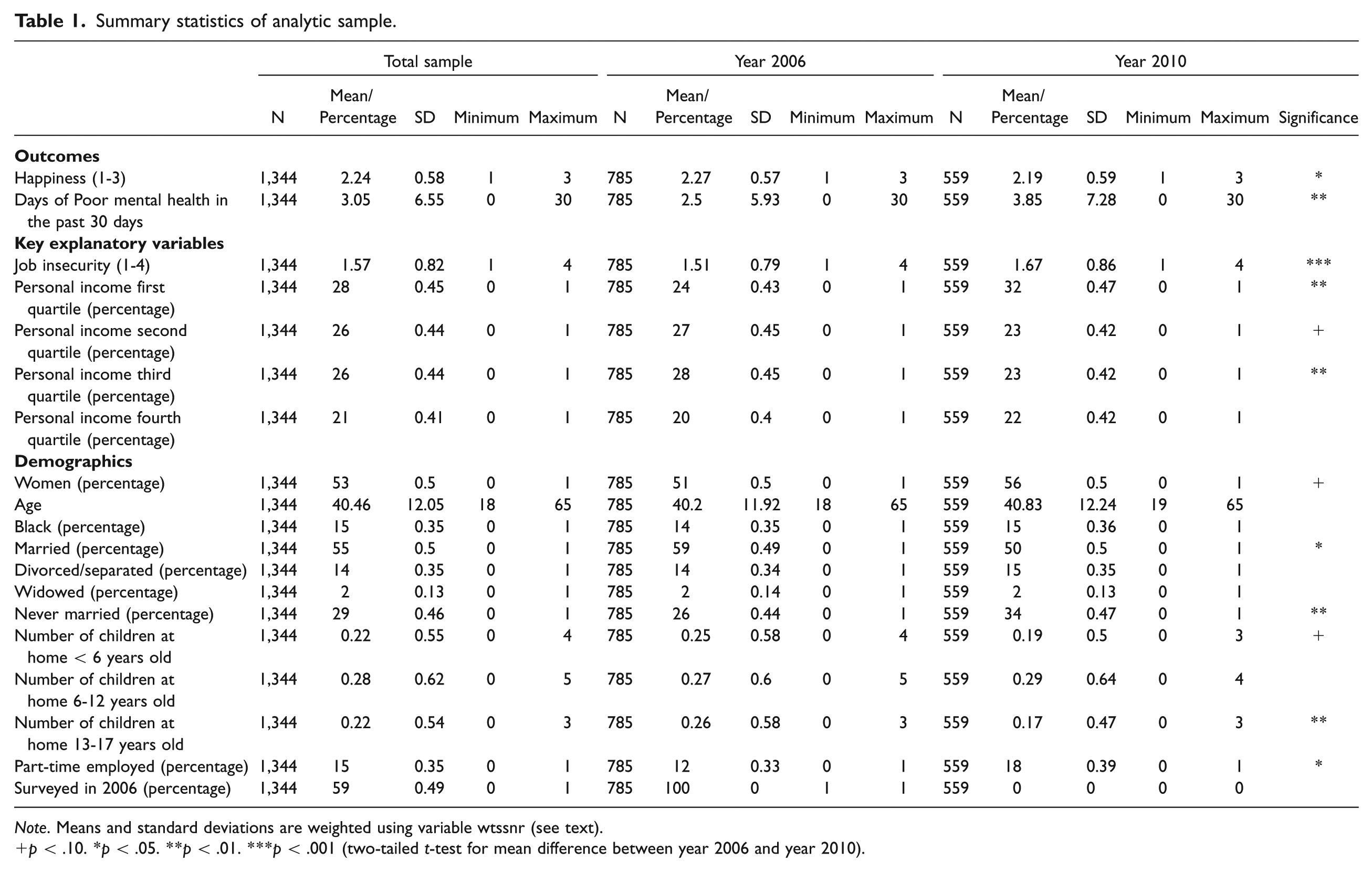
Weighted means or percentages of dependent and independent variables are presented in Table 1. In the first column, we present descriptive statistics for the whole sample, while in each subsequent column we present the descriptive statistics separately for those surveyed in 2006 and 2010, and the last column reports whether there are significant differences across the two years, based on t-tests.
Summary statistics of analytic sample.
Note. Means and standard deviations are weighted using variable wtssnr (see text).
p < .10. *p < .05. **p < .01. ***p < .001 (two-tailed t-test for mean difference between year 2006 and year 2010).
Table 1 shows that on average across the two survey waves, respondents report happiness at 2.24 on a 1 to 3 scale, and over the past 30 days, they spent 3.05 days in poor mental health. There is a small but statistically significant drop in happiness from 2.27 in 2006 to 2.19 in 2010 (p < .05, about 14% of the 2006 standard deviation), as well as more than a full day increase in reported days of poor mental health, from 2.5 in 2006 to 3.85 in 2010 (p < .01), underscoring the tangible ways that a climate of turbulence is manifested in the lives of workers. Overall, reported job insecurity was 1.57, between “not at all likely” and “not too likely” to lose their jobs or be laid off, but this value was much higher in 2010 (1.67 vs. 1.51 in 2006, an increase of more than 20% of the 2006 standard deviation, p < .001). Thus, both measures of mental health and job insecurity vary according to the economic climate.
The income distribution also changed between years 2006 and 2010, with significantly more workers located in the lowest quartile (below the category of $20,000 to $22,499) in the turbulent 2010 (32 percent vs. 24 percent in 2006, p < .01), whereas the proportion of the third quartile, those reporting income between categories of $35,000 to $39,999 and $50,000 to $59,999, was considerably smaller in 2010 (23 percent vs. 28 percent in 2006, p < .01). As for the demographic composition, slightly more than half of the sample consists of women (53 percent), age ranges from 18 to 65 with a mean of 40, and about a sixth are black (15 percent). More than half are married (55 percent), followed by workers who were never married (29 percent), and 14 percent are divorced or separated, while 2 percent are widowed. Note that this sample consists of only those who are currently working. Significantly more respondents worked part-time in 2010 (18 percent vs. 12 percent in 2006, p < .05). Bivariate correlations (available upon request) suggest that job insecurity is somewhat correlated with lower levels of happiness (−0.13) and more days of poor mental health (0.14), whereas higher income is associated with better scores on these well-being measures. Correlations between primary independent variables and control variables are mostly weak, suggesting there is little multicollinearity.
The Shifting Relationship between Job Insecurity and Well-being (Hypothesis 1)
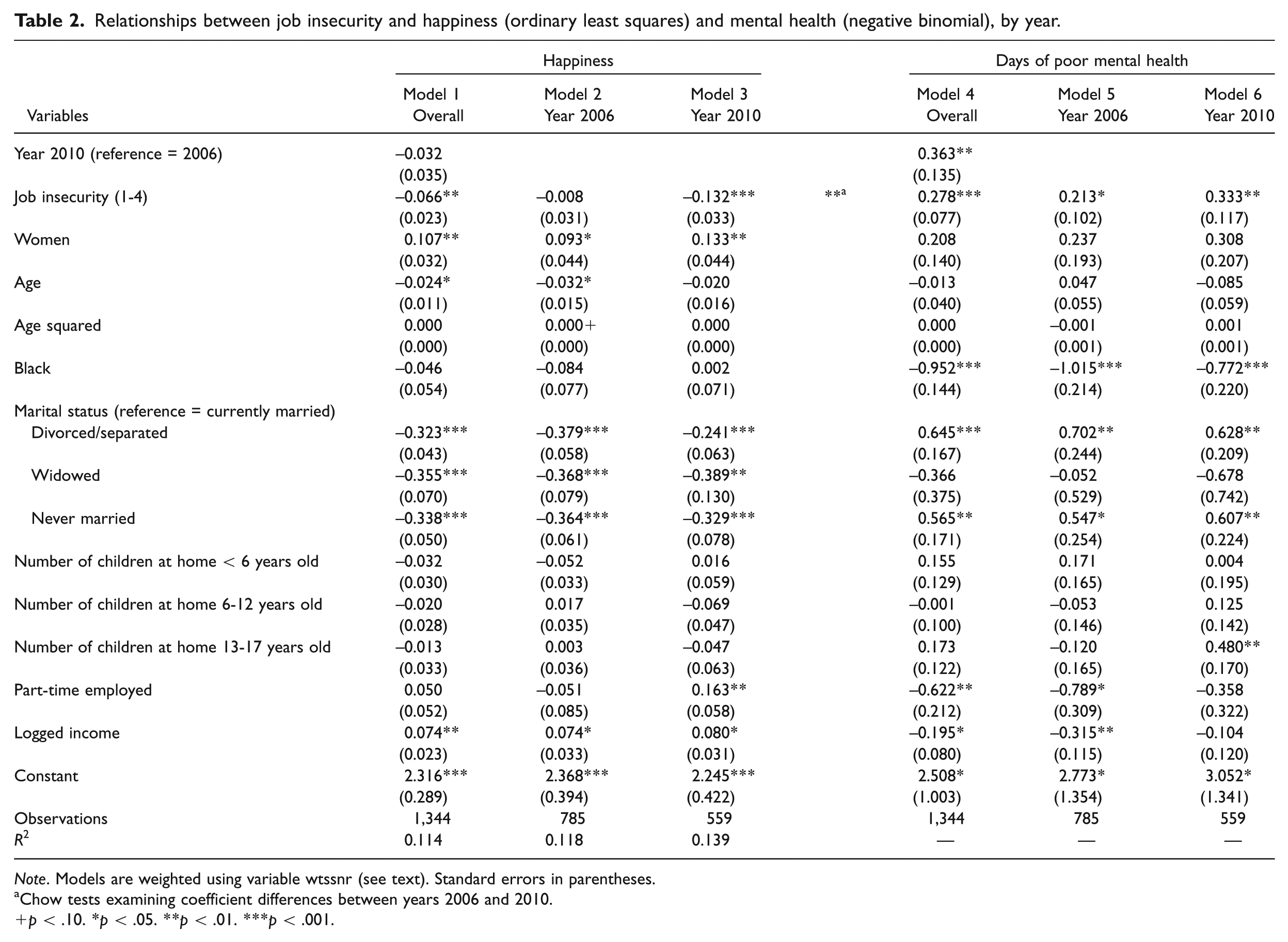
In Table 2, the first set of models (Models 1 and 4) establishes whether job insecurity is a significant predictor of the two outcomes across years, and the second set of models (Models 2-3 and 5-6) examines whether the associations between job insecurity and well-being measures are moderated by the macro-level economic context, that is, being interviewed in 2010 compared to 2006.
Relationships between job insecurity and happiness (ordinary least squares) and mental health (negative binomial), by year.
Note. Models are weighted using variable wtssnr (see text). Standard errors in parentheses.
Chow tests examining coefficient differences between years 2006 and 2010.
p < .10. *p < .05. **p < .01. ***p < .001.
We find higher job insecurity to be associated with lower levels of happiness (−0.066, p < .01) and more days of poor mental health (0.278, p < .001), controlling for a number of sociodemographic characteristics. Consistent with the cycles of control formulation in Hypothesis 1, high job insecurity is particularly deleterious for workers’ well-being during the turbulent climate of 2010. Although no distinguishable differences in happiness by degree of job insecurity are found in 2006 (Model 2, Table 2), in 2010 each additional unit of job insecurity is associated with less happiness, .132 lower (Model 3, p < .001). Chow tests confirm that the job insecurity–happiness relationship is significantly different between 2006 and 2010 (p < .01), suggesting that the turbulent economic climate magnified the negative implications of being job insecure. We take this as suggestive evidence that the recession posed a greater threat to workers’ sense of control (Elder 1985). While we did not have a formal measure for mastery or control, recall that we theorized it may be a key mechanism linking job insecurity to lower mental health outcomes in a recessionary climate. We hold that a favorable economy provides workers, on average, a greater sense of control over their lives, thereby possibly buffering the health effects of job insecurity. In contrast, a turbulent economy may lower workers’ sense of control, magnifying the negative mental health effects of job insecurity. Our alternative hypothesis based on reference group theory (Clark 2003; Merton 1968), that is, the idea that having more people unemployed might make job insecurity seem more common and thereby buffering its negative mental health effects, is not supported.
Turning to the covariates, we find women are happier than men (.107, p < .01), and black employed respondents report 61.4 percent (= 1 − exp[−.952] = .614, p < .001) fewer days in poor mental health within the last 30 days compared to those of other race/ethnicity origins. Being married predicts significantly higher levels of happiness, while divorced/separated or never-married workers report significantly more days of poor mental health compared to married workers. 7 Part-time employed workers report 46.3 percent (= 1 − exp[−.622] = .463, p < .01) fewer days in poor mental health relative to those with a full-time job, whereas respondents with higher incomes enjoy higher levels of happiness (.074, p < .01) and spend 17.7 percent (= 1 − exp[−.195] = .177, p < .05) fewer days in poor mental health.
Does Personal Income Moderate the Job Insecurity–Well-being Link (Hypothesis 2)?
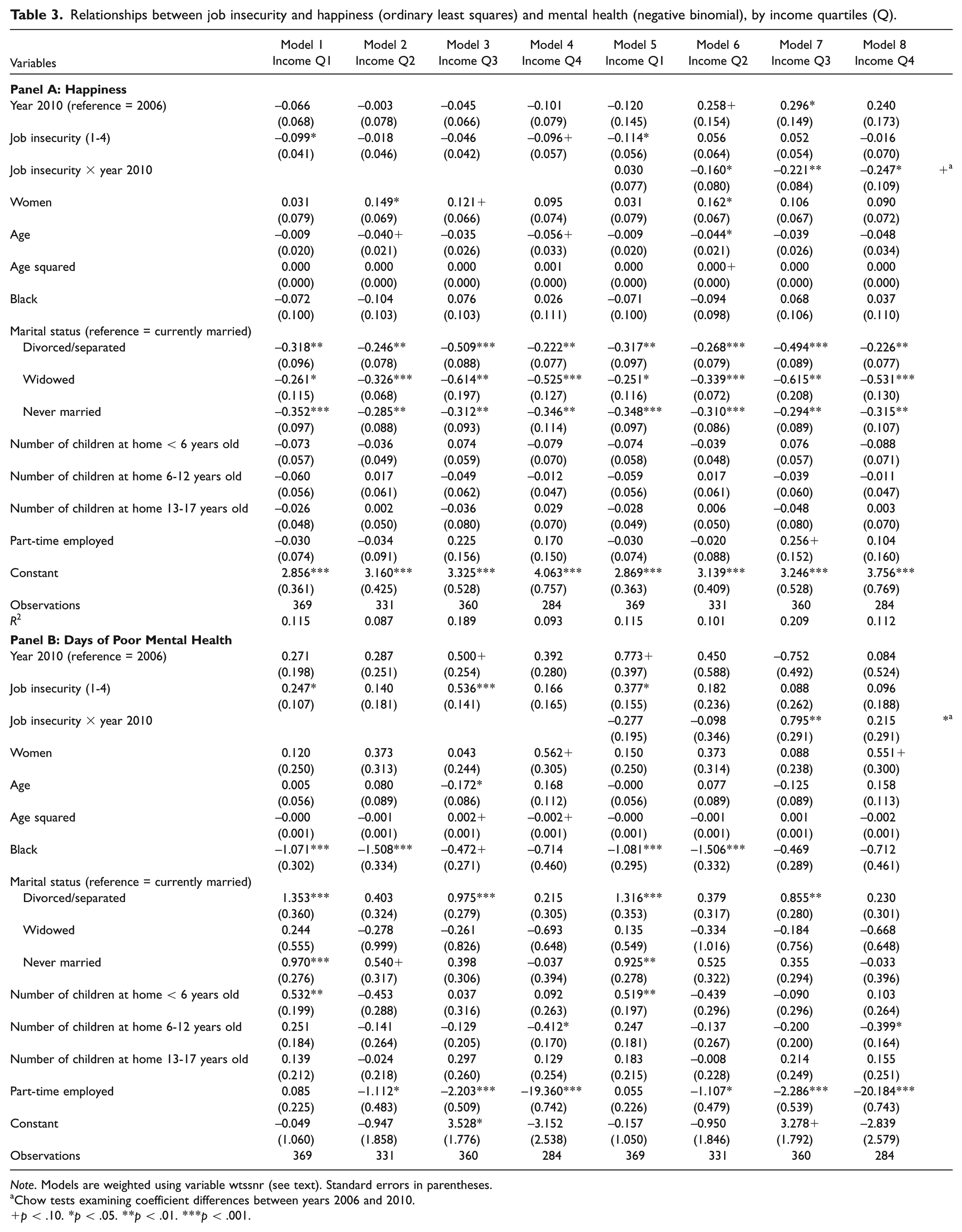
We next examine whether the relationships between job insecurity and mental health outcomes vary across income groups. Models 1-4 in Table 3 show results by income quartiles. There is suggestive evidence that workers who earn the least income are particularly vulnerable to job insecurity in terms of their well-being: with each additional unit of job insecurity their happiness is lowered by .099 (p < .05; Model 1) and they spend 28 percent (= exp[.247] = 1.280, p < .05; Model 1) more days in poor mental health. But the relatively well-off (those located in the top two quartiles) also suffer from job insecurity at a magnitude comparable to those in the lowest quartile. With each additional unit of job insecurity, those in the top quartile report a happiness score .096 lower (p < .1; Model 4), while workers in the third quartile report 70.9 percent (= exp[.536] = 1.709, p < .001; Model 3) more days in poor mental health.
Relationships between job insecurity and happiness (ordinary least squares) and mental health (negative binomial), by income quartiles (Q).
Note. Models are weighted using variable wtssnr (see text). Standard errors in parentheses.
Chow tests examining coefficient differences between years 2006 and 2010.
p < .10. *p < .05. **p < .01. ***p < .001.
Previously we showed that the association between job insecurity and mental health is magnified in 2010 compared with pre-recessionary insecurity in 2006. Further examination reveals that the heightened relationship between job insecurity and mental health also varies across workers who have different levels of income, across economic contexts, as shown in Models 5 through 8 in Table 3. A general pattern is that the relationship between job insecurity and well-being does not depend on economic contexts for workers in the lowest income group (Model 5); however, among those in middle-class income quartiles, job insecurity predicts significantly worse well-being in a turbulent economy (Model 7). Each additional unit of job insecurity predicts more than double the number of days (= exp[.795] = 2.214, p < .01) in poor mental health in 2010, compared with those reporting similar insecurity in 2006, for people in the third income quartile, reporting income between $35,000 and $59,999 (Model 7). Chow tests confirm that the job insecurity–poor mental health day relationship is significantly different across income quartiles (p < .05). This suggests that workers with middle-class incomes became even more sensitive to the level of job insecurity during uncertain economic times, heightening the threat of job insecurity, likely due to their shifted sense of control (Elder 1985), a pattern of which is not shared by the workers who have the least or most personal income. This conforms to previous finding that the effect of job loss is also greater for the middle class, as compared to higher and lower classes (Andersen 2009). Again, while we do not have a measure of sense of control, we argue that workers with different levels of income may have corresponding differences in loss of sense of control accompanying a major economic downturn.
Are There Gender Differences in the Job Insecurity–Well-being Link (Hypothesis 3)?
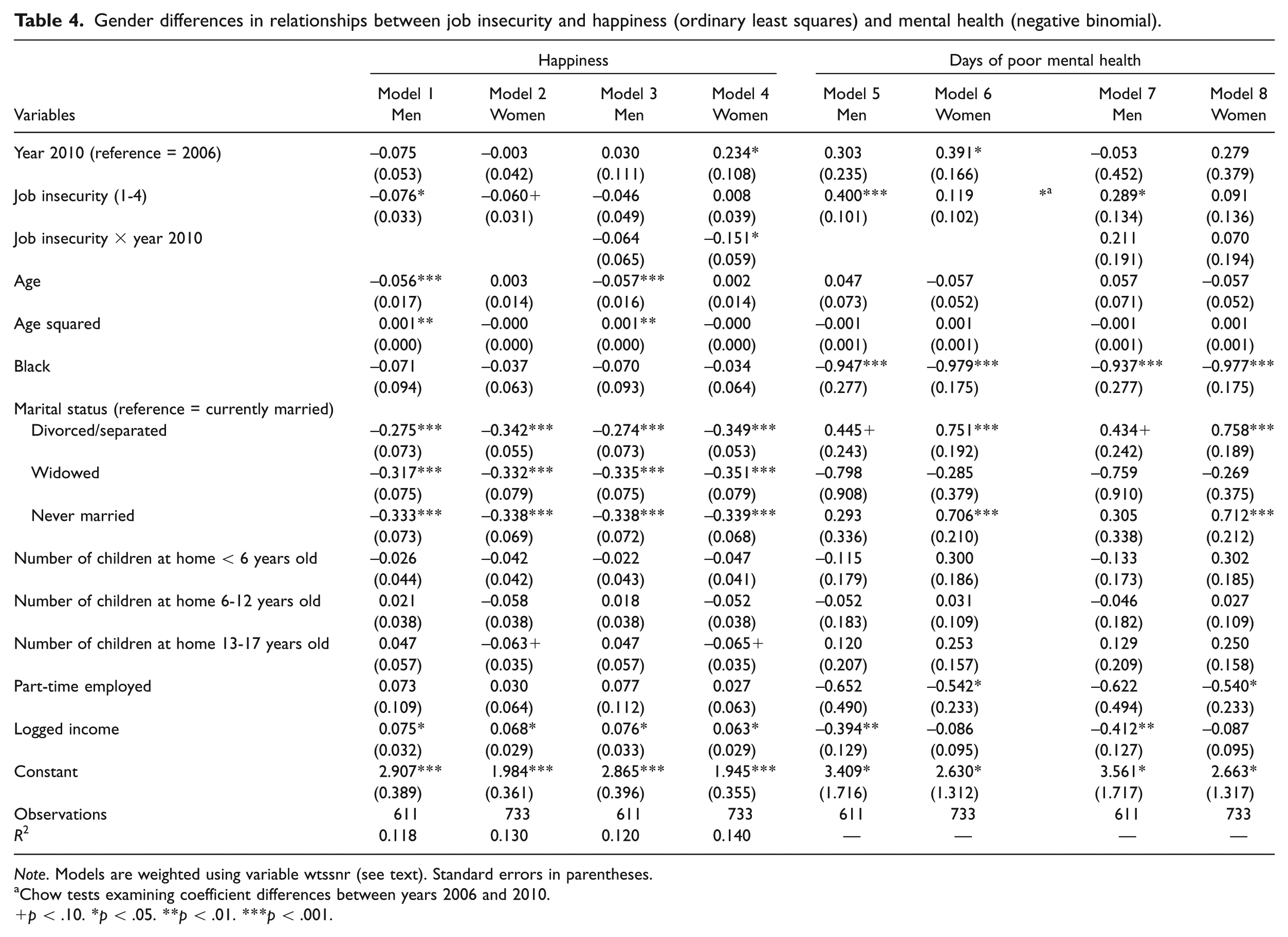
Lastly, we investigate whether the relationship between job insecurity and well-being outcomes differs between men and women workers and whether such gender differences vary across the different economic contexts of 2006 and 2010. Partially confirming Hypothesis 3, Table 4 indicates that men on average are particularly susceptible to higher levels of job insecurity. Controlling for sociodemographic characteristics, each additional level of job insecurity predicts 49.2 percent (= exp[.400] = 1.492, p < .001, Model 5) more days of poor mental health in men, but is not associated with women’s poor mental health days (Model 6), a statistically significant difference based on the Chow test (p < .05). However, the relationship between job insecurity and happiness exhibits similar patterns for both men (−.076, p < .05, Model 1) and women (−.060, p < .1, Model 2).
Gender differences in relationships between job insecurity and happiness (ordinary least squares) and mental health (negative binomial).
Note. Models are weighted using variable wtssnr (see text). Standard errors in parentheses.
Chow tests examining coefficient differences between years 2006 and 2010.
p < .10. *p < .05. **p < .01. ***p < .001.
Are there greater gender differences in terms of the job insecurity–well-being linkage in the recessionary climate of 2010 than in 2006? Chow tests suggest it is not the case. The relationships between job insecurity and happiness or poor mental health days differ in a similar fashion from 2006 to 2010 for both men and women. Taken as a whole, despite suggestive evidence that women became more sensitive (in terms of lower levels of happiness, −.151, p < .05, see Model 4) to job insecurity in the more turbulent economy of 2010, the difference between men and women in the relationship between job insecurity and poor mental health days does not undergo fundamental changes even though the economic context changed dramatically. 8
Discussion
Employment relations have changed in a number of ways in recent decades, becoming more precarious in light of heightened global competition, organizational restructuring, and the use of nonstandard (e.g., contract) workers (Kalleberg 2009, 2011). Studies have found deleterious effects of job insecurity on mental health outcomes, in terms of depressive symptoms (Burgard et al. 2009, 2012; Ferrie et al. 2003, 2005; Rugulies et al., 2006) and mental distress (Lau and Knardahl 2008). Building on and extending this literature, we have examined the job insecurity–well-being relationship across two different economic contexts, pre-recessionary 2006 and recessionary 2010, as well as across personal income levels and by gender.
Drawing on nationally representative data on workers in the United States at these two time points, we find first that higher job insecurity is associated with lower levels of happiness and more days of poor mental health, replicating findings from previous studies. We then tested for period effects, specifically, whether feelings of job insecurity may be more indicative of adverse mental well-being when the economy is in turmoil, theorizing that an uncertain economy will only exacerbate the mental health effects of individuals’ job insecurity (Hypothesis 1), conforming to the “cycles of control” thesis (Elder 1985) that a turbulent economy will reduce workers’ sense of control. We contrasted this thesis with reference group theory (see Merton 1968) that job insecurity may seem less of a private trouble when many are experiencing it, reducing its deleterious effects on mental health outcomes. 9 Even though we have no measure of personal control, our results are in the direction of the “cycles of control” thesis, showing that high job insecurity in fact translates into significantly lower levels of happiness in 2010, compared to pre-recessionary 2006. This is a key finding, pointing to the importance of considering the economic environment when examining the relationship between job insecurity and mental health.
Second, we hypothesized and find that job insecurity is related to mental health outcomes differently dependent on workers’ personal income (Hypothesis 2). At the core of this hypothesis is that individuals have different levels of economic resources as well as encounter different levels of difficulty in finding re-employment with comparable pay; therefore, workers across income levels may be differently affected in terms of their mental health given the threat of job loss, both attributed to their own sense of job insecurity as well as due to the shifting economic climate. Our findings confirm that for those with income in the third quartile, the negative implication of job insecurity on poor mental health days is amplified in the midst of a turbulent economy (as captured by being surveyed in 2010, when the unemployment rate was 9.6 percent). We believe that this association may reflect the growing—and unexpected—insecurity of those traditionally more advantaged, that is, those with middle-class incomes. Thus, another dimension of the stress of higher status (Schieman 2013; Schieman et al. 2009; Schieman and Glavin 2008; Schieman and Reid 2009) may be feeling less prepared for the growing uncertainty around both keeping jobs and future employability. The fact that this is found in middle-class workers with individual incomes in the third quartile suggests their possible concern with employment opportunities in the labor market offering similar pay and/or the possibility of downward mobility. This also adds to existing research finding differing association of job loss with subjective well-being across social classes, with the negative effect highest for those in the middle class prior to job loss (Andersen 2009). It is also in keeping with the “cycles of control” thesis (Elder 1985) with those in the middle of the earnings distribution feeling more or less in control of their careers as they experience their own job security and the threat of a turbulent economic climate. The paradox of the stress of higher status formulation, of having “good jobs” (Kalleberg 2011) and hence greater resources but simultaneously feeling anxious about the future corresponds to shifts in feelings of personal control concomitant with shifts in opportunities as theorized by Elder (1985).
Lastly, we tested whether the association between job insecurity and mental health operates differently for men and women (Hypothesis 3). We find that perceived job insecurity is associated with lower happiness ratings for both men and marginally lower happiness for women as well as with considerably more poor mental health days for men, but not for women. This suggests that men may feel more affected by a sense of job insecurity, confirming existing research on gender differences regarding the threat of job loss.
There are some important limitations to this study. First, it is based on cross-sectional data, meaning we cannot speak to causal ordering, given that mental health may also predict perceived job insecurity, as well as vice versa. Future research using longitudinal data following the same people over time is essential to better assess this relationship. Second, this study relies on self-reports of both the predictors and the outcomes. Third, gender and income may also be antecedent variables that determine exposure to insecurity. As sensitivity analysis, we conducted t-tests comparing job insecurity by our status variables, finding that men and women in this sample report almost identical levels of job insecurity (1.62 for men and 1.61 for women, p = .699 from t-test), but workers earning higher incomes tend to have lower levels of job insecurity (p = .000 from ANOVA). Therefore, workers of different incomes are exposed to different levels of insecurity in the first place, regardless of economic climate. In particular, future investigations are necessary to further parse out the relationships between job security, gender, income, and mental health. For example, both gender and income may reflect selection into particular kinds of occupations that may promote job insecurity and/or mental health, as well as the relationship between them. Nevertheless, we believe that our focus on the relationship between insecurity and mental health differs across social statuses and economic climates provides important new insights as to the significance of contexts in the relationship between insecurity and mental health.
This indeed is the value of this study and data set: the opportunity to analyze the relationship between job insecurity and well-being across different economic contexts (2010 and 2006), as well as by personal income and gender. Our findings reaffirm and extend evidence in the existing literature on the links between job insecurity and workers’ mental well-being by further contextualizing this relationship. Consider the finding that job insecurity in the context of a turbulent economy (2010) is associated with poorer mental health outcomes than is job insecurity in a better economic climate (2006). While there have been studies examining the mental health effects of unemployment in different economic contexts (Turner 1995), few recent investigations have considered the economic environment within which job insecurity occurs, and no studies to our knowledge have examined the insecurity–well-being relationship in the Great Recession. Second, we show that the association between job insecurity and well-being outcomes is more unfavorable for those with moderately higher (middle-class) incomes in the midst of the recession, perhaps because the experience of job insecurity has been less common for this group. Middle-class workers may feel off center as a result of now experiencing it in a climate with fewer employment opportunities, especially at the salary levels they have come to expect. As scholars have noted, the Great Recession may be one of the most significant economic events in our lifetime (Treas 2010). Our evidence moves toward understanding the many and multilevel implications of the Great Recession, as well as the complex relationship between perceived job insecurity, an adverse economic climate, and workers’ well-being.
The findings also suggest important future research directions. We find the job insecurity–well-being relationship to be magnified for those with personal income in the third quartile, signifying that contemporary job insecurity might in fact be becoming more stressful for those with some advantages in terms of status and resources. This builds on the existing “stress of higher status” hypothesis (Schieman 2013; Schieman et al. 2009; Schieman and Glavin 2008; Schieman and Reid 2009), which argues that while greater resources could be expected to buffer work stress, this is not always the case. Note, however, that unlike studies by Schieman and colleagues, we are not examining the effects of job conditions on those with higher status but, rather, of job insecurity, finding that the stress of job insecurity is magnified for workers with income in the third quartile during the recession, suggesting middle-class vulnerability. Moreover, job insecurity has not historically been associated with higher status workers. This suggests the need for research that would untangle how the broader economy intersects with workers at different levels in the status/income hierarchy, broadening the stress of higher status argument to include job insecurity and concerns about future (re)employability. We propose that the threat of job loss may be more stressful for those with higher incomes given their previous expectations of security in tandem with having more to lose (conforming to the “cycles of control” model). Future research is essential to tease out under what conditions workers advantaged and disadvantaged in the labor market experience deleterious mental health effects from both job insecurity and the experience of a turbulent labor market (Cooper 2012).
Footnotes
Acknowledgements
We thank the McKnight Foundation for support of Professor Moen’s McKnight Presidential Chair. The authors gratefully acknowledge support from the Minnesota Population Center (5R24HD041023) funded through grants from the Eunice Kennedy Shriver National Institute for Child Health and Human Development (NICHD).
Notes
References
Supplementary Material
Please find the following supplemental material available below.
For Open Access articles published under a Creative Commons License, all supplemental material carries the same license as the article it is associated with.
For non-Open Access articles published, all supplemental material carries a non-exclusive license, and permission requests for re-use of supplemental material or any part of supplemental material shall be sent directly to the copyright owner as specified in the copyright notice associated with the article.
