



Abstract
Building on calls within the health literature for a deeper engagement with the concept of agency, we utilize nationally representative survey data from the National Longitudinal Study of Adolescent to Adult Health (N = 13,592) to develop an empirical conception of the traditional treatment of health agency focused on two social psychological constructs that build upon current foci on personal control within the stress process model: (1) “subjective vitality” and (2) a forward-looking orientation (“optimism”). We find an interesting paradox: adolescents with higher health-based agency early in the transition to adulthood have significantly higher status attainment (occupational and educational) outcomes, but early mental health advantages disappear over the transition to adulthood. This suggests that while subjective beliefs about health agency put adolescents on trajectories toward higher socioeconomic status, they also set them up for declines in mental health due to unachieved expectations. There seem to be objective upsides and subjective downsides of possessing greater agency in adolescence.
Sociology, in particular, medical sociology, has been characterized by underdeveloped empirical models relating agency to social structure (Cockerham 2005). Most sociologists agree that both aspects of this long-standing theoretical debate are important for life outcomes and that structural position influences an individual’s capacity to exert control over his or her life (e.g., Archer 2003; Giddens 1984; Mirowski and Ross 2007; Sewell 1992), which suggests that at least some of the relationship between social structure and life outcomes flows through individual agentic capacities. However, empirical treatments of agency have lagged behind notable theoretical advances (e.g., Thoits 2006) and wider agency discussions (e.g., Emirbayer and Mische 1998; Sewell 1992). Consequently, empirical models linking social structure to health outcomes have been underspecified because they have not sufficiently examined how they are related.
We derive a social psychologically informed construct capturing two aspects of agency that are less developed within the stress process literature linking structure and health and status attainment outcomes, building in part on Thoit’s (2006) suggestions for studying factors that increase agency. We argue for a novel empirical measure of “health agency” that captures distinct elements from the typically employed measures of personal control/mastery. This measure captures motivational aspects of agency (1) captured in the underutilized construct of “vitality,” translating traditional aspects of mastery into a subjectively oriented notion of capacity to engage one’s life course, and (2) a subjective appraisal of those life chances that serves as an important link between social structure and life outcomes (Hitlin and Johnson forthcoming). This incorporates agency into the study of health in four ways: (1) by illustrating an empirical measure of agency useful for health researchers developing an emotionally anchored future-based self-conception; (2) by suggesting the utility of this construct in adolescence for predicting successful life outcomes (e.g., Clausen 1991, 1993); (3) by illustrating a counterintuitive aspect of high adolescent levels of agency in adolescence, namely that—for this cohort—aging effects appear to outweigh the mental health benefits of early high agency levels; and (4) providing further illustration of long-established literatures drawing on social psychological factors to explain systematic relationships between social structural location and health outcomes.
Using the National Longitudinal Study of Adolescent to Adult Health (Add Health), we model health agency as a mediator between early structural position and later life outcomes. The results demonstrate an apparent paradox: while our empirical measure predicts more successful socioeconomic outcomes, having more health agency in adolescence predicts steeper declines in socioemotional well-being across the transition to adulthood, perhaps, we suggest, due to a perception of not living up to these initially higher aspirations. Like related constructs, health agency mediates structural position to both propel success and set up the potential for emotional declines across the transition to adulthood (Ross and Mirowsky 2013), a critical part of the developmental process (Shanahan 2000).
Traditional Conceptions of Agency and Life Course Outcomes
A sense of agency stems from capacities developed early in the life course and influences how individuals actively shape their own socialization (Heinz 2003; Kiecolt and Mabry 2000): “individuals construct their own life course through the choices and actions they take within the opportunities and constraints of history and social circumstance” (Elder, Johnson, and Crosnoe 2003:11). The idea of subjective agency as socially meaningful is most often tied into related constructs of personal control, mastery, and self-efficacy (e.g., Clausen 1991, 1993; Shanahan, Elder, and Miech 1997; Shanahan, Hofer, and Miech 2003; Thoits 2003). Theoretical treatments of agency focus on the importance of time (e.g., Emirbayer and Mische 1998), but this is rarely extended into empirical treatments. A sense of agency shapes interpretations one makes about one’s capacities and life difficulties and forms a lens through which one interprets potential stressors (Thoits 2006). Somebody with a strong sense of agency—and a sense that applying that capacity will ultimately pay off in the future—is more likely to persevere through life’s challenges or take risks that may increase life outcomes (Hitlin and Johnson forthcoming). Children develop a sense of “centralized agency” that helps unify their sense of self across domains (Proulx and Chandler 2009), and the development of such a sense contributes to capacities (like delaying gratification) that increase stratification outcomes (Clausen 1991, 1993) and academic success (Metcalfe and Mischel 1999).
A sense of agency is societally shaped and has demonstrated ramifications for later life outcomes. Significant portions of recent young adult cohorts have met educational expectations, but those with minority ethnic status and lower socioeconomic status (SES) still experienced constraints with respect to educational achievement (Reynolds and Johnson 2011). Students from higher-SES backgrounds are more likely to retain high educational expectations across the transition to adulthood, contributing to stratification successes (Johnson and Reynolds 2013). Similarly, childhood mental health problems lead to lower college enrollment, suggesting how life course orientations are linked with socioeconomic disparities (McLeod and Kaiser 2004). Individual health and stratification outcomes are linked to social class through such individual functioning across the life course (e.g., Abel 2008; Dupéré, Leventhal, and Vitaro 2012; Phelan, Link, and Tehranifar 2010; Schnittker 2004; Thoits 2006). Certain structural positions offer more potential for agentic action and shape individual orientations.
A notion of agency relevant to the study of health should incorporate aspects beyond those in the traditional agency measures of mastery/personal control. Well-established literatures linking mastery/personal control to the stress process (see Ross and Mirowsky [2013] for an overview) draw on measures that primarily focus on subjective evaluations of one’s potential to influence their life outcomes. With respect to health and the life course, we suggest that belief about one’s sense of physical agency captures an additional, essential aspect of agency. In addition to a sense of personal control over one’s outcomes, people develop senses of themselves as healthy (or not) people; having energy and beliefs about illness and recovery potential are underexplored aspects of subjective senses of agency and aspects that we suggest both reflect social position (e.g., race, SES) and allow for individual variation based in subjective self-evaluations of one’s energy, coupled with an additional, underexplored aspect of agency (Hitlin and Johnson forthcoming): one’s optimism about the future. Our construct thus approaches the measure of subjective agency comprising two less-established first-order factors: subjective health vitality and optimism. These two constructs form a single latent factor that, in turn, mediates established relationships between social location and mental health outcomes. 1 It leads, we will demonstrate, to an interesting paradox comparing mental health and stratification outcomes.
Toward a Distinct Health-related Empirical Measure
Thoits (2006) treats agency as a capacity influenced by a host of social psychological factors; we focus on the subjective belief (see Hitlin and Long 2009) about this capacity, important for shaping health behaviors and perseverance (Bandura 2004). The most common empirical treatment of agency involves the overlapping constructs of self-efficacy (Gecas 2003), mastery (Pearlin et al. 1981), and personal control (Mirowsky and Ross 1998). Self-efficacy beliefs are important for understanding mental health (e.g., Dupéré et al. 2012), and their development contributes to positive outcomes in stressful situations (Frazier et al. 2011).
We demonstrate the utility of a structurally embedded, individual measure of agency (see also Christie-Mizell and Erickson 2007; Reynolds et al., 2007). We develop a measure that operates alongside well-established psychosocial resources that mediate the stress process model, like mastery and personal control. This present measure captures two aspects of agency most relevant to health that are traditionally not the focus of these established measures. Following Hitlin and Elder (2007), we focus on subjective beliefs about vitality (health and recovery potential) alongside a more temporal aspect of agency found in measures of optimism. Subjective vitality is “a function of conditions that support agency and growth” (Ryan and Frederick 1997:557). Drawing on a recent stream of work focusing on the importance of concepts of the future for steering social action (Frye 2012; Mische 2009; Tavory and Eliasoph 2013), we argue that a proper measure of health agency also requires a forward-looking aspect where actors decide whether it is “worth it” to apply their energy toward tackling a particular problem. Such persistence increases educational and occupational attainment (H. Andersson and Bergman 2011; Duckworth and Seligman 2005), and we explore whether this is also true in the health domain, drawing on measures of emotional, subjective evaluation of one’s potential futures captured in notions of optimism.
Subjective Vitality
Vitality is a core indicator of well-being (Kasser and Ryan 1999). In circumstances where one’s perceived locus of control is outside of the self, this should reduce energy that people feel is available to accomplish life goals (Ryan and Frederick 1997). The traditional focus of the stress process, personal control, asks a series of positively and negatively valenced questions, for example, about one’s ability to “do just about anything I really set my mind to” and “the really good things that happen to me are mostly luck.” These measures have demonstrated great utility in understanding the relationship between social structure, social psychological functioning, and health outcomes (e.g., (Lewis, Ross, and Mirowsky 1999; Mirowsky and Ross 1998, 2003). For the health domain, however, we build on this work by modeling indicators of subjective vitality that reflect the ongoing satisfaction of basic agentic drives: “people felt more energy whenever they experienced more competence, relatedness, or autonomy in their daily activities” (Ryan and Deci 2008:712). In addition to beliefs about control of one’s personal outcomes, we suggest that agency includes elements of subjective health assessments captured within this notion of vitality.
This construct captures the “driving force” element of agency, with vitality measured as a subjective variable, capturing “positive feelings of energy and aliveness” (Ryan and Frederick 1997:533), energy drawn from one’s sense of self, only recently an area of focus for sociologists of mental health (Thoits 1999). 2 Clausen’s (1991) empirical treatment for agency includes items such as “feels cheated and victimized by life” and “is self-defeating,” items that are the converse of the sense of vitality we measure. Ryan and Frederick (1997) find that subjects across varied samples reported less vitality when perceived to be controlled by external forces; being experimentally induced to feel self-motivated increased their sense of subjective vitality. Thus, we explore this theoretically distinct aspect of agency as important for life course health outcomes. We do not have the traditional mastery/personal control measures available, though we have one (less strongly loading) factor standing in for the typical sociological measures of mastery, as we discuss shortly. Health agency, we argue, is anchored in a general subjective disposition about one’s potential to vitally engage the world.
Optimism
People do not orient themselves just to present situations; they also carry a sense of life course trajectories and develop future-oriented intentions (Frye 2012; Howard 1994; Mische 2009). There is a core emotional substrate to these orientations; individuals develop structurally shaped assessments about future possibilities. In many cases, they may be unrealistically positive (Taylor and Brown 1988), though such “positive illusions” augment mental health (Taylor and Brown 1994). People differ on the extent they feel optimism for the future (Peterson 2000; Peterson and Chang 2003), but research suggests positive mental health benefits (M. Andersson 2012; Bailey et al. 2007; Scheier et al. 1989). Optimism predicts well-being over time, offering a capacity of resistance to postpartum depression (e.g., Carver and Gaines 1987); a lack of optimism predicts greater depression after hospitalization for heart disease (Shnek et al. 2001) and depression in cancer patient caregivers (Given et al. 1993) as well as elderly men (Giltay, Zitman, and Kromhout 2006; see Carver, Scheier, and Segerstrom 2010).
We suggest that a proper notion of health-informed agency incorporates this emotional life assessment, distinct from (though potentially correlated with) personal control. Optimism motivates agentic action (Fredrickson and Joiner 2002; Frye 2012; Mortimer 2012; Hitlin and Johnson forthcoming). Rudd and Evans (1998) discuss this point in their assessment of agency for young people transitioning to adulthood, a period of the life course that may involve unrealistic aspirations (Johnson 2002; Reynolds and Baird 2010). Having strong feelings about one’s positive future leads to advantaged stratification outcomes (e.g., Diemer and Li 2011; Vuolo, Staff, and Mortimer 2011) and even predicts resilience from depression following heart attacks (Galatzer-Levy and Bonanno 2014).
Socioeconomic and Social Psychological Outcomes and Trajectories: The Agency Paradox
This paper has two empirical goals. First, we want to demonstrate the potential components of agency as it relates to health, anchored, we argue, within measures including subjective vitality and optimism. Second, we hope to illustrate the utility of this measure with respect to important stratification and health outcomes, suggesting another socioemotional construct useful for health researchers (alongside traditional measures of personal control and self-esteem, for example) for predicting important early-adult stratification outcomes, like occupational attainment and self-perceived success. After establishing our measure as a significant predictor across a 14-year period, we turn to its role in predicting depression, exploring a sense of health agency across the complicated transition to adulthood (Hartmann and Swartz 2007; Uhlenberg and Mueller 2003). Personal senses of agency, health and otherwise, are potentially more relevant for understanding this relatively unstructured transition in the American context as compared with other Western nations (Kerckoff 2003). This relationship is well established with traditional measures of control (Mirowsky, Ross, and Willigen 1996; Ross and Mirowsky 2013); we suggest health agency, and its focus on vitality and optimism, as an additional construct mediating the established relationship between structural advantage and status attainment and depression outcomes.
Status Attainment
Greater senses of agency are associated with social structural position (e.g., social class; Kraus, Piff, and Keltner 2009), while modern youth cohorts have “extraordinarily high aspirations” (Vuolo et al. 2011) for educational and occupational attainment (e.g., Beal and Crockett 2010). Such aspirations are not fixed, as adolescents revise their aspirations across this transition by bringing them in line with current status attainment outcomes (Reynolds and Baird 2010; Vuolo et al. 2011). Such optimistic expectations are linked to social structural position: they are reduced for those who suffer childhood misfortune (Schafer, Ferraro, and Mustillo 2011), black students develop less optimism about future outcomes due to beliefs that they will face greater structural barriers (Matthew 2011), and low-SES children are less likely to maintain optimism in the face of obstacles, though those who do experience improved physiological health outcomes (E. Chen 2012). We explore the extent to which these stratification and mental health outcomes are influenced by one’s sense of health agency, in a similar manner to the more common measures of agency represented by the vast literatures on personal control and mastery.
Consequently, with the conceptual link between social structural position, agency, and socioeconomic outcomes described above, we hypothesize the following:
Depression
Thoits (2003) calls for increased attention to the role of agentic processes in the study of health outcomes, especially for understanding the normative situation whereby most individuals do not suffer mental health setbacks in the face of stress. However, Taylor, Repetti, and Seeman (1997) suggest that SES exposures to chronic stress can lead to a reduced sense of control, thus increasing health concerns. A lack of control has been linked to a variety of suboptimal health outcomes, like depression, anxiety, and stress-based diseases (Haidt and Rodin 1999; Taylor et al. 1997) across ethnic groups (Morris, Wood, and Dunaway 2007). Indeed, stress events that are out of an individual’s control (e.g., the death of a parent) are associated with adolescent depression regardless of race-ethnicity; yet, such events account for depressive symptom trajectories only in females (regardless of race) and black males (Brown, Meadows, and Elder 2007). Personal agency helps explain ethnic, racial, and socioeconomic patterns in health disparities for members of minority groups (Karlsen and Nazroo 2002), while racial patterns in attitudes about the power of social structure influence individual optimism about potential life course outcomes (Matthew 2011). 3
Methods
Data
Our data come from the available four waves of Add Health, a nationally representative, school-based sample of adolescents that first assessed students in grades 7 through 12 in 1994 (Harris et al. 2009). Originally, an in-school questionnaire was given to each student who attended 1 of 132 randomly selected U.S. schools on a particular day during the 1994–95 school year. From that, a random sample of 200 or so students from each school and a linked “feeder” school was drawn to obtain an in-home sample of about 12,000 adolescents. Including special samples based on some ethnic and genetic characteristics, the Wave 1 sample size was 20,745, with the vast majority of ages ranging from 13 to 18 years old. Response rates for the consecutive waves were 88, 77, and 80 percent (the sample design of Wave 2 did not include Wave 1 respondents who were in 12th grade).
Not all of the original respondents were part of the nationally representative sample—additional respondents were drawn into the sample that had characteristics of interest to the Add Health project (e.g., twins). These additional respondents do not have sample weights and were, therefore, not included in these analyses, resulting in a sample size of 18,919. Weights were included in all analyses to make results nationally representative, as was the school identification variable to account for the clustering of students within the schools originally sampled.
In addition to failure to follow up some respondents with sample weights, there were missing data due to item nonresponse. These missing data issues were treated using multiple imputation with chained equations. Twenty imputed data sets were included with an imputation model that included all of the variables in the analyses that follow. Imputed data sets selected for analysis were separated by 200 iterations to avoid autocorrelation in the imputed values. Graphical diagnostics (not shown) suggested the imputation model converged much earlier than the 200 iterations mark we chose.
This sample offers a number of advantages. The sense of agency that individuals possess during this formative time, in the transition to adulthood, has a strategic influence on the direction their lives take. Self-perceived agency is a mechanism through which a variety of macrosocial factors may influence the lives, choices, careers, and outcomes of individuals (e.g., Clausen 1993; Shanahan and Bauer 2004). Given the size, detail, and national representativeness of the Add Health data, we have an opportunity to refine and expand theoretical treatments of agency, especially since the data were collected at a formative time in the life course (Kiecolt and Mabry 2000; Shanahan 2000). Evidence suggests that these beliefs become more important predictors of behavior as children age into and out of adolescence (Davis et al. 2008).
Measures
Health-based Agency
Data sets with the advantages of Add Health rarely contain precise social psychological measures. 4 Using Wave 1 as baseline, we constructed a set of social psychological measures tapping previously established, theoretically important operationalizations of the first-order constructs. We employ four items to capture elements of subjective vitality. Two of the items have individuals agreeing with statements about how often they get sick and how long it takes to recover. The other items involve self-perceptions of one’s energy, a direct measure of subjective vitality, and whether hard work accounts for one’s achievements. This final item allows us to incorporate the traditional “mastery” notion of agency within our model, and the latent construct is strong empirically (see below).
We employ a measure of optimism to measure an emotionally laden orientation toward the future. The measure taps into future orientations vital for adequately conceptualizing agency within a life course model of social structure and the person. Having a positive future sense is important for mental health and for holding a belief that agentic action is useful in the first place (Bandura 1982). We employ three items asking respondents about their perceived chances at obtaining future life outcomes: “How likely is it that you will go to college?”“How likely is it that you will live to age 35?” and “How often during the last week have you felt hopeful about the future?” Although these items do not represent a conventional measure of optimism, the resulting latent factor coherently suggests differences in orientations toward the future.
Outcomes
Socioeconomic
College completion was measured at Wave 4. Respondents reported their highest level of education. Responses were dichotomized so that 1 indicated completing a four-year college degree or more (including some graduate work or completion of graduate or professional degree) and 0 indicated not having received at least a four-year college degree (including completing some college and completing post-secondary vocational or technical training).
Income included all income sources (including legal and nonlegal) for the respondent’s entire household and was measured at Wave 4. Respondents were given the following categories: (1) less than $5,000, (2) $5,000 to $9,999, (3) $10,000 to $14,999, (4) $15,000 to $19,999, (5) $20,000 to $24,999, (6) $25,000 to $29,999, (7) $30,000 to $39,999, (8) $40,000 to $49,999, (9) 50,000 to $74,999, (10) $75,000 to $99,999, (11) $100,000 to $149,999, and (12) $150,000 or more. To adjust for nonlinearity of these response categories (i.e., a unit increase in the numbers that represent the categories does not correspond to a unit increase in dollars) and to make the variable more intuitively interpretable, this measure was recoded so that each category was represented by its midpoint in $1,000, with the final, open-ended category represented by $175,000.
To assess perceptions of SES (perceived SES), respondents were shown a picture of a ladder with 10 rungs and were asked, Think of this ladder as representing where people stand in the United States. At the top of the ladder (Step 10) are the people who have the most money and education and the most respected jobs. At the bottom of the ladder (Step 1) are the people who have the least money and education and the least respected jobs or no job. Where would you place yourself on this ladder? Pick the number for the step that shows where you think you stand at this time in your life, relative to other people in the United States.
The number representing the rung was also the numeric code given to the response. In other words, 10 represented a perception of being in the highest SES category possible.
Depression
To measure depression, we use a nine-item version of the Center for Epidemiologic Studies Depression Scale. Research has validated this version of the scale with the first three survey waves of Add Health using longitudinal confirmatory factor analysis, and the scale has been shown to be invariant across gender (Meadows, Brown, and Elder 2006). We also include the fourth-wave measures here. Individual items are coded on a four-point scale, from never or rarely (0) to most or all of the time (3), and refer to feelings the respondent had in the past week. Appropriate items were reverse coded so higher scores represent greater depressive symptoms. Cronbach’s alpha for the scale for each wave is as follows: Wave 1, .79; Wave 2, .80; Wave 3, .80; Wave 4, .81.
Social Structural Position
All social structural position variables were assessed in the Wave 1 in-home survey. Gender was coded 1 for female and 0 for male. In order to measure multiple aspects of socioeconomic structure, we employ three distinct measures of SES from Wave 1 of Add Health. Mother’s education represents the level of schooling completed by the resident mother on a four-point scale: less than high school, high school or equivalent, some college, college degree or more. The primary data source for this variable was the Wave 1 parent report. Ninety percent of the responding parents were the respondent’s resident mother. If the responding parent was a father, we used the father’s report of the respondent’s mother’s education. If a parent report was not available, we used the child report of mother’s education from the Wave 1 in-home interview or the in-school data. We also include a measure of whether the respondent’s family has received poverty-based assistance within the past 12 months as a measure of recent poverty status. Data come from the parent report, but as with mother’s education, this variable contains information from the child in-home data when a parent report did not exist. Neighborhood disadvantage is a measure that was developed to identify the concentrated disadvantage associated with racially segregated urban neighborhoods (Sampson, Morenoff, and Earls 1999). The scale used data from the 1990 U.S. Census and is measured at the block group level. Five items were included: percentage below the poverty line, percentage receiving public assistance, percentage unemployed, percentage female-headed families with children, and percentage black. The items were submitted to an exploratory factor analysis, and only one factor was extracted with factor loadings ranging from .72 to .89. In creating the summed scale, individual items were weighted by their factor scores. Race-ethnicity was coded white, black or African American, Hispanic, American Indian/Native American, and Asian/Pacific Islander. In Add Health, Hispanic ethnicity is assessed using a separate question than race. For our measure, those who reported Hispanic ethnicity were coded as Hispanic regardless of their racial classification.
Controls
To control for individual aptitude, we use an abbreviated measure of the Peabody Picture Vocabulary Test (PVT) assessed during the Wave 1 in-home interview. Respondent scores were standardized with a mean of 100 and standard deviation of 15. We divided these scores by 100 to rescale them so results for the PVT would be on a similar order as the other variables. Age (in years) is also included as a control in the models of SES attainment and a growth parameter in the growth curve models.
Health Agency Measurement Model
As a first step, we used Mplus 6 to estimate a confirmatory factor model of life course agency. Agency was measured as a second-order latent factor with latent factors for optimism and personal control at the first order. Indicators for the first-order factors are described above. The equations used to estimate the model are as follows:


For equation (1), η j represents optimism and personal control, ξ represents agency, γ j represents the second-order factor loading for optimism and personal control, and ζ j represents measurement error for optimism and personal control. For equation (2), y represents the measured indicators for optimism and personal control, λ y the loadings of the indicators on their respective factors, η j as in equation (1), and ϵ y measurement error for the individual indicators. To identify the model, we constrain the variance of agency to 1 and one factor loading for each of the first-order factors, optimism and personal control, to 1 (Bollen 1989). Additionally, we modeled correlated errors for two of the personal control items (“You seldom get sick” and “When you get sick, you get better quickly”) because of their similar wording and reference to being sick.
Factor loadings and overall model fit are presented in Figure 1. The χ2 is 136 with 12 degrees of freedom, which is significant at p < .001. A strict application of this fit suggests a poor fit. However, the large sample size used in the analysis grants the test considerable power—enough to identify substantively insignificant differences between the data and the proposed model. Consequently, we depended on alternative overall fit measures. The TFI was .97, the comparative fit index was .98, and the root mean square error of approximation was .026, all of which suggest the model is a good fit to the data.

Measurement model of agency.
The factor loadings for optimism and personal control hover in the .4 range (standardized), with one loading for personal control higher and another lower. Although the loading of .30 for the first personal control item is somewhat low, we continued to use it in the model both because the overall fit was reasonable and because of its theoretical importance for the latent measure. The first-order factors had substantial loadings on agency—.81 for optimism and .67 for personal control. This supports the idea that a measure of temporal orientation, optimism in this case, is an important and only recently employed component of agency (Hitlin and Elder 2007; Schafer et al. 2011) perhaps by protecting the individual’s sense of self. Responses to items were weighted by their factor scores to create an agency score for each Add Health respondent to be used in subsequent growth curve analyses.
Growth Curve Analysis
Because the ages of Add Health respondents spanned all of adolescence (ages 12–19), it would be inappropriate to model growth in our outcomes by measurement period (i.e., wave). This would entail the assumption that all respondents at each time period were at approximately the same developmental stage, an assumption that is clearly violated. Consequently, we model growth in depression by age using an accelerated longitudinal design. Formal tests of the accelerated longitudinal design (not shown) suggested that there were age differences in the development of depression. However, we use the accelerated longitudinal design for parsimony, which means our findings are a combination of developmental and age cohort differences.
Subsequent analyses proceeded in the following steps for each of the outcomes. First, we estimate growth curve trajectories using the classic structural relationships between all SES and control measures and each outcome measure. The equations used to estimate this model are as follows:


The outcomes for each individual, Yti, are modeled with a curvilinear pattern of change. The intercept for the growth curve (π0i), specified here as the midpoint of the trajectory

Third, we estimate the relationship between the structural covariates and the rate of change of each outcome. Equation (5) becomes

Finally, we introduce life course agency as a mediator of the effect of structure on rates of change for each outcome. Equation (8) becomes

Assessing mediation in single-level analyses is fairly straightforward, and commonly applied standards have been in place for some time (Baron and Kenny 1986). However, assessing mediation is more complicated in a multilevel context due to the presence of between- and within-group mediation effects that will be confounded in some models (Zhang, Zyphur, and Preacher 2009). Confounding occurs when the antecedent is measured at level 2 but the mediator and outcome are measured at level 1, a situation commonly labeled as 2-1-1. Our model is a 2-2-1 model, however: traditional structural predictors of our outcomes measured at level 2 (i.e., the individual), agency as a mediator also measured at level 2, and outcomes of depression and self-esteem measured at level 1 (i.e., age). For this case, confounding is not a problem and traditional methods of assessing mediation can be used (Zhang et al. 2009). Specifically, the difference between coefficient estimates for antecedent variables in the absence of and presence of the mediator represents the mediation effect.
Results
Descriptive statistics for all study variables are presented in Table 1. Socioeconomic outcomes were measured at Wave 4, depression was measured at each wave and is the data used for the growth curve analysis, and remaining variables were measured at Wave 1. The age of the sample ranged from 12 to 19 years old at Wave 1; slightly more than half the sample were female; about half were white, 20 percent were black, and 20 percent were Hispanic; the modal category for mother’s education was high school degree; and about 10 percent were in poverty.
Means (or Proportions), Standard Deviations, Minimum and Maximum of Study Variables.
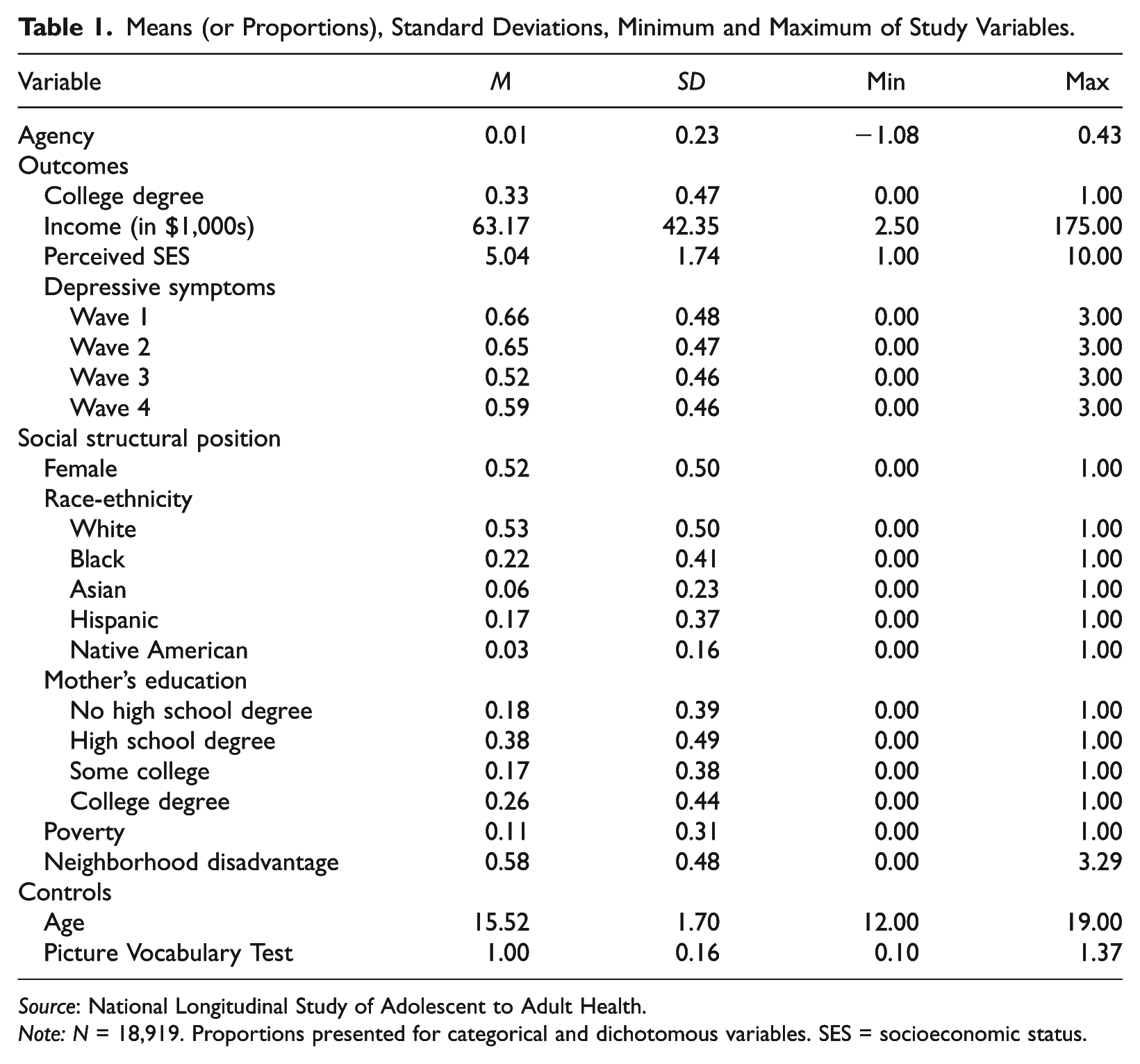
Source: National Longitudinal Study of Adolescent to Adult Health.
Note: N = 18,919. Proportions presented for categorical and dichotomous variables. SES = socioeconomic status.
Agency as a Longitudinal Predictor of Socioeconomic Outcomes
We begin with some simple regression analyses of important early adulthood outcomes regressed on health agency and some important structural controls. Hypothesis 1a, that agency predicts later socioeconomic outcomes (i.e., obtaining a college degree, income, and perceived SES), and Hypothesis 1b, that agency mediates the relationship between social structural variables (i.e., gender, race-ethnicity, mother’s education, poverty, and neighborhood disadvantage) and socioeconomic outcomes, are addressed in Table 2. We present two models for each outcome—college completion (logistic regression), income, and perceived socioeconomic status (ordinary least squares regression). The test of Hypothesis 1a is represented by the coefficient for agency in the second model for each outcome. A significant coefficient indicates support for the hypothesis. The test of Hypothesis 1b requires supplemental analyses that compare coefficients from the first model (i.e., without agency) and the second model. Support for this hypothesis is indicated by coefficients from the first and second model that are statistically different.
Agency as a Predictor of Education, Income, and Perceived SES.
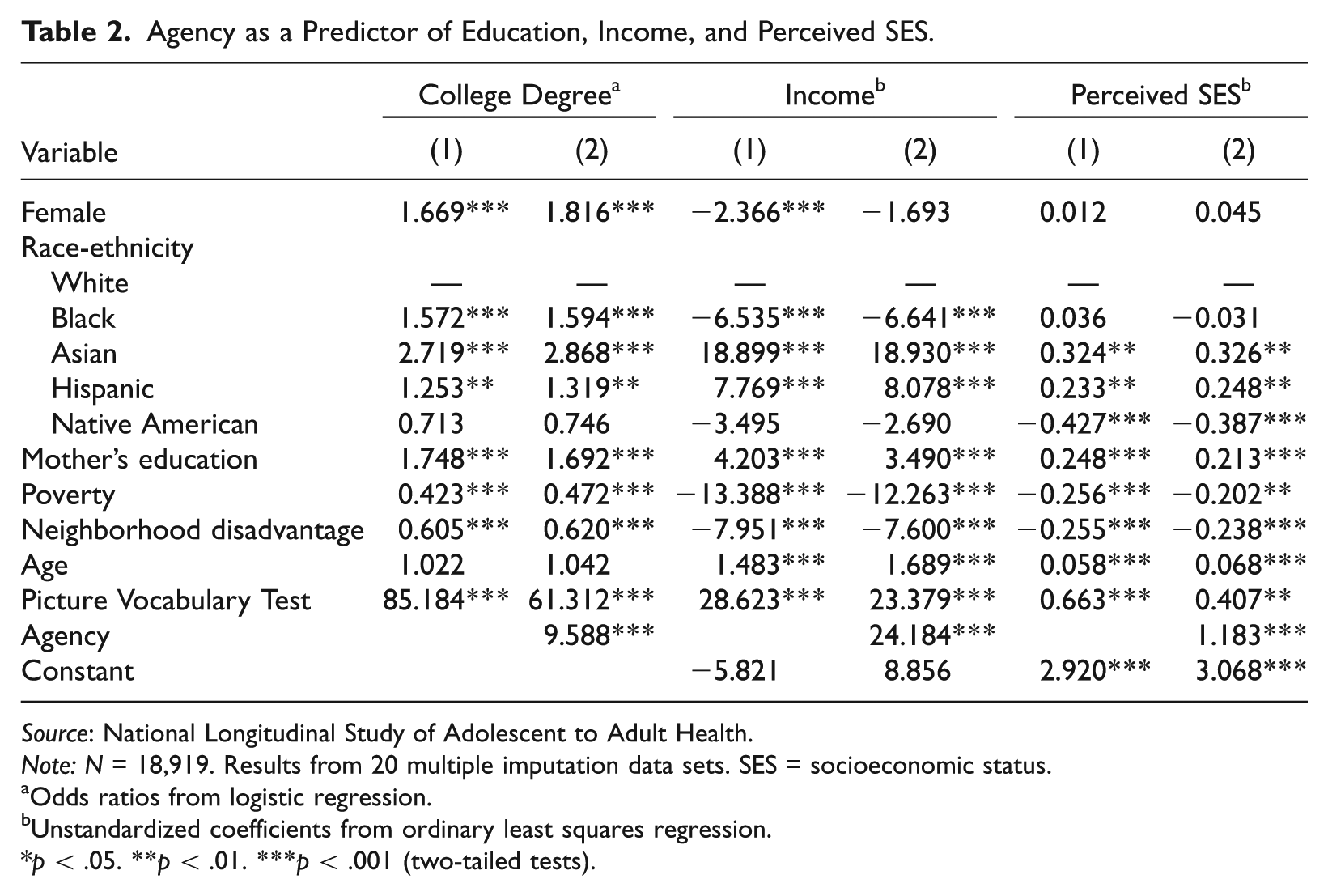
Source: National Longitudinal Study of Adolescent to Adult Health.
Note: N = 18,919. Results from 20 multiple imputation data sets. SES = socioeconomic status.
Odds ratios from logistic regression.
Unstandardized coefficients from ordinary least squares regression.
p < .05. **p < .01. ***p < .001 (two-tailed tests).
The results illustrate that our measure of agency has a strong, significant relationship to each outcome, providing support for Hypothesis 1a. A one-unit increase in agency—composed of subjective vitality and optimism—increases the odds of college completion by almost 9.5 percent, income by about $24,000, and perceived SES by 1.2 (on a 10-point scale). Three structural position variables—female, mother’s education, and poverty—were significantly different from the first and second models for all three outcomes, supporting Hypothesis 1b. The estimates for mother’s education and poverty were attenuated, suggesting that agency is part of the reason these structural positions are related to lower SES. The neighborhood disadvantage coefficient was attenuated for income and perceived SES but not college degree. The estimate of female for income was attenuated, but the college degree and perceived SES estimates became stronger. Although these differences deserve further examination, it may be that this pattern of differences is a result of women’s greater inroads into higher education but their continued lag behind men in earnings.
Depression
The relationship between depression growth curves and agency are presented in Table 3. This presents evidence for Hypothesis 2a, that agency is related to depression trajectories, and Hypothesis 2b, that agency mediates the relationship between social structural position and depression trajectories. Because trajectories are characterized by intercept and growth parameters, we estimate four models: the second contains the estimate of the relationship of agency and the depression intercept, the fourth the estimate of the relationship of agency and the growth of depression; and the first and third are the baseline models that are required to test whether agency mediates the relationship between the structural predictors and the intercept and growth of depression. Full support for Hypothesis 2b requires mediation of agency between the relationship of structural variables and both the intercept and growth parameters of depression.
Agency and Depression Growth Curves.

Source: National Longitudinal Study of Adolescent to Adult Health.
Note: N = 18,919. Results from 20 multiple imputation data sets.
p < .05. **p < .01. ***p < .001 (two-tailed tests).
The estimated growth parameters suggest that the average level of depression at the intercept, in these models specified as age 21.5, is just below 1 on the scale from 0 to 3. The coefficients for age and age squared indicate that there is a slightly negative trend in depression over time with a positive curvature. Figure 2 plots the estimated growth curves for depression with a 95 percent trajectory band. All covariates except neighborhood disadvantage are significantly related to the depression intercept. As expected, females had higher depression scores. Blacks, Native Americans, and Asians have higher depression than whites, while those who had higher PVT scores and more educated mothers experienced lower levels of depression.

Growth curves of depression with 95 percent confidence intervals.
Those who report higher levels of health agency have lower depression intercepts (Model 2) and increasing depression trajectories (Model 4). The negative relationship of agency with the depression intercept supports Hypothesis 2a, but the positive estimate of the relationship of agency with change in depression suggests an opposite relationship than that hypothesized. Despite the estimates of the growth parameters and agency being presented in Table 3, it is difficult to garner an intuitive sense for how agency is related to trajectories of depression. Consequently, we present estimates of depression trajectories in Figure 3 representing the estimated trajectories for the 20th, 50th, and 80th percentiles of agency (measured at Wave 1). There is a pattern of convergence across time. This is the essence of the agency paradox—that despite the positive relationship of agency and socioeconomic outcomes and the negative relationship with depression intercepts, higher early agency is related to an increasing experience of depression over time. We return to this paradox in the discussion.

Estimated trajectories of depression at 20th, 50th, and 80th percentile of agency.
We test Hypothesis 2b by examining changes in the predictors of the respective estimates of the relationship between the structural position and the depression intercept and growth. As with Hypothesis 2a, we consider the hypothesis supported if the coefficients for the covariates from the model without agency are significantly different from the model that includes agency. Tests of the intercept predictors across Model 1 and Model 2 result in support for Hypothesis 2b for female, mother’s education, and poverty. Each coefficient is statistically attenuated upon the introduction of agency as a predictor of the intercept, although the coefficients themselves remain significant predictors of the intercept and the attenuation is not substantial. The coefficients for race-ethnicity were not statistically attenuated. The corresponding tests for the predictors of growth in depression (i.e., comparing Model 3 and Model 4 predictors of growth) resulted in the same pattern of results. However, although the tests were significant, there was almost no identifiable change in the parameter estimates to the thousandths.
Conclusion: The Paradox of Health Agency
This paper demonstrates that a sense of health agency, measured in adolescence and incorporating aspects of subjective vitality and optimism, is a significant predictor of young adult status attainment and mental health 14 years later, lending credence to our contention that this theoretical construct and empirical measure is sociologically useful. We then examine health-based agency as a mediator between social structure and growth curve trajectories of depression, demonstrating that adolescent health-based agency is a factor, occasionally in an unexpected direction, influencing the transition to adulthood.
Our model of agency combines “subjective vitality” with a temporally based measure of optimism. Vitality is “enhanced by activities that satisfy basic psychological needs for relatedness, competence and autonomy” (Ryan and Deci 2008:702), theoretically supporting our empirical demonstration that these factors load onto a single, socially meaningful construct capturing a different social psychological constellation than the traditional mediating measure within the stress process literature, personal control. Vitality represents a health-related set of cognitions that, in our data, effectively predict later health (and stratification) outcomes, when coupled with optimism, an individual’s orientation toward life chances. Future work should engage the extent to which optimism, a social psychological aspect getting renewed attention in sociology (Frye 2012; Tavory and Eliasoph 2013), is anchored in conscious awareness of “privilege” versus temperamental differences. Health agency captures an intuitive sense of one’s subjective belief to handle the stresses of life, from both a physical and a psychological sense, that we demonstrate activates as an additional important sense of agency across the transition to adulthood.
This leads to a paradox: health-based agency functions differently instrumentally than it does emotionally. Adolescents’ structural position sets the stage for young adulthood and the transition to adult occupational roles. Our analysis suggests that there are systematic differences in how structural constraints lead to different perceptions of agency, which in turn have measurable effects on future achievement. However, perhaps paradoxically, our nationally representative sample demonstrates a slightly negative depression trajectory. Early-life structural locations, such as race, gender, and SES, influence the patterns of these trajectories, and some of these differences can be accounted for by the role of agency as a mediator between structural position and socioemotional functioning. It appears that if achievement does not reach expectations typical of one’s peers in similar structural locations—perhaps capturing a generational trend surrounding the disenchantment of the transition to adulthood—we see a convergence of outcomes, suggesting an aging effect that overshadows initial agentic levels. For example, black adolescents with higher levels of agency evidence a steeper increase in depression across this transition, perhaps demonstrating a lack of achieving previously valued life outcomes and perhaps unrealistically high initial aspirations (Johnson 2002). Obviously, future research needs to explore whether these trends continue in this fashion and how young adults revise their expectations in light of current experiences (Young 2006). It appears, however, that those with a high sense of agency refer back to the general trend of their age group when they face the various roadblocks endemic to social life.
Reynolds and Baird (2010) suggest that there are no emotional costs from unrealized educational achievement expectations, a domain-specific relative to our notion of generalized optimism. Our data show a slight but general trend of emotional costs across the transition to adulthood, with a peculiar relationship to initial senses of agency. Future research should examine the interaction between educational aspirations that end up being unrealized and other life course domains/plans/hopes that are achieved concurrently across a multifaceted human life. Theoretically, at least, people are reconstructing narratives that influence their senses of agency—which in turn become both a result of and a motivational force behind future achievement and emotional reactions (see Archer 2003). Increases in mental health are preceded by respondents’ sense of agency embedded in their self-narratives (Adler 2011); as people expressed themselves in terms of having more agency—defined as reports of self-sufficiency—as a result of psychological treatment, mental health improved.
Perhaps the largest drawback to our analyses is that the Add Health data do not contain contemporaneous measures of agency to be able to model their growth across this transition. The consistent reenvisioning of life goals during the life course, what Reynolds and Baird (2010) call “adaptive resilience,” likely underlies the associations we demonstrate. The moving target of one’s sense of self is a proximate factor to a variety of behavioral outcomes; our models demonstrate how this socially shaped self-representation, measured at a key junction in the American developmental life course, is related to social outcomes later on, setting an initial standard for making sense of later experiences and events in a complicated way. Research with data that have broader measures of expectations and aspirations (Morgan 2006) than Add Health would shed important light on these issues.
Future research should explore if our measure evidences this same decline over the life course, since older adults are, in fact, more optimistic (Carstensen et al. 2011), especially if they remain in good health (Shrira et al. 2011). After midlife, for example, self-perceptions of control decline with respect to health and cognitive domains, although those with stronger self-efficacy beliefs show fewer declines (Lachman 2006). We agree with Cockerham (2005) that understanding structure and agency are important for understanding health outcomes. We additionally cannot measure changes in this construct over time, given the Add Health data, though research suggests perceived control increases into early middle age (30–40), decreases until 60, then slightly increases again (Specht, Egloff, and Schmukle 2012).
We suggest that a sense of agency in adolescence leads to a life course paradox; it is important for understanding stratification outcomes as well as health and well-being outcomes (as cited, above), yet it appears to motivate greater downward shifts in depression for those who have a higher sense. A sense of health agency is both positive and negative, setting us up for success and health while at the same time being overridden by developmental factors—that future work will profitably unpack—across the transition to adulthood, such that people with varying senses of agency, initially, tend to cohere around age-specific senses of depression. Agency facilitates positive life outcomes but also appears to set up high expectations that may not be met as adolescents transition to adulthood. For those students who adopt an ideology of high attainment success, their eventual successes may not live up to the very initial optimism that contributed to motivating that attainment, leading to less positive feelings in early adulthood (Reynolds and Johnson 2011), though others suggest that general beliefs in the American ethos can buffer those with lower personal control from a sense of depression (Mirowsky, Ross, and Willigen 1996). Subjective senses of agency contribute to objectively higher attainment but set the stage for future lower subjective mental health outcomes.
Footnotes
Acknowledgements
Special acknowledgment is due to Ronald R. Rindfuss and Barbara Entwisle for assistance with the original design. Persons interested in obtaining data files from Add Health should contact Add Health, Carolina Population Center, 123. W. Franklin St., Chapel Hill, NC 27516-2524 ( ). The authors are greatly indebted to Matthew Andersson, Glen H. Elder Jr., and Monica Johnson for comments on earlier drafts of the paper.
Funding
The author(s) disclosed receipt of the following financial support for the research, authorship, and/or publication of this article: This research uses data from Add Health, a program project designed by J. Richard Udry, Peter S. Bearman, and Kathleen Mullan Harris and funded by a grant from the National Institute of Child Health and Development, 3P01 HD031928.