



Abstract
A popular image of Americans is that they are among the most individualistic people on the planet. This long-standing myth has informed theorizing about the sense of control and its relevance for stress and mental health. Prior claims have suggested that differences based on individualistic and collectivistic values contribute to group differences in the sense of control. We analyze data from the World Values Survey to test this hypothesis, focusing on a comparison of Americans and individuals in East Asian societies. Findings demonstrate that Asians report lower perceived control than Americans—but adjustments for individualistic values do not explain these differences. The positive association between individualistic values and perceived control is stronger among Asians compared to Americans. Perceived control is associated most strongly with subjective well-being for Americans, but individualistic values do not explain the differences. Our observations question claims that Americans gain more from individualistic values while Asians are sanctioned for them. Given its significance for stress and mental health, it is essential to document social patterns in the levels and effects of perceived control. We contribute to that effort by uncovering unexpected patterns that challenge the claim that individualistic values—and their benefits for control—are a quintessentially American thing.
A popular image of Americans is that they are among the most individualistic people on the planet. As Oyserman, Coon, and Kemmelmeir (2002:3) put it: “To contemporary Americans, being an individualist is not only a good thing; it is a quintessentially American thing.” This view of the “individualistic American” has a long history. In his book Democracy in America, de Tocqueville ([1835] 1969:508) characterized individualism as uniquely American: “Such folk owe no man anything and hardly expect anything from anybody. They form the habit of thinking of themselves in isolation and imagine that their whole destiny is in their own hands.” More than a century later in his classic The Organization Man, William H. Whyte (1956:4-5) echoed de Tocqueville’s depiction in describing the American ethos: “Ofall peoples it is we who have led in the public worship of individualism.” These deep currents ofAmerican individualism have powerfully informed theorizing about the sense of personal control and its special relevance for stress processes and mental health (Mirowsky and Ross 2003).
Mirowsky and Ross (2003:174) define the sense of personal control as “a learned, generalized expectation that outcomes are contingent on one’s own choices and actions.” Numerous other measures have been used in social-psychological research to tap the construct of the sense of control, including mastery (Pearlin and Schooler 1978), locus of control (Rotter 1966), personal autonomy (Seeman 1983), and instrumentalism (Wheaton 1980). Decades of research confirm that the sense of control is an influential psychological resource that mediates and/or moderates the association between stressors and well-being (Pearlin and Bierman 2013; Ross and Mirowsky 2013; Thoits 1995; Wheaton 1983). Individuals with a high sense of control perceive stressors to be less ominous, and the decreased threat suggests that they will try to solve or ameliorate problems rather than deny or avoid them. The sense of personal control is therefore considered among the most impactful self-concepts for personal functioning and well-being (Ross and Sastry 1999).
Given its significance for mental health, scholars have sought to document social patterns in the levels and effects of perceived control (Ross and Mirowsky 2013; Schieman and Narisada 2014). In a widely cited paper titled “Asian Ethnicity and the Sense of Personal Control,” Sastry and Ross (1998) provide one of the most intriguing investigations into this question, drawing particular attention to differences between Asians and non-Asians and emphasizing the potential influence of individualistic and collectivistic values orientations. Their findings demonstrate that: (1) Asians tend to report lower perceived control compared to non-Asians and (2) the negative association between perceived control and distress is weaker among Asians compared to non-Asians. Sastry and Ross (1998) proposed a “cultural differences” explanation for those observations, which argues that Asians’ endorsement of a collectivistic values orientation—and rejection of an individualistic one—tends to diminish perceived control and reduces its benefits for well-being: Findings are interpreted in terms of Asian collectivist values. Compared with individualistic Western cultures, Asian cultures emphasize selfless subordination to family and community, which may decrease levels of personal control . . . the dictates of collectivist cultures are such that high levels of personal control among Asians may be a norm violation. (P. 101)
Since the Sastry and Ross (1998) publication, to our knowledge no population-based research has evaluated the differences in the sense of control between Asians and non-Asians—and perhaps more importantly, none have explicitly tested the explanatory significance of group differences in individualistic and collectivistic values. We seek to dialogue with Sastry and Ross’s theoretical arguments, findings, and interpretations. In this effort, we analyze more recent versions of the same survey that they used in their analyses—the 2005-2009 and the 2010-2014 World Values Surveys (WVS)—and extend their approach by assessing the role of individualistic and collectivistic values for group differences in perceived control and its link to subjective well-being. 1 Specifically, we ask:
Research Question 1: Do individuals in Asian nations report lower perceived control compared to those in the United States? And if so, are those differences uniform across Asian groups?
Research Question 2: Do individualistic and collectivistic values contribute to any observed differences?
Research Question 3: Does the association between perceived control and subjective well-being—as measured by happiness and life satisfaction—differ for Asian groups compared to Americans net of individualistic and collectivistic values orientations?
We further extend prior research by also evaluating a new question: whether or not an individualistic values orientation is associated with perceived control differently across Asian groups compared to Americans.
Background
Classifications and Comparisons: Disentangling the “Asian Effect”
We begin with a description of how Sastry and Ross (1998) classified and compared Asians with non-Asians and then propose an alternative way of analyzing these groups. They compared a single Asian group comprised of residents of China, India, Japan, and South Korea to a group comprised of residents of countries in North America, Europe, and South America. Given that their aim was to investigate the impact of “common cultural elements” among Asians and non-Asians—the purportedly collectivistic versus individualistic values orientations, respectively—this classification scheme might seem reasonable. One concern, however, is that it obscures potential differences among Asian groups. If it is demonstrated that Asians have lower perceived control compared to non-Asians, this may be attributable to lower control among a few—but not all—groups within the broader Asian category. The same issue also applies to differences in individualistic and collectivistic values and differences in the link between perceived control and subjective well-being. Analyses should therefore be conducted in ways that reveal rather than mask or minimize any variations among the Asian groups. To accomplish this objective, our analyses separately compare individuals residing in China, Japan, South Korea, and Taiwan with those residing in the United States. 2
Do Differences in Individualistic Values Explain Group Differences in Perceived Control?
If individuals in Asian nations tend to report a lower sense of control compared to Americans, the question becomes—why? After Sastry and Ross (1998) observed that Asians as a group reported lower perceived control compared to non-Asians (net of adjustments for demographic characteristics and socioeconomic status), they then speculated that this was attributable to cultural differences; that is, they specifically proposed a cultural explanation for Asians’ lower sense of control based on the different levels, processes, and consequences of individualistic and collectivistic values orientations. They argued that Asians tend to be less individualistic and more collectivistic compared to Americans. That claim implies that if we statistically adjusted for individualistic and collectivistic values orientations, then we should account for any observed differences in the sense of control between Asians and Americans.
Researchers who investigate cross-cultural differences have articulated the distinctions between individualistic versus collectivistic values. At thecore of this distinction lies the contrast between an emphasis on independence and interdependence in relation to others. As Triandis (1995:10) contends: “Among individualists the self is defined independently of specific collectives,” but for “collectivists the self includes many of the attributes of the group a person belongs to.” An individualistic values orientation emphasizes the individual—with a focus on traits associated with autonomy, personal initiative, and self-fulfillment. This contrasts sharply with a collectivistic values orientation that emphasizes the collective—greater value is placed on a sense of duty to the in-group, group harmony, and the subordination of personal goals to the goals of the collective (Bellah et al. 1985; Hui 1988; Hui and Triandis 1986; Markus and Kitayama 1991; Triandis 1989, 1995).
A central assumption in prior research—and at the heart of this values-based explanation for group differences in perceived control—is that “Asian culture,” broadly speaking, tends to be less individualistic and more collectivistic relative to “Western culture” (Kitayama et al. 1997; Markus and Kitayama 1991; Oyserman et al. 2002; Triandis 1995). If this claim is accurate, then it should have implications for group differences in perceived control. Specifically, if “Westerners” emphasize values such as independence and self-fulfillment, then they may be more prone to attribute life outcomes to their own choices and actions (that is, a high sense of personal control). By contrast, if Asians are more likely to value a sense of duty to the group and defer to the goals of the collective, then they may perceive that life outcomes tend to be determined by others and not by themselves. These views predict that Asians should therefore report lower perceived control compared to non-Asians. Sastry and Ross (1998:103) wove these theoretical threads into their empirical predictions: “Because they are encouraged to subordinate their personal needs to the demands of the family or the traditional communities, Asians may perceive less freedom, less autonomy to further their own goals, and less ability to determine outcomes in their own lives.”
Some scholars have challenged claims about Asian and non-Asian differences in individualistic and collectivistic values orientations—and in doing so stimulate critical questions about its credibility as an explanation for Asian and non-Asian differences in perceived control. For example, scholars have questioned the validity of what Takano and Osaka (1999) call the “common view”—that is, the perspective that Japanese are less individualistic and more collectivistic compared to Americans. Empirical comparisons between the Japanese and Americans are illuminating because differences between them are frequently cited in influential scholarship on individualism and collectivism (e.g., Markus and Kitayama 1991; Triandis 1995). In one review, Takano and Osaka (1999) examined 15 studies that employed commonly accepted definitions of individualistic and collectivistic values orientations. Fourteen of those studies did not support the common view—9 studies found no difference between Japanese and Americans, and 5 found that the Japanese endorsed a more individualistic values orientation compared to Americans. According to the authors, the only study that supported the conventional view about the Japanese endorsing a more collectivistic values orientation was Hofstede’s (1980) study—and that report in turn subsequently generated extensive research on individualism and collectivism, despite the critical questions about its measurements and findings (see also Voronov and Singer 2002).
These findings are echoed by Matsumoto’s (1999) critical evaluation of Markus and Kitayama’s (1991) self-construal theory, which is fundamentally related to the ideas of individualism and collectivism. According to self-construal theory, individuals from Western cultures tend to have independent self-construals that identify the self as an autonomous and separate entity. By contrast, individuals from non-Western, primarily Asian cultures, have interdependent self-construals that characterize the self in terms of the connectedness with others. Matsumoto’s (1999) review of studies that compare Japanese and Americans found little evidence to support those theoretical claims. Similarly, in a replication of Asch’s (1956) classic experiment among Japanese participants, Takano and Sogon (2008) observe conformity rates similar to previous experiments with American participants. Collectively, these studies raise doubts about the common view that the Japanese are more likely than Americans to reject individualistic values in favor of collectivistic values.
These observations concur with Oyserman and colleagues’ (2002) comprehensive meta-analysis of research on individualism and collectivism. They argue that the lack of standard measurement has contributed to conflicting cross-national findings. Americans were found to be more individualistic than Asian groups, but the differences were not consistent. Differences among American, Japanese, and Korean comparisons were small, while differences among American, Chinese, and Taiwanese comparisons were greater. Likewise, the findings for collectivism were also mixed. Koreans were found to be as collectivistic as Americans, and the Japanese were actually less collectivistic than Americans. By contrast, moderate differences in collectivism were observed between Americans and Chinese, and large differences were observed between Americans and Taiwanese. Taken together, these assorted findings raise doubts about the claim that Asians—as a group—are uniformly less individualistic and more collectivistic than Americans. According to Oyserman and colleagues (2002:41), these patterns therefore underscore “the necessity of understanding differences between various Asian countries (see Dien, 1999) and resisting the implicit tendency found among American cultural psychologists to assume that all East Asians are the same [italics added].” 3
As we noted above, when Sastry and Ross (1998) observed that Asians reported a lower sense of control than non-Asians, they speculated that this pattern might be due to Asians’ tendency to reject an individualistic values orientation and endorse a collectivistic one. Their analyses, however, did not empirically evaluate the explanatory efficacy of values orientations. Our study therefore contributes in novel ways to this literature by explicitly testing these claims—while recognizing that the literature cited previously raises doubts that group differences in perceived control are due to differences in individualistic versus collectivistic values orientations. In empirical analyses, this “values orientation” hypothesis would be corroborated if (1) Asians are less likely than Americans to endorse an individualistic values orientation and (2) statistically adjusting for an individualistic values orientation in turn accounts for Asians’ lower levels of the sense of control. In the Measurement section, we will describe in extensive detail the conceptualization and assessment of individualistic and collectivistic values.
Sanctioned for Having a High Sense of Control? The Link with Well-being
The assessment of group differences in perceived control is only one part of the puzzle. Sastry and Ross (1998) also investigated whether the relationship between perceived control and well-being differed for Asians compared to non-Asians. They observed that perceived control had a weaker association with psychological distress among Asians. In reflecting on their rationale, they argued that because the sense of personal control is a “Western value,” having a high sense of control might have a weaker connection to emotional well-being among Asians: Failure to achieve personal goals may be less important because individuals are encouraged to subordinate their own needs to those of the group. Not only are these individuals rewarded for fulfilling their obligations to community and family; individuals who pursue individual autonomy and who strive to meet their personal goals may be punished. Compared with those in individualistic cultures, persons in collectivist cultures may derive less benefit to well-being from a high sense of personal control. (P. 103)
A related explanation is that the sense of personal control—on its own—is beneficial for Asians’ well-being but that Asians may encounter what is labeled a “cultural trade-off” that diminishes its benefits. Sastry and Ross (1998:116) elaborate on the implications of this idea for their specific empirical predictions: “Although the sense of control may be effective, persons of Asian ethnicity may be negatively sanctioned [italics added] for pursuing individual self-interests. . . . Thus, high levels of personal control could involve trade-offs for Asians’ psychological well-being, producing a null or a smaller effect.”
These explanations rely on the assumption that Asians are less likely than Americans to endorse an individualistic values orientation—but that remains an open question. Because Sastry and Ross (1998) did not assess individualistic and collectivistic values, it is unclear if differences in values orientations contribute to an expected weaker relationship between personal control and well-being among Asians. To our knowledge, no population-based research has explicitly examined the relationship between perceived control and well-being among Asians and comparison groups—while accounting for the potential influence of values orientations. We therefore first examine whether the relationship between perceived control and subjective well-being is weaker or negative among Asian groups compared to Americans. Then, we extend prior research by testing whether the adjustment for individualistic values contributes to that pattern.
A New Extension: The Relationship between Individualistic Values and Perceived Control
In defining the parameters of our analysis, we realized an opportunity to ask a new question that advances prior knowledge: What is the relationship between an individualistic values orientation and the sense of control—and does it differ between Asians and Americans? Our motivation for this expansion originates from speculative points presented in prior literature. For example, while Sastry and Ross (1998) did not examine the link between individualistic values and perceived control, we surmise that it was an underlying feature of their argument. When they observed that the relationship between perceived control and distress was weaker for Asians compared to non-Asians, their interpretation was that because personal control is a Western value, Asians might be “sanctioned” for having high levels of it. We extrapolate from that argument a rationale for testing the relationship between individualistic values and perceived control. If an individualistic values orientation is a “quintessentially American thing”—as Oyserman and colleagues (2002:3) have noted as a pervasive view—then Asians who endorse individualistic values might be sanctioned. If that scenario were true, the association between individualistic values and the sense of control may be weak or even negative among Asian groups. By contrast, if the endorsement of individualistic values is consistent with Western norms and deeply embedded in the American ethos, then the relationship between individualistic values and sense of control should be stronger for Americans.
Summary of Hypotheses
Based on the ideas and evidence described previously, we test the following hypotheses:
Hypothesis 1: Following from Sastry and Ross’s (1998) original prediction and findings, Asians should tend to report a lower sense of control compared to Americans (although our analyses goes further by disaggregating the “Asian” category for more precise comparisons).
Hypothesis 1A: Differences in individualistic/collectivistic values should account for Asian groups’ lower sense of control. Support for this hypothesis requires that: (a) Asian groups are less likely to endorse individualistic values than Americans and (b) groups who more strongly endorse individualistic values should tend to report a greater sense of control.
Hypothesis 2: The relationship between individualistic values and perceived control should be more positive among Americans and weaker or negative among Asian groups.
Hypothesis 3: The relationship between the sense of control and two indicators of subjective well-being—happiness and life satisfaction—should be more positive among Americans and weaker or negative among Asian groups.
Hypothesis 3A: The statistical adjustment for individualistic values should contribute to the size of the interaction effects predicted in Hypothesis 3.
Methods
Sample
To test our hypotheses, we use data from two cross-sectional waves of WVS. Wave 5 was collected between 2005 and 2009, and Wave 6 was collected between 2010 and 2014. To date, a total of six waves of WVS data have been collected; however, only Waves 5 and 6 contain the questions about individualistic and collectivistic values. The official online documentation provided by the WVS describes the survey as follows: “The WVS consists of nationally representative surveys conducted in almost 100 countries which contain almost 90 percent of the world’s population, using a common questionnaire. The WVS is the largest non-commercial, cross-national, time-series investigation of human beliefs and values ever executed, currently including interviews with almost 400,000 respondents” (for the full documentation, see http://www.worldvaluessurvey.org/WVSContents.jsp). Principal investigators in each country are responsible for translating the English questionnaire into local languages and then administering them to a nationally representative sample of adults aged 18 and over. The quality of the samples varies by country because of differences in infrastructure and capability in collecting nationally representative data (Sastry and Ross 1998). To address this problem, samples are corrected for small deviations in the distribution of demographic characteristics (e.g., gender, age, education) compared to their respective populations by applying the sampling weights created by the WVS team. For our analyses, we compare four Asian groups—Chinese (n= 3,061), Japanese (n = 2,403), South Korean (n = 2,342), and Taiwanese (n = 2,329)—with Americans (n = 3,258). 4
Measures
The Sense of Personal Control
We evaluate responses to the following item: “Some people feel they have completely free choice and control over their lives, while other people feel that what they do has no real effect on what happens to them. Please use this scale where 1 means “no choice at all” and 10 means “a great deal of choice” to indicate how much freedom of choice and control you feel over the way your life turns out.” This is the same item that Sastry and Ross (1998) analyzed and has appeared in other recently published studies (Corcoran, Pettinicchio, and Young 2015; Welzel and Inglehart 2010). As a global indicator, this single item taps the general theme of agency that is found in constructs of the sense of personal control (Pearlin and Schooler 1978; Ross and Mirowsky 2013).
Subjective Well-being
We analyze two commonly used indicators of subjective well-being (SWB). The first indicator is happiness: “Taking all things together, would you say you are _____.” Response choices are: very happy (1), rather happy (2), not very happy (3), and not at all happy (4). We reverse coded the item so that higher scores indicate more happiness. The second indicator is life satisfaction: “All things considered, how satisfied are you with life as a whole these days?” Response choices are coded on a 10-point scale from completely dissatisfied (1) to completely satisfied (10). Similar single-item indicators have frequently been analyzed in recently published studies on happiness (Borgonovi 2008; Haller and Hadler 2006; Lam, Fan, and Moen 2014; Lam and Liu 2014) and life satisfaction (Bonini 2008; Li and Bond 2010; Selim 2008).
Individualistic Values
Individualistic and collectivistic orientations have been assessed in a number of different ways (Oyserman et al. 2002). Despite these differences, at the core lies the fundamental contrast between an orientation that focuses on the individual and one that focuses on the collective. Fortunately, the two most recent waves of the WVS included items that are derived from Schwartz’s theory of values, which has rich theoretical linkages to these orientations. Given the centrality of this complex measure, we believe it is essential here to provide detailed background context. In doing so, we describe the components of Schwartz’s value theory, its connection to individualistic and collectivistic values, and the specific items that we use to create the measure.
According to Schwartz (2007:173), values are “desirable, trans-situational goals, varying in importance, that serve as guiding principles in people’s lives.” Schwartz’s theory stipulates a typology of human values and the structural relationships among them. The theory identifies the following 10 motivationally distinct human values: self-direction, stimulation, hedonism, tradition, conformity, security, achievement, power, benevolence, and universalism. The relationships among these values are expressed in a circular structure, whereby adjacent values are compatible while opposing values are conflicting. For instance, the structure places tradition and conformity adjacent to each other as these values share emphases on “subordination of self in favor of socially imposed expectations” (Schwartz 2012:9). The values of tradition and conformity, however, are placed on the opposite side of stimulation, which emphasizes “excitement, novelty, and challenge in life” (Schwartz 2012:5). The relative placement of tradition, conformity, and stimulation in the value structure therefore reflects the fact that individuals adhering to tradition and conformity often forgo an emphasis on stimulation (and vice versa). The presence of these 10 values and the complex patterns of structural relationships among them have been confirmed in hundreds of samples from 82 countries (Schwartz 2012).
Based on this structure of values, Schwartz identifies two bipolar dimensions, one of which is termed openness to change versus conservation. Openness to change is represented by self-direction and stimulation—values that emphasize independence, choosing one’s own goals, and excitement, novelty, and challenge in life. By contrast, conservation is represented by tradition, conformity, and security—values that emphasize respect for one’s tradition and customs, behavior that is consistent with social expectations and norms, harmony, and the stability of relationships (Schwartz 2012). The dimension is characterized as “bipolar” because an emphasis on openness to change values conflicts with an emphasis on conservation values. Scholars have noted the similarities with individualistic versus collectivistic values. For example, Gheorghiu, Vignoles, and Smith (2009) use the openness to change versus conservation dimension to assess independence and interdependence. Likewise, Welzel (2013) characterizes the contrast between the values of self-direction/stimulation and conformity/security as analogous to the contrast between individualistic and collectivistic values.
With these ideas as our rationale, we use the openness to change versus conservation dimension to assess individualistic and collectivistic values orientations. To construct the measure, we use the condensed version of the Schwartz’s Portrait Values Questionnaire (PVQ) that is included in Waves 5 and 6 of the WVS. These WVS items have been used in recently published research to assess Schwartz’s openness to change versus conversation dimension (e.g., Malka et al. 2014) and are part of the widely used European Social Survey’s 21-item version of the PVQ (e.g., Bilsky, Janik, and Schwartz 2011; Davidov, Schmidt, and Schwartz 2008; Gheorghiu et al. 2009; Miles 2015).
Three items assess individualistic values. The first is self-direction: “It is important to this person to think up new ideas and be creative; to do things one’s own way.” The second is stimulation: “Adventure and taking risks are important to this person; to have an exciting life.” The third is hedonism: “It is important to this person to have a good time; to “spoil” oneself.” 5 The response choices are: (1) very much like me, (2) like me, (3) somewhat like me, (4) a little like me, (5) not like me, and (6) not at all like me. We reverse-coded the items such that higher scores indicate a stronger endorsement of an individualistic values orientation. By contrast, three other items assess collectivistic values. The first is tradition: “Tradition is important to this person; to follow the customs handed down by one’s religion or family.” The second is conformity: “It is important to this person to always behave properly; to avoid doing anything people would say is wrong.” The third is security: “Living in secure surroundings is important to this person; to avoid anything that might be dangerous.” The same “like me/not like me” response choices described previously are also used for these items. We reverse-coded these items such that higher scores indicate a stronger endorsement of a collectivistic values orientation.
The results from factor analyses indicate that self-direction, stimulation, and hedonism load on one factor, while tradition, conformity, and security load on a separate second factor. Based on these results, we averaged the self-direction, stimulation, and hedonism items to create the individualistic values index (α = .56), where higher scores indicate more individualistic values. Similarly, we averaged the tradition, conformity, and security items to create the collectivistic values index (α = .58), where higher scores indicate more collectivistic values. Following the procedures used by Schwartz and others (e.g., Gheorghiu et al. 2009), we then subtracted the collectivistic values index from the individualistic values index. 6 Higher values on this scale therefore represent the relative priority that a study participant places on individualistic values as opposed to collectivistic values and ranges from −5 (maximum collectivistic values orientation) to +5 (maximum individualistic values orientation).
Schwartz’s theory underscores the relative importance of certain values over others. The measures must therefore be constructed in a way that reflects value priorities. In the present study, the subtraction of the collectivistic values index from the individualistic values index captures the relative priority that a study participant places on individualistic values over collectivistic values. For instance, if a study participant has a mean score of 5 for the individualistic values and a mean score of 2 for the collectivistic values, then the individual will have a score of +3 on the individualistic-collectivistic values dimension, reflecting higher relative endorsement of individualistic values. Note also that because the theory stipulates that the values of self-direction, stimulation, and hedonism are in conflict with the values of tradition, conformity, and security, this implies that an individual cannot be maximally individualistic and maximally collectivistic at the same time. For example, if a study participant reports very much like me for all of the items, the interpretation is that the participant has an acquiescent response tendency regardless of item content and is given a score of 0 on the scale. Because higher scores on the scale reflect the relative endorsement of individualistic values, for shorthand in our analyses we simply label this individualistic values.
Control Variables
We adjust for the following sociodemographic and socioeconomic variables because prior research has demonstrated their relationship to perceived control (Ross and Mirowsky 2013; Schieman and Plickert 2008): gender, age, marital status, employment status, education, income, and financial strain. Men are coded 0, and women are coded 1. Age is coded in years. Married individuals and those “living together as married” are coded 1, and all others are coded 0. Employed individuals are coded 1, and unemployed individuals are coded 0. Individuals with less than a university degree are coded 0, and those with a university degree or higher are coded 1. To measure relative income, study participants were asked: On this card is a scale of incomes on which 1 indicates the “lowest income decile” and 10 the “highest income decile” in your country. We would like to know in what group your household is. Please, specify the appropriate number, counting all wages, salaries, pensions and other incomes that come in.
7
Along with income, we adjust for a measure of financial strain, which asks: “During the past year did your family: (1) save money; (2) just get by; (3) spent some savings; (4) spent savings and borrowed money.” We coded financial strain as a categorical measure, with “save money” as the reference group. All analyses also adjust for the WVS wave (0 = Wave 5 and 1 = Wave 6).
Plan of Analyses
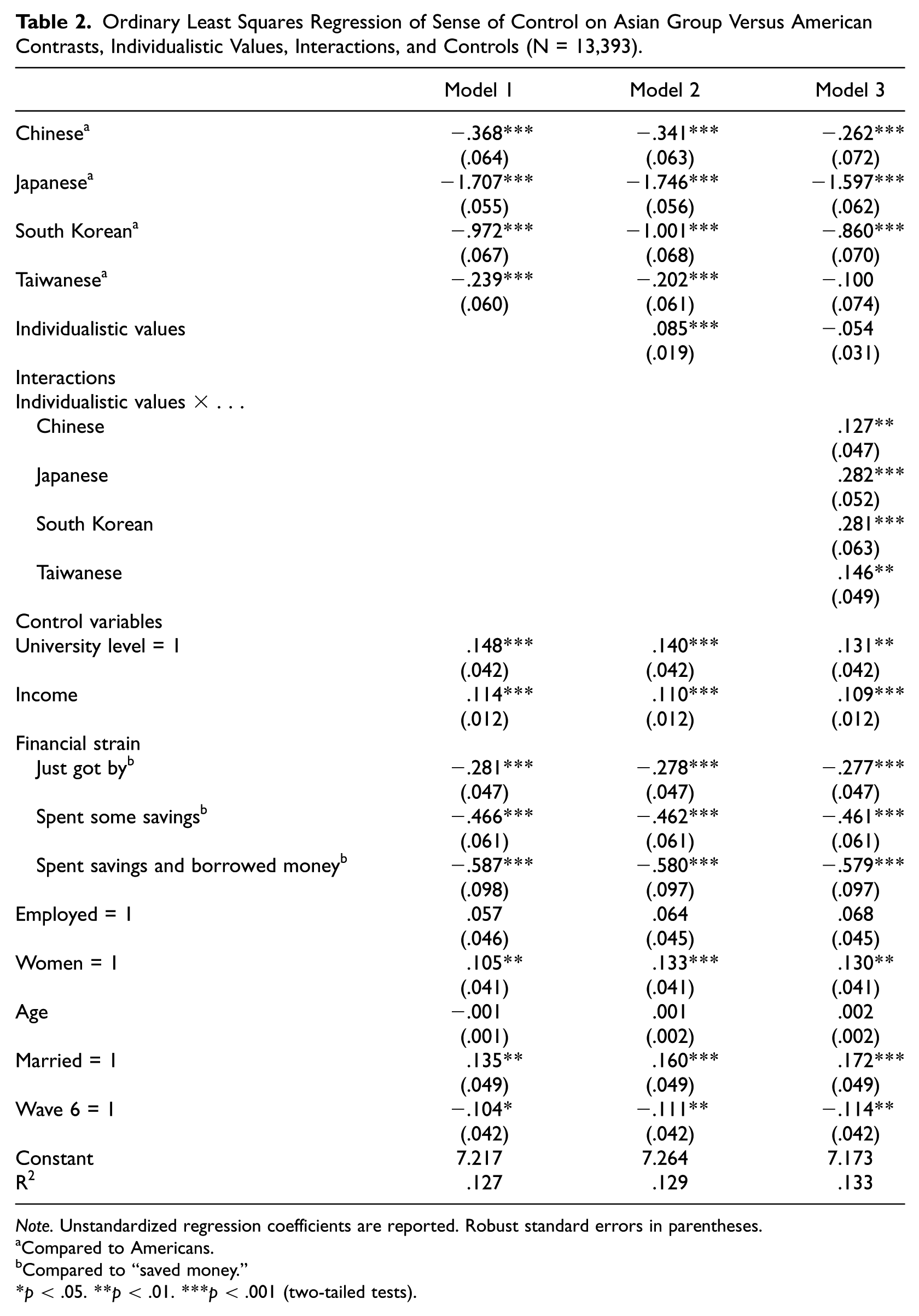
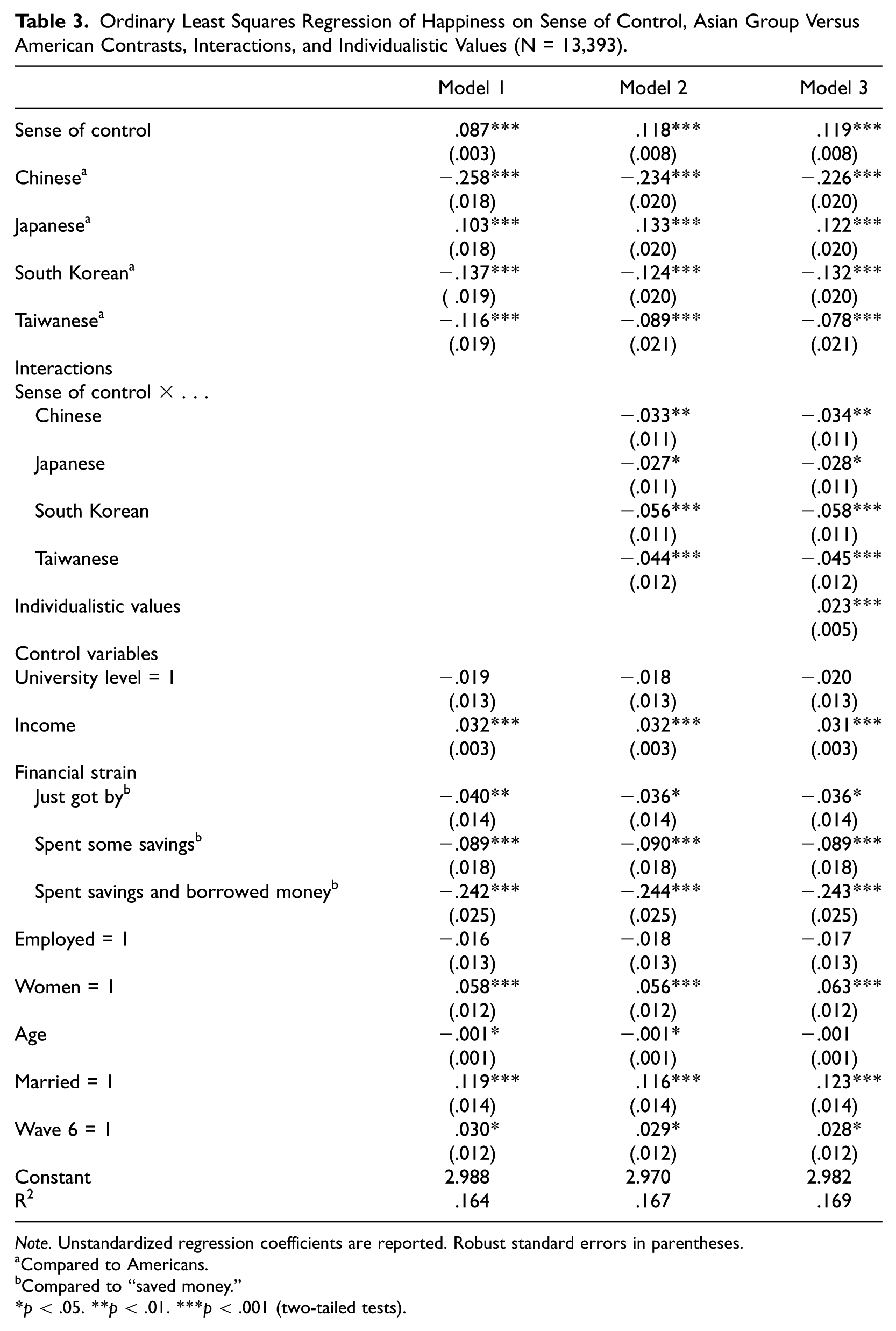
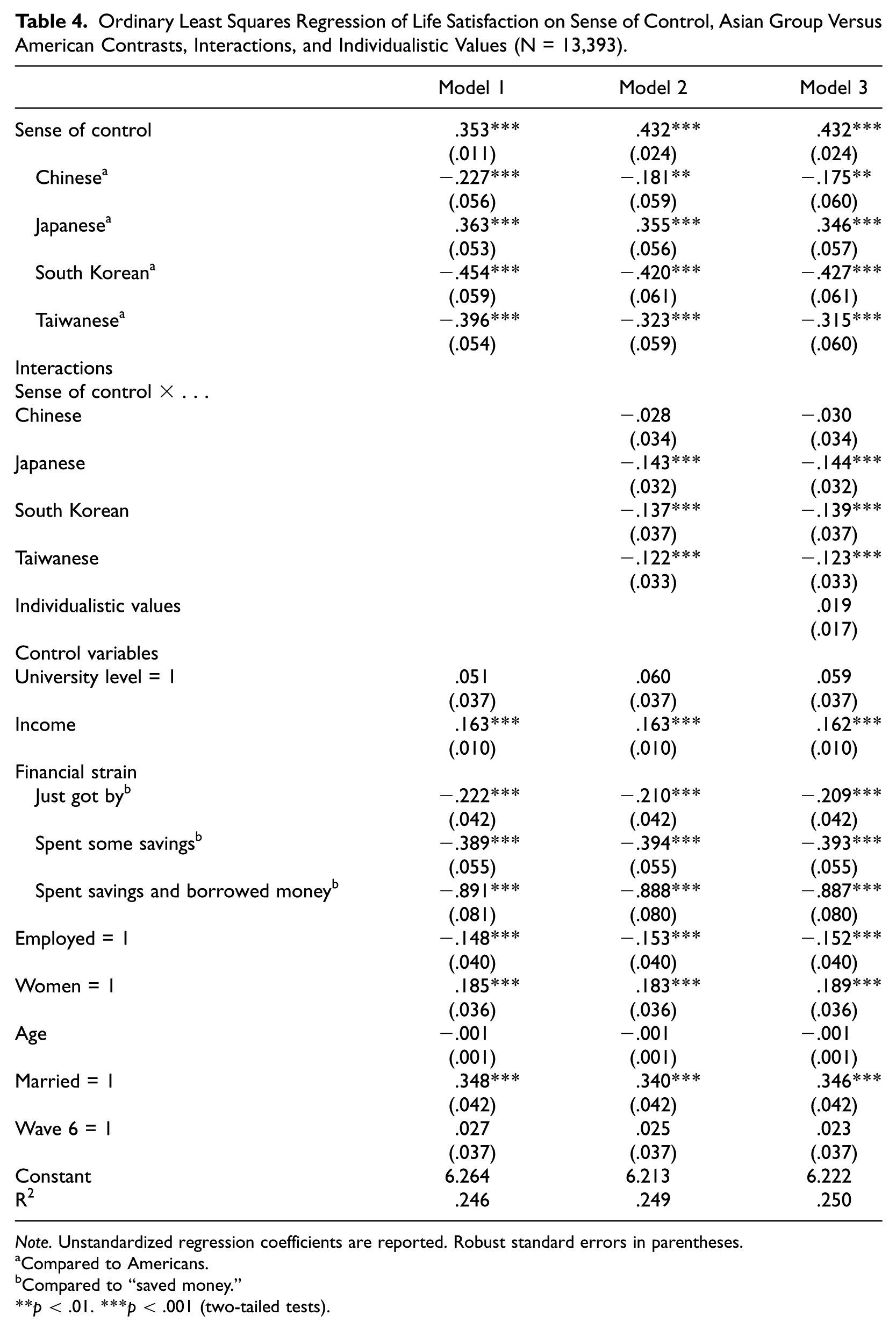
After presenting descriptive statistics in Table 1, we report three sets of results for perceived control (Table 2), happiness (Table 3), and life satisfaction (Table 4) as the focal dependent variables. We use ordinary least squares (OLS) regression for all analyses.8,9 In the analysis of perceived control in Table 2, Model 1 tests Hypothesis 1 by comparing levels of perceived control for individuals from different Asian nations with Americans, net of control variables. Model 2 tests Hypothesis 1A by adjusting for individualistic values and examining whether any group differences in Model 1 are attenuated. In Model 3, we assess Hypothesis 2—group differences in the association between individualistic values and perceived control—by adding interaction terms between perceived control and each Asian group. For the analysis of happiness in Table 3, we report three models. Model 1 tests the association between perceived control and happiness, net of the control variables. We assess Hypothesis 3 by adding interaction terms between each Asian group and perceived control (Model 2) and then assess Hypothesis 3A by adjusting for individualistic values (Models 3). We repeat these procedures for life satisfaction in Table 4.
Descriptive Statistics for Total Sample: Means/Proportions, Standard Deviations, and Range (N = 13,393).

Note. Proportions for dichotomous variables, means for continuous variables (with standard deviations).
p < .05. **p < .01. ***p < .001 (two tailed t tests for comparisons between Americans and each Asian group).
Ordinary Least Squares Regression of Sense of Control on Asian Group Versus American Contrasts, Individualistic Values, Interactions, and Controls (N = 13,393).
Note. Unstandardized regression coefficients are reported. Robust standard errors in parentheses.
Compared to Americans.
Compared to “saved money.”
p < .05. **p < .01. ***p < .001 (two-tailed tests).
Ordinary Least Squares Regression of Happiness on Sense of Control, Asian Group Versus American Contrasts, Interactions, and Individualistic Values (N = 13,393).
Note. Unstandardized regression coefficients are reported. Robust standard errors in parentheses.
Compared to Americans.
Compared to “saved money.”
p < .05. **p < .01. ***p < .001 (two-tailed tests).
Ordinary Least Squares Regression of Life Satisfaction on Sense of Control, Asian Group Versus American Contrasts, Interactions, and Individualistic Values (N = 13,393).
Note. Unstandardized regression coefficients are reported. Robust standard errors in parentheses.
Compared to Americans.
Compared to “saved money.”
p < .01. ***p < .001 (two-tailed tests).
Results
Descriptive Statistics
Before reporting the findings for our hypotheses tests, we describe two of the main patterns among the bivariate descriptive comparisons shown in Table 1. First, compared to Americans, all Asian groups report lower average levels of perceived control—although, as we detail in the following, the size of those differences varies across Asian groups. Second, for the comparisons of individualistic values, we observe that the Chinese and Taiwanese report lower mean scores compared to Americans. By contrast, however, the Japanese and Koreans have higher mean scores on individualistic values compared to Americans. This pattern suggests that Asians do not conform to the prediction that they are uniformly less likely than Americans to endorse individualistic values. In addition, Americans tend to report higher average levels of happiness and life satisfaction compared to the Asian groups.
Group Differences in Perceived Control and the Influence of Individualistic Values
In Table 2, we report the multivariate models predicting perceived control. Model 1 confirms what the bivariate comparisons indicated: All Asian groups have significantly lower average levels of perceived control compared to Americans—and these differences in perceived control are not uniform across groups. To cite one set of comparisons, the difference in perceived control between the Japanese and Americans is 1.707 (p < .001); by contrast, the difference in perceived control between the Chinese and Americans is only .368 (p < .001). Additional analyses (not shown) indicate that there are also statistically significant differences in average levels of perceived control among Asian groups. While the Chinese and Taiwanese do not differ in perceived control, both groups do have higher levels than the Japanese (p < .001) and the South Koreans (p < .001). Moreover, the South Koreans report higher perceived control than the Japanese (p < .001). Taken together, our findings indicate that if we had created a single Asian category that combined all groups and then compared them to Americans, we would have overestimated the relative level of perceived control among the Japanese and South Koreans and underestimated it among the Chinese and the Taiwanese. Collectively, these patterns support Hypothesis 1 and concur with Sastry and Ross’s (1998) findings: Asians tend to report lower perceived control compared to Americans, but disaggregating the Asian category adds precision.
In Model 2, we appraise group differences in perceived control after taking into account individualistic values. First, we document that an individualistic values orientation is associated positively with perceived control. However, this statistical adjustment does not account for the lower average perceived control among Asian groups compared to Americans. These observations encourage the rejection of Hypothesis 1A—that is, we find no evidence that group differences in individualistic values contribute to group differences in perceived control. In other words, our results challenge prior claims in the literature that Asians tend to report a lower sense of personal control than Americans because of Asians’ greater tendency to reject an individualistic values orientation. These findings are consistent with the patterns in Table 1: Asian groups do not uniformly report less individualistic values compared to Americans.
In Model 3, we evaluate the novel question of whether individualistic values are associated with perceived control differently for Asian groups compared to Americans. The positive interaction coefficients indicate that individualistic values are more positively associated with perceived control among the Chinese, Japanese, South Koreans, and Taiwanese compared to Americans. Additional analyses (not shown) find that the slopes for the effect of individualistic values are significantly different from zero for all Asian groups: Chinese (p < .05), Japanese (p < .001), South Koreans (p < .001), and Taiwanese (p < .05). Figure 1 illustrates the predicted values from these sets of interaction coefficients. At lower scores on the individualistic values index, Asian groups tend to have lower perceived control than Americans; however, at higher scores on the individualistic values index, levels of perceived control tend to converge between the Asian groups and Americans. Taken together, our observations do not support Hypothesis 2: Contrary to the hypothesis that Asian groups should tend to benefit less—or even be sanctioned—by endorsing individualistic values compared to Americans, our findings demonstrate that Asian groups tend to benefit more from individualistic values. 10

Individualistic values and sense of control.
Group Differences in the Association between Perceived Control and Well-being
The models in Tables 3 and 4 evaluate whether the relationship between the sense of control and subjective well-being differs for Asian groups compared to Americans.
Happiness
In Table 3, Model 1 shows that the sense of control is associated with higher levels of happiness. The interaction terms shown in Model 2, however, indicate that the association between the sense of control and happiness is weaker for all Asian groups compared to Americans. These patterns support Hypothesis 3 and are consistent with the patterns reported by Sastry and Ross (1998). It is also especially noteworthy that the estimates reported in Model 2 remain remarkably stable in Model 3 with the adjustment for individualistic values. This finding negates the claim that group differences in individualistic values contribute to group differences in the relationship between perceived control and happiness. 11 Figure 2 illustrates the predicted values from these sets of interaction coefficients in Model 3, showing that perceived control is most strongly associated with levels of happiness among Americans. At the same time, it is also noteworthy that the slopes representing the effect of perceived control for all Asian groups are also positive and significantly different from zero (p < .001 across all Asian groups).

Sense of control and happiness.
Life satisfaction
The results from analyses of life satisfaction reported in Table 4 are similar to those observed for happiness. First, Model 1 indicates that perceived control is associated with higher levels of life satisfaction. In Model 2, the interaction terms indicate that the association between perceived control and life satisfaction is weaker for all Asian groups—with one exception: The association between perceived control and life satisfaction is not statistically different between the Chinese and Americans. Moreover, the patterns shown in Model 2 hold steady after adjustment for individualistic values in Model 3; that is not surprising given that individualistic values are unrelated to life satisfaction. Figure 3 illustrates the predicted values from the sets of interaction coefficients in Model 3. The association between perceived control and life satisfaction is strongest for Americans. Once again, however, the slopes for the perceived control effect are also positive for Asian groups; additional analyses indicate that these slopes are significantly different from zero (p < .001 for all Asian groups).
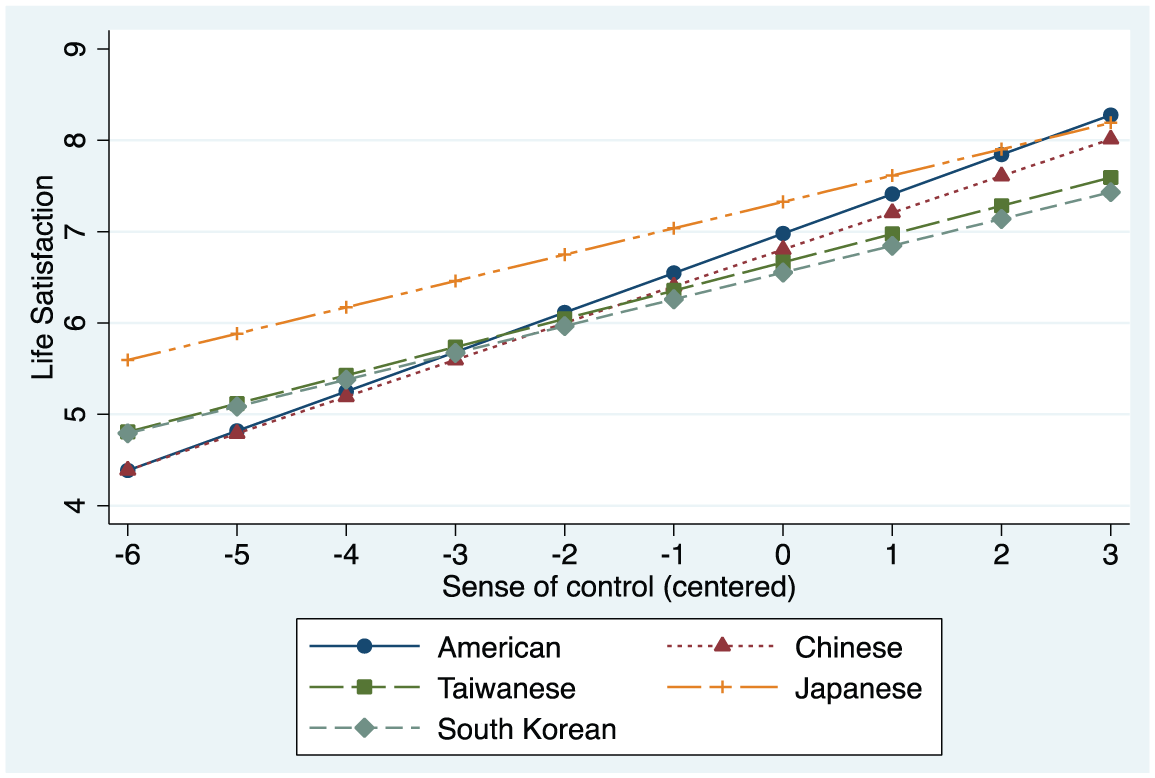
Sense of control and life satisfaction.
Discussion
It is commonly assumed that being an individualist is a “quintessentially American thing” (Oyserman et al. 2002:3). This enduring image of the “individualistic American” has contributed to theorizing about the sense of personal control and its uneven distribution across social groups. Starting from this standpoint, we sought to integrate the insights and interpretations articulated by Sastry and Ross (1998) in their study, “Asian Ethnicity and the Sense of Control,” to evaluate a particular set of comparisons between different Asian groups and Americans. We wish to emphasize that our efforts were not intended to represent a pure replication of their analyses. We have instead sought to elaborate on their ideas and discoveries while assimilating other pertinent literatures to provide a novel test of claims about individualistic values orientations.
The main contribution of our study is the investigation of the supposition that Asian groups are less likely to endorse an individualistic values orientation, which in turn should account for Asian groups’ lower sense of control relative to Americans. Our findings negate that view. While our results indicate that Chinese and Taiwanese respondents are less likely than Americans to endorse an individualistic values orientation, we also observe that Japanese and South Korean respondents are more likely to endorse individualistic values than Americans. Accordingly, our findings demonstrate that individualistic values did not account for lower perceived control among Asian groups—rather, each Asian group reported lower average levels of perceived control than Americans after we accounted for individualistic values. Taken together, while our observations concur with Sastry and Ross’s finding that Asian groups tend to report lower perceived control, our results also contest the assertion that group differences in individualistic values denote an influential basis for group differences in perceived control.
Consistent with Sastry and Ross (1998), we found that the positive association between perceived control and two indicators of subjective well-being—happiness and life satisfaction—is generally weaker among Asian groups compared to Americans. However, the adjustment for individualistic values did not contribute to explaining these differences. It is noteworthy that while perceived control is more strongly associated with happiness and life satisfaction for Americans, the perceived control slopes for all Asian groups are all positive, indicating that Asian groups actually do benefit from having a higher sense of control—but not to the same extent that Americans appear to benefit. Our findings therefore challenge past interpretations that suggested Asians are sanctioned or punished for having a high sense of personal control. If that were the case, it seems more likely that we would have observed a negative (or at least a null) association between perceived control and well-being among Asian groups.
As a new extension to prior research, we also sought to evaluate whether or not an individualistic values orientation conditioned group differences in perceived control. Once again, we drew our motivating theoretical rationale from the assertion by Sastry and Ross (1998:115) that “[t]he more individualistic cultures, such as those in the West, encourage individuals to pursue goals; this cultural trait increases Westerners’ autonomy.” Referring specifically to “Eastern cultures,” Sastry and Ross also argued that “individuals who pursue individual autonomy and who strive to meet their personal goals may be punished” (p. 103). We interpreted those statements to imply that an individualistic values orientation should be more weakly associated with sense of control among Asians. Contrary to that prediction, however, we found that the endorsement of individualistic values had stronger positive associations with perceived control among all Asian groups compared to Americans. These findings challenge the hypothesis that Asians are sanctioned or punished for endorsing individualistic values. The opposite pattern is evident: Our observations demonstrate that individualistic values are more strongly coupled with levels of the sense of personal control among the Asian groups relative to Americans.
Before concluding, several study limitations require discussion. First, the WVS contains only a single-item measure of the sense of control; we acknowledge that multiple items are ideal. Future studies should therefore assess whether the patterns replicate with more reliable measures (e.g., the Mirowsky and Ross 1991 sense of control index). We also recognize that evaluating an index of psychological distress would have been more ideal. In their analyses of the WVS, Sastry and Ross (1998) assessed the Bradburn Affect Balance Scale as a dependent measure. While Waves 5 and 6 of the WVS did not include the Bradburn Scale, they do contain standard indicators of happiness and life satisfaction. These items have been frequently used in cross-cultural or comparative research and are substantively justified on the grounds that “[w]ell-being and distress are opposite ends of the same continuum: more well-being means less distress and more distress means less well-being” (Mirowsky and Ross 2003:26).
Another potential limitation of our study involves the operationalization of individualistic and collectivistic values. Our approach sought tocarefully conform to standard conventions ina fairly expansive literature to create these measures—nonetheless, we recognize some concerns. First, Schwartz’s openness to change versus conservation dimension, which we used to assess individualistic and collectivistic values, has been operationalized with more items in surveys such as the European Social Survey. Future research should seek to replicate our findings with a broader set of Schwartz’s items that might improve overall reliability. Second, it is important to acknowledge that Schwartz’s method represents only one approach to assessing individualistic and collectivistic values orientations. New analyses might test if our findings replicate using other indicators. These are the typical limitations of using secondary data. In its defense, however, to our knowledge the WVS is the only available data set that provides for comparisons in the sense of control among nationally representative samples of Americans and Asian groups—and has decent measures of individualistic and collectivistic values. Nonetheless, our study should be seen as a preliminary starting point for more rigorous inquiry about the relevance of individualistic values for group differences in: (a) the sense of control, (b) the link between individualistic values and the sense of control, and ultimately (c) the relationship between the sense of control and subjective well-being.
We also acknowledge that cross-national surveys like the WVS can be criticized with respect to the comparability of measures—that is, the thorny matter of translation might raise concerns about the validity and reliability of cross-national comparisons. In the effort to assuage this unease, the WVS documentation expresses the following: “The questionnaire is translated into the various national languages and in many cases independently translated back to English to check the accuracy of the translation. In most countries, the translated questionnaire is pre-tested to help identify questions for which the translation is problematic” (World Values Survey n.d.). While errors associated with questionnaire design and translation are likely inevitable, Esmer (2004) counters that the WVS has been carefully constructed in order to minimize these errors. Nonetheless, we recognize these concerns and underscore the value of assessing constructs like sense of control with more items. We also note that Sastry and Ross (1998) replicated their WVS findings with analyses of Asian Americans in the United States. The similarities in their observations suggest the patterns are unlikely to be an artifact of translation problems.
The WVS is a cross-sectional survey, which limits definitive statements about causal ordering. Despite this limitation, our analyses document and describe group comparisons in both levels and associations. Issues of causal ordering are arguably the most problematic for the interrelationships among individualistic values and the sense of control. It was not our intention, however, to make strong causal claims; instead, our objective was to test a prior unsubstantiated assertion that evolved from theorizing about values as an explanation for group differences. That proposition refers to group comparisons of levels and associations among the focal variables. For example, past theorizing predicts that individualistic values should correspond positively with the sense of control—but we recognize that perceived control may provide the confidence and sense of agency that fosters more individualistic values. In our view, the more important issue—and the motivation for our analyses—entails previous researchers’ specific claims about the nature of the association across different groups. We believe it is acceptable to compare group levels of perceived control and its association with subjective well-being in order to evaluate the explanatory relevance of individualistic values. Nonetheless, while our aim was to observe how these measures covary across different groups, the causal dynamics remain unclear. Testing these associations over time might help to disentangle and articulate the underlying causal processes.
Our observations stimulate new questions for future research. For example, we found that individualistic and collectivistic values do not explain the lower sense of control among Asian groups, nor are these values relevant for the observed weaker association between perceived control and well-being among Asian groups. In addition to replicating these patterns with more reliable measures of individualistic and collectivistic values, future research might consider the explanatory influence of other social-structural and cultural factors. For instance, research has identified the role of work-related demands and resources in shaping the sense of control (Ross and Mirowsky 2013; Schieman and Narisada 2014). Likewise, individualistic and collectivistic orientations are only one dimension of purported cultural differences—and one question remains unanswered: Why do individualistic values have a stronger positive association with the sense of control among Asian groups relative to Americans? What is it about individualistic values that seem to foster a higher sense of control for Asian groups? Future research might develop a clearer sense of the meanings of these individualistic values and why they are more closely coupled with the sense of personal control for some groups but not others. 12
Conclusion
Our study tackles a series of interrelated questions. Do Asians have a lower level of sense of personal control compared to Americans? Yes—but the differences are not uniform across Asian groups. Is the lower sense of personal control among Asians groups attributable to their likelihood to reject individualistic values? No—group differences in individualistic values do not explain Asians’ lower sense of control. Do Americans gain more from endorsing individualistic values? No—the relationship between individualistic values is more closely coupled with personal control among Asian groups compared to Americans; that is, they seem to benefit more. Are Asians sanctioned for having a high sense of control? No—while the relationship between perceived control and well-being is weaker for Asians, they still benefit from the enhanced subjective well-being that is associated with having a higher sense of personal control.
Sastry and Ross (1998) provided the inspirational foundation for these questions. They set the parameters of our analytical path and stimulated provocative new puzzles. Importantly, their ideas about cultural explanations provided the roadmap for integrating cross-disciplinary literatures and perspectives. Along the way, we navigated a complex (and sometimes rocky) conceptual and theoretical terrain about individualistic and collectivistic values—and the relevance of these values for the sense of control and its link to well-being. The answers we discovered reinforce Pearlin’s (1989) ideas about the utility of applying the sociological perspective to understand personal resources and their links to mental health. As Aneshensel, Phelan, and Bierman (2013) highlight in their introduction to the Handbook of the Sociology of Mental Health, one of the persistent challenges in the field is the identification of social group differences and the explanations for them. This challenge is especially important with respect to the sense of personal control, given its long-standing theoretical and empirical significance in the sociology of mental health (Ross and Mirowsky 2013; Ross and Sastry 1999).
Footnotes
Acknowledgements
We thank the editor and the reviewers for their incredibly helpful comments. We are also grateful to Blair Wheaton and Andrew Miles for their guidance and support with this project.