




Abstract
The present study uses Wave 8 of the German Family Panel to test the spillover and crossover effects of work-family conflict on job satisfaction, relationship satisfaction, and mental health for individuals (actor effects) as well as their spouses/partners (partner effects) in dual-earning couples. We further contribute by assessing whether the results vary by gender and union type. Results suggest that among married couples, for job satisfaction, there are no gender differences in actor effects (but gender differences in partner effects), and actor and partner effects remain distinct. For relationship satisfaction, there are no gender differences in actor or partner effects, but both effects remain distinct. For mental health, however, there are gender differences in actor effects (but not in partner effects), and both effects remain distinct. Among cohabitors, there are no differences in actor effects by gender, and adding in partner effects does not significantly improve the models predicting all three outcomes. Some results also suggest differences in relationship dynamics between married and cohabiting couples.
Keywords
Introduction
Work-family conflict is a topic of growing concern in the twenty-first century as greater numbers of dual-earning couples seek to balance their responsibilities in these two domains. Greenhaus and Beutell (1985:77) define work-family conflict as “a form of inter-role conflict in which the role pressures from the work and family domains are mutually incompatible. . . . That is, participation in the work (family) role is made more difficult by virtue of participation in the family (work) role.” This type of interrole conflict operates in two distinct directions: One’s work role can hinder one’s role in the family domain (work-to-family conflict; WFC), or one’s family role can jeopardize one’s role in the work domain (family-to-work conflict; FWC). For example, having a deadline at work can affect one’s ability to attend a child’s school play (WFC), whereas getting little sleep due to caring for a newborn baby can affect one’s ability to perform at a work meeting (FWC).
Existing literature suggests that both WFC and FWC are correlated with a wide range of outcomes (see e.g., Allen et al. 2000; Amstad et al. 2011; Bakker, Demerouti, and Dollard 2008; Frone, Russell, and Barnes 1996; Gareis et al. 2009; Michel et al. 2009; Ngo and Lui 1999). For example, research finds negative associations between WFC and FWC and job satisfaction (Allen et al. 2000; Bellavia and Frone 2005; Ford, Heinen, and Langkamer 2007; Kossek and Ozeki 1998). Likewise, there is evidence that both forms of work-family conflict negatively correlate with marital satisfaction (Chen and Li 2012; Matthews, Conger, and Wickrama 1996; Voydanoff 2005) and mental health indicators, such as depression and psychological strain (Kelloway, Gottlieb, and Barham 1999; Vinokur, Pierce, and Buck 1999). However, most studies to date have tested the “spillover effects” of work-family conflict using individual-level data (Amstad et al. 2011). There has been much less in-depth examination of “crossover effects” (Young, Schieman, and Milkie 2014), particularly in terms of clarifying the complex processes through which stress and strain are transmitted across partners, resulting in negative outcomes (e.g., declines in mental health). In a prior work, Young et al. (2014) accomplish this goal, becoming one of few studies to fill this gap in the literature and thoroughly examine the relationship between spouses’ WFC, family stressors, FWC, and respondents’ mental health. Further, they contribute by teasing out the theoretical mechanisms by which the stress process model (Pearlin 1999) explains the effects of crossover and whether these dynamics might differ for men and women.
We build on and extend Young et al.’s (2014) work by using couple-level data and dyadic analysis to study the crossover effects of work-family conflict, something few studies have done (Hammer, Allen, and Grigsby 1997; Lu et al. 2016; Matthews et al. 2006). These few existing studies have small, nonrepresentative samples that typically focus on specific occupations or outcomes, limiting the robustness and generalizability of their findings. Couple-level data are also important because as Young et al. (2014:5) point out, “spouses do not always have sufficient information about the other.” This leads to a type of bias Kenny and Acitelli (2001) call “assumed-similarity bias,” where one assumes another’s experience is similar to one’s own experience. This type of bias might be especially present among cohabitors, who are typically in less committed relationships of shorter durations (Brown 2000, 2003), perhaps making their reports of partners’ behaviors less accurate or reliable because they lack sufficient information about one another.
In fact, most existing studies on couples have focused exclusively on married partners, with little emphasis being placed on other types of unions, such as cohabitors (Symoens and Bracke 2015). Young et al. (2014) conclude their work by encouraging future researchers to more closely examine variations in crossover effects among married and cohabiting couples, particularly to assess whether there are differences in mental health outcomes due to differences across union statuses. We extend their work by closely exploring these differences here. We also shift our theoretical focus toward examining whether crossover effects of work-family conflict on mental health might vary for married and cohabiting couples due to differences in the “cost of caring” (Kessler and McLeod 1984) and apply life course perspective as a new theoretical lens to interpret differences in work-family conflict by union type. Further, we examine the relationship between work-family conflict and two other domain-specific outcomes: relationship satisfaction (family) and job satisfaction (work). In doing so, we assess the usefulness of applying Amstad et al.’s (2011) theoretical framework to better understand the consequences of work-family conflict across multiple domains of social life.
Accordingly, in the following, we examine the actor effects (AEs) and partner effects (PEs) of WFC and FWC on outcomes across three domains (job satisfaction, relationship satisfaction, and mental health) for dual-earning German couples. We contribute to the literature in three ways. First, we empirically explore the relationship between WFC, FWC, and these three outcomes using couple-level data and dyadic data analysis. Second, our study tests whether there are gender differences in AEs and PEs. Third, we assess whether AEs and PEs vary by union type by comparing married and cohabiting couples.
Theoretical Frameworks
The experience of work-family conflict is associated with negative outcomes in the well-being of workers across multiple areas of social life. Following a theoretical model first proposed by Bellavia and Frone (2005) and more recently adopted by Amstad et al. (2011), these outcomes can be grouped into three major domains: work-related (e.g., burnout, satisfaction, and job performance), family-related (e.g., satisfaction and strain in the relationship), or domain-unspecific (e.g., mental health, physical health, and life satisfaction). For the purpose of this paper, we will focus on one outcome from each domain: (1) job satisfaction (work), (2) relationship satisfaction (family), and (3) mental health (domain-unspecific).
Amstad et al. (2011) adopt two alternate hypotheses for understanding the relationship between work-family conflict and the domain-specific outcomes: the cross-domain and the matching hypotheses. The first hypothesis (Frone, Russell, and Cooper 1992a) proposes that there is a “cross-domain” relationship between work-family conflict and outcomes such that WFC should be more influential on family-related domain outcomes (e.g., relationship satisfaction) and FWC should more strongly affect work-related domain outcomes (e.g., job satisfaction). In other words, conflict that emerges in one domain has a deleterious effect on well-being in a separate domain of social life. Frone et al. (1992a) theorized that when one role a person occupies (e.g., teacher) interferes with another of their roles (e.g., mother), this individual will struggle to fulfill the responsibilities associated with the latter role and become dissatisfied with this receiving role as a result (e.g., lower family satisfaction resulting from WFC).
The “matching hypothesis” suggests the opposite possibility—WFC should more negatively impact work-related domain outcomes, and FWC should more harshly impact family-related domain outcomes. Here, because the root of the conflict lies in one domain, individuals are likely to experience declines in well-being within that same domain. According to Amstad et al. (2011:153), this matching hypothesis is rooted in the theoretical notion that a person’s “negative affective reactions” and/or “strain reactions” to work-family conflict (e.g., lowered satisfaction at work because they are spending less time with their family) will correspond to the domain where the conflict and problems originate (e.g., increasing demands at work). Thus, the theoretical underpinnings of the matching hypothesis are rooted in what Shockley and Singla (2011:864) refer to as “source attribution,” which also links back to appraisal theories (Lazarus 1991) and the suggestion that “when self-relevant roles are threatened, individuals tend to appraise the source of the threat negatively.”
Numerous empirical studies have tested the efficacy of the cross-domain and matching hypotheses (see e.g., Li, Lu, and Zhang 2013; Luk and Shaffer 2005; Nohe et al. 2015; Shockley and Singla 2011) in predicting work-family conflict itself as well as various work-, family-, and domain-unspecific outcomes related to it. As Amstad et al. (2011), Ford et al. (2007), and Nohe et al. (2015) point out in their meta-analyses, the cross-domain perspective has been more “popular” in the existing literature; however, the matching hypothesis has received more empirical support. For example, Shockley and Singla (2011) found that there is a stronger relationship between WFC and job satisfaction as well as between FWC and relationship satisfaction. Nevertheless, some scholars (see e.g., Li et al. 2013) have questioned the generalizability of applying the matching hypothesis in non-Western nations like China. Given the likelihood that work-family conflict might vary across cultures and contexts, we also seek to test the usefulness of the cross-domain and matching perspectives in explaining outcomes of WFC and FWC in Germany.
Spillover/Actor Effects
Existing research outlines two theoretical pathways through which work-family conflict affects individuals and their partners. The first, spillover, transpires when stressors in one domain generate strain that is then transferred to another domain, thereby affecting an individual’s well-being. It is said to occur because of interrole conflict (Greenhaus and Beutell 1985) that arises when individuals occupy multiple social roles (e.g., employee and mother), and it is linked to negative outcomes in job satisfaction, relationship satisfaction, and mental health (see e.g., Bellavia and Frone 2005; Grzywacz, Almeida, and McDonald 2002; Grzywacz and Bass 2003; Grzywacz and Marks 2000; Michel et al. 2011). Negative spillover is frequently explained using theoretical frameworks such as the role-scarcity hypothesis (Edwards and Rothbard 2000) and conservation of resources theory (Hobfoll 1989). The role-scarcity hypothesis suggests that individuals have a limited number of resources, and thus, strain can develop when multiple roles pull from the same resources. Similarly, conservation of resources theory proposes that individuals typically strive to achieve and maintain their resources, and thus, strain can develop when a disruption in one’s workplace or family leads to an inability to balance roles and protect resources in either domain, leading to a decline in well-being. In addition, the stress process model (Pearlin 1999) suggests that when someone experiences primary stressors at work or at home, they can lead to secondary stressors that heighten and/or proliferate conflict, affecting mental health specifically.
These theories have been tested, and the prior research highlighted here demonstrates that there is a negative association between work-family conflict and job satisfaction, relationship satisfaction, and mental health. In the following, we extend this literature and contribute by using couple-level data to evaluate whether there are gender and/or union status differences in the spillover and crossover effects of work-family conflict, in both directions, on three outcomes that Amstad et al. (2011) would classify as being “domain specific” (job satisfaction and relationship satisfaction) and “domain unspecific” (mental health). In doing so, we also more thoroughly assess the usefulness of applying Amstad et al.’s (2011) theoretical framework to examine work-family conflict across social contexts.
Gender Differences in Spillover/Actor Effects
The experiences of work-family conflict for men and women have changed over time. In the United States, men’s reports of work-family conflict have increased consistently across the past three decades, particularly for fathers in dual-earner marriages (Aumann et al. 2011; Galinsky, Aumann, and Bond 2011; Nomaguchi and Johnson 2009). This could be due in part to recent changes in both gender ideologies and gendered divisions of paid and unpaid labor (Winslow 2005). Women’s labor force participation has increased, and fathers are also devoting more time to child care and housework (Bianchi, Robinson, and Milkie 2006; Galinsky et al. 2011). Despite this movement toward greater equality, women are still more likely to manage the care of children, and traditional male breadwinner expectations persist (Bianchi et al. 2006; Nomaguchi and Johnson 2009; Schieman and Glavin 2008; Schieman, Glavin, and Milkie 2009). Moreover, scholars have critiqued the workplace for being resistant to shifting away from the male breadwinner model, thereby disadvantaging mothers (Ridgeway and Correll 2004; Williams 2001) and increasing levels of work-family conflict for fathers (Aumann, Galinsky, and Matos 2011).
We draw on these recent trends as well as several theoretical perspectives on gender to generate predictions about how the AEs of work-family conflict might vary for men and women. According to Ridgeway (2011), despite movement toward egalitarianism in the time use among romantic partnerships, gender inequality continues to persist due to powerful traditional beliefs and expectations about gender that can quickly be used to frame and organize social interactions. For example, due to expectations surrounding the norms of roles like wife and mother, women will likely feel more responsibility over and invest more time in the family domain, while men will feel more responsibility over and invest more time in the work domain (see e.g., Bakker et al. 2008; Brummelhuis et al. 2008; Voydanoff 2002). Accordingly, one might expect that men are more likely to experience the negative AEs of WFC (due to cultural expectations surrounding their career roles, making work a greater source of conflict), while women are more likely to experience the negative AEs of FWC (due to cultural expectations surrounding their family roles, making family a greater source of conflict). For example, women are more likely than men to see their employee role as negatively competing with their family responsibilities (Simon 1995), and frequent work contact is correlated with greater levels of guilt and distress for women but not men (Glavin, Schieman, and Reid 2011).
Prior literature testing gender differences is not consistent (Cinamon and Rich 2002). Some studies have found stronger negative AEs of WFC for men than women (Frone et al. 1996), while others have found that men are more affected by FWC spillover and women are more affected by WFC spillover (Amstad and Semmer 2011; Symoens and Bracke 2015). Despite the inconsistent literature, because men and women still demonstrate unequal divisions of paid and unpaid labor (Bianchi et al. 2006; Nomaguchi and Johnson 2009; Sayer 2005) and traditional cultural expectations about gender persist throughout social interactions today (Ridgeway 2011), we expect that the AEs of WFC will be stronger for men than women, while the AEs of FWC will be stronger for women than men (Hypothesis 1).
Crossover/Partner Effects
A second theoretical pathway called crossover occurs at the couple level when the stress an individual experiences from WFC or FWC is transmitted to one’s partner, thereby affecting his or her well-being. As Bakker et al. (2008:901) explain, “Whereas [spillover] is an intraindividual transmission of stress or strain, crossover is a dyadic, interindividual transmission of stress or strain.” Thus, conflict between work and family roles not only affects individual actors but their romantic partners. Westman (2001, 2006) elaborates on this phenomenon by proposing three plausible mechanisms of transmission across couples. First, partners may feel one another’s stress and strain because they tend to empathize with the person they share a relationship with. Second, because partners’ lives are so closely connected, the strains experienced by one are often felt by the other, simply by virtue of them sharing their experiences, homes, and (often) children together. Finally, strain can affect an individual’s partner due to a decline in effective couple-level communication or social interaction that results from the work-family conflict the partner experiences (see e.g., Amstad and Semmer 2011; Bakker and Demerouti 2009; Bakker et al. 2008; Matthews et al. 2006; Young et al. 2014). Moreover, the stress process model (Pearlin 1999) also suggests that experiences of primary and secondary stressors can exacerbate and/or proliferate conflicts, thereby negatively affecting the mental health of both individuals and their partners. Thus, the existing theoretical models and literature lead us to expect significant PEs for WFC and FWC. Specifically, due to crossover, those whose spouses have higher WFC and FWC will report significantly lower job satisfaction, relationship satisfaction, and mental health (Hypothesis 2).
Gender Differences in Crossover/Partner Effects
As stated, we believe that the AEs of WFC will be stronger for men and the AEs of FWC will be stronger for women. Accordingly, if the effects of WFC and FWC cross over to the partners of these individuals, we anticipate that these outcomes will also vary by gender. Because we hypothesized that men are more likely to experience WFC due to persistent masculine breadwinner ideologies, female partners will likely have to compensate by investing even more time in the family domain. Thus, we expect that PEs of WFC will be stronger for women than men (Baruch, Biener, and Barnett 1987; Niles and Goodnough 1996; Rosenthal 1985).
Theoretical perspectives on gender socialization and empathy can be employed to generate additional hypotheses about why the outcomes of partners’ work-family conflict might also vary for men and women, particularly in terms of mental health consequences. For example, Symoens and Bracke (2015) found that husbands’ WFC had an impact on their wives’ mental health, whereas wives’ WFC did not have a negative effect on their husbands’ mental health. According to Kessler and McLeod (1984) and Rosenfield and Smith (2010), the relationships between empathy, sensitivity, and femininity are transmitted to women via gender socialization. As a result, when individuals in a woman’s social network experience conflict, women might have a heightened awareness of the conflict (Rosenfield and Smith 2010) and experience greater levels of distress as a result (Kessler and McLeod 1984). Thus, women are not necessarily more vulnerable to stress related to work-family conflict but rather, are socialized to internalize and empathize when people they care about experience conflict (Simon 1998). Because of these connections between gender socialization and empathy, we expect that the PEs of FWC will also be stronger for women than men (Hypothesis 3).
Finally, we expect that AEs and PEs will differ. Unlike AEs, PEs are more likely to be indirect because they require transmission across individuals and are more dependent on a variety of factors, including how close partners are, how much time they spend together, and their level of communication (see e.g., Kenny and Cook 1999; Westman 2001, 2006). Thus, we expect that AEs will generally be stronger than PEs (Hypothesis 4).
Comparing Married and Cohabiting Couples
As new family structures become more common, particularly in the United States and Europe, it is also increasingly important to compare the effects of work-family conflict across unions. Further, because our study tests whether AEs and PEs vary between married and cohabiting couples, it is critical to review general ways relationships differ across these two formations. First, research suggests that cohabiting unions, compared to marriages, are less institutionalized (Cherlin 2004; Yabiku and Gager 2009), leading to lower levels of well-being for cohabitors (Soons, Kalmijn, and Teachman 2009). In other words, the norms governing the behavior of individuals who cohabit are not as clearly delineated as they are among spouses (Cherlin 2004). As a result, cohabiting partnerships tend to be associated with lower levels of relationship satisfaction and commitment as well as a higher risk of dissolution (see e.g., Brown 2003, 2004; Brown, Manning, and Payne 2015).
Second, cohabitation can have different meanings to those who enter into the arrangement. For some, it is more akin to being single than married (Rindfuss and VandenHeuvel 1990), while for others, it is mostly a short-term precursor to marriage or even a substitution for marriage (Heuveline and Timberlake 2004). In the United States today, cohabitation continues to be primarily short-lived and is very rarely viewed as a substitution for marriage (Smock and Manning 2004). Cohabitors continue to receive far fewer rights and legal protections than married couples. In addition, despite the fact that the majority of couples will cohabit prior to first marriages, few cohabiting unions are long term in duration, and cohabitation is more common among individuals with a lower socioeconomic status (Brown et al. 2015).
While cohabitation has increased in all European countries in recent decades, the highest rates are found in Germany, Austria, and Norway (Perelli-Harris et al. 2014). In German-speaking countries, cohabitation is primarily viewed as a younger stage in the life course that tends to occur before marriage and children. In addition, cohabitation is associated with having greater levels of freedom and an ability to explore self-fulfillment, sometimes with multiple partners. Similar to the United States, German cohabitors have very few legal rights or responsibilities (Gassen and Perelli-Harris 2015; Le Goff 2002). Still, differences exist within Germany. In the Western region, cohabitors generally desire to marry and associate marriage with financial stability and plans to have children. In contrast, East German cohabitors express a lower desire to marry, see fewer differences between cohabitation and marriage, and interpret having children with someone as being more serious than marriage (Perelli-Harris et al. 2014).
Based on this literature, we expect that AEs and PEs will vary between married and cohabiting couples in Germany. Very few studies have tested these differences among union types. Symoens and Bracke (2015) predicted that FWC would cause greater spillover strain for cohabiting individuals than married individuals because married men and women have more committed, secure relationships and thus will not feel their well-being is threatened if they must devote more time to work. Cohabitors, who are more prone to relationship uncertainty, are therefore at greater risk of well-being declines resulting from FWC (see e.g., Knobloch and Knobloch-Fedders 2010; Knobloch, Miller, and Carpenter 2007). In contrast, the same study hypothesized that WFC would have more consequential PEs for married couples because greater devotion and investment in one’s family among married partners equates to more negative outcomes in well-being when conflict arises.
While Symoens and Bracke (2015) ultimately found no differences in AEs and PEs for cohabiting and married couples, we draw on their study to make our own predictions here. Due to higher levels of commitment, relationship closeness, and intimacy among married people as well as the increased emphasis on freedom and self-fulfillment among cohabitors, we infer that married spouses will be more affected by both the WFC and FWC of their partners. In opposition, because cohabiting unions are not as committed or as likely to last over the long term, we infer that cohabitors will be less affected by the WFC and FWC of their partners. In other words, as Westman (2001, 2006) explains, negative PEs are transmitted because of the empathy, shared connection, and support couples experience by virtue of being in longer-term, more committed relationships. Because cohabitors likely feel less commitment, connection, and stability, the negative AEs of WFC and FWC might seem more pronounced in the absence of a strong support system from their partners.
Finally, we can also draw on differential vulnerability theories to generate predictions about how the consequences of work-family conflict vary by marital status. According to this perspective, unmarried individuals are likely more vulnerable to experiencing distress related to the consequences of strain and conflict between work and family roles (see e.g., Pearlin and Johnson 1977; Simon 1998). In other words, marriage can serve as a protective barrier to the higher risks unmarried individuals face (e.g., isolation and financial hardship). Thus, we expect that AEs will be stronger among cohabiting couples and PEs will be stronger among married couples (Hypothesis 5).
Materials and Methods
This study uses Wave 8 of the German Family Panel (pairfam), which focuses on partnership and family dynamics in Germany and is funded by the German Research Foundation (Brüderl et al. 2017; Huinink et al. 2011). The survey, first launched in 2008–2009, collects data from a national, random sample of 12,402 anchor persons as well as their spouses and partners annually. Questions about work-life balance were only asked in Waves 6 and 8. 1 This study focuses on the more recent wave and is limited to married and cohabiting couples where both spouses/partners are employed (1,043 married and 323 cohabiting couples).
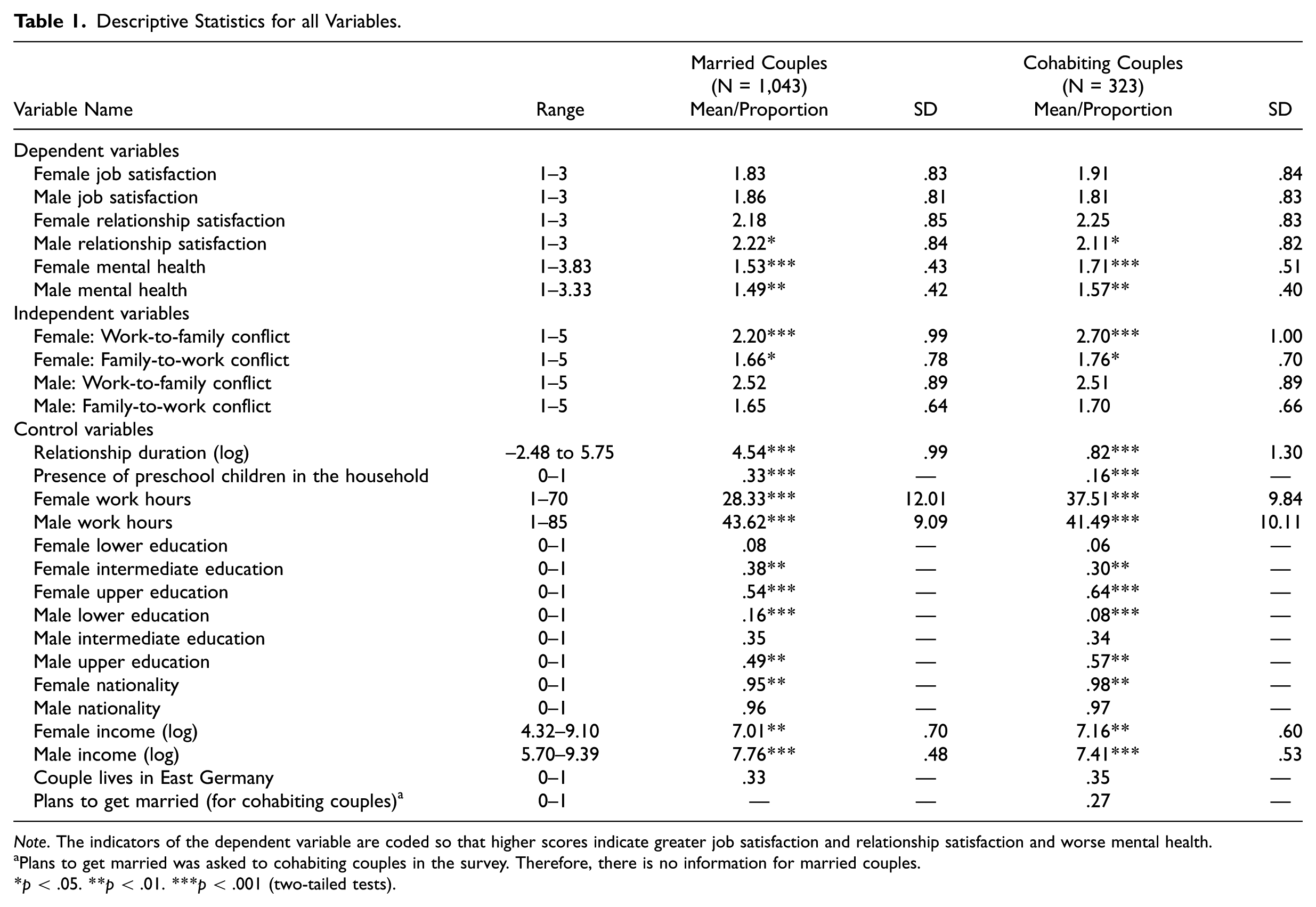
On average, among the couples in the sample, wives are approximately 38, and husbands are approximately 41 years old, while female and male cohabitors are around 29 and 31, respectively. Approximately 49 percent of the married men and 54 percent of the married women completed upper education, 2 whereas 57 percent of the cohabiting men and 64 percent of the cohabiting women completed upper education. On average, married couples have been married for 11 years, and cohabiting couples have been together for 4 years. Among cohabiting couples, around 27 percent have plans to get married. Table 1 presents detailed descriptive statistics for the couples in our sample and the full list of variables.
Descriptive Statistics for all Variables.
Note. The indicators of the dependent variable are coded so that higher scores indicate greater job satisfaction and relationship satisfaction and worse mental health.
Plans to get married was asked to cohabiting couples in the survey. Therefore, there is no information for married couples.
p < .05. **p < .01. ***p < .001 (two-tailed tests).
Dependent Variables
In this study, the three dependent variables are job satisfaction, relationship satisfaction, and mental health. Job satisfaction is measured by one indicator: “How satisfied are you with school, education and career?” 3 The answer categories range from 0 (very dissatisfied) to 10 (very satisfied). This item was highly skewed, and therefore, a log transformation of the variable was used. Higher numbers indicate greater levels of job satisfaction. Relationship satisfaction is also measured by one item: “All in all, how satisfied are you with your relationship?” 4 The answer categories range from 0 (very dissatisfied) to 10 (very satisfied). This item was also highly skewed; therefore, a log transformation of the variable was used. 5 Higher numbers indicate greater levels of relationship satisfaction. Finally, mental health is measured using six indicators. Respondents are asked: “In the following list you see a number of statements that people can use to describe themselves. Please read each statement and indicate from among the four answers the one that corresponds to the way you feel in general. (1) My mood is melancholy. (2) I am happy. (3) I am depressed. (4) I am sad. (5) I am in desperation. (6) My mood is gloomy.” 6 The answer categories range from 1 (almost never) to 4 (almost always). The factor loadings of these six items range from .60 to .75 and .58 to .71 for married and cohabiting couples, respectively, which all exceed the threshold level of .50 (Hair et al. 2006). Cronbach’s alpha scores for men and women are .78 and .83, respectively (for married couples), and .78 and .81, respectively (for cohabiting couples), indicating high internal reliability. After reverse coding the second item, summing these six items, and taking the average of the summed score, higher numbers indicate lower levels of mental health.
Independent Variables
This study uses two main independent variables: WFC and FWC. To measure WFC, respondents are asked:
(1) Because of my workload in my job, vocational training, or university education, my personal life suffers. (2) Even when I am doing something with my friends, partner, or family, I must often think about work. (3) After the stress of work, I find it difficult to relax at home and/or to enjoy my free time with others. (4) My work prevents me from doing things with my friends, partner, and family more than I’d like.
Each item ranges from 1 (not at all) to 5 (absolutely). 7 The factor loadings of these four items range from .65 to .86 and .62 to .82 for married and cohabiting couples, respectively. Cronbach’s alpha scores for men and women are .75 and .82, respectively (for married couples), and .75 and .81, respectively (for cohabiting couples), indicating high internal reliability. After summing these five items and taking the average to create a scale, higher scores indicate greater levels of WFC.
To measure FWC, respondents are asked:
(1) Because I am often under stress in my private life, I have problems concentrating on my work. (2) Because of my personal schedule, I often lack time to do my work. (3) The time I need for my partner, family, and friends keeps me from being more involved in my job, vocational training, or university education. (4) Conflicts in my personal life reduce my work performance.
Each item ranges from 1 (not at all) to 5 (absolutely). The factor loadings of these four items range from .61 to .87 and .62 to .83 for married and cohabiting couples, respectively. Cronbach’s alpha scores for men and women are .74 and .78, respectively (for married couples), and .74 and .76, respectively (for cohabiting couples), indicating high internal reliability. After summing these five items and taking the average to create a scale, higher scores indicate greater levels of FWC.
Control Variables
This study also uses several other variables that have been shown to be associated with our independent and/or dependent variables (Bruck, Allen, and Spector 2002; De Simone et al. 2014; Minnotte, Minnotte, and Bonstrom 2015; Roehling, Jarvis, and Swope 2005; Schieman et al. 2009; Voydanoff 2005, 2007; Yucel 2017a, 2017b): education, nationality, work hours, 8 income, marriage (relationship) duration, 9 the presence of preschool-aged children in the household, plans to marry in the future (for cohabiting couples), and whether the individual lives in the East or West Germany. 10
Analytical Strategy
This study follows the same analytical approach of prior research (Yucel 2017a; Yucel and Gassanov 2010). The actor-partner interdependence model (APIM) framework is used, and dyadic data analysis is carried out using structural equation modeling (SEM) in AMOS 22.0. As part of dyadic data analysis, first, the AEs and PEs for our two main independent variables, WFC and FWC, 11 are tested. Next, using chi-square difference tests, this study tests the gender differences in AEs and PEs between men and women and whether AEs and PEs are equal to each other. The relative fits of these nested models in SEM are compared. If the difference in chi-square between unconstrained models (i.e., coefficients are estimated separately for both genders and for both types of unions) and constrained models (i.e., coefficients are constrained to be equal for both genders and for both types of unions), the unconstrained model is preferred. However, if there are no differences, the constrained models with pooled estimates are preferred (Kenny and Cook 1999). Finally, to test whether AEs and PEs vary between married and cohabiting couples, multigroup analyses are used (see Results section for details).
Results
Descriptive Findings
Descriptive findings for all variables are displayed in Table 1. There are no differences between married men (women) and cohabiting men (women) in terms of their reports of job and relationship satisfaction; however, cohabiting men and women are significantly more likely than married men and women (respectively) to have worse mental health. There are no differences in reports of WFC and FWC between cohabiting and married men; however, cohabiting women are more likely to report WFC and FWC than married women. Cohabiting couples also have significantly shorter relationships than married couples, while spouses have significantly more preschool-aged children than cohabitors.
Multivariate Analyses
Consistent with the approach in Yucel and Gassanov (2010) and Yucel (2017a), multivariate analyses proceed in five steps. Results for married couples are displayed in Tables 2 through 4, while Table 5 presents the final models for cohabiting couples across all three dependent variables. Tables showing the full models for cohabiting couples can be provided on request.
Predictive Model of Job Satisfaction among Married Couples (N = 1,043 Couples).

Note. This study also controls for the following variables: marital duration, work hours, education, nationality, income, living in East or West Germany, and having preschool children living in the household. Higher scores indicate greater job satisfaction. Best-fitting model is highlighted in bold. W = wives; H = husbands.
p < .05. **p < .01. ***p < .001 (two-tailed tests).
Married Couples
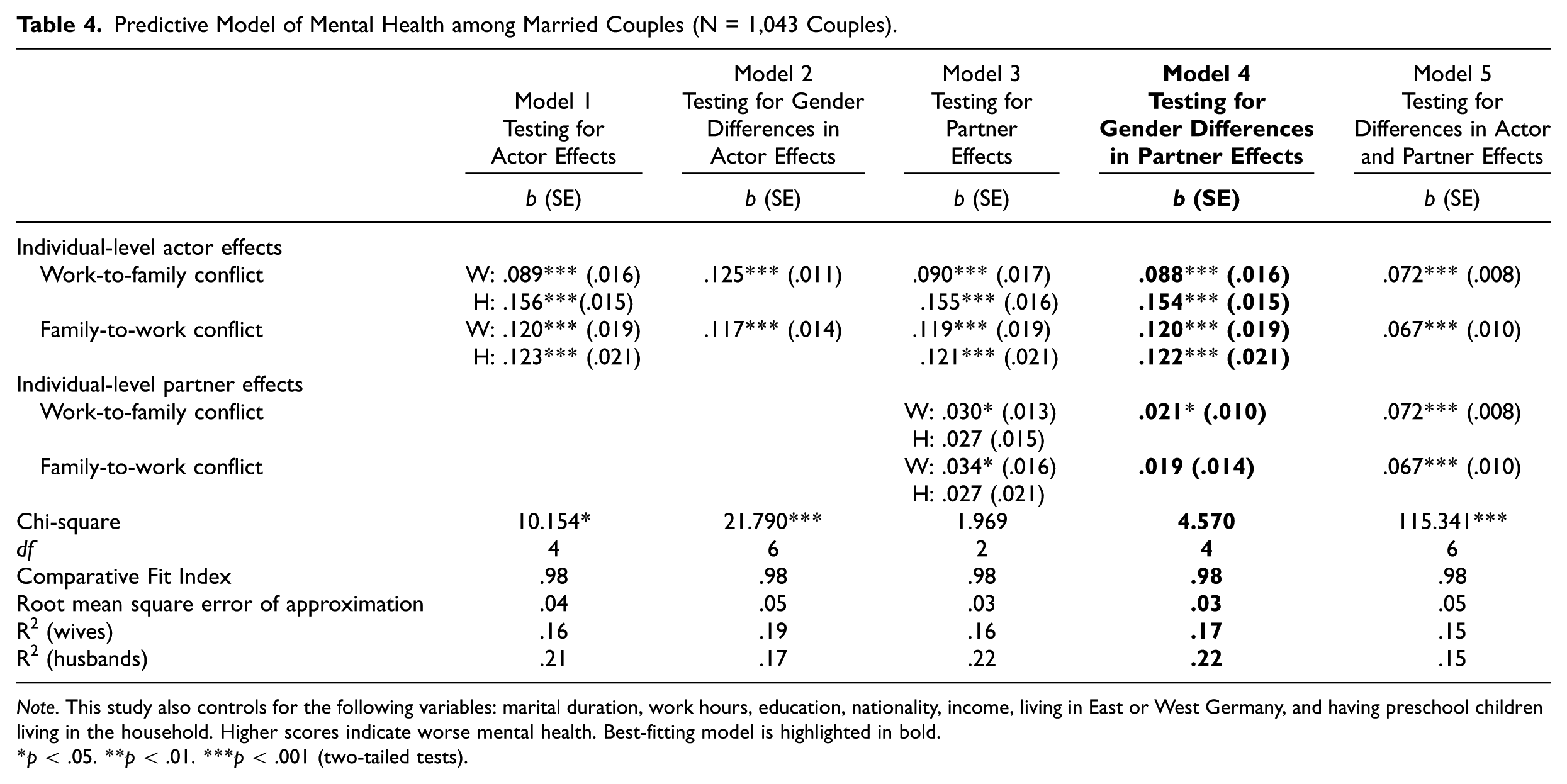
First, we test if there are any AEs between respondents’ WFC, FWC, and their reports of job satisfaction, relationship satisfaction, and mental health. As shown in the first model (Model 1) of Tables 2 through 4, significant AEs emerge. For both husbands and wives, those with higher WFC (b = −.094, p < .001; b = −.065, p < .001 for husbands and wives, respectively) report significantly lower job satisfaction. Higher FWC is associated with lower relationship satisfaction for both wives (b = −.084, p < .001) and husbands (b = −.093, p < .001). In addition, both spouses with higher WFC (b = .156, p < .001; b = .089, p < .001 for husbands and wives, respectively) and FWC (b = .123, p < .001; b = .120, p < .001 for husbands and wives, respectively) report worse mental health.
Model 2, Tables 2 through 4, shows the results for gender differences in AEs. According to the chi-square difference test, comparing Models 1 and 2, the effects are not significantly different for job satisfaction and relationship satisfaction (Δχ2 = 4.51, df = 2, p > .10; Δχ2 = 3.30, df = 2, p > .10, respectively). This indicates that there are no gender differences in AEs. Specifically, the negative effects of WFC on job satisfaction (b = −.080, p < .001) and FWC on relationship satisfaction (b = −.086, p < .001) are similar between spouses. On the other hand, for models that predict mental health, the models are significantly different between Models 1 and 2 (Δχ2 = 11.64, df = 2, p < .01). This indicates that there are indeed gender differences in AEs for mental health. Specifically, the AE of WFC on mental health is significantly stronger for husbands (b = .156, p < .001) than wives (b = .089, p < .001). There are no gender differences, however, in the AEs of FWC on mental health.
Model 3 in Tables 2 through 4 tests whether PEs significantly improve the path models of job satisfaction, relationship satisfaction, and mental health. According to the chi-square difference test, comparing Models 2 and 3 across Tables 2 through 4, adding PEs does improve our understanding of the correlates of job satisfaction, relationship satisfaction, and mental health among married couples (Δχ2 = 9.04, df = 4, p < .10; Δχ2 = 8.84, df = 4, p < .10; Δχ2 = 19.82, df = 4, p < .001, respectively). Model 3 is preferred over Model 2. Specifically, wives of husbands who report higher WFC have lower job satisfaction (b = −.033, p < .01), and husbands of wives who report higher FWC have lower relationship satisfaction (b = −.029, p < .05). Finally, husbands of wives who report higher WFC and FWC have worse mental health (b = .030, p < .05; b = .034, p < .05, respectively).
Model 4 in Tables 2 through 4 tests whether there are gender differences in PEs. Comparing Model 3 and Model 4, the results indicate that there are gender differences in PEs for job satisfaction (Δχ2 = 6.84, df = 2, p < .05). Specifically, wives of husbands with higher WFC report lower job satisfaction (b = −.033, p < .01). Thus, Model 3 is preferred over Model 4. For relationship satisfaction and mental health, PEs work similarly between husbands and wives (Δχ2 = .35, df = 2, p > .10; Δχ2 = 2.60, df = 2, p > .10, respectively). Thus, Model 4, the restricted model, is preferred over Model 3. Specifically, individuals who are married to spouses with higher FWC also report lower relationship satisfaction (b = −.025, p < .05). Finally, individuals who are married to spouses with higher WFC conflict report lower mental health (b = .021, p < .05). These findings are independent of the significant AEs in the model.
Model 5 in Tables 2 through 4 tests whether AEs and PEs are statistically equal. For example, the analysis examines whether a person’s job satisfaction is equally associated with one’s own reports and one’s spouse’s reports of WFC and FWC. The chi-square difference tests comparing Models 4 and 5 are significant, so Model 4 is preferred for job satisfaction, relationship satisfaction, and mental health (Δχ2 = 43.52, df = 4, p < .001; Δχ2 = 25.49, df = 2, p < .001; Δχ2 = 110.77, df = 2, p < .001, respectively). AEs and PEs are significantly different from each other. Specifically, the AE of WFC on job satisfaction (b = −.080, p < .001) is significantly stronger than the husbands’ PE on their wives’ job satisfaction (b = −.033, p < .01), whereas wives’ PE on their husbands’ job satisfaction is not significant (b = .008, p > .10). Moreover, the results suggest that AE of FWC on relationship satisfaction (b = −.089, p < .001) is significantly stronger than the PE of FWC (b = −.025, p < .05). Moreover, the AE of WFC on mental health (b = .088, p < .001; b = .154, p < .001 for wives and husbands, respectively) is significantly stronger than the PE (b = .021, p < .05). Finally, the AE of FWC on mental health for both wives and husbands is significant (b = .120, p < .001; b = .122, p < .001, respectively), whereas the PE of FWC is not.
Overall, the best-fitting model for job satisfaction is Model 3 (see the bold text in Table 2), where there are no gender differences in AEs but gender differences in PEs and these effects remain distinct. The best-fitting model for relationship satisfaction is Model 4 (see the bold text in Table 3), where there are no gender differences in AEs and PEs but these effects remain distinct. The best-fitting model for mental health is Model 4 (see the bold text in Table 4), where there are gender differences in AEs but no gender differences in PEs and these effects remain distinct. For the job satisfaction model (see Model 3 in Table 2), the significant coefficients are the AEs (for both genders) and husbands’ PE of WFC (b = −.080, p < .001; b = −.033, p < .01, respectively). For the relationship satisfaction model (see Model 4 in Table 3), the significant coefficients are the AEs and PEs (for both genders) of FWC (b = −.089, p < .001; b = −.025, p < .05, respectively). For the mental health model (see Model 4 in Table 4), the AE of WFC for wives and husbands is b = .088 (p < .001) and b = .154 (p < .001), respectively. The AE of FWC for wives and husbands on mental health is b = .120 (p < .001) and b = .122 (p < .001), respectively. On the other hand, the PE of WFC on mental health is b = .021 (p < .05). The best-fitting models for all three outcomes for married couples are also shown in Figure 1.
Predictive Model of Relationship Satisfaction among Married Couples (N = 1,043 Couples).

Note. This study also controls for the following variables: marital duration, work hours, education, nationality, income, living in East or West Germany, and having preschool children living in the household. Higher scores indicate greater relationship satisfaction. Best-fitting model is highlighted in bold.
p < .05. **p < .01. ***p < .001 (two-tailed tests).
Predictive Model of Mental Health among Married Couples (N = 1,043 Couples).
Note. This study also controls for the following variables: marital duration, work hours, education, nationality, income, living in East or West Germany, and having preschool children living in the household. Higher scores indicate worse mental health. Best-fitting model is highlighted in bold.
p < .05. **p < .01. ***p < .001 (two-tailed tests).
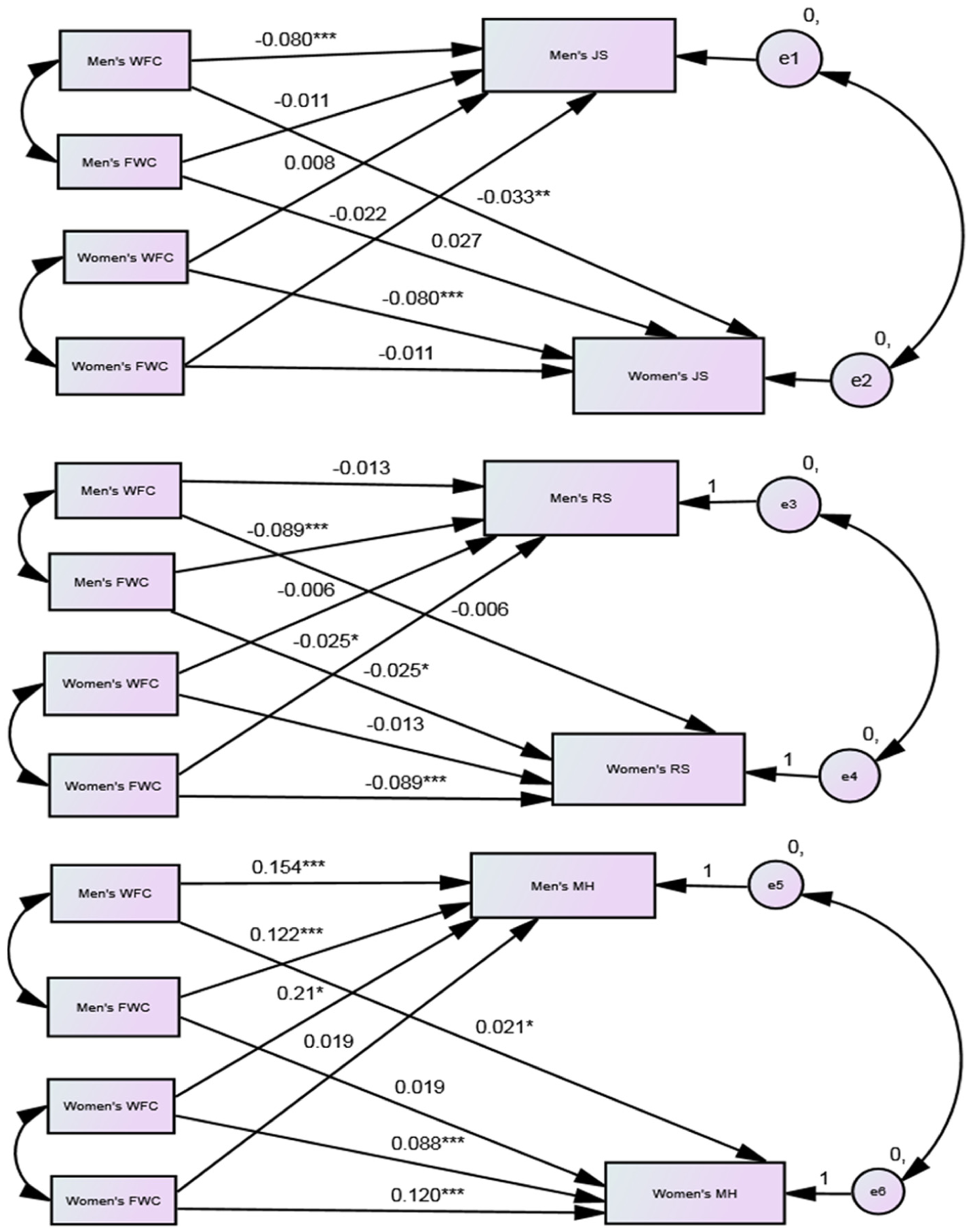
Unstandardized coefficients for the best-fitting models in structural equation model (for job satisfaction, relationship satisfaction, and mental health) for married couples.
Cohabiting Couples
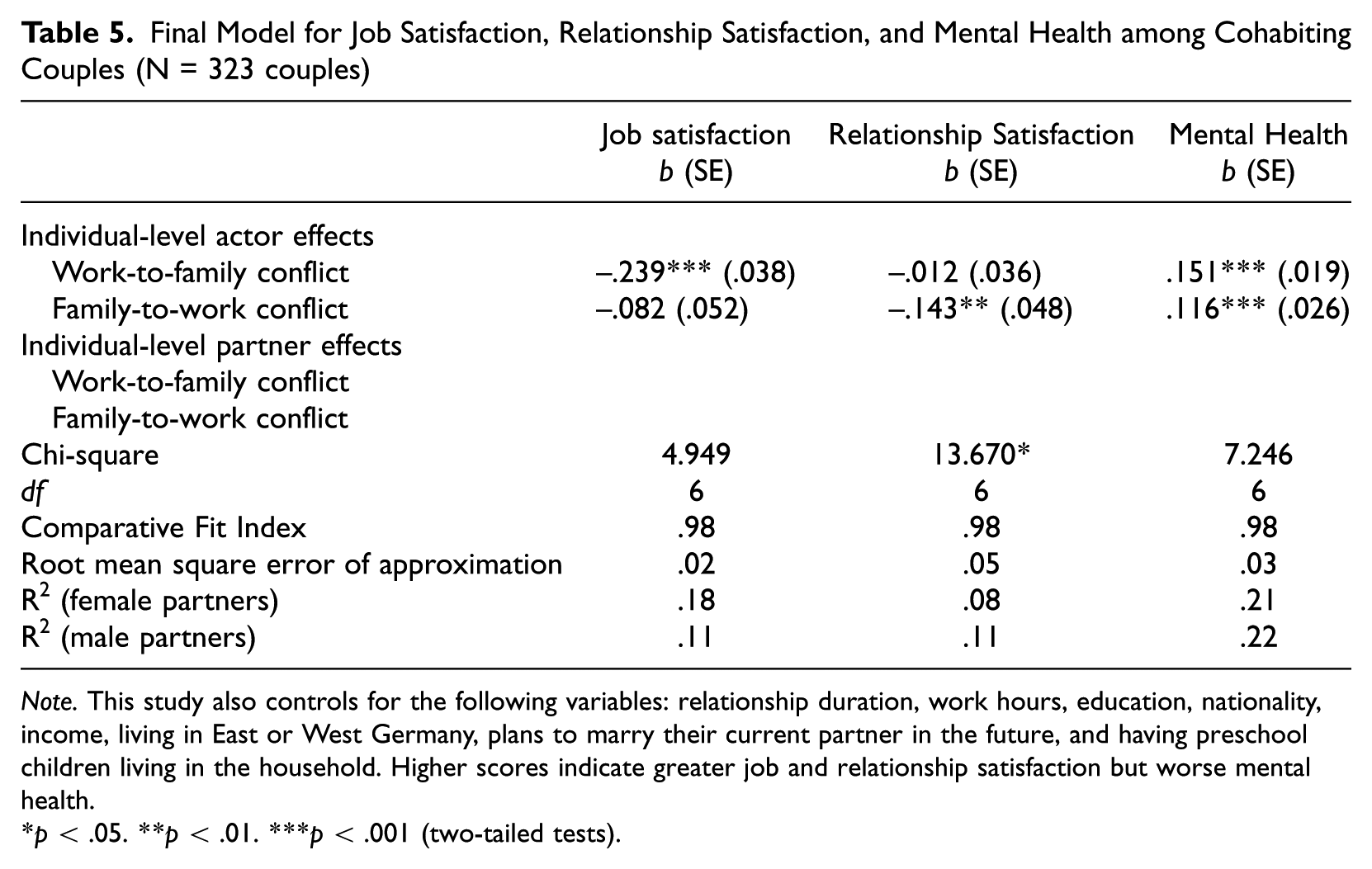
Table 5 shows the same five steps as described previously for cohabiting couples. The results are different from married couples, indicating that the best-fitting model is Model 2, where there are no gender differences in AEs and PEs do not significantly add to the model. This is the best model for predicting job satisfaction, relationship satisfaction, and mental health. This model also shows that for cohabitors, individuals with higher WFC report lower job satisfaction (b = −.114, p < .001). In addition, those with higher FWC report lower relationship satisfaction (b = −.049, p < .01). Lastly, those with higher WFC and FWC report worse mental health (b = .151, p < .001; b = .116, p < .001, respectively). On the other hand, among cohabitors, partners’ reports do not significantly add to the models predicting job satisfaction, relationship satisfaction, and mental health. Only the best-fitting model for all three dependent variables is displayed in Table 5. The full tables showing all five models for all three dependent variables can be provided on request.
Final Model for Job Satisfaction, Relationship Satisfaction, and Mental Health among Cohabiting Couples (N = 323 couples)
Note. This study also controls for the following variables: relationship duration, work hours, education, nationality, income, living in East or West Germany, plans to marry their current partner in the future, and having preschool children living in the household. Higher scores indicate greater job and relationship satisfaction but worse mental health.
p < .05. **p < .01. ***p < .001 (two-tailed tests).
Multigroup Analyses
As the last step, this paper tests whether the AEs of WFC and FWC on job satisfaction, relationship satisfaction, and mental health vary between married and cohabiting couples. 12 Following the same analytical approach from prior research (Yucel 2017a; Yucel and Gassanov 2010), multigroup analyses are used to examine group differences by running a series of nested models where all AEs of WFC and FWC are constrained to be equal across groups in consecutive steps (Byrne 2013). 13 Then, using chi-square difference tests, the model fit between each of these constrained models is compared to the model fit of the baseline unconstrained model (Model 1). 14 Most chi-square tests suggest that adding equality constraints at each step improves the fit of the baseline model (Model 1). Thus, these findings suggest that most AEs do not differ between married and cohabiting couples.
On the other hand, two models indicate that constraining some parameters to be equal across groups worsens the baseline model’s fit significantly. Specifically, Step 4 in Table 6 constrains the AE of females’ WFC on mental health to equality across married and cohabiting couples. Based on the difference in the chi-square test, this result suggests that the AE of females’ WFC on mental health differs significantly for married and cohabiting couples (Δχ2 = 5.891, df = 1, p < .05) such that it is stronger among cohabiting couples. In addition, Steps 2 and 4 in Table 6 constrain the AEs of men and women’s WFC on job satisfaction to equality across married and cohabiting couples, respectively. Based on the difference in the chi-square test, the AE of males’ and females’ WFC on job satisfaction differs significantly for married couples versus cohabiting couples (Δχ2 = 3.31, df = 1, p < .10) such that the negative AE of females’ WFC on mental health and the AEs of females’ and males’ WFC on job satisfaction are stronger among cohabiting couples. The highlighted numbers in Table 6 also show a significant worsening of the model fit for job satisfaction and mental health. A table displaying nonsignificant chi-square test results when comparing models for relationship satisfaction can be provided on request.
Fit Indices for Nested Models in Multigroup Analyses for Mental Health and Job Satisfaction.
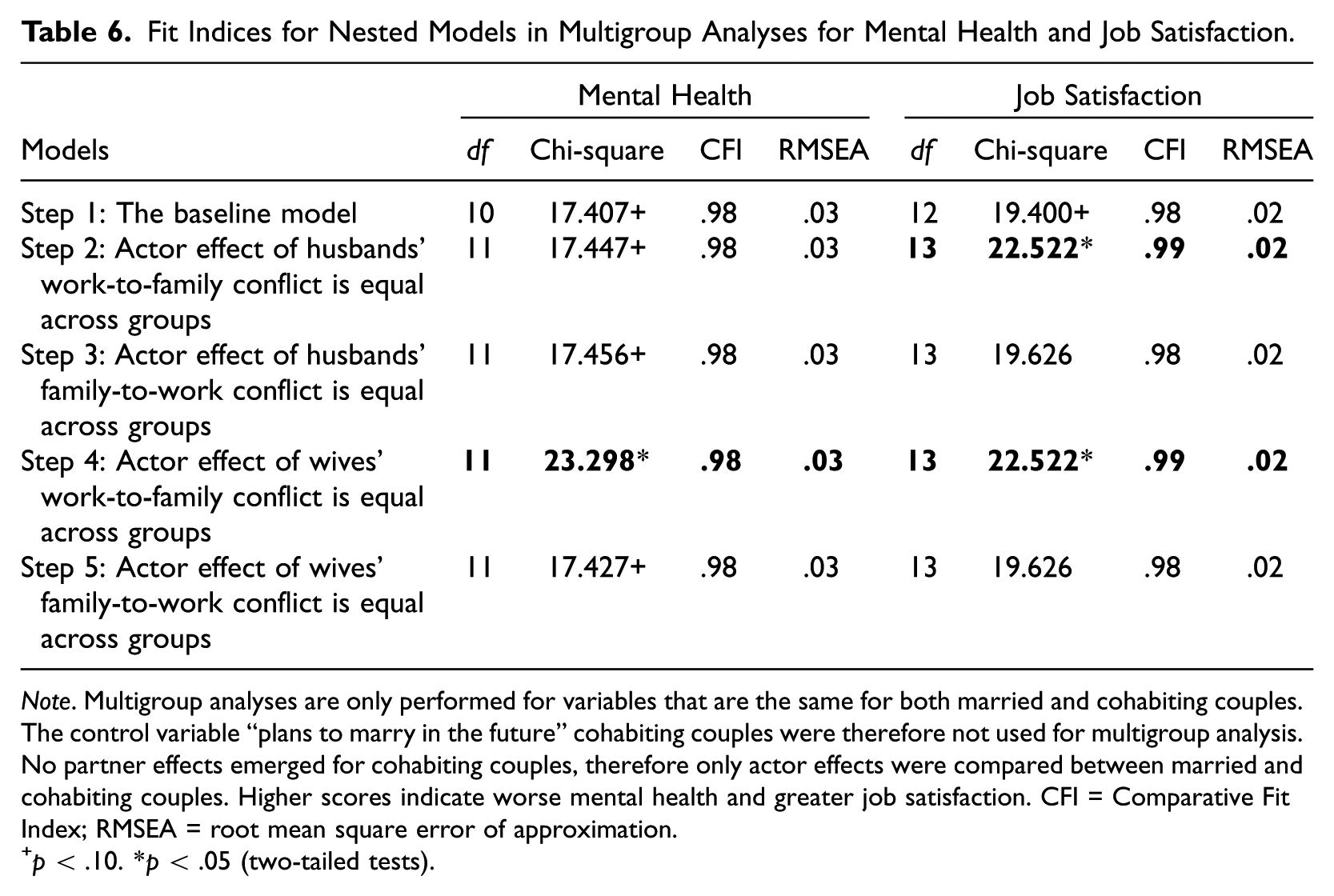
Note. Multigroup analyses are only performed for variables that are the same for both married and cohabiting couples. The control variable “plans to marry in the future” cohabiting couples were therefore not used for multigroup analysis. No partner effects emerged for cohabiting couples, therefore only actor effects were compared between married and cohabiting couples. Higher scores indicate worse mental health and greater job satisfaction. CFI = Comparative Fit Index; RMSEA = root mean square error of approximation.
p < .10. *p < .05 (two-tailed tests).
Discussion
Prior research has studied the effects of WFC and FWC on a variety of outcomes (Allen et al. 2000; Amstad et al. 2011; Bakker et al. 2008; Cooklin et al. 2014; Kinnunen, Geurts, and Mauno 2004; Minnotte 2016; Pedersen and Minnotte 2012), but most studies that have examined spillover and crossover effects using couple-level data have had small sample sizes (Abeysekera and Gahan forthcoming; Amstad and Semmer 2011; Hammer et al. 1997; Matthews et al. 2006), with few exceptions (Shimazu et al. 2013). Even fewer studies have compared married couples to other union types (Symoens and Bracke 2015). Additionally, whereas most prior research on work-family conflict focuses on workers from specific occupations or regions, this study uses a large, representative sample of dual-earning married and cohabiting couples in Germany, allowing for stronger generalizability. With this in mind, our study contributes by using couple-level data to test the spillover and crossover effects of work-family conflict (in both directions) on three outcomes across multiple domains and assessing whether they vary by gender or union type.
Our findings confirm the application of several key theoretical frameworks in assessing the dynamics of WFC and FWC on job satisfaction, relationship satisfaction, and mental health. First, when considering the usefulness of applying the cross-domain (Frone et al. 1992a) versus matching hypotheses (Amstad et al. 2011) to interpret the findings, our research lends strong support to the latter. As predicted by the matching hypothesis, and in support of the meta-analyses by Amstad et al. (2011) and Nohe et al. (2015), we find that for domain-specific outcomes, only the domain where the root of the conflict lies is significantly correlated with declines in well-being in that same domain. This is evident in several of our key findings. Among both married and cohabiting couples, only WFC negatively impacts work-related domain outcomes (e.g., job satisfaction), and only FWC negatively impacts family-related domain outcomes (e.g., relationship satisfaction). Thus, our findings align with two key theoretical underpinnings of the matching hypothesis—appraisal theories (Lazarus 1991) and source attribution (Shockley and Singla 2011). For example, as predicted by the matching hypothesis, when a salient role (spouse) is strained due to the increasing demands of another role (worker), an individual will begin to negatively appraise (via lower job satisfaction) the original source of the strain on their relationship (working too many hours). Despite this finding, the matching and cross-domain perspectives are not without limitations. Because of the inherent overlap and interaction that takes place between roles in the workplace and home, to examine outcomes of work-family conflict rooted in the work versus the family domains, as though they are separate, mutually exclusive entities, might oversimplify a more complex, fluid reality (Clark 2000).
Further, in support of prior literature, results suggest that married individuals who experience higher levels of work-family conflict have lower job satisfaction, lower relationship satisfaction, and worse mental health. These findings illustrate the continued usefulness of several theoretical concepts. As the role scarcity hypothesis (Edwards and Rothbard 2000) proposes, individuals have limited resources and can feel strain when their roles as employees and spouses compete for their time. As conservation of resources theory explains (Hobfoll 1989), this strain can also be exacerbated when stressful events (e.g., an unexpected deadline at work) cause an individual to be unable to balance both employee and spousal roles (because of their inability to conserve the amount of time they need to both meet the deadline and be home to help their family). As a result of these conflicts, our findings suggest that individuals can suffer a decline in job satisfaction, relationship satisfaction, and mental health. Likewise, our findings match the predictions of Pearlin’s (1999) stress process model, which proposes that primary stressors (e.g., unexpected work deadlines) might lead to secondary stressors (e.g., arguments between partners over how long a spouse should stay at work that evening). Thus, work-family conflict can potentially heighten existing conflicts and/or proliferate additional conflicts, negatively impacting individuals’ mental health.
While these findings on spillover are consistent with well-established existing literature, our main contribution lies in our use of couple-level data to compare the crossover effects of work-family conflict by gender and union type. Among married couples, our findings of significant negative PEs of WFC and FWC on job satisfaction and relationship satisfaction, respectively, support Amstad et al.’s (2011) matching hypothesis, while the negative PE of FWC on mental health supports Westman’s (2001, 2006) assertion that stress and strain associated with work-family conflict are transmitted across spouses. This finding that when husbands and wives experience WFC and FWC, the job satisfaction, relationship satisfaction, and mental health of their spouses are negatively affected can be interpreted through the theoretical lenses of crossover stress and empathy among significant others (Bakker and Demerouti 2009; Westman 2001, 2006). Essentially, when partners share closely connected lives and frequently communicate their work and family stressors, the “cost of caring” for one another (Kessler and McLeod 1984) likely translates into a decline in well-being for both individuals and their spouses across multiple domains. These findings related to the transmission of stress due to empathy among partners are underscored by existing literature (see e.g., Bakker et al. 2008; Matthews et al. 2006), particularly in terms of negative mental health outcomes (Young et al. 2014). Still, as expected, while adding in PEs improves our models, AEs are generally stronger and more significant than PEs because they have a more direct and consequential impact on individuals’ behavioral outcomes.
When testing gender differences in AEs and PEs of WFC and FWC for married couples, however, we find mixed support for the usefulness of applying theoretical frameworks on the persistence of traditional gender expectations (Ridgeway 2011). In contrast to our hypotheses, the negative AEs of both WFC and FWC on job satisfaction and relationship satisfaction, respectively, are similar between husbands and wives, and there are no gender differences in the PEs of either FWC and WFC on relationship satisfaction and mental health, respectively. This lack of gender differences in some of our analyses could be due to growing egalitarianism and equality in the work and family experiences of men and women (Frone et al. 1992b; Young et al. 2014). Alternatively, some gender differences do emerge. As predicted, the PE of WFC on job satisfaction is stronger for women than men. In addition, the AE of WFC on mental health is significantly stronger for husbands than wives. In other words, in accordance with existing literature (see e.g., Frone et al. 1996), it does appear that husbands’ WFC crosses over to their wives, perhaps due to the continued emphasis on empathy throughout women’s gender socialization. Likewise, men’s continued adherence to the work domain, even as societal expectations of involved fatherhood become more dominant (Winslow 2005), is associated with stronger negative effects of WFC on husbands’ mental health. Thus, our findings point to the need for more effective government and workplace policies designed to help married couples balance work and family. In light of recent literature documenting a rise in reports of work-family conflict among married, dual-earning fathers in particular (Aumann et al. 2011; Galinksky et al. 2011; Nomaguchi and Johnson 2009), this finding on mental health is critical.
While some of our results on the relationship between work-family conflict and mental health replicate those found in existing literature (Young et al. 2014), we extend prior work by using couple-level data to examine whether outcomes across multiple domains of social life vary by union status, assessing whether crossover stress (in particular) operates differently among spouses versus cohabiting partners. Among cohabitors, findings suggest there are some significant AEs between WFC, FWC, and our outcomes but no significant PEs. Further, we find that the negative AEs of men’s and women’s WFC on job satisfaction and the negative AE of women’s WFC on mental health are stronger among cohabiting couples than married couples. On one hand, similar to the results on married couples, some of these findings lend strong support to Amstad et al.’s (2011) matching hypothesis. This suggests that Amstad et al.’s theoretical framework can be usefully applied to better understand the spillover and crossover dynamics of work-family conflict among individuals in both married and cohabiting partnerships. Our findings on cohabitors also align with differential vulnerability theories and their prediction that cohabitors are often more vulnerable (emotionally and economically) and thus might feel less commitment, connection, and stability in their relationship, making the negative spillover effects of WFC seem more pronounced in the absence of a strong support system from a partner (Pearlin and Johnson 1977; Simon 1998).
The lack of significant PEs for cohabiting couples also confirms our prediction that higher levels of commitment, relationship closeness, and intimacy among married people coupled with the increased emphasis on freedom and self-fulfillment among cohabitors (Brown 2003, 2004; Brown et al. 2015) might result in PEs being stronger for married couples. This also matches the theoretical mechanisms of crossover that Westman (2001, 2006) outlines, suggesting that negative crossover effects are typically transmitted because of the empathy and shared connection couples share when they are in long-term, committed relationships (something cohabitors often lack). Thus, it is possible that the cost of caring (Kessler and McLeod 1984; Wethington 2000) and the emotional burden of crossover stress, particularly its negative relationship to mental health (Young et al. 2014), is not as pronounced among cohabitors as it is among spouses. These variations by union status lend support to the use of couple-level data to study crossover stress among couples as it reduces the possibility of assumed-similarity bias and the possibility that cohabitors in particular might lack sufficient information about one another.
Life course perspective can also be applied to better make sense of the absence of significant PEs among cohabiting couples. This theoretical perspective “emphasizes the importance of time, context, process, and meaning on human development and family life” (Bengston and Allen 1993:471). When using life course perspective to examine partnering and relationship processes, one might infer that younger cohabitors interpret their unions as being shorter-term, less committed, or more about convenience than longevity and thus are less likely to transition to marriage. In other words, due to their being in a different life stage with varying relationship dynamics (see e.g., Sassler 2010), cohabitors in our study could be in qualitatively different than married respondents.
It is also possible that these variations we find among married and cohabiting partners are driven by other factors that are not easily captured in survey data. For example, prior research suggests that factors such as differing norms (Brown and Booth 1996; Cherlin 2004), gender ideologies (Davis and Greenstein 2009; Sassler and Miller 2011), attitudes (Brown 2000; Stanley, Whitton, and Markman 2004), and/or levels of social acceptance and support from families (Brown 2003; Brown and Booth 1996) might either select people into cohabitation or emerge as a result of cohabiting. While we cannot measure or control for these factors in the present study, our findings underscore the growing importance of examining family context (e.g., union status) and how it shapes work-family conflict itself as well as various outcomes associated with it (see e.g., Kossek and Lee 2017; Young 2015). As the role cohabition and marriage play in family formations and life course experiences continues to shift (Brown et al. 2015), the import of social context should not be overlooked. We suggest scholars continue to test the mediating and/or moderating effects of union status on outcomes (particularly mental health) using a larger, more diverse sample of cohabiting couples. In addition, future research should consider more nuanced and integrated theoretical approaches for explaining variations in the effects of work-family conflict among cohabiting and married couples (Kossek and Lee 2017).
Limitations and Suggestions for Future Research
There are several limitations of this research. First, the cross-sectional design of the data limits our ability to make causal arguments. In addition, some of the relationships between our key variables are likely bidirectional. For example, those with poor mental health and problems at work and/or in their relationships might experience higher WFC and FWC. Likewise, being dissatisfied at work might lead to discord at home (WFC), and experiencing marital strain might cause problems at work (FWC). Without the use of longitudinal data, we cannot conclude that causality is occurring or assume causal, directional positioning between our key variables (for a comprehensive review of antecedents of WFC and FWC, see Michel et al. 2011). While we can only be certain of correlation between the variables in our study, the wealth of prior research theoretically and empirically demonstrating that WFC and FWC likely precede changes in job satisfaction, relationship satisfaction, and mental health lends confidence to our findings (see e.g., Allen et al. 2000; Amstad et al. 2011; Bellavia and Frone 2005; Nohe et al. 2015). This is also supported by longitudinal research (Yucel and Fan 2018), where changes in work-family conflict over time are associated with changes in well-being outcomes among married couples. Second, although this research makes a contribution by exploring the spillover and crossover effects of WFC and FWC on various outcomes, one of our key variables (relationship satisfaction) is measured using only one item. This could create reliability issues and/or introduce measurement error. Despite this, some prior research has shown strong reliability and validity for single-item measures of relationship satisfaction (Huston, McHale, and Crouter 1986; Huston and Vangelisti 1991). Third, the single item we have used to measure job satisfaction fails to measure it in the conventional way. Prior research shows mixed findings on the relationship between the level of education and job satisfaction (for a review, see Fabra and Camisón 2009) and that job and career satisfaction are related but separate constructs (Kuchinke, Kang, and Oh 2008; Lounsbury et al. 2007). Given this evidence, we infer that one might be satisfied with their job but not necessarily be satisfied with their education or that one’s job satisfaction does not necessarily indicate a satisfaction with the career they may (or may not) have. Fourth, although this study mainly focused on WFC and FWC, various working conditions (i.e., job demands and job resources) could likely influence the outcomes in this study, as shown in some prior meta-analyses (Schaufeli 2017; Schaufeli and Taris 2014). In addition to their main effects, job demands and job resources can act as moderators. For example, job demands worsen the negative effects of WFC and FWC on well-being and health outcomes (Van Yperen and Hagedoorn 2003), whereas job resources are expected to alleviate the negative effects of WFC and FWC (Hughes and Parkes 2007). Thus, future research could expand on this study by testing the AEs and PEs of job demands and job resources on similar outcomes. Moreover, though not our focus, the spillover and crossover effects of WFC and FWC might be more negatively related to our outcomes when couples have a more unequal division of household labor (Stevens, Kiger, and Riley 2001) and possess a more egalitarian gender ideology (Minnotte et al. 2010), when families have greater child care responsibilities or parenting duties (Lin and Burgard 2018), and/or when there is a lack of available child care (Frye and Breaugh 2004). Future research might explore the AEs/PEs of such family-related variables and attitudes on similar outcomes.
Conclusions
In conclusion, this study makes a significant contribution by empirically evaluating the relationship between WFC, FWC, and three outcomes (relationship satisfaction, job satisfaction, and mental health) across multiple domains of social life, testing both spillover and crossover effects. Further, we use couple-level data and dyadic data analysis to test gender differences in AEs and PEs and assess whether these effects differ by union type. Moreover, we employ a large representative sample of dual-earning married and cohabiting couples in Germany, allowing for stronger generalizability than existing studies focused only on married couples, workers from specific occupations or regions, or outcomes in one domain. Our findings point to a need for continued research on how WFC and FWC affect not just individuals but couples, particularly through a closer examination of crossover effects transmitted across spouses. Future research might also build on our findings by continuing to explore differences in the correlates of WFC and FWC among couples in different types of unions. As cohabitation becomes an increasingly common family form across the United States and Europe, more couple level-data and research are needed, particularly using larger data sets with greater numbers of cohabitors.