



Abstract
Attention-deficit/hyperactivity disorder (ADHD) is tied to higher levels of depression, but the social factors that shape these associations are not well understood. This study considers whether family transitions affect depressive symptoms differently for young adults with and without childhood symptoms of ADHD at subthreshold or diagnostic levels. Between-within regression analysis of nationally representative longitudinal survey data shows that transitions into cohabitation and parenthood affect depressive symptoms differently for young adults with and without childhood symptoms of ADHD. Specifically, within-person effects indicate that transitions into cohabitation and parenthood are tied to decreases in depressive symptoms, but only for young adults without childhood symptoms of ADHD. In contrast, transitions into marriage are tied to decreases in depressive symptoms, and transitions out of coresidential unions are tied to increases in depressive symptoms, regardless of childhood symptoms of ADHD. The results suggest that some family transitions may work to widen ADHD disparities in depression, underscoring the importance of family contexts for shaping mental health throughout the life course.
Attention-deficit/hyperactivity disorder (ADHD) is a chronic condition that can endure throughout the life course (Kessler et al. 2006). The symptoms of impulsivity, inattention, and/or hyperactivity that characterize the disorder can shape life experiences and influence well-being across multiple domains. For example, in adulthood ADHD is associated with poorer educational attainment and employment outcomes, more substance use, and a higher risk for suicide (Barkley et al. 2006; Biederman et al. 2006). Moreover, ADHD is linked to multiple comorbid mental health issues, the most common of which is depression, with ADHD being tied to higher levels of depression in adulthood (Biederman et al. 2008). These associations apply to individuals diagnosed with ADHD as well as to those with “subthreshold” ADHD (i.e., high symptoms of ADHD that fall short of full symptom diagnostic criteria) (Biederman et al. 2018; Hong et al. 2014; Kita and Inoue 2017; Sobanski et al. 2007). Although ties between ADHD and depression are well documented, less is known about the social elements that shape these associations.
Prior research points to the importance of family contexts for mental health (Thoits 2011; Umberson, Pudrovska, and Reczek 2010), and studies citing more strain around coresidential unions and parenthood for individuals with ADHD raise the possibility that coresidential union and parenthood transitions affect depression differently for adults with and without childhood symptoms of ADHD (Bruner, Kuryluk, and Whitton 2015; Kroeger 2018). In this study we use data from three waves of the National Longitudinal Study of Adolescent to Adult Health (Add Health) and between-within (BW) regression modeling to examine whether transitions into coresidential unions, transitions out of coresidential unions, or transitions into parenthood affect depressive symptoms differently for young adults with and without childhood symptoms of ADHD at subthreshold or diagnostic levels. Importantly, we consider ADHD-related differences in the effects of family transitions on depressive symptoms specifically in young adulthood, a key time in the life course when individuals form their first coresidential unions and become parents for the first time.
The results of this study will contribute to the sociological literature on close social ties and mental health (Thoits 2011), with particular relevance to research showing that the effects of family relationships on mental health are not uniform but rather are highly dependent on a range of indicators (Umberson and Montez 2010; Williams 2003). Moreover, understanding whether family transitions affect depressive symptoms differently for young adults with and without childhood symptoms of ADHD will expand knowledge on the social processes that shape ADHD-depression disparities in young adulthood, thereby contributing to the literature on ADHD and comorbid mental health issues (Sobanski et al. 2007). Finally, the results of this study will have the potential to assist policy makers and health care practitioners in their efforts to reduce depressive symptoms among adults with ADHD, an important task given research showing stronger ties between ADHD and negative outcomes such as risk for suicide when depression is also present (Biederman et al. 2008).
Background
ADHD is a chronic disorder characterized by lower activity in parts of the brain important for working memory. Although there is a genetic component to ADHD, substance use among mothers during pregnancy, premature delivery, and low birth weight can all contribute to its development (NIMH 2016). Approximately 10 percent of children in the United States are diagnosed with ADHD (Miller, Ho, and Hinshaw 2012; Pastor et al. 2015), and even more have subthreshold ADHD (i.e., high levels of symptoms of ADHD that fall below the full symptom criteria for diagnosis) (Balázs and Keresztény 2014). More than half of children diagnosed with ADHD continue to experience symptoms as adults (Biederman et al. 2010; Kessler et al. 2006), and children with subthreshold ADHD have a high risk for developing the full disorder in adulthood (Agnew-Blais et al. 2016; Shankman et al. 2009).
ADHD and Adverse Outcomes in Adulthood
The hallmark symptoms of ADHD—impulsivity, inattention, and/or hyperactivity—manifest in childhood and pose long-term challenges to emotional and behavioral regulation, resulting in significant impairment for those with full and subthreshold diagnoses alike (Biederman et al. 2018; Hong et al. 2014). For example, in adulthood ADHD-related symptoms are associated with making riskier decisions (Matthies, Philipsen, and Svaldi 2012), more regret over past decisions (Schepman et al. 2012), and more harmful coping strategies such as avoidance or detachment to manage problems (Young 2005). These behavioral impairments are broadly implicated in associations of ADHD in adulthood with a higher risk for suicide (Biederman et al. 2008; Ljung et al. 2014), more substance use (Faraone et al. 2007; King, Boyd, and Thorsen 2017), poorer employment outcomes (Fletcher 2014), lower educational attainment and income (Barkley et al. 2006; Biederman et al. 2006), and more criminal activity (Fletcher and Wolfe 2009). In addition, ADHD is associated with a greater total number of negative life events, even after controlling for the effects of comorbid mental health issues (Garcia et al. 2012).
ADHD and Coresidential Unions
ADHD is associated with more romantic relationship turnover, more divorce, and the occurrence of multiple marriages (Biederman et al. 2006; Canu and Carlson 2007; Klein et al. 2016). Studies focusing on nonmarital and marital unions alike have linked ADHD to lower relationship quality, an outcome due in part to the ADHD-related impairments in emotional regulation (Bruner et al. 2015; Overbey, Snell, and Callis 2011; Pollock et al. 2017). Concerning marriage specifically, studies focusing on adults with ADHD and/or on adults whose spouses have ADHD indicate that marriages in which one of the partners has ADHD are characterized by lower marital satisfaction and less intimacy (Ben-Naim et al. 2017; Eakin et al. 2004). Qualitative research suggests that these trends are partially driven by non-ADHD spouses’ feeling that they must compensate for their ADHD partners’ failure to help with housework, child care, or other daily tasks (Eakin et al. 2004).
ADHD and Parenthood
In young adulthood ADHD is associated with more parental strain and less parental happiness (Kroeger 2018). This trend is likely driven by a number of factors that distinguish parents with ADHD from their non-ADHD counterparts. First, adults with ADHD experience more unplanned pregnancies, which are associated with more parental stress (Owens and Hinshaw forthcoming). Second, ADHD is associated with more negative parenting practices, such as overreacting or underreacting to children when they misbehave and/or not providing adequate supervision to children (Williamson et al. 2017). Relatedly, parents with ADHD are less involved and more impatient with their children (Chronis-Tuscano et al. 2017; Park, Hudec, and Johnston 2017). Finally, research among couples suggests that the presence of ADHD symptoms in one partner can adversely affect a couple’s ability to coparent, which can make parenting more stressful (Williamson and Johnston 2016).
ADHD and Depressive Symptoms
Although ADHD is linked to multiple comorbid mental health issues (Biederman et al. 2018), depression is arguably the most common, with some studies showing that adults with ADHD have three times the odds of experiencing depression compared with their non-ADHD counterparts (Biederman et al. 2008; Kessler et al. 2006). In addition to differences in the occurrence of clinical depression, studies find that ADHD is linked to more depressive symptoms in adulthood (Meinzer et al. 2015). Comorbid depression negatively affects well-being among individuals with ADHD in multiple ways. For example, among adults with ADHD, higher values on measures of depressive symptoms are tied to lower quality of life and more suicidal ideation (Chao et al. 2008; Van Eck et al. 2015). Furthermore, in the presence of comorbid depression, associations of ADHD with risk for suicide are larger in magnitude (Biederman et al. 2008).
Studies considering mechanisms for the ADHD-depression relationship in adulthood find that contributing factors include more negative life experiences, lower levels of social support, and more negative coping skills (Knouse, Zvorsky, and Safren 2013; Meinzer et al. 2015). These studies are important because they elucidate how cumulative life experiences can contribute to the ADHD-depression disparity at specific time points. Yet such studies are less helpful in improving our understanding of the social factors that shape associations between ADHD and depression as they unfold across the adult life course. By considering whether family transitions affect depressive symptoms differently for young adults with and without childhood symptoms of ADHD, the present study will shed light on whether coresidential union or parenthood transitions significantly shape ADHD-depression disparities in young adulthood.
Coresidential Unions, Parenthood, and Depressive Symptoms in Adulthood
Research on coresidential unions and depression generally finds that marriage and cohabitation are linked to fewer depressive symptoms relative to being single (Lamb, Lee, and DeMaris 2003). Although some research suggests that marriage is more beneficial than cohabitation for depression (Brown 2000), recent research has found similar mental health benefits for cohabitation and marriage (Musick and Bumpass 2012; Perelli-Harris and Styrc 2017). Research on transitions out of coresidential unions shows that the dissolution of cohabiting and marital unions alike is tied to increases in depressive symptoms (Kamp Dush 2013). This pattern is driven largely by the stressors surrounding union dissolution, such as the process of separating households and incomes or arranging shared custody of children. Associations between union dissolution and depression are strongest immediately following a dissolution, becoming weaker with the passage of time (Gardner and Oswald 2006).
The benefits of marriage and cohabitation for mental health hold primarily for high-quality, healthy relationships (Williams 2003). In fact, research indicates that staying in an unhappy union can lead to increases in depressive symptoms far greater in magnitude than those associated with dissolving an unhappy union (Williams 2003). Healthy marriages and cohabitations can reduce depressive symptoms through the provision of social control, social support, and social integration (Thoits 2011; Umberson and Montez 2010). More specifically, entry into coresidential unions often results in reductions in unhealthy and risky behaviors, such as substance use (Rendall et al. 2011). In addition, individuals in coresidential unions report higher levels of social support compared with their single counterparts, presumably because they have regular access to support from a spouse or partner (Umberson and Montez 2010). Finally, individuals in coresidential unions tend to be less isolated and more socially integrated through extended family and friendship networks (Thoits 2011).
In contrast to coresidential unions, transitions into parenthood are not uniformly associated with fewer depressive symptoms relative to remaining child free (Evenson and Simon 2005). The relationship between parenthood and depression is complex given there are both costs and benefits associated with parenthood (Umberson et al. 2010). For instance, although parenthood is often stressful, it may contribute to a sense of meaning and purpose and foster more stable and predictable lifestyles, both of which may lead to fewer depressive symptoms (Myrskylä and Margolis 2014). Indeed, much existing research finds that transitions into parenthood do not negatively affect mental health, with some studies even finding improvements in mental health following transitions to parenthood (Booth, Rustenbach, and McHale 2008; Knoester and Eggebeen 2006; Nomaguchi and Milkie 2003). Yet existing research also suggests that transitions into parenthood may lead to increases in depressive symptoms for individuals navigating parenthood in more stressful contexts. For example, negative interactions between partners and less perceived social support between partners are tied to increases in depressive symptoms following the transition to parenthood (Figueiredo et al. 2018; Simpson et al. 2003; Smith and Howard 2008).
Hypotheses
Considering the empirical research linking ADHD to family strain and depression in concert with the sociological literature linking family contexts to mental health, we specify three hypotheses related to whether family transitions affect depressive symptoms differently for young adults with and without childhood symptoms of ADHD. With respect to coresidential union transitions, we take into account research showing that adults with ADHD report lower relationship quality, that only higher quality unions have benefits for mental health, and that staying in lower quality unions can be more detrimental to mental health than union dissolution:
Hypothesis 1: Transitions into coresidential unions will be associated with decreases in depressive symptoms for individuals without childhood symptoms of ADHD but will not be associated with decreases in depressive symptoms for individuals with childhood symptoms of ADHD.
Hypothesis 2: Transitions out of coresidential unions will be associated with increases in depressive symptoms for individuals without childhood symptoms of ADHD but will not be associated with increases in depressive symptoms for individuals with childhood symptoms of ADHD.
With respect to transitions into parenthood, we take into account the nuanced associations between parenthood and depression—with some studies finding that transitions into parenthood have no effect on mental health and others finding that parenthood can lead to improvements in mental health—in concert with research showing that ADHD is associated with more parental strain and that parenting in more stressful contexts can lead to increases in depressive symptoms:
Hypothesis 3: Transitions into parenthood will be associated with decreases in depressive symptoms for individuals without childhood symptoms of ADHD but will not be associated with decreases in depressive symptoms for respondents with childhood symptoms of ADHD.
Data and Method
This study uses data from waves 1, 3, and 4 of the restricted-use Add Health. Add Health features a clustered sampling design of individuals within schools (Harris 2009). The first wave of Add Health, collected between 1994 and 1995, included students in grades 7 through 12 from a sample of 145 U.S. middle, junior high, and high schools. In addition to the in-school survey, separate in-home surveys were given to a subset of respondents. At wave 1, 18,924 respondents from the in-home survey had valid sampling weights. Of these, 12,288 were reinterviewed at both waves 3 (2001–2002) and 4 (2008–2009). We excluded wave 2 (1996) from the present analysis because our analytic method assumes evenly spaced panels of data. That is, there are approximately seven years between each wave for waves 1, 3, and 4, but wave 2 is collected only one year after wave 1. For the remainder of the paper, we refer to wave 1 as time 0, wave 3 as time 1, and wave 4 as time 2.
Because of our focus on family transitions, we excluded 505 respondents who had already experienced coresidential or parenthood transitions at time 0, resulting in a starting analytic sample of 11,783. After excluding respondents with missing values on ADHD symptoms, depressive symptoms, variables needed to construct the coresidential union and parenthood transitions, and covariates, our final analytic sample was 10,957. Because only 7 percent of our analytic sample had missing values on the analysis variables, we used listwise deletion to accommodate missing data (Allison 2010).
Depressive symptoms were measured using a scale (range = 0–27, α = 0.80) based on the sum of nine questions from the Center for Epidemiologic Studies Depression Scale (CES-D) (Radloff 1977). At each wave, respondents were asked the extent to which over the last seven days they had been bothered by things that did not usually bother them, could not shake off the blues, felt just as good as other people (reverse coded), had trouble concentrating, felt depressed, felt too tired to do things, enjoyed life (reverse coded), felt sad, or felt disliked. Response options ranged from 0 (never or rarely) to 3 (most of the time or all of the time).
Following prior research, we considered childhood symptoms of ADHD at both subthreshold and diagnostic levels (Agnew-Blais et al. 2016; Faraone et al. 2009; Mowlem et al. 2019; Shankman et al. 2009). Therefore, we measured respondent had childhood symptoms of ADHD using a dichotomous indicator equal to 1 if respondents reported five or more symptoms of ADHD between the ages of 5 and 12 (1 = yes, 0 = no). Our dichotomous indicator was created from a count of retrospective symptoms of ADHD (reported at time 1) that were experienced between the ages of 5 and 12 (range = 0–17, α = 0.85). The symptoms were based on 17 of the 18 items in the fourth edition of the Diagnostic and Statistical Manual of Mental Disorders (APA 1994). Response options for each symptom ranged from 0 (never or rarely) to 3 (very often), and respondents were assigned a score of 1 for each symptom they experienced often or very often.
Family transitions were measured from retrospective histories of romantic relationships and pregnancies (administered at time 2). The dates provided for respondents’ coresidential unions and live births were used to estimate coresidential union status and parental status at each wave as well as change in coresidential union status and parental status across waves. For measures of parental status and change in parental status across waves, we also used information from the household roster at each wave to include any stepchildren or adopted children. Because we excluded respondents who had already experienced family transitions at time 0, all respondents in our analytic sample were single with no prior unions and child free at time 0. Transitions into coresidential unions included categories for stable single, single to cohabiting (single at time 0 and cohabiting at time 1 or single at times 0 and 1 and cohabiting at time 2), and single to married (single at time 0 and married at time 1 or single at times 0 and 1 and married at time 2). Transitions out of coresidential unions were considered for respondents who were single at time 0 and in coresidential unions at time 1. We combined marital and cohabiting dissolutions because there were too few marital dissolutions across categories of childhood symptoms of ADHD to model dissolution types separately in the interaction models. Categories included stable coresidential union (in a coresidential union with the same partner at times 1 and 2); dissolved coresidential union, single (in a coresidential union at time 1 and single at time 2); and dissolved coresidential union, repartnered (in a coresidential union with different partners at times 1 and 2). Transitions into parenthood included categories for stable nonparent and nonparent to parent. Individuals were coded as having transitioned from nonparent to parent if they were nonparents at time 0 and parents at time 1 or if they were nonparents at times 0 and 1 and parents at time 2.
Time-Invariant Covariates
All regression models control for female (1 = yes, 0 = no), race/ethnicity (non-Hispanic White, non-Hispanic Black, Hispanic, non-Hispanic Asian, and non-Hispanic other), age in years at time 0 (interval), parents’ highest education at time 0 (high school or less, some college, college degree or more), and family structure at time 0 (two-parent biological or adoptive parent household, stepparent household, single-parent household, other type of household). We also control for family belonging at time 0 (range = 4–20, α = 0.74) because strength of familial relationships during adolescence can influence depression and family transitions later in the life course (King et al. 2015). The scale is a sum of responses to four questions on the extent to which at time 0 respondents agree that they want to leave home (reverse coded), their family understands them, their family has fun together, and their family pays attention to them, with higher values indicating higher levels of belonging.
Time-Varying Covariates
Socioeconomic indicators controlled for at each wave include enrollment in school (1 = yes, 0 = no), respondent education (high school or less, some college, college degree), and whether respondents work 35 or more hours per week (1 = yes, 0 = no). Binge drinking and cigarette smoking are also controlled for, given research showing that both are significantly associated with depressive symptoms, ADHD, and family transitions (Faraone et al. 2007; King et al. 2017). Binge drinking is an ordinal indicator summarizing how often over the past year respondents consumed five or more alcoholic beverages in one sitting (ranging from 0 [no binge drinking] to 6 [binge drinking daily or nearly every day]). Smoking is a categorical indicator of how often over the past month respondents smoked (no smoking, irregular or nondaily smoking, regular or daily smoking). Because there are approximately seven years between each wave, some individuals entered and exited unions between waves. Because dissolved marriages or cohabitations can have lasting effects on depression (Lamb et al. 2003), we controlled for two indicators related to prior unions: any union dissolutions (1 = yes, 0 = no) and relationship churning in dissolved unions (defined as dissolving a cohabitation or marriage but then moving back in with or remarrying the same partner). In addition to these time-varying controls, regression models focused on coresidential union transitions also control for parental status (0 = nonparent, 1 = respondent has one or more children) and regression models focused on transitions into parenthood also control for marital status (single, cohabiting, married).
Analytic Method
To consider whether family transitions affect depressive symptoms differently for young adults with and without childhood symptoms of ADHD, we use BW linear regression (Allison 2009; Curran and Bauer 2011). BW regression can be implemented using multilevel modeling. In a traditional multilevel regression model, with waves of analysis at level 1 nested within individuals at level 2, the estimates of the time-varying covariates represent uninterpretable weighted averages of the effects between and within individuals. In contrast, the BW multilevel model decomposes the total effect of each time-varying covariate into two parts: a “within-individual effect” capturing the effect of the difference between an individual’s wave-specific value and his or her average value over all waves and a “between-individual effect” capturing the effect of an individual’s average value over all waves. The within-individual effects from BW models closely approximate those from fixed-effects regression (Allison 2009). Yet unlike fixed-effects regression, BW models allow direct estimation of time-invariant predictors, such as ADHD. In a fixed-effects regression model, such variables would be conditioned out along with the fixed effects.
The basic equation for the models in this study can be summarized as follows:

where yij represents depressive symptoms for person i at wave j, β0i is the subject-specific random intercept, β j denotes the effect of survey wave j on depressive symptoms and Tij denotes a factor variable for wave of interview (with time 0 as referent), β z is a vector of effects of time-invariant covariates, βw is the vector of “within-individual” effects for the time-varying covariates, and βb is the vector of “between-individual” effects for the time-varying covariates. For each family transition of interest, we estimated three models. Model 1 included the main effects for respondent had childhood symptoms of ADHD and the within-individual and between-individual effects of the family transition of interest, controlling for time and all time-invariant covariates; model 2 added interaction terms between respondent had childhood symptoms of ADHD and the within-individual and between-individual effects of the family transition of interest; and model 3 added the within-individual and between-individual effects of the time-varying covariates.
In model 1, for each family transition of interest, the within-person estimate captures the change in depressive symptoms between waves for individuals experiencing the family transition between waves; the between-person estimate captures the average difference in depressive symptoms among individuals who have and have not experienced the family transition. In models 2 and 3, for the interaction between respondent had childhood symptoms of ADHD and each family transition of interest, the within-person estimate captures whether the change in depressive symptoms for individuals experiencing the family transition significantly varies by childhood symptoms of ADHD; the between-person estimate captures whether the average difference in depressive symptoms among individuals who have and have not experienced the family transition significantly varies by childhood symptoms of ADHD. Because of our interest in the within-person change in depressive symptoms following family transitions and whether this varies for respondents with and without childhood symptoms of ADHD, we focus our discussion of results on the within-individual effects even though we show both within- and between-individual effects for the family transition variables. For brevity of presentation of the results, estimates for control variables are not shown in the tables (but are available upon request).
To ensure our reference categories corresponded to when respondents were stably single (for transitions into unions), stably partnered (for transitions out of unions), or stably child free (for transitions into parenthood), each set of regression models included respondents for all waves prior to their transitions as well as the first observed wave after their transitions. Therefore, in models focused on transitions into coresidential unions, individuals were included in the analysis for all three time points if they were single at all waves or if they were single at times 0 and 1 and transitioned into a coresidential union between times 1 and 2. Yet individuals who transitioned into coresidential unions between times 0 and 1 were excluded at time 2. Similarly, in models focused on transitions into parenthood, individuals were included in the analysis for all three time points if they were nonparents at all waves or if they were nonparents at times 0 and 1 and transitioned into parenthood between times 1 and 2. Yet individuals who transitioned into parenthood between times 0 and 1 were excluded at time 2. Finally, in models focused on transitions out of coresidential unions, all individuals who had transitioned into coresidential unions between times 0 and 1 were included in the analysis for times 1 and 2.
Results
Table 1 shows descriptive statistics for depressive symptoms, family transitions, and covariates, with separate columns for respondents with and without childhood symptoms of ADHD.
Descriptive Statistics, by Childhood Symptoms of ADHD.

Source: National Longitudinal Study of Adolescent to Adult Health.
Note: Estimates correct for survey design. Times 0, 1, and 2 correspond to waves 1, 3, and 4, respectively. Person N for total sample = 10,957; population N for total sample = 19,421,129. ADHD = attention-deficit/hyperactivity disorder.
Significance of p values for differences between those with versus without childhood symptoms of ADHD estimated using nlcom in Stata 15: *p < .05, **p < .01, and ***p < .001 (two-tailed tests).
At time 1: includes about 13 percent versus 10 percent (p < .01) of those with versus without childhood symptoms of ADHD dissolving cohabiting unions and about 2 percent versus 1 percent (not significant) of those with versus without childhood symptoms of ADHD dissolving marital unions. At time 2: includes about 37 percent versus 32 percent (p < .01) of those with versus without childhood symptoms of ADHD dissolving cohabiting unions and about 11 percent versus 10 percent (not significant) of those with versus without childhood symptoms of ADHD dissolving marital unions.
Union dissolutions at time 1 and relationship churning in prior unions at time 1 are controlled for as time-invariant variables in Table 3, when transition out of coresidential union is the moderator.
Controlled for in model 3 in Table 4, when transition into parenthood is the moderator.
Table 2 presents results for the BW multilevel regression of depressive symptoms on childhood symptoms of ADHD, transitions into coresidential unions, and interactions between childhood symptoms of ADHD and transitions into coresidential unions. Model 1 shows the effect of childhood symptoms of ADHD as well as the within-individual and between-individual effects of transitions into coresidential unions on depressive symptoms, controlling for time and all time-invariant covariates. The results indicate that having childhood symptoms of ADHD is associated with 1.26 more depressive symptoms (p < .001). In addition, the within-individual effects show that transitions into marriage (–0.52, p < .001) and cohabitation (–0.38, p < .001) alike are associated with decreases in depressive symptoms.
Between-Within Multilevel Linear Regression of Depressive Symptoms on Childhood Symptoms of ADHD, Transitions into Coresidential Unions, and Childhood Symptoms of ADHD × Transitions into Coresidential Unions.

Source: National Longitudinal Study of Adolescent to Adult Health.
Note: Standard errors are in parentheses. Estimates adjust for complex survey design. Times 0, 1, and 2 correspond to waves 1, 3, and 4, respectively. All models control for time, female, race/ethnicity, age at time 0, parent education at time 0, family structure at time 0, and family belonging at time 0. Model 3 adds controls for time-varying covariates: has dissolved coresidential unions, relationship churning in prior unions, enrolled in school, respondent education, working ≥35 hours per week, binge drinking in past year, smoking in past month, and respondent has one or more children. ADHD = attention-deficit/hyperactivity disorder.
Reference group: stable single.
p < .05, **p < .01, and ***p < .001 (two-tailed tests).
Model 2 adds interactions between childhood symptoms of ADHD and the within-individual and between-individual effects of transitions into coresidential unions. The results partially support our first hypothesis: that transitions into coresidential unions are associated with decreases in depressive symptoms for respondents without but not with childhood symptoms of ADHD. First, transitions into marriage are associated with decreases in depressive symptoms irrespective of childhood symptoms of ADHD and are therefore inconsistent with our first hypothesis. In contrast, and consistent with our first hypothesis, transitions into cohabitation are associated with decreases in depressive symptoms for respondents without childhood symptoms of ADHD (–.50, p < .001) but not for respondents with childhood symptoms of ADHD (–.50 + .46 = −.04). These effects are significantly different from one another (p < .05), as indicated by the significant within-individual interaction term for transitions into cohabitation. After controlling for all time-varying covariates in model 3, the significance and magnitude of the associations shown in model 2 remain unchanged.
Table 3 presents results for the BW multilevel regression of depressive symptoms on childhood symptoms of ADHD, transitions out of coresidential unions, and interactions between childhood symptoms of ADHD and transitions out of coresidential unions. Model 1 shows estimates for childhood symptoms of ADHD and the within-individual and between-individual effects of transitions out of coresidential unions. For respondents in coresidential unions at time 1, having childhood symptoms of ADHD is associated, on average, with 1.37 more depressive symptoms (p < .001). Transitions out of coresidential unions between times 1 and 2 are associated with increases in depressive symptoms for respondents who remain single at time 2 (.69, p < .01) but are not significantly associated with change in depressive symptoms if respondents are repartnered at time 2.
Between-Within Multilevel Linear Regression of Depressive Symptoms on Childhood Symptoms of ADHD, Transitions out of Coresidential Unions, and Childhood Symptoms of ADHD × Transitions out of Coresidential Unions.

Source: National Longitudinal Study of Adolescent to Adult Health.
Note: Standard errors are in parentheses. Estimates adjust for complex survey design. Times 0, 1, and 2 correspond to waves 1, 3, and 4, respectively. All models control for time, female, race/ethnicity, age at time 0, parent education at time 0, family structure at time 0, family belonging at time 0, dissolved coresidential unions at time 1, and relationship churning in prior unions at time 1. Model 3 adds controls for time-varying covariates: enrolled in school, respondent education, working ≥35 hours per week, binge drinking in past year, smoking in past month, and respondent has one or more children. ADHD = attention-deficit/hyperactivity disorder.
Reference group: in stable coresidential union from time 1 to time 2.
p < 0.05, **p < .01, ***p < .001 (two-tailed tests).
Model 2 adds interaction terms between childhood symptoms of ADHD and the within- and between-person effects of transitions out of coresidential unions. The nonsignificant interaction terms indicate that our second hypothesis—that transitions out of coresidential unions are associated with increases in depressive symptoms for respondents without but not with childhood symptoms of ADHD—is not supported. Instead, the results show that irrespective of childhood symptoms of ADHD, transitions out of coresidential unions are associated with increases in depressive symptoms if respondents remain single at time 2 but are not significantly associated with change in depressive symptoms if respondents are repartnered at time 2. This pattern of results remains even after accounting for the time-varying controls in model 3.
Table 4 shows results for the BW multilevel regression of depressive symptoms on childhood symptoms of ADHD, transitions into parenthood, and interactions between childhood symptoms of ADHD and transitions into parenthood. Model 1 shows estimates for childhood symptoms of ADHD and for the within- and between-person effects of transitions into parenthood. Having childhood symptoms of ADHD is associated with 1.24 more depressive symptoms (p < .001). Furthermore, transitions into parenthood are associated with decreases in depressive symptoms (–.28; p < .01). Model 2 adds interactions between childhood symptoms of ADHD and the within- and between-person effects of transitions into parenthood. The results indicate that transitions into parenthood are associated with decreases in depressive symptoms for respondents without childhood symptoms of ADHD (–.39, p < .05) but not for respondents with childhood symptoms of ADHD (–.39 + .43 = .02). These effects are significantly different from one another (p < .05), as indicated by the significant within-individual interaction term for transitions into parenthood. The results strongly support our third hypothesis: that transitions into parenthood are associated with decreases in depressive symptoms for respondents without but not with childhood symptoms of ADHD. The addition of time-varying controls in model 3 attenuates the protective effects of transitions into parenthood for depressive symptoms among respondents without childhood symptoms of ADHD but does not alter the magnitude or significance of the within-individual interaction term.
Between-Within Multilevel Linear Regression of Depressive Symptoms on Childhood Symptoms of ADHD, Transition into Parenthood, and Childhood Symptoms of ADHD × Transition into Parenthood.

Source: National Longitudinal Study of Adolescent to Adult Health.
Note: Standard errors are in parentheses. Estimates adjust for complex survey design. Times 0, 1, and 2 correspond to waves 1, 3, and 4, respectively. All models control for time, female, race/ethnicity, age at time 0, parent education at time 0, family structure at time 0, and family belonging at time 0. Model 3 adds controls for time-varying covariates: has dissolved coresidential unions, relationship churning in prior unions, enrolled in school, respondent education, working ≥35 hours per week, binge drinking in past year, smoking in past month, and marital status. ADHD = attention-deficit/hyperactivity disorder.
Reference group: stable nonparent.
p < 0.05, **p < .01, and ***p < 0.001 (two-tailed tests).
Additional Analyses
In our BW regression results, we found that transitions into cohabitation and parenthood affected depressive symptoms differently for young adults with and without childhood symptoms of ADHD, such that transitions into cohabitation and parenthood led to decreases in depressive symptoms only for young adults without childhood symptoms of ADHD. To illustrate how the differential effects of transitions into cohabitation or parenthood may work to widen ADHD-depression disparities in young adulthood, we estimated differences in predicted depressive symptoms at time 2 between those with versus without childhood symptoms of ADHD, across categories of transitions into coresidential unions (predicted from model 3 in Table 2) and parenthood (predicted from model 3 in Table 4). Consistent with the regression results shown in Table 2, Figure 1 shows similar ADHD-depression disparities at time 2 among married adults relative to stable-single adults but significantly larger ADHD-depression disparities among cohabiting adults relative to stable-single adults (1.50 vs. 1.06, p < .05). Furthermore, consistent with the regression results shown in Table 4, Figure 1 shows a significantly larger ADHD-depression disparity at time 2 among parents relative to stable nonparents (1.39 vs. 0.98, p < .05).
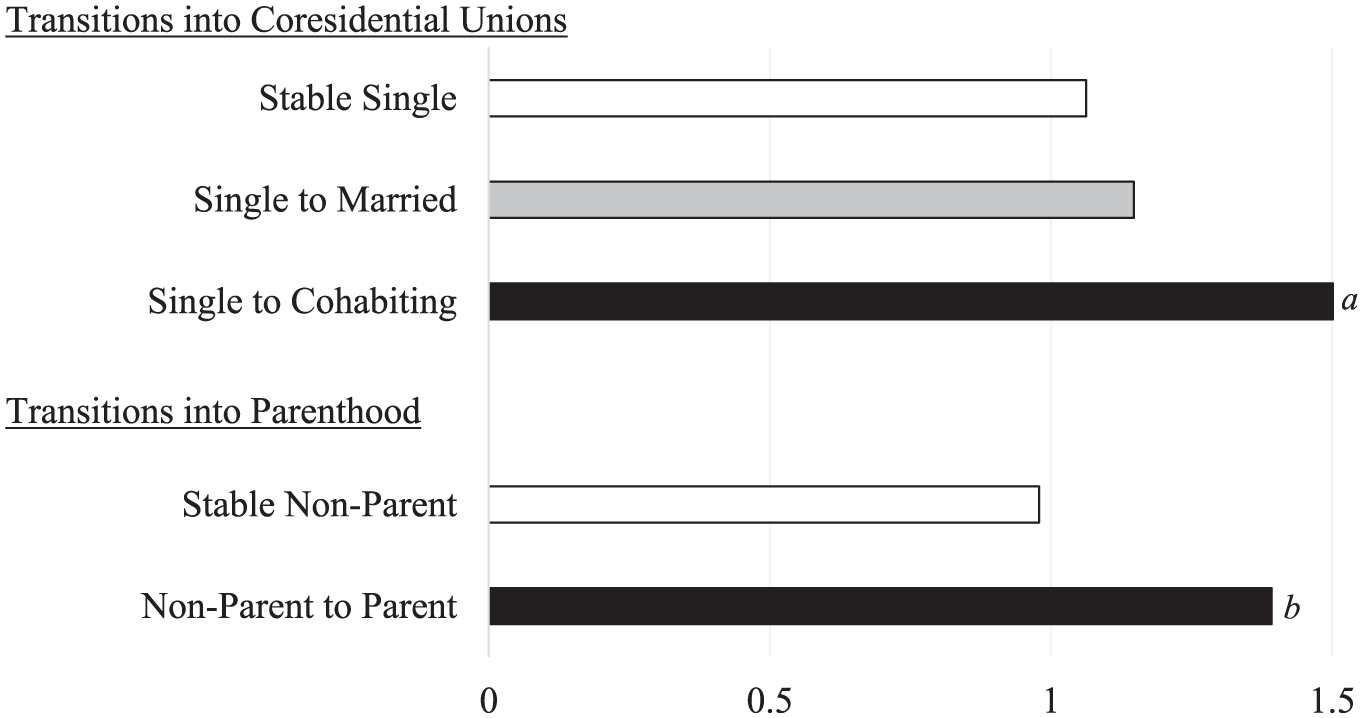
Difference in predicted depressive symptoms at time 2 between those with vs. without childhood symptoms of attention-deficit/hyperactivity disorder, across categories of transitions into coresidential unions and transitions into parenthood.
Next, to clarify our finding that transitions into cohabitation and parenthood led to decreases in depressive symptoms only for young adults without childhood symptoms of ADHD, we examined depressive symptoms at time 2 for two subgroups: those who were currently cohabiting at time 2 and those who were parents at time 2. More specifically, we considered whether ADHD-related differences in depressive symptoms at time 2 were explained by relationship strain (among those currently cohabiting) or parental strain (among those who were parents). Questions on relationship and parental strain were asked only at time 2, thereby preventing us from incorporating this subanalysis into our longitudinal models. Relationship strain was measured as the sum of 7 indicators of relationship dissatisfaction across multiple domains, with higher values indicating more strain (range = 7–35, α = 0.88). Parental strain was measured as the sum of two items capturing the extent to which respondents felt overwhelmed and/or stressed because of parenthood, with higher values indicating more strain (range = 2–10, α = 0.69). The results are shown in Appendix A, with models 1 and 2 showing the results for cohabitors at time 2 and models 3 and 4 showing the results for parents at time 2.
For respondents cohabiting at time 2, results indicated that childhood symptoms of ADHD were positively and significantly associated with relationship strain, both relationship strain and childhood symptoms of ADHD were significantly and positively associated with depressive symptoms, and childhood symptoms of ADHD had significant direct and indirect associations (via relationship strain) with depressive symptoms. As an extra sensitivity check to the regression results in Table 2, we examined levels of relationship strain by childhood symptoms of ADHD for those married at time 2 and found no significant differences. These results are consistent with the regression results in Table 2 showing that transitions into cohabitation lead to decreases in depressive symptoms only for those without childhood symptoms of ADHD, whereas transitions into marriage are tied to decreases in depressive symptoms, regardless of childhood symptoms of ADHD. For parents at time 2, results indicated that childhood symptoms of ADHD were positively and significantly associated with parental strain, both parental strain and childhood symptoms of ADHD were significantly and positively associated with depressive symptoms, and childhood symptoms of ADHD had significant direct and indirect associations (via parental strain) with depressive symptoms. This is consistent with the regression results in Table 4 showing that transitions into parenthood are associated with decreases in depressive symptoms, but only for respondents without childhood symptoms of ADHD.
Finally, the results from our BW regression analyses were robust to numerous sensitivity checks (results available upon request). First, we reestimated our models with the linear count of childhood symptoms of ADHD, and the direction and significance of results remained the same. Second, we tested whether interactions between ADHD and family transitions differed by gender, and found no significant differences. Third, we tested whether associations between ADHD, transitions into parenthood, and depressive symptoms differed for those who had a single (i.e., nonmarital and noncohabiting) first birth versus a coresidential first birth and found no significant differences.
Discussion
Notwithstanding the plethora of studies linking ADHD to higher levels of depression (Kessler et al. 2006; Meinzer et al. 2015), in addition to research showing that the negative effects of ADHD on overall well-being are intensified in the presence of comorbid depression (Biederman et al. 2008), prior research has rarely considered the social factors that shape associations between ADHD and depression in adulthood. To our knowledge, this study was the first to examine whether family transitions affected depressive symptoms differently for young adults with and without childhood symptoms of ADHD. Specifically, we used nationally representative longitudinal survey data and BW regression modeling to consider whether transitions into coresidential unions, transitions out of coresidential unions, or transitions into parenthood affected depressive symptoms differently for young adults with and without childhood symptoms of ADHD at subthreshold or diagnostic levels. Our results revealed two key findings that, taken together, suggest that some family transitions have the potential to significantly shape ADHD-depression disparities in young adulthood.
First, we found that transitions into parenthood were associated with decreases in depressive symptoms only for respondents without childhood symptoms of ADHD, thereby leading to predicted ADHD-depression disparities in young adulthood that were significantly larger among parents than among nonparents. We expect that transitions into parenthood are more challenging for adults with ADHD because of their tendency to report fewer effective parenting strategies and more parental strain (Kroeger 2018; Williamson et al. 2017). In the sensitivity analyses examining depressive symptoms at time 2 among parents, we found that parental strain partially mediated the positive associations between ADHD and depressive symptoms. A limitation of the data was that the measure of parental strain was available only at time 2. Therefore, future research should consider associations between ADHD, parental strain, and depression using longitudinal data as they become available. In addition, the present study assessed ties between parenthood and depressive symptoms specifically in young adulthood, a period in the life course when respondents’ children are relatively young. Because research indicates higher levels of depression for parents with younger versus older children (Evenson and Simon 2005), future research should examine whether the differential effects of transitions into parenthood on depressive symptoms for adults with and without childhood symptoms of ADHD dissipate, persist, or grow as respondents’ children age.
Second, we found that transitions into cohabitation were associated with decreases in depressive symptoms only for respondents without childhood symptoms of ADHD, thereby leading to predicted ADHD-depression disparities in young adulthood that were significantly larger among cohabitors than among the stably single. That transitions into cohabitation can widen ADHD-related disparities in depression is especially important given that cohabitation is the most common type of first union (Manning 2013). Collectively, the results for transitions into coresidential unions showed that, among respondents with childhood symptoms of ADHD, cohabitation was distinct from marriage in its consequences for depressive symptoms. That is, whereas cohabitation was tied to decreases in depressive symptoms only for respondents without childhood symptoms of ADHD, transitions into marriage were tied to decreases in depressive symptoms regardless of childhood symptoms of ADHD. Therefore, in the case of marriage, our results provided strong support for prior theoretical and empirical work on family contexts and mental health suggesting that the formation of intimate unions can provide meaning, purpose, stable lifestyles, and psychological rewards (Thoits 2011).
To elucidate our finding that cohabitation was distinct from marriage in its consequences for depressive symptoms among young adults with childhood symptoms of ADHD, future research should investigate differences in relationship quality among young adults with ADHD who are married versus cohabiting and the implications of these differences for mental health. Although prior research has examined ties between ADHD and relationship quality in nonmarital unions more generally, it has not focused on ties between ADHD and relationship quality in cohabiting unions specifically, nor has it compared relationship quality among those with ADHD across coresidential union types (Bruner et al. 2015; Pollock et al. 2017). Cohabitations might be more prone than marriages to impulsive entries, which may be more common among young adults with ADHD. Consequently, for young adults with ADHD, cohabiting unions might be characterized by lower relationship quality and fewer benefits to mental health compared with marital unions.
That transitions into cohabitation provided no mental health benefit among young adults with childhood symptoms of ADHD is consistent with prior research linking ADHD to lower relationship quality in nonmarital unions (Bruner et al. 2015). In contrast, that transitions into marriage were tied to decreases in depressive symptoms regardless of childhood symptoms of ADHD contradicts research linking ADHD to lower marital quality (Eakin et al. 2004). Our focus on the linkages between ADHD, family transitions, and depressive symptoms specifically in young adulthood may contribute to this pattern of results. Future research should investigate whether the patterns found in this study fluctuate at different stages in the adult life course. Such studies should consider transitions into coresidential unions in tandem with transitions out of coresidential unions; that transitions into cohabitation provide no mental health benefit for respondents with childhood symptoms of ADHD whereas transitions out of coresidential unions increase depressive symptoms regardless of childhood symptoms of ADHD raises the possibility that multiple union transitions result in cumulative mental health penalties for adults with ADHD. Future research should investigate this possibility using a marital biographical approach (Hughes and Waite 2009).
In sum, in finding that family ties are important in shaping ADHD-depression disparities in young adulthood, the results of this study contribute both to literature linking close social ties to mental health (Thoits 2011) and to literature linking ADHD to comorbid mental health issues (Sobanski et al. 2007). Yet more research is needed to improve knowledge on ADHD-related differences in the effects of family relationships on mental health. For instance, although our findings were robust to triple interactions with gender in sensitivity analyses, it is possible that our lack of significant differences was driven by only 36 percent of our ADHD subsample being female. Future research on this topic should continue to consider gender variations, perhaps oversampling women when possible to combat smaller cell sizes. In addition, future research should consider whether other normative transitions in young adulthood, such as transitions to full-time employment, add nuance to linkages between ADHD, family contexts, and mental health. Challenges with time management raise the possibility that family transitions are more stressful for adults with ADHD when also managing a full-time job for the first time. Moreover, adults with ADHD may be especially prone to the “spillover” of stress from work to their family relationships, with implications for depressive symptoms (Yucel and Latshaw forthcoming).
Finally, the results of this study complement sociological research showing that the consequences of family relationships for mental health are highly dependent on a range of indicators (Umberson and Montez 2010; Williams 2003). Specifically, our results suggest that the effects of coresidential union and parenthood transitions on depressive symptoms may depend on the chronic conditions individuals endure throughout much of their lives, at least in the case of ADHD. Given that up to 25 percent of children in the United States have chronic mental or physical health conditions (Compas et al. 2012), it is important that future research consider the influence of numerous early-life chronic health conditions on ties between family contexts and mental health throughout the adult life course.
Footnotes
Appendix
Estimates from Linear Mediation Analyses at Time 2.

| Cohabiting at Time 2 (n = 1,991) | Parent at Time 2 (n = 5,283) | |||
|---|---|---|---|---|
| ADHD → Relationship Strain → Depressive Symptoms | ADHD → Parental Strain → Depressive Symptoms | |||
| Model 1 | Model 2 | Model 3 | Model 4 | |
| Outcome: Relationship Strain | Outcome: Depressive Symptoms | Outcome: Parental Strain | Outcome: Depressive Symptoms | |
| b (SE) | b (SE) | b (SE) | b (SE) | |
| Direct effects | ||||
| Relationship strain | .19*** (.03) | |||
| Parental strain | .42*** (.04) | |||
| Had childhood symptoms of ADHD | .65* (.29) | .98*** (.28) | .22* (.10) | 1.14*** (.18) |
| Indirect effect of childhood symptoms of ADHD on depressive symptoms | .13* (.06) | .09* (.04) | ||
| Total effect of childhood symptoms of ADHD on depressive symptoms | 1.11*** (.28) | 1.23*** (.16) | ||
| Proportion mediated | .11 | .07 | ||
Source: National Longitudinal Study of Adolescent to Adult Health.
Note: Standard errors are in parentheses. Estimates adjust for complex survey design. Times 0, 1, and 2 correspond to waves 1, 3, and 4, respectively. All models control for female, race/ethnicity, age at time 0, parent education at time 0, family structure at time 0, family belonging at time 0, has dissolved coresidential unions at time 2, relationship churning in prior unions at time 2, enrolled in school at time 2, respondent education at time 2, working ≥35 hours per week at time 2, binge drinking in past year at time 2, and smoking in past month at time 2. Models 1 and 2 control for respondent has one or more children at time 2. Models 3 and 4 control for current coresidential union at time 2, nonmarital/noncohabiting first birth at time 2, and one or more children diagnosed with ADHD at time 2. ADHD = attention-deficit/hyperactivity disorder.
p < .05, **p < .01, ***p < .001 (two-tailed tests).
Acknowledgements
The first, second, and third authors acknowledge support by grant P2CHD042849 from the Eunice Kennedy Shriver National Institute of Child Health and Human Development, awarded to the Population Research Center at the University of Texas at Austin. The first author also acknowledges support by an F32 National Institute of Child Health and Human Development Ruth L. Kirschstein National Research Service Award (F32 HD072616). This research uses data from Add Health, a program project directed by Kathleen Mullan Harris and designed by J. Richard Udry, Peter S. Bearman, and Kathleen Mullan Harris at the University of North Carolina at Chapel Hill and funded by grant P01-HD31921 from the Eunice Kennedy Shriver National Institute of Child Health and Human Development, with cooperative funding from 23 other federal agencies and foundations. Special acknowledgment is due Ronald R. Rindfuss and Barbara Entwisle for assistance in the original design. Information on how to obtain the Add Health data files is available on the Add Health Web site ( ). No direct support was received from grant P01-HD31921 for this analysis.