




Abstract
Racism-related stress frameworks posit that the discriminatory experiences of one’s loved ones may threaten one’s well-being, but relatively few studies have examined how they may impact mental health beyond childhood and adolescence. Using data from the Nashville Stress and Health Study (N = 1,252), the present study assessed the prevalence of vicarious experiences of discrimination among subsamples of Black men (n = 297) and women (n = 330), examined the association between vicarious experiences of discrimination and psychological distress among Black men and women, and evaluated the impact of vicarious discrimination on psychological distress in the context of other stressors. Results suggest that Black women report more vicarious exposure to specific types of discrimination. Furthermore, vicariously experienced discrimination was associated with higher levels of psychological distress among Black women, but not among Black men. Our findings extend the literature on racism-related stress and offer new insights for interventions aimed at reducing racial disparities in mental health.
Amid a global health pandemic, voices from around the world converged in summer 2020 to speak out, declaring that “Black Lives Matter” and demanding an end to police violence and other forms of institutional injustices against Black Americans. While anti-Black racism in the United States is far from new, numerous recent murders at the hands of police officers around the country—including, but not limited to George Floyd and Breonna Taylor—brought unprecedented national attention to the everyday racism-related challenges faced by Black Americans (Dreyer 2020; Sewell 2020). Moreover, with the rise of social media, Black Americans have been increasingly plagued with images and videos of violence and discrimination committed against other Black people, which many describe as “painful” or “traumatizing” to witness (Bailey et al. 2017; Stewart, Schuschke, and Tynes 2019). Substantial evidence has identified and linked racism-related social stressors, such as perceived discrimination, to adverse mental health outcomes among Black people (Alang, McAlpine, and McClain 2021; Kessler, Mickelson, and Williams 1999; Lewis, Cogburn, and Williams 2015; Louie 2020; Paradies et al. 2015; Pascoe and Richman 2009; Piertese et al. 2012). Yet, few studies have evaluated how secondhand, or vicarious, experiences of discrimination may also impact the health and psychological well-being of this population.
Vicarious racism has been defined as the distressing “experiences of prejudice and discrimination that happen to members of one’s family and close friends . . . as well as those involving strangers . . . ” (Harrell 2000:45). Prior research suggests that the adverse experiences that one endures are likely to impact those who share ties with that individual (Pearlin 2010), which mirrors the conceptualization of the racism-related stress dimension of vicarious racism. Public focus on the noxious effects of vicarious racism has grown in recent years, particularly following the tragic and untimely death of Erica Garner (daughter of Eric Garner) in 2017, as well as the deaths of the parents of Atatiana Jefferson, all of whom died unexpectedly after their loved ones were slain by law enforcement (Smith 2020; V. Wang 2017). Given that each of these disastrous events were also widely publicized, many Black people in the United States have endured collective trauma due to their feelings of connectedness to other Black Americans and beliefs in their linked fate, which is consistent with recent findings on linked fate and mental health (Monk 2020). As such, witnessing, or becoming aware of, the racism-related stressors faced by others may be especially harmful for Black Americans (Gee, Walsemann, and Brondolo 2012; Harrell 2000). Nevertheless, empirical evidence for whether these vicarious discrimination experiences affect mental health remains relatively limited (Bor et al. 2018; Heard-Garris et al. 2018; Louie and Upenieks 2022; Moody et al. 2022), since most measures of perceived discrimination focus on the individual’s personal experiences of unfair treatment (Shariff-Marco et al. 2011). In fact, systematic reviews and meta-analyses (e.g., Paradies et al. 2015) have revealed that fewer than 20 percent of the studies on racism and health between 1983 and 2013 used measures of indirect exposure to racism (e.g., group, vicarious, proxy-reports), with most focusing on the impact of personal experiences of discrimination. However, this approach likely underestimates the larger toll of racism-related stress on Black Americans’ health and limits our ability to identify effective strategies for intervention.
To address these limitations, the present study examines the mental health consequences of vicarious discrimination among Black men and women. By distinguishing the effects of personal and vicarious experiences of discrimination, this study aims to gain a more comprehensive understanding of the effects of racism-related stress on the health of Black Americans and to inform policies and interventions that reduce inequalities among this population.
Background
Psychological Distress among Black Americans
Sociological research has increasingly recognized the significance of racism as a fundamental cause of health inequities in recent decades (Phelan and Link 2016; Williams and Collins 1995), largely informed by W. E. B. Du Bois’ (1899) early declaration of racism’s consequences for Black Americans’ health in the late 19th century. However, there is still much to learn about the various, and often nuanced, ways in which racism-related stressors contribute to mental health patterns among Black Americans. For instance, a growing body of epidemiological research demonstrates a “mental health paradox,” indicating that while Black Americans report relatively low rates of major psychiatric disorders, levels of psychological distress tend to be elevated among this population (Banks et al. 2006; Barnes and Bates 2017; Mouzon 2013; Thomas Tobin 2021; Thomas Tobin and Moody 2021). The discordant distress–disorder patterns of Black Americans are considered “paradoxical,” largely because the etiologies of these outcomes have been traditionally thought to overlap. Moreover, Black Americans experience many psychosocial risks linked to poor mental health (e.g., exposure to social stressors, greater socioeconomic disadvantage, limited coping resources), but recent evidence shows these factors may differentially influence psychological distress among this group (Thomas Tobin 2021). Thus, growing efforts to explain these counterintuitive patterns have investigated group-specific experiences, namely, persistent exposures to racism-related stressors across the life course, which may elicit heightened feelings of demoralization that contribute to psychological distress (Horowitz and Wakefield 2007; Louie and Wheaton 2018; Thomas Tobin 2021; Thomas Tobin and Moody 2021).
Prior research has underscored the pernicious nature of psychological distress, noting that it often undermines individuals’ ability to fulfill their social roles and responsibilities (Mirowsky and Ross 2003). Studies also indicate that Black Americans are more likely to have severe and disabling symptoms compared to other groups (Ayalon and Young 2003; Walton and Payne 2016; P. S. Wang, Berglund, and Kessler 2000; Williams et al. 2007). Moreover, highly distressed Black individuals face heightened risk of co-occurring chronic health conditions that may further exacerbate their psychological issues (Erving and Frazier 2021; Skrine Jeffers et al. 2021). These patterns not only suggest that psychological distress manifests in distinct ways among Black Americans, but also underscores the need to identify group-specific processes and exposures, such as vicarious discrimination, which contribute to elevated levels of psychological distress among this population.
Vicarious Discrimination as a Form of Racism-related Stress
Perceived discrimination, as described by David R. Williams and colleagues (1997), is a measure assessing individual-level perceptions of unfair treatment that could be attributable to a variety of factors (e.g., gender, weight, race, social class). Perceived racial discrimination is unfair treatment occurring at the individual level. However, what distinguishes racial discrimination from perceived discrimination more broadly is that the recipient of the discrimination believes the unfair treatment to be attributable to their race. Racism is a broader structural level form of inequality that differentially ranks the value and worth of persons on the basis of racial markers like skin tone, hair texture, and phenotype. Historically, Black Americans have remained at the bottom of the racial hierarchy and continue to occupy this subordinated position in the present day (Bonilla Silva 1997, 2003). Though measures of perceived discrimination are self-reported and cannot possibly capture the myriad of ways in which racism operates in the United States, perceived discrimination is an individual-level perceptual measure that is rooted in structural level racism.
One framework that outlines the complex processes through which the health of individuals is impacted by racism is the racism-related stress framework (Harrell 2000). Racism-related stress is defined as, “the race-related transactions between individuals or groups and their environment that emerge from the dynamics of racism and that are perceived to tax or exceed existing individual and collective resources or threaten well-being” (Harrell 2000:44). This framework recognizes the multidimensional lived experiences of constant and simultaneous exposures to racism in multiple life contexts (Jones et al. 2020) and subsequent racism-related vigilance among racial and ethnic minorities from the “womb to the tomb” (Hicken, Lee, and King 2018). Like general stressors, there are numerous forms of racism-related stressors, which vary in magnitude and impact (Williams and Mohammed 2009). These include racism-related life events, daily racism-related microstressors (e.g., microaggressions), chronic-contextual stress, collective experiences of racism, the transgenerational transmission of group traumas, and vicarious racism (Harrell 2000).
Prior research has documented several pathways through which racism-related stress may influence health (Carter 2007; Clark et al. 1999; Cohen, Kessler, and Gordon 1995; Goosby, Cheadle, and Mitchell 2018; Williams and Mohammed 2009). For example, exposure to racism-related stressors can be upsetting and lead to the poor emotional states that produce psychological distress (Paradies 2006). Furthermore, the concept of stress contagion suggests that the effects from stressors may cross from one individual to another (Wethington 2000), particularly depending on the relationship that the target has with others in their social network (Louie and Upenieks 2022). These mechanisms demonstrate the health significance of racism-related stressors and emphasize their role in shaping psychological distress among Black Americans. However, since most research focuses on personal experiences of discrimination, our understanding of how vicarious experiences of discrimination shape health remains relatively limited.
Vicarious discrimination refers to the indirect experiences of discrimination that individuals endure through the observations and accounts of others (Essed 1991; Harrell 2000). This element of the racism-related stress framework underscores the notion that racism can impact individuals directly and indirectly. Furthermore, vicarious discrimination is parallel to the life course concept of “linked lives,” which refers to the interconnectedness of individuals through their relationships with others throughout their lives (Elder 1994; Gee et al. 2012; Moody, Brown, and Ciciurkaite 2019). Both vicarious discrimination and the concept of linked lives highlight that at every stage of life, people’s actions and experiences with success and adversity will not only impact them personally but will also likely impact those who share ties with them. While it stands to reason that witnessing another person experience discrimination, or even simply hearing of these accounts, can trigger physiological stress responses within individuals similar to those that occur with direct experiences of discrimination, empirical support for this conjecture has been lacking in prior research. Nevertheless, there has been growing interest in the sequelae of vicarious discrimination.
While much of the existing literature on vicarious discrimination and health focuses on how parents’ experiences of racism can impact their children (Anderson et al. 2015; Daniels et al. 2020; Goosby and Heidbrink 2013; Heard-Garris et al. 2018), more recent studies have also demonstrated that children’s experiences of racism can also impact their parents’ health. For example, Cynthia G. Colen and colleagues (2019) examined longitudinal data and found that youth who endure more frequent experiences of discrimination have mothers who face higher rates of rapid decline in self-rated health at midlife. In a related line of research, researchers have documented how stress from vicarious racism is associated with greater disease activity among a community sample of Black women living with systemic lupus erythematosus (Martz et al. 2019). Vicarious discrimination can adversely impact blood pressure and is associated with genes linked to psychological distress and mood disorders (Quinlan et al. 2016). One study even found that vicarious discrimination had a greater impact on blood pressure relative to direct experiences of racism (Boulter et al. 2015). Collectively, these findings document the significant health risks associated with stress from indirect exposure to unfair treatment. However, as few have evaluated the impact of vicarious discrimination on the subjective well-being of Black Americans (Moody 2022; Wofford, Defever, and Chopik 2019), aspects of the psychological consequences of secondhand exposure to discrimination remain unclear. Additional research is needed to distinguish the mental health significance of vicarious discrimination from that of other stressors that individuals may face.
Discrimination Stress and Mental Health among Black Women and Men
Drawing from the intersectionality framework (Collins 2000; Crenshaw 1991), we propose that exposure to and the psychological impact of vicarious discrimination may vary by gender among Black Americans. Black men and women face related, yet distinct, intersectional vulnerabilities that could differentially expose them to discrimination. On one hand, Black women experience both gendered and racialized oppression rooted in structural-level sexism and racism (Crenshaw 1991; Homan, Brown, and King 2021). On the other hand, Black men experience gender advantage yet they are marginalized with respect to their race (Gilbert et al. 2016). The combination of possessing both gender privilege and racial marginalization, however, may make Black men more susceptible to personally experiencing discrimination. According to the “subordinate male target hypothesis,” Black men may encounter greater exposure to discrimination than Black women because they pose a greater threat to white male dominance (Mouzon et al. 2020; Sidanius and Veniegas 2000). Past research confirms that Black men report experiencing more frequent lifetime discrimination (Yoon, Coburn, and Spence 2019) and everyday discrimination (Mouzon et al. 2020) relative to Black women. This literature is in alignment with national trends showing that Black men experience police brutality, incarceration, racial profiling in public places to greater extent than their Black female peers (Curry 2017).
In contrast to research confirming greater risk for directly experienced everyday and major discrimination among Black men (Erving 2022; Harnois and Ifatunji 2011; Ifatunji and Harnois 2016), Black women may be exposed to a higher volume of vicarious discrimination because of their chronic exposure to network stress (Woods-Giscombé et al. 2015). As we previously argued, vicarious discrimination, as a measure of stress exposure, captures discrimination experienced within one’s social network; in addition, because past research suggests that the composition and size of women’s and men’s social networks differ, vicarious discrimination, as an indicator of network-related discrimination, may also be gendered among Black Americans. Though having a broad and expansive social network can generally be salubrious (Thoits 2011), Black women’s high levels of engagement in social roles and strong emotional ties with network members from various aspects of their lives (e.g., family, work, school, church) could contribute to heightened exposure to network-related stressors (Beauboeuf-Lafontant 2009; Woods-Giscombé 2010; Woods-Giscombé et al. 2015). A recent study reported Black women face higher levels of network stress than stressors they experience directly (Woods-Giscombé et al. 2015). As such, it stands to reason that Black women’s caregiving roles in families, workplaces, churches, and within Black communal contexts may place them at disproportionate risk for experiencing vicarious discrimination compared to Black men. This is not to suggest that Black men do not experience vicarious discrimination; instead, racialized and gendered norms surrounding expectations of intensive caregiving and nurturing may heighten Black women’s exposure to vicarious discrimination (Beauboeuf-Lafontant 2009; Woods-Giscombé et al. 2015).
Despite our hypothesis that Black women may experience higher levels of vicarious discrimination than their male peers, it is unclear whether the association between vicarious discrimination and psychological distress will differ for Black men and women. Research on the psychological effects of (self) perceived discrimination suggests either no gender differences in its association with mental health (Jang et al. 2008; Yoon et al. 2019), or that the association between discrimination and mental health is stronger among Black women (Banks, Kohn-Wood, and Spencer 2006). However, whether the psychological influence of vicarious discrimination on Black Americans differs by gender remains unclear.
Intersectionally grounded research indicates that Black women often express feeling obligated to care for and shoulder the burdens of family and friend network members (Woods-Giscombé 2010). The notion of “Strong Black Womanhood” carries with it both strength and relational strains unique to the intersectional experiences of Black women (Beauboeuf-Lafontant 2009; Woods-Giscombé 2010; Woods-Giscombé et al. 2015). The actualization of strength entails tending to the needs of others, often to the neglect of one’s own personal needs; moreover, the obligation to help others at one’s own experience is linked to psychological distress among Black women (Woods-Giscombé et al. 2019). Given Black feminist scholarship on societally imposed expectations of Black women to carry and resolve the social and psychological concerns of others, the association between vicarious discrimination and psychological distress could be stronger among Black women than Black men.
The Present Study
The purpose of this study is to investigate the mental health consequences of vicarious discrimination among Black Americans. We address three main research aims: First, we assess the prevalence of vicarious experiences of discrimination among Black women and men. Previous findings suggest that Black men tend to report higher levels of discrimination than Black women (Mouzon et al. 2020), while others note differences in the types of discrimination experiences that Black women face relative to men (Harnois and Ifatunji 2011; Ifatunji and Harnois 2016). However, few studies have considered whether vicarious experiences of discrimination may be distinct among Black women and men. Second, we examine the association between vicarious discrimination and psychological distress among Black men and women. As prior research documents significant gender differences in mental health (Thoits 2010) and distinct exposures to racism-related stressors (Harnois and Ifatunji 2011; Ifatunji and Harnois 2016; Utsey et al. 2002), we also consider the psychological consequences of vicarious discrimination separately among Black women and men. We focus on psychological distress, given its prevalence among Black Americans (Louie and Wheaton 2019) and its demonstrated association with social stressors in previous studies (Thomas Tobin 2021; Turner and Avison 2003). Third, and relatedly, we evaluate the impact of vicarious discrimination on psychological distress in the context of other social stressors. As David R. Williams and Selina A. Mohammed (2009) argue, discrimination should be assessed within the larger social context of multiple stressful exposures within which it is embedded because such experiences may give rise to other stressors. Specifically, it is possible that vicarious discrimination makes a unique contribution to health, or it may simply contribute to greater exposure to other stressors. Thus, there is a need to evaluate the relationship between vicarious discrimination and mental health while holding constant the larger array of stressors in which vicarious discrimination may be embedded. By examining vicarious discrimination and its impact on psychological distress, this study aims to advance our understanding of the role of pervasive racism-related stressors in shaping health inequalities among Black Americans.
Methods
Sample
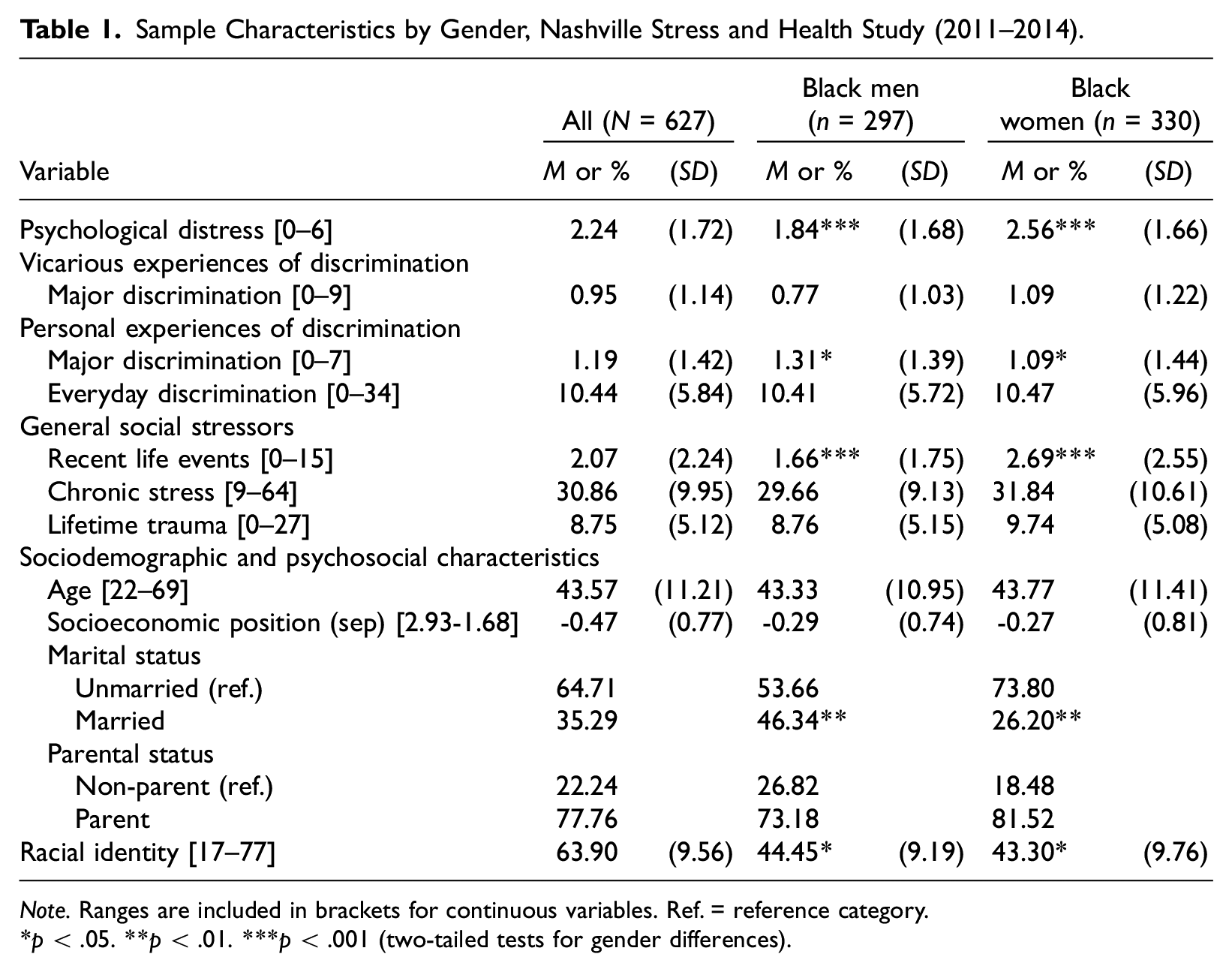
The Nashville Stress and Health Study (NSAHS) is a population-based sample of Black and White adults (N = 1,252) ages 22 to 69 from the city of Nashville and surrounding areas within Davidson County, Tennessee. A multistage, stratified sampling approach was used to obtain a random sample. Black households were oversampled to achieve a final sample with similar proportions of racial and sex groups, and a sampling weight allowed for generalizability of sample characteristics to the county population. American Association for Public Opinion Research (AAPOR) rates were used to assess success across screening and interviewing phases (Response Rate 1 = 30.2, Cooperation Rate 1 = 74.2, Refusal Rate 1 = 30.2, and Contact Rate 1 = 40.7). Between 2011 and 2014, respondents were interviewed about their personal and family backgrounds, stress and coping experiences, health behaviors, and health histories during 3-hour computer-assisted interviews with trained study staff who were matched to participants of the same race. All participants provided informed consent. Study procedures were approved by the Vanderbilt University Institutional Review Board and have been described in detail elsewhere (T. N. Brown, Turner, and Moore 2016; Turner 2013; Turner, Thomas, and Brown 2016). This dataset was ideal for this study given its unique measure of vicarious exposure to major discrimination, which will be described in greater detail in the next section. The present analyses include data from 627 respondents, and characteristics for the subsample are provided in Table 1.
Sample Characteristics by Gender, Nashville Stress and Health Study (2011–2014).
Note. Ranges are included in brackets for continuous variables. Ref. = reference category.
p < .05. **p < .01. ***p < .001 (two-tailed tests for gender differences).
Measures
Psychological distress
Psychological distress was measured using a 6-item subscale of the Symptoms Checklist-90 (SCL-90) (Derogatis and Clearly 1977; Derogatis, Lipman, and Covi 1973; Derogatis, Rickels, and Rock 1976), which asks respondents to report whether they experience the various dimensions of psychological distress (e.g., depression, anxiety, hostility, obsessive-compulsive, and paranoid ideation-related symptoms). Specifically, respondents were asked about whether they experienced any of the following within their lifetime: (1) “a strong fear of social or performance situations…”; (2) “an attack of fear or panic when all of a sudden you felt very frightened, anxious, or uneasy”; (3) “when you worried a lot more about things than other people with the same problems as you”; (4) “a period lasting several days or longer when most of the day you felt sad, empty or depressed”; (5) “not being able to concentrate”; (6) “very restless and fidgety” and impatient. Items were summed such that higher scores indicate higher levels of psychological distress.
Vicarious discrimination
Vicarious experiences of major discrimination were assessed using the Major Experiences of Discrimination scale (Williams et al. 2008), a 7-item measure based on a count of lifetime exposure to major incidents of unfair treatment. Respondents were asked about whether they had experienced negative treatment such as “been unfairly fired or denied a promotion,”“been unfairly treated by the police,” and “been unfairly discouraged by teacher from pursuing a job/career.” If they answered “Yes,” respondents were then asked to whom the discrimination occurred: (1) self, (2) spouse, (3) child, (4) other relative, or (5) close friend. Non-events and events experienced directly by the respondent were coded as 0, while events faced by loved ones were coded as 1. Responses were summed such that higher scores indicated greater exposure to vicarious discrimination.
Personally experienced discrimination
Two forms of personally experienced discrimination were examined. Major discrimination, also based on the Major Experiences of Discrimination scale (Williams et al. 2008), assessed individuals’ own lifetime experiences of major unfair treatment. As noted above, this measure captured the personal experiences of major discrimination of the respondents who answered “Yes” to items regarding unfair treatment, and “(1) self” to the question regarding who experienced the discrimination. The total count of “Yes” items were used to create a major discrimination score for each respondent. Higher values indicated greater exposure to personally experienced major discrimination. Everyday discrimination captures day-to-day experiences of unfair treatment and was measured using the Everyday Discrimination Scale (Williams et al. 1997). The Everyday Discrimination Scale (αBlack Subsample = .86; αBlack Men = .86; αBlack Women = .87) comprised of nine items such as “You are treated with less courtesy than other people” and “You receive worse service than other people at restaurants or Stores.” Respondents were asked to report the frequency with which these events occur: (0) never, (1) rarely, (2) sometimes, (3) often, and (4) almost always. Responses were summed such that higher scores indicated greater exposure to personally experienced everyday discrimination.
General stressors
Exposure to other social stressors was captured through measures of recent life events, chronic stress, and lifetime trauma. Recent life events were measured by a 32-item inventory, and respondents were asked to report if each event (e.g., “Did a child die,”“Was there a marital separation or divorce,”“Did someone have a major financial crisis,” and “Was demoted at work or took a pay cut.”) happened to them or someone close within the past 12 months. Exposure to recent life events was based on a count of the number of events reported. Chronic stress was measured using a 41-item scale (αBlack Subsample = .86; αBlack Men = .86; αBlack Women = .87) capturing exposure to chronic stressors across several life domains such as general strain (e.g., “You’re trying to take on too many things at once”), employment strain (e.g., “You want to change jobs but don’t feel you can”), relationship strain (e.g., “You have a lot of conflict with your partner”), and children (e.g., “A child’s behavior is a source of serious concern for you”). Respondents were asked the extent to which such experiences were (0) not true, (1) somewhat true, or (2) very true for them. Items were summed, and higher scores indicate greater exposure to chronic strains. Lifetime trauma was indexed with a 43-item inventory that assesses the lifetime occurrence (0 = no, 1 = yes) of major and potentially traumatic stressors (Turner and Avison 2003). The measure includes items related to both violent and non-violent stressors (e.g., parental divorce, failing a grade in school), along with items concerning life traumas (e.g., sexual assault, physical and emotional abuse, being injured with a weapon), witnessing violence, receiving information about bad events, and the death of relatives or close friends. Exposure to lifetime trauma was based count of the number of events respondents reported experiencing.
Sociodemographic characteristics
All analyses accounted for age, socioeconomic position, marital status, parental status, and racial identity. Age was employed as a continuous measure in years. Respondents’socioeconomic position (SEP) was measured using a standardized index of years of completed education, self-reported annual household income, and level of occupational prestige based on the Nam–Powers–Boyd occupational scores (Nam and Boyd 2004). Additional information on the NSAHS coding procedure for occupational prestige can be found elsewhere (Turner et al. 2016). Socioeconomic position scores were calculated by standardizing and summing the three dimensions; scores were then divided by the number of dimensions on which data were available (R. L. Brown 2014; Gayman, Brown, and Cui 2011). This resulted in a socioeconomic position score that represents the number of standard deviations above or below the sample’s mean socioeconomic position, with greater values indicating higher socioeconomic position. By equally weighting education, income, and occupational prestige, this approach captures individuals’ placement within a social hierarchy and provides a comprehensive assessment of socioeconomic position while reducing data loss on individual indicators (R. L. Brown 2014). Marital status distinguished between married (=1) and unmarried (=0) respondents. Parental status distinguished between those who reported having children (=1) or not (=0). Prior research demonstrates a significant association between racial identity and the perception and health consequences of discrimination (Operario and Fiske 2001; Sellers et al. 2003; Shelton and Sellers 2000); thus, the present study accounted for racial identity. Racial identity was based on 11 items (αBlack Subsample = .80; αBlack Men = .80; αBlack Women = .79) about the degree to which being Black was important to self-concept and the extent to which they felt connected to other Black people. Example items include, “you have a strong sense of yourself as a member of your racial/ethnic group” and “most of your close friends are from your own racial/ethnic group.” Response items ranged from (1) strongly disagree to (7) strongly agree. Items were summed, such that higher values indicated stronger connectedness to a Black identity and Black people.
Analytic Strategy
Weighted means and proportions were estimated for all study measures among the full sample and by gender. T-tests and chi-square tests of significance were used to evaluate differences between women and men (Table 1). Differences in vicarious discrimination events for the full sample and separately among men and women were also assessed (Table 2). To examine the association between vicarious discrimination and psychological distress among Black women and men, we estimated gender-stratified linear regression models. We chose this stratified modeling approach based on prior research on gender and psychological distress, which suggests divergent processes whereby gender shapes distress (Kessler and McLeod 1984). As such, we considered these processes separately and then used Chow tests to evaluate significant differences in the effects of vicarious discrimination across genders. This process is similarly described in greater detail elsewhere (Erving and Thomas 2018). Results from Chow tests indicated that the magnitude of the relationship between vicarious discrimination and psychological distress was significantly different for Black women and men in Model 2 (F = 23.08, p < .001), Model 3 (F = 20.02, p < .001), and Model 4 (F = 12.66, p < .001). Among both men (Table 3) and women (Table 4), associations between psychological distress and age, SEP, marital status, parental status, and racial identity were considered in Model 1. Model 2 added vicarious discrimination. To consider whether the effect of vicarious discrimination is distinct from that of personally experienced discrimination, major and everyday discrimination were added in Model 3. To evaluate whether vicarious discrimination makes a distinct, independent impact on psychological distress in the context of other stressors, general stressors (i.e., recent life events, chronic stress, and lifetime trauma) were added in Model 4.
Vicarious Experiences of Discrimination among Black Men and Women, Nashville Stress and Health Study (2011–2014).

p < .05. **p < .01. ***p < .001 (two-tailed tests).
Association between Psychological Distress and Vicarious Discrimination, Personally Experienced Discrimination, and General Social Stressors among Black Men (n = 297), Nashville Stress and Health Study (2011–2014).

Note. Ref. = reference category.
p < .05. **p < .01. ***p < .001 (two-tailed tests).
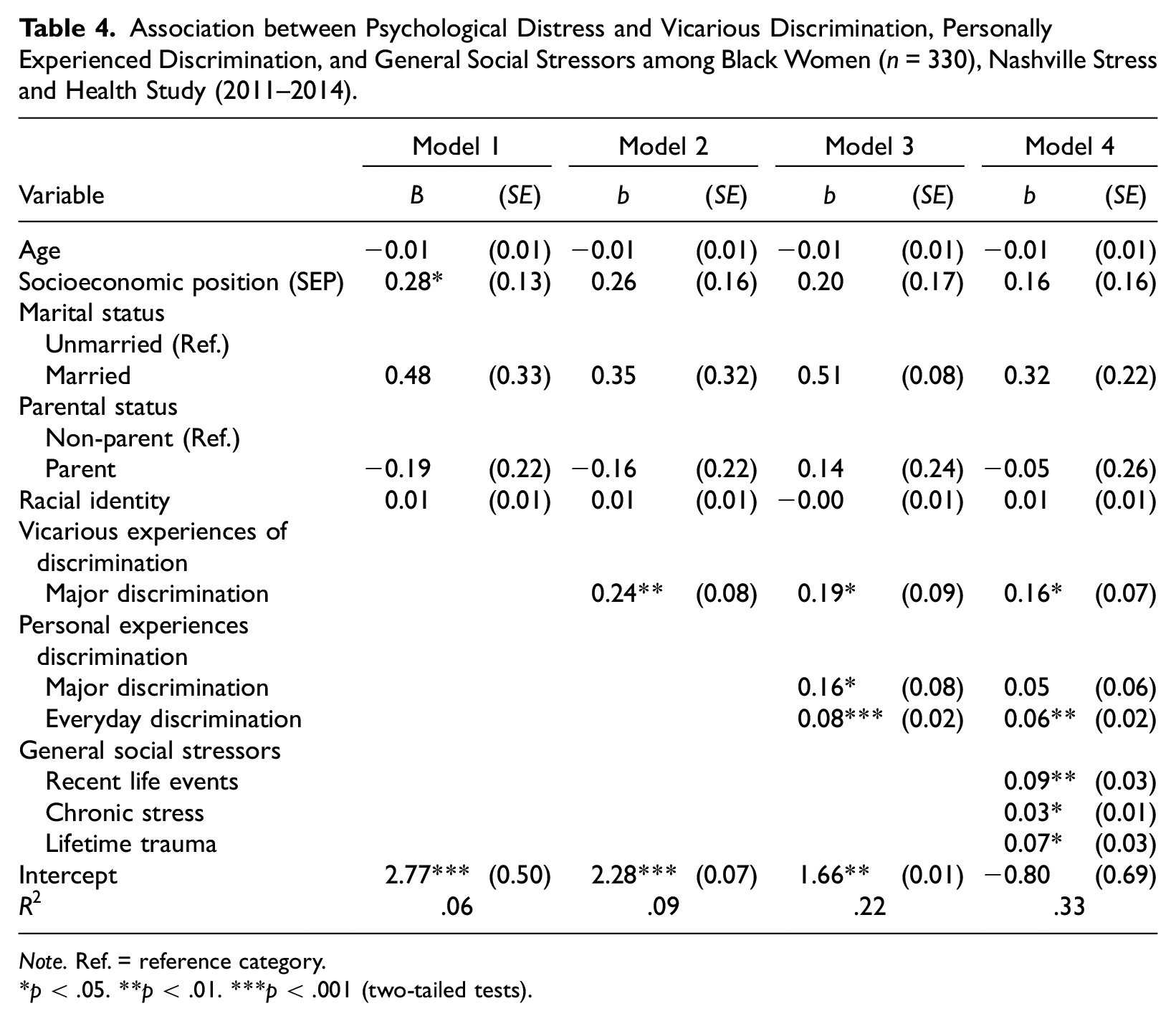
Association between Psychological Distress and Vicarious Discrimination, Personally Experienced Discrimination, and General Social Stressors among Black Women (n = 330), Nashville Stress and Health Study (2011–2014).
Note. Ref. = reference category.
p < .05. **p < .01. ***p < .001 (two-tailed tests).
Results
Table 1 presents the weighted means and proportions of sample characteristics by gender. Women (M = 2.56, SD = 1.66) reported significantly (p < .001) higher levels of psychological distress relative to men (M = 1.84, SD = 1.68). However, men and women reported nearly one instance of vicarious exposure to major discrimination on average (M = 0.95, SD = 1.14, range = 0–9). While exposures to personally experienced everyday discrimination, chronic stress, and lifetime trauma were also comparable across groups, men reported significantly more personal experiences with major discrimination compared to women (p < .05). In contrast, women reported significantly more recent life events (p < .001). Overall, the sample had an average age of 43.57 (SD = 11.21) and most had relatively low to moderate SEP levels (M = -0.47, SD = 0.77). While only 35 percent were married, more than three-quarters of the sample (77.76 percent) had children. Men were also more likely to be married, as 46 percent of men were married compared to 26 percent of women. In addition, most reported high levels of racial identity, indicative of strong feelings of connectedness to a Black identity and to Black people; racial identity scores were slightly higher among men (M = 44.45, SD = 9.19, p < .05) relative to women (43.30, SD = 9.79).
Table 2 shows the percentage of respondents reporting vicarious discrimination events. Among the full sample, the most common events that individuals said their loved ones faced were being “unfairly fired or denied a promotion” (31.09 percent), “unfairly treated by the police” (27.07 percent), and “for unfair reasons, not been hired for a job” (14.08 percent). However, some patterns were distinct among women and men. For instance, while 17.76 percent of Black women noted that their loved ones had “for unfair reasons, not been hired for a job,” only 9.59 percent of Black men reported this event happening among their family and friends (p < .01). Similarly, significantly (p < .001) more Black women (35.83 percent) than Black men (16.39 percent) reported their loved ones’ experiences with unfair treatment by the police. Other vicarious discrimination events (e.g., been unfairly discouraged by a teacher or advisor from continuing education) occurred less frequently and comparably across gender groups. In sum, though the overall mean difference in vicarious discrimination was not statistically significant by gender, upon closer inspection among the individual items, Black women were more likely to report two specific vicarious discrimination events relative to their Black male counterparts.
The Impact of Vicarious Discrimination among Men
In Table 3, the relationship between vicarious discrimination and psychological distress among Black men was examined. Model 1 shows that younger age (b = -0.03, SE = 0.01, p < .05) and not having children (Parent: b = -0.72, SE = 0.33, p < .05) were associated with higher levels of psychological distress. SEP, marital status, and racial identity were not linked to distress among men. These patterns persisted in Model 2, with vicarious discrimination added, and results show that vicarious discrimination was not associated with psychological distress. Similarly, personal experiences of major discrimination were not significantly linked to distress in Model 3. However, personally experienced everyday discrimination was significantly associated with greater psychological distress (b = 0.11, SE = 0.03, p < .001). This association persisted in Model 4, which also evaluated the role of general social stressors and results show that chronic stress (b = 0.02, SE = 0.01, p < .05) and lifetime trauma (b = 0.07, SE = 0.03, p < .05) were also linked to higher levels of psychological distress. Collectively, these factors accounted for more than 26 percent of the variation in psychological distress among Black men (R2 = .26), and findings indicate that personally experienced everyday discrimination, chronic stress, and lifetime trauma are more influential than vicarious discrimination for psychological distress for Black men.
The Impact of Vicarious Discrimination among Women
Table 4 shows the associations between vicarious discrimination and psychological distress among Black women. In Model 1, greater SEP was associated with higher distress levels (b = 0.29, SE = 0.14, p < .05). However, age, marital status, parental status, and racial identity were not linked to distress levels among women. Model 2 added vicarious discrimination, and greater exposure to vicarious discrimination was significantly associated with higher levels of psychological distress (b = 0.24, SE = 0.08, p < .01). In Model 3, the influence of personally experienced discrimination was examined, and both personally experienced major (b = 0.16, SE = 0.08, p < .05) and everyday discrimination (b = 0.08, SE = 0.02, p < .001) were linked to higher levels of distress. Nonetheless, the link between vicarious discrimination and psychological distress remained significant, although accounting for these direct forms of discrimination reduced the impact of vicarious discrimination by 21 percent. With all stressors considered simultaneously in Model 4, vicarious discrimination remained significant (b = 0.16, SE = 0.07, p < .05), such that greater exposure to vicarious discrimination was associated with higher distress. Moreover, recent life events (b = 0.09, SE = 0.03, p < .01), chronic stress (b = 0.03, SE = 0.01, p < .05), and lifetime trauma (b = 0.07, SE = 0.01, p < .05) were all linked to higher psychological distress. Collectively, these factors accounted for 33 percent of the variation in psychological distress among Black women, and results show that in addition to personally experienced discrimination and general stressors, vicarious discrimination makes a significant and distinct impact on distress among this group.
Discussion
As Americans continue to grapple with the reckoning of racialized systems that marginalize racial and ethnic minorities, concerns regarding the psychological well-being of Black Americans, who continuously endure the effects of racism across multiple life contexts, has grown. Although findings on the mental health of Black Americans remain somewhat paradoxical (Erving, Thomas, and Frazier 2018; Louie and Wheaton 2018; Thomas Tobin and Moody 2021), a wealth of empirical evidence demonstrates that perceived discrimination is an important social stressor with significant psychological consequences among this population (Brondolo et al. 2009; Goosby, Cheadle, and Mitchell 2018; King et al. 2022; Paradies et al. 2015; Pascoe and Richman 2009; Williams and Mohammed 2009). Burgeoning research also suggests that secondhand experiences of racism may negatively impact the health and well-being of Black Americans (Colen et al. 2019; Louie and Upenieks 2022; Martz et al. 2019; McFarland et al. 2018; Moody 2022; Moody et al. 2022). Yet, most studies examining the association between discrimination and health tend to focus on personal experiences of discrimination (Gee et al. 2012; Paradies et al. 2015). Furthermore, among the newly emerging studies that investigate how vicarious racism affect health, few have considered how vicarious racism impacts the mental health of Black adults. Our study addresses these gaps in research and extends current knowledge on how racism-related stress shapes health by providing evidence for how vicarious experiences of discrimination are linked to mental health outcomes among Black men and women. Specifically, the purpose of this study was to examine whether vicarious discrimination (i.e., discrimination experienced by one’s spouse, child, other relative, and friends) is associated with psychological distress among Black men and women within the context of direct experiences of discrimination and other stressors. Overall, results demonstrate that vicarious discrimination significantly shapes Black women’s psychological distress and underscores how Black men and women differentially experience this stressor. This study offers several notable findings and important new insights of interest for future research on racism and health.
Given the limited research on vicarious discrimination, our first goal was to examine the prevalence of vicarious discrimination experiences among Black men and women. Collectively, we found that Black men and women most often reported vicarious experiences with institutional discrimination involving threats to others’ livelihood (e.g., unfairly denied opportunities for upward social mobility) and safety (e.g., unfair treatment by law enforcement). Our findings are consistent with other research reporting that vicariously experiencing discrimination, specifically as it relates to unfair treatment from law enforcement, is a prominent stressor with implications for mental health among Black adults (Bor et al. 2018); vicarious discrimination has also been linked to biological aging among Black men (McFarland et al. 2018). When assessing gender differences in exposure to vicarious discrimination, Black women and men reported similar levels of these experiences. However, after assessing specific types of vicarious discrimination, we note significant gender differences at the institutional level. Specifically, Black women reported higher levels of vicarious experiences of job-related discrimination and unfair treatment from law enforcement. These findings are likely due to the ways that Black women serve as sources of empathy for others who experience such adversities (Gray and Keith 2003; Taylor and Budescu 2013; Woods-Giscombé et al. 2015). Additionally, in alignment with the “subordinate male target hypothesis” (Sidanius and Veniegas 2000), an abundance of research documents a higher prevalence of personal discrimination experiences from jobs and law enforcement among Black men (Harnois and Ifatunji 2011; Ifatunji and Harnois 2016). These encounters would likely impact Black women vicariously, as they are connected to Black men through their friendships, romantic partnerships, and familial ties. Our findings suggest that future research should more deliberately examine specific types and contexts of discrimination (i.e., workplace, educational setting), experienced both personally and vicariously, to better understand how individuals may be differentially exposed to racism-related stress.
The second aim of this study was to examine the association between vicarious discrimination and psychological distress among Black men and women. Our results indicate that the impact of secondhand discrimination on mental health vary across the Black adult population. While vicarious discrimination was not associated with distress for Black men, vicarious discrimination was associated with greater levels of psychological distress after accounting for sociodemographic factors among Black women. This finding provides evidence in support of scholars (e.g., Harrell 2000) who have previously theorized about the potentially negative effects of vicarious discrimination and other secondhand stress experiences. Furthermore, after accounting for exposure to personally experienced discrimination among Black women, our results suggest that vicarious discrimination has a negative impact on distress independent of other discrimination-related stressors. These findings are consistent with research showing that vicarious discrimination may have a similar or greater impact on health relative to direct exposure to discrimination (Boulter et al. 2015) and studies highlighting the negative mental health consequences of network stress among Black women (Woods-Giscombé et al. 2015). Additionally, this finding builds on the discrimination literature by reporting a positive association between vicarious discrimination and psychological distress, which is an emerging area of study for the wellness of Black Americans.
These patterns may reflect the gendered differences in psychological distress outcomes that have been established in mental health literature (Keith and Brown 2018; Rosenfield 2012). Specifically, men and women tend to differ in how they experience psychosocial stressors (Almeida and Kessler 1998; Thoits 2010), and how their stress experiences are expressed. Also, while men consistently report more experiences of discrimination, women tend to report worse mental health outcomes (Turner and Avison 2003; Utsey et al. 2002). Nevertheless, in the context of network stress, women tend to report higher levels than their male peers (Kessler and McLeod 1984). Arguably, vicarious discrimination is a measure of unfair treatment within a person’s social network, so the findings from the current study are consistent with the idea that women are more psychologically affected by stressors that happen to people within their social network. Moreover, prior research demonstrates that gender moderates the relationship between perceived discrimination and distress outcomes among Black Americans (Banks et al. 2006). Thus, it is plausible that the general conceptualization of psychological distress, and perhaps other mental health outcomes, capture a vicarious stress component among Black women, in particular, which may not be as salient in the reporting of psychological distress for Black men. In addition, Black women may also be overburdened by certain secondhand exposures to major discrimination because their more common positions in stress-inducing caregiving roles may leave them more vulnerable to its mental health consequences (Beauboeuf-Lafontant 2009; Woods-Giscombé 2010; Woods-Giscombé et al. 2015). Thus, based on their important connections with the people to whom they are closely tied, Black women may face more distressing vicarious exposures to major discrimination.
Social stress theory emphasizes the importance of evaluating the comprehensive impact of multiple stressors (Thoits 2010), and racism-related stress researchers assert that the impact of racism-related stress should be assessed within the context of multiple social stress exposures (Williams and Mohammed 2009). Thus, our third aim was to evaluate the effect of vicarious discrimination on psychological distress within the context of other social stressors to determine whether vicarious discrimination had a unique effect on the levels of psychological distress reported by Black adults. Results from this study revealed that vicarious experiences of discrimination were significantly associated with greater psychological distress among Black women, even while accounting for direct experiences of discrimination and general stressors. This finding underscores the deleterious nature of vicariously experienced discrimination within the life context of exposure to additional stressors. However, when the relationship between vicarious discrimination and distress was assessed among Black men within the context of sociodemographic factors, discrimination-related stressors, and general stressors, vicarious discrimination was not significantly associated with psychological distress. As such, the present study suggests that other stressors, such as recent life events and lifetime trauma, may be more influential for distress among Black men, as they were significantly linked to greater psychological distress. This is not to suggest that vicarious discrimination does not matter with regards to Black men’s mental wellness, however. Findings from other work suggest that specific discrimination-related experiences and their social contexts (e.g., living in neighborhoods where residents are policed aggressively) are uniquely associated with higher psychological distress outcomes among Black men (Sewell, Jefferson, and Lee 2016). Additionally, research examining the same sample as the present study demonstrates that vicarious unfair treatment by police is significantly linked to shorter telomere length among Black men (McFarland et al. 2018). Accordingly, vicarious racism may negatively impact Black men’s health via physiological pathways rather than by contributing to elevated psychological distress. Furthermore, using a measure that singularly focuses on specific vicarious discrimination stressors (i.e., loved ones’ experiences of unfair treatment from law enforcement) for our analyses, instead of our comprehensive scale of multiple experiences, may have yielded more significant associations for Black men based on the aforementioned research. Future research should continue evaluating these processes to clarify the ways in which vicarious discrimination shapes other psychological outcomes among Black men.
Although the present study contributes to the literature on discrimination and health, there were several limitations. First, as this study utilized cross-sectional data from Black Americans in the NSAHS, we are unable to make conclusions about causality. Second, the use of a regional sample from Nashville, Tennessee limits our ability to generalize these results to other contexts. As others have noted (DeAngelis 2022; Louie and Upenieks 2022; Louie et al. 2022), numerous historical and contemporary factors specific to the Nashville context may influence study findings. For instance, Nashville is home to two historically Black universities as well as Meharry Medical College, the oldest historically Black medical school in the nation. As such, the city’s Black population is socioeconomically diverse and includes Black Americans with higher SES. Moreover, during the period of data collection for the NSAHS (between 2011 and 2014), the United States witnessed several high-profile killings of unarmed Black Americans at the hands of law enforcement officials, and Nashville is an urban city recognized for racial tensions between police and people of color (Gideon’s Army 2016). While generalizability of study findings to other populations and contexts is limited, the NSAHS is well-suited for this investigation because it allows for comprehensive assessment of general and racism-related stressors, including vicarious and personally experienced discrimination. It is also a strong place-based study comprised of a socioeconomically diverse sample of Black women and men. Nevertheless, as our understanding of these processes would be strengthened by studies within other social settings over time, future studies should evaluate these relationships in nationally representative longitudinal data. We understand that longitudinal observational data is limited it in its ability to establish causality, yet it may reveal how vicarious discriminatory processes unfold over the life course (e.g., the sequential ordering of such vicarious events occurring at critical life course stages) and, in turn, influence health. Third, the present study utilizes a single measure of vicarious discrimination, based on respondents’ exposure to major discrimination faced by loved ones. Respondents were not asked about what they attributed their vicarious experiences of discrimination to, however. Furthermore, while this scale provides insights into individuals’ indirect experiences with major discrimination, there are other forms of discrimination, such as everyday discrimination, which individuals may encounter vicariously. Linked fate is an additional measure that operationalizes experiences connected to vicarious exposures to discrimination, but it was not included during primary data collection for this study. While the present study was able to adapt the Major Experiences of Discrimination (Williams et al. 2008) scale to assess vicarious experiences, the Everyday Discrimination (Williams et al. 1997) scale only assessed direct encounters with day-to-day bias. As such, there is a need for more comprehensive measures of vicarious and other forms of racism-related stressors within community-based surveys. Fourth, we did not find a significant association between vicarious discrimination and psychological distress among Black men. However, this community sample of Black Nashville residents was unable to ascertain how these associations might operate among incarcerated Black women and men. Consistent with national averages (Looney 2018), the incarceration rate for Black men in certain areas of Nashville are upward to 14 percent (e.g., in North Nashville in the 37208 zip code). Thus, this association may reflect the underrepresentation of Black men in community samples more broadly. Fifth, this study focuses on the link between vicarious discrimination and psychological distress to better understand how indirect forms of racism-related stress impact the mental health of Black Americans. While our findings add to the small, but growing, body of evidence demonstrating the mental health significance of these experiences (Louie and Upenieks 2022; Moody 2022), there is a need to evaluate the role of vicarious discrimination in shaping other psychological outcomes, such as major depression or anxiety, as recent research suggests that the etiologies of these conditions may be distinct among Black Americans (Thomas Tobin 2021; Thomas Tobin and Moody 2021). Furthermore, gender differences in the prevalence of mental health outcomes are well-documented, noting that while women are more likely to experience internalizing disorders (e.g., mood disorders), men are more likely to suffer from externalizing disorders such as substance dependence or oppositional defiant disorders (Rosenfield and Mouzon 2013). Thus, exploring the influence of vicarious discrimination on outcomes that Black men may disproportionately face may provide a more comprehensive understanding of the significance of this stressor among this population.
Overall, the present study provides a novel examination of the impact of vicarious discrimination on the psychological distress of Black Americans within the context of other stressors. Moving beyond the traditional framework of empirically disentangling complex Black-White differences, this study also narrows the scope of inquiry, such that the focus is on Black Americans and clarifying within-group differences among this population. Ultimately, study findings suggest that vicarious discrimination uniquely impacts the psychological well-being of Black women and raises additional questions about the significance of this stressor for outcomes among Black men. Consequently, estimations of the cumulative stress burden among Black women may be less robust when vicarious discrimination is not considered. As such, more attention on this relatively understudied area is needed to provide more comprehensive assessments of racism-related stressors, and to enhance understanding of their health consequences within the context of other psychosocial stressors. Future studies should also consider how the health consequences of racism-related stressors may be conditioned by psychosocial coping processes. For instance, individuals with higher levels of racial centrality (i.e., a dimension of racial identity that refers to the importance of race to one’s self-concept) tend to report more personal experiences of racism but lower levels of psychological distress in response to racism-related stress (Operario and Fiske 2001; Sellers et al. 2003; Shelton and Sellers 2000). Moreover, based on the life course perspective of “linked lives,” it is also critical that we consider the experiences of those who are closely linked to individuals. As the present study demonstrates that individuals may be significantly impacted by the stress experiences of their loved ones, future studies on stress and health should integrate a “linked lives” perspective to evaluate the racism-related stress experiences of individuals’ social networks more intentionally. Although current discrimination measures have been well-constructed for inquiries about traditional forms of discrimination, it is imperative that researchers come to a consensus on a common conceptualization and operationalization of vicarious discrimination (Heard-Garris et al. 2018). Failure to do so will only further perpetuate the obscurity of vicarious discrimination as a legitimate focal point of study in the social determinants of health literature. Ultimately, we can identify ways to buffer the negative impacts of racism-related stress if we continue to include vicarious experiences in our research and our target areas for intervention.
