



Abstract
COVID-19 marked a change in social life that disrupted interaction, including people’s ability to verify their identities. We examine how identity nonverification associated with COVID-19 exposure helps us understand some of the psychological distress individuals experienced. We assess the relationship between identity nonverification and depression and anxiety, controlling for respondents’ prior depression and anxiety and prior nonverification (both retrospectively obtained), their background characteristics, COVID-19 exposure, and coping strategies during the pandemic. We analyzed a U.S. sample of 620 respondents one year into the pandemic. Respondents indicated the identity they felt was most negatively affected by the pandemic. We studied the four most frequently mentioned identities (friend, romantic, family, and worker identities) across respondents and across four racial/ethnic groups (Whites, Blacks, Hispanics, and Asians). We found that exposure to COVID-19 was positively associated with (1) identity nonverification based on self-appraisals, (2) the coping strategy of disengagement, and (3) depression and anxiety. Unexpectedly, COVID-19 was negatively associated with identity nonverification based on reflected appraisals. In turn, identity nonverification based on self- and reflected appraisals was positively related to depression and anxiety, as was the disengagement coping strategy. There was little variation in the results across the four identities or the racial/ethnic groups.
Introduction
The onset of the disease, COVID-19, marked a sudden shift in social life. To minimize the early spread of the virus (SARS-CoV-2), people limited in-person contact. Many interactions moved to virtual formats, and the measures taken to arrest the pandemic disrupted daily life. Adjustments generated feelings of isolation and loneliness as well as symptoms of depression and anxiety (Banerjee and Rai 2020; de Lima et al. 2020; Kumar and Nayar 2021; Rajkumar 2020; Son et al. 2020).
While depression and anxiety during the pandemic may have been due to a variety of potential stressors, such as fear of the disease, concerns about one’s financial security, and lockdown protocol, they also may have been linked to individuals’ having problems “properly” enacting their identities and experiencing identity nonverification across situations (Burke and Harrod 2005; Cast and Cantwell 2007; Stets and Burke 2014b). People may have had trouble playing out and verifying their identities given the social distancing that disrupted friendships, intimate relationships, home life, and work life, thus impacting their friend, romantic, family, and work identities.
In this research, we examine a mechanism by which the stressor of exposure to COVID-19 may have been related to individuals’ depression and anxiety directly and indirectly through identity nonverification. Identities provide a sense of who individuals are, and stress can disrupt the control of meanings individuals give to who they are, producing psychological distress (Adams and Serpe 2020; Burke 1991; Thoits 1991b). We look closely at identity nonverification during the pandemic and the outcome of that on feelings of depression and anxiety. As Peggy A. Thoits (2013) earlier argued, more research needs to incorporate self and identity mechanisms into stress theory. We do that here by examining the mechanism of identity nonverification and its contribution to poor mental health, given the stress of the recent pandemic.
Our analysis of identity nonverification as it relates to depression and anxiety also considers how people cope during stressful times, since how people manage stress could affect their outcomes. Depending upon whether the coping strategies are helpful or harmful to stress management, they could increase or decrease feelings of depression and anxiety (Farley et al. 2005; Lazarus and Folkman 1984; Shamblaw, Rumas, and Best 2021). If identity nonverification persists in affecting depression and anxiety after accounting for individuals coping strategies, its mechanisms become important to understand in stress research.
We conducted a survey of respondents in 2021, 1 year into the pandemic. To ensure that we could make useful comparisons across social categories, we obtained a roughly equal number of respondents across race/ethnicity, gender, income, and age categories. We queried respondents on their experiences of depression and anxiety, the identity that they felt was most affected by the pandemic, and the extent to which they were able to play out and experience verification of this identity. We also captured their coping behaviors, the extent to which they were exposed to COVID-19, their prior mental health and identity difficulties, and their background characteristics.
The findings revealed that the stressor of exposure to COVID-19 was positively related to depression and anxiety directly and indirectly through identity nonverification. Identity nonverification based on self-appraisals and identity nonverification based on reflected appraisals were positively associated with depression and anxiety. The results suggest that we need to focus on identity nonverification more in stress research. People’s identities are closely linked to their psychological states, and when stressors harm one’s identity, they likely predict emotional problems (Thoits 2013). We think that more attention is needed on how the stress process is associated with psychological health through identity nonverification.
Theory And Hypotheses
Stress and Identity Theory
The COVID pandemic was a stressful experience for individuals, including difficult face-to-face interactions and the loss of loved ones, jobs, adequate schooling, and good health. Given the lockdowns and periodic isolation, this stressful situation prompted us to think about how it affected people’s ability to enact and verify their identities, and how this might relate to their feelings of depression and anxiety.
People may interpret a stressor as signaling threat or harm to the self (Lazarus and Folkman 1984; Thoits 2013). The threat may be physical or psychological harm. In the latter case, there may be unmet expectations that cause individuals distress, such as depression and anxiety. The perception of stress and how it impacts the self has been core to understanding identity nonverification in identity theory (Burke 1991). For Burke, any social stressor can be seen as interrupting the continuously operating process of enacting and verifying one’s identity. The continual interruption causes the autonomic system to activate and produce distress (Mandler 1982).
An identity is a set of meanings or self-descriptions that help individuals make sense of themselves. Formally, meaning is an internal mediation response between an initial perception of a stimulus and the response to the stimulus (Burke and Stets 2023; Osgood, Suci, and Tannenbaum 1957). For example, when we see fire (a stimulus), the meaning we may give to it is “danger,” and the response may involve either trying to put out the fire or fleeing. When the stimulus is the self, meanings describe who one is in an identity, and these meanings are held in one’s identity standard. People seek to behave in ways consistent with their identity standard meanings.
Individuals have meanings for themselves in roles such as “friend” or “worker,” as members of various groups such as one’s local church or neighborhood watch group, as members of social categories such as “female” or “Hispanic,” or as unique persons, such as being “moral” or “dominant” (Burke and Stets 2023). Thus, people have role, group, categorical, and person identities tied to who they are in situations. In this research, we focus primarily on role identities (the friend, romantic, and worker identities) that were disrupted during the pandemic, although we also examine a group identity (the family identity).
Meanings associated with the friend identity, might include, for example, being reliable and supportive, but the pandemic may have posed challenges to enacting behaviors consistent with these identity standard meanings given persistent lockdowns and individuals contracting the disease. Individuals may have experienced difficulty in “being there” for their friends, creating problems in verifying the friend’s identity. The meanings of the worker identity might include being hardworking, competitive, and self-directed, but the loss of one’s job during the pandemic or working from home where family distractions might exist rather than the office, might have disrupted worker meanings and produced identity verification problems.
An identity becomes activated in a situation when the meanings in a situation are relevant to the identity standard meanings. For example, the worker identity will be activated at one’s job, a family identity will be initiated at home, and the friend identity will be elicited at social gatherings. These identities are activated in these settings because the meanings in the situation can be perceived and controlled to match the meanings held in the identity standard.
Once an identity is activated in a situation, individuals enact their identities to be sure their identity meanings are manifest in the situation. They do this by acting to control (their perceptions of) identity-relevant meanings in the situation to match the meanings held in their identity standard. This is a perceptual control process that is continuously operating. The goal is to maintain perceptions of situational meanings to be congruent with the meanings in their identity standard. For example, if a woman has a parent identity standard that contains the meanings of being caring, helpful, and supportive, she should enact behaviors consistent with these meanings, such as being responsive to her child’s physical and psychological needs. Any act of neglect would be inconsistent with these meanings and would cause her to be upset.
Jane D. McLeod (2012) suggests that meanings are important in another way than how we have been discussing it in identity theory. She points out that interpretations and negotiations with others over the meaning of potentially stressful life circumstances are an important aspect of the stress process, as the same events can impact people in different ways (or not at all) depending on what those interpretations are. In identity theory, interpretations of the meaning of stressful circumstances would be part of individuals’ perceptions in the situation in the perceptual control process in identity theory, which only asks whether (however arrived at) those perceived meanings match the meanings in the identity standard.
People receive feedback (and these too are perceptions) as to who they are in a situation from reflected appraisals, or how they think others see them in a situation (Stets and Burke 2014a; Stets and Harrod 2004), and from self-appraisals, or how they personally think they are enacting their identities (Riley and Burke 1995). The reflected appraisal process is rooted in the symbolic interaction idea of the “looking-glass self” where people see themselves reflected in the reactions of others to them (Cooley [1902]1964). Cooley argued that individuals wanted their self-views confirmed, and when confirmation was not forthcoming, people would be upset. While people’s perceptions of others’ views of them may not be accurate, what is important is what they believe others think. This also follows from identity theory’s roots in symbolic interaction in which people’s subjective interpretations or their definitions of the situation are important (Serpe and Stryker 2011). Self-appraisals are individuals’ own views as to how well they are meeting the identity standards they set for themselves. It is evaluating what meanings their behavior carries and whether those match their identity standard meanings.
In the perceptual control process, people act to make their perceptions of identity-relevant meanings the same as their identity standard meanings. Identity nonverification occurs when there is a discrepancy between the meanings of how people perceive they are coming across in the eyes of others (reflected appraisals) and the meanings in their identity standard, as well as when people perceive they are having problems enacting the meanings tied to their identity (self-appraisals) (Burke and Stets 2023; Stets and Burke 2014a). When the discrepancy happens, the normally smooth operation of the perceptual control process of identity meanings is interrupted, and people respond with heightened autonomic activity experienced as distress (Burke 1991; Mandler 1982). Distress is the subjective response to stress. The more individuals’ experience identity nonverification, the more distress they will feel, which often takes the form of depression and anxiety (Burke and Harrod 2005; Burke and Stets 1999). While depression is associated with sadness and rumination, often over the loss of something or someone, anxiety is unease and worry about a potentially negative outcome.
The identity nonverification process may be seen as a secondary stressor or a proliferating stressor that emerges from a primary stressor (Pearlin and Bierman 2013). While a primary stressor like COVID-19 may directly affect psychological distress or depression and anxiety, which often occur together and no less so during COVID-19 (Zhao et al. 2021), identity nonverification can be seen as an additional stressor that simultaneously or serially affects people’s depression and anxiety during the pandemic. What is important is that identity theory explains the mechanism (interruption of the perceptual control process) by which this secondary stressor emerges and results in psychological distress.
Distress is disruptive and will motivate individuals to reduce the nonverification either by changing perceived meanings in the situation by behaving differently, or by using cognitive strategies, such as reinterpreting or ignoring discrepant meanings in the situation, blaming others, or justifying one’s actions (Savage et al. 2017; Stets and McCaffree 2019; Stets et al. 2020). Some have suggested that persistent identity nonverification may produce the strategy of emotional suppression as a way of detaching oneself from undesirable feedback (Miller and Kalkhoff 2020; Miller et al. 2019). More generally, the cognitive and behavioral responses to identity nonverification are analogous to the coping strategies that people may use in response to a stressful situation (Lazarus and Folkman 1984). The stressful situation we examine is exposure to COVID-19.
The COVID-19 Pandemic
Given that the pandemic uprooted everyday life, we think that people struggled to have their identities verified in their own eyes (self-appraisals) and as seen through the eyes of others (reflected appraisals). For example, social distancing meant that people were more likely to use online platforms to communicate. Unfamiliarity with online platforms and stilted onscreen conversations due to reduced social cues may have made identities, such as the friend, romantic, worker, and family identities difficult to enact and verify. For those who shifted their place of work or schooling to the home, the worker, student, and family identities may have been challenging to enact and verify, given potentially conflicting identity meanings that may have been simultaneously activated.
In this research, we examine exposure to COVID-19 as one of the stressors that individuals experienced during the pandemic. It is not the only stressor that people suffered, and it likely undercounts the number of stressful situations individuals endured. Because COVID-19 exposure is at the heart of the pandemic, we study its consequences for identity nonverification. Once a person is exposed to COVID-19, it is with them wherever they go, thus interrupting the ability to enact and verify a variety of identities at home, at work, and with friends.
Figure 1 represents our heuristic model. As such, it is not meant to depict all of the relationships among the variables in our model. Instead, it is intended to provide a general overview of the relationships among the exogenous, endogenous, and outcome variables. We anticipate that exposure to COVID-19 will not only be positively related to identity nonverification but also will be positively associated with feelings of depression and anxiety. Exposure to COVID-19 is generally followed by quarantining, and while quarantining helps contain the spread of the disease, it contributes to depression and anxiety (de Lima et al. 2020; Kumar and Nayar 2021; Rajkumar 2020; Son et al. 2020; Vindegaard and Benros 2020). Quarantining creates isolation and loneliness (Banerjee and Rai 2020), which feeds depression and anxiety (Palgi et al. 2020). We also anticipate that identity nonverification will independently contribute to depression and anxiety. As discussed above, identity disruptions produce distress (Burke 1991; Burke and Harrod 2005; Burke and Stets 1999).

Heuristic model of COVID-19 exposure on identity nonverification, coping, and depression and anxiety.
Based on the above, we offer the following initial hypotheses regarding exposure to COVID-19, identity nonverification, and depression and anxiety:
H1a. The more individuals are exposed to COVID-19, the more they will experience identity nonverification through self-appraisals.
H1b. The more individuals are exposed to COVID-19, the more they will experience identity nonverification through reflected appraisals.
H2. The more individuals are exposed to COVID-19, the higher will be their depression and anxiety.
H3a. The more individuals experience identity nonverification through self-appraisals, the higher will be their depression and anxiety.
H3b. The more individuals experience identity nonverification through reflected appraisals, the higher will be their depression and anxiety.
Also shown in Figure 1 are coping strategies. How people cope with stress will likely impact feelings of depression and anxiety. Effective coping strategies can help mitigate the psychological harm that stress produces. Since identity nonverification may help us understand why people experience depression and anxiety given exposure to COVID-19, we need to examine whether identity nonverification remains relevant when considering people’s coping strategies.
We follow Carver and colleagues (1989) in viewing coping as a multidimensional construct. Coping involves thoughts, feelings, and behaviors people use to manage stress (Farley et al. 2005; Lazarus and Folkman 1984; Shamblaw et al. 2021; Thoits 1990, 1991a). Coping strategies vary by situation, available resources, and personal characteristics (Lardier Jr et al. 2020; Lazarus and Folkman 1984; LeSure-Lester 2003). In one of the most widely used measures of coping (the Brief COPE scale Carver 1997) that we use in this research, people tend to cope by addressing the stressor, seeking social support to ameliorate it, or avoiding the stressor (Farley et al. 2005; Kato 2015; Shamblaw et al. 2021; Solberg, Gridley, and Peters 2022).
Using the labels most commonly applied to the above three dimensions, we follow previous work and classify them as “active,”“support,” and “disengaged” styles of coping (Solberg et al. 2022). Active coping strategies are actions designed to address the stressor. They also involve thinking about things in an optimistic and encouraging way. The coping strategy of support involves reaching out to others or one’s religion to help manage stress. Disengagement avoids the stressor or distances oneself from it, perhaps through drugs or alcohol. It also may involve giving up trying to manage things.
Prior research has shown that during the pandemic, people were inclined to use active and support styles of coping more than disengagement (Afifi and Afifi 2021; Logel, Oreopoulos, and Petronijevic 2021; Park et al. 2020; Polizzi, Lynn, and Perry 2020). They generally attempted to seek solutions to the stress, remaining hopeful and positively reframing their situation, staying busy, and reaching out to others for help and comfort (Kar, Kar, and Kar 2021; Logel et al. 2021; Shamblaw et al. 2021). However, we do not know what specific aspects of the pandemic were associated with all three strategies. We anticipate that exposure to COVID-19 will be positively associated with all the different coping strategies as a way of managing stress. Coping strategies that are active or support-seeking tend to reduce depression and anxiety, while disengagement tends to increase depression and anxiety (Kar et al. 2021; Logel et al. 2021; Shamblaw et al. 2021).
When individuals experience identity nonverification, one of the ways of interpreting how they respond cognitively and/or behaviorally is to think of it in terms of coping. In this way, identity nonverification could influence the coping strategies that individuals report. However, it is also possible that how individuals cope with stress could affect the occurrence and persistence of identity nonverification. For example, greater problems in verifying an identity could frustrate individuals and prompt them to use a counterproductive coping strategy, such as disengagement, to protect themselves from harm. Alternatively, if individuals cope by reaching out to others for help, this support might reduce identity verification problems as they experience others endorsing who they are.
Since our data is cross-sectional, we cannot examine the causal relationship between identity nonverification and coping, though we suspect the influence is bidirectional. Instead, we examine each process as independently related to depression and anxiety and estimate their error correlations, as illustrated in Figure 1. This keeps the focus on our primary concern, identity nonverification, while still recognizing the relationship between identity nonverification and coping.
Based on the above discussion, we hypothesize that:
H4a. The more individuals are exposed to COVID-19, the more their use of active coping.
H4b. The more individuals are exposed to COVID-19, the more their use of support coping.
H4c. The more individuals are exposed to COVID-19, the more their use of disengaged coping.
H5a. The more individuals use active coping, the lower will be their depression and anxiety.
H5b. The more individuals use support coping, the lower will be their depression and anxiety.
H5c. The more individuals use disengaged coping, the higher will be their depression and anxiety.
Finally, as depicted in Figure 1, we control for background factors that may create spurious relationships between nonverification and our endogenous variables. These include feelings of depression and anxiety prior to the pandemic (Lee et al. 2020; Vindegaard and Benros 2020; Xiong et al. 2020) and identity nonverification that individuals experienced prior to the pandemic. These factors enable us to separate the consequences of prior problems from the consequences of problems during the pandemic.
We also control for individuals’ demographic characteristics that may be related to psychological distress, including being female (Lee et al. 2020; Vindegaard and Benros 2020; Xiong et al. 2020), young (Lee et al. 2020; Xiong et al. 2020), never married (Umberson, Thomeer, and Williams 2012), of low income (Xiong et al. 2020), and unemployed (Xiong et al. 2020). Further, those of a lower status (for example, the unemployed and those of a lower income) may be more likely to experience identity nonverification than those of a higher status (Burke 2008; Cast, Stets, and Burke 1999; Stets and Harrod 2004). Lower-status actors also may use different coping styles given their greater exposure to stressors and lesser access to resources than higher-status actors (McLeod 2013).
All our hypotheses are framed in general terms that assume that how stress is related to identity verification, and thus the relevance of identity theory for stress research, is applicable across different racial/ethnic groups and across different identities. We are particularly interested in variation across racial/ethnic groups because inequities were apparent during the pandemic. For example, Blacks and Hispanics were more likely to be negatively affected by the virus physically and psychologically than other racial/ethnic groups (Alcendor 2020; Mude et al. 2021; Purtle 2020). We also explore whether our findings apply to some identities and not others, thus suggesting that the identity process we outline is specific and not general.
Data And Methods
Sample
Data were gathered by Qualtrics using their national survey panels to obtain a nonrandom quota sample of 840 individuals during the spring of 2021. To test the broad applicability of identity theory across a range of social categories, the sampling strategy attempted an equal number of respondents within gender, four major racial/ethnic groups, income, and age categories. For the current analysis, the sample consists of (1) 49% men and 51% women; (2) 19% Asians, 22% Blacks, 24% Hispanics, and 35% non-Hispanic Whites; (3) 41% low income (<$50,000), 33% middle income ($50,000–$100,000), and 26% high income (>$100,000); and (4) 37% age 18-34, 38% age 35-54, and 25% age 55 and older.
We examine the coefficients of our structural model across the four racial/ethnic groups: Asians, Blacks, Hispanics, and Whites. As discussed in more detail below, we also examine four identities that were most likely to be selected across respondents as the most difficult to play out during the pandemic: the friend identity, romantic identity, worker identity, and family identity. Our final sample is 620 individuals, which are the respondents from the four racial/ethnic groups who selected one of the four identities. Omitted respondents are those who did not identify one of the four identities as the most difficult for them to enact during the pandemic.
Measures
Dependent variable
Our outcomes of depression and anxiety were measured with a series of items. Depression was assessed by the eight items in the PHQ-9 scale (Kroenke, Spitzer, and Williams 2001). Respondents answered the question, “Over the last two weeks, on how many days have you been bothered by any of the following problems?” The items included, for example, little interest or pleasure in doing things, feeling down, and feeling tired. Response categories included “Not at all,”“Several days,”“More than half the days,” and “Nearly every day” (coded 1-4). Anxiety was gauged by the seven items in the GAD-7 scale (Spitzer et al. 2006). Respondents received the same prompt that prefaced the depression measure, and the response categories were the same as the depression items. The anxiety items were different and included, for example, feeling nervous, worrying too much, or becoming easily irritated.
We expected to create two scales, one for depression and one for anxiety; however, the correlation between the two scales was .89, indicating that anxiety and depression were co-occurring in this sample at the time of the survey. It appeared that the degree to which a person was depressed was almost the same as the degree to which that person was anxious, indicating a high rate of comorbidity, which is consistent with prior research (ter Meulen et al. 2021). A factor analysis of the combined depression and anxiety items showed a single principal component factor with an omega reliability of .98. 1 Because the two scales were so highly correlated, analyses of each would yield the same results. Thus, we combined the two scales into a single construct that measured depression and anxiety as they appeared in the sample. The items and loadings for the factor analysis are shown in Supplemental Appendix A. The depression and anxiety scale was created by averaging all items. A high score reflected high levels of depression and anxiety.
Independent variables
COVID-19 exposure was measured with five items regarding contact with COVID-19, such as whether they had ever been diagnosed with COVID-19, or whether someone in the household had been diagnosed with COVID-19. Responses to each question were “No” or “Yes” (coded 0/1). The items as shown in Supplemental Appendix B formed a single principal component factor with an omega reliability of .85. The responses to the items were averaged, with higher scores representing greater exposure to COVID-19. While this scale captures only a small part of all possible sources of distress that occurred because of the pandemic, it does allow us to identify certain sources involving being diagnosed or being in contact with persons who were diagnosed with COVID-19. We chose not to use a scale that covered many possible sources without being able to know which mattered.
To measure identity nonverification, we first ascertained the identity respondents had the most difficulty playing out during the pandemic. To do this, respondents read the following:
When people think of who they are, they may see themselves in different ways. For example, they may see themselves as a student, a friend, a democrat, an American and so forth. Below is a list of different ways in which people may see themselves. Please select one that you had the most difficulty playing out, on average, during the COVID-19 pandemic, that is, over the past year.
Respondents were given a list of nine areas, including: friendships, romantic relationships, occupation, political party, family, gender, race or ethnicity, nationality, and religion. A tenth item indicated they had “no problems” in any of the areas listed.
We limited our analyses to the most frequently cited areas where respondents indicated they had problems playing out who they were. These included their friendships, romantic relationships, occupation, and family. Correspondingly, we labeled these the friend identity, romantic identity, worker identity, and family identity. These four identities represented 75% of the selected identities chosen by the sample. Other identities had fewer than 100 respondents selecting them. The selected identity was coded 1 for each respondent; otherwise, it was coded 0.
Identity nonverification was indicated in two different ways. For the first indicator, self-appraisal nonverification, individuals responded to the following: “Please indicate how difficult it has been to be [selected identity: friend, romantic, worker, or family] during the COVID-19 pandemic, with 0 being ‘Not at all difficult’ and 10 being ‘Extremely difficult’” (coded 0-10). While a higher score represented greater identity nonverification, the full range of values was reported. This self-appraisals measure is based on individuals’ own views as to how well they were meeting the identity standard they set for themselves (Burke and Stets 2023). The more difficulty they report, the more they see that they are not meeting their standard, and thus they are not being verified as to who they are, at least from their own point of view. This measure has been used in other research (Burke and Harrod 2021; Grindal, Kushida and Nieri 2021). 2
The second indicator, reflected appraisal nonverification, respondents read the following: “Think about how you see yourself in terms of being [selected identity]. How much do you think close others see you this way with 0 being ‘Not at all’ and 10 being ‘Completely’” (coded 0-10). Higher scores reflected greater levels of identity nonverification, and again, the full range of values was used. If respondents think that others do not see them in a way like themselves, then they are not being verified as to who they are, at least from the perceptual viewpoint of others.
The above measure captured the reflected appraisal process in identity theory, or how individuals perceive that significant (close) others see them (Stets and Burke 2014a; Stets and Carter 2012; Stets and Harrod 2004). It has been used in other research (Hunt and Reichelmann 2019; Kiecolt et al. 2021; Reichelmann and Hunt 2021; Stets and Fares 2019). Using both a self-appraisal measure and a reflected appraisal measure provides more information as to the different sources of identity nonverification (Burke and Stets 2023). 3
To measure the coping strategies that individuals employed, respondents indicated to what extent they had been doing each of 28 coping activities in the Brief COPE Scale (Carver 1997). This is the most frequently used coping scale in research on different stressful situations and among different populations (Kato 2015). The activities covered 14 theoretically derived coping strategies, with two items aimed at each. Response categories for each item included “I haven’t been doing this at all,”“I’ve been doing this a little bit,”“I’ve been doing this a medium amount,” and “I’ve been doing this a lot” (coded 1-4).
In a review of studies using the Brief COPE, a large number of studies empirically found the items factored into the three general strategies (Solberg et al. 2022). These three strategies were addressing the stressor, seeking social support to ameliorate the stress, and avoiding the stressor; they have been typically labeled “active,”“support,” and “disengaged” coping (Solberg et al. 2022). As shown in Supplemental Appendix C, our factor analysis of the 28 items revealed the same three strong principal component factors. These factors are consistent with previous research, and thus, we labeled them active coping, support coping, and disengaged coping.
Active coping is designed to confront the stressor by cognitively and behaviorally responding in a constructive manner. Support is a help-seeking strategy that people may turn to, contingent on the availability of support. Disengagement involves not confronting the stressor, often producing unfavorable results for stress management. Each coping scale was made by averaging the items that comprised the scale, with low scores indicating little use of the strategy and high scores indicating high use of the strategy. As the table indicates, each of the scales had high reliability.
For our control variables, we included prior depression and anxiety to examine how current depression and anxiety is associated with the current pandemic. Respondents were given a list of common mental health conditions, and they were asked to identify which ones they had been diagnosed with. Nine mental health conditions were listed, including depression and anxiety. Response categories were “No” or “Yes” (coded 0/1). Then, they were asked if the diagnosis had been made since the outbreak of COVID-19. Again, response categories were “No” or “Yes” (coded 0/1). If respondents had been diagnosed with depression or anxiety, and the diagnosis was made prior to the pandemic, prior depression and anxiety were coded 1; otherwise, it was coded 0. 4 This measure of depression and anxiety is different from respondent’s assessment of depression and anxiety during the pandemic, which is based on their reported frequency of symptoms. Thus, the relationship between the two variables may not be as strong as it would be if they were measured in the same way.
Similarly, we controlled for prior self-appraisal nonverification (prior to the pandemic) to ascertain how current identity nonverification is related to mental health during the pandemic. Respondents were asked, “Prior to the outbreak of the COVID-19 pandemic, did you have difficulty being [selected identity].” Response categories were “No” or “Yes” (coded 0/1). If respondents reported prior difficulty with their selected identity, prior self-appraisal nonverification was coded 1; otherwise, it was coded 0.
Several demographic characteristics are examined, including race/ethnicity, gender, age, marital status, income, and employment. Respondents self-selected into one of four racial/ethnic categories: Asian, Black, Hispanic, or White. Respondents not selecting one of these categories did not fit the sampling frame and were dropped. Female was coded 0 for male and 1 for female. Age was measured in years. Married was coded 1 for currently married and 0 otherwise. Never Married was coded 1 for those who had never been married and 0 otherwise. Separated/Divorced/Widowed was coded 1 for those who were separated, divorced, or widowed and 0 otherwise (married was the omitted category).
Income was measured by respondents selecting which of 16 categories contained their family income from under $5,000 to $150,000 or more. Each person’s income was scored at the midpoint of the category in thousands of dollars. Employed was coded 1 for those currently working for pay or self-employed, and 0 otherwise. Unemployed was coded 1 for those currently out of work, and 0 otherwise. Not in the Market was coded 1 for those who were students, homemakers, retired, or those unable to work, and 0 otherwise (employed was the omitted category).
Analysis
The model represented in Figure 1 is estimated using a structural equation model with groups (either four race/ethnic groups or four identity groups). Using group models allows us to test whether the estimated coefficients vary by group. There are ten exogenous variables, including COVID-19 exposure, prior self-appraisal nonverification, prior depression and anxiety, and seven demographic variables that are related to the six endogenous variables, including the outcome of depression and anxiety. Five endogenous variables are the intermediate identity and coping variables, which have no causal priorities among them. The error terms on these intermediate variables are allowed to be correlated to account for the connections that exist among them. Because the intermediate variables indicate mediation effects, we test those effects.
The analysis is in two stages. In the initial stage, all the coefficients are free to vary across groups. The equality of these coefficients across racial/ethnic groups are then tested as are the equality of the coefficients across the four identities. Only six effects were found to vary across the groups, and all but one of these variations across groups occurs for the effects of the control variables. The places where the consequences varied by group are indicated by notes 4–9 in the results shown in Table 2.
Except for these six effects, the remaining coefficients are constrained to be equal across the racial/ethnic and identity groups, showing the applicability of the model across racial/ethnic and identity groups. The constrained model fit the data for the race constraints (χ2 = 254.7, df = 225, p≥ .09) and for the identity constraints (χ2 = 211.6, df = 187, p≥ .12). Both constrained models showed a good fit of the model to the data (RMSEA = .03).
Results
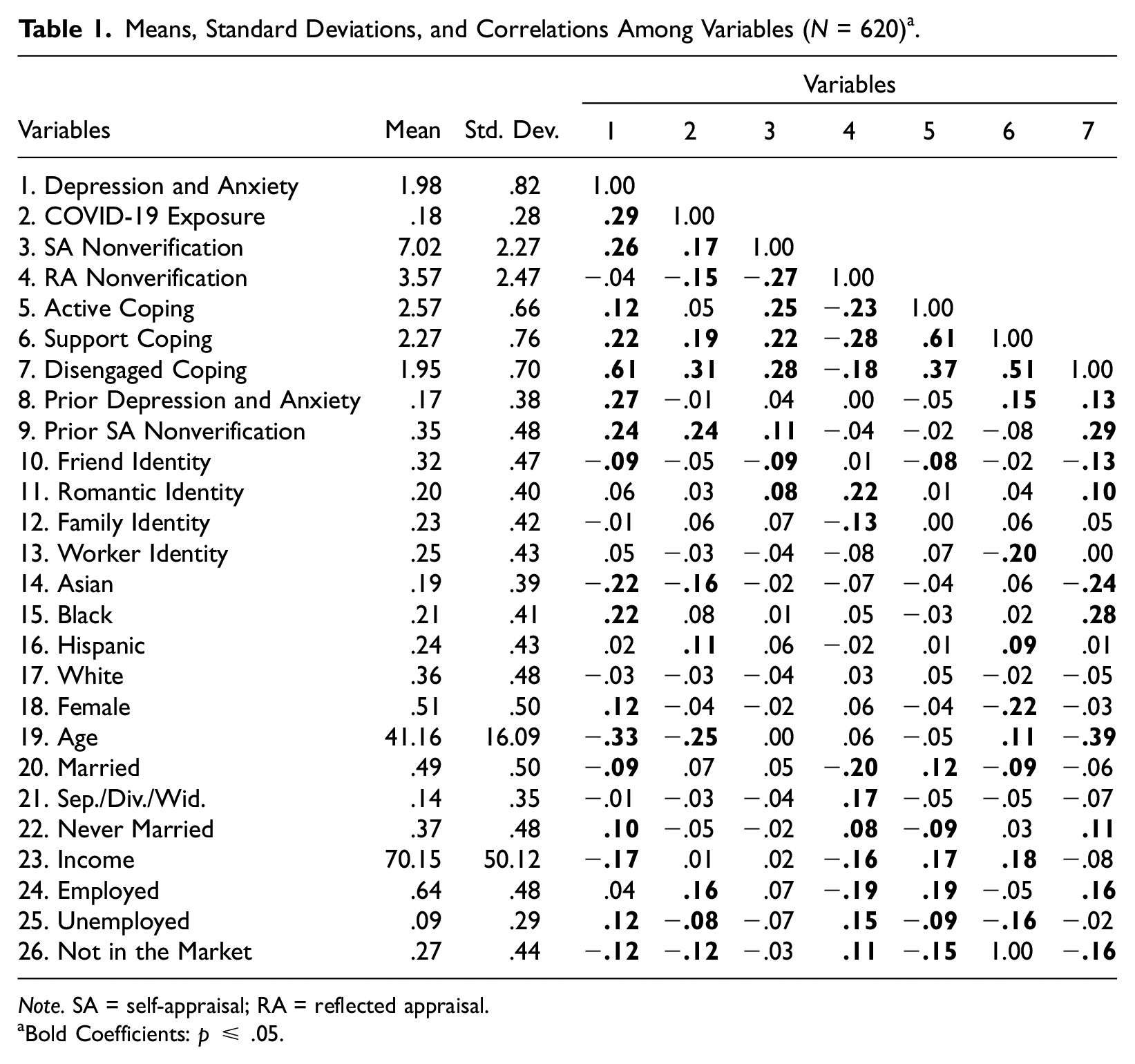
In Table 1, we present the means, standard deviations, and correlations among the variables. The mean level of exposure is in agreement with one item out of the five in the scale. We note that 60% of the respondents had not been exposed at the time of the survey. Self-appraisal nonverification is quite high (7 out of 10). Reflected appraisal nonverification is much lower (mean = 3.6), indicating that respondents generally do feel others see them in the same way they see themselves in their identity. With respect to coping, active strategies are most likely to be used, and disengagement is least likely to be used, which is consistent with previous research (Afifi and Afifi 2021; Logel et al. 2021; Park et al. 2020; Polizzi et al. 2020).
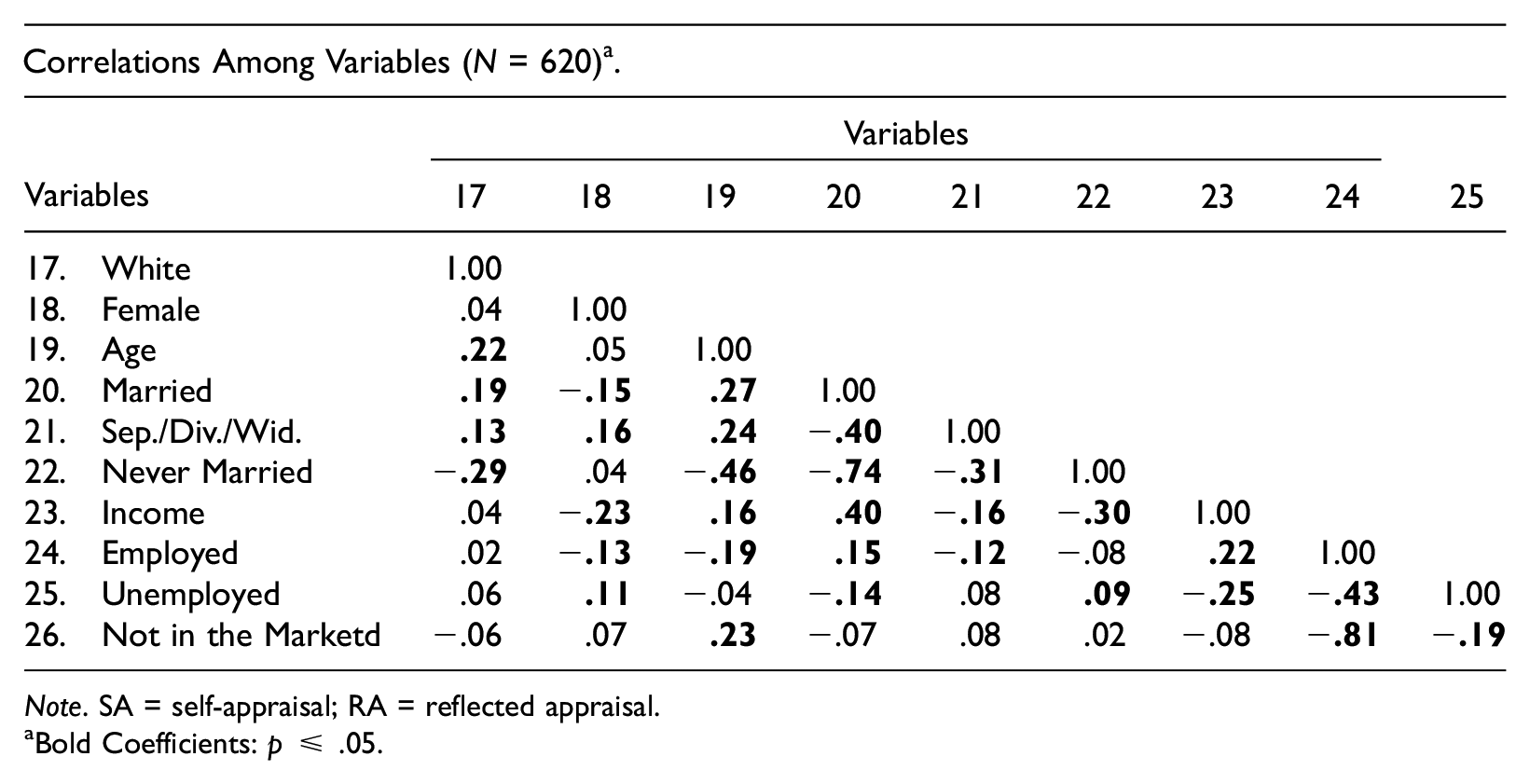
Means, Standard Deviations, and Correlations Among Variables (N = 620) a .
Note. SA = self-appraisal; RA = reflected appraisal.
Bold Coefficients: p ≤ .05.

Note. SA = self-appraisal; RA = reflected appraisal.
Bold Coefficients: p ≤ .05.
Note. SA = self-appraisal; RA = reflected appraisal.
Bold Coefficients: p ≤ .05.
Table 1 also presents all the correlations among the variables in our model. Without controlling for other variables, depression and anxiety is positively related to COVID-19 exposure (r = .29, p≤ .05), self-appraisal nonverification (r = .26, p≤ .05), disengaged coping (r = .61, p≤ .05), prior depression and anxiety (r = .27, p≤ .05), and prior self-appraisal nonverification (r = .24, p≤ .05). Interestingly, self-appraisal nonverification is negatively related to reflected appraisal nonverification (r = −.27, p≤ .05).
Table 2 presents the standardized estimates of the variables in our model using the depression and anxiety outcome.
5
We find that greater COVID-19 exposure is accompanied by increased identity nonverification that respondents experience through self-appraisals
Standardized Estimates in the Model (N = 620) a

Note. SA = self-appraisal; RA = reflected appraisal.
Bold coefficients: p≤ .05.
Effect does not hold for the work or family identities.
Positive effect holds for the family identity.
Effect does not hold for the romantic identity.
Positive effect holds for the family identity.
Negative effect holds for romantic and family identities.
Being female increases active coping among Blacks.
Consistent with Hypothesis 2, people who are more exposed to COVID-19 have greater depression and anxiety
For the results concerning coping behavior, we predicted that increased levels of all three strategies of coping (active, support, and disengagement) would be associated with greater exposure to COVID-19 (Hypotheses 4a–4c). The results show that exposure is strongly linked to disengaged coping
The outcomes of exposure to COVID-19, identity nonverification, and coping that are shown in Table 2 occur even after controlling for other factors that are related to depression and anxiety. By controlling for both the psychological distress respondents experienced prior to the pandemic as well as the experience of prior identity nonverification, we can be more certain that it is current exposure and identity nonverification during the pandemic that are related to respondents’ depression and anxiety.
The significant effects of the other control factors are consistent with previous findings. Prior depression and anxiety are positively associated with respondent’s current experience of depression and anxiety
In testing the mediating effects of the intermediate variables (Sobel 1987), we find some effects that are significant. COVID-19 exposure is associated with depression and anxiety through self-appraisal nonverification
The findings in Table 2 also reveal that the estimates of our structural model are consistent across racial/ethnic groups and across the different identities we study. The few exceptions to this consistency of results across groups occur primarily among the effects of the control variables. As shown in Table 2, Black women are significantly more likely to use active coping than Black men, though as the table also shows, active coping was unrelated to depression/anxiety. We also find that problems associated with depression and anxiety prior to the pandemic significantly contribute to depression and anxiety during the pandemic for every identity but the romantic identity. Also, for the family identity only, identity nonverification through self-appraisals is positively associated with prior depression and anxiety and age. Because only a few differences occur across racial/ethnic groups and different identities, it is possible that these small differences are due to chance.
In general, most of our hypotheses are supported. COVID-19 exposure is positively associated with identity nonverification through self-appraisals, which we expected, but it is negatively related to identity nonverification through reflected appraisals, which we did not expect. As anticipated, exposure to COVID-19 is positively related to people’s depression and anxiety. In addition to this direct relationship, there is an indirect relationship between COVID-19 exposure and depression and anxiety through self-appraisal nonverification, support coping, and disengaged coping. Also consistent with our hypotheses, both indicators of identity nonverification are associated with depression and anxiety. Finally, while exposure to COVID-19 is positively related to disengaged coping, which we expected, we also anticipated and found that support coping is negatively related to depression and anxiety while disengaged coping shows a positive relationship.
Discussion
The pandemic uprooted daily life, affecting many domains, including people’s work, home, and social lives. The identities people held in these areas may have been disrupted because of quarantining protocols that generated social isolation, the reduction of social cues with more online interactions, the stress of doing more with fewer resources, and the physical health problems that emerged with COVID-19 exposure. These experiences may have disengaged people from their everyday routines and challenged their identities.
Rather than viewing the stressors of the pandemic as directly affecting depression and anxiety, identity theory explains the distress people experience in the face of these disruptions as occurring through the interruptions of the usually smooth-running perceptual control process involved in the identity verification process (Burke 1991; Burke and Stets 2023). In this way, we might conceptualize identity nonverification as stress proliferation, that is, a secondary stressor that emerged from the primary stressor of the pandemic (Pearlin and Bierman 2013). This develops stress theory by bringing identity processes into it.
Specifically, we addressed how varying levels of one stressor, exposure to COVID-19, affected peoples’ ability to verify their identities. We also examined how identity nonverification occurs through all the social stressors of the pandemic related to individuals’ depression and anxiety, controlling not only COVID-19 exposure and other background characteristics but also the different ways in which people coped with their stressful situations. Importantly, disruptions in identity verification mattered to individuals’ depression and anxiety, as this study revealed, even a year into the pandemic. Our outcomes of depression and anxiety co-occurred in this sample, making them statistically indistinguishable. Such comorbidity is not uncommon in prior research, and with respect to COVID-19, it may have been the result of loneliness resulting from the pandemic (Palgi et al. 2020).
While we found the expected positive relationship between COVID-19 exposure and identity nonverification based on self-appraisals, an interesting but unexpected finding was the negative relationship between COVID-19 exposure and identity nonverification based on reflected appraisals. Thus, COVID-19 exposure had both positive and negative consequences. We suggest this may be a consequence of the way the pandemic played out. When exposed to COVID-19, people may have been pulled away by lockdowns from normal interaction procedures and contexts in many important roles such as work and dating, which made problems for those identities with respect to self-appraisals.
At the same time, people were spending more time sequestered with close others, and they may have been able to get to know each other better, resulting in the experience of greater identity verification through reflected appraisals. It does not appear to be the case that reflected appraisal nonverification is incorrectly measured as it relates to other variables in the expected direction. We see greater reflected appraisals nonverification as a result of separation and divorce, being never married, and being unemployed.
People who recognize that they are having difficulties with their identities because of isolation may be sequestered with family who are aware of their difficulties and still see them for who they are. This is the difference between self-appraisals (how individuals see themselves) and reflected appraisals (how individuals think that others see them). We all personally struggle with accomplishing our identity goals, and others may verify us irrespective of those struggles. Further research is needed on this potential dynamic. Over time data would be needed to sort out this connection.
While a socially stressful situation produces disruptions to the verification process, which can lead to the experience of distress (Burke 1991), the experience of distress may vary according to social location and cultural ideologies, values, and beliefs (McLeod 2012; Pearlin and Bierman 2013). For example, compared to higher class individuals, those from the lower class may be more vulnerable to interpreting a situation as stressful given their greater economic problems and limited resources (such as less social and human capital) that would facilitate continued identity verification.
It is difficult to imagine variability in social location in interpreting exposure to COVID-19 as stressful, given that its effect on people’s health was serious for many and sometimes catastrophic, resulting in death. It is possible, however, that there is variability in what identities are vulnerable to nonverification, the coping strategies that are employed, and how each affects depression and anxiety based on individual’s position in the social structure and the cultural ideologies and values they endorse. We need a closer examination of this potential variability using longitudinal data that can establish causal relationships and this is a limitation of the current study.
Future research would need to use longitudinal data to sort out the relationship between identity verification and coping. With the cross-sectional data we have, we can only note the correlations between these processes. The results of our cross-sectional data reveal that all the relationships in our model, with a few exceptions, occurred irrespective of one’s racial/ethnic group or one’s identity. Future research will want to investigate not just one identity that may get disrupted but multiple identities that are disrupted in stressful situations since multiple identities may produce conflicting meanings, which may generate additional problems in identity enactment and verification.
Nevertheless, the processes we have examined were consistent across categories of people. Indeed, in separate analyses, we found that with the controls in the model, neither racial/ethnic groups nor identities had significantly different levels of depression and anxiety. 7 Different groups did have different levels of depression and anxiety, but this was not because exposure and identity processes had different consequences. Rather, some groups varied in levels of age and employment and were exposed to COVID-19 more than other groups.
Respondents’ background characteristics revealed that women, the young, and those who were unemployed were more likely to experience higher levels of depression and anxiety than men, older individuals, and those who were employed. The young and those who were employed also were more likely to use the coping style of disengagement, which was associated with depression and anxiety. We did not examine all the factors that may be related to individuals’ depression and anxiety during the pandemic, such as previous or current physical health problems and previous or current experiences of discrimination. Additionally, since our data were cross-sectional, we could not make causal claims as to whether identity nonverification problems produced depression and anxiety, or whether depression and anxiety generated identity problems. Whatever initiates the relationship, it likely creates further problems both for people’s enactment and verification of their identities and their depression and anxiety.
More generally, we found that COVID-19 exposure had disruptive effects on the ability of Americans to play out and be verified in their identities through their self-appraisals, and this disruption was positively related to depression and anxiety. This emerged even after controlling for other factors associated with depression and anxiety such as the different ways that people coped with stress. Identity nonverification occurred across all racial/ethnic groups and irrespective of whether individuals reported they had problems with their worker identity, family identity, friend identity, or romantic identity.
The results suggest that our ability to carry out our identities and to have them verified was an important ingredient to our psychological health during the COVID pandemic. More attention is needed that incorporates self and the identity processes into stress research as it impossible to discuss stress and coping without reference to mechanisms originating inside individuals that may be implicated in the process (Thoits 2013). We have focused on one important mechanism, the mechanism of identity nonverification.
Supplemental Material
sj-docx-1-smh-10.1177_21568693231213089 – Supplemental material for Identity Nonverification, Coping, and Depression and Anxiety during the Pandemic
Supplemental material, sj-docx-1-smh-10.1177_21568693231213089 for Identity Nonverification, Coping, and Depression and Anxiety during the Pandemic by Jan E. Stets, Emily Angelo, Benjamin C. Fields and Peter J. Burke in Society and Mental Health
Footnotes

References
Supplementary Material
Please find the following supplemental material available below.
For Open Access articles published under a Creative Commons License, all supplemental material carries the same license as the article it is associated with.
For non-Open Access articles published, all supplemental material carries a non-exclusive license, and permission requests for re-use of supplemental material or any part of supplemental material shall be sent directly to the copyright owner as specified in the copyright notice associated with the article.
