




Abstract
This research empirically investigates the Environmental, Social, and Governance (ESG) sustainable determinants affecting the 24-hr around-the-year operation model of Contemporary Taiwan's convenience stores. Given the operational tensions between continuous service provision and sustainability imperatives, this research addresses the critical question of how customers, convenience stores, and the public perceive the existential viability of 24-hr operations through cross-analyzing three core dimensions: customers' need for 24-hr convenience store goods and services (CN24CSGS), convenience stores’ 24-hr goods and services supply (CS24GSS), and public expectations of 24-hr convenience store goods and services (PE24CSGS). The triadic reciprocal determinism of Social Learning Theory (SLT) was applied to integrate a comprehensive analytical framework. A mixed-methods approach employing factor analysis (FA), triple-dimension entropy analysis (TEA), and analytical network process (ANP) was utilized to identify and validate core determinants across quantitative and qualitative dimensions. Results reveal that staff health care and management service level (SHC-MSL) emerges as the most critical determinant (SCEW = 0.1659), followed by public welfare programs (PWP = 0.0694) and employee occupational training level (EOTL = 0.0596), all within the governance accountability framework. Findings indicate that carbon emission reduction (CER = 0.0503) represents the primary environmental challenge, while community public education development (CPED = 0.0308) constitutes the key social responsibility factor. Eventually, 24-hr convenience store operations remain sustainable when supported by robust ESG governance mechanisms, particularly emphasizing employee welfare and environmental stewardship. These findings provide actionable insights for managers and policymakers of convenience store in Taiwan seeking to balance operational efficiency with sustainable development goals.
Plain Language Summary
This research empirically investigates the Environmental, Social, and Governance (ESG) sustainable determinants affecting the 24-hour around-the-year operation model of Contemporary Taiwan’s convenience stores. Given the operational tensions between continuous service provision and sustainability imperatives, this research addresses the critical question of how customers, convenience stores, and the public perceive the existential viability of 24-hour operations through cross-analyzing three core dimensions: customers' need for 24-hour convenience store goods and services (CN24CSGS), convenience stores’ 24-hour goods and services supply (CS24GSS), and public expectations of 24 hour convenience store goods and services (PE24CSGS). The triadic reciprocal determinism of Social Learning Theory (SLT) was applied to integrate a comprehensive analytical framework. A mixed-methods approach employing factor analysis (FA), triple-dimension entropy analysis (TEA), and analytical network process (ANP) was utilized to identify and validate core determinants across quantitative and qualitative dimensions. Results reveal that staff healthcare and management service level (SHC-MSL) emerges as the most critical determinant (0.1659 of SCEW), followed by public welfare programs (0.0694 of PWP) and employee occupational training level (EOTL = 0.0596), all within the governance accountability framework. Findings indicate that carbon emission reduction (0.0503 of CER) represents the primary environmental challenge, while community public education development (0.0308 of CPED) constitutes the key social responsibility factor. Eventually, 24-hour convenience store operations remain sustainable when supported by robust ESG governance mechanisms, particularly emphasizing employee welfare and environmental stewardship. These findings provide actionable insights for managers and policymakers of convenience store in Taiwan seeking to balance operational efficiency.
Keywords
Research Background
By 2023, Taiwan’s convenience store industry had reached NT$412.6 billion in sales, marking 14 consecutive years of record growth, with average revenue per store exceeding NT$30 million. The number of outlets rose to 13,706 nationwide, equating to one store for every 1,703 residents. This expansion represents a 40.3% market increase over 7 years and positions Taiwan among the world leaders in store density, behind only South Korea and Japan. Unlike many Western economies that emphasize digital retail transformation, Taiwan’s development reflects a distinct model in which dense physical accessibility and diversified service integration coexist with digital platforms. This underscores the need for theoretical perspectives that capture the cultural and structural features of Asian service economies. A defining characteristic of this system is the 24-hr, year-round operation model, introduced in the 1980s and quickly adopted by major chains. Over time, convenience stores have expanded beyond daily goods to become multifunctional service hubs, offering financial transactions, parcel delivery, prepared foods, and even social support initiatives (Alshehri, 2025).Their prevalence has made them integral to daily routines: statistics show that Taiwanese residents visit convenience stores an average of 147 times per year. In addition to economic contributions, convenience stores provide crucial community functions such as maintaining operations during natural disasters, partnering with nonprofits, and assisting in neighborhood safety programs (Abdelmoety et al., 2022).
Nevertheless, the sustainability of the 24-hr model has become increasingly uncertain (Martiny et al., 2024). Rising operational costs, declining availability of night-shift workers due to demographic change, and limited profitability during late-night hours pose ongoing challenges (Hsiao & Tang, 2025). At the same time, broader global concerns, such as climate change, public health crises, and social responsibility, have heightened pressure on firms to integrate environmental, social, and governance (“ESG”) principles (Arvidsson & Dumay, 2022) into their strategies. Round-the-clock operations, while convenient, also raise issues such as energy intensity, labor conditions, and governance transparency, which require systematic assessment if the model is to remain viable. From an environmental perspective, stores must reconcile consumer demand for comfort and fresh food with efforts to reduce energy and resource use. From a social perspective, while 24-hr outlets act as community anchors, they also bring concerns about fair compensation, safe working conditions, and the well-being of overnight staff (Kritsanawonghong et al., 2014). From a governance perspective, the sector is increasingly expected to disclose labor practices, comply with international ESG reporting standards, and strengthen oversight of operational impacts. Together, these dimensions highlight the need to critically evaluate whether the benefits of continuous operation justify its sustainability costs (Chou et al., 2016).
Despite its importance, little empirical research has directly examined how consumer expectations, organizational practices, and societal pressures interact to shape the sustainability of Taiwan’s 24-hr convenience store model (Hammarlund & Nordin, 2025). To bridge this gap, this research proposes an integrated framework combining the ESG paradigm with the triadic reciprocal determinism of the social learning theory (“SLT”) (Bandura et al., 1961). The framework conceptualizes three interconnected relationships: (a) the customers’ need of 24-hr convenience store goods and services (CN24CSGS), (b) convenience stores’ 24-hr goods and services supply (CS24GSS) and (c) public-expect of 24-hr convenience store goods and services (PE24CSGS). These have become the most important consideration for achieving the ESG sustainable development trend of Taiwan’s convenience stores (Roggeveen et al., 2020; Thomyapitak et al., 2024; Wijaya et al., 2020).
This integration advances the literature by embedding ESG sustainability within reciprocal interactions among consumers, firms, and society. On a theoretical level, it extends sustainability models into the domain of high-density, service-oriented Asian retail economies (Oh et al., 2018). On a practical level, it offers a decision-making framework for balancing profitability with environmental stewardship, social responsibility, and governance compliance. By employing a sequential FA–TEA–ANP methodology, the study ensures both empirical rigor and managerial relevance, thereby generating insights for the future development of Taiwan’s convenience store sector under sustainability imperatives (Putri et al., 2025).
In detail, in sight of the definition of the individual, organizational and socialization aspects in the SLT, the individual aspect in SLT focuses on the personal cognitive processes within the learner. This level examines how individuals process, encode, and retain information from their social environment. It emphasizes personal factors like attention, memory, motivation, and self-efficacy that influence how someone learns from observing others. The individual is seen as an active processor of social information rather than a passive recipient. The organizational aspect refers to the structural and institutional contexts that shape social learning. This level examines how formal organizations (schools, workplaces, institutions) create environments and systems that facilitate or inhibit social learning. It considers organizational policies, hierarchies, cultures, and formal learning structures that influence how knowledge and behaviors are transmitted within organized settings.
Then, the socialization aspect emphasizes the broader social and cultural processes through which learning occurs. This level focuses on how social groups, communities, and cultural contexts shape learning through shared norms, values, practices, and collective meaning-making. It examines how social interactions, cultural transmission, and community participation contribute to learning and development. These three levels work together in SLT to provide a comprehensive understanding of how learning is simultaneously an individual cognitive process, organizationally structured, and socially and culturally embedded. The later work emphasized this multi-level perspective, showing how personal, behavioral, and environmental factors interact reciprocally in what he called the “triadic reciprocal determinism”. These three key interactive relationships of triadic reciprocal determinism model of the SLT are (a) customer’s individual aspect (CN24CSGS) interacts with convenience store of organizational aspect (CS24GSS); (b) convenience store of organizational aspect (CS24GSS) interacts with public expectation of socialization aspect (PE24CSGS) and (c) public expectation socialization aspect (PE24CSGS) interacts with customer’s individual aspect (CN24CSGS) (Bandura, 1971). Eventually, in summary, the brief research theoretical and conceptual framework was completely expressed in Figure 1.

Main research theoretical and conceptual framework.
Thus, building on Figure 1, this research undertook a systematic evaluation of three core determinants by integrating the sustainable dimensions of the ESG framework with the triadic reciprocal model of the SLT.
To ensure both methodological rigor and analytical comprehensiveness, a sequential mixed-methods design was employed. This design not only addresses the research gap regarding the sustainability of 24-hr operations in Taiwan’s convenience store industry but also enhances originality by combining statistical validation, expert-informed weighting, and structural modeling into a single evaluation framework. The methodological framework consisted of three complementary stages: (a) factor analysis (“FA”) approach: in the first stage, FA (Huang et al., 2022a) was employed as the quantitative foundation to refine and validate the evaluation criteria. FA was particularly suitable for processing large-scale survey data, as it systematically reduces dimensionality while revealing latent factor structures.
By optimizing variance distribution and maximizing factor loadings, FA ensured statistical robustness and representativeness of the determinants considered in the research. Then, (b) triple-dimension entropy analysis (“TEA”) method: building upon the FA results, TEA (Calvo-Porral & Lévy-Mangin, 2019; Mannor et al., 2005) was applied in the second stage to establish the relative weighting and criticality of the identified factors. Unlike traditional ranking methods, TEA incorporates expert judgment while addressing uncertainty through principles of information theory. This method was chosen for its ability to transform statistically derived factors into hierarchically prioritized determinants, thereby bridging quantitative outcomes with qualitative expertise.
Lastly, (c) analytical network process (“ANP”): in the final stage, ANP (M. Y. Hsieh, 2022) was implemented to construct and validate the comprehensive evaluation model. ANP was deliberately selected over conventional hierarchy-based approaches because of its capacity to capture interdependencies and feedback loops among determinants. Through pairwise comparisons and consistency testing, ANP provided a network-based structure that reflects the complex reciprocal influences within ESG determinants under the 24-hr operational model.
Collectively, this FA–TEA–ANP sequence establishes a synergistic methodological framework. FA delivers statistical validation of underlying structures, TEA introduces expert-driven prioritization while mitigating subjectivity, and ANP consolidates these insights into a validated, interdependent model. This integration not only strengthens methodological rigor but also ensures originality by aligning ESG sustainability assessment with both quantitative robustness and practical decision-making relevance. Ultimately, the framework provides the most comprehensive and reliable basis for evaluating the research objective: “Sustainability Development: An Empirical Investigation on ESG Sustainable Determinants for the 24-hr Around Year Operation Model of Contemporary Taiwan’s Convenience Stores.”
Literatures
Environment, Social, and Governance (ESG) Concepts
With reference to the roots of ESG sustainable development concept emerged from several parallel social movements in the 1960s through 1980s because the most of investors began avoiding companies in controversial industries or with questionable practices. Simultaneously, environmental awareness grew dramatically following landmark environmental legislation due to the CSR developed during this period as businesses began acknowledging responsibilities beyond profit-making, though these three components including environmental impact, social responsibility, and governance accountability, were still largely treated as separate domains (Baraibar-Diez et al., 2019).
Then, the 1990s and early 2000s saw crucial institutional frameworks established that would eventually coalesce into ESG. Key developments included the Global Reporting Initiative (GRI) in 1997, the Dow Jones Sustainability Index (DKSI) in 1999, and the United Nations Global Compact (UN-GC) in 2000. The formal term ESG was first mentioned in the Who Cares Wins report of the United Nations Global Compact in 2004. The ESG sustainable development concept argued that integrating environmental, social, and governance factors into capital markets would benefit societies while strengthening markets. This period culminated with the launch of the United Nations Supported Principles for Responsible Investment (UN-SPRI) in 2005, which created a framework for investors to incorporate issue of the ESG sustainable development concept into investment practices. Otherwise, the ESG sustainable development concept transitioned from niche concept to mainstream financial consideration in the period between 2006 and 2015. The formal launch of the Principles for Responsibility Investment (PRI) in 2006 marked a turning point as dozens of investment companies committed to ESG essential principles.
The global financial crisis in 2007 and 2008, then, dramatically heightened focus on governance issues and risk management, while mounting evidence of climate change elevated environmental considerations. During this period, ESG sustainable development concept evolved from being primarily viewed as an ethical stance to being recognized as financially material, with growing academic research suggesting correlations between strong financial performance and returns from the ESG sustainable development concept. The 2015 adoption of the United Nations Sustainable Development Goals (UN-SDGs) provided companies and investors with a shared framework for measuring impacts of the ESG sustainable development concept (Alnajjar, 2000). Recently, since the Major asset managers like BlackRock began actively advocating integration, the ESG sustainable development concept has been recently characterized by rapid acceleration and attempts at standardization from 2016 to 2018 to be expanding its influence. Significantly, as following pandemic of the COVID-19, the adoption of ESG sustainable development concept was accelerated by highlighting social inequalities and the importance of corporate resilience into the social responsibility, and governance accountability as referred in Figure 2.

ESG sustainable development concept.
Particularly, as following the ESG development of global disclosure standards and formation of the International Sustainability Standards Board and European Union Sustainable Finance Disclosure Regulation (EU-SFDR), the ESG sustainable development concept had matured into a more sophisticated framework with increased focus on measurable impact and standardized metrics in 2024, while simultaneously facing heightened scrutiny and political debate about its effectiveness and implementation. Throughout this period, the ESG sustainable development concept has evolved from a primarily reporting-focused practice to a strategic consideration integrated into corporate decision-making (Baraibar-Diez & Odriozola, 2019).
Hence, the 24-hr around operation model of convenience store creates a fundamental conflict between Taiwan’s customer expectations and organizational sustainability requirements, as customers are accustomed to the brightly lit and perfectly climate-controlled environment of convenience stores at all times. Such an expected shopping environment means that convenience stores must consume a lot of energy to meet customer’s shopping expectations. Lighting alone accounts for about 25% to 30% of a typical store’s electricity consumption. Refrigeration systems (which must operate continuously to ensure food safety) account for 40% to 45% of energy consumption, while the air-conditioning (HVAC) systems account for 15% to 20% (Juan, 2020). This means huge operating costs and environmental impact. According to the convenience store energy saving technology manual of Energy Committee of the Ministry of Economic Affairs of the Ministry of Economic Affairs, Taiwan’s convenience store industry consumes about 2.1 billion kWh of electricity each year, of which about 35% occurs at night (midnight to 6 a.m.), but customer traffic drops by about 65% to 80% at this time. From 2019 to 2024, the sharp increase in energy costs has caused the convenience store costs to increase by about 30%, causing direct cost pressure on the already thin profit margins of merchandise sales.
On the other hand, in terms of the global carbon emission reduction goal, how to effectively reduce the convenience store industry’s annual contribution to Taiwan’s emissions of approximately 1.2 million tons of carbon dioxide equivalent is an additional cost that convenience stores currently need to face; especially when governments around the world plan to levy carbon emissions and waste. Successively, food expired, waste and water resource waste and garbage increment were another three issues for the convenience store since the in-door dining and toilet services started at night operation time because customers were selected to stay overnight at the convenience stores for enjoying the air-condition, toilet, in-door dining services without any buying behaviors (Shen et al., 2019).
As a result, the 24-hr around year of Taiwan’s convenience store sector faces growing tension between its organizational environmental initiatives and escalating public expectations on climate responsibility. Therefore, the energy consumption trade-offs (“ECT”) (Siqueira et al., 2017), carbon emission reduction (“CER”), water source usage-reduction (“WSU”), food waste reduction (“FWR”) (Valdez Cervantes & Franco, 2020) and garbage classification and reduction (“GCR”) (Saengsikhiao et al., 2020) were concluded as main assessed criteria for analyzing the environmental impacts dimension of the ESG sustainable development concept on the key interactive relationship between (a) convenience store of organizational aspect (CS24GSS) and (b) public expectation socialization aspect (PE24CSGS) of SLT triadic reciprocal determinism model on exploring the existential issue of 24-hr around year operation model of Taiwan’s convenience stores.
Continuously, the customer accessibility expectations (“CAE”) (Fida et al., 2020) and employee on-duty time length (“EOTL”) (Gunawan & Harjanti, 2023) were two critically considered as analytical correlated factors of 24-hr around operation model of convenience store in Taiwan’s convenience stores because Taiwan’s customers have come to rely on round-the-clock access not just for emergency needs but as already a lifestyle accommodation. Especially, According to the 2023 annual report of the Taiwan Chain Stores and Franchise Association (TCSFA), up to 73% of urban Taiwan’s youngers, who were 18 to 34 years old consider overnight consuming and staying of the 24-hr convenience stores as essential to their lifestyle than older cohorts. As following the high development of the CAE, the service consistency request (“SCR”; Irawan et al., 2023) extend beyond product availability to service offerings, such as bill payment, package handling, and fresh food preparation, creating substantial working complexity during operation periods. The expectation-reality gap is particularly pronounced not only for retail-selling but also for food in-door services, where maintaining full hot food options 24-hr around year that requires significant energy usage and staff resources despite serving dramatically fewer customers.
Nevertheless, under the higher CAE request, the reduction of customer’s coming numbers (“RCCN”) is another operational challenge to create substantial strain on the 24-hr operation services model of convenience store. The reason is that only 22% of all convenience store transactions occurring night hours between 12 PM and 6 AM and these transactions typically generate only 10-15% of daily revenues while accounting for 20% to 25% of operational costs, creating negative profitability for many locations during these periods, according to the 2023 annual report of Ministry of Economy.
In detail, these few night shifts transactions produce from shift workers, entertainment venue patrons, and users of late-night delivery services. Besides, as following the high development of the CAE, these service consistency request (“SCR”) extend beyond product availability to service offerings, such as bill payment, package handling, and fresh food preparation, creating substantial working complexity during operation periods. The expectation-reality gap is particularly pronounced not only for retail selling activities but also for food in-door services, where maintaining full hot food options 24-hr around year that requires significant energy usage and staff resources despite serving dramatically fewer customers. Really, the majority of current Taiwan’s customers have started to request the SCR between peak and off-peak hours that results in substantial human costs of maintaining service levels (“SHC-MSL”) (Crace & Gehman, 2022) for Taiwan’s convenience stores because the one employ at night shift has to provide the same service levels with the services from two or more employees’ at day shift.
Taking next step, more and more Taiwanese are not willing to take night shift results from the increasingly prioritizing work-life balance in the current public employment decisions (“CPED”) (Huang et al., 2022b). This causes the implementation of 24-hr operation service model operations of convenience stores has to pay wage premiums (“PWP”) (20%–40%) to employees at night shift for supplying their series health risks including disrupted circadian rhythms, elevated stress levels, higher accident rates, and long-term health implications of employees at night shift. On the other hands, the frequently on-duty night shift with minimal personnel because of operational costs reduction does cause the employee’s working stress increasing (“EWSI”) and confronting public potential crimes appearances (“CPPCA”) (e.g., robbery, raping, injury crime and etc.) as well. Hence, addressing significant recruitment and training challenges (“SRTC”) and enough employee’s legitimate welfare concerns (“EELWC”) (Shaukat et al., 2016) has caused another substantial human costs because convenience stores have to make sure that employees at night shift have enough professionals to deal with these emergent and dangerous situations in the night shift of 24-hr operation service model operations.
Eventually, the 24-hr around year of Taiwan’s convenience store sector faces growing tension between its customer’s escalating requests and organizational governance initiatives on corporate financial performance. Therefore, the SCR, SHC-MSL, EOTL, PWP, SRTC and EELWC were categorized as main assessed criteria for analyzing the governance accountability dimension of the ESG sustainable development concept on the key interactive relationship between (a) customer’s individual aspect (CN24CSGS) and (b) convenience store of organizational aspect (CS24GSS) of SLT triadic reciprocal determinism model on exploring the existential issue of 24-hr around year operation model of Taiwan’s convenience stores.
Relatively speaking, the CAE, RCCN, CPED, EOSI and CPPCA were integrated as main assessed criteria for analyzing the social responsibility dimension of the ESG sustainable development concept on the key interactive relationship between (1) public expectation of socialization aspect (PE24CSGS) and (3) customer’s individual aspect (CN24CSGS) of SLT triadic reciprocal determinism model on exploring the existential issue of 24-hr around year operation model of Taiwan’s convenience stores. Hence, this research was able to comprehensively and completely explore the trade-offs reality of maintaining consistent operations across all 24 hrs around year model of convenience store through cross-analyses among (a) public expectation of socialization aspect (PE24CSGS), (b) convenience store of organizational aspect (CS24GSS) and (c) customer’s individual aspect (CN24CSGS) of SLT triadic reciprocal determinism model.
Social Learning Theory (SLT)
The conceptual origin of the SLT emerged from early behaviorists and social psychologists such like William James and John Dewey, whose pragmatic philosophies emphasized the social nature of learning; especially, in 1898, the Las of Effect of Edward Thorndike established that behaviors followed by satisfying consequences are more likely to be repeated, providing an early foundation for reinforcement concepts because his behavioral psychology shifted focus to observable behaviors in the 1910s, though it largely neglected mental processes that would later become central to the SLT. Then, in 1941, the Neal Miller and John Dollard was the first formal articulation of social learning principles, integrating Freudian concepts with behavioral learning theory and emphasizing imitation as a learned behavior by bridging behaviorism and cognitive approaches through several key developments.
Bandura (1973) further advanced the field to formally address the SLT beyond strict behaviorism by emphasizing expectancies, subjective values, and situational context because he pointed out that the operant conditioning research, while focused on direct experience rather than observation, nonetheless influenced social learning through its emphasis on reinforcement principles. Bandura’s work represents the most significant development in the SLT, beginning with his landmark from 1961 to 1963 that demonstrated children readily learn aggressive behaviors by watching adult models, even without direct reinforcement.
His seminal book, Social Learning Theory, officially formalized the SLT in 1977 by emphasizing observational learning, modeling, and four meditational processes: attention, retention, reproduction, and motivation. He further introduced the self-efficacy theory, highlighting the importance of a person’s belief in their ability to succeed in 1977 as well. Then, Boucheron et al. (2003) had expanded the SLT into the social cognitive theory (“SCT”), placing greater emphasis on cognitive factors and introducing the triadic reciprocal determinism, which describes how person (individual aspect), organization (organizational aspect), and society (socialization aspect) mutually influence each other.
In detail, the triadic reciprocal determinism is a cornerstone concept in the SLT. Particularly, as it evolved into the form of the SCT and it consists of three factors that continuously interact with and influence each other: Firstly, the person (individual aspect) interacts with organization (organizational aspect): personal factors (cognition, affect, biological events and behavior) and the organization inter-shape on each other bidirectional. A person’s thoughts, beliefs, and expectations influence their belongs the organization, while the consequences of their behaviors in the organization subsequently modify their thoughts and beliefs. For example: a employees’ self-efficacy outcomes affect organizational performance and efficiency, while successful organizational performance and efficiency strengthen their self-efficacy outcomes bidirectional.
Secondly, the organization (organizational aspect) interacts with society (socialization aspect): the organization (organizational aspect) and society (socialization aspect) also influence each other reciprocally because organizational performances and efficiency affect how it perceives and interacts with the entire society, while the society stimuli and contexts and organizational performances and efficiency inter-shape the cognitive development and behaviors responses in the organization and society. For instance: a supportive social learning situation can enhance an organizational learning powers, while organizations with the positive learning attitudes and powers can also contribute to creating a better social learning situation bidirectional.
Thirdly, the society (socialization aspect) interacts with person (individual aspect): society (socialization aspect) and person (individual aspect) exist in a two-way relationship as well because the society can alter the thoughts, cognition and behaviors of each person who lives in the society, while thoughts, cognition and behaviors of each person can modify any socials conditions. An example would be how the positive social atmosphere can subsequently affect the thoughts, cognition and behaviors of each person to be positive while the positive the thoughts, cognition and behaviors of each person can also lead to social positive development bidirectional as referred in Figure 3.

Triadic reciprocal determinism of SLT.
In recent decades, the SLT has expanded the observational learning mechanisms and triadic reciprocal determinism into various domains; especially, digital age applications have explored social learning through media, virtual environments, and online social networks. The human behavior’s relative researches have increasingly focused on cultural and contextual factors that shape observational learning processes based on modeling and observational learning principles; particularly, educational applications have leveraged social learning principles in instructional strategies like cooperative learning, peer modeling, and apprenticeship learning. Modernly, the SLT non-stops to evolve and influence numerous fields, including education, public health, criminology, and organizational behavior.
Evaluated Statistic Methods
Our analytical strategy employed a three-stage process to systematically identify and rank critical factors influencing wearable sensor technology adoption. We began with the FA approach, which condensed numerous survey variables into a smaller set of meaningful underlying dimensions. Next, the TEA method assigned importance weights to each dimension by quantifying the degree of variation in expert opinions that means factors with greater diversity in assessments received higher priority. Finally, the ANP model generated a comprehensive priority hierarchy by evaluating all possible interdependencies among factors through structured pairwise evaluations. This integrated approach transforms qualitative expert insights into mathematically rigorous, objective decision-making criteria.
As illustrated in Figure 1, our investigation adopted a hybrid methodological design to rigorously assess three principal determinants, integrating ESG sustainability principles with the SLT’s triadic reciprocal framework. This multi-phase analytical strategy combined quantitative and qualitative techniques in a deliberate sequence to ensure comprehensive evaluation. In the phase 1–the FA approach for dimensional reduction: we initiated our analysis with FA as a data reduction technique to reveal latent constructs underlying the observed measurement variables. This statistical procedure identifies patterns of covariation among variables and consolidates them into more parsimonious dimensional representations. The fundamental model is expressed as:

Here, X denotes the matrix of observed measurements, LF represents the latent construct matrix, and ε captures residual variance. By computing factor loadings (
The, in the phase 2—TEA method for weight derivation: following dimensional reduction, we applied TEA method as our second analytical stage to derive importance weights for identified constructs. This information-theoretic approach quantifies the degree of uncertainty or variation within expert assessments across multiple decision matrices. The procedure unfolds in three sequential steps:
Step 1 – Matrix Normalization: We standardized the decision matrix by proportional scaling, dividing each element by its respective column total:

where
Step 2 – Entropy Computation: We calculated entropy values to quantify information dispersion within each criterion:

where
Step 3 – Weight Derivation: Criterion importance weights were calculated inversely proportional to their entropy values:

where
These computational procedures yielded quantified importance metrics for all evaluated dimensions.
In phase 3—ANP model for priority ranking: building upon the dimensional structure from FA and importance weights from TEA, we implemented ANP to capture complex interdependencies among evaluation criteria. Unlike hierarchical methods, ANP accommodates feedback relationships and mutual influences through systematic pairwise comparison matrices. This technique generated a comprehensive priority structure addressing our central research objectives. The foundational comparison matrix takes the form:

This matrix incorporates measured weight (
Three essential elements constitute the initial pairwise comparison matrix:

where W represents the matrix of relative pairwise weights calculated using appropriate mathematical procedures by calculating
The relative pairwise weights (

The Consistency Index (C.I.) is measured for each initial pairwise comparison matrix, and the Consistency Ratio (C.R.) is calculated using CI and the Random Index (R.I.) as illustrated:

For validation purposes within the ANP model, high consistency is indicated by a C.R. value below 0.1. This integrated three-phase methodology provided a rigorous analytical foundation for addressing our research questions with both statistical validity and practical applicability.
Research Design
Questionnaires Collection
Taking the survey design and bias mitigation strategies into consideration, recognizing the potential for self-report bias and social desirability effects inherent in ESG-related questioning, multiple methodological safeguards were implemented to enhance response validity and reliability. First, questionnaire anonymization protocols were established to reduce social desirability bias by ensuring complete respondent confidentiality and eliminating any potential for response traceability. Second, neutral question framing was employed throughout the survey instrument, with questions structured to avoid leading or value-laden language that might influence responses toward socially acceptable answers. Third, response validation techniques included reverse-coded items and consistency checks to identify potential response pattern biases or systematic responding behaviors.
Additionally, mixed-mode data collection was implemented, combining face-to-face interviews with self-administered questionnaires to minimize interviewer bias while maintaining data quality. The survey instrument incorporated balanced response anchoring using both positively and negatively framed items to reduce acquiescence bias. Furthermore, temporal separation techniques were employed where feasible, with some respondents completing demographic information separately from ESG evaluations to reduce the activation of social identity considerations that might influence sustainability-related responses. In order to address the inherent sensitivity of ESG topics, indirect questioning approaches were utilized alongside direct measures, including scenario-based evaluations and comparative ranking exercises that reduced the salience of socially desirable responding.
Significantly, as following the free of paper and cargo examination in the social science researches of the contemporary academic ethic regulation and policy of the Taiwanese and global Institutional Review Boards (IRBs) (as referred Ethics Declaration session), the all large-scale questionnaires were completed with respect to (a) the entire interviewed tourists were directly collected in person, (b) no any individual information or personal identified news of the entire interviewed tourists to be exposed in the research, (c) all interviewed tourists agreed with the usage-consent for their completed questionnaires, (d) the age of the all interviewed tourists must be up to 18 years old because the 18 years old is the adult age in Taiwanese laws and (e) there is definitely no any invasive surveyed measures in surveyed processes.
Cross-validation procedures were implemented by comparing responses across different stakeholder groups (customers, employees, employers, public) to identify potential systematic biases or inconsistencies in response patterns. As a result, the valid collected questionnaires were 287 because other 13 interviewees were unconsented to provide their questionnaires for the evaluation and analysis in this research. Making known in detail, the valid retrieved of these weight-questionnaires is up to 95.67% (287/300) as presented in Table 1.
The Descriptive Statistics of the Valid 246 Interviewed Tourists.

Chilung, Taipei, New Taipei and Taoyuan cities.
Hsinchu, Miaoli, Taichung and Changhua cities.
Yunlin, Chiayi, Tainan and Kaohsiung cities.
Hualien and Taitung counties.
In Table 1, the female interviewees 124 which was the 43.21% of the 287 valid collected participants and then, the major 119 interviewed interviewees came from middle Taiwan which means the 41.46% of the 287 valid collected tourists. As for the education background, most of the interviewed interviewees (288, 79.44%) received the college or more than college degree and furthermore, the income per month of majority of the 193 interviewed tourists located in the low than $30,000 NTD which was 67.24% of the 287 valid interviewed questionnaires. Specifically, no one never consumed in convenience stores per week and frequently, the most of 152 valid interviewees consumed in convenience stores per week that means 52.96% of the 287 valid interviewed questionnaires. The 237 valid collected participants knew the environmental impacts of convenience stores, 263 valid collected participants knew governance accountability of convenience stores and 211 valid collected participants knew governance accountability of convenience stores.
In order to achieve high research reliability and professional rigor, qualitative data collected from experts and professionals should constitute at least 10% of the total sample size used for quantitative analysis. This threshold helps minimize errors in expert survey data. Hence, 30 expert questionnaires (representing 10% of the original designed questionnaires) were utilized for professional weighted measurements in the TEA method matrix of qualitative analysis.
The expert panel comprised three distinct groups: (a) ten academic researchers with over 10 years of experience in convenience store operation research; (b) ten academic researchers with over 10 years of experience in ESG-related research; and (c) ten academic researchers with over 5 years of experience in SLT-related research. Particularly, the question was designed as “How important is the ECT in achieving balance between (2) convenience store organizational aspects (CS24GSS) and public expectation of socialization aspects (PE24CSGS) from the environmental impacts dimension of the ESG sustainable development concept perspective on exploring the existential issue of 24-hour year-round operation model of Taiwan’s convenience stores?” The experts' interview choices for assessed questions were also designed as a 5-point Likert scale: very important, important, neutral, unimportant, very unimportant.
Then, in order to construct evaluated model and testify the induced core determinants from evaluating the criteria, 30 specialists were further executed for professional weighted measurements in the ANP hierarchical model. The expert panel comprised second 10 distinct groups: (a) Ten empirical specialists with over 10 years of operational experience in convenience store; (b) Ten managers with over 5 years of work experience in in convenience store industry and (c) Ten industrialists with over 10 years of experience in convenience store. Particularly, the questions were designed as assessing the core determinants from the evaluated results the FA approach and TEA method for executing the ANP hierarchical model and specialist’s interviewed choices of assessed questions were also designed as 5-degree Likert’s: very important, important, normal, unimportant, very unimportant.
Evaluated Measurements
FA Approach Measurements
Based on Equation 1, with reference to the theoretical principles of the FA of qualitative analysis, Table 2 directly showed the FA analysis was appropriate for the appraisement of 287 valid collected questionnaires because not only the number of the Kaiser-Meyer-Olkin measure of sampling adequacy was 0.843 which was much higher than 0.7 but also the number of the testified numbers of significance of the Kaiser-Meyer-Olkin measure and Barlett test was 0.000…. which lower than 0.05 by executing appraised equation (1) of the FA quantitative analysis.
The KMO and Bartlett’s Test of FA of Quantitative Analysis.

Furthermore, the entire commonalities among the 16 evaluated criteria of environmental impacts, governance accountability and social responsibility of the ESG sustainable development concept on the key interactive relationships (CN24CSGS with CS24GSS; CS24GSS with PE24CSGS and PE24CSGS with CN24CSGS) on exploring the existential issue of 24-hr around year operation model of Taiwan’s convenience stores were measured in the FA approach of quantitative analysis were displayed in Table 3 by executing appraised Equation 1 of the FA quantitative analysis.
The Entire Communalities of the FA Approach.

In Table 3, the communalities of the five evaluated criteria of environmental impacts dimension were: ECT was 0.683, CER was 0.829, WSU was 0.804, FWR was 0.789 and GCR was 0.817; the six evaluated criteria of governance accountability dimension were: SCR was 0.772, SHC-MSL was 0.682, EOTL was 0.873, PWP was 0.887, SRTC was 0.724 and EELWC was 0.787 and five evaluated criteria of social responsibility dimension were: CAE was 0.798, RCCN was 0.792, CPED was 0.813, EOSI was 0.836 and CPPCA was 0.809. Apparently, the communality numbers of 16 evaluated criteria in Table 3 are closed or up to the 0.7 which means the interactive connections and dependences existed and interacted with research question and topic each other.
TEA Measurements
After acquiring the entire communalities of these 16 evaluated criteria through assessment of the 287 valid interviewed questionnaires of FA approach evaluated execution to achieve the higher research validity and representativeness, the qualitative analysis Equation 2 of the TEA method was further employed to refine the consensus weights of assessed criteria from implementing the 30 experts’ questionnaires by the calculations of appraised Equation 2 with higher research reliability and accuracy. Consequently, Table 4 demonstrated the triple-magnitude entropy evaluated matrix of 25 experts’ weighted measurements in the TEA method of qualitative analysis.
The Entire 25 Experts’ Weighted Measurements of the TM-EM Method.

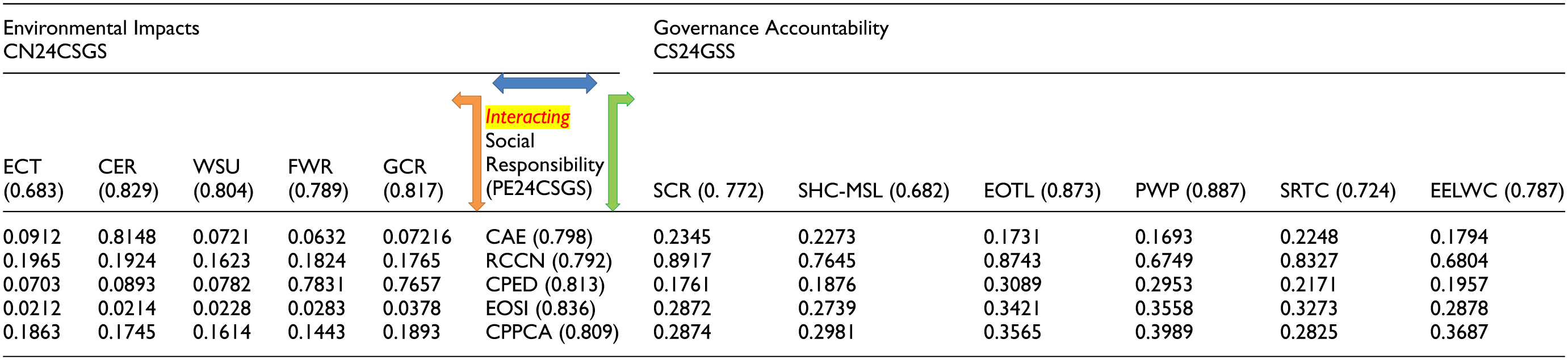
In Table 4, not only the ECT of the environmental impacts but also the SCR of the governance accountability can directly affect the CAE (0.0912; 0945) and RCCN (0.1965; 0.8917) of the social responsibility. Successively, the GCR of the environmental impacts and PWP of the governance accountability can directly influence the EOSI (0.037; 0.3558) and CPPCA (0.1893; 0.3989) of the social responsibility as well. Ultimately, the CPED of the social responsibility was able to straightly impact by the CER of environmental impacts as well as the EOTL of the governance accountability.
ANP Hierarchical Model Measurements
After obtaining the entire communalities and interactive weights, the Equations 3 to 5 of the ANP hierarchical model was applied to construct the effective evaluated model in order to induce the core key determinants to evaluate three kinds of candidates (Negative Standpoint for 24-hr around year operation model (“NS24AYOM”); No-impact Standpoint for 24-hr around year operation model (“NIS24AYOM”) and Positive Standpoint for 24-hr around year operation model (“PS24AYOM”) on exploring the existential issue of 24-hr around year operation model of Taiwan’s convenience stores. Hence, the effective evaluated model was established by the measured consequences of the FA approach of quantitative analysis and TEA method of qualitative analysis as shown in Figure 4.

Effective evaluated model of ANP hierarchical model.
The research methodology employed a triangulated approach, integrating the quantitative FA approach, qualitative TEA method, and ANP hierarchical framework as illustrated in Figure 4. This methodological integration facilitated the identification of critical determinants enumerated in Table 5. The tabulated data represents a comprehensive synthesis of the FA-derived communality values extracted from extensive survey instruments, TEA-assessed weightings derived from expert evaluation protocols, and ANP-calibrated expert judgments. This methodological convergence enabled the elucidation of both direct and indirect interrelationships among the identified design parameters, thereby enhancing the construct validity and predictive reliability of the conceptual model.
The Weights of Criteria and Sub-Criteria in the AHP Hierarchical Model.

As a result, in sight of testified calculations of measured Equations 4 and 5, the consistency measures derived from the ANP hierarchical model are presented in Table 5. In detail, Table 5 reveals the highest standardized comprehensive evaluated weights (“SCEW”) was located at the positive standpoint for 24-hr around year operation model (PS24AYOM) which means these evaluated 12 criteria were the most core determinants of ESG sustainability concept indicates 24-hr around year operation model for the current Taiwan’s convenience stores. Further speaking, the highest three SCEW in the were SHC-MSL (0.1659), PWP (0.0694) and EOTL (0.0596) of the governance accountability of the ESG sustainable development concepts on the key interactive relationships (CN24CSGS with CS24GSS; CS24GSS with PE24CSGS and PE24CSGS with CN24CSGS) on exploring the existential issue of 24-hr around year operation model of Taiwan’s convenience stores. It induces the 24-hr around year operation model of Taiwan’s convenience stores still needs the supports from employee’s SHC-MSL, PWP and EOTL of the governance accountability of the ESG sustainable development concepts.
Eventually, the CER (0.0503) of environmental impacts, SHC-MSL (0.1659) of governance accountability and CPED (0.0308) of social responsibility was the three most core determinants of the ESG sustainable development for the 24-hr around year operation model of current Taiwan’s convenience stores. In views of evaluation verification of the ANP hierarchical model, analysis of the empirical data reveals that all consistency index (C.I.) and consistency ratio (C.R.) and values remained below the critical threshold of 0.1 as shown in Table 6, indicating acceptable consistency levels across the pairwise comparison matrices and confirming sufficient dependence and correlation among the evaluated 12 criteria.
The All C.I. and C.R. Values in ANP Hierarchal Model.

Discussion
The ANP-based analysis reveals that governance accountability is the most critical ESG factor for Taiwan’s 24-hr convenience stores. The criterion Staff Health Concern and Maintain Sufficient Labor (SHC-MSL) dominated the results with the highest SCEW (0.1659). Importantly, the three top factors (SHC-MSL, Proper Wage Payment, and Equity of Overtime Labor) are all governance-related, indicating that workforce stability is the fundamental constraint on continuous retail viability. Specifically, these findings diverge significantly from conventional Western retail sustainability models, which typically emphasize environmental performance (e.g., carbon reduction, energy efficiency) (Diaz et al., 2025). The observed prioritization is that the governance is the most priority; then, the environment is the more priority and eventually, the social is the last priority. This prioritization reflects Taiwan’s unique operational context: an extremely dense network of stores serving 23 million residents, creating distinct and intensive labor demands compared to models in other regions. Critically, the moderate weighting of the carbon emission reduction (SCEW is 0.0503) doesn’t signal indifference to environmental stewardship. Instead, it suggests a hierarchical logic: enhancing environmental performance is contingent upon first establishing a stable, healthy workforce. Without adequate staffing, environmental initiatives lack the necessary organizational capacity for effective execution.
Furthermore, the documented reciprocal links among the constructs, conceptual necessity (CN24CSGS), stakeholder consensus (CS24GSS), and positive evaluation (PE24CSGS) that shows sustainability support develops through mutually reinforcing processes, requiring integrated interventions that address multiple stakeholder perspectives simultaneously. Particularly, it advances sustainability scholarship across three dimensions: (a) stakeholder salience: It expands stakeholder theory by positioning employees in continuous service operations as definitive stakeholders. They simultaneously hold power (to disrupt service), legitimacy (via social and legal protection), and urgency (immediate operational dependency), a combination that fundamentally shapes the sustainability trajectory and differs from conventional retail where customer or shareholder interests may prevail (Barrymore & Sampson, 2021). (b). Contingency-based materiality: the results empirically support the idea that ESG materiality is contingent upon operational model characteristics. The governance-dominant structure identified here contrasts sharply with the balanced or environment-leaning weightings common in institutional investor frameworks (Khan et al., 2016), demonstrating that operationally grounded assessments yield materially different conclusions than investment-oriented ones. Lastly, (c). methodological superiority: the research validates the analytical strength of the ANP mode for sustainability assessment. This network-based framework explicitly models the interdependencies and feedback loops among criteria, capturing significant interactive dynamics that traditional hierarchical approaches would overlook, which could otherwise lead to systematic misestimation of importance.
This research establishes that employee health and adequate staffing are non-negotiable prerequisites for 24-hr convenience store viability in Taiwan. The governance-centered ESG weighting contradicts traditional models of distributed importance. Crucially, the results expose a conflict between operational efficiency and sustainability. The high weight of SHC-MSL (0.1659) necessitates significant governance-oriented expenditures, such as advanced scheduling tech, robust health programs, premium shift pay. These costs directly oppose the cost-reduction strategies that have historically driven competitive advantage in 24-hr retail. Decision-makers face a dilemma: immediate cost containment via minimal staffing versus long-term viability secured by human capital investment (Das & Varshneya, 2017). Market pressure exacerbates this tension. Minimal labor expenditure offers short-term pricing advantages but creates workforce risks (high turnover, diminished service, instability). The modest emphasis on the carbon emission reduction (0.0503) further complicates resource allocation: while environmental initiatives boost reputation, stakeholder priorities demonstrably favor workforce well-being.
Ultimately, the governance-environment-social sequence indicates that efficiency-sustainability integration is not a standardized process. Sustainable efficiency demands situation-specific calibration, where workforce capacity is the prerequisite that enables subsequent environmental and social improvements (El Hedhli et al., 2013). From a theoretical standpoint, these findings extend stakeholder salience frameworks, support contingency-based ESG materiality, and validate the ANP methodology. Given the global shift toward continuous service, understanding the unique sustainability hurdles is increasingly vital for both academia and management; especially, navigating cost-welfare-competitiveness contradictions (H.-C Hsieh et al., 2020).
Conclusion and Recommendations
This research explored the sustainability challenges of Taiwan’s 24-hr, year-round convenience store model by empirically identifying key ESG-related determinants. Using a framework that considered reciprocal interactions among the customers’ need of 24-hr convenience store goods and services (CN24CSGS), convenience stores’ 24-hr goods and services supply (CS24GSS) and public-expect of 24-hr convenience store goods and services (PE24CSGS). The research provides a nuanced perspective on how ESG principles influence the long-term viability of continuous retail operations. The measured results highlight several critical dimensions:
(1) Governance accountability as a core driver: staff healthcare and managerial service quality (SHC-MSL) emerged as the most influential element with 0.1659 of SCEW, underscoring that employee well-being and service standards are indispensable for maintaining sustainable operations of Taiwan’s 24-hr convenience store industry.
(2) Environmental pressures: carbon emission reduction (0.0503 of CER) surfaced as the principal environmental challenge, suggesting that strategies aimed at lowering energy use and emissions must be prioritized to align operations with sustainability objectives of Taiwan’s 24-hr convenience store industry.
(3) Social engagement: community public education development (0.0308 of CPED) demonstrated that active involvement with local communities is essential to secure and maintain social acceptance for around-the-clock operations of Taiwan’s 24-hr convenience store industry.
(4) Additional insights: positive attitudes toward the 24-hr model (PS24AYOM) indicate that, when guided by ESG frameworks, continuous service can achieve a balance between profitability, social responsibility, and environmental accountability. The integration of the SLT with ESG analysis further strengthens the theoretical basis for examining the complex relationships among stakeholders in the Taiwan’s 24-hr convenience store industry.
From a managerial perspective, the results suggest that convenience store operators should prioritize employee welfare programs, invest in energy efficiency technologies, and strengthen community partnerships to enhance resilience and long-term sustainability. From a policy perspective, labor protection measures, carbon reduction incentives, and community development initiatives can reinforce corporate governance efforts and support the alignment of private operations with national sustainability goals. Strengthening collaboration between firms and regulators is therefore essential to balance economic growth with societal and environmental responsibilities.
Overall, the originality of this research lies in its development of a comprehensive evaluation model that bridges ESG determinants with triadic reciprocal relationships, thereby offering both a theoretical contribution to sustainability research and a practical roadmap for decision-makers. This approach not only advances understanding of Taiwan’s 24-hr convenience store industry but also provides a transferable framework for analyzing sustainability challenges in other sectors where continuous operations intersect with ESG imperatives. The originality and value of the research are multifaceted. Theoretically, it advances scientific literature by embedding ESG determinants within Social Learning Theory’s reciprocal framework, thereby providing a novel lens for understanding how sustainability is co-constructed by organizations, consumers, and society. Unlike previous studies that treat ESG factors as isolated variables or compliance metrics, this research demonstrates their dynamic interactions, offering a robust, transferable model for high-density service industries worldwide.
From a practical and professional perspective, the study delivers actionable insights for managers, policymakers, and industry stakeholders. For retail managers, it identifies priority areas such as employee welfare, energy efficiency, and community engagement as critical to sustaining continuous operations. For policymakers, it informs labor, environmental, and social policies that facilitate alignment between private sector practices and broader sustainability goals. The model thus serves as a strategic decision-making tool, guiding operational planning and policy design in a way that balances economic performance, environmental stewardship, and social responsibility.
For the reason, this research is necessary because it addresses a critical gap in both theory and practice, introduces a methodologically rigorous and conceptually novel framework, and generates insights with both academic and professional relevance. By integrating ESG principles with SLT-based reciprocal analysis, the research contributes to the evolution of sustainability literature in service industries and establishes a practical roadmap for guiding future development of continuous-operation business models under environmental, social, and governance imperatives.
Crucially, in consideration of the implications for policy and practice after accomplishing this research, the findings point to several actionable implications. For business leaders and store managers, embedding employee welfare programs, improving energy efficiency (Sotirios & Marco, 2025), and fostering community partnerships are critical pathways for operational sustainability. For policy makers, establishing supportive mechanisms, such as labor protection policies, carbon reduction incentives, and community development initiatives, can help align private sector practices with broader sustainability agendas. Strengthening collaboration between corporate governance and public policy is therefore vital for advancing the resilience and sustainability of Taiwan’s 24-hr convenience store industry. In particular, this research contributes to the broader literature on sustainable development in retail operations by demonstrating that the integration of ESG determinants provides both a theoretical framework and practical roadmap for balancing economic outcomes with environmental stewardship and social responsibility (Zarifis, 2024).
Several inherent constraints within our research design merit acknowledgment, as they shape the interpretive boundaries and applicability of our conclusions. Foremost among these is the geographic specificity of our investigation, which examines exclusively Taiwan’s convenience retail environment. This regional focus necessarily circumscribes our ability to extrapolate findings across international boundaries. Taiwan exhibits unique characteristics—including specialized regulatory mechanisms, culturally embedded sustainability values, distinctive consumer engagement patterns, and idiosyncratic operational practices—that may diverge markedly from conditions prevailing in Western European contexts, developing nation markets, or neighboring Asian territories. The country’s specialized ESG compliance frameworks, government-mandated sustainability protocols, and collective environmental consciousness may represent atypical configurations within the global convenience retail landscape, thereby limiting how broadly our determinant hierarchy applies to multinational retail operations.
Equally significant are the temporal constraints embedded in our cross-sectional analytical approach. By capturing data at a single temporal juncture, we necessarily forego insight into the dynamic trajectories through which ESG priorities evolve. Our methodological design cannot accommodate the ongoing recalibration of sustainability emphases, continuous policy modifications, or progressive stakeholder demand shifts that define the rapidly maturing ESG arena. Recognizing that environmental governance structures, public environmental engagement, and corporate sustainability commitments are undergoing remarkable transformation worldwide, our temporally fixed findings may prove insufficient for capturing how factor interrelationships or comparative rankings fluctuate across extended periods.
An additional interpretive constraint concerns our examination of the fundamental antagonisms between operational performance imperatives and sustainability commitments (Mohammad & Faisal, 2025). While our analysis effectively delineates and sequences core ESG determinants, it provides limited insight into the practical tensions emerging when organizations attempt concurrent advancement across multiple dimensions. Consider workforce capability enhancement initiatives, which may impose considerable financial burdens that conflict with profitability mandates. Likewise, carbon footprint reduction efforts might necessitate compromises in service consistency or operational responsiveness, creating dissonance between ecological and operational priorities. Our factor ranking methodology, despite its analytical sophistication, may inadequately represent the multifaceted interdependencies and potential antagonisms among determinants as they manifest in operational reality.
Several inherent constraints within our research design merit acknowledgment, as they shape the interpretive boundaries and applicability of our conclusions. Foremost among these is the geographic specificity of our investigation, which examines exclusively Taiwan's convenience retail environment. This regional focus necessarily circumscribes our ability to extrapolate findings across international boundaries. Taiwan exhibits unique characteristics; including specialized regulatory mechanisms, culturally embedded sustainability values, distinctive consumer engagement patterns, and idiosyncratic operational practices that may diverge markedly from conditions prevailing in Western European contexts, developing nation markets, or neighboring Asian territories. The country’s specialized ESG compliance frameworks, government-mandated sustainability protocols, and collective environmental consciousness may represent atypical configurations within the global convenience retail landscape, thereby limiting how broadly our determinant hierarchy applies to multinational retail operations.
Equally significant are the temporal constraints embedded in our cross-sectional analytical approach. By capturing data at a single temporal juncture, we necessarily forego insight into the dynamic trajectories through which ESG priorities evolve. Our methodological design cannot accommodate the ongoing recalibration of sustainability emphases, continuous policy modifications, or progressive stakeholder demand shifts that define the rapidly maturing ESG arena. Recognizing that environmental governance structures, public environmental engagement, and corporate sustainability commitments are undergoing remarkable transformation worldwide, our temporally fixed findings may prove insufficient for capturing how factor interrelationships or comparative rankings fluctuate across extended periods.
An additional interpretive constraint concerns our examination of the fundamental antagonisms between operational performance imperatives and sustainability commitments (Mohammad & Faisal, 2025). While our analysis effectively delineates and sequences core ESG determinants, it provides limited insight into the practical tensions emerging when organizations attempt concurrent advancement across multiple dimensions. Consider workforce capability enhancement initiatives, which may impose considerable financial burdens that conflict with profitability mandates. Likewise, carbon footprint reduction efforts might necessitate compromises in service consistency or operational responsiveness, creating dissonance between ecological and operational priorities. Our factor ranking methodology, despite its analytical sophistication, may inadequately represent the multifaceted interdependencies and potential antagonisms among determinants as they manifest in operational reality.
This investigation focuses exclusively on Taiwan’s convenience retail sector, which exhibits unique operational characteristics: exceptionally high outlet density, diversified service offerings beyond traditional merchandise, and deep societal integration. These distinctive features may limit applicability to other markets. Comparative research across varied regulatory environments, contrasting stringent European frameworks with permissive North American approaches, would clarify whether our findings reflect universal retail patterns or Taiwan-specific conditions. These includes (1). temporal limitations:
(2) Stakeholder heterogeneity: the research framework aggregates stakeholder perspectives without examining potential divergence across groups. Future research should determine whether employees, management, customers, and community residents exhibit distinct priority hierarchies, and whether variation emerges across demographic characteristics, career stages, or employment classifications. (3). Performance linkages: while establishing priority rankings, we do not empirically connect ESG performance to organizational outcomes. Subsequent studies should assess whether excellence in high-priority domains correlates with enhanced employee retention, operational reliability, financial sustainability, or stakeholder relationship quality which are providing outcome-based validation of practical significance.
Eventually, (4) emerging considerations: rapid technological transformation and evolving sustainability paradigms suggest future frameworks should incorporate emergent dimensions: digital infrastructure sustainability, comprehensive supply chain impacts, circular economy principles, and organizational resilience during disruptions (environmental disasters, health crises, economic downturns). Significantly, these constraints delineate current boundaries while charting productive research avenues. Addressing these through geographic expansion, temporal extension, stakeholder disaggregation, outcome validation, and emergent factor incorporation would substantially strengthen both theoretical robustness and practical utility of ESG priority frameworks for global convenience retail.
Our findings for practical recommendations yield actionable implications for multiple stakeholder groups. Firstly, retail operators should prioritize governance mechanisms, particularly management system legitimacy and stakeholder-centered human capital, by investing in transparent decision-making processes, robust employee development programs, and stakeholder engagement platforms that demonstrate accountability and responsiveness. Secondly, policymakers can leverage these priority insights to design targeted regulatory interventions and incentive structures that emphasize governance transparency, labor protection standards, and stakeholder participation requirements, thereby aligning regulatory frameworks with demonstrated stakeholder priorities. Thirdly, community stakeholders, including local residents, consumer advocacy groups, and civil society organizations, should utilize this priority hierarchy to focus their monitoring efforts and advocacy initiatives on governance accountability and human capital practices, holding retail operators accountable for performance in domains stakeholders deem most critical.
Footnotes
Appendix
Abbreviation.

| Environment, Social and Governance | ESG |
|---|---|
| Customers’ Need of 24-hour Convenience Store Goods and Services | CN24CSGS |
| Convenience Stores’ 24-hour Goods and Services Supply | CS24GSS |
| Public-expect of 24-hour Convenience Store Goods and Services | PE24CSGS |
| Social Learning Theory | SLT |
| Factor Analysis | FA |
| Triple-dimension Entropy Analysis | TEA |
| Analytical Network Process | ANP |
| Energy Consumption Trade-offs | ECT |
| Carbon Emission Reduction | CER |
| Water Source Usage-reduction | WSU |
| Food Waste Reduction | FWR |
| Garbage Classification and Reduction | GCR |
| Customer Accessibility Expectations | CAE |
| Employee On-duty time length | EOTL |
| Service Consistency Request | SCR |
| Reduction of Customer’s Coming Numbers | RCCN |
| Service Consistency Request | SCR |
| Maintaining Service Levels | SHC-MSL |
| Current Public Employment Decisions | CPED |
| Pay Wage Premiums | PWP |
| Employee’s Working Stress Increasing | EWSI |
| Confronting Public Potential Crimes Appearances | CPPCA |
| Significant Recruitment and Training Challenges | SRTC |
| Enough Employee’s Legitimate Welfare Concerns | EELWC |
| standardized comprehensive evaluated weights | SCEW |

Ethical Considerations
This research was determined to qualify for a waiver of Institutional Review Board (IRB) review under established guidelines for social science research (Sieber & Baluyot, 1992). This determination was based on three key justifications, ensuring full compliance with both national (Academia Sinica, Taiwanese Ministry of Science and Technology, and Ministry of Education) and international standards (e.g., U.S. Common Rule 45 CFR 46.116): (1). Nature of research: this study focuses on organizational sustainability dimensions and is categorized as social science research, not clinical human subject research, as it primarily involves gathering expert opinions on operational models. (2) Minimal risk assessment: The project was assessed as minimal risk (Association of American Universities, 2000). The data collection involved only a questionnaire fill-out action conducted in public settings, requiring no interactive or invasive procedures. The probability and magnitude of harm or discomfort were judged to be no greater than those ordinarily encountered in daily life or during routine examinations (45 CFR 46.102) (Australian Government, 2018; Dal-Ré, 2023; U.S. Department of Health and Human Services [DHHS], 1998). (3) Waiver conditions met: All participants were over the legal age of 18 in Taiwan (Weijer et al., 2012). Participation was fully voluntary and based on informed direct consent (American Association of University Professors [AAUP], 2001; Zhang et al., 2021), with the content of the research explained beforehand. Crucially, the data collected contained no personal identifying information or concrete participant identification, ensuring anonymity and confidentiality (Bell et al., 1998). Furthermore, the study did not involve vulnerable populations such as minors, detainees, or individuals under undue coercion. Collectively, these factors confirm that the research clearly and fully qualifies as a waiver of IRB requirements for social science studies involving minimal risk and voluntary, non-identifiable data collection (Kassels & Merz, 2021; National Commission for the Protection of Human Subjects of Biomedical and Behavioral Research (NCPHSBBR), 1979; National Research Council (NRC), 1993)
Funding
The authors disclosed receipt of the following financial support for the research, authorship, and/or publication of this article: The authors gratefully acknowledge the financial support provided by the National Science and Technology Council (NSTC) of Taiwan (Grant Nos. NSTC 114-2410-H-008-060 and NSTC 113-2629-H-142-001), the Ministry of Education (MOE-114-TPRBM-0039-017Y1), and the National Taichung University of Education (NTCU114106).
Declaration of Conflicting Interests
The authors declared no potential conflicts of interest with respect to the research, authorship, and/or publication of this article.
Data Availability Statement
Data available on request from the authors: The data that support the findings of this research are available from the corresponding author, upon reasonable request.