




Abstract
This study examined he impact of using a local community-based app for second-hand dealings in an online marketplace (i.e., Danggeun Market) on civic participation, as well as the mediating effects of neighborhood belonging and collective efficacy in this relationship. The study analyzed original nationwide online survey data (N = 1,000) collected from South Korean citizens in November 2021. The analysis revealed that the use of a local community-based app was positively associated with civic participation. The results also showed positive indirect effects by which the use of the local community-based app was linked to civic participation through neighborhood belonging and collective efficacy. Based on these findings, this study concludes that the local community-based app for second-hand dealings can serve as a new local media platform for promoting civic participation. These findings have important implications for local media research and civic community development.
Plain Language Summary
This study explores how using a local community app for buying and selling second-hand items affects civic participation. Researchers analyzed data from a nationwide online survey to understand this connection. They also examined whether two factors—neighborhood belonging and collective efficacy help explain this relationship. The results show that people who use these apps are more likely to engage in civic activities, such as participating in community events or volunteering. Additionally, the study found that the app’s positive impact on civic participation happens partly because it strengthens users’ sense of belonging to their neighborhood and increases their confidence in collective action. These findings suggest that local community apps do more than facilitate second-hand transactions—they also help build stronger communities and encourage civic engagement. This research has important implications for local media and civic organizations, highlighting the role of newly emerging local media platforms in fostering community connections and participation.
Keywords
Introduction
Advancements in digital media technologies have significantly reshaped how people connect, communicate, and engage with their communities. For example, in South Korea, the Danggeun Market (Danggeun means “carrot” in Korean) is a local community-based app for second-hand dealings, designed to foster localized interactions and shared interests among users living in close geographical proximity. This local community-based app is a free and convenient platform where users can communicate and exchange information about their local communities, fostering greater engagement within their communities. The local community-based apps may help users build social networks, share resources, seek advice, find local social gatherings, participate in community activities, and strengthen local community ties. Thus, the use of the local community-based apps contributes to the promotion of civic participation.
Informed and participatory citizens are vital to democracies (N. Kim et al., 2022). Participation in civic activities is essential for the proper functioning of healthy democracies because citizens achieve common goals through cooperative actions (Scheufele & Shah, 2000). A democratic society requires citizens to engage actively in daily community life (Kwon et al., 2021). The local community, as where individuals conduct their daily lives, serve as the foundation for civic participation (Kwon et al., 2021).
Communication scholarship has explored the role of media in affecting citizens’ participation in civic issues. Traditional media, including newspapers and television news, have played an important role in helping people participate in community issues (N. Kim et al., 2022). Recently, scholars have explored how emerging digital media (e.g., social media and mobile media) influence civic participation (Nah et al., 2021). Specifically, these new media platforms have influenced citizen participation in civic affairs by changing how people connect to social networks and consume information. For example, individuals can easily create and share information at free or extremely low cost and build or maintain online social networks conveniently, regardless of time and space constraints (Choi & Shin, 2017). While traditional local media (e.g., local newspapers), which have been crucial in delivering local news and information to residents, are in decline, new digital media, with the potential to promote community residents’ involvement in civic participation by facilitating communication and social interactions, are on the rise (Afzalan et al., 2015).
This study posits that local community-based app use in online marketplaces, as newly emerging local media, can offer new opportunities to facilitate civic participation. Recently, the popularity of online marketplaces, especially second-hand deals, has increased (Fernando et al., 2018; Padmavathy et al., 2019). Second-hand (or used) deals involve buying or selling products or goods previously owned by others (Padmavathy et al., 2019). The development of new media technologies (e.g., the Internet and smartphone apps) has catalyzed the growth of online consumer-to-consumer (C2C) transactions in second-hand marketplaces (Fernando et al., 2018). For example, the use of online applications in second-hand dealings is increasing in South Korea. Danggeun Market is one of the most popular online marketplace applications for second-hand dealings in the country (Park, 2021). It is a free mobile app based on users’ local community that offers buying and selling functions for used (or second-hand) items among users along with local information sharing and in-app messaging features. As Danggeun Market allows users to connect and communicate with other users in their local community, it functions as an emerging form of hyperlocal media.
Using data from a nationwide online panel survey of South Korean citizens, this study explores whether and how the use of the local community-based application for second-hand dealings (i.e., the Danggeun Market) can influence civic participation. To better understand this relationship, this study tests two potential mediating mechanisms by which app use may indirectly affect civic participation through neighborhood belonging and collective efficacy. According to Communication Infrastructure Theory (CIT), communication resources rooted in local media and community functions can promote civic participation (Choi et al., 2021). For example, local media use (e.g., newspapers and television) is positively associated with neighborhood belonging and collective efficacy, both of which are known to increase citizen participation in journalism (e.g., Nah & Yamamoto, 2019). However, while prior research typically concentrates on traditional media (e.g., Nah & Yamamoto, 2019), the effect of locality-based apps for second-hand dealings as newly emerging local media on civic participation remains largely unexplored. Extending previous scholarship, this study examines the role of the local community-based app in second-hand dealings as newly emerging local community media and its potential connection to civic participation. Furthermore, the study reveals the mediating effects of neighborhood belonging and collective efficacy on the relationship between local community-based app use and civic participation. Therefore, this study advances our understanding of the psychological processes underlying the effect of the local community-based app on civic participation, considering the roles of neighborhood belonging and collective efficacy, and offers novel insights into how the local community-based app facilitates community engagement in the rapidly evolving media environment.
Civic Participation and Newly Emerging Local Media
In a healthy democratic society, citizens actively participate in civic processes (Choi & Shin, 2017). Civic participation indicates the voluntary actions of citizens in decision-making and problem-solving processes concerning community issues (Y. C. Kim & Ball-Rokeach, 2006a, 2006b; Nah & Yamamoto, 2020; Putnam, 1996). It encompasses a range of civic and political activities, including volunteering for community projects, participation in community meetings, contributions to community organizations, engagement with local opinion leaders or media outlets, and involvement in local electoral processes (Nah & Yamamoto, 2020). These forms of engagement are significant in sustaining civic communities and cohesive societies, strengthening participatory democracy (Choi & Shin, 2017; S.-H. Kim & Han, 2005). Civic participation also contributes to enhancing the quality of life within communities (Putnam, 2000).
Research on civic participation has examined media can mobilize citizens to participate in civic and political activities. Some studies have found that media use can undermine civic participation. For instance, watching television contributed to a decrease in civic engagement (Molyneux, 2019). Additionally, using the Internet for entertainment purposes was negatively associated with political participation (Y. Kim et al., 2013). However, substantial scholarly works consistently show that media use can positively affect civic and political participation. For example, newspaper readership was positively associated with civic participation (Shah et al., 2005). In the new media environment, the Internet, particularly when used for information and news, can serve a similar civic participation role (Boulianne, 2009). Furthermore, the academic literature on media and communication primarily demonstrates that local media use enhances civic participation rather than diminishing it. Recent empirical studies have found that local media use, such as local news, may positively affect civic participation (e.g., Jung & LeNoble, 2022; Thorson et al., 2020). Local media offer contexts of local issues, such as how local issues are relevant to citizens, and mobilize information, such as time and place for participation, contributing to civic participation (Thorson et al., 2020).
This study applies to CIT to explains how community-based communication and media resources help community residents participate in collaborative work for the public interest (Y. C. Kim & Ball-Rokeach, 2006a, 2006b; Nah et al., 2016). CIT conceptualizes media and communication as core components of a community’s infrastructure, comparable to physical infrastructure, such as parks, schools, libraries, or healthcare facilities. The theory emphasizes the role of neighborhood storytelling networks that operates within local community contexts, such as local media or community residents (S. Lee et al., 2023). According to the CIT, community residents engage in everyday communication through key neighborhood storytelling networks such as local media and interpersonal conversations, revolving around locally relevant and widely shared stories (Nah et al., 2016). In particular, local media serve as key community storytelling agents by delivering news and information about local communities, bridging community members and communities, and raising public discussions for local communities (Nah & Yamamoto, 2019). Thus, CIT underscores that local media are essential in promoting civic participation. In recent years, as the rise of new digital media (e.g., social media) has played an increasingly central role in community storytelling networks (Shao et al., 2022), it has become imperative to explore the role of newly emerging storytelling agents (e.g., S. Lee et al., 2023), such as the local community-based app for second-hand dealing (e.g., Danggeun Market), in civic participation.
From this perspective, this study proposes the possibility that the use of local community-based apps for second-hand dealings, as newly emerging local media, can provide a new chance to promote civic participation. In South Korea, Danggeun Market, one of the most popular apps for second-hand dealings, is designed to connect users in close local communities by offering them a place to buy and sell directly within their local area. As a local media platform, the app has two unique features. First, the app sets a distance limit that allows users to buy and sell items located within 6 km of their residential location, because the app only displays item listings within that range to users. While other apps enable transactions of second-hand goods nationwide, transactions in the Danggeun Market app are limited to users’ local communities. The app offers an online Global Positioning System (GPS) service to designate users’ residential locations and continuously verify their locations while they are using the app. Thus, users who participate in transactions for second-hand items may essentially be neighbors living in the same local community, fulfilling the criterion of geographical proximity, which, in turn, can foster a sense of familiarity or closeness among users.
Second, the app provides online community spaces where users can share local information and discuss local issues. App users can obtain various types of information about their local community (e.g., restaurants, coffee shops, schools, events, crime, local government, hobbies, news, and missing items), helping them understand what is happening in their community. Moreover, app users have opportunities to communicate and interact with other users living in the same community for transactions or information sharing. Thus, the application may serve as an emerging local media platform to produce and consume local community information that can satisfy residents’ information needs regarding their community. Together with the distance limit for second-hand item dealing, information acquisition about local communities and online interactions among users living in the same area may contribute to promoting people’s civic participation.
This study suggests that the local community-based app use for second-hand dealings can positively influence civic participation. To the best of our knowledge, few studies have examined the relationship between the local community-based app use for second-hand dealing and civic participation. As such, this study provides new knowledge on the effect of the local community-based app use for second-hand dealings on civic participation. Based on this discussion, this study proposes the following hypothesis:
Mediating Roles of Neighborhood Belonging and Collective Efficacy
Beyond the direct relationship between the local community-based app use for second-hand dealings and civic participation, this study also examines the mediating mechanisms by which app use affects civic participation through neighborhood belonging and collective efficacy. However, little is known about the mediating effects of these two factors on the association between the app use and civic participation. As such, the analysis can provide a better understanding of how the app use is associated with civic participation, considering the role of neighborhood belonging and collective efficacy.
Neighborhood belonging refers to an individual’s emotional attachment to the local community and its residents (Spialek & Houston, 2019). It also indicates how local residents interact with and perceive their neighbors (Nah et al., 2021). As individuals live in a community, they often evaluate or feel about their neighborhood and participate in everyday activities within their neighborhood. For example, residents may exchange small favors with their neighbors in daily life, including helping with repairs and providing a ride, and have meetings and conversations with their neighbors (Y. C. Kim & Kang, 2010; Liu et al., 2018). Moreover, belonging to a local community can generate positive behavioral consequences. For instance, neighborhood belonging fosters individuals’ participation in civic affairs (Y. C. Kim & Kang, 2010). Individuals with a higher level of neighborhood belonging are more likely to spend time and effort in their communities (Shin & Yang, 2022). When individuals feel that they belong to their community, they are motivated to participate in civic issues for the public good and a better community. In line with this research, this study suggests that neighborhood belonging is positively associated with civic participation.
As previous studies have shown that local media use can be significant in increasing neighborhood belonging (e.g., Nah & Yamamoto, 2017; Nah et al., 2022), this study also suggests that the use of local community-based apps for second-hand dealings may have a positive relationship with neighborhood belonging. With information sharing and expression of opinions regarding community issues (Nah et al., 2022), the Danggeun Market app can function as a local medium for improving civic participation. In particular, as neighborhood belonging is often formed through interpersonal communication among community residents (Liu et al., 2018), sharing news and information about the community and chatting with neighbors on the app can positively influence the cultivation of neighborhood belonging. App use may offer opportunities for users to become familiar with their neighbors and strengthen neighborhood belonging (Nah & Yamamoto, 2019). Based on the above discussions, this study argues that the local community-based app use for second-hand dealings can be positively associated with neighborhood belonging, which, in turn, can affect civic participation. Thus, this study proposes a mediating role of neighborhood belonging in the relationship between the use of the local community-based app for second-hand dealings and civic participation.
Collective efficacy refers to community residents’ perceived willingness to participate in solving community issues and problems (Nah & Yamamoto, 2019). This reflects shared beliefs about citizens’ collective abilities to engage in collective tasks and accomplish common goals (Thaker et al., 2019). Collective efficacy helps citizens understand that collaborating with their neighbors, rather than acting individually, can help them achieve their goals (F. L. Lee, 2006). Collective efficacy also represents a community’s social cohesion and residents’ shared beliefs in their neighborhood’s ability to solve community problems (Nah et al., 2022). Scholars have suggested that collective efficacy can serve as an important predictor of civic activity. For example, collective efficacy can influence civic participation. This explains why people who believe that their neighbors will respond collectively in times of need are more likely to participate in civic affairs (Jung & LeNoble, 2022). Collective efficacy can also help build community norms for civic participation (Thaker et al., 2019). Indeed, one survey research showed that collective efficacy has a positive relationship with civic participation (Jung & LeNoble, 2022).
Furthermore, this study expects that the use of the local community-based app for second-hand dealings will positively affect collective efficacy. Collective efficacy has gained greater importance in society because residents can connect more easily and closely than before, owing to new communication technologies (e.g., social media or smartphones). Similarly, community interactions and networks among residential members through the local community-based app for second-hand dealings may help develop collective efficacy. As local media use for information about the community influences collective efficacy (Nah et al., 2022), the use of the local community-based app likely has a positive effect on collective efficacy. Indeed, an empirical research showed that social media use for local information positively influences collective efficacy (Jung & LeNoble, 2022). Thus, this study argues that the local community-based app for second-hand dealings may facilitate collective efficacy of neighbors to engage in resolving community issues. Based on these considerations, this study proposes that the local community-based app use for second-hand dealings may have a positive relationship with collective efficacy, which, in turn, can influence civic participation. Therefore, this study suggests a mediating effect of collective efficacy in the association between the app use and civic participation.
Figure 1 illustrates the associations between local community-based app use for second- hand dealings, neighborhood belonging, collective efficacy, and civic participation.

Proposed research model.
Methods
Data
Data were gathered in November 2021 through a nationwide online panel survey targeting South Korean citizens, administered by a prominent Korean research organization. The digital panel comprised approximately 1.13 million participants, designed to reflect the national population distribution in terms of age, gender, and residential area, using a proportionate quota sampling technique. A random sample of 117,019 panel members received email invitations to participate in the survey. Responding to the emails, 2,223 individuals joined in the survey. Among them, 1,000 respondents fully filled out the survey, which yielded a completion rate of 45.0%.
Measurement
Civic Participation
The study measured civic participation using eight behavioral items on a 5-point scale (1 = not at all, 5 = very much) by asking respondents how frequently respondents participated in each of the following activities in the past year: “attending a civic forum or meeting where citizens discuss about local issues,”“contacting politicians to discuss current issues,”“contacting community leaders or public officers, including school officers and police officers, to discuss community issues or community policies,”“attending social movements about local issues,”“attending local political campaigns,”“attending community events, such as school events, cultural festivals, and food sharing events,”“contributing money to a local organization, social group, charity, or political organization in a community,” and “attending a protest or rally for local issue.” A composite index was constructed by averaging the responses’ scores (Cronbach’s α = .96, M = 1.82, SD = 1.01). These measurement items were adapted and modified from previous studies (e.g., Choi et al., 2021; Nah & Yamamoto, 2017).
Neighborhood Belonging
Neighborhood belonging was measured with four items on a 5-point scale (1 = strongly disagree, 5 = strongly agree) by asking respondents how much they agreed with the following statements: “I am interested in knowing my neighbors,”“I enjoy meeting or talking with my neighbors,”“I let neighbors borrow things from me or my family,” and “It is easy to become friends with my neighbors.” Responses to these four questions were averaged together to make an index of neighborhood belonging (Cronbach’s α = .87, M = 2.67, SD = 0.90). These measurement items were adapted and modified from earlier research (e.g., Choi et al., 2021; Nah & Yamamoto, 2019).
Collective Efficacy
Collective efficacy was assessed with seven items on a 5-point scale (1 = none; 5 = all) by asking respondents how many of their neighbors they think would take action under the following circumstances: “a stop sign or speed bump was needed to prevent people from driving too fast through your neighborhood,”“there were dangerous potholes on the streets where you live,”“the playgrounds or the parks that neighborhood children want to play on has become unsafe,”“the trees along the streets in your neighborhood were uprooting the sidewalks, making them unsafe,”“a child in your neighborhood is showing clear evidence of being in trouble or getting into big trouble,”“one of the high schools in your neighborhood is getting closed due to budget cuts,” and “the parking rate in your neighborhood suddenly doubles.” These responses were averaged together to create an index of collective efficacy (Cronbach’s α = .87, M = 3.31, SD = 0.73). These measurement items were adapted and modified from earlier works (Choi et al., 2021; Nah & Yamamoto, 2019).
App Use
The use of Danggeun Market was measured using five items on a 5-point scale (1 = never, 5 = very often), assessing how frequently respondents engaged in the following activities during the past month: “communicating with other users,”“contacting other users for dealings,”“searching items to buy,”“posting items to sell,” and “reading or writing information about your community.” Responses to these items were averaged together to make an index of app use (Cronbach’s α = .88, M = 2.95, SD = 1.01).
Control Variables
To control for effects that could influence the association between app use, neighborhood belonging, collective efficacy, and civic participation, this study included demographic and community context variables in the analysis: age (M = 47.49, SD = 13.96), gender (50.2% female), education (median = college degree), and monthly income (median = KRW 4,000,000–KRW 4,999,000; approximately USD 4,000–USD 4,990). Political ideology was assessed by asking respondents to answer on a 5-point scale (1 = very conservative; 5 = very liberal, M = 3.00, SD = 0.78). Place of residence was estimated by asking respondents to mention the place they live in (Seoul: 19.6%, other places: 80.4%). Length of residence was estimated by asking respondents about their length of stay in months at their current place (M = 166.61, SD = 138.60).
Analysis
The research hypotheses were examined using the SPSS PROCESS macro (Model 4; Hayes, 2018). Using ordinary least squares regression, the PROCESS macro simultaneously tests the direct and indirect effects with mediators among variables (Hayes, 2018). After controlling for age, gender, education, income, political ideology, place of residence, and length of residence, this study tested the direct relationships between app use, neighborhood belonging, collective efficacy, and civic participation and the indirect relationships between app use and civic participation through two mediators (i.e., neighborhood belonging and collective efficacy). For the mediating test, a 95% bias-corrected bootstrapping approach with 5,000 samples was used to produce more accurate confidence intervals (Hayes, 2018).
Findings
Common Method Bias and Validity
Common method bias was evaluated using Harman’s single-factor test. The analysis showed that the first factor explained 30.453% of the variance, which did not exceed 50% of the total variance (Podsakoff et al., 2003). This result indicates that common method bias was not a significant concern in this study.
Additionally, convergent validity and discriminant validity using confirmatory factor analysis were estimated for the measurement instrument constructs (i.e., eight items for civic participation, four items for neighborhood belonging, seven items for collective efficacy, and five items for app use). As Table 1 presents, factor loadings values and average variance extracted (AVE) values for all four construct items exceeded the 0.5 threshold, and composite reliability (CR) values for each construct were found to be greater than 0.7, supporting the convergent validity (Cheung et al., 2024; Fornell & Larcker, 1981). Discriminant validity was evaluated by comparing the AVE values of each construct and the squared correlations between one construct and any other construct. As shown in Table 2, discriminant validity for all four variables was confirmed since the AVE values (bold in the table) were higher than the squared correlation coefficients (normal in the table; Fornell & Larcker, 1981).
Convergent Validity.

Note. CR = Composite Reliability; AVE = Average Variance Extracted.
Discriminant Validity.

Note. The diagonal values (in bold) indicate the AVE, whereas the off-diagonal values indicate the squared correlations.
Direct Effects
Figure 2 displays the unstandardized coefficients of the direct relationships among app use, neighborhood belonging, collective efficacy, and civic participation. App use showed a statistically significant direct relationship with civic participation (B = 0.23, SE = 0.03, p < .001), supporting H1. Additionally, app use was significantly and positively related to neighborhood belonging (B = 0.35, SE = 0.03, p < .001) and collective efficacy (B = 0.14, SE = 0.02, p < .001).
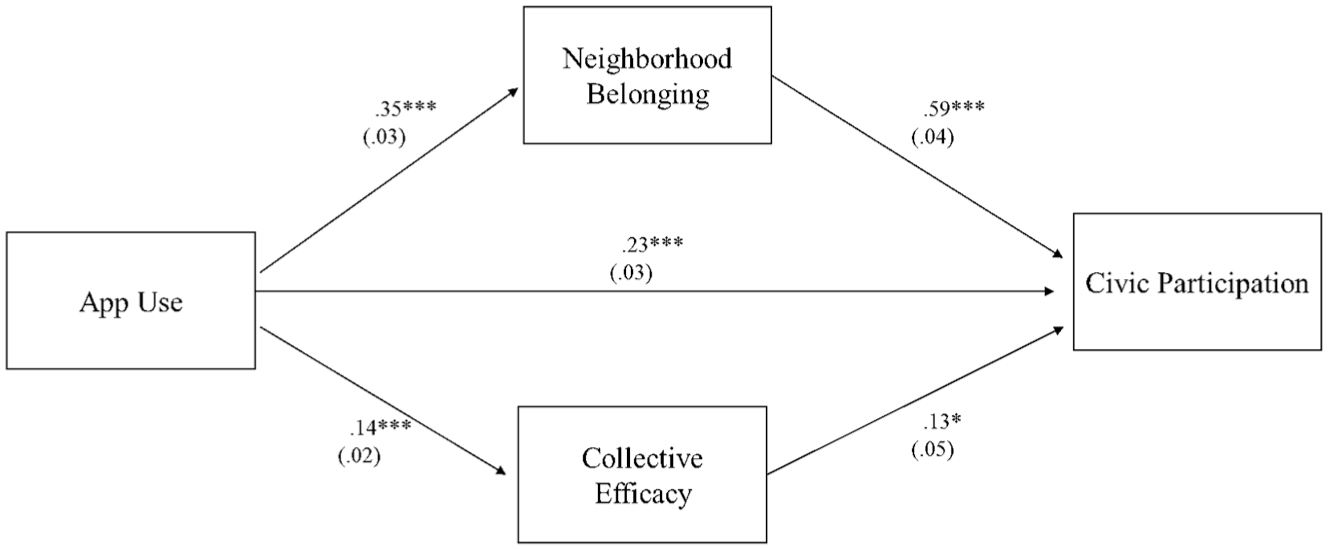
Path analysis results for the relationships between app use, neighborhood belonging, collective efficacy, and civic participation.
The results also demonstrated that neighborhood belonging was positively associated with civic participation (B = 0.59, SE = 0.04, p < .001). The analysis further found that collective efficacy positively was related to civic participation (B = 0.13, SE = 0.05, p < .05).
Indirect Effects
Table 3 presents the indirect effects of app use on civic participation through neighborhood belonging and collective efficacy. The analysis revealed a significant indirect effect between app use and civic participation through neighborhood belonging (B = 0.211, SE = 0.025, 95% CI = [0.163, 0.263]). Furthermore, the study found a significant indirect effect between app use and civic participation through collective efficacy (B = 0.019, SE = 0.008 [0.004, 0.037]).
Indirect Pathway of App Use on Civic Participation Through Neighborhood Belonging and Collective Efficacy.
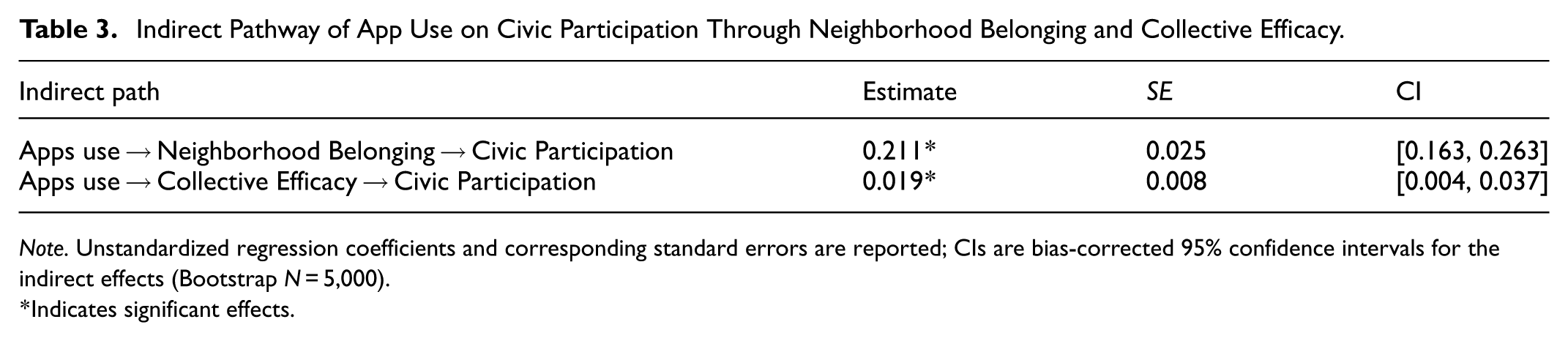
Note. Unstandardized regression coefficients and corresponding standard errors are reported; CIs are bias-corrected 95% confidence intervals for the indirect effects (Bootstrap N = 5,000).
Indicates significant effects.
Discussion
By analyzing national online survey data of South Korean adults, this study examined the impact of the Danggeun Market app use on civic participation. It also investigated the mediating roles of neighborhood belonging and collective efficacy in the relationship between app use and civic participation. The findings indicate that the local community-based app for second-hand dealing can function as a new form of local media that promote civic participation. Currently, little is known about the role of local community-based apps for second-hand dealings in fostering citizens’ engagement in participatory activities. In this regard, this study provides new insights into how the new local media platform contributes to civic life and community development in democratic societies.
Specifically, the study found that frequent use of the Danggeun Market app is positively associated with civic participation. Users who engaged more frequently with the app were more likely to participate in civic activities. Similar to prior findings on local media within the CIT frameworks (e.g., Kwon et al., 2021; McLeod et al., 1999; Nah et al., 2021), app use was positively related to civic participation. This finding indicates that the local community-based app, as an emerging local media platform, can play an important role in influencing civic participation. In particular, with increasing concerns about the decline of traditional local media (e.g., local newspapers) in the new media environment (Abernathy, 2020; Kang, 2019), the findings of this study imply that local community-based apps such as Dangguen Market may function as local media to help facilitate users’ civic participation by sharing news and information about the local community and providing opportunities for users to interact with their neighbors.
Beyond the direct relationship between app use and civic participation, the findings of this study support the proposed indirect effects model, displaying that neighborhood belonging mediates the relationship between app use for second-hand dealings and civic participation. Consistent with previous research showing a positive association between local media use and neighborhood belonging (Nah & Yamamoto, 2019), this study found that respondents who frequently used the local community-based app were more likely to be closely attached to their neighborhoods, which, in turn, led to greater engagement in civic participation. Community residents would use the Danggeun Market application to interact with neighbors, fostering a sense of belonging to their place of residence. Participation in second-hand goods transactions and interactions with neighbors in the app may help develop connections and emotional bonds with neighbors, further facilitating civic participation.
Moreover, collective efficacy played a mediating role in the association between the use of the local community-based app and civic participation. This aligns with prior studies indicating that local media use influences collective efficacy (e.g., Jung & LeNoble, 2022; Nah et al., 2022), this study demonstrated that more frequent app users may be more likely to perceive a greater willingness among their neighbors to solve community problems, which, in turn, promotes civic participation. As the Danggeun Market app provides an affordable and convenient means of connecting and exchanging messages with other users without the limitations of time and cost, engaging in second-hand dealings and communicating with neighbors through the app would help build social relationships and mutual trust among community residents. This can help form collective efficacy in dealing with common issues, contributing to civic participation.
Furthermore, the Danggeun Market app requires users to verify their actual residence through GPS and restricts transactions and interactions within a radius of 6 km of their living residence. The application facilitates neighbor-to-neighbor connections to cultivate cohesive and engaged local communities. As previous research on social capital indicates (Putnam, 2000; You & Hon, 2019), this technological feature may help users to connect with weak social ties characterized by temporal, casual, and instrumental relationships (Yamamoto, 2018), which may, in turn, motivate them to be interested in common community issues and participate in collective actions (Kavanaugh et al., 2003).
This study’s findings provide important theoretical and practical implications for how media and communication technologies can be utilized for a healthy civic society and community development. In terms of theoretical contributions, first, this study extends the existing CIT scholarship by considering the role of local community-based apps for second-hand dealings as a newly emerging form of local media that fosters civic activities. While previous CIT research has primarily focused on traditional local media and social media platforms, this study broadens CIT’s scope to include hyperlocal, transaction-oriented, app-based communication infrastructure that blend economic exchange with community building. To the best of our knowledge, the current study may be among the first to empirically test the impact of local community-based app use for second-hand dealings on civic participation, providing evidence of the beneficial role of local community-based apps in cultivating civic communities. Second, whereas prior studies have mainly investigated the direct relationship between local media use and civic participation (e.g., Nah et al., 2016; Nah et al., 2021; Thompson, 2021), this research deepens theoretical understanding by uncovering the indirect pathways by which local media influence civic participation through neighborhood belonging and collective efficacy. This refines the CIT framework by emphasizing the mediating role of community-level psychological resources that link everyday localized digital media use with civic engagement in local communities.
In terms of practical implications, first, given the beneficial roles of the Danggeun Market app, community organizers and activists can consider utilizing such apps as new local media to encourage community residents to participate actively in civic activities. The local community-based app for second-hand dealings can serve as an essential element for mobilizing citizens in their local communities. Second, in response to new media environments, local public officials or community development practitioners may need to attempt to continuously establish a stronger communication technology infrastructure and connect existing local media with new media technologies, such as the Danggeun Market app, to enhance neighborhood belonging and collective efficacy. Third, given concerns about the decline of local media such as local newspapers, this study indicates that local community-based apps serve as a newly emerging local media platform and can be a significant in intensifying citizenship in the new media environment. Future research should continue to explore the role of other emerging local media and community communication technologies in sustaining a healthy civic society and community development in democracy.
Limitations and Recommendations for Future Research
This study has several limitations that future research should address. First, as this study employed cross-sectional survey data to examine the relationships among local community based app use for second-hand dealings, neighborhood belonging, collective efficacy, and civic participation, the results could not establish causality among variables. Nevertheless, the hypotheses of this study are based on strong theoretical reasoning from previous studies. Future studies should use longitudinal or panel data to confirm the causes and effects of these variables. Second, this study focused exclusively on South Korean residents. Thus, the results of this analysis may lack external validity and may not be extrapolated to other communities, populations, countries, or cultures. Future research should investigate the impact of local community-based applications on civic participation across different geographical and cultural contexts to assess the broader applicability of these findings.
Footnotes
Author Note
Doo-Hun Choi is Associate Professor in the Department of Media and Communication at Gachon University, Gyeonggi-do, South Korea. His research interests include the influence of new media on society.

Ethical Considerations
This study obtained approval from the Institutional Review Board of Hallym University (IRB no. HIRB-2020-090).
Consent to Participate
Informed consent to participate was obtained from all participants through online questionnaire.
Author Contributions
Doo-Hun Choi (Conceptualization, Methodology, Analysis, Writing).
Funding
The author disclosed receipt of the following financial support for the research, authorship, and/or publication of this article: This work was supported by the Ministry of Education of the Republic of Korea and the National Research Foundation of Korea (NRF-2018S1A3A2074932).
Declaration of Conflicting Interests
The author declared no potential conflicts of interest with respect to the research, authorship, and/or publication of this article.
Data Availability Statement
Data are available from the corresponding author [Choi, D.-H.], upon reasonable request.*