



Abstract
This study constructs a “technology-individual-society” triadic integration framework, embedding cultural-psychological variables into the classic Technology Acceptance Model and Unified Theory of Acceptance and Use of Technology, to systematically investigate the multidimensional determinants of generative AI (GAI) adoption intention in the context of Chinese higher education. Through a large-sample survey of 840 teachers and students from five universities in eastern and western China, partial least squares structural equation modeling and multi-group analysis were employed to empirically reveal significant spatial variations in adoption intention pathways. The findings indicate that emotional dependency and individual innovation drive adoption intention through attitude mediation, while perceived usefulness exhibits a counter-intuitive negative effect, reflecting the underlying tension between technological empowerment and occupational displacement anxiety. Substantial differences in adoption intention patterns exist between eastern and western universities: the eastern group demonstrates a “technology-driven” pathway, where adoption intention is strongly influenced by perceived usefulness and attitude; the western group follows an “institutional adaptation” logic, where the shaping effect of perceived trust on attitude is exceptionally prominent, and the impact of effort expectancy on perceived usefulness is stronger. Regional differences are moderated through a triple mediating chain of “technological performance → attitude → adoption intention,” highlighting the systemic interaction effects of infrastructure, institutional environment, and cultural psychology.
Plain Language Summary
This study aims to explore the adoption intention of teachers and students in colleges and universities in eastern and western China towards GAI and the key factors influencing their choices. To this end, a three-dimensional analytical framework of “technology-individual-society” is constructed, with a focus on incorporating psychological dimensions such as “emotional dependency” and “perceived trust”. A total of 840 teachers and students from 5 colleges and universities were surveyed, and standardized empirical analysis methods were adopted for data processing. The results show that there are significant differences in the GAI selection logic between teachers and students in eastern and western China: the eastern group focuses more on the usability and utility of GAI, while the western group pays greater attention to technology trust and institutional support.
Introduction
The rapid development of GAI is reshaping the overall pattern of knowledge production, dissemination, and innovation in the global higher education sector with unprecedented depth and breadth (Pang & Wei, 2025). In this study, GAI refers to intelligent systems based on cutting-edge technologies such as pre-trained transformer architecture and diffusion models, which can independently generate original text, visual, or multimodal content. Its core feature lies in “proactively creating new content,” which is essentially different from traditional narrow- sense AI (Chen et al., 2024; Han, 2024). GAI tools represented by ChatGPT and DeepSeek have broken through the boundaries of traditional technologies through this core capability, promoting the transformation of educational scenarios and fundamentally driving the shift of educational models from traditional “knowledge transmission” to “knowledge co-creation” (Honigsberg et al., 2025). The UNESCO “2024 Global Education Monitoring Report” indicates that approximately 76% of member states have incorporated GAI education strategies into their national development frameworks, reflecting that GAI has become a core driver of global educational transformation (Molina & Medina, 2025). The core implication of this data is “attention at the national strategic level” rather than the adoption rate of specific technologies. This trend is particularly prominent in China. The “New GAI Development Plan” explicitly advocates building an “Intelligence + Education” ecological system (Khanal et al., 2025), promoting the in-depth integration of GAI into the higher education system.
Within higher education institutions, the application of GAI has transcended its initial role as a mere auxiliary tool (Ouhadouan & Fatmi, 2024), becoming deeply embedded in the core processes of teaching (Chere & Wayi-Mgwebi, 2024), research (Suresh et al., 2025), and administration (Wei & Wei, 2024). In the realm of teaching, adaptive platforms based on machine learning algorithms can real-time analyze learners’ cognitive characteristics (Dai et al., 2025) and dynamically optimize course content and learning pathways (Lang et al., 2025). In research innovation, academic writing support systems endowed with advanced semantic analysis capabilities assist researchers in constructing logically rigorous argumentation frameworks (Cui, 2024), while predictive research modeling tools, through big data mining, identify interdisciplinary research opportunities and provide strategic guidance (Akpan et al., 2025). In academic assessment, intelligent systems offer immediate feedback, yet simultaneously raise new questions regarding the validity and fairness of evaluation (Kaldaras et al., 2024). While this systemic integration unlocks tremendous efficiency dividends, it is concomitantly accompanied by severe ethical challenges and institutional adaptation dilemmas. Global educational technology monitoring data reveals that although a large number of higher education practitioners recognize the transformative potential of GAI, there is widespread concern about its potential to exacerbate academic integrity risks (Gallent Torres et al., 2023). This “duality” of technological empowerment coexisting with ethical tension is particularly salient within the Chinese context.
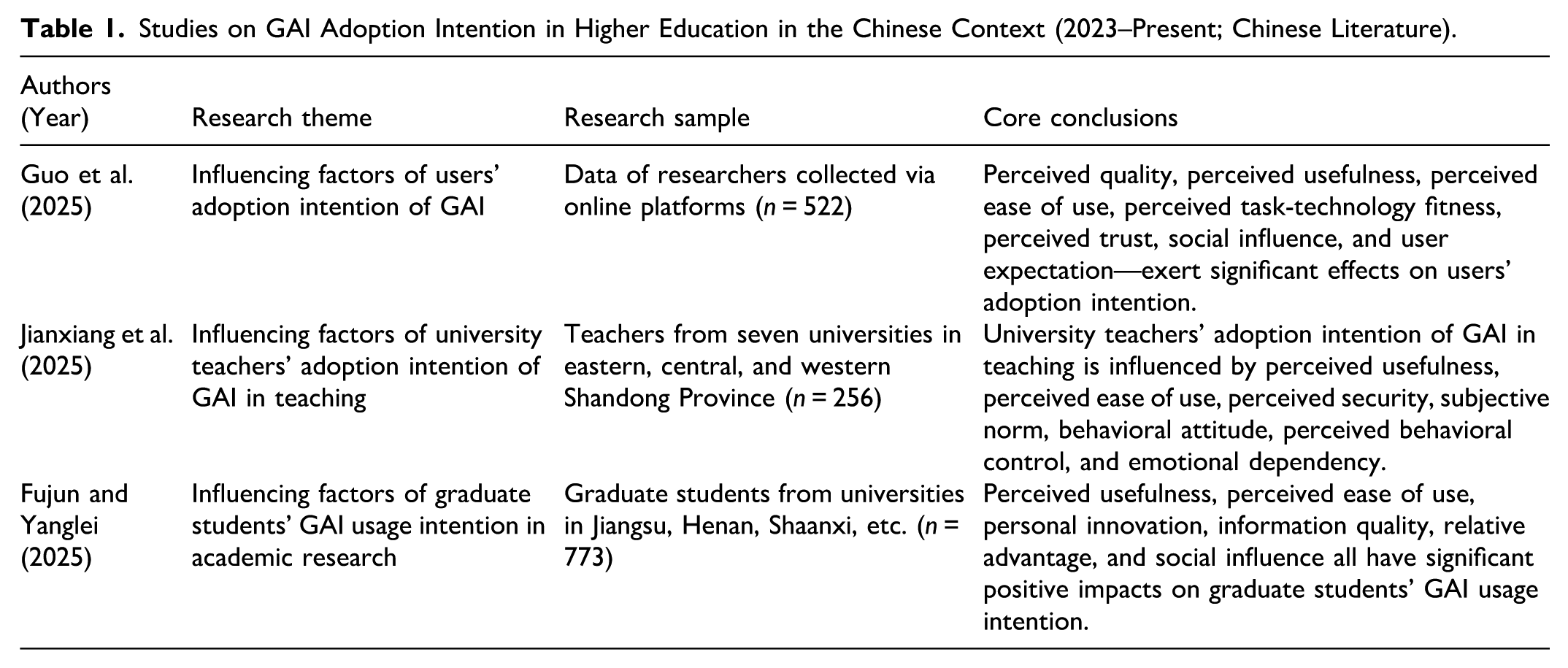
However, current academic research exhibits three limitations when analyzing the complex mechanisms of GAI adoption in higher education. Firstly, there is a narrowing of theoretical perspectives. A substantial body of research focuses on validating the efficacy of the technical models themselves but relatively neglects the embedded nature of GAI as a socio-technical system (Awidi, 2024; El Fathi et al., 2025; Mugaanyi et al., 2024). It fails to adequately examine the interactions between technological attributes and social structures, institutional environments, and cultural psychology. Secondly, the analytical framework has a Western-centric bias: existing research predominantly relies on English-language literature (Ekundayo & Arasanmi, 2024; Patterson et al., 2024), neglecting local empirical studies in the Chinese context. Relevant research emerging in recent years on China National Knowledge Infrastructure has revealed the unique mechanisms of GAI adoption in Chinese universities (see Table 1), and these local evidences have not been incorporated into previous theoretical integrations, further exacerbating the Western-centric bias. Finally, there is a geographical limitation at the methodological level. Existing quantitative studies predominantly rely on samples from single regions or institutions (M. Tang et al., 2025), lacking rigorous designs with national representativeness and regional comparative dimensions. This makes it difficult to capture the heterogeneity in GAI adoption and its underlying drivers within a large and developmentally imbalanced country like China.
Studies on GAI Adoption Intention in Higher Education in the Chinese Context (2023–Present; Chinese Literature).
To address the aforementioned limitations, study deeply integrates the core tenets of TAM and UTAUT, while incorporating three key cultural-psychological moderating variables: individual innovativeness, perceived trust, and emotional dependency. Among these, emotional dependency is used to capture the emotional bonds and psychological reliance formed during users’ adoption interaction with GAI, a dimension often overlooked by traditional rational behavior models (Huang & Huang, 2024). Building on this, this study proposes a “technology-individual-organization-society” four-dimensional integrated framework (see Figure 1) to systematically uncover the dynamic adoption mechanism of GAI in the Chinese higher education context, from technology selection and user adaptation to eventual institutionalization. The core of this framework lies in exploring how “regional difference,” a deep-seated moderating variable, is embedded in the complex interaction network of four dimensions. The technological performance dimension includes perceived usefulness and perceived ease of use, reflecting the subjective perception of the technology’s inherent attributes; the individual psychological dimension encompasses perceived trust, emotional dependency, and individual innovativeness, embodying users’ own cognitive and emotional characteristics; the organizational dimension focuses on facilitating conditions, referring to the objective guarantees provided by universities; the social interaction dimension emphasizes social influence, corresponding to the subjective demonstration and pressure effects brought about by academic communities, educational policies, and technological trends.
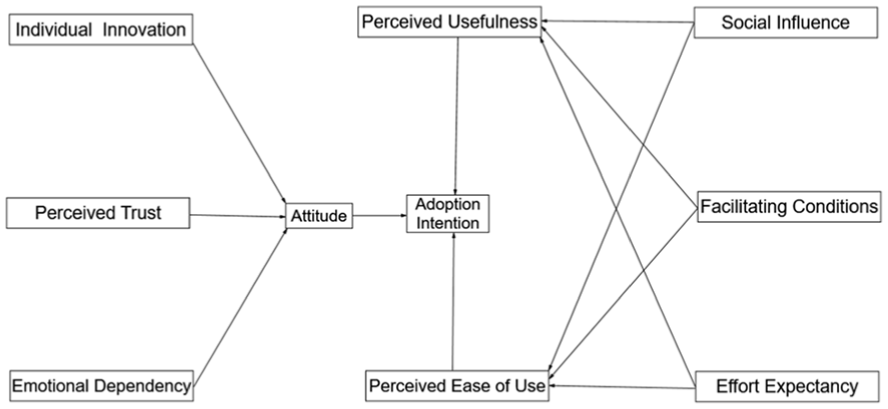
Research models and hypotheses.
This study employs a large-scale empirical survey covering 840 faculty and students from five universities in eastern and western China, utilizing advanced partial least squares structural equation modeling for hypothesis testing and multi-group comparative analysis. The findings powerfully reveal distinct spatial heterogeneities in the GAI adoption intention pathways within Chinese higher education: the eastern university group exhibits significantly “technology-driven” adoption characteristics, whereas the western university group demonstrates an “institutionally adaptive” adoption intention pattern. Crucially, this regional difference is not simply linear but is realized and reinforced through a triple mediating pathway of “technological performance → individual attitudes → behavioral intention.”
Theoretical Foundation
Technology Acceptance Model (TAM)
The TAM stands as a pivotal theoretical framework within the information systems research domain, aiming to dissect the mechanisms underlying individual adoption decisions concerning new technologies. Its core logic posits that user adoption intention is primarily driven by perceived usefulness and perceived ease of use (Davis, 1989). Perceived usefulness refers to the degree to which a user subjectively believes that using a specific technology will enhance their work performance or learning outcomes (Saadé, 2007); Perceived ease of use is a core construct of the TAM, defined as “the degree to which a user believes that using a particular system would be free of effort” (Davis, 1989). It focuses centrally on “usage experience”—such as “whether the interface for operating GAI is concise” and “whether the operational steps to complete teaching tasks are cumbersome” (D. Lee et al., 2007). Its measurement dimensions revolve around “immediate feelings during use,” which must be based on users’ actual operational experience and belong to “post-behavioral cognition.” Together, these two factors shape the user’s attitude toward the technology (Prastiawan et al., 2021), subsequently directly influencing adoption intention (Siu & White, 2025). The model’s parsimony and explanatory power have established it as a classic paradigm for exploring technology integration in higher education, particularly validated in studies on the application of AI tools.
Within the context of higher education, the applicability of TAM manifests unique connotations. The adoption of GAI by educators and students is not solely based on perceived usefulness and perceived ease of use; it must also be embedded within contextual factors. The limitations of TAM have also driven its continuous evolution. Subsequent research has enhanced the model’s explanatory power concerning collectivist cultural contexts and the affective dimensions of technology by incorporating extended variables such as social influence, facilitating conditions, and emotional dependency. This theoretical adaptation reveals that GAI is not merely a process of rational calculation but rather a social practice involving the mutual constitution of technological attributes, individual psychology, institutional environments, and cultural values. This provides a theoretical foundation for analyzing the regional heterogeneity of GAI adoption within Chinese higher education.
Unified Theory of Acceptance and Use of Technology (UTAUT)
The UTAUT, an integrative framework for technology adoption research, synthesizes core elements from eight classic theories to predict individual technology acceptance (Venkatesh et al., 2003). It identifies four key determinants—performance expectancy, effort expectancy, social influence, facilitating conditions—with behavioral intention as the mediating variable and actual usage as the outcome, moderated by gender, age, experience, and voluntariness of use.
In higher education, the UTAUT illuminates GAI adoption mechanisms through clear theoretical attribution of each construct. Performance expectancy reflects perceived utility of GAI in enhancing teaching/learning efficiency (Koroleva & Jogezai, 2025), rooted in “technology-individual” interaction. Effort expectancy, defined as pre- behavioral expectations of learning effort, focuses on “learning costs” (C. Kim, 2025) and differs from TAM’s post- experiential “perceived ease of use”; Venkatesh et al. (2012) confirmed their independence, with effort expectancy centered on “individual cognition.” Social influence encompasses academic normative pressure, policy guidance, and technological trends (Batista et al., 2024), attributed to “social interaction.” Facilitating conditions refer to organizational supports like infrastructure and training (Yang, 2025), falling under “organizational empowerment”—distinct from social influence’s subjective perceptions.
The UTAUT’s value lies in integrating “technology-individual-organization-society” factors. For China’s higher education digital transformation, two local considerations apply: collectivist culture reinforces the “social influence” path, and regional development imbalances affect “facilitating conditions” (eastern vs. western resource disparities).
Innovation Diffusion Theory (IDT)
Innovation diffusion theory (IDT) was systematically proposed by Rogers et al. (2014), providing a classic paradigm for analyzing the diffusion mechanism of technological innovations in social systems. Its core contribution lies in identifying five key attributes that influence innovation adoption. In the field of higher education, as a disruptive technology, the adoption process of GAI embodies the theoretical logic of IDT. The acceptance of GAI by educators and students depends not only on their functional utility but also crucially on the compatibility of this technology with academic ethics norms, teaching traditions, and institutional infrastructure.
The Diffusion of Innovations Theory further categorizes adopters into five groups: innovators, early adopters, early majority, late majority, and laggards (Elsherif, 2011). The core basis for this classification is “individual innovativeness” (Rogers et al., 2014) clearly stated in IDT that individual innovativeness refers to “the degree to which an individual adopts an innovation earlier than other members in a social system.” Its core role is to serve as an antecedent variable of adoption intention, directly influencing users’ attitudes toward new technologies, rather than a moderating variable as in UTAUT2. This theoretical positioning is also supported by Chinese local empirical research: a study by Fu et al. found that individual innovativeness positively affects GAI adoption intention (Fujun & Yanglei, 2025). Therefore, this study still sets individual innovativeness as a “key independent variable directly influencing attitudes,” which is not only consistent with the original theoretical logic of IDT but also aligns with empirical results in the Chinese context (see Table 1), rather than incorrectly classifying it as a moderating variable in UTAUT2.
Individuals with higher innovativeness tend to more acutely perceive the relative advantages of GAI and show higher tolerance for its complexity (Lin et al., 2025). This characteristic is more prominent among teachers and students in universities in eastern China, providing a theoretical foundation for subsequent regional difference analysis. This study integrates IDT into the extended TAM-UTAUT framework, emphasizing the pathway where individual innovativeness influences adoption intention through the mediation of attitude, thereby confirming the driving force of innovative propensity on adoption intention.
Social Cognitive Theory (SCT)
Social cognitive theory (SCT), a core framework explaining the dynamic interaction mechanisms of human behavior, offers a multi-dimensional theoretical perspective for understanding the adoption behavior of GAI in higher education (Alamri, 2025). Systematically proposed by Bandura, the theory emphasizes the triadic reciprocal determinism among the individual, the environment, and behavior (Bandura, 1986). This posits that cognitive processes, social environmental factors, and behavioral performance continuously and dynamically interact to jointly shape technology adoption decisions. In the context of technology acceptance in higher education, SCT transcends the limitations of traditional rational choice models by incorporating psychological mechanisms such as perceived trust and emotional dependency into the analytical framework, revealing the complex socio-psychological motivations underlying technology adoption behavior.
Perceived trust, a core construct within SCT, reflects an individual’s belief in their capability to successfully execute specific technological tasks. In the GAI adoption scenario, the perceived trust of educators and students directly influences their intention to use GAI (Silalahi, 2024). Emotional dependency, within the SCT framework, reveals how emotional experiences during technology use affect behavioral persistence. The interactive nature of GAI tools can evoke positive or negative emotions in users, and these affective experiences regulate subsequent usage behavior through self-reinforcement mechanisms.
Theoretical Integration Framework
To avoid the “super-positional” limitation of theoretical application, this study constructs a theoretical integration scheme based on the “technology-individual-society-environment” four-dimensional framework. This scheme aims to clarify the unique contributions and synergistic relationships of four major theories. Table 2 systematically presents the specific positioning of each theory in the model. At the technology dimension, the study takes TAM as the core, focusing on the cognitive driving role of its core variables on attitude and adoption intention, while integrating UTAUT’s “facilitating conditions” to explain the synergistic effect between technological attributes and environmental support factors. At the individual dimension, IDT’s “individual innovativeness” is integrated with SCT’s “perceived trust” and “emotional dependency.” Among these, “emotional dependency” is defined as an intermediary psychological resource under the SCT framework, linking “technology interaction” and “attitude,” which effectively supplements the deficiency of TAM’s purely rational cognitive path and reflects the core idea of SCT’s “individual-environment-behavior” reciprocal determinism. At the social dimension, the study takes UTAUT’s “social influence” as the core, combined with SCT’s basic logic of “social environment shaping individual psychology,” to explain the reinforcing effect of social norms on individual attitudes in the context of collectivist culture.
Theoretical Integration and Synergistic Relationship.
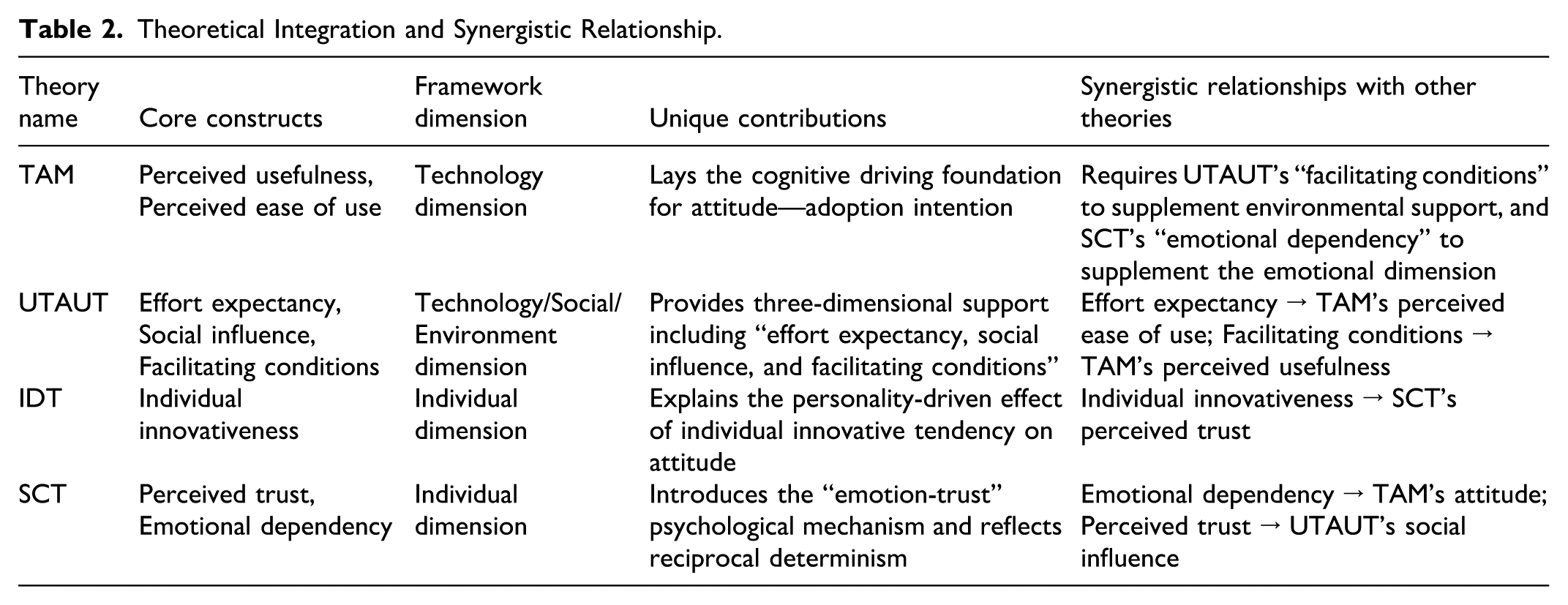
This synergistic integration effectively breaks through the explanatory limitations of a single theory. For example, UTAUT’s “effort expectancy” provides an important antecedent explanation for TAM’s “perceived ease of use”; IDT’s “individual innovativeness” offers a driving mechanism from the perspective of personality traits for SCT’s “perceived trust.” Ultimately, the integrated framework forms a mutually nested and interacting theoretical network of “technology-individual-society-environment.”
Operational Definition of Core Constructs
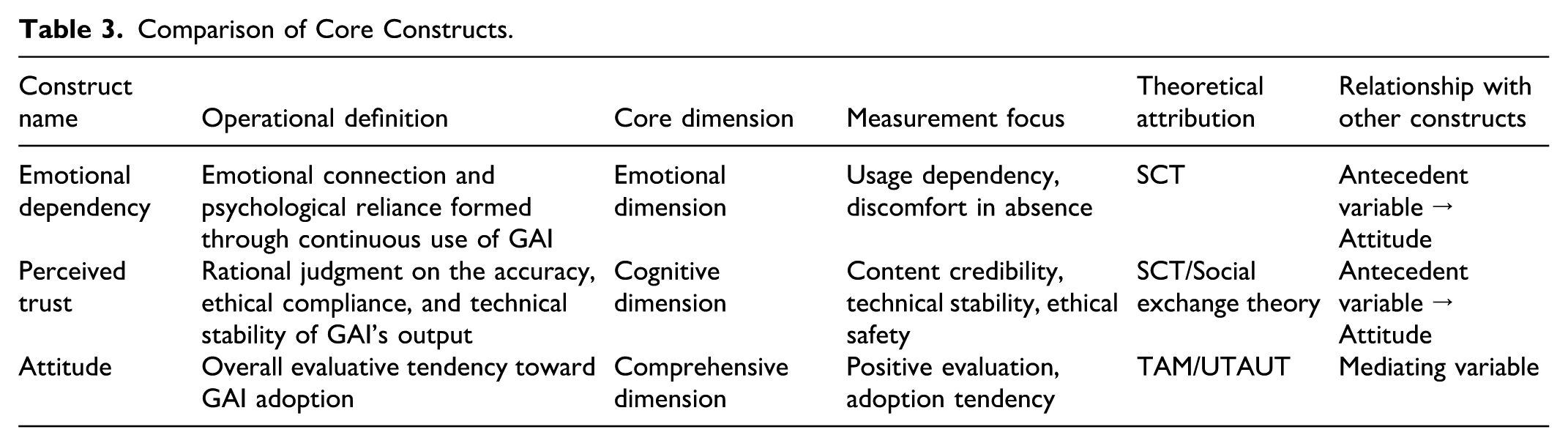
Based on theoretical foundations and empirical scenarios, this study formulates operational definitions for three easily confused constructs—emotional dependency, perceived trust, and attitude—and systematically presents their core differences in Table 3. Emotional dependency is operationally defined as the irreplaceable emotional connection and psychological reliance formed by users through positive interaction experiences during the continuous use of GAI. This construct is characterized by “sustained emotional needs,” with measurement focusing on “usage dependency” and “discomfort in absence.” Perceived trust is defined as users’ rational judgment on the accuracy, academic ethics compliance, and technical stability of GAI’s output. Its core feature is “cognitive evaluation of reliability,” with measurement dimensions including “content credibility” and “ethical safety” (Silalahi, 2024). Attitude is defined as users’ overall evaluative tendency toward adopting GAI, based on GAI’s utility, emotional experiences, and ethical risks. This construct integrates both cognitive and emotional dimensions, with measurement focusing on “positive evaluation” and “adoption intention tendency” (Davis, 1989). The logical relationship among the three is as follows: emotional dependency and perceived trust serve as antecedent variables, which form attitude through integration and then influence adoption intention. By clarifying the theoretical boundaries and measurement dimensions of each construct, this study effectively avoids conceptual overlap and ensures the rigor and explanatory power of the model.
Comparison of Core Constructs.
Hypotheses Development
Social Influence
Social influence, a core construct within the UTAUT, refers to the degree to which an individual perceives that important others or groups believe they should use a new technology (Venkatesh et al., 2003). Within the higher education context, social influence manifests as the shaping power of the academic community, educational policy orientations, and the demonstration effects of technological trends on individual decision-making (Krezel & Krezel, 2017).
For a disruptive technology like GAI, social influence may operate on adoption decisions through dual pathways. Firstly, the normative pathway: official promotion strategies for GAI by university administrators or public advocacy by academic leaders will enhance users’ perception of the technology’s compliance and mainstream acceptance, thereby strengthening their confidence in its perceived ease of use (Gai, 2024). For instance, when institutions integrate GAI tools into teaching platforms and provide institutionalized support, users’ concerns about technical operational barriers may diminish due to “policy endorsement.” Secondly, the informational pathway: successful peer cases reduce technological uncertainty through knowledge sharing, enabling users to better understand GAI’s functional boundaries and operational procedures, consequently reinforcing its perceived usefulness. Based on this, the study proposes:
Facilitating Conditions
Facilitating conditions, reflect the level of organizational support, infrastructure, and resource guarantees required for technology use. Their impact mechanism on GAI adoption in higher education scenarios manifests in two interrelated dimensions. Regarding perceived ease of use, when universities provide robust technical support systems, optimized hardware configurations, and localized interfaces, users can master the core functions of GAI tools without excessive cognitive investment; this environmental empowerment directly lowers the psychological barriers and operational costs of technology use (Yang, 2025).
Facilitating conditions strengthen perceived usefulness through two paths. On one hand, continuous technical updates and maintenance ensure the stability and responsiveness of GAI tools, allowing faculty and students to reliably integrate them into core tasks such as teaching preparation and literature analysis (Gai, 2024). On the other hand, targeted usage guidance services help users discover the application value of GAI in specific educational scenarios (Pang & Wei, 2025). Under the impetus of China’s “Smart + Education” policy, the institutional support provided by universities for GAI applications itself constitutes a crucial dimension of facilitating conditions; this institutional backing further enhances users’ perception of GAI’s educational value and usefulness. Based on this, the study proposes:
Effort Expectancy
Within the theoretical framework of GAI adoption in higher education, effort expectancy, directly concerns users’ assessment of the cognitive cost required to operate the GAI (Gai, 2024). According to Venkatesh et al.’s theoretical elaboration (Venkatesh et al., 2012), effort expectancy measures the degree of perceived ease of use associated with an individual’s learning and using GAI; when its level is high, users tend to perceive the technology as easy to master, thereby lowering the psychological barriers to initial adoption. In the higher education setting, if faculty and students anticipate that the learning effort required for GAI tools is low, it reinforces their positive perception of the technology’s operational convenience, that is, it enhances perceived ease of use.
Furthermore, effort expectancy also shapes perceived usefulness through an indirect mechanism. When users expect less effort to master GAI, they can more readily redirect saved cognitive resources toward practical application, thereby experiencing the technology’s efficiency gains more quickly (Y. Lee et al., 2025). The UTAUT framework emphasizes that effort expectancy, as an antecedent to performance expectancy, can amplify users’ recognition of perceived usefulness when reduced. Particularly in complex higher education scenarios, if faculty and students perceive a tool as easy to learn and use, they are more likely to regard it as an effective aid for enhancing academic output or teaching effectiveness, directly boosting their perceived usefulness (T. L.-P. Tang & Austin, 2009). Based on this, the study proposes:
Perceived Usefulness
Perceived usefulness reflects an individual’s subjective belief that using a technological tool will enhance their job performance (Davis, 1989). In the context of GAI adoption in higher education, faculty and students’ assessment of GAI’s utility encompasses multidimensional value aspects such as optimizing teaching efficiency, enhancing learning experiences, and improving research quality (Sharma, 2024). According to the fundamental logic of the Technology Acceptance Model (TAM), when educators perceive GAI as significantly reducing cognitive load and improving academic output quality (Wang et al., 2025), or when students believe the technology can effectively promote deep learning and critical thinking development (Wu et al., 2025), their behavioral intention to adopt the new technology will be strengthened. This perceived usefulness stems not only from the technology's direct functional output but is also rooted in the systemic demand for efficiency gains and innovative empowerment within the broader context of higher education's digital transformation. In the process of Chinese universities advancing educational modernization, perceived usefulness, as a crucial link connecting technological functionality with educational objectives, is expected to exert a significant positive influence on the adoption intention of faculty and students (D. Kim et al., 2025). Based on this, the study proposes:
Perceived Ease of Use
Perceived ease of use reflects a user’s subjective assessment of the simplicity of operation, low learning threshold, and interaction fluency of a GAI (Gai, 2024). In the higher education context, the adoption decisions of faculty and students regarding technological tools are highly dependent on their perception of cognitive load—when GAI systems can reduce usage complexity through intuitive interface design, natural language interaction, and contextual help functions, users are more inclined to integrate them into daily teaching and research activities (Ziegler, 2024). Theoretically, perceived ease of use influences adoption intention through dual pathways: directly reducing psychological resistance to technology use, and indirectly driving adoption by reinforcing the cognitive assessment of perceived usefulness (Green, 2024). Empirical studies widely confirm that in the educational technology domain, the positive predictive power of perceived ease of use on adoption intention is particularly significant (Green, 2024), especially when users need to balance multiple teaching and research tasks within limited time-frames; the perceived ease of use characteristics of the technology become a key moderating variable for reducing workload and enhancing usage intention (Caffaro et al., 2020). Based on this, the study proposes:
Individual Innovativeness
Individual innovativeness profoundly influences higher education practitioners’ emotional evaluations and cognitive tendencies toward GAI (Pushpanadham & Sarpong, 2024). According to Rogers’ Diffusion of Innovations Theory. Chinese local studies have also confirmed that in the higher education context, teachers and students with high individual innovativeness are more likely to break through traditional teaching/learning paradigms, proactively explore the application value of GAI, and thus develop positive attitudes, individuals with high innovativeness typically exhibit an open cognitive framework and a propensity for positive experiences with new technologies; their technology adoption decisions are less constrained by path dependence and more likely to form positive attitudinal assessments. This mechanism presents a dual pathway from a social cognitive theory perspective: on one hand, an innovative spirit strengthens individuals’ self-efficacy perception regarding technological capabilities (Aboobaker et al., 2023), enabling educators facing complex algorithmic outputs of generative AI to actively construct cognitive schemas to alleviate anxiety stemming from technological unfamiliarity (Granda et al., 2024); on the other hand, an innovative trait motivates users to adopt exploratory usage strategies, discovering the tool’s potential value in scenarios like curriculum design and research collaboration through deep interaction (Fisher & Baird, 2006), thereby forming affective commitment. In the Chinese higher education context, this innovation-driven effect holds greater practical significance—when teachers break free from the constraints of traditional teaching paradigms and use generative AI as a catalyst for reconstructing academic productivity, their attitude formation stems not only from the tool’s utility but is also rooted in the professional identity reshaping brought about by innovative practice. Based on this, the study proposes:
Perceived Trust
Perceived trust significantly shapes user attitude in the context of GAI adoption in higher education (Chiu, 2025). From a social exchange theory perspective, educational users’ trust in GAI is essentially a trade-off between risk perception and value expectation (Huynh, 2024)—when faculty and students believe the GAI can reliably output stable knowledge, protect academic privacy, and adhere to educational ethics norms, this cognitive assessment translates into positive affective tendencies, consequently forming a favorable attitude toward the technology. The particularity of the higher education setting amplifies the decisive role of perceived trust (Tahmasbi et al., 2025): the stringent demands of academic activities for information accuracy and originality mean that users’ trust in GAI encompasses not only an assessment of technical performance but also a judgment of their educational appropriateness. This dual dimension of trust—technological trust and educational trust—collectively forms the foundation of attitude formation. Within the collectivist cultural background of Chinese higher education, the social attribute of trust is further magnified: when the educational community generally recognizes the reliability of generative AI, individual users are more likely to form convergent positive attitudes (Yilmaz et al., 2024). Synthesizing these points, perceived trust systematically and positively influences users’ attitude toward GAI through a triple mechanism: reducing risk perception, enhancing value recognition, and promoting affective connection (Silalahi, 2024). Based on this, the study proposes:
Emotional Dependency
Emotional dependency, a long-overlooked affective dimension construct in technology acceptance research, demonstrates unique explanatory power in the adoption process of highly interactive technologies like GAI (Huang & Huang, 2024). Social cognitive theory indicates that emotional dependency in technology use continuously shapes user attitude through a self-reinforcing mechanism (Bani-Hani & Shepherd, 2021); in educational settings, this affective bond manifests as the intensity of the emotional connection formed between the user and the intelligent system. When higher education users obtain positive learning experiences through GAI, they gradually establish emotional dependency to the technology (Zhao et al., 2025); this accumulation of positive affect directly translates into a favorable attitude toward GAI. In the higher education context, the positive impact of emotional dependency on attitude is specifically manifested across three levels: cognitively enhancing recognition of the technology’s value (Sandberg & Savulescu, 2011), emotional dependency reducing usage anxiety, and behaviorally increasing the willingness for sustained interaction. Particularly when GAI exhibit quasi-interpersonal interaction characteristics, users are more prone to develop emotional dependency; this anthropomorphic tendency further strengthens the association between emotional dependency and positive attitude. Based on this, the study proposes:
Attitude
Attitude, plays a pivotal role as a key hub in the adoption mechanism of GAI in higher education. According to the theoretical logic of the Technology Acceptance Model (TAM), when educators and students develop a positive affective evaluation of GAI, it stimulates their proactive intention to integrate the technology into teaching and research practices (Liu, 2025). This attitude construction process is essentially the result of multidimensional information integration: it incorporates rational judgments about technological utility, encompasses affective cognitions of interaction experiences, and permeates value considerations regarding technological ethical risks. Within the Chinese higher education context, collectivist cultural traditions further reinforce the socially constructed nature of attitude (Cheong, 2021)—faculty and students’ attitudes toward GAI are not only influenced by individual usage experiences but are deeply embedded within the normative recognition of the academic community and the legitimacy perception of the institutional environment. Empirical research indicates that when users form a positive cognitive framework viewing GAI as “empowering rather than replacing,” their adoption intention shows a significant upward trend (Abdullah, 2024); this attitude-driven effect is particularly prominent in decision-making scenarios where technological ethical controversies coexist with efficiency gains. Based on this, the study proposes:
Tools and Data Collection
Questionnaire Design
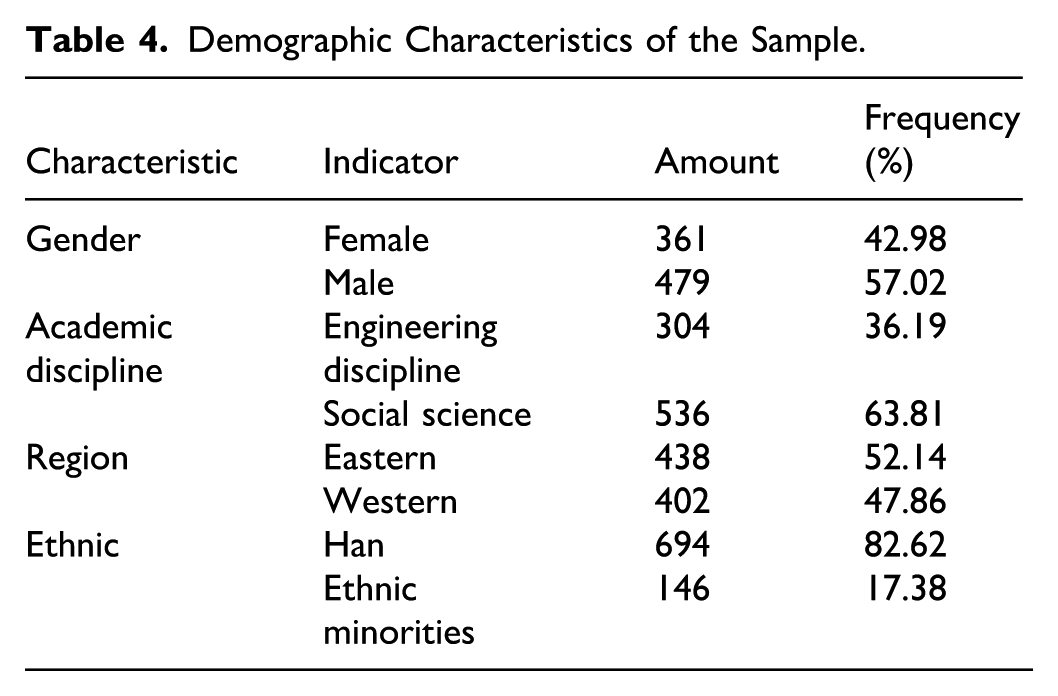
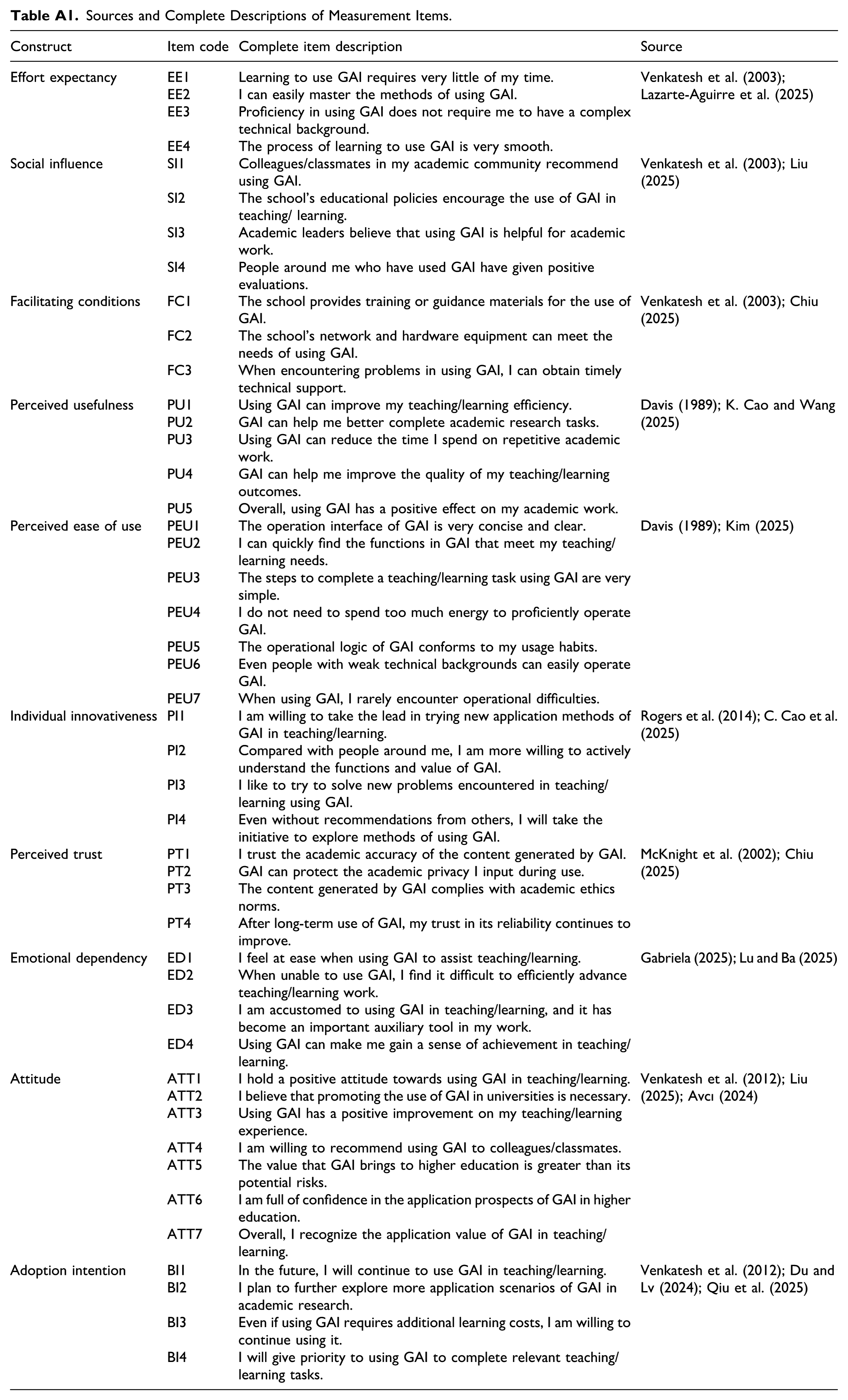
This study developed a structured questionnaire based on mature theoretical constructs from existing literature and divided it into three sections to ensure rigor. The first section is Research Explanation and Informed Consent, which outlines the research objectives, research procedures, and relevant content of informed consent to safeguard research ethics and participants’ rights and interests. The second section is Demographic Information Survey, which collects participants’ demographic characteristics (gender, discipline, region, ethnicity) for subsequent subgroup analyses (Table 4). The third section is Core Construct Measurement Items, which operationalizes 10 core constructs through 46 measurement items, including: Emotional Dependency (4 items), Effort Expectancy (4 items), Social Influence (4 items), Facilitating Conditions (3 items), Perceived Usefulness (5 items), Perceived Ease of Use (7 items), Individual Innovativeness (4 items), Perceived Trust (4 items), Attitude (7 items), and Adoption Intention (4 items) (see Appendix Table A1 for established scales).
Demographic Characteristics of the Sample.
Item design followed three principles: prioritizing highly cited IS field scales for comparability, adapting general technology references to “GAI” with higher education-related keywords, and simplifying wording to reduce comprehension burden. All items used a 7-point Likert scale (1 = “strongly disagree,” 7 = “strongly agree”) consistent with original scales. This structured design ensured the instrument’s reliability, validity, and adherence to disciplinary methodological norms.
Data Collection and Analysis Framework
To ensure the scientific validity and reliability of research data, this study constructs a full-process data processing framework of “pre-quality control − standardized data collection − post-deviation testing.” Sequentially, it conducts common method bias control and testing, sampling design and data collection, and non-response bias testing. The specific processes and results are as follows.
Control and Testing of Common Method Bias
This study’s core data are derived from self-reported questionnaires, posing potential common method bias. To mitigate such interference on conclusions, we adopted a “pre-prevention + post-testing” strategy following Podsakoff et al. (2024). Pre-prevention measures during questionnaire design and distribution included implementing an anonymous response mechanism with clear notification that data is solely for academic research to address respondents’ concerns, using neutral item expressions to avoid leading language, shuffling core construct item orders to reduce psychological association cues, and formulating standardized instructions to clarify response requirements and precautions for fewer random responses. Post-testing employed Harman’s single-factor test, conducting unrotated exploratory factor analysis (EFA) on all 46 measurement items. Results (see Table 5) extracted 10 common factors with eigenvalues greater than 1, and the first factor’s variance explanation rate was only 28.76%, below the 40% critical standard. This indicates no serious common method bias, with data quality meeting subsequent analysis requirements.
Results of Harman’s Single-Factor Test.
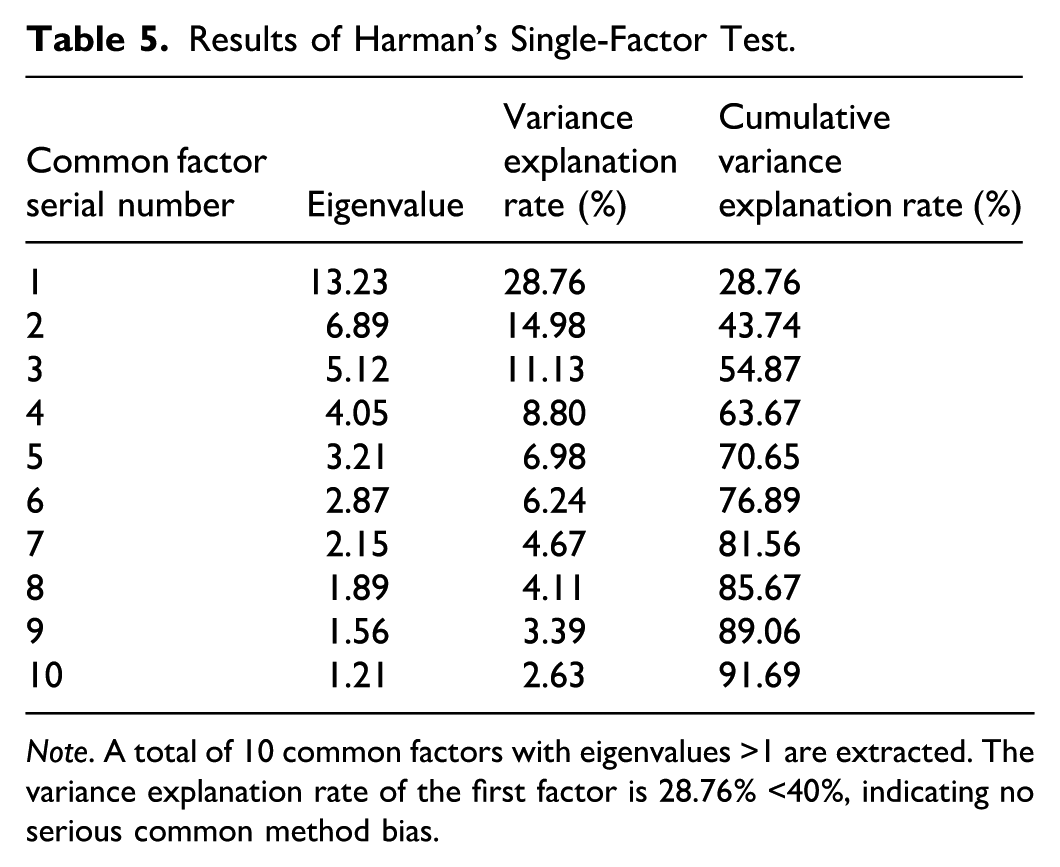
Note. A total of 10 common factors with eigenvalues >1 are extracted. The variance explanation rate of the first factor is 28.76% <40%, indicating no serious common method bias.
Sampling Design and Data Collection
To ensure the representativeness of the sample and the rationality of regional comparison, this study adopts a three-level stratified sampling framework of “region − university − teachers and students,” designs the sampling scheme based on the regional heterogeneity characteristics of educational digitalization development, and carries out data collection through standardized processes.
Sampling Framework Design
Sampling followed the “typicality + heterogeneity” principle with multi-level logic. Based on the National Development and Reform Commission’s official classification in the China Regional Coordinated Development Plan Outline (Wei et al., 2020), two typical regions were selected Eastern Province representing the “developed type” and Western Province the “catching-up type” of educational digitalization to support regional comparative analysis. Meanwhile, two to three universities covering different discipline types were chosen in each region to avoid sample bias from a single school type. Additionally, teacher and student samples were randomly selected according to the proportion of college and department scales in each university with a 1:3 teacher-student ratio to balance the two groups’ sample structure. Specifically, Eastern universities with improved digital infrastructure while Western universities comprised a key supported educational area in the West. A total of 1,000 questionnaires were distributed 520 in Eastern universities and 480 in Western ones.
Data Collection Process and Response Status
Data are distributed through the online platform Wenjuanxing (https://www.wjx.cn/) and disseminated through official channels such as university academic affairs management systems and teacher professional communities to improve the recovery rate and validity of questionnaires. Before the formal data collection, standardized briefings are organized to clarify the research purpose, response norms, and ethical commitments to respondents, reducing response bias. A total of 840 valid questionnaires are recovered in this survey, with an overall effective response rate of 84%.
Regional response status: 438 valid questionnaires are recovered from Eastern universities, with a response rate of 84.2%; 402 valid questionnaires are recovered from Western universities, with a response rate of 83.8%. Chi-square test (χ2 = .05, p = .82) shows that there is no significant difference in the response rates between the two regions, indicating that regional factors have no systematic impact on sample recovery.
Non-Response Bias Testing
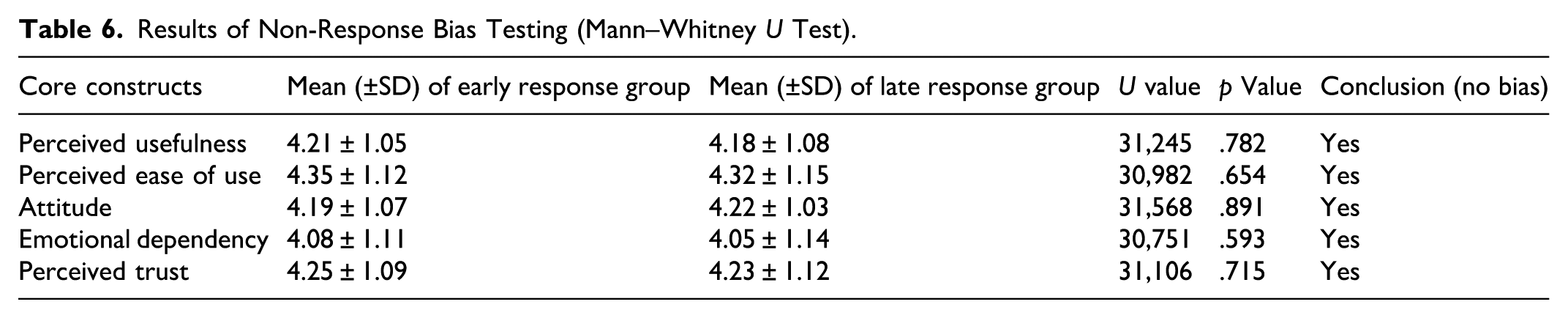
To test the impact of non-response bias on sample quality, the Mann–Whitney U test is adopted. Respondents are divided into the “early response group” (the first 30% of recovered questionnaires, n = 252) and the “late response group” (the last 30% of recovered questionnaires, n = 252) according to the questionnaire recovery time. The score differences between the two groups in core constructs such as perceived usefulness, perceived ease of use, and attitude are compared. The test results (see Table 6) show that the p-values of inter-group comparisons for all core constructs are greater than .05, indicating that there is no significant difference between the early response group and the late response group in core research variables, and there is no significant non-response bias. The sample has good representativeness and reliability.
Results of Non-Response Bias Testing (Mann–Whitney U Test).
Ethical Considerations and Informed Consent
This study involves faculty and student participants and has been approved by the Science and Technology Ethics Committee of Qinghai University (Approval No: PJ202501-140). Employing an anonymous online questionnaire as the primary research method, the study poses minimal potential harm, and targeted preventive measures have been implemented: participants are explicitly allowed to skip any item or withdraw from the survey at any time, no personally identifiable information is collected, data is encrypted for storage and securely deleted 5 years after publication, and strict compliance with the General Data Protection Regulation (GDPR) and China’s Personal Information Protection Law is ensured. The potential benefits of this study significantly outweigh the potential harms—it not only provides empirical support for the integrated application of generative artificial intelligence (GAI) in universities and the equitable implementation of educational technology, enriches relevant theories, but also helps participants clarify their own attitudes toward the technology. Informed voluntary consent from participants was obtained via an online informed consent form, which fully informed them of the study details, risks, and rights, safeguarding their right to voluntary participation and right to know.
Measurement Model Assessment
In structural equation modeling, measurement model assessment is core to verifying latent-observed variable relationships and theoretical consistency. This study adopts partial least squares SEM for its strengths in handling complex models, smaller samples, controlling measurement error, and testing hypotheses. Assessment covers three key aspects: reliability (via composite reliability [CR] and Cronbach’s alpha), validity (convergent validity via factor loadings/average variance extracted [AVE]; content validity), and discriminant validity (comparing latent variable correlations with AVE square roots). This systematic evaluation lays a solid foundation for subsequent structural model analysis, enhancing the study’s conclusion credibility.
Reliability Test
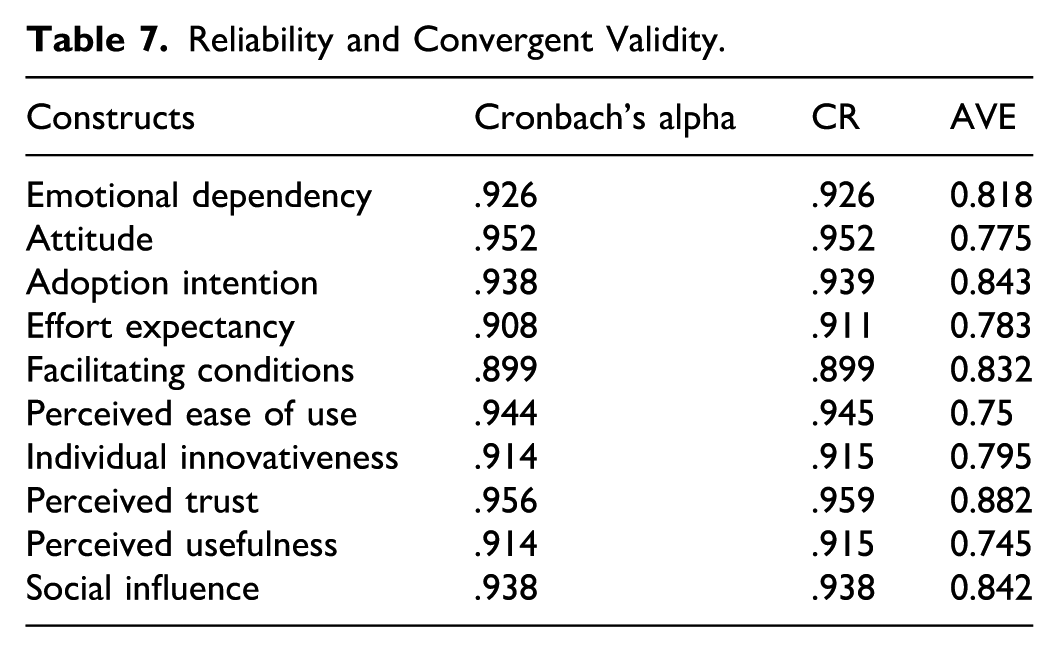
Reliability test aims to assess the stability and internal consistency of measurement tools. This study employed composite reliability (CR) and Cronbach’s alpha coefficient as dual indicators. As shown in Table 7, all latent variables exhibited CR values exceeding .8, indicating high stability of the measurement model; the Cronbach’s alpha coefficients for each latent variable were all greater than .8, further confirming good internal consistency among scale items (J. Hair, Hollingsworth, et al., 2017; Liengaard et al., 2021; Sarstedt et al., 2021). Combined, these two indicators demonstrate that the measurement model meets the rigorous reliability standards of psychological and social science research, with high data reliability and effective error control.
Reliability and Convergent Validity.
Exploratory Factor Analysis (EFA) of the Emotional Dependency Construct
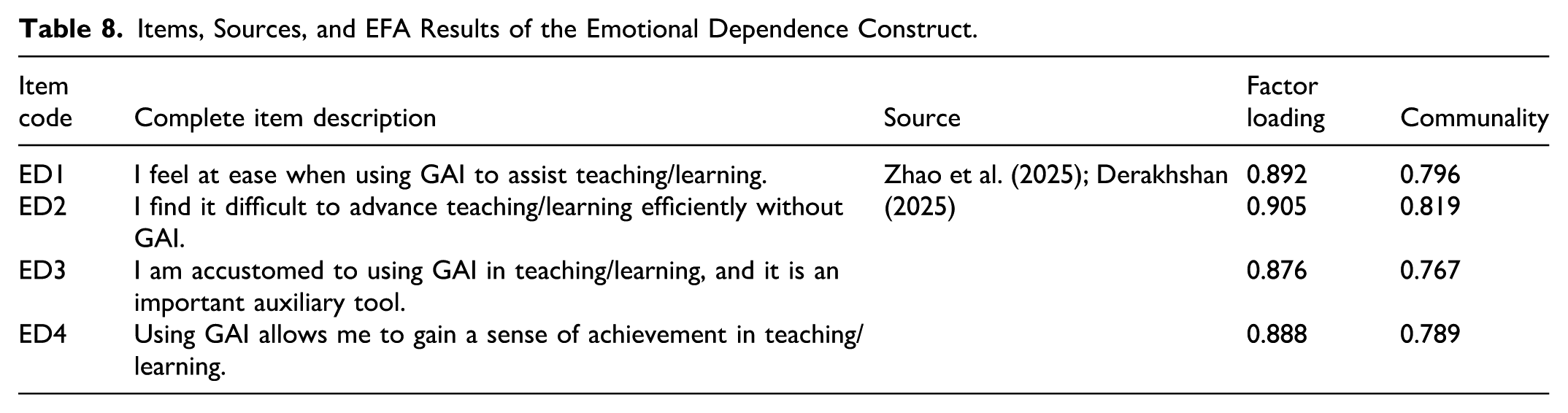
To verify the unidimensionality of the emotional dependence construct, EFA (Principal Component Analysis + Varimax Rotation) was conducted on its four items. (1) Fit test: The KMO value = 0.912 (>0.8, suitable for factor analysis), and the Bartlett’s test of sphericity yielded χ2 = 1,876.34 (df = 6, p < .001), indicating the data are suitable for factor extraction. (2) Factor structure: A total of one common factor with an eigenvalue >1 was extracted, explaining 81.8% of the variance (consistent with the AVE = 0.818 for emotional dependence in Table 8). All item factor loadings exceeded 0.85 (Table 7). These results confirm that the emotional dependence construct has a good unidimensional structure with sufficient measurement validity (Table 9).
Items, Sources, and EFA Results of the Emotional Dependence Construct.
Discriminant Validity (Fornell-Larcker Criterion).
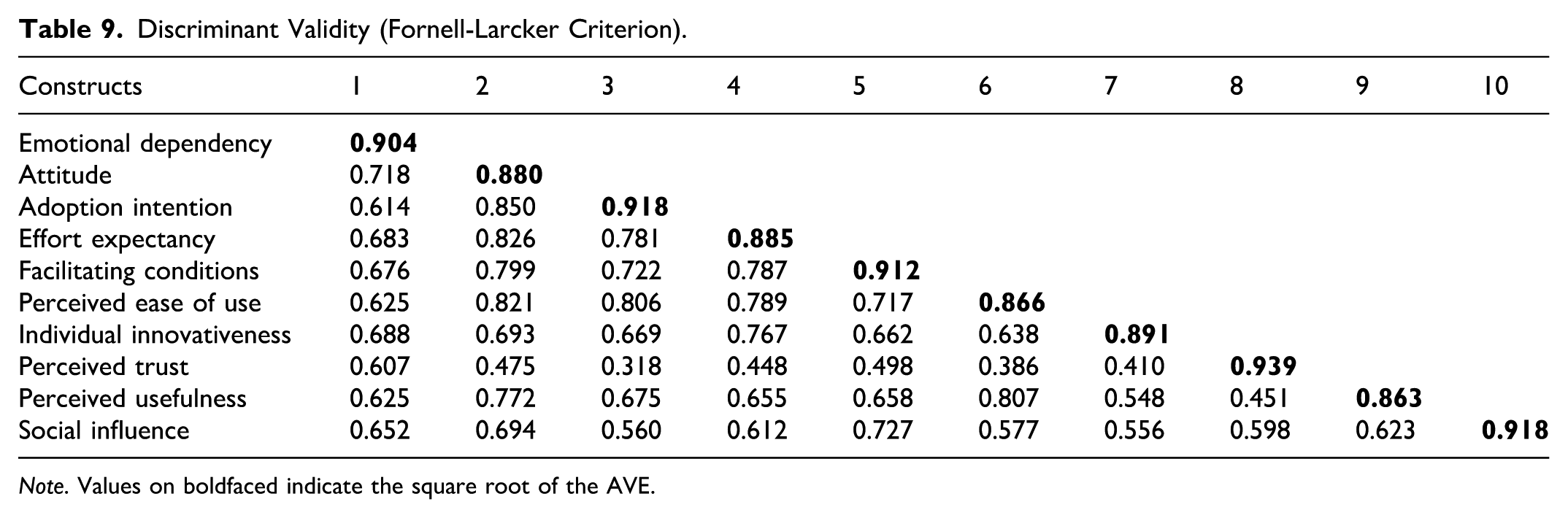
Note. Values on boldfaced indicate the square root of the AVE.
Validity Testing
This study adopted the Fornell-Larcker criterion and the Heterotrait-Monotrait Ratio of Correlations (HTMT) to assess discriminant validity, with a specific focus on verifying the empirical independence of perceived ease of use and effort expectancy. As shown in Table 7, the square root of AVE for perceived ease of use is 0.866, and for effort expectancy is 0.885, while their correlation coefficient is 0.789. The square roots of AVE for both perceived ease of use and effort expectancy are significantly greater than their correlation coefficient (0.866 > 0.789, 0.885 > 0.789), fully meeting the discriminant validity standard (Fornell & Larcker, 1981). As presented in Table 10, the HTMT value between perceived ease of use and effort expectancy is 0.849, which is below the critical threshold of 0.85 (J. F. Hair, Hult, Ringle, Sarstedt, Danks, & Ray, 2021). This further confirms that the two constructs can be clearly distinguished at the empirical level, with no construct redundancy. In addition, the AVE values of all latent variables exceed the threshold of 0.7 (Table 7), and the square roots of AVE on the diagonal are significantly greater than the corresponding correlation coefficients, indicating good discriminant validity of the overall measurement model.
Discriminant Validity (HTMT).
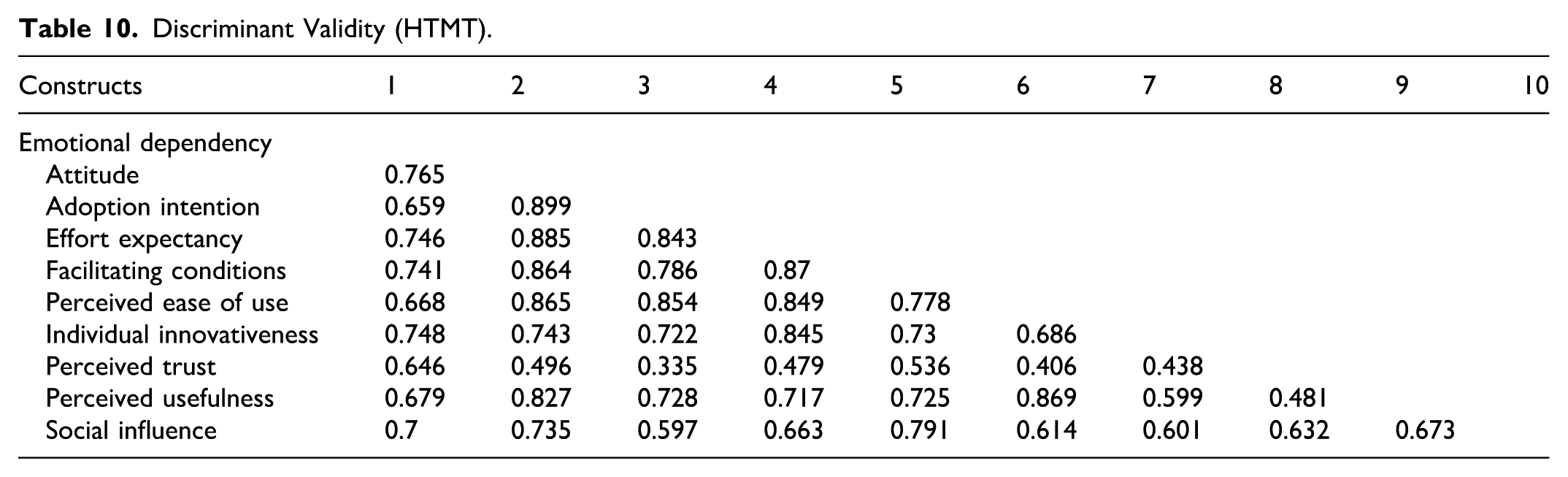
Meanwhile, the HTMT assessment results (Table 11) show that the ratios between most construct pairs are below the strict critical value of 0.85 (J. F. Hair, Hult, Ringle, Sarstedt, Danks, & Ray, 2021). However, the HTMT values of three construct pairs are slightly above the threshold. Attitude versus adoption intention (0.899), effort expectancy versus attitude (0.885), and facilitating conditions versus effort expectancy (0.870). To address this, discriminant validity was verified through the following methods. Supplementary verification via Fornell-Larcker criterion: As shown in Table 5, the square roots of AVE for the above three construct pairs are significantly greater than their correlation coefficients, fully meeting the discriminant validity standard. Theoretical logic verification: attitude is a core mediating variable of adoption intention; both effort expectancy and attitude involve individuals’ subjective perceptions of technology; both facilitating conditions and effort expectancy are associated with perceptions of “cost/support” for technology use. The certain theoretical correlation between these constructs leads to slightly higher HTMT values, but they do not exceed the lenient critical threshold of 0.90 (Kline, 2012). Combined with the Fornell-Larcker criterion, it can be concluded that the measurement model still has sufficient discriminant validity, and the independence of each construct is acceptable, laying a solid foundation for construct validity for subsequent analyses.
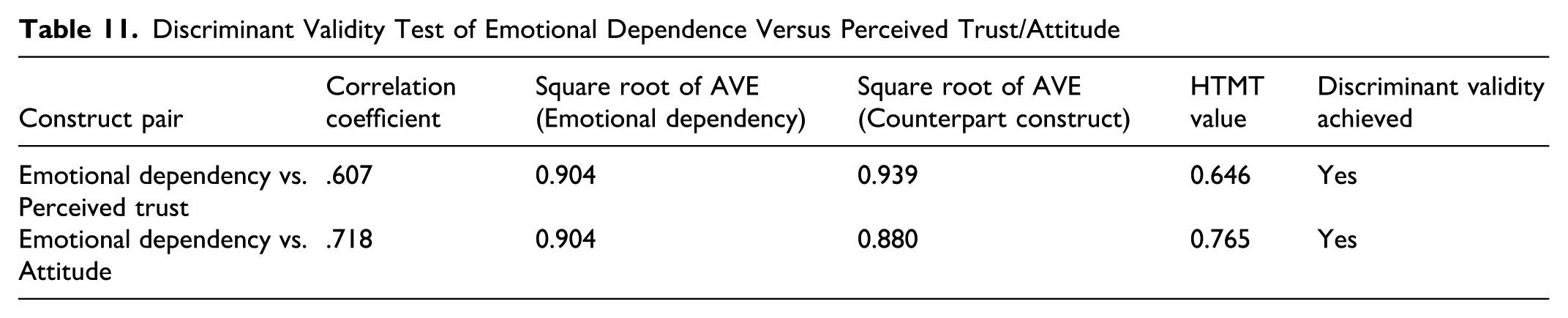
Discriminant Validity Test of Emotional Dependence Versus Perceived Trust/Attitude
Structural Model Assessment
After assessing the measurement model, this study employs partial least squares structural equation modeling (PLS-SEM) to analyze the path relationships among latent variables. The core of this analytical framework lies in evaluating several key aspects. Firstly, it tests the proposed research hypotheses by examining the statistical significance of path coefficients. Secondly, the model quantifies the direct effects between latent variables, revealing the strength of their influence through specific numerical values (see Figure 2).
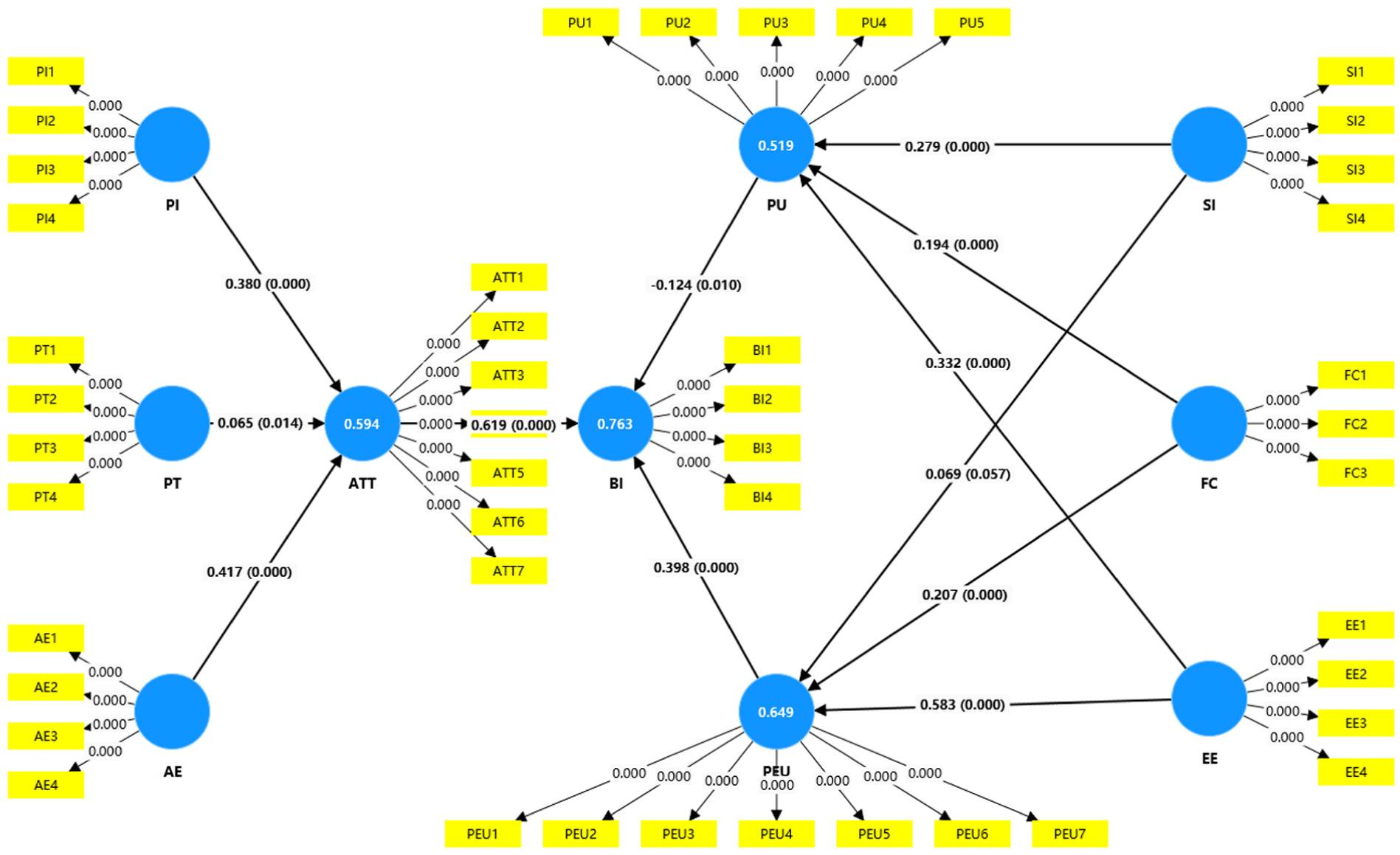
Structural model-path analysis.
Concurrently, to ensure the robustness of the results, the study assesses potential multi-collinearity issues among exogenous latent variables based on variance inflation factors (VIF). Finally, the overall explanatory and predictive power of the model are evaluated by examining the coefficient of determination (R2) as well as indicators such as the predictive relevance index (Q2) and effect size (f2). PLS-SEM is particularly suitable for handling structurally complex models and non-normally distributed data due to its characteristic of maximizing the variance of endogenous latent variables during the iterative process, and it demonstrates particular advantages in predictive analysis scenarios involving small samples or the presence of multicollinearity (Joe F. Hair, Matthews, et al., 2017).
Collinearity Assessment
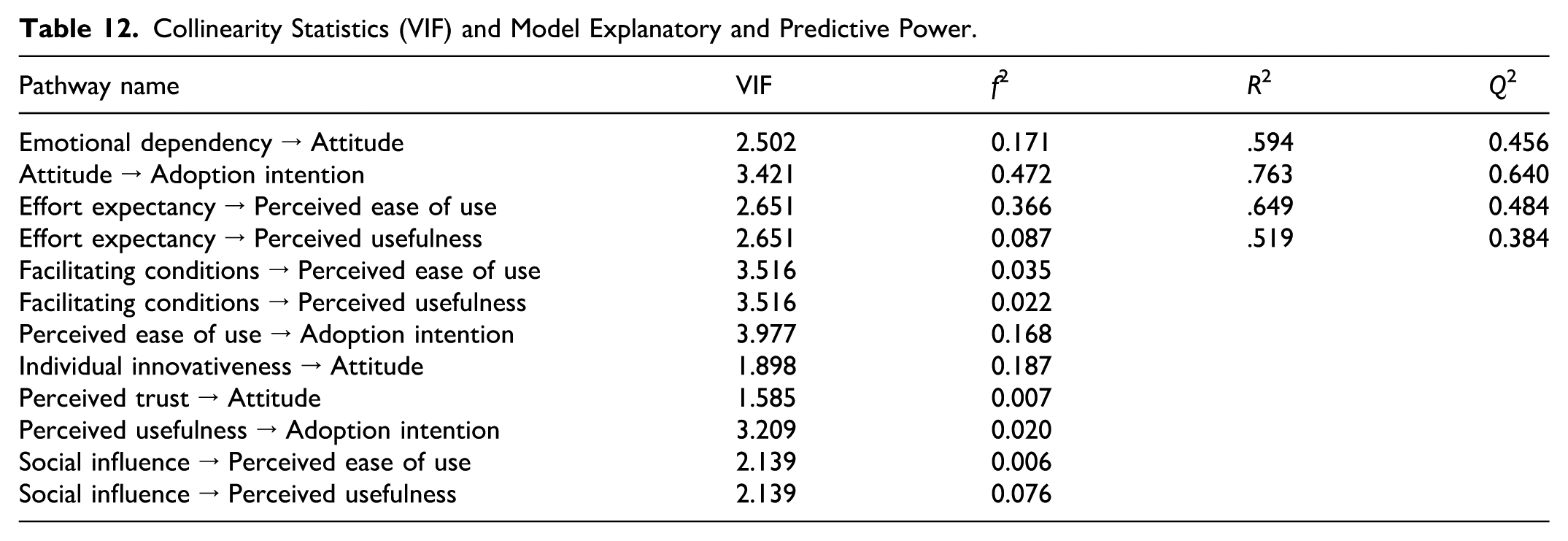
Multi-collinearity in structural equation modeling (SEM) can bias the estimation of path coefficients between latent variables, thereby undermining the statistical power of hypothesis testing. This study employed the variance inflation factor (VIF) as a diagnostic indicator for multi-collinearity (Ilo et al., 2020; Thompson et al., 2017). As shown in Table 12, the VIF values for all latent variables ranged from 1.585 to 3.561, with all observations significantly below the critical threshold of 5 (Kamranfar et al., 2023). These results indicate the absence of significant multi-collinearity issues in the model, confirming that the data characteristics fully meet the analytical prerequisites for partial least squares structural equation modeling.
Model Explanatory Power (R2) and Predictive Relevance (Q2)
The results of the endogenous variable explanatory power assessment (Table 12) show that the R2 values of perceived usefulness, perceived ease of use, attitude, and adoption intention are .519, .649, .594, and .763, respectively, all exceeding the threshold of .4, indicating the model has strong explanatory power. A posthoc power analysis was conducted using the minimum R2 method recommended by Joseph F. Hair, Babin, and Krey (2017): Based on the smallest R2 value in the model (perceived usefulness R2 = .519), with the significance level α = .05, the number of latent variables = 10, and the number of observed variables = 46, the statistical power (1 − β) = 0.92 > 0.8 was calculated via G*Power 3.1. This indicates that the sample size (n = 840) is sufficient to support the model hypothesis testing, and the statistical power complies with the norms of information systems research. In terms of predictive validity testing, the Q2 values for all endogenous variables are greater than zero, with perceived usefulness at 0.384, perceived ease of use at 0.484, attitude at 0.456, and behavioral intention at 0.640, meeting the predictive relevance criteria proposed by Hair, Hult, Ringle, Sarstedt, Danks, Ray, et al. (2021), further confirming that the model has excellent out-of-sample predictive ability (J. F. Hair et al., 2019). In addition, the effect size f2 analysis results (Table 12) show that the effect sizes f2 of attitude on adoption intention and effort expectancy on perceived ease of use are both ≥0.35, indicating large effects; the effect sizes f2 of emotional support on attitude, perceived ease of use on behavioral intention, and perceived innovativeness on attitude are between 0.15 and 0.35, belonging to medium effects; while the remaining variables exhibit small or negligible effects (Cohen, 2013).
Collinearity Statistics (VIF) and Model Explanatory and Predictive Power.
Path Analysis and Hypothesis Testing
Based on the extended TAM-UTAUT model, this study proposed 12 hypotheses, estimated path coefficients via PLS-SEM, and tested significance using Bootstrap sampling (5,000 iterations; Table 13). Results showed social influence positively affected perceived usefulness (β = .279, p < .001), supporting H1b. Facilitating conditions positively influenced both perceived ease of use (β = .207, p < .001) and perceived usefulness (β = .194, p < .001), supporting H2a and H2b. Effort expectancy positively impacted perceived ease of use (β = .583, p < .001) and perceived usefulness (β = .332, p < .001), supporting H3a and H3b. Innovation innovativeness (β = .380, p < .001) and emotional dependence (β = .417, p < .001) both positively affected attitude, supporting H4 and H5. Perceived usefulness negatively influenced usage intention (β = −0.124, p < .05), supporting H6. Perceived ease of use (β = .398, p < .001) and attitude (β = .617, p < .001) positively affected usage intention, supporting H7 and H8. Notably, social influence’s effect on perceived ease of use was non-significant, so H1a was unsupported.
Comparison of Path Coefficients.
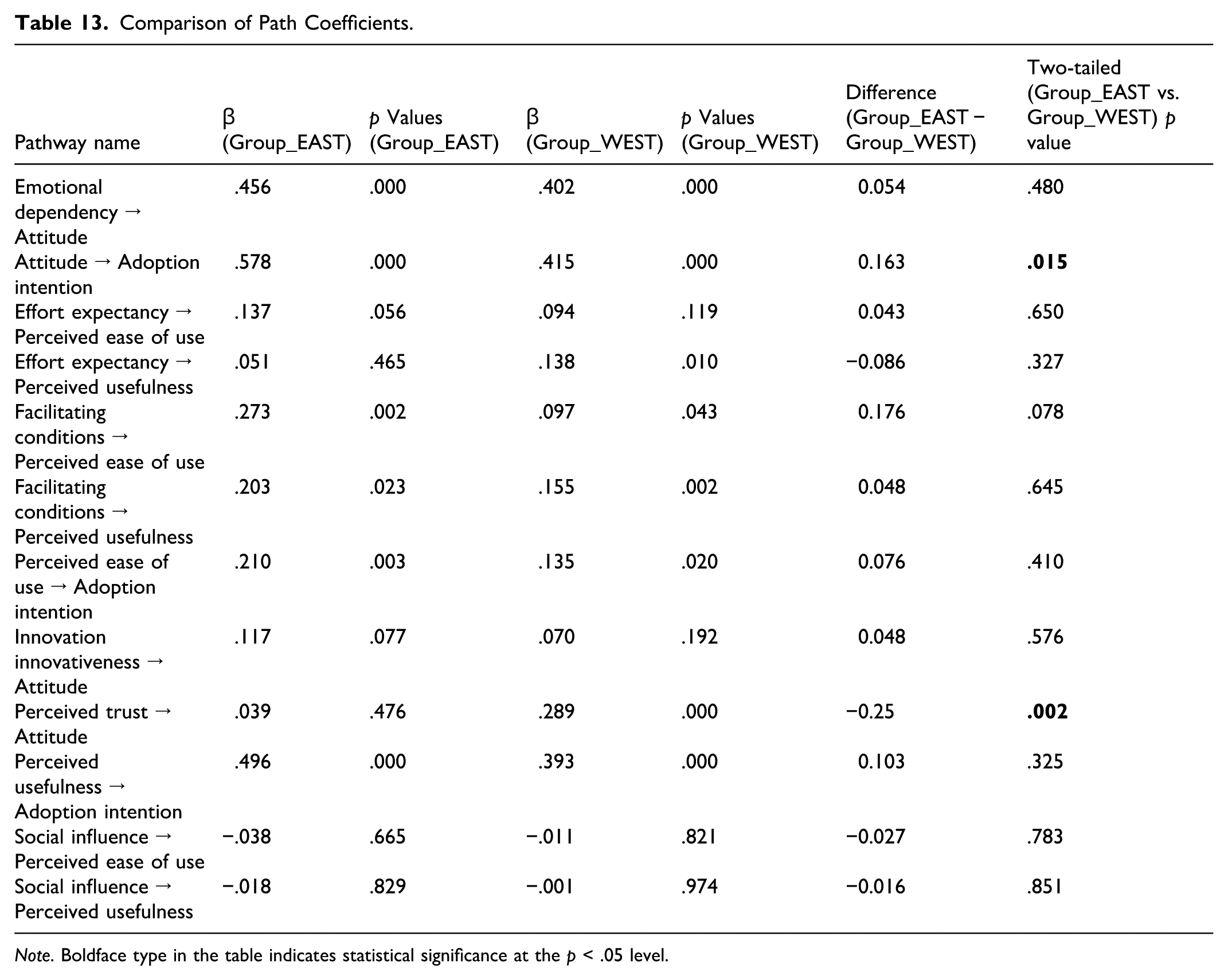
Note. Boldface type in the table indicates statistical significance at the p < .05 level.
Core driving factors were attitude and perceived ease of use. Perceived usefulness’s negative effect may stem from GAI-related concerns like occupational substitution, academic integrity challenges, and skill depreciation in higher education. This unique finding enriches theoretical understanding and provides empirical evidence for technology acceptance models’ scenario-specific optimization. Structural model validation confirmed the extended TAM-UTAUT framework effectively explains GAI adoption logic. User attitude, effort expectancy, perceived ease of use, individual innovativeness, and emotional dependence are core drivers for continued use, laying an empirical foundation for GAI system design optimization.
Robustness Test of the Negative Impact of Perceived Usefulness
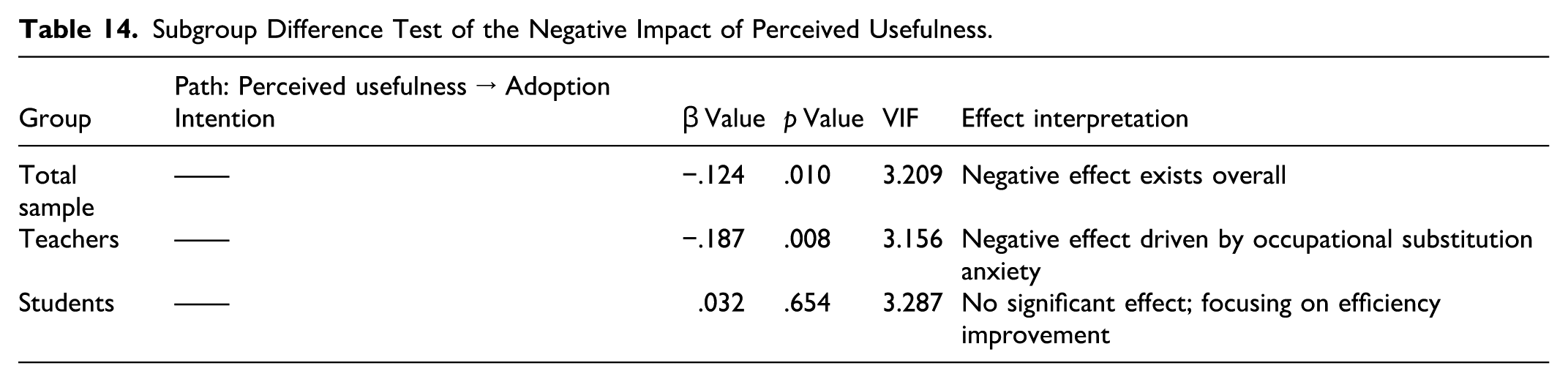
To verify the reliability of the negative path “perceived usefulness → adoption intention” (β = −.124, p < .05), this study conducted three supplementary tests. Firstly, a suppression effect test was performed following Hair et al.’s criteria (J. F. Hair, Hult, Ringle, Sarstedt, Danks, Ray, et al., 2021): a suppression effect may exist if a variable’s mediating effect absolute value exceeds its direct effect, another variable’s path coefficient has an unexpected sign, and the variance inflation factor (VIF) is normal. Here, attitude’s direct effect on adoption intention was β = .619 (p < .001) and mediating effect was ≈0.258, meeting suppression effect characteristics. Perceived usefulness’s VIF was 3.209 (<5), excluding multicollinearity-induced sign bias (Table 12). Second, subgroup difference analysis showed the negative effect originated mainly from teachers (β = −.187, p < .01) with no significant effect on students (β = .032, p = .654). This correlates with “occupational substitution anxiety”—teachers worry about GAI replacing teaching/research while students focus on learning efficiency (Table 14). Thirdly, extended multi- collinearity diagnosis included tolerance (Tolerance = 1/VIF = 0.312 > 0.1) and eigenvalue tests (minimum eigenvalue = 0.237 > 0.01), further eliminating multi-collinearity interference. These tests collectively confirm perceived usefulness’s negative impact on adoption intention is real and not due to statistical bias.
Subgroup Difference Test of the Negative Impact of Perceived Usefulness.
Multi-Group Structural Equation Model Analysis
To explore structural differences in GAI adoption mechanisms between eastern and western Chinese universities, this study used multi-group partial least squares structural equation modeling (PLS-MGA) for comparative analysis. The 840-sample was split into eastern (n = 438) and western (n = 402) groups, with permutation tests assessing path coefficient differences (Table 13), revealing distinct spatial heterogeneity.
Eastern universities’ adoption intention is strongly positively influenced by perceived usefulness (β = .496, p < .001), stronger than western ones (β = .393, p < . 001) though the difference is non-significant (Δβ = .103, p = .325), reflecting eastern faculty and students’ high sensitivity to technological efficacy. Facilitating conditions’ effect on perceived ease of use is more pronounced in the east (β = .273, p = .002 vs. western β = .097, p = .043), with the difference approaching marginal significance (Δβ = .176, p = .078)—attributable to eastern regions’ advanced infrastructure lowering operational barriers. Critically, attitude’s mediating effect on intention is significantly stronger in the east (β = .578, p < .001 vs. western β = .415, p < .001; Δβ = .163, p = .015), highlighting technological cognition and affective evaluation’s pivotal role.
Conversely, perceived trust’s positive effect on attitude is exceptionally significant in the west (β = .289, p < .001 vs. eastern β = .039, p = .476; Δβ = −.250, p = .002), reflecting western users’ greater reliance on institutional endorsement and trust networks amid limited technological resources. Additionally, effort expectancy’s impact on perceived usefulness is more salient in the west (β = .138, p = .010 vs. eastern β = .051, p = .465), indicating western users’ higher sensitivity to learning costs, with utility assessments more affected by anticipated effort.
Discussion
This study systematically reveals the complex formation mechanism of GAI adoption intention in China’s higher education sector and empirically verifies significant path heterogeneity between eastern and western Chinese universities, offering multi-dimensional insights for understanding GAI’s localized integration in this context.
Incorporating emotional dependency expands TAM/UTAUT theories’ explanatory boundary in non-Western contexts. As an emotional bond formed through individual-GAI interaction, it exerts a unique driving effect on attitude formation under collectivism (Agishtein & Brumbaugh, 2013), challenging the pure rationality assumption in technology adoption research and highlighting emotional bonds’ core role in higher education technological integration. Notably, perceived usefulness negatively impacts adoption intention (β = −.124, p < .05), a result confirmed robust through suppression effect tests, subgroup analysis, and extended multi-collinearity diagnosis. This counterintuitive finding aligns with Baxter & Sommerville’s “technology paradox” and “substitution anxiety” theory (Baxter & Sommerville, 2011): while faculty and students recognize GAI’s efficiency, concerns over “skill depreciation” and “academic alienation” offset utility perceptions, forming a negative path.
Subgroup analysis shows the negative effect originates primarily from teachers (β = −.187, p < 0.01) with no significant impact on students (Table 14), consistent with Rahman et al. who note teachers’ anxiety over GAI replacing their teaching dominance while students prioritize learning efficiency (Rahman et al., 2024). Despite its direct negative effect, perceived usefulness exerts a positive indirect impact via attitude (perceived usefulness → attitude → adoption intention; β = .772 × .619 ≈ .480), indicating positive attitudes buffer negativity. This explains why the negative effect is weaker in eastern Chinese universities (attitude mediation β = .578) than western ones (β = .415), as eastern faculty and students better balance utility and risks through positive attitudes, providing key empirical evidence for technology acceptance models’ evolution amid disruptive innovation.
Eastern and western Chinese universities exhibit differentiated adoption paths reflecting technology diffusion’s “geographically embedded” nature. Eastern Chinese universities follow a “technology-driven” model, with adoption intention strongly promoted by perceived usefulness (β = .496, p < .001) and ease of use, plus a stronger attitude mediation effect (β = .578, p < .001)—mirroring their emphasis on technological utility, rational decision-making, mature technological ecosystems, and individual innovativeness. In contrast, western Chinese universities adopt an “institutional adaptation” path, where perceived trust significantly shapes attitudes (β = .289, p < .001), highlighting institutional endorsement and social networks’ risk-buffering role in resource- constrained regions. Effort expectancy’s impact on perceived usefulness is stronger in western Chinese universities (β = .138, p = .010), reflecting higher sensitivity to learning costs. These differences operate through the “technological performance → attitude → adoption intention” mediating chain, confirming how regional development imbalances restructure GAI adoption dynamics via infrastructure, cultural psychology, and institutional variations.
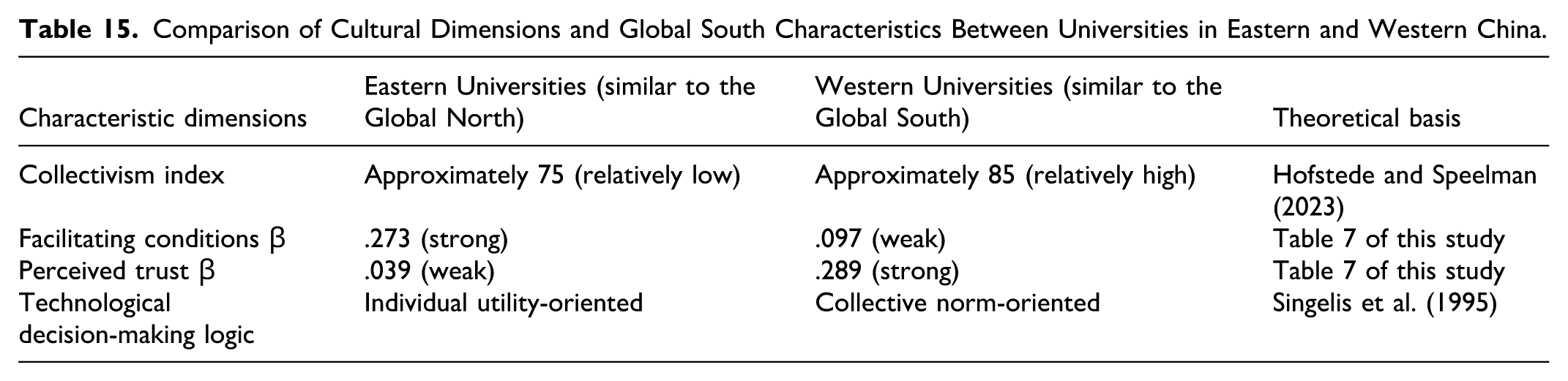
Regional differences reflect collectivist culture heterogeneity and “Global South” development characteristics. Hofstede Insights data shows China’s overall collectivism index is 80/100; eastern China’s higher economic openness fosters a weaker collectivist tendency ( ≈75) emphasizing innovation, forming the “technology-driven” path, while western China’s stronger collectivism ( ≈85) prioritizes collective norms and institutional dependence, leading to the “institutional adaptation” path reliant on perceived trust (Table 15). From a Global South perspective, western Chinese universities’ adoption aligns with developing countries’ patterns (Mugaanyi et al., 2024): weaker technological infrastructure (facilitating conditions β = .097 vs. eastern β = .273) mirrors resource scarcity in Global South nations, driving reliance on institutional empowerment; the strong perceived trust effect (β = .289) reflects developing regions’ emphasis on “institutional legitimacy,” while eastern China, like the Global North, relies on technological performance.
Comparison of Cultural Dimensions and Global South Characteristics Between Universities in Eastern and Western China.
Practical implications focus on translating theory into practice through teaching innovation and digital ethics integration. Eastern Chinese universities can adopt a “human-machine collaborative teaching model,” using GAI as a “cognitive teaching assistant” for knowledge decomposition and homework correction while teachers handle curriculum design and value guidance, exerting utility and mitigating perceived usefulness’ negative effect. Western Chinese universities can build a “GAI + local teaching case database,” such as bilingual modules for multi-ethnic regions (Lang et al., 2025). Drawing on UNESCO’s (Ruffini & Silva, 2025) Ethics Guidelines for AI in Higher Education, a “three- level ethical review system” is critical to alleviating eastern universities’“occupational substitution anxiety” and building western universities’“technological trust.”
Region-specific institutional interventions are essential: eastern Chinese universities should prioritize ethical governance and faculty AI skill training, establishing a “GAI Ethics Committee” for content auditing and “human-machine collaborative teaching workshops.” Western Chinese universities need institutional trust cultivation and low-threshold technical support, including a “model teacher” system for case sharing and a “GAI technical support hotline” for round-the-clock guidance to reduce effort expectancy.
Research findings extend to developing regions like Southeast Asia and Africa, emphasizing resource adaptation and trust cultivation. Similar to western Chinese universities, developing region universities can address “insufficient facilitating conditions” via international technical assistance and low-cost GAI terminals, build technical trust through official endorsement, and introduce a “GAI content filing system” for output traceability in regions with weak academic integrity. This provides “Chinese experience” for global developing contexts, with African universities learning western China’s “institutional trust cultivation” and European/American universities referencing eastern China’s “attitude guidance.” This localized finding enriches global educational digital transformation’s “diversified path” theory, breaking the Western-centric logic of “technological popularization = efficiency improvement.”
The study’s deeper value lies in offering a “dynamic balance” Chinese case for global educational digital transformation, aligning with UNESCO’s Beijing Consensus principle of “synergy between technological potential and social sustainability” (Mochizuki & Vickers, 2024). Differentiated adoption intention paths indicate technological empowerment must embed in regional development realities, balancing efficiency and equity, innovation and tradition, and global standards and local practices—forming the philosophical cornerstone of educational modernization.
Conclusion and Research Limitations
This study constructed a “technology-individual-society” triadic integration framework and via an empirical survey of 840 university faculty and students in eastern and western China revealed the complex mechanisms underlying GAI adoption intention. The findings show emotional dependency, individual innovativeness and perceived trust significantly influence adoption decisions through attitude mediation while perceived usefulness exerts a unique negative effect reflecting the deep tension between technological empowerment and professional anxiety. Multi-group analysis confirms eastern Chinese universities exhibit a “technology-driven” adoption model relying more on perceived ease of use and performance expectancy whereas western universities demonstrate an “institutional adaptation” path with perceived trust and social norms playing more prominent regulatory roles. These findings not only expand the explanatory boundary of technology acceptance theories in non-Western contexts but also reveal the mechanisms of regional heterogeneity through Hofstede’s cultural dimensions and the Global South perspective, providing a “Chinese experience” reference for educational digital transformation in developing countries worldwide.
This study has several limitations requiring refinement in future research. The sample selection may have geographical limitations as although five universities in eastern and western China were covered the geographical breadth still has room for expansion and future research could include central China university samples to more comprehensively capture the impact of regional development differences on GAI adoption mechanisms. The study adopted a cross-sectional design making it difficult to reveal the dynamic evolution and long-term effects of GAI adoption intention especially as users’ technological proficiency improves and the institutional environment changes the relationships between key constructs may undergo structural adjustments and a longitudinal tracking design would help accurately capture such temporal characteristics. The study mainly relied on self-reported questionnaires for data collection which may be affected by common method bias and although strict questionnaire design procedures minimized this risk future research could combine semi-structured interviews, behavioral observations and other methods to enhance conclusion robustness through triangulation. The study focused on faculty and student adoption intention without fully considering university administrators’ role in GAI institutionalization as administrators’ technological cognition, risk preferences and resource allocation strategies may significantly impact organizational-level technology integration and future research could construct a multi-agent integrated analysis framework. Finally the operationalization of cultural psychological variables focused on the individual level without fully examining the influence of group-level cultural traits such as organizational and disciplinary culture on GAI adoption and differences in GAI application scenarios and acceptance across disciplines warrant in-depth exploration.
Footnotes
Appendix
Sources and Complete Descriptions of Measurement Items.
| Construct | Item code | Complete item description | Source |
|---|---|---|---|
| Effort expectancy | EE1 | Learning to use GAI requires very little of my time. | Venkatesh et al. (2003); Lazarte-Aguirre et al. (2025) |
| EE2 | I can easily master the methods of using GAI. | ||
| EE3 | Proficiency in using GAI does not require me to have a complex technical background. | ||
| EE4 | The process of learning to use GAI is very smooth. | ||
| Social influence | SI1 | Colleagues/classmates in my academic community recommend using GAI. | Venkatesh et al. (2003); Liu (2025) |
| SI2 | The school’s educational policies encourage the use of GAI in teaching/ learning. | ||
| SI3 | Academic leaders believe that using GAI is helpful for academic work. | ||
| SI4 | People around me who have used GAI have given positive evaluations. | ||
| Facilitating conditions | FC1 | The school provides training or guidance materials for the use of GAI. | Venkatesh et al. (2003); Chiu (2025) |
| FC2 | The school’s network and hardware equipment can meet the needs of using GAI. | ||
| FC3 | When encountering problems in using GAI, I can obtain timely technical support. | ||
| Perceived usefulness | PU1 | Using GAI can improve my teaching/learning efficiency. | Davis (1989); K. Cao and Wang (2025) |
| PU2 | GAI can help me better complete academic research tasks. | ||
| PU3 | Using GAI can reduce the time I spend on repetitive academic work. | ||
| PU4 | GAI can help me improve the quality of my teaching/learning outcomes. | ||
| PU5 | Overall, using GAI has a positive effect on my academic work. | ||
| Perceived ease of use | PEU1 | The operation interface of GAI is very concise and clear. | Davis (1989); Kim (2025) |
| PEU2 | I can quickly find the functions in GAI that meet my teaching/learning needs. | ||
| PEU3 | The steps to complete a teaching/learning task using GAI are very simple. | ||
| PEU4 | I do not need to spend too much energy to proficiently operate GAI. | ||
| PEU5 | The operational logic of GAI conforms to my usage habits. | ||
| PEU6 | Even people with weak technical backgrounds can easily operate GAI. | ||
| PEU7 | When using GAI, I rarely encounter operational difficulties. | ||
| Individual innovativeness | PI1 | I am willing to take the lead in trying new application methods of GAI in teaching/learning. | Rogers et al. (2014); C. Cao et al. (2025) |
| PI2 | Compared with people around me, I am more willing to actively understand the functions and value of GAI. | ||
| PI3 | I like to try to solve new problems encountered in teaching/learning using GAI. | ||
| PI4 | Even without recommendations from others, I will take the initiative to explore methods of using GAI. | ||
| Perceived trust | PT1 | I trust the academic accuracy of the content generated by GAI. | McKnight et al. (2002); Chiu (2025) |
| PT2 | GAI can protect the academic privacy I input during use. | ||
| PT3 | The content generated by GAI complies with academic ethics norms. | ||
| PT4 | After long-term use of GAI, my trust in its reliability continues to improve. | ||
| Emotional dependency | ED1 | I feel at ease when using GAI to assist teaching/learning. | Gabriela (2025); Lu and Ba (2025) |
| ED2 | When unable to use GAI, I find it difficult to efficiently advance teaching/learning work. | ||
| ED3 | I am accustomed to using GAI in teaching/learning, and it has become an important auxiliary tool in my work. | ||
| ED4 | Using GAI can make me gain a sense of achievement in teaching/ learning. | ||
| Attitude | ATT1 | I hold a positive attitude towards using GAI in teaching/learning. | Venkatesh et al. (2012); Liu (2025); Avcı (2024) |
| ATT2 | I believe that promoting the use of GAI in universities is necessary. | ||
| ATT3 | Using GAI has a positive improvement on my teaching/learning experience. | ||
| ATT4 | I am willing to recommend using GAI to colleagues/classmates. | ||
| ATT5 | The value that GAI brings to higher education is greater than its potential risks. | ||
| ATT6 | I am full of confidence in the application prospects of GAI in higher education. | ||
| ATT7 | Overall, I recognize the application value of GAI in teaching/learning. | ||
| Adoption intention | BI1 | In the future, I will continue to use GAI in teaching/learning. | Venkatesh et al. (2012); Du and Lv (2024); Qiu et al. (2025) |
| BI2 | I plan to further explore more application scenarios of GAI in academic research. | ||
| BI3 | Even if using GAI requires additional learning costs, I am willing to continue using it. | ||
| BI4 | I will give priority to using GAI to complete relevant teaching/learning tasks. |
Acknowledgements
The authors have reviewed and edited the output and take full responsibility for the content of this publication. We would like to express our gratitude to editors and reviewers for their extraordinarily helpful comments.

Ethical Considerations
Ethical review and approval were waived for this study due to not involving humans or animals.
Consent to Participate
Informed consent was obtained from all subjects involved in the study.
Funding
The authors received no financial support for the research, authorship, and/or publication of this article.
Declaration of Conflicting Interests
The authors declared the following potential conflicts of interest with respect to the research, authorship, and/or publication of this article: The authors declare that the research was conducted in the absence of any commercial or financial relationships that could be construed as a potential conflict of interest.
Data Availability Statement
The original contributions presented in the study are included in the article/supplementary material, further inquiries can be directed to the corresponding author.