



Abstract
Chatbots have become increasingly popular as tools for supporting English language learning. However, how to effectively enhance learning ability through emotion induction during interactions with intelligent chatbots remains an unresolved issue. This study integrates Flow Theory, Perceived Value Theory, and the Unified Theory of Acceptance and Use of Technology (UTAUT) with emotion-induction features of a chatbot to develop and test a theoretical model. Survey data from 388 university students who used DeepSeek for English learning were analyzed using structural equation modeling (SEM). Learning ability was operationally defined as continuance learning behavior and learning engagement or self-rated performance, measured through Likert-scale items. The results show that performance expectancy, effort expectancy, and perceived emotional value were all significantly associated with flow, with effort expectancy exhibiting the most substantial direct effect on flow. Perceived emotional value exerts the most significant total effect on continuance learning behavior by enhancing emotional engagement and reinforcing sustained effort through flow. Positive affective prompts strengthen effects of performance expectancy, effort expectancy, and perceived emotional value on flow. In contrast, negative emotion induction appears to reduce the strength of these associations. These findings specify which cognition–affect pathways matter most for English learning with chatbots and inform the design of emotion-aware prompting in DeepSeek to enhance flow and continuance learning behavior.
Keywords
Introduction
The sudden rise of DeepSeek has brought China’s broader artificial intelligence (AI) ecosystem into the spotlight (Dreyer, 2025). Among various AI applications, intelligent chatbots have shown significant potential in supporting learning across domains, especially in language learning (Yin et al., 2024). Built on DeepSeek, these chatbots can engage learners in natural language conversations, provide instant feedback and personalized suggestions, and enhance users’ emotional experience to promote English learning motivation (Gibney, 2025; Y. Wang & Xue, 2024). Previous research has demonstrated that intelligent chatbots improve learners’ engagement across behavioral, cognitive, and affective dimensions (Yin et al., 2024) contributing to enhanced learning ability through various strategies. While much of the existing literature has addressed general language learning, the present study focuses on English language learning, a common and critical domain of foreign language education in higher education. Currently, most chatbots still follow predefined dialogue paths, though over a quarter have adopted personalized learning trajectories. Others incorporate experiential, collaborative, and emotion-driven learning principles. More than one-third of chatbot systems have been evaluated in experimental studies, with results showing improved learning ability and user satisfaction (Kuhail et al., 2022).
Despite extensive research on the impact of intelligent chatbots on language learning, how to effectively enhance learning ability through emotion induction during interactions with intelligent chatbots remains relatively scarce. Emotions are widely recognized as key factors in the foreign language learning process: positive emotions such as interest and enjoyment can foster learning motivation and engagement, while negative emotions like anxiety and boredom may hinder language output and reduce persistence (Septiana et al., 2024). Emotional states directly affect learners’ confidence, fluency, and overall experience in English learning. Unlike traditional instruction, intelligent chatbots are uniquely capable of delivering emotionally responsive interactions through tone, feedback style, and dialog pacing, thereby creating a more supportive English learning environment.
Against this backdrop, this study adopts the DeepSeek Large Language Model to investigate how the emotion induction of an intelligent chatbot influences college students’ English learning ability. A theoretical framework is developed based on two core constructs from the Unified Theory of Acceptance and Use of Technology (UTAUT)—performance expectancy and effort expectancy—along with perceived emotional value and flow. This study analyzes how emotion induction affects learning ability in different English learning contexts and examines its moderating role. This study seeks to provide substantive strategies to adjust university students’ English learning behaviors, facilitate proper use of DeepSeek for English learning enhancement, and optimize the emotion induction functions of DeepSeek, thereby strengthening its supportive role in English language learning.
Literature Review
Emotion Induction of Educational Chatbots
Emotion is defined as a complex phenomenon encompassing cognitive appraisal, physical changes, and action tendencies (Diaz, 2022). Emotion induction refers to an experimental procedure that triggers emotions by recreating the sensory experiences necessary for an emotional response (Garcia et al., 2024). More broadly, emotion induction is typically defined as the systematic use of external stimuli—such as films, music, images, autobiographical recall, or scenario imagination—to elicit specific emotional states in a controlled manner, and its methods have been extensively validated in psychological research (Siedlecka & Denson, 2019). For example, films and music have proven to be highly effective paradigms for eliciting both positive and negative emotions, providing reliable external references for experimental manipulations (Ribeiro et al., 2019). Consequently, emotion induction can influence cognition, thereby affecting evaluative processes. In this study, we operationally define emotion induction as the deliberate embedding of linguistic prompts, tonal variations, and structured feedback within chatbot interactions to systematically evoke affective states that align with learning goals (Yin et al., 2024).
Through affective design and interaction strategies, chatbots can effectively induce emotional responses in users. In a meta-analysis synthesizing 32 empirical studies with 2,201 participants, Deng et al. showed that chatbot technology exerts moderate to high overall influence on learning, particularly in explicit reasoning, academic achievement, knowledge retention, and learning interest. Positive learning experiences and emotions encourage proactive student engagement and efficient resource allocation, improving academic ability, while negative emotions may distract students and undermine performance (Deng & Yu, 2023). Jasin et al. investigated an immediacy-based educational chatbot system, demonstrating that its personalized interactions and rapid response capabilities effectively enhance students’ engagement and learning confidence while fostering self-regulated learning behaviors (Jasin et al., 2023). In foreign language contexts, Li et al. showed that positive emotions correlate positively with English as a Foreign Language (EFL) performance, whereas negative emotions can diminish learning abilities by hindering self-regulation (S. Li et al., 2024).
To theoretically frame these mechanisms, Russell’s circumplex model of affect highlights that emotions are not only valenced as positive or negative but also vary along an arousal dimension, thereby creating a two-dimensional structure that better explains nuanced affective responses (“A circumplex model of affect,” 1980). This perspective clarifies why emotions such as confusion or curiosity—though not purely positive—may still enhance cognitive engagement under medium arousal, thus contributing to flow states. Similarly, Pekrun’s control-value theory specifies how discrete achievement emotions (e.g., enjoyment, anxiety, boredom) are shaped by learners’ perceptions of control and value, and how these emotions predict engagement and performance in academic settings (Pekrun, 2006). Together, these models provide a robust basis for understanding how emotion induction through chatbots can regulate motivational and cognitive pathways. While Russell’s circumplex model offers strong operational clarity by mapping emotions onto the two dimensions of valence and arousal, it risks oversimplifying functionally distinct affective states, such as curiosity versus frustration, that may occupy similar coordinates but yield opposite learning outcomes. By contrast, Pekrun’s control-value theory provides richer explanatory power by linking discrete achievement emotions to learners’ perceptions of control and value. Yet, it is less straightforward to operationalize within chatbot interaction design. Integrating these two perspectives allows this study to combine the circumplex model’s parsimony and measurability with the control-value theory’s theoretical depth and educational relevance, ensuring both practical applicability and explanatory rigor in framing emotion induction for educational chatbots.
Researchers have recently proposed multiple theoretical frameworks to clarify how emotion induction works and its impact on learning. Pekrun’s Control-Value Theory (CVT) offers a key conceptual basis, positing that students’ emotional experiences relate closely to their sense of control over a task and the perceived value of that task: feeling capable and regarding the task as important fosters positive emotions, whereas lacking these perceptions tends to generate negative emotions (Pekrun, 2006). Through a meta-analysis, Camacho-Morles et al. explored how achievement-related emotions shape academic performance, showing that positive emotions positively contribute to student achievement, while negative emotions adversely affect it. This underscores how emotion induction may be applied in education, particularly in regulating emotions during teaching and learning (Camacho-Morles et al., 2021).
Recent studies in educational technology further emphasize the centrality of affective adaptation. For example, systematic reviews confirm that empathic pedagogical conversational agents significantly enhance motivation and engagement by embedding affective cues and empathetic feedback (Ortega-Ochoa et al., 2024). Similarly, meta-analyses demonstrate that AI chatbots consistently positively affect student learning outcomes, reinforcing the relevance of emotion-aware designs for sustaining long-term learning behaviors (Wu & Yu, 2024). Affect-aware intelligent tutoring systems also highlight how dynamic recognition and adaptation to learner emotions can optimize learning trajectories (Fernández-Herrero, 2024).
Learners do not always feel purely positive or purely negative; mixed emotions such as curiosity with mild confusion are common in learning settings and can still support task focus and deeper processing when they stay at a moderate arousal level (D’Mello et al., 2014) This view is consistent with accounts that positive emotions broaden attention and thinking, which can ease entry into flow (Fredrickson, 2001), and with the idea that learners’ perceived control and value determine whether emotions help or hinder learning processes (Pekrun, 2006).
In addition to a positive–negative split, learning often involves mixed states (e.g., curiosity with manageable, task-focused anxiety); under moderate arousal and appropriate guidance, such states can remain functional and support entry into flow. These findings reveal that emotion induction is intimately linked with learning behaviors in intelligent education. By leveraging well-crafted affective designs and interactive approaches, intelligent chatbots can induce college students’ emotional states, thus improving learning ability and satisfaction. This paper builds on these theoretical perspectives to investigate how chatbots leverage emotion induction to influence learners’ ability ultimately.
UTAUT Applications in English Learning
The Unified Theory of Acceptance and Use of Technology (UTAUT) was introduced by Venkatesh et al. in 2003 and has since gained broad application in explaining and predicting individual acceptance and use of information systems (Venkatesh et al., 2016). It identifies four key predictors—performance expectancy (PE), effort expectancy (EE), social influence (SI), and facilitating conditions (FC)—along with moderating variables such as gender, age, experience, and voluntariness (Abbad, 2021; Williams et al., 2015). PE reflects users’ belief in a technology’s utility; EE captures perceived ease of use; SI concerns perceived social pressure; and FC refers to perceived external support (Balakrishnan et al., 2022; Escobar-Rodríguez & Carvajal-Trujillo, 2014; Slade et al., 2015; Williams et al., 2015).
In the context of English learning, Shen et al. found FC to be the strongest predictor of Chinese students’ intention to use mobile English learning tools, with PE, EE, and perceived playfulness also showing significant effects (Shen et al., 2023). Wang extended UTAUT to examine EFL learners’ use of large language models in academic writing, revealing that PE and SI predicted intention, while motivation influenced both intention and actual use (Q. R. Wang, 2025). Zhang and Yu reported that PE, FC, and attitude toward use positively influenced the acceptance of gamified vocabulary apps, while EE, SI, and openness had negative associations (K. X. Zhang & Yu, 2022).
Though widely used, UTAUT’s moderators show inconsistent effects across contexts, calling for model refinement in response to emerging technologies and cultural variability (Balakrishnan et al., 2022; Blut et al., 2022).
The Application of Perceived Emotional Value in English Learning
Perceived value describes users’ holistic assessment of a product or service, based on comparing perceived benefits against perceived costs (Sweeney & Soutar, 2001). Sweeney and Soutar proposed the PERVAL scale, which categorizes perceived value into emotional value, social value, quality value, and price value. Empirical evidence shows that these dimensions significantly influence consumer decision-making. Emotional and social value, for instance, heighten affective experiences and social identity, while quality and price value directly shape cost-benefit judgments (Sweeney & Soutar, 2001).
In English learning, students’ perceived emotional value of learning tasks—such as interest, utility, and personal importance—has been shown to influence their engagement and self-regulated behaviors significantly. Hoi et al. identified interest value as a key personal factor sustaining long-term engagement in the L2 classroom, suggesting that learners’ intrinsic enjoyment of English learning is critical in fostering behavioral, cognitive, and emotional engagement (Vo et al., 2024). Similarly, Suárez et al. demonstrated that intrinsic motivation, perceived utility, and a positive attitude toward homework significantly predicted students’ behavioral engagement, including time investment, homework completion, and time management, which in turn positively impacted academic achievement (Suárez et al., 2019). In the context of online English learning, Wang and Zhan found that learners’ perceived value of English learning positively predicted self-regulated learning through the mediation of learning motivation, which also helped mitigate the negative impact of learning anxiety (W. Wang & Zhan, 2020). These findings underscore the pivotal role of perceived emotional value in initiating motivation and sustaining engagement and self-regulation in English learning.
The Flow Theory in English Language Learning
Heart flow (often referred to as “flow”), first proposed by Mihaly Csikszentmihalyi in Beyond Boredom and Anxiety, describes a state of total immersion wherein an individual is intensely focused, experiences heightened enjoyment, and perceives distorted passage of time (Csikszentmihalyi, 2000).
Recent studies have increasingly applied the concept of flow to examine specific aspects of English language learning. Dewaele et al. (2019) investigated flow in traditional foreign language classrooms and found that when students feel emotionally safe and supported, flow enhances their enjoyment, attentiveness, and ability to process language input, while also mitigating anxiety (Dewaele et al., 2019). Zhao and Khan focused on online English learning platforms, showing that perceived enjoyment, challenge, and situational involvement contribute to flow, increasing learners’ satisfaction and their intention to continue using the platforms (Zhao & Khan, 2021). In AI-assisted English learning, Zhai et al. demonstrated that flow mediates the relationship between basic psychological needs (autonomy, competence, and relatedness) and students’ willingness to engage with AI tools (Zhai et al., 2024). Their findings highlight flow as a key mechanism linking internal motivation to persistent language learning behavior in intelligent learning environments. Emerging AI chatbot research indicates that positive emotion induction through transparent interactions, personalized services, rapid responses, and ubiquitous connectivity improves user engagement, facilitating a virtual flow state that significantly bolsters communication quality and satisfaction (Baabdullah et al., 2022).
Summary of the Literature Review
Existing research indicates that positive emotion induction effectively enhances learning motivation and concentration, while excessive negative emotional arousal may suppress motivation under certain conditions (Yin et al., 2024). Furthermore, performance expectancy, effort expectancy, and perceived emotional value have been shown to promote flow experiences (B. Gao, 2023; Kim & Thapa, 2018), thereby enhancing learning immersion and satisfaction (B. Gao, 2023). Although considerable research has examined how chatbots enhance learning ability, few studies have specifically addressed the role of emotion induction of chatbots within this process.
Beyond general chatbot research, platform-specific evidence on DeepSeek has begun to accumulate and helps justify our context. In EFL settings, a study reported high student preference and satisfaction with DeepSeek, tied to perceived usefulness and ease of use (Habeb Al-Obaydi & Pikhart, 2025). In professional training contexts, a quasi-experimental evaluation that integrated DeepSeek into problem-based learning observed higher examination performance and stronger learner engagement relative to traditional instruction (Hou et al., 2025). From an assessment perspective, generalizability-theory analyses indicate moderate-to-high agreement between DeepSeek-generated holistic writing scores and teacher ratings, alongside qualitatively relevant feedback for EFL writing (H. Gao et al., 2025). At the model level, advances in the reasoning-oriented DeepSeek-R1 family provide a technical rationale for interactions that may scaffold attention and facilitate flow-conducive cognitive states (Guo et al., 2025). Overall, existing DeepSeek research substantiates acceptance, learning benefits, and assessment reliability. However, it has not explicitly modeled emotion induction as a moderator in the UTAUT–perceived-value–flow pathway for students’ use of DeepSeek in English writing tasks; our study fills this gap.
The Present Study
In this study, we integrate UTAUT and Perceived Value Theory constructs to explore how emotion induction influences English learning ability. According to Venkatesh et al., Performance Expectancy (PE) refers to the perceived benefits users expect from using the system, particularly its ability to improve task performance (Venkatesh et al., 2003). Effort Expectancy (EE) reflects the ease of use and cognitive load of using the system (Venkatesh et al., 2003). Perceived Emotional Value (PEV) captures the emotional satisfaction users experience while using the technology, an essential element of Perceived Value Theory (Petrick, 2002). These constructs are conceptually distinct: PE addresses system use’s cognitive and functional aspects, EE refers to the ease and cognitive effort involved, and PEV focuses on the emotional experience. Aligned with Control–Value Theory, EE indexes perceived controllability of the tool (control), whereas PE and PEV capture task value in functional and affective terms (value); thus, perceived control and value are embedded in our predictors
In the present study, PE, EE, and PEV are examined as distinct but complementary factors influencing users’ engagement, flow, and learning ability in the context of chatbot interactionsThe research offers new theoretical backing for designing emotional feedback mechanisms in intelligent education systems, as well as empirical evidence to guide the optimization of emotion induction strategies for enriched user experience and learning ability.
This study recruited 388 university students to participate in a questionnaire survey, primarily investigating the role of emotion induction by chatbots when they used DeepSeek for English writing tasks. The following research questions (RQs) guided the analysis of the questionnaire data.
Hypothesis Development
Among the four core variables of the UTAUT model, performance expectations and effort expectations can motivate users to develop a clear sense of purpose and accomplishment towards technology use (Escobar-Rodríguez & Carvajal-Trujillo, 2014). Perceived emotional value is significantly associated with the flow, and emotional satisfaction is a key factor in triggering flow (Kim & Thapa, 2018).
Csikszentmihalyi’s study shows that the flow experience enhances users’ motivation for continued use and technology acceptance (Y. Li & Zhao, 2021), which locates the learning ability in the study of this paper. Hu et al.’s study points out that the flow experience mediates the relationship between UTAUT elements and intention to use, and that flow positively influences intention to continue using (Hu et al., 2024). In this study, learning ability is conceptualized as a second-order construct comprising three first-order dimensions: (a) continuance learning behavior, (b) behavioral engagement, and (c) self-rated performance. This higher-order factor is treated as the dependent variable of the model. Accordingly, we propose the following hypotheses:
Fredrickson’s Broaden-and-Build Theory posits that positive emotions expand individuals’ cognitive and behavioral repertoires, fostering openness, creativity, and deeper task engagement (Fredrickson, 2001). In contrast, Pekrun’s Control-Value Theory suggests that negative emotions deplete cognitive resources, diminishing task focus and motivations (Pekrun, 2006). Such emotions also impair learning by reducing motivation and increasing distraction (Yin et al., 2024).
Based on the integration of UTAUT, Flow Theory, and Perceived Value Theory, as well as prior studies in emotion induction, the following hypotheses are proposed:
All hypothetical theoretical models are shown in Figure 1.

Conceptual model for this study.
Materials and Methods
Data Collections and Participants
This study was conducted through an anonymous online questionnaire, deliberately avoiding collecting sensitive personal information such as identity, health, or financial data. Participants were free to withdraw at any time by closing the survey page without any negative consequences, thereby minimizing potential risks. Before participation, all respondents were required to read an information sheet and provide informed consent by checking a designated box; the system automatically recorded consent to ensure compliance with ethical standards.
Before any interaction occurred, DeepSeek was preconfigured with two condition-specific reconfigured affective orientations via system-level keyword constraints that differed only in affective orientation: a positive orientation (progress-focused, encouraging phrasing; e.g., “great job,”“well done,”“keep going”) and a negative orientation (critical/challenge-focused phrasing; e.g., “not correct,”“needs revision,”“reconsider this part”). Task content, feedback specificity, and instructional information were constant across conditions; only the affective orientation varied. At the start of the session, participants were randomly assigned (1:1) to one orientation, which remained constant throughout the micro-task.
Immediately prior to the survey, participants completed a standardized English-writing micro-task with the chatbot comprising three stages: (i) brainstorming topic ideas, (ii) outlining key points, and (iii) drafting and revising a short composition under guidance. A typical session lasted ≈12 to 18 min with ≈10 to 15 system–user turns, conducted remotely via a web browser on participants’ devices in a quiet environment with stable internet access. Screening items captured prior to DeepSeek use in the past 30 days (frequency, typical session length, primary purposes); respondents reporting no prior use were excluded. Duplicate submissions were prevented using timestamps and masked IP checks; two attention-check items ensured data quality.
Participants completed a standardized task with the chatbot under one of the two feedback conditions. The design allows for testing the causal effect of feedback tone on performance expectancy (PE), effort expectancy (EE), perceived emotional value (PEV), flow, and learning ability. Data were collected after the experiment, where participants completed a standardized task with the chatbot under one of the two feedback conditions. The design allows for testing the causal effect of feedback tone on performance expectancy (PE), effort expectancy (EE), perceived emotional value (PEV), flow, and learning ability. The instrument assessed usage patterns of an intelligent chatbot, with a focus on DeepSeek. Participants were recruited through professional networks and were required to have prior experience using DeepSeek chatbots. The questionnaire measured frequency of use (categorized as frequent, occasional, less frequent, or rare), primary use cases, and perceived utility. To ensure data quality, responses were validated for completeness and consistency; incomplete or inconsistent entries were excluded. The platform recorded timestamps and IP addresses to avoid duplicate submissions while ensuring anonymity. Over 2 weeks, 388 valid responses were obtained.
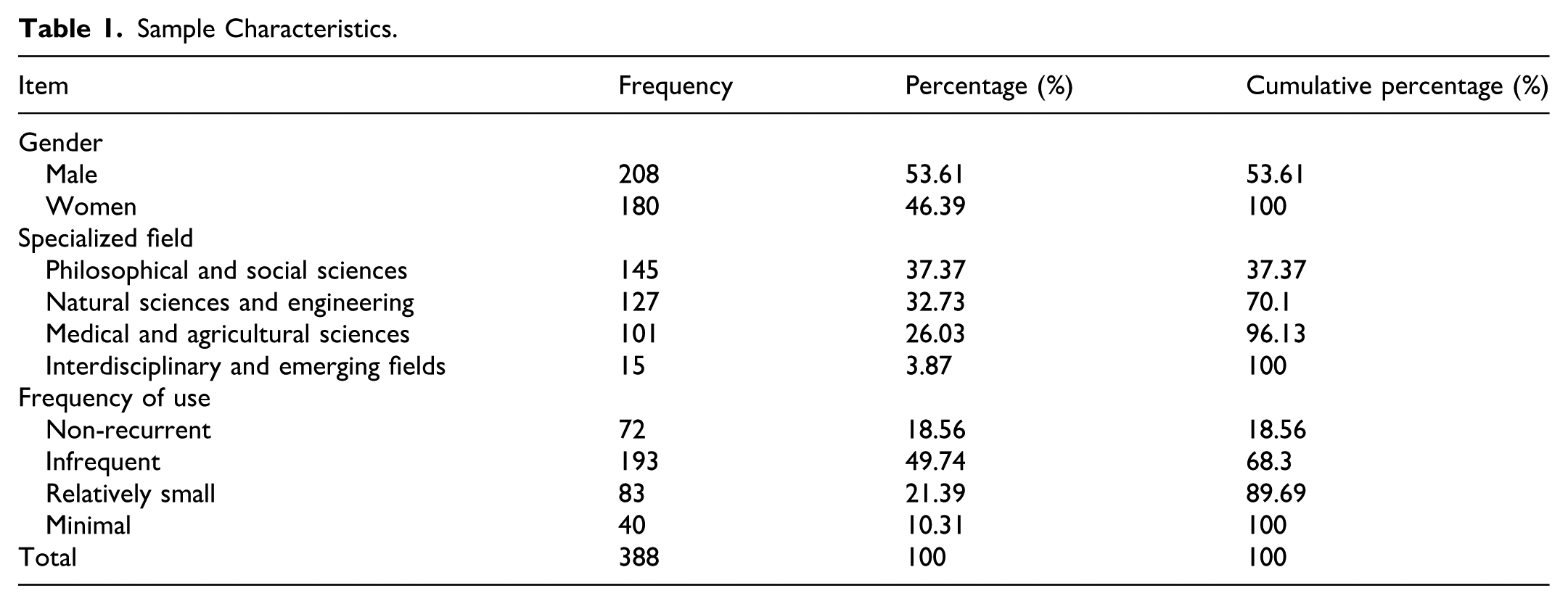
Table 1 presents the descriptive statistics of participant demographics and other baseline characteristics:
Sample Characteristics.
Questionnaire Design: Flow Experience
The questionnaire consisted of two sections: demographic information and core variable measurement. The demographic section collected data such as gender and academic discipline to assess their potential influence on learning ability. The measurement section aligned with the theoretical framework and included four modules: emotion induction; performance expectancy, effort expectancy, perceived emotional value; flow; and learning ability. Items were adapted from validated scales and revised to fit the intelligent chatbot learning context. A five-point Likert scale (1 = strongly disagree, 5 = strongly agree) was used for all items to enable quantitative analysis and support structural equation modeling.
Emotion induction was operationalized as a categorical condition (positive vs. negative) determined a priori by the above preconfiguration and recorded in the session assignment log. To verify perceived orientation, we administered six self-report items (five-point Likert) immediately after the interaction (e.g., “When using the chatbot for English writing, the chatbot guided me with positive wording”; “The chatbot provided negative responses to my writing/edits”). These items function as manipulation checks and do not define the experimental condition.
All latent variables were measured on five-point Likert scales (1 = strongly disagree, 5 = strongly agree) using validated instruments adapted to the chatbot-assisted English-learning context: Performance Expectancy (PE) and Effort Expectancy (EE) followed established UTAUT wording (sample PE: “Using DeepSeek helps me accomplish my English tasks more effectively”; sample EE: “Interacting with DeepSeek is easy for me”); Perceived Emotional Value (PEV) reflected emotional appraisal during interaction (sample: “Using DeepSeek makes me feel encouraged and satisfied during English learning”); Flow captured absorption/enjoyment (sample: “I was deeply engaged and lost track of time when interacting with DeepSeek”); and Learning ability was operationalized as continuance learning behavior/engagement and self-rated performance (Papageorgiou et al., 2025; Sticca et al., 2017; Xu et al., 2024) (e.g., “I learned a lot during the chatbot-assisted writing process,”“Using the chatbot supports my continued English learning over time”).
All questionnaire items were adapted from validated scales and revised to fit the context of intelligent chatbot-assisted English writing or polishing. Performance Expectancy (PE) and Effort Expectancy (EE) items were drawn from the Unified Theory of Acceptance and Use of Technology (UTAUT) by Venkatesh et al. (2003). To ensure contextual relevance, the original phrasing (e.g., “job,”“system,”“raise”) was reworded to reflect the English learning context with intelligent chatbots. EE items (UTAUT) indicate perceived controllability in this context, PE items index functional task value; PEV items index affective value.
Perceived Emotional Value (PEV) items were based on the emotional value subscale proposed by Petrick (2002), with expressions of “pleasure,”“joy,” and “delight” directly referenced and adapted to the learning experience with chatbots.
Flow Experience (Flow) was measured using six items adapted from the Flow State Scale by Jackson and Marsh (1996). The original sports/athletics context was modified into academic learning scenarios involving chatbot use. All six core flow dimensions were retained: challenge-skill balance, immersion, time distortion, control, distraction avoidance, and concentration.
Learning Ability (LA) was operationalized using items from J. Zhang, Zhang, Liu, and Zhang (2023), initially designed for online learning. Items were rephrased to match intelligent chatbot-assisted English writing contexts, emphasizing perceived learning effectiveness, quality, satisfaction, and intention to continue.
To ensure conceptual clarity and contextual appropriateness, all items were meticulously reworded to reflect the specific domain of chatbot-assisted English learning. Special care was taken to retain the semantic essence of the original constructs while embedding task-specific language, such as “using an intelligent chatbot for English writing or polishing.” For example, generic terms like “system,”“job,” or “learning platform” were replaced with concrete references to chatbot functionalities in writing and revision tasks. Items from domains such as sports (Flow) or general online learning (LA) were reframed into brief, academically situated activities that mirror real chatbot use. Throughout the adaptation process, we prioritized preserving the source measures’ latent structure and psychological constructs while making the language intuitive and relevant to participants in an educational technology setting (Table 2).
Source and Wording of Survey Items.

All learning ability (LA) items were presented to participants in English and Chinese, following a rigorous translation and back-translation procedure. Specifically, item F4 indexes continuance learning behavior, items F1 and F3 reflect behavioral engagement, while item F2 captures self-rated performance. This dimensional structure aligns with the second-order conceptualization described in section “Hypothesis Development”.
All items were retained in English for analysis and presented to participants in a bilingual (English–Chinese) format following the translation–back-translation procedure already described. All items underwent translation–back–translation by two bilingual researchers, expert reconciliation (n = 3, educational psychology/second-language acquisition), and a cognitive pretest (n ≈ 30) with the target population. Reliability and validity were examined via Cronbach’s α, CFA, composite reliability (CR), average variance extracted (AVE), Fornell–Larcker discriminant checks, and Harman’s single-factor test, in line with SEM best practices.
Results
Measurement Model Assessment
Descriptive statistics indicated that participants reported generally neutral-to-positive responses across all measured variables, with means ranging from 3.207 to 3.655. Emotion induction variables exhibited greater variability (SD up to 1.205), while performance-related constructs showed more consistency.
Reliability analysis revealed high internal consistency for all constructs (Cronbach’s α >.85). Exploratory and confirmatory factor analyses confirmed the structural validity of the measurement model, with a KMO value of 0.894 and a significant Bartlett’s test of sphericity (p < .001). Convergent validity was established, as all constructs had average variance extracted (AVE) values above 0.5 and composite reliability (CR) values above 0.7. Discriminant validity was supported using the Fornell–Larcker criterion. Harman’s single-factor test indicated no serious standard method bias, with the first factor accounting for only 31.08% of the variance.
A second-order CFA for learning ability (F1–F4) yielded satisfactory fit (χ2/df = 1.62, CFI = 0.968, RMSEA = 0.042), with first-order loadings ranging from 0.73 to 0.88, confirming the three-factor structure anticipated in Table 4.Correlation analysis demonstrated significant relationships among core variables, particularly between emotion induction, performance expectation, and flow, thereby providing a basis for further hypothesis testing through structural equation modeling.
Structural Equation Modeling
Because SEM jointly estimates the measurement and structural models and subsumes multiple regression, we rely on SEM for all hypothesis tests and omit separate OLS results to avoid redundancy.
Structural equation modeling (SEM) was used to analyze the relationships between the variables, and the introduction of the experimental design allows for a more robust interpretation of the causal pathways between emotional feedback and learning outcomes. The proposed SEM (see Table 3) showed a good model fit (χ2/df = 1.211, GFI = 0.933, AGFI = 0.918, RMSEA = 0.023, CFI = 0.989). All structural paths were significant. PE (β = .241), EE (β = .267), and PEV (β = .252) had positive effects on flow. Flow is significantly associated with the learning ability (β = .186). The effects of PE, EE, and PEV on learning ability were also significant. To rule out potential multicollinearity among PE, EE, PEV, and other predictors, we inspected variance-inflation factors and HTMT ratios; both diagnostics fell within accepted thresholds, confirming that collinearity is not a concern in our model. To make the causal logic explicit and address the request for a conceptual model with path coefficients, Figure 2 visualizes the estimated causal ordering among the constructs and annotates each directed path with its standardized coefficient. Arrows encode our directional hypotheses: PE, EE, and PEV act as exogenous drivers that cause changes in the mediator Flow; Flow, in turn, transmits part of this influence to Learning Ability (LA). Solid arrows indicate statistically supported causal paths in the fitted model, while double-headed arrows denote covariances among exogenous drivers. The numeric labels on the arrows match the standardized SEM estimates already reported in section “Mediation effect test” and Table 4; indirect (mediated) effects via Flow are summarized in Table 5. Taken together, the figure offers a compact visual account of the causal chain from cognitive appraisals (PE, EE, PEV) → engagement (Flow) → outcomes (LA).
Road Warp Inspection.

p < .001.

Conceptual/structural model with standardized path coefficients.
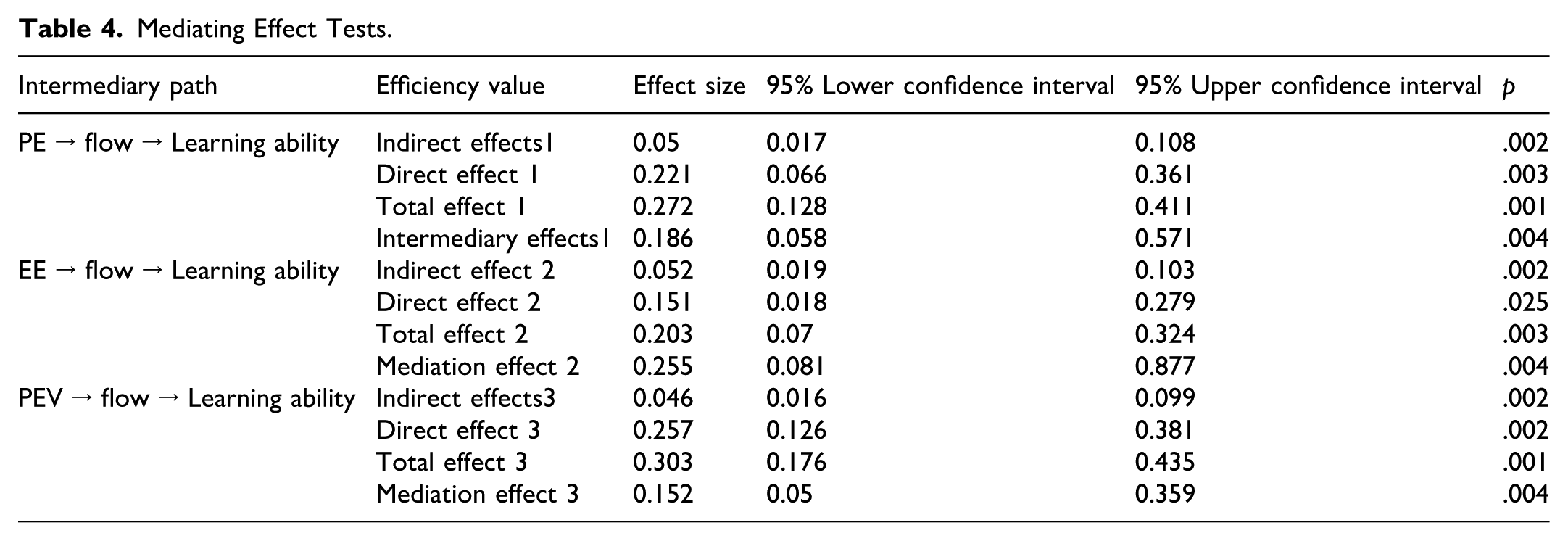
Mediating Effect Tests.
Moderating Effects of Emotion Induction.
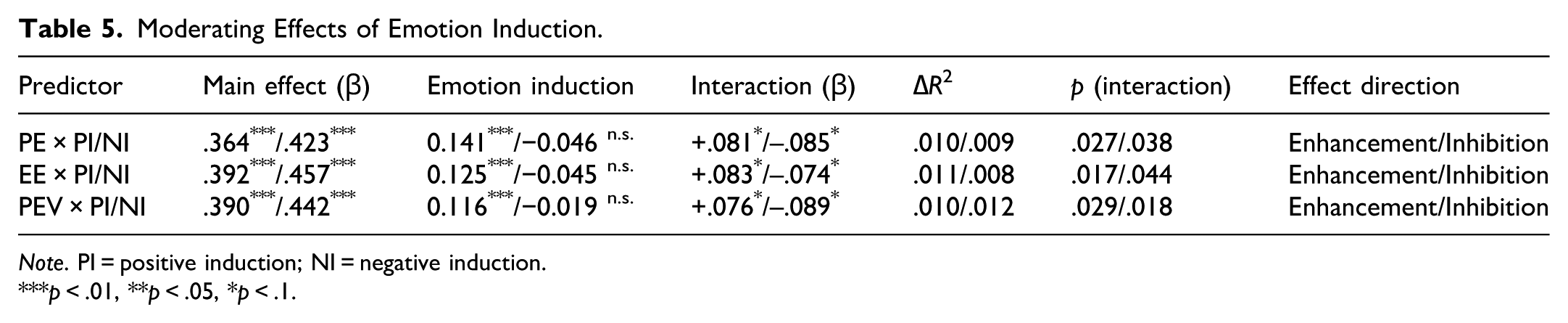
Note. PI = positive induction; NI = negative induction.
p < .01, **p < .05, *p < .1.
Mediation Effect Test
Significance testing (see Table 4) of the mediating effect is performed by the Bootstrap method, which constructs confidence intervals for the mediating effect by generating a large number of samples through resampling and estimating the value of the mediating effect in each sample. If the confidence interval does not contain zero, the mediation effect can be considered significant.
Regulatory Role Test
As the regulatory test (see Table 5) shows, positive emotion induction significantly moderated the effects of PE, EE, and PEV on flow (interaction terms p < .05, ΔR2 = .010–.011), amplifying their positive influence. In contrast, negative emotion induction weakened these relationships, with significant negative interactions (p < .05, ΔR2 = .008–.012). These findings confirm that emotion induction plays a significant and asymmetrical moderating role in shaping user experience.
Discussion
Model Discussion
In this study, Performance Expectancy (PE) refers to the expected benefits of using the chatbot, Effort Expectancy (EE) reflects the ease of use, and Perceived Emotional Value (PEV) captures the emotional satisfaction users derive from the interaction. These three constructs are distinct yet complementary, contributing to user engagement and learning outcomes. Interpreted through CVT, EE reflects perceived control, while PE and PEV reflect task value; this mapping clarifies why emotion induction modulates their routes to flow by shifting control/value appraisals. This study proposes an integrated model that combines the Unified Theory of Acceptance and Use of Technology (UTAUT), Flow Theory, and Perceived Value Theory to investigate English learning ability among college students. While prior research has frequently combined UTAUT and Flow Theory to explain English learning ability (B. Gao, 2023; Y. Li et al., 2025), few have incorporated emotional dimensions. This research introduces perceived emotional value into the integrated framework, thereby enriching the conventional technology acceptance model by addressing the affective components of learning. Adopting performance expectation, effort expectation, and perceived emotional value aligns well with the context of intelligent English learning, offering a more tailored model for understanding how emotional mechanisms influence English learning ability.
A key contribution of this study is the inclusion of emotion induction as a novel moderating variable. These three constructs—PE, EE, and PEV—drive user engagement and contribute to flow and learning ability, confirming their complementary roles in the model. While the original UTAUT model considers gender, age, voluntariness, and experience as moderators (Venkatesh et al., 2003), recent extensions have included constructs such as connected classroom climate (Y. Li & Zhao, 2021)and social self-efficacy (Balakrishnan et al., 2022). However, few studies have explored how emotional induction interacts with user ability and value perceptions. By integrating emotion induction into the model—operationalized through the DeepSeek large language model—this research expands the scope of moderating variables and provides a new perspective on affective regulation within intelligent education systems.
Importantly, this research empirically validates the extended model using DeepSeek, a state-of-the-art large language model platform. With over 30 million daily active users, the platform offers a robust empirical base for testing intelligent learning models. The findings confirm that emotion induction significantly moderates the relationships between performance expectation, effort expectation, perceived emotional value, and flow, which in turn enhances learning ability. Specifically, positive emotion induction strengthens these associations, facilitating students’ entry into a flow state that leads to improved learning ability, whereas negative emotion induction weakens them. These results align with previous findings on the role of flow in learning ability enhancement (M. Li et al., 2022; Zhao & Khan, 2021).
Although this study uses a binary classification of emotion induction (positive vs. negative), the underlying theory recognizes that emotions are multidimensional. Based on Russell’s circumplex model and Pekrun’s Control-Value Theory, emotions are characterized by both valence (pleasant vs. unpleasant) and arousal (high vs. low), which can influence learning outcomes in different ways (“A circumplex model of affect,”1980; Pekrun, 2006).
Practically, the findings offer actionable strategies for optimizing English learning behaviors among college students through integrating DeepSeek. By enhancing learning expectancy, reducing cognitive obstacles, and promoting positive emotional engagement, learners are more likely to sustain motivation and achieve deeper learning involvement. The emotion induction of DeepSeek further contributes to maintaining an efficient learning state. These abilities not only extend current theoretical insights but also suggest concrete directions for implementing AI-assisted English language learning in higher education.
We interpret the results within a university EFL writing context involving interactions with the DeepSeek chatbot; future work should test whether the observed patterns generalize across educational levels (e.g., K-12, adult learning), language domains, or alternative chatbot platforms.
Emotion Induction as a Moderator in Technology Acceptance and Flow
Amplification and Suppression: Bidirectional Effects of Emotion Induction
The findings reveal that emotion induction plays a significant moderating role in shaping key predictors of flow experience. Specifically, positive emotion induction amplifies the effects of performance expectation (β = .081, p < .05), effort expectation (β = .083, p < 0.05), and perceived emotional value (β = .076, p < .05), resulting in increases in model explanatory power by 22.0%, 23.7%, and 22.6%, respectively. In contrast, negative emotion induction weakens these relationships, with path coefficients ranging from β = –.085 to –.089 (p < .05).
This study contributes empirical evidence to support the influence of chatbot-driven emotion induction on English learning ability in the context of DeepSeek. It extends the traditionally static UTAUT framework by integrating a dynamic emotional layer into the acceptance–flow–learning chain (Venkatesh et al., 2003) offering a more nuanced view of technology-mediated learning processes. The findings underscore the importance of emotional diversity in educational settings, reflecting the complexity and variability of real-world learning environments (Efklides, Volet, & instruction, 2005). In particular, positive emotional cues—such as encouragement and empathy—enhance students’ perceptions of system usability and ability. This is consistent with Fredrickson’s broaden-and-build theory (Fredrickson, 2001), which suggests that positive emotion induction fosters cognitive flexibility and promotes deeper engagement. Conversely, negative emotion induction tends to elicit psychological resistance, reducing motivation and diminishing perceived learning value.
Constructive Effects of Mild Negative Emotions
Conceptual Clarification and Theoretical Foundations: Russell’s Circumplex Model suggests that emotions are regulated by arousal (“A circumplex model of affect,”1980). Under moderate arousal levels, confusion or curiosity—as examples of mild negative emotions—may still enhance cognitive engagement and facilitate flow experiences. Educational psychology literature on “desirable difficulties” and “constructive confusion” consistently highlights that a certain degree of uncertainty can stimulate metacognitive monitoring and deeper cognitive processing, rather than inevitably hindering learning.
Reinterpretation of Existing Results: Moderation analyses in this study show that negative emotion induction significantly attenuated the paths from PE, EE, and PEV to flow (ΔR2 = .008–.012), with interaction terms around −0.08. However, the main effects of these cognitive predictors on flow remained significantly positive (e.g., PE → Flow β = .364). In other words, although low-intensity, non-derogatory negative prompts may narrow the cognitive-to-flow pathways, they do not completely negate their facilitating effects. In our setting, this implies that challenging anxiety at moderate arousal may narrow rather than reverse the cognition-to-flow links; with timely scaffolds, attentional focus can be maintained, and flow can still emerge. This suggests that mild challenges could activate monitoring and error-detection processes, leading to deeper task processing rather than inhibition.
Our moderation pattern—positive tone strengthens the cognition → flow links while negative tone weakens them—fits with the role of emotional nuances. Specifically, mixed states such as curiosity + manageable confusion can still feed into flow and learning when they are guided and resolved in time (D’Mello et al., 2014). In contrast, high-arousal anxiety is known to consume attentional control and interrupt flow (Eysenck et al., 2007), whereas low-arousal boredom reliably undermines academic outcomes (Tze et al., 2016). Read together with our results, these findings clarify how emotional nuances—especially mixed emotions—can still support flow and learning when arousal is moderate, but not when anxiety spikes or boredom persists (Pekrun, 2006).
Pedagogical Implications and Future Directions: Emotion-aware chatbots may incorporate “constructive confusion” strategies by using open-ended questions or delayed hints to prompt learners to reflect on their errors rather than providing simple negative feedback. Support: When the system detects strong negative emotions, it should respond with timely cues or stepwise guidance to transform potentially disruptive affect into constructive challenge. Future studies may extend current measures by adding confusion/uncertainty dimensions to explore how different intensities and types of negative emotions influence flow and learning ability. This would support the development of more adaptive and personalized emotion induction strategies.
The Emotion-Flow-Learning Nexus in Chatbot-Assisted English Learning
Among the UTAUT constructs, effort expectation exhibits the most potent effect on flow (β = .267), followed by perceived emotional value (β = .252) and performance expectation (β = .241). These findings suggest that ease of use, emotional resonance, and functional utility collectively shape students’ immersive learning experience, supporting the integrative value of combining cognitive and emotional factors in intelligent language learning environments.
Notably, perceived emotional value emerges as the most robust direct predictor of English learning ability (β = .235, p < .001), surpassing performance expectation (β = .184) and effort expectation (β = .144). This reframes conventional assumptions within the UTAUT framework (S. Chen et al., 2024) and highlights the central role of emotional design in educational chatbots. Our findings are consistent with prior studies by Kim et al. and Chen (C.-C. Chen & Lin, 2018; Kim & Thapa, 2018), and extend Venkatesh et al.’s original UTAUT model (Venkatesh et al., 2016) by integrating emotional dimensions, in line with K.-Y. Wang et al. (2024).
Demographic factors such as gender (p = .609), academic background (p = .204), and usage frequency (p = .770) do not significantly influence learning ability. While the traditional UTAUT model emphasizes such moderators (Venkatesh et al., 2003), our findings suggest that emotion induction overrides these characteristics, offering broader applicability. Specifically, positive emotion induction significantly enhances motivation among low-frequency users (β = −.084 → β = −.067), indicating potential for personalized chatbot interventions in English education.
Model fit indices confirm the robustness of the proposed framework (χ2/χ2/df = 1.211, CFI = 0.989, RMSEA = 0.023). This study introduces a novel path—emotion induction → technology acceptance → flow experience → learning ability—bridging a theoretical gap in UTAUT applications and offering actionable insights for the emotional optimization of AI-driven English learning platforms.
Flow’s Mediating Effects Empower English Learning
Structural equation modeling confirms that flow serves as a partial mediator in all three primary learning-related paths. Specifically, performance expectations (β = .241, p < .001) and effort expectations (β = .267, p < .001) explain 18.4% and 25.6% of the variance in learning ability through flow, respectively. Verified through DeepSeek-supported chatbot interactions, these results reinforce prior findings (B. Gao, 2023; Zhao & Khan, 2021), regarding the mediating role of flow in the influence of UTAUT cognitive variables on learning ability. Among the three, effort expectancy exhibits the strongest indirect effect through flow (0.052), followed by performance expectancy (0.050), while perceived emotional value, though significant, contributes the, most negligible indirect effect (0.046). A post-hoc decomposition of the higher-order outcome shows that flow explains a larger share of variance in continuance-intention/engagement (β = .18) than in self-rated performance (β = .12), suggesting that the immersive state primarily sustains students’ willingness to keep using DeepSeek rather than instantly boosting their perceived writing quality. These findings support Fredrickson’s broaden-and-build theory (Fredrickson, 2001) in the context of AI-supported English learning and extend perceived value theory (K.-Y. Wang et al., 2024) by confirming the unique predictive role of emotional value. Converging evidence from EFL cohorts indicates high preference and satisfaction with DeepSeek, aligned with perceived usefulness and ease of use (Habeb Al-Obaydi & Pikhart, 2025). This provides a theoretical foundation for integrating affective design into chatbot-based educational technologies.
Bootstrap analysis confirms that all mediating paths are significant (95% CI excludes zero), while direct effects remain robust, indicating partial mediation. These results highlight flow as a key integrative mechanism (B. Gao, 2023), suggesting that intelligent learning systems should prioritize emotional design strategies to foster flow.
Prior studies (Huang, 2024; Ou et al., 2021; Xiao et al., 2024) identify autonomy support and positive academic emotions as key flow. These factors enhance students’ engagement by reinforcing enjoyment and perceived control, while negative emotions such as anxiety hinder flow by triggering cognitive interference. Such evidence aligns with the emotional pathway proposed in this study.
These results suggest that chatbot-induced emotional designs trigger and maintain flow through positive emotional reinforcement, enhancing motivation and performance. Meanwhile, UTAUT constructs retain independent explanatory power (Venkatesh et al., 2016), underscoring the need for a balanced design strategy that integrates cognitive and affective components.
Theoretical Integration: Linking Emotion Theories to Empirical Findings
The Broaden-and-Build Effect of Positive Emotions
Fredrickson’s Broaden-and-Build Theory posits that positive emotions broaden individuals’ momentary thought–action repertoires and build enduring personal resources throughout learning and adaptation processes (Fredrickson, 2001).
The findings of this study align closely with this theoretical framework. Performance expectancy (PE → Flow β = .267), effort expectancy (EE → Flow β = .275), and perceived emotional value (PEV → Flow β = .245) all exert significant positive effects on flow experience. Flow significantly predicts English learning ability (Flow → Learning Ability β = .186).
More critically, moderation analyses indicate that positive emotion induction significantly enhances the cognitive → flow pathways (ΔR2 = .010–.011), increasing learners’ task engagement and sustained learning behavior. This pattern exemplifies how positive emotions expand cognitive channels and build learning resources, as theorized by Broaden-and-Build.
Constraining Effects of Negative Emotions Under the Control-Value Framework
According to Pekrun’s Control-Value Theory (CVT), achievement emotions arise from learners’ perceptions of control and value. A lack of control or perceived value often triggers negative emotions, which may deplete cognitive resources and reduce learning motivation (Pekrun, 2006).
In this study, negative emotion induction significantly attenuates the positive influence of PE, EE, and PEV on flow (ΔR2 = .008–.012). Nevertheless, partial mediation through flow remains statistically significant. For instance, the indirect effect of PE → Flow → Learning Ability is 0.05, with a 95% confidence interval of [0.017, 0.108], indicating that even under reduced perceptions of control and value, the emotional pathway is compressed but not entirely severed. This finding empirically supports the CVT proposition that low control and value lead to negative emotions, impairing learning motivation and performance.
Synthesized Framework and Pedagogical Implications
By synthesizing the above two emotion theories, key constructs in the present study can be theoretically mapped as follows (Table 6):
Mapping of Theoretical Constructs, Empirical Findings, and Pedagogical Implications.
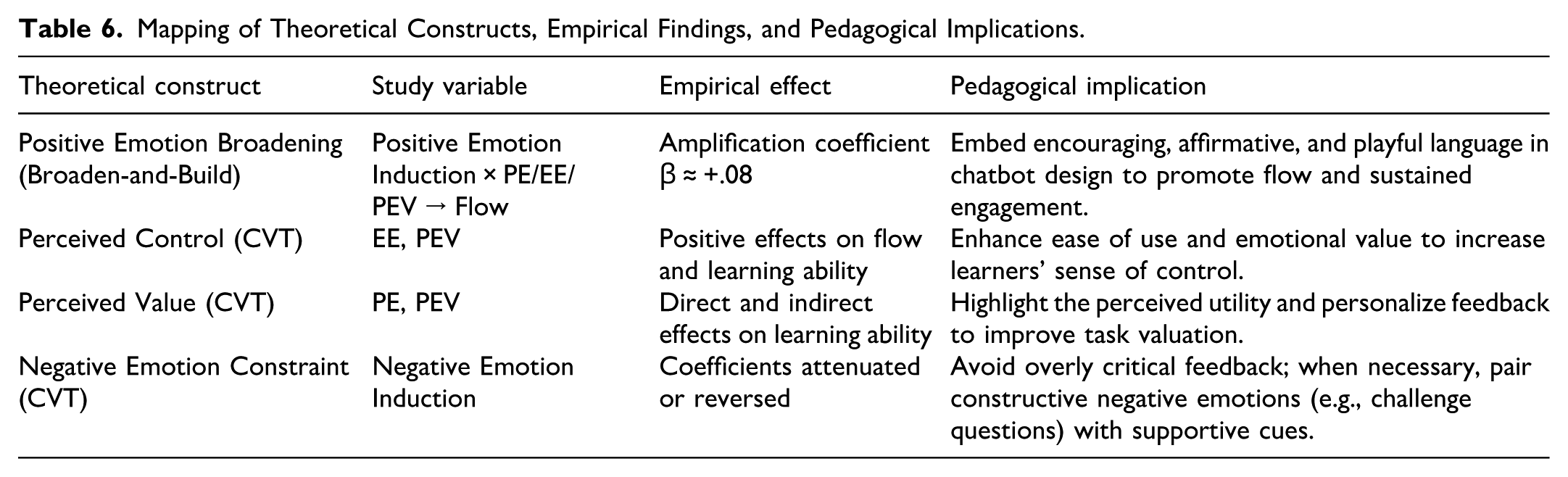
From a macro perspective, positive emotions expand the transmission pathways from PE/EE/PEV to flow and learning ability via the broaden-and-build mechanism, whereas negative emotions—particularly in low control or low value contexts—constrict these pathways, in line with the constraints predicted by CVT. Future studies may explore the dynamic effects of mixed or mild negative emotions under varying levels of control and value to refine emotion induction strategies for adaptive learning. Outside EFL, independent benchmarks report DeepSeek performing on par with leading systems in complex decision tasks, while task-level evaluations show readable outputs with domain-dependent accuracy—supporting our emphasis on usability and context-sensitive design (Özcivelek & Özcan, 2025; Sandmann et al., 2025).
Limitations and Future Research Directions
While this study provides valuable insights into the effects of emotion induction via intelligent chatbots on English learning, it has certain limitations. One key issue is our reliance on a binary classification of emotions (positive vs. negative), which oversimplifies the multidimensional nature of affect and precludes triangulation with objective performance indicators; future work should therefore combine subjective ratings with external measures (e.g., standardized English test scores) to enrich construct validity. Emotions such as curiosity and anxiety may co-occur and interact in ways that influence learning ability. Moreover, the potential benefits of moderate negative emotions have been largely overlooked.
A further limitation concerns external validity. Because all 388 participants were enrolled at Chinese universities and used the DeepSeek chatbot for English learning, the findings may be constrained in their generalisability to other age groups, cultural contexts, or AI-assisted learning platforms. Future work should therefore replicate the study across multiple countries, academic levels (e.g., K-12, adult continuing education), and language pairs to examine whether cultural dimensions such as power distance or uncertainty avoidance moderate the emotion–flow–learning pathway. In addition, employing stratified random sampling across high- and low-context cultures and conducting parallel studies in multiple target languages (e.g., Spanish, Arabic, Japanese) would clarify whether linguistic distance or platform norms moderate learners’ affective responses. Cross-platform comparisons (e.g., WeChat mini-programs versus WhatsApp bots) could further test adaptive emotion strategies’ robustness within different socio-technical ecosystems.
Although we contrasted positive versus negative tone, we did not directly measure co-activation of positive and negative affect or separate valence and arousal. Future work will include brief valence and arousal measures (e.g., short PANAS/SAM) to compute a mixed-emotion index and test arousal-contingent effects on flow and learning, and will adopt a more nuanced emotional framework that captures intermediate and ambivalent emotional states. This would allow for a deeper understanding of how varied emotional profiles affect acceptance variables and learning performance, and further investigation into the constructive effects of moderate negative emotions may reveal new strategies for enhancing learner engagement and optimizing AI-assisted language education.
Future research should therefore investigate adaptive emotional strategies in conversational AI that can dynamically tailor feedback to learners’ evolving affective states. Such strategies could combine real-time multimodal emotion recognition—including text semantics, voice prosody, and facial expressions—with reinforcement-learning policies that select the most pedagogically effective prompt style, whether encouragement, constructive challenge, humor, or calming guidance. Long-term classroom-based A/B experiments should compare static versus adaptive designs to evaluate sustained effects on flow, engagement, and objective language-learning outcomes across diverse cultural and disciplinary contexts. Open-source benchmark datasets and transparent reporting of emotion-adaptation logic will facilitate replication and cross-study synthesis. Future studies should explore adaptive emotional strategies in AI that recognize valence and arousal, incorporating mixed emotions and their impact on flow and learning.
Conclusions and Countermeasures
Conclusion
The findings indicate that performance expectations, effort expectations, and perceived emotional value all positively contribute to English learning ability. Among these factors, perceived emotional value exerts the strongest influence.
Moreover, flow not only positively affects learning abilities but also in the relationships between performance expectations, effort expectations, perceived emotional value, and English learning ability. Flow exhibits the strongest mediating effect in the path from effort expectancy to English learning ability, followed by performance expectancy. While still significant, the mediating effect of perceived emotional value is the smallest among the three.
Emotion induction triggered by intelligent chatbot significantly moderates students’ English learning ability. Positive emotion induction strengthens the positive effects of performance expectations, effort expectations, and perceived emotional value on English learning ability, thereby improving students’ learning experiences and performance. In contrast, negative emotion induction weakens these positive effects, reducing students’ motivation and overall performance.
Overall, this study fills a gap in the application of emotion induction within intelligent education, provides actionable recommendations for improving student English learning ability and optimizing the use of DeepSeek, and provides a theoretical basis for designing emotion-focused teaching and optimizing intelligent education systems.
Countermeasures
Given the above research conclusions, in order to improve the English learning ability of college students, this paper puts forward the following suggestions:
Optimizing Students’ English Learning Behavior Through Flow-Oriented Strategies
To effectively enhance English learning ability, students are encouraged to adopt behavioral strategies conducive to entering a psychological flow state. Specifically, they may regulate their performance expectations, effort expectations, and perceived emotional value. For instance, by setting clear and progressively challenging learning goals, learners can raise their performance expectations, which, in turn, heightens the anticipation of achievement and promotes deeper immersion in the task. Furthermore, maintaining consistent study routines and engaging in self-reward mechanisms can increase perceived value and enjoyment in learning, both essential precursors to flow. Educators may also encourage reflective practices, such as journaling or self-assessment, to help learners internalize emotional value and adjust expectations dynamically.
Leveraging DeepSeek’s Emotion Induction Mechanism to Improve English Learning
The empirical findings suggest that DeepSeek’s positive emotion induction can significantly enhance the ability of English learning by reinforcing the influence of cognitive expectations and emotional engagement. Therefore, learners can intentionally leverage this mechanism to optimize their learning experiences. One effective strategy is to input prompts with emotionally uplifting language or to steer the chatbot toward maintaining a predominantly positive tone. For example, learners may include expressions such as “encourage me,”“give me positive feedback,” or “celebrate my progress” in their interactions to amplify motivation. Additionally, DeepSeek can be programmed to recognize learners’ achievement milestones and respond with affirming messages, sustaining engagement. It is recommended that students avoid prompts that elicit criticism or negative emotion, especially during tasks requiring concentration or confidence-building, as negative emotion induction may dampen effort and reduce emotional value perception. Our model offers a starting point for examining emotion–flow–learning links beyond university cohorts, inviting replication across different levels, language pairs, and platforms.
Looking ahead, integrating an adaptive emotion engine that continuously senses and responds to learners’ affective states will enable DeepSeek to personalize feedback intensity and style in real time, thereby sustaining optimal arousal, motivation, and focus throughout each learning session.
Promoting English Interactive Language Ability Through DeepSeek-Facilitated Communication
Beyond its role in emotional support, DeepSeek can be strategically utilized to promote learners’ interactive language ability in English. Through continuous and goal-directed conversations with the chatbot, students are provided with opportunities to practice real-time language comprehension and production, strengthening receptive and productive skills. Engaging in interactive tasks such as question–answer exchanges, personal introductions, scenario-based dialogues, and opinion discussions can simulate authentic communicative contexts and enhance students’ responsiveness and fluency. Furthermore, DeepSeek may be equipped to provide implicit feedback, suggest alternative phrasings, or encourage elaboration, which helps learners refine their communicative strategies and expand their lexical repertoire. By regularly participating in such interactive exchanges, students are likely to develop greater confidence, improve syntactic accuracy, and build pragmatic competence. Thus, using DeepSeek as a conversational partner holds significant potential for supporting the development of students’ English interactive language ability in a personalized and adaptive manner.
Practical Recommendations for Enhancing DeepSeek’s Emotion Feedback Mechanism
Based on the study’s findings, DeepSeek’s emotional feedback system can be further optimized to better support English learning. First, the system could incorporate a motivational language module that delivers timely encouragement, praise, or empathetic responses to enhance user engagement. Implementing adaptive feedback mechanisms, such as collecting user ratings on emotional satisfaction after each session, would provide valuable data for improving emotional response accuracy. Third, the chatbot could adopt context-sensitive emotion strategies by tailoring its responses according to the learner’s proficiency level, task difficulty, and interaction history. Finally, embedding emotion-aware feedback into specific learning scenarios, such as vocabulary practice or reading comprehension, may increase user satisfaction and the overall ability of the learning experience.
Supplemental Material
sj-docx-1-sgo-10.1177_21582440261420472 – Supplemental material for Can DeepSeek Intelligent Chatbot’s Emotion Induction Enhance College Students’ English Learning Ability?
Supplemental material, sj-docx-1-sgo-10.1177_21582440261420472 for Can DeepSeek Intelligent Chatbot’s Emotion Induction Enhance College Students’ English Learning Ability? by Lin Fan and Zhigang Li in SAGE Open
Supplemental Material
sj-xlsx-2-sgo-10.1177_21582440261420472 – Supplemental material for Can DeepSeek Intelligent Chatbot’s Emotion Induction Enhance College Students’ English Learning Ability?
Supplemental material, sj-xlsx-2-sgo-10.1177_21582440261420472 for Can DeepSeek Intelligent Chatbot’s Emotion Induction Enhance College Students’ English Learning Ability? by Lin Fan and Zhigang Li in SAGE Open
Footnotes
Acknowledgements
I would like to thank Chengdu University of Technology (University of China) for her invaluable guidance, insightful feedback, and generous support throughout the study. I would also like to extend my sincere gratitude to the college students who learn English and Participate in the experiment.

Author Contributions
Conceptualization was performed by Zhigang Li and Lin Fan. Material preparation, data collection, and analysis were performed by Lin Fan. Lin Fan wrote the first draft of the manuscript, and both Lin Fan and Zhigang Li have drafted the work or substantively revised it.
Ethical Considerations
This study did not require further ethics committee approval as it did not involve animal or human clinical trials and was not unethical. The study was designed as an anonymous online survey with no sensitive or personally identifiable questions, and participation was voluntary.
Consent to Participate
We declare that all participants voluntarily gave informed consent after being informed of the study’s purpose, confidentiality, and their right to withdraw before submitting the questionnaire. Informed consent was obtained through an explicit consent statement presented at the beginning of the online survey.
Funding
The authors received no financial support for the research, authorship, and/or publication of this article.
Declaration of Conflicting Interests
The authors declared no potential conflicts of interest with respect to the research, authorship, and/or publication of this article.
Data Availability Statement
The data used in this study are available upon request.
Potential Benefits and Risk Assessment
The potential benefits include advancing the understanding of chatbot-assisted learning in programming education and offering participants an opportunity to reflect on their learning experiences. The potential risks were minimal, involving only possible minor discomfort from survey questions, and were mitigated through anonymity and voluntary participation. Overall, the benefits to society and participants clearly outweighed the limited risks.
Supplemental Material
Supplemental material for this article is available online.
References
Supplementary Material
Please find the following supplemental material available below.
For Open Access articles published under a Creative Commons License, all supplemental material carries the same license as the article it is associated with.
For non-Open Access articles published, all supplemental material carries a non-exclusive license, and permission requests for re-use of supplemental material or any part of supplemental material shall be sent directly to the copyright owner as specified in the copyright notice associated with the article.
