



Abstract
Instructional approach determines how students’ conceptual understanding can be improved. In learning, one approach cannot fit all; students should be able to participate in learning. The aim of the study was to investigate the effects of integrated cooperative problem-solving with multiple representations, cooperative problem solving and multiple representations instructional approach on students’ conceptual understanding. Integrated Cooperative Problem-solving with Multiple Representations (at Dilla), Cooperative Problem solving (at Hossaina), and Multiple Representations (at Arba Minch) approaches were assigned to experimental groups and the control group was Bonga education college. The pilot test was distributed to 80 students and scores analyzed. Cronbach’s alpha scores resulted in .71 and .73 in the pre-posttest, which is in an acceptable interval. The study employed a mixed research approach with pre-and posttests non-equivalent quasi-experimental research design. The results of the one-way ANCOVA show that students in experimental groups significantly scored a higher mean score on their conceptual understanding test compared to the control group and qualitative results also supported that students in experimental groups scored higher. Therefore, the study concluded that the instructional approaches used for experimental groups significantly enhanced students’ conceptual understanding of geometry learning.
Plain Language Summary
Why was the study done? The study was done to examine the effects of integrated cooperative problem solving with multiple representations, cooperative problem-solving and multiple representations instructional approaches on students’ conceptual understanding in learning geometry. What did the researcher do? The researcher studied by designing quasi experimental study. Different instructional approaches were applied and data were collected using pretest and posttest test, observation and interview. Finally, data were analyzed using statistical tests so that the effects of approaches examined. What did the researcher find? The researcher find that the students’ conceptual understanding scores significantly increased after intervention in experimental groups and there were also significant differences across the groups. What do the findings mean? Since the students’ mean score on pretest had no significant differences, the differences occurred on posttest indicates the results of instructional approaches.
Keywords
Introduction
Conceptual understanding refers to the ability to comprehend mathematical concepts that help to perform operations and relate concepts (Kilpatrick, 2001). There are three components of conceptual understanding: comprehension, operations, and relations. In addition, learning with understanding improves retention, promotes fluency, and facilitates learning materials (Malatjie & Machaba, 2019). In line with their idea, an indicator of conceptual understanding is the ability to represent mathematical situations in different ways and able to know how different representations can be useful for different purposes (Alex & Mammen, 2018). Understanding geometry concepts is very important in learning mathematics to understand another field of mathematics. Understanding the geometry concept can help students think logically and deductively about some mathematical objects and their relationships (Alqahtani & Powell, 2016).
In recent decades attention has been given to teaching mathematics in conceptual understanding (Crooks & Alibali, 2014). And this is the result of a lack of students’ conceptual understanding of mathematics. Consequently, enhancing students’ mathematics conceptual understanding can benefit students in a variety of ways. To do so, this study applied the three instructional approaches; cooperative problem solving, multiple representations, and the integration of the two approaches in learning geometry. The term cooperative learning encompasses a subset of active learning activities in which students learn in groups of three or more rather than alone or in pairs (Kadry & Safieddine, 2016). It is the model in which students work in teams to achieve a common goal under conditions that include positive interdependence, accountability, face to face interaction with facilitators, appropriate use of group processing, and collaborative skills. From many types of cooperative learning we focused on the jigsaw method in this study.
Geometry is one of the basic techniques people use to comprehend and explain the physical environment by measuring length, surface area, and volume. This area of mathematics offers people the chance to investigate and comprehend their physical environment through observation and measurement, and students must study it in school. Students may be able to recognize the shape of figures and the space around their lives by studying geometry (Rohendi et al., 2018). As a bridge between real world events and mathematical ideas, geometry plays a crucial role in mathematics education. The scientific field of mathematics education is regarded as the study of how people learn and perform mathematics of any kind, as well as how this learning and performing may be influenced and fostered by teaching, the use of media, various representations, or the social organization of mathematical activity (Boadu & Bonyah, 2024).
Jigsaw Group: It was introduced to enhance peer cooperation and create team work of students (Şengül & Katranci, 2014). The number of students in each group divides the subject to be covered. Each group is given the same topic, and students are asked to choose one of the divided topics, and students from different groups who choose the same topic come together in “expert groups” to work, discuss and learn about these common topics. Students who return to their original groups after learning the subject discussed in the expert group are responsible for teaching the subject; they are working on one another within the time frame specified. In this technique, all students are both learners and teachers at the same time (Deringol et al., 2021).
Moreover, the problem-solving instructional approach focuses on teaching mathematical lessons through problem solving contexts and inquiry-oriented approaches, which are characterized by the teacher helping students construct a deep understanding of mathematical concepts and processes by engaging students in doing mathematics (Albay, 2019; Lester & Cai, 2016). From different problem-solving approaches, Polya’s Problem solving techniques were selected. Polya’s Problem solving techniques: George Pólya identified four principles of problem-solving techniques in his 1945 book, How to solve a problem (Chadli et al., 2018). This technique is a means of finding a solution to a difficulty in achieving an objective that, indirectly, could be achieved. The principles are: understand the problem (observe), devise a plan (plan), carry out the plan (do), and look back (check; Oktaviana et al., 2023; Sintema & Jita, 2022).
A cooperative problem-solving instructional approach is formed by integrating cooperative learning and problem-solving approaches, which enables students to work together in learning and applying higher order thinking skills, and leads to higher achievement in solving mathematical problems (McGlinn, 1991). Similarly, Sullivan et al. (2015) added that cooperative problem solving helps students get opportunities to identify and deal with complex, multidimensional challenges through group learning, and its setting is to encourage learning about and resolving difficult issues through interaction and discovery. Cooperative problem solving is a successful means for helping students learn, and encourages students’ engagement and accommodates students’ differences.
In addition, Bergner et al. (2016) define cooperative problem solving as a method of social interaction in which autonomous groups work together to achieve a common goal. In all definitions, the common words work together for a common goal and have the greater ability to solve a given problem. Furthermore, the result of the study by Klang et al. (2021) showed a significant effect of the cooperative learning approach on students’ problem solving in geometry and on peer support in problem solving. Students’ peer acceptance and friendships at the posttest were significantly associated with the effect of the cooperative learning approach. Its application follows the different strategies of problem-solving approaches and the principles of cooperative learning approaches.
Another instructional approach, multiple representations, is also an active learning approach that helps students understand lessons by presenting a single idea in different representations. Using different representations to explain a notion makes the approach different. Along the way, students usually discuss the lesson at least twice. One is when they represent a given idea using representation; the second is when they translate one representation to another. Multiple representation based instructions were introduced by the Lesh Multiple Representations Translations Model (LMRTM). Research findings have indicated that multiple representation instruction has effects on students’ mathematics learning. Treagust (2019) found that multiple representation instruction enhances students’ conceptual understanding; Çetin and Aydın (2019) revealed that multiple representation based instruction improves students’ mathematical achievement, and that is also in line with the work of Ainsworth (2006).
Furthermore, many studies highlighted the fact that multiple representation instruction enhanced understanding of abstract mathematical concepts, provided meaningful mathematical understanding, and contributed to students’ conceptual construction of mathematical knowledge (Ainsworth, 2006; Dreher & Kuntze, 2015; Tripathi, 2008). In another work, Mahama and Kyeremeh (2023) also added that, multiple representation-based instructions help students perform better compared to the conventional approach.
In Ethiopia, the teaching and learning process was a lecture method, and the quality of mathematics education is a serious problem because of the largely practiced traditional teaching method, low students’ problem-solving skills, low students’ motivation and negative attitude toward mathematics (Habtamu et al., 2022). Teachers in higher education institutions and colleges of teacher education (CTEs) are still using traditional teacher cantered teaching methods (Ahmad & Latib, 2015), which are less effective at conceptual understanding and internalizing concepts. This is a problem that needs to be solved immediately. So, to examine students’ conceptual understanding, this research has been done on geometry learning using the selected pedagogical approaches and the ssignificance of the differences between the control group and experimental intervention groups.
As it is very obvious, students with low performance in computing basic arithmetic operations cannot have geometrical conceptual understanding. In Ethiopia, concrete evidence cited (Eshetu et al., 2022) and reports of Tirussew et al. (2018) indicated a lack of conceptual knowledge and reasoning skills in geometry, and Kotu and Weldeyesus (2022) reported that a significant number of students scored failure to develop proper understanding of geometry concepts and problem-solving skills. This ensures that in Ethiopia, students’ mathematical conceptual understanding is low.
The majority of classrooms in Ethiopia are dominated by conventional lecture methods, in which instructors talk and students listen. This is in contrast to active teaching and learning activities. He stated that the Ethiopian tradition of teaching and learning faces different problems, like: a lack of learning resources and support, a lack of teacher expertise, inappropriate curriculum materials, and students’ lower preference for active participation in learning due to a lack of prior experience are all obstacles to the practice of active learning. Similarly, as Bekele (2022) and Semela (2014) revealed, Ethiopian College of Teacher Educations (CTEs) continues to employ conventional teacher centered methods.
Researchers agree that quality teaching and learning have been associated with the nation’s economic and social development, and extended beyond the attainment of course objectives and mastery to prepare the graduates for the world of work (Marginson, 2007; Rieckmann, 2012). In addition, Negash et al. (2023) stressed that the expected outcome of quality education is primarily to encourage students’ independent learning and thus, ultimately, to produce competent graduates. This potentially determines teaching quality, particularly in the 21st century (Dale & Hyslop-Margison, 2011). The students should be able to participate in the process of instruction, independently accomplishing the learning tasks with minimum support from their teacher.
This study, therefore, was focused on investigating/testing the effects of integrated cooperative problem solving in multiple representations, jigsaw cooperative problem solving, and multiple representation instructional approaches on students’ conceptual understanding in learning geometry at the education colleges in Ethiopia. The target group of this study is mathematics department students and mathematics teachers of the Dilla, Hossaina, and Arba Minch education colleges.
The research questions of the study are (1) Are there significant differences in the mean gains of pretest and posttest of students’ conceptual understanding in learning geometry with in the three interventions and control groups? (2) Are there any significant differences in conceptual understanding in learning geometry among the three interventions and control groups using the pretest as a covariate? (3) How students’ conceptual understanding enhanced in learning geometry?
Purpose of the Study
The purpose of this study was to examine the effects of integrated cooperative problem solving with multiple representations, cooperative problem-solving and multiple representations instructional approaches on students’ conceptual understanding in learning geometry.
Theoretical Framework
The theoretical framework of this basis on two main theories. First, the Lesh Translation Model is a framework to represent the knowledge of mathematical conceptual understanding (M. S. Park et al., 2018). The model (see Figure 1) consists of representations: realistic, symbolic, language, pictorial, and manipulative (concrete, hands on models) representation. The Lesh Translation Model emphasizes that concept understanding lies in the ability of students’ representing mathematical concepts through the representations and translating. This support students’ relational thinking and mathematical conceptual understanding. This theory used as founding framework for multiple representation.

The Lesh translation model.
Moreover, Social constructivism and Social Interdependence Theory were considered as theoretical framework of the study. The theory of social constructivism was developed by Soviet psychologist Lev Vygotsky (1896–1934). At the foundation of this theory is the belief that knowledge is not a copy of an objective reality but is rather the result of the mind selecting and making sense of and recreating experiences. Social constructivism posits that the understanding an individual develops is shaped through social interaction. The educator is responsible for creating a collaborative environment focused on problem solving that makes students active participants in their learning. The educator takes steps to install in students with personal agency and allow them to take ownership of their learning.
Generally, the benefits of social constructivism depend on the effective application of key principles in classrooms. Social constructivism can be applied in classrooms through collaborative learning, structure, and problem-based learning. Amna et al. (2021) suggests that social constructivism can be applied in classrooms through methods such as case studies, research projects, problem-based learning, brainstorming, collaborative/group learning, guided discovery learning, and simulations. Unlike traditional group work, cooperative learning requires interdependence between group members to solve problems. To comply with social constructivism, group members should have different abilities, so that more advanced colleagues help other group members contribute to their respective areas of peripheral development.
In this study the following alternative were formed:
Conceptual Framework
This study conceptual framework was drawn on the basis of theoretical framework and actual interventions of the study. In this study, we conceptualized student’s mathematics conceptual understanding as dependent and the instructional approaches as independent variable. Accordingly, at Dilla College the integrated Cooperative Problem solving with Multiple representation instructional approaches used for interventions. The conceptualization of Lesh Translation model to translate multiple representations and Jigsaw type group adapted from Garcia (2021) implemented. A five members of groups formed and employed their group learning using multiple translations like oral, picture, symbol, real object, and manipulatives. Then the group members were redistributed (Jigsaw group) and used multiple representations to share their skills, knowledge and understanding in first round. Figure 3 shows this type group.
At Hossaina college, cooperative problem solving instructional approach employed. In this case, five members of groups formed and learning takes place. This is first round of Jigsaw group adapted from Garcia (2021) shown in Figure 3. Then, the members redistributed for the second round. The students benefited from jigsaw type approach.
At Arba Minch college, Multiple representation approach implemented. In this case Lesh translation model used and teaching takes place. Students benefited from lesson by acquiring understanding of explaining one idea in different representations like Table 1. Finally, Bonga college used as control group. Figure 2 indicates the conceptual framework of the study.
Sample Multiple Representations with Concept.


Conceptual framework of the study.
Methodology
Study Context
The study was held at four education colleges, namely Dilla, Hossaina, and Arba Minch, for the intervention group, and the fourth college, Bonga Education College, was used as a control or comparison group. Geographically, they are located in three different regional states, according to the present Ethiopian administration system. The medium of instruction is English in all colleges. Euclidean plane geometry was the course selected for the study, and the intervention groups were Dilla using Integrated Cooperative Problem solving with Multiple Representations, Hossaina using Cooperative Problem solving and Arba Minch using Multiple Representations to test students’ conceptual understanding changes. Traditional approach applied at Bonga college. At the end of the course, students in experimental settings expected to have increased conceptual understanding of geometry learning.
Research Design
The study applied a mixed research approach with pre and posttests using a nonequivalent quasi experimental research design. A nonequivalent quasi experimental research design is a research design where intervention and control groups are not randomly assigned. The groups were assigned based on their preexisting group, and the design was chosen since the study was done on the preexisting group, which was not randomly assigned. One mathematics department group from each college found a similar batch of Dilla, Hossaina, and Arba Minch assigned for intervention and Bonga assigned for the control group.
Study Participants
Participants of the study were second year mathematics department students who were following a degree program in the 2023 to 2024 G.C. academic year at Dilla, Hossaina, Arba Minch, and Bonga education colleges. These four education colleges were selected from Ethiopian education colleges on the basis of purpose. In the colleges using a nonequivalent quasi experimental research design, one group of students from each college with one Euclidean plane geometry course teacher was selected. The number of students in the intact group was not equal. From these colleges, Dilla (39 students), Hossaina (32 students), and Arba Minch (35 students) were the intervention groups, and Bonga (51 students) was used as the comparison group. Concerning the qualifications of teachers, all of them have an MSc. in mathematics and have over 10 years of working experience. This indicated that teachers have similar qualifications based on their educational background and working experience.
Instruments and Procedures of Data Collection
The study employed pretest posttest control testing, class observation, and interviewing to gather data. We constructed for pretest posttest testing 10 Two Tier Multiple Choices (TTMC) to test students’ conceptual understanding. The conceptual understanding test was constructed using test specifications from the course syllabus. The first tier of the test includes questions about factual knowledge in the lesson, and the second tier is the reason for the first tier response. For data triangulation, class observation and an unstructured interview were used. The pretest was used before the course started, while the posttest was at the end of the course. Class observations (held two times) and an unstructured interview were implemented on what was to be observed or data could not be reached by TTMC. Observation protocol presented below in Table 2.
Classroom Observation Protocol.

Interventions
Before employing intervention, 2 days of training on the approach were given to intervention group teachers differently. Four colleges (groups) were taught Euclidean plane geometry. In general, the interventions were employed for one semester (15 weeks). Intervention one was held at Dilla Education College using the Integrated Cooperative Problem solving with Multiple Representation instructional approach (ICPSMR). The training was given to the teacher on the approach. The 2 days training contained two main topics: contents of the pedagogical approach and the way it can be implemented. Under the contents cooperative problem solving and multiple representations were discussed. In addition, a jigsaw type group was selected from the types of cooperative learning, and attention was given to the five elements of cooperative learning (positive interdependence, individual and group accountability, face to face interaction with the facilitator or teacher, appropriate use of cooperative skills, and group processing).
In addition, Polya’s heuristic steps to solve mathematical problems were another issue. The Polya’s four steps are: (1) understand the problem, (2) devise a problem, (3) carry out the problem; and (4) look back. Finally, multiple representations were integrated with cooperative problem solving for students’ better conceptual understanding in geometry learning. That means the training indicated that using different representations in each step of action develops students’ conceptual understanding. Concerning the strategy to be implemented, forming students into groups of jigsaw type should be the primary work. Then teacher orient and guide students on multiple representations and polya’s problem solving. In the way of implementation, problems should be solved by employing Polya’s problem solving strategy cooperatively and presented in multiple representations.
During the intervention, the two pedagogical approaches, jigsaw type cooperative problem solving and multiple representation, were jointly implemented. The teacher used jigsaw method to form groups (the first step group was formed based on the preferences of learners because cooperative problem solving has an impact and learners feel discomfort to participating with unfamiliar group members) and redistribute the members to form another group. Every lesson and problem or concept were presented using multiple representations; depending on the multiple representations selected early before the actual lesson. Selecting appropriate representation and translating correctly are crucial in developing students’ conceptual understanding.
Experimental group two applied cooperative problem solving instructional approach applied at Hossaina Education College. The teacher selected for intervention in this study was trained for 2 days on jigsaw type cooperative problem solving. The main focus of the training was five elements of cooperative learning and Polya’s problem solving steps to develop students’ conceptual understanding of geometry learning (see Figure 3).

Jigsaw model used in cooperative problem solving.
Intervention was made for 15 weeks according to the training given. Since students are highly likely to participate in groups where friendship exists, the teacher begins group formation with closed learners (friendship considered). After the cooperative groups were formed on the basis of closeness and learning, the next groups were formed by deforming the first and randomly distributing the members to transfer the acquired understanding and skills to others. In the group formed in the second round, the spirit of discussion was guided by motives to transform understandings and skills rather than a friendship spirit. Fearing to talk was displaced by the conceptual understanding acquired in the first round group, where they discussed hotly due to the closeness and friendship that existed there. The role of teacher was highly demanded to cooperate with the groups and guide them.
Intervention three was the multiple representations instructional approach applied at Arba Minch Education College. In this case, selecting appropriate representation and translating correctly were two focus areas of the training. At least two representations should be selected for one concept and used. Similar to the training given the multiple representations applied for the intervention on geometry learning. The geometry course is relatively good for the multiple representations approach, and the teacher used different mathematical representations throughout the course. Mainly, picture, oral, real life, and model representations were repeatedly used, and translation from one to another took place.
In all interventions, assessment is aligned with instructional strategies. The control group teacher didn’t participate in the training and used a traditional approach to teaching geometry.
Validity and Reliability
Concerning validity, content validity was tested to determine whether the instrument was valid or not. First, the items were constructed using a table of specifications drawn from the course syllabus. Both teachers and students were sampled to assess their validity. For eight (8) mathematics teachers the constructed tests were distributed to collect data about items (conceptual understanding). After collecting data from teachers, a discussion was made with them on items for both the pretest and the posttest. And finally, by the discussion result, items were modified and prepared for the pilot test. In the case of the content validity ratio, it was calculated by the formula of Lawshe’s content validity ratio
Reliability testing: the internal consistency of the instrument was tested by piloting the instrument (both pre and posttests) with 80 students following the degree program at one of education colleges. In the administration, Cronbach’s alpha was used to test reliability and resulted in .71 on the pretest and .73 on the posttest. The result indicated that the reliability of the instrument was good and acceptable.
Data Analysis
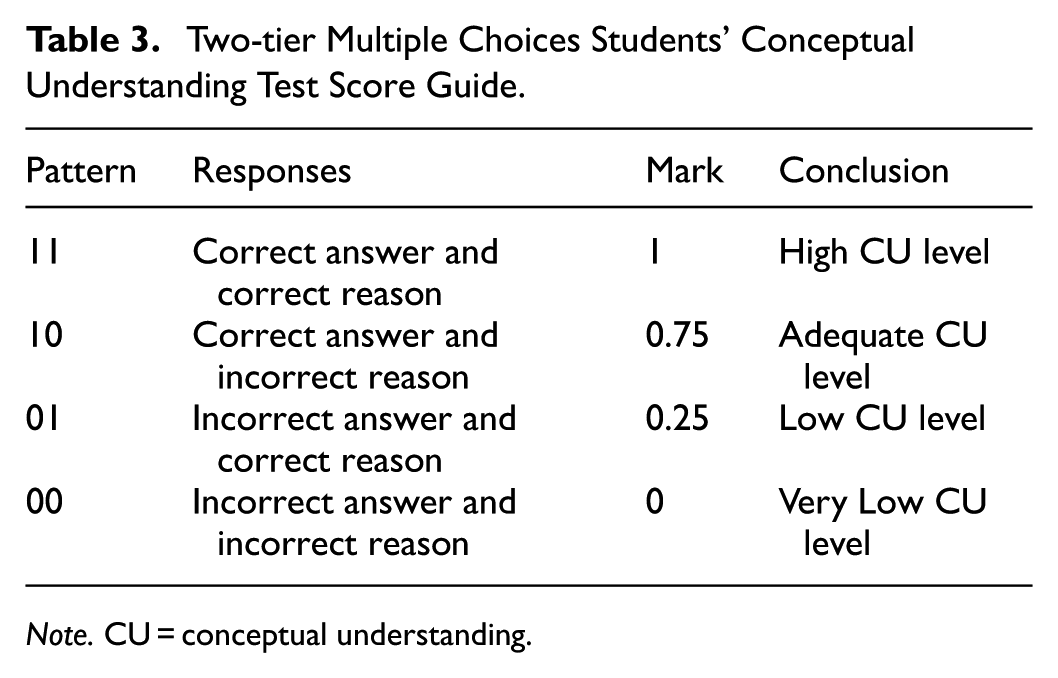
A mixed research approach was employed in this study. Quantitative data was collected using TTMC conceptual understanding, while classroom observation and an unstructured interview were for qualitative data. Before analyzing data, the TTMC was administered quantitatively. From the scoring methods of TTMC, the current study prefers the partial credit scoring method, which accounts the intermediate learning stages. First, four codes: 11, 10, 01, and 00 were assigned for the scoring (see Table 3).
Two-tier Multiple Choices Students’ Conceptual Understanding Test Score Guide.
Note. CU = conceptual understanding.
The data were analyzed to answer the research questions. The SPSS v 26 was used to analyze the quantitative part to assess changes in students’ conceptual understanding. Descriptive statistics like mean, standard deviation, skewness and kurtosis were used for all groups to check that the assumptions of parametric statistics were not violated. Since the descriptive statistics indicated no serious violations of the assumptions of the parametric statistics, the paired samples t test, ANOVA and ANCOVA were used in this study. The paired sample t test results indicated the difference within group (s) between pre and posttests, ANOVA is used to check whether there is a significant difference in the mean gains of the intervention and control groups, whereas ANCOVA is used to determine the significance of the difference between the intervention groups and the comparison group, considering the pretest as a covariate.
Qualitatively, we conducted unstructured interview with 15 students and three teachers. Data analyzed using Braun and Clarke (2019) reference of thematic analysis method. The analysis revealed the key interrelated themes benefits of instructional approach, being in group versus individual learning, challenges, and recommendations in implementing the approach in classroom.
Results
Quantitative Results
This section presents the results of the study in quantitative part. First, the descriptive data is followed by the statistical tests presented.
Table 4 illustrates the pregeometry and post geometry descriptive values. To answer research question one, different statistical tests were employed and analyzed to give the following result: First, analysis of variance (ANOVA) used to test the significance of pregeometry tests mean difference between the groups. Concerning the independence of variable assumptions ANOVA, the colleges where the study employed were located in different regional states and different zones; therefore, reasonable scores were independent. Referring to the normality distribution of pregeometry test scores have been tested using skewness and kurtosis values. The SPSS result indicated that the ICPSMR group (Skewness
Descriptive Statistics of Pre and Post Geometry Students’ Conceptual Understanding Test Score.
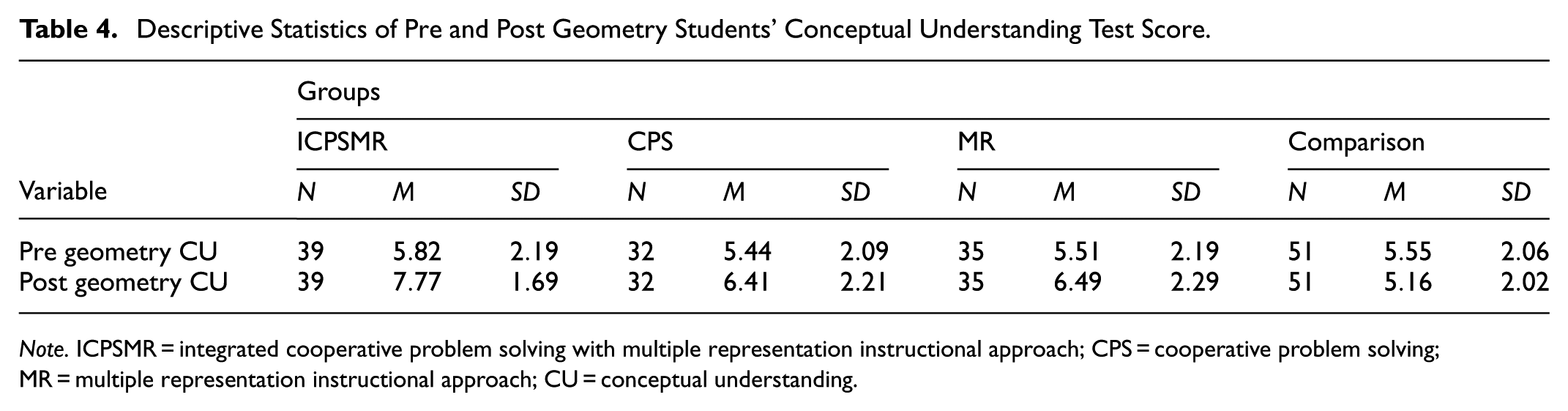
Note. ICPSMR = integrated cooperative problem solving with multiple representation instructional approach; CPS = cooperative problem solving; MR = multiple representation instructional approach; CU = conceptual understanding.
Table 5 reveals that the ANOVA tested for preometry conceptual understanding test and its result revealed (
ANOVA Results for Pregeometry Conceptual Understanding test.

Note. CU = conceptual understanding.
The other test statistic used to answer the research question One was a paired samples t test. It was used to examine whether the mean gain of pretest to posttest students’ conceptual understanding significantly changed or not after geometry class in both intervention groups and control groups. The first assumption is that the independent variable is dichotomous and its groups are paired. Since we used the pre and posttest results of the same course (or each paired measurement was obtained from the same course and each student takes both tests), this assumption has been met. The second assumption is that, dependent variable is normally distributed and it was checked using skewness and kurtosis values. For the pretest SPSS result indicated that the ICPSMR group (Skewness
A paired samples t test as presented on Table 6 was conducted to evaluate the impact of ICPSMR approach on students’ conceptual understanding test scores. The results showed a significant increase in the marks of the students (
Paired Samples t-test Results of all Groups.
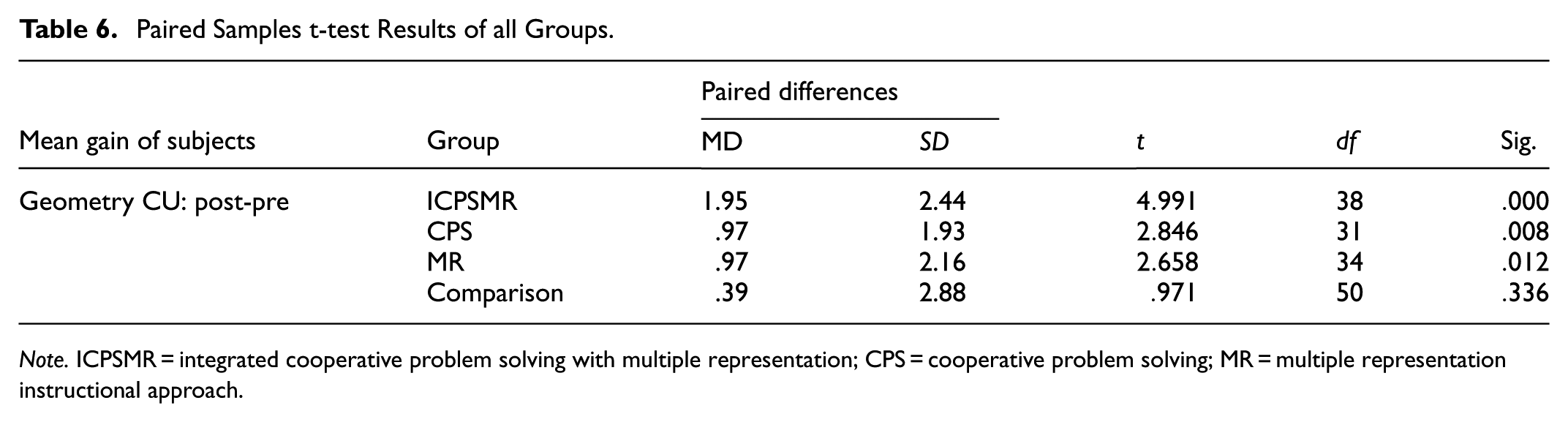
Note. ICPSMR = integrated cooperative problem solving with multiple representation; CPS = cooperative problem solving; MR = multiple representation instructional approach.
Finally, a paired samples t test was conducted to evaluate the impact of the traditional instructional approach on students’ conceptual understanding test scores and resulted (
For second
The procedure of ANCOVA pretest (or covariate) was controlled. Concerning the ANCOVA assumptions, independence of observations and normality were already checked in the preceding sections and were satisfied. For the homogeneity test, Levene’s Test of Error Variances was used and its output,
Analysis of covariance for geometry conceptual understanding as a function of the four groups, pretest as a covariate was resulted in students in the ICPSMR group achieving higher conceptual understanding than students instructed using traditional approach. From Table 7, we can observe that whatever we adjust the posttest result, the mean value of the student’s conceptual understanding is not changed or there are minor changes in some groups, and this can be checked to see whether there are significant differences in groups in the following table.
Adjusted and Unadjusted Means and Variability on the Groups for Conceptual Understanding in Learning Geometry Using Pretest as a Covariate.
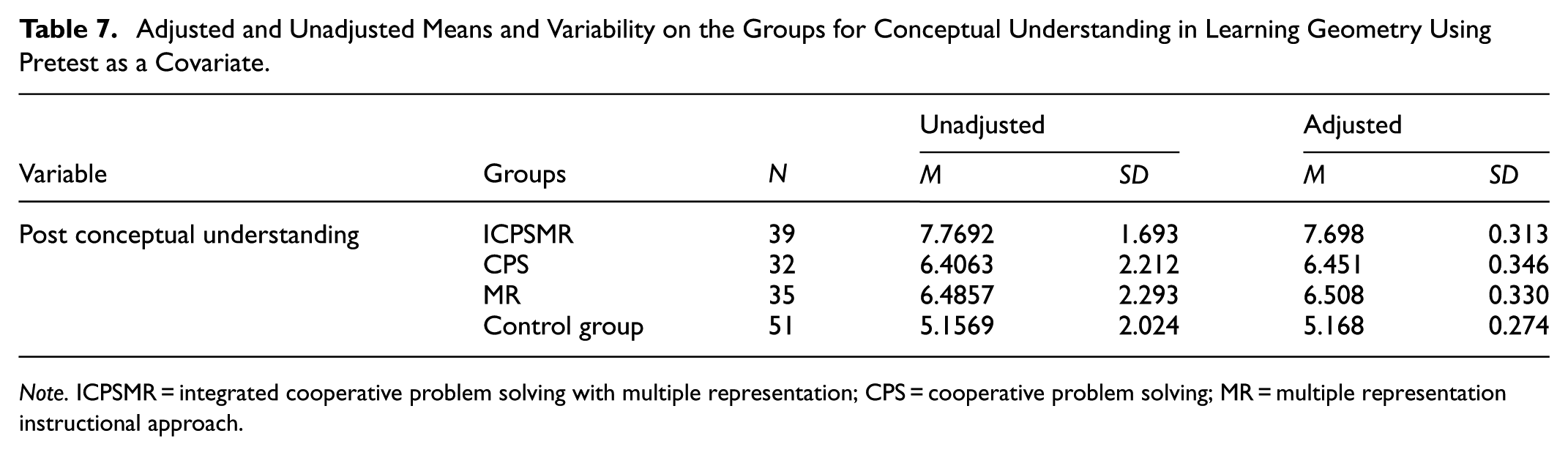
Note. ICPSMR = integrated cooperative problem solving with multiple representation; CPS = cooperative problem solving; MR = multiple representation instructional approach.
Table 8 indicates the effect of the students’ pre geometry conceptual understanding test controlled, and there was a statistically significant difference between the groups’ conceptual understanding test with F(3,152) = 12.49,
Analysis of Covariance for cOnceptual Understanding in Learning Geometry Using Pretest as a Covariate.

The result of Bonferroni test based on the total adjusted post geometry conceptual understanding by groups.

Note. ICPSMR = integrated cooperative problem solving with multiple representation; CPS = cooperative problem solving; MR = multiple representation instructional approach.
The mean difference is significant at the .05 level.
The adjusted posttest score results in the Bonferroni test in Tables 7 and 9 illustrated that there was statistically significant difference between the intervention groups and the control group, but no statistically significant difference was observed between the intervention groups in their conceptual understanding with
Qualitative Results
Qualitatively, we conducted unstructured interview with 15 students and three teachers; and classroom observation to answer
Interview Results
Interview held on teachers and students presented under this sub section.
Benefits of Instructional Approach Concerning Students’ Conceptual Understanding
“Do you think that your instructional approach helped students in increasing students’ conceptual understanding in geometry learning?”
DTM: the implemented approach is an active approach that includes the combination of jigsaw cooperative problem-solving and multiple representation, gives people the opportunity to deeply discuss with their friends, helps them to explain a concept in multiple ways and enhances students’ conceptual understanding. HTH: the implemented approach helped students with enhancing confidence to ask questions, to explain and to request opportunities to give a chance of giving a presentation in the classroom. The five pillars or essential elements of cooperative learning guided them to understand concepts well and their conceptual understanding increased after intervention. ATK: the implemented approach includes multiple representations, which is basic in mathematics to increase students’ conceptual understanding. Representing a concept using multiple representations and translating from one to another helped students to enhance their conceptual understanding.
“Do you think that the way you learned help you to understand well and long lasting on geometry learning?”
DL01: the implemented approach helped me well and developed my confidence to explain the concept for the class. DL06: the implemented approach encourages me to understand a concept using multiple representations and I can raise questions to my friends openly in group. DL14: the implemented approach helped me to understand well when I translated from one representation to another representation. DL17: the implemented approach helped me understand the concept well with its opportunity to discuss in friendly groups. DL19: the implemented approach helped me by providing me with multiple representations to understand a concept we learned. HN01: the implemented approach helped me by decreasing fear to participate in group. HN22: the implemented approach helped me by its opportunity given to all member of group to expert of the lesson. HN23: the implemented approach helped since I had the opportunity to raise every question makes me ambiguity in learning. HN24: the implemented approach to increase my understanding in discussing and presenting concept in depth. When I be in group discussion I can actively participate even in long time discussion without feeling tiredness. HN25: the implemented approach is best fit for me in that different part of lessons covered by different expert individuals. AM02: the implemented approach helped me to understand since the concept presented in multiple representations. AM07: the implemented approach helped me that I understand more as I use more representations to explain a concept. AM10: the implemented approach helped to understand concept in translation from one to another. AM11: the implemented approach helped me problems asks me to solve using multiple representations. AM13: the implemented approach helped me to understand well representing concept and translating representations transfers understanding.
This unstructured interview results proved that applying ICPSMR helps students to increase students’ conceptual understanding. The approach guided students well to understand learned geometry concept and gain simultaneous deep knowledge of representations. Explaining one concept using different representations and doing it in groups enhanced their confidence and delightedly express their understanding to their partners as well. They interested to lesson and students affirmed as their self-efficacy enhanced.
Students participated in jigsaw CPS experimental group benefited from the approach in that, the approach guided the pillars of cooperative learning positive interdependence, individual, and group accountability, face to face promotive interaction, interpersonal skills and group processing to solve problems. They also benefited in getting fearless of math problems and solve a given problem. They guided each other well. Continuing, students those participated in MR approach benefited in enjoyed in presentation of a concept differently. One of the interviewees expressed multiple representation as, “… knowing different languages. An individual who knows many languages understands more in societies.” That is good expression. If you are monolingual, you are not as smart multilingual to understand and communicate with different communities.
Classroom Observation Results
The study grouped the observation results into different themes (see Table 9) creating an interactive learning environment and instruction, students’ participation and students’ conceptual understanding.
Creating Interactive Learning Environment and Instruction
Observation held results that students become familiar with the approaches from time to time. Through the observation of Experimental group I, the teacher used different activities to create an interactive learning environment for the approach ICPSMR. Different cards, problems that contain division of lesson, attendance of students, and multiple representations were prepared earlier and presented to the classroom. Seating arrangements of students are adjusted into groups of five member seats. Movable students’ seats made the process easier to rearrange in the classroom during the implementation of the instructional approach. The constructed problems carry the main idea in the lesson and are designed to test students’ conceptual understanding.
Through the Experimental group II, the teacher designed a jigsaw cooperative problem-solving instructional approach. To make the implementation easier and more attractive, the teacher divided the lesson into different problems and distributed them in a first round group, guided them, and formed a round of two round groups. The main activity of a teacher is assisting and guiding them. Students were happy to be in a group and to have an opportunity to explain concepts to others.
Through the Experimental group III, the teacher made the instruction interactive by providing multiple representations to the classroom and presenting the lesson using multiple representations. Teachers also used to make students participate in lessons by incorporating multiple representations into problems.
Students’ Participation
The observation results concerning students’ participation are presented under this subsection. Students in Experimental group I, participated well in willingness to form groups, to participate in groups, to give presentations for the class and reflect on their understanding. Similarly, students in Experimental group II participate in good manners, while students in Experimental group III wait for a teacher until he calls name participation. This implies being in a group and repetition of the activities minimizes students’ fear of participating, their hesitation, the doubt to correct or answer and contributes to making students’ ideas clear. That during participation, they forward what they discussed in group for the class. But in Experimental group III, since they haven’t adapted group work, they hesitate to explain their idea. They doubt their answer.
Students’ Conceptual Understanding
At the initial observation, students faced difficulties in that they were not familiar with the approach and lacked prior knowledge in all groups. After interventions held in experimental groups, different changes have been seen to students’ conceptual understanding. The class observation held after the intervention revealed that students’ conceptual understanding increased. Students in the Experimental group I willingly respond to different questions raised in the classroom, work classwork, correctly represent concepts in multiple representations, solve problems on time. Similarly, the Experimental group II students also showed increased students’ conceptual understanding expressed in their problem solving, classroom participation and results of their classwork. In the case of Experimental group III even though they have shown promising changes, there are implications of needing additional work. Student wait until the teacher calls their name to participate.
Discussion
The findings of the study discussed under this topic. The main findings from the quantitative data found using statistical test indicated that there are significant differences in students’ conceptual understanding between each intervention group and comparison group. Qualitatively, data gathered using an unstructured interview with students and teachers, and classroom observation indicated that there were witnesses to the findings. The difference in the students’ conceptual understanding found after they learned geometry using ICPSMR, CPS, and MR instructional approaches was confirmed by observation. The data described how students’ conceptual understanding was developed after interventions were completed. In this study, both observation results and interviews were in line with the quantitative results. They were presented by dividing into sub topics.
Students’ Conceptual Understanding and Effect of Jigsaw Cooperative Problem-Solving
The finding of this study concerning the statistical significance of mean differences between experimental intervention group learned by cooperative problem-solving instructional approach and conventional group is in line with Cai et al. (2025) and Wahyuni et al. (2019), showed that cooperative learning is better at students’ conceptual understanding than conventional methods. The traditional approach was criticized for its inadequately fostering profound reflection and cooperative work among learners. Students feel good to peer discussion and reflect their work in confident then they understand the concept more.
In addition, Shofa et al. (2024) also added to the existing literature that jigsaw type cooperative learning increased students’ conceptual knowledge beyond level students’ basic mathematics ability. They showed, when the teacher applied jigsaw type cooperative learning students’ conceptual knowledge increased through their cooperative learning. This implies the instructional approach helps students to share their experience, interrelate real life situations with lessons learned, make students feel happy to react with their friends through the lesson, develop positive interdependence, and cover fragments of the lesson learned. Generally, Jigsaw type cooperative learning boosts the power of communication, deep search to know, open self-expression and fear-less discussion.
Similarly, Sumarni et al. (2018) revealed the effectiveness of cooperative learning by working on cooperative learning using jigsaw assisted visual media, and cooperative problem solving is more effective than conventional methods in mathematics learning in general. The study indicated that students those set to solve problems in cooperative scored more than those who were allowed to learn the conventional approach. Cooperatively solving problems does not mean acquiring understanding from others. Rather, it also advances your prior understanding through your reflection. That is why cooperative problem solving will be more effective than traditional approach.
Furthermore, the research work of Yapatang and Polyiem (2022) proves that cooperative problem-solving leads to students’ mathematical problem-solving ability and learning achievement, which directly implies that the approach is highly preferable in developing students’ mathematical conceptual understanding than the traditional approach. Meaningfully, this supports the finding of the current study that students’ conceptual understanding increased after the jigsaw type cooperative problem solving implemented in teaching geometry. Finally, the study (Tinungki et al., 2024) rephrased the definition of conceptual understanding, supported cooperative learning and ensured increased students’ problem-solving ability, communication skills and self-proficiency through team assisted individualization. According to the literature, conceptual understanding is one of the five elements of self-proficiency. This implies working in a team plays a pivotal role in increasing students’ conceptual understanding and this is confirmed by students’ response in this study.
Students’ Conceptual Understanding and Effect of Multiple Representation
The other finding of the current study that needed to be discussed with literature is the statistically significant differences in students’ conceptual understanding between the group learned by multiple representations and the traditional instructional approaches. Along the way, the study (Purwadi et al., 2019) concluded that the concrete pictorial abstract strategy significantly affected students’ mathematical conceptual understanding. Adding to their research findings, students were motivated and more enthusiastic during their discussion. This implies that using concrete pictures, which is part of multiple representations, serves to increase students’ conceptual understanding and is in line with the findings of the current study.
Likewise, Çetin and Aydın (2019) indicated that mathematical achievement and multiple representation-based instruction have a positive relationship. Meaning, the findings of this study were supported and students’ conceptual understanding increased in the group of the Multiple Representations approach implemented in intervention. Similarly, Pape and Tchoshanov (2001) also recommend the effective use of multiple representations help to develop students’ mathematical conceptual understanding rather than simply teaching with a traditional approach. This is in line with the findings observed in the study. Using multiple representations helps students to understand the abstract concept.
Students’ Conceptual Understanding and Effect of Integrated Cooperative Problem-Solving in Multiple Representation
Regarding the finding of statistically significant mean differences in students’ conceptual understanding between Integrated Cooperative Problem solving with Multiple Representations and traditional approaches, the literature (Kim, 2025) described that more than one representation is more likely to capture learners’ interest and play an important role in promoting conditions for effective learning. Providing multiple representation in learning highly contribute for students’ conceptual understanding. According to Berthold and Renkl (2009) providing multiple representation merely is not sufficient condition rather it is valid with respect to scaffolding self-explanation.
In addition, Cleaves (2008) indicated when working on using multiple representation Jigsaws, the technique gives students the opportunity to gain access to rich mathematics. Students who are hesitant to participate in whole class discussions are more likely to engage in small group work during a jigsaw lesson. The article suggests that the opportunity of having access to a deeper understanding (the function of MR) and being positively interdependent (CPS jigsaw) made the approach more advanced than traditional. This idea guarantees integrated cooperative problem-solving in multiple representation plays an undeniable role in increasing students’ conceptual understanding. Classroom observation and interview results also witness the findings in line with the literature.
In line this, Hsu et al. (2025)and Muhamad Fadzil and Osman (2025) researched on the integrated Problem solving and cooperative learning, shown its effectiveness to students’ learning. Finally, the article Doherty et al. (2021) also supports the findings of this study in some way and suggests that jigsaw puzzles are a useful tool to study the development of learners’ understanding of pictorial representation. The implemented instructional approach encourages students to communicate openly, provides multiple representation which carries rich resources, enhances cooperation and positive interdependence. These are components of learning that tell us about increasing students’ conceptual understanding.
Finally, the study (Khatimah, 2021) conducted on impact of classroom environment in students’ learning and Putra and Yanto (2025) on boosting students’ success. The literature suggests that the role of the classroom environment in students’ understanding and success cannot be diminished. The attractive and well conducive environment plays a great role in increasing students’ conceptual understanding. Attractiveness of the classroom matters to students’ learning. In addition, students’ participation helps in enhancing their conceptual understanding (Decristan et al., 2023; Subandiyah et al., 2025) and the qualitative results indicated this in the current study. This implies students’ participation increased as they engaged and contributes to students’ understanding.
Practical Implications
The study design and experimental intervention give insight on the practical application of the instructional approaches. Student-centered approaches contribute for critical thinking, team-work and problem-solving (Mahesh, 2024). The quantitative results of this study revealed that the scores of students where the integrated approaches were implemented tended to score higher. The study (Pllana, 2021) suggests that mathematics dictates several teaching strategies, like graphing, connecting, higher order thinking, etc. This concludes that combining strategies improves learning outcomes. The other article (Pllana, 2021) also supports implementing a merged (combined) teaching method that enhances students’ learning. Even though the integrated instructional approach benefits students’ learning, it needs serious and intensive care and principles.
Therefore, Multiple Representation instruction requires having multiple representations and well-prepared problems integrated into lesson. The study shows that geometry learning students can benefit if the approach is implemented. The other approach, the jigsaw type of cooperative problem solving requires pre-designed problems, well organized expert, and a jigsaw group. It can be implemented in geometry teaching. Finally, the third experimental approach is the combination of the two instructional approaches. This is also applicable in continuous guide of teacher. In all approaches, teacher’s guidance, follow up, and flexible classroom management.
Limitation of the Study
Since this study contributed to the effects of integrated cooperative problem-solving with multiple representations, cooperative problem-solving and multiple representations, instructional approaches on students’ conceptual understanding of learning geometry, acknowledging its limitation is important. First, the findings should be exercised in a different educational setting. The other was that the observational part of the study was susceptible to observer bias that may influence interpretations of the classroom activities. Future study should address these limitations for a better understanding of the approach’s effect on students’ conceptual understanding of geometry learning.
Conclusion and Implications
From the results and discussions presented above, we concluded that there were statistically significant mean differences in students’ conceptual understanding between each of the three experimental groups and comparison group in learning geometry. Both quantitative and qualitative data indicated that the instructional approaches implemented to experimental intervention contributed to the increase of students’ conceptual understanding compared to the traditionally instructed group. Students’ conceptual understanding in experimental intervention groups significantly increased, whereas no statistically significant change was seen in students’ conceptual understanding in the control group. That means the difference between pretest and posttest is not statistically significant in the control group.
The study indicated that the findings contributed to the existing literature both theoretically and practically and applicable. All three instructional approaches implemented in experimental groups need well prepared prior teacher’s activity. The prior lesson design minimizes the teacher’s load in the classroom and fastens the effectiveness of the process. The implication of this conclusion is that applying the ICPSMR, or CPS, or MR approach to geometry learning enhances students’ conceptual understanding rather than traditional approach.
Contribution to Literature
The study has a bolden contribution to the literature. The study intentionally created integrated cooperative problem solving in multiple representations by combining two pedagogical approaches to help students in geometry learning and present them. Practically, pedagogical approaches that help students in enhancing their conceptual understanding have been shown in the study. Theoretically, the study indicated how the instructional approaches were designed for implementation. And the statistical significance of students’ conceptual understanding was examined. Specifically, the approach conducted on experimental group I is new, and the result was acceptable, and we recommend teachers to implement and research on.
Footnotes
Acknowledgements
We would like to express our gratitude to Dilla, Hossaina, Hawassa, Arba Minch and Bonga education college administrators, teachers and students for their support and cooperation during the study.

Ethical Considerations
This study was approved by the Ethics Committee of College of Natural and Computational Sciences, Hawassa University with the reference number CNCS-REC027/24.
Consent to Participate
The participated teachers and students signed an informed consent form.
Author Contributions
The primary (corresponding) author has designed this experimental study, conducted the study, analyzed and interpreted the data, and wrote up the report. Two co-authors, serving as supervisors, contributed significantly to the article by providing constructive comments and scientific review.
Funding
The authors received no financial support for the research, authorship, and/or publication of this article.
Declaration of Conflicting Interests
The authors declared no potential conflicts of interest with respect to the research, authorship, and/or publication of this article.
Data Availability Statement
The data that support the findings of this study can be obtained from the corresponding author upon reasonable request.