




Abstract
This study explores the dual effects of perceived personalization on advertising value and privacy risk perceptions among Korean Instagram users. The results reveal that perceived personalization reduces advertising avoidance by enhancing informativeness, entertainment, and credibility, while simultaneously lowering concerns about data collection and misuse. The strength of these indirect effects varies depending on users’ Need for Cognition (NFC). For low-NFC users, personalization reduces advertising avoidance primarily through increased informativeness and entertainment. In contrast, for high-NFC users, the effect is driven by enhanced informativeness, credibility, and reduced concerns about data collection. These results advance theoretical understanding by identifying distinct psychological mechanisms through which personalization influences user responses. The findings also offer strategic guidance for marketers by highlighting how cognitively tailored advertisements that emphasize clear utility and transparent data practices can foster user trust and reducing avoidance behavior.
Plain Language Summary
This study examined how Korean Instagram users respond to personalized advertising, which refers to ads that use personal data to tailor content. It also explored how these responses differ according to users' cognitive styles. Drawing on the privacy calculus framework, the study found that people evaluate personalized ads by balancing potential benefits, such as informativeness and entertainment, against privacy concerns about data collection and misuse. Importantly, users' Need for Cognition (NFC) the extent to which they enjoy thinking deeply shapes these evaluations. Users with low NFC were less likely to avoid personalized ads when the ads were entertaining and informative. Conversely, users with high NFC who tend to think analytically were more receptive to personalized ads when they were credible, informative, and transparent about data use. Overall, the findings suggest that effective personalized advertising should consider individual cognitive differences. Advertisers should provide clear and trustworthy messages that explain how user data are handled while also offering engaging and relevant content. By balancing personalization with ethical communication, brands can reduce advertising avoidance and foster more positive user engagement on social media.
Keywords
Introduction
The rapid evolution of digital technology has fundamentally transformed how brands communicate with consumers, making personalized advertising a cornerstone of modern marketing strategies. Personalized advertising, which leverages consumer data, preferences, and behavioral patterns to deliver tailored content, has been shown to reduce information overload and enhance consumer satisfaction (Boerman et al., 2017; C. Li, 2016). Notably, data-driven targeting can boost revenue by up to 10% and improve marketing efficiency by up to 30%, underscoring its strategic importance in the digital marketing landscape (Boudet et al., 2021).
However, within the global digital ecosystem, the introduction of privacy regulations—such as the General Data Protection Regulation (GDPR) in Europe—and industry changes, including Google's plan to phase out third-party cookies (i.e., tracking data from external websites), have highlighted the growing tension between protecting user privacy and delivering personalized services. Additionally, the rising frequency of large-scale data breaches has further underscored this trade-off as a central challenge for both policymakers and platform operators.
Despite its potential, the success of personalized advertising may be hindered by the so-called "personalization paradox." According to self-referencing theory, consumers process information related to themselves more favorably, thereby increasing the persuasive power of advertisements (De Keyzer et al., 2022; Escalas, 2007; Krishnamurthy & Sujan, 1999). Conversely, extensive data collection can raise privacy concerns, leading to negative consumer behaviors such as advertising avoidance (Jung, 2017; Mo et al., 2023). Advertising avoidance, defined as consumers intentionally ignoring or blocking advertisements, is often driven by factors such as information overload, inappropriate content, and excessive ad exposure (Çelik et al., 2023; Guo et al., 2020; Kelly et al., 2021; Van den Broeck et al., 2018). In digital environments, where ad-blocking tools are easily accessible, advertising avoidance has become a significant barrier to advertising effectiveness (Çelik et al., 2023).
In this context, the privacy calculus model, grounded in social exchange theory, offers a valuable theoretical framework. This model posits that consumers evaluate the benefits and risks of disclosing personal information before making decisions (Ackermann et al., 2022; McKee et al., 2024). While prior studies often treat privacy concerns as a single factor and benefits as a unified construct (Bol et al., 2018; Dienlin & Metzger, 2016; McKee et al., 2024), privacy concerns in personalized advertising can be more precisely conceptualized as two dimensions: data collection concerns and data misuse concerns. These dimensions influence consumer behavior through distinct psychological mechanisms.
Furthermore, the elaboration likelihood model (ELM) highlights the role of consumers' need for cognition (NFC) as a key moderating factor in their responses to personalized advertising. High-NFC consumers tend to process messages analytically via the central route, while low-NFC consumers rely on heuristic cues via the peripheral route (Haugtvedt et al., 1992; Petty et al., 1986). High-NFC consumers are likely to scrutinize the informational value and quality of personalized advertisements, balancing privacy concerns against advertising value. Conversely, low-NFC consumers may be more influenced by peripheral cues, such as visual appeal or simple benefit claims, which can either alleviate or amplify privacy concerns. These cognitive differences are likely to shape the evaluation of advertising value and privacy concerns.
This study examines the impact of personalized advertising on ad value (informativeness, entertainment, and credibility) and privacy concerns (data collection and misuse concerns) on Instagram, a prominent platform for personalized ads, within South Korea’s highly active social media environment and rapidly expanding digital advertising market. According to Ducoffe's (1996) web advertising model, ad value consists of three dimensions: informativeness, entertainment, and credibility. Informativeness refers to the usefulness of information provided by the ad, entertainment pertains to the ad's ability to amuse and engage, and credibility reflects the trustworthiness of the ad's message and source. In personalized advertising, these value dimensions are often enhanced through self-referential processing.
Privacy concerns, on the other hand, are divided into two independent dimensions: data collection concerns and data misuse concerns. Data collection concerns reflect anxieties about excessive personal information gathering, while data misuse concerns represent fears of unexpected uses of collected data. Recent studies suggest that effective personalization can mitigate such privacy concerns (Hayes et al., 2021), indicating that consumers' positive experiences with personalized value may help alleviate their apprehensions about data usage.
By introducing NFC as a critical moderating variable, this study explores how the effects of personalized advertising vary based on consumers’ cognitive traits. High-NFC consumers assess messages based on their quality and detailed information, whereas low-NFC consumers are more influenced by peripheral factors like visual appeal (Haugtvedt et al., 1992; Martin et al., 2005). Therefore, this study seeks to clarify how NFC moderates the trade-off between the effectiveness of personalized advertising and advertising avoidance by examining how consumers re-evaluate advertising value and privacy concerns.
The present research offers several key contributions. First, this study refines the privacy calculus model by distinguishing between data collection and data misuse, thereby providing a more nuanced understanding of how privacy concerns influence advertising avoidance. Second, it conceptualizes ad value through three dimensions—informativeness, entertainment, and credibility—clarifying how each dimension shapes consumer responses. Finally, by integrating self-referencing theory with the Elaboration Likelihood Model (ELM) and examining the moderating role of need for cognition (NFC), this study provides novel insights into how perceived personalization can both enhance ad value and alleviate privacy concerns.
Theoretical Background
Privacy Calculus Model
According to Social Exchange Theory (SET), individuals seek to maximize benefits and minimize costs when making decisions (Blau, 1964; Homans, 1958). Building on this principle, the privacy calculus model in information systems suggests that consumers weigh the benefits against the risks before deciding to disclose personal information (Ackermann et al., 2022; McKee et al., 2024; Trepte et al., 2020). When the perceived benefits of sharing personal information outweigh potential risks, consumers are more inclined to disclose it.
Previous studies have typically viewed privacy risks as the cost component, while perceived benefits have been operationalized across various contexts (Bol et al., 2018; Dienlin & Metzger, 2016; Hayes et al., 2021; Sun et al., 2015). For instance, Zhao et al. (2012) examined location-based social networks by classifying privacy concerns as a cost, while personalization and connectedness were treated as benefits. To streamline the model, many researchers have combined various advantages of disclosure into a single “perceived benefit” factor (Bol et al., 2018; Dienlin & Metzger, 2016; Jozani et al., 2020). In personalized advertising, perceived risks typically entail negative aspects such as privacy concerns, whereas perceived benefits encompass positive aspects such as convenience and time-saving advantages (Hayes et al., 2021).
To understand consumers' information disclosure decisions, privacy calculus studies typically treat benefits like usefulness, financial rewards, and enjoyment as positive factors and privacy risk as a negative factor (Jozani et al., 2020; H. Li et al., 2010). However, in personalized advertising, privacy concerns are more nuanced, encompassing both data collection and data misuse concerns (Bol et al., 2018). Accordingly, this study extends the Privacy Calculus Model by distinguishing between two types of privacy concerns—data collection and data misuse—as distinct risk factors in personalized advertising. At the same time, we conceptualize advertising value, consisting of informativeness, entertainment, and credibility (Ducoffe, 1996), as the perceived benefit of personalization.
Together, these benefit and risk components form the core structure of our extended privacy calculus model. When perceived risks outweigh perceived benefits, consumers may engage in avoidance behavior, such as skipping, blocking, or ignoring ads altogether. Advertising avoidance is a defensive response to perceived intrusiveness and privacy threats in digital advertising contexts (Guo et al., 2020; Kelly et al., 2021). Figure 1 illustrates the conceptual framework of this study, which integrates advertising value (as perceived benefits) and two distinct types of privacy risk (data collection and data misuse concerns) into an extended privacy calculus model. This framework provides the conceptual foundation for the research questions and hypothesis development that follow.

Research model.
Extended Privacy Calculus Model for Personalized Advertising
Personalized advertising customizes ads based on consumers' data, preferences, and online behaviors, drawing on both behavioral data and personal information (Boerman et al., 2017; EU General Data Protection Regulation, 2020). According to self-referencing theory, individuals process new information more favorably when it resonates with self-relevant content (Debevec & Romeo, 1992). This self-referential content can make advertisements more persuasive, even upon first exposure (Escalas, 2007; Krishnamurthy & Sujan, 1999). However, when ads are poorly targeted, their effectiveness may diminish, regardless of their intended relevance.
There is a clear distinction between actual personalization, understood from the advertiser’s perspective, and perceived personalization, understood from the consumer’s perspective (Komiak & Benbasat, 2006). Research shows that consumers may not perceive high personalization even in ads that use extensive personal information (De Keyzer et al., 2015; Komiak & Benbasat, 2006; C. Li, 2016). This discrepancy is often shaped by self-referential cues, with studies showing that favorable responses depend more on perceived personalization than the actual degree of personalization (C. Li, 2016).
When consumers perceive ads as aligned with their preferences, they tend to evaluate these ads more favorably (De Keyzer et al., 2015; Noar et al., 2009). Conversely, low perceived personalization may reduce an advertisement’s perceived usefulness (Mehmood et al., 2020; Shen & Ball, 2009). At the same time, excessive reliance on personal information may heighten privacy concerns and trigger negative responses. Even if consumers recognize an ad's relevance, they may develop negative attitudes when the perceived benefits do not offset privacy risks (Awad & Krishnan, 2006). Accordingly, this study emphasizes the need to investigate how consumers evaluate advertising benefits and risks based on their perceived level of personalization.
Advertising Value as Perceived Benefits
With the growing acceptance of personalized advertising, this study adopts Ducoffe’s (1996) web advertising model to conceptualize its perceived benefits—namely, informativeness, entertainment, and credibility. These dimensions represent the value consumers derive from personalized ads and constitute the benefit component of our extended privacy calculus model (Abbasi et al., 2021).
Informativeness refers to an advertisement’s ability to deliver relevant and useful information to consumers. Research shows that informative ads are more effective in conveying content that consumers find valuable (Aaker & Norris, 1982; Abbasi et al., 2021). When consumers perceive an ad as sufficiently informative, they tend to develop more positive attitudes toward it (Ducoffe, 1996).
Entertainment has become increasingly significant in modern advertising. Consumers often seek recreational experiences through advertisements (Ducoffe, 1996), and prior studies have shown that entertaining ads foster positive attitudes (Abbasi et al., 2021) and reduce advertising avoidance (Chung & Kim, 2021). In personalized advertising, the entertainment dimension is especially important, as relevant content can capture consumers’ attention more effectively and enhance product appeal.
Credibility refers to the degree to which consumers trust both the content of an advertisement and its source (MacKenzie & Lutz, 1989). In online environments where information uncertainty is common, credibility plays a crucial role in building consumer trust (S. Hussain et al., 2020). The credibility of online ads is influenced by the quality and quantity of information they provide (Shankar et al., 2002). In personalized advertising, credibility may depend on how personal information is used and presented within the ad.
Collectively, informativeness, entertainment, and credibility represent the core dimensions of advertising value in personalized advertising. As ad content becomes more closely aligned with individual preferences and needs, these attributes tend to become more salient, thereby increasing consumers’ perceived value of the ads (Mo et al., 2023; Setyani et al., 2019). Accordingly, this study conceptualizes advertising value as a multidimensional construct comprising informativeness, entertainment, and credibility.
Consumer Concerns Regarding Privacy Risks
Privacy risk perceptions significantly influence consumers' willingness to share personal information across contexts like e-commerce and social networking (Awad & Krishnan, 2006; Culnan & Bies, 2003; Dinev & Hart, 2006). While high privacy risks deter data sharing, consumers may accept such risks if the benefits, such as enhanced user experiences, outweigh their concerns (Dinev & Hart, 2006; Trepte et al., 2020).
In personalized advertising, privacy risks—particularly concerns over data misuse—represent a key barrier. Prior research often treated privacy concerns as a single construct (Bol et al., 2018; Malhotra et al., 2004), potentially oversimplifying consumer perceptions, as discomfort from data collection may differ from fears of misuse. This study addresses this gap by conceptualizing privacy risk as two distinct concerns: (a) data collection practices and (b) potential data misuse, which are treated as separate cost components in personalized advertising. By analyzing these dimensions independently, we aim to offer a more nuanced understanding of how privacy concerns shape consumer attitudes toward advertisements.
Although privacy concerns remain significant, well-targeted ads can elicit positive responses by offering clear benefits such as informativeness, entertainment, and credibility (Adeline et al., 2023; A. Hussain et al., 2023). When ads align with consumers’ interests, they foster trust and transparency and may alleviate privacy concerns (Zhu & Chang, 2016). Accordingly, this study hypothesizes that perceived personalization in targeted ads reduces concerns about data collection and misuse.
Consumer Avoidance of Digital Advertising
Advertising avoidance refers to the intentional actions consumers take to ignore or avoid specific ads, often due to perceived irrelevance or intrusiveness (Çelik et al., 2023). Common antecedents of advertising avoidance include information overload, inappropriate ad content, and frequent ad exposure (Guo et al., 2020; Kelly et al., 2021; Van den Broeck et al., 2018). In digital environments, where ad-blocking technologies are easily accessible, advertising avoidance has become increasingly prevalent, posing a serious challenge to advertising effectiveness (Çelik et al., 2023).
To mitigate such tendencies, personalized advertising seeks to enhance ad relevance by tailoring content to consumers’ preferences, behaviors, or demographic characteristics (Çelik et al., 2023). When personalized ads are perceived as informative, entertaining, and credible, they are less likely to be considered intrusive or irrelevant. Rather, these features may foster cognitive engagement and trust, making users more receptive to the ads and thereby reducing the likelihood of avoidance (De Keyzer et al., 2015; Mo et al., 2023).
However, personalization can also evoke significant concerns about data privacy, particularly regarding how personal information is collected, stored, and potentially misused (Kelly et al., 2021; Loureiro et al., 2023). When users perceive a loss of control over their data, they may adopt avoidance behaviors as a psychological self-protection strategy to safeguard their privacy (J. Kim & Zo, 2025). This duality is captured by the concept of the privacy paradox: although personalized ads can increase user engagement through relevance, they may simultaneously provoke avoidance behavior due to perceived privacy risks (Hayes et al., 2021; Mo et al., 2023).
Mediating Effects in Privacy Calculus
Previous studies on personalized advertising have mainly examined how perceived personalization directly affects consumers’ perceptions and behavioral intentions (Chu et al., 2024; C. Li, 2016; Shanahan et al., 2019; Tran et al., 2023). However, the privacy calculus model suggests that consumers do not make decisions based on benefits alone; instead, they evaluate both perceived benefits and risks simultaneously (Dinev & Hart, 2006). Accordingly, understanding the mediating mechanisms that connect perceived personalization with advertising avoidance is critical for capturing the psychological trade-offs consumers face in digital environments.
According to self-referencing theory, individuals evaluate personally relevant information more favorably (Escalas, 2007). Highly personalized ads often enhance advertising value by increasing perceptions of informativeness, entertainment, and credibility. For instance, Y. J. Kim and Han (2014) found that personalized ads are viewed as more useful, trustworthy, and enjoyable, leading to higher perceived ad value. Because consumers who perceive greater ad value are less likely to avoid ads (Chung & Kim, 2021), we hypothesize that the positive impact of personalization on reducing advertising avoidance is indirectly driven by elevated advertising value.
Second, personalized ads inevitably involve collecting and processing personal data. Although increased personalization can heighten privacy concerns, the privacy calculus framework posits that such concerns may diminish when consumers perceive data usage as appropriate, transparent, and beneficial (Aiolfi et al., 2021; Benlian, 2015; Chen et al., 2022; Zhu & Chang, 2016). When consumers see personalized ads as both valuable and aligned with their preferences, privacy concerns tend to decrease, fostering acceptance (Chen et al., 2022). Accordingly, we anticipate that higher perceived personalization will reduce concerns about both data collection and misuse, which in turn will lead to lower avoidance of advertising.
Need for Cognition
Need for Cognition (NFC) reflects an individual's tendency to engage in and enjoy cognitive activities (Cacioppo & Petty, 1982). According to the Elaboration Likelihood Model, high-NFC individuals process information through a central route, analyzing messages carefully, while low-NFC individuals prefer peripheral processing, relying on heuristic cues (Haugtvedt et al., 1992; Petty et al., 1986). Research has shown these processing differences significantly impact advertising effectiveness. High-NFC individuals evaluate products based on message quality and detailed product information, responding negatively to weak arguments regardless of presentation. In contrast, low-NFC individuals are more influenced by peripheral elements like attractive models or visual appeal (Haugtvedt et al., 1992; Martin et al., 2005).
In personalized advertising, these cognitive processing differences are likely to influence how consumers evaluate the trade-off between advertising value and privacy risks (Lambillotte et al., 2022). Low-NFC consumers, who rely on peripheral processing, may focus primarily on immediate personalization benefits and surface-level matches with their preferences. Conversely, high-NFC consumers, who engage in systematic processing, are expected to critically evaluate both advertising benefits and potential privacy implications, leading to more complex response patterns. Based on these differences, we propose:
Methods
Participants
The study was conducted in June 2022 via an online survey administered by Macromill Embrain, a professional research panel provider in Korea. The target population comprised Korean Instagram users in their 20s and 30s with prior exposure to personalized advertising. Instagram was selected as the focal platform because of its widespread adoption among digital-native consumers and its active use of algorithmically personalized ads (Gaber et al., 2019). To ensure sample representativeness, stratified quota sampling based on gender was applied. All participants received a brief explanation and examples of personalized advertising prior to the survey, and individuals unfamiliar with the concept were screened out. A total of 480 participants were initially recruited. The sample size was determined through an a priori power analysis using G*Power, which indicated that a minimum of 138 participants was required to achieve a statistical power of .95 (α = .05) for detecting medium effect sizes in structural equation modeling. Thus, the collected sample exceeded the recommended threshold, ensuring sufficient power. After excluding participants who failed the manipulation check or engaged in straight-lining responses, the final sample consisted of 413 participants.
All participants were informed about the purpose of the research and the anonymous use of their responses prior to participation. Participation was voluntary, and informed consent was obtained from all respondents.
Experimental Design
Participants were randomly assigned to one of three experimental conditions that differed in the amount of personal information used for ad personalization. In the low-information condition, advertisements were based solely on non-identifiable search data. The medium-information condition combined search data with demographic information, including age and gender. The high-information condition incorporated search data, demographic data, social media activity (e.g., likes), and personal identifiers such as names to deliver highly personalized advertisements. To minimize product-related bias, all participants were asked to imagine encountering a personalized sneaker advertisement while browsing Instagram, with the product category held constant across conditions.
To verify the effectiveness of the manipulation, a manipulation check was conducted using two items measured on a nine-point Likert scale: “The advertisement is based on my personal information” and “The advertisement is based on my online activity information.” Participants who failed the manipulation check or displayed straight-lining response patterns were excluded from further analysis, resulting in a final sample of 413 participants.
A one-way ANOVA was performed to assess whether participants perceived significant differences in the level of personal information use across the three conditions. The analysis revealed a significant main effect of condition on perceived personalization (F(2, 411) = 58.09, p < .001). Post-hoc comparisons confirmed that participants in the high-information condition perceived a significantly higher level of personalization than those in the medium (mean difference = .275, p < .001) and low (mean difference = .576, p < .001) conditions. Additionally, the medium-information condition was rated significantly higher than the low-information condition (mean difference = .302, p < .001). These results confirmed the validity of the experimental manipulation. Table 1 presents the demographic characteristics of the final sample (N = 413).
Demographic characteristics of participants.

Measurements
Table 2 shows the measurement items used in this study, adapted from prior literature for validity and reliability. All items were rated on a seven-point Likert scale (1 = strongly disagree, 7 = strongly agree).
Individual items and factors descriptive statistics.

Analysis Procedure
This study employed Partial Least Squares Structural Equation Modeling (PLS-SEM) using SmartPLS 4, a method particularly well-suited for theory exploration and prediction (J. Kim & Zo, 2025). PLS-SEM is widely recognized for its capacity to handle both reflective and formative constructs and evaluate complex structural models, making it appropriate for investigating the latent relationships in this study (Richter et al., 2016).
The analysis followed a two-stage approach: (a) evaluation of the measurement model to assess indicator reliability, convergent validity, and discriminant validity, and (b) examination of the structural model to test hypothesized relationships among the constructs. In addition, multi-group analysis was conducted to assess the moderating role of Need for Cognition (NFC).
Results
Measurement Model
To ensure the robustness of the measurement model, we assessed construct reliability and validity following guidelines by Hair et al. (2019). Factor loadings ranged from .731 to .963, exceeding the acceptable threshold of .70, with one NFC item removed due to insufficient loading (<.40). Internal consistency was confirmed as Cronbach's alpha (CA), rho_A, and Composite Reliability (CR) values for all constructs ranged from .790 to .964, surpassing the recommended threshold of .70. Convergent validity was established through Average Variance Extracted (AVE) values ranging from .695 to .917, exceeding the minimum requirement of .50 (Fornell & Larcker, 1981). These results are presented in Table 3.
Item Loadings, STATISTICAL Reliability, and Convergent Validity.

Note. AVE = Average Variance Extracted; CA = Cronbach’s Alpha; CR = Composite Reliability; FA = Factor Loading. Construct abbreviations: PP = Perceived Personalization; AA = Advertising Avoidance; INF = Informativeness; ENT = Entertainment; CRD = Credibility; DCC = Data Collection Concerns; DMC = Data Misuse Concerns; NFC = Need for Cognition.
For discriminant validity, we employed the Fornell-Larcker criterion. As presented in Table 4, the square root of each construct's AVE exceeded its correlations with other constructs, suggesting adequate discriminant validity. Overall, these results suggested that the measurement model demonstrated acceptable reliability and validity for testing the structural relationships.
Discriminant Validity (Fornell-Larcker Criterion).

Note. PP = Perceived Personalization; AA = Advertising Avoidance; INF = Informativeness; ENT = Entertainment; CRD = Credibility; DCC = Data Collection Concerns; DMC = Data Misuse Concerns; and NFC = Need for Cognition. Bold diagonal values indicate the square root of the Average Variance Extracted (√AVE) for each construct.
Structural Model Testing
The structural model analysis confirmed all hypothesized relationships between perceived personalization, advertising value, privacy risk, and advertising avoidance (see Figure 2 and Table 5). Perceived personalization showed strong positive effects on advertising value dimensions: informativeness (β = .773, p < .001), entertainment (β = .588, p < .001), and credibility (β = .605, p < .001). Conversely, it demonstrated negative relationships with privacy risk dimensions: data collection concern (β = −.231, p < .001) and data misuse concern (β = −.164, p < .01).
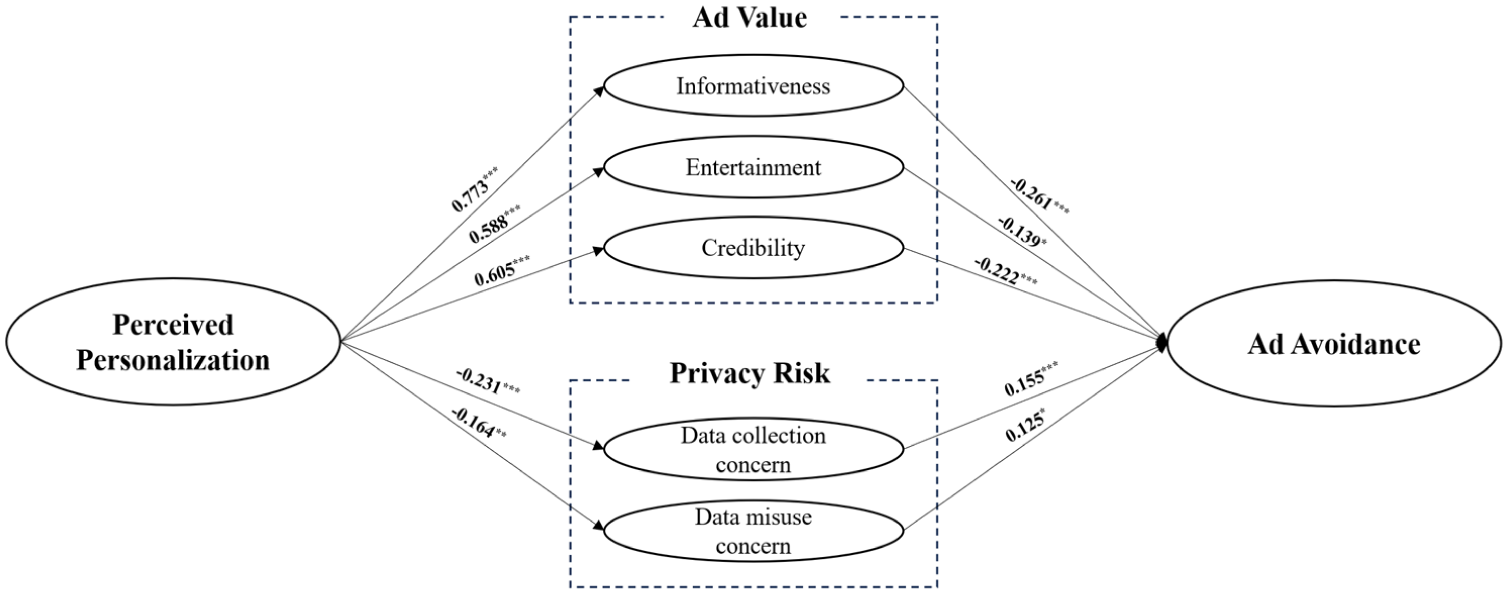
Structural model test results.
Path Coefficients for Direct Effects.

Note. PP = Perceived Personalization; AA = Advertising Avoidance; INF = Informativeness; ENT = Entertainment; CRD = Credibility; DCC = Data Collection Concerns; DMC = Data Misuse Concerns; and NFC = Need for Cognition.
All advertising value dimensions had negative direct effects on advertising avoidance: informativeness (β = −.261, p < .001), entertainment (β = −.139, p < .05), and credibility (β = −.222, p < .001). Privacy risks showed positive direct effects on advertising avoidance, with both data collection concern (β = .155, p < .001) and data misuse concern (β = .125, p < .05).
Collectively, Our findings demonstrated the dual mechanism of perceived personalization: enhancing advertising value while reducing privacy concerns, both contributing to decreased advertising avoidance.
The Variance Inflation Factor (VIF) values ranged from 1.000 to 3.217, remaining well below the recommended threshold of 10 (Hair et al., 2019). These results indicated that multicollinearity was not a concern, thereby supporting the robustness of the structural estimates and the discriminant validity of the constructs. The model also demonstrated adequate explanatory power. Specifically, the R2 value for advertising avoidance was .480, indicating that approximately 48% of the variance in consumers’ advertising avoidance behavior was explained by the model.
Mediation Tests
To examine the mediating effects, a bootstrapping test with 5,000 samples was conducted, showing significant indirect effects, as all 95% confidence intervals excluded 0 (see Table 6). The analysis indicated that perceived personalization indirectly reduced advertising avoidance through the mediating roles of informativeness, entertainment, and credibility. Specifically, informativeness significantly mediated the effect of perceived personalization on advertising avoidance (β = −.202, CI = [−0.283, −0.130]). Similarly, entertainment (β = −.082, [−0.145, −0.020]) and credibility (β = −.134, [−0.210, −0.060]) served as partial mediators, emphasizing the importance of these advertising value dimensions in reducing advertising avoidance.
Path Coefficients for Indirect Effects.

Additionally, privacy risk also mediated the relationship between perceived personalization and advertising avoidance. Data collection concern (β = −.036, CI = [−0.062, −0.015]) and data misuse concern (β = −.021, [−0.042, −0.004]) both showed significant negative indirect effects, suggesting that reduced privacy concerns associated with personalization contributed to lower advertising avoidance.
In summary, these findings demonstrated that perceived personalization could reduce advertising avoidance through two pathways: by enhancing advertising value (informativeness, entertainment, and credibility) and by lowering privacy concerns. These dual pathways underscored the importance of balancing ad relevance with user privacy.
Multi-Group Analysis
We conducted a multi-group analysis (MGA) using the median split method (Franceschelli et al., 2014) to examine whether individuals’ Need for Cognition (NFC) moderates responses to personalized advertising. Participants were divided into high- and low-NFC groups, and the analysis revealed distinct response patterns between the two groups (see Table 7).
Multi-Group Analysis Results.

Note. PP = Perceived Personalization; AA = Advertising Avoidance; INF = Informativeness; ENT = Entertainment; CRD = Credibility; DCC = Data Collection Concerns; DMC = Data Misuse Concerns; and NFC = Need for Cognition.
p < .001. **p < .01. *p < .05.
Perceived personalization had a stronger positive influence on advertising evaluations—specifically, informativeness, entertainment, and credibility—among individuals with high NFC. For example, its effect on informativeness was significantly greater in the high NFC group (β = .841) than in the low NFC group (β = .718), with a significant group difference (Δβ = −.123, p < .01). Similar patterns were found for entertainment (high NFC: β = .675; low NFC: β = .508; Δβ = −.166, p < .01) and credibility (high NFC: β = .681; low NFC: β = .526; Δβ = −.155, p < .01). These results suggested that cognitively motivated individuals derived greater value from personalized ads across various content dimensions.
In contrast, perceived personalization did not produce significantly different effects on privacy concerns—specifically, concerns about data collection and misuse—between the two groups (p > .05). This indicated that privacy-related concerns were similarly activated regardless of individuals’ NFC level.
When examining predictors of advertising avoidance, only the path from credibility to avoidance behavior showed a significant group difference (Δβ = .261, p < .05), suggesting that trust played a more critical role in reducing advertising avoidance among individuals with high NFC.
Overall, high NFC individuals responded more positively to personalized ads in terms of informativeness, entertainment, and credibility, and were more influenced by credibility when deciding whether to avoid ads. In contrast, those with low NFC were less sensitive to ad quality and relied more on surface-level cues. The overall path patterns for each NFC group were illustrated in Figures 3 and 4.

Path analysis of advertising avoidance model for low NFC group.

Path analysis of advertising avoidance model for high NFC group.
The model demonstrated adequate explanatory power, with R2 = .480 for advertising avoidance in the full sample. When examining each NFC group separately, the R2 for advertising avoidance was .426 in the low NFC group and .523 in the high NFC group, suggesting that the model had stronger explanatory power among individuals with higher cognitive motivation.
Regarding the indirect effects, the mediating pathways through which perceived personalization reduced advertising avoidance varied by NFC (Need for Cognition) level. Among individuals with low NFC, personalization significantly reduced advertising avoidance through informativeness (β = −.225, p < .001) and entertainment (β = −.096, p < .01), indicating that those less inclined toward effortful thinking are less likely to avoid ads when they find them informative or entertaining.
For individuals with high NFC, significant indirect effects were observed via informativeness (β = −.166, p < .05), credibility (β = −.271, p < .001), and data collection concerns (β = −.043, p < .05). In this group, trust in the advertisement, the quality of the information, and reduced privacy concerns all contributed to lower advertising avoidance.
A direct comparison between the groups revealed a significant difference only in the credibility pathway (Δβ = .199, p < .05), suggesting that credibility played a more salient mediating role for those with higher cognitive motivation.
Overall, these findings supported Hypothesis 13, demonstrating that the indirect effects of perceived personalization on advertising avoidance differed based on individuals’ NFC levels. Specifically, Hypothesis 13-1 was supported, as low NFC individuals primarily responded through benefit-oriented paths such as informativeness and entertainment. Hypothesis 13-2 was also supported, given that high NFC individuals exhibited significant indirect effects through both benefit (informativeness, credibility) and risk (data collection concerns) pathways.
Discussion and Conclusion
General Discussion
First, our research identified two main pathways through which perceived personalization reduces advertising avoidance. Specifically, perceived personalization increases advertising value by enhancing informativeness, entertainment, and credibility, while simultaneously alleviating privacy concerns. While prior studies have suggested that personalization may heighten privacy concerns (Jung, 2017; Mo et al., 2023), our findings demonstrate a value-mediated process in which effective personalization can transform privacy apprehensions into engagement opportunities.
In particular, by delivering clear and tangible benefits, personalization builds value-based trust, which in turn reduces perceived privacy risk. This trust-based mechanism aligns with Hayes et al.’s (2021) finding that consumers are more willing to share personal information when personalized content offers meaningful value. Taken together, these results suggest that personalization should not be understood simply as a privacy trade-off, but rather as a relational mechanism through which perceived advertising value informs consumers’ privacy calculus. When personalization provides meaningful value, consumers are more likely to interpret data disclosure as a fair and reciprocal exchange rather than as a privacy risk.
Second, our research extends the privacy calculus model by demonstrating that privacy concerns are dynamically constructed, rather than fixed, and shaped by how personalization is implemented. When consumers perceive data usage as relevant and transparent, well-executed personalization can effectively reduce privacy concerns (Hayes et al., 2021). This privacy concern–reducing effect is particularly salient among Gen Z, who, despite being privacy-conscious, respond more positively when personalization practices are perceived as fair and transparent (McKee et al., 2024). Together, these findings highlight the growing importance of transparency and procedural fairness in data-driven advertising contexts.
Third, our findings revealed distinct moderating effects of Need for Cognition (NFC), indicating that consumers’ cognitive motivation systematically shapes their responses to personalized advertising. Regarding advertising value, perceived personalization enhanced all value dimensions across NFC levels, although low-NFC consumers were particularly responsive to entertainment-related benefits, consistent with prior research (Nesbitt et al., 2011; Richard & Chebat, 2016).
In contrast, high-NFC consumers showed greater reductions in privacy concerns when exposed to well-personalized advertisements. As Kehr et al. (2015) suggest, these consumers initially perceive higher privacy risks but reassess these concerns when personalization is interpreted as a fair value exchange. Importantly, the mechanisms through which advertising avoidance was reduced differed by NFC level: low-NFC consumers primarily responded to informational and entertainment cues, whereas high-NFC consumers were influenced by a broader set of factors, including informativeness, credibility, and reduced concerns about data collection. These findings position NFC as a critical boundary condition, highlighting that personalization effectiveness depends not only on message content but also on consumers’ cognitive orientation toward processing advertising information.
Overall, our findings suggest that advertisements are more effective in reducing consumer advertising avoidance when they strike a balance among informativeness, credibility, and entertainment, while also mitigating concerns about data collection. By balancing advertising value with privacy management, advertisers can better engage consumers, especially Gen Z, who seek both relevance and transparency, thereby minimizing advertising avoidance behaviors.
Theoretical Implications
This study makes several noteworthy theoretical contributions to the literature on personalized advertising. First, we extended the privacy calculus model by examining its role in advertising avoidance. While previous studies have treated privacy risk as a singular construct, our research distinguished between data collection concerns and data misuse concerns, providing a more nuanced understanding of consumer behavior. This conceptual distinction between collection and misuse concerns enabled us to identify which specific type of privacy concern more strongly influences advertising avoidance, offering both theoretical insights and practical implications for privacy management in personalized advertising.
Second, our study identified a dual-pathway mechanism in personalized advertising. We found that personalization reduced advertising avoidance both by enhancing advertising value and by mitigating privacy concerns. By integrating self-reference theory with the privacy calculus model, we demonstrated that effective personalization strategies can simultaneously deliver value and address privacy concerns. This dual-pathway mechanism extends privacy calculus theory by showing how personalization execution influences the privacy-value trade-off.
Third, our study revealed Need for Cognition (NFC) as a key moderator in consumer responses to personalized advertising. We found that consumers' cognitive traits significantly influenced how they evaluate the trade-off between advertising value and privacy risks. This moderating role of NFC extends personalization research by demonstrating the importance of considering individual cognitive differences in advertising effectiveness.
Practical Implications
This study provides actionable guidance for advertisers and platform managers seeking to reduce advertising avoidance through more effective personalization strategies. First, advertising content should reflect consumers’ cognitive tendencies. Among low-NFC users—who are less inclined to engage in effortful processing—personalization reduced advertising avoidance through informativeness and entertainment. For this group, visually rich ads that clearly present product benefits using concise, engaging messages (e.g., “Top picks for your trip” or “Recommended just for you”) are likely to be particularly effective, as they align with low-NFC users’ preference for minimal cognitive effort.
In contrast, high-NFC users responded through more complex mechanisms, including increased informativeness, heightened credibility, and decreased concerns about data collection. These individuals are more receptive to logically structured and transparent advertising. Advertisers targeting this group should use verifiable product claims and explicit personalization cues (e.g., “Based on your browsing history” or “Suggested because you liked X”) to build credibility and perceived relevance.
Importantly, our results showed that personalization, when perceived as relevant, did not intensify privacy concerns. Among high-NFC users, it even reduced worries about data collection, thereby lowering advertising avoidance. This privacy-reducing effect of personalization suggests that trust can emerge naturally from well-targeted personalization, even without explicit privacy assurances.
To capitalize on this privacy concern-reducing effect, platform managers should integrate transparency into the personalization experience itself. For example, features like a “Why am I seeing this?” button that explains the connection between a user’s past behavior and current recommendations (e.g., “Based on your recent search for travel destinations”) can enhance perceived control and build trust (Schnabel et al., 2020).
Overall, personalized advertising should move beyond a one-size-fits-all approach. For low-NFC users, advertisers should prioritize simple, entertaining, benefit-focused content. For high-NFC users, advertisers should emphasize credible, information-rich messaging that signals personalization is both relevant and transparent. Tailoring personalization strategies to users’ cognitive styles can significantly enhance engagement while reducing avoidance.
Limitations and Future Research
This study has several limitations that suggest directions for future research. First, while our experiment focused on Korean Instagram users, consumer reactions to personalized advertising may vary across different cultural contexts and social media platforms. Future research could examine how these cultural differences and platform characteristics influence the relationship between personalization and advertising avoidance. In addition, because the study relies on a specific national and platform-based sample, caution is warranted when generalizing the findings to other cultural or digital environments.
Second, our study focused on behavioral intentions (advertising avoidance) rather than actual behaviors. While behavioral intentions are important predictors, future research could employ behavioral data or field experiments to validate our findings by examining users' actual responses to personalized advertisements in real-world settings. Moreover, because all key constructs were measured using self-report survey instruments, the results may be subject to common method bias and social desirability effects, which should be addressed in future research through multi-method approaches.
Third, the experimental stimuli were limited to personalized sneaker advertisements. Consumer responses to personalization may vary depending on product type, especially for products with different levels of involvement or privacy sensitivity. Future studies should examine how our findings apply across different product categories and industries.
Fourth, while we identified Need for Cognition as an important moderator, other individual characteristics such as privacy concerns, technology acceptance, or ad skepticism might also influence responses to personalized advertising. Future research could explore additional psychological traits to provide a more comprehensive understanding of personalization effects. Addressing these limitations would enhance the external validity and robustness of future research on personalized advertising.
Footnotes

Ethical Considerations
All participants were informed about the purpose of the research and the anonymous use of their responses prior to participation. Participation was voluntary, and informed consent was obtained from all respondents. The study did not involve clinical procedures or vulnerable populations, and no personally identifiable information was collected; therefore, the research was considered minimal risk. The potential benefits of this research, including advancing understanding of personalized advertising and privacy concerns, were deemed to outweigh any minimal risks of participation. Accordingly, formal IRB approval was not required in accordance with institutional and journal guidelines.
Funding
The authors disclosed receipt of the following financial support for the research, authorship, and/or publication of this article: This research was supported by the MSIT (Ministry of Science and ICT), Korea, under the ITRC (Information Technology Research Center) support program (IITP-2026-RS-2020-II201749) supervised by the IITP (Institute of Information & Communications Technology Planning & Evaluation).
Declaration of Conflicting Interests
The authors declared no potential conflicts of interest with respect to the research, authorship, and/or publication of this article.
Data Availability Statement
The data that support the findings of this study are not publicly available due to privacy restrictions but are available from the corresponding author on reasonable request.